No Justice, No Peace: Petersburg’s Kangaroo Courts Revisited

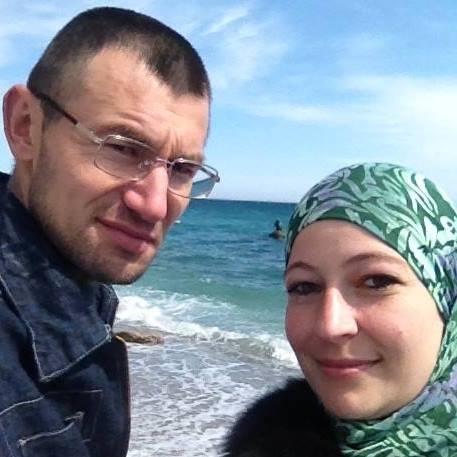
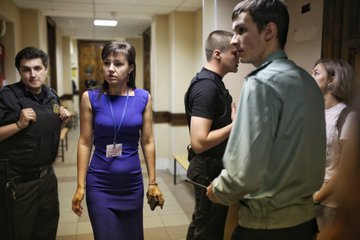
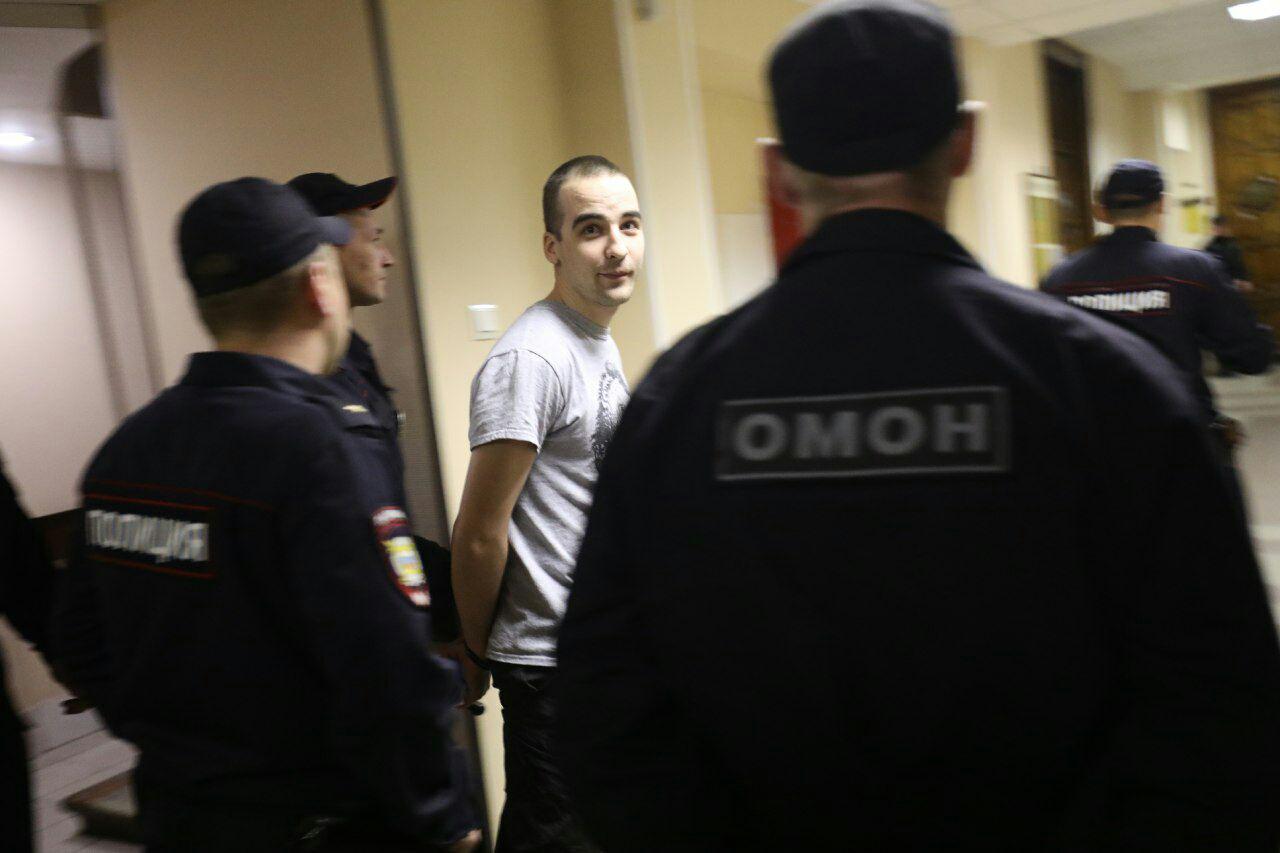
boyarshinovRussian political prisoner Yuli Boyarshinov, a “suspect” in the FSB frame-up known as the Network case aka the Penza-Petersburg “terrorism” case, lookng like a human being amidst the combined armed guard of regular police and riot police at Petersburg’s Dzerzhinsky District Court this past Friday. Photo by David Frenkel. Courtesy of Telegram channel Angry Defender (Zlaya Zashchitnitsa)

Reporters Kicked Out of Dzerzhinsky District Court
Zaks.ru
October 19, 2018

Reporters and people who have come to support the accused have been kicked out of Petersburg’s Dzerzhinsky District Court, where Network case suspect Igor Shishkin’s custody extension hearing is currently underway. Court bailiffs have explained the decision was dictated by the court’s shortened working day, our correspondent reports.

Today, the Dzerzhinsky District Court has already held two custody extension hearings involving suspects in the Network case. Viktor Filinkov and Yuli Boyarshinov were again remanded in custody until January 22, 2019. The hearings took place in closed chambers. Only reporters and relatives of the suspects were allowed to go up to the floor in the courthouse where the courtroom is located. Court bailiffs forced the men’s supporters to stay on the first floor.

When Mr. Boyarshinov was led away after hearing the court’s ruling, friends and activists who had come to support him sang a song by the group Truckdrivers on the first floor of the courthouse.

We don’t want freedom in handcuffs.
We want crystal-clear truth.
You can ask for it on the barricades
Or trust in law and order.

Angered by the supporters’ behavior, the bailiffs detained activist Yevgenia Kulakova and took her to their office to write her up for violating Article 17.3 of the Administrative Offenses Code (failure to obey a judge or court bailiff’s for maintaining order in the court). However, civil rights activist Dinar Idrisov came to the young woman’s aid, and the bailiffs let her off after issuing a warning.

Later, the bailiffs ordered everyone to exit the building, even the relatives of Network case suspect Igor Shishkin, who could have been called as witnesses. According to the bailiffs, the court was open only until 4:45 p.m. today. It is a common practice in Petersburg courts to kick out members of the public and reporters.

Viktor Filinkov, Yuli Boyarshinov, Igor Shiskin, and eight residents of Penza have been accused of involvement in a “terrorist community” that was, allegedly, planning to carry out terrorist attacks and overthrow the Russian state. Several of the accused have claimed they were tortured into incriminating themselves and their fellow suspects.

Translated by the Russian Reader

***************

What can you do to support the Penza and Petersburg antifascists and anarchists tortured and imprisoned by the FSB?

  • Donate money to the Anarchist Black Cross via PayPal (abc-msk@riseup.net). Make sure to specify your donation is earmarked for “Rupression.”
  • Spread the word about the Network Case aka the Penza-Petersburg “terrorism” case. You can find more information about the case and in-depth articles translated into English on this website (see below), rupression.com, and openDemocracyRussia.
  • Organize solidarity events where you live to raise money and publicize the plight of the tortured Penza and Petersburg antifascists. Go to the website It’s Going Down to find printable posters and flyers you can download. You can also read more about the case there.
  • If you have the time and means to design, produce, and sell solidarity merchandise, please write to rupression@protonmail.com.
  • Write letters and postcards to the prisoners. Letters and postcards must be written in Russian or translated into Russian. You can find the addresses of the prisoners here.
  • Design a solidarity postcard that can be printed and used by others to send messages of support to the prisoners. Send your ideas to rupression@protonmail.com.
  • Write letters of support to the prisoners’ loved ones via rupression@protonmail.com.
  • Translate the articles and information at rupression.com and this website into languages other than Russian and English, and publish your translations on social media and your own websites and blogs.
  • If you know someone famous, ask them to record a solidarity video, write an op-ed piece for a mainstream newspaper or write letters to the prisoners.
  • If you know someone who is a print, internet, TV or radio journalist, encourage them to write an article or broadcast a report about the case. Write to rupression@protonmail.com or the email listed on this website, and we will be happy to arrange interviews and provide additional information.
  • It is extremely important this case break into the mainstream media both in Russia and abroad. Despite their apparent brashness, the FSB and their ilk do not like publicity. The more publicity the case receives, the safer our comrades will be in remand prison from violence at the hands of prison stooges and torture at the hands of the FSB, and the more likely the Russian authorities will be to drop the case altogether or release the defendants for time served if the case ever does go to trial.
  • Why? Because the case is a complete frame-up, based on testimony obtained under torture and mental duress. When the complaints filed by the accused reach the European Court of Human Rights in Strasbourg and are examined by actual judges, the Russian government will again be forced to pay heavy fines for its cruel mockery of justice.

***************

If you have not been following the Penza-Petersburg “terrorism” case and other recent cases involving frame-ups, torture, and violent intimidation by the Russian Federal Security Service (FSB) and other arms of the Russian police state, read and disseminate recent articles the Russian Reader has posted on these subjects.

Andrey Loshak: What the Krasnodar Police Did to Lawyer Mikhail Benyash

mikhail benyahsMikhail Benyash. Courtesy of Andrey Loshak’s Facebook page
Andrey Loshak
Facebook
September 24, 2018

Achtung! Uwaga! Attention! Yet another outburst of lawlessness is underway in Krasnodar, an experimental region of Russia where the authorities test ever more repressive techniques and see whether they can get away with them or not. When I was making a film about volunteers in Navalny’s presidential campaign, it was Krasnodar where I encountered the gnarliest fucked-up shit. Provocateurs in hoods and masks attacked young people attending an “unauthorized” protest rally, and the cops, who stood nearby, claimed not to see anybody in masks attacking anyone. It was really frightening. The provocateurs assaulted the activists and assisted the cops in loading them into paddy wagons. I was also detained then for the first time in my life, despite my attempts to prove I was a reporter. I was quickly released, however. They were still afraid of causing a stir in the Moscow liberal media.

Afterwards, my cameraman and I stood outside the gates of the police station until one in the morning filming the activists, who were mainly really young men and woman, as they were let go after they were formally charged and written up. The whole time this was happening, the lawyer Mikhail Benyash was trying to get into the police station, but the police kept him out. He stood by the gate, writing down the names and numbers of the released detainees. He sadly reported that, due to the court hearings of the detainees, whom he would be defending, he would not be making it back to his hometown of Gelendzhik anytime soon, although there he was in the midst of civil court cases involving hoodwinked investors in unbuilt cooperative apartment buildings.

I asked him why he bothered with all of it when no one paid him for his work. His answer stunned me. It transpired he and I had the exact same motives. He also liked the young people who had been detained, and he also saw them as a source of hope. He was the first romantic lawyer I had ever met. (Unfortunately, I did not know Stanislav Markelov personally.) It was no wonder I took a shine to him. Later, in our correspondence, he suggested titling the series The Ugly Swans, after the novel by the Strugatskys, and wrote me a detailed explanation of why I should do it.

Here is an excerpt from his letter.

“These were the kind of young people with whom you spoke on October 7: quite сheerful, cool, and kind. Unspoiled. Clever, a little naive, and free of feigned helplessness. They grew up on the internet, in the chats on VK and Telegram.

“Instead of Tolstoy and Dostoevsky, they imbibed fantasy novels and movies about superheroes, and they fashioned all of it into a model for doing the right thing.

“Instead of Dostoevsky’s subservience, they absorbed the humor of Marvel Comics and a primitive albeit correct sense of right and wrong from movies about Batman, the Flash, and Iron Man. They fire back at priests of all types with quotations from Sheldon Cooper.

“Now I have been watching all these crazy comics serials, but not for entertainment or by way of procrastinating, but in order to understand the young people who grew up on them and so I can speak their language. I’m holding my own for the time being, but the kids are evolving rapidly.”

On September 9, which the Navalny Team had declared a day of protests nationwide, Benyash arrived in Krasnodar as usual to defend activists detained at the march, which, as usual, had not been authorized by the authorities. On the eve of the protest, nearly all Navalny staffers in Krasnodar had been arrested on a ridiculous pretext: all of them were jailed for, allegedly, disobeying police officers. There was not anything like this preventive crackdown in any other city in Russia.

On the way to Krasnodar, Benyash got a telephone call informing him he was under surveillance by the police. The caller also told him his exact location. Mikhail does not scare easily, so he did not turn around. Once he was in Krasnodar, he headed with a female acquaintance to the police station where the detainees would be taken.

Suddenly, a Mazda stopped next to him. Several brutes in plain clothes jumped out of the car, grabbed Mikhail, and tossed him into their car, where they forcibly confiscated his telephone as he was trying to telephone colleagues. The men beat him, choked him, and pressed his eyes with their fingers.

At the police station, he was thrown to the ground, handcuffed, and dragged to the fourth floor. In Krasnodar, experienced opposition activists know the fourth floor is the location of the CID and that if you are taken there, it means the police will put on the pressure and try and beat a confession out of you.

All of these events were witnessed by Mikhail’s female companion, whom the cops also brought to the station.

On the fourth floor, they beat the living daylights out of Benyash. Several blows to his face caused him to fall and hit his head on the corner of a safe.

Meanwhile, the news got out that Benyash had been detained. Lawyer Alexei Avanesyan tried to get into the station to see him, but the police would not let him in. At some point, the cops donned helmets and armor before announcing the station was going into lockdown mode, which happens when a police state is threatened by an armed attack from the outside. In fact, the police in Krasnodar go into lockdown mode every time they don’t want to let lawyers into the station to consult with detained opposition activists. When Avanesyan learned Benyash had been beaten, he summoned an ambulance crew to examine Benyash, who recorded and certified his injuries. By ten p.m., i.e., eight hours after Benyash had been detained, the lockdown was called off and Avanesyan was let into the police station.

There Avanesyan encounted Deputy Chief Papanov, who lied, telling Avanesyan Benyash was not at the station. Avanesyan is not the shy and retiring type, either. He took advantage of the confusion to make a break for the fourth floor, where he found the beaten Benyash in a room and three field agents huddled over him. Avanesyan was then allowed to consult with the detained lawyer Benyash. The police were trying to frame him on two charges: organizing an unauthorized protest rally and resisting the police!

Avanesyan alerted their colleagues via social media, asking them to come to Banyash’s court hearing. Seven lawyers showed up. Although the hearing was scheduled for nine in the morning, it didn’t kick off until ten in the evening. Apparently, none of the local judges wanted to get dirt on their hands.

The court clerk, who was drunk, didnot want to let the lawyers into the hearing, but she was forced to back off, but ordinary members of the public were not admitted into the courtroom.

Judge Buryenko denied all the motions made by the defense. He did not ask police officers to testify. He did not admit the video recordings into evidence, and he even refused to view them. He did not call Benyash’s companion to testify, although she was standing in the hallway.

Benyash was found guilty on all counts and sentenced to forty hours of community service and fourteen days in jail. Although the lawyer had nothing to do with organizing or running the protest rally, he was given the harshest punishment for his non-involvement in it, despite the fact that the number of detainees in Krasnodar also broke all records: around one hundred protesters were hauled in by the police on September 9.

I quote Mediazona, who cite the court’s written verdict.

“According to the police officer’s report, Benyash got into the car voluntarily in order to go to the police station and have charges filed against him, but in the police station parking lot the lawyer banged his head against the car window of his own accord and kicked open the door in an attempt to escape. The police officer claims Benyash refused to stop hitting his head against the wall [sic], which was grounds for charging him with violating Article 19.3 of the Administrative Offenses Code.”

But there is more. Benyash was supposed to be released from jail yesterday. Avanesyan arrived at the special detention facility, seventy kilometers outside of Krasnodar, where Benyash had been jailed, to pick him up. But instead of picking up his released colleague, he was shown a new indictment against Benyash, this time on criminal charges. Benyash was alleged to have violated Article 318 Part 1 of the Russian Federal Criminal Code: “engaging in violence against the authorities.” Medical certificates attesting to the finger bites allegedly suffered by police officers and the enormous suffering they endured as a result have been admitted into evidence.

Benyash has again been detained: for forty-eight hours for the time being. Tomorrow, he will go to court.

Dear colleagues from Novaya Gazeta, TV Rain, and other independent media, please cover this case. Otherwise, the experiment in Krasnodar will very quickly  expand nationwide. Even the Brezhnev-era KGB did not stoop to beating up and imprisoning dissident lawyers.

Thanks to George Losev for the heads-up. Translated by the Russian Reader

__________________________________________________

The Russian Reader is a website that covers grassroots politics, social movements, the economy, and independent culture in Russia and the Russian-speaking world. All the work on the website is done for free, and no fees are paid for the articles translated into English and posted on the site. Unless otherwise noted, everything published on the Russian Reader can be reproduced elsewhere so long as the Russian Reader is indicated clearly as the source, and a link back to the original post is included in the republication. In fact, you are encouraged to repost these articles on social media and share them wherever you like. Growing numbers of viewers and visitors are the only way I know whether the Russian Reader is accomplishing its mission: to make news and views from the other Russias more audible to the outside world.


Yekaterina Kosarevskaya: Vegan Times

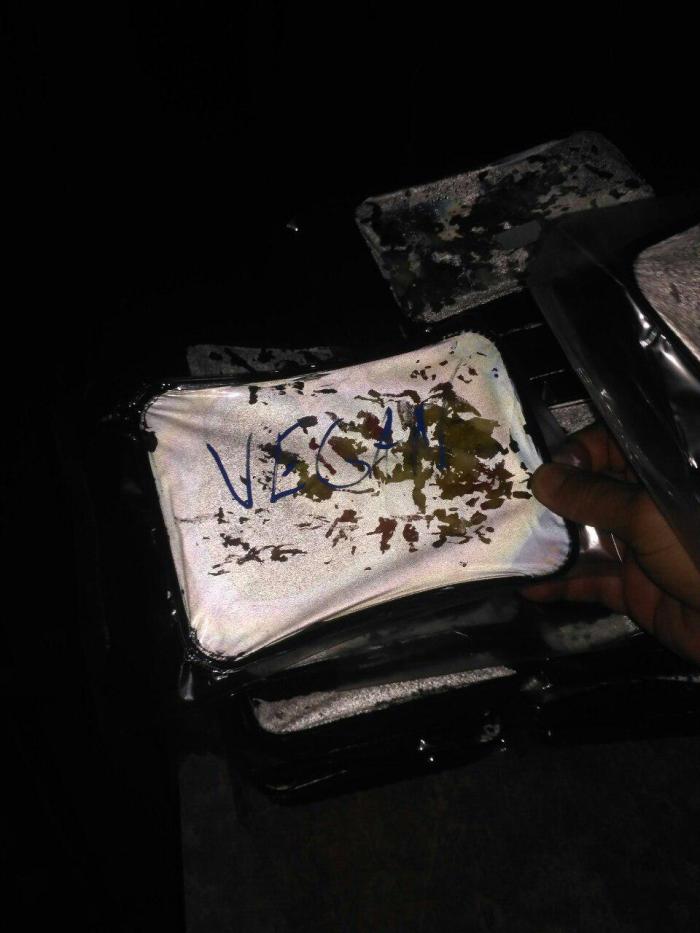
vegan meals in temporary detention facilityVegan meals issued to prisoners at the Special Detention Facility on Zakharyevskaya Street, where the detainees sentenced to short jail terms for their involvement in the September 9, 2018, anti-pension reform protest rally in Petersburg are serving their time. Photo courtesy of the Telegram channel ONK SPB 16% (16% of the Petersburg Public Monitoring Commission)
Yekaterina Kosarevskaya
Facebook
September 13, 2018

A court in Penza has extended the time in police custody of the suspects in the Network case.

Formal indictments have been filed, and the case will soon be handed over to the prosecutor. Dima and Ilya [Dmitry Pchelintsev and Ilya Shakursky] have been indicted violating Article 205.4 Part 1 of the Criminal Code [“organizing a terrorist community”]. Dima chose Part 1 himself. Dima has refused to admit his guilt.

I imagine, if there were total knowledge of human nature, this knowledge could be attained by simultaneously understanding Konstantin Bondarev, who went sleepless for two nights as he gave the commands to administer electrical shocks to the suspects in the case, and Dima Pchelintsev, who after spending a year in a remand prison, had to choose between two pieces of paper, one promising him five to ten years in prison, the other, fifteen to twenty, and he chose the one promising him fifteen to twenty years (or is that life in prison?), but which did not contain the phrase “I admit my guilt, and I am sorry for what I did.”

There is no such thing as total knowledge.

Meanwhile, Petersburg had a week chockablock with jail sentences for some of the people who attended two different anti-pension reform rallies. Around a hundred protesters were sentenced to jail time, for a grand total of five hundred days in jail for all convicts. That comes to a year and a half in jail, which is a cushy sentence even for people sentenced under Criminal Code Article 205.6, i.e., failure to report a terrorism-related crime. And what is there to report? This is not a comparison. Comparisons are invidious.

I wanted to be in Penza, of course, but for some reason I returned to Petersburg.

The palliative functions of my civil rights work are still with me, but now they have been turned inside out. Temporary relief is now brought not by the presence of a civil rights defender, but things are made present to the civil rights defender. Before my very eyes hot meals and bed linens appear at police stations, people are released from police stations where they cannot be held, and government-issued dinners marked “VEGAN” are handed out at the Special Detention Center. The only things we cannot handle are bedbugs and violations of the freedom of assembly, and this also gives us peace of mind.

A certain Telegram channel writes that the whole business of rescinding the go-ahead for the September 9 protest rally and the subsequent detaining of six hundred people boils down to a feud between the United Russia faction in the Petersburg Legislative Assembly and Petersburg city hall. (Aren’t they United Russia party members, too?) The channel does something incredible: it attempts to figure out Petersburg politics.

I’m amazed, but I’m afraid to go down that rabbit hole. I had better keep trying to figure out Petersburg’s prisons.

And so it goes this autumn.

Translated by the Russian Reader

Shakursky and Pchelintsev Formally Indicted for Organizing “Terrorist Community”

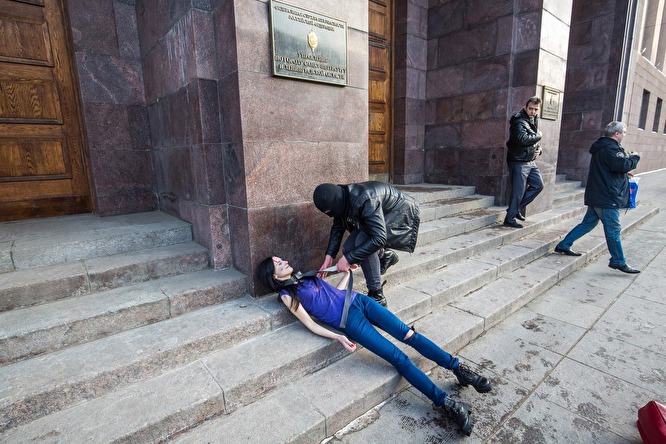
znakcom-1838828-666x444Protest against the Penza-Petersburg “terrorism” case on the steps of FSB headquarters in Petersburg, February 2018. Photograph by David Frenkel. Courtesy of Znak.com
Penza-Petersburg “Terrorism” Case Suspects Shakursky and Pchelintsev Charged with Organizing Terrorist Community
Mediazona
September 10, 2018

Penza-Petersburg “terrorism” case suspects Dmitry Pchelintsev, Ilya Shakursky, and Arman Sagynbayev have been formally indicted. Now Pchelintsev and Shakursky, who earlier were accused of involvement in the alleged “terrorist community” the Network, have been indicted for organizing it, per Article 205.4 Part 1 of the Russian Federal Criminal Code. Mediazona heard the news from the Parents Network, a committee formed by relatives of the young men arrested and accused in the case.

In keeping with previous accusations, Sagynbayev was indicted for involvement in a “terrorist organization,” per Russian Criminal Code Article 205.4 Part 2. During the reading of the indictment, he recanted his previous testimony, saying he had given it under duress. Mediazona has published Sagynbayev’s deposition to his defense attorney, in which he recounts how FSB field agents tortured him after after they detained him in Petersburg.

With the lawyer present, an FSB investigator pressured Sagynbayev for approximately five hours, but the accused man nevertheless failed to confess his guilt. Subsequently, a FSB field agent visited Sagynbayev in the Penza remand prison and threatened to send him “to the north, to Sentsov,” but explained he still could change his testimony.

As our sources in the Parents Network recounted, during the reading of the indictment, the FSB investigator showed Pchelintsev two written conclusions. In the first, it said Pchelintsev had confessed his guilt and was charged with violating Criminal Code Article 205.4 Part 2, which stipulates a penalty of five to ten years in prison. In the second, it said Pchelintsev had not admitted his guilt and was charged with violating Article 205.4 Part 1, punishable by fifteen to twenty years in prison.

None of the indicted men pleaded guilty.

Translated by the Russian Reader

***************

What can you do to support the Penza and Petersburg antifascists and anarchists tortured and imprisoned by the FSB?

  • Donate money to the Anarchist Black Cross via PayPal (abc-msk@riseup.net). Make sure to specify your donation is earmarked for “Rupression.”
  • Spread the word about the Network Case aka the Penza-Petersburg “terrorism” case. You can find more information about the case and in-depth articles translated into English on this website (see below), rupression.com, and openDemocracyRussia.
  • Organize solidarity events where you live to raise money and publicize the plight of the tortured Penza and Petersburg antifascists. Go to the website It’s Going Down to find printable posters and flyers you can download. You can also read more about the case there.
  • If you have the time and means to design, produce, and sell solidarity merchandise, please write to rupression@protonmail.com.
  • Write letters and postcards to the prisoners. Letters and postcards must be written in Russian or translated into Russian. You can find the addresses of the prisoners here.
  • Design a solidarity postcard that can be printed and used by others to send messages of support to the prisoners. Send your ideas to rupression@protonmail.com.
  • Write letters of support to the prisoners’ loved ones via rupression@protonmail.com.
  • Translate the articles and information at rupression.com and this website into languages other than Russian and English, and publish your translations on social media and your own websites and blogs.
  • If you know someone famous, ask them to record a solidarity video, write an op-ed piece for a mainstream newspaper or write letters to the prisoners.
  • If you know someone who is a print, internet, TV or radio journalist, encourage them to write an article or broadcast a report about the case. Write to rupression@protonmail.com or the email listed on this website, and we will be happy to arrange interviews and provide additional information.
  • It is extremely important this case break into the mainstream media both in Russia and abroad. Despite their apparent brashness, the FSB and their ilk do not like publicity. The more publicity the case receives, the safer our comrades will be in remand prison from violence at the hands of prison stooges and torture at the hands of the FSB, and the more likely the Russian authorities will be to drop the case altogether or release the defendants for time served if the case ever does go to trial.
  • Why? Because the case is a complete frame-up, based on testimony obtained under torture and mental duress. When the complaints filed by the accused reach the European Court of Human Rights in Strasbourg and are examined by actual judges, the Russian government will again be forced to pay heavy fines for its cruel mockery of justice.

***************

If you have not been following the Penza-Petersburg “terrorism” case and other recent cases involving frame-ups, torture, and violent intimidation by the Russian Federal Security Service (FSB) and other arms of the Russian police state, read and republish the recent articles the Russian Reader has posted on these subjects.

Varya Mikhaylova: After the Protest Rally

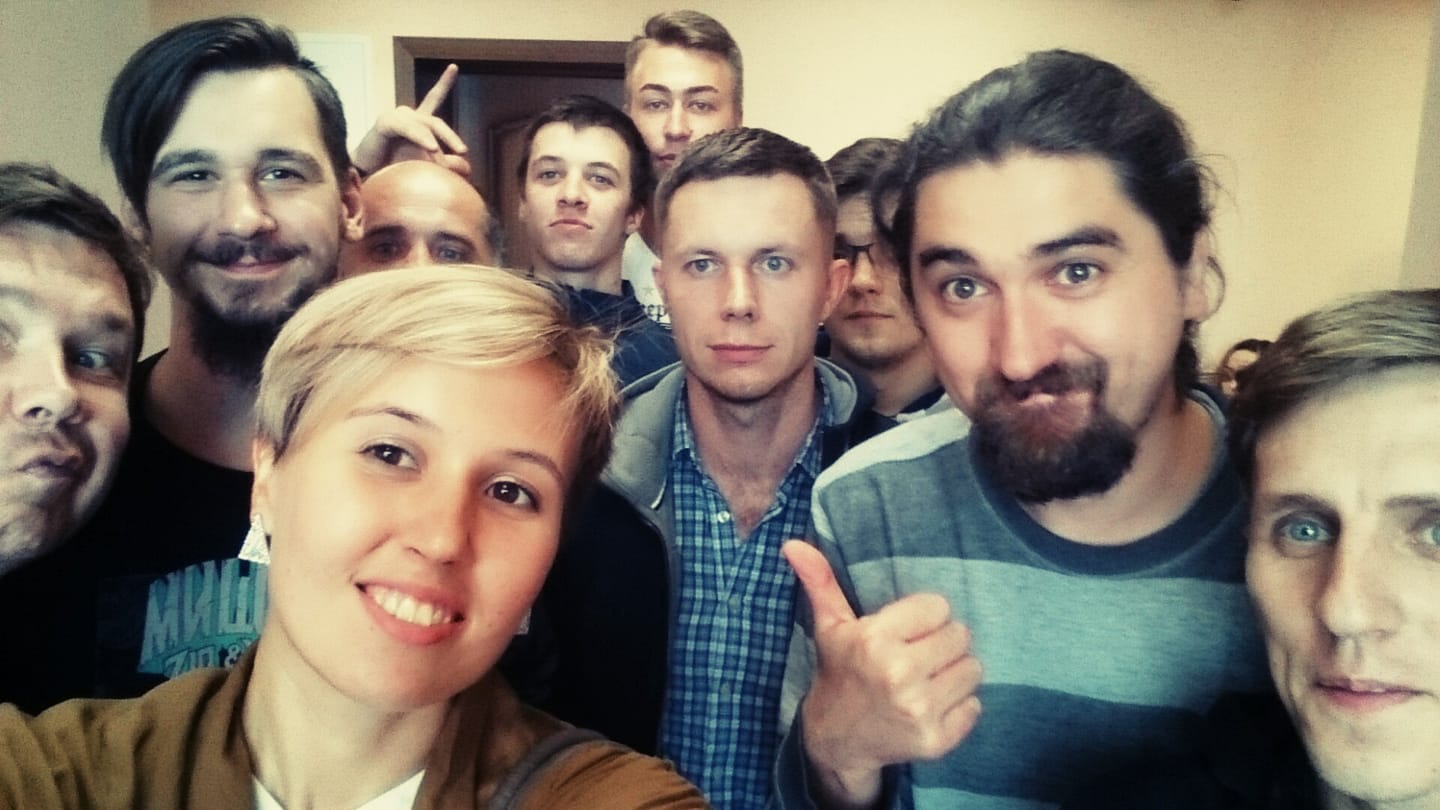
varyaVarya Mikhaylova and her defendants. Photo courtesy of Ms. Mikhaylova’s Facebook page
Varya Mikhaylova
Facebook
September 10, 2018

Yesterday, after the protest rally, for several hours I made the rounds of different police precincts where detainees had been taken: Lenin Square, Prospekt Bolshevikov, Rybatskoye, and General Khrulov Street. It was night when I got home.

Today, I defended people who were involved in the rally and people who weren’t involved in the rally at the Primorsky District Court. I have just left the court building.

Total legal nihilism prevailed in the court. People were tried not individually, but in bunches. The judge said outright to the defendants that if they refrained from making any appeals she would go easier on them. Many defendants were not allowed to go to the bathroom all day. A police officer ate the food intended for the detainees from the 25th Police Precinct. Most of my defendants were convicted and sent off to jail for four to seven days.

But there were a number of important victories.

  1. I managed to get one defendant’s charge changed from Article 20.2 Part 8 of the Administrative Offenses Code (“repeated violation”) to Article 20.2 Part 6.1 (“involvement in an unauthorized assembly, rally, demonstration,  march or picket”). We were able to convinced the judge there were was nothing in the case file proving the repeated violation charge. Instead of fifteen to thirty days in jail or a fine of 150,000 to 300,000 rubles, he was sentenced to five days in jail.
  2. The case of another defendant was completely dismissed. However, since I was removed from the hearing, it was hardly my doing. But the defendant thinks it was crucial I told him to tell the judge about his chronic illness.
  3. The judge wrote in the sentence she handed down to ten guys that the length of their jail terms took effect today, not yesterday, when they were detained, but I convinced her to correct this mistake, and consequently they got back one day of freedom lawfully owed to them.

It went something like that. I wish all of you would go to the court hearings the day after a big protest rally at least once. Your world would never be the same again.

And the detainees are all amazing.

Translated by the Russian Reader

Oleg Sentsov: 115 Days

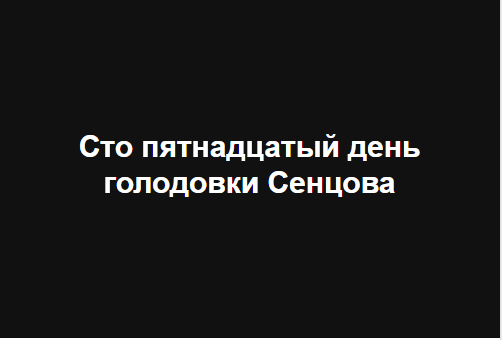
115 Days“The 115th day of Sentsov’s hunger strike.” Image courtesy of Askold Kurov
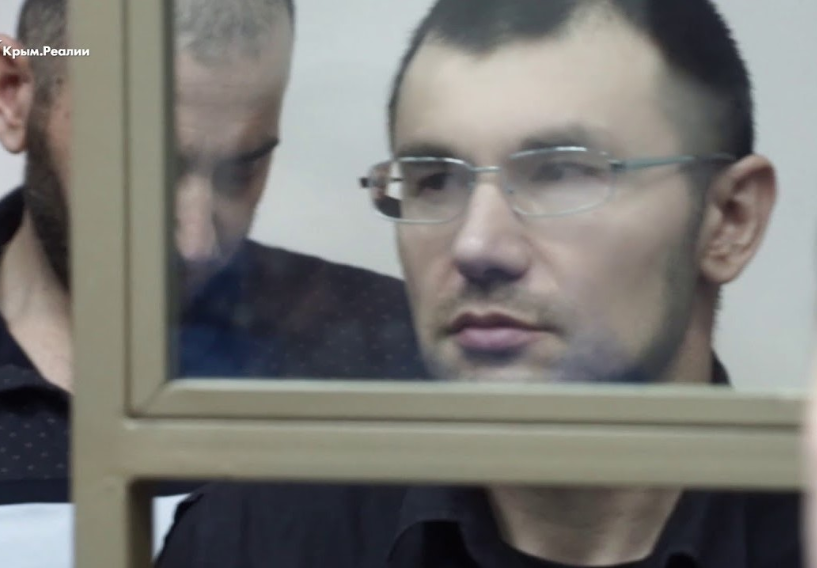
Ukrainian political prisoner Oleg Sentsov has been on hunger strike for 115 days in the Polar Bear Maximum Security Prison Camp in Labytnangi, Russia, where he has been serving a twenty-year sentence on trumped-up charges of “terrorism.”

Mr. Sentsov’s only crime was that he opposed the occupation of his native Crimea by neo-imperialist Russia.

Mr. Sentsov’s only demand is that Russian authorities release sixty-four other Ukrainian political prisoners they have incarcerated during their illegal war against Ukraine.

Emir Hussein Kuku: 23 Days on Hunger Strike

274381Emir Hussein Kuku

Anton Naumlyuk
Facebook
July 19, 2018

Emir Hussein Kuku

Guards did not give Emir Hussein Kuku the baby food his wife Meryem brought and tried to have delivered to her husband,  hoping that, if he did not stop his hunger strike, he would at least ease up a bit. Kuku has been on hunger strike for 23 days. He has demanded the release of all Ukrainian political prisoners in Russia. The guards initially took the care package from his wife, but they quickly returned it, since Kuku refused to quit his hunger strike.

Kuka has written himself about the state of his health.

“On the 22nd day of my hunger strike, my condition leaves much to be desired, to put it mildly. My left kidney (which FSB Special Forces officers beat in 2015) really hurts, as does my heart and something under my left ribs and in the front of my chest; my pancreas, probably. The area around my liver and my right kidney hurt, but they hurt less. I feel the pain if I stand up or sit reading. If I lie down, the pain subsides, but it doesn’t go away entirely. It’s hard to fall asleep. I toss and turn, sleepless, almost until morning. I won’t bother mentioning trifles like dizziness, the weakness I feel when I take five steps in my cell, the constant thirstiness, the vile taste in my mouth, and the smell of acetone.

“On July 16, I was again transported to the hospital for inmates with TB. The doctors have not divulged the outcome of the tests and ECG, but their faces tell me the news is not good. Actually, for several days, the doctors in the remand prison have stopped talking to me about my condition. They have even stopped weighing me. Apparently, this is due to publication of my statement about my health. The big shots with the stars on their epaulettes banned them from playing into the hands of ‘enemies of the state.’ All I found out in the TB hospital was that my ‘official’ weight was 67.8 kilograms, meaning I have lost 11 kilograms. Although, according to my calculations, I should weigh around 66 kilograms, since I weighed 68.5 kilograms on July 12, and I’ve been losing 0.6 kilograms a day.

1530198608-9959Emir Hussein and Meryem Kuku

“They have not been giving me any maintenance therapy—no glucose, no vitamins, nothing. Apparently, top-ranking officials do not want a second Sentsov, someone who would be able to drag out a hunger strike for months if he got care in the form of glucose and vitamins. They realized the mistake they made [with Senstov]. They have to break me quickly.

“Earlier, I was warned that if I didn’t give up the hunger strike, they would be forced to hospitalize me in the TB hospital, a place teeming with inmates infected with tuberculosis and HIV. It’s a TB hospital, after all.”

The trial of the so-called Yalta group in the Hizb ut-Tahrir case is currently underway in the North Caucasus Military District Court [in Rostov-on-Don].

Photos courtesy of 112.International and Unian. Translated by the Russian Reader

Crimean Farmer and Political Prisoner Vladimir Balukh Has Been on Hunger Strike for 104 Days

Vladimir Balukh’s 100 Days: The Crimean Euromaidan Supporter Has Been on Hunger Strike in Remand Prison for Over Three Months
Anna Kozkina
Mediazona
June 27, 2018


Vladimir Balukh. Photo by Anton Naumlyuk. Courtesy of RFE/RL

Today [July 1, 2018] is the [104th] day of a hunger strike by Vladimir Balukh, who awaits a verdict in his third criminal trial in Simferopol Remand Prison. In 2014, he refused to accept Russian citizenship, raising the Ukrainian flag over his house in solidarity with the Euromaidan protests. The first criminal case against Balukh was opened in 2015. It would be followed by two more case. In the article below, Mediazona catalogues the persecution the Crimean activist has endured and describes his hunger strike, during which he has lost at least thirty kilos.

On June 22, 2018, Balukh, who is imprisoned in Simferopol Remand Prison, said he was returning to the harsher form of hunger strike and would now only be drinking water. Balukh had been drinking fruit drink for some time.

Olga Dinze, Balukh’s defense attorney, said the cause was increased pressure from prison wardens. In court, Balukh had spoken of regular searches of his cell, including at night. According to him, prison wardens and guard have hinted it was time for him to “go down in the hole,” i.e., be sent to solitary confinement.

The following day, Ukrainian human rights ombudsman Lyudmila Denisova requested Pierre-Emmanuel Ducruet, head of the International Red Cross’s Simferopol office, visit Balukh at the remand prison and secure professional medical care for him.

The Flag, Heaven’s Hundred Heroes Street, and the Insulted FSB Agent
In late 2013, Crimean farmer Vladimir Balukh raised a Ukrainian flag over his house in the village of Serebryanka in solidarity with the Euromaidan demonstrators. The flag stayed there after the March 2014 referendum. Balukh did not recognize Crimea’s annexation by Russia and refused to apply for a Russian passport.

Police and Russian Federal Security Service (FSB) agents first paid him a visit in the spring of 2015. Balukh was not home when they arrived. When he heard about the visit to his home by the security services, he stayed with friends for several days. The police and FSB searched Balukh’s house and also paid his mother a call.

The security services visited Balukh for the second time in November 2015. Claiming he was suspected of auto theft, they searched his house again. After the search, the farmer was charged with insulting a government official, a violation under Article 319 of the Russian Criminal Code. Allegedly, Balukh had used “foul, insulting language when addressing field agent Yevgeny Baranov, which the latter found unpleasant.” Balukh did not deny he could have sworn at the field agent, since FSB officers had punched him in the kidneys and stepped on his head after throwing him on the ground.

In February 2016, the Razdolnoye District Court found Balukh guilty, sentencing him to 320 hours of community service. Subsequently, the Crimean Supreme Court sent the case back to the lower court for review, but in June the district court reaffirmed its original guilty verdict, again sentencing Balukh to 320 hours of community service.

The Ukrainian flag was torn down from the farmer’s house again and again, but he put it back up every time. On November 29, 2016, the third anniversary of the Euromaidan protests, Balukh hung a sign on his house, identifying the address as “Heaven’s Hundred Heroes Street, 18.” Two weeks later, police and FSB carried out yet another search of his house. This time, they allegedly found eighty-nine rounds of ammunition and several TNT blocks in the attic. After the search, the flag and the street sign were removed from Balukh’s house. Balukh was detained and later remanded to police custody.

Balukh was charged with illegal possession of weapons and explosives (Article 222 Part 1 and Article 222.1 Part 1 of the Russian Criminal Code). The farmer claimed his innocence and said his political stance was the reason for the criminal prosecution. He claimed the rounds of ammo and explosives were planted during the search. Police allegedly found them in the presence of a single official witness.

The Memorial Human Rights Center designated Balukh a political prisoner. It noted that he had received clear threats after hanging the street sign on his home memorializing the murdered Maidan protesters.

“It was after this that the chair of the village council and his deputies visited Balukh’s home and threatened that his independent behavior would have unpleasant consequences, including the ‘discovery’ in Balukh’s house of weapons or narcotics. He demanded  Balukh take the sign down,” wrote Memorial.

Memorial argued that the prosecution had not proven the ammunition actually belonged to Balukh, since his fingerprints were not found on the items.

Vladimir Balukh’s House. Photo courtesy of hromadske.ua

“Go to Ukraine and Treat Your Back There”
On August 4, 2017, the Raznodolnoye District Court sentenced Balukh to three years and seven months in a medium security penal colony and a fine of ₽10,000 [approx. €136] for possession of the ammunition and TNT.

A week after Balukh was sentenced, he had a run-in with Valery Tkachenko, warden of the Razdolnoye Temporary Detention Facility. According to Balukh, Tkachenko punched him in the shoulder and tried to kick him as well. He also, allegedly, made insulting remarks about the ethnicity of Balukh and his parents. Balukh’s attorney filed a complaint with the police.

Two weeks later, the Investigative Committee opened a case against Balukh himself, claiming he had violated Article 318 Part 1 of the Criminal Code (violence against a state official). Subsequently, Balukh’s alleged actions were reclassified as a violation of Article 321 Part 2 (disrupting the operations of penitentiary facilities). According to police investigators, on the morning of August 11, 2017, Balukh had elbowed the warden in the stomach while his cell was being inspected. He then, allegedly, entered his cell and struck Tkachenko’s arm.

In November 2017, the district court commenced its review of the ammunition possession case, and in December Balukh was transferred from the remand prison to house arrest.  After complaining of pain in his back and groin, Balukh was soon taken to hospital straight from the courtroom.

At the district hospital, medical staff merely measured his blood pressure and gave him a cardiogram. After listening to Balukh’s complaints, the local doctor said, “My back hurts, too. Should I not go to work or what?”

Balukh asked the court permission to travel to Simferopol or Feodosia for a medical examination, but his request was turned down. During his December 27 court hearing, the ambulance was called several times due to Balukh’s temperature, high blood pressure, and back pain. According to the news website Krym.Realii, the head physician of the local hospital’s emergency department, Nadezhda Drozdenko, told Balukh, “Go to Ukraine and treat your back there.” When the hearing went on for ten hours, Balukh lay down on the floor due to the severe pain.

In early 2018, the court again found Balukh guilty on the ammunition possession charge and sentenced him to three years and seven months in a work-release penal colony. The verdict was upheld on appeal, although the sentence was reduced by two months.

Balukh was again sent to the remand prison. He has continued to complain of back pain, whose cause doctors have never been able to diagnose.

“He Has Adopted a Stance of Hopelessness”
After the Crimean Supreme Court upheld the verdict in the ammunition possession case, Balukh went on an indefinite hunger strike as of March 19, 2018. He gave up all food, only drinking water and tea, protesting what he regarded as the illegal verdict against him.

In late March, Balukh was assaulted in the remand prison and hospitalized in the infirmary, as reported by Aktivatika, who quoted defense attorney Olga Dinze.

“The hunger strike has been difficult for him. Besides, the prison wardens have engaged in constant provocations. They have brought him delicious food, enticing him to eat. It destabilizes him a bit, but he has hung and kept his word,” said the lawyer.

Vladimir Balukh on June 22, 2018. Photo by Zair Semedlyaev. Courtesy of crimeahrg.rog

In mid April, his social defender, Archbishop Kliment of Simferopol and Crimea, reported Balukh had been assaulted by guards.

A month later, Vladimir Chekrygin, an expert with the Crimean Human Rights Group, told Krim.Realii Balukh was under pressure in the remand prison.

“We know the guards at the remand prison have periodically threatened Balukh for his actions. They have told him that sooner or latter he would be punished for his willfulness. They have been doing searches in his cell night and mornings. Searches are permitted, but at certain hours and under extraordinary circumstances. They are not letting him rest,” Chekrygin explained.

On May 18, Russian human rights ombudsman Tatyana Moskalkova visited the Simferopol Remand Prison. She wrote to her Ukrainian colleague, Lyudmila Denisova, that Balukh had no complaints either about the conditions of his incarceration or cruel treatment.

In May, the Raznodolnoye District Court began hearing the third criminal case against Balukh, involving his run-in with the temporary detention facility warden. During the trial, even the prosecution’s witnesses, guards at the facility, testified Balukh did not assault the wardeb. During the investigation, the alleged victim refused to take part in a face-to-face confrontation with Balukh, who described his behavior in great detail to the judge.

“He would come to my cell and try to insult me, to humiliate me for being Ukrainian and thus, as he thought, for being a member of Right Sector. He would say us Ukrainians should be murdered as a species, and so on,” said Balukh.

On June 10, Balukh was again transferred from Razdolnoye to the Simferopol Remand Prison. There he was put in the “glass,” a narrow cell in which one can only stand or sit, for two hours, Crimean human rights defenders reported.

The following day, it transpired the remand prison wardens no longer believed Balukh was on hunger strike. The guards had learned Balukh was drinking not only water but also oatmeal kissel. Archbishop Kliment had persuaded Balukh to make the compromise a month after he started his hunger strike.

“Vladimir agreed. We know  he began consuming only kissel. Sometimes, he has honey and bread crumbs at most. At some point, the prison wardens found out about the kissel and decided not to recognize his actions as a hunger strike. There are special rules when wardens decide a prisoner has gone on hunger strike. They have stopped following these rules when it comes to Balukh, since they believe he is no longer on hunger strike. But Vladimir has continued his protest. He has lost thirty kilos of weight. The doctor from the remand prison infirmary has stopped making regular checkups of Balukh, although he is obliged to do so when inmates go on hunger strike,” explained Olga Skripnik, head of the Crimean Human Rights Group.

Protesting constant inspections in the remand prison, Balukh returned on June 22, 2018, to the original form of his hunger strike. He has again been only drinking water. Olga Dinze explained the frequent searches of Balukh’s cell as a consequence of Balukh’s having filed a motion to be paroled for his first criminal conviction.

On June 25, Dinze told Mediazona her client’s condition had taken a turn for the worse.

“I think Balukh has suffered a pinched nerve. It is a quite serious case. He has been experiencing severe pain in his chest, neck, and shoulder blades. He feels unwell all the time,” Dinze said, adding the new symptoms were probably due to long-term back pain.

According to Dinze, Balukh was not receiving medical care.

“He refuses cares from the doctors in the remand prison. They cannot give him the medical care he needs, diagnose him, and prescribe him appropriate treatment. He has requested doctors from the Red Cross,” said Dinze.

The defense attorney added that, after Balukh stopped drinking oat kissel, he was transferred to a cell in the general population, but the conditions there were decent. He currently has no complaints against the wardens.

Earlier, Dinze told Krym.Realii Balukh had been hoping for a prisoner exchange.

“Vladimir is quite weary. He is emotionally exhausted. He has adopted a stance of hopelessness. He says no one will ever release him from prison. If they cannot keep him in prison on the current convictions, there will be new charges. So now he is finally talking. For the last few months we have been talking about how, if there is a prisoner exchange and everything goes well, he would really, really like to go to mainland Ukraine,” said Dinze.

The Ukrainian authorities have recently repeatedly stated their readiness to exchange Russian convicts for the sixty-four Ukrainian nationals imprisoned in Russian remand prisons and penal colonies, including Balukh and filmmaker Oleg Sentsov, who has been on hunger strike since mid May.

Closing arguments in Warden Tkachenko’s case against Balukh have been scheduled for July 2.

Thanks to Yegor Skovoroda for the heads-up. Translated by the Russian Reader

Petersburg Court Bailiffs Attack Reporter at Network Case Hearing

Mediazona’s Petersburg Correspondent Accused of Disobeying Court Bailiffs
Mediazona
June 19, 2018

David Frenkel, a Mediazona correspondent, has informed us that bailiffs at Petersburg’s Dzerzhinsky District Court have cited him for violating Article 17.3 of the Administrative Code (“failure to comply with the orders of a judge or court bailiff”).

Frenkel attended the custody extension hearing of Penza-Petersburg “terrorism” case suspect Viktor Filinkov. Journalists and the public were not admitted to the courtroom during the hearing and the judge’s ruling. When the hearing was over, and Filinkov was escorted from the courtroom, the public, around forty people, applauded him.

It was then that court clerk Yelena Krasotkina, outraged the public supported the prisoner, ordered the bailiffs to detain Frenkel, who at the time was standing in the corridor and not applauding.

Yekaterina Kosarevskya, a member of the Petersburg Public Monitoring Commission, said she heard Krasotkina say to the bailiffs, “Write somebody up for something.”

One of the bailiffs suggested detaining Frenkel. Ten minutes later, another bailiff threatened to detain Kosarevskaya.

When the bailiffs detained Frenkel, they broke his glasses. They claimed he screamed.

The bailiffs cited him Frenkel for violating Adminstrative Code Article 17.3 Part 2 (“Failure to obey the lawful request of a court bailiff for establishing order in the court and stopping actions violating court rules”).

Frenkel sent a photo of the citation to his Mediazona colleagues: he was unable to read it, since a bailiff, surnamed Vikulov, had broken his glasses. The citation claimed Frenkel “made noise, clapped, shouted, and urged the crowd to take illegal actions.”

Frenkel was then taken to the 78th Police Precinct. The policemen swore when they found out why Frenkel had been brought to the police station. He was released after approximately fifteen minutes.

Viktor Filinkov’s term in remand prison was extended four months, until October 22, 2018.

When Frenkel was escorted from the corridor, it transpired the bailiffs had run out of blank arrest sheets.

Around forty people had gathered before the hearing in the second-floor corridor of the courthouse. They included the parents of Yuli Boyarshinov, another suspect in the Penza-Petersburg “terrorism” case, whose remand to police custody was extended later in the day. No member of the public was able to attend the hearing. Before escorting Filinkov from the holding cell, the guards and bailiffs ordered the public to go down to the first floor. They claimed their request had to do with “safely escorting” their prisoner.

The members of the public were reluctant to leave the second floor. Court clerk Yelena Krasotkina emerged from the office of the Dzerzhinsky District Court’s presiding judge. Krasotkina announced the decision to hold both hearings in closed chambers had been made earlier and ordered the public to leave the courthouse.

View image on TwitterView image on TwitterDavid Frenkel (@merr1k): “I get the sense the brass has taken the Dzerzhinsky District Court to task, and so they are avoiding the use of force. They are swearing and getting mad, but they’re putting up with us. 11: 12 a.m., July 19, 2018.”

The bailiffs placed a bench at the entrance of the corridor to courtroom, forbidding members of the public from going around the bench. Krasotkina reprimanded the bailiffs, complaining , “They’re all still here,” meaning the members of the public. Armed guards in masks escorted Filinkov into the courtroom as this was happening.

Inside the Dzerzhinsky District Court, June 19, 2018. Photo by David Frenkel. Courtesy of Mediazona  

Members of the public and the bailiffs argued with each other. A man who was possibly in charge of the armed guard joined them. He warned the public they would not be admitted to the courtroom to hear the judge’s ruling in the cases of Filinkov and Boyarshinov.

“How is that?” asked a member of the public.

“Well, if the judge permits it, the public gets in. If the judge doesn’t, they don’t,” replied the man.

“How do we find that out?” asked perplexed members of the public.

“When the hearing is over, they’ll come out and tell you,” he concluded.

Krasotkina periodically emerged from the presiding judge’s office, taking a photograph of the members of the public on one such occasion.

Filinkov’s defense counsel, Vitaly Cherkasov, a lawyer with the Agora International Human Rights Group, then emerged from the courtroom, telling the crowd the defense had asked the judge to transfer Filinkov to house arrest.

Finally, after the court had rendered its ruling, Frenkel was detained by the bailiffs.

Armed guards escort Viktor Filinkov at the Dzerzhinsky District Court. Photo by David Frenkel. Courtesy of Mediazona 

This was not the first time a member of the press has been cited for violating Article 17.3 at the Dzerzhinsky District Court. On March 22, 2018, bailiff Ivan Lozovsky cited journalist Sasha Bogino for violating the administrative law. He ordered her to stop “live streaming,” although the Mediazona correspondent was sitting in the courtroom with her laptop open and not filming anything. In late May, a court ordered Bogino to pay a fine of 500 rubles.

Filinkov and Boyarshinov have been in police custody since January of this year. On June 18, 2018, the Dzherzhinsky District court extended the term in custody of the third Petersburg suspect in the Penza-Petersburg “terrorism” case, Igor Shishkin. Another six young men are in police custody in Penza as suspects in the same case.

According to the Russian Federal Security Service (FSB), the members of the alleged “terrorist community” known as “The Network” had planned “to stir up the popular masses in order to destabilize the political circumstances” in Russia on the eve of March’s presidential election and the 2018 FIFA World Cup, which is currently underway. In addition, on June 15, 2018, it transpired that three new charges had been added to the case.

Three of the suspects, who have been charged with violating Article 205.4 of the Russian Criminal Code (“involvement in a terrorist community”), Viktor Filinkov, Ilya Shakursky, and Dmitry Pchelintsev, have claimed they were tortured into confessing after they were detained by FSB field officers. In addition, Alexei Poltavets, an acquaintance of the suspects, has claimed he was tortured into testifying against them.

The Russian Investigative Committee has so far refused to refuse to file abuse of authority charges against any FSB officers. In the case of Ilya Kapustin, who was tortured during his interrogation by the FSB as a witness, the Investigative Committee decided Kapustin’s taser burns were “consistent with injuries caused by skin diseases or insect bites.”

The suspects’ loved ones have formed a Parents Network. In April 2018, the group held a press conference in Moscow.

Translated by the Russian Reader

***************

What can you do to support the Penza and Petersburg antifascists and anarchists tortured and imprisoned by the FSB?

  • Donate money to the Anarchist Black Cross via PayPal (abc-msk@riseup.net). Make sure to specify that your donation is earmarked for “Rupression.”
  • Spread the word about The Network Case aka the Penza-Petersburg “terrorism” case. You can find more information about the case and in-depth articles translated into English on this website (see below), rupression.com, and openDemocracyRussia.
  • Organize solidarity events where you live to raise money and publicize the plight of the tortured Penza and Petersburg antifascists. Go to the website It’s Going Down to find downloadable, printable posters and flyers. You can also read more about the case there.
  • If you have the time and means to design, produce, and sell solidarity merchandize, please write to rupression@protonmail.com.
  • Write letters and postcards to the prisoners. Letters and postcards must be written in Russian or translated into Russian. You canfind the addresses of the prisoners here.
  • Design a solidarity postcard that can be printed out and used by others to send messages of support to the prisoners. Send your ideas to rupression@protonmail.com.
  • Write letters of support to the prisoners’ loved ones via rupression@protonmail.com.
  • Translate the articles and information at rupression.com and this website into languages other than Russian and English, and publish your translations on social media and your own websites and blogs.
  • If you know someone famous, ask them to record a solidarity video, write an op-ed piece for a mainstream newspaper or write letters to the prisoners.
  • If you know someone who is a print, internet, TV or radio journalist, encourage them to write an article or broadcast a report about the case. Write to rupression@protonmail.com or the email listed on this website, and we will be happy to arrange interviews and provide additional information.
  • It is extremely important this case break into the mainstream media both in Russia and abroad. Despite their apparent brashness, the FSB and their ilk do not like publicity. The more publicity the case receives, the safer our comrades will be in remand prison from violence at the hands of prison stooges and torture at the hands of the FSB, and the more likely the Russian authorities will be to drop the case altogether or release the defendants for time served if the case ever does go to trial.
  • Why? Because the case is a complete frame-up, based on testimony obtained under torture and mental duress. When the complaints filed by the accused reach the European Court of Human Rights in Strasbourg and are reviewed, the Russian government will be forced to pay heavy fines for its cruel mockery of justice.

***************

If you have not been following the Penza-Petersburg “terrorism” case and other cases involving frame-ups, torture, and violent intimidation by the Russian Federal Security Service (FSB) and other arms of the Russian police state, read and repost the recent articles the Russian Reader has translated and published on these subjects.

Anna Tereshkina: At the Court Hearing

tereshkina-11

Anna Tereshkina
Facebook
June 19, 2018

*This text is not an objective reflection of the “hearing.” Rather, I see its value as therapeutic in the light of what happened today.

This was my second time at a remand extension hearing for Viktor Filinkov.

There were more people, and their voices were louder. But I still left feeling as if I had been hit with a shovel, which was no surprise.

tereshkina-2.jpg

This time round, the court bailiffs immediately herded everyone down to the first floor, but they were unable to drive anyone completely out of the courthouse.

People stood near the stairway.

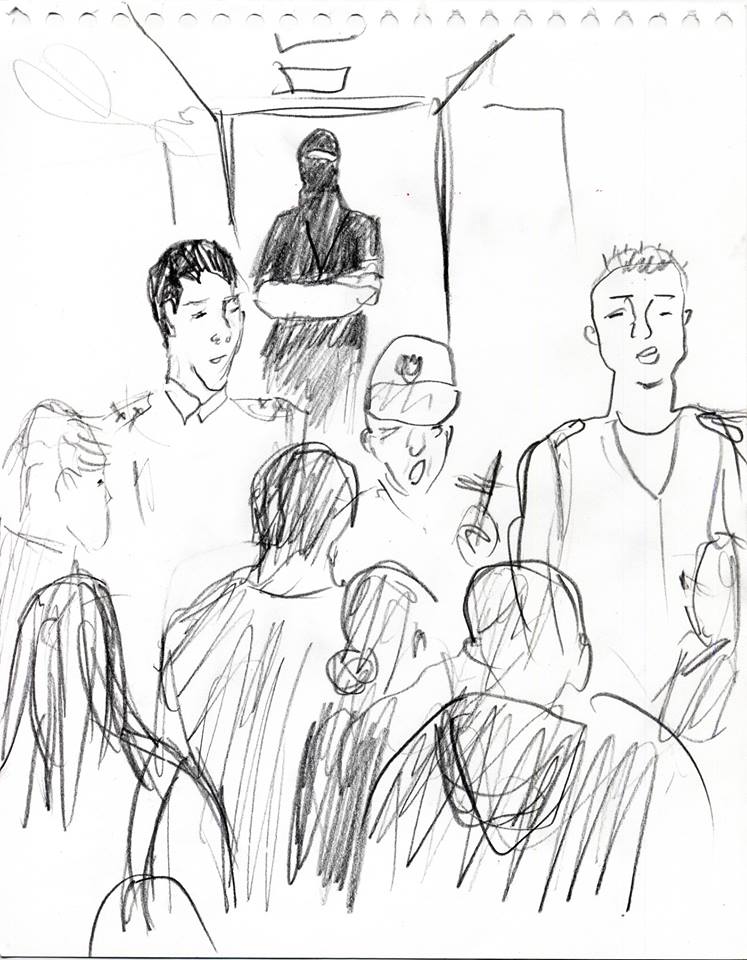
Our way down the long corridor was blocked by three beefy bailiffs, who were the centerpiece of a genuine commedia dell’arte.

At first, they used a bench to block the way into the corridor. Folks sat down on the bench. Then they decided to remove the bench. One young woman, however, refused to get up, and the three muscleheads threatened to drag her forcibly from the bench. They left the bench where it was, but turned it around. I managed to squeeze through and sit down on it.

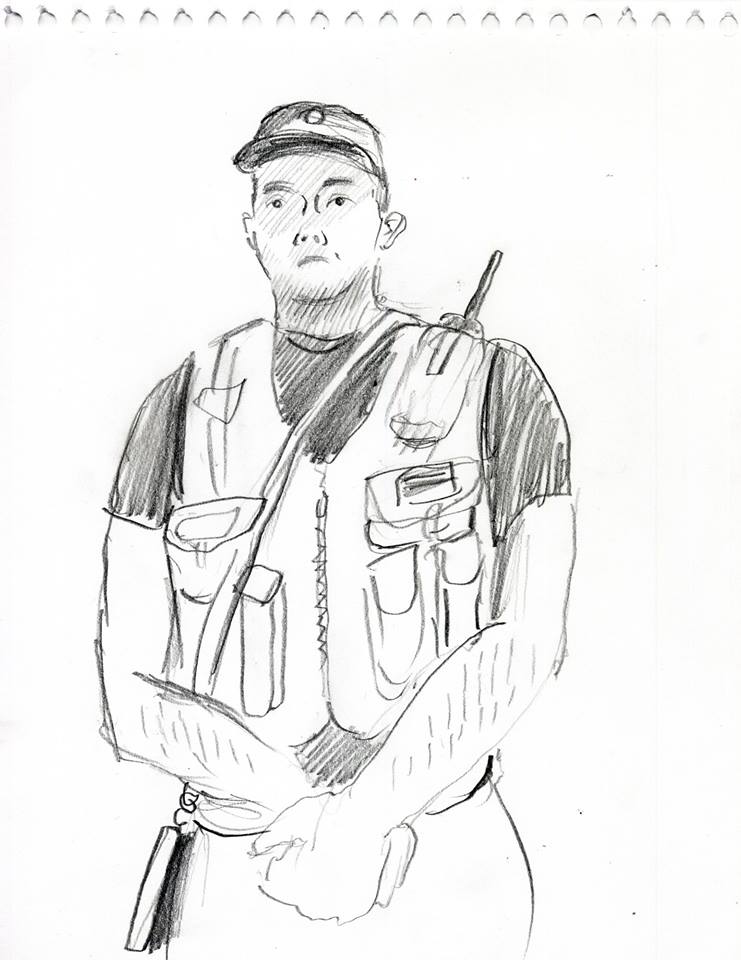
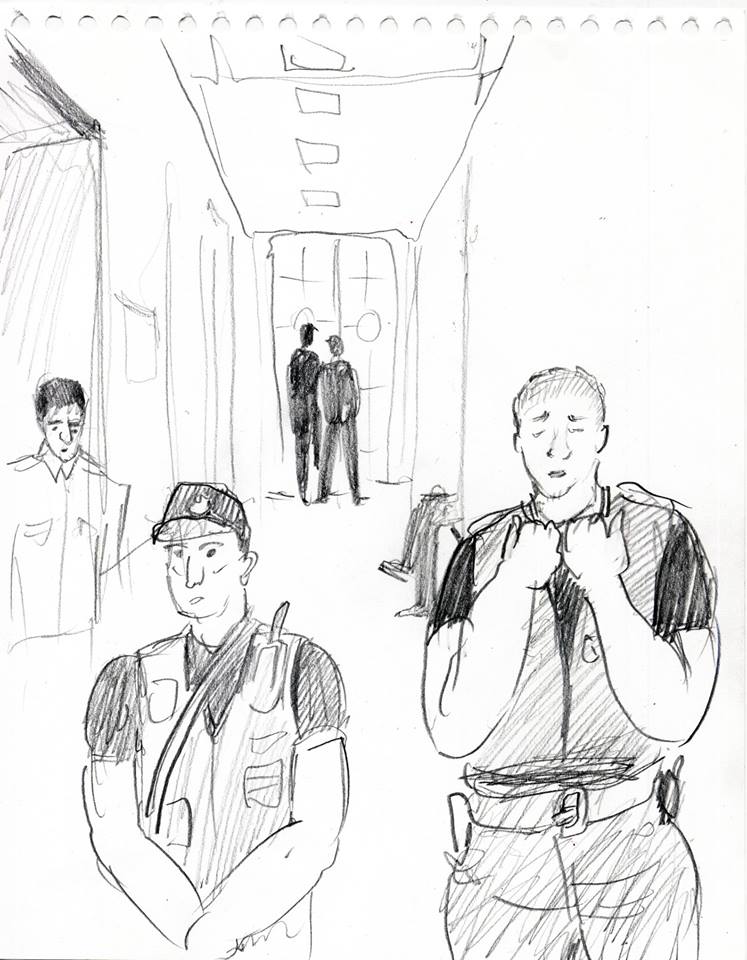
Folks were pushing from one side, as during rush hour in the subway, while on the other side an amphitheater opened up. Knights in bulletproof vests outfitted with tons of pockets stood in this amphitheater. They were nearly motionless, like the best sitters during life drawing classes at the Academy of Arts.

I tried to make a stupid joke that snuggling up against young women like that, not letting them walk down the corridor, was the only joy in their dull jobs. A tall, thin bailiff (I had sketched him at the previous hearing) kept running back and forth, trying to cuddle up to T., pushing his more broad-shouldered colleague away from her.

The broad-shouldered bailiff, who bore a resemblance to Ramzan Kadyrov, smiled reservedly when I joked, while the other bailiff (I memorized his name: Anton) went so far as to say it was not their choice to wear the bulletproof vests, but they were under orders to wear them. He kept pulling at the neck of his t-shirt, as if he wanted to tear off his entie sweaty get-up.

But my jokes and attempts to see something human about them collapsed when all of them went after reporter David Frenkel, elbowing their way through the crowd. We tried to squeeze past them, but they had the right to employ violence. I sensed the tension in their elbows. But if someone like me had tensed their elbows like that, they would have been charged with “disobeying” officers of the law. It was scary.

Amid the stuffiness of the corridor, a ball consisting of the swearing gorillas and skinny David rolled down the stairway. (It transpired later the brave young men broke David’s glasses.)

The crowd seethed with despair and resentment.

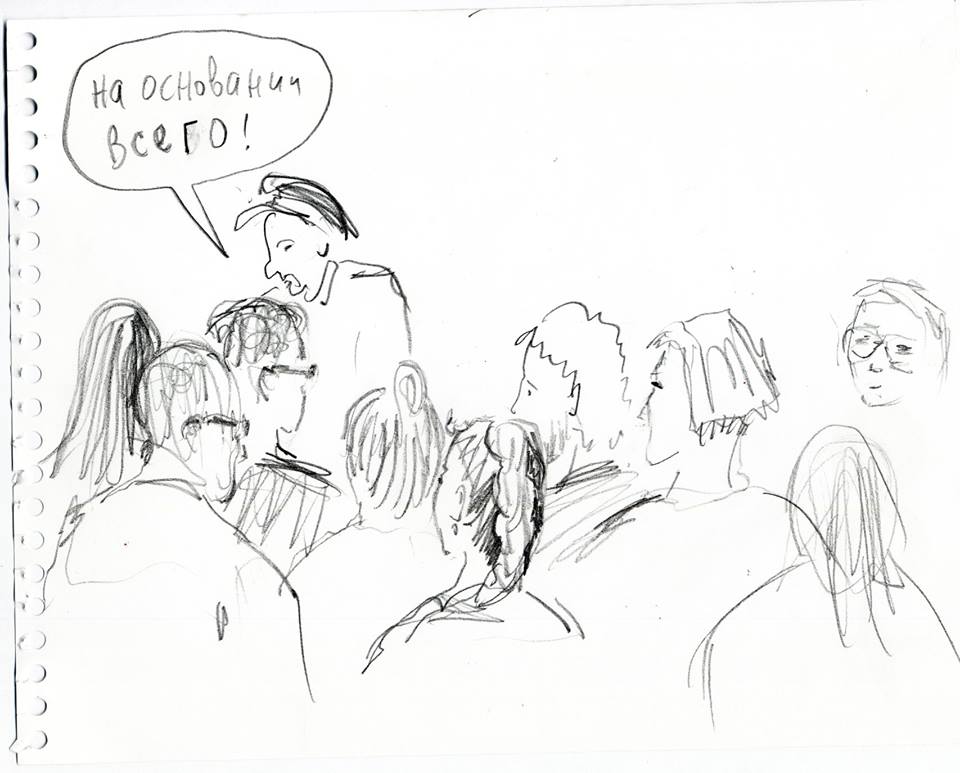
“Look at yourselves! How you behave! You are violating the right of citizens to exercise their right to . . . ,” a female court clerk in a blue dress kept repeating at us.

tereshkina-1“I have every grounds!”

The bits of bureaucratese clawed at each other. Words stumbled and snapped, turning into feckless curses.

“What grounds do you have for kicking us out?”

“I have every grounds!”

“Who the heck are you?”

“I’m the locum!”

“Whose locum? What’s your name?”

“I’ve already told you everything!”

This had all happened somewhere before, either in a story by Kafka or during my schooldays.

Ultimately, I really resent the fact I cannot draw Viktor or Yuli Boyarshinov or the lively crowd, constantly in motion, but am forced to draw the faces of the bailiffs, frozen in the stupid frenzy of their work. Violence is such a habitual part of their work they have ceased noticing it.

I would rather not have the opportunity to draw them. I would rather this hearing had not taken place. I would like to have magical powers and make it all go away. I would snap my fingers and, instead of a court bailiff, a marvelous violinist would be standing there or a waste recycling engineer who was a feminist and vegan to boot.

tereshkina-5

But, alas, the bailiffs pushed us back by another ten centimeters, and Ninja Turtles in balaclavas escorted Viktor into the courtroom. Our only magical powers were yelling and clapping as loudly as we could.

Like last time, I could not take it anymore. I left before the hearing was over. Where can I find the strength to endure this?

Drawings by Anna Tereshkina. I thank Ms. Tereshkina  for her kind permission to reproduce them here as well as publish a translation of the accompanying text.  All images © Anna Tereshkina, 2018. Translated by the Russian Reader.

***************

What can you do to support the Penza and Petersburg antifascists and anarchists tortured and imprisoned by the FSB?

  • Donate money to the Anarchist Black Cross via PayPal (abc-msk@riseup.net). Make sure to specify that your donation is earmarked for “Rupression.”
  • Spread the word about The Network Case aka the Penza-Petersburg “terrorism” case. You can find more information about the case and in-depth articles translated into English on this website (see below), rupression.com, and openDemocracyRussia.
  • Organize solidarity events where you live to raise money and publicize the plight of the tortured Penza and Petersburg antifascists. Go to the website It’s Going Down to find downloadable, printable posters and flyers. You can also read more about the case there.
  • If you have the time and means to design, produce, and sell solidarity merchandize, please write to rupression@protonmail.com.
  • Write letters and postcards to the prisoners. Letters and postcards must be written in Russian or translated into Russian. You canfind the addresses of the prisoners here.
  • Design a solidarity postcard that can be printed out and used by others to send messages of support to the prisoners. Send your ideas to rupression@protonmail.com.
  • Write letters of support to the prisoners’ loved ones via rupression@protonmail.com.
  • Translate the articles and information at rupression.com and this website into languages other than Russian and English, and publish your translations on social media and your own websites and blogs.
  • If you know someone famous, ask them to record a solidarity video, write an op-ed piece for a mainstream newspaper or write letters to the prisoners.
  • If you know someone who is a print, internet, TV or radio journalist, encourage them to write an article or broadcast a report about the case. Write to rupression@protonmail.com or the email listed on this website, and we will be happy to arrange interviews and provide additional information.
  • It is extremely important this case break into the mainstream media both in Russia and abroad. Despite their apparent brashness, the FSB and their ilk do not like publicity. The more publicity the case receives, the safer our comrades will be in remand prison from violence at the hands of prison stooges and torture at the hands of the FSB, and the more likely the Russian authorities will be to drop the case altogether or release the defendants for time served if the case ever does go to trial.
  • Why? Because the case is a complete frame-up, based on testimony obtained under torture and mental duress. When the complaints filed by the accused reach the European Court of Human Rights in Strasbourg and are reviewed, the Russian government will be forced to pay heavy fines for its cruel mockery of justice.

***************

If you have not been following the Penza-Petersburg “terrorism” case and other cases involving frame-ups, torture, and violent intimidation by the Russian Federal Security Service (FSB) and other arms of the Russian police state, read and repost the recent articles the Russian Reader has translated and published on these subjects.