
Lena Karbe’s documentary film Inner Emigrants examines what people in Russia think about the war with Ukraine. Deutsche Welle spoke with the filmmaker about making the picture and the conclusions we can draw from it.
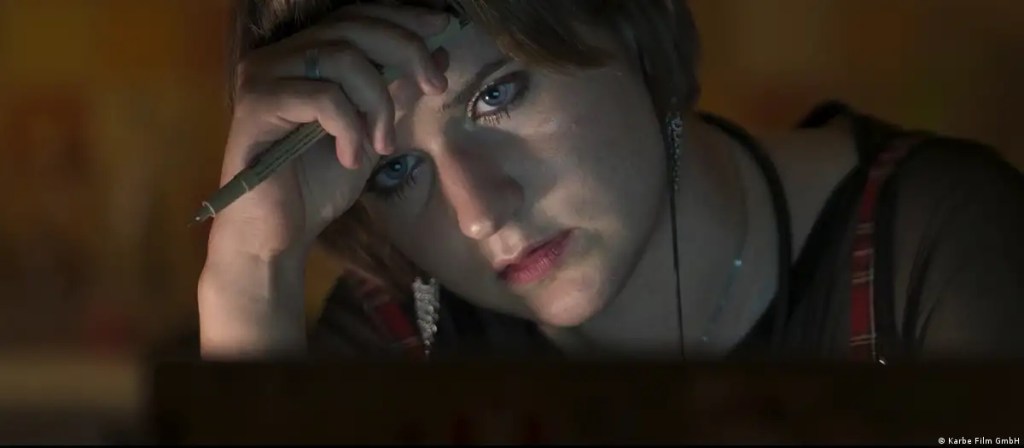
Lena Karbe’s documentary film Inner Emigrants (Innere Emigranten) is currently playing in cinemas in Germany. Born in Russia, the filmmaker has lived and work in Germany for fifteen years. Her new picture looks at the work of three crisis hotline psychologists in Russia. Viewers see them volunteering their evenings by talking to people in need of counseling.
The film was shot over three years, from 2022 to 2024, in the wake of Russia’s full-scale invasion of Ukraine. The war and people’s thoughts about it are the picture’s focus. Its protagonists oppose the war and wonder whether they can take a stand against the war and society’s attitude to it. Instead of engaging in open protest, they choose inner emigration. Our correspondent sat down with Lena Karbe after a screening of the film in Cologne to talk about how the picture was made and the conclusions we could draw after seeing it.
DW: How and when did you get the idea of making this film?
Lena Karbe: The idea occurred to me immediately after Russia’s invasion of Ukraine. I’m a documentary filmmaker, but I have always done projects about other countries of the world—about China, for example. I “transferred” my interest in political topics to other countries because I’m from Petersburg myself and have lived in Germany for fifteen years, and I probably needed the distance to be able to make a film about the country where I was born. The start of the full-scale invasion was the shock that accelerated these processes for me. I realized that I couldn’t make a film about something else at the moment.
As is often the case in filmmaking, I fortuitously happened upon an article about a crisis hotline and got in touch with its coordinator. He immediately took a big interest in the project, probably because at the time (this was April 2022) all of us were in a state of shock and the idea of starting a project like this seemed like a way of finding a constructive channel for all our conflicting feelings. So all the initial steps happened quite quickly.
Meaning that the hotline’s coordinator and the psychologists to whom you reached out fairly quickly agreed to be in the film. What were their motivations? After all, involvement in this project presents a certain risk for them.
In some sense, they were in absolutely the same situation as their callers and I were in—a situation of absolute uncertainty. We were all in a state of shock. It was absolutely unclear what the future held in store.
All my films follow their characters over the course of several years. I said from the outset that I would like to make a record of the time, meaning that it would not be a quick project. I wanted to document the situation over several years, and this was the film’s psychological function for everyone involved in it. It helped us to cope with our complicated states of mind.
So it helped you figure yourselves out?
Yes. And yet, the context is vital: a crisis hotline that anyone whosoever can dial. We thought it would help us find out more about what the country’s populace actually thinks, because information from Russia is quite limited and one-sided in Germany. Like many others, I found it quite hard to deal with the alleged fact that the entire population of Russia holds the same opinion—if you believe the information out there. I wanted to see and hear it for myself.
How did you manage to do this project? The press release for the film says that it was shot in complete secrecy. At the presentation you said that you shot completely openly in the subway, for example, and on the streets. Didn’t it require a great deal of courage to do that?
As I’ve already said, I’m a documentary filmmaker. It’s my main occupation, and with certain projects it is clear from the get-go that they cannot be done differently. So I wouldn’t call that courage. I think it’s just a consequence of the decisions you make.
Meaning it’s professionalism.
Meaning there’s no other way to do it.
The film is called Inner Emigrants, an allusion to the German term “inner emigration,” which is applied to writers who didn’t flee Germany during the Second World War. Why did you give the film this particular title?
Despite the fact that there isn’t a one-to-one correspondence between the realities of inner emigration in German literature and the situation in Russia, there are very many similar elements in this phenomenon and the behavior of many people in Russia now. It was this particular point that aroused my curiosity.
If you believe certain statistical data, the silent majority makes up somewhere around sixty percent of the Russian populace, and many of those people would say that they are inner emigrants.
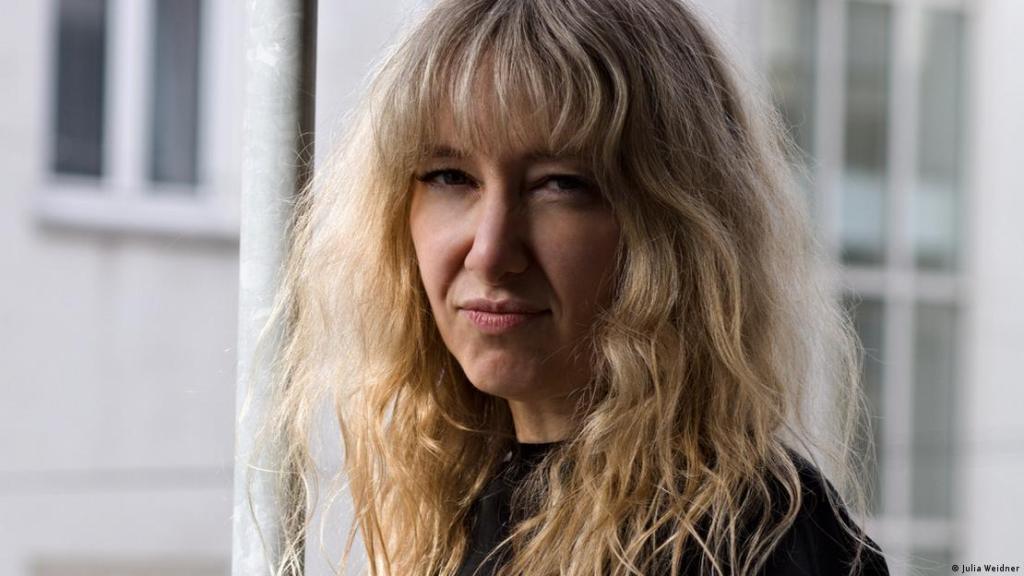
This kind of film, in which I wanted to understand the moods in Russia after the invasion of Ukraine, could be made ten thousand different ways. It was vital to me that this wasn’t a journalistic project. I endlessly admire the work of my journalist colleagues, but documentary filmmaking, the genre in which I work, is a more universal approach. Its goal is not to inform people but to delve into a phenomenon and make the viewer feel something. I hope that by film’s end the viewer has come to feel for themself the complexity and ambiguity of inner emigration and the contradictoriness of the term itself.
I saw two important points in the film. The first was the way you showed what lies behind the statistics you cited. The psychologists are a kind of mirror. On the one hand, they are the film’s protagonists, who have their own quite ambivalent thoughts and feelings. One of them is disgusted by people who tell him over the phone that they support the war. This disgust is manifested to a lesser degree in the other protagonists. At the same time, they show us what happens behind the scenes. Do you agree with what I took away from the film?
Yes. I think people’s reactions to this film can vary widely, which is quite important. It’s dangerous to lose touch with Russian realities entirely. I’m speaking now from the perspective of those of us living in Germany. Because even in 2022, coverage of events in Russia—video footage—was already quite limited, and now there’s practically none. I would very much like for this film to lead to a dialogue. It’s obvious, but not so obvious to some, that the Russian-speaking population in Germany is quite diverse. And we don’t talk to one another.
Do you mean dialogue with Russians living in Germany?
Yes. And of course, even though we currently have no contact with Russia, it’s important that we don’t completely shut ourselves off from everyone. It seems to me that generalization is the big problem. When it comes to very strong, extreme emotions, we slip into a childish, categorical mindset and start lumping everyone together.
You mean that we divide everything into black and white, while there are in fact shades of gray?
Yes.
My second takeaway from the film boils down to the question “What should we do?” What should we do ourselves, and what should we do about those who are clearly saying things that don’t align with their own beliefs and values? The film both does and doesn’t give an answer to this question. On the one hand, the final shot shows someone going out in public with a placard and protesting the war. The final shot always serves as a highlight. In this way, you show that something can be done. On the other hand, the psychologists in the film argue that they cannot change how people feel about the war, meaning that changing their minds is both impossible and pointless. Do you think this is really the case? Or is there a point in talking with people, say, with the “Putinists” living in Germany?
When I speak of dialogue, I mean first of all that we have set aside hatred, if possible. Hatred is a destructive emotion, and we won’t be able to build a future for Russia based on it. I think there is a type of people with whom it is impossible to have a dialogue, nor is it our task to change their minds. I even had in mind a dialogue with ourselves, so that we don’t stop thinking and seeking the truth, so that we avoid being categorical and generalizing. If we lump everyone together, it’ll be tough.
Do you have the will and the means to keep making films in and about Russia?
Definitely not right now, but we’ll see how things change. I hope that this film can be considered a record of its time. Now, at any rate, I’m taking a professional (but not a personal) timeout from observing the situation.
My background is quite important to me. I wouldn’t rule out [making a new film about Russia], but not in the near future
Source: Olga Solonar, “‘Inner Emigrants’ in Russia: How to Survive the War?” Deutsche Welle Russian Service, 19 May 2026. Translated by the Russian Reader
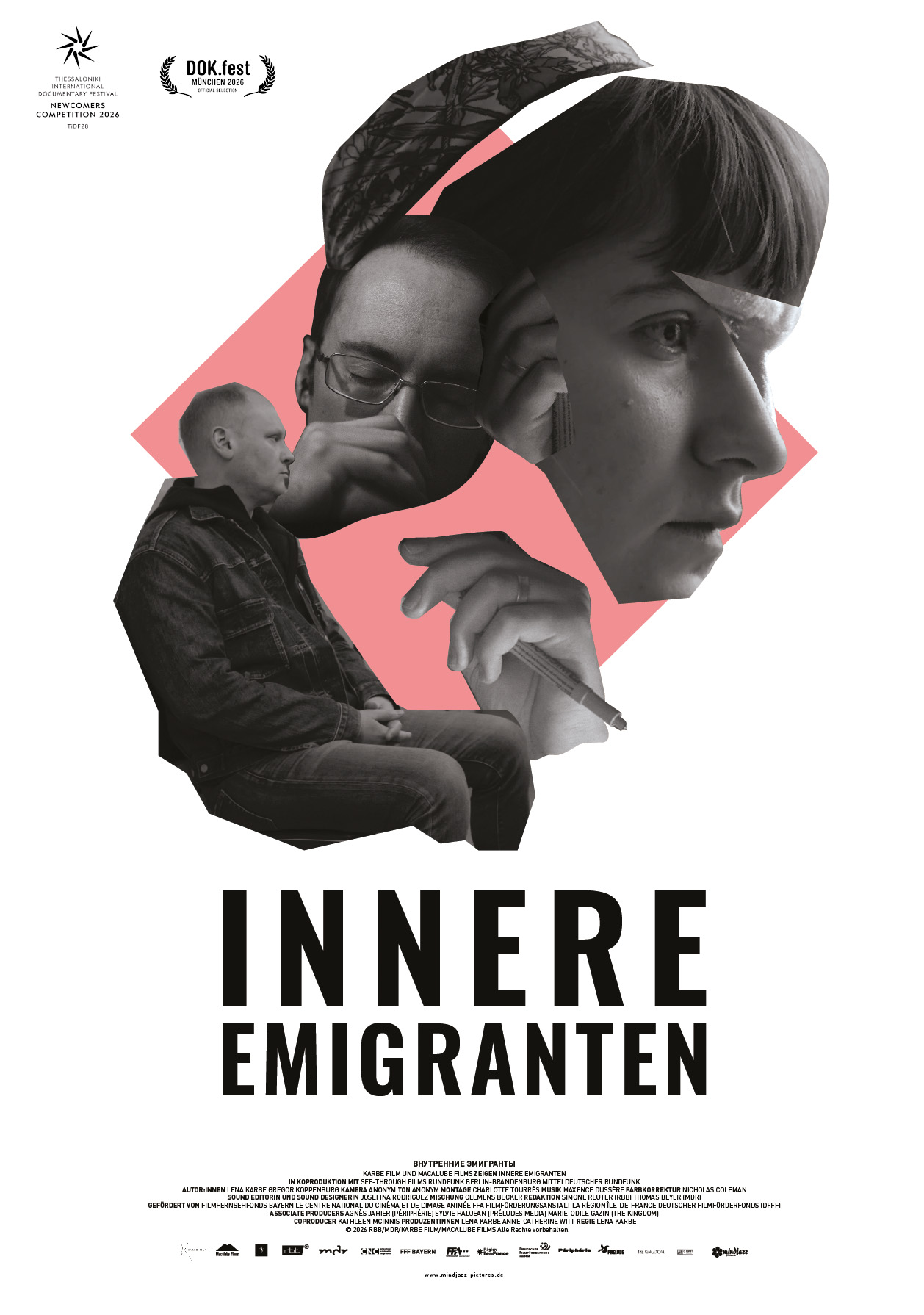
Mindjazz Pictures has acquired the distribution rights in Germany to Lena Karbe’s “Inner Emigrants,” ahead of its world premiere on Monday at Thessaloniki Documentary Festival. The theatrical release in Germany will kick off May 14.
Karbe spent nearly four years traveling undercover to Moscow to chronicle the experiences of three psychologists maintaining an anonymous crisis hotline at the start of the Ukraine war, while at the same time struggling to reconcile their totalitarian regime’s strict demands with their own beliefs.
Born and raised in Russia herself, Karbe (now a German citizen) wanted to explore why Russia’s silent majority was staying silent as the war on Ukraine took hold. “Are they complicit, or — as many Russians say — ‘neutral’?” asks Karbe.
The director says “Inner Emigrants” is “a cautionary tale.”
“What we see in Russia today is that silence allows the totalitarian regime to grow stronger,” she says. “It shows how quickly civil liberties can be dismantled and repression can become normalized, as the majority chooses to turn inward rather than to resist openly.”
Mindjazz Pictures managing director Holger Recktenwald says the film “offers a rare and intimate insight into the psychological inner world of a society living under massive propaganda and state repression since the invasion of Ukraine.”
It asks the question “what silence, conformism and ‘inner emigration’ mean in a totalitarian system,” Recktenwald adds.
It was a film of “strong relevance for German audiences: it sheds light on the mechanisms of authoritarian systems, highlights the psychological strain in the context of war and propaganda, and at the same time opens up a respectful space for debate about responsibility, complicity, resistance, and empathy — without relativizing or blurring perpetrator-victim structures.”
“Inner Emigrants” is produced by Karbe Film and Macalube Films, in co-production with See-Through Films, in co-production with Rundfunk Berlin-Brandenburg, and Mitteldeutscher Rundfunk, with the support of Filmfernsehfonds Bayern, Centre National Du Cinéma et de l’Image Animée, FFA Filmförderungsanstalt, La Région Île-Defrance and Deutscher Filmförderfonds (DFFF).
It is the second feature documentary from Karbe. Her first film, “Black Mambas” (2022), world premiered at CPH:DOX, where it won the F:ACT Award.
