Diabetics in Saratov Deemed Threat to Russian National Security

insulincPatriotic Russian diabetics treat their disease only with domestically produced insulin, such as Rosinsulin, pictured here. Photo courtesy of Medsintez Pharmaceutical Plant

For Insufficient Enthusiasm
Court Rules Saratov Regional Organization of Chronic Diabetes Sufferers “Foreign Agents.” Activists “Undermined the State’s Authority” by Questioning  Insulin Produced in Russia
Nadezhda Andreyeva
Novaya Gazeta
March 28, 2018

Saratov’s Frunza District Court today concluded its hearing of administrative charges against the Saratov Regional Organization of Chronic Diabetes Sufferers. Judge Maria Agisheva ruled the diabetics had violated the law on “foreign agents.”

The defense had asked for a postponement of the hearing, since Moscow human rights lawyer Nikolai Dronov, who had been representing the diabetics in court the past five months, was unable to travel to Saratov today. In addition, the organization’s president, Larisa Saygina, had not been able to read the findings of a forensic examination of the case, submitted to the court on Friday, May 25. Judge Agisheva rejected the defense’s motion, but announced a half-hour recess so the diabetics could read the findings of court-appointed experts.

The forensis examination was carried out by faculty members at the Saratov State Legal Academy (SGYuA). The court had attempted to engage specialists from RANEPA and the Kazan Interregional Expertise Center, but they had turned down the court’s request on various pretexts. SGYuA had also rendered its expert opinion last year, when the administrative case was in the process of being filed. As we reported earlier, Professor Ivan Konovalov saw signs of the work of “foreign agents” in the activities of the diabetics organization. The forensic examination was performed by his SGYuA colleagues Associate Professor Elena Koloyartseva and Professor Viktor Kupin.

According to SGYuA’s experts, the Saratov Regional Organization of Chronic Diabetes Sufferers was awarded a grant of 712,000 rubles [approx. €9,800] from foreign pharmaceutical companies. The authors of the forensic examination thus concluded the organization had engaged in political activity, namely, it had submitted critical remarks about the work of officials to the authorities. According to the political scientists, the organization’s former head, Yekaterina Rogatkina, had publicly expressed doubts about the quality of insulin produced in Russia, thus undermining the Russian state’s authority. [The emphasis here and elsewhere is in the original article—TRR.]

The experts found it noteworthy the media reported on the filing of administrative charges against the diabetics organization. In particular, the commentary of the organization’s current president, Larisa Saygin, filmed for the Saratov TV program “Open Channel” on a city street, was regarded by the experts as a solo picket. According to SGYuA’s faculty members, the news report had been deliberately aired three months before the presidential election in order to discredit presidential candidate Vladimir Putin.

We should recall at this point it was Nikita Smirnov, the head of Putin’s student campaign headquarters in Saratov, who had filed the complaint against the diabetics with the the local prosecutor’s office.

As the experts emphasized in their findings, opposition leader Mikhail Khodorkovsky offered the Saratov diabetics legal assistance, which likewise testified to the organization’s guilt.

As indicated on SGYuA’s website, Professor Koloyartseva studied in the 1980s at the Saratov State Pedagogical Institute. In 2001, she was awarded a kandidat degree in political science. She serves on the public council of the Saratov Regional Duma. She is also a member of Civic Dignity, a grassroots organization that supports social and civic activism among young people and has been heavily involved in forums on moral and spiritual growth sponsored by the authorities.

According to the website Legal Russia, Viktor Kupin graduated from the Lenin Military Political Academy in 1978, while Saratov media outlets earlier reported he studied at the Engels Air Defense Academy.

Until 2007, Professor Kupin taught a course entitled “Philosophical and Political Problems of National Security” at military academies in Petersburg.

In 2004, Professor Kupin defended his doktor dissertation, entitled “The Geopolitical Imperatives of Global Security.”

In 2014, Kupin was an expert in the trial of Partnership for Development, an environmental organization that had operated in Saratov Region since 1995. The NGO received $42,000 from the US government to encourage civic involvement in the region’s villages and small towns. An anonymous complaint against Partnership for Development was filed with the prosecutor’s office on July 10, 2014. On July 22, an administrative case was opened against the organization under Article 19.34 of the Administrative Offenses Code (“Absence of registration in the relevant registry on the part of an organization performing the work of a foreign agent”).

Professor Kupin’s expert finding was ready the very same day. As he explained in court, he wrote the five pages of text in several hours, since he had been asked to do it “as soon as possible.” According to Professor Kupin, Partnership for Development showed clear signs of carrying out the “political orders of a foreign state, orders meant to undermine social stability, generate political tension in the region, expand the base of political influence on public opinion [sic], and  implement US geopolitical interests.”

“The interest in Saratov Region was occasioned by its special place and exceptional geopolitical position in Russia as a lynch pin in the emergent Eurasian Union of Russia, Belarus, and Kazakhstan,” wrote  Professor Kupin. “[Partnership for Development’s] activity runs counter to the security interests of Russia, which opposes the uni-polar dictatorship of the world, headed by the US.”

Less than a month after the prosecutor received the anonymous complaint, a court ruled Partnership for Development was a “foreign agent.” It was fined 300,000 rubles. Its chair, Olga Pitsunova, was also personally fined 100,000 rubles. Partnership for Development closed up shop.

At today’s hearing, Judge Agisheva denied the defense’s motion to summon its own expert witnesses to the trial. The diabetics were fined 300,000 rubles [approx. 4,100 euros]. The organization’s ex-president, Ms. Rogatkina, told us the diabetics would appeal the ruling.

“We are discouraged. This case was absurd from the outset.  We consider it a miscarriage a justice.”
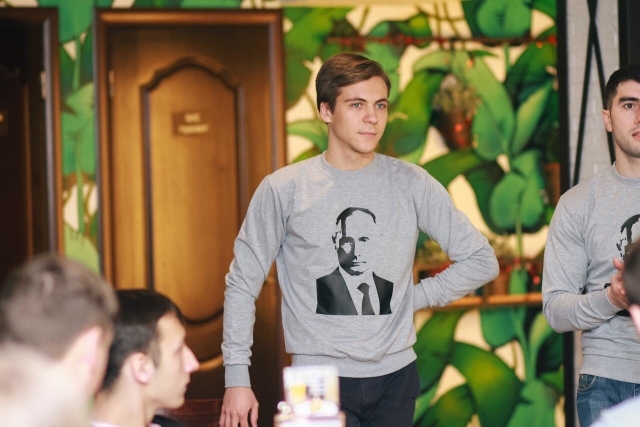
Putinist youth activist Nikita Smirnov. Photo courtesy of Novaya Gazeta

Last year, Mr. Smirnov, a student at the Saratov Medical University and head of Vladimir Putin’s student campaign headquarters, asked the Frunza District Prosecutor’s Office to verify whether the work of the diabetic organizations was covered by the law on “foreign agents.”

As the future physician told us, he had “read on the internet that the organization was financed by foreign companies, I don’t remember which.” He had felt it was his “civic duty” to “send a signal.”

Translated by the Russian Reader
Maria Kuvshinova: What Sentsov Could Die For

What Sentsov Could Die For
Maria Kuvshinova
Colta.Ru
May 25, 2018

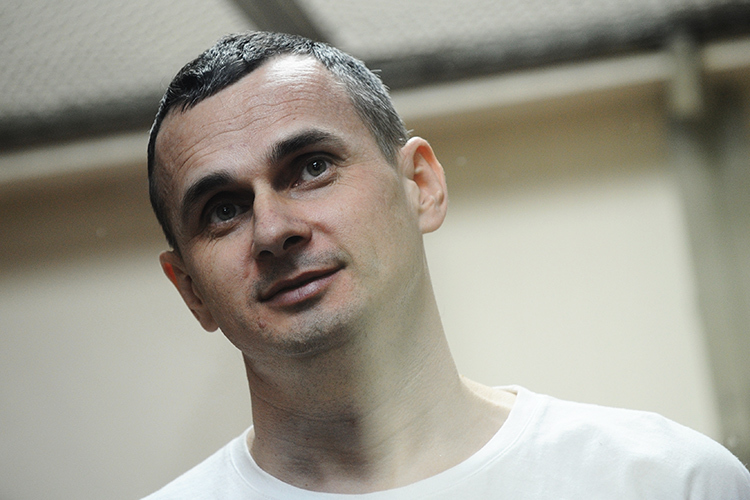
Detailed_pictureOleg Sentsov. Photo by Sergei Pivovarov. Courtesy of RIA Novosti and Colta.Ru 

On May 14, 2018, Oleg Sentsov went on an indefinite hunger strike in a penal colony located north of the Arctic Circle. His only demand is the release of all Ukrainian political prisoners in Russia. According to Memorial’s list, there are twenty-four such prisoners.

In August 2015, Sentsov was sentenced to twenty years for organizing a terrorist community and planning terrorist attacks. The second defendant in the case, Alexander Kolchenko, was sentenced to ten years in prison. Mediazona has published transcripts of the hearings in their trial. Around three hundred people have read them over the last three years. The transcripts make it plain the only evidence of the alleged terrorist organization’s existence was the testimony of Alexei Chirniy, who was not personally acquainted with Sentsov. It is police footage of Chirniy’s arrest while he was carrying a rucksack containing a fake explosive device that propagandists often pass off as police footage of Sentsov’s arrest.

Before his arrest, Sentsov was an Automaidan activist. In the spring of 2014, he organized peaceful protests against Crimea’s annexation by Russia.

“Yesterday’s ‘suicide bomber auto rally’ took place in Simferopol yesterday, but in quite abridged form,” Sentsov wrote on Facebook on March 12, 2014. “Only eight cars, six reporters with cameras, and twenty-five activists/passengers assembled at the starting point. I would have liked to have seen more. Unfortunately, most of the armchair revolutionaries who were invited were afraid to go. The traffic cops and regular police also showed up at the starting line, insisting we not leave for our own safety. We told them our protest was peaceful. We had no plans of breaking the rules, so we suggested they escort us to keep the peace for everyone’s sake.”

The second defendant, Kolchenko, admitted involvement in the arson of an office that was listed in the case file as belonging to the United Russia Party, but which in April 2014 was an office of Ukraine’s Party of Regions. The arson took place at night. It was meant to cause physical damage while avoiding injuring anyone.

The Russian authorities tried to prove both Sentsov and Kolchenko were linked with Right Sector, a charge that was unsubstantiated in Sentsov’s case and absurd in the latter case due to Kolchenko’s well-known leftist and anarchist convictions. Gennady Afanasyev, the second witness on whose testimony the charges against the two men were based, claimed he had been tortured and coerced into testifying against them.

Sentsov and Kolchenko’s show trial, like the show trials in the Bolotnaya Square Case, were supposed to show that only a handful of terrorists opposed the referendum on Crimea’s annexation and thus intimidate people who planned to resist assimilation. The Russian authorities wanted to stage a quick, one-off event to intimidate and crack down on anti-Russian forces. But two circumstances prevented the repressive apparatus from working smoothly. The first was that the defendants did not make a deal with prosecutors and refused to acknowledge the trial’s legitimacy. The second was that Automaidan activist Oleg Sentsov unexpectedly turned out to be a filmmaker, provoking a series of public reactions ranging from protests by the European Film Academy to questions about whether cultural producers would be capable of blowing up cultural landmarks. Segments of the Russian film community reacted to the situation with cold irritation. According to them, Sentsov was a Ukrainian filmmaker, not a Russian filmmaker, and he was not a major filmmaker. The owner of a computer club in Simferopol, his semi-amateur debut film, Gamer, had been screened at the festivals in Rotterdam and Khanty-Mansiysk, while release of his second picture, Rhino, had been postponed due to Euromaidan.

The Ukrainian intelligentsia have equated Sentsov with other political prisoners of the empire, such as the poet Vasyl Stus, who spent most of his life in Soviet prisons and died in Perm-36 in the autumn of 1985, a week after he had gone on yet another hunger strike. The Ukrainian authorities see Sentsov, a Crimean who was made a Russian national against his will and is thus not eligible for prisoner exchanges, as inconvenient, since he smashes the stereotype of the treacherous peninsula, a part of Ukraine bereft of righteous patriots. Sentsov’s death on the eve of the 2018 FIFA World Cup would be a vexing, extremely annoying nuisance to the Russian authorities.

Sentsov is an annoyance to nearly everyone, but he is a particular annoyance to those people who, while part of the Russian establishment, have openly defended him, although they have tried with all their might to avoid noticing what an inconvenient figure he has been. Although he was not a terrorist when he was arrested, he has become a terrorist of sorts in prison, because his trial and his hunger strike have been a slowly ticking time bomb planted under the entire four-year-long post-Crimean consensus, during which some have been on cloud nine, others have put down stakes, and still others have kept their mouths shut. Yet everyone reports on the success of their new endeavors on Facebook while ignoring wars abroad and torture on the home front. Sentsov represents a rebellion against hybrid reality and utter compromise, a world in which Google Maps tells you Crimea is Russian and Ukrainian depending on your preferences. To what count does “bloodlessly” annexed Crimea belong, if, four years later, a man is willing to die to say he does not recognize the annexation?

The success of Gamer on the film festival circuit, which made Sentsov part of the international film world, and his current address in a prison north of the Arctic Circle beg three questions. What is culture? Who produces culture? What stances do cultural producers take when they produce culture? There are several possible answers. Culture is a tool for reflection, a means for individuals and societies to achieve self-awareness and define themselves. It is not necessarily a matter of high culture. In this case, we could also be talking about pop music, fashion, and rap. (See, for example, the recent documentary film Fonko, which shows how spontaneous music making has gradually been transformed into a political force in post-colonial Africa.) On the contrary, culture can be a means of spending leisure time for people with sufficient income, short work days, and long weekends.

Obviously, the culture produced in Russia today under the patronage of Vladimir Medinsky’s Culture Ministry is not the first type of culture, with the exception of documentary theater and documentary cinema, but the founders of Theater.Doc have both recently died, while Artdocfest has finally been forced to relocate to Riga. The compromised, censored “cultural production” in which all the arts have been engaged has no way of addressing any of the questions currently facing Russia and the world, from shifts in how we view gender and the family (for which you can be charged with the misdemeanor of “promoting homosexualism”) to the relationship between the capitals and regions (for which you can charged with the felony of “calling for separatism”). Crimea is an enormous blank spot in Russian culture. Donbass and the rest of Ukraine, with which Russia still enjoyed vast and all-pervasive ties only five years ago, are blank spots. But cultural producers have to keep on making culture, and it is easier to say no one is interested in painful subjects and shoot a film about the complicated family life of a doctor with a drinking problem and a teetotalling nurse.

When we speak of the second type of culture—culture as leisure—we primarily have in mind Moscow, which is brimming over with premieres, lectures, and exhibitions, and, to a much lesser extent, Russia’s other major cities. So, in a country whose population is approaching 150 million people, there is a single international film festival staged by a local team for its hometown, Pacific Meridian in Vladivostok. All the rest are produced by Moscow’s itinerant three-ring circus on the paternalist model to the delight of enlightened regional governors. It matters not a whit that one of them ordered a brutal assault on a journalist, nor that another was in cahoots with the companies responsible for safety at the Sayano-Shushenskaya Dam, where 75 people perished in 2009. What matters is that the festival movement should go on. There is no room in this model for local cultural progress. There can be no free discussion generated by works of art when everyone is engaged in total self-censorship. After I went to Festival 86 in Slavutych, whose curators have been conceptually reassessing the post-Soviet individual and the post-Soviet space, I found it painful to think about Russian film festivals. This sort of focused conceptualization is impossible in Russia. It is of no interest to anyone.

There are two more possible answers to the question of what culture is. Culture is propaganda. Or, finally, culture is only the marquee on a commercial enterprise profiting at the taxpayer’s expense. It is not a big choice, and the kicker is that by agreeing today to be involved in churning out propaganda, milking taxpayers, supplying optional leisure time activities, producing censored works, and colonizing one’s own countrymen for the sake of money, status, and membership in a professional community, the people involved in these processes automatically stop making sense. It is naïve to think the audience has not noticed this forfeiture. It is no wonder the public has an increasingly hostile reaction to cultural producers and their work.

No one has the guts to exit this vicious circle even in protest at the slow suicide of a colleague convicted on trumped-up charges, because it would not be “practical.” The events of recent months and years, however, should have transported us beyond dread, since everyone without exception is now threatened with being sent down, the innocent and the guilty alike.

Post-Soviet infantilism is total. It affects the so-called intelligentsia no less than the so-called ordinary folk. Infantilism means being unable to empathize, being unable to put yourself in another person’s shoes, even if that person is President Putin, a man with a quite distinct sense of ethics, a man who has been studied backwards and forwards for twenty years. Apparently, the message sent to the creative communities through the arrest of Kirill Serebrennikov was not registered. If you want to be a dissident, start down the hard road of doing jail time for misdemeanor charges, facing insuperable difficulties in renting performance and exhibition spaces, becoming an outsider, and experiencing despair. If you want a big theater in downtown Moscow, play by the rules. Like your average late-Soviet philistine, Putin regarded the creative intelligentsia with respect at the outset of his presidential career. (See, for example, footage from his visit to Mosfilm Studios in 2003.) However, a few years later, he was convinced the creative intelligentsia was a rampantly conformist social group who would never move even a millimeter out of its comfort zone and would make one concession after another. A lack of self-respect always generates disrespect in counterparts.

By signing open letters while remaining inside the system and not backing their words with any actions whatsoever, the cultural figures currently protesting the arrests of colleagues are viewed by the authorities as part of the prison’s gen pop, while people who live outside Moscow see them as accomplices in looting and genocide. No one takes seriously the words of people who lack agency. Agency is acquired only by taking action, including voluntarily turning down benefits for the sake of loftier goals. The acquisition of agency is practical, because it is the only thing that compels other people to pay heed to someone’s words. I will say it again: the acquisition of agency is always practical. At very least, it generates different stances from which to negotiate.

Sentsov has made the choice between sixteen years of slow decay in a penal colony and defiant suicide in order to draw attention not to his own plight, but to the plight of other political prisoners. Regardless of his hunger strike’s outcome, he has generated a new scale for measuring human and professional dignity. It is an personal matter whether we apply the scale or not, but now it is impossible to ignore.

Thanks to Valery Dymshits for the heads-up. Translated by the Russian Reader

Varya Mikhaylova: Legal Nihilism

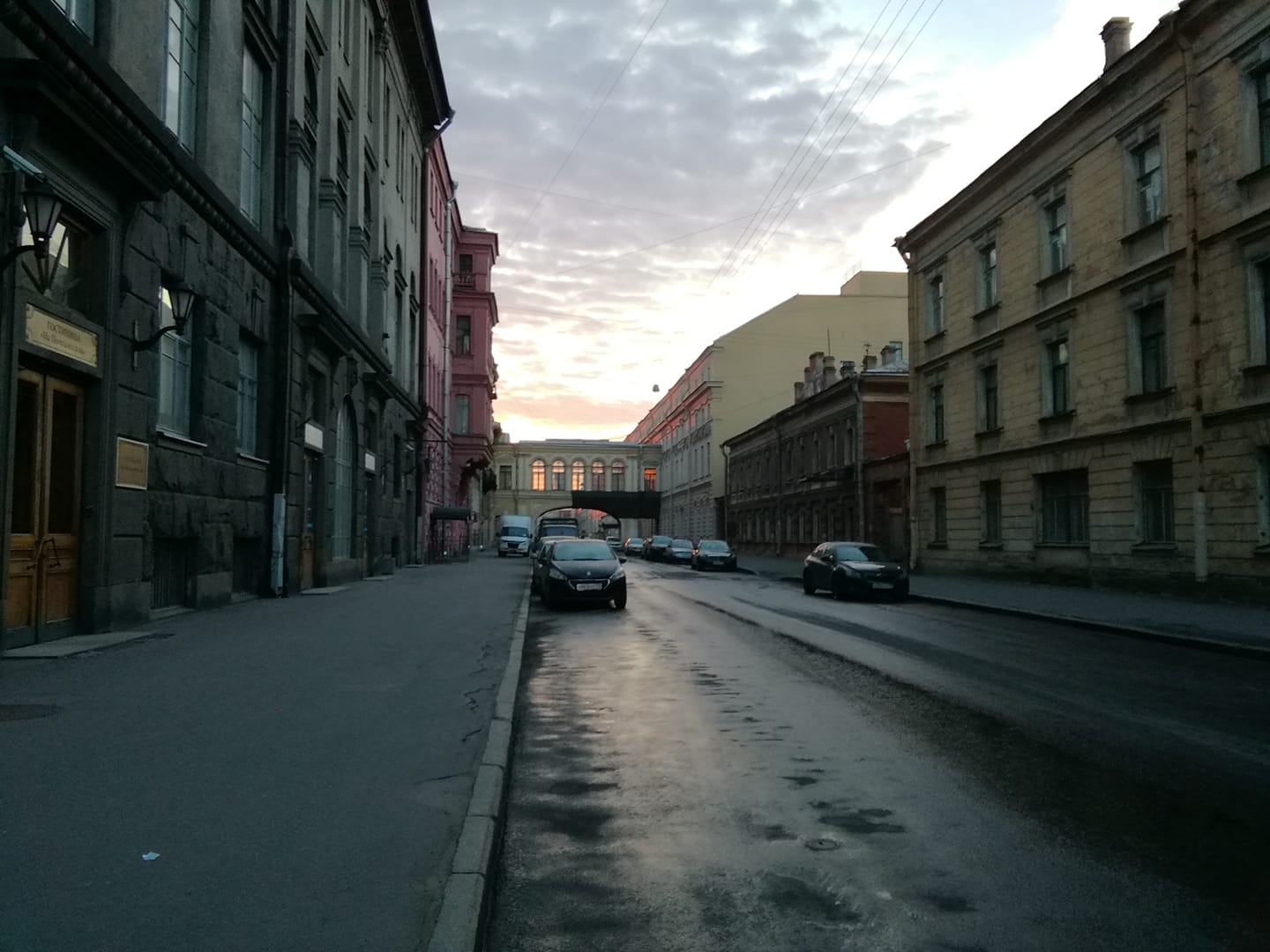
varya-morningDawn outside the October District Court, on Pochtamskaya Street in Petersburg’s Admiralty District. The Central Post Office is visible in the background. Photo by Varya Mikhaylova

Varya Mikhaylova
Facebook
May 7, 2018

I greeted the morning of the day Vladimir Putin started his new term as president in a way that was more than symbolic. At five in the morning, as the first rays of the sun were peaking over the horizon, I left the October District Court, where for the past thirteen hours I had defended people detained during the He’s No Tsar to Us protest rally in Petersburg.

I was afraid to go to court, because what happened in March could easily have happened again. The police had then tried to detain the activists who had come to support their friends right in the courtroom. But by Sunday afternoon this excuse seemed utter rubbish, and I rushed to the October District Court.

Friends of the detainees stood outside the courthouse with bags of food and things. They were not allowed into the courthouse, and the bailiffs refused to take their care packages and give them to the detainees. It was a miracle that me and another human rights activist, Maria Malysheva, were let into the courthouse. By current standards, that was a cause for joy.

There were five detainees in the courthouse. Some of them had been consciously involved in the protest rally and made no bones about it, while the others had come along for the ride, had come to gawk or had just been in the wrong place at the wrong time.

One of my future defendants was an amazing mathematics teacher who, at that point, had not eaten or drunk water for twenty-six hours. After we arrived, we tearfully persuaded the bailiffs to at least send in the food and water brought by the people waiting outside.

A policeman in the courthouse refused to give one young woman her telephone. He sat next to her holding the phone in a cellophane packet and was very proud of his perserverance. After I called the police HQ hotline, however, he handed over the phone to the detainee while looking down at the floor.

After four hours of waiting, we went into the first hearing at 7:15 p.m., while the final hearing commenced at four in the morning. We made around fourteen motions total during the hearings, and all of them were rejected except motions to admit a social defender to the hearings and view a video. Our motions to summon a prosecutor, witnesses, and public officials, request access to a video, enter evidence into the record, and transfer a hearing to another jurisdiction were all turned down. The last motion led to a particularly funny exchange with the judge.

“Defender, why do you think the case should be transferred to another jurisdiction?”

“Your honor, the alleged violation came to light in the area covered by the 78th Police Precinct, and the case should be heard by the Kuibyshev District Court.”

“Why do you say that? It came to light in the 1st Police Precinct.”

(In other cases, it would be the 77th Police Precinct, the 34th Police Precinct, and so on.)

“So, it turns out my defendant was detained and delivered to police custody, but only subsequently, at the police station, did the violation come to light?”

“It turns out that was what happened.”

Neither the judge nor her female clerk concealed their contempt for the protest rally in the slightest.

“You, an educated person, a professor, what induced you to go there?”

“If I had been in your shoes, I would have left as soon as I saw what was happening.”

“Schoolchildren with time on their hands.”

“You should have thought about the possibility of jail time, your job, and your pupils when you were going to the protest, not now, when you ask me not to pass this sentence.”

And so on, and so forth.

The video that was introduced into evidence in every case deserves special attention. It was very long (over an hour), but it contained no footage either of the rally’s beginning, in the Alexander Garden, or its finale, when the police detained protesters. Two of my defendants, who insisted they had not taken part in the march, were not in the video. Another of my defendants was in the video, and the video corroborated exactly what he said during the hearing: that he was involved in the march, but he had not chanted any slogans and was not carrying a placard. So, the video was on our side in absolutely every case, but this did not ruffle the court at all, because the principal mantra that all judges repeat in such cases is, “There are no grounds for not trusting the testimony of the police officers.”

The police are a separate conversation. They have learned to do a better job of compiling the case files than in 2012, but they still make a royal mess of it. Therefore, in the case files of the people I defended, there was no mention of a single witness to the alleged administrative violations or a single official attesting search witness [i.e., a “poniatoi,” as required under Russian law], although all of them had their personal effects confiscated. But the most enchanting episode had to with my defendant Yulya, whose case was heard last, from 3:00 a.m. to 5:00 a.m. I will write a separate post about it now.

The outcomes of the court hearings in which I served as a social defender were as follows. My defendant who was in the march, but did not chant any slogans, was sentenced to a fine of 15,000 rubles [approx. 200 euros] and three days in jail. The two random bystanders were each sentenced to a fine of 10,000 rubles and three days in jail. In the courtroom next door, a female protester who was heavily involved in the rally was sentenced to four days in jail and fine of 10,000 rubles, while another innocent bystander was slapped with two days in jail and a fine of 10,000 rubles.

We plan to appeal all the verdicts, of course.

I gather that the point of these court hearings against people who are involved in protest rallies is not to intimidate everyone, but to inculcate total legal nihilism in each and every one of us. People who deliberately go to a rally, waving flags and bearing placards, are sentenced to four days in jail and 10,000-ruble fines, while random passersby receive the same sentences or worse. Human right defenders who attempt to give detainees blank court appeal forms are slapped with fines of 170,000 rubles [approx. 2,250 euros] and fifteen days in jail.

***

Recently, I was asked how activists could establish links with human right defenders who would stand for them at hearings. My reply was that life in 2018 is such that activists and human rights defenders are quite often one and the same people.

These were the first hearings in which I defended detainees on my own, so feel free to congratulate me.

Translated by the Russian Reader

Varya Mikhaylova: Yulya’s Hearing

Varya Mikhaylova
Facebook
May 7, 2018

Now I want to write separately about Yulya’s hearing, which was the last.

Here is how it was.

At three in the morning, the judge said, “Let’s recess until morning, because, as it is, no one can think straight anymore.”

This was a good suggestion for the judge and me, whose warm beds awaited us at home, but not for Yulya, who would have been shipped backed till morning to a police station where she had not been issued any sleeping gear, and where there was a terrible stench and bedbugs.

So, we begged the judge, if she wanted to postpone the hearing, to do it lawfully and humanely: by releasing Yulya on her own recognizance and letting her go home. Because this was what should have happened to all the detainees, who despite all the regulations and common sense were tried on the weekend in emergency court hearings that were closed to the public.

It was such an emotional conversation, I cried as I appealed to the judge to give my defendant the chance at least to take a shower, get her wits about her, and prepare a normal defense.

But there was a snag, you see. If Yulya had gone home and later failed to appear in court, it would have been impossible to slap her with a jail sentence, which cannot be handed down in absentia. All the court could have given her in absentia was a 1,000-ruble fine. So, the judge told us almost in no uncertain terms that was why Yulya would not go home under any circumstances.

Then we pleaded with the judge to hear Yulya’s case right away. As it was, I could not make it to court in the morning, Yulya would not be able to find another social defender, and she would be shipped immediately back to the stinky police department. Whereas, after the judge made her decision, Yulya would be sent to the temporary detention facility on Zakharyevskaya Street, where she would at least have linens and blankets.

The judge could also have exonerated her and sent her home.

That whole conversation was also quite funny, because the judge did nothing at all to conceal the fact the verdict could only be guilty, although we had not even begun to hear the case, and the judge knew nothing about Yulya whatsoever.

The judge ultimately relented, and the hearing kicked off. Usually, people are initially tried for violating Article 20.2 of the Administrative Offenses Code (violating the regulations for holding public events), and only then for violating Article 19.3 (failure to obey a police officer’s lawful requests). During each previous hearing, I had argued to the judge that if the defendant had already been convicted under Article 20.2, and the aggravating circumstances were failure to obey a policeman’s orders, it would be wrong to try the individual separately for failure to obey a policeman’s orders, since this would violate the basic principle of double jeopardly, something the Russian Prosecutor General’s Office had addressed.

Apparently, the judge was heartily tired of my speech, so she decided first to try Yulya for violation of Article 19.3. She found Yulya guilty and sentenced her to three days in jail.

Then the second hearing, on the charge Yulya had violated Article 20.2, commenced. It was four in the morning.

The case file on this charge had been compiled worst of all. It was such a mess the report confirming Yulya had been delivered to a police station was not signed at all. There was no name and no policeman’s signature. It was just a piece of paper.

We pointed this out to the judge, of course, and that was our big mistake. Because the whole point of these hearings was for the defendants and defenders to take home the message that the more you showed off, the worse it would be for you. Having noted the mistakes in the case file, the judge postponed the hearing until 11:15 a.m. on Monday.

So, Yulya was tried at four in the morning and was sentenced to jail, but she was taken from the courthouse back to the stinky police station anyway.

The police station where Yulya was taken did not have even a chair for her to sit on, and so she was taken to another precinct, where she slept for an hour and a half sitting on a chair. By eleven o’clock, she had been taken back to the October District Court, where her hearing resumed.

She was found guilty of violating Article 20.2 and fined 10,000 rubles [approx. 130 euros]. The police officer whose signature had missing from the delivery report simply put his signature on the report, already bound and filed in the case file.

These photos of Yulya and me were taken at four in the morning when we were waiting for the judge to deliver her verdict in the first case.

Image may contain: 2 people, including Варя Михайлова, selfie and closeup

Image may contain: 2 people, people smiling, selfie and closeup

Translated by the Russian Reader

Search and Intimidate

“Court approval of search warrant requests, 2007–first quarter of 2017. Red=number of warrant requests; gray=warrants issues. || In the past 11 years, Russian courts have approved, on average, 96.3% of search warrant requests. 67% of the requests concerned searches of private premises as part of surveillance operations, while 33% of searches were part of specific criminal investigations. ||Numbers and kinds of intimidation during so-called political searches (based on an analysis of 600 searches conducted in the homes of grassroots activists and members of persecuted organizations): violence, threats – 97; breaking down doors, forced entry through windows – 70; search performed at early hour of the day – 63; search conducted at homes of relatives – 47. Sources: International Agora and Russian Supreme Court Judicial Department.” Courtesy of Vedomosti

How Police Searches Have Become Tools of Political Intimidation
Agora International Says Privacy in Russia Has Nearly Vanished
Anastasiya Kornya
Vedomosti
March 29, 2018

Over the past ten and a half years, Russia courts have issued law enforcement agencies 1,976,201 warrants to search or investigate private premises. This number constitutes 96.32% of all such requests, according to calculations made by analysts at the Agora International Human Rights Group, which on Thursday will release a report entitled “Politically Motivated Police Searches: The Specter of Inviolability.” Often police investigators manage to obtain search warrants after the fact. During the period, the number of requests for search warrants has increased by nearly fifty percent. With respect to Russia’s 54 million households, this means that, over the last ten years, every twenty-seventh home in Russia has been searched.

The report’s authors note this is only the tip of the iceberg. Searches and inspections of non-residential premises, such as offices, warehouses, etc., do not require court warrants, and data on the number of such incursions has not been published by anyone.

The exception to this rule are law offices. Since April 2017, they have enjoyed greater formal protection than the residences of ordinary citizens. Law offices cannot be searched without a court order, and a representative of the regional bar association must be present during the search. Andrei Suchkov, vice-president of the Federal Bar Association, says they have not specially kept track of the statistics, but his sense is the number of searches in law offices has decreased during this time. There have been cases when police investigators tried to carry out searches without permission, but the courts have nevertheless mainly sided with lawyers, he notes.

Agora’s report reminds its readers that, in the early 1990s, the term “mask show,” meaning a police search carried out with backup from masked and armed special forces soldiers, came into common usage. Such searches were an effective means of coercing business partners and business rivals alike. Subsequently, the tool came to be used against the regime’s political opponents.

Recently, the practice of “serial” searches has been widespread. Thus, according to Leonid Volkov, head of Alexei Navalny’s presidential election campaign, police have raided the offices of the Anti-Corruption Foundation and Navalny’s regional campaign offices no less than 150 times. Police have raided the offices of Mikhail Khodorkovsky’s Open Russia around fifty times over three years. Agrora’s analysts note the most frequent targets of large-scale, systematic searches have been members of opposition organizations and Crimean Tatars.

Another goal of police searches is the confiscation of electronic devices and subsequent unauthorized access to personal data, correspondence, and social media accounts. For example, during a June 2012 search of Alexei Navalny’s home, police seized a laptop, tablet computers, and mobile phone. Two weeks later, Navalny’s email and Twitter account were hacked.

In recent years, as Agora’s report underscores, police searches have been a vital element of campaigns against not only political opponents but also government officials. State-controlled national TV channels extensively covered searches in the homes of ex-regional governors Alexander Khoroshavin and Vyacheslav Gayzer, Federal Customs Service chief Andrei Belyaninov, and members of the Dagestani government.

Pavel Chikov, head of Agora, says they took an interest in the numbers of police searches after analyzing the state of privacy of correspondence and telephone conversations. If we recall that, on average, the courts have approved 98.35% of wiretapping warrants, we must admit judicial oversight in this area is illusory, and there is no privacy in Russia, claims Chikov.

Expanding the remit of law enforcement agencies to ever broader areas of daily life has transformed searches from investigative tools to signals broadcast by the regime and received by everyone involved in politics, government, and business, concurs political scientist Mikhail Vinogradov.

“What matters nowadays is not the outcome, but the search per se. We have been seeing an increased number of searches whose point is just that,” says Vinogradov.

Translated by the Russian Reader

Anna Tereshkina: At Viktor Filinkov’s Remand Extension Hearing

Anna Tereshkina
Facebook
March 21, 2018

I went to Viktor Filinkov’s court hearing, where his motion to have his remand in policy custody changed to house arrest was reviewed.

I arrived at the Dzerzhinsky District Courthouse by 10 a.m., already hungry although I had eaten breakfast. Outside the subway station, I bought a pasty and put it in my backpack.

It turned out there was no need to arrive fifteen minutes before the hearing was scheduled to begin, because they kept everyone stewing for over an hour before starting.

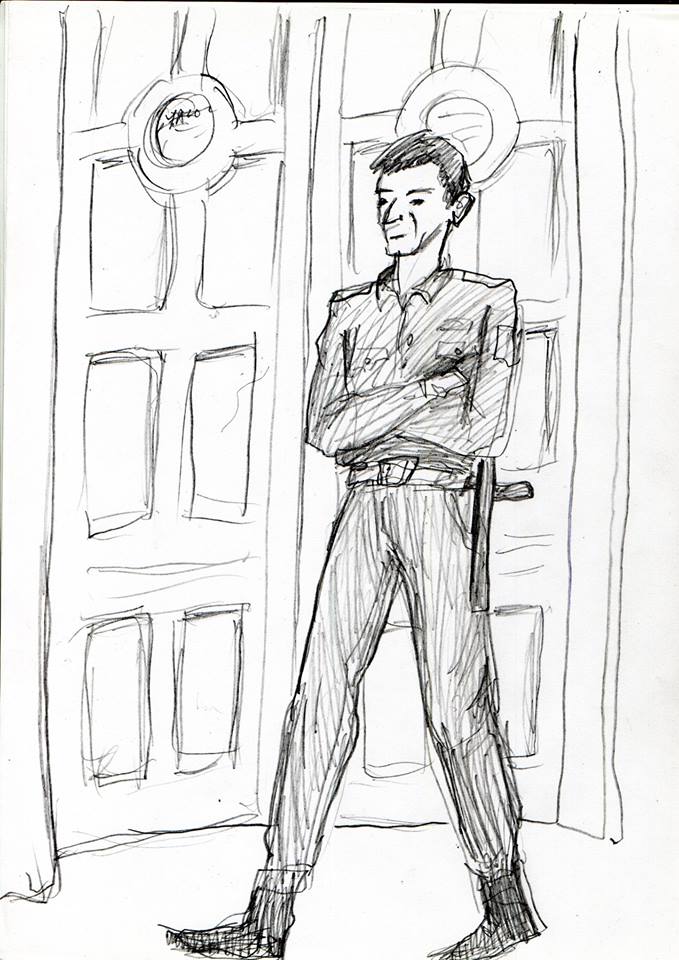
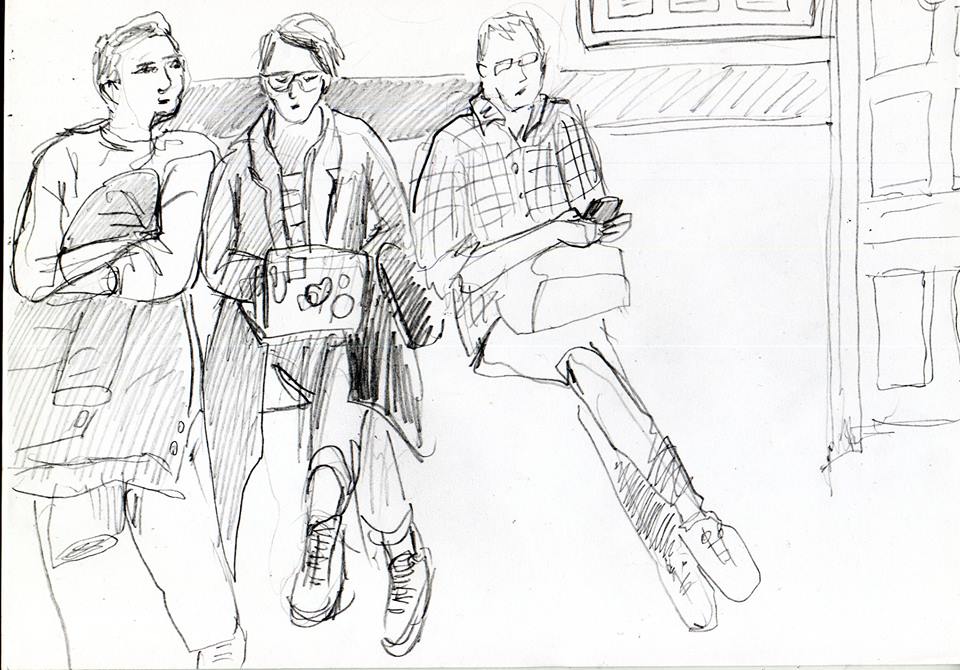
I was able to draw my girlfriends as they languished in the stuffy court building.

tereshkina-filinkov-1

Then a tall, skinny court bailiff herded everyone to the end of the hallway. Viktor was brought in, and everyone raised their arms and focused the cameras on their smartphones. There was a round of applause.

I was somehow expecting a huge ovation, but then it hit me, mournfully, that there were not very many of us, something like fifteen to twenty people, I think. Or is that a lot? Or was every other person monkeying with his or her camera?

We were not let into the courtroom immediately.

Everything seemed quite dicey, as if at any minute they might never let us out of there.

My hands were shaking, so my only drawing of Viktor did not come out very legible.

tereshkina-filinkov-2

Viktor himself looked liked a man who had not lost hope.

I noticed his shoes were tied with strange laces. Were they fashioned from plastic bags, as he had described, or did someone give him white laces for the hearing?

The judge’s voice was unexpectedly kind and polite, like the voice of a school guidance counselor.

We were kicked out of the courtroom, of course, while the court deliberated whether to hold the hearing in chambers or not.

After waiting for an hour, I took out my pasty, which had gone cold.

The lanky bailiff was tormented. He would try and drive everyone away from the passage to the courtroom, the walls, and the doors. But the people who had come to the hearing reacted to him as if he were an annoying fly. The only thing that interested them were the big wooden doors and what has happening on the other side of them.

tereshkina-filinkov-3

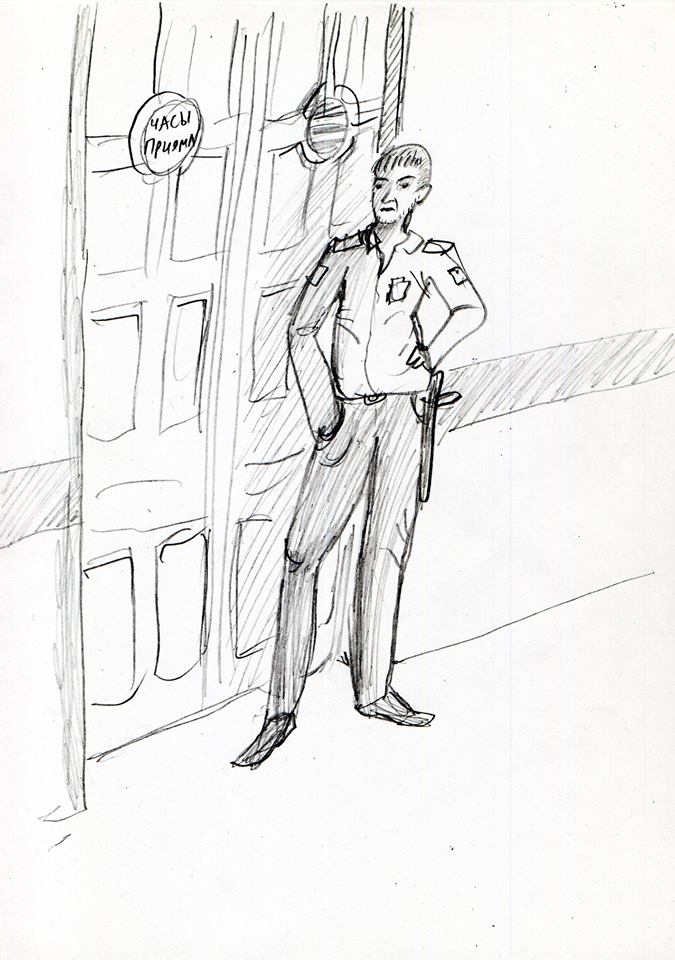
I sketched the bailiff, wondering whether he beat his wife and kids.

tereshkina-filinkov-4

Finally, he called another bailiff, who had bangs and wore ordinary jeans instead of the trousers issued with his uniform. He stood by the door more calmly.

Suddenly, a fresh breeze wafted through the hallway. It was workers carrying furniture. Two massive wooden benches, a wardrobe, and a whole suite of judge’s thrones adorned with crests. One of them had no seat at all, as if its makers had wanted to use it as a toilet at the dacha.

The bailiff with the bangs got distracted and stepped away from the door. One of the workers immediately dashed to our coveted Courtroom No. 9, stuck his nose in the door, and loudly asked, “Can we bring in the wardrobe?”

A clerk in a gray dress came out and said they should wait until the hearing was over.

Yes, the hearing had long been underway, but we had not even been called into the courtroom and told the court had decided to hold the hearing in chambers.

People grumbled and wrote complaints.

Nastya showed me a book, The Suffering Middle Ages, which had a chapter about how, from the twelth to fourteenth centuries, law books were lavishly illustrated with giant penises.

The tall, nervous bailiff returned and once more herded everyone to the end of the hallway.

Viktor was brought out by the guards. The applause and shouts of support were louder than the first time.

The court had again recessed for deliberation. The workers finished their unloading, and stuffiness again reigned in the hallway. Someone brought juice, biscuits, and bananas.

The bailiff with the bangs immediately popped up, saying it was forbidden to eat in the courthouse. He was probably the hungriest of us all.

tereshkina-filinkov-6

For five minutes or so, no one did, in fact, eat anything, but then we passed around the biscuits, divvied up the bananas, and poured the juice into cups. The bailiff didn not feel like reminding us again, apparently, and he said nothing.

Viktor’s defense attorney Vitaly Cherkasov came out and said we would have to wait for at least another hour. We had been sitting there for four hours as it was.

tereshkina-filinkov-5

Many people left the courthouse to have a smoke and eat lunch, so they could come back later.

I left altogether because my brain had completely melted.

I was home when I read that, at 3:46 p.m., the court had ruled Viktor be kept in police custody until June 22.

I felt a sharp pang of the suffocating absurdity that nearly everyone has accepted. But no, I hope they haven’t.

Translated by the Russian Reader. Thanks to Ms. Tereshkin for her kind permission to reproduce her drawing and publish a translation of her text here. All images © Anna Tereshkina, 2018. If you have not heard about the Penza-Petersburg “terrorism” case, you need to read the following articles and spread the word to friends, comrades, and journalists.

Ping, Ping, Ping: The Remand Extension Hearing of the Penza “Terrorists”

Ping, Ping, Ping: A Report from the Remand Extension Hearing of the Defendants in the Penza “Terrorism” Case
Yegor Skovoroda
Mediazona
March 16, 2018


Ilya Shakursky. Photo courtesy of Yegor Skvoroda and Mediazona

Yegor Svokoroda traveled to Penza, where, over the course of three days, the Lenin District Court considered whether to extend the remand in police custody of the antifascists who, according to the FSB, were part of a “terrorist community” known as The Network.

FSB Senior Investigator Valery Tokarev blushes gradually: first the tip of his nose, then his ears, and finally the bald patch that covers half his head. He is arguing with a lawyer, insting on a closed hearing in order to ensure “investigatory privilege.” The lawyer objects.

“The case is at the evidence gathering stage. We have not finalized all the witnesses or the defendants. A number of parties to the crime have not been identified or are on the wanted list,” says Tokarev, his forehead covered with sweat.

This scene was repeated several times in Penza’s Lenin District Court, where, between March 13 and March 15, the arrest in police custody of five antifascists apprehended and charged with involvement in a “terrorist community” was extended. Time after time, Judge Svetlana Shubina closed the hearings to the public and the press.

Ordering that yet another of the accused be remanded in custody to the local remand prison until June 18, Judge Shubina time after time bases her ruling by referring to the particularly complicated nature of the case and the allegation that each of the young men was a member of a “stable, highly secretive criminal group,” and that “firearms and ammunition” were involved. Shubina notes investigators had to finish their numerous forensic examinations and interrogations, and finally indict Sagynbayev, Pchelintsev, Shakursky, Chernov, Zorin, Kuksov, Ivankin, and Kulkov.

Yegor Zorin, a fourth-year student at the Belinsky Pedagogical Institute, was the first person detained in the investigation of the “terrorist community.” The FSB has alleged its members planned, during the March 18 presidential election and this summer’s FIFA World Cup, to “agitate the masses in order to further destabilize the political situation in the country” by setting off bombs; when the H-hour came, they would lead an armed insurrection. Zorin was apprehended on October 17, 2018. There are unconfirmed reports he signed a confession, which was the basis of Criminal Case No. 11707560001000036, concerning organization of and involvement in a terrorist community, per Article 205.4 Parts 1 and 2 of the Russian Federal Criminal Code.

Zorin’s time in the remand prison was not extended. He was jailed there until December 18 and subsequently transferred to house arrest. The press service of the Lenin District Court told Mediazona, however, that after December 18, investigators had not petitioned the court to extend his arrest.


Arman Sagynbayev. Photo courtesy of Yegor Skvoroda and Mediazona

The next to be apprehended were Zorin’s classmate Ilya Shakursky and their common friend Vasily Kuksov during the wee hours of October 19, 2017. On October 27, Dmitry Pchelintsev was detained; he knew Shakursky through the leftist activist scene and because they shared a hobby: airsoft. On November 6, Arman Sagynbayev was detained in Petersburg. He had been to Penza several times for airsoft practice sessions. He was transferred to the Penza Remand Prison. On November 9, Andrei Chernov, another airsoft player and an old friend of Pchelintsev’s was detained.

A passion for airsoft and a sympathy for leftist ideas, anarchism, and antifascism were what all the detainees had in common. The case files contain videos of training sessions in the woods outside Penza, sessions during which the young men used fireworks. The FSB has alleged that the group training sessions were preparation for the insurrection, while the hikes the young men took in the woods constituted “illegal mastery of survival skills in the woods and rendering of first aid.”The airsoft teams in which the antifascists played, Voskhod (“Sunrise”) and 5.11 (“November Fifth”), were cells of a terrorist organization known as The Network (Set’). Aside from Penza, The Network was alleged to have underground cells in Moscow, Petersburg, and Belarus.*

The FSB has alleged the Penzans divided up the roles in their “terrorist community.” Pchelintsev was the leader and ideologue. His deputy, nicknamed Redhead, handled reconnaissance and recruiting, while Sagynbayev, nicknamed Andrei Security, was the engineer and sapper, Shakursky (aka Spike), the tactician, Chernov (aka Twin), the signalman, Zorin (aka Grisha), the sniper, while a certain Boris was also a coordinator and ideologue.

Redhead is Maxim Ivankin, mentioned in the court’s new custody ruling, while in all likelihood the Boris referred to by the security services is M.A. Kulkov. According to our sources, both men have left Russia and are on the wanted list.

The Lenin District Court occupies a three-storey nineteenth-century mansion whose interior has been modernized. The courtroom where the custody extension hearings take place is located in a wing of the building accessible only through doors outfitted with an electronic lock. To gain access to the hallway leading to the courtroom you have to place a card on the lock, which sets off an obnoxious pinging sound. The squeaky alarm goes off constantly. Ping, ping, ping: terrorist community. Ping, ping, ping: investigative privilege. Ping, ping, ping: extend the arrests.

Ping, ping, ping, ping, ping, ping, ping.


Dmitry Pchelintsev and his wife Angelina. Photo courtesy of relatives

A broad-shouldered FSB guard escorts 25-year-old Dmitry Pchelintsev into the room, not taking his eyes off him the entire hearing. Guards just like him also escort the other detainees. Some of them wear balaclavas to conceal their identities, some wear Buff scarves over their faces. Viktor Filinkov, detained in Petersburg, and Pchelintsev himself recounted how they were tortured by men wearing such masks. Pchelintsev recalled how the officers who tortured him later escorted him to the remand prison.

“When I was tortured with electrical shocks, my mouth was full of ‘crushed teeth’ due to the fact I gritted my teeth since the pain was strong, and I tore the frenulum of my tongue. My mouth was full of blood, and at some point one of my torturers stuck my sock in my mouth,” Pchelintsev told his lawyer in order to explain why he had signed a confession.

Soon, after he was beaten again, Pchelintsev recanted his testimony about being tortured. Pchelintsev, who has thick, kinky eyebrows and slightly protruding ears, worked as a target practice instructor after serving in the army. He wears a checkered shirt whose collar he constantly buttons and unbuttons. Cautious at first, he thaws by the end of the hearing, when he manages to chat with his wife Angelina through the glass of the so-called fish tank in which defendants are held during trials and hearings.

Dmitry laughs, talking about books and Alina Orlova songs. He jokes that during the last hearing he was in handcuffs because “Arman was sitting next to me, and they thought I would attack him.”

Alina Orlova sings “I Stroll Around Moscow,” IKRA Club, Moscow, September 29, 2008

“What should I do with your car?” Angelina asks. The FSB claims to have found two grenades under the seat of the old Lada. Pchelintsev said they were planted there.

“Burn it,” says Dmitry, joking once more.

“I’m afraid I’d be arrested.”

“Yeah, you’d also go to jail for terrorism,” Pchelintsev quips. “Actually, I was told we should take it to the junkyard and sell it for scrap.”

Angelina presses her nose against the glass of the fish tank.

Ping, ping, ping, ping, ping, ping, ping.


Vasily Kuksov. Photo courtesy of relatives

29-year-old design engineer Vasily Kuksov appears to be the most confused and indifferent of all the prisoners. His wife Yelena says Vasily was cheerful and life-affirming prior to his arrest. He enjoyed drawing and was into music, performing a year ago at a Vladimir Vysotsky memorial festival at the Penza Philharmonic. Now his case file describes him as an “individual who leads an isolated lifestyle characterized by antisocial behavior.”

Vasily Kuksov performing at the Penza Philharmonic on January 25, 2017

Kuksov has not complained that FSB officers were violent with him, but his friend Ilya Shakursky recalled that, when they were taken to the FSB building in Penza, first he heard Kuksov’s groan and then later saw him, his face badly mangled. Nevertheless, Kuksov avoided testifying by invoking his right not to incriminate himself under Article 51 of the Russian Constitution.

A pistol was confiscated from his car. According to his loved ones, the gun had been planted there.

Kuksov is the only prisoner whom the investigator allows to talk with his mother for a long time during the recess [sic].

As he listens to the judge’s ruling, Kuksov zips and unzips the zipper of his black winter jacket.

Ping, ping, ping, ping, ping, ping, ping.

“They blindfolded me, tied my hands, and stuck a sock in my mouth. Then I thought they wanted to leave my fingerprints on something, but later they attached wires to my big toes. I felt the first surge of current, and I could not hold back the moaning and shaking. They repeated the procedure until I promised to say what they told me to say. After that, I forgot the word ‘no’ and said everything the officers told me to say,” recalled 21-year-old antifascist Ilya Shakursky.

Shakursky was a classmate of the first person arrested in the case, Yegor Zorin. Both of them were studying to be physics teachers.

Shakursky is a thin young man with a shaved head and a deep wrinkle on his forehead. He is a well-known activist in Penza. He used to be involved with Food Not Bombs, and he was himself always organizing everything from lectures to trips to the woods to pick up trash. Before the antifascist rally held annually on January 19, he sent friends a letter in which he wrote, “If I were on the outside, I would definitely attend the memorial event for two great heroes, Nastya Baburova and Stas Markelov.”

Recently, relations between him and Pchelintsev had been strained. The young men had fallen out over Shakursky’s ex-girlfriend Victoria Frolova. They had fought several days before Shakursky’s arrest. The FSB officers who were staking out the alleged terrorist group were surprised to see two members of the “stable” group brawling.

When the judge reads out the ruling, Shakursky, dressed in a gray track suit, lifts his left eyebrow slightly and folds his hands behind his back.

Shakursky’s mother sobs.

Ping, ping, ping, ping, ping, ping, ping.

When questioning 28-year-old Andrei Chernov’s mother after her son was arrested, the investigator wondered aloud whether she knew he had a secret nickname, Twin.

“He’s had the nickname since he was a kid,” Tatyana Chernova says, recalling her outrage. Next to her is Alexei Chernov, Andrei’s twin brother.


Andrei Chernov. Photo courtesy of Yegor Skvoroda and Mediazona

The Chernov brothers studied in the same department at the pedagogical institute as Zorin and Shakursky, but they dropped out before the other young men had enrolled there. Subsequently, Andrei went to work at a factory where he assembled water heaters. He was apprehended on the shop floor.

According to his defense attorney, Stanislav Fomenko, Chernov had not been subjected to violence by the FSB. Tatyana Chernova adds that her son signed a confession after Dmitry Pchelintsev, who had been tortured, spoke with him. Chernov has now recanted his testimony.

Andrei wrote to his mother that after human rights activists spoke out about the plight of the young men and the press published articles about the so-called Penza Case, the guards and wardens at the remand prison often visited his cell to perform spot checks, videotaping everthing he did.

Chernov was finally examined by an ophthalmologist (there were suspicions he had a detached retina). The doctor for some reason prescribed him antibiotics.

Chernov smiles the most of all the defendants. If it were not for the fish tank, it would be impossible to tell him apart from his brother.

“My son is not guilty of anything. Sure, he played airsoft and studied survival skills, but lots of people are into that. I will fight for my son till the end of my days,” says Tatyana Chernova.

Ping, ping, ping, ping, ping, ping, ping.

No one has come to the courtroom [sic] to support 25-year-old Arman Sagynbayev, transferred to Penza from Petersburg,** and yet he is cheerful and talkative.

Arman was born in Novosibirsk, where his mother, stepfather, ex-wife, and their five-year-old daughter still live.

He has spent the last several years in Petersburg, where he was convicted of petty theft (Article 158 Part 1 of the Criminal Code) and sentenced to a fine of 6,000 rubles. When Sagynbayev’s room was searched, the security services allegedly found a bucket of aluminum powder, four kilograms of ammonium nitrate, two alarm clocks, and various radio components.

After his arrest, Sagynbayev fully acknowledged his guilt. He is still cooperating with investigators. He has no objections when Deputy Prosecutor Sergei Oskolkov moved to extend his arrest.

“He has no complaints. He has not claimed he was tortured. He cooperates with the investigators and gets privileges in return for his cooperation. He was now given the chance to speak with his mother. He spoke with her the entire recess [sic]. Arman has a separate cell,” says his lawyer, Rakhmanova [sic].

In the remand prison, her client, who suffers from a serious illness, receives timely medical care, she emphasizes, without specifying what the illness is

At the beginning of the week, Sagynbayev was sent under armed guard to Saratov, where he was examined at the St. Sophia Regional Clinical Psychiatric Hospital. He is the only suspect in the case who has been made to undergo an inpatient forensic examination.

“He said lots of things to our experts about anarchy and social revolution. They said he was deluded and refused to render an opinion, recommending he be hospitalized,” Rakhmanova explains.

According to the attorney, the doctors in Saratov concluded Sagynbayev was mentally competent.

Ping, ping, ping, ping, ping, ping, ping.

* The name of the airsoft team 5.11 had nothing to do with the revolution allegedly scheduled by nationalist Vyacheslav Maltsev for November 5, 2017. According to various sources, the name refers either to a popular brand of tactical clothing and equipment or to the date when seventeen-year-old Penza anarchist Nikolai Pchelintsev was hanged in 1907. Historians Alexander Kolpakidi and Gennady Potapov write that Pchelintsev took the blame for the murder of a gendarme during a shootout, counting on the court’s mercy towards him as a juvenile, but instead was sentenced to death. His burial site in the Abrekov Woods near Penza is marked by a monument to fallen revolutionaries. Mediazona has been unable to ascertain whether Dmitry Pchelintsev is a distant relative of Nikolai Pchelintsev.

** The FSB apprehended antifascists in Petersburrg late January 2018. According to the FSB, the city was home to two cells of The Network, code-named Jordan and Field of Mars. The investigation of the Petersburg case, Case No. 11807400001000004, is supervised by FSB investigator Gennady Belyayev. After they were detained, Igor Shishkin and Viktor Filinkov confessed their guilt. Filinkov soon recanted what he claimed had been rehearsed testimony and gave a detailed account of how FSB officers had tortured him with an electric shocker. Shishkin has said nothing about torture, but doctors recorded bruises, abrasions, and a fracture to the lower wall of his eye socket, while members of the Petersburg Public Monitoring Commission found numerous traces on his body that resembled burns made by electric wires.

Translated by the Russian Reader

If you have not heard about the Penza-Petersburg “terrorism” case and the related crackdown against Russian grassroots and political activists on the eve of the March 18 Russian presidential election, you need to read the following articles and spread the word.


“Young People Gathered to Voice a Silent Reproach”: Dmitry Borisov’s Closing Statement in Court

“Young People Gathered to Voice a Silent Reproach”: Dmitry Borisov’s Closing Statement in Court
OVD Info
February 21, 2018

Dmitry Borisov. Photo by Irina Yatsenko. Courtesy of OVD Info
Moscow’s Tverskoy District Court is scheduled to pass sentence on Dmitry Borisov at twelve noon on February 22. Borisov is a defendant in the so-called March 26 Case, involving various “forceful actions,” allegedly taken by protesters against policemen and Russian National Guardsmen on Pushkin Square during a March 26, 2017, rally inspired by Don’t Call Him Dimon, a video exposé posted on YouTube on March 2, 2017, by anti-corruption activist and would-be presidential candidate Alexei Navalny. The video accused Russian prime minister and former president Dmitry Medvedev of wide-ranging corruption. The prosecution has asked the judge to sentence Borisov to three years in prison.

The court heard the defense’s and prosecution’s closing arguments, as well as Borisov’s closing statement on February 20. According to our count, forty-six people came to the hearing to support Borisov, many of them wearing t-shirts emblazoned with his picture. Prosecutor Larisa Sergunyayeva rattled off her closing argument, a printed text that she read out to the court. During her speech, activist Ildar Dadin called her a few rude names. Dadin was removed from the courtroom, but Sergunyayeva did not slow down her rapid-fire delivery.

According to Sergunyayeva, the testimony given by policemen was believable, while the testimony of protesters could not be trusted because they had a stake in the case’s outcome. Borisov’s malicious intent was allegedly proven by the discovery of a chat session on Telegram chat on his elephone in which he had written about planning to go to the rally with friends. Many positive character references were made on Borisov’s behalf, and he had no criminal record, but if the prosecutor has her way, he will spend three years behind bars for violating Article 318 Part 1 of the Russian Criminal Code, which stipulates a maximum punishment of five years in prison.*

Borisov’s attorneys, Ilya Novikov and Nikolai Fomin, spoke for about an hour and a half. They explained Borisov had been standing calmly at the rally when, for no apparent reason, police seized his friend and dragged him to the paddy wagon. Borisov grabbed his friend. The police knocked Borisov to the ground and beat him. Four of them dragged him to the paddy wagon. The lawyers explained the prosecution’s claim Borisov had wrested a leg free from one of the policemen carrying him and kicked him in the helmet was untenable, since the policeman who had testified he had seen this was located somewhere where he could not have seen the incident. They also argued the policemen who were witnesses in the case had perjured themselves when discussing the administrative charges also filed in connection with the events of March 26, 2017. They argued that if Borisov really had kicked the policeman’s helmet, he probably would have broken his visor, because Moscow police are currently outfitted with extremely poor-quality helmets. Finally, the defense pointed out the alleged victim did not immediately file charges. He did so two months later, apparently under pressure from Investigative Committee detectives Alexander Uranov and Rustam Gabdulin, notorious for their involvement in the Bolotnaya Square case. They handled the investigation of the March 26, 2017, case in exactly the same manner.

The defense attorneys predicted the court would hand down the worst sentence possible.

OVD Info has published Dmitry Borisov’s closing statement in court, below. The transcript may contain a few mistakes, because the accused spoke softly.

Dmitry Borisov: Closing Statement in Court
Your honor, the lawyers spoke very professionally, for which I am quite grateful. I did not use violence against police officers, nor did I intend to do so, because, at very least, it would have been senseless to do so. I had been captured by four policemen and was in a vertical position. All I could see was the sky.

I honestly do not understand why for nine months running I have been traveling to interrogations and court hearings not from home, but in trucks in which fifteen people sit in a three meter square cage. After sitting in this cage for seven hours, they faint and have to urinate in bottles, because the truck is parked in the garage of the Moscow City Court.

I also do not understand why I have spent many hours in the so-called assembly cells at the remand prison, that is, halfway between my cell and the trip to court. These cells are sixteen meters square, and fifty men, all of them smoking, are crammed into them. That is more than three persons per square meter. Try and imagine three men smoking in a one square meter space. Try and imagine how they feel. These cells are so filthy many people would not believe such a thing was possible in the capital of our mighty country. I do not want that to sound too sarcastic. I love my country, and that is a partial explanation of why I was in Pushkin Square on March 26. There are people who say you can judge a city by the cleanliness of its toilets. If you saw the toilet in the assembly cell you would think you were in a village on the outskirts of a godforsaken banana republic.

As for the cells in Butyrka Prison, they are scruffy, filthy dungeons with a view, for example, of an unimaginably dirty brick wall. That is the view in my cell. There is no heat. We have a single radiator in our cell, but it does not work. The ventilation consists of nine tiny holes, although the cell houses twenty-eight smokers.

My lawyers have spoken about how the case was politically motivated from the get-go. The actions of the investigators and their assistants were aimed from the very outset at proving my guilt. Although Ilya Novikov has spoken about it, I would like to mention the photograph of eight defendants in the Bolotnaya Square case that proudly hangs above Investigator Uranov’s desk, with the sentences they received written below each defendant in increasing order. If I am not mistaken, the longest sentence was four years. Apparently, Mr. Uranov is especially proud of this picture. I personally witnessed him getting on the internet and searching for news about how he had apprehended “enemies of the people.” He was upset when he discovered his name spelled incorrectly in one article. I cannot remember whether his first name is Alexei or Alexander, but it was written incorrectly in the internet. He was quite adamant on this point.

As for the case itself, my guilt consists only in the fact I tried to prevent my friend from being abducted. In the opinion of some people, he was in the wrong place at the wrong time on March 26 in Pushkin Square. I am convinced it is wrong to grab people in the center of our country’s capital as if they were animals and drag them to a paddy wagon without identifying yourself and explaining the charges, even if you are wearing a security services uniform.

And that day more than a thousand people were detained.

They were detained not for holding an unauthorized rally, but for making a silent reproach. It took me a long time to find the right word to express what happened there. Young people gathered there to voice a silent reproach, to force the authorities to think a little.

We did not gather to engage in bloody revolution, but to remind the authorities it is worth giving things some thought. Otherwise, their actions really will lead to hungry bloody riots. Therefore, I ask you to exonerate me. I am not guilty of anything. I have been in jail for nearly eight and a half months for no reason at all.

*Use of violence that does not endanger human life or health, or threats to use violence against a representative of the authorit[ies], or his relatives, in connection with the discharge [of] his official duties, shall be punishable by a fine in the amount of 200 to 500 minimum wages, or in the amount of the wage or salary, or any other income of the convicted person for a period of two to five months, or by arrest for a term of three to six months, or by deprivation of liberty for a term of up to five years.” Source: The Criminal Code of the Russian Federation

••••••••••

OVD Info reported that on February 22, 2018, the Tverskoy District Court found Dmitry Borisov guilty as charged and sentenced him to one year in a medium-security penal colony.

Translated by the Russian Reader

Solidarity with Persecuted Russian Antifascists and Anarchists in NYC and Minneapolis

27540850_322877634890103_3528138355329883641_n

Metropolitan Anarchist Coordinating Council – MACC
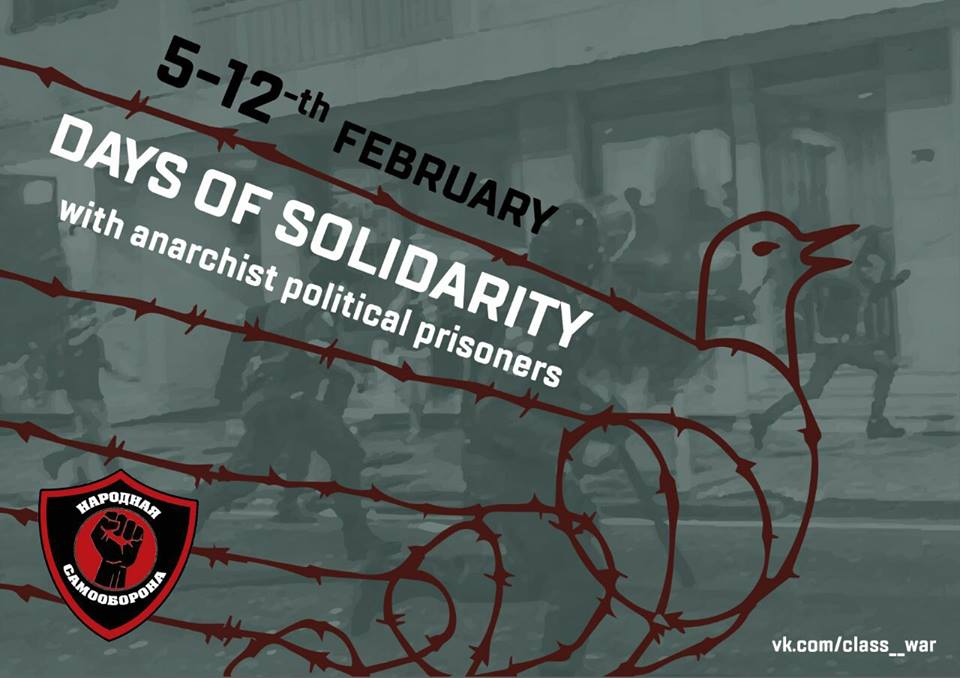
As part of the week of solidarity with Russian anarchist political prisoners there will be a demo at the Russian Consulate, 91st Street, today, February 7, 2:30 PM–4:00 PM.

#Antifa #Antifascism

More information on the recent arrest and torture of anarchist and antifascist political prisoners here:

https://freedomnews.org.uk/russia-arrests-and-torture-of-anarchists-and-antifascists/

•••••••••••

Solidarity with Russian Anarchists
The Base
1302 Myrtle Avenue, Brooklyn, New York 11221
7 PM–10 PM, February 8, 2018

Six anarchists have been arrested in Penza, Saint Petersburg, and Crimea, from October 2017 to February 2018, by officers of the Russian Federal Security Service (FSB) on charges of involvement in a terrorist group. During this period, there have been raids on the homes of anarchists and antifascist all over Russia. The arrested anarchists have been tortured into falsely confessing their involvement in the imaginary network. This is clearly a state-fabricated conspiracy being used to eradicate the anarchist movement.

As the support team says, “These repressions can only intimidate people and crush the anarchist movement. In this case it’s necessary to show that we are not afraid and we can’t be destroyed by their force. Otherwise, the repressions will be used every time when the anarchist movement attracts the notice of the FSB. We must show them that the stronger their crackdowns are, the more furious our resistance is.”

We are hosting a movie and information session about the broader anarchist and antifascist movement in Russia, and talking in more detail about this particular case.

About the movie
Antifascist Attitude is the first-ever documentary film on the emerging Russian antifascist movement made by activists themselves. The movie features moderate NGO activists and radical grassroots activists and anarchists from three cities: Moscow, St. Petersburg, and Irkutsk. It also features the antifascist lawyer Stanislav Markelov, murdered by neo-Nazis in Moscow on January 19, 2009.

Come and learn about what’s happening and ways to support our comrades in Russia!

•••••••••••

Solidarity Dinner with Russian Antifascists
Twin Cities IWW General Defense Committee Local 14
5:30–8:00 p.m., Saturday, February 17, 2018
2101 Hennepin Ave, Minneapolis, MN, United States

Join the General Defense Committee for a dinner, discussion, and letter writing to support antifascists targeted by the FSB crackdowns in Penza and St Petersburg.

The far right rises in the US, in Russia, and across the world, attacking oppressed peoples, immigrants, and working class revolutionaries. Antifascists are fighting against nationalist hate across borders, and facing attacks from the ruling class’s governments. In Russia, the FSB (Federal Security Service) are hard at work arresting, torturing, and framing antifascist activists in Penza, St. Petersburg, and elsewhere.

The Anarchist Black Cross in Moscow and St. Petersburg has asked for international solidarity with the Russian anarchists facing repression. We will be holding a dinner in the IWW offices at 2101 Hennepin Avenue South, Suite 101, Minneapolis, on Saturday, February 17, 2018, from 5:30 p.m. to 8:00 p.m.

We’ll discuss the situation in Russia as well as the repression faced by anarchists in Belarus, Ukraine, and other countries. We’ll collect donations, provide a space for letter writing to the defendants, and facilitate discussion on further international solidarity work with political prisoners, labor organizers, and anti-authoritarians.

https://libcom.org/news/support-anarchist-antifa-prisoners-stpetersburg-penza-31012018

https://itsgoingdown.org/call-international-days-solidarity-russian-anarchist-political-prisoners-feb-5th-12th-2018/

https://avtonom.org/en/news/how-stability-has-really-been-achieved-russia

Diana Rudakova: Seven Days in Jail for Supporting the Wrong Candidate

intro_diana 1
Diana Rudakova

Diana Rudakova, Navalny’s Tambov Campaign Coordinator, after Seven Days in Jail: “I Wasn’t Afraid and Did My Best”
Yekaterina Ivanova
7X7
November 13, 2017

Diana Rudakova, Alexei Navalny’s campaign manager in Tambov, was released on November 8 after spending seven days in the police special detention center. Rudakov was detained on November 1 after holding a well-attended rally, featuring Navalny, on October 29. 7X7‘s correspondent caught up with Rudakova and found out what her court hearing was like, what violations she was accused of, and why she went on hunger strike at the detention center.

Diana, let’s start with the background. Tell us how Tambov got ready for the meeting with Navalny this time round. As far as I know, you again had problems with the venue and contractors.

Our preparations were long and thorough. We distributed over eight thousand invitations to the meeting with Alexei. We looked for contractors and equipment. It was quite complicated, of course: people are afraid to work with us, afraid of pressure from the mayor’s office. So we looked for contractors in neighboring towns, but even that doesn’t guarantee you will get a stage and sound equipment. For example, our contractor from Ryazan turned around at one in the morning when he was halfway to Tambov. He said they had put the squeeze on him. He couldn’t work with us even though it meant he didn’t work at all that day. So we found another contractor in the middle of the night. On the day of the meeting with Alexei, we noticed all the roads around the shopping center [the meeting took place at the Bashnya Shopping Center on the outskirts of Tambov] had been blocked. We immediately made up our minds that the stage could not be transported to the venue, so we were ready to physically drag it there.

Plus, there were the sudden KVN [Club of the Funny and Inventive] performances, meant to distract young people and compete against the meeting with Navalny?

We didn’t even bother with the KVN command performances. They were trifling compared to the problems we had to solve on the eve of the meeting. But the meeting took place. It had to take place. Navalny met with supporters in a field. He spoke standing atop a speaker case and a small table. So, the simplest recipe for a successful meeting is Alexei and a group of people.

How many people showed up? How many people did you count on?

I was really happy with how the meeting turned out. I had expected half as many people to show up. We got a quite accurate count of the attendees, because we had handed out invitations, keeping the stubs for ourselves. We also counted the number of people who signed up on our mobile app. We handed out tickets to 1,243 people, and 1,291 people signed up on the mobile app. So the real number was somewhere in the middle. Plus, lots of people stood outside the fence: they didn’t come in, because it was closer to the stage. This was about two or three hundred people. So, all in all, there were about 1,500 people. This makes it, of course, the largest such event in Tambov history, not counting United Russia  “rallies,” where people were forced to attend.

Tell me all about your arrest. How did it happen? What were the charges? Why did they send you to jail?

Literally the day after the meeting, I came to work and saw policemen in our campaign headquarters. What was surprising was they had decided to arrest me for a solo picket I had held on October 7. Apparently, they had already written up the charge sheet and were holding onto the case file like a trump card, which they could pull out when it suited them and punish me. After detaining me at the office, they took me straight to the Soviet District Court. If a Navalny campaign volunteer is tried in the Soviet District Court, there’s a 100% likelihood of jail time. As we were approaching the court building, but hadn’t yet entered it, the policemen were already figuring out how they would drive me to the special detention center. I asked one of them to pretend to be lawful at least and wait until after the hearing. “Diana Borisovna,” he replied, “you’re an intelligent woman, and you know things work.”

You wrote on Facebook that the hearing was a pure formality.

The hearing lasted between ten and twelve minutes. The judge came into the courtroom with a pre-prepared ruling and commenced to read it out. He didn’t let my lawyer or me make a final statement. So I was sentenced to seven days in jail. I’m certain that the punishment had to do with the regime’s need to make an example of me to others. Because the authorities have stopped authorizing meetings with Navalny altogether. Holding meetings on private premises would have been a way out of this impasse. After our successful meeting, the federal campaign headquarters decided to focus on this format.

What prompted you to go on hunger strike?

After I found that my deputy coordinators and campaign office volunteers had been detained and sentenced to jail, I realized things could not go on this way and I went on hunger strike. [Leonid Yarygin was sentenced to 25 days in jail; Igor Slivin, to 20 days in jail and a fine of 300,000 rubles; and Margarita Zaitseva, to 5 days in jail.]

When you were in the detention center could you receive information from the outside? Did you know that many people tried to support you emotionally, that they handed out leaflets and circulated petitions?

A huge thanks to the folks and reporters, my friends and comrades who helped me on the outside by signing petitions, writing letters, reaching out to the independent media, and publicizing what happened to our campaign staff. After I went on hunger strike, a policeman immediately (ten minutes later) came to the detention center to write me up for violating Article 19.3 of the Russian Federal Administrative Code (“Disobeying a police officer’s lawful request”), because the day before I had refused to be fingerprinted and photographed, as was my right under the law. The next day, the policeman came again to write me up for something else. The deputy prosecutor and the prosecutor, all kinds of ombudsmen and overseers kept coming and going. A doctor constantly came to see me. Not a day went by when there wasn’t someone burning with the desire to talk to me about my hunger strike. So, if I hadn’t done it, my time in jail probably wouldn’t have been so rich.

Of course, I knew many of my friends and comrades on the outside were doing a lot to publicize the nasty things that happened to our campaign staff. If it hadn’t been for them, everything would have turned out differently. If it hadn’t been for them, I probably wouldn’t have made it out of the detention center, but would have immediately been dispatched to another court, where I would have been sentenced to another stint in jail.

I simply cannot thank people enough. A huge thanks to the campaign office volunteers who kept our office running, welcomed visitors, collected signatures on petitions, and plastered the entire city with leaflets defending Leonid, Igor, and me. They held solo pickets. When I was released and I was able to see all this, I was really touched. It’s quite hard to get information in the detention center, because you’re issued a mobile phone once a day for fifteen minutes and only to make calls.

How are things in the Tambov campaign headquarters now? What are your plans for the near future? Are you ready to throw in the towel after what has happened? You’re a young woman, after all, but now you’ve been arrested and spent time in a detention center.

Now we simply have to do what we need to do. I’m guided by the famous proverb, “Do what you must, and come what may.” I’m doing my best so that in the future, however it turns out, I can say I did everything I could, whether Russia becomes free or, on the contrary, remains unfree. In either case, I won’t have to be ashamed I was afraid. I wasn’t afraid and I did my best.

Diana Rudakova is 25 years old. She graduated from the architecture and construction program at Tambov Technical University in 2015. Her graduation project won third place in the Russian Nationwide Landscape Architecture Competition, which took place in Moscow at the Central House of Architects.

In 2012, Rudakova was co-organizer of a campaign opposing the merger of Tambov’s two universities, Tambov State and Tambov Technical, a campaign in which over 1,200 students were involved. From 2015 to 2017, Rudakova worked as a landscape designer in the Tambov Municipal Amenities and Landscaping Department while also being involved in the historical preservation movement. Since May 26, 2017, Rudakov has run Alexei Navalny’s campaign headquarters in Tambov.

Translated by the Russian Reader. Photo courtesy of 7X7 and Diana Rudakova