
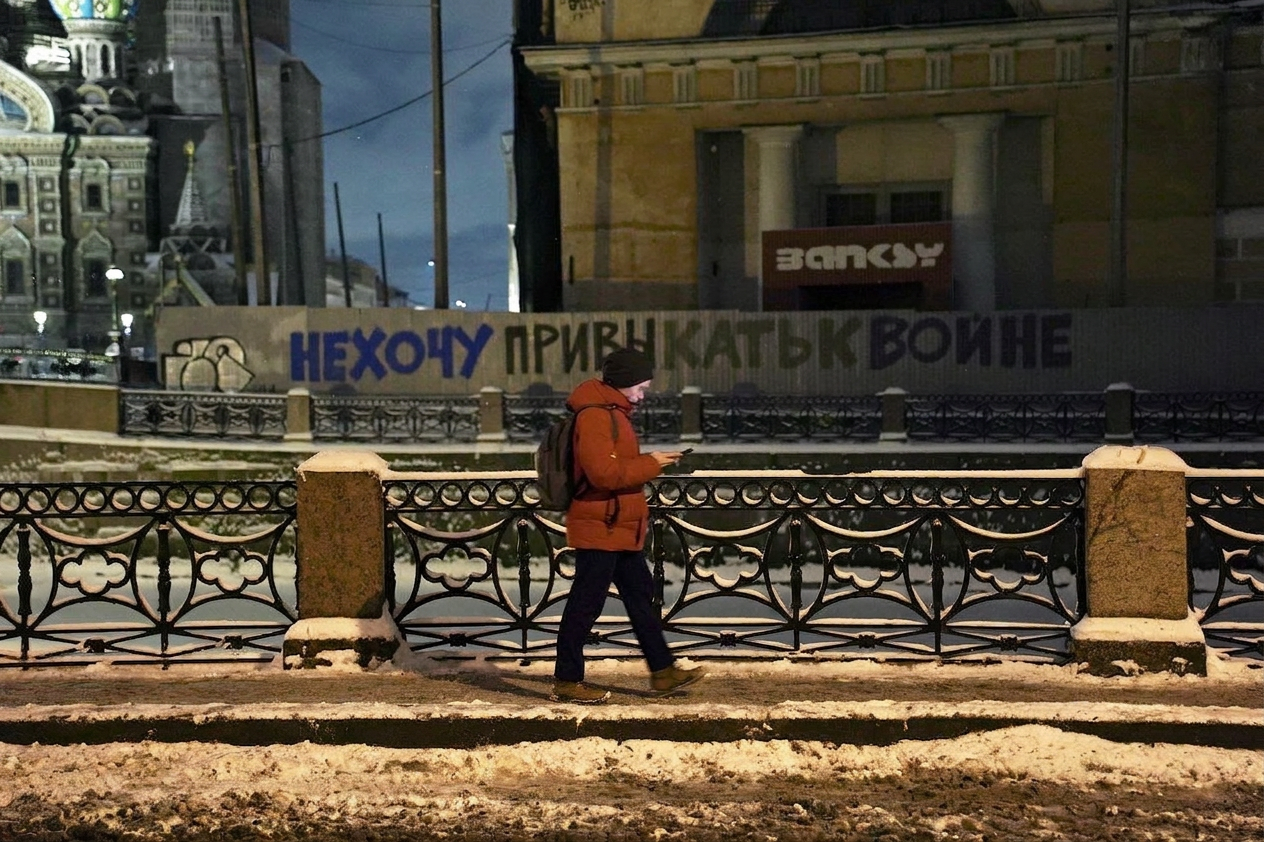
Author of graffiti “I don’t want to get used to the war” released after sentencing
The Petrograd District Court sentenced activist Alexander Arseniev to twenty months in prison on criminal charges of vandalism and “discrediting” the [Russian] army, his lawyer, Alexei Pryanishnikov, reported on his Telegram channel.
Arseniev was released in the courtroom after his stay in a pretrial detention center was counted as time served. According to Arseniev’s case file on the court’s website, the final hearing in the case took place today. As this article went to press, the court’s decision had not yet been entered into the file.
Arseniev wrote “I don’t want to get used to the war” on a fence near the Stables Department and at Gazprom Arena in February 2025. The graffiti outside the stadium was repainted overnight.
Last March, Arseniev was detained in Moscow and extradited to Petersburg, where he was remanded in the pretrial detention center. Spray paint cans and an acrylic marker were found police searched his flat.
Source: Bumaga (Facebook), 22 May 2026. Translated by the Russian Reader
Repression in today’s Russia is not on par with the mass repression of the country’s past. Nevertheless, it fulfills the same function by intimidating society and changing the behavior of millions.
Many people also feel that this repression is intensifying. But human rights data show the opposite: for a year now, the number of new politically motivated cases has remained at the same level — around 500 per quarter.
In the “Repression Barometer” report for the first three months of 2026, researchers from Memorial’s project in support of political prisoners made clear that Russian authorities appear to regard the current level of politically motivated arrests — which plateaued at 500 per quarter — as optimal.
Out of a population of around 140 million, that is not very many cases. By comparison, around four times as many murder cases are opened over the same time frame. Repression does not affect the majority. In 1937–1938, for example, more than 1.37 million people out of the U.S.S.R.’s population of 162 million were arrested in cases involving “counter-revolutionary crimes” and around half of them were shot.
But modern repression performs the same role as the mass repressions of the 1930s by creating a sense of an all-powerful, punitive hand of the state that effectively changes the behavior of millions.
But why is it so powerful when only a small number of people are punished? Political cases become a weapon for intimidating the population not through scale, but through unpredictability.
Hundreds of thousands, if not millions, of people make online comments that could be classified as “fake news,” “discrediting” the Armed Forces or “justifying terrorism.”
But criminal cases are opened against only a few — and it is precisely this selectiveness that makes the system so effective. It is impossible to predict where the boundaries of permissibility lie and at what point the state will decide to impose a punishment.
The same logic applies in cases involving “extremist” symbols, a category that today includes many things from the logos associated with Alexei Navalny’s activities to pentagrams and rainbow flags. In reality, such images can be found on many social media pages, but criminal cases are opened only in isolated instances.
Each such case sends a signal. Formally, rules exist. But in practice, they are applied selectively — and no one can be certain they will not be next.
The state cannot currently imprison millions. But it does not need to. Imprisoning hundreds unpredictably is more than enough to create the impression that anyone could end up behind bars.
The wording of the relevant laws also plays into this. They are extremely vague and even lawyers cannot always calculate the risk of simple actions. For most people, doing nothing is the best way to make sure they remain on the right side of the law.
A good example is cases involving “foreign agents,” where the law does not forbid private users from reposting or quoting their content without a disclaimer. But because of the chilling effect of a growing number of restrictive laws, people are afraid to quote or repost material from such branded outlets. The problem is compounded by the existence of other statuses like “undesirable” and “extremist,” for which legal consequences for sharing their material do exist. But many people, fearful of crossing the line, prefer to keep away.
Fear takes hold first and foremost among the most informed and engaged people who read independent news and follow human rights organizations. Aware of the risks, they begin to express themselves more vaguely, participate less often in public discussions and withdraw from active involvement.
The victims of unpredictable repression, meanwhile, are increasingly ordinary people who write comments or publish posts on VKontakte without realizing the risks they are taking.
Despite covering barely a quarter of the total number of incidents, the media — both pro-government and independent — plays a major role in creating the impression of widespread repression. Absurd and plainly unjust cases receive such wide coverage — like the story of the hookah on an Easter kulich — that their very absurdity intensifies the fear of the unpredictability of repression.
Within this logic, criminal cases against public figures who have left the country — writers, actors, bloggers, politicians and television presenters — look like a separate area of work for the security services. There is no practical point to these repressions: hardly any of these people will be extradited from Europe, where they have settled. But such cases receive widespread public attention, which further helps create an atmosphere of fear. Celebrities are not spared, so what can ordinary mortals expect?
Thus, contemporary Russian repression does not need to become mass repression at all. Its effectiveness rests on a combination of unpredictability and public signaling: most cases remain almost invisible, but individual stories become a signal to everyone else.
If human rights defenders are right and the authorities really do regard the current level of repression as “optimal,” then perhaps they believe nothing more is required. There is no need to imprison millions to frighten millions more. It is enough to maintain a constant stream of cases and, from time to time, show society that anyone could be next.
Source: Ivan Astashin, “Political Repression Is a Numbers Game in Russia,” Moscow Times, 18 May 2026

One thought on ““I Don’t Want to Get Used to the War””