
Even Lunacharsky Street is so transparent
Bicycles and horses race home
On these streets, my love, I honed my style
I touched the air with my hand
Even Lunacharsky Street can be so gloomy and wicked at times
And a cloud with a pointy beard delivers a delicious jolt
And it groans languidly
There is nothing beyond the black sky
And nothing will be first
Perhaps the gods played a trick on you
And scattered their plywood arrows in the corners
Somewhere far away
I take you without asking
Somewhere far away
I bury myself alive
In letters and numbers
I’m drowning and floundering
With an artificial belly
Like a clown in a circus
Upward and downward
This is
Real life
This is
The fleeting joy of a glance on the street
A smile, warmth
Your shadows kiss
You don’t care, you keep going
Leaving behind perhaps another life
I can’t do it—this thought terrifies me so
I can’t do it
There is nothing beyond the black sky
And nothing will be first
Perhaps the gods played a trick on you
And scattered their plywood arrows in the corners
Somewhere far away
I take you without asking
Somewhere far away
I bury myself alive
In letters and numbers
I’m drowning and floundering
With an artificial belly
Like a clown in a circus
Upward and downward
This is
Real life
This is
The fleeting joy of a glance on the street
A smile, warmth
Your shadows kiss
You don’t care, you keep riding
Leaving behind perhaps another life
I can’t do it—this thought terrifies me so
I can’t do it
Source: Genius. Translated by the Russian Reader
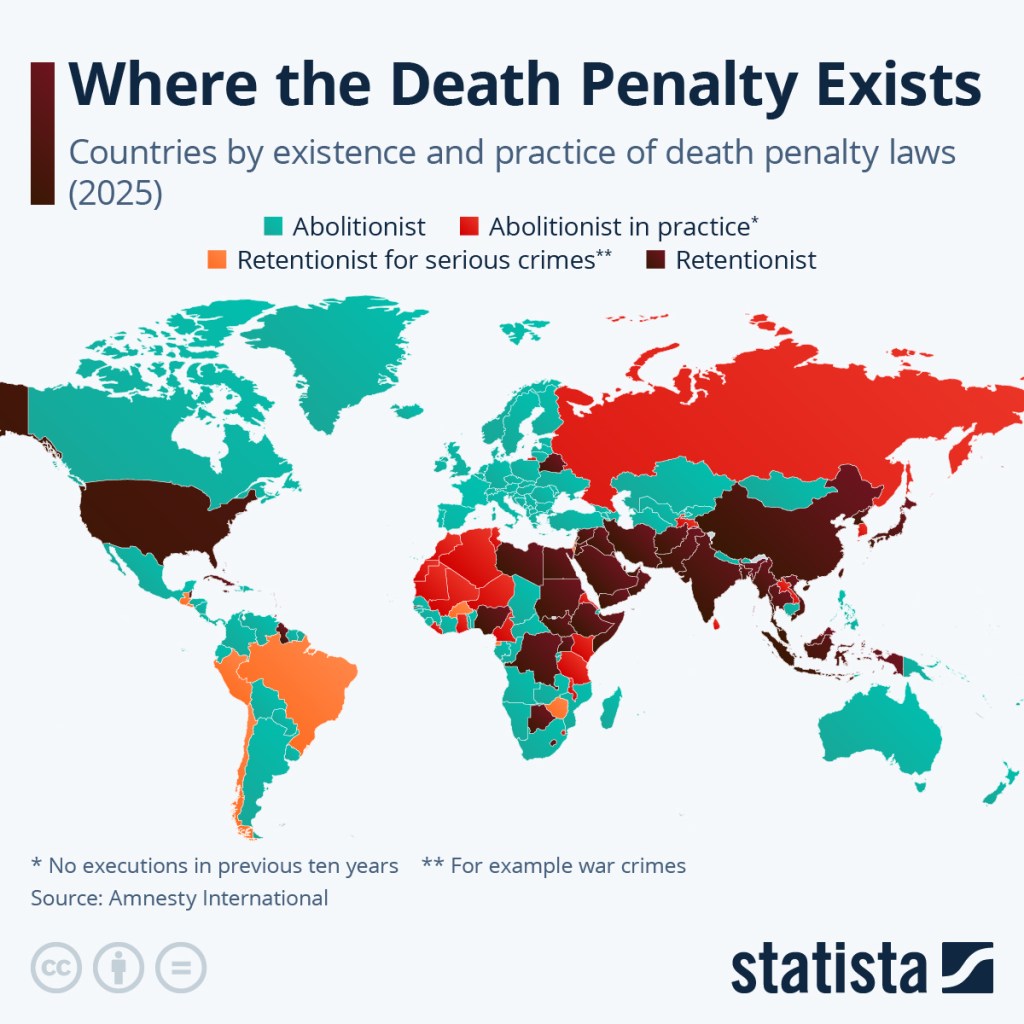
Amnesty International has published its annual Death Sentences and Executions report for the year 2025, with data showing a sharp increase in the number of executions carried out. At least 2,707 people are known to have been put to death by the state last year, up 78 percent compared to 2024. As our infographic shows, the death penalty continues to be quite widespread in Asia, with China, India, Thailand, Singapore and Indonesia, among others, employing it. The use of capital punishment is very rare in Europe: it only exists in Belarus, and Amnesty International notes that 2025 was the first year it recorded neither new death sentences nor executions since President Alexander Lukashenko assumed office in 1994. While Russia technically also retains the death penalty in its law, the country is considered abolitionist in practice, meaning no executions have been carried out in at least ten years.
In the Americas, the death penalty is also mostly a thing of the past, with the notable exceptions of Guyana, Cuba and the United States. Last year, the U.S. executed 47 people across 11 states, almost twice as many as in 2024 (25 executions). Florida alone accounted for almost half of these executions (19). Capital punishment is still more common in Africa and the West Asia. In 2025, Iran executed at least 2,159 people, more than double its 2024 figure and the highest number on record since 1981, and the Islamic republic has been consistently using the death penalty as a tool of political repression.
113 countries and territories around the world have abolished the death penalty completely, most recently Zambia. In 2023 and 2024, African nations Equatorial Guinea, Ghana and Zimbabwe abolished the death penalty for all but very serious crimes. 87 nations still have capital punishment on the books, but 24 of them are considered abolitionists in practice. In March of this year, the Israeli Knesset voted to expand its death penalty law in such a way that applies only to Palesinians and dismantles fundamental safeguards to prevent the arbitrary deprivation of life and protect the right to a fair trial, a decision condemned by Amnesty International. The NGO has called on Israel to repeal the decision.
Source: Valentine Fourreau, “Where the Death Penalty Exists,” Statista, 21 May 2026
When Shiraz Calls
A personal account of day-to-day life in Iran told through the calls of two Iranian sisters – one in the UK, the other in the Iranian city of Shiraz. Since the outbreak of war at the end of February, a near total internet blackout and a shutdown of international phone lines by the Iranian authorities has meant limited information has got out of the country. Despite the risks involved, the sisters have made recordings of their conversations which have been shared with the BBC. They discuss when the bombs land, the destruction of places they love and the realities of an economy that’s being brought to its knees. They struggle to sleep at night. Salaries don’t come through. It’s a roller coaster of emotions. But there are also moments of calm and comfort…a spot of dark humour and the scent of hyacinths.
Actors:
Leila played by Lisa Zahra
Gita played by Zahra Ahmadi
Presenter: Caroline Hawley
Producers: Adele Armstrong and Soroush Pakzad
Sound design: Peregrine Andrews
Editor: Clare Fordham
Source: BBC Radio 4
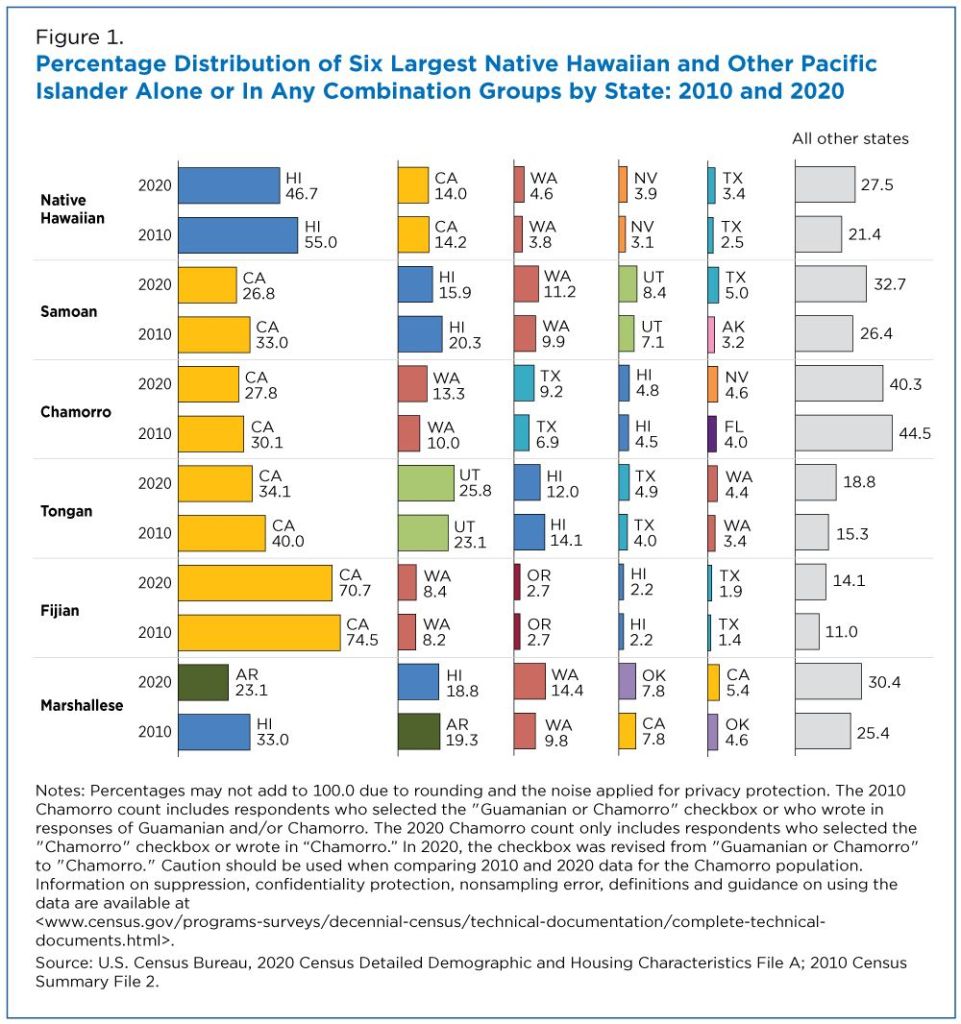
This Census chart shows changes in where Hawaiian and other Pacific Islander populations were living in 2010 and 2020. By 2020, more than half of Native Hawaiians (at the top left, in blue) were not living in Hawaii, something local Hawaiian leaders attribute to the high cost of living on the islands.
Source: Monterey County NOW, 24 May 2026
This week, Rafia Zakaria won the 2026 National Magazine Award in the category of Columns and Essays. The winning piece, “Water Pressure,” was published in Issue 150 of The Believer and is available to read in full on our website. It follows Zakaria’s father on his search for clean water in Karachi, Pakistan, where the mounting climate crisis has crept into all aspects of daily life. Zakaria discussed the prize and the celebrated essay with our managing editor, Ginger Greene.
THE BELIEVER: You won a National Magazine Award last night in New York for your essay, “Water Pressure.” What did it feel like to see this piece recognized in that way?
RAFIA ZAKARIA: It was a tremendous surprise… It is very difficult to place personal essays, but it is the personal story that can ultimately make an abstract issue—such as water scarcity in a faraway city like Karachi—seem as real as the heat wave that was happening in New York on the day of the award ceremony. I was so grateful to work on this project, and to have the freedom and latitude to explore what extreme heat can do to ordinary people in an ordinary megacity.
BLVR: Your story explores the many difficulties of procuring water and power in Karachi, in an ever-warming world. What inspired you to approach this subject? And what were some of the difficulties you faced as you developed the essay?
RZ: I feel like a lot of climate journalism focuses on the deterioration of beautiful natural environments and the loss of wild ecosystems. I wanted to focus on how extreme heat, as well as water and power scarcity, affect human relationships, how it erodes and corrodes the scheme of relations between people and the environment. Sometimes it is not possible to see how it is happening, when you are in the midst of dealing with these problems every day. But as someone who is in and out of Karachi, I was able to perceive these dynamics.
One of the difficulties I faced reporting this story was a lack of precedence for this sort of exploration. For instance, there is excellent and deep reporting on natural or man-made disasters and their aftermath. But there is less writing on persistent issues, like decades-long water shortages, where there is no single cataclysmic event on which to center a story. I wanted to show that the story of chronic scarcity can also be told in an impactful and interesting way.
BLVR: The piece opens with a vivid scene from your family’s neighborhood in Karachi, in which a man is angered when he notices your aunt receiving an overflow of water into her underground water tank, such that it’s wastefully flooding out onto the street. Their confrontation ends when your aunt begins to throw rocks at him to get him to leave her alone. I was curious: What was your first reaction when you heard this story? Was it relayed to you as a problem of “water envy,” as you call it?
RZ: I will admit that my aunt’s reaction was a bit extreme, but it crystallized how chronic scarcity can create levels of seething frustration that can bubble to the surface in absurd ways. The story was told to me in the context of: Is she OK? But actually no one facing this sort of privation day after day is really OK. Water is a mainstay of existence, so the fact that you can now have an iPhone but not access to clean water is a bizarre juxtaposition of privilege and paucity.
I also felt that my aunt’s actions put into stark focus what people likely want to do but usually don’t. I came up with the term “water envy” because I wanted to start creating a vocabulary for phenomena that are felt, but for which there are often no words. I think the phrase encapsulates how policing resource consumption becomes just another part of living in a neighborhood. In most cases people will not challenge each other to the extent they do in this instance, but that is why it is such an apt story: Both characters had reached the end of their rope.
BLVR: Water politics in Karachi are complicated. For one thing, there are the daily strategies middle-class Karachiites have developed to procure water, which involves pumping water from the main lines into private underground water tanks. Navigating the uncertainty of main-line waterflow has become a full-time job for your father, as you point out. At the same time, there are many more people who don’t have access to these “pump games,” because they can’t afford a private tank. They are forced to purchase water from private companies that hike up their prices. How has the situation with Karachi’s water mafia progressed since you reported this piece?
RZ: I think the situation is much more dire now, because the pressures have become more acute. The population has grown dramatically and grows further still on a daily basis. Temperatures have risen, owing to climate change phenomena like the heat domes I talk about in the piece. As a result, people increasingly have to resort to taking their chances and obtaining water without knowing its source or even if it is potable.
In the summer there are thousands of deaths that are ultimately caused by lack of clean water, but they are not often tallied under this category. As the heat index rises in Karachi, these situations are pushed to the limit and people—particularly the very old and the very young—begin to die. The water mafias are more entrenched and merciless now; they know how to throttle competition and work with street gangs and land mafias to ensure that the consumers in a specific area have no options but to pay them.
BLVR: As we approach the summer months, Karachi is already reaching excessively high temperatures. In early May, the city recorded a peak of 111 degrees Fahrenheit, the city’s highest reading since 2018. This heat, as you describe in your piece, compounds with power outages and water shortages, which seeds the ground for long-term public health crises. How are you feeling about the upcoming summer?
RZ: I dread the summer months for Karachiites. If you fall sick during the summer, it is hard to get reliable care in a timely fashion and, most of all, to find a relatively cool environment to recover in. Any illness could threaten survival. Since there is no easily available large-scale refrigeration in poorer areas, there is also a huge risk of eating spoiled food. There is no way of telling if something in a store fridge was left out for hours the night before, or if the energy source powering the fridge is reliable. So it’s Russian roulette all summer long.
This summer will not be any different. The political rift between Karachi and the rest of the province means that the city is constantly starved of resources and the federal government seems disinterested in the plight of the people that live there. Many Karachiites are the children of people who migrated from India in 1947 and hence distinct from Punjabis, who make up the majority ethnicity. All of these divisions make the situation one of constant chaos. People are living a bit of a Hobbesian existence there.
BLVR: How has the situation in Karachi shaped your relationship to your experience of the US? You recently moved to Salt Lake City in Utah, which is also in the midst of a climate-related disaster. Have you noticed any similarities between the two places?
RZ: Well, there is a war over water underway in Utah as well. Last week, three county commissioners in Box Elder County, Utah, passed a proposal to build a 40,000 acre data center in the area—that is twice the size of Manhattan. The residents, aghast at what their elected representatives have done, are now trying to organize a referendum that will stop the plan. If the data center is built, the project will suck up all the water left in the already drying Great Salt Lake. It is estimated that it will also increase nighttime temperatures by 8 to 28 degrees Fahrenheit.
This situation really reminds me of Karachi, and it is difficult for me not to feel a bit like a Cassandra. Utahns have little idea of what that sort of scarcity and extreme heat can do to the fabric of society. It transforms our individual and collective relationships with the natural environment, but also the relationships we humans have with each other.
Source: “A Short Interview with Rafia Zakaria,” The Believer (Substack), 24 May 2026
