No Amnesty for “Terrorists”

boyarshinovAmnesty International, the world’s premier human rights organization, thinks there is a chance Network case suspect Yuli Boyarshinov (pictured here) and his ten comrades can get a fair trial in Russia, which has a 99% conviction rate. Photo courtesy of Rupression

Despite what I wrote to a comrade yesterday, it turns out Amnesty International did issue a report on the Network case—just as last year was ending, meaning well over a year since the ugly, insulting mess kicked off in Penza.

But you might wish Amnesty International had not bothered to write anything, especially after you read the report’s conclusion.

Amnesty International is urging the Russian authorities to review the Network case and if the evidence received during such review demonstrates that the case was, indeed, fabricated, all charges against the co-accused individuals must be dropped and they must be immediately released. If there are legitimate grounds to continue their prosecution, the Russian authorities should fully respect the right to a fair trial and, amongst other things, open the trial in the Network case to members of the public.

If the suspects in the sickening torture carnival and flagrant frame-up known as the Network case go to trial, there is a 99% chance that, as in the recent case of two other well-known convicted “terrorists,” Oleg Sentsov and Alexander Kolchenko, the Networkers will be tried in closed chambers by a military tribunal in a city like Rostov-on-Don, which has the added advantage of being quite far from the Networkers’ homes in Penza and Petersburg, making it extraordinarily  difficult for their family and friends to make the trip so they can, at best, stand in the hallway of the courthouse or outside it and, perhaps, every once in a while catch a glimpse of their loved ones as they are shuttled back and forth between hearings by heavily armed bailiffs and guard dogs.

Correspondingly, the Networkers will be found guilty on all charges and sentenced to hefty terms in prison like Kolchenko and Sentsov, who were just as obviously the victims of a blatant frame-up, meant to teach Crimeans and the world a brutal lesson about the new bosses in the Crimean Peninsula.

Given these circumstances, what prevented Amnesty International from declaring the Networkers prisoners of conscience and turning their case into a full-fledged international solidarity campaign is beyond me.

Amnesty International must think there is a chance the Networkers are “real” terrorists, meaning the world’s greatest human rights advocates have become either hopelessly naive in their late middle age or abysmally cynical. {TRR}

Thanks to Comrade Koganzon for finding AI’s dismal report.

______________________________________

What can you do to support the Penza and Petersburg antifascists and anarchists who have been tortured and imprisoned by the Russian Federal Security Service (FSB)?

  • If you are in London or can get to London on January 19, join the solidarity demo at the Cable Street Mural at 2 p.m. The demonstration is supported by Anarchist Communist Group, Anarchist Federation, Brighton Antifascists, Bristol Anti-Fascists, Brazilian Women against Fascism, Feminist Fightback, London Antifascists, London Anarchist Black Cross, North London Anti-Fascists, Plan C LDN, RS21, and Labour Briefing. Please email london19jan(at)riseup.net to add your organization to the list of supporters. More information about the Cable Street Mural and its location can be found on its Facebook page.
  • Donate money to the Anarchist Black Cross via PayPal (abc-msk@riseup.net). Make sure to specify your donation is earmarked for “Rupression.”
  • Spread the word about the Network Case aka the Penza-Petersburg “terrorism” case. You can find more information about the case and in-depth articles translated into English on this website (see below), rupression.com, and openDemocracyRussia.
  • Organize solidarity events where you live to raise money and publicize the plight of the tortured Penza and Petersburg antifascists. Go to the website It’s Going Down to find printable posters and flyers you can download. You can also read more about the case there.
  • If you have the time and means to design, produce, and sell solidarity merchandise, please write to rupression@protonmail.com.
  • Write letters and postcards to the prisoners. Letters and postcards must be written in Russian or translated into Russian. You can find the addresses of the prisoners here.
  • Design a solidarity postcard that can be printed and used by others to send messages of support to the prisoners. Send your ideas to rupression@protonmail.com.
  • Write letters of support to the prisoners’ loved ones via rupression@protonmail.com.
  • Translate the articles and information at rupression.com and this website into languages other than Russian and English, and publish your translations on social media and your own websites and blogs.
  • If you know someone famous, ask them to record a solidarity video, write an op-ed piece for a mainstream newspaper or write letters to the prisoners.
  • If you know someone who is a print, internet, TV or radio journalist, encourage them to write an article or broadcast a report about the case. Write to rupression@protonmail.com or the email listed on this website, and we will be happy to arrange interviews and provide additional information.
  • It is extremely important this case break into the mainstream media both in Russia and abroad. Despite their apparent brashness, the FSB and their ilk do not like publicity. The more publicity the case receives, the safer our comrades will be in remand prison from violence at the hands of prison stooges and torture at the hands of the FSB, and the more likely the Russian authorities will be to drop the case altogether or release the defendants for time served if the case ever does go to trial.
  • Why? Because the case is a complete frame-up, based on testimony obtained under torture and mental duress. When the complaints filed by the accused reach the European Court of Human Rights in Strasbourg and are examined by actual judges, the Russian government will again be forced to pay heavy fines for its cruel mockery of justice.

***************

If you have not been following the Penza-Petersburg “terrorism” case and other recent cases involving frame-ups, torture, and violent intimidation by the Russian Federal Security Service (FSB) and other arms of the Russian security state, read and share recent articles the Russian Reader has posted on these subjects.

We Change Our Minds like Socks, or, The Pollocracy’s Comeback

3Focus group drawing from the study “Autumn Change in the Minds of Russians: A Fleeting Surge or New Trends?” The first panels is labeled “Now.” The second panel shows a drunken Russia at the bottom of the stairs “in five years,” while “the US, Europe, Canada, China, [and] Japan” stand over it dressed in swanky business suits. The third panel is entitled “Friendship.” Source: Fond Liberalnaya Missiya

Experts Who Predicted Bolotnaya Claim Attitudes of Russians Have Changed
Vladimir Dergachov
RBC
December 24, 2018

Economists Mikhail Dmitriev and Sergei Belanovsky, and psychologists Anastasia Nikolskaya and Elena Cherepanova have authored a new report, “Autumn Change in the Minds of Russians: A Fleeting Surge or New Trend?” which they will present on Monday, December 24.

RBC has obtained a copy of the study. It was conducted as a follow-up to previous autumn opinion polls, which identified a loss of interest in foreign policy among Russians, growing dissatisfaction with domestic policy, and a collapse in reliance on the government.

How the Study Was Conducted
The experts combined qualitative sociology and psychological tests [sic], comparing the results with the Levada Center’s polling data. In October and November 2018, respondents in Moscow, Vladimir, Gus Khrustalny, Yekaterinburg, Krasnoyarsk, Saransk, Romodanovo (a village in Mordovia), and Ufa were surveyed as part of focus groups. In Moscow, a number of focus groups were convened involving public sector employees, including physicians, and university lecturers and researchers from the Russian Academy of Sciences (RAN). There was also a mixed focus group featuring engineers, traffic police officers, and theater employees.

Peace Instead of Scandals
Previous surveys, conducted by Dmitriev and Belanovsky in April and May 2018, showed Russians largely supported the country’s foreign policy, although critical respondents said the country spent too much money on supporting other countries and used foreign policy to distract people from issues at home. Six months later, the statements made by respondents revealed a demand for a peaceable foreign policy. “Spy scandals, falling missiles, certain statements by Russian politicians, and the protracted war in Syria” have led to a downturn in support for Russia’s foreign policy, the report claims.

In the May 2018 study, respondents were not yet pessimistic about the future. In the October surveys, however, a majority (68%) of respondents had a negative attitude towards the future. They envisioned a Russia that, in five years, was weakening and lagging behind other countries in terms of progress, a country whose populace was intimidated and did not have the right to vote.

They Predicted the Bolotnaya Square Movement

In March 2011, Dmitriev and Belanovsky, then employed at the Center for Strategic Development (TsSR), presented a report in which they alleged a profound political crisis had emerged, and support for Vladimir Putin, Dmitry Medvedev and United Russia had fallen off. They predicted increasing dissatisfaction with the political system. Less than a year later, sparked by insufficiently [sic] fair and transparent elections to the State Duma, large-scale protests kicked off in Russia.

Self-Expression Instead of Survival
In the May study, the demand for justice had increased dramatically, shunting aside the previously dominant demand for a strong leader. In October, the invocation of distributive justice (a more equal distribution of income and assets) gave way to the demand for procedural justice (equality of all before the law).

The respondents in all the focus groups felt physical needs and government welfare were less important than the need for respect, liberty, and leaders capable of voicing these values. Harsh statements by public officials on social issues (i.e., that people could live on 3,500 rubles a month by eating macaroni, etc.) had provoked increasing irritation. Concerning the raising of the retirement age, the respondents negatively assessed the suddenness of the decision and the way it was made behind closed doors.

Ninety-four percent of respondents claimed they no longer relied on the government, only on themselves. Sixty-three percent of respondents expressed a willingess to contribute personally to the country’s progress. This contribution was conceived in different ways: from a willingness to pay high taxes and be involved in charitable work, to grassroots activism and educational outreach. According to a Levada Center poll, 60% of respondents felt responsible and were willing to make personal efforts to facilitate improvements in Russia.

A Demand for Change
The May study testified to a slackening of reliance on a strong leader among Russians. In October, the analysts registered a demand for new leaders who would respect people, be honest and democratic [sic], admit to their mistakes, and act in the people’s interest. These qualities were bound up with the values of self-expression, which were foregrounded by respondents.

These qualities had little in common with the positive and negative qualities Russians [sic] had used to assess Vladimir Putin in a July poll by the Levada Center (stability, respect, personal charm, capacity for compromise, firmness, and foresight). The discrepancy in criteria was a sign of the rudimentary emergence of counter-elite sentiments [sic], the researchers warned.

A growing demand for change was noted among the respondents. Up to 76% of respondents would be willing to support temporarily painful reforms vital to overcoming the crisis in Russia. Russians no longer demanded immediate improvements. They were willing to wait and endure hardship for the sake of a positive ultimate income.

The respondents had almost no substantive notions of the necessary reforms. The experts compared public opinion to an “empty vessel” waiting for new leaders who inspired confidence.

None of the focus groups voiced aggression towards the regime, but the willingness to get involved in social movements had grown. The demand for respect and freedom prevailed over other demands, and thus the struggle for respect was imagined by the respondents as peaceable and legitimate.

Negativism towards the regime was no longer associated with a demand for populism, whose tokens include the appeal to distributive justice and anti-immigrant sentiments.

Frustation of Public Sector Employees
The report devotes a entire section to moods in the study’s public sector worker focus groups. The researchers discovered the highest level of tension among these people.

Public sector employees were frustrated not because of financial problems [sic], but because of the sector’s irrational organization [sic]. For example, due to the May 2012 decree on raising salaries, the managers of many public sector organizations took some workers off payroll, dramatically increasing the workload of other employees. The respondents were also dissatisfied with the avalanche of reports due to increasing bureaucratization, the chronically poor quality of management, and the fact that personal loyalty to bosses had replaced professionalism in the management hierarchy.

Three Scenarios
According to the experts, these trends indicate Russian public opinion has moved beyond the “stasis” of the post-Crimean consensus. They paint three possible scenarios for further changes in public opinion. The first would involve returning to “rallying around the flag,” typical of the post-Crimean period. This scenario would become a reality if international conflicts involving Russia escalated dramatically.

The second scenario would involve a rollback to counter-elite populism [sic] due to negative economic changes.

The third scenario foresees the consolidation of new values in the public’s mind over a lengthy period. This turn of events is likely if the status quo in the economy and foreign policy is maintained, that is, given sluggish economic growth and the absence of intense international conflicts. The experts cite Iran as an example of a country where this scenario has come true [sic]. Eighty percent of Iranians were born after the Islamic Revolution and have no experience of life under the previous regime. Due to the economic difficulties caused by western sanctions, young Iranians are tired of permanent crisis and disapprove of the country’s costly expansionist foreign policy. The unfavorable socio-economic conditions have a generated a demand for a alternative secularized and westernized lifestyle among young people.

In this scenario, the experts suggest altering the way the regime interacts with the populace in order to diminish its growing negativity. This is doable as long as the populace manifests no aggression towards the regime and is open to constructive dialogue.

The researchers note this scenarios contradicts the prevailing international trend of populists taking power. Unlike the societies of many developed countries, Russians have not descended into archaic populism and “social infantilism,” displaying instead increased social maturity and responsibility for the state of affairs in Russia [sic].

A Long-Term Shift
Political consultant Dmitry Fetisov generally agrees with the study’s findings. He links society’s growing demand for a peaceful foreign policy with the fact the Kremlin demonstrated a successful example of this policy during the 2018 FIFA World Cup [sic],  and the critical attitude of public sector employers towards the regime with the pension reform. Fetisov argues, however, that these trends could change depending on how the Kremlin acts.

Political scientist Nikolay Mironov is certain these shifts in public opinion are long term. He argues the trends described in the study have been caused by the post-2014 economic stagnation. Mironov does not believe a return to the “rally around the flag” consensus is possible, even in the event of international conflicts, unless they impinge on Russian territory. Mironov concludes what is needed are large-scale economic reforms and an easing of foreign policy.

Levada Center sociologist Denis Volkov also notes the growing criticality of respondents towards officialdom and public fatigue from assistance to other countries [sic]. However, Volkov argues it is wrong to chart changes in public opinion by comparing surveys of focus groups, rather than using quantitative research. Fetisov likewise points to the study’s lack of representativeness, as it is based on comparing the opinions of different focus groups.

Translated by the Russian Reader

This article and the research paper it purports to summarize and analyze should be read with a huge spoonful of salt.

First, “public opinion” polls in Russia are wildly unreliable, as I have tried to show over the years on this website, often with a leg up from likeminded Russian journalists and researchers.

Second, this study, apparently, is a funhouse mirror image of the usual “Putin’s wild popularity” poll. The economists and psychologists who wrote the report set out to detect a “positive” sea change in Russian public opinion and, God willing, they found it, by offering their focus group respondents a weak-tea pipe dream they obviously dream themselves. If that dream seems rife with contradictions, it is, although the researchers seem utterly unaware of them.

Third, even in a country as messy, corrupt, and authoritarian as Russia, the idea that people can rely only on themselves is absurd. Of course, they rely on the government for lots of things, at least if they are living in more or less large towns and cities. To the extent that libertarianism has become popular here, it has done so only as a consequence of the prevailing black political reaction, as cultivated by the Putinist state and its propaganda organs.

On the other hand, we are supposed to imagine these newly minted libertarians would be simultaneously willing to pay high taxes and endure hardships to make their country a better place, and yet this is supposed to happen without the “social infantilism” of “developed countries” where people protest on the streets against elites.

Given that the once-mighty RBC has long been a shadow of its former self, I was tempted to write this passage off as ad-libbing on the part of their reporter, but, in fact, he merely paraphrased the report’s authors, to wit:

В отличие от обществ многих развитых стран, население которых продолжает скатываться популистскую архаику и «социальный инфантилизм», российское население неожиданно для всех начинает демонстрировать возросшую социальную зрелость и ответственность за положение дел в стране. Эти качества в наибольшей мере ассоциируются с модернизированной системой ценностей, характерной для развитых стран до того, как их стала охватывать волна контрэлитного популизма.

“In contrast to the societies of many developed countries, whose populace continues to slide into archaic populism and ‘social infantilism,’ the Russian populace has surprised everyone by beginning to show increased social maturity and responsibility for the state of affairs in the country. These qualities [were] associated with the modernized value system of the developed countries before the wave of counter-elite populism engulfed them.”

As this blog has shown over the last eleven years, I have often been among the first to celebrate and chronicle emergent grassroots resistance and social movements in Russia, but the people who wrote the passage above were engaging in wishful thinking, not scholarship. If anything, their counterintuitive, baseless conclusion shows the contradictions of the newfangled method of governance at arm’s length I have dubbed the “pollocracy.”

The pollocracy has been used by the regime to monitor “public moods” while also explicitly and aggressively shaping that mood by asking pointed questions that countenance only certain answers.

On the other hand, it is used by the regime AND its allegedly liberal pseudo-critics to, alternately, register tremors of discontent among an otherwise disenchranchised and disempowered populace, and demonstrate these exact same people are routinely subject to all sorts of illiberal, irrational populist delusions and phobias, thus making them unfit to govern themselves.

Finally, the pollocracy has been used as a substitute for actual, full-fledged grassroots political involvement. A populace that “slides” into “archaic populism” and “social infantilism” is one thing (a bad thing), but a populace that meekly agrees to confine its dissent to skewed public opinion polls and hokey focus groups is both “socially mature” and not a threat to anyone, least of all to the current Russian regime.

It is especially telling these “socially mature” focus groups expect, allegedly, a less aggressive Russian foreign policy to emerge ex nihilo, merely because they wish it into existence in the safety of their anonymous focus groups. God forbid they should have to organize a national anti-war movement on their own. {TRR}

Free Edem Bekirov!

15447318032279451Edem Bekirov.  Photo courtesy of Vector News

Ayder Muzhdabaev
Facebook
December 28, 2018

Watch the footage we shot of Edem Bekirov. Then read what the well-known Kyiv musician Mitya Gerasimov has written.

“I’m sitting in my parents’ kitchen in Kazan. In its news bulletin, Echo of Moscow, a supposedly liberal radio station, reports that a terrorist has been detained on the Crimean border, the member of an armed band. He has been accused of storing and transporting weapons and explosives. His name is not mentioned, but it is clear they are talking about our friend Edem Bekirov, a Crimean Tatar from Novooleksiivka in Kherson Region.

“Edem is an ill, elderly man who has had heart bypass operations and a leg amputated due to diabetes. Before the latest operation, he went to Kyiv to see his mom. On the border, he was abducted by men in masks. For a time, nothing was known about his whereabouts. Then they let him call home from the FSB’s Simferopol office. He had not been given anything to eat or drink for two days or been taken to the bathroom. He was not permitted to take bandages to dress the unhealed wound on his stump or the medicines that keep him alive. He needs to take sixteen pills a day.

“The Russian authorities have been slowly killing Edem in a remand prison for over two weeks. The day before yesterday, the so-called court dismissed the appeal in his case. The radio reports the detained man associated with the terrorist group led by Lenur Islamov. They apparently meant the Crimean Tatar TV channel ATR, where Edem’s daughter works.

“Everyone knows Crimean Tatars do not kill anyone or carry out terrorist attacks. They have a principled stance of nonviolent resistance to the occupiers. The cartridges and twelve kilos of explosives that Edem, one-legged and ill, was supposedly taking somewhere is the same nonsense they made up about the so-called terrorist militant Oleg Sentsov. I remember watching Russian television in early 2014, before the annexation. It was footage of Grushevsky Street in Kyiv: Molotov cocktails, burning tires, snowdrifts. The announcer explained to viewers they were seeing Crimean Tatars rioting in Simferopol.

“There is the pre-New Year’s hustle and bustle on the streets of our cities: lanterns, New Year’s trees, shopping, traffic jams. Like many other Crimean political prisoners, Edem Bekirov will ring in his new year behind bars. We must do everything we can to publicize his plight. We have to shout about it on every street corner. We have to get him out of jail before it’s too late.”

That is the Happy New Year we are having.

Translated by the Russian Reader

Щасливого Різдва!

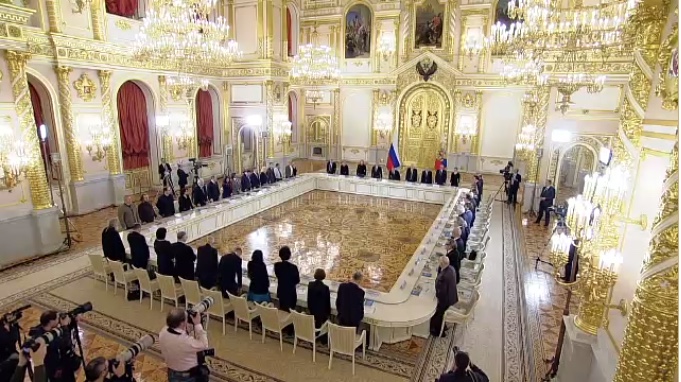
thugocratic council.jpegA recent meeting of the Presidential Council for Civil Society and Human Rights at the Kremlin. Image courtesy of kremlin.ru
I am not sure what to do with the canard, beloved of “anti-imperialists” the world over, that, because Ukraine has been less than perfectly governed, has been lousy with human rights violations, and has featured an inordinate number of neo-Nazis and other unsavory characters, it has deserved what Putinist Russia has been doing to it since 2014.

If “anti-imperialists” were consistent, they would want the same fate visited on every other country that is badly governed and has a dicey human rights record. I imagine that would mean a hundred or more countries would have to be invaded simultaneously to right all the wrongs in our world, at least as these wrongs are seen, allegedly, by “anti-imperialists.”

This begs the question of why a country with an even worse human rights record, a country governed by a tiny clique of unbelievably corrupt, violent secret police officers who have no intention of ever yielding power to any other group, much less to the country’s people, was the best qualified to invade Ukraine and show it the “anti-imperialist” light. {TRR}

Are Russians Eating Well?

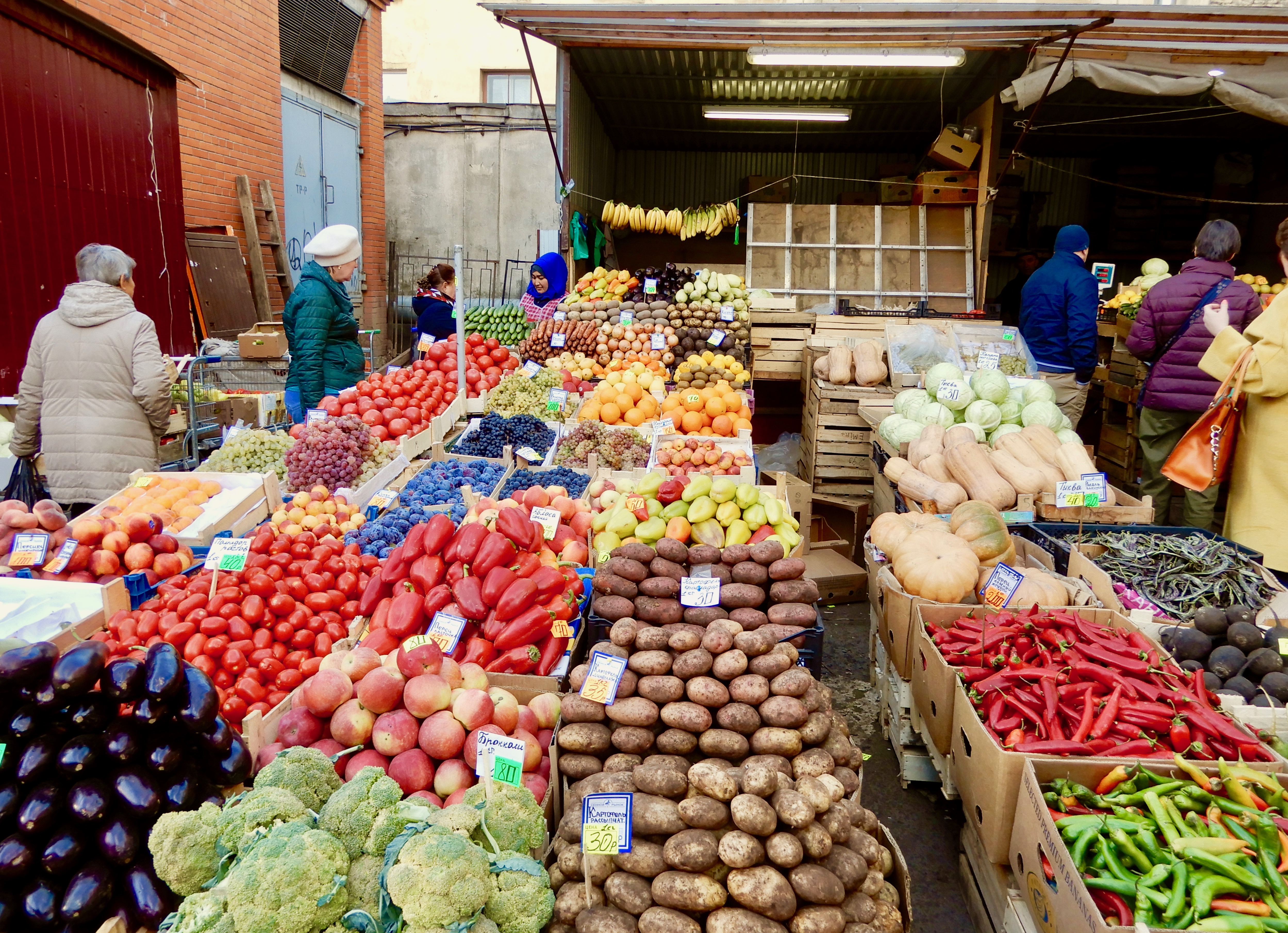
DSCN1832A fruits and vegetables stall at the famous Hay Market (Sennoy rynok) in downtown Petersburg, September 29, 2018. Photo by the Russian Reader

Eating Their Fill: Russia’s Food Security in the Wake of Crimea
Have Russians Eaten Better After the Government Moved to Defend Them from Western Food? 
Yevgeny Karasyuk
Republic
December 6, 2018

Soon after the embargo that was imposed four years ago in response to the stance of western countries on Crimea, analysts warned Russia itself would primarily suffer from food anti-sanctions.

“We won’t heighten the Russian Federation’s food security at all. In fact, we will reduce it,” Natalya Volchkova, a professor at the New Economic School, said at the time.

Of course, the criticism of the experts was ignored. No one in government questioned the policy of forced import substitution. Most Russians even imagined it was a rare instance when the government made a good decision. Only a few years ago, 71% of the populace [sic] spoke in favor of limiting imports.*

Time has passed, and the experts to whom no one listened have compiled figures showing where the policy has taken the country. A recent report, authored by a group of researchers from RANEPA, provides an analysis of its consequences.

Import substitution in the food sector was an obsession and, at the same time, a source of pride for ex-agriculture minister Alexander Tkachov. His replacement, Dmitry Patrushev, son of the Russian Security Council’s secretary and a none-too-successful state banker, has changed little in the government’s take on the situation. The new minister is certain Russia has reached a level of self-sufficiency above 90% in terms of basic food staples. Thus, Alexei Gordeyev, deputy prime minister for agriculture and an ex-agriculture minister himself, is convinced Russia has successfully carried out import substitution.

Food imports actually did slump sharply—by 46%—from 2013 to 2016. Although an unbiased analysis if how Russian producers succeeded in turning the tables and quickly saturating the market with their own products would point to the ruble’s sudden devaluation, rendering foreign imports uncompetitive, as had already happened in recent history, rather than to the success of the anti-sanctions.

Whatever the cause of Russia’s newfound food independence, however, it has not lead to food security. Citing the international standard, the authors of RANEPA’s report define food security as “the physical and economic availability of safe nourishment, sufficient for an active, fulfilling life.” In other words, there really are more domestically grown and produced food items in Russia nowadays, but the bulk of the populace has less and less access to them.

“Caloric Value of the Russian Diet.” The blue line indicates caloric value, while the dotted line indicates the recommended daily caloric intake per family member in kilocalories. The light purple area indicates the number of Russians who suffer from obesity, in thousands of persons, while the shaded dark purple area indicates the number of Russia who suffer from anemia, also in thousands of peoples. Source: Rosstat and RANEPA. Courtesy of Republic

Last year, Russia was ranked forty-first in the Global Food Security Index, compiled by the Economist Intelligence Unit, meaning that it ranked lower than it had in 2013, when it ranked fortieth. This was due, among other things, to insufficient funding of research and a reduction in the variety of food products.

According to official statistics, food accounts for approximately 35% of expenses in Russian household budgets, which is a high proportion when compared with the OECD countries, among which even the highest percentages, achieved by Poland and Mexico, fall short of 25%. Independent evaluation of spending on food, however, claim that the proportion of Russian family budgets spent on food is actually over fifty percent. Given the almost continuous drop in the real incomes of Russians, the selection of products has declined in quality and abundance. On average, Russian households continue to skimp on everything they can do without, as confirmed by the compilers of the Coffee and Milk Index, as published by Romir, a Russian marketing research company. (The index tracks sales of chocolate, coffee, milk, and bottled water.) RANEPA’s researchers noted the discrepancy between the excess fat in the food and bread Russians eat and the low number of calories in their diets.

By closing the borders to imports and showering the domestic agro-industrial complex with generous state subsidies—1.2 trillion rubles [approx. 15.9 billion euros] in the past six years from the federal budget alone—the regime has persuaded itself it has been filling the nation’s bellies and improving its health. Its expectations were exaggerated, however. Oversaturated with cheap carbohydrates, the standard fare eaten by many Russians remains unbalanced and low on energy. “This is borne out by widespread anemia among the populace as a whole and children in particular,” RANEPA’s researchers write. The number of Russians who suffer from obesity has grown for the same reason.

Obviously, these problems cannot be written off as temporary glitches in demand in the domestic food market, whose revival has been unanimously trumpeted by former agriculture ministers and the current agriculture minister. Rather, they are the natural consequence of systemic problems with the natural resources economy that shoulders the burden of the Kremlin’s geopolitical capers. The average Russian family often simply cannot afford a plentiful variety of healthy, high-quality food.

The authors of RANEPA’s report have emphasized this.

“Neglecting this fact can lead to a distorted picture of the state of food security,” they write.

However, there is still very little chance the alarming conclusions of the experts will be heard this time around, forcing the government to make adjustments to its food policy.

* How did they do that? Was a nationwide referendum held? The author, of course, is referring to a so-called public opinion poll in which, at best, a thousand or two “ordinary” Russians were asked loaded questions, to which they gave the “right” answers. {TRR}

__________________________________

Russians Spend 30% of Their Budgets on Food
Georgy Tadtayev
RBC
December 17, 2018

Russians spend nearly a third of their household budgets on food. Russia lags behind Montenegro, Latvia, and Turkey in this sense. Russians spend less than seven percent of their budgets on culture and leisure.

According to RIA Rating, as reported by RIA Novosti, Russians spent 31.2% of their household budgets on food in 2017.

The estimate of the percentage of their household budgets people in forty European countries, Russia, Kazakhstan, and Turkey spend on food was based on information from the IMF and national statistics agencies. Russia ended up in the bottom ten of the ranking, ranking 31st. Its nearest neighbors were Montenegro (29.7%) and Latvia (31.7%).

Ukrainians spend the greatest portion of their household budgets on food: 50.9%. People in Kazakhstan (46%, 39th place) and Moldova (43.4%, 38th place) also spend more than 40% of their budgets on food.

Western European countries topped the rating. Luxembourg came in first place. Residents of the duchy spend a mere 8.7% of their money on food. Close behind Luxembourg were Great Britain (10%) and the Netherlands (10.6%).

The agency also ranked countries according to percentages of income spent on alcohol and cigarettes. Residents of three Balkan countries—Romania (8.2%), Bulgaria (5.1%), and Serbia (4.7%)—spend the most on bad habits. Luxembourg (1.3%), Moldova (1.5%), and Cyprus (1.6%) spend the least on alcohol and cigarettes. Russia ranked 24th: Russians spend 3% of their househould budgets on bad habits.

Sweden was the top-ranked country in terms of spending on culture and leisure: Swedes spend 18.7% of their budgets for these purposes. Moldovans spend the least on leisure and culture: 1.3%. Russia ranked 21st: Russians spend 6.9% of their money in this category.

Translated by the Russian Reader

Let’s Give In to Russian Blackmail

nod-constitution day-1“The Russian Constitution: The Basic Law or Legal Sabotage?” Front page of a newspaper handed out on the streets of Petersburg by memberx of NOD (National Liberation Movement) on December 12, 2018, celebrated as Constitution Day in Russia. This article argues that Russia’s current constitution, adopted in 1993, was drafted by CIA agents working under the cover of USAID. Their goal, allegedly, was to colonize Russia by subjugating its sovereignty to international law.

___________________________

Don’t Let Russia Leave the Council of Europe
Yuri Dzhibladze and Konstantin Baranov
oDR
December 13, 2018

Those who wish to punish the Kremlin for its aggressive actions in Ukraine and elsewhere are missing the target: it is not the Russian government, but the Russian public who will suffer if the country leaves the Council of Europe.

After the Kerch Strait incident, proponents of pushing Russia out of the Council of Europe seem to have got additional justification for their position in a discussion that rages in the Council’s Parliamentary Assembly (PACE). In fact, the potential costs of this departure appear to be too high and far-reaching—not only for the Russian society, but for the whole of Europe.

More than four years since its delegation has been deprived of voting and participation rights in the PACE, Russia is now a step away from leaving the Council of Europe – either at its own initiative or as a result of expulsion for non-payment of its membership fees. In recent months, the situation has reached a deadlock due to an uncompromising position of both the Russian authorities and their critics in the PACE.

Those who wish to punish the Kremlin for its aggressive actions in Ukraine and elsewhere miss the target: it is not the Russian government, but the Russian public who would suffer the most should the country leave the Council of Europe. Since 1996, when Russia joined the organisation, for millions living in the country (including nationals of other states), the European Court of Human Rights (ECtHR) has been an ultimate hope for justice, which they cannot find in Russia. In this period, almost 2,500 judgements have been delivered to Russia. In 2017 alone, the state paid over 14.5 million euros as just satisfaction to victims. The judgments have had a significant positive impact on Russian laws and judicial practice, despite their implementation being far from ideal and counting to roughly one-third of cases. Should Russia depart from the Council of Europe, the scope of human rights problems in the country will grow exponentially, including a threat of speedy reinstatement of the death penalty.

The potential consequences would go far beyond the deterioration of the internal situation. This move would not resolve the issue of the annexed Crimea or put an end to the armed conflict in Donbass. On the contrary, expelling the violating country would demonstrate the weakness of the European system of protection of human rights and the rule of law in dealing with such gross violations.

What is more, Russia’s withdrawal would definitely worsen conditions of citizens of Ukraine and other countries who are held in Russian prisons and face unfair trials, torture and inhuman and degrading treatment. It would also result in a denial of the protection of the European Convention on Human Rights (ECHR) to inhabitants of Russia-controlled Crimea. It would eliminate effective guarantees from deportation for refugees and asylum seekers from Syria, Afghanistan and Central Asia. Finally, the practice of expulsion of a member state might trigger other countries to leave the Council and deter Belarus from returning to a special observer’s status at the PACE.

Politicians should assume full responsibility for making the choice that may define Europe’s future and work towards a solution that would preserve the common European legal framework and space for critical dialogue aimed at promoting human rights, democracy and the rule of law on the entire territory of Europe, including Russia.

We do not demand to “give in to blackmailing.” Lifting all restrictions on the Russian delegation in the PACE would be indeed unprincipled. However, finding a reasonable solution, in our view, would be a courageous decision to take responsibility and to advance the core values of the organisation by allowing the critical dialogue to continue. Amending the PACE rules of procedure – restricting national delegations’ rights only within the Assembly itself and not depriving them of the voting rights in elections of non-PACE mandates—including ECtHR judges, Commissioner for Human Rights and Secretary General—appears such a legally sound and reasonable solution.

Threats by Russian officials to leave the Council of Europe are not just a bluff to raise the bargaining stakes. There are many influential people in the Russian political establishment in favour of isolationist policies who actually want the country to withdraw. If a reasonable solution is not found before next spring, Russia’s authorities will not wait for the official discussion of its potential expulsion at the Committee of Ministers in June 2019 and will announce the withdrawal from the Council before.

It should be clear to everyone: Russia’s departure from the Council of Europe would not stop human rights violations and halt the authoritarian backslide in our country, or prevent the Kremlin’s aggressive behaviour in the international arena. Instead, it would put an end to a difficult struggle of Russian civil society to make Russia an important part of Europe on the basis of shared norms and values of democracy, rule of law and respect for human rights. It will turn a large territory in Europe into a legal “grey zone” for decades to come.

The authors represent a group of Russian human rights defenders who recently issued a Memorandum on the crisis in relations between the Council of Europe and the Russian Federation.

About the authors

Yuri Dzhibladze is a founder and president of Moscow-based Centre for the Development of Democracy and Human Rights and advocacy coordinator at the EU-Russia Civil Society Forum. He has worked on human rights, democracy, and international organisations since the late 1980s.

Konstantin Baranov is member of the Coordinating Council and international advocacy coordinator at the Youth Human Rights Movement, an international NGO enjoying participatory status with the Council of Europe. He is an expert on the protection of civil society space and fundamental freedoms in Russia and the post-Soviet area.

NB. This article was originally published by oDR under a Creative Commons Attribution 4.0 International licence

___________________________

When will Russia stop behaving like the enemy of Western Europe?
Dima Vorobiev, I worked for Soviet propaganda
Quora
Answered Feb 18

Russia is not the enemy of the Western Europe. The disruptive policy of President Putin is aimed at (1) weakening the political and military dominance of the US in Europe and/or (2) full or partial acceptance by the West of the following list of Russia’s political objectives:

  • Recognition of Crimea as Russian territory
  • Total freeze on expansion of NATO. No membership for Sweden, Finland, Ukraine or Georgia.
  • No NATO bases in the Baltics, Poland, Czech republic and Slovakia, Romania and Bulgaria. Removal of the American anti-ballistic bases in Central Europe.
  • Finlandization of Georgia, Ukraine and guarantees of such arrangement for Belarus, in case it gets a pro-Western government in the future.
  • Guarantees of unhindered land connection through Lithuania between the Russian heartland and the exclave of Kaliningrad. The unhindered transit through the Suwalki gap would be very useful for Russia as a gauge of the level of determination on the part of NATO in the case of a swift escalation in tensions.
  • Recognition of Russia’s right to permanent military presence in the Mediterranean (through bases in Syria and possibly in Libya or other places)
  • Repeal of all sanctions against Russian oligarchs, their companies and sectoral interests.

If the West won’t agree to such a new global security arrangement, the current confrontation will continue, with variations only in the level of tensions. Because of the technological gap, the Russian military-industrial complex will increasingly depend on China for high-tech components for our weapons systems. Russian economy will also be more and more streamlined to accommodate the needs of Chinese manufacturing.

This stalemate can continue for many years, unless one of the following happens:

  1. Unexpected massive deterioration of economy in Russia.
  2. Low-probability, high-impact catastrophe in the US or Europe that makes the West seek help from Russia
  3. Power shift in Russia with full revision of national policy. (Highly unlikely with President Putin still in power).

Andrei Kolesnikov: Hooked on Militarism?

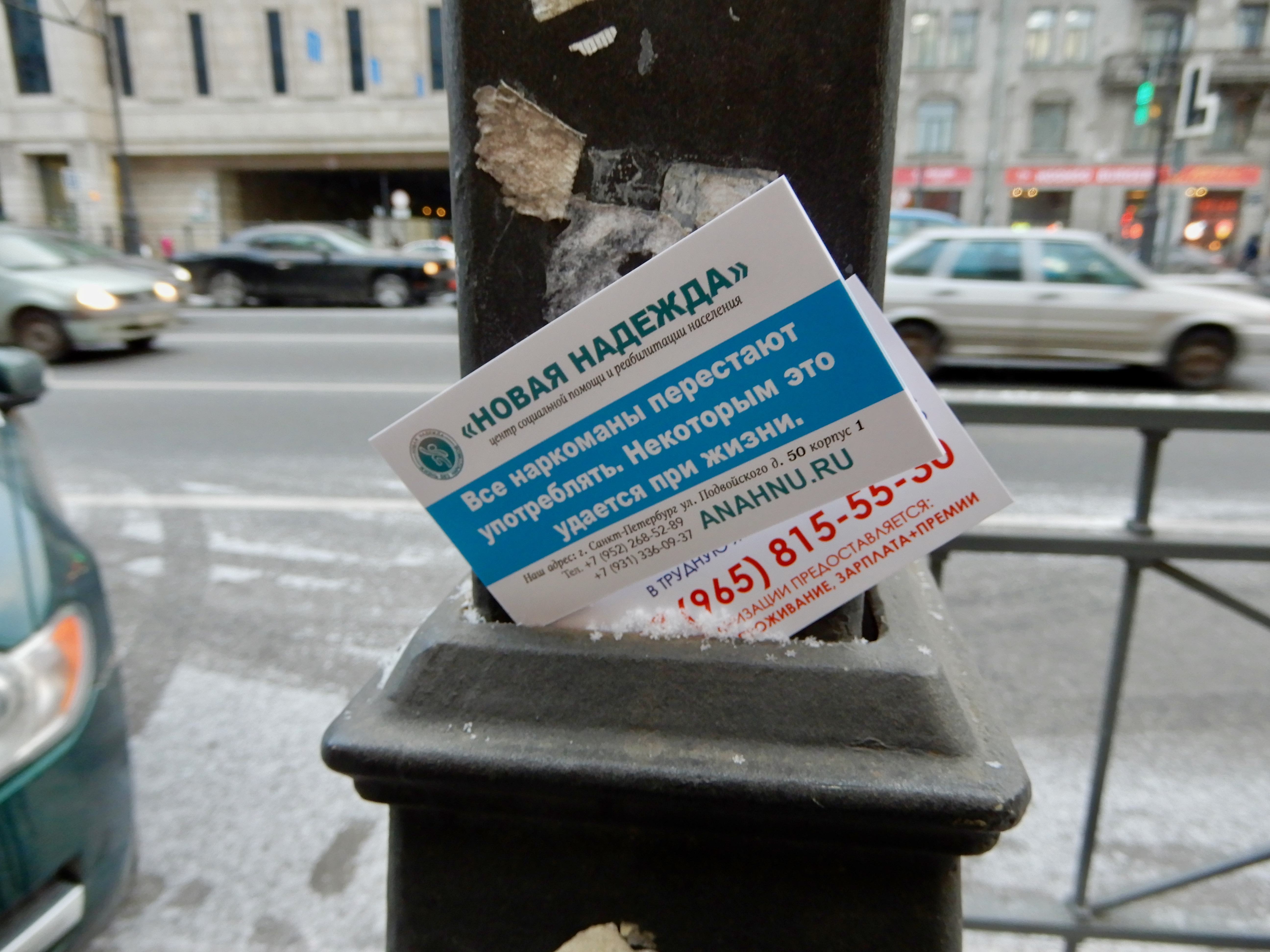
new hope“New Hope. All drug addicts quit using. Some manage to do it while alive.” Photo by the Russian Reader
Where Militaristic Infantilism Leads
Society’s Losing Its Fear of War Is More Dangerous Than What Happens in the Absence of an Anti-War Movement
Andrei Kolesnikov
Vedomosti
November 28, 2018

The “polite people” in the Russian military have taken to ramming ships, shedding their politesse. A military coming out has happened. Either so-called hybrid war has become more hybridized in terms of the variety of its methods or it has become more like good old-fashioned war, involving actual armed clashes. Politically, Russia has become not merely toxic but hypertoxic. A premonition of war prevails among more timid folks, although the footage of the ramming at sea, as painless and triumphal as a military parade on Red Square or a football match (“Crush him!”), still make military operations appear unscary and toylike. We will carry the day in any case, sans victims and blood (ours, that is), as in a cartoon by Putin.

This militaristic infantilism—the loss of the fear of war, the loss of the idea that war is terrible—is the worst outcome of our country’s daily intoxication with the thought of its own greatness for several years running. The army is greatly respected nowadays. People need to trust someone, and the armed forces have bypassed another institution, the presidency, in trustworthiness ratings.

Does this mean Russians are ready for a real war? To put it more plainly, are Russian parents willing to let their eighteen-year-old boys be called up to fight Ukrainian boys just like them? Does anyone understand what they would be fighting for? Is it really all about cementing the nation, “Crimea is ours!” and the personal ambitions of several high-ranking figures in the Russian establishment?

Since 2012, Russia’s collective identity has been built on negative foundations, on awakened resentment, which had been dozing, but had no thought of waking up. The plan has worked quite well. This resentment, however, is verbal and fictitous. Public opinion supported “coal miners” and “tractor drivers” verbally. In Syria, the official army and private military companies fought, or so Russians imagined, at their own risk. The proxy war with the US has gone very far at times, but in the summer of 2018 it did not stop the majority of Russians from abruptly improving their attitude [sic] to the States and the west in general.

But suddenly there is the threat of a real war. On the other side of the border, in the country [i.e., Ukraine] that the Russian imperialist mind never really considered sovereign, a mobilization is underway and martial law has been declared. Is this reality capable of changing popular opinion and rousing Russian civil society, which has a lot going for it except an anti-war movement? No, because so far the war has not been regarded as real.

Identification with the military is the last bullet in the Russian regime’s gun, but it is a blank or, rather, a prop. Exploiting what Russians regard as sacred—i.e., privatization of the memory of the Great Patriotic War [WWII] by a particular group—is a tool that is still in play, but militarism as such has lost its power to mobilize and consolidate Russians. If “German POWs” are marched around Novgorod on January 20, 2019, in an absurd attempt to reenact the NKVD’s Operation Grand Waltz, and on January 29, a military parade is held in St. Petersburg to mark the latest anniversary of the lifting of the Siege of Leningrad, it will not raise Putin’s approval rating from 66% to 80%. Those days are gone. So, the props have been dropped in favor of direct action in the Kerch Strait, but its power to mobilize people is not at all obvious.

You can cynically throw the ashes of those who perished in the Siege of Leningrad to stoke the furnace of fading ratings as much as you want. You can march people dressed up as German POWs round Novgorod as much as you like. When, however, pollsters ask Russians between the ages of eighteen and twenty-four what countries they regard as role models, they list Germany, China, and the US. This is not because young Russians are unpatriotic, but because not everything comes to down to the top brass feeding on the poisonous corpse of the Stalinist past. The present day, progress, and visions for the future matter, too.

Can we do it again? We cannot. Nor is there any reason to do it. Infantilized by the regime, Russian society’s maturation will be measured by the numbers of people who are convinced that we cannot and should not do it again.

Andrei Kolesnikov is program director at the Moscow Carnegie Center. Translated by the Russian Reader

Falling

200 ruble note-1

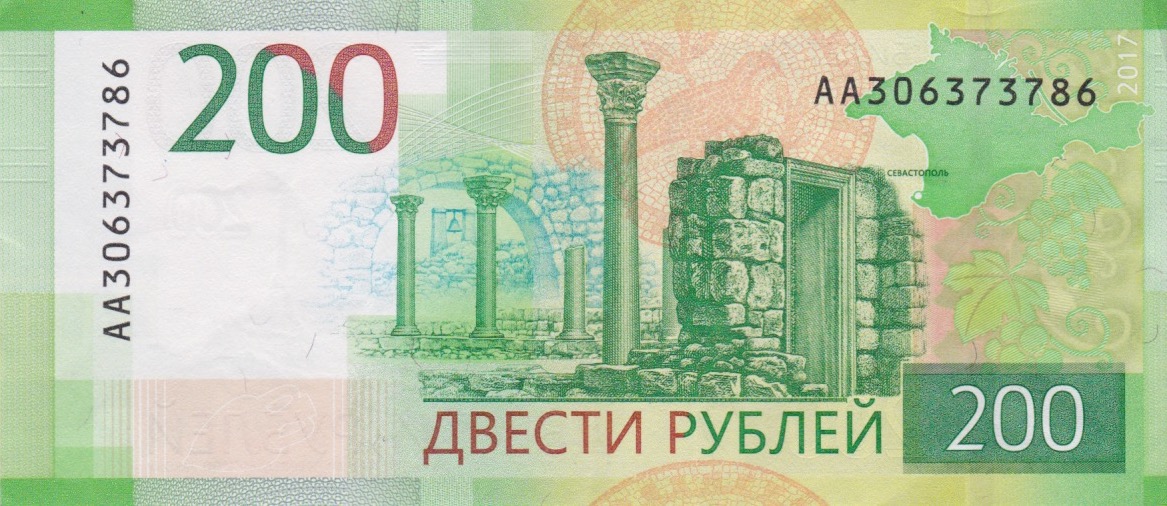
200 ruble note-2A year ago, Russian Central Bank chief Elvira Nabiullina triumphantly introduced the new Crimea-themed two hundred ruble banknote into circulation. Since the economy is shaped more by flows of goods, resources, people, services, knowledge, and money, and the actions of ordinary people, decision makers, and the snake oil salesmen known as capitalists, and less by puerile revanchist neo-imperalist symbolism, the new banknote, pegged at €2.90 by Deutsche Welle only a year ago, is now worth a mere €2.65. I am keeping my specimen as a souvenir of the current bad times until better days arrive. Image by the Russian Reader

Fall in Real Incomes of Russians Accelerated Sharply in September
Economists Say Government’s Forecast No Longer Realistic
Tatyana Lomskaya
Vedomosti
October 17, 2018

Real incomes of Russians have declined for a second month in a row, Rosstat has reported. Their decline accelerated in September to 1.5% in annual terms after falling by 0.9% in August. Prior to that, they had grown for seven months, from the start of the year, by 1.7%. (This figure excludes the one-time 5,000-ruble payments made to pensioners in January 2017.) Real wages accelerated their growth in September, from 7.2% to 6.8% in the previous month.

Incomes of ordinary Russian had been falling for four years in a row, from 2014 to 2017, resuming growth only this year. In the first half of the year, they increased by 2.6%, mainly due to wage increases, notes Igor Polyakov from the Center for Macroeconomic Analysis and Short-Term Forecasting (TsMAKP). Business income increased only by 0.7%, while social transfers (excluding the one-time payment to pensioners) increased by 1.2%, which was significantly weaker than all incomes generally. Other sources of income decreased. There was a slight increase in incomes derived from property, but incomes received from securities and deposits decreased, as did, apparently, incomes from unreported activity, says Mr. Polyakov. He argues it is unlikely circumstances have changed considerably in recent months.

But the anxiety of Russians caused by the volatility of financial markets has increased, says Mr. Polyakov. People have taken to withdrawing cash from foreign currency accounts and transferring it to safe deposit boxes, as well as spending it abroad on holiday. Rosstat cannot register these expenditures and thus reduces its assessment of miscellaneous income. In August, the public’s net demand for US dollars grew by comparison with July from $0.8 billion to $1.7 billion, an increase of nearly 53%, the Central Bank reported.

Retail growth slowed in September to 2.2% in annual terms from 2.8% a month earlier. It is likely the public preferred buying foreign currency while curtailing consumption, argues Mr. Polyakov.

The drop in incomes combined with the serious increase in wages [sic] remains a mystery, writes Dmitry Polevoy, chief economist at the Russian Direct Investment Fund. The growth in real incomes in the first half of 2018 was mainly due to the presidential election campaign, notes Vladimir Tikhomirov, chief economist at BCS Global Markets. Salaries in the public sector and pensions increased rapidly. [That is, the Kremlin bribed Russians directly dependent on its largesse to get out the vote for President-for-Life Vladimir Putin—TRR.] After the election, growth stalled. And, after a palpable devaluation of the ruble in April and accelerating inflation, a dip in incomes was anticipated, argues Mr. Tikhomirov. In September, prices for imported goods rose. In addition, the seasonal discount on fruits and vegetables ended, and the July increase in utilities rates made itself felt, explains Mr. Tikhomirov.

By the end of the year, the incomes of Russians will gradually decline a little, while overall incomes will grow less than 1% on the year, predicts Mr. Tikhomirov. Real incomes might grow by 2% on the year, counters Mr. Polyakov. In any case, this is noticeably lower than official forecasts. The Russian Economic Development Ministry anticipated a 3.4% growth in real incomes in 2018.

Real incomes of ordinary Russians fell by 1.7% in 2017, although the government had forecast a 1.3% increase, the Federal Audit Chamber noted in its opinion on the draft federal budget for 2019–2021. When the forecast was corrected, incomes had decline dsteadily from the beginning of the year, and there were no preconditions for rapid growth by year’s end, the auditors write.

Income growth depends on whether private enterprise will increase wages, argues Mr. Polyakov, but thos wages will be subject to the planned rise in the VAT to 20% in 2019.

President Putin has set a goal of halving poverty by 2024. (The official poverty rate last year was 13.2% of the populace.) The Economic Development Ministry’s forecast significantly increased the growth rate of real wages and anticipated higher growth rates for real incomes, which has raised doubts at the Audit Chamber. There is no wage increase for public sector employees planned in 2019, while the growth of wages in the private sector will depend on growths in productivity.

Rank-and-file Russians have been forced into debt, write analysts from RANEPA and the Gaidar Institute in their opinion on the draft budget. By mid 2018, Russians owed banks 13.7 trillion rubles (approx. 181 billion euros), an increase of 19% from the previous year, they write, and an amount that significantly outpaces the increase in nominal incomes. It is an alarming trend that means an increase in the amounts of money ordinary Russians spend servicing loans, experts warn.

Translated by the Russian Reader

Leonid Volkov: The Export Pozner

pozner-yale-1.jpgVladimir Pozner at Yale University on September 27, 2018. Photo by Peter Cunningham. Courtesy of YaleNews

Leonid Volkov
Facebook
September 28, 2018

Yale has an incredibly rich extracurricular life. Every evening is chockablock with special events, public lectures, round tables, debates, and so on. Many politicians and public figures consider it an honor to speak at Yale. Today, for example, the president of Ghana is going to be lecturing, and there is nothing exotic about it.

All these events fight for an audience. They are advertised in a variety of mailings, and the bulletin boards on campus are densely crammed with flyers.

I imagine the president of Ghana will be sad today. He was beaten this evening [September 27]. The prettiest flyers, which have been on the bulletin boards since mid-August, announced a lecture provocatively entitled “How the United States Created Vladimir Putin.”

I had never seen such a popular event here. It was standing room only. Audience members (students, professors, researchers, etc.) sat on the steps of the lecture hall and stood in the aisles. There were around three hundred people. And no, I could not resist my curiosity, either. I was really interested in how Channel One operated when it was exported.

On stage was the ageless Vladimir Pozner. Would that everyone looked like that at eighty-four! His speech and manners were flawless. His manner of interacting with the audience was impeccable. He joked when it was appropriate and answered questions quickly. He was a professional of the highest class.

[These were Pozner’s talking points.]

  • Putin extended a helping hand after 9/11, but it was rejected.
  • The first proposal Putin made when he was elected to the presidency in 2000 was that Russia should join NATO. He was mortally offended by NATO’s rejection of his offer.
  • He fully voiced this resentment in his 2007 Munich speech, and the resentment was justified.
  • The western media have portrayed Putin in a negative light, all but comparing him with Hitler. This treatment has been wholly undeserved.
  • By offending and attacking Putin, they naturally angered him and made him what he is. The media are to blame for this (sic).

Did Russia meddle in the 2016 US presidential election?

[Pozner’s response was that] the Russian regime cheered for Trump, naturally, because Hillary Clinton had said so many bad things about Putin, but Pozner had seen no proof of meddling. Besides, had America not meddled in elections the world over?

And so it went.

Moreover, [the tone of the Pozner’s speech was captured] in the very first words [out of Pozner’s mouth].

“First of all, believe me when I say I am not representing anyone here. I speak here as an independent journalist, a breed that has nearly died off in Russia.”

Oh, while I was writing all this down, there was a question about Crimea. [Pozner’s response can be paraphrased as follows.]

Was international law violated? Yes, it was, but Sevastopol is a city populated by Russian naval officers and sailors. How could Russia have allowed the possibility of losing its naval base there and having it replaced by a NATO base, by the US Sixth Fleet? Should international law not be disregarded in such circumstances? Besides, Crimea has always been part of Russia.

Finally, [Pozner told his listeners, they] would understand better what had happened in Crimea if [they] imagined what would happen if a revolution occurred in Mexico (sic). In this case, would the US not want to deploy several army divisions on its southern border?

Yes, a new referendum should probably be held in Crimea, but [Pozner] was absolutely certain of the referendum’s outcome.

Argh!

Pozner equated Putin and Russia, of course, in all his remarks.

“It was clear the Russians had to respond in a certain way,” he would say in reference to actions taken by Putin.

In short, my friends, I was impressed. The export Pozner is nothing at all like the Pozner served up for domestic consumption in Russia. (I hope he is very well paid.)

But despite his best efforts, Pozner portrayed Putin as a rather pitiful man: insecure, petty, and vindictive. In this sense, of course, Pozner did not lie.

Leonid Volkov has been attacked on his own Facebook page by readers and Mr. Pozner himself on the latter’s website for his allegedly inaccurate portrait of Mr. Pozner’s appearance at Yale. Stories about the evening published on Yale University’s in-house organ YaleNews and the university’s student-run newpaper the Yale Daily News, however, substantially corroborate Mr. Volkov’s sketch of the event. His description of Pozner and his talk also jibe with my own sense of Mr. Pozner as a chameleon who skillfully tailors his messages to his audiences and the times. Or was it not Mr. Pozner who routinely appeared on my favorite news program, ABC’s Nightline, when I was a teenager in the early 1980s, to defend the moribund Soviet regime with a completely straight face? Read “In the Breast of Mother Russia Speaks a Kind and Loving Heart” for an account of a similiarly virtuoso agitprop performance by Mr. Pozner in the US nearly four years ago. {TRR}

Translated by the Russian Reader