God Is Merciless, or, Mary Dejevsky

DSCN1761

Since childhood I have had the habit of going to sleep listening to the radio. It would be a queer but innocent habit were it not for the fact that I had Lutheranism mainlined into my brain during childhood as well. I am thus perpetually a sinner in the hands of an angry god, and that god is frequently quite displeased with me. Or so it seems.

From time to time, Jehovah punishes me by putting the British journalist and Putin fan Mary Dejevsky on the radio as I am going to sleep.

Last night, she was on ABC Radio National’s Between the Lines, and she was in fine fettle.

Asked about the political crisis sparked by the pension reform in Russia, Dejevsky said she rather admired Vladimir Putin for spending some of his tremendous reserves of political capital and popularity by biting the bullet and trying to solve an objective problem so his “successor” would not have to solve it.

It is actually a good problem to have, this business of needing to raise the retirement age precipitously, Dejevsky argued, because it is premised on the supposedly happy alleged fact that Russians are, on average, living much longer than before, and that, we were meant to imagine, was due to Putin’s wise policies.

When the hapless Australian interviewer, Tom Switzer, asked her about the nationwide protests sparked by the proposed reform and the numerous arrests at those protests, Dejevsky dismissed them out of hand, claiming she had been to “provincial Russia” just last week, and things there were “peaceful.”

I won’t even go into Dejevsky’s sparkling defense of Putin’s illegal occupation of Crimea, which prefaced her lies about Putin’s popularity, the pension reform, and the supposedly sleepy provinces.

In case you are not a Lutheran occasionally punished by the Lord God Jehovah by having to listen to Mary Dejevsky in the middle of the night or by having to read the latest pro-Putinist tripe she has written, I would remind you she has long been gainfully employed by the Independent and the Guardian as a columnist, and she is a frequent guest on thoroughly respectable news outlets such as ABC Radio National, BBC Radio 4, etc.

It seemingly has not occurred to the smart, cynical folk working at these bastions of tough-minded journalism that Mary Dejevsky is a less than objective observer of the Russian scene.

The Lutheran god is a merciless god. {TRR}

Photo by the Russian Reader. This blog was slightly edited after I received legal threats from an electronic entity claiming to be Mary Dejevsky.

The Minimum of Solidarity (125 Days)

day 125Award-winning Ukrainian filmmaker and political prisoner Oleg Sentsov has been on hunger strike for 125 days in the Polar Bear Maximum Security Prison in the far north of Russia. His only demand throughout the strike has been that the Russian authorities release sixty-four other Ukrainian political prisoners, most of them, like Mr. Sentsov, from Crimea, which was illegally occupied by Russia in 2014.

In recent days, I have seen a lot of snide commentary from Russian nationals to the effect that Mr. Sentsov should give up his hunger strike, because it’s obviously not working.

In my opinion, what Mr. Sentsov, who was sentenced to twenty years in prison on trumped-up charges by a kangaroo military tribunal in Rostov-on-Don, does is up to him, don’t you think? I think he should get a free pass when it comes to what he does or doesn’t do after the Putin regime ruined his life while Russian society mostly stood by idly and silently once again.

Oleg Sentsov is a far braver man than most of us can hope to be. If we do not want to help him and refuse to show solidarity with him and his cause, the least we could do would be to refrain from writing and talking about him.

That would be the minimum of solidarity in this case. {TRR}

#SaveOlegSentsov


Oleg Sentsov: 115 Days

115 Days“The 115th day of Sentsov’s hunger strike.” Image courtesy of Askold Kurov

Ukrainian political prisoner Oleg Sentsov has been on hunger strike for 115 days in the Polar Bear Maximum Security Prison Camp in Labytnangi, Russia, where he has been serving a twenty-year sentence on trumped-up charges of “terrorism.”

Mr. Sentsov’s only crime was that he opposed the occupation of his native Crimea by neo-imperialist Russia.

Mr. Sentsov’s only demand is that Russian authorities release sixty-four other Ukrainian political prisoners they have incarcerated during their illegal war against Ukraine.

Oleg Sentsov: “Catastrophically Bad”

DSCN0173Dmitry Dinze is Oleg Sentsov’s lawyer. Oleg Sentsov is the Ukrainian filmmaker and political prisoner who has been on hunger strike for eight-six days in the Polar Bear Maximum Security Penal Colony in Labytnangi, Yamalo-Nenetsk Autonomous District, Russian Federation. His only demand has been that the Kremlin release the sixty-four other Ukrainian political prisoners currently held in Russian prisons.

Late last night, Mr. Dinze, one of Russia’s best human rights and criminal defense lawyers, wrote“I’m no fan of rumors, of course. I find facts more interesting, even better, confirmed facts, but in this case the circumstances are different. According to diplomats who have been in contact with Russian officials on resolving the issue of Oleg Sentsov, they have no intention of releasing Sentsov. They are thinking his death should be a lesson to other inmates. If this is true, I don’t know what to say.”

Natalya Kaplan
Facebook
August 8, 2018

Things are not just bad, they are catastrophically bad. Oleg sent me a letter via his lawyer. He almost cannot stand up anymore. He wrote the end was near, and he was not talking about being released from prison. He asked whether anyone was still interested in his hunger strike: he is not given the letters sent to him, none of them. He said was in a news vacuum and had no idea what was happening.

The European Court of Human Rights insisted he be transferred to a civilian hospital, one close to his place of residence. Oleg refused. He said he would simply not survive the trip, and he had been bullied even more in the civilian hospital in Labytnangi, where he was hospitalized in the intensive care ward, than he had been in the prison hospital.

That’s Russia for you. I have no clue what else we can do and how we can save him. Things are really bad.

Natalya Kaplan is Oleg Sentsov’s cousin. Thanks to Yana Teplitskaya for the heads-up. Translation and photo by the Russian Reader

83 Days

83 daysImage courtesy of Askold Kurov

Ukrainian filmmaker and political prisoner Oleg Sentsov has been on hunger strike in a prison in the far north of Russia for eighty-three (83) days. His only demand is that the Kremlin release the other sixty-four (64) Ukrainian political prisoners it has incarcerated on trumped-up charges in the wake of its illegal, unprovoked occupation of Crimea and invasion of Eastern Ukraine. {TRR}

#SaveSentsov
#FreeOlegSentsov
#Free64

Oleg Sentsov

37388658_2052268531474743_764773632051249152_nThe room in the prison infirmary where Oleg Sentsov is kept. 

Anton Naumlyuk
Facebook
July 19, 2019

Oleg Sentsov

Attorney Dmitry Dinze visited Oleg Sentsov in the Labytnangi penal colony today.

“He looked even worse than last time. He was quite pale. He walked under his own power. Around a week ago, he went through a second health crisis. He got sick. The doctors wanted to hospitalize him and force-feed him as much as possible, to give him IV drips with more nutrients. He refused. He was left in the penal colony on the condition he would ingest the nutrient mix himself under a doctor’s supervision. He takes two spoonfuls a day. He is kept in a room in the prison infirmary. He has no intention of quitting the hunger strike. ‘I’ll hold out as long as I can last,’ he says.”

Sentsov also expressed bewilderment as to why Ukraine and Lyudmila Denisova, human rights ombudsman for the Verkhovna Rada, had ended their vigorious campaign of support for Ukrainian political prisoners.

“Sentsov thinks the Ukrainian side should do more to press for the release of the other political prisoners,” said Dinze.

Sentsov also sent his greetings to Yevgeny Panov (Yevhen Panov), a defendant in the case of the so-called Crimean saboteurs, and to Vladimir Balukh.

Thanks to Askold Kurov and Vladimir Akimenkov for the heads-up. Translated by the Russian Reader


Emir Hussein Kuku: 23 Days on Hunger Strike

274381Emir Hussein Kuku

Anton Naumlyuk
Facebook
July 19, 2018

Emir Hussein Kuku

Guards did not give Emir Hussein Kuku the baby food his wife Meryem brought and tried to have delivered to her husband,  hoping that, if he did not stop his hunger strike, he would at least ease up a bit. Kuku has been on hunger strike for 23 days. He has demanded the release of all Ukrainian political prisoners in Russia. The guards initially took the care package from his wife, but they quickly returned it, since Kuku refused to quit his hunger strike.

Kuka has written himself about the state of his health.

“On the 22nd day of my hunger strike, my condition leaves much to be desired, to put it mildly. My left kidney (which FSB Special Forces officers beat in 2015) really hurts, as does my heart and something under my left ribs and in the front of my chest; my pancreas, probably. The area around my liver and my right kidney hurt, but they hurt less. I feel the pain if I stand up or sit reading. If I lie down, the pain subsides, but it doesn’t go away entirely. It’s hard to fall asleep. I toss and turn, sleepless, almost until morning. I won’t bother mentioning trifles like dizziness, the weakness I feel when I take five steps in my cell, the constant thirstiness, the vile taste in my mouth, and the smell of acetone.

“On July 16, I was again transported to the hospital for inmates with TB. The doctors have not divulged the outcome of the tests and ECG, but their faces tell me the news is not good. Actually, for several days, the doctors in the remand prison have stopped talking to me about my condition. They have even stopped weighing me. Apparently, this is due to publication of my statement about my health. The big shots with the stars on their epaulettes banned them from playing into the hands of ‘enemies of the state.’ All I found out in the TB hospital was that my ‘official’ weight was 67.8 kilograms, meaning I have lost 11 kilograms. Although, according to my calculations, I should weigh around 66 kilograms, since I weighed 68.5 kilograms on July 12, and I’ve been losing 0.6 kilograms a day.

1530198608-9959Emir Hussein and Meryem Kuku

“They have not been giving me any maintenance therapy—no glucose, no vitamins, nothing. Apparently, top-ranking officials do not want a second Sentsov, someone who would be able to drag out a hunger strike for months if he got care in the form of glucose and vitamins. They realized the mistake they made [with Senstov]. They have to break me quickly.

“Earlier, I was warned that if I didn’t give up the hunger strike, they would be forced to hospitalize me in the TB hospital, a place teeming with inmates infected with tuberculosis and HIV. It’s a TB hospital, after all.”

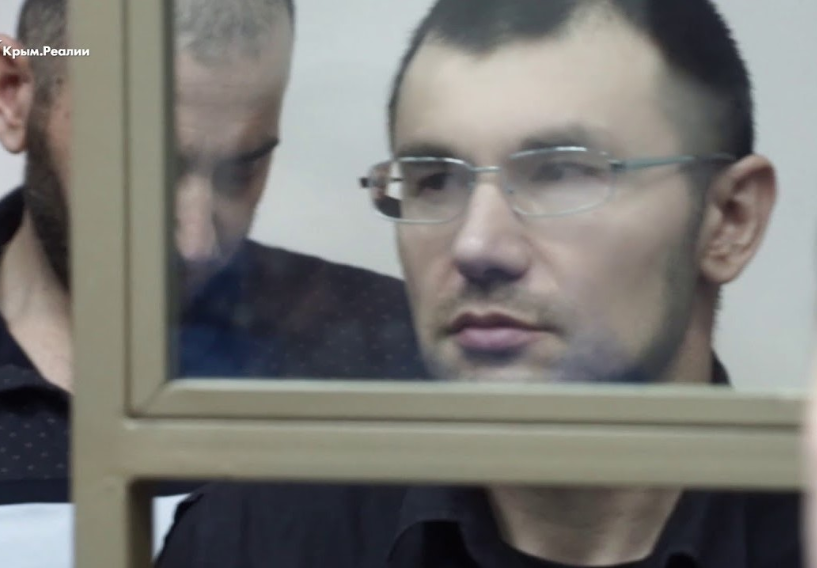
The trial of the so-called Yalta group in the Hizb ut-Tahrir case is currently underway in the North Caucasus Military District Court [in Rostov-on-Don].

Photos courtesy of 112.International and Unian. Translated by the Russian Reader

Crimean Farmer and Political Prisoner Vladimir Balukh Has Been on Hunger Strike for 104 Days

Vladimir Balukh’s 100 Days: The Crimean Euromaidan Supporter Has Been on Hunger Strike in Remand Prison for Over Three Months
Anna Kozkina
Mediazona
June 27, 2018
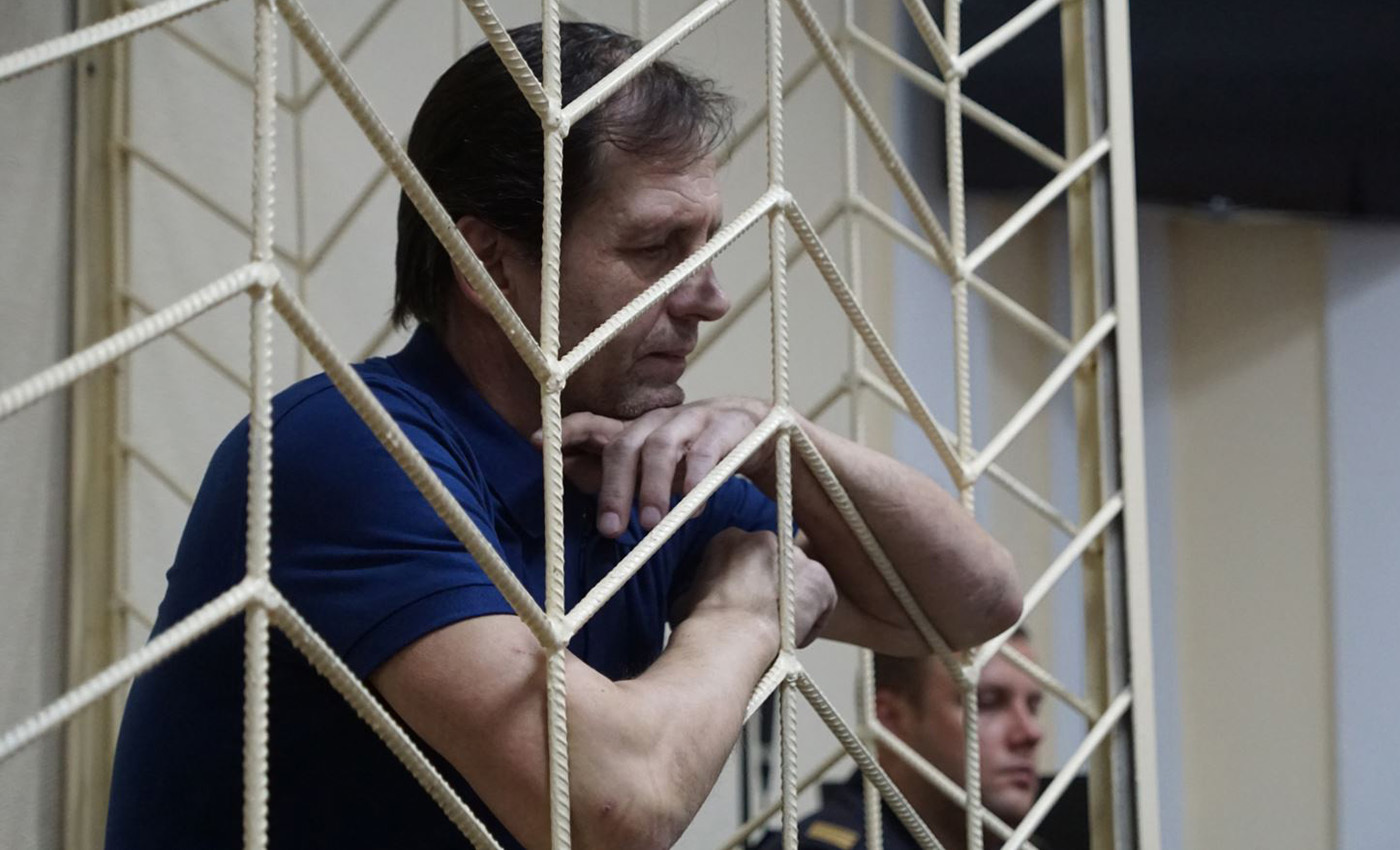

Vladimir Balukh. Photo by Anton Naumlyuk. Courtesy of RFE/RL

Today [July 1, 2018] is the [104th] day of a hunger strike by Vladimir Balukh, who awaits a verdict in his third criminal trial in Simferopol Remand Prison. In 2014, he refused to accept Russian citizenship, raising the Ukrainian flag over his house in solidarity with the Euromaidan protests. The first criminal case against Balukh was opened in 2015. It would be followed by two more case. In the article below, Mediazona catalogues the persecution the Crimean activist has endured and describes his hunger strike, during which he has lost at least thirty kilos.

On June 22, 2018, Balukh, who is imprisoned in Simferopol Remand Prison, said he was returning to the harsher form of hunger strike and would now only be drinking water. Balukh had been drinking fruit drink for some time.

Olga Dinze, Balukh’s defense attorney, said the cause was increased pressure from prison wardens. In court, Balukh had spoken of regular searches of his cell, including at night. According to him, prison wardens and guard have hinted it was time for him to “go down in the hole,” i.e., be sent to solitary confinement.

The following day, Ukrainian human rights ombudsman Lyudmila Denisova requested Pierre-Emmanuel Ducruet, head of the International Red Cross’s Simferopol office, visit Balukh at the remand prison and secure professional medical care for him.

The Flag, Heaven’s Hundred Heroes Street, and the Insulted FSB Agent
In late 2013, Crimean farmer Vladimir Balukh raised a Ukrainian flag over his house in the village of Serebryanka in solidarity with the Euromaidan demonstrators. The flag stayed there after the March 2014 referendum. Balukh did not recognize Crimea’s annexation by Russia and refused to apply for a Russian passport.

Police and Russian Federal Security Service (FSB) agents first paid him a visit in the spring of 2015. Balukh was not home when they arrived. When he heard about the visit to his home by the security services, he stayed with friends for several days. The police and FSB searched Balukh’s house and also paid his mother a call.

The security services visited Balukh for the second time in November 2015. Claiming he was suspected of auto theft, they searched his house again. After the search, the farmer was charged with insulting a government official, a violation under Article 319 of the Russian Criminal Code. Allegedly, Balukh had used “foul, insulting language when addressing field agent Yevgeny Baranov, which the latter found unpleasant.” Balukh did not deny he could have sworn at the field agent, since FSB officers had punched him in the kidneys and stepped on his head after throwing him on the ground.

In February 2016, the Razdolnoye District Court found Balukh guilty, sentencing him to 320 hours of community service. Subsequently, the Crimean Supreme Court sent the case back to the lower court for review, but in June the district court reaffirmed its original guilty verdict, again sentencing Balukh to 320 hours of community service.

The Ukrainian flag was torn down from the farmer’s house again and again, but he put it back up every time. On November 29, 2016, the third anniversary of the Euromaidan protests, Balukh hung a sign on his house, identifying the address as “Heaven’s Hundred Heroes Street, 18.” Two weeks later, police and FSB carried out yet another search of his house. This time, they allegedly found eighty-nine rounds of ammunition and several TNT blocks in the attic. After the search, the flag and the street sign were removed from Balukh’s house. Balukh was detained and later remanded to police custody.

Balukh was charged with illegal possession of weapons and explosives (Article 222 Part 1 and Article 222.1 Part 1 of the Russian Criminal Code). The farmer claimed his innocence and said his political stance was the reason for the criminal prosecution. He claimed the rounds of ammo and explosives were planted during the search. Police allegedly found them in the presence of a single official witness.

The Memorial Human Rights Center designated Balukh a political prisoner. It noted that he had received clear threats after hanging the street sign on his home memorializing the murdered Maidan protesters.

“It was after this that the chair of the village council and his deputies visited Balukh’s home and threatened that his independent behavior would have unpleasant consequences, including the ‘discovery’ in Balukh’s house of weapons or narcotics. He demanded  Balukh take the sign down,” wrote Memorial.

Memorial argued that the prosecution had not proven the ammunition actually belonged to Balukh, since his fingerprints were not found on the items.
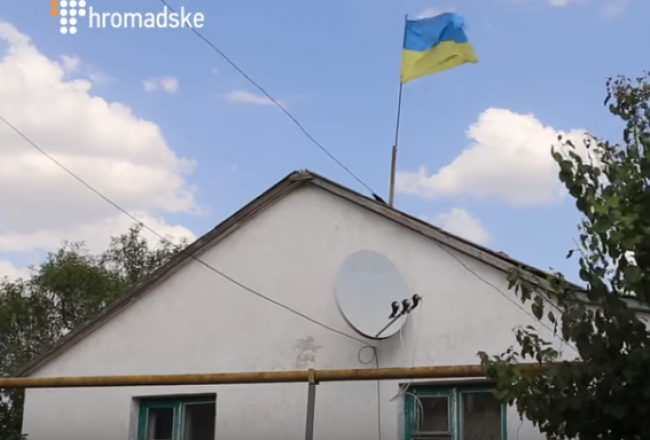
Vladimir Balukh’s House. Photo courtesy of hromadske.ua

“Go to Ukraine and Treat Your Back There”
On August 4, 2017, the Raznodolnoye District Court sentenced Balukh to three years and seven months in a medium security penal colony and a fine of ₽10,000 [approx. €136] for possession of the ammunition and TNT.

A week after Balukh was sentenced, he had a run-in with Valery Tkachenko, warden of the Razdolnoye Temporary Detention Facility. According to Balukh, Tkachenko punched him in the shoulder and tried to kick him as well. He also, allegedly, made insulting remarks about the ethnicity of Balukh and his parents. Balukh’s attorney filed a complaint with the police.

Two weeks later, the Investigative Committee opened a case against Balukh himself, claiming he had violated Article 318 Part 1 of the Criminal Code (violence against a state official). Subsequently, Balukh’s alleged actions were reclassified as a violation of Article 321 Part 2 (disrupting the operations of penitentiary facilities). According to police investigators, on the morning of August 11, 2017, Balukh had elbowed the warden in the stomach while his cell was being inspected. He then, allegedly, entered his cell and struck Tkachenko’s arm.

In November 2017, the district court commenced its review of the ammunition possession case, and in December Balukh was transferred from the remand prison to house arrest.  After complaining of pain in his back and groin, Balukh was soon taken to hospital straight from the courtroom.

At the district hospital, medical staff merely measured his blood pressure and gave him a cardiogram. After listening to Balukh’s complaints, the local doctor said, “My back hurts, too. Should I not go to work or what?”

Balukh asked the court permission to travel to Simferopol or Feodosia for a medical examination, but his request was turned down. During his December 27 court hearing, the ambulance was called several times due to Balukh’s temperature, high blood pressure, and back pain. According to the news website Krym.Realii, the head physician of the local hospital’s emergency department, Nadezhda Drozdenko, told Balukh, “Go to Ukraine and treat your back there.” When the hearing went on for ten hours, Balukh lay down on the floor due to the severe pain.

In early 2018, the court again found Balukh guilty on the ammunition possession charge and sentenced him to three years and seven months in a work-release penal colony. The verdict was upheld on appeal, although the sentence was reduced by two months.

Balukh was again sent to the remand prison. He has continued to complain of back pain, whose cause doctors have never been able to diagnose.

“He Has Adopted a Stance of Hopelessness”
After the Crimean Supreme Court upheld the verdict in the ammunition possession case, Balukh went on an indefinite hunger strike as of March 19, 2018. He gave up all food, only drinking water and tea, protesting what he regarded as the illegal verdict against him.

In late March, Balukh was assaulted in the remand prison and hospitalized in the infirmary, as reported by Aktivatika, who quoted defense attorney Olga Dinze.

“The hunger strike has been difficult for him. Besides, the prison wardens have engaged in constant provocations. They have brought him delicious food, enticing him to eat. It destabilizes him a bit, but he has hung and kept his word,” said the lawyer.
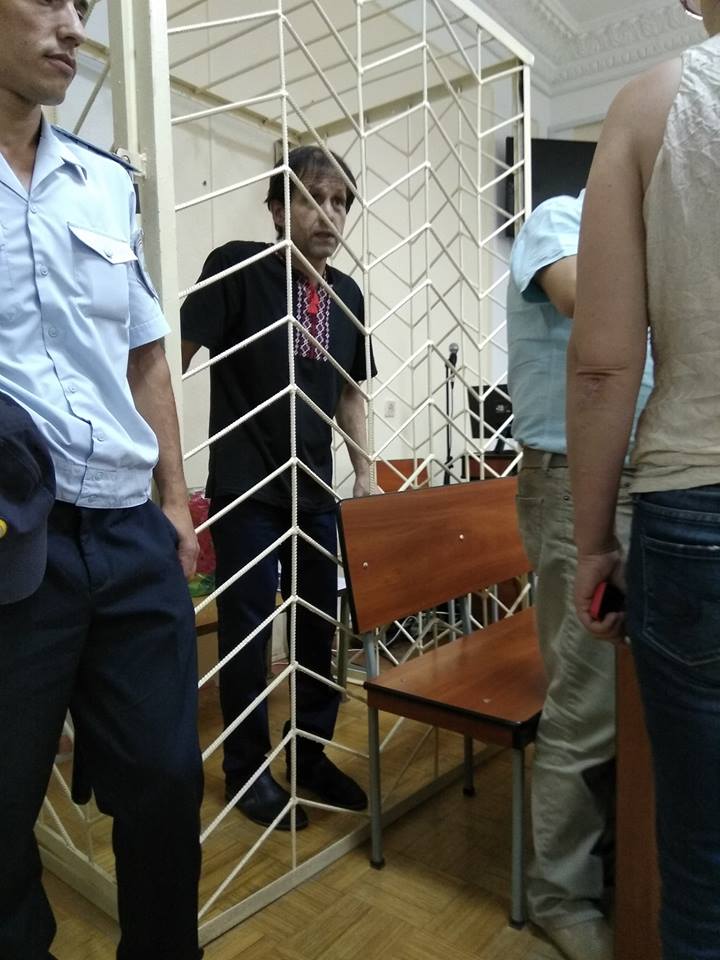
Vladimir Balukh on June 22, 2018. Photo by Zair Semedlyaev. Courtesy of crimeahrg.rog

In mid April, his social defender, Archbishop Kliment of Simferopol and Crimea, reported Balukh had been assaulted by guards.

A month later, Vladimir Chekrygin, an expert with the Crimean Human Rights Group, told Krim.Realii Balukh was under pressure in the remand prison.

“We know the guards at the remand prison have periodically threatened Balukh for his actions. They have told him that sooner or latter he would be punished for his willfulness. They have been doing searches in his cell night and mornings. Searches are permitted, but at certain hours and under extraordinary circumstances. They are not letting him rest,” Chekrygin explained.

On May 18, Russian human rights ombudsman Tatyana Moskalkova visited the Simferopol Remand Prison. She wrote to her Ukrainian colleague, Lyudmila Denisova, that Balukh had no complaints either about the conditions of his incarceration or cruel treatment.

In May, the Raznodolnoye District Court began hearing the third criminal case against Balukh, involving his run-in with the temporary detention facility warden. During the trial, even the prosecution’s witnesses, guards at the facility, testified Balukh did not assault the wardeb. During the investigation, the alleged victim refused to take part in a face-to-face confrontation with Balukh, who described his behavior in great detail to the judge.

“He would come to my cell and try to insult me, to humiliate me for being Ukrainian and thus, as he thought, for being a member of Right Sector. He would say us Ukrainians should be murdered as a species, and so on,” said Balukh.

On June 10, Balukh was again transferred from Razdolnoye to the Simferopol Remand Prison. There he was put in the “glass,” a narrow cell in which one can only stand or sit, for two hours, Crimean human rights defenders reported.

The following day, it transpired the remand prison wardens no longer believed Balukh was on hunger strike. The guards had learned Balukh was drinking not only water but also oatmeal kissel. Archbishop Kliment had persuaded Balukh to make the compromise a month after he started his hunger strike.

“Vladimir agreed. We know  he began consuming only kissel. Sometimes, he has honey and bread crumbs at most. At some point, the prison wardens found out about the kissel and decided not to recognize his actions as a hunger strike. There are special rules when wardens decide a prisoner has gone on hunger strike. They have stopped following these rules when it comes to Balukh, since they believe he is no longer on hunger strike. But Vladimir has continued his protest. He has lost thirty kilos of weight. The doctor from the remand prison infirmary has stopped making regular checkups of Balukh, although he is obliged to do so when inmates go on hunger strike,” explained Olga Skripnik, head of the Crimean Human Rights Group.

Protesting constant inspections in the remand prison, Balukh returned on June 22, 2018, to the original form of his hunger strike. He has again been only drinking water. Olga Dinze explained the frequent searches of Balukh’s cell as a consequence of Balukh’s having filed a motion to be paroled for his first criminal conviction.

On June 25, Dinze told Mediazona her client’s condition had taken a turn for the worse.

“I think Balukh has suffered a pinched nerve. It is a quite serious case. He has been experiencing severe pain in his chest, neck, and shoulder blades. He feels unwell all the time,” Dinze said, adding the new symptoms were probably due to long-term back pain.

According to Dinze, Balukh was not receiving medical care.

“He refuses cares from the doctors in the remand prison. They cannot give him the medical care he needs, diagnose him, and prescribe him appropriate treatment. He has requested doctors from the Red Cross,” said Dinze.

The defense attorney added that, after Balukh stopped drinking oat kissel, he was transferred to a cell in the general population, but the conditions there were decent. He currently has no complaints against the wardens.

Earlier, Dinze told Krym.Realii Balukh had been hoping for a prisoner exchange.

“Vladimir is quite weary. He is emotionally exhausted. He has adopted a stance of hopelessness. He says no one will ever release him from prison. If they cannot keep him in prison on the current convictions, there will be new charges. So now he is finally talking. For the last few months we have been talking about how, if there is a prisoner exchange and everything goes well, he would really, really like to go to mainland Ukraine,” said Dinze.

The Ukrainian authorities have recently repeatedly stated their readiness to exchange Russian convicts for the sixty-four Ukrainian nationals imprisoned in Russian remand prisons and penal colonies, including Balukh and filmmaker Oleg Sentsov, who has been on hunger strike since mid May.

Closing arguments in Warden Tkachenko’s case against Balukh have been scheduled for July 2.

Thanks to Yegor Skovoroda for the heads-up. Translated by the Russian Reader

45 Days

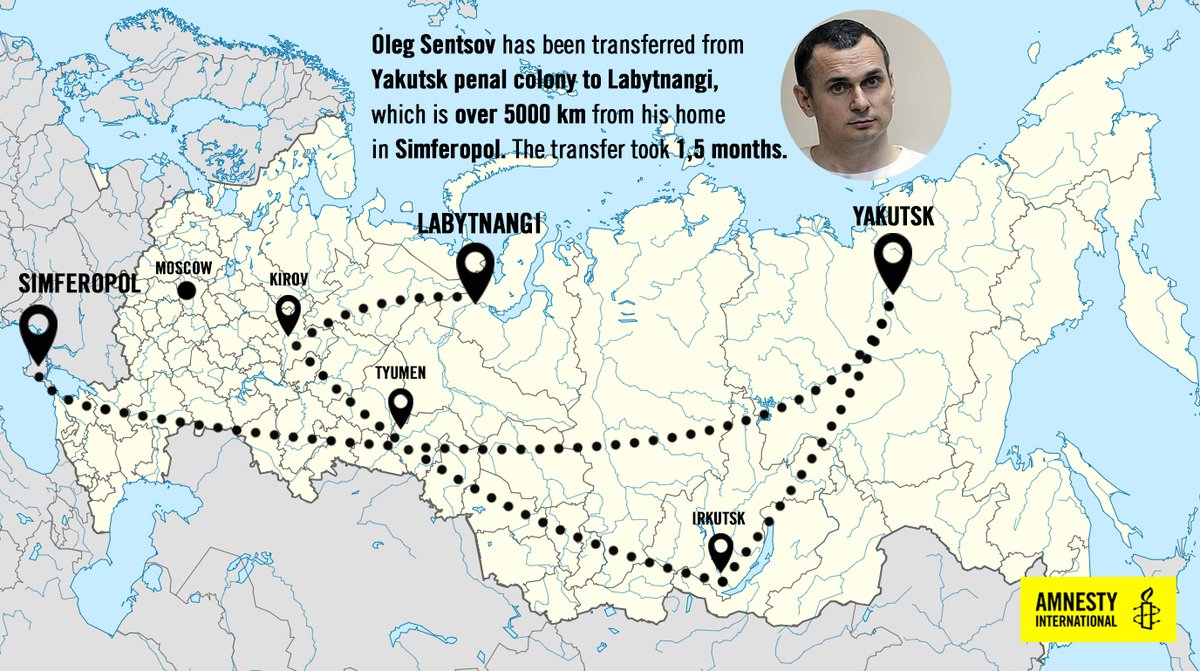
word-image-49This map, published by Amnesty International, shows the geography of Oleg Sentsov’s ordeal, from his arrest in occupied Crimea, in May 2014, to his arrival at the Labytnangi Correctional Colony, north of the Arctic Circle, in October 2017. Courtesy of Let My People Go!
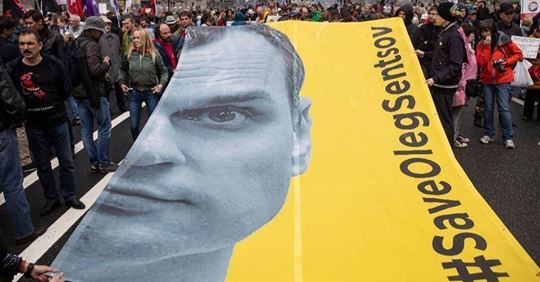
#SaveSentsov
#FreeOlegSentsov

Ukrainian film director and political prisoner Oleg Sentsov is in the midst of his forty-fifth day on hunger strike in the maximum security penal colony, north of the Arctic Circle, where the Putin regime sentenced him to twenty years for the thought crime of not approving its illegal occupation of Crimea in 2014.

Sentsov’s only demand is that the Putin regime release the several dozen other Ukrainian political prisoners it has imprisoned.

It should also release Mr. Sentsov, made to suffer for a crime he did not commit. (He was convicted on terrorism charges). It would be a gesture of peace and reconciliation appreciated round the world, especially during the World Cup, which Russia is currently hosting.

But I am not holding my breath. Russia has been misruled for the last twenty years by a clique of KGB officers who morphed into some of the most reckless and impudent gangsters the world has ever seen once the Soviet Union collapsed. Yet this utterly destructive regime gets oodles of aid and comfort from the international far left and far right, as well as corrupt entities like FIFA and the London City, who want to partake in Russia’s embezzled riches.

A wiseguy like Putin knows this and, I am afraid, has calculated that the fallout from Sentsov’s death in prison is an acceptable risk. Releasing Sentsov, on the other hand, would show that Putin is susceptible to pressure from the outside world. Unless I am misreading him, he is loath to do this, at least in an obvious way. // TRR


Yegor Lopatin: Oleg Sentsov’s Forty Days

safe_image

Oleg Sentsov’s Forty Days
Yegor Lopatin
Za-Za
June 22, 2018

We are witnessing a tragedy generated by incredible cynicism. Oleg Sentsov has been on hunger strike for forty days.

Have you tried not eating for four days? For ten days? I once performed an experiment on myself and did not eat for eight days. What mattered to me was whether I could do it or not. I passed the test fairly easily.

As far as I can remember, no one has been on hunger strike for forty days in a row.*

I would imagine Sentsov, who is 42 years old, has already irreparably damaged his health and can never be completely normal again. This is quite sad. What is even sadder, however, is that he apparently has decided to die, thus challenging the people who sent him to prison for 20 years, annexed Crimea, and unleashed a war in Donbass.

Sentsov has no other means of influencing these people, who are firmly convinced anyone can be broken with a good spanking. We are thus witnesses to a invisible duel between Sentsov and Putin, who bears direct responsibility for everything that happens in Russia.

No one will emerge from this duel a winner. There will only be losers. Sentsov will most likely die an agonizing death, and the damage to Putin’s reputation will be worse than from the sinking of the Kursk and the downing of Flight MH17, although people with their heads screwed on straight have long understood that Putin’s reputation is beyond saving.

Ukrainian President Petro Poroshenko will also bear blame for Sentsov’s death. He has been incredibly passive during the hunger strike and has done basically nothing to save Sentsov.

All of us, the people of Russia, are directly responsible for the lawlessness of our authorities, who have destroyed a young man on trumped-up charges. I do not believe Sentsov could have planned terrorist attacks in Crimea or even laid a finger on anyone.

Sentsov was sentenced to 20 years in prison because Putin illegally annexed Crimea, defying the Budapest Memorandum on Security Assurances, signed on December 5, 1994.

This is a typical KGB move: doing something nasty and blaming the victim for it.

So, before you bask in the success of the Russian national football team, remember that an amazingly courageous man is dying a painful death right now for his beliefs.

His name is Oleg Sentsov.

This is not only his tragedy. It is our tragedy, too.

Yegor Lopatin is a Russian writer. Thanks to Elena Zaharova for the heads-up. Translated by the Russian Reader. Photo courtesy of the Los Angeles Times

* Provisional IRA militant Bobby Sands was on hunger strike in the Maze Prison for 66 days in 1981, while Soviet dissident and political prisoner Anatoly Marchenko struck for 117 days in 1986. Marchenko died in a prison hospital several days after ending his strike, while Sands died in the prison hospital while still on strike. // TRR