Pornofilmy, “This Will Pass”

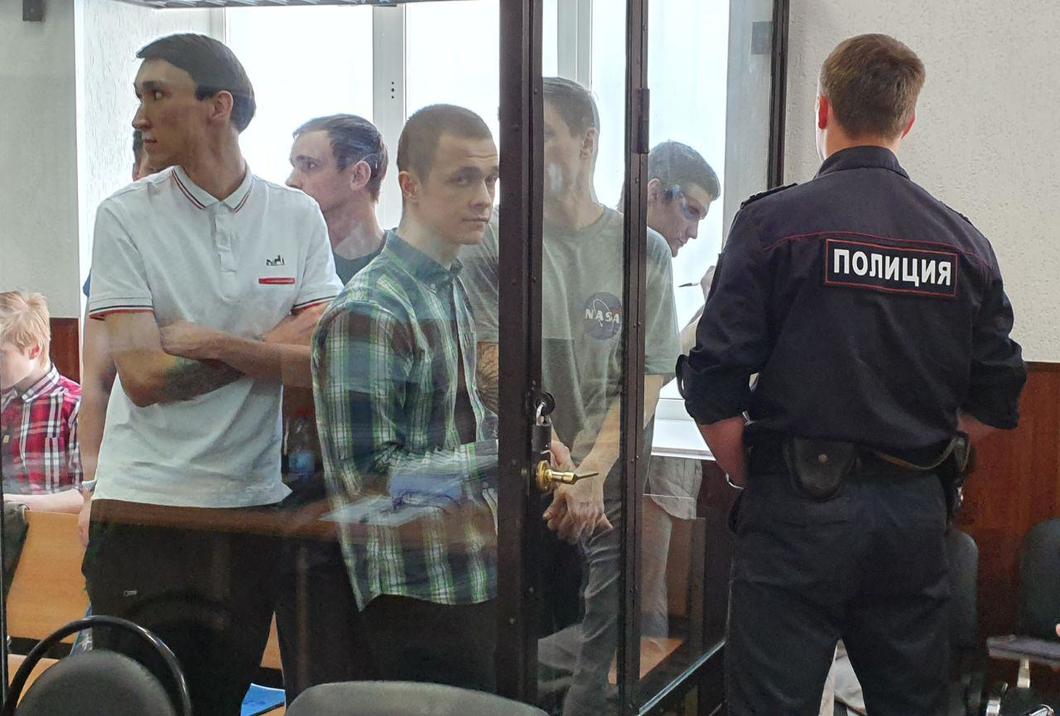
After a hearing in the so-called Network trial in Petersburg this past Thursday, supporters of Russian political prisoners Viktor Filinkov and Yuli Boyarshinov chanted the lyrics of the song “This Will Pass,” by Russian rock group Pornofilmy, as the young men were led out of the courthouse and put in a paddy wagon for transport back to the remand prison where they have been jailed for the last two years. Since the song mentions the Network Case defendants and their torture at the hands of the FSB, and contains a brief but telling catalogue of the current Russian regime’s crimes, I made this hyperlink-annotated translation of the lyrics for you.

Pornofilmy: This Will Pass

Аll of it will pass, like thunderstorms in May
Someone’s tears, a V sign on the mouth
Like a United Russia MP’s mandate
Like an interrogation, like a cop’s sneer
Like the corridors at Lefortovo Prison
Like Beslan, like the poison gas at Nord-Ost
Like the federal pack of soulless majors
Sevastopol, Donetsk and Luhansk
This will definitely pass . . .

This will definitely pass!
A wet plastic bag on its head
Electric shock marks on its hands
My Russia is behind bars
But trust me
It will pass!
What black times we live in
But in the distance I seem to see
The forgotten light of living hope, so trust me
This will definitely pass

Like the swastika of the Russian world
Like the fires in Siberia’s forests
Prison sentences for honest guys from Penza and Petersburg
Paddy wagons packed with children
Or the lying scum on the telly
Article 228 and shakedowns at five in the morning
Like riot crops bravely maiming women
Like December, January and February
This will definitely pass…

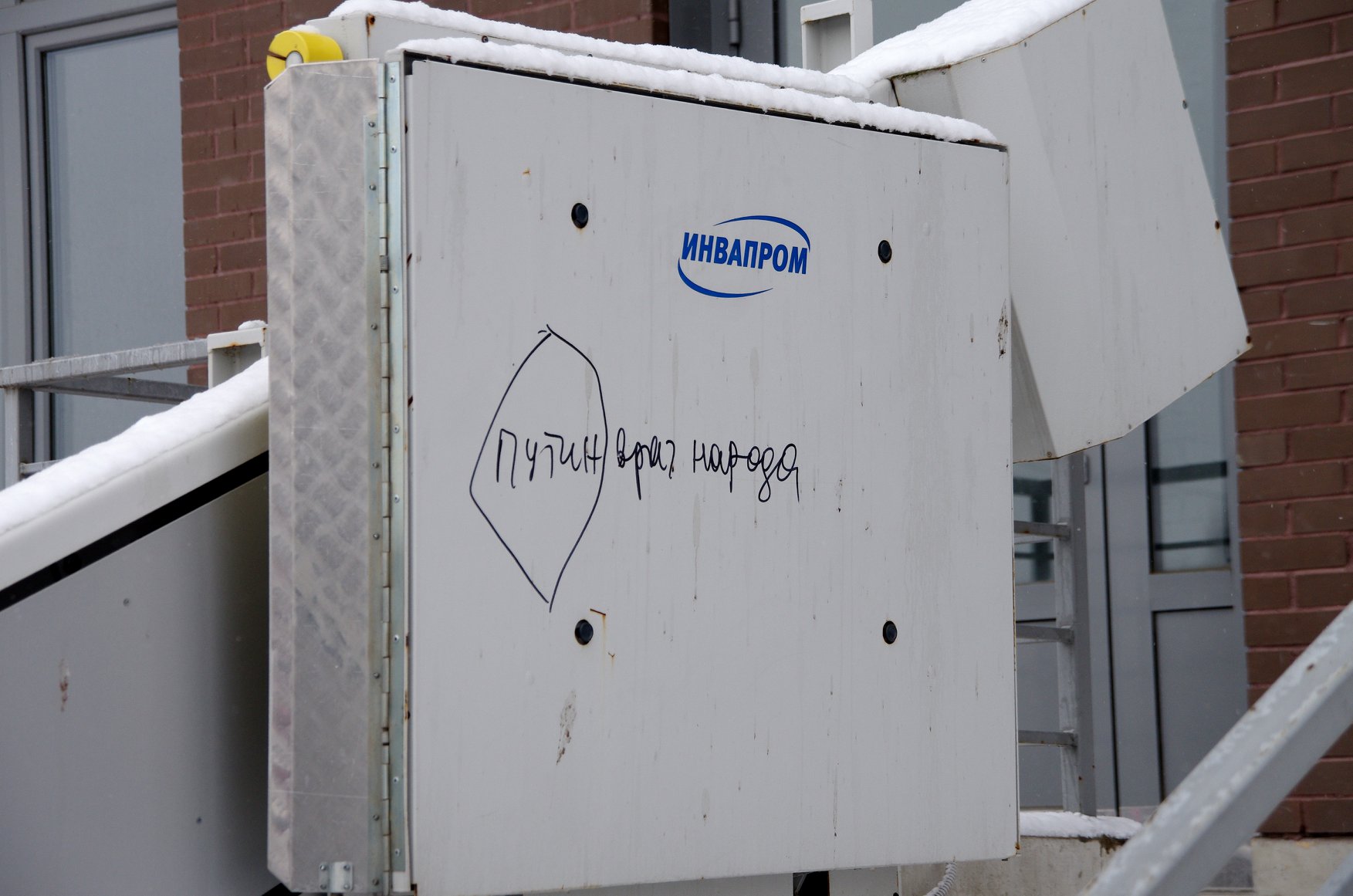
putin enemy of people“Putin is an enemy of the people.” March 1, 2020, Petersburg. Photo by and courtesy of VA

This will definitely pass!
A wet plastic bag on its head
Electric shock marks on its hands
My Russia is behind bars
But trust me
It will pass!
What black times we live in
But in the distance I seem to see
The forgotten light of living hope, so trust me
This will definitely pass

All of it will pass, everything passes sometime
In a year, in a day, in an instant
Yesterday’s dictator will lie alone in the morgue
Now just a dead old man
And the doors at Lefortovo will be cut from their hinges
And Russia will rise from its slumber
Like the battered and blown-up Malaysian airplane
Spring will burst into your icy hut

This will definitely pass!
A wet plastic bag on its head
Electric shock marks on its hands
My Russia is behind bars
But trust me
It will pass!
What black times we live in
But in the distance I seem to see
The forgotten light of living hope, so trust me
This will definitely pass

Translated by the Russian Reader

At the Network Trial in Petersburg

Jenya Kulakova writes: “The peculiarities of a small military garrison court and a high-profile political trial. A troika of military judges, flushed with irritation. They are three hours late for the hearing. Trying not to blow its cover, an FSB van transports them: three times it squeezes through a crowd of people shouting, ‘Freedom to political prisoners!’ and ‘Shame on the court!’ They peer fearfully from the courtroom, closing the door. On their second try, they are escorted by the bailiffs. We are like the buzzing of annoying mosquito to them. It will only make them angry, not appeal to their absent conscience. But what else can we do? Should we silently see off the people who in a few days will send our friends down for ten years or so? Yegor Ostapushchenko’s photo captures the moment when the judges peer from the courtroom, not daring to leave.

87514148_10216306409718439_2273106240202604544_o

Vlad Gagin writes: “Today I went to the trial of the Petersburg defendants in the Network Case, Viktor Filinkov and Yuli Boyarshinov. I stood outside for five hours and almost froze, because I had dressed so unforgivably lightly, but the important thing was that I felt part of a network, so to speak. It is a network of those whose texts I once read, those I loved, those whose activist projects I was interested in, those with whom I quarreled over ideological differences and everyday troubles, old friends and wonderful strangers, the red and black flag, and police officers who do not look you in the eyes. The city seemed like a city. The meaning of strange rituals like the secret removal of the defendants from the courtroom (as happened, I think, at the previous event in Penza) became clear: the space of struggle is quite small, but it is there. It is important to show the defendants that many people have come to support them. Bureaucracy (for example, the constant postponement of the start of the court hearing) is weaponized here. In fact, everything is weaponized. The next hearing is tomorrow morning at eleven o’clock at Ploshchad Truda, 1. Come if you can.”

Thanks to George Losev for the second link. Photo by Yegor Ostapushchenko; courtesy of Jenya Kulakova. Translated by the Russian Reader

__________________________________________

If you have not been following the Penza-Petersburg “terrorism” case aka the Network Case, and other recent cases involving frame-ups, torture, and violent intimidation by the Russian Federal Security Service (FSB) and other arms of the Russian police state, read and share the articles I have posted on these subjects.

The Network Case in Context

Scenes from the reading of the verdict in the Network trial in Penza on February 10, 2020. Filmed by Vlad Dokshin, edited by Alexander Lavrenov. Courtesy of Novaya Gazeta

Vladimir Akimenkov
Facebook
February 10, 2020

Today’s verdict in Penza was terribly inhumane, exorbitantly vicious, and so on, of course. The Putin regime handed out humongous sentences to members of the anti-authoritarian scene, punishing them for exercising their right to be themselves. Anarchists and non-official antifascists were severely and cruelly punished by the dictatorial regime—acting through the FSB and a kangaroo court—for their DIY activities, for making connections outside the official, formalized world, for dissenting, for rejecting all hierarchies. These political prisoners have been sent to the camps for many years, and it will take an enormous effort to keep them alive, if they are sent to the north, to keep them healthy and sane, and to get them released early. I wish them and their relatives and friends all the strength in the world.

Unfortunately, many people have reacted to the verdict in the Network Case as if it were utterly unprecedented, as if the bloodbath in Chechnya, and the torture and savage sentences meted out to defendants in other “terrorist” cases had never happened. It as if, even recently, their own government had not committed numerous crimes against the people of Ukraine and Syria, against prisoners in camps and other “others,” against National Bolshevik party activists and a range of other movements, against young radicals and people who professed the “wrong” religion, and on and on and on.  People, including political activists, have been surprised by the torture of the defendants, the rigged trial, and the harsh sentences in Penza, as if they lived in a happy, prosperous society, not a totally toxic, brazen empire whose security forces are the heirs of a centuries-long tradition of butchery and fanatical cruelty.

You are not supposed to say out loud what I am about to write, but if the young men had attacked government offices, there would probably have been no national and international solidarity campaign on behalf of these political prisoners. Or they would simply have been tortured to death or subjected to extrajudicial executions. If the Networkers had gone to jail for direct actions, a good number of Russian “anarchists” and “antifascists” would have disowned them, stigmatized them, urged others not to help them, and denounced them to western socialists. This was what really happened to the Underground Anarchists a hundred years ago: they were condemned by their “allies,” who wanted to go legal and curried favor with the Red despots.  The same thing has happened in our time: there were anarchists who hated on the young Belarusians sentenced to seven years in prison for setting fire to the KGB office in Bobruisk, the political refugees in the Khimki Forest case, the persecuted activists of the Popular Self-Defense, and Mikhail Zhlobitsky. Or, for example, some of the people in the ABTO (Autonomous Combat Terrorist Organization) case, who were sent down for many years for arson attacks: they were tortured and accused of “terrorism,” and we had to work hard to scrape away the mud tossed at them by the state and “progressive” society. Oddly enough, the attitude of “thinking people” to “incorrect” political prisoners is matched by the Russian government’s refusal to exonerate Fanny Kaplan or the revolutionaries who blew up the Bolshevik Party city committee office on Leontievsky Lane in Moscow on September 25, 1919. (After the bloodshed in Moscow in 1993, however, Yeltsin made the populist move of exonerating the people involved in the Kronstadt Rebellion.)

One of the places we should look for the roots of the savage trial of the Penza prisoners is the disgusting newspeak that people in the RF have been taught—”the president’s orders have not been implemented,” “the government has sent a signal,” “the annexation of Crimea,” “the conflict in Donbass,” “the clash in the Kerch Strait,” “s/he claims s/he was tortured,” “s/he claims the evidence was planted,” “the terrorists of the People’s Will,” “Chechen terrorists,” “the Russophobe Stomakhin,” “the neo-Nazi Astashin,” “the guerrilla band in the Maritime Territory,” “the terrorist attack in Arkhangelsk,” and so on.

Various people, including people from the anarchist scene, have written that the Network Case has shattered them and the people they know. If this is so, it is even worse than the outrageous criminal case itself. Yes, I am a living person, too, and yes, I find it very hard myself. But we cannot let the circumstances bend and break us: this is exactly what they want. This is especially the case if you are a consistent foe of systematic oppression, if you are an anarchist. Really, people, what would you do if the regime launched a truly massive crackdown on dissenters of the kind we have seen in the past, from tsarist Russia to Erdogan’s Turkey, from America at the turn of the nineteenth and twentieth centuries to the Iran of the ayatollahs? However, a massive crackdown would entail having a mass liberation movement, something that does not exist in today’s Russia. By the way, it would appear that our half-strangled semi-free media have been doing an excellent job of spreading fear among the atomized masses by regaling them with stories of the state’s repressive policies, of its crimes and nefarious undertakings, instead of using the news to instill people with righteous anger.

We can assume that the brutal verdict in the Network Case and other instances of rough justice on the part of the state will have direct consequences for the Kremlin both at home and abroad. Generally speaking, evil is not eternal. Over time, people will be able to overcome their disunity, believe in themselves, and finally destroy the thousand-year-old kingdom of oppression. “The jailed will sprout up as bayonets.”

politzeki1“Russia’s political prisoners: the jailed will sprout up as bayonets.” A banner hung over Nevsky Prospect in Petersburg by the Pyotr Alexeyev Resistance Movement (DSPA) in August 2012. Photo courtesy of Zaks.ru
♦♦♦♦♦♦♦♦♦♦♦♦♦♦♦♦

Elena Zaharova
Facebook
February 10, 2020

I don’t understand.

You can throw a brick at me, you can ban me, you can do what you like, but I don’t get you. Why this sudden mass fainting spell? When the authorities started abducting, murdering, and imprisoning the Crimean Tatars in 2014, you didn’t notice. Okay, you couldn’t care less about Crimea and Ukraine. The authorities have long been imprisoning members of Hizb ut-Tahrir in Kazan and Bashkortostan, but there’s the rub—we defend Jehovah’s Witnesses, not Hizbites. And the authorities have been sentencing the Crimean Tatars and the Hizbites to ten years, twenty years, twenty-two years in prison. But you haven’t heard about that. And suddenly today you say, “Oh the horror!!! It’s fascism!!!”

It’s the same with the Constitution. The authorities long ago trampled it into the dust, killing it off with Federal Law No. 54 [on “authorization” for  demonstrations and public rallies] and giving us the heave-ho. No one noticed. For the last couple of weeks, however, everyone has been calling on people to defend the Constitution—that is, to defend what it is written in a booklet that everyone was too lazy to read before.

Need I mention the wars no one has noticed yet?

Only don’t remind me about the dozens of people who have been picketing outside the presidential administration building in Moscow for two years running. I have nothing but praise for them, but they are the exception.

Vladimir Akimenkov was one of the defendants in the Bolotnaya Square Case and currently raises money for Russian political prisoners and their families. Elena Zaharova is an anti-war and civil rights activist. Translated by the Russian Reader

86 Years in Prison for 7 Defendants in Network Case

Defendants in Network Case Receive Up to 18 Years in Prison
Bumaga
February 10, 2020

The Volga District Military Court, [sitting in Penza], has [convicted and] sentenced seven defendants in the Network Case.

Dmitry Pchelintsev was sentenced to 18 years in a maximum-security penal colony. Ilya Shakursky was sentenced to 16 years in a penal colony and fined 50,000 rubles. Investigators claimed they were organizers of a “terrorist community.” Both men alleged that FSB officers had electrocuted them in order to obtain confessions.

Maxim Ivankin was given 13 years in a maximum-security penal colony, while Andrei Chernov was sentenced to 14 years, and Mikhail Kulkov, to 10 years. They were found guilty of involvement in a “terrorist community” and attempting to sell drugs.

Vasily Kuksov was sentenced to 9 years in a penal colony. He was accused of involvement in a “terrorist community” and illegal possession of a weapon. Another defendant, Arman Sagynbayev, received 6 years in prison.

The verdict handed down by the court in Penza suggests that the acquittal of the Petersburg defendants in the case is less likely, Viktor Cherkasov, the lawyer for Viktor Filinkov, a defendant in the Network Case, told Bumaga.

“It sends a message,” said Cherkasov. “It is difficult to hope [for a positive outcome], but we are still determined to protect Filinkov’s interests.”

Cherkasov said that he planned in court to point to the faked evidence in the case. He also that he would take the case to the European Court of Human Rights if Filinkov were found guilty. The next hearing in the Network Case in Petersburg should take place between February 25 and February 28.

[In October 2017 and January 2018], antifascists and anarchists were detained in Penza and Petersburg. They were accused of organizing a “terrorist community,” allegedly called “the Network.” Its alleged purpose was to “sway the popular masses for further destabilization of the political situation” in Russia.

The defendants in the case said investigators had tortured them as a way of forcing them to confess and weapons had been planted on their persons and property to further implicate them. [Some of] the arrested men had played airsoft together: this, investigators, said was proof they were planning terrorist attacks.

Investigators claim that the Petersburg defendants in the case, Filinkov and Yuli Boyarshinkov, acted as the group’s sapper and signalman, respectively. Their trial is scheduled to resume in late February.

Translated by the Russian Reader

This verdict doesn’t leave me at a loss for words. I’m just convinced there is no point in using them when everyone who could listen has made a point of tuning out people like me. If someone invited me to appear on their aptly named alternative radio program or their globe-spanning Qatar-based international TV network (as nearly happened in the past), I could talk for hours about the Network Case. But that’s not going to happen. Although if I were a betting man, I would wager that our tiresome planet’s obnoxious pillars of liberal truth—the New York Times, the Guardian, the Washington Post, and Al Jazeera, among others—will suddenly weigh in on the case after blithely ignoring it for two years, as will many if not all of the crypto-Putinist “Russia watchers” in our midst, eerily silent until now. Barring a sudden revolution, don’t imagine this is the last such case in Russia, a country that has worried so many people around the world for the last several years that they’re determined not to know anything particular about it except “Putin” and “troll factories.” And don’t imagine that a show trial just as juicy and unjust won’t be coming to a theater near you. Please don’t reprint, repost or otherwise reference this article without prefacing it with my remarks. I’d like to preempt “spontaneous” shows of “solidarity” by people who couldn’t be bothered to do anything when it would have made a difference. Despite the well-known saying, it IS a popularity contest, and seven innocent young men in Penza have lost it. [TRR]

Two Network Case Defendants Married in Prison

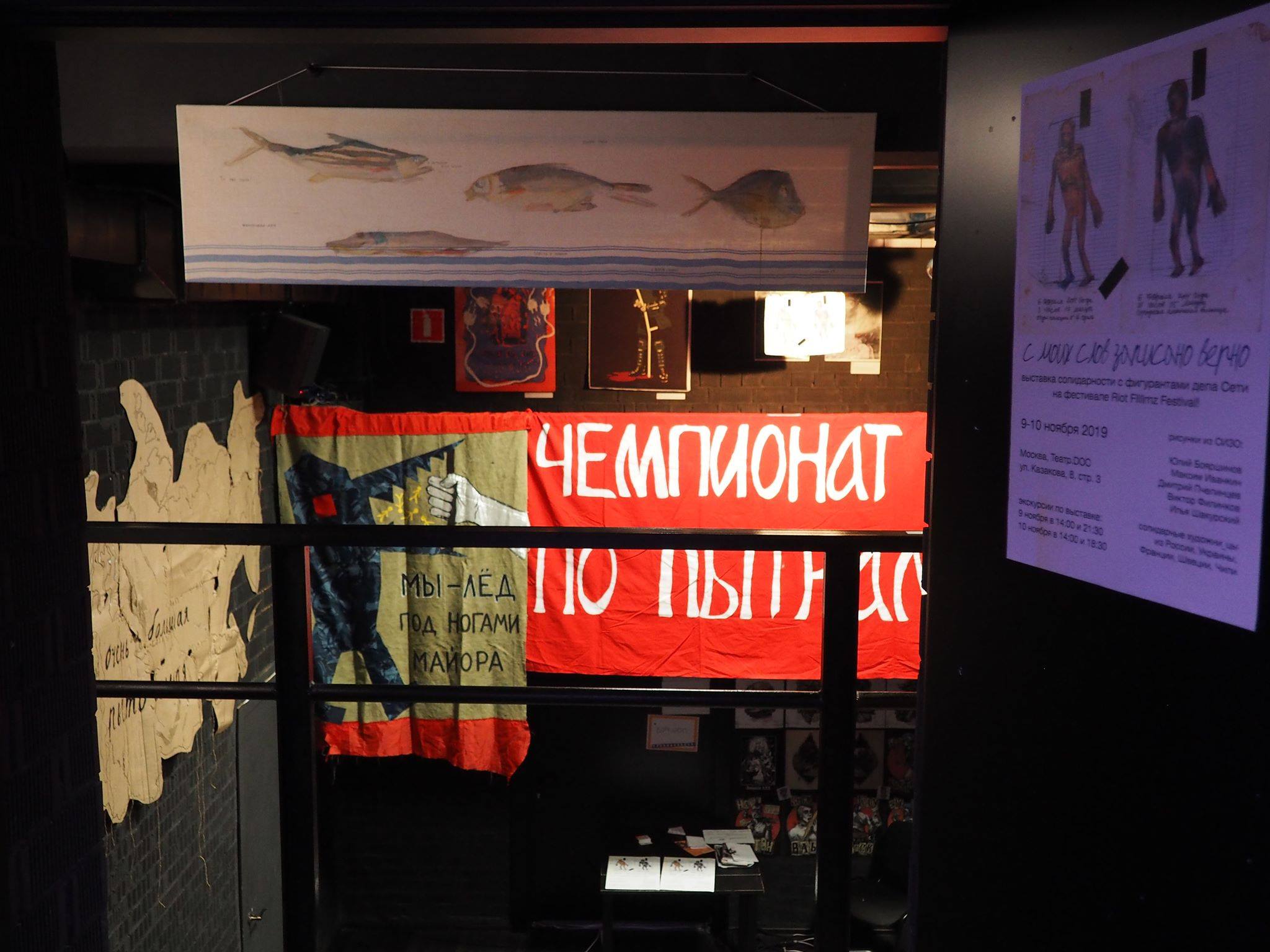
Anastasia Pchelintseva and Anna Shalunkina after their weddings to Dmitry Pchelintsev and Maxim Ivankin. Photo courtesy of 7×7 and Novaya Gazeta
Two Defendants in Network Case Married in Prison
Novaya Gazeta
January 29, 2020

Dmitry Pchelintsev and Maxim Ivankin, two defendants in the Penza trial of the so-called Network (a terrorist organization banned in Russia)* have been married in remand prison, reports 7×7.

Registry Office workers registered Dmitry Pchelintsev’s marriage to his girlfriend, Anastasia Tymchuk, in the room on the premises of Penza Correctional Facility No. 4 where the defendants are currently held. Journalists, relatives, and friends of the couple were not allowed to attend the ceremony. Tymchuk reported that the groom made her a windcatcher as a wedding gift.

“It makes no difference what our life will be like from here on out: whatever the verdict and sentence are, we are still going to be together. We are still going to see this through to the end. We are going to seek the truth and do everything to secure [Dmitry’s] release,” Pchelintsev’s bride told journalists.

Another defendant in the case, Maxim Ivankin, registered his marriage to Anna Shalunkin at Penza Remand Prison No. 1. Ivankin had proposed to his girlfriend right in the courtroom after one of the hearings in the trial, presided over by judges from the Volga Military District Court.

“The whole procedure took two minutes,” Shalunkina said after the ceremony. “We only managed to ask each other how the other was doing. Whereas [Pchelintsev and Tymchuk] were allowed to sit next to each other and chat, here [in remand prison] there were two stools, a table, and a cage. I stood next to the table, and [Ivankin] stood in the cage. We were permitted to kiss each other only through the bars.”

Shalunkina explained that she had decided to marry Ivankin now because if he is found guilty, it is unclear where he will be taken to serve his sentence.

In August of last year, Yuli Boyarshinov, a defendant in the Petersburg portion of the Network Case, was married in remand prison. His bride wore a paper veil, and their wedding rings were fashioned from barbed wire.

A report about the weddings by 7×7

Eleven antifascists from Penza and Petersburg were arrested by the FSB several months before the 2018 presidential election. According to investigators they were planning to create armed groups in Moscow, Petersburg, Penza Region, and other Russian regions for attacking military garrisons, police officers, and United Russia party offices.

The trial in Penza against seven of the defendants—Maxim Ivankin, Vasily Kuksov, Mikhail Kulkov, Dmitry Pchelintsev, Arman Sagynbayeva, Andrei Chernov, and Ilya Shakursky—has concluded. All of them are charged with organizing [and/or] being involved in a “terrorist community.” Shakursky, Pchelintsev, and Kuksov also face charges of arms trafficking. On February 10, a panel of three judges from the Volga District Military Court will announce the verdict.

The case against Boyarshinov and Filinkov is being tried separately by the Moscow District Military Court, sitting in Petersburg.

Another defendant, Igor Shishkin, pleaded guilty and was sentenced to three and a half years in prison.

The defendants have reported that FSB officers tortured them to force confessions. In a complaint filed with the European Court of Human Rights, Filinkov said that FSB officers had beaten and electrocuted him, deprived him of food, water, and sleep, and subjected him to psychological pressure.

* Russian media are required by law to identify this perverse fiction by the FSB in this way.

Thanks to Anatrrra for the heads-up. Translated by the Russian Reader

__________________________________________

If you have not been following the Penza-Petersburg “terrorism” case aka the Network Case, and other recent cases involving frame-ups, torture, and violent intimidation by the Russian Federal Security Service (FSB) and other arms of the Russian police state, read and share the articles I have posted on these subjects.

Viktor Filinkov: “It’s As If You Disappear—Only the Pain Remains”

Viktor Filinkov’s Speech in Court on 4 June 2019 While Recording a Voice Sample (The Court Could Not Interrupt the Defendant for Ten Minutes)

Viktor Filinkov: When I was tortured . . . Well, it was unexpected, of course. It was nothing like in the movies. There was no time to think or laugh like some superheroes do or anything like that: you’re just screaming in pain. You’re in a terrible state, in fact. I’ve never experienced anything like it.

Yes, I’d been shocked when touching an electrical socket or a telephone wire, and when licking a battery. But it’s a completely different sensation when you’ve been shocked with a stun gun. They were beating me at the same time, but I didn’t feel it at all, except for the blows to my head. When they hit me in the head, my vision went a little white. My eyes were mostly closed, because I had a cap pulled over my face, but I saw white when they hit me in the head.

When they twisted my arms or something like that, I didn’t feel anything at all. On the other hand, if you’re riding in the back seat of a car with your hands cuffed behind your back like this—like when they later took me to see a psychologist—your shoulders and joints start hurting really bad after the first hour or so. By the second hour, it’s completely unbearable. You’re wriggling and fidgeting the whole time because the pain is so unbearable.

I was tortured for around four hours, and although my hands were behind my back the entire time, I felt no pain at all in my shoulders. In fact, I felt no pain at all because my whole body hurt. When your whole body hurts, you can’t single out a specific part that hurts more. The burns from the electrical shocks didn’t hurt—they hurt only the next day or so—meaning the pain spreads out over your whole body. It feels like everything hurts, although they’re hitting and shocking you in very specific places.

I don’t even know where the shocks hurt the most. They shocked me in different places, mainly my feet, the shocks to my feet were the longest. And to the chest as well. I could twist my wrists, and work my neck a bit, but I think it didn’t matter where they shocked me: the shocks were quite painful. When they press the stun gun to your foot, it’s like you lose yourself completely. It’s as if you disappear—only the pain remains.

Recording Technician Volkov: Maybe you could talk about something more pleasant.

Filinkov (smiling): There was nothing pleasant about it.

Volkov: Not this instance, necessarily. Maybe some memorable instances from childhood.

Filinkov: Hmm… Memorable instances from childhood. It depends what you mean by childhood.

Volkov: Okay, then, what do you miss right now?

Filinkov: My wife—I miss my wife a lot. I love her very much. When they were torturing me, a field agent asked me why I was with my wife. I screamed that I loved her. They were shocking me, but I still screamed that I loved her. They would yell at me, “Why are you with her? Confess!” I would yell that I loved her, and they would give me a shock for saying so. This went on for a while. It was probably one of the most humiliating parts of the whole thing.

No, there was another one. They would ask me who my wife associated with—shocking me as they asked, of course—and I tried to remember who she associated with. I would reply that she had many acquaintances, but didn’t know who she associated with. I didn’t know that many people, especially my wife’s acquaintances. And they would say to me, “She’s getting fucked. Didn’t you know that?” The whole thing was just awful. And there were lots of questions like that… Apparently, it was a way of catching me out.

It was also a way of turning me against everyone. You realize that the people who are torturing you are the guilty one, but they try to put the blame on someone else. So, they would tell me about my “pal” Boyarshinov: I didn’t know who Boyarshinov was then. They would say, “That guy Yuri,” and try to explain he’d been going to plant a bomb to kill people. Under those circumstances I really believed “Yuri” (Yuli) Boyarshinov had gone to plant a bomb. They were really persuasive.

They also told me other people had wanted to kill people. Like Arman Sagynbayev: they said he wanted to make an explosive called ammonal. They knew I didn’t know that he had the ingredients, but I had to teach them a lesson. Then I cheated a little: when they asked me what they had found in Sagynbayev’s closet, I said they had found only aluminum powder. They didn’t specify that I was also supposed to say there had been saltpeter there as well. They kept saying, “A barrel! A barrel of powder!” The fact that it was a barrel was important, apparently. I never saw it.

They also said, of course, that everyone was ready to dish on me, and told me what would happen if I didn’t sign the interrogation report.

In fact, their threats were completely meaningless. I was completely broken after ten minutes of torture, but the threats continued for another twenty or twenty-five hours or however long I was there. It was a very long time. All the threats—that they would kill me there or put me in a cell with tuberculosis-infected prisoners or the SWAT team would take me to Penza—were pointless.

The SWAT team business was a trick. They told me a SWAT team would take me to Penza, where I would be in a line-up. All [of the other defendants] would identity me, point their fingers at me, and then I would go back [to Petersburg]. Besides the driver, there would be two SWAT officers in the vehicle. They would take turns sleeping, but I wouldn’t be able to sleep, and there wouldn’t be any water. The FSB agents would wonder aloud how long a person could last without water. The whole thing was completely pointless. I would have signed the interrogation report in any case.

It wasn’t like they said, “Here, sign it,” and I said, “No, I won’t sign it. Go to hell!” and they were like, “Oh yeah? We’ll show you.” It was just a prelude to everything they did. Just a prelude. Violence is seemingly the basis of their work. I later learned those guys in masks were from [the FSB’s] “Hail” SWAT team. When they escort someone in handcuffs, they drag him in different directions. I would say, “Hang on! You’re dragging me in different directions. I don’t understand where to go.” They would laugh and say it served me right. Meaning the violence was for its own sake. And none of them were bothered then about what had happened.

When I tried talking about the fact that torture was inhumane, they would interrupt me and say, “Did anyone really torture you? You bumped yourself in the car.” Different field agents who were there said this in front of investigators. The one who I remembered the most was an investigator named Alexei from the second floor of the FSB regional headquarters building [in Petersburg]. He wore a jacket and suspenders.

The jacket was bright green. He would give me toilet paper when I went to the toilet. I would go to the toilet not to go to the toilet, of course. I was thinking how to put an end to my suffering and contemplated slitting my wrists. But the office was right there, and an agent would always follow me out and stand by the door, which couldn’t be closed. I went there several times, hoping they’d let their guard down, but no: there was always an agent outside the door, and I wouldn’t have been able to shatter the mirror or the toilet tank.

If I’d known that I had a sharpened coin in my pocket, but I’d forgotten about it. It made it through several pat downs. The SWAT team patted me down twice and didn’t find it. Then an investigator searched me and didn’t find it. Then I was searched at the temporary detention center on Zakharyevskaya Street [in Petersburg], and they didn’t find the coin. It was found only at Remand Prison No. 3. They decided to put it in the till, but it was a Ukrainian hryvnia coin, so they decided not to mess with it. They asked me what to do with it, and I told them to throw it away.

“Fine, fine, just don’t tell anybody,” they said. And they threw it away.

Volkov: That’s long enough, thank you.

Judge Muranov: Is that it?

Volkov: Yes.

Judge: So, Viktor Sergeyevich, I didn’t interrupt you when you were recording your monologue, but now I’m giving you an official warning. If you use obscene language again in the courtroom, you’ll be removed until the closing arguments. Have I made myself clear?

Filinkov: Yes, you have. May I ask a question?

Judge: Ask away.

Filinkov: How I am supposed to quote obscene language?

Judge: I don’t know, but I would ask you not to use obscene expressions. I gave you an official warning, which has been entered into the record.

Filinkov: Understood.

Judge: Sit down.

Judge: Maxim Alexandrovich, are you done?

Volkov: I would like to take literally a minute to check the quality of the recording . . . The recording is fine.

Thanks to Jenya Kulakova for the original Russian text and the video. Translated by the Russian Reader

__________________________________________

If you have not been following the Penza-Petersburg “terrorism” case aka the Network Case, and other recent cases involving frame-ups, torture, and violent intimidation by the Russian Federal Security Service (FSB) and other arms of the Russian police state, read and share the articles I have posted on these subjects.

“My Statement Has Been Recorded Accurately” (Berlin, February 1-3, 2020)

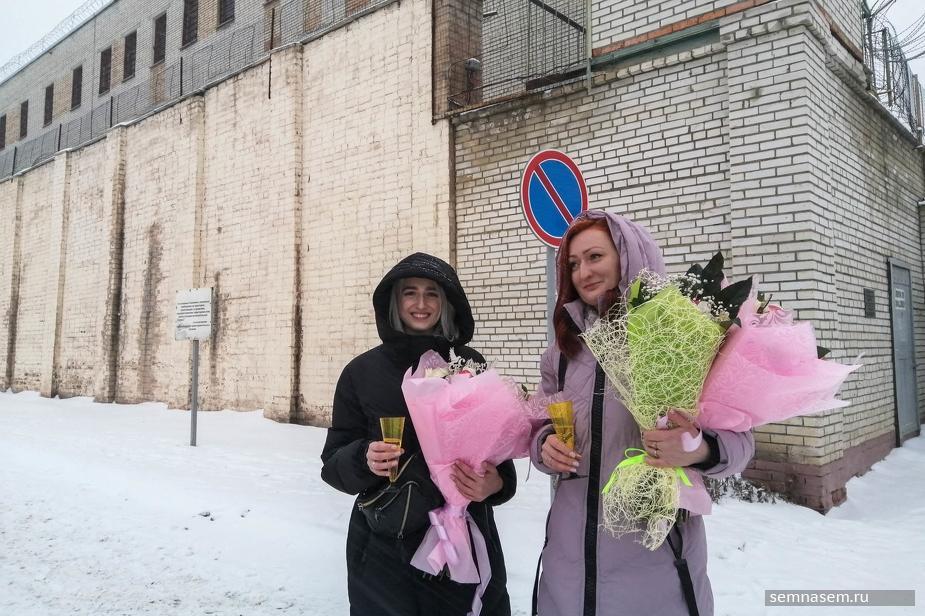
network exhibition

“My Statement Has Been Recorded Accurately”/”Meiner Aussage getreu protokolliert”

An Exhibition in Solidarity with Political Prisoners in Russia
Living Gallery Berlin, February 1-3, 2020

Exhibition opening and roundtable, 5 p.m., February 1, 2020, with simultaneous translation from Russian to German, exhibition closing and auction, 7 p.m., February 3, 2020

Living Gallery Berlin presents a group show of works by Russian anarchists and antifascists, as well as artists in solidarity with them.

The Network Case is a high-profile political trial in Russia. Ten activists from Penza and Petersburg have been in police custody for over two years, accused of involvement in a “terrorist community” known as the Network. They were subjected to torture with electrical shocks, beatings, and psychological and physical coercion to force them to confess. Their trials are coming to a close, but most of have denied their guilt and demanded an investigation of their allegations of torture. The defendants face sentences ranging from six years to eighteen years in prison.

The exhibition was created in Petersburg by the team behind Rupression.com, which has been publicizing the Network Case in solidarity with the young activists, who were brutally arrested and have been accused of absurd crimes. The artwork they have produced in police custody is part of their fight for freedom and dignity. The exhibition gives them a chance to speak.

The exhibition also features works by contemporary artists from Russia, Ukraine, France, Chile, and Sweden. They meditate on state-sponsored violence, torture, crackdowns, imprisonment, and absurd accusations.

The exhibition has already been shown five times in Russia: three times at various venues in Petersburg, and one time each in Moscow and Penza. The Berlin showing will be the first time the exhibition has been presented abroad.

The opening on February 1, 2020, will feature a guided tour of the show and a round table on political prisoners in Russia today, moderated by Olga Romanova, head of Russia Behind Bars. Former Russian political prisoners, as well as political exiles who faced persecution in Russia in connection with the Network Case, have been invited to attend.

The exhibition closes February 3. The closing will feature a charity auction at which you can buy works presented in the show and thus help the defendants in the Network Case, whose families constantly need money for legal and humanitarian aid to the prisoners. Poet Alexander Delfinov will serve as the auctioneer.

During all three days of the exhibition, there will be tours of the show in English and German, as needed. Exhibition goers will be able to write letters and postcards with words of support to the political prisoners, as well as buying merch from Rupression.com’s campaign. Proceeds from the sale will also be used to support the political prisoners in the Network Case.

The exhibition is organized with support from Memorial Deutschland and Dekabristen e.V.

Living Gallery Berlin
Kollwitzstraße 53
10405 Berlin

The gallery is opening from 2 p.m. to 10 p.m.

Thanks to Jenya Kulakova for the heads-up. A few minor factual errors in the original announcement have been corrected. Exhibition view (above) courtesy of the organizers. Translated by the Russian Reader

__________________________________________

If you have not been following the Penza-Petersburg “terrorism” case and other recent cases involving frame-ups, torture, and violent intimidation by the Russian Federal Security Service (FSB) and other arms of the Russian police state, read and share the articles I have posted on these subjects.

18 Years in Prison for Being Tortured by the FSB

content_001_setNetwork Case defendants. Photo by Andrei Karev. Courtesy of Novaya Gazeta

Prosecutor Asks Court to Sentence Penza Network Case Defendants to Up to Eighteen Years in Prison
OVD Info
December 26, 2019

The state prosecutor has asked the Volga District Military Court to sentence the five defendants in the Penza portion of the Network Case to between six and eighteen years in prison, according to a member of the campaign to support the defendants who was present in the courtroom.

The prosecution asked the court to hand down the longest sentence to Dmitry Pchelintsev: 18 years in a maximum-security penal colony. It asked the court to sentence Ilya Shakursky to 16 years, Andrei Chernov to 14 years, Maxim Ivankin to 13 years, Mikhail Kulkov to 10, Vasily Kuksov to 9 years, and Arman Sagynbayev to 6 years. It asked that all the defendants except Kuksov and Sagynbayev be sent to maximum-security penal colonies.

The prosecutor told the court that the defendants’ accounts that they were tortured into testifying had not been corroborated.

All the defendants are accused of involvement in a “terrorist community,” punishable under Article 205.4.4 of the Russian Criminal Code. Pchelinsky and Shakursky are accused of organizing a “terrorist community,” punishable under Article 205.4. In addition, some of the defendants are accused of illegal possession of firearms (Article 222.1), illegal possession of explosives (Article 222.1.1), attempted arson or bombing with mischievous intent (Article 167.2 in combination with Article 30.3), and large-scale attempted drug trafficking (Article 228.1.4.g in combination with Article 30.3).

The criminal case against the Network “terrorist community” was launched in October 2017. According to the FSB, eleven young men in Penza and Petersburg organized the Network and were planning to overthrow the government. The defendants in the case claimed the FSB subjected them to psychological pressure, tortured them with electric shocks, beat them, and planted weapons on them. Some of the defendants recanted the confessions they made in the days following their arrests. OVD Info has reported on each of the defendants in the case in detail.

Translated by the Russian Reader

__________________________________________

If you have not been following the Penza-Petersburg “terrorism” case and other recent cases involving frame-ups, torture, and violent intimidation by the Russian Federal Security Service (FSB) and other arms of the Russian police state, read and share the articles I have posted on these subjects.

Mediazona: Russian Show Trial Calendar

баршайRussian political prisoner Andrei Barshay, holding up a handmade placard reading “Free Everyone!” at his custody hearing in Moscow on October 16. Photo by Yevgeny Feldman. Courtesy of Vedomosti

Mediazona

The regime has ratcheted up its crackdown, but the numbers of people willing to help those affected by the crackdown by writing letters to prisoners, sending care packages to remand prisons, and attending court hearings have increased as well. Mediazona has been covering all the important court cases in Russia, and so we will be publishing a “Court Schedule” in which we summarize all the important court hearings in the coming week, updating it as new information is made available.

Seventh Studio Case (Retrial)
Room 409, Meshchansky District Court, Moscow
Judge Olesya Mendeleyeva
10:00 a.m, November 5

Director Kirill Serebrennikov, Culture Ministry employee Sofia Apfelbaum, and ex-Seventh Studio heads Alexei Malobrodsky and Yuri Itin have been accused of embezzling 133 million rubles allocated to the Platform theater project.

Initially, the defendants in the case were under house arrest, but later they were released on their own recognizance. In early September, the court sent the case back to the prosecutor’s office after a comprehensive forensic analysis was performed. On October 8, Moscow City Court overruled that decision, ordering a retrial in the case.

Mediazona has been covering the Seventh Studio Case.

New Greatness Case (Main Trial)
Room 219, Lyublino District Court, Moscow
Judge Alexander Maslov
2:00 p.m., November 5

Moscow’s Lyublino District Court has been hearing the case of eight members of the little-known movement New Greatness, who have been accused of involvement with an “extremist” organization, as punishable by Articles 282.1.1 and 282.1.2 of the Russian Criminal Code. The prosecution’s case is based on testimony given by a person identified as “Ruslan D.,” who is presumably an informant employed by the security services. The defense has insisted it was “Ruslan D.” who encouraged the activists to create a political organization and drafted its charter.

Four of the defendants—Ruslan Kostylenkov, Pyotr Karamzin, Vyacheslav Kryukov, and Dmitry Poletayev—have been in police custody since March 2018. At the October 17 hearing, Kostylenkov and Kryukov slashed their wrists to protest the extension of their time in remand prison.

Three defendants—Anna Pavlikova, Maria Dubovik, and Maxim Roshchin—are under house arrest. The eighth defendant, Sergei Gavrilov, has left Russia and asked for political asylum in Ukraine. He is on the wanted list.

Mediazona has been covering the New Greatness Case.

Dmitry and Olga Prokazov (Child Custody Case)
Room 520 (Appeals Wing), Moscow City Court
Judge Olga Igonina
9:20 a.m., November 6

Dmitry and Olga Prokazov went to the protest rally in Moscow on July 27 with their one-year-old son. The Moscow Prosecutor’s Office decided they had put the boy in danger and asked the court to strip the couple of their parental rights. According to Dmitry Prokazov, on July 27 they had gone only to places where they saw no threat to their child.

“We were tired and decided to go home. I asked our friend Sergei [Fomin] to join us. He agreed and we headed home together. Sergei is my best friend, my childhood friend. He’s the godfather of my eldest son and my wife’s cousin. […] At some point, I asked Sergei to carry the child, and we went to the subway together and then home,” Prokazov recalled.

On August 15, police searched the Prokazovs’ home on the basis of a criminal investigation launched by the Investigative Committee, which suspected the couple of abandonment (Article 125 of the Russian Criminal Code) and failure to perform parental duties (Article 156). Defense lawyer Maxim Pashkov said investigators had no grievances against the couple after questioning them.

In early September, the Lefortovo District Court ruled in favor of the Prokazovs, refusing to deprive them of parental custody. The prosecutor’s office appealed the decision. The hearing at Moscow City Court has been postponed twice.

Penza Case (Main Trial)
Penza Regional Court
A panel of three judges, chaired by Yuri Klubkov
11:00 a.m., November 6, 7, 8

Seven antifascists—Maxim Ivankin, Vasily Kuksov, Maxim Kulkov, Dmitry Pchelintsev, Arman Sagynbayev, Anton Chernov, and Ilya Shakursky—have been charged with founding the “terrorist community Network.” According to the FSB, the defendants were planning to “stir up the masses in order to then destabilize the political situation in the country” and organize a rebellion during the 2018 presidential election and 2018 World Football Cup. The criminal case against the men was launched in the autumn of 2017.

Pchelintsev and Shakursky have said they were tortured with electrical shocks in the basement of the Penza Remand Prison. In September 2018, Sagynbayev, who initially pleaded guilty, said he had also been tortured into testifying. Another defendant, Viktor Filinkov, an alleged member of the Network’s Petersburg cell, has also said he was tortured with an electrical shocker after the FSB detained him.

Although the case is being heard by the Volga District Military Court, the hearings have been taking place at the Penza Regional Court. Experts and witnesses are to be examined at the upcoming hearings.

Mediazona has been covering the Penza Case.

Moscow Case: Eduard Malyshevsky (Merits Hearing)
Room 356, Tverskaya District Court, Moscow
Judge Belyakov
3:30 p.m., November 6

47-year-old Eduard Malyshevsky is accused of violence against a police officer (Russian Criminal Code Article 318.1). According to investigators, after he was detained at the July 27 rally, Malyshevsky kicked out the window of a paddy wagon, which grazed a police officer as it fell to the ground. The defense claims that when Malyshevsky saw two women being beaten by police, he was outraged and pounded on the window, but did not see the police officers next to the vehicle.

After the rally, a court sentenced Malyshevsky to thirteen days in jail for disorderly conduct (Article 20.1.1 of the Administrative Offenses Code). When he was released from the detention facility, Malyshevsky went home to Khimki. A month after the rally, on August 30, he was detained by police and remanded in custody.

Moscow Case: Nikita Chirtsov (Remand Appeal)
Room 225, Moscow City Court
10:00 a.m., November 7

Chirtsov, who took part in the July 27 rally, was detained in Minsk on August 28. Local law enforcement officials explained that Chirtsov, 22, was on the wanted list in Russia on suspicion of using violence against police officers and involvement in rioting.

Chirtsov was expelled from Belarus and banned from entering the country for ten years. On the evening of August 30, he flew from Minsk to Moscow. He was met at Domodedovo Airport by a Mediazona correspondent, but no one attempted to detain Chirtsov.

Chirtsov was detained only two days later, on September 2. Investigators charged him with only one crime: violence against a police officer (Russian Criminal Code Article 318.1), to which he has pleaded not guilty. Chirtsov was remanded in custody on September 3.

Moscow Case: Vladimir Yemelyanov (Remand Appeal)
Room 225, Moscow City Court
10:15 a.m, November 7

Yemelyanov, 27, is accused of grabbing [Russian National Guardsman] Kosov by the uniform at the July 27 protest and pulling him over, making it impossible for him to move and causing him physical pain. Yemelyanov has pleaded not guilty, insisting he did nothing illegal.

A store merchandiser, Yemelyanov suffers from asthma. An orphan, he lives with his 74-year-old grandmother and 91-year-old great-grandmother. Although his grandmother went to his custody hearing, the judge did not allow the parties to question her on the stand.

“I felt civically responsible for the people against whom force was used [at the July 27 rally] and took it upon myself to stop the illegal actions of the Russian National Guardsmen. For my part, I see nothing wrong in the fact that I tried to save a person,” Yemelyanov said in court.

Yemelyanov was remanded in custody on October 16.

Moscow Case: Andrei Barshay (Remand Appeal)
Room 225, Moscow City Court
10:30 a.m., November 7

Like the other defendants in the Moscow Case, 21-year-old Andrei Barshay, a student at the Moscow Aviation Institute, is accused of violence against a police officer, as punishable by Article 318.1 of the Russian Criminal Code.

According to investigators, Barshay pushed a Russian National Guardsman in the back at the July 27 protest rally. Barshay was detained only on October 14. He came to his custody hearing with a piece of paper on which he had written the words “Free Everyone!” On October 16, the Basmanny District Court remanded him in custody for two months.

After Barshay was sent to remand prison, his lawyers reported that his cellmates, who were ex-convicts, had joked about rape in their client’s presence and tried to persuade him to make a deal with investigators. Barshay was then sent for an inpatient psychological and psychiatric examination.

“Undesirable Organization” Case: Yana Antonova
Lenin District Court, Krasnodar
Judge Vitaly Gavlovsky
12:00 p.m., November 7

Antonova, a pediatric surgeon and former Open Russia coordinator in Krasnodar, is accused of involvement in the work of an “undesirable organization,” as punishable by Article 284.1 of the Russian Criminal Code.

The pretext for the case were two posts Antonova made on Facebook and her attendance of a protest rally. In the first post, she wrote about the lack of schools in Krasnodar; in the second, she encouraged people to attend a rally in support of Anastasia Shevchenko from Rostov-on-Don, who has also been charged with involvement in an “undesirable organization.”

Thanks to Elena Zakharova for the heads-up. Translated by the Russian Reader. Please read my previous posts on the 2019 Russian regional elections and the fallout from them, including the ongoing crackdowns against opposition politicians and rank-and-file protesters.

The Second Anniversary


73381220_2389008344688627_4167196150702538752_n“10.19.2017: Ilya Shakursky and Vasily Kuksov are detained in Penza. Both of them are brutally beaten. Two years is already a sentence. Rupression.com.”

Yesterday, October 19, solo pickets were held from two p.m. to five p.m. on Sennaya Ploshchad (Haymarket Square) in Petersburg on the occasion of the second anniversary of the first arrests (in Penza) in the so-called Network case aka the Penza-Petersburg “terrorism” case.

Source: Anarchist Black Cross SPb

74414546_2388648421391286_8123246056956755968_n“What the Chekists from the FSB do: they abduct, they torture, they murder. This is terror! #NetworkCase #NewGreatness #StopFSB.”

__________________________________________

What can you do to support the Penza and Petersburg antifascists and anarchists who have been tortured and imprisoned by the Russian Federal Security Service (FSB)?

  • Donate money to the Anarchist Black Cross via PayPal (abc-msk@riseup.net). Make sure to specify your donation is earmarked for “Rupression.”
  • Spread the word about the Network Case aka the Penza-Petersburg “terrorism” case. You can find more information about the case and in-depth articles translated into English on this website (see below), rupression.com, and openDemocracyRussia.
  • Organize solidarity events where you live to raise money and publicize the plight of the tortured Penza and Petersburg antifascists. Go to the website It’s Going Down to find printable posters and flyers you can download. You can also read more about the case there.
  • If you have the time and means to design, produce, and sell solidarity merchandise, please write to rupression@protonmail.com.
  • Write letters and postcards to the prisoners. Letters and postcards must be written in Russian or translated into Russian. You can find the addresses of the prisoners here.
  • Design a solidarity postcard that can be printed and used by others to send messages of support to the prisoners. Send your ideas to rupression@protonmail.com.
  • Write letters of support to the prisoners’ loved ones via rupression@protonmail.com.
  • Translate the articles and information at rupression.com and this website into languages other than Russian and English, and publish your translations on social media and your own websites and blogs.
  • If you know someone famous, ask them to record a solidarity video, write an op-ed piece for a mainstream newspaper or write letters to the prisoners.
  • If you know someone who is a print, internet, TV or radio journalist, encourage them to write an article or broadcast a report about the case. Write to rupression@protonmail.com or the email listed on this website, and we will be happy to arrange interviews and provide additional information.
  • It is extremely important this case break into the mainstream media both in Russia and abroad. Despite their apparent brashness, the FSB and their ilk do not like publicity. The more publicity the case receives, the safer our comrades will be in remand prison from violence at the hands of prison stooges and torture at the hands of the FSB, and the more likely the Russian authorities will be to drop the case altogether or release the defendants for time served if the case ever does go to trial.
  • Why? Because the case is a complete frame-up, based on testimony obtained under torture and mental duress. When the complaints filed by the accused reach the European Court of Human Rights in Strasbourg and are examined by actual judges, the Russian government will again be forced to pay heavy fines for its cruel mockery of justice.

***************

If you have not been following the Penza-Petersburg “terrorism” case and other recent cases involving frame-ups, torture, and violent intimidation by the Russian Federal Security Service (FSB) and other arms of the Russian police state, read and share the articles I have posted on these subjects.