The Intensifying Crackdown in Russia

Varvara Volkova

“My friends died at the hands of Russian soldiers. Why can’t I talk about it?” 

This question will cost Varvara Volkova 7 years in a Russian penal colony. Here’s her story.

Varvara was a flight attendant, not an impassioned political activist. In a neighbourhood chat, she stated the obvious: Russian forces are killing civilians in Ukraine. The prosecution framed it as “fake news” motivated by hatred toward the armed forces, and the court accepted it.

The mechanism used to go after her relies on a Soviet-style culture of snitching: a Russian tank driver complained about her comments, then a professional informer, who intentionally hunts dissidents, amplified the case and demanded she be jailed.

In fact, there’s a whole network of these informers — they call themselves “SMERSH.” For those who don’t know Russian history, it is a reference to Stalin’s WWII counter-intelligence service. It means “Death to Spies” — a direct revival of the terror methods of the 1930s. They published screenshots of her messages everywhere trying to ruin her life; claimed she called the soldier a “fascist”; said she offered to make tea for Ukrainian soldiers if they reached the Moscow region. For words spoken in anger, the system decided to smash her life to pieces.

There is a grim irony in this tragedy: the regime destroyed Varvara to protect the “honor” of the military and her accuser. But the tank driver who reported her is already dead: he was killed in the war earlier this March. 

Observers abroad often underestimate the price of resistance in today’s Russia. It is not just a fine anymore, but years and years of one’s life. Varvara Volkova shows us the true bill — and it is devastating. 

I track the consequences of speech in modern-day Russia, make sure to follow for more updates.

Source: Khodorkovsky Communications Center (Facebook), 25 November 2025


Preface by the Editorial Board: Below we publish the translation of an article of our Russian comrades about state repression in their country. The article reports, among others, about the situation of comrade Felix Eliseev. He has been in prison for 2.5 years as part of a 14-year prison term. Felix was sentenced for “treason” as he was accused of making propaganda against Putin’s imperialist war against Ukraine and sending money to Ukraine to buy weapons. While the prison authorities do everything to break him, Felix does not lose his spirit and endures his imprisonment stoically. (See https://www.thecommunists.net/rcit/felix-eliseev-a-revolutionary-communist-in-russian-prison/)

We call readers to support Felix by spreading this information about a communist and anti-fascist serving an unjust sentence!

You can also support Felix financially at www.paypal.me/irinablackbook, with the note “for Felix”.

* * * * *

According to the human rights organization Memorial, there are currently over 1,000 political prisoners in Russia, while other groups estimate the number could be as high as 2,500. This number is three times higher than in 2020, more than twice as high as in 2022, and continues to grow. In 2025, there was a sharp increase in criminal cases under articles on “justification of terrorism,” “sponsoring terrorist activity,” and “treason.” This is not due to increased terrorism, but to the fact that the security forces, having perfected their repression mechanisms, have begun to intensify their crackdown on “sponsorship” cases, such as those of the FBK (Anti-Corruption Foundation, recognized as an extremist organization in Russia) or cases related to money transfers to the Ukrainian army, which occurred back in 2022. The term “terrorism” itself has become so vague that even the average person doesn’t always understand what it actually means.

Among political prisoners are many individuals with progressive leftist views, serving time for anti-war activities or “inaccurate” public statements online. The “Foundation for Support of Left-Wing Political Prisoners” provides support to at least some of these individuals. Among them are: defendants in the “Tyumen Case”; defendants in the “Chita Case”; Anton Orlov, a trade union and leftist activist, coordinator of the independent medical workers’ union “Action” in Bashkortostan; Daria Kozyreva, an activist from St. Petersburg known for her anti-war protests and criticism of the Russian army; Gagik Grigoryan, a young activist imprisoned in 2023 at the age of 17; Azat Miftakhov is a Russian mathematician and anarchist, sentenced in 2021 to six years in prison for allegedly setting fire to the United Russia office in 2018. After serving this sentence, he was arrested again in 2023 on charges of “justifying terrorism” in a private conversation with a prison cellmate and sentenced to four years in prison; defendants in the “Kansk teenagers case”; defendants in the “Network case”; Boris Kagarlitsky is a left-wing publicist known in many parts of the world; Ruslan Ushakov is the author of articles published on opposition Telegram channels, sentenced to eight years in prison for posts in a public chat.

The case of the communist Felix Eliseev

Another political prisoner is Felix Eliseev, a Russian communist, blogger, and administrator of the Telegram channels “She Fell Apart” and “Kolkhoznoye Madness.” He was arrested in December 2022 and charged with justifying terrorism. According to investigators, Eliseev posted two anti-war posts on his Telegram channel, one of which endorsed a Ukrainian Armed Forces helicopter strike on an oil depot in Belgorod. The charges were later upgraded, and Eliseev was charged with “treason”. The court alleges that he transferred funds through a cryptocurrency account to a “curator,” who used the funds to purchase equipment and weapons for Ukrainian Armed Forces soldiers.

Felix, like many other political prisoners convicted of “terrorist and extremist” offenses, is serving his sentence under intense pressure from the prison administration. He is regularly placed in solitary confinement cells, where they do everything they can to break him mentally and physically.

However, political repression in Russia involves more than just horrific criminal cases of “terrorism,” “treason,” and other “betrayals of the nation.” It also includes the persecution of undesirable and dissenting youth who dare publicly speak out against the war and the ruling elite, thereby gathering many other concerned young people around them.

The “Stop Time” case

One example of such government abuse is the “Stop Time” case. The “Stop Time” case concerns the persecution by Russian authorities of members of the St. Petersburg street music group “Stop Time” – Diana Loginova (pseudonym Naoko), Alexander Orlov, and Vladislav Leontyev – for their participation in impromptu concerts, including one near the Ploshchad Vosstaniya metro station, where they performed anti-war songs by artists designated by the authorities as “foreign agents.” On October 16, 2025, Loginova was arrested and sentenced to 13 days of administrative arrest for performing a song by an artist unpopular with the authorities. The other members of the band were also arrested and sentenced to 12-13 days. These events resonated in the media (both pro-government and opposition) and society, becoming a topic of discussion in the context of artistic freedom and the tightening of censorship in modern Russia.

On October 29-30, the musicians received another 12-13 days of arrest, and on November 11, two of them were arrested for another 13 days. On November 23, the musicians were released from arrest. The lead singer and one of the band members left Russia that same day.

In many Russian cities, street bands followed “Stop Time’s” example and performed opposition songs by artists-foreign agents to large audiences in public squares. They also faced pressure from the authorities and harassment from Z-Neanderthals.

Also, recently, spiders in a jar have started eating each other. Criminal cases have been brought against several well-known military Z-bloggers for discrediting the army! More than two years after Strelkov’s imprisonment and Prigozhin’s murder, a new steamroller of repression is purging those loyalists who are too undesirable.

All of the above demonstrates that Russian society has no legal means to publicly express its attitude toward the events unfolding around it. For any word “against,” the sword of Damocles of Russian justice hangs over every citizen. Despite this, concerned Russians, especially young people, are finding ways to rally together and show the world that not all is lost in this country.

Meanwhile, cowardly security officials and government officials tremble at the mere thought that the masses will sooner or later awaken from their slumber and rise to deliver justice to the imperialist oppressors in the Kremlin. In Russia, literal punishments are being introduced for thought crimes. Thus, in September of this year, an administrative law punishing “searching for extremist materials” came into force. This law allows the FSB to view any citizen’s internet search history, and if it contains views of materials deemed extremist or terrorist, the user faces a visit from masked officers and a fine. The first cases under this law have already been filed.

Furthermore, the country is introducing a so-called “white list” for the internet—only those websites approved by Roskomnadzor are permitted to be accessed; others are inaccessible, and VPNs cannot be connected. So far, in the spirit of Russian tradition, this system is poorly functioning and flawed, but the day is not far off when Russian society will find itself locked in a “cheburnet.” (*)

Freedom for political prisoners!

For freedom of speech, conscience, and the internet!

Down with political repression!

Radical democratization of the country, not the fascist regime of a dictator!

All power to the working class and the working masses, not to a handful of oligarchic monopolists!

(*) Cheburnet is a mixture of two words: Чебурашка (Cheburashka) and internet. Cheburashka is a character from Soviet cartoon for children. Despite it is kind and helpful, in modern mass consciousness it is associated with Soviet censorship. So cheburnet basicaly means internet under the censorship of Russian government and intelligence agencies.
Source: Communist Tendency (RCIT Section in Russia), “Political Repression in Russia,” Revolutionary Communist International Tendency, 25 November 2025


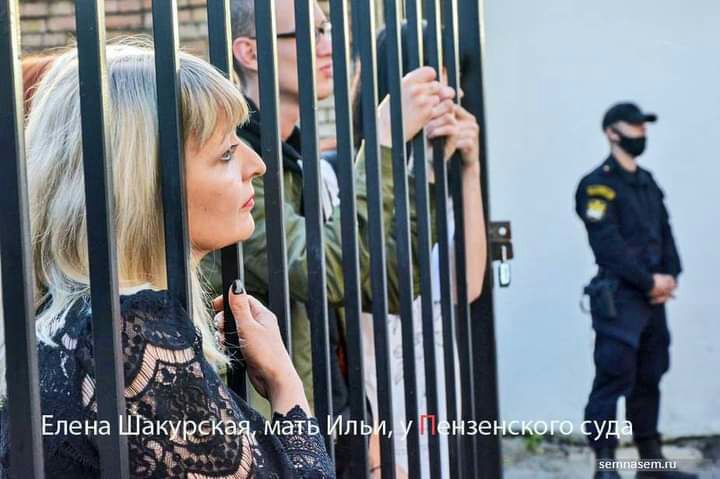
An appeal from Elena, mother of Ilya Shakursky:

My name is Elena Nikolaevna Bogatova, and I am the mother of political prisoner Ilya Alexandrovich Shakursky. I am crying out for help to save my son so that he does not rot away in solitary confinement.

They took my only son away when he was twenty-one years old. He is now twenty-nine. He has been tortured. He has serious health problems that we still cannot solve. He still has eight years to serve, and they could turn him into a disabled person. I cannot help him on my own, so I am asking all caring people to help us.

It is impossible for a mother to know that her child is being destroyed, and that she cannot save him!

Although he committed no crime, he is in prison under the harsh Article 205 [of the Russian Criminal Code; Article 205 proscribes “terrorist acts”], enduring all the hardships of prison life, without ever receiving any encouragement; we cannot even hope for parole. Right now, [the prison authorities] want to turn him into repeat offender so that he cannot have any visits, phone calls, letters, or packages. They want to take everything away from him.

I ask you to write an appeal. I understand that there are many of us now, and everyone is exhausted. But we must stand together for the sake of our loved ones, for the sake of the younger generation, which is currently being destroyed. Hear the cry of a mother who cannot bear the pain for her son and for all those behind bars. If we push with our shoulders, the walls will collapse….

https://t.me/ilyashakursky

Source: Elena Shakurskaya (Facebook), 28 November 2025. Translated by the Russian Reader


OVD-Info Faces a Critical Situation: We Have Lost All Our Ruble Donations

26.11.2025

Russian payment services have refused to continue working with us, without providing any explanation, and have cut off our ability to accept one-time and recurring donations. This has severed our connection to our main source of support—the 12,000 individuals who regularly transfer money to OVD-Info.

The services’ refusal to cooperate with us is one of the many manifestations of state pressure on human rights organizations and independent media. Some of them even had to close due to the loss of donations in rubles.

This is a severe blow to our work. With these donations we were able to pay for the work of defense lawyers and legal experts, travel to the regions, maintain our free hotline, and help those who are politically persecuted in Russia. Furthermore, regular donations allowed us to plan our long-term work and development.

We do not plan to close or reduce the scope of our work, because repression is not diminishing. Any political activity, expressing a view against the invasion of Ukraine, or criticism of Putin instantly becomes grounds for persecution. We simply cannot abandon Russians to face this brutal, repressive system alone. We are defending over 90 defendants in criminal cases, almost every day we send lawyers to police stations, courts, searches, penal colonies, and pre-trial detention centers. We answer dozens of messages and calls daily—and we want to continue doing this.

However, now everything depends on whether we can find another 12,000 people who will regularly support OVD-Info.

You can support us here.

Source: OVD Info


Yulia Lemeshchenko. Photo from the Memorial website

The Second Western Military District court in Moscow last week sentenced Yulia Lemeshchenko to 19 years’ imprisonment for high treason, sabotage, and preparing and training for an act of terrorism.

Yulia, 42, is a Russian citizen, born in Staryi Oskol, in Belgorod region. She lived in Voronezh in southern Russia, until 2014. Then she moved to Kharkiv, Ukraine, with her son and her husband, who had found work there. Later on the couple separated.

Yulia took up powerlifting and in 2021 was named Ukrainian women’s champion.

In 2024 Yulia did military training in Kyiv – firearms, explosives and flying drones – and returned to Russia, via a third country. She sabotaged power transmission infrastructure near St Petersburg, and in Voronezh conducted surveillance on Aleksei Lobodoi, an air force commander responsible for bombing Kharkiv.

Yulia was arrested in January this year. She did not deny the facts outlined in the prosecution case, but told the court that “from a moral standpoint” she considered herself not guilty. This is a translation of her final statement to the court, published by Mediazona.

=

Ukrainian Champion in a Russian Court: Yulia Lemeshchenko’s Final Statement

As you see, I don’t have any sheets of paper and I haven’t especially prepared, but I think I will improvise. I will now probably say a few things that were already said during this hearing, but let this be a sort of summing-up, in a monologue.

So I already spoke here about the fact that, in any war, two sides clash, and each side insists that it is right and that its cause is just. I took one of these sides. I am not a citizen of the country for which I decided to fight, but, all the same, for me, Ukraine is home. I love that country. And I love Kharkiv, with all my heart.

There is a district in Kharkiv called Severnaya Saltovka. About 500,000 people lived there. Half a million. A few people I knew lived there. My hairdresser lived there. After the Russian shelling and bombing, not a single house in that district was left undamaged. Not a single one. And I am not just talking about a few broken windows. I am talking about whole blocks of flats in ruins.

Right next to the block where I lived, there were explosions. In my block, on the ground floor, my neighbour Anya lived with her four-year-old son Nikita. A shell exploded right under their window. Their apartment was completely destroyed. What has happened to Anya and her son I don’t know. I don’t know whether they are still alive.

Friends of mine have died in this war, one relative – my second cousin – and colleagues of mine. War is monstrous. I could not stand aside. When war comes, people who are affected can either try somehow to fight, or they can flee. People flee – I don’t know – maybe because they are cowardly or weak. I don’t consider myself to be a cowardly or weak person. So I decided to fight back – to fight against Russian military aggression.

It is possible that, by saying these things, I am getting myself still deeper into trouble. But my honour, and my conscience, are important to me. I did what I believed to be necessary. I did what I could. To regret, to repent – who knows, maybe I will do that on my deathbed. But for now, what will be, will be. I have nothing further to say.

=

When the court hearing began, Mediazona reported that the judge, Vadim Krasnov, read out evidence that Yulia gave after being arrested in January. After the all-out Russian invasion of Ukraine in 2022, Yulia at first moved to Germany. In 2023 she returned to Ukraine and made contact with the “Free Russia” legion, but did not join.

In 2024, when she did her military training, the instructors – who did not answer questions about which part of the armed forces they served in – said that, by way of payment for her work, she could receive Ukrainian citizenship.

The judge asked if she had done so, to which she replied, with a smile, “not yet”.

During the hearing, Judge Krasnov asked Yulia why she had chosen such a radical method of struggle, rather than, for example, providing medical help to the wounded.

“I can only answer that question with another, rhetorical question”, she replied. “Why did Russia decide to use violent methods to destroy Ukrainian cities? A war had started. Do you understand?”

The judge responded that, by 2022, the war had already been underway for eight years. Yes, but it had become frozen, Lemeshchenko said. After the invasion, she wanted to help Ukraine however she could, and was invited to become a saboteur.

“How far were you prepared to go?” asked the judge. “I did not want to do anything that would take human lives”, Lemeshchenko replied. “They accepted that point. On that we had an agreement.”

The judge said that the sabotage Lemeshchenko carried out near St Petersburg left hospitals without electric light. She replied that the aim had been to paralyse a drone factory, that she was sincerely sorry if anyone in Petersburg had suffered. And that she and her son had many times sat in their apartment, without light, when Kharkiv was being bombed.

Lemeshchenko also told the court that, during interrogation, agents of the federal security service (FSB) had threatened to murder her, and pushed her head against a wall. She had tried to tell them the truth. She said that she did not retract her evidence – and nor would she complain about her treatment, as she did not believe that those responsible would be punished.

□ Here is Yulia’s statement in court, recorded with English interpretation. Yulia is recognised as a political prisoner by Memorial, and her case was reported by the Kharkiv Human Rights Protection Group.

□ The last word in court by Anton Khozhaev, a trainee officer accused of desertion to the Ukrainian side, and more on Russian anti-war protesters

□ Voices Against Putin’s War, just published by Resistance Books, includes 12 statements by anti-war protesters and associated material. The livestream of a launch event is here27 November 2025.

Source: “‘I decided to fight back. Ukraine is my home.’ Yulia Lemeshchenko’s final word in court,” People and Nature, 27 November 2025
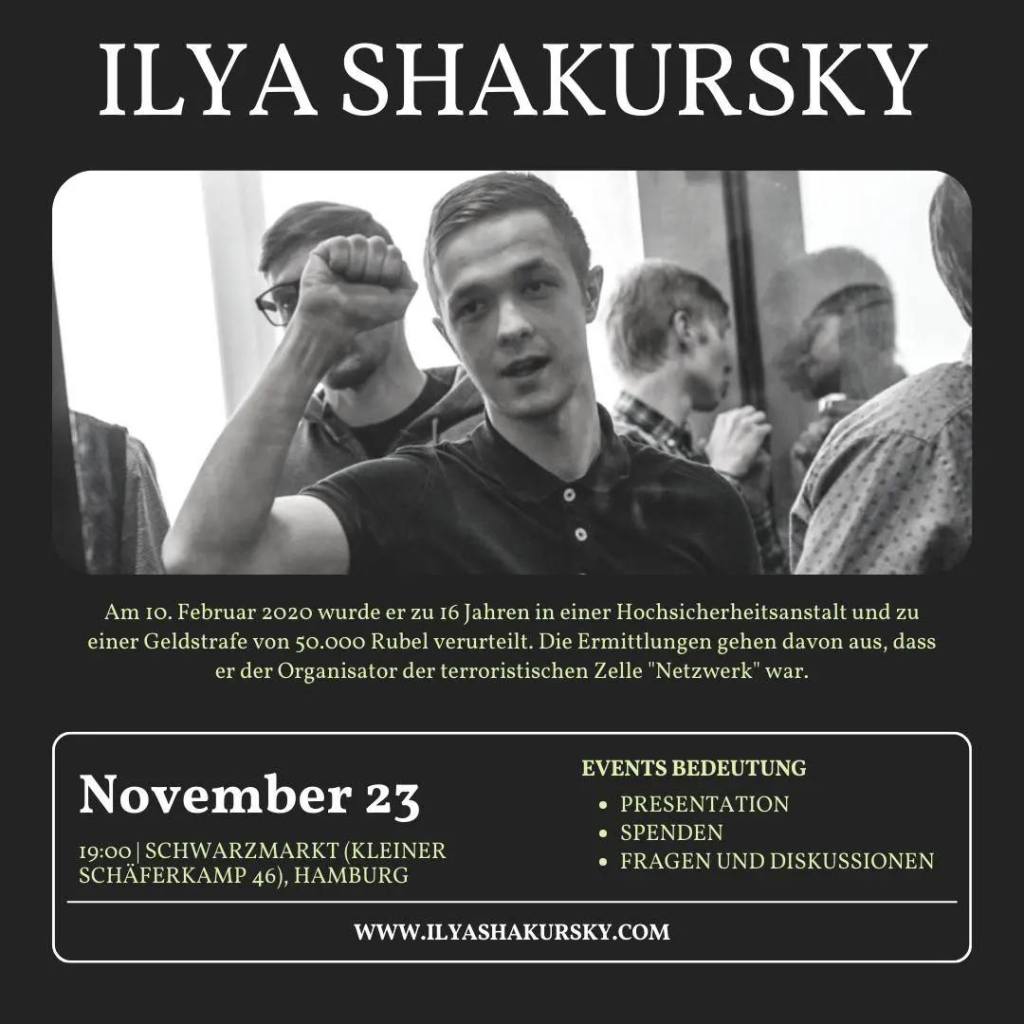
Ilya Shakursky Solidarity Event: Kleiner Schäferkamp 46, Hamburg, 23 November 2024

This Saturday, 23 November, at 7 p.m., the last presentation about and fundraiser for Ilya Shakursky will take place at Schwarzmarkt in Hamburg (Kleiner Schäferkamp 46). After the new year, a big update is in store for the project, but in the meantime we look forward to seeing the local public and thank everyone who has supported us this year!

Event language: German

Subscribe to Ilya’s Telegram channel.


Este sábado 23 de noviembre será la última presentación sobre Ilya Shakursky con posibilidad de donaciones en Hamburg im Schwarzmarkt (Kleiner Schäferkamp 46), después del año nuevo el proyecto espera una gran actualización, pero mientras tanto esperamos al público local y ¡gracias a todos los que nos han apoyado este año!

Idioma del evento: alemán

Suscríbete al canal de Ilya.

Source: Elena Shakurskaya (Facebook), 20 November 2024. Translated by the Russian Reader and a Spanish-speaking robot.

Ilya Shakursky: Letter to a Friend

Since the all-out invasion of Ukraine, political repression in Russia has intensified, targeted in the first place at anti-war protest. But this is the outcome of a 20-year slide towards dictatorship. Russia’s antifascist movement has been a prime target for both armed nationalists and the state: it culminated in 2017–19 with the torture and imprisonment of the “Network” case defendants. In July this year, one of them, Ilya Shakursky, sent this letter from prison, looking back at the antifascist movement’s history. It was published on Avtonom, the anarchist web site. Translation and notes in brackets by People & Nature.


Ilya Shakursky in court in 2020. Photo: Penza News / Free Russia House

Ilya Shakursky: letter to a friend

It went like this. My friend shared his thoughts with me: he had arrived at this discomforting realisation that after my arrest, everything was finished – as if our world was sharply divided into “before” and “after”. It seemed that that life, in which we were immersed for many years – the atmosphere of the dvizha [slang: roughly, movement/ milieu], the concerts, demos, discussions, journeys, street fights, performances – had disappeared, had dissolved into fear and into the constraints that shroud so many of us. It seemed that that life had mutated into nostalgic reflections on those times when just to be yourself in Russia had not yet become so dangerous.

Of course, the root cause of my friend’s predicament is the reality: in the regions, the movement comprises fairly small circles of people, and all the activity depends on their enthusiasm. So it is not surprising that in a small town, after high-profile arrests, everything goes quiet. But now – when there’s a widespread tendency to analyse the history of the almost-destroyed antifascist and anarchist movements in present-day Russia – I have read in several articles the opinion that this latest defeat of the movement began precisely with the “Network” case. My own impression is that the movement at that time, although it suffered from a lack of coordination, exactly in 2016-17 began to aspire to, and head towards, unity and amalgamation.

We all know well about the devastating defeat of the young, audacious movement of the early 2000s and its consequences. It was then that the state power recognised the strength of the antifa, the subcultures, the anarchists and ecologists that it could not control. That all came to an end with the deaths of Fyodor Filatov [antifascist, founder of the Moscow Trojan Skinheads, killed on 8 October 2008 by the Militant Organisation of Russian Nationalists (BORN)], Ilya Dzhaparidze [antifascist killed by BORN on 27 July 2009], Ivan Khutorskoy [antifascist killed by BORN on 16 November 2009], [Stanislav] Markelov and [Anastasiia] Baburova [antifascist lawyer and journalist, killed in broad daylight in central Moscow by BORN on 19 January 2009], the “Khimki case” [showtrial of activists after the big Khimki forest protests] and emigration. The 2000s ended with Exodus (Iskhod) by Pyotr Silayev [author and antifascist activist]. Among us – young antifascist and anarchist men and women – that book was a big hit.

Time passed by. 2011: a vendetta in response to the break-up of the movement and the radicalisation of new people. 2012: Bolotnaya Square [a big anti-government rally, followed by mass arrests]. 2014: Maidan and the start of military action in Ukraine. We, young people whose outlook was shaped by these events, tried to re-awaken and breathe life into the flickering flame of the dvizha. Concerts, squats, days out, fist fights, graffiti, lectures, FNB [Food Not Bombs, Moscow] and free markets. We lived by all this: it was our culture, our self-expression and our inner inspiration. We got to know each other, we were inspired by the experience of our older comrades. We took the road of struggle, we cultivated an atmosphere, we kept the movement going – or at least we tried. And we reached the point where the spirit of the age put in front of us the need for militarisation. The stakes were raised. We realised we were getting closer to the point at which we would have to defend ourselves, to fight to survive. The times changed. …

Autumn of 2017. Arrests. Tortures. Exile from the country. New repressive laws. “The Network”. Sentences. Zhlobitsky [the 17 year old who suicide-bombed the FSB office in Arkhangelsk]. Attempts to protest and resist. People’s Self-Defence [anarchist network]. Kansk [case brought under terror laws against teenagers who put up protest posters]. And again, tortures and repression. The 2010s came to their end, and now it was our “Exodus”. But not all of us could get across the desert. Some stayed right where they were. And here was the bleak emptiness that my friend told me about, that has reigned since 2017. Time has passed, and there is nothing left of that life that swirled around us. Fear infuses everything. Some were just tired out, some escaped, some – so it seems – went out of their minds and became completely different people. The desert swallowed people in endless emptiness. It’s as if previously optimistic, active people were shackled hand and foot by depression, apathy and disillusionment. Very few lights were left burning.

The new reality: crowds of roughnecks, saluting Nazi-style; billboards calling on people to sign contracts with the army; arrests and sentencing of dissidents daily; [Zakhar] Prilepin [leader of armed Russian nationalists in eastern Ukraine] in the state Duma [parliament]; anarchists and antifa outside the law; Stalinism; quotations from [Ivan] Ilyin [by Putin]; imperial flags and red banners.

When we were arrested, with every interrogation I realised more clearly that the chekists [security police officers] didn’t want simply to combat allegedly criminal activity or to strike fear into us. No, their aim was destruction – destruction of the ideological enemy that we represented. Destruction of those whose ideas of freedom and equality are absolutely alien to them, who hate “chinks” and “faggots” and love busty women and hunting parties. Portraits of those who executed the anarchists of the last century hang on their office walls, and, as if returning to the past, they are doing that Bolshevik work again. They started with the anarchists, and the Nazis they could not control, and ended up with the liberals and pacifists. The desert melts into the burning heat of repression. There’s no water and no life.

And why am I writing all this? This letter is to my friend, whose heart is full of sadness and mourning – but by writing to him, I am writing to all of you: to all with whom I met in the woods outside Moscow at concerts by Volodya Ukrop and Natasha Chetverio [antifascist singers]; all, who listened to “MDB” [Moscow Death Brigade, a punk and hip-hop band] on earphones, when taking a train to a stand-off with the “boneheads” [a “white power”/ racist subculture close to skinheads]; all who stood in defence of the Mosshelk dormitory [where activists supporting residents resisting eviction were arrested]; all who raised our flags at the demonstrations in central Moscow in 2017; all who spoke openly about problems of discrimination, and who wrote letters to Lyosha Sutuga [an antifascist activist] when he was in prison; all who wore “Will Power” (“Sila voli”) T-shirts; all who read “Avtonom”; and all who threw away those papers summoning us to chats at the Centre “E” [the state Centre to Counter Extremism]. We lived through all this together, and now we are again living through hard times that plant the darkest thoughts in our minds. But, friends, there’s no point in throwing up our hands, there’s no reason to convince ourselves that our community is dead, or that our spirit has been extinguished.

When the chekists fastened on to the term “Network”, they actually misunderstood something. They thought that we would hand over our party membership cards and renounce our responsibilities to an alleged organisation. But the anarchist movement’s networks exist without any clearly-defined structure. The network of the anarchist and antifascist movements is the smiles of two people who don’t know each other, but who catch each other’s eye in the metro with some characteristic attribute; it’s when you are in a city that’s not your own, but then someone sends you the number of a place to stay and it becomes your own; it’s when we get to know each other by a single handshake, more than likely without knowing each other’s real names; it’s when we can travel hundreds of kilometres to support our guys in a big street fight, support musicians we know or join an environmentalist sit-in. Neither the investigators nor the prosecutors and judges understand this. And for that reason they are unable to destroy us.

The European dictatorships of the 20th century annihilated those whose experiences, and heroism, is a source of inspiration for many of us today. Franco thought that he had wiped out the Spanish anarchists; Hitler thought that he had taken out all the German antifascists. But today we see how big the antifascist festivals in Berlin are, how substantial are the areas of European cities occupied by the anarchists.

It seems that we – rebels, idealists and dreamers – were always alien, marginal and incomprehensible for this country. But anyway, we are at home here. And after this next round of destruction and repression, we will rise again among new generations of young people, right here in this place. Yes, we lived through that last phase; yes, right now it’s that time when it seems that every day is more fearful and more difficult than the last. But we need to preserve in ourselves, at all costs, the honesty that has been awakened in our hearts, that spirit of freedom and the struggle for it that brings us together.

The recent blows struck at the movement have hurled some of us over the world, but they have not broken the links of solidarity and friendship. So let’s not bury ourselves in the darkness of these times, let’s continue to be ourselves, and to do all that we can to clear the darkness away.

Ilya Shakursky, July 2023. The letter was passed on by Ilya’s mum, Elena.

To support Ilya:

Russia,

431161 Mordovian republic,

Zubovo-Polynasky district, Ozernyi,

ulitsa Lesnaya 3,

FKU IK-17 UFSIN Russia (Republic of Moldova),

Shakursky Ilya Aleksandrovich (d.o.b. 1996)

2202 2005 6759 6000 (Sber, Nina Ivanovna Sh.)

PayPal: abc-msk@riseup.net (in euros, marked “for Shakursky”)


More in English on Russian antifascism

A letter from Ilya Shakursky sent in 2021 is here. People & Nature reported on the “Network” case verdicts here, and on other aspects of the case hereherehere and here. For The Russian Reader’s much more comprehensive coverage, start here. A recent comment on the security police’s attempts to link Azat Miftakhov, the jailed Moscow anarchist, with their invented “Network” is on OpenDemocracy here. The Rupression site has more information.

An overview of the antifascist movement’s history was recently posted on the Avtonom site here. On the campaign of killings of antifascists by armed nationalist groups at the end of the 00s, see here. Reports of the trial of the BORN killers here and here, and more on the fascists’ links with the Kremlin here. A memoir of Ivan Khutorskoy is here.

An article explaining why Russian and other antifascists began to mark 19 January – the anniversary of the killing of Stanislav Markelov and Anastasiia Baburova – is here, and an interview with Anastasiia’s parents here. A report of a demonstration in London on the 10th anniversary is here.

There’s a report on the 2010 battle for Khimki forest, which was threatened by road construction, here, a retrospective written in 2017 here, and a focus on the antifascists’ involvement here.

□ In Russian, a blog by Ilya Shakursky  


Source: “‘After this round of repression, we will rise again’ – Russian political prisoner Ilya Shakursky,” People and Nature, 2 October 2023. Thanks to Simon Pirani for the translation and publication, and for his kind permission to repost it here. People living outside of Russia will find it difficult or impossible to send letters to Russian prisons via regular mail. In many cases, however, you can send letters (which must be written in Russian or translated into Russian) to Ilya Shakursky, his co-defendants in the Network Case, and many other Russian political prisoners via the free, volunteer-run service RosUznik. You can also write to me (avvakum@pm.me) for assistance and advice in sending such letters.||| TRR

Ilya Shakursky’s 27th Birthday

Ilya Shakursky. Photo courtesy of Elena Shakurskaya

Today, April 10, my son Ilya turns 27. This is the sixth birthday he has celebrated behind bars. But every year I wait, believe, and hope that he be released from captivity and be near us. I naively believe in justice and truth. A miracle must happen sometime and Goodness will triumph!

My son, the best in the world, I lovingly congratulate you on your birthday! You are a part of me, and from the bottom of my heart I want to wish you incredibly beautiful days and nights, the most wonderful emotions, and fulfillment of ambitious plans! You deserve everything wonderful; may sincere Faith, pure and devoted Love, and optimistic Hope always remain with you! I wish my son the brightest road today. After all, you are all I have. My mother’s heart very often worries about you. It hurts for every trial you go through. It hurts for everything! Know, son, that you are everything to me. You are my only man, for whom I am not sorry to give my life. You’re my rock.

Ilya’s payphones have been turned off, and at the moment there is no connection with him. Today the weather is as warm and sunny as it was in 1996 [on the day he was born]. May the sun’s rays give hope, faith, kindness, and most importantly freedom to Ilya and to all political prisoners!

Source: Elena Shakurskaya (Facebook), 10 April 2023. Translated by Thomas H. Campbell. In February 2020, Ilya Shakursky was convicted and sentenced to 16 years in prison as part of the notorious Network Case, in which the Russian Federal Security Service (FSB) tortured and framed a dozen anti-fascists in Penza and Petersburg for, allegedly, “organizing a terrorist community.” I have posted extensively on the case and its aftermath over the last five years.

Network Case Defendant Maxim Ivankin Claims He Was Tortured into Memorizing Meduza’s Smear and Repeating It as a “Confession”

Maxim Ivankin in court. Still from a video by 7×7. Image courtesy of Novaya Gazeta

“They put me on a spreader and beat me”: man convicted in Network case confesses to murder after he is subjected to “course of treatment”
Yan Shenkman
Novaya Gazeta
October 5, 2021

Maxim Ivankin, convicted in the Network case, has turned up at Pre-Trial Detention Center No. 1 in Ryazan. During the three weeks when he was officially in transit from Chuvashia to Ryazan, and not accessible to his lawyers, he signed a confession in the so-called Ryazan case, admitting his complicity in the murders of Artyom Dorofeyev and Katya Levchenko. Only a few days later, however, he complained that he had been subjected to physical coercion and retracted his testimony.

Russian Investigative Committee investigators have long been attempting to connect the Ryazan case with the Network case. Here are several facts supporting this hypothesis:

1. The investigation was initially based on the account given by Alexei Poltavets to the news website Meduza. Poltavets claimed that he and Ivankin committed the murders in the spring of 2017. There was no significant corroboration of Poltavets’s account before Ivankin confessed, nor did the authorities particularly look for such evidence. Poltavets himself is currently in hiding in Ukraine. He has not been questioned by the Russian authorities, and so his account is inadmissible in court. However, the investigation did not consider any other explanations for the murders. It is not surprising, then, that Ivankin’s confession is a slightly modified variation on Poltavets’s monologue.

2. In the spring and summer of this year, Investigative Committee investigator A.M. Kosenko made the rounds of the penal colonies where the men convicted in the Network case are serving their sentences. According to some of them, he demanded that they bear false witness against Ivankin. Or, to put it more delicately, Kosenko was gathering evidence against Ivankin. After refusing to speak without a lawyer present, some of the convicted men (for example, Mikhail Kulkov and Ilya Shakursky) were sent to punitive detention cells. For completely other reasons, of course.

3. Ivankin was threatened with violence if he did not cooperate with the investigation, and these threats were also communicated to his wife, Anna.

The day after Ivankin was dispatched to Ryazan, he found himself in Nizhny Novgorod and, a bit later, in Vladimir. If you look on the map you’ll see that neither Nizhny nor Vladimir are on the way from Chuvashia to Ryazan. There is a direct road between them, which lies much farther to the south than the route by which Ivankin was transported.

Judging by the stories of convicts, the penal colonies in Vladimir, in particular, the hospital at Penal Colony No. 3 (aka Motorka), have a reputation as places where where prisoners are taken to be coerced and beaten into testifying. The most famous example is the case of Gor Hovakimyan, who died after being tortured in the hospital at Penal Colony No. 3. Ivankin was taken to this hospital. “I still do not know what my diagnosis is,” he said in a statement to his lawyers.

Vladimir Osechkin, the founder of the project Gulagu.net, recently reported that his organization had more than 1,000 Federal Penitentiary Service videos corroborating that torture takes place in Russian penal colonies, including footage from the Vladimir region.

And now the most important part. Lawyers Svetlana Sidorkina and Konstantin Kartashov visited Ivankin in the Ryazan pre-trial detention center on October 4 and 5. They have given Novaya Gazeta a copy of their official, on-the-record conversation with Ivankin, from which we have excerpted the following passages:

Question: Were you subjected to psychological and physical pressure in the hospital? If yes, what were the circumstances?

Answer: Yes, I was. Immediately, when I was brought to the hospital, I was met by the “reds” (activists from among the inmates)… The inmates began beating me in the back of the head and the kidneys… I will be able to identify the activists… When I was asked to sign a statement, I was put on a spreader for refusing to sign, and I was beaten in this position.

This treatment lasted about nine days. It is difficult to say more precisely: Ivankin himself has doubts. Apparently, he lost track of time.

I told them I was not involved in the murders of Dorofeyev and Levchenko… The field officers said that they were not satisfied with my position, and demanded that I rewrite the handwritten confession written by them, which I was forced to rewrite under the supervision of several activists. The events described in the confession matched the account given by journalists in the media (“Meduza”).

The activists forced me to learn the contents of the confession by heart. Until I had repeated it to them verbatim, I was not allowed to sleep… Investigator Kosenko arrived and wrote up a report that he had received the confession…

I was forced, in writing, to waive the services of my private legal counsel and my right to have my relatives notified… I made the confession out of fear for my life and safety…

My testimony was verified at the crime scene. The whole thing was a farce, because I don’t know what happened. In all the documents I indicated that I had not been coerced [into confessing], but I had to say that, out of fear for my life.

And here is the result: an indictment order. Previously, we should recall, Ivankin was officially a witness in the Ryazan case. If he was treated this way as a witness,  what awaits him as an indicted man?

Under Article 105.2 of the Russian Federal Criminal Code (premeditated murder and conspiracy to murder) Ivankin faces a possible life sentence.

If Russia had the death penalty, Ivankin would be sentenced to death.

I have before me a document from the Federal Penitentiary Service in which what happened to Ivankin is called a “course of treatment.” “Maxim now shudders when he hears the word ‘Vladimir,'” says his lawyer Konstantin Kartashov. Nevertheless, he retracted his confession. But he did say, “If the publicity subsides, I’m finished.”

Translated by the Russian Reader

Ilya Shakursky: “Now and Then the Flame Dies Down, but Solidarity Is a Stream of Sparks”

ILYA SHAKURSKY, an antifascist political prisoner in Russia, appeals to you in this interview to write to him, and to others imprisoned in the infamous Network case. Please see a note at the end about where to send messages.

Tomorrow, Tuesday 19 January, is the anniversary of the assassination of antifascists Anastasia Baburova and Stanislav Markelov, who were shot dead in broad daylight in central Moscow in 2009. People will gather – in Moscow, to lay flowers at the place where they were killed, elsewhere online – and we publish this article on several web sites simultaneously, to express solidarity.

The Network case began in Penza and St Petersburg in October 2017, when the Federal Security Service (FSB) started detaining young anarchists and antifascists, who had supposedly participated in a terrorist group. The security services claimed that the young detainees were preparing terrorist acts, aimed at the presidential elections and the football World Cup in 2018 [which was staged in Russia].

It soon became clear that this “Network” had been dreamed up by the FSB, and the confessions extracted from the alleged participants with the use of the most barbaric tortures. Details of the methods used, including electric shock batons, were published widely before the defendants were tried.

Nevertheless, the defendants were found guilty and sentenced – in January 2019 in Petersburg, Igor Shishkin, to three and a half years in prison; in February 2020, seven defendants in Penza, including Ilya Shakursky, to sentences ranging from six and 18 years in prison; and in June 2020 in Petersburg, Viktor Filinkov to seven years, and Yuli Boyarshinov to five and a half years.

In October 2020, an appeal by the Penza defendants was heard and rejected. An appeal by Viktor Filinkov is in progress.

All ten defendants are included in a list of 61 political prisoners compiled by Memorial, Russia’s largest human rights defence group.  

This interview with Ilya Shakursky, who is serving a 16-year sentence, is by Dmitry Semenov. It was published by Free Russia House, an “alternative embassy for Russian civil society” based in Kyiv, and by the Rupression collective that supports the Network case prisoners. (The questions were sent via Elena Shakurskaya, Ilya’s mother, and answers received, via Elena, in written form.)

Ilya Shakursky, speaking at Anticapitalism 2013

Question: Do you feel the support from outside the prison system, and how important is it? Could you say something briefly to our readers and to people who support you?

Ilya Shakursky: It feels good to realise, every morning when they call out my surname and hand over letters I have received, that people remember me and continue to support me. At those moments, the grey monotony of imprisonment is broken up by different colours. It doesn’t matter whether the letter is a couple of lines or goes on like a whole essay. Just getting some news gives me strength and happiness. When I see photos of solidarity actions all over the world; when I read interviews with well-known people who speak about the absurdity of the criminal case against us; when I hear the drums and voices of friends [demonstrating] on the other side of the [prison] wall; when I think of the concert, at which the whole hall sang “This Will Pass” [“Vse proidet”] (a song about the Network case by the Russian punk group Pornofilmy), or of the rap-battle, where verses were read in support of our case, or of the street artist who used graffiti to speak out about repression in Russia today – I feel like it wasn’t all in vain.

Continue reading “Ilya Shakursky: “Now and Then the Flame Dies Down, but Solidarity Is a Stream of Sparks””

Three Years of Revenge (A Chronicle of the Network Case)

The Three-Year Revenge
The appeals hearing in the Network Case is over. The sentences are the same: from six to eighteen years in prison
Yan Shenkman
Novaya Gazeta
October 20, 2020

The Network Case […] has been going on for exactly three years. Today, we can say that the case has come to an end: an appeals court has upheld the convictions of all the defendants [in the Penza portion of the case, not the Petersburg portion], who face six to eighteen years in prison. In the coming days and weeks, they will be transported to penal colonies to serve their sentences, while their lawyers file complaints with the Russian Court of Cassation and the European Court of Human Rights in Strasbourg. Novaya Gazeta recalls how one of the most dramatic and unjust cases of the 2010s unfolded.

2017

October

The Maltsev/Artpodgotovka Case […] had just exploded on the front pages, and the World Cup and the presidential election were on the horizon. The circumstances were perfect for the special services to uncover a “terrorist plot” and impress their superiors. A year and and a half earlier, an ambitious FSB colonel, Sergei Sizov, took charge of the agency’s Penza office: it is believed that he launched the Network Case. Now a lieutenant-general, Sizov currently heads the agency’s Chelyabinsk regional office. Soon after he was assigned to Chelyabinsk, news broke of the so-called Chelyabinsk Case, which is quite reminiscent of the Network Case.

The arrests in Penza began on October 18, 2017. Yegor Zorin was the first to be taken. He had drugs on him, allegedly, but now that we know how investigators handled the evidence in the case, this circumstance is in doubt. Zorin was pressured into cooperating with the authorities, giving evidence about a certain organization, to which he and his friend Ilya Shakursky belonged, allegedly. Shakursky is a well-known anti-fascist activist, organizer of charitable and environmental campaigns, and musician. The authorities had long had their eyes on him and were so interested that they sicked a provocateur on him. This provocateur, Vladislav Gresko-Dobrovolsky, would later be a secret witness for the prosecution at the trial.

Dmitry Pchelintsev, Andrei Chernov, Vasily Kuksov and, a bit later, Arman Sagynbayev are arrested. The young men are beaten and threatened during their arrests. Although weapons were found, allegedly, on Kuksov, Shakursky, and Pchelintsev, no traces of the accused or their body tissues are detected on the weapons.

Everything is held against them: the books they read (including Tolstoy), a staged airsoft video, shot two years earlier; their correspondence on messengers; and hikes in the forest that involved practicing survival skills and first aid. But what matters most is their own testimony, obtained under torture, something that no one except the prosecutor’s office doubts anymore. The conclusion: the accused are a “terrorist community” that was planning to seize power and enact regime change.

November

Rumors reach Moscow that anarchists and antifascists have been disappearing in Penza. Their arrests are really like abductions: a person disappears, and that is it. Alexei Polikhovich, a correspondent with OVD Info and an anarchist who recently served time in the Bolotnaya Square Case, travels to Penza. He learns about what has happened, including the torture, but the relatives of the detainees ask him not to publish the information. The general sentiment at the time was not to make a fuss: things would only get worse, and most importantly, the torture would resume. Consequently, the information is published only in January, after the arrests in Petersburg of Viktor Filinkov, Igor Shishkin, and Yuli Boyarshinov as part of the same case.

2018

January

Yana Teplitskaya and Katya Kosarevskaya, members of the Petersburg Public Monitoring Commission, find Filinkov in the Crosses Prison, recording “numerous traces of burns from a stun gun on the entire surface of [his] right thigh, a hematoma on [his] right ankle, [and] burns from a stun gun in [his] chest area.” There were more than thirty such signs of injury. Filinkov claims he was tortured. Slightly later, Pchelintsev and Shakursky would claim they were tortured. Doctors confirm that Shishkin suffered a fracture in the lower wall of his eye socket, as well as numerous bruises and abrasions.

Pchelintsev: “When I was tortured with electrical shocks, my mouth was full of ‘crushed teeth’ due to the fact I gritted my teeth since the pain was strong, and I tore the frenulum of my tongue. My mouth was full of blood, and at some point one of my torturers stuck my sock in my mouth.”

The case attracts attention.

February 14

A banner bearing the inscription “The FSB is the main terrorist” is hung on the fence of the FSB building in Chelyabinsk “in solidarity with repressed anarchists all over the country.” The people who hung the banner are detained and, according to them, tortured. They are charged with disorderly conduct. Six months later, the charges are dropped due to lack of evidence. It is in Chelyabinsk that investigators use the phrase “damage to the FSB’s reputation” for the first time. The phrase is the key to the entire process. Subsequently, the security forces would take revenge against those who publicized instances of torture and procedural violations. People who supported the accused would sometimes be punished: they would face criminal charges and threats to their lives. The motive of revenge is clearly legible in all the actions taken by investigators, in the stance adopted by the prosecutors and the judges, and in the verdict itself.

Spring

Gradually, information about the Network Case is published in the media, first as brief news items, then as full-fledged articles in independent publications. By the end of April, everyone is writing about the case. The solidarity campaign becomes massive, and the case gains notoriety. At the same time, the NTV propaganda film Dangerous Network is broadcast: in terms of genre, it  resembles other such film, including Anatomy of a Protest and 13 Friends of the Junta. It attacks not only the accused, making them look like bin Laden-scale terrorists , but also the human rights defenders and activists who support them and thus, allegedly, betray Russian interests. Dangerous Network was the first of many similar “documentaries” and articles on the case.

The first solidarity rallies and concerts are held in May. The parents of the defendants create the Parents Network, an association aimed at protecting their children, and ask for help from federal human rights ombudswoman Tatyana Moskalkova. Consequently, the torture stops, but no one thinks to close the case.

In July, there are new arrests in the case: Penza residents Mikhail Kulkov and Maxim Ivankin are arrested. At the same time, in July, during a session of the UN Committee Against Torture, the Russian delegation is asked about the Network Case. The delegation ignores the question.

October 28

An unauthorized “people’s meeting” in support of the defendants in the Network and New Greatness cases takes place outside FSB headquarters on Lubyanka Square in Moscow. Similar protests are held in Petersburg, Penza, Novosibirsk, Rostov-on-Don, and Irkutsk. Among those detained after the protest in Moscow is activist Konstantin Kotov. A week later, 77-year-old human rights activist Lev Ponomaryov is fined and sentenced to 25 days of administrative arrest for calling for the meeting. Ponomaryov comments, “This is the FSB’s revenge.” The gatherings on Lubyanka against torture and crackdowns would continue in 2019.

October 31

In Arkhangelsk, 17-year-old anarchist Mikhail Zhlobitsky blows himself up at the local offices of the FSB. Shortly before the blast, a message appears on the Telegram channel Rebel Talk [Rech’ buntovshchika]: “Since the FSB fabricates cases and tortures people, I decided to go for it.” There is no indication of a specific case, but the phrase “fabricates cases and tortures” suggests the Network Case.

December

At a meeting of the Human Rights Council, journalist Nikolai Svanidze and council chair Mikhail Fedotov tell Putin about the provocations in the New Greatness Case and the torture in the Network Case. “This is the first time I’ve heard about it,” Putin says, promising to “sort it out.” Fedotov also appealed to FSB director Nikolai Bortnikov, but none of the internal investigations into the Network Case revealed any wrongdoing by law enforcement officers. The reason is simple: law enforcement agencies investigate themselves, and complaints of torture and other wrongdoing are sent down the chain of command to the local level—to those guilty of torture and other crimes.

2019

February

Moscow State University graduate student Azat Miftakhov is detained by police. At the police department, he slashes his wrists—to avoid torture, as he explains to his lawyer. According to one theory, Miftakhov has been detained in an attempt to “uncover” the Network’s “Moscow cell.”

Azat Miftakhov. Photo: Victoria Odissonova/Novaya Gazeta
April 

A petition is posted on Change.org demanding that the Network Case be dropped and that the allegations of torture be investigated. It is signed by rock musician Andrey Makarevich, actress Liya Akhedzhakova, writer Lyudmila Ulitskaya, actress Natalya Fateyeva, animator Garri Bardin, and many others.

On April 8, by decision of the Moscow District Military Court, the FSB places the Network on its list of “terrorist” organizations. It bothers no one that the guilt of the defendants in the case has not yet been proven in court.

May

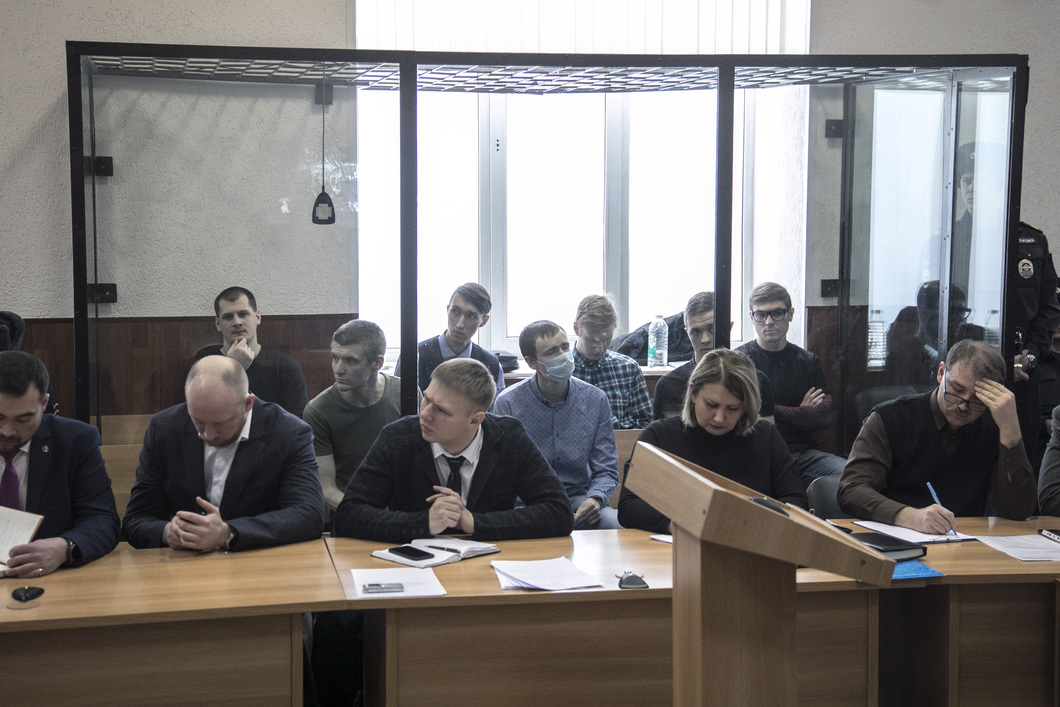
The case is brought to trial: the [Penza] trial will last until February 10, 2020. At the trial, the prosecution’s witnesses will recant their earlier statements, which they claim were given either under duress or misrepresented. The prosecution still has confessions made under torture, the testimony of secret witnesses, and physical evidence, including internet correspondence and computer files that were altered after they were confiscated, weapons of unknown origin, and a conclusion by FSB experts that the defendants constituted a group, and Pchelintsev was their leader.  This is enough to persuade the court to sentence the seven Penza defendants to 86 years in prison in total: Pchelintsev is sentenced to 18 years; Shakursky, to 16; Chernov, to 14; Ivankin, to 13; Kulkov, to 10; Kuksov, to 9; and Sagynbayev, to 6.

Penza Network defendants during the reading of the verdict. Photo: Victoria Odissonova/Novaya Gazeta

2020

February

There is unprecedented public outrage at the verdict and the prison sentences requested by the prosecutor. Hundreds of open letters and appeals—from musicians, poets, cinematographers, book publishers, artists, teachers, and municipal councilors—are published. For the first time in Russia, the practice of torture by the special services is openly and massively condemned. The verdict is called an attempt to intimidate the Russian people. The public demands a review of the Network Case and an investigation of the claims of torture. People stand in a huge queue on Moscow’s Lubyanka Square to take turns doing solo pickets.

Journalist Nikolai Solodnikov, holding a placard that reads, “I demand an investigation of the torture in the Network Case.” Photo: Svetlana Vidanova/Novaya Gazeta

But a week later, the wave of indignation is shot down. Meduza publishes a controversial article, “Four Went In, Only Two Returned,” in which a certain Alexei Poltavets confesses to a double murder that he committed, allegedly, with defendants in the Network Case. There had long been rumors about the so-called Ryazan Case—the murders of Artyom Dorofeyev and Ekaterina Levchenko in the woods near Ryazan—within the activist community, but the story had never surfaced, because there was no evidence. There is no evidence now, either: the Network’s involvement in the murder is not corroborated by anything other than the claims made by Poltavets. Poltavets himself is in Kiev, and no formal murder charges are made against the Network. But it is enough to discredit the solidarity campaign. Now, in the eyes of society, those who take the side of the Network Case defendants are defending murderers. Public outrage fades, and the verdict remains the same.

June

In Petersburg, Filinkov and Boyarshinov are sentenced to seven years and five and a half years in prison, respectively. Shishkin made a deal with the investigation and was sentenced to three and a half years in prison in 2019.

Viktor Filinkov and Yuli Boyarshinov. Photo: David Frenkel/Mediazona

Putin signs a decree awarding Sergei Sizov the rank of lieutenant general. Other Russia activists are arrested in Chelyabinsk. The so-called Chelyabinsk Case begins.

September

The appeals hearing in the Network Case has begun. It is held in the closed city of Vlasikha near Moscow, with a video link from Penza. The issue now is not torture, but the lack of evidence for the verdict. And indeed, from the point of view of any lawyer, the verdict look quite odd. It is not the verdict of an independent court, but a rewrite of excerpts from the case file and the indictment, a sloppy collection of unconfirmed facts and unreliable expertise. The verdict is reminiscent of the famous line from the 1979 Soviet TV miniseries The Meeting Place Cannot Be Changed: “He’s going to prison! I said so.”

October 20
The appeal hearing ends and the verdict is upheld. The authorities have enacted their revenge. The defense concludes that there is no more justice in Russia.

Translated by the Russian Reader. Please read my previous posts on the Network Case, and go to Rupression.com to find out how you can show your solidarity with the defendants in the case.

18 Years in Prison for “Et Cetera” (Penza Network Case Appeals Hearing)

18 Years in Prison for “Et Cetera”
Why the FSB cannot manage any case without resorting to torture: on the appeals hearing in the Penza Network case
Yan Shenkman
Novaya Gazeta
September 3, 2020

Everything about the Network Case is seemingly clear. All of the defendants have been found guilty and sentenced to six to eighteen years in prison. Public support has subsided due to a fake news hit job against the defendants. The matter is closed, and you can switch with a clear conscience to other news items: Belarus, Khabarovsk, Navalny, and so on.

But why is it, then, that every time I come to Penza, inconspicuous-looking tough guys follow me around town? Why do the court bailiffs try their darnedest to close the formally open court hearings in the case to the public? Why, finally, was testimony given under torture removed from the case file? Are the authorities afraid?

Yes, they are afraid. Six months have passed, but the case is still a bugbear for the FSB.

Photo courtesy of Sota.Vision and Novaya Gazeta
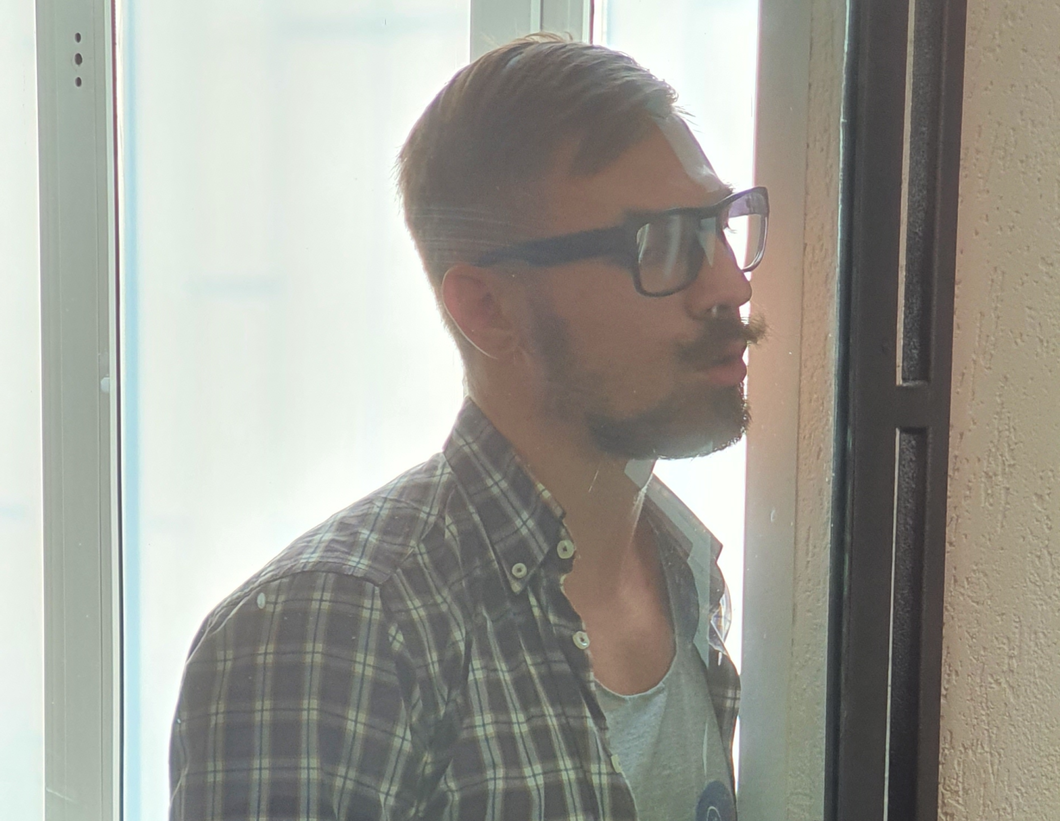
There are five pairs of handcuffs on the railing that separates us from the prisoners. They look like broken Olympic rings. They are for defendants Pchelintsev, Shakursky, Chernov, Kulkov, and Ivankin. The two other defendants, Kuksov and Sagynbayev, are sitting separately: they have tuberculosis.

The appeals hearing begins on a terribly dark note: the guys are told about the death of the Alexei “Socrates” Sutuga. Kuksov says, “That is beyond awful.” In the three years since they’ve been in police custody, a lot has happened, including the New Greatness case, the Ivan Golunov case, the Moscow case, the presidential “reset,” and, finally, the coronavirus. The context has changed completely. There is a photo in the case file of the defendants wearing black masks. It looks really scary. It would suffice to show it to laypeople for them to conclude the defendants were terrorists, of course. The court also thought so.

But now half the country goes around in masks, and it frightens no one.

In the 1930s, there were associations of former political prisoners in the USSR. Amid the turbulent events at the turn of the century, the old-style political prisoners appeared anachronistic. One war, two revolutions, another war, and rivers of blood had flowed since they had served time under the tsars for impertinence to their superiors, involvement in student political groups, and other nonsense. That government, just like this one, did not like students and those who were impertinent to their superiors. They put them in jail and beat them at demos. We remember how that whole story ended.

Pchelintsev says it outright: “We have been sacrificed.” Yes, they are classic victims of history.

Dmitry Pchelintsev. Photo by Alexei Obukhov. Courtesy of Novaya Gazeta

The first few hours of the hearing are spent on technical issues that, however, are not so technical. The numerous complaints filed by the defense lawyers boil down to the fact that the convicts were not given a good look at the case files and other documents from their trial nor allowed to voice their complaints. The court turns down all the defense’s motions and requests.

It’s as if court is saying, You don’t need to need what you’re in prison for. If you’re in prison it means that is how it has to be.

The defense’s complaints against the verdict can be divided into three parts.

1. The Witnesses

At the trial, the prosecution’s witnesses (!) did not confirm the veracity of their pretrial testimony. Some of the witnesses even disavowed it. Some admitted they had been pressured during the investigation. Some, it transpired, testified to what other people had told them. But the court was not in the least troubled by this fact: for some reason nothing bothers it at all.

That leaves the secret witnesses: there are six of them in the case. One of them, identified as “Kabanov,” is an experienced provocateur (Novaya Gazeta has written about him): this is not his first job for the security services. Another of them could not really explain what he had witnessed. Three of the witnesses claimed that the defendants had told them about their criminal plans after they had been arrested and remanded in custody, that is, in the remand prison in Penza.

Could this have happened? It’s unlikely, but let’s assume it is true. And yet these same “witnesses” could not even correctly describe the defendants’ physical appearance and the setting in which the conversation allegedly took place. Not to mention the fact that prisoners are always dependent. It is an easy matter for the authorities to put pressure on them, to frighten them, to force them to give the “right” testimony in court in exchange for better conditions.

Investigators put testimony obtained from the defendants under torture in the mouths of these witnesses. You get the feeling that they carried the transcripts of the interrogations around them and read them aloud to the first people they met.

Finally, there is the small matter that the transcripts of the interrogations do not match the videos of the interrogations. A person would literally say one thing in the transcript and another thing in the video recordings. The court looked at the videos, compared them with the transcripts, nodded, and everything was left as it was. There is no mention of these discrepancies in the verdict.

2. The Forensic Examinations

Almost all the investigation’s forensic examinations have been refuted by independent experts and specialists. Among the reasons cited by them are incompetence, bias, non-compliance with established standards, and even falsification. It is for falsifications in the Network Case that the Military Investigative Committee is now reviewing FSB Investigator Valery Tokarev. It is so obvious that even their own people don’t believe it.

Although the court claims that defense’s forensic examinations do not contradict the FSB’s forensic examinations, they actually do. None of the FSB’s forensic examinations passed the test, neither the computer examination, the linguistic examination nor the psychological examination.

We must give the court its due: it more often than not did enter findings and testimony that were unpleasant to the prosecution into evidence. But it did not evaluate them in any way and did not take them into account when rendering its verdict. There they are. Sure, qualified specialists have proven that the FSB’s forensic examinations are bullshit, and they can say so if they like. But this has no bearing whatsoever on the verdict.

3. Bias and Presumption of Guilt

Each letter of the verdict indicates that the court was biased in favor of the prosecution. The trial need not have taken place. The investigative case file and the court’s published findings are nearly identical. In fact, it was the FSB who tried the Network defendants, not the court. The court only signed off on their pre-ordained verdict.

As many people have heard, Russia has an independent judiciary.

And here is the icing on the cake, the culmination of this theater of the absurd: the Volga District Military Court that handed down the guilty verdict in the Network Case did not officially exist when the verdict was rendered. So, it is not clear exactly who tried the case.

The Penza Network Case defendants during the trial. Photo by Alexei Obukhov. Courtesy of Novaya Gazeta

Let’s leave aside for a moment the FSB’s use of torture, the injustice of the case, and the court’s bias. Even if everything had been objective and impartial, from a legal point of view this is not a verdict, but the delirium of a madman. What does a sentence like the following tell us?

“The participants took clandestine security measures, as evidenced by the presence of aliases, communication on the internet using secure protocols, trips to other cities in passing vehicles, et cetera.”

A huge number of questions immediately come to mind.

Half of the people on the internet uses aliases (aka usernames). Are all of them involved in “clandestine security measures”?

Secure protocols are a feature, for example, of Telegram, which is used by half of the country, including government agencies. So, does this mean we should only use insecure protocols? Then the authorities should put an end to it, they should criminalize secure protocols and warn us not to use them.

No one has ever accused hitchhikers of using “clandestine security measures.” This is a game changer for criminology.

Finally, the “et cetera.” This was written by adults. How could “et cetera” be grounds for sentencing someone to eighteen years in prison?  How could anyone write such nonsense in a verdict at all?

The defendants communicate with their relatives. Photo by Alexei Obukhov. Courtesy of Novaya Gazeta
Konstantin Kartashov, Maxim Ivankin’s lawyer: “I cannot call this document a verdict.”

Oxana Markeyeva, Dmitry Pchelintsev’s lawyer: “The verdict does not meet the procedural requirements.”

Translated into plain language, this means the judges did a poor job, a shabby job. If they had been building a house instead of writing a verdict, the house would have collapsed.

The reason for all these inconsistencies is simple: the guilt of the defendants was proved not in the course of the investigation, but in the course of torturing them. The FSB, however, were afraid to use this testimony, obtained under duress, although they would not admit to torturing the defendants. But without it, nothing sticks. Without it, the verdict is just a random pile of dubious evidence vouched for by the authority of Russian state security. The main thing you need to know about the case is that seven young men were sentenced to terms in prison from six to eighteen years, and their guilt was not proven in court. And this unproven guilt is a threat to all of us—not just to opposition activists, but to anyone walking down the street who catches the eye of FSB field agents.

There are so many problems with the verdict that it is impossible even to state all of them in one or two appeals hearings. There is little hope that the court will heed the arguments of the defense. There is an aura of hopelessness about the case. But it has to be brought to a close because a lot of things hang in its balance. After all, the verdict is based mainly on suspicion—on the fact that, hypothetically, the defendants could have “organized a terrorist community.” In theory, any of us could organize one. We are all under suspicion.

The lawyers in this case are not only defending Pchelintsev, Shakursky, Chernov, Kulkov, Ivankin, Kuksov, and Sagynbayev. They are also defending society, the right of each of us to be protected from the FSB. When they lose their appeal, they will keep going—to the European Court of Human Rights, to the Court of Cassation, to the Russian Supreme Court. Everyone involved in engineering this verdict should realize that they will inevitably have to account for their actions, and at the highest level. I don’t know about criminal responsibility, but universal disgrace is inevitable. They must answer for what they have done, and sooner or later they will answer for it.

Translated by the Russian Reader. Please read my previous posts on the Network Case (see the list, below), and go to Rupression.com to find out how you can show your solidarity with the other defendants in the case.

#NetworkCase 

Viktor Filinkov: The Big Picture

Viktor Filinkov, political prisoner: “An idealist who takes on responsibility for the big picture”
People and Nature
July 4, 2020

While Black Lives Matter demonstrators fill the streets of cities around the world, opening a new chapter in the history of anti-racist and anti-fascist struggle, the Russian anti-fascists Viktor Filinkov and Yuli Boyarshinov are starting long jail sentences.

A St Petersburg court sentenced Filinkov to seven years, and Boyarshinov to five-and-a-half, on 22 June, on trumped-up charges of involvement in a “terrorist grouping” – the “Network”. In February, seven other defendants were jailed by a court in Penza for between six and 18 years, and last year another in St Petersburg for three-and-a-half years.

Detailed evidence that the “Network” case defendants were subjected to horrific tortures after their arrest has been published and submitted to state bodies. President Vladimir Putin last year cynically promised to look into it. Nevertheless, the defendants have been railroaded to penal colonies.

This portrait of Viktor Filinkov – who refused to admit guilt and received one of the heaviest sentences – is by Yevgeny Antonov. It was first published in Russian by the Petersburg news outlet Bumaga.

photo-2020-06-22-11-54-45
Viktor Filinkov in court. Photo by David Frenkel, Mediazona

On Monday 22 June, the 2nd Western District Military Court [in St Petersburg] announced the sentences on the Petersburg defendants in the “Network” case, Viktor Filinkov and Yuli Boyarshinov. They were found guilty of involvement in a terrorist grouping (article 205.4, part 2 of the criminal code). Filinkov was sentenced to seven years in a penal colony (standard regime). Boyarshinov got five and a half years (Yuli was also convicted of the illegal possession of explosive materials (article 222.1, part 1)).

Four days before the sentencing, Filinkov addressed the court. The 25-year old computer programmer set out the inconsistencies in the prosecutor’s case, and used diagrams to show why the PGP [Pretty Good Privacy encryption] programme would not be used by a conspiratorial terrorist group, as the prosecution had claimed.

In his closing statement, Filinkov stated that the internal affairs ministry, the prosecutor, the federal prison service, the Investigative Committee, the federal security service [FSB], the court and the legislature had worked in bad faith. He accused them of obeying orders unquestioningly and of being unwilling to investigate the case.

“The nine-year sentence that the prosecutor has asked for seems like some sort of indication of respect for everything that I have done”, Filinkov said. “All of them have disgraced themselves. I don’t know what the solution to this situation is.”

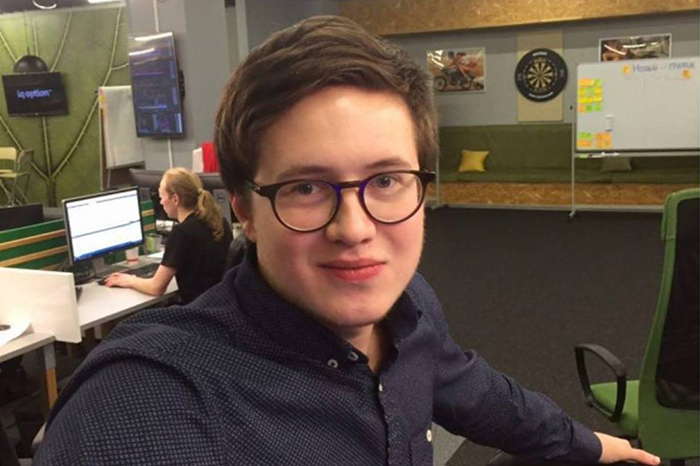
755296506252927Viktor Filinkov at work. Photo courtesy of Rupression
Viktor Filinkov was born in Petropavlovsk, in Kazakhstan. His mother worked in a jeweller’s shop; his father, who worked installing medical equipment, died when Viktor was 11; and his elder sister lived away from home.

“We waited so long for Viktor. And when he was born, he grew up loved and cared for, by grandparents, by his aunts and uncles, and by us”, Natalia Filinkova, Viktor’s mother, told Bumaga. “He hardly knew the word ‘no’. He was a good, kind child, very honest, strong-willed. Right from when he went to nursery, if he didn’t like something, he would say so straight out. He would tell anyone, to their face, what he thought. I used to ask him, ‘why so direct?’ and he would answer ‘because it’s true!’.”

According to Natalia, electronics caught her son’s imagination when he was still a child. At six, he used his sister’s computer to read up about it. At ten, he would put together robots. As a teenager, he learned programming and won computer competitions. In court, Filinkov’s colleagues from the IT company where he worked confirmed his remarkable skills as a programmer.

“He hadn’t yet started going to school, when he told me, when I grow up I’ll be professor, earn lots and lots of money and buy KAMAZ [the truck construction company], so that it can make lots of money too. He obviously thought professors are high earners”, Natalia joked.

After Viktor’s father’s death, the family had to spend less, and moved to a smaller flat, but was still free of serious financial problems. Viktor’s wife, Aleksandra Aksenova, said that he described his childhood as difficult. “He saw how his mum and his sister kept their noses to the grindstone. But still, they had no money for meal time treats. I well remember how Viktor said that, when he was a child, butter was a real treat. It was not starvation, but it was definitely poverty.”

Viktor is described as a sociable person, with dozens of friends, who loves social gatherings. According to his mother, he was a voracious reader as a teenager – of technical books from school in particular. And he would sit on the internet and play computer games.

Aleksandra Aksenova says that Viktor mentioned to her his dislike of the education system in Kazakhstan, and his frequent arguments with his school teachers. “One thing that’s striking about Viktor is that he loves a good argument. Once he has worked out his position, he is very good at defending it. But also, if it turns out he is wrong, he’s not afraid to say so.

“Although he didn’t like the way the school system worked, he was anything but stupid. With STEM subjects he was in his element. And he argued with his teachers, often because he knew more than they did.”

Viktor himself says that, as he got older, he wore his hair long, on account of which the school management “tried to put pressure on him”. Around this time, Filinkov’s anti-fascist and anarchist views took shape.

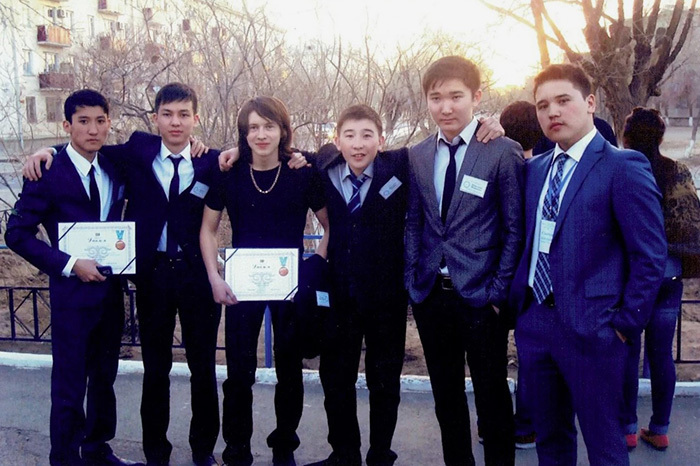
annotaciya-2020-06-22-111158Viktor Filinkov (third from left) with schoolmates in Kazakhstan. Photo courtesy of Mediazona

“At some point when Vitya was in the 9th year [i.e. at 15], he said that he had become keen on anarchism”, Natalia Filinkova remembers. “Surely he read about it on the internet, there was plenty

Viktor Filinkov (third from left) as a school pupil. Photo: zona.media

written there. This was shortly after [the lawyer, Stanislav] Markelov and [the journalist Anastasia] Baburova were killed [in Moscow]. This had a real effect on Viktor; he wanted justice.”

Viktor’s mother says, however, that they did not talk about politics. In court, she said: “He was a good example to others. At no time did he suggest that he was against the government.”

photo-2018-01-24-22-04-10Viktor Filinkov in happier times. Photo courtesy of Rupression

In 2013 Viktor finished school and moved to Omsk, [in western Siberia, in Russia] where he started studying in the faculty of information and communications technology at Omsk state university.

Viktor never graduated. After two-and-a-half years he abandoned his studies, because his mum became “seriously ill”. (Natalia asked that the diagnosis remain confidential). Filinkov started work, earning 30,000 rubles [400 euros at 2016 exchange rate] per month.

Viktor was happy to quit university, a friend from that time told Bumaga; he complained that classes were boring. This source said that Filinkov soon understood that he had hit the pay ceiling in Omsk, and thought about moving on.

Viktor’s wife recalls that at that time he began to participate in anti-fascist actions and to support human rights campaigns. In 2014-16 he stood on picket lines opposing redundancies among health workers, supported trade unions and attended demonstrations in memory of Markelov and Baburova.

By 2015 Viktor was a committed anti-fascist, an acquaintance from Omsk told Bumaga. According to them, Viktor came to these beliefs himself, without reading “ideological literature” such as the work of [Pyotr] Kropotkin or [Mikhail] Bakunin.

“We first met in 2015, when he was hanging around the university with his friends”, this source recalls. “We had interests in common – in computer technology, and sport – and became friends. There was a small circle there [in Omsk] of people who were anti-authoritarian: a milieu of young leftists, who shared a clear understanding: racism – no way, capitalism – no way.”

This friend of Filinkov’s said they were “not the sort who build communes and prepare revolution”: their main aim was to create horizontal cooperation, within which people could live side-by-side comfortably and help each other. This way of living was seen as an alternative to the state’s.

Aleksandra Aksenova, with whom Filinkov often discussed his time in Omsk, said: “He grew up in conditions of great social injustice. He also saw people’s attitudes to him, due to the fact he was a citizen of another country [Kazakhstan]. How could he not become an anti-fascist?”

Viktor himself has said that in 2016, because of the views he held, he was several times attacked by nationalists.

Both Aksenova and Filinkov’s friend from Omsk said that Viktor had come to know Aleksei Poltavets, who would later confess to the murder of an associate of the “Network” defendants in Penza. Of the other future defendants Viktor knew little, but he had heard their names, says the source in Omsk.

“It wasn’t so much about going to demonstrations or getting together in groups”, Filinkov’s Omsk friend said. “It was that we tried to live by the principles of anti-authoritarianism, anarchism, anti-fascism. And of course we spent time together: cycling, skating, playing around with Linux, trying to write [computer] programmes, listening to music, hanging out, climbing on roofs.”

5-demonstratorsPolice detain a demonstrator outside the courthouse in Petersburg where Filinkov and Boyarshinov were sentenced on June 22, 2020. Photo by David Frenkel, Mediazona

Viktor met his future wife in the summer of 2015 at an anti-fascist concert in Moscow. Aleksandra then lived in Moscow, Filinkov was just visiting. They kept in touch on line, then began talking on the phone and in mid 2016 decided to meet in Penza, midway between Omsk and St Petersburg, where Aleksandra then lived.

Aleksandra had by then got to know many anti-fascists and anarchists, including future defendants in the “network” case: she was friends with Dmitry Pchelintsev, knew Arman Sagynbaev, Igor Shishkin, Andrei Chernov and Yuli Boyarshinov, and had communicated with Ilya Shakursky. Filinkov himself said that, even by the time of the court case, he had only known some of the other defendants indirectly, or met them just once.

“My comrades got to know Vitya”, Aksenova remembers. “They grew pretty fond of him, because he knew so much about so many things. They would endlessly come to see him. ‘Vitek, help with this, help with that, my computer is broken, I need to find something, how can this be done safely?’ And he would sit and explain everything.”

Aksenova says that Filinkov grew to like Dmitry Pchelintsev, the shooting instructor and anti-fascist, who the FSB would later name as the founder of the “network” terrorist organisation. “It’s no secret to anybody that one of most well-read guys in Penza was Dmitry Pchelintsev”, Aksenova says. “He could explain his reasoning, sometimes very romanticised and sometimes loudly, but it was always interesting to talk with him.”

In court, Filinkov’s lawyer, Vitaly Cherkasov, insisted that in Penza Viktor hardly spent time with any of the others, since he was “so enchanted with his lover”.

In September 2016, Filinkov found work at a Petersburg start-up. He and Aleksandra began to live together, and then got married – partly so that Viktor could become a Russian citizen.

At the same time, Filinkov got to know Sagynbaev, and began to attend lectures on first aid. In 2017 Aksenova applied for permission to acquire a firearm: the couple then kept it in a safe in their flat.

In the same year Filinkov, along with other anti-fascists, began to visit a flat at Bogatyrsky Prospekt 22. Aksenova says: “These were meetings of friends. They discussed community projects, and how they could cooperate with each other. As was stated in court, they talked about, among other things, sociological methods of study, and how to develop a culture of discussion.”

When, at the end of 2017, Pchelintsev and other activists in Penza disappeared, Filinkov and Aleksandra tried to find out what had happened to them. Aksenova decided to travel to Kiev, and in January 2018, when it became known that the Petersburg anti-fascist Yuli Boyarshinov had been arrested, Viktor decided to fly out to join her.

Filinkov had a ticket for a Kiev flight two days after Boyarshinov was detained. He told his wife that he was leaving for the airport, but never made it to the Ukrainian capital. Aleksandra searched for her husband for two days. Later on it became clear that he had been detained by FSB officers. Filinkov said that in those days the officers tortured him with an electric shocker, in order to obtain a confession.

6-filinkov-boyarshinovFilinkov and Boyarshinov at a court hearing in 2018

Filinkov spent two-and-a-half years in an Investigative Detention Centre (SIZO). During that time he reported injuries he had sustained as a result of the torture. He was diagnosed with a ruptured spinal disc, and prescribed medicine for psychological problems that he suffered.

According to the FSB, Viktor Filinkov, together with other members of the “Network”, in 2016-18 acquired firearms and learned how to use them, and “acquired the practical means to seize a building”, with the aim of making violent change to the constitutional order. The FSB claimed that the group, in which Filinkov allegedly took part, aimed at the “armed overthrow of the state power”. In the prosecution case, Viktor was named as the signals operative.

The prosecutors argued that Filinkov spoke about being tortured in order to discredit Russia’s law enforcement agencies. As evidence, they adduced the fact that Viktor did not officially inform anyone about the torture before he met with Vitaly Cherkasov, his lawyer, on 26 January [2018]. Cherkasov asserts that his client was in a state of shock, and says that he himself saw the marks [on Filinkov] that resulted from him being beaten.

Members of the Public Monitoring Commission [a civic organisation empowered to monitor conditions in places of detention] also confirmed that there were signs of torture. But no independent medical examination was conducted. Viktor’s mother met with him only several months after his arrest: according to her, it was cold and her son wore a coat: all she saw was a scar on his chin.

When the court hearings began in Petersburg, Filinkov at practically every opportunity spoke of his innocence and rejected the prosecution’s claims. In open court he said: “All that I can say is: no, it’s not true. The burden of proof lies with the prosecution. But for two-and-a-half years, the authorities have shown their bias. They have wagged their fingers at me and said that I have to prove that I am not a camel.”

Filinkov’s work colleagues said in court that he had spoken openly with several of them about his wife’s legal possession of a firearm. He had introduced her to them as “Olga” – which the FSB claimed was a conspiratorial pseudonym. The prosecution also claimed that Filinkov’s “code name” was Gena. Viktor himself insists that people started to call him by that nickname in Omsk, because sometimes he laughed “like a hyena” [“giyena” in Russian].

jenya viktor yuliPublic defender Jenya Kulakova (left) photographs Network Case defendants Viktor Filinkov (center) and Yuli Boyarshinov. Courtesy of Jenya Kulakova

People who know Viktor well have told Bumaga that they understand why he refused to confess, which theoretically could have reduced his sentence. (According to Vitaly Cherkasov, after arrest Filinkov was offered a three-year term [if he confessed].)

“That’s just his character. He won’t confess to something that he didn’t do”, Viktor’s mother Natalia said. “I know what he is thinking: if a person is right, why should he incriminate himself? Knowing him, I wouldn’t even dare to ask if he would think about making a deal. I couldn’t have brought myself to say it to him. Just impossible.”

Aleksandra explains her husband’s decision in terms of the “prisoner’s dilemma” in game theory. There is a choice for two sides: betray each other, or cooperate. Betrayal brings greater gains for each side, and for this reason it is assumed that rational players will choose betrayal. But if both sides turn traitor, the total winnings will be less than if they cooperate.

“When all the defendants in a fabricated trial refuse to admit their guilt, and insist on what they see as the truth, then the mathematical chance that they will all be given the maximum sentence is reduced”, Aleksandra says. “In such a case there’s a possibility that the whole case will just collapse. Because everyone will say what really happened. But in our case, things were complicated because there were only three defendants in Petersburg.”

Officially, the other Petersburg “network” defendants – Igor Shishkin and Yuli Boyarshinov – made no statements that they had been tortured. But after they were first detained, members of the Public Monitoring Commission learned that Shishkin had been diagnosed with a large number of bruises and instances of localised internal bleeding, and that the bone around his eye [the lower orbital wall] had been broken. Boyarshinov stated that FSB officers came to see him in the detention centre, and that other detainees had threatened to rape him.

In his final statement to the court, Filinkov said that he understood both Yuli Boyarshinov, who had confessed to his guilt, and Igor Shishkin, who had cooperated with the investigation (and already in 2019 been sentenced to three-and-a-half years). Viktor considers that they saw no other way out.

Aksenova concludes: “He is an idealist. An idealist who sees the need to take his place in history, who takes upon himself responsibility for the big picture.

“If there were no such idealists, then we would never have an example to follow, of how a person should act in such circumstances. Maybe it will seem to some people that Viktor’s words and actions were rash, and doomed to fail from the outset. I would not argue. But these words and actions are a necessity, for us to stand up for our ideals.” 3 July 2020.

■ Please visit the Rupression web site, to see how you can support the “Network” case prisoners.

■ For more coverage of Filinkov and Boyarshinov’s trial, and of the case, see The Russian Reader, Open Democracy Russia, and Freedom News. People & Nature has written about the case too, e.g. here, and about international solidarity events.

Thanks to People & Nature for permission to reprint this article. \\ TRR