Overview of the Moscow renovation program’s showroom, opened yesterday, July 6, 2017, by Mayor Sergei Sobyanin. Photo courtesy of Sergei Vedyashkin/Moskva News Agency & Meduza
Authorities Plan to Divide Moscow into Private and Public Areas
Anna Trunina RBC
June 26, 2017
Moscow’s renovation program provides for the complete redevelopment of residential building courtyards. The mayor’s office argues that these spaces should not be passages, so for the first they will delineated into private [privatnye] and public spaces.
By autumn, the Moscow authorities expect to adopt new regional urban planning norms that will divide residential districts into private and public areas for the first time. The mayor’s office has proposed rejecting the idea of communicating courtywards, Marat Khusnullin, Moscow’s deputy mayor for urban policy and construction, said in an “interview” published on the mayor’s official website.
According to Khusnullin, the renovation program not only consists in updating the city’s housing stock but also in creating a “full-fledged integrated urban environment,” in redeveloping and landscape the courtyards.
“The concrete jungles, as Moscow’s bedroom communities were rightly dubbed, were erected over decades. Now they must become a thing of the past,” Khusnullin argues.
According to preliminary calculations by the authorities, says Khusnullin, after neighborhoods are replanned and space is freed up by the demolition of five-story houses in Moscow, the number of parking spots will double. The project for public spaces will not be uniform, but will be unique in each of Moscow’s districts. The standards of comfort and improvement will be identical, however.
The space in the renovated neighborhoods, Khusnullin notes, will be divided into residential and public areas.
“For example, when they go into their courtywards, residents will enter a zone of a peace and comfort where there will be minimum of strangers and cars. Naturally, the entrances to the shops on the first floors will be located on the streetside. There will be no walk-through yards [prokhodnye dvory]. We will provide convenient pedestrian walkways from residential buildings to subway stations and bus stops, so that residents won’t have to blaze their own trails through lawns,” claims Khusnullin.
“Five-Storey Russia: An RBC Major Investigation of Renovation,” Published June 22, 2017 on RBC’s YouTube Channel
Khusnullin says that development and construction in Moscow during the Soviet era was “very uneven and disorganized.” It was this that caused the emergence of “strange, unused spaces” within neighborhoods.
City authorities also plan to increase the number of green spaces in the districts.
“Our proposal is to construct gardens, lay down paths, and set up benches on the same sites. But this in no way means all the old trees will be cut down. There will be more greenery. Planners have been tasked with taking care of the existing green areas while finding places for the additional planting of trees and shrubbery,” says Khusnullin.
Currently, the law bill on renovation has passed its third and final reading in the State Duma. Subsequently, the Moscow mayor’s office summed up the votes of Muscovites, which showed that 90% of the buildings initially slated for the program would be demolished and rebuilt.
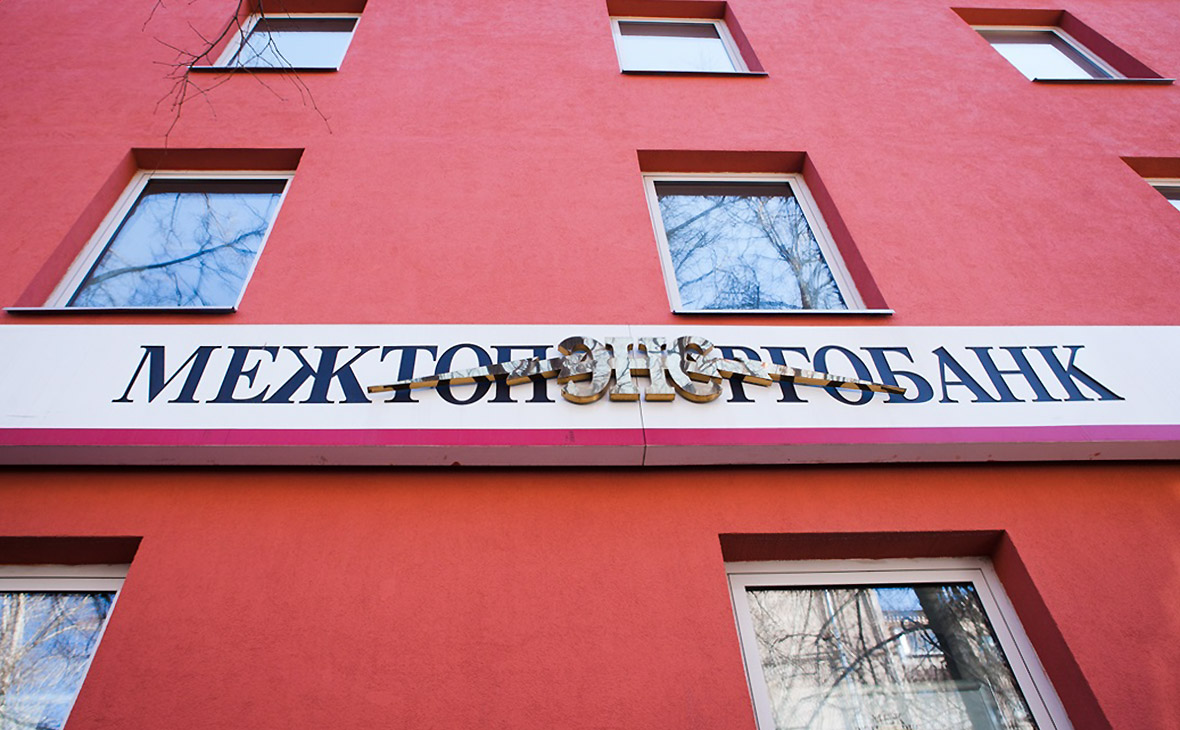
Mezhtopenergobank. Photo courtesy of Alexei Zotovo/Kommersant & RBC
I love the names of Russian banks, nearly all of them fronts for the global machinations of the Kremlin, its oligarchs, and their minions.
“Mezhtopenergobank (rated among the country’s top hundred banks in terms of assets) has admitted it lacks liquidity. The difficulties arose because ‘negative information about the bank’s financial state’ had been making the rounds.”
Mezhtopenergobank PJSC reports difficulties in completing transactions due to lack of available liquidity
Mezhtopenergobank PJSC, a commercial interregional fuel and energy bank, reports difficulties in completing transactions due to a lack of available liquidity.
The bank’s financial condition has become less stable due to a number of factors caused by negative market conditions, in particular, in the construction sector. A reduction in profits and an increase in the volume of overdue debts have also resulted from the refusal of major borrowers to fulfill their obligations. In addition to the need to generate significant reserves for problem loans, as required by the supervising authority, the postponement of the scheduled refinancing of a number of client projects and the revision and tightening of the repayment schedule by the Small and Medium Enterprises Bank (SME Bank) have also been negative factors in the bank’s business.
Despite the worsening of a number of financial indicators, the bank was fulfilling client requests in a timely manner, maintaining liquidity at the required level, until last week. The bank’s operations also continued to generate a stable income.
The rapid loss of liquidity was triggered by the vigorous dissemination of negative information about the bank’s financial condition, which resulted in a sharp increase in the number of client withdrawal requests. Consequently, the load on information systems increased. They could not handle the critical volume of requests, which led to failures and affected the speed and possibility of completing transactions. Nevertheless, until July 2, the bank continued to perform transactions at its offices, via remote banking, and through ATMs.
The bank reminds its clients that all funds in accounts are fully accounted for in the bank’s information systems, balance sheets, and mandatory registers, despite the fact that the ability to dispose of these funds is currently impeded. Mezhtopenergobank PJSC is a participant of the Deposit Insurance System and has insured all funds in the accounts, cards, and deposits of private individuals and individual entrepreneurs in the amounts stipulated by law.
We would also remind borrowers and co-signatories that all payments under current obligations to the bank will be received and processed as usual, and must be sent to Mezhtopenergobank PJSC by the due dates, as stipulated in agreements.
Remote client services are operating in informational mode. Clients will have full access to bank account balances, transaction records, and electronic statements.
Customers and co-signatories will be informed about further actions as additional information becomes available.
Since none of what follows, which I’ve excerpted from RBC’s Facebook newsfeed just seconds ago, makes any sense in Russian, I’m translating it by way of beefing up my “transsense” (Zaum) chops. You never know when they’ll come in handy. Truth be told, they come in handy way too often. TRR
В Совете Федерации планируют создать комиссию, которая займется мониторингом враждебной активности иностранных государств.
Таким образом Совет Федерации хочет «продемонстрировать не просто лояльность президенту, но и свою вписанность в патриотические тренды», говорит политолог.
The Federation Council plans to form a commission to monitor the hostile actions of foreign states.
The Federation Council thus wants “to display not just its loyalty to the president but also its conformity with patriotic trends,” says a political scientist.
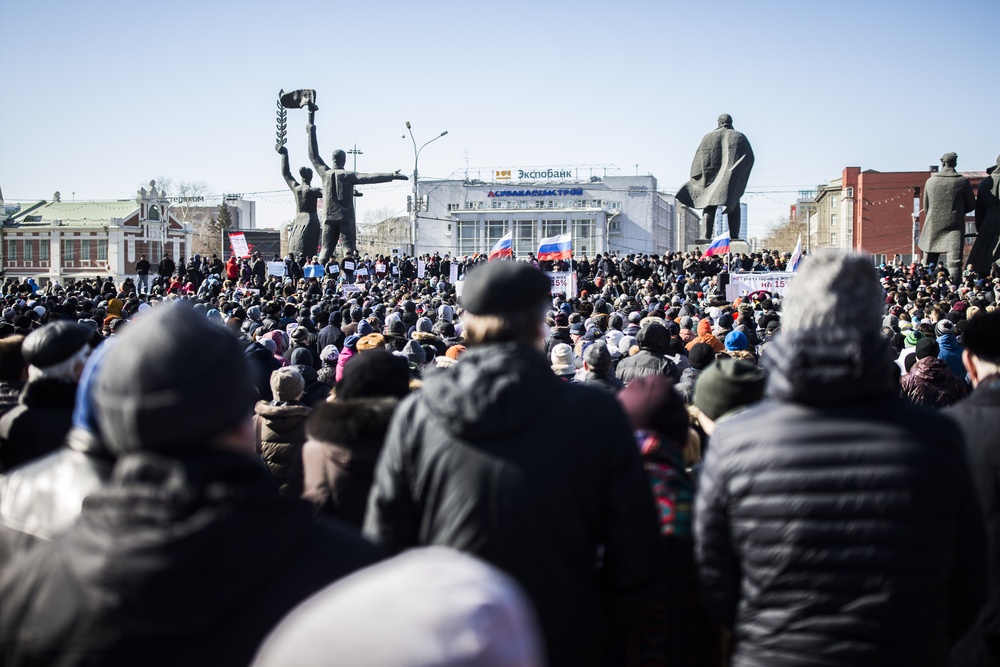
Rally against planned building maintenance and utility rate hikes, March 19, 2017, Novosibirsk. Photo courtesy of navalny.com
Novosibirsk Cancels Sharp Hike in Utility Rates in Wake of Protests
Yevgeny Kalyukov RBC
April 19, 2017
Seven protest rallies in the region’s capital have forced regional leaders to give up their plan to raise rates for housing services and utilities by 15%.
RBC Novosibirsk has reported that Vladimir Gorodetsky, governor of Novosibirsk Region, has announced he will not raise rates for residential building maintenance and utilities by 15% beginning July 1, 2017.
During a briefing on Wednesday in Novosibirsk, Gorodetsky said he had signed an amendment to a decree adopted in December 2016. The amendment lowers the maximum rate rise to 4%.
Seven protest rallies have taken place in Novosibirsk in recent months. Protesters demanded the authorities either give up plans to increase rates so sharply or resign. Opposition politician Alexei Navalny was involved in the third rally.
“I hadn’t imagined the degree to which the protesters were dissatisfied. It’s a rare thing when my speech is more moderate in mood than the slogans shouted by rallygoers. My overall feeling was that the city had had it. Clearly, no one here can pay the new rates. And it’s a sure bet no one wants to pay for someone else to live well. We also have to understand the rate rise hasn’t come into force yet. Meaning the people coming out to the rallies realize there will other figures on their bills come June. I’m curious to see what will happen here in August when the summons to take to the streets, contained in the building maintenance and utilities bill, arrives in everyone’s apartment,” Navaly wrote in his blog after the rally.
On April 17, a petition calling for cancellation of the rate hike, signed by several thousand people, was delivered to Gorodetsky’s office.
“Believe me, I don’t listen just to the opinions of the people at the rallies. I have meet with the trade unions, the Public Chamber, and the Russian People’s Front. People said the burden was heavy,” Gorodetsky said on Wednesday by way of explaining his decision.
In keeping with the decree “On Maximum Increases in Payments Made by Citizens for Communal Services in the Municipalities of Novosibirsk Region in 2017,” signed on December 16, 2016, the amount of money charged to consumers of communal services would have increased by 15% as of July 1, 2017, in a number of towns and villages in the region, including Novosibirsk itself.
Given the dismal state of Russian healthcare, many people practice folk medicine. Photo by TRR
Experts Predict Reduction in Number of Hospitals to 1913 Levels
Polina Zvezdina RBC
April 7, 2017
The optimization of healthcare has led to massive hospital closures and a decrease in the quality of medicine in Russia, experts say. By 2021–2022, the number of hospitals in the country might drop to the level of the Russian Empire.
Hospitals of the Russian Empire
Between 2000 and 2015, the number of hospitals in Russia halved, dropping from 10,700 to 5,400, according to calculations made by analysts from the Center for Economic and Political Reform (CEPR), based on data from Rosstat. In a report entitled “Burying Healthcare: Optimization of the Russian Healthcare System in Action,” CEPR analysts note that if the authorities continue to shutter hospitals at the current pace (353 a year), the number of hospitals nationwide will have dropped to 3,000 by 2021–2022, which was the number of hospitals in the Russian Empire in 1913. (RBC has obtained a copy of the report.)
Healthcare reform kicked off in 2010, when the law on compulsory health insurance was adopted, David Melik-Guseinov, director of the Moscow Health Department’s Healthcare Organization Research Institute reminded our correspondent. It consisted in optimizing costs by closing inefficient hospitals and expanding the use of high-tech health facilities. The authors of the CEPR’s report explained that they examined a fifteen-year period when Vladimir Putin was in power, including his tenure as prime minister. In addition, the vigorous reform and optimization of healthcare kicked off between 2003 and 2005, as is evident from the statistics on the numbers of hospitals and outpatient clinics.
Hot on the heels of the hospitals, the number of hospital beds also decreased during the fifteen-year period: on average by 27.5%, down to 1.2 million, according to the CEPR’s calculations. In the countryside, the reduction of hospital beds has been more blatant: the numbers there have been reduced by nearly 40%. These data have been confirmed by Eduard Gavrilov, director of the Health Independent Monitoring Foundation. According to Gavrilov, the number of hospital beds has been reduced by 100,000 since 2013 alone.
Melik-Guseinov agrees the numbers of hospitals and beds have been decreasing, but argues these figures cannot be correlated with the quality of medical service and patient care. The primary indicator is the number of hospitalizations, and that number has been growing, he claims. For example, 96,000 more people were discharged in Moscow in 2016 than in 2015. This means that, although hospital bed numbers have gone done, hospital beds have been used more efficiently. Each hospital bed should be occupied 85–90% of the time, Melik-Guseinov stresses. If beds stand empty, they need to removed.
Outmaneuvering Outpatient Clinics
As the CEPR’s report indicates, the trend towards a decrease in hospitals and hospital beds could be justified were resources redistributed to outpatient clinics, but they too are being closed in Russia. During the period from 2000 to 2015, their numbers decreased by 12.7%, down to 18,600 facilities, while their workload increased from 166 patients a day to 208 patients.
“The planned maneuver for shifting the workload and resources from hospitals to outpatient clinics did not actually take place. The situation became more complex both in the fields of inpatient and outpatient care,” conclude the authors of the report.
In its report, CEPR also cites the outcome of an audit of healthcare optimization performed by the Federal Audit Chamber. The audit led the analysts to conclude that the reforms had reduced the availability of services. As the CEPR notes, the incidence of disease increased among the population by 39.1% during the period 2000–2015. Detected neoplasms increased by 35.7%, and circulatory diseases, by 82.5%. The analysts personally checked the accessibility of medical care in the regions. The report’s authors tried to get an appointment with a GP in a small Russian city, for example, Rybinsk, in Yaroslavl Region. If they had been real patients, they would have waited 21 days to see a doctor. In addition, write the analysts, hospitals do not have a number of drugs, such as dipyrone, phenazepam, and ascorbic acid.
Melik-Guseinov is certain that one cannot rely on data on the incidence of disease among the population as an indicator of deteriorating healthcare in Russia. He points out that what is at stake is not the incidence of disease per se, but diagnosis. The fact that the more illnesses are detected is a good thing.
Fastfood Wages
The CEPR’s analysts write that the lack of medicines in hospitals reflects another problems in Russian healthcare: its underfunding. The government constantly claims expenditures on healthcare have been increasing, but, taking inflation into account, on the contrary, they have been falling. The CEPR refers to an analysis of the Federal Mandatory Medical Insurance Fund. Their analysts calculated that its actual expenditures would fall by 6% in 2017 terms of 2015 prices.
The report’s authors also drew attention to medical personel’s salaries. Taking into account all overtime pay, physicians make 140 rubles [approx. 2.30 euros] an hour, while mid-level and lower-level medical staff make 82 and 72 rubles [approx. 1.36 euros and 1.18 euros] an hour, respectively.
“A physician’s hourly salary is comparable, for example, to the hourly pay of a rank-and-file worker at the McDonald’s fastfood chain (approx. 138 rubles an hour). A store manager in the chain makes around 160 rubles an hour, meaning more than a credentialed, highly educated doctor,” note the analysts in the CEPR’s report.
According to a survey of 7,500 physicians in 84 regions of Russia, done in February 2017 by the Health Independent Monitoring Foundation, around half of the doctors earn less than 20,000 rubles [approx. 330 euros] a month per position, the Foundation’s Eduard Gavrilov told RBC.
Compulsory medical insurance rates do not cover actual medical care costs, argue the CEPR’s analysts. For example, a basic blood test costs around 300 rubles, whereas outpatient clinics are paid 70 to 100 rubles on average for the tests under compulsory medical insurance. Hence the growing number of paid services. Thus, the amount paid for such services grew between 2005 and 2014 from 109.8 billion rubles to 474.4 billion rubles.
The authors of the report conclude that insurance-based medicine is ineffective in Russia. Given the country’s vast, underpopulated territory, one should not correlate money with the number of patients. This leads to underfunding and the “inevitable deterioration of medical care in small towns and rural areas.”
“It is necessary to raise the issue of reforming insurance-based medicine and partly returning to the principles of organizing and financing the medical network that existed in the Soviet Union,” the analysts conclude.
RBC expects a response from the Health Ministry.
Translated by the Russian Reader. Thanks to Comrade AT for the heads-up
St. Petersburg Gets a Taste of Terrorism
Vladimir Alexandrov Kommersant Daily
December 20, 1996
A bomb exploded in the Petersburg subway in the early hours of December 19. By a lucky chance, there were no victims. This was the first terrorist attack in Petersburg [sic].* Until the incident, law enforcement had either received false bomb threats or had found the bombs in time. FSB officers, who have joined the investigation, have not yet put forward any more or less convincing explanations of what happened.
The hands on the clock in the driver’s cab showed 12:10 a.m. when he felt the train tremble violently. (It was then traveling between Ploshchad Lenina and Vyborgskaya stations, on the Kirovsky Zavod-Vyborgskaya Line).
“At first, I thought one of the junction boxes in the train’s pneumatic system had exploded, but several seconds later, I realized something unpredictable had happened,” he said.
The steering system was compromised. The emergency sensors lighted up. The driver immediately reported the incident to the duty officer at the station, and he contacted the police.
In fact, an explosive device had gone off in the train’s second car. There were two passengers in the car at the time, one of whom was deafened by the blast wave. His face and hands were injured by shards of glass.
Despite the fact the energy supply system was malfunctioning, the train rolled into Vyborgskaya station under its own momentum. The wounded man received first aid. Because he had trouble speaking and was quite disoriented, he was almost immediately taken to hospital. The second passenger, a woman, disappeared from the scene for reasons as yet unknown.
An FSB investigative team soon arrived. They inspected the car. It was an awful sight. The bomb had torn apart the car’s insides. The windows had been knocked out, the doors torn from their grooves, and the seats and upholstery ripped apart. The windows had been blown out in adjacent cars as well.
The damaged train was moved onto a storage track, near the Ploshchad Lenina subway station, where there used to be a depot.
The outcome of the forensic investigation was made public only yesterday. Judging by the blast pattern, an explosive device with no casing was placed in the subway car. It contained approximately 400 grams of TNT. The mechanism used to ignite the explosives has not yet been identified.
“It was our good fortune that there were few people on the train at the time of the attack [according to some sources, there were sixteen — Kommersant]. Otherwise, the consequences of the explosion would have been difficult to foresee,” said an FSB spokesman.
The motives and the people who carried out the attack are also still unknown. According to a few witnesses, when the train was stopped at Ploshchad Lenina, several young men dashed out of the car where the explosion would later occur, but no has yet linked the subsequent events with these men. Nevertheless, they are being actively sought by police.
Traffic on the stretch of track between Ploshchad Lenina and Vyborgskaya was restored by early morning on December 19 because the tunnel had suffered almost no damage. Diagnostic work on the tracks and cable conduits will continue tonight, however.
Nearly all police units in St. Petersburg have been on alert since the attack. Security at all subway stations, on public transport, and at other vital sites in the city has been increased. The FSB has established a special task force to investigate the crime.
Petersburg Governor Vladimir Yakovlev was informed about the incident half an hour after the explosion. According to him, it was hardly connected with events in Chechnya. Mentioning recent similar events in different countries, the governor suggested that “terrorism has, apparently, simply become a profitable business.”
This is the first terrorist attack in St. Petersburg in the last three months, although the police constantly receive anonymous bomb threats. (The callers usually claim the bombs have been planted in schools.) The last time police received an anonymous message about a bomb in the subway was in early October of this years. Traffic on the Moskovskaya-Petrogradskaya Line was halted for ten minutes due to the threat.
Translated by the Russian Reader. Thanks to Comrade Norsu for the invaluable heads-up and having a good memory.
_______________________________
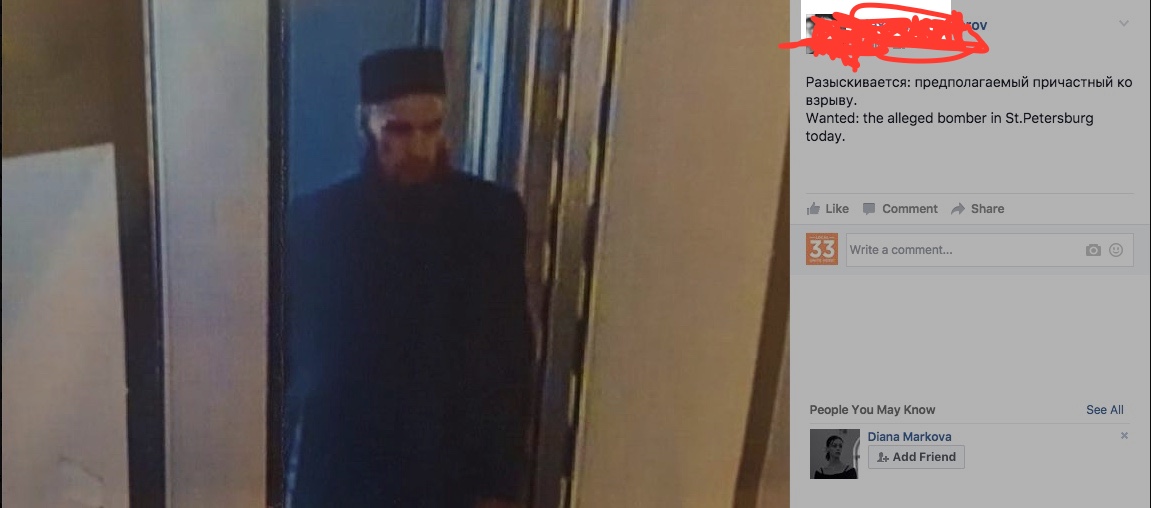
Social network users were quick to join the exciting hunt for the “alleged bomber,” especially because the screenshot image disseminated by local media evoked every radicalized Islamophobe’s wet dream of a “Muslim terrorist.”
Man Named as Suspect in Subway Explosion Turns Himself over to Police
Inna Sidorkova and Vladimir Gordeev RBC
April 3, 2017
A man resembling the man in a photograph whom the media had identified as a suspect in the terrorist attack in the subway has produced himself at a Petersburg police precinct.
“He saw himself on TV, got scared, and came to the police himself,” said RBC’s source in law enforcement. According to him, the man had nothing to do with the terrorist attack.
Earlier, REN TV and online newspaper Fontanka.ru had published a screenshot of a recording made by a CCTV camera. The image showed a man who, allegedly, had carried out the terrorist attack. The still showed a tall, bearded man dressed in black.
The “alleged terrorist” looks very much like a Russian Orthodox priest or seminary student. Photo courtesy of RBC and their sources in law enforcement**
** UPDATE (5 April 2017). His real name is Andrei (Ilyas) Nikitin, and here is the touching story of how this totally innocent man got booted off a plane in Moscow because Islamophobic, panick-mongering Russian media and social media users had already dragged him through the mud and labeled him a “terrorist.”
_______________________________
Execution of the five Pervomartovtsy, April 13, 1881. Source: Wikipedia
*Pervomartovtsy (Russian: Первома́ртовцы; a compound term literally meaning those of March 1) were the Russian revolutionaries, members of Narodnaya Volya [The People’s Will] who planned and carried out the assassination of Alexander II (March 1, 1881), and attempted to assassinate Alexander III (March 1, 1887, also known as “The Second First of March”).
The 1881 assassination was planned by Narodnaya Volya’s Executive Committee. Andrei Zhelyabov was the main organizer. After his arrest on February 27, he was replaced by Sofia Perovskaya.
Alexander II was killed on March 1, 1881, by a bomb thrown by Ignacy Hryniewiecki. Hryniewiecki wounded himself fatally in the assassination; Nikolai Sablin committed suicide. The conspirators—Zhelyabov, Perovskaya, Nikolai Kibalchich, Gesya Gelfman, Timofei Mikhailov, and Nikolai Rysakov—were tried by a Special Tribunal of the Ruling Senate on March 26–29 and sentenced to death by hanging. On April 3, 1881, five Pervomartovtsy were hanged, except for Gelfman, whose execution was postponed due to her pregnancy. Her execution was later commuted to indefinite penal servitude. She nevertheless died in prison of post-natal complications.
The second “First of March” was planned by members of the so-called Terrorist Faction of Narodnaya Volya, including [Vladimir Lenin’s older brother] Alexander Ulyanov. On March 1, 1887, they went to St. Petersburg’s Nevsky Prospect with bombs and waited for the Tsar’s carriage to pass by. However, they were arrested on the spot before his arrival. All fifteen conspirators, including Alexander Ulyanov and Pyotr Shevyryov (the main organizers), Pakhomy Andreyushkin, Vasily Generalov and Vasily Osipanov (the bombthrowers), and ten other people were tried by a Special Senate Committee on April 15–19 and sentenced. The first five men were hanged on May 8, 1887, while the rest were sentenced to prison, exile or penal servitude.
Source:Wikipedia. The article has been edited lightly to make it more readable. TRR
_______________________________
A 1988 map of downtown Leningrad, showing Zhelyabova and Perovskya Streets (inside the red oval). The streets were renamed in memory of the People’s Will terrorists in October 1918. The streets reverted to their pre-Revolutionary names (Bolshaya and Malaya Konyushennaya Streets) only in October 1991. (Image courtesy of retromap.ru.)
Yet streets named in memory of their fellow People’s Will terrorists Alexander Ulanov and Nikolai Kibalchich are still firmly in place on the grid of post-Soviet Petersburg to this day.
Alexander Ulyanov Street, in Petersburg’s Okhta neighborhoodKibalchich Street, in Petersburg’s southern Frunze District
Nikolai Davydov, successful Russian immigrant Silicon Valley businessman whose life has (not) been ruined by “hysterical Russophobia.” Image courtesy of RBC
Yet another victim of the “hysterical Russophobia” sweeping the US and Europe has been identified.
If “hysterical Russophobia” were a real thing, instead of a talking point for crypto-Putinists and just plain Russians who don’t know how to explain to their non-Russian neighbors why their homeland has become so “odd” in the past several years, you would have heard about Russian immigrants to the EU and US suffering the same main violence and putrid discrimination that Muslim, Asian, and African immigrants and asylum seekers suffer there, not to mention the relentless violence and staggering discrimination suffered by such absolutely 100% native Americans as Aboriginal Americans (i.e., Native Americans), African Americans, and Hispanic Americans in a land their peoples have been inhabiting from several centuries to several thousands of years.
But no, you never hear of such violence and discrimination against Russian immigrants, and the fact there is no such violence and discrimination against Russians (at least, not enough to show up on anyone’s radars) is a good thing, of course.
It does, however make you wonder what exactly this “hysterical Russophobia” is that has so many tongues wagging, but has absolutely no negative effect on the ability of actual, individual Russians to lead happy, productive, and violence- and discrimination-free lives in the countries where they have chosen to settle.
That’s an easy riddle to solve, however. “Hysterical Russophobia” is a non-phenomenon invented by a motley coalition of people with various political axes to grind, including sections of the mostly hilarious current western left, who for some reason have not heard the news about what has been happening in the Socialist Motherland the last twenty-five years or so or feign not to have heard it. They’re still defending Russia long after it became the world center of the blackest social and political reaction. That is, they’re defending a corrupt, oligarchic capitalist tyranny.
Why actual Russian immigrants might feel defensive about the old homeland is understandable, but they should figure out what’s worth defending and what’s not. The Putin regime, for example, literally has no redeeming features whatsoever, as a perusal of this blog, for example, and its predecessor, Chtodelat News, should persuade you, although there are thousands and millions of more credible sources of information out there that are even more persuasive than my occasional, half-baked efforts to knock some sense into your heads.
People who nevertheless hotly defend the Putin regime, wherever they’re from, immediately strike me as suspicious or hopelessly naive. And I’m not alone.
Well, you’ve probably guessed I’m just being facetious.
I think it’s great that Russians can go anywhere and make new, happy, productive lives for themselves. It should be that way for everyone, of course. No one is illegal, and all that.
Yet, simultaneously, the Russian government has been working overtime over the last year to exacerbate the Syrian refugee crisis. But you’d be hard pressed to hear any of the nattily dressed émigrés, described in the Financial Times article, quoted above, or their countrymen saying anything whatsoever about that nasty business and their country’s role in it. Mum’s the word, I’ve got my life to live, and all that.
However, a fair number of Russians, in my experience (and not only mine), have had lots to say, paradoxically, about Germany and other European countries being “overrun” by refugees from Syria and other war zones. It turns out these “black” unfortunates, who come from completely other galaxies, apparently, don’t have the same right so seek a safe place to live and work in Berlin, Paris, London et al., as the now-“white” (as opposed to White) Russians do.
A Managed Thaw: What the Reversal of Verdicts in the Dadin and Chudnovets Cases Means
Pavel Chikov RBC
March 6, 2017
The Kurgan Regional Court quashed the verdict against Yevgenia Chudnovets and released her from a penal colony, where she had served four months of a five-month sentence for, allegedly, disseminating child pornography on the web. The Russian Deputy Prosecutor General almost literally copied the arguments made in the appeal by Chudnovets’s attoreny. Previously, during its consideration of the appeal, the selfsame Kurgan Regional Court had refused to release Chudnovets at the request of both the prosecutor and defense attorneys. The same court then denied the appeal against the verdict. The verdict was reversed only after the Prosecutor General’s Office and the Supreme Court intervened. Now Chudnovets will have the right to compensation for the harm caused her by illegal criminal prosecution.
The Chudnovets story unfolded at the same time as the even more high-profile case of Ildar Dadin. Dadin’s case was the first criminal case filed under the newly minted law on violating the law on public rallies, the first guilty verdict handed down under the new law. Dadin was taken into custody in the courtroom. Then came the shocking sentence of three years in a medium-security penal colony for a first offense, a moderately severe offense whose underlying cause was purely political, in a case tried in Moscow under the glare of all the media. During the appeals phase, the verdict was altered slightly, and the sentence reduced a bit. But then there was the drama of Dadin’s transfer to the penal colony, his arrival in a Karelian prison camp infamous for its severe conditions, the immense scandal that erupted after he claimed he had been tortured, and the harsh reaction to these revelations by the Federal Penitentiary Service. Then Dadin was secretly transferred to a remote penal colony in Altai over a demonstratively long period, after which the Constitutional Court, in open session, ruled that the relevant article of the Criminal Code had been wrongly interpreted in Dadin’s case. After this, the Supreme Court jumped quickly into the fray, granting a writ of certiorari, aquitting Dadin, and freeing him from the penal colony.
Politically Motivated Releases
The judicial system acted with phenomenal alacrity in both the Chudnovets and Dadin cases. Chudnovets’s criminal case was literally flown round trip from Kurgan to Moscow and back. Given current realities, this could only have been possible under the so-called manual mode of governance and with authorization at the highest level.
It calls to mind the instantaneous release of Mikhail Khodorkovsky from the same Karelian prison colony in December 2013, and the same sudden early releases, under amnesty, of the Greenpeace activists, convicted in the Arctic Sunrise case, and Masha Alyokhina and Nadya Tolokonnikova, two months before their sentences were up. Of course, the record holder in this sense is the Kirov Regional Court, which in the summer of 2013 quashed Alexei Navalny’s five-year sentence in the Kirovles case.
In all these previous cases, the causes of the system’s sudden softness were self-explanatory. The thaw of December 2013 was due to the upcoming 2014 Winter Olympics in Sochi. Navalny’s pardon was clearly connected with his being able to run in the Moscow mayoral elections. It was hard not to doubt the narrowly political, tactical objectives of these targeted releases.
The latest indulgences—the sudden releases of Dadin and Chudnovets, the transfer of the last defendant in the Bolotnaya Square case, Dmitry Buchenkov, and the Yekaterinburg Pokémon catcher, Ruslan Sokolovsky, from custody in pretrial detention facilities to house arrest—have been greeted with a roar of approval from the progressive public. The liberal genie would have burst out of its bottle altogether were it not for the eleven-hour police search of the home of human rights activist Zoya Svetova in connection with the ancient Yukos case. The search was as sudden and hard to explain as the releases described above.
Federal officials have not tried to dampen the talk of a thaw. On the contrary, they have encouraged it. The president’s press secretary Dmitry Peskov, Supreme Court Chief Justice Vyacheslav Lebedev, federal human right’s ombudsman Tatyana Moskalkova, and Justice Ministry spokespeople have publicly supported decriminalizing the Criminal Code article under which Dadin was convicted.
Putting the Brakes On
Even earlier we had noticed that the number of politically motivated criminal cases had stopped increasing. Twelve years of defending grassroots activists, human rights activists, journalists, and heads of local NGOs mean we are sensitive to changes in which way the wind blows. It would be wrong to speak of an improvement. Rather, the brakes have been put on the slide into deterioration. There are still dozens of political prisoners doing time in Russia’s prisons.
Political scientists have spoken of an unloosening of the screws; lawyers, of necessary legal reforms. One way or another, it is clear these events did not began in February, and the changes have been implemented from the top, quite deliberately, but without any explanation.
Given the tactial objectives pursued in previous reversals of high-profile cases, there are serious grounds for assuming recent events are due to next year’s main political event, the presidential election.
Preparations for the election began last spring with a shakeup of the law enforcement agencies. The superfluous Migration Service and Gosnarkokontrol (Federal Agency for Drug Trafficking Control) were eliminated. A new political special forces unit, the National Guard of Russia, was established. The influence of the Investigative Committee has been sharply reduced, although from 2012 to 2016 it had been the Investigative Committee that served as the main vehicle for domestic political crackdowns.
The old framework has gradually ceased functioning. The effectiveness of show trials has waned. Leading opposition figures have grown accustomed to working with the permanent risk of criminal prosecution hanging over them. Some have left the country and thus are beyond the reach of the security forces, but they have exited politics as well. Protest rallies have not attracted big numbers for a long time, and NGOs have been demoralized by the law on “foreign agents.” The stats for cases of “extremism” are mainly padded by the online statements of web users in the provinces and “non-traditional” Muslims.
In recent years, the state has delegated its function of intimidation and targeted crackdowns to pro-regime para-public organizations. Navalny is no longer pursued by Alexander Bastrykin, but by organizations like NOD (National Liberation Movement) and Anti-Maidan.
Under a Watchful Eye
The foreground is no longer occcupied by the need to intimidate and crack down on dissidents, but by information gathering and protest prevention, and that is the competence of different government bodies altogether. It is the FSB that has recently concentrated the main function of monitoring domestic politics in its hands. FSB officers have been arresting governors, generals, and heavyweight businesmen, destroying the reputations of companies and government agencies, and defending the internet from the west’s baleful influence.
Nothing adds to the work of the FSB’s units like a managed thaw. Bold public statements, new leaders and pressure groups, and planned and envisioned protest rallies immediately attract attention. The upcoming presidential election, the rollout of the campaign, and good news from the courts as spring arrives cannot help but awaken dormant civic protest. Its gradual rise will continue until its apogee in March of next year [when the presidential election is scheduled]. Information will be collected, analyzed, and sent to the relevant decision makers by the summer of 2018. And by the autumn of 2018 lawyers will again have more work than they can handle. This scenario needs to be taken into account.
There is, of course, another option: the Kremlin’s liberal signals may be addressed not to the domestic audience, but to a foreign one. Foreign policy, which has remained the president’s focus, is in a state of turbulence. Vladimir Putin is viewed by the western liberal public as a dark force threatening the world order. Sudden moves toward democratization can only add to the uncertainty and, consequently, the Kremlin can gain a tactical advantage in the game of diplomacy. Considering the fact there are lots of politicians in the world who are happy to be fooled, the ranks of the Russian president’s supporters will only swell.
Pavel Chikov is head of Agora, an international human rights group. Thanks to Comrade AK for the heads-up. Translation and photograph by the Russian Reader
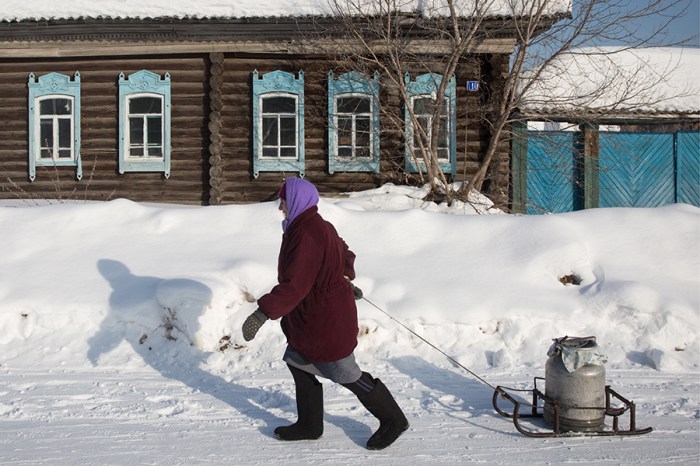
An elderly woman pulling a container with water in the village of Kondratyevo, Omsk Region, February 19, 2017. Photo courtesy of Dmitry Feoktistov/TASS
Duma to Legalize Elimination of Settlements by the Regions
Maria Makutina RBC
February 22, 2017
The Duma has tabled an amendment that would legalize converting municipal districts into urban districts. RBC’s sources have informed us the move to eliminate local government in settlements would be supported by the relevant committee. In Moscow Region, such mergers have sparked grassroots protests.
An “Elegant Way” of Eliminating Local Self-Government
Mikhail Terentiev, an United Russia MP from Moscow Region, has submitted amendments to the law on general principles of local self-government to the Duma Committee on Local Self-Government. (RBC has the document in its possession.) The MP has proposed amending the law to make it possible to merge all settlements, including rural settlements, that constitute a municipal district with an urban district. Under such a merger, the settlements and the municipal district would forfeit their status as municipal entities. Decisions about such mergers would be taken by regional authorities “with the consent” of local representative bodies.
Terentiev has also proposed changing the definition of an “urban district,” as stipulated by the law. Currently, it is defined as a urban settlement that is not part of a municipal district. The new draft law defines it as “one or more contiguous populated areas that are not municipal entities.”
Moscow Region authorities have found an “elegant and simple way” to legalize the single-tier system of local government that, in recent years has, been established in a number of Russia’s regions, including Moscow Region, Andrei Maximov, an analyst with the Committee of Civic Initiatives, explained to RBC.
Moscow Region Governor Andrei Vorobyov. Photo courtesy of Sergei Fadeichev/TASS
Protests
In November of last year, Andrei Vorobyov, governor of Moscow Region, announced plans to convert around twenty municipal districts into urban districts in 2016–2017. According to Vorobyov, the reform would save money by reducing the number of officials.
The proposed move sparked popular protests. Moscow Region municipal district council members, unhappy with the dissolution of local executive and representative bodies, held protest rallies. Public hearings on reforming local systems devolved into clashes with the Russian National Guard.
A Local Self-Government Congress was held in Moscow in February. Local council members from Moscow Region requested that Prime Minister Dmitry Medvedev and law enforcement agencies investigate “numerous incidents in which local government bodies, including municipal districts, rural settlements, and urban settlements, have been forcibly dissolved.”
“The law does not provide for dissolving a municipal district or converting it into a urban district, so Moscow Region authorities conceived a way of getting round the law. First, they merge rural settlements with an urban settlement, and then they turn it into an urban district. But the municipal districts are left in a limbo,” said Maximov.
The Presidential Human Right Council has argued that the reforms in Moscow Region violate the public’s right to local self-government. HRC deputy chair Yevgeny Bobrov said as much to Vladimir Putin at the council’s December 8, 2016, meeting. The president promised to “work” on the issue.
Nevertheless, in 2015, the Russian Supreme Court ruled that the merger of two rural settlements and the Ozyory urban settlement into an urban district was legal.
Simplifying Governance
MP Terentiev explained to RBC that his amendments were motivated by the need to optimize the budget in Moscow Region.
“The governor and I realized that money could be saved on officials,” he said.
Thanks to the reforms, “there will be an overall approach to wage policies and the opportunity to reduce administrative barriers to business,” Terentiev argued.
The current law stipulates that Russia is divided into settlements, which are organized into municipal districts, and particularly large settlements, which are organized into urban districts, Maximov explained. According to Terentiev’s draft amendments, any territorial entity in Russia can be turned into an urban district, meaning it can be moved from the two-tier system to the one-tier system.
The authorities have been attempting to confer the status of urban districts on municipal districts in order to dissolve settlements and simplify governance. Rural authorities can interfere with the plans of regional authorities to implement urban planning projects and create obstacles to resolving land use issues, which currently require the consent of the settlements affected, political scientist Alexander Kynyev explained to RBC.
The Total Deterioration of Settlements
Experience has shown that populated areas lacking elements of self-governance deteriorate and disappear, RBC’s source on the Local Self-Government Committee told us. According to the source, the draft amendments would lead to the total deterioration of the settlement-tier of governance throughout the entire country.
“It is nonsense to eliminate settlements in densely populated Moscow Region. It doesn’t fit into any paradigm. It is just the governor’s whim. It will be easier for him to manage his affairs this way, and so the law has been mangled for this sake. He has to demolish everything so it will be easier to build it up again,” RBC’s source said.
The reform has been opposed by people of different views and parties. Local self-government as such has been threatened. As the 2018 presidential election approaches, the federal authorities want to avoid such controversies, argues Kynyev.
Through the Back Gate
Terentiev tabled his draft amendments as part of the second reading of a draft law bill that would abolish direct popular votes on whether to change the status of urban and rural settlements. The government tabled the draft law back in the spring of 2015. It was passed in its first reading the same year, after which the Duma has not returned to it.
Radical change in the territorial basis of local self-government has been brought in “through the back gate,” noted our source in the Duma, although the 2014 local self-government reforms were “seriously discussed” in society, he recalled.
Alexei Didenko (LDPR), chair of the Duma’s Local Self-Government Committee, agreed the draft bill could “eliminate the machinery of popular self-government,” and ordinary people would find it harder to defend their interests. According to Didenko, the draft amendments were at odds with what the president said during his 2013 state of the nation address: “Local governance should be organized in such a way anyone can reach out and touch it.”
Didenko told RBC the decision whether to support Terentiev’s draft amendments or not would be made by his committee, most of whom are United Russia members, in March. Two sources in the Duma told RBC the committee would approve the draft amendments.
How Local Authorities Have Been Stripped of Their Powers
In his December 2013 address to the Federal Assembly, President Putin asked that the organizational principles of local self-government be clarified. According to Putin, the quantity of responsibilities and resources of municipal officials were out of balance, “hence the frequent confusion over powers.”
In May 2014, a law reforming local self-government was passed, endowing the regions with the right to assume a considerable number of the powers previously exercised by local authorities in taking economic decisions.
The original draft of the bill called for the abolition of direct elections of big-city mayors and city council members. The final draft stipulated the heads of municipal entities could be either elected directly or appointed from among council members. In the first case, the head of the municipal entity could lead the administration himself. (If the municipal entity in question is a city, he would become city manager.) In the second case, the head of the municipal entity would chair its representative body.
Regional legislative assemblies were accorded the right to divide cities and towns into intra-urban municipal entities. Two new types of municipal entities were introduced for this purpose: urban districts with intra-city divisions, and intra-urban districts.
First-tier council members (that is, council members of urban and rural settlements) are elected directly by voters. Second-tier council members (of municipal districts and urban districts with intra-city divisions) are either elected or delegated from among the heads of settlements and first-tier council members, in the case of municipal districts, or only from among first-tier council members, in the case of urban districts with intra-city divisions. The method of electing council members was also to have been defined by regional law.
In February 2015, two other methods for electing heads of municipal entities were introduced. The first method allows the head of a municipality, chosen by the municipality’s council from among its members, to lead the local administration. However, he surrenders his mandate as a council member. The second method allows a bureaucrat, chosen by council members from a slate of candidates suggested by a hiring committee, to lead the local administration. This had made it possible for city managers to become autocratic mayors.
Translated by the Russian Reader. See my December 15, 2016, post on the same topic,“In Tomilino.”
Instrument Failure: Why It Is Hard to Trust Rosstat’s Data on the Recession’s End
Sergei Aleksashenko RBC
February 6, 2017
Over the last year, Rosstat has ceased publishing a number of important indicators for judging the economy’s real performance.
The other day, Rosstat published its updated assessment of the Russian economy’s performance over the past two years. Strictly speaking, there is nothing surprising about the fact that Russia’s official statistics agency amends its previously published assessments. It happens constantly in other countries, too. The fact is that the initial assessments, which are released a month or a month and a half after the the end of the latest quarter, are derived from on-the-spot information that is subsequently corrected.
A Rubik’s Cube
But what is really surprising is that, according to the updated view of Rosstat’s statisticians, the economy’s performance over the last two years was significantly better than had been thought. Rosstat now claims that, in 2015, Russia’s GDP decreased only by 2.8%, rather than 3.7%, as indicated in earlier assessments, and that 2016 basically saw no decrease whatsoever. This new take has been a surprise to everyone, including the Economic Development Ministry, whose experts have said they don’t understand why Rosstat has so radically revised its own assessments. They have been seconded by experts at Vnesheconombank (VEB), which nowadays employs a large team of macroeconomists led by ex-deputy economics minister Andrei Klepach. Rosstat’s assessement has also been a surprise to the prime minister and president, who have expressed no joy the economy had been doing much better than they thought only a couple of weeks ago.
As in many other cases, the different indicators in GDP figures do not exist in isolation from one another. They are closely linked, and it is almost never possible to change one of them without changing another. In very simple terms, it looks like this. GDP is the sum of the added value produced in different sectors of the economy, such as industrial manufacturing, agriculture, transportation, finance, etc. If the figures for manufacturing have suddenly improved or deteriorated, then, with all other things being equal, the figures for GDP should change just as much. But in addition to a manufacturing element in GDP, there is an end use element in GDP, which shows the level of demand for what the economy produces. In this case, the factors of demand are the populace, the state sector, nonprofit organizations, accumulation (investment and inventories), and net export (the difference between exports and imports). If the figures for manufacturing have deteriorated, not only should the total amount of GDP change but one of the components of demand should change as well, meaning we should be able to understand not only what manufacturing sector produced more added value but also who paid for it.
But that is not all. There is a third component of GDP, sources of income: added value divided by household income, net taxes (on manufacturing and imports), the gross operating surplus, and mixed income. That is, after we have determined from GDP figures for manufacturing who has produced more, and from figures for use who has bought what has been produced, the figures on sources of income tell us who earned money from this. It is a kind of Rubik’s Cube, which has only one correct (objective) combination. We see it clearly at once, just as see clearly when the cube has not been put together correctly.
The Quarterly Maze
There are other subtleties in GDP figures. For example, one of the big problems is calculating GDP in real terms, that is, adjusting it for inflation. Rosstat publishes deflators for individual sectors and, naturally, when they are used with sector-specific nominal data, the grand total should converge. So everyone has a good sense of the state of the economy, Rosstat should assess each quarter’s GDP performance in terms of the previous quarter. We are well aware that the first quarter, in which half of the month of January is taken up by holidays, and cold weather puts a halt to many kinds of work, bears no resemblance to the third quarter, when the weather is warm and the harvest is underway in the countryside. Nor does it bear any resemblance to the fourth quarter, when builders are trying to bring on line as many completed (or almost completed) buildings as possible, and the government spends at least twice as much money from the budget as in other months. When all these things are factored out, we arrive at the most important indicator, which tells us how things stood in the previous quarter.
Don’t laugh, but Rosstat has not published this figure since April 2016. At the recent Gaidar Forum, I needled one of the heads of Rosstat to find out why this had been happening. For fifteen minutes, he tried to persuade me I had simply not been able to locate the right table on his agency’s website. Rosstat’s website leaves a lot to be desired, of course. To fish out the right information, you sometimes have to spend an hour or two figuring out the poorly organized databases. In this case, however, I insisted the information was simply not there. A couple of days later, I received a letter from Rosstat saying that, indeed, Rosstat did not calculate this figure and did not know when it would be doing so again.
That alone is enough to take Rosstat’s published data about the Russian economy’s improved performance at less than face value. If we add to this the fact that Rosstat stopped publishing monthly investment figures in the spring of last year, and announced in November that revised figures for the manufacturing sector’s performance (figures that would, of course, be revised upwards) would be published only in the spring, it becomes obvious that Russia’s official statisticans cannot actually put the Rubik’s Cube together, and they don’t really know what is going on with the Russian economy. Meaning that all the instruments that should be telling us where the ship of our economy is sailing and how fast it is sailing there have failed.
The Secret GDP
I don’t want to argue the problem I want to touch on in my conclusion prevents Rosstat from adding everything up correctly. I suspect there are many more problems, and I fear that even the heads of Rosstat are not aware of all of them. But we cannot avoid talking about the fact that vast amounts of data relating to the work of the military-industrial complex and the security agencies are classified.
In fact, if this secrecy keeps anyone from understanding anything, it is the Russian authorities and Russian society. When it receives classified information, Rosstat has to hide it amidst its tables in such a way that not a single spy will guess it is there. To do this, Rosstat inevitably distorts the performance indicators for different sectors, adding something here, and trimming something there. But since hiding the truth from spies is much more important than telling the truth to Russian society, don’t shoot the piano player, as they say, for the poorly assembled Rubik’s Cube. He is playing as well as he can.
If you think about it, it is obvious the financial figures for the military-industrial complex’s performance are no state secret. The technical specs of weapons, the technology used to produce them, and, maybe, their locations can be secrets, but not the amount of money spent on their procurement (the classified section of the budget) or the amount of added value generated by the military-industrial complex.
I am confident that under the current Russian president we should not expect any progress in declassifying these figures. That was not what he was taught at the Higher School of the KGB. Since that is so, we are unlikely to find out in the coming years what is up with the Russian economy.
Sergey Aleksashenkois a senior fellow at the Brookings Institution in Washington, DC. Translated by the Russian Reader. Image courtesy ofliketotally80s.com