Government Refuses to Allocate 70 Billion Rubles to Combat HIV
Polina Zvezdina RBC
January 26, 2017
The Health Ministry has sent the government a plan for implementing the national strategy for preventing the human immunodeficiency virus (HIV) until 2020. RBC has a copy of the document, whose authenticity has been confirmed by a source close to the government, in its possession. The plan does not stipulate allocating additional funds for combating the infection. In the financial feasibility study appended to the draft plan, officials noted the agencies responsible for its implementation, as well as the regions, would have to finance the plan’s implementation.
Additional financing of the plan was stipulated in a earlier draft, also examined by RBC. In the draft, the Health Ministry had indicated additional monies from the budget, 17.5 billion rubles per annum, would be required to meet the strategy’s targets. There were plans to spend 13.2 billion rubles of this money on treatment, 3.2 billion rubles on diagnosis, and 1.1 billion rubles on treatment oversight. This funding should have made it possible for all HIV patients currently registered at AIDS centers to undergo special treatment and increase to 35% the share of the population tested annually for HIV. In 2015, 19.3% of the population was tested for HIV, while 37.3% of infected patients were provided with medical treatment.
It was the Finance Ministry that did not approve allocating the 70 billion rubles, judging by a ministry review sent to the Health Ministry on December 22, 2016. First Deputy Finance Minister Tatyana Nesterenko did not support the additional allocation, because these funds were not included in the approved federal budget for 2017–2019. In the review, the Finance Ministry argued that budgetary allocations for new spending could be contemplated only at the beginning of the fiscal year and provided that the government had additional revenues.
The government will continue its discussion of the draft plan for HIV prevention, said Denis Godlevsky, an expert at the HIV Assistance Foundation. There is a chance the Health Ministry will succeed in obtaining the full funding, he said.
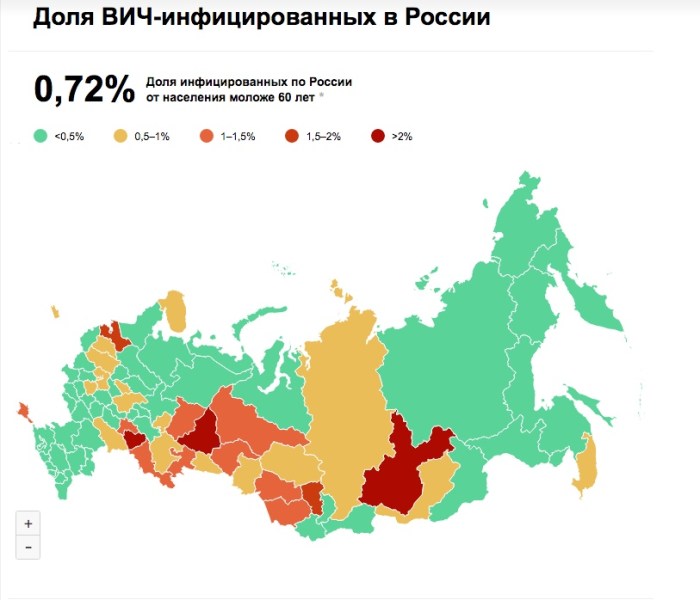
Percentages of HIV infected people in Russia by region. The percentage of people under the age of 60 infected nationwide is 0.72%. In the original article (go to the link at the top of the page), this map is interactive by region. The figures for Crimea and Sebastopol reflect the percentage of infected residents among all age groups. Infographic courtesy of RBC
Testing 35% of the population annually for HIV and providing 100% treatment for all registered patients were goals the Health Ministry hoped to achieve only if it received the “requisite” financing, as outlined in the HIV prevention strategy adopted by the government. If this money is not provided, the ministry proposes focusing on a different set of figures. Under the current healthcare budget, the number of people undergoing testing would increase to only 24%, while 56% of infected patients would receive treatment.
The Health Ministry has not responded to RBC’s questions as to which set of targets the ministry would follow when implementing the strategy.
If government agencies would use the funds already available effectively and rationally, the situation would begin to change for the better anyway, said Alexei Lakhov, deputy director for public relations at E.V.A., a noncommercial partnership.
“And when the situation changes for the better, a financial feasibility study can be done requesting additional appropriations,” Lakhov suggested.
The HIV prevention strategy was approved on October 20, 2016. It contained no information about funding.
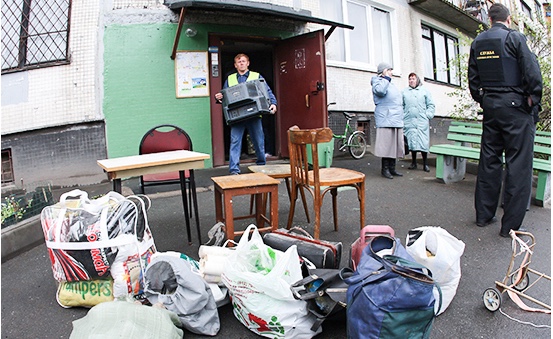
1. Everyone shall have the right to a home. No one may be arbitrarily deprived of his or her home.
2. The bodies of state authority and local self-government shall encourage housing construction and create conditions for exercising the right to a home.
3. Low-income people and other persons mentioned in law and in need of a home shall receive it gratis or for reasonable payment from the state, municipal and other housing stocks according to the norms fixed by law.
Photo courtesy of Alexander Drozdov/Interpress/TASS
Head of Federal Bailiffs Service Assesses Legality of Justice Ministry Proposal to Confiscate Debtors’ Dwellings
Vladislav Gordeyev RBC
January 10, 2017
A draft bill, proposed by the Justice Ministry, that would in some cases permit the confiscation of a debtor’s only dwelling, does not violate Russians’ constitutional right to housing, said Arthur Parfenchikov, director of the Federal Bailiffs Service (FSSP).
“The proposed legislation stipulates guaranteed housing during forfeitures, but within the established norms,” he wrote on his Twitter page.
He tweeted in response to remarks made by ex-children’s rights ombudsman Pavel Astakhov, who had written, “The Russian Constitution guarantees everyone’s right to housing. There is nothing in it about the obligation to pay debts, only taxes.”
In addition, Astakov called the draft bill “quite controversial,” since it could “make people homeless who don’t have any means as it is.”
Parfenchikov also noted the law was being adopted “in accordance with the provisions of the Constitution,” and “the Justice Ministry [was] implementing the mandate of the Constitutional Court, which ordered [it] to establish this procedure several years ago.”
As published on the Federal Portal for Draft Regulatory Acts, the draft bill stipulates a debtor’s only dwelling can be sold if two conditions are met. First, if its floor area is twice the size of the legally approved norm for the debtor and his family. Second, if its value is twice the value of the dwelling due to him by law.
Moreover, the debtor must have no money and other property that could be sold to repay his debts.
According to the Housing Code, the legal norm for the provision of living space is set individually by the regions. In Moscow, for example, the current norm is 18 square meters per person.
“At the present time, the rights of creditors (claimants) are violated, since there is a ban on the forfeiture of residences (or their parts) if they are the only suitable dwellings available to debtors and members of their family living with them in the residences owned by them. In addition, a difficult situation has arisen around debts for child support payments, and the rights of minors to living quarters are also violated when their parents divorce,” it says in the one of the documents accompanying the draft bill, as posted on the Federal Portal for Regulatory Draft Acts.
Translated by the Russian Reader
_________
Since the otherwise odious Pavel Astakhovhas suddenly reverted to his previous incarnation as a social liberal and passionate defender of human rights, I would like to dedicate this song to him. TRR
Activists Picketing in Support of Ildar Dadin Detained in Moscow RBC
January 4, 2016
Police in Moscow detained six activists [Pavel Kuznetsov, Mikhail Lashkevich, Leonid Dubrovo, Tatyana Tarvid, Elena Zakharova, and Maria Ryabikova — TRR] who had been holding solo pickets in support of Ildar Dadin, according to OVD Info.
The activists had been picketing on Zhitnaya Street, where the Federal Penitentiary Service and Justice Ministry are located. Several of the picketers held placards that read, “Where is Dadin?”
The detainees were taken to Yakimanka police precinct.
Later, activist Sergei Ozhich reported on his Facebook page that all six detainees had been released. They have been charged with misdemeanors under Article 20.2.5 of the Russian Federal Administrative Offenses Code (violation of the established rules for holding assemblies, rallies, demonstrations, marches, and pickets by a participant of a public event).
In early November 2016, Dadin wrote in a letter that he had been severely beaten and threatened by the staff at the penal colony where he was imprisoned. The Federal Penitentiary Service, the Investigative Committee, the Presidential Human Rights Council, and civil rights activists took an interest in his case.
Members of the Presidential Human Rights Council recommended that the Federal Penitentiary Service transfer Dadin to another penal colony. In early December, he was transferred to another colony. Anastasia Zotova, Dadin’s wife, filed an inquiry with the Federal Penitentiary Service’s Karelian Directorate asking about his whereabouts. His whereabouts are still unknown, however. By law, the inmate should have informed a relative of his whereabouts within ten days.
Dadin is serving a sentence for violating the law on [“unauthorized” political] rallies. In December [2015], he was sentenced to three years’ imprisonment, but a court later reduced the sentence to two and and half years. Dadin was the first person sentenced to an actual prison sentence under the new law.
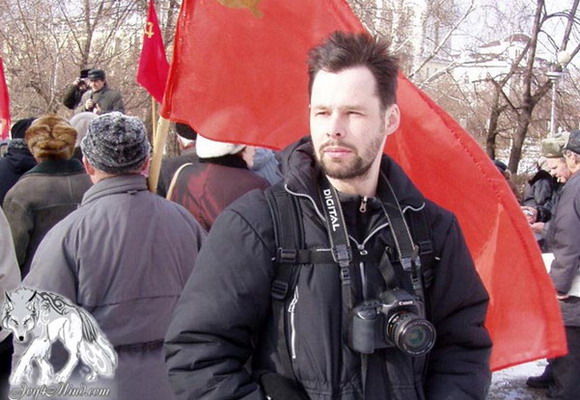
Alexei Kungurov. Photo courtesy of the New Chronicle of Current Events
Tyumen Blogger Sentenced to Two and a Half Years in Prison for Post on Syria
Anastasiya Yuditskaya, Dmitry Nosonov & Yegor Gubernatorov RBC
December 20, 2016
Tyumen blogger Alexei Kungurov was charged under Russian Federal Criminal Code Article 205.2.1 (“public calls for terrorism or public justification of it”). A visiting panel of judges from the Volga District Military Court found him guilty and sentenced him to two and a half years’ imprisonment in a work-release penal colony, Asiya Bayshikhina, Kungurov’s wife, has informed RBC.
“There is very little information right now. I know only he has been sentenced to two [sic] years in a work-release penal colony. Alexei was on his recognizance from February, but in June he was placed in a pre-trial detention facility. He has been in Pre-Trial Detention Facility No. 1 in Tyumen the whole time,” Bayshikhina told RBC.
Kungurov’s attorney, Alexander Zyryanov, told RBC the defense planned to appeal the verdict.
“We are going to lodge an appeal with the Military Collegium of the Supreme Court. We plan to do this at the beginning of next week. We have ten days to do it.”
Criminal charges were filed against Kungurov in March over a LiveJournal post, entitled “Who Putin’s falcons are really bombing,” in which the blogger criticized the actions of the Russian armed forces in Syria.
In August, the Prosecutor General’s Office reported that terrorist crimes had increased by 73% in the first six months of 2016 compared to the same period last years. The office reported then that it had solved a total of 1,313 terrorist crimes and 830 extremist crimes.
Deputy Prosecutor General Alexander Buksman noted that the increasing numbers of such crimes were “the outcome of preventive work by law enforcement agencies in surveilling the Internet for banned publications and bringing to justice leaders and members of the armed underground in the North Caucasus and their accomplices, and persons who are fighting in Syria as part of terrorist groups.”
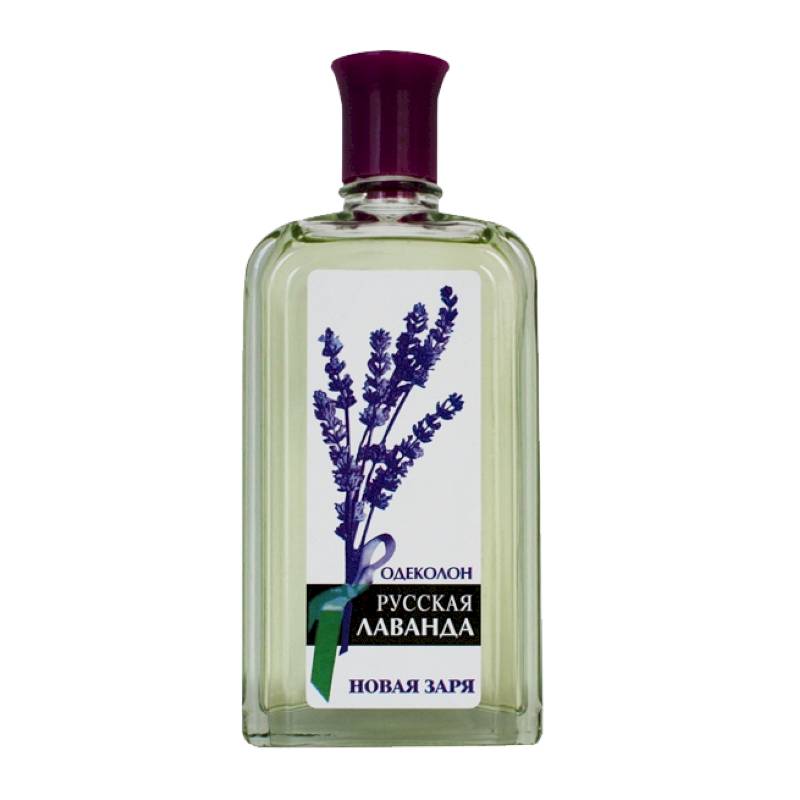
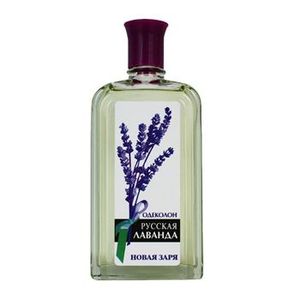
Lavender Toilet Water 15 g. Verbena 15 g. Herbal Lotion 30 g. Nail Polish 2 g. Mouthwash 150 g. Lemon Soda 150 g.
—Venedikt Erofeev, Moscow to the End of the Line, trans. H.W. Tjalsma (New York: Taplinger, 1980), pp. 69–70
Government to Introduce Excise Taxes on Medicinal Tinctures to Combat Alcoholism
Polina Zvezdina RBC
December 13, 2016
The government has proposed imposing excise taxes on medicinal tinctures, household chemicals, and cosmetics containing alcohol. The reason is that the populace consumes them instead of the expensive liquour sold in shops. As RBC has previously reported, approximately 10% of Russians suffer from drugstore alcoholism.
Prescribe and Report
The Finance Ministry has drafted amendments to existing laws and the Tax Code that would impose excise taxes on alcohol-based pharmaceutical products, except for vital and essential drugs (VEDs). The ministry was ordered to do this by Deputy Prime Minister Alexander Khloponin, who oversees the alcohol market. In late October, he reported on the matter to Prime Minister Dmitry Medvedev. RBC has a copy of his letter. A spokesperson for Khloponin refused to comment on the document’s authenticity or its contents.
Due to a drop in incomes and an increase in prices for strong alcoholic beverages, Russians have been increasingly been drinking alcohol-based liquids not intended for consumption, Khloponin argues in his proposal. Among such liquids, he lists Cucumber Lotion, Boyara (a tincture of hawthorn and rose hips), and Bread and Wheat, two alcohol-based additives. The sales of such products have recently increased in Tatarstan, Ufa, Samara, Cheboksary, Saransk, and Kaluga, according to the document.
If the deputy prime minister’s undertaking is implemented, it will affect drugs used by the public for their intended purpose, such as Corvalol and Valocordin.
Currently, the Tax Code does not deem alcohol-based medicines, veterinary drugs, food products, and cosmetics sold in packages containing 100 milliliters or less as excisable products.
Vadim Drobiz, former head of the Research Center for the Federal and Regional Alchohol Markets (TsIFFRA), told RBC that between twelve and fifteen million [i.e., approximately 10% of the Russian population] regularly consumes medical tinctures and cosmetic lotions not intended for consumption. The “parallel” alcohol market’s capacity already accounts for around 20% of the official market’s turnover, as RBC reported in an investigation published on November 24.
Specific Proposals
Khloponin has proposed labeling all alcohol-based non-food products as excisable and abolishing the zero-rate excise tax for certain brands of cosmetics and household chemicals. The rate of the excise duty should be the same as that imposed on strong alcoholic beverages. Currently, the excise rate on strong spirits is 500 rubles per one liter of pure alcohol.
The excise taxes should be extended to all alcohol-based medicines, except for medicines included in the VEDs list, writes Khloponin. In addition, the pharmaceutical market should apply the Unified State Automated Information System (EGAIS) for accounting for the production and turnover of alcohol to the distribution of ethanol intended for the production of medicines. According to current laws, the EGAIS will be introduced to the pharmaceutical market from 2017, but it will record only ethanol production.
Khloponin argues that retail sales of the flavor additives Bread and Wheat should be banned altogether. The regions also need to have the authority to independently monitor sales of alcohol-based non-food products.
The Finance Ministry did not respond to RBC’s inquiry. The Health Ministry informed us that as part of the fight against “drugstore alcoholism,” the ministry had drafted a federal law bill banning the sale of alcoholic pharmaceutical products from vending machines [see article, below].
Hospital Budgets and Pensions
If the Finance Ministry finalizes its undertaking, the public will suffer, Elena Nevolina, executive director of the National Pharmaceutical Chamber, noted in an interview with RBC. Many popular tinctures, such as valerian, Corvalol, Valocordin, and Votchal drops, are not included in the VEDs list. After excise taxes are imposed, their prices will skyrocket or they will simply vanish from the market, she argues. This might indirectly impact the work of ambulance brigades, since pensioners, accustomed to consuming certain medicines, will be more likely to summon ambulance crews if the medicines are unavailable, Nevolina believes.
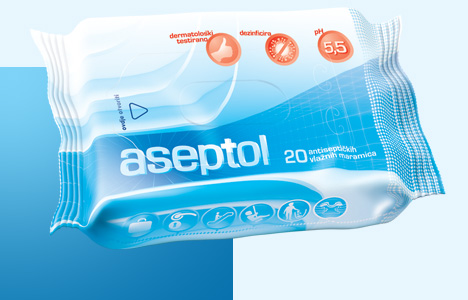
Another alcohol-based medication not included in the VEDs list is Aseptol, a topical solution widely used by medical personnel to disinfect their hands. The retail price for 100 ml of the solution is currently around 35 rubles. After the excise duty is imposed, its price could double, believes Nevolina.
Although hospitals purchase Aseptol in large quantities, it amounts to less than 1% of all sales. According to research by the DSM Group, purchases of Aseptol amounted to 179 million rubles in 2014, 195 million rubles in 2015, and 171 million rubles in the first nine months of 2016. The public procurement market for Aseptol accounted only for 549,000 rubles, 820,000 bules, and 936,000 rubles of these total sales, respectively.
Based on an excise tax rate of 500 rubles per 1 liter of pure alcohol, the price of Corvalol would increase by one and half times, and the price of Carniland (Votchal’s drops) and Valocardin, by a few percent.
The measures proposed by the government will enable better monitoring of the pharmaceutical alcohol market, said Dmitry Dobrov, board chair of the Union of Alcohol Producers.
“EGAIS and excise taxes have proven effective in the alcohol market. Sales and tax revenue have been growing, and illegal production has practically disappeared,” he said.
Major Pharmaceutical Manufacturers of Alcohol-Based Drugs
The Industry and Trade Ministry supplied RBC with a list of the major manufacturers of alcohol-based medicinal products. The leaders in terms of sales and production are Gippokrat from Samara (whose 2015 revenue was 980 million rubles and overall production, 51.8 million units); Flora Kavkaza from Karachay-Cherkessia (230.9 million rubles; 13.4 million units); Begrif from Novosibirsk Region (211.7 million rubles; 10.9 million units), the Tula Pharmaceutical Factory (251.5 million rubles; 9.6 million units); and the Ivanovo Pharmaceutical Factory (138.1 million rubles; 7.5 million units).
The market for alcohol-based drugs has been growing from year to year. According to DSM Group, it amounted to 3 billion rubles in 2014, almost 4 billion rubles in 2015, and 3.1 billions rubles in the first nine months of 2016.
Hawthorn “lotion” dispenser in Izhevsk. Photo courtesy of susanin.udm.ru
Boyara 24 Alcodispenser Shows Up at New Location in Izhevsk Argumenty v Izhevske
October 15, 2016
Yet another dispenser for selling the alcohol-based Hawthorn (Boyaryshnik) liquid has been installed in Izhevsk. As Susanin News Agency reports, the 24-hour sales point, where even a child could shop, has been installed on January 9th Street.
For 20 rubles, the Boyara 24 machine dispenses a bottle of liquid containing 75% ethyl alcohol. Hawthorn Lotion for Oily Skin, as indicated on the label, is designed to cleanse and tone the skin.
But few locals used the alcohol-based liquid as it was intended. The dispenser’s target market is society’s drunken stratum. To obtain a bottle of Hawthorn, you merely have to drop money into a coin slot and turn a handle. The dispenser imposes no limits on the times when the liquid is sold or the age of purchasers. It does not even need electricity to run round the clock.
During an experiment conducted by a Susanin News Agency film crew and concerned citizens, it transpired that the alcodispenser did not work properly. Four attempts were made to purchase Hawthorn Lotion, but the machine dispensed bottles only in two instances. Empirically, therefore, we established that the dispenser sells the alcohol-based liquid for 40 rubles rather than 20.
The first such dispenser showed up in Mechanical Engineers Village approximately two weeks ago. It was successfully dismantled, most likely by penniless alcohol enthusiasts.
Translated by the Russian Reader. Photo of lavender toilet water courtesy of knigi-janzen.de
Several sources in the alcohol business have told RBC that Rosalkogolregulirovanie plans to ban the sale of alcohol at outlets registered to individual entrepreneurs. According to one of our interlocutors, the law “On State Regulation of the Production and Sales of Ethyl Alcohol, Alcohol, and Alcohol Products, and On the Limitation of Consumption (Drinking) of Alcohol Products” will be amended to reflect the move.
Rosalkogolregulirovanie did not respond to RBC’s request for comments.
Kommersant’s sources reported on the draft bill on Tuesday, November 22. According to the draft document, which the newspaper had seen, restrictions would be introduced nationwide on July 1, 2017, with the exception of Crimea and Sevastopol. The ban would be postponed in these regions until January 1, 2018.
Currently, individual entrepreneurs can engage in retail sales of beer, beer drinks, and various sorts of cider and mead. In addition, a separate category of entrepreneurs, those who have the status of agricultural producers, can sell wine. So far, however, such entrepreneurs do not officially exist in Russia. At the moment, only three applications for the relevant commerical license have been filed, and none of them has been approved yet.
As Kirill Bolmatov, corporate affairs director for Heineken, told RBC, Rosalkoregulirovanie’s main beef with individual entrepreneurs is that they are “insufficiently disciplined when filling out the mandatory paper financial reporting statements.”
“Yet EGAIS [Unified State Automated Information System] completely tracks the movement of all alcoholic beverages in real time, and there is no point in filling out the statements,” said Bolmatov.
He called the pressure on businessmen “harmful,” since “beer is a large share of the turnover for small shops.” Adoption of the amendments would entail closing a large number of small shops.
“It’s a blow to small business,” he told RBC.
Individual entrepreneurs account for at least 37% of all retail outlets selling SAN InBev’s products, Oraz Durdyyev, the beer company’s legal and corporate relations director, told RBC.
“Prohibiting individual entrepreneurs from selling beer would deal a serious blow to legal small businesses, because beer is one of the high-margin products they have in stock, which helps keep prices down on goods purchased by the underprivileged,” argued Durdyyev. “Given the current economic realities, a ban like this is out of place and harmful, and could lead to increased social tensions.”
Entrepreneurs and beer companies have already faced significant restrictions on sales venues. As a spokeperson for Baltica brewing company reminded us, restrictions on beer sales at kiosks were introduced on January 1, 2013. According to the company, kiosks accounted for 20% of all beer sold. Since then, the number of retail outlets selling beer has decreased by 50,000. Over 30,000 of these outlets were kiosks and pavilions. During the period, the number of kiosks has fallen by 75%, from 30,000 to 8,600, and the number of pavilions by 24%, from 45,00 to 35,000. Baltica beer is sold at approximately 100,000 outlets registered to individual entrepreneurs, the company told us.
Translated by the Russian Reader
________
The Soft Boys, “Leppo And The Jooves”
Crabwise
Over the Andalusian extensions of the life and loves of Noddy
Through the windows of disgust
The teeth of Leppo and his managers awry
No time to cry
Sunrise A lamp of no position in the loss of all existence To the vultures without bibles and The preachers without leaves that pass it by No time to sigh
All them pretty women Planted in a row You see them in the newspapers But you can’t have ’em – no! No no no no no no no no! Oh ho ho!
They get Lep-Lep-Leppo and the J-J-J-J-J-Jooves They jump on anything that m-m-m-m-m-moves On taxis, coffin-lids, Americans, piano-heads and roofs Leppo…
Likewise A farmer and his diary might conspire to freeze a widow So I went to rob the lizard Of his skin, his coat, his money and his earth All that he’s worth
Someday You realize that everything you do or see or think of If it interferes with nothing Might as well dissolve in arrows or in tears Nobody hears
All them famous people Washed off in the rain Leave not even a puddle, baby All you leave is your name Huh-ha-ha-ha-ha-ha!Your name!
I got a name, baby It’s Lep-Lep-Leppo and the J-J-J-J-J-Jooves Oh ho ho! They jump on anything that m-m-m-m-m-moves Ah ha ha! Ah ha ha. On taxis, coffin-lids, Americans, piano-heads and roofs Leppo…
Listen And you can hear the dripping of the clocks, the reaping of the sun The vengeance of the hammer and The squeamish tight explosion of the liar Burn in the fire
Gazing With unforeseeing eyes into the smoke, the lungs of war And all the endless formulations of unusable beginnings that Have grown from hungry rivers into trees Nobody sees
All them hungry people They don’t look so good But I don’t let it bother you I don’t see why it should No no no no no no! Oh oh ho! Oh ho ho!
Lep-Lep-Leppo and the J-J-J-J-J-Jooves They jump on anything that m-m-m-m-m-moves On taxis, coffin-lids, Americans, piano-heads and roofs Leppo…
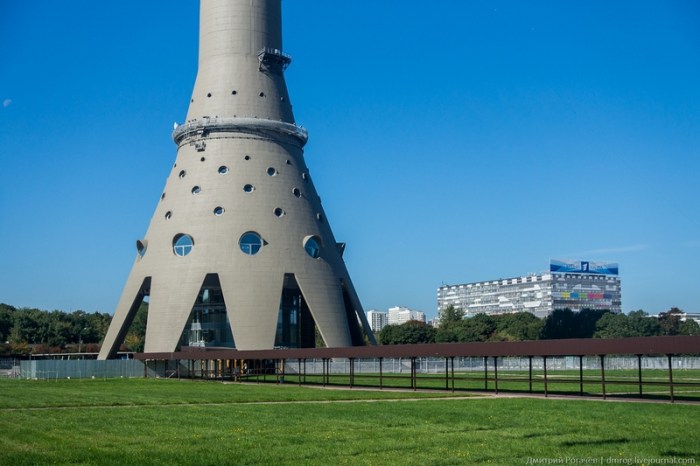
Ostankino Tower and TV Center. Photo courtesy of slavorum.org
Muscovite Sues Ostankino for Stupefying the Populace with Television RBC
November 17, 2016
Moscow resident Roman Maslennikov has filed a lawsuit against the Ostankino TV Center for “stupefying the populace” with the programs it broadcasts, reports RIA Novosti, quoting the plaintiff.
The lawsuit, a copy of which the news agency has in its possession, states that, over the last few years, Maslennikov has begun to feel dependent on a daily viewing of the programs shown on Russian channels.
“If I don’t watch TV for at least thirty minutes a day, my mood deteriorates, I lose my appetite, and thus my entire body suffers,” the plaintiff claims.
Maslennikov further claims he began to watch TV every day for at least two hours and noted that in six months the level of his intellect “dropped significantly.” He also noticed that he could not remember what he did the other day. The plaintiff emphasized that he has suffered from “failing mental health,” and that his thought processes have been retarded due to the superfluous information broadcast on TV in the guise of advertisements, shows, news, and serials.
Maslennikov has asked that the TV center pay him moral damages in the amount of 987,600 rubles [approx. 143,000 euros] and inform all viewers of the health hazards posed by watching TV programs.
Russian MP Vitaly Milonov. Photo courtesy of @Fake_MIDRF
Chuvashia Resident Fined for Reposting Photo of Milonov
Maria Leiva RBC
November 16, 2016
A member of the board of Open Russia from Chuvashia has been fined 1,000 rubles for reposting a photograph of Russian MP Vitaly Milonov in which he is posed in a t-shirt brandishing a slogan deemed extremist in Russia
A court in Chuvashia has fined Dmitry Semyonov, a member of Open Russia‘s board in the region, 1,000 rubles for reposting a photo of MP Vitaly Milonov in a t-shirt emblazoned with the slogan “Orthodoxy or Death” on the social media network VKontakte. The slogan has been ruled an incitement to sectarian strife and placed on the federal list of extremist matter. Semyonov’s lawyer, Alexei Glukhov, reported the news on his Facebook page.
In another post, he added that the court had reject the defense’s motion to order a forensic examination and summon specialists to confirm the date when the Internet had been monitored.
Last week, Semyonov was summoned by the police over the repost of Milonov’s photograph. As the activist told RBC himself, he was charged in writing with violating Article 20.29 of the Administrative Offense Codes (producing and disseminating extremist matter).
“The charge sheets say that, on November 3, FSB officers suddenly felt like monitoring social media networks and chanced upon my post,” said Semyonov.
He linked the incident to his work as a social and political activist with Open Russia. Semyonov is the organization’s regional coordinator in eight Russian regioins.
In turn, Glukhov told RBC that police in Chuvashia constantly haul in activists for reposts on social media.
In conversation with RBC, Milonov said that last Wednesday he had sent a letter to the Justice Ministry asking them to remove the slogan from the register of extremist matter, but had not yet received a reply.
“As one brother to another, I’ll tell the justice minister, ‘Do you really imagine living outside the faith? So it’s a normal Orthodox slogan, and anyone who thinks otherwise is a bastard,” said the MP.
He was confident the slogan would soon be removed from the list of extremist matter, but promised to study Semyonov’s case more closely, “although membership in Khodorkovsky’s organization deserves attention itself.”
Earlier, Milonov told RBC that he did not consider displaying a photograph in which he posed with the slogan “Orthodoxy or Death” a crime. However, the MP doubted that Semyonov was being prosecuted solely over the photograph.
“Not Gonna Get Us,” t-shirt in souvenir shop and news stand at Petersburg’s Pulkovo Airport, October 23, 2016. Photograph by the Russian Reader
Budget Expenditures on Security Forces to Grow to Two Trillion Rubles by 2019
Vladimir Dergachov and Elizaveta Antonova RBC
October 23, 2016
The authorities have decided not to save money on the security forces, despite the difficult economic situation in the country. The draft budget shows that annual spending on national security will grow to 2 trillion rubles by 2019.
The government has inserted an increase in expenditures from 1.94 trillion rubles to 2 trillion rubles [approx. 30 billion euros] by 2019 under the line item “National Security and Law Enforcement.” These figures are contained in the draft budget for 2017-2019, as submitted by the Finance Ministry. (RBC has the relevant memorandum in its possession.) These expenditures also include the secret part of the budget, which this year grew to 22.3%.
Total budgetary provisions for national security are supposed to reach 1.943 trillion rubles in 2016. Over the next three years, a spending increase in this sector has been laid into the budget. In 2017, 1.967 trillion rubles will be spent on the security forces; in 2018, 1.994 trillion rubles; and in 2019, 2.006 trillion rubles. That is, spending on national security will increase by 63 billion rubles [approx. 933 million euros] over three years.
The “National Security and Law Enforcement” section of the budget has fourteen subsections, including prosecution and investigation authorities (the Prosecutor General’s Office and Russian Investigative Committee, the Justice Ministry, the Interior Ministry, security, border guards, Interior Ministry Troops, drug police, and the penal system). The section also includes spending on emergency situations, migration policy, civil defense, and specialized applied research.
A government spokesperson forwarded RBC’s questions about spending on law enforcement to the law enforcement agencies.
RBC found out which ministries would benefit from the allocation of funds after the latest reforms in the law enforcement sector.
How Creation of the National Guard Impacted the Budget
In early April 2016, President Vladimir Putin abolished the Federal Drug Control Service (FSKN) and Federal Migration Service (FMS) as free-standing entities, incorporating them into the Interior Ministry. The Interior Ministry, in turn, lost part of its powers. Its internal troops and special forces units were turned into a new security agency, the National Guard of Russia. The National Guard acquired, in particular, the OMON (Special Purpose Militia Detachment or riot cops), the SOBR (Special Rapid Deployment Unit), the Licensing and Permit Center, and the Extra-Departmental Security Service.
As a result, the line item for spending on drug control agencies has been eliminated. (The subsection contains dashes after 2016, in which 27.3 billion rubles were allocated.)
The draft budget also incorporates a spending decrease in the line item entitled “Police Agencies,” from 683.4 billion rubles in 2016 to 625 billion rubles in 2019. (Hereinafter, expenditures are given for the period from 2016 to 2019.)
Spending on the line item “Internal Troops” will nearly double due to the formation of the National Guard: from 114.6 billion rubles to 206.6 billion rubles.
When asked about the growth in spending on this line item, National Guard spokesman Yevgeny Kubyshkin suggested that RBC readdress their question to the government officials who drafted the document.
Among other significant changes in spending due to agency and ministerial shake-ups is the more than tenfold reduction on “Migration Policy,” from 33.7 billion rubles to 285.5 million rubles. This line item incorporates spending on the Federal Migration Service, which has been merged with the Interior Ministry.
The Russian Interior Ministry’s press office confirmed to RBC that appropriations were reallocated when the budget for 2017-2019 was drafted. Monies were reallocated to pay for the Interior Ministry units transferred to the National Guard. Sources at the ministry also confirmed that spending on the abolished FMS and FSKN had been accounted for in the ministry’s budget.
“Thus, the parameters of the draft federal budget of the Russian Interior Ministry for 2017-2019, excluding pension funds, are 695.1 billion rubles in 2017; 691.9 billion rubles in 2018,; and 689.7 billion rubles in 2019. This testifies to the fact that federal financing of the Russian Interior Ministry will remain nearly at the levels of 2015-2016,” a source at the ministry told RBC.
Prosecutors Get More, Security Officers Less
The line item for “Prosecuting and Investigative Authorities” stands out among the expenditures, with an increase from 86 billion rubles to 94.8 billion rubles.
The growth of spending on prosecutors and investigators is due to the fact that, as of January 1, 2017, military investigators will be merged with the Investigative Committee and will be financed out of their budget, Investigative Committee spokeswoman Svetlana Petrenko explained to RBC. RBC is waiting for a response to its questions from the Prosecutor General’s Office.
Spending on the line item for the “Penal System” will be slashed from 196.3 billion rubles to 176.8 billion rubles. Federal Penitentiary Service (FSIN) spokeswoman Kristina Belousova declined to comment.
The subsection “Security Agencies” (which includes the FSB) will be also be cut, from 306.4 billion rubles to 292 billion rubles. RBC’s request for information from the FSB’s Public Relations Office went unanswered.
The line items for “Justice Authorities” and “Border Guards” have been marked for slight decreases in spending. Over the three years, spending on the Justice Ministry will decrease from 43.4 billion rubles to 42.6 million rubles, while the border guards’ budget will be reduced from 124.2 billion rubles to 119 billion rubles. The Justice Ministry promised it would answer RBC’s inquiries at a later date.
According to the government’s draft budget, spending on “Protecting the Populace from Emergency Situations” will be reduced from 81.2 billion rubles to 70.1 billion rubles. On the other hand, spending on “Fire Safety” will be increased from 109.9 billion rubles to 119.4 billion rubles. RBC has sent an inquiry to the Emergency Situations Ministry and is still waiting for a reply.
“Non-Transparent” Expenditures Grow by Two and a Half Times
However, expenditures on “Other National Security and Law Enforcement Issues” will grow by two and a half times, from 108.4 billion rubles in 2016 to 237 billion rubles in 2019. According to the budget classification codes, this subsection includes expenditures having to do with the “leadership, management, and provision of support for activities such as the development of overall policy, plans, programs, and budgets, as well as other undertakings in the field of national security and law enforcement not covered by other subsections in this section.”
The Russian budget already contains a voluminous secret section, and line items like “Other Expenses” make expenditures even less transparent, Vasily Zatsepin, head of the military economy lab at the Gaidar Institute for Economic Policy, told RBC. According to Zatsepin, this subsection could contain anything whatsoever, for example, “financial assistance to certain districts in the Donetsk and Lugansk regions [of Ukraine].”
However, the subsection “Applied Research in the Field of National Security and Law Enforcement” will be slashed from 27.5 billion rubles to 22.3 billion rubles, respectively.
Security Priorities
The government memo makes clear that overall allocations for the entire national security section of the budget amount to 2.3% of GDP. Their share of total federal spending is 11.8%.
Although spending in this category in terms of GDP will drop from 2.3% to 2% by 2019, spending on national security in terms of overall spending will increase over the next three years, from 11.8% in 2016, to 12.2% in 2017, to 12.5% percent in 2018, and to 12.6% in 2019. This is more than combined spending on education, health care, culture, sports, media, and environmental protection.
The regime’s priority is to redistribute the budget toward foreign policy and the deep state, as well as social welfare payments to the populace to maintain stability, Nikolay Mironov, head of the Center for Economic and Political Reform told RBC.
“Everything else is overlooked, although education, health care, and the national economy, whose line items have been cut, are strategic areas. Investment in them does not pay off in the current year, but always pays off later,” argued Mironov.
Translated by the Russian Reader
Artist’s rendering of Akhmat Tower, Grozny, Chechnya. Courtesy of The Village
Price Tag of Grozny’s Akhmat Tower Rises to One Billion Dollars
Anton Pogorelsky RBC
October 21, 2016
The cost of building Chechyna’s tallest tower has doubled
The final cost of building the Akhmat Tower, the tallest building in Grozny, will be one billion US dollars or 66 billion rubles, reports Rambler News Service, quoting Muslim Khuchiyev, the city’s mayor. This is twice the earlier announced amount of five hundred million US dollars. The reason for the increase in the skyscraper’s price was not specified.
“This is nothing other than [private] investments. Not a kopeck of the budget [will be spent],” Rambler News Service quoted Khuchiyev as saying.
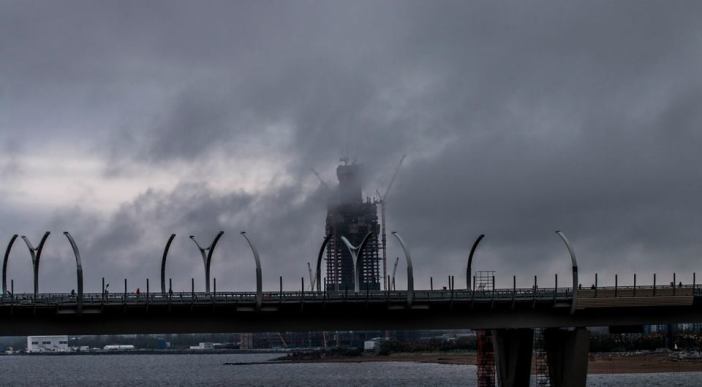
The 102-storey Akhmat Tower will be 435 meters high, 35 meters more than was planned initially. According to Khuchiyev, after construction of the Akhmat Tower has been completed, it will be the tallest building in Europe. At the moment, the title belongs to the 374-meter-high Federation Tower in Moscow. However, the title of the tallest building on the continent should pass to the Lakhta Center in Petersburg. It will be 462 meters tall, 27 meters more than the Chechen tower.


 Tear of a Komsomol Girl [cocktail recipe]