Aaron Maté, Their Blood, Our Bullets: The Hidden Story of the US–Russia War for Ukraine
The hotly anticipated debut from an award-winning journalist reveals the hidden story of the US-Russia proxy war in Ukraine.
“One hell of a reporter who knows how to get at the truth.” —Seymour Hersh
“Exposes wars and crimes and corruption—Maté, a courageous, independent journalist, has done a great service.” —Katrina vanden Heuvel
“A must-read for anyone hoping to transcend Western propaganda about the Ukraine War.” —John J. Mearsheimer
About the book
In this bombshell investigation, years in the making, Aaron Maté exposes Washington’s professed support for Ukrainian sovereignty and democracy as a sham.
Building on the rigorous, fearless reporting that has established him as a leading independent journalist, Maté irrefutably documents how the US and its NATO allies have meddled in Ukraine with the real aim of weakening and destabilizing Russia.
In pursuit of this aggressive geopolitical design, successive US administrations exploited Ukraine’s internal divisions and sabotaged every chance for compromise while relentlessly backing Russia into a corner. Gambling with the global economy and risking nuclear war, US planners then provoked and prolonged an illegal Russian invasion that has had catastrophic consequences—for the Ukrainian people above all.
Washington’s cynical foreign policy did not just detonate peace in Europe but also deranged politics at home. Controversies around Russia and Ukraine played a pivotal role in three consecutive US presidential campaigns, driving the national hysteria known as “Russiagate” as well as the first impeachment of Donald Trump.
With Trump’s re-election pledge to broker peace still elusive, Maté presents a groundbreaking account of how the Russia–Ukraine conflict came to be, and how a brutal proxy war with existential stakes for humanity can finally be resolved.
Aaron Maté is an independent journalist and co-host of the podcast Useful Idiots. He has reported and produced for outlets including The Grayzone, The Nation, The Real News, Al Jazeera, and Real Clear Investigations. He won a 2019 Izzy Award for outstanding achievement in independent media and was previously a longtime producer at Democracy Now!
SOURCE: OR Books
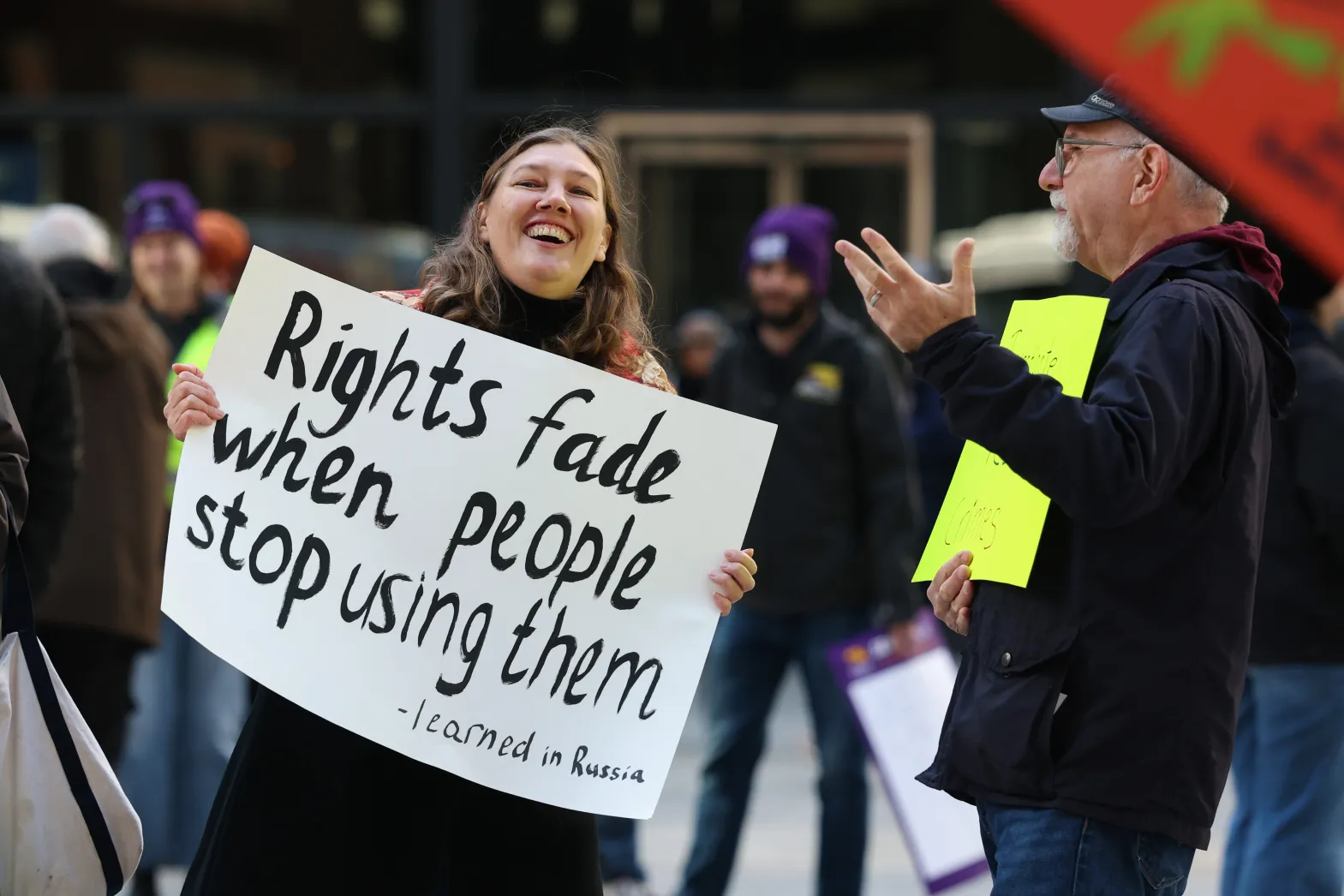
Elena Kaspirovich fled political repression in her native Russia nearly a decade ago, when she was targeted by law enforcement for protesting and activism under the authoritarian regime of President Vladimir Putin.
After arriving in the Chicago area, the Russian dissident was elated by the sense of freedom and strength of democratic ideals in the nation that provided her haven.
Yet Kaspirovich has grown increasingly disturbed by the Trump administration’s close – and often fawning – relationship with Putin, the imperialist ruler who has methodically dismantled democracy in her homeland since coming to power in 2000.
She was concerned when President Donald Trump welcomed Putin with a red carpet ceremony in Alaska last summer, a sharp break in traditional diplomatic protocol for a longtime U.S. adversary, particularly one facing an International Criminal Court arrest warrant for war crimes.
She expressed dismay at Trump’s frequent flattery of Putin – calling the autocrat “savvy” and “genius” – as well as the president’s decision last month to waive stiff sanctions and tariffs on Russia.
And more broadly, Kaspirovich is disturbed by a mounting U.S. coziness with an array of dictators and far-right figures, fearing this warmth for autocrats could have devastating consequences on democracy domestically as well as internationally.
“I believe the club of dictators is real,” Kaspirovich said. “Its members never ask each other about human rights. For them, human life counts for nothing. … Dictators admire only power.”
Other Chicago-area survivors of autocratic and totalitarian nations offer similar words of warning as they watch their adopted homeland increasingly embrace the very regimes they came here to escape.
A Chinese scholar and human rights lawyer who recently came to teach at a Chicago university recounted how he had been forced into exile under brutal totalitarian Communist President Xi Jinping; he condemned Trump’s posture toward China, arguing that the U.S. president’s praise for Xi – and disregard for Chinese human rights abuses – benefits Beijing’s authoritarian rule.
A Chicago playwright and director who fled autocratic Belarus – whose authoritarian leader Trump has praised as a “highly respected president” – cautioned that these expressions of admiration embolden dictators and strong-arm rulers, weakening opposition movements abroad.
And a local professor who faced persecution in Russia for political opposition sees troubling parallels between the authoritarian rule of Putin and Trump’s attempts at eroding democracy in the U.S., from crackdowns on press freedoms to election denialism to bids to expand presidential powers.
Trump’s closeness with autocrats and far-right leaders marks a “radical break” from traditional modern U.S. foreign policy, in that “he’s treated leaders of countries that are either our rivals or our enemies better than he’s treated our allies,” said Robert Pape, political science professor and director of the Chicago Project on Security and Threats at the University of Chicago.
“What it does domestically is it changes the norms inside of America,” said Pape, author of the book “Our Own Worst Enemies: America in the Age of Violent Populism,” which was published in September. “Those norms for democracy, which is restraint in the use of force and support for democratic institutions, those norms really matter in our country.”
Trump’s embrace of authoritarian leaders abroad has an eroding effect on the commitment to democracy domestically, Pape added.
The question then becomes, “If the president is embracing authoritarianism abroad, why is it not OK to embrace authoritarianism at home?” he said.
The Trump administration’s support of various strong-arm leaders and right-wing candidates spans a litany of nations around the globe.
In Brazil, the U.S. president has formed a close ideological alliance with far-right former President Jair Bolsonaro, culminating with the Trump administration approving visas and granting entry in the U.S. last month to his son Flávio Bolsonaro, a hardline candidate who lost the October runoff presidential election and then fled multiple criminal investigations in Brazil.
Last month, Trump remarked that his relationship with North Korean totalitarian dictator Kim Jong Un was “very good” and that they get along “very well.” This was roughly two months after his administration scaled back annual joint military drills in U.S.-allied South Korea; Trump cited his positive relationship with Kim, adding that the long-running operation sends a “totally inappropriate and hostile” signal to Pyongyang.
In another deviation from standard diplomacy, Trump greeted Chinese President Xi with a 100-foot red carpet, military band and ceremonial gun salute during a September visit to Washington D.C.
“From the time of my first election in 2016, President Xi and I have forged a friendship, a truly great friendship, actually, built on mutual respect and the vital interests of our people,” Trump said during the visit.
The Trump administration and high-profile MAGA figures have also championed European far-right and nationalist parties like Alternative for Germany and the National Rally in France, as well as former right-wing populist Hungarian Prime Minister Viktor Orbán, who stepped down in April following a landslide defeat, despite Trump’s endorsement.
Trump has even invoked the label “dictator” for himself, on occasion.
Acknowledging that critics call him authoritarian, Trump remarked, “but sometimes you need a dictator,” following his January address at the World Economic Forum.
As for Kaspirovich, she fears Trump’s support of autocratic rulers and strong-arm figures mirrors his desire for a massive expansion of presidential powers domestically.
She cited examples like Trump’s first-day executive order to end constitutionally protected birthright citizenship, cuts to programs Congress had already approved and various attempts to restrict media freedoms.
“It all screamed that democracy was under attack,” she said.
Kaspirovich took heart that many of these policies were curbed or overturned by the courts.
She was also relieved by sweeping Democratic Party wins during midterm elections earlier this month, which were widely regarded as a referendum on the Trump administration. Trump, however, appeared to backtrack into election denialism last week, suggesting on his Truth Social page that the “blue wave” wasn’t legitimate.
“Does anybody really believe that this ‘Election’ was honest. How could the Polls be so wrong???” he wrote, while offering no evidence of malfeasance. “Some early voting ‘dumps’ were so large that it was impossible to win, no matter how many people went to vote. It’s all about the machines, which are far more important than the voter.”
Kaspirovich cautioned that democracy can be fragile. She saw freedom start to bloom in Russia in the 1990s after the fall of the Soviet Union but then watched it unravel.
“I learned this in Russia: Freedom does not disappear in one day,” she said. “It disappears when people stop using it.”
She urged Americans to remain vigilant about preserving their liberties.
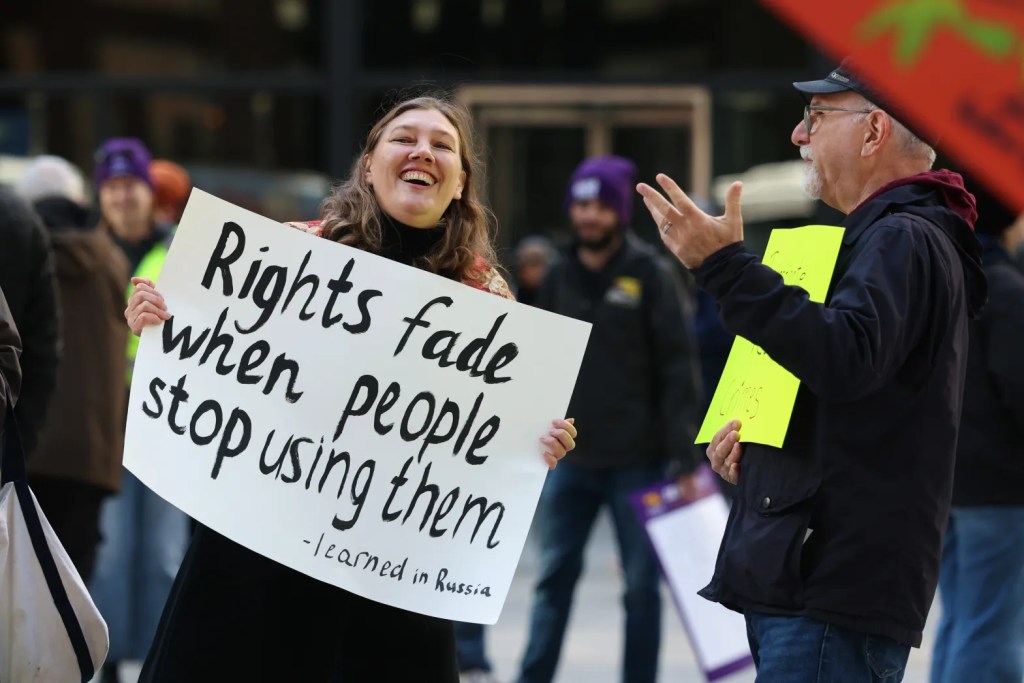
“Use your rights and freedoms, and remember the countries where people don’t have them,” she added. “I believe in Americans. I have seen how many people here care about their freedom. And that gives me hope.”
‘Pursuit of power’
Chinese human rights attorney and political activist Teng Biao recounted being kidnapped and “disappeared” by the Chinese secret police three times between 2008 and 2013.
“I participate in a lot of protests and human rights events,” recalled Teng, a former visiting professor with the Pozen Family Center for Human Rights at the University of Chicago. “That’s why the Chinese government hates me very much. They banned me from teaching at the university. They disbarred me. They kidnapped me and detained me and tortured me. The reason is human rights activism and articles. I wrote a lot of articles criticizing the Chinese government and political system.”
After years of persecution, Teng fled to the United States in 2014.
Over the years, the scholar and lawyer has watched Trump increasingly ingratiate himself to Xi, the president and paramount leader of the People’s Republic of China.
The president’s welcome of the totalitarian leader in September was deferential and lavish, from personally meeting Xi on the tarmac – which Xi had not done when Trump visited Beijing in May – to jokes by Trump that “China had the friendliest press corps.”
But these overtures didn’t shock Teng, who has opposed Trump since 2016.
“Trump is really an admirer of all those dictators, all of those authoritarian leaders,” said Teng, who was in Chicago until 2023, when he moved to Washington D.C. “He admires dictators all over the world and he tries his best to destroy American Constitutional democracy. And he undermines freedom of expression, press freedom. He undermines the separation of powers and he is corruptive.”
Teng pointed to Trump’s promotion of false claims of a stolen 2020 election and statements of support for the Jan. 6, 2021 insurrection.
He also cited the Trump administration’s severe immigration crackdown that has roiled many American cities, including the Chicago area.
Teng noted that multiple prominent evaluators have reported a major decline in American democracy. The Economic Intelligence Unit dropped the U.S. from 28th to 34th in its 2025 global rankings, marking the nation’s lowest democracy score since the index’s inception in 2006.
“So many people like me see the United States as the beacon of democracy,” Teng said. “But when they see Donald Trump, when they see the rising racism, when they see Immigration Customs and Enforcement deporting, arresting and abusing immigrants, we are shocked. We are very disappointed. The United States is seen as the model of liberal democracy. Now it is going to the opposite direction.”
While other American leaders may have historically “made marriages of convenience with unsavory leaders abroad” or engaged with them strategically, Trump’s approach is unique in his systematic favor for authoritarian leaders, said Michael Albertus, a political science professor at the University of Chicago.
“That seems to be the attraction for Trump, that style of power,” he added. “So that does seem like something systematically different in American foreign policy.”
Albertus predicted Trump’s closeness to dictators, as well as his attempts to consolidate power domestically, won’t abate after the blow of the midterm losses.
But his lame-duck phase will greatly weaken how foreign heads of state perceive him, Albertus predicted. “They’re already going to be thinking about the next chapter in American foreign policy, whether (Trump) likes it or not,” Albertus added.
Despite this, it might be difficult for the US to repair fractured relationships with longtime allies abroad, even after the Trump era ends, said Alexandra Filindra, professor of political science and psychology at the University of Illinois Chicago.
“This is something that’s very hard to reverse,” she added.
Political division, optimistic signs
In September 2020, Andrei Kureichik got a call from his lawyer saying he needed to leave his native Belarus immediately or he would be arrested.
Massive protests swept the former Soviet Republic in the aftermath of the disputed August 2020 election.
Kureichik was among a groundswell of dissidents supporting an opposition candidate who challenged Alexander Lukashenko, the first and only president of Belarus since the office was founded in 1994.
Lukashenko – nicknamed “Europe’s last dictator” – unleashed a state-led campaign of arrests and violence in response.
“It was a terrible time,” recalled Kureichik. “A lot of people were pushed into exile, like myself.”
He purchased last-minute plane tickets to Ukraine for him and his then-13-year-old son. When he handed his passport to government officials at the airport, he was terrified they would detain him. But they let him board the airplane.
Kureichik, a playwright and director, never returned to Belarus.
He lived abroad in Europe for several years and came to the United States in 2022 for a fellowship at Yale University. He is now a fellow and doctoral candidate at the University of Chicago.
Amnesty International has repeatedly condemned Lukashenko’s regime for human rights violations, suppression of free speech and arbitrary detentions.
Yet the Trump administration has been increasingly friendly to Minsk, including gradually easing some sanctions. Lukashenko in January accepted Trump’s invitation to join the U.S. president’s controversial “Board of Peace.”
“We have a good relationship, and the leader is somebody that I have a lot of respect for,” Trump said of Lukashenko in February.
Kureichik said it’s hard for him to understand the U.S.’s recent “different diplomatic approach” to Belarus.
“For me, Lukashenko is a criminal and a bloody tyrant,” he added.
Over the past few years, Kureichik said he’s watched the American people grow more divided and politically polarized.
“I see that American society is changing, it’s changing before my eyes,” he said.
Yet he was hopeful after the midterm elections, saying the “result and this turnout were precisely an attempt to protect democracy, when people intuitively felt that it was in danger.”
He doesn’t believe Trump will change. In the final two years “he may even support dictatorships and right-wing movements around the world more,” Kureichik said.
He noted after the election Trump elevated Stephen Miller – an immigration hardliner whose ancestors fled antisemitism in Belarus – to chief of staff.
This appointment “suggests that (Trump) has most likely chosen the path of retaliation,” Kureichik said.
Through their votes, the American “people said no to inhumanity and cruelty,” he said.
“But a real change of policy is still far away,” he added.
Perseverance of democracy
As a frequent critic of Putin’s regime, economist Konstantin Sonin endured political persecution in Russia before immigrating to the United States to join the faculty at the University of Chicago a little over a decade ago.
For years, he returned to Russia for two or three months annually and was on a longer sabbatical there in February 2022, during Russia’s full-scale invasion of Ukraine.
The professor tried to stay and speak out against the unjust war. But the Kremlin’s crackdown on freedoms in the invasion’s aftermath reached new heights of repression.
The Kremlin targeted peaceful protest. Disparaging Russian armed forces or spreading “false information” about the invasion were punishable by up to 15 years in prison. Many Russian independent media outlets were banned.
Soon after the invasion, Sonin returned to Chicago and he hasn’t gone back since.
He said Russian authorities opened a criminal case against him several years ago for violating wartime censorship laws, sentencing him to 8.5 years in prison in absentia.
To aid war-torn Ukraine, Sonin has gone to Kyiv for short-term university teaching stints there.
“As a person who was born in Russia and lived in Russia for 45 years, I feel totally responsible. I’m trying to help Ukraine as much as possible,” he said.
During his most recent trip over the summer, professors and students there suffered from relentless exhaustion, anxiety and stress, he recalled. “There are missiles. There are drones. The probability that you will be hit is low. But it is difficult to sleep,” he said. “And everyone knows someone who was killed on the battlefield.”
Sonin sees parallels between Putin and Trump, including, “lawsuits against the media and this attempt in 2020 to subvert the transit of power” in the United States.
“All of these things, they are sort of from the authoritarian playbook,” said Sonin, author of the book “How Revolutions Happen,” which is coming out in April.
Russian institutions failed to constrain Putin, Sonin noted.
In contrast, he pointed out ways American institutions of democracy have persisted.
The Jan. 6, 2021 attempt to overturn the election proved unsuccessful; the 2026 midterm elections served as a massive repudiation of Trump, Sonin added.
He credited this perseverance to the steadfastness of American democracy and its public. “What keeps it strong is that Americans start to worry about their democracy very early,” he said. “I think that is what has been keeping American institutions intact when a lot of institutions around the world failed.”
SOURCE: Angie Leventis Lourgos, “These locals escaped authoritarian regimes. Now Trump is embracing the very dictators they left behind,” Chicago Tribune, 16 November 2026. I subscribe to the digital and online editions of this newspaper and am justifiably happy in being able to share this article with you. |||||TRR
IMAGE CREDIT: Activist Elena Kaspirovich holds her sign as she talks with a fellow demonstrator during a rally and march titled “The People Have Spoken,” in response to the Nov. 3 midterm elections, at Federal Plaza on Nov. 7, 2026, in Chicago. (John J. Kim/Chicago Tribune)
