Opaque

Finance Ministry Deletes Info on Ministerial Salaries
Ivan Tkachov
RBC
December 31, 2017

Information on the salaries of federal ministers in 2016 has disappeared from the website of the Russian Finance Ministry. The information was deleted a day after RBC published the article “Finance Ministry Discloses Salaries of Ministers for First Time.” 

More than ten sets of publicly accessible information, including the number of employees and average monthly salaries at state ministries and agencies, the number of official vehicles, etc., was posted by the Finance Ministry on December 11. On December 27, RBC discovered the open data essentially disclosed the official average monthly salaries of the heads of federal ministries, except the Defense Ministry and the Interior Ministry, for 2016. Previously, information about the salaries of  ministers had not been disclosed.

On December 28, this information disappeared entirely from the Finance Ministry’s website without any explanation. As of December 31, it was still not listed in the ministry’s open data registry. Data on salaries at government ministries and agencies had earlier been located on this page, and information that this was the case has been saved in Google’s web cache.

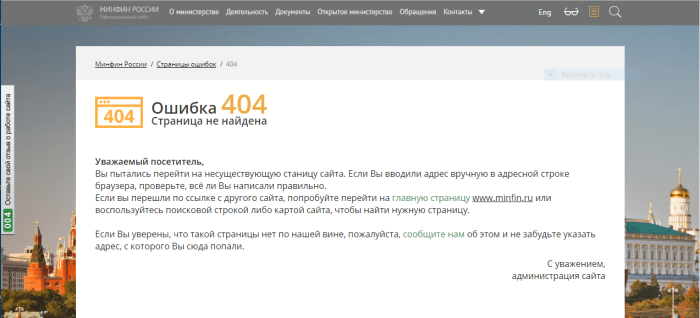
Screenshot of Russian Finance Ministry website page that had previously listed the salaries of ministers. Now it reads, “Error 404: Page Not Found.”

The liaison officer at the IT Department for State and Municipal Finance Management and Budget Processs Informational Support has not responded to our request for information. The Finance Ministry’s press secretary also failed to respond to our request.

In the open data, now inaccessible, the Finance Ministry disclosed the average monthly salary of “employees holding public offices” at each of the federal ministries. Since only one person, the minister, occupies public office at each ministry, the data actually amounted to information about the salaries of ministers.

Accordingly, the finance minister was the highest paid minister in 2016, earning 1.729 million rubles a month [approx. 25,000 euros]. He was followed by the economic development minister, who earned 1.266 million rubles a month [approx. 18,000 euros] and the energy minister, who earned 1.155 million rubles a month [approx. 16,700 euros]. They earned from eleven to thirteen times more than the average staffer in their ministries. Twelve ministers listed their ministerial salaries as basically their only source of declared income, according to our calculations.

RBC has learned that publication of ministers’ salaries has provoked discontent in the ministries. Thus, a source in one ministry compared it with “sabotage.”

The information removed from public access had mostly been published on the Finance Ministry’s website in June 2017. The .pdf file contained information about the number of employees in federal ministries, the travel expenses of federal ministries and state agencies, and the number of official vehicles, but not the salaries of individual ministers, which was disclosed for the first time.

What Else the Finance Ministry’s Data Told Us
In 2016, Russian federal ministries and agencies owned or used a total of 47,000 vehicles. The average monthly cost of maintaining each vehicle was 27,000 rubles [approx. 390 euros].

The Prosecutor General’s Office (its central administration and regional offices) had the most vehicles: 4,269. The Federal Bailiff Service was in second place, with 4,209 vehicles, followed by the Federal Tax Service, with 4,030 vehicles. The Emergency Situations Ministry had approximately 3,500 vehicles at its disposal, while the Investigative Committee, Federal Customs Service, and the Federal Service for State Registration, Cadastre and Cartography (Rosreestr) each had approximately 3,000 vehicles in their motor pools.

In 2016, the Health Ministry, which had only 47 vehicles at its disposal, had the most expensive maintenance costs per vehicle: 341,000 rubles [approx. 4,900 euros]. The Russian Government’s maintenance cost per vehicle was 327,000 rubles. It had a motor pool of 270 vehicles.

Last year, the federal ministries and agencies spent almost 7 billion rubles on official travel [approx. 101 million euros]. The biggest spenders were the Federal Customs Service and the Federal Tax Service, which spent 742 million rubles and 712 million rubles, respectively. If we talk only about official foreign travel, the biggest spender was the Foreign Ministry: it spent 200 million rubles on travel abroad in 2016. It was followed by the Finance Ministry and the Economic Development Ministry, which spent 57.9 million rubles and 51.8 million rubles, respectively, on official trips abroad.

Translation and photo by the Russian Reader

Sanktsionshchiki

sankts“Sanctioned product”

The Demand for Sanctions Specialists Has Grown in Russia
Svetlana Romanova
RBC
November 9, 2017

According to recruiting agencies and job search sites, he Russian job market has seen a growing demand for employees who understand the ins and outs of sanctions legislation.

According to Headhunter.ru, there were 27 published vacancies for sanctions specialists in October 2017; there were a mere nine vacancies in October 2014. Sberbank, VTB, UniCredit, Raiffeisen, Globex, and the Russian Regional Development Bank are among the companies now recruiting these specialists.

It is not only banks that have been generating the demand (they account for 44% of all vacanies) but also law firms (21%), accounting firms (11%), and insurance companies (10%). Starting pay is 250,000 rubles a month [approx. 3,600 euros a month], but experienced specialists can count on monthly salaries of 500,000 rubles, we were told by the personnel agencies we interviewed.

Vacancies advertised on websites are only the tip of the iceberg: headhunters are usually employed to find sanctions specialists. The first request for a sanctions specialist to the recruiting agencyHays was made by a major private Russian bank in late 2014, said Darya Anikina, managing consultant for financial institutions at Hays. Currently, the agency selects candidates for at least five positions a month at different companies. Our sources at the agencies Cornerstone, Kontakt, and Unity also told us about a deficit of sanctions specialists.

“The profession doesn’t exist officially. It’s not taught anywhere,” said Yuri Dorfman, a partner at Cornerstone.

Headhunters have to make compromises and use their imaginations. For example, Cornerstone recently succeeded in placing a specialist at a bank. At his previous job, he had been employeed preventing money laundering, and monitoring and stopping illegal financial transactions. Sanctions specialists are also aware of the demand and have been making the most of it. When moving to a new company, they ask for at least a thirty or forty percent raise, rather than the customary twenty percent raise.

Whereas sanctions specialists are sought out by banks and legal firms, the consumer goods retail sector has been vigorously looking for specialists to help it get round the Russian Federation’s countersanctions, meaning specialists in logistics and foreign trade. According to the website Superjob, the salaries for such vacancies increased by 18% in 2017.

______________________________

Sanktsionshchiki: Who Recruiting Agencies Are Hunting Nowadays
Svetlana Romanova
RBC
November 9, 2017

The Russian labor market’s demand for sanctions experts has been growing. People who practice this new, rare profession earn between 250,000 and 500,000 rubles a month, and employers have been headhunting them with a vengeance.

Since March 2014, the US, the EU, and other countries have been continously imposing more and more sanctions on Russian nationals, companies, and individual industries. This has provoked a demand for sanctions experts on the Russian jobs market. Some companies simply cannot do without their assistance. According to headhunters, there is a lack of such specialists. Employees who have improved their qualifications and learned how to deal with the restrictions and risks occasioned by sanctions can count on salary increases of thirty to forty percent.

Sanktsionshchiki
In March 2014, 46-year-old Artyom Zhavoronkov, a partner at the legal firm Dentons who specializes in mergers and acquisitions, was planning to travel to Washington, DC, to give a lecture to an American audience about how to build a business in Russia. But since the US had imposed the first set of sanctions against Russia [sic], the Americans cancelled the lecture. Zhavoronkov kept his head and suggested changing the subject of the lectures. He decided to talk about something more topical: the sanctions and their consequences. Ultimately, the lecture took place, and it was standing room only in the auditorium. It was then that Zhavoronko understood he had found a new business niche: legal advices on issues related to sanctions. Currently, he consults twenty to thirty international and Russian clients monthly.

Recruiting agencies received the first requests for sanctions specialists in the spring of 2014, but by the autumn of 2017 the demand for such specialists had become stable. The demand has grown not only for temporary consultants like Zhavoronkov: many companies seeks to hire in-house specialists. According to HeadHunter.ru, its website listed nine such vacancies in October 2014. By October 2017, that number had grown to 27. Candidates are usually expected to have degrees in law or finance, a good command of English, and a high tolerance for stress.

This is the tip of the iceberg, because companies usually employ headhunting agencies to find sanktionshchiki. Russian ompanies have realized no one is going to cancel the sanctions anytime soon, the lists of sanctioned companies and individuals have been expanding, and so the problem will not solve itself.

The first request for a sanctions specialist to the recruiting agency Hays was made by a major private Russian bank in late 2014, said Darya Anikina, managing consultant for financial institutions at Hays. Currently, the agency selects candidates for at least five positions a month at different companies. Compared with other professionals, this is a tiny figure, but for the time being they are all that is needed. In a company that employs a thousand people, there might be three or four such specialists, but they will earn more than their colleagues.

Who and What Banks Are Looking for

Vacancy: Specialist for international sanctions monitoring group

Duties: Vetting of bank clients and transactions against the lists of international sanctions, as imposed by the US, EU, UN, and other in-house lists. Search and analysis of additional information on the internet and the bank’s internal databases in order to analyze automatically generated warnings regarding the bank’s clients and transactions. Drafting of brief, well-argued analyses of automatically generated warnings. Filing of reports.

Requirements: Tertiary degree in economics, finance or law. No less than six months’ experience working in a credit institution. Experience working with automated banking systems. Command of written and spoken English at the intermediate level is obligatory. Ability to cope with large amounts of routine work. The candidate must be detail-oriented, focused, perseverant, able to learn quickly, proactive, diligent, and well-spoken.

Sourcejob listing on the website Headhunter.ru

Banks on the Hunt
Artyom Zhavoronkov provides sanctions-related legal services. He establishes whether the owner of a company with whom his client plans to make a business deal is not on the sanctions lists, and he drafts supply contracts that account for international restrictions. But he also provides more ambitious services. Recently, Zhavoronkov drafted a plan for an oil company: he conceived and drafted an in-house list of “sanctions” rules. For example, Zhavoronkov devised a special algorithm for sale managers that prevents them from making deals with companies and individuals on the sanctions list.

“If questions arise, sales managers contact legal counsel, and together they decide whether they can sign a contract,” Zhavoronkov explained.

Most of all, Zhavoronkov is proud he succeeded in getting a major company off the sanctions list. (He did not name the company, citing a nondisclosure agreement.) He conducted long negotiations with regulators, trying to prove to them that the circumstances that had led to his client’s ending up on the sanctions list had changed. Although the US Treasury Department’s Office of Foreign Assets Control (OFAC) has not made public a single instance in which the US has taken Russian companies off the sanctions lists, there have been precendents in other countries. In September 2014, Canada removed sanctions from two Russian banks, Expobank and Rosenergobank, acknowledging they had been placed on the sanctions list mistakenly.

The services of sanctions experts are needed by investment funds, including ones run by major banks, and the management companies of oligarchs who have been sanctioned, said Zhavoronkov.  There is also demand from consulting companies. However, judging by job search websites, it is Russian banks that are most in need of employees versed in the ins and outs of sanctions. Since 2014, banks have accounted for 44% of such vacancies on HeadHunter.ru, with legal companies coming in second at 21%.

Recently, two vacancies were posted by the country’s largest bank, Sberbank. It seeks two experts for its international sanctions monitoring group. The specialists must prepare opinions on transactions and operations, that is, check whether they are covered by the sanctions imposed by international organizations and individual governments, consult with employees, and respond to their requests. Sberbank refused to tell us whether it had succeeded in filling the positions.

Other financial institutions have placed help wanted ads on HeadHunter.ru: VTB, UniCredit, Raiffeisen, Globex, and the Russian Regional Development Bank. None of them agreed to talk with us on the record. RBC’s sources at a major state bank confirmed they have a full-time sanctions specialist on staff. But the source refused to provide details, adding that no one wants to talk about it publicly, since the “topic is painful and nothing to brag about.”

Russian financial institutions that have been sanctioned need specialists to keep from having even more serious restrictions imposed on them and avoid jeopardizing their business partners.

Banks that have not been blacklisted need such specialists to avoid violating the sanctions by working with counterparties. Otherwise, they can also have their access to western loans cut off. Primarily, this concerns the top one hundred financial institutions in terms of assets. It is they who hire sanctions specialists, said Roman Kuznetsov, senior analyst at the investment company QBF. Each major bank has a few sanctions specialists, said Andrei Zakharov, director of the financial institutions personnel recruiting department at Kontakt.

Experience Is More Important than a Diploma
Of course, not a single Russian university educates sanctions specialists, nor are there any continuing education courses on the topic as of yet. Everything has to be learned on the job. Successful candidates for sanctions specialist jobs usually have three or four years’ experience working in legal compliance or auditing departments of banks. Candidates with other financial backgrounds are considered less often, said Darya Anikina.

Dentons employs 200 attorneys. Aside from Zhavoronkov, however, only two of his colleagues, both of them under thirty, deal with sanctions-related cases. Zhavoronkov is their mentor. He made it his goal to cultivate these unique specialists in firm. Currently, there are very few experienced employees who understand the intricacies of the sanctions. Three and a half years have passed since the first sanctions were imposed. This is too short a time to form a pool of specialists.

Unlike the Russian labor market, the specialization has existed on the American job market for several decades. Sanctions compliance in the US is an entire niche business, claimed Zhavoronkov. The staff of any American law firm usually has one such specialist. His or her work is considered routine.

According to Bloomberg, the demand for sanctions expertise in the US grew in 2014. American companies frequently hired former officials from the Treasury Department, who were involved in drafting most of the restrictions. For example, until 2014, Chip Poncy was head of the unit for combating the financing of terrorism and financial crimes at the Treasury Department, but after the first sanctions against Russia [sic] were imposed, Poncy founded Financial Integrity Network, which helps businesses deal with the restrictions.

The costs of making a mistake can be quite hefty. For example, the French bank BNP Paribas agreed to pay $8.97 billion in fines after it was discovered it violated sanctions regimes between 2004 and 2012, when it did business with individuals and companies from Sudan, Iran, and Cuba, which have been sanctioned by the US.

The Reverse Side of the Sanctions
Whereas banks and legal firms have been seeking sanctions specialists, the FMCG (fast-moving consumer goods) sector has been vigorously seeking people who can help them bypass the produce embargo imposed by Russia, that is, they have been seeking experts in logistics and foreign trade. According to the website Superjob, the job of foreign trade manager was among the top jobs in terms of salary increases in 2017. The starting salaries for such specialists have increased by 18% since the beginning of the year.

The Price Tag
None of the vacancies on HeadHunter.ru that RBC examined contained information on the salaries of sanctions specialists. However, recruiters says the starting salary of a specialist with little work experience is 250,000 rubles a month.

Nevertheless, it is difficult to fill the positions quickly, admitted Anikina. Nor is it always clear how and where to find the right people, Yuri Dorfman, a partner at the agency Cornerstone, agreed with Anikina.

“This is not marketing, where the process for filling jobs is clear and formalized. The profession doesn’t exist officially,” he said.

Recently, Cornerstone managed to find a specialist for the compliance department at a bank. At his previous job, he had been employeed preventing money laundering, and monitoring and stopping illegal financial transactions. Sanctions specialists, a new and rare breed, are also aware of the demand and have been making the most of it. When moving to a new company, they ask for at least a thirty or forty percent raise, rather than the twenty percent pay rise customary on the market.

Felix Kugel, managing director of the recruitment company Unity, sees an experienced attorney who has a thorough knowledge of corporate law as the perfect sanctions specialist. The salary of an employee like this could be around 500,000 rubles a month [i.e., over 7,000 euros; by way of comparison, according to the website Trading Economics, the average montly salary in Russia as of October 2017 was 38,720 rubles or 556 euros, although regular readers of this website will know that real monthly salaries are often much lower in particular occupations and regions—TRR].

It is unlikely sanctions specialists will be unemployed.

“I would be glad if the sanctions were lifted, despite the fact I earn money from them,” said Zhavoronkov, “but I am confident this won’t happen in the near future.”

Zhavoronkov recalls the Jackson-Vannick amendment to the Trade Act of 1974, which limited trade with countries that restricted emigration and violated other human rights, e.g., the Soviet Union, China, Vietnam, and Albania. It was officially abolished in 2012, although it had de facto ceased to function in 1987.

The new specialization will be in great albeit limited demand [sic] in Russia in the coming years, agreed Roman Kuznetsov. But additional knowledge about how the sanctions are structured would come in handy to all Russian banking, finance, and legal sector employees. Understanding the ins and outs of the sanctions means you have a good chance of increasing your salary by thirty to forty percent, we were told at Hays.

Restricted Area
The first set of sanctions, occasioned by the annexation of Crimea and the conflict in Donbass, were imposed by the US, EU, Australia, New Zealand, and Canada in mid March 2014. Since then, the black lists have expanded due to the inclusion of personal sanctions (directed at specific people and companies affiliated with them) and sectoral sanctions (directed against individual industries and activities), and other countries and international organizations have joined the sanctions regime. Currently, the US has sanctioned over one hundred Russian nationals and companies, not counting foreign companies connected with sanctioned Russians. The EU has sanctioned 149 individuals and 38 companies.

Five Russian banks with ties to the Russian state have been sanctioned: Sberbank, VTB, Gazprombank, Rosselkhozbank, and Vnesheconombank. These financial institutions are not eligible for long-term financing abroad, and US and European investors are forbidden from buying shares and Eurobonds from these banks. In addition, the US has banned doing business with 33 companies in the Russian military-industrial complex, including Kalashnikov, Almaz-Antey, Rosoboronexport, Rostec, United Aircraft Corporation, and Russian Helicopters. The oil and gas industry is represented in the black lists by Rosneft, Transneft, Gazpromneft, NOVATEK, Gazprom, and Surgutneftegaz. The US and UE have imposed sanctions not only on banks, military-industrial companies, and oil and gas companies but also on completely “peaceful” firms, for example, the drinking water and beverage manufacturer Aquanika, a subsidiary of Gennady Timchenko‘s Volga Group.

In 2016, [former Assistant Secretary of State for European and Eurasian Affairs at the US Department of State] Victoria Nuland said in Kiev that the sanctions would not be lifted until Russia returned Crimea to Ukraine.

Translated by the Russian Reader. Photo courtesy of Stringer

Dmitry Buchenkov, Last Bolotnaya Square Defendant, Flees Russia

CF8AAC04-C132-492E-9382-9B569A27A780_cx0_cy8_cw0_w1023_r1_sDmitry Buchenkov

Last Bolotnaya Square Defendant Flees Russia
RBC
November 9, 2017

In an interview with Current Time TV, Bolotnaya Square defendant Dmitry Buchenkov said he has left Russia for a European Union country.

He said he has applied for political asylum in this country. Buchenkov failed to say exactly where he had gone.

“I’m calm about the fact I won’t be returning to the motherland soon. I won’t say leaving was easy. Psychologically, of course, I didn’t want to leave,” he noted. “The regime and the entire justice system forced me to take this step.”

He added he was currently not in touch with relatives.

When asked how he managed to cross the Russian border, the Bolotnaya Square defendant said he was “neither the first nor the last person to do it in such circumstances.”

According to Buchenkov, the Bolotnaya Square Case was “political” from the onset. He said that, after he was put under house arrest, “for six months [he] observed how the case was unfolding personally for [him]” and was convinced a guilty verdict lay in store. He said he was transferred from a pretrial detention facility to house arrest during a “brief thaw.” He was not outfitted with an electronic tracking bracelet, because the Naro-Fominsky division of the Federal Penitentiary Service had run out of them.

“I think the police investigators have long known they nabbed the wrong guy. But it was too late for them to back out,” said Buchenkov.

On the morning of November 9, Buchenkov did not show up to the Zamoskvorechye District Court for the latest hearing in his case, in which he stood accused of involvement in rioting. The Federal Penitentiary Service has accused him of fleeing, writes Current Time. Federal Penitentiary Service spokeswoman Natalya Bakharina said the defendant had “absconded,” since he was not to be found in his flat. She noted another family had been living there since November 5, and they were given keys to the flat in late October.

Buchenkov’s attorney Ilya Novikov wrote that he would refrain from commenting for the time being. In turn, Buchenkov’s other attorney, Svetlana Sidorkina, told RBC she did not know about her client’s departure from Russia.

“I don’t know about it. I do know he did not come to today’s hearing, during which the matter of whether to continue the forensic investigation or not was to have been ajudicated,” said Sidorkina.

According to her, the court decided to postpone the hearing since Buchenkov was not in attendance.

In April, at a hearing in the Zamoskvorechye District Court, Buchenkov declared himself not guilty of involvement in rioting and fighting with policemen. He was accused of violence against six Interiory Ministry officers and causing damage in the amount of 73,800 rubles to a commercial firm that set up porta-potties near Bolotnaya Square in Moscow.

Buchenkov, a 38-year-old anarchist and history teacher, was detained and remanded to custody in December 2015, thus becoming the thirty-fourth defendant in the Bolotnaya Square Case. Later, the Moscow City Court released him from custody and put him under house arrest. Buchenkov’s lawyers insisted the activist was not in Moscow during the events of May 6, 2012. The claim was corroborated by Buchenkov’s relatives in Nizhny Novgorod.

According to the defense, the police investigators who, allegedly, identified Buchenkov on video recordings of the May 6, 2012, protest rally mixed him up with another person. The defense lawyers sought to enter higher resolution photographs into evidence, but police investigators refused to take them into account.

Translated by the Russian Reader

Common People

Patriarch Kirill Sees Russia’s Future in Unity of Common People and Elites
Vera Kholmogorova
RBC
November 1, 2017

Kirill, Patriarch of Moscow and All Russia, outlined his vision of Russia’s future. According to the patriarch,  it consists in the complementarity and unity of the elites and common people. 

Patriarch Kirill. Photo courtesy of Valery Sharifulin/TASS

The unity of the common people and elites is the future of Russia, argues, Kirill, Patriarch of Moscow and All Russia. He discussed this during a meeting of the World Russian People’s Council, reports our correspondent.

“Russia is now looking for a vision of the future. I think the vision of the future is a vision of the common people and a vision of the elite achieving complementarity. The elites and common people should be indivisible, a single principle and single whole,” he said.

The patriarch stressed, however, it was “impossible to artificially appoint an elite.” According to him, it had to be educated,” just as the common people had to be educated.

“If we do not educate our own common people, others will develop them,” warned the head of the Russian Orthodox Church.

Patriarch Kirill also said Russia had “acquired immunity to all forms of political radicalism” in the one hundred years that had passed since the events [sic] of 1917.

“Russia has enough strength to remain an island of stability. Our society is now consolidated. The tragic civic split [that existed in 1917] does not exist,” he stressed.

According to the patriarch, “we can rejoice in unification and reconciliation” and “be an example and support for all those who want to survive the current global crisis.”

“The common people are not naturally inclined to revolution,” he argued.

The 21st World Russian People’s Council was held on November 1 in Moscow’s Christ the Savior Cathedral. The event’s stated topic was “Russia in the 21st Century: Historical Experience and Prospects for Development.” It was attended by Patriarch Kirill, clergymen, MPs, and public figures.


Should You Sue for Wages?
Russians Don’t Believe They Should Fight for Their Labor Rights: How Wrong They Are
Pavel Aptekar
Vedomosti
November 1, 2017

Economic turmoil has not only made Russian workers uncertain of the future but also indifferent to violations of their labor rights, e.g., wage arrears, increases in the length of the work day, and the absence of holidays. Workers rarely file complaints with courts and oversight bodies, fearing not only a negative reaction from management but also closure of their companies due to inspections by the state. However, in some cases, appealing to the courts for help is a quite effective means of defense.

According to a survey conducted in June 2017 among 1,600 workers over the age of eighteen in thirty-five Russian regions by the Center for Social and Political Monitoring at RANEPA’s Institute of Social Sciences, violations of labor rights are not uncommon. In practice, nearly half of the workers surveyed (42%) had encountered them. The most common violations were wage arrears (24.1%), changes in work schedules (22.5%), and failure to provide paid leave or refusal to pay it (13.1%).

Meanwhile, the apathy of workers who encounter violations has increased. The percentage of those who did not seek redress for violation of their rights has increased from 49.7% of those polled in 2006 to 54.4% of those polled in 2016–2017. Workers have lost faith in nearly all means of rectifying situations. The percentage of those who complained to management had dropped from 41% to 36.7%; to a trade union, from 8% to 5.1%; to the courts, from 7.4% to 4.1%; and to the civil authorities, from 6.7% to 2.9%.

The unwillingness of employees to protect their rights reflects the idleness of most Russian trade unions, but it does seem to make sense to appeal to the courts, at least in the case of nonpayment of wages.

According to the Supreme Court’s ajudication department, the number of such complaints has been constantly increasing. In 2007, there were 350,242 such complaints; in 2013, 459,016 complaints; and in the first six months of 2017, 243,861 complaints. Moreover, in the absolute majority of complaints (95.7–97.5%) the courts have found for the plaintiff. The situation is the other way around when it comes to suits against unlawful dismissals. In 2007, the courts ruled for plaintiffs in 10,525 of 17,934 lawsuits or 58.7% of all cases. In 2013, plaintiffs won 7,124 of 14,953 lawsuits or 47.6% of all such cases. In the first six months of 2017, the courts ruled in favor of plaintiffs in 1,748 of 4,316 lawsuits or 40.5% of all cases.

The results of the survey reflect the growing apathy of Russians in crisis conditions and fear of losing their jobs, explains Andrei Pokida, director of the Center for Social and Political Monitoring and co-author of the study. Some workers fear a negative reaction if they hang dirty laundry out to dry. If they do complain, they complain only to management. Other workers fear a complaint filed with state agencies could lead to an inspection, resulting in the closure of the company for violations. The reluctance to defend their rights is also caused by a lack of legal literacy among many workers and low incomes. Not all of them are capable of putting together the paperwork for a lawsuit, the services of lawyers are expensive, and many workers simply believe violations are the norm, explains Pyotr Bizyukov from the Center for Social and Labor Rights.

Translated by the Russian Reader. The emphasis in the first article is mine.

Freedom’s Just Another Word for Criminal Hysteria the TV Should Ignore and the Police Should Quash

Russian riot police paddy wagon parked in downtown Petersburg, 11 November 2016. Photo by the Russian Reader

Putin Calls for Assessing Police Actions at Protest Rallies
Natalya Demchenko and Pavel Kazarnovsky
RBC
October 30, 2017

The president argued that instead of organizing protests, critics of the authorities should ensure their presence [sic] on the internet and in the media. He also said that “disrupting life in big cities” was wrong, but that freedom [sic] must be guaranteed.

During a meeting of the Presidential Human Rights Council, Vladimir Putin suggested analyzing the actions of law enforcement agencies vis-à-vis protesters, noting that freedom must be guaranteed. The president’s address was broadcast live by TV channel Rossiya 24.

“Freedom must be guaranteed. I completely agree with you. We must always analyze established practices in our country,” he said in reply to a question from council member Nikolai Svanidze.

According to Putin, however, “some groups of protesters” and rally organizers deliberately aggravate the situation “in order to attract attention,” whereas in order to “state their position and criticize the authorities” it suffices to secure a presence on the internet and in the media [sic].

“I can imagine that the authorities drive these protests over the hill since they have no desire whatsoever to show them up and close. But deliberately interfering with life in the big cities, deliberately triggering aggression, is also wrong. We must work with both parties to this process,” said Putin.

According to him, hysterical outbursts occur from time to time in Russia due to protest rallies.

“Outbursts happen. Look at what has been going on in the US. There are hysterics there,” noted the president.

According to him, these outbursts are a natural phenomenon. There is no need to expect complete calm.

“There never was such a thing and there never will be.”

It is necessary, however, to minimize the negative aftermath of the outbursts.

A series of anti-corruption rallies, organized by Alexei Navalny’s Anti-Corruption Foundation, were held this past March in Russia. The events were authorized [sic] by the authorities in 24 cities, although organizers advertised events in a hundred cities across Russia. The best attended rallies took place in Moscow, St. Petersburg, Novosibirsk, Yekaterinburg, Chelyabinsk, and Vladivostok.

In Moscow, a protest on Tverskaya was not agreed by the authorities, who did not propose an alternative venue to the organizers [as required by law]. Navalny thus announced that, in according with a Constitutional Court ruling, he considered the protest rally authorized and encouraged his supporters to come to Tverskaya. Consequently, according to OVD Info, over a thousand people were detained by police. (According to official police figures, the number was around 500.)

Presidential spokesman Dmitry Peskov later said the Kremlin respected people’s civic stances and the right of Russians to voice them in a manner agreed with the authorities, but the March protest rally on Tverskaya had been a provocation.

When asked why the national TV channels did not cover the anti-corruption rallies in Moscow and other Russian cities, Peskov said the TV channels showed what they considered “important and meaningful.”

Translated by the Russian Reader

There is actually no evidence the Russian authorities have any respect for such basic human freedoms as freedom of speech and freedom of assembly, as guaranteed by the Russian Constitution and the international conventions to which Russia is a signatory.

Here are the highlights of my coverage of the recent clashes between Russian protesters, many of them young people, and Russia’s “lawlessness” enforcers, encouraged by the “legal anarchy” on display once again in President Putin’s remarks earlier today, as quoted above. TRR


Live Target Practice in Syria

Defense Ministry to Take Delivery of 24 “Flying Tanks” for Testing in Syria
Inna Sidorkova
RBC
October 19, 2017

In November, the Russian Defense Ministry will receive the first batch of improved Night Hunter helicopters from Russian Helicopters. The new choppers will cost the Defense Ministry at least 400 million USD. The helicopters should alter aviation tactics in Syria. 

755084141380411
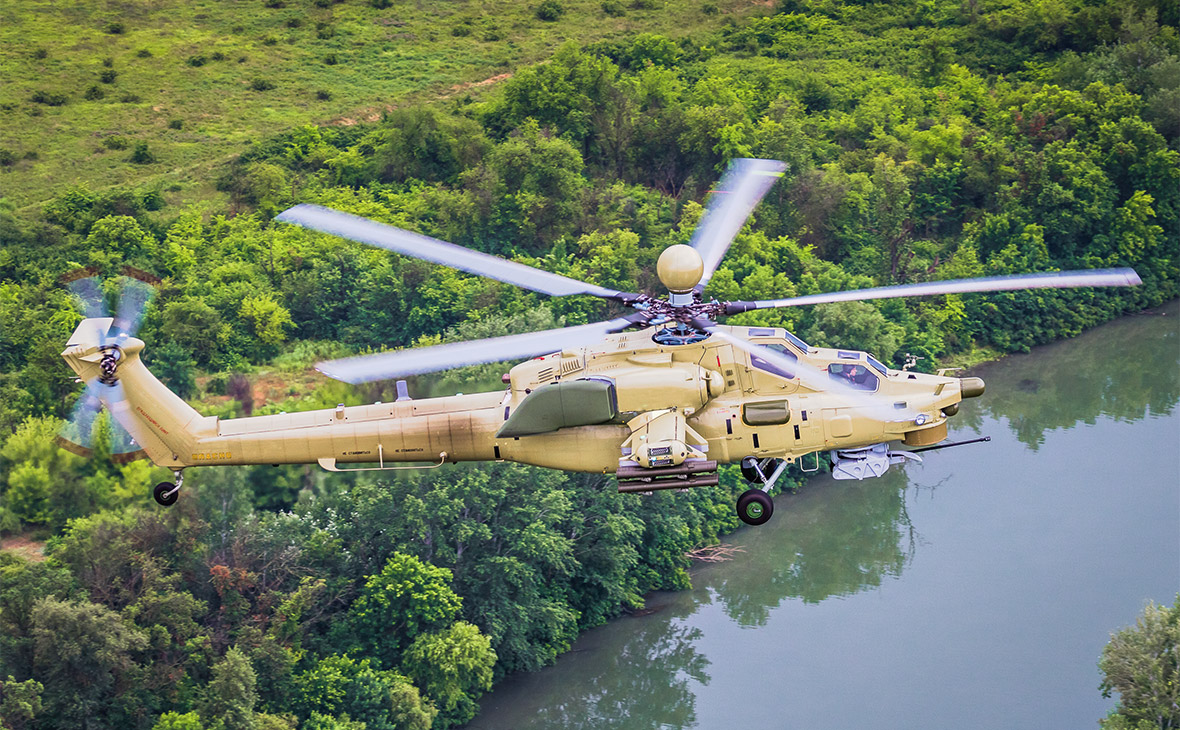
Russian Night Hunter combat helicopter. Photo courtesy of Russian Helicopters/RBC

For Syria
By 2020, the Defense Ministry will take delivery of twenty-four modernized Night Hunter Mi-28UB combat training helicopters, Andrei Boginsky, general director of Russian Helicopters, a subsidiary of state corporation Rostek, told RBC. He stressed the Mi-28UB was designed with its future use in Syria in mind.

The first batch of helicopters—up to ten units—will be delivered to the Defense Ministry in November of this year. Two choppers will be delivered to the 334th Center for Combat Training and Army Flight Crew Retraining in Torzhok, Vadim Barannikov, deputy manager of Russian Helicopters Rosvertol plant, told journalists on October 19.

“Currently, the Defense Ministry is the Mi-28UB’s only buyer. However, similarly configured Mi-28-like helicopters will be delivered to foreign customers,” said Boginsky.

He added that the coming online of the chopper’s combat training version opened up “practically unlimited” opportunities for improving the training of Mi-28N pilots.

“The chance to train on a real combat helicopter, rather than on a simulator, is a huge advantage for our combat pilots in comparison with their counterparts from other countries,” said Boginsky.

Boginsky declined to tell RBC the cost of the contract with the Defense Ministry and the price of a single helicopter. However, as two of RBC’s sources in the aviation industry noted, the cost of the Mi-28UB would be a “little higher” than the basic model due to the improved design and other features. According to AircraftCompare.com, a website specializing in collecting and analyzing information on aviation equipment, the cost of the Mi-28N ranges from 16.8 million USD to 18 million USD. The sum of the contract with the Defense Ministry for delivery of the helicopters should be at least 400 million USD.

The delivery of twenty-four Mi-28 combat training helicopters is Russian Helicopters biggest contract with the Defense Ministry since 2015, the company’s press service told RBC. For the first time in history, the Russian army will get its hands on combat training helicopters with dual piloting systems.

The Mi-28UB
The design of the Mi-28 combat training helicopter, the improved Night Hunter, is based on the Mi-28N night attack helicopter, which was added to the army’s arsenal by presidential decree in 2009. Its maximum speed is 300 kilometers/hour, its dynamic ceiling, 5.6 kilometers, and its takeoff weight, nearly 11,000 kilograms. The Mi-28UB is armed with Ataka-V air-to-surface and Strelets air-to-air guided missile systems, a nonremovable mobile 30mm automatic cannon, and B-8V20A mounts for C-98 80mm caliber rockets and C-13 130mm caliber rockets.

The main difference between the Mi-28UB and the Mi-28N is the dual piloting system, as RBC was informed by Russian Helicopters press service. The chopper can be piloted both from the commander’s cockpit and the system operator pilot’s cockpit, which expands its capacity for training combat pilots. In addition, during emergency combat circumstances, control of the helicopter can be assumed by the second crew member. The helicopter is also outfitted with a simulator for training student pilots to deal with in-flight equipment failure.

The Mi-28UB is outfitted with modernized integrated onboard radioelectronic equipment. The cockpit has been expanded, the area covered by armored glass has been increased, and visibility from the system operator pilot’s cockpit has been improved. The Mi-28UB has an automatic landing system. A state-of-the-art laser defense station has been installed onboard to defend the helicopter from heat-seeking missiles.

Why a “Flying Tank” Is Needed
The Mi-28UB has been added to the arsenal to adjust the tactics used by Russian aviation in Syria and other hotspots in the future, said the military experts interviewed by RBC.

The army lacks combat pilots, noted Colonel Viktor Murakhovsky (Reserves), chief editor of the magazine Arsenal of the Fatherland. During a speech in the State Duma in February, Defense Minister Sergei Shoigu claimed that, as of 2016, the Aerospace Forces (VKS) lacked 1,300 pilots.

When the VKS launched its Syrian campaign, the Defense Ministry called up officers from the reserves and even introduced accelerated pilot courses for servicemen working in different jobs, such as aircraft technicians, Murakhovsky recalled.

“In this sense, it means a lot to train pilots on helicopters with dual piloting systems,” said Murakhovsky. “Thanks to the system, an experienced pilot will be able to prompt the trainee and take over the helicopter in emergencies. Pilots will be trained twice as quickly.”

The combat training version of the helicopter was initially designed to train cadets to fly the Mi-28. Previously, rookie pilots had to undergo initial training on stimulators or other helicopters, and then retrain on the Mi-28. This took time, argued Colonel Andrei Payusov (Reserves). The modernized Mi-28 will be used to train graduating cadets and retrain serving pilots, he believes.

The Mi-28 combat training helicopter will facilitate running young flight crews through their paces and nurture combat pilots, Colonel Sergei Yefimov (Reserves), a combat sniper pilot, told RBC. The Mi-28 gives the army the chance to change combat tactics, and the improved visibility and armored glass will help crews feel more confident in the cockpit.

“The modernized integrated onboard radioelectronic equipment will make searching, detecting, identifying, and eliminating targets more effective,” said Yefimov.

But in addition to accelerated training of combat pilots, the Mi-28 faces yet another task, said Colonel Sergei Gorshunov, senior navigation inspector in the Fourth Army’s aviation wing and the Southern Federal District Air Defense. In modern combat, it is hard for a single member of the crew to pilot a helicopter properly while tracking the enemy and aiming at a target, stressed Gorshunov.

“So the Defense Ministry asked for a helicopter with a dual piloting system,” said Gorshunov.

According to Gorshunov, the Mi-28UB can be used not only to support infantry but also to cause tangible damage to the enemy’s armored units.

“We might say it’s a flying tank. If the guided missiles are deployed, a couple of helicopters can disable from four to eight tanks,” concluded Gorshunov.

The first prototype of the Mi-28UB was manufactured by Rosvertol in 2013. The helicopter was put into mass production in late 2015, RBC’s source in the aviation industry said.

“The helicopter was tested for a very long time. All the tests have been passed, including tests in Syria. Now it is a matter of delivering the first batch,” he explained.

Translated by the Russian Reader

UPDATE. Russian Helicopters was listed in a White House document of Russian companies and entities that may be considered for further sanctions. The New York Times published the unclassified document on October 26, 2017.

“Rate This Translation”

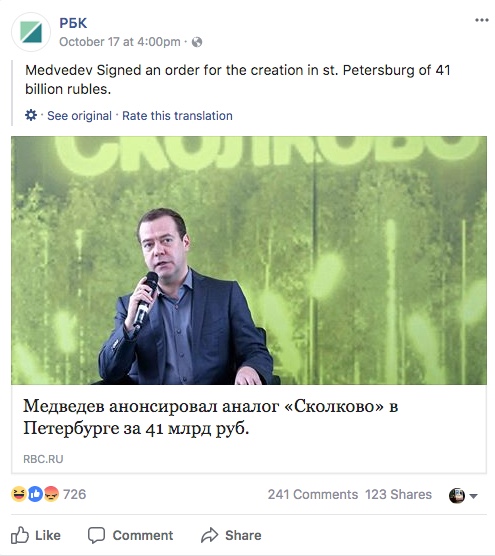
I didn’t ask for the wildly inaccurate translation, screenshotted below. It just showed up on my Facebook newsfeed from RBC as is, yet inadvertently hinting at the real state of affairs in the Kingdom of Denmark.

I wonder how Google Pixel Buds are going to do anything but confuse the hell out of the people who wear them if their translations are similarly brilliant.

Believe me, only trained, experienced human interpreters and translators are capable of making sense out of nonsense.

rate this translation

“Senators” vs. “Undesirables”

A37K0741_0
The Russian Federation Council,* whose members have a penchant for calling themselves “senators,” even though they are not a popularly elected body nor a body known as a “senate.” This peculiar fashion has been picked up by the Russian media and, now, even some foreign media, thus reinforcing the fallacy that Russia is governed democratically. Photo courtesy of Izvestia and Zurab Dzhavakhadze

Media Learns about Idea to Expel People from Russia for “Undesirable Behavior”
RBC
September 4, 2017

The Federation Council’s Committee for Defending State Sovereignty and Preventing Interference in Russian Domestic Affairs [sic] has been drafting a law bill that would stipulate expulsion from Russia for “undesirable behavior.” Izvestia learned about the bill from sources in the parliament familiar with the drafting of the document.

Acccording to the newspaper, the penalty of expelling people from Russia for “undesirable behavior” would be stipulated by a law bill that could be tabled in the State Duma as early as next year. It would amend the current federal law “On Undesirable Organizations,” adopted two years earlier.

The newspaper’s sources said that expulsion for “undesirable behavior” would be applied to individuals, mostly foreigners. However, the sources noted the term could be applied to Russian citizens and legal entities.

The newspaper notes that “undesirability” would be determined by whether the actions of the persons caused real harm to Russia’s national security. It could be a matter of “inciting ethnic and religious hatred and political discord,” as well as potential interference in Russia’s electoral process. The newspaper likewise notes that “outside work” with Russian educational institutions and young people could be deemed “undesirable.”

According to the sources, several options for how the law would be applied were currently under consideration. One of them would involve empowering State Duma and Federation Council members with the capacity to send requests to the Prosecutor General’s Office to check whether a person’s activities were “undesirable.” If the audit turned up a violation, Russian citizens could be accountable. [sic] Foreigners, on the contrary, would be threatened with expulsion from the country.

Andrei Klimov, deputy chair of the Federation Council’s Committee on Foreign Affairs confirmed that the amendments to the law were being drafted.

Translated by the Russian Reader

*Сritics of the Federation Council stress that it is an inherently undemocratic body made for regional elites, with little say from the Russian people. Since the reforms advocated and passed by President Putin in 2000, critics have also charged that the Council resembles more of a rubber stamp body for the Kremlin than an independent legislative body. Many senators are viewed as close allies of Putin and the United Russia party, despite rules which explicitly spell out that political factions are not allowed. Since Mironov’s rise in the Council in 2002, the Kremlin’s position on impending legislation is closely communicated to and coordinated with the Chairman and the committee and commission chairs. This top-down approach has meant that the Council votes with extreme efficiency, backing Kremlin positions on legislation nearly all of the time.

Critics also point to how long the Council convenes, meeting only one day every two weeks, speeding through legislative analysis and providing lop-sided majorities for each vote. Many blame this speedy legislation on the enormous influence the Kremlin exerts, who they charge have already instructed Council committee and commission chairs on how to vote. Several left-leaning State Duma deputies have lamented that Putin has stripped away the Federation Council’s last hold on checks and balances.

Since Putin’s restructuring of provincial executives in 2004, placing them under direct appointment by the Kremlin upon approval of their legislatures, federalist supporters have also charged the president in reducing the provincial role of the Federation Council. Where Yeltsin had envisioned a chamber [addressing] regional concerns, they argue, critics view Putin’s restructuring as deeply centralizing the Council to reflect the president’s and United Russia’s political interests, taking away provincial voices. Putin supporters counter these criticisms by acknowledging that Yeltsin had also appointed governors to Russia’s federal subjects in the early days of the Federation.

Source: Wikipedia

Keep Calm and Just Step Sideways

754918613327889
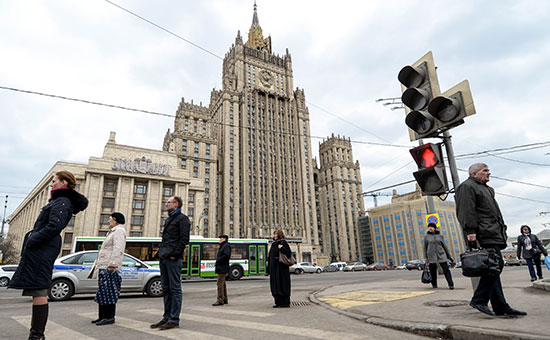
Muscovites are pretenaturally calm and dressed unseasonably warmly as the world hurtless toward senseless nuclear conflagration. Photo courtesy of RBC

I am only sharing this news flash from RBC with you because of the fabulous photo that accompanied it on RBC’s Facebook news feed, and the way it illustrates the article’s point—sideways, as it were.

“‘It is necessary to remain calm,’ the Russian Foreign Ministry said after North Korea tested a hydrogen bomb. The ministry called for a return to dialogue as ‘the only possible way of comprehensively settling the Korean Peninsula’s problems.'”

That sounds great albeit weirdly kumbayaish from folks whose usual idea of a “comprehensive settlement” is invasion and occupation of a peaceful neighboring country, aiding and abetting a bloody Arab tyrant in crushing a popular revolution, sowing racist and Islamophobic mayhem throughout the world via fake news and bots, especially after the meltdown in Charlottesville, messing with elections in other countries, including plans to assassinate one of the candidates, the incumbent PM, ruthlessly and routinely crushing dissent and protest in their own country, and implicitly declaring anti-Americanism the official state ideology not because they thought it would go down well with the rank and file, or because they themselves hate America so much (it doesn’t, and they don’t), but because it was the only way they could think of keeping Putin in the Kremlin for another six years.

Remember, comrades: he’s already been in the Kremlin for eighteen years.

But the photo is terrific. The people in it are not calm. They could not care less about anything.

Or if they do care, they are not going to let on to it whilst walking down the street in the middle of Moscow.

In any case, RBC originally ran this photo in April of this year to accompany an article about how my friends at Mediazona were suing the Foreign Ministry for refusing to reply to its written request for information about contacts between Russian diplomats in the US and members of the Trump presidential campaign.

What goes around comes around, so just step sideways. TRR

_________________________________


Center for Economic and Political Reform: Protests on Rise in Russia

Analysts Claim Number of Protests Sharply on the Rise in Russia
Yevgenia Kuznetsova
RBC
July 10, 2017

The number of social and political protests in Russia has risen in the second quarter by 33% compared to the beginning of the year. Experts attribute the rise to seasonal activeness and the growth of social tension.

754997086450355
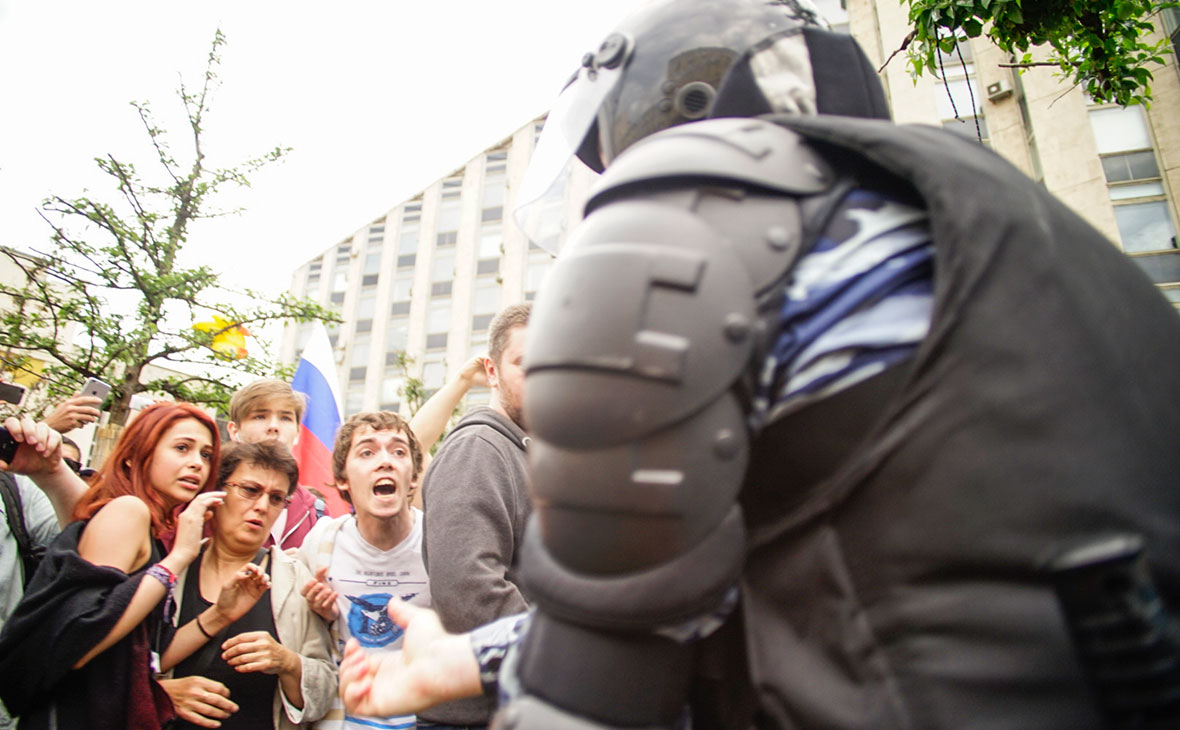
Photo courtesy of Oleg Yakovlev/RBC

Protest Factors
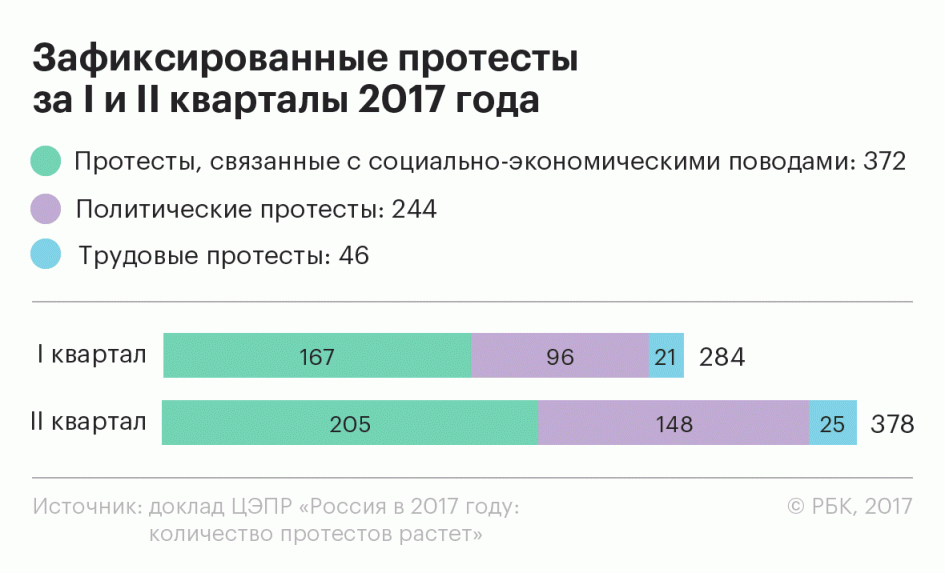
During the second quarter of 2017, the number of protests in Russia rose by a third compared to the start of the year. There were 284 protests in the first quarter of the year, while 378 protest events were recorded in the second quarter, the Center for Economic and Political Reform (CERP) reported in its paper “Russia in 2017: The Number of Protests Grows.” RBC has a copy of the paper.

The CERP’s analysts divide protests into political protests and social protests. The latter include protests over the violation of social rights, declines in living standards, loss of work, and nonpayment of back wages. Over the second quarter, the number of both types of protest grew. The paper’s authors recorded 148 political protests from April to July, compared to 96 in the first three months of the year, while the number of protests provoked by social injustices rose from 167 to 205. The analysts collected their information about protests from the media, social networks, regional analysts, and workforces, who recorded the protests on the ground.

The paper claims the level of protests was high both in 2016 and early 2017. Last year, however, the majority of protests touched on specific issues—wage arrears, the demands of defrauded investors and residential building stakeholders, increases in utility rates, the launch of the Plato system of road tolls for truckers, etc. The authorities did not solve these problems, and so protests have been politicized this year. People involved in them have taken to the streets with more general slogans, for example, anti-corruption slogans, the paper’s authors note. In their opinion, this is the cause of the increase in political protests. ​​

754997084667478
Protests recorded in the 1st and 2nd quarters of 2017. [Green] Protests caused by socio-economic issues: 372. [Violet] Political protests: 244. [Light blue] Labor protests: 46. 1st quarter: 167 social protests, 96 political protests, 21 labor protests = 284 protests. 2nd quarter: 205 social protests, 148 political protests, 25 labor protests = 378 protests. Source: Center for Political and Economic Reform, “Russia in 2017: The Number of Protests Grow.” Copyright 2017, RBC

The growth of protests is explained by another factor: seasonality, CERP director Nikolay Mironov told RBC. People protest less at the start of the year than in the spring months. According to Mironov, the regime uses the seasonality of protests to decide when to schedule elections. In 2012, analysts at the Central Electoral Commission determined the populace was politically most active, including in terms of turnout, during two seasons: late March, April, and May, and late October, November, and December. Therefore, the regime moved the nationwide parliamentary and local legislative assemblies election day to September to lower the turnout while announcing the presidential election for March 2018 to raise the turnout

Other eventful factors in the second quarter of this year were the adoption of the law on residential housing renovation and the large-scale protests by Alexei Navalny’s supporters. But the main factor, according to Mironov, was the overall increase in tension due to the fact that the problems that have given rise to protests have not been solved or have been solved on a case-by-case basis.

“This is the Kremlin’s election strategy: solve problems on an ad hoc basis, because it is impossible to solve them as a whole. But you can go to a region and resolve a specific problem in a flashy way for the TV cameras,” Mironov explained.

Mironov argues that the federal authorities also expect that, after a public flogging during the president’s televised call-in show and his trips to the regions, local authorities will start solving problems on their own.

“But it doesn’t work. For example, after the televised call-in show, the workers in Nizhny Tagil got their back wages paid, but the strike by miners in Gukovo, in Rostov Region, was hushed up and will continue to be hushed up,” said Mironov.

The increase in the number of political protests partly has to do with how the media covers the protests, Mironov argues. According to him, journalists usually pay more attention to political protests than to social protests, and this has a dampening effect on protests. People about whom reporters don’t write are “a priori less protected.”

Localization
The CEPR’s conclusions about the growth of protests have been indirectly confirmed by research carried out by the Levada Center. According to one of its surveys, the number of people who agree that political protests are possible in their town has risen from 14% in February to 23% in June, Levada Center sociologist Stepan Goncharov told RBC. The number of people willing to take part in political protests has increased from eight to twelve percent. An even greater number of people predicted social protests would break out in their towns. When asked, “Are protests against decreased living standards possible in your town right now?” 28% of respondents in June said they were, as opposed to only 19% in February.

754997084666804
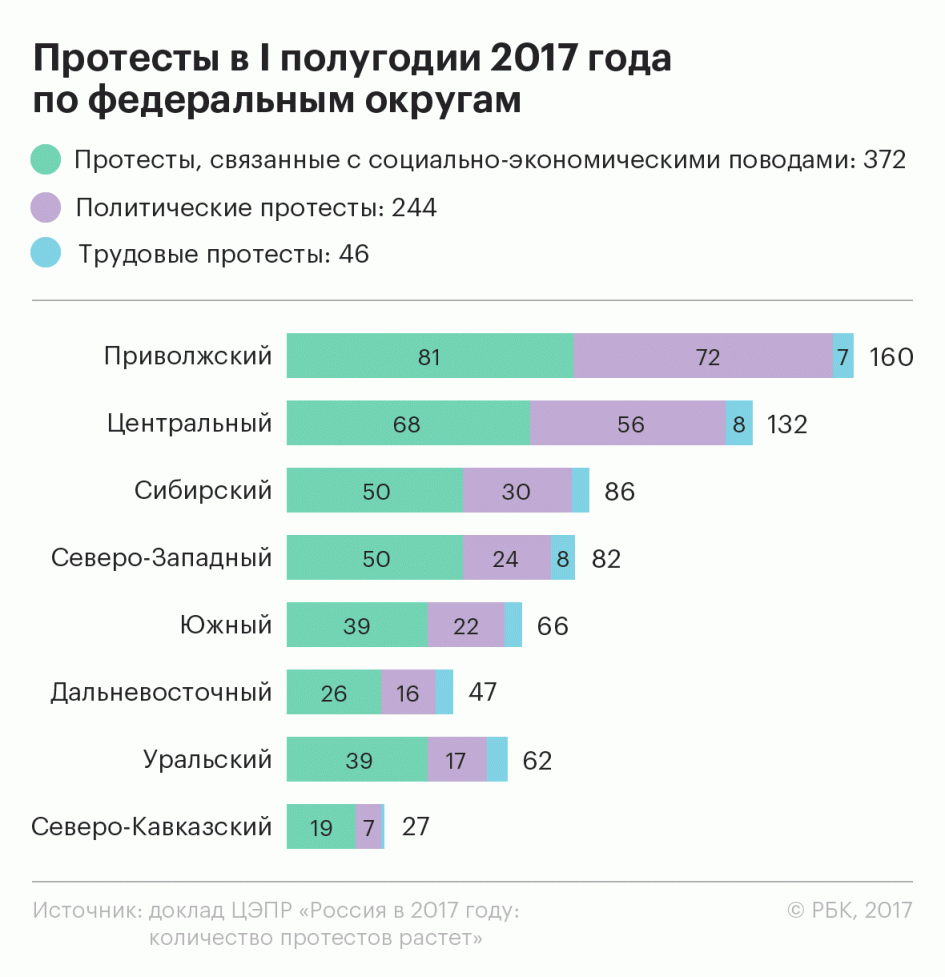
Protests in the 1st quarter of 2017 by federal district. [Green] Social protests: 472. [Violet] Political protests: 244. [Light blue] Labor protests: 46. Volga Federal District: 160 protests. Central Federal District: 132 protests. Siberian Federal District: 86 protests. Northwest Federal District: 82 protests. Southern Federal District: 66 protests. Far Eastern Federal District: 47 protests. Ural Federal District: 62 protests. North Caucasus Federal District: 27 protests. Source: Center for Political and Economic Reform, “Russian in 2017: The Number of Protests Grow.” Copyright RBC, 2017

It would be wrong to say there have been considerably more social protests in recent months, argues Mikhail Vinogradov, head of the Petersburg Politics Foundation, based on the results of his own research. According to Vinogradov, the number of political protests has increased mainly due to protests by Navalny’s supporters, but the number of social protests has remained at the same level. It would also be wrong to say the number of social protests depends directly on how the authorities resolve the issues that provoke them, says Vinogradov. According to him, the authorities do not have an overall algorithm. In some locales, they resolve issues immediately, fearing protests, while in other places they ignore problems or get bogged down in talking about them. The problem is that the authorities are not always able to determine the real cause of protests and react correctly to it.

Discontent is growing, but the majority of protests remain local for the time being, argues political scientist Konstantin Kalachev.

“The regime is fairly good at solving problems by nipping them in the bud,” argues Kalachev.

Although we cannot be sure social protests will not segue into political protests.

“For the time being it all comes down to demands to dismiss one governor or another, nothing more,” says Kalachev.

Translated by the Russian Reader