Minnesota Now, the U.S. Then and Now

I want to try and describe what it is like in Minnesota right now for my friends in other states. As a reminder, Alyse and I live in the suburbs — Apple Valley — not Minneapolis. This federal invasion and occupation is occurring all across the state, not just in Minneapolis.

ICE is not looking for specific people. They don’t have a sheet of paper with specific names, specific addresses, that they are arriving in communities to get. They drive around looking for kidnappings of opportunity.

So they will sit and idle in their car, waiting for a Black, brown or Asian person who is walking into the gas station, taking out their trash, walking their dog, or working at their job and then swarm and grab them.

ICE drives around *incredibly recklessly* and uses license plate readers to find people with mostly-Hispanic sounding last names, pulls them over, and kidnaps them. Again, these aren’t specific people ICE has been tasked with finding. Most of the people who are kidnapped are U.S. citizens, lawful permanent residents, or have legal status of some sort (work permit, a social security number, or are a refugee or asylee) (picture 1). These are documented immigrants or citizens who have broken no laws — including not having broken laws entering the country. These are people just going about their daily life who get stopped and snatched because they’re Black, brown or Asian.

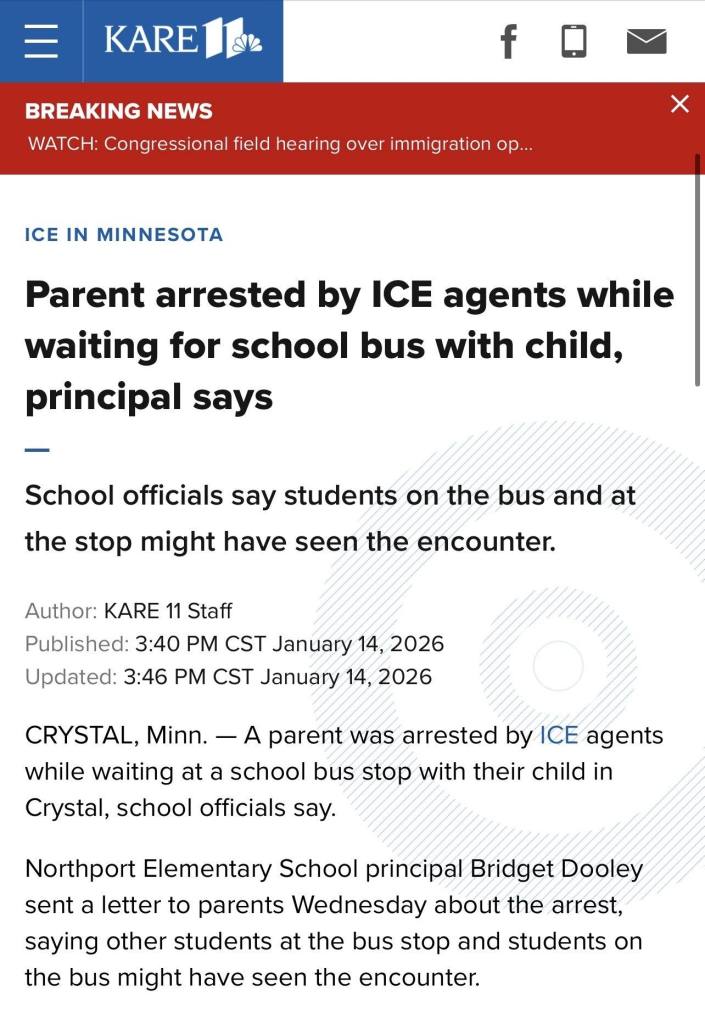
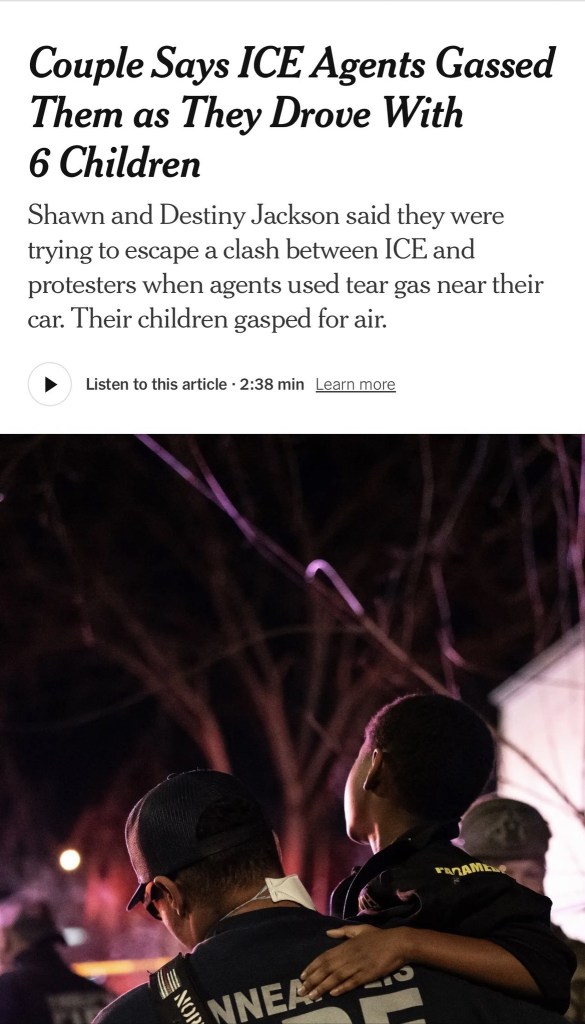
Just going about OUR daily life, we see abandoned cars in the middle of highways, on neighborhood streets, in front of doctors offices. Sometimes the doors are still open and the car is still running. We could be in line to get Burger King and watch ICE snatch a teenager on his way into work (picture 2). We could be taking out the trash, walking kids to the bus stop, going for a walk outside, and there will all of a sudden be a swarm of anonymous, masked, violent men ripping a family from their home or out of the booth at a restaurant. Picture 3 is a neighborhood, one mile from my house, at 8:30AM this past Wednesday. It was school bus pick up time and also trash day in that neighborhood. This is just in the middle of the neighborhood.

This can happen any where at any time. There is no place we can go and be assured we won’t see someone be violently taken. Target. The grocery store. A restaurant. Driving Hattie to swim lessons. Driving to church. Going to the doctor (picture 4). Multiple times a day, we get texts from co-workers, neighbors, friends, family members about a person they know (or are related to, or work with, or are their kids’ friends parents) who was taken.

ICE sets up checkpoints in neighborhoods and make everyone leaving or entering show their papers (note: very few people can prove their citizenship at a moments notice. A majority of Minnesotans don’t have passports. Citizens don’t just carry their birth certificate around). They go door-to-door in apartment buildings and neighborhoods, just hoping a Black, brown or Asian person will open their door (because they have no judicial warrant to take a specific person(s), just kidnapping whoever accidentally opens their door).

Schools have had to close. ICE has shown up to schools and just pepper sprayed kids and parents (picture 5). Districts are calling families and advising that their kids switch to online school. ICE circles and targets Spanish-immersion programs, forcing moms and dads to sit watch over their kids’ school to keep their kids and teachers safe (picture 6). Kids come home from school to empty houses, their parents having been stolen sometime during the day. When parents are kidnapped in front of others, they will yell out their full names and the name of their kids’ school(s) so someone can call the school and alert the administration, hoping their kids can be put with a safe adult instead of coming home to no one. There are people who signed delegation of parental authority (DOPA) forms — agreeing to take a neighbor or friend’s kids in the event of an emergency — who now have multiple children from multiple families.

ICE is ubiquitous. They are everywhere. We see them 3, 5, 7 times a day just going through our normal routine. There are more federal agents in Minnesota than there are local law enforcement from the ten largest metro police departments COMBINED (picture 7).

This is going to come to other states and I want people to be prepared, because I cannot overstate how many people have (had to) come together to respond.

Regular Minnesotans — people who have never once gone to a protest, called their elective representatives, participated in an economic strike, people who rarely even vote — have been activated. Grandparents carry whistles in their cars in case they come across ICE while living their lives and need to warn the surrounding area. Parents of kids in K-12 organize to ensure there’s parents at bus stops and the area around schools, because ICE stakes out bus stops and school properties — taking parents who are waiting at the bus stop or in the carpool line (picture 😎. We’ve set up massive food donation and delivery infrastructure. We organize rides to school and work. People are literally taking in families.

SO many kids aren’t going to school right now (picture 9). So many businesses are closed or have lost their customer base entirely. So many families are facing eviction because they can’t go to work and won’t be able to pay their rent.

Minnesotans are being collectively punished and traumatized. 6 month old babies have been teargassed because their parents are just driving in their own neighborhood (picture 10). We are coming together in the most beautiful ways — I don’t want to understate that. But I want everyone outside of Minnesota to understand: we are under a federal invasion and occupation of armed, masked, paramilitary that roam our streets, brutalizing, harassing and murdering with impunity.

There may be people who might think that when this comes to your state, being white or being a U.S. citizen or living in a suburb or rural area or living in a neighborhood with few or no immigrant neighbors means you won’t see or experience this kind of daily assault of an invasion and occupation. I want to dispel that idea.

There are things I’m forgetting, certainly, but I wanted to try and paint the picture because this isn’t ending in Minnesota. We are the test case before expanding to other states in the country.

Help us now to stop this before it spreads. Organize in your communities now.

To support MN’s during this time, donate here: http://standwithminnesota.com/

Source: Erin Maye Quade (Facebook), 18 January 2026. Thanks to Rahul Mahajan for the heads-up.


On January 7 U.S. Immigration and Customs Enforcement (ICE) agent Jonathan Ross shot and killed Renee Good, a thirty-seven-year-old woman who had been observing ICE raids from her car in her Minneapolis neighborhood. In videos of the incident, we can see Ross firing through Good’s windshield and open window as she begins to drive away. The horrific footage of the killing felt like a stark symbol of today’s authoritarian moment—but at the same time, I knew that anyone involved in the struggle against police violence would find it tragically familiar.

To put Good’s killing in context, I spoke with historian and Boston Review contributing editor Robin D. G. Kelley, whose forthcoming book, Making a Killing: Capitalism, Cops, and the War on Black Life, covers the history of county, state, and municipal police violence—as well as the activism against it. In an email exchange, we discussed the pitfalls of the “perfect-victim narrative,” policing’s terror tactics, why agents don’t need more training, and where we go from here.

Deborah Chasman: Good’s killing shocked Americans. But much about it reflects violence that’s very familiar to you. Can you put the murder in the context of your research?

Robin D. G. Kelley: Despite having spent more than thirty years studying and writing about police violence, I am still shocked by every death—even when the outcome is predictable. But the killing of Good shocked even the most seasoned organizers. She was a white woman and a mother—two things you’re not supposed to be when armed agents of the state put you in a body bag. (That she was queer and a poet, not so much.)

Of course, the very idea that certain people, by virtue of their characteristics, don’t deserve to be brutalized, caged, or killed by police is the problem. Mariame Kaba warns against “perfect-victim narratives,” which reinforce what Ruth Wilson Gilmore calls “the problem of innocence.” Centering someone’s innocence clouds the case for abolition, which seeks to create a world where no one is caged or gunned down even if they broke the law. No matter who she was, what she looked like, her marital or citizenship status, or what she might have done in the past or even in the moment, Good had the absolute right not to be shot for driving away.

What doesn’t surprise me is why and how Jonathan Ross shot her and the federal government’s efforts to cover up what happened. Researching Making a Killing, I found too many incidents to count where police fatally shot people for attempting to drive away. These were not high-speed chases, by the way—sometimes it was just a car lurching forward or an engine revving up that prompted a shooting. They all have one thing in common: police justify the shootings as acts of self-defense. The alleged “suspect,” the story goes, intended to ram the officer, who opened fire because he feared for his life. After these shootings, cops rarely argue they were simply trying to stop a fleeing suspect, because it opens them up to two objections: that firing at a driver puts others in harm’s way, and that they could have taken down the license plate and pursued the person later. Fearing for one’s life is always used to absolve cops from having to explain why they didn’t act differently.

This is why, in videos of the moments before the shooting, we can hear Good’s wife Rebecca saying, “We don’t change our plates every morning, just so you know. It will be the same plate when you come talk to us later.” And this is also why, for many years and in different cities, movements fighting police misconduct demanded that officers be banned from using lethal force against fleeing suspects who do not pose an imminent threat, whether on foot or in a car.

I’m also not shocked by the utter refusal of the federal government to investigate or consider bringing charges against Ross. I’ve lived through and documented so many cases of officers whose egregious acts of violence led to no indictments and no investigations; so many cases of police and even prosecutors destroying incriminating evidence. The question is, why are so many people surprised and indignant about the feds’ unqualified defense of Ross? Maybe because we’ve fallen into the trap of distinguishing ICE and CBP (bad) from local police (good). Maybe it’s a residual effect of the January 6 insurrection, in which some police officers had been victims of right-wing mobs (which themselves included a disproportionate number of cops and soldiers). In any case, the narrative has taken hold that ICE agents are rogue cops or cops on steroids, trained to terrorize or simply untrained. Strangest of all in this story is the liberal pipe dream that local police will stand up against ICE and CBP, when police have collaborated with ICE and been deployed to protect agents from protesters, even in so-called sanctuary cities.

I’m not sure if it’s amnesia or just wishful thinking, but it seems like the well-documented terror tactics of municipal, county, and state police have just disappeared from people’s memory. Chicago and Los Angeles, where resistance to ICE has been extraordinary and well-organized, have histories of police violence that rival anything ICE agents are doing. Indeed, it is precisely the long experience of organizing against this violence that prepared activists in these cities to resist ICE.

Chicago, which takes up a very long chapter in my book, is known for police torture, the maintenance of secret “black sites,” assassinations and executions, and prosecutors who have consistently protected police even to the point of hiding evidence. This is the city where the second Black police superintendent, LeRoy Martin, bragged in 1987, “When you talk about gangs, I’ve got the toughest gang in town: the Chicago Police Department.” And it is the same city that has been a model of resistance to police repression for more than half a century, culminating in the collective struggles for justice for Rekia Boyd, Laquan McDonald, and victims of torture that brought down the ruling regime of Rahm Emanuel.

This is not to diminish ICE and CBP’s violent tactics. These outright abductions are terrifying, though again, not without precedent. Police have abducted Black men standing on a street corner or a stoop and tossed them into unmarked vans just for looking suspicious, and there are numerous cases of young Black women abducted off the streets and sexually assaulted by police. But there is a fundamental difference between these abductions and ICE’s: the former were intended to be secret, the latter publicized. ICE and CBP agents are either filming these acts of terror themselves (Ross had one hand on his gun and the other holding his cell phone to film!), or they are arriving with a film crew. The point is to create fear, to terrorize people into submission, to create a state of emergency.

Finally, let’s try not to make these attacks about Trump or even Stephen Miller. Both ICE and CBP have histories of violence dating back to well before 2016. My colleague Kelly Lytle Hernandez has written on the history of the Border Patrol, which has been terrorizing people since 1924.

DC: Republicans and right-wing pundits have been relentless in blaming Good for her murder, or calling her a domestic terrorist and warning that any activism will put you in harm’s way. Clearly there’s a legal element to blaming Good—it’s meant to exonerate the agent. But how do those narratives function politically?

RK: Anyone organizing against state power will be a target, whether their protest abides by the law or involves civil disobedience. Either way, nothing justifies the harm, which is what these narratives attempt to do. Just last night, after ICE shot another person in Minnesota and protesters were in the streets battling federal agents, there was a lot of talk—including from Governor Tim Walz and Minneapolis Mayor Jacob Frey—about the need for peaceful protest: code for candlelight vigils and silent prayer. Militant civil disobedience, aggressively confronting a phalanx of masked agents in riot gear, or blocking traffic is nonviolent, but these tactics are not considered by the political class to count as “peaceful protest.” And by now, it should be clear that peaceful protest, whatever form it takes, will not get ICE or CBP out of your city; it will not stop the terror or the abductions.

And yet, when we return to Good’s death, we must remember that she actually wasn’t protesting. She was a legal observer doing her job, and when told to leave she was complying. Unsurprisingly, J. D. Vance and all the right-wingers who blame Good for her death are simply lying. Calling her a domestic terrorist—it’s the oldest trick in the book. The subtext to which we ought to pay attention is how her gender and sexuality constituted the real threat to Ross, his fellow agents, Vance, Stephen Miller, and MAGA. One must imagine what it meant to Ross for a smiling queer woman to tell him, “I’m not mad at you.” After shooting her three times, Ross or an agent near him mutters, “Fucking bitch!” That says it all.

Nearly every victim of an ICE or CBP shooting is blamed for being either a fugitive or domestic terrorist. When ICE agents fatally shot Silverio Villegas-González, a thirty-eight-year-old immigrant from Mexico, as he tried to drive away from what amounted to an ambush in Chicago, DHS released a brazenly false statement claiming that he “refused to follow law enforcement officers’ commands” and used his car as a weapon, hitting and dragging one of the officers. And so the same old story goes: “Fearing for his own life and broader public safety, the officer fired his weapon.” We know now that no officer was hit or dragged, and the one officer allegedly hurt suffered minor cuts from breaking Villegas-González’s window.

Likewise, when CBP agents shot Marimar Martinez, a thirty-year-old schoolteacher and U.S. citizen—also in Chicago—they labeled her a domestic terrorist and charged her with ramming a federal law enforcement officer. We know now that the agent, Charles Exum, rammed her vehicle, jumped out with his gun drawn, and said “Do something bitch” before shooting her five times. The DHS lies were so egregious (and Exum didn’t help their case by bragging about it in text messages) that the prosecution had no choice but to drop all the charges.

DC: In the wake of Good’s murder, many have called for better training for ICE officers—a response that activist Kelly Hayes, among others, has forcefully rejected. I know you agree. Can you explain why?

RK: Jonathan Ross wasn’t one of those cats recruited with a $50,000 bonus and handed a gun. Besides being a veteran of the Iraq war, he had spent a decade as a member of the special response team of ICE’s enforcement and removal operation. He got more training than most of the other masked goons running the streets of the Twin Cities. The argument for more and better training was thoroughly discredited after George Floyd’s murder in 2020. As it turned out, Derek Chauvin had lots of training: he had taken the crisis intervention training, use-of-force training, de-escalation vs. restraint training, and even training in implicit bias, which became mandatory for Minneapolis police officers beginning in 2018. The result? Chauvin racked up seventeen misconduct complaints over nineteen years on the force. And after 2018, cases of police brutality and excessive force complaints increased across the city.

But if training hasn’t worked, why does it continue? Why is it always trotted out, alongside new technologies, as the solution? Because training and technologies (body cams, Tasers, so-called less-than-lethal weapons, predictive policing software) are a boondoggle for corporate interests. Training costs money, which increases police budgets, which are paid for through taxes and bonds—a hidden source of revenue for financial institutions that administer the bonds. The money for training flows to private companies, usually run by former police chiefs and so-called criminal justice experts—not community organizations that have been fighting for accountability. Sometimes the investment in new technologies and training comes from corporate-funded private police foundations, whose donations enable departments to purchase equipment, such as surveillance technology, guns, ballistic helmets, cameras, and drones, and assist officers with bonuses or legal fees, with no oversight or public input. But corporations like Amazon and Google get a great return on their investment since law enforcement agencies adopt technologies of surveillance, data mining and management, etc., coming from these companies.

To understand what “training” produces, let’s focus on one company: 21st Century Policing Solutions, LLC (21CP), which grew directly out of an Obama-era task force formed in late 2014 after the killing of Michael Brown. 21CP is made up of law enforcement officials, lawyers, and academics, and it’s paid by municipalities and university public safety forces to train police in a host of areas: gaining community trust, racial equity, changing use-of-force policies, communication, transparency, strategic management, and community policing. Usually, this work entails producing reports that ultimately just repeat boilerplate recommendations. Oklahoma City paid 21CP $193,000 for a report many Black residents found to be useless—nothing changed. Aurora, Colorado, paid 21CP $340,000 to “investigate” the police missteps that resulted in the death of Elijah McClain, a young Black man who had been injected with ketamine under police custody and died. 21CP produced a 161-page report that primarily described the operations of the Aurora Police Department, compared it with other departments in similar-sized cities, repeated what we all know about the death of McClain, and offered obvious and fairly innocuous recommendations: prohibiting chokeholds, retaliatory violence, using force on people who are handcuffed—in other words, prohibiting behavior that is already prohibited. And worse, these reports often suggest recruiting and training more officers. I want to suggest that when we talk about training and technology, we need to follow the money. And in the case of CBP and ICE, the last thing we should be doing is proposing reforms that give them more money.

As the coercive arm of the state, the police—including CBP and ICE—are the primary instruments of state violence within the borders of the United States. They function as an occupying force in America’s impoverished ghettos, barrios, reservations, on the Southwest border, and in any territory with high concentrations of subjugated communities. For people who reside in these communities, keeping us safe is not the objective. Instead, the modern police force—whether local, state, or federal—wages domestic war. Whether we call it a war on crime, a war on militants, or a war on drugs, law enforcement at every level has turned many Black working-class neighborhoods in particular into killing fields and open-air prisons, stripping vulnerable residents of equal protection, habeas corpus, freedom of movement, and even protection from torture. The attack on non-white immigrants is just another front in a war the police have waged since their inception.

And despite the handwringing and outrage over the Trump administration’s flagrant violation of the Posse Comitatus Act of 1878 limiting the use of the military in domestic matters, the police have long functioned as an army against dissident social movements. The police are the first line of defense against strikes and left-wing protests, while often serving as a cordon to protect Klansman, Nazis, and the alt-right.

DC: What are the chances that Ross will be held accountable? How does this end?

RK: Simply put, Ross will not be held accountable, nor will anyone else responsible for the death or injury of victims of ICE or CBP attacks. As I document in my book, we can’t get accountability from the “regular” police, whatever that means: after decades, we haven’t been able to achieve something as basic as an honest civilian review board with subpoena powers and the ability to hire and fire officers! Since Trump’s second term, things have gotten even worse. Guided by the Heritage Foundation’s Project 2025, the Trump administration rescinded Biden-era police and criminal justice reforms; shuttered the National Law Enforcement Accountability Database (NLEAD) created in 2023 to allow prospective employers to access the records of federal law enforcement officers in order to check their backgrounds for misconduct; halted all open federal investigations into law enforcement, notably in Jackson, Mississippi, and New York City; ended federal consent decrees mandating reforms of Louisville and Minneapolis police departments; made the extraordinary offer of free private-sector legal services for officers accused of misconduct.

It is not enough to abolish ICE. We need to abolish the police and cages and build other institutions and relationships that can bring us genuine safety. Abolition is less an act of demolition than a construction project. It is creative creation, the boundless, boundary-less struggle to make our collective lives better, what Ruth Wilson Gilmore calls “life in rehearsal.”

Ironically, the federal government’s escalation of violence and its spillover into other communities have actually forced people to find their own strategies to keep each other safe, through communication, patrols, whistles, trainings in nonviolent resistance, and old-fashioned organizing. It’s not just about keeping ICE out, but making sure that the medical and child care needs of neighbors are being met, that people who can’t leave their homes out of fear are fed, and that some homes can become designated safe houses.

I’m reminded of a 2009 statement issued by the abolitionist organization Critical Resistance. Instead of police, the statement asks,

What if we got together with members of our communities and created systems of support for each other?. . . . Relying on and deploying policing denies our ability to do this, to create real safety in our communities.

We’re seeing this in action now in the mobilizations against ICE. The question is whether it can be sustained and turned into something that can replace our dependence on armed agents of the state to solve human problems.

Independent and nonprofit, Boston Review relies on reader funding. To support work like this, please donate here. Robin D. G. Kelley is Distinguished Professor and Gary B. Nash Endowed Chair of U.S. History at UCLA and a contributing editor at Boston Review. His many books include Freedom Dreams: The Black Radical Imagination. Deborah Chasman is publisher and coeditor of Boston Review. Her writing has also appeared in New York magazine and the Chronicle of Higher Education.

Source: Robin D.G. Kelley and Deborah Chasman, “Renee Good’s Murder and Other Acts of Terror,” Boston Review, 17 January 2026

Alexander Krichevsky of Izhevsk: Six Years in Prison for a Comment

Alexander Krichevsky. Photo: Mediazona

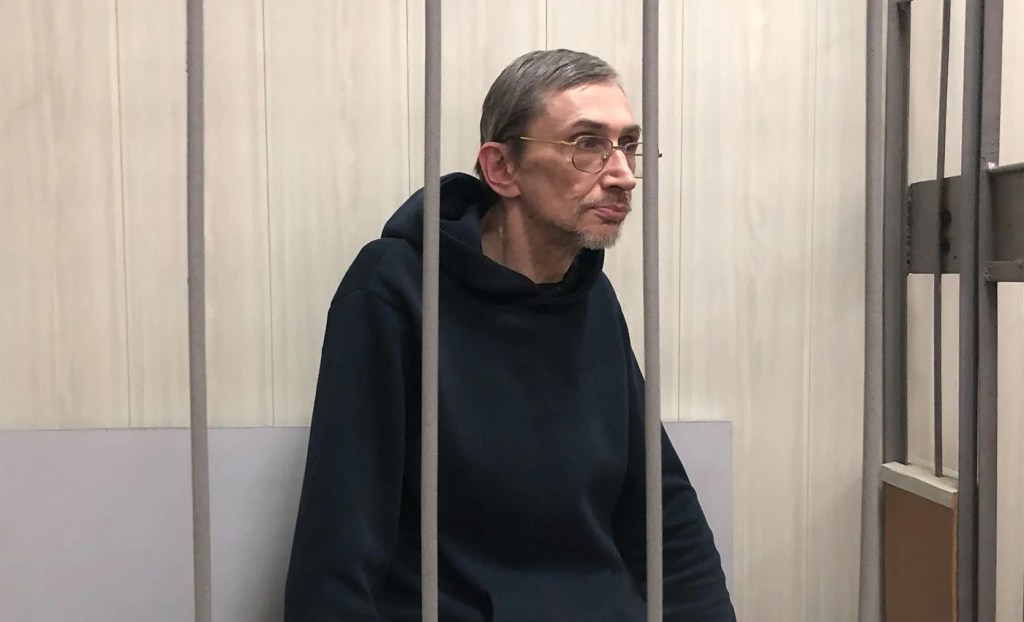
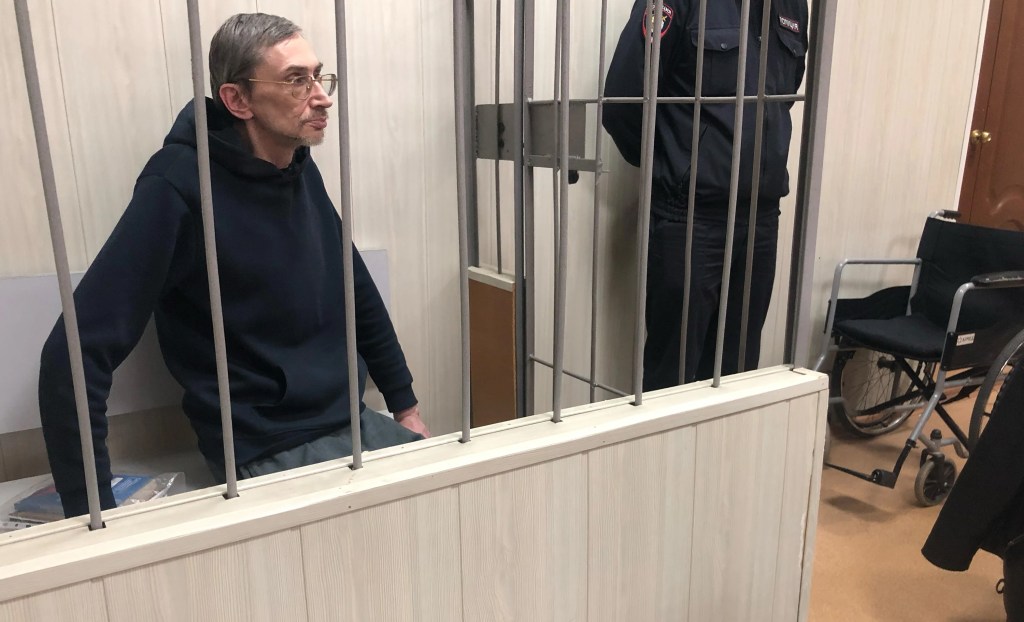
In September 2024, Alexander Krichevsky, a 58-year-old resident of Izhevsk, posted a lengthy comment on a Chechen opposition blogger’s Telegram channel. In the comment, Krichevsky compared Putin and the “FSB clique” to a “darkness” which must be destroyed. The security forces deemed this statement incitement to murder the president and FSB officers. They monitored the man and intercepted his internet traffic. Last December, Krichevsky was detained and remanded in custody to a pretrial detention center despite his ailments and the fact that he is confined to a wheelchair. His ailing mother was placed in a care home, where she died a month later. Today, at the Central District Military Court in Yekaterinburg, where Krichevsky’s case is being heard, the prosecutor requested that he be given the maximum sentence of six years in prison.

“That is why we listen to him, because he is not afraid—he’s a ray of freedom in a kingdom of darkness! And only together will we destroy this darkness, only when we understand that we have only one enemy—Putin and his FSB clique. . . . Both you and we must destroy this enemy to continue living as peaceful neighbors,” 58-year-old Izhevsk resident Alexander Krichevsky wrote in a chat on the channel of opposition Chechen blogger Tumso Abdurakhmanov aka Abu Saddam Shishani, on 11 September 2024.

This was Krichevsky’s response to a user who had asked Abdurakhmanov himself in a chat: “Tumso, aren’t you afraid that Kadyrov’s people might find you?”

When questioned in court, Krichevsky said that he was sure he was responding to the user personally, not writing in a public chat. He repeated many times that he had only figurative “destruction” in mind and had been trying to “reconcile” Abdurakhmanov’s readership by pointing out that they had only one enemy.

“Of course, I wasn’t even thinking about physically destroying such a large number of people and didn’t understand how [what I wrote] would even look. Apparently, my love for pretty words—all those rays of light and other nonsense—let me down. I was thinking in terms of games: when a person plays checkers or chess, they destroy their opponent’s pieces. Roughly speaking, that was the image I had in my head,” Krichevsky said in court.

The FSB operative who discovered Krichevsky’s comment saw it not as criticism alone, but also as a “public call to murder the president of the Russian Federation and officers of the Federal Security Service.”

The same conclusion was reached by Polina Komova, a philologist and expert at the Ministry of Internal Affairs Forensic Center in Udmurtia. She acknowledged in court that the word “destroy” could have other meanings “depending on the context,” but in her opinion it could be understood only in its literal meaning—that is, “to end [someone’s] existence, to exterminate”—in Krichevsky’s comment.

“He was planning a terrorist attack involving self-detonation”: wiretapping and arrest

The security forces began monitoring Krichevsky in early December 2024. It emerged in court that the FSB had requested data on his calls and connections from Rostelecom and learned that on 11 September, when he wrote the comment, he had accessed Telegram from home. Megafon provided the security forces with information about the base stations in the area where Krichevsky’s phone number pinged that day.

On 5 December 2024, the Supreme Court of Udmurtia gave the FSB permission to tap Krichevsky’s phones, and a few days later it approved “gathering information from technical communication channels and acquiring computer information.” A few days before Krichevsky’s arrest, operatives monitored his apartment to “document illegal activities.” The report states that Krichevsky did not leave his home.

On 19 December 2024, Krichevsky was detained and sent to a pretrial detention center. He described his arrest to journalists.

“There was a knock on the door at seven in the morning, and seven people came into [our] small flat: five FSB officers and two eyewitnesses. I opened the door myself. They immediately sat me down on a chair in the hallway. My ailing mother was lying there, barely alive. They said, ‘Can you hand over [your phone]?’ They tried to intimidate me once: ‘If you refuse, we’ll take you away and charge you with additional offenses.’ I realized that resistance was futile. I gave them the phone, and they looked at it and took what they needed.”

The social media comment charges against Krichevsky were accompanied by an FSB report containing much more serious, but in effect unproven, allegations. The document states that, according to “intelligence,” Krichevsky, who opposes the “state’s political course” and the conduct of the “special military operation,” supported radical Islamists fighting for Ukraine and was planning to convert to Islam and carry out a terrorist attack in Udmurtia “by blowing himself up with cooking gas.” The court never did hear what this report was based on.

Photo: Mediazona

“None of my comments or my own thoughts bear this out. When I heard this business about blowing myself up . . . In this case, everything that the prosecutor has just read aloud is pure speculation on the part of the investigators. None of my quotes corroborates it,” Krichevsky said in court.

Judge Alexander Raitsky simply reminded Krichevsky that the case centered on a single [social media] comment, which the defendant himself did not disput, and that the court would evaluate the evidence in the deliberation room.

The case file also contains another comment by Krichevsky from the same written exchange: “Many empires have collapsed in this world. I myself foresee the end of the Russkies [rusnya]. I don’t feel sorry for them: let them collapse with a bang. That’s where they belong. I myself hate these FSBniks, pigs [cops], and other scum who suck the blood of our homeland and shit on our neighbors.”

The security forces deemed this “a statement containing a negative assessment of the group of persons sharing the profession of Federal Security Service officers and police officers,” but it was not included in the indictment.

Responding to the judge’s question about this comment, Krichevsky said that he sometimes tried to “adapt” to the rude tone of the conversation [on the Telegram channel’s chat].

“My mother died four weeks after my arrest”: wheelchair-bound in a detention center

Krichevsky had worked as a systems administrator in Izhevsk before his arrest.

As a child, Krichevsky had moved with his family from Udmurtia to Rostov-on-Don. After high school, he enrolled in medical school, but in 1989 he broke his spine and had to drop out because his left leg was paralyzed and he had lost feeling in his right leg. After a long period of rehabilitation, he was able to walk again, but was unable to recover fully: he had a severe limp and had difficulty going up stairs.

Krichevsky said in court that his father had committed suicide on 11 September 2008.

“He had terminal cancer. He was in serious pain and turned to me because I was in medical school. He wanted me to tell him what poison he could use to commit suicide. I refused to do it. Then, two days before his death, I noticed he was sharpening a knife in an odd way. He died in a rather original way, if that word is appropriate in this situation—he stabbed himself in the heart with a knife,” Krichevsky told the court.

In early 2010, during a trip to Thailand, Krichevsky broke his left leg, which had been paralyzed since his [accident in 1989]. He underwent surgery at a local hospital, but he could not stay in hospital for long because his visa had expired. Krichevsky returned to his hometown of Izhevsk, where he underwent a second operation, but his condition only worsened.

“My knee wouldn’t straighten. They tried to do something about it, but because I had spinal injuries, my knee spasmed, and it remained crooked and they couldn’t do anything about it. And my hip didn’t recover either; I also had a fractured hip,” Krichevsky told the court.

Since then, Krichevsky has been confined to a wheelchair. Other ailments have also emerged: kidney problems, emphysema, and head tremors.

“I don’t know whether it’s early Parkinson’s combined with Alzheimer’s, or something else,” Krichevsky said.

Krichevsky had been living with his elderly mother and caring for her since 2016. Last year, she was hospitalized with a complex fracture. After she was discharged, she was unable to walk, and Krichevsky would help her to sit up and do breathing exercises in order to prevent pulmonary edema and bedsores. After Krichevsky was arrested, the woman was sent to a care home. She died of a pulmonary edema a month later.

“They apparently left her lying in bed at the care home. When a person lies in a horizontal position for a long time, they develop a pulmonary edema. That’s what my mother died of,” he said in court.

Photo: Mediazona

While in pretrial detention, Krichevsky formally lost his Group I disability status, which he had prior to his arrest, and so he was unable to obtain a medical examination.

According to Krichevsky, a neurologist at the Izhevsk detention center promised to send him to a hospital, but instead Krichevsky was transferred to another pretrial detention center. “I thought they were taking me to a hospital, but they took me first to Perm and then to Yekaterinburg. They basically lied to me when they said they were taking me to a hospital,” he said on the stand.

Krichevskny never did get any medical attention: “We’ll only help you if you’re dying, [they said.] Otherwise, just sit there and suffer.”

“Radical views and hostility toward the current government”: trial and pleadings

Krichevsky’s trial was postponed five times in a row: it took a long time to bring him in his wheelchair, first to Detention Center No. 1 in Yekaterinburg, and then to the court. He was brought to the hearings late, and had to spend four to five hours in the police van, where, according to Krichevsky, the temperature was the same as outside.

At the beginning of the trial, Krichevsky filed a motion requesting that he be assigned an inpatient forensic examination and treatment. He said that he had never been examined by a neurologist at the Yekaterinburg detention center, only by a GP. He was taken for examination to the local medical unit, which was not equipped for people with disabilities: there was a “big step” in front of the toilet and sink which he could not get over. As a result, the doctors only checked his reflexes and sent him back.

In their medical report, the doctors at the detention center stated that Krichevsky had no disability and that his overall health was satisfactory, meaning that he was able to take part in the court hearings.

Before the proceedings, Krichevsky again requested to be sent for treatment, “in accordance with the neurologist’s recommendation” in Izhevsk, but Judge Raitsky denied the request, seeing no need for it. Prosecutor Artem Terentyev also asked that the request be denied, as it went “beyond the scope of the criminal case under consideration.”

During the trial, the prosecutor asked that Krichevsky be imprisoned for six years in a medium-security penal colony. The prosecutor stressed that the defendant had “radical views” and was “hostile toward the current government of the Russian Federation and its officials,” and that he had written the offending comment at a time when the mobilization had not yet been completed. The prosecutor considered these to be aggravating circumstances.

The prosecutor cited Krichevsky’s “poor health” as a mitigating circumstance.

You can support Alexander by writing him a letter.

Address:
Russian Federation 620019 FKU SIZO-1, GUFSIN of Russia for the Sverdlovsk Region • Sverdlovsk Region, Yekaterinburg, Repin Street, 4 • Alexander Anatolyevich Krichevsky, born 1967

You can also send letters through the online service Zonatelecom.

Source: Vasily Besspalyi, “Wheelchair user from Izhevsk sentenced to six years in prison for comment about Putin; his mother, sent to nursing home after his arrest, dies a month later,” Mediazona, 22 December 2025. Translated by the Russian Reader. Since letters to Russian prisoners are vetted by prison censors, they must be written in Russian or translated into Russian, something that can done more or less handily using an online machine translator like Google Translate. Please write to me if you need help or advice. ||||| TRR

Free Daria Egereva!

Brothers and sisters, colleagues,

I reach out to you in anger and pain concerning the arrest of my sister and colleague Daria Egereva and the new, large-scale crackdown against representatives of Russia’s Indigenous Peoples. Phrases like “isolated incident” or “local overreach” do not describe what is happening today. This is a deliberate, targeted state policy of intimidating, suppressing, and criminalizing Indigenous leaders, of destroying the will of our peoples.

I speak about this not only as a member of the UN Permanent Forum on Indigenous Issues but also as someone who has fallen victim to this crackdown myself. On 17 December 2025, my home in the village of Lovozero was searched. Security forces broke into my personal space and confiscated computer equipment, communication devices, and documents. Similar searches and interrogations took place in the homes of other Indigenous minority activists throughout Russia. It was a planned, well-coordinated campaign of intimidation.

This is not a new reality for us. Back in 2014, I and other representatives of Indigenous Peoples were persecuted by the security forces for trying to convey the truth about the circumstances of Indigenous Peoples in Russia to the international community when we were prevented from leaving the country to attend a UN conference. Today, this practice continues in a much more brutal form, and it has been happening across the country. Crackdowns against the people involved in the events in Baymak, criminal cases against Erzya activists, and the detention of social movement activists in the Altai Republic are just recent examples of how the state has been trying to destroy the independent voice of the peoples of Russia.

Indigenous human rights activists have been labeled “extremists” and “terrorists” simply because they have used peaceful means to defend their peoples’ rights to their traditional lifestyles, cultures, languages, and basic human dignity. This is punishment for those who are not afraid to speak the truth openly, including outside their country, at the UN and other human rights forums.

Particularly outrageous is the fact that the Russian authorities accuse activists of terrorism, a crime for which Russia today imposes monstrous sentences of fifteen to twenty years in prison on people who have not committed violent acts and have never called for violence. These sentences are not intended to “combat terrorism” but to intimidate. The Russian authorities have laid their hands on those who have led a traditional way of life for centuries, herding reindeer, fishing, hunting, and foraging for wild plants on their own land, thus preserving their knowledge of Nature bit by bit.

We must not mince words: this is not a fight against terrorism, it is political vengeance. It is direct punishment by the state for the fact that representatives of Indigenous Peoples dare to appeal to the UN, speak out about violations of their rights, take part in the work of international bodies, and tell the truth about what is happening in Russia. The Russian authorities are deliberately criminalizing the very idea of cooperating with the United Nations.

There is virtually no room left in today’s Russia for free and independent opinion. Any criticism, any dissent, any independent social activism is harshly squashed. It is particularly cynical that the blow is being dealt to the most vulnerable—to the Indigenous Peoples of Siberia and the Arctic, who are socially disadvantaged, dwell in remote settlements amid harsh natural conditions, have no political clout, and are invisible to “mainstream society.” Our peoples cannot defend their rights except through international law, and nd that is precisely why we are being punished today.

I would particularly like to emphasize the Russian state’s profound hypocrisy. While formally declaring its commitment to protecting the rights of Indigenous Peoples, it has been systematically destroying independent Indigenous Peoples’ organizations for many years by persecuting their leaders and using state-controlled structures such as RAIPON and councils attached to regional governments as puppets on the international stage. These puppets do not represent the real interests of Indigenous Peoples, serving only as a front for repressive policies and a means of propagandizing the “happy lives” of our peoples in Russia.

What is particularly cynical about the current developments is that just recently, in November 2025, Vladimir Putin decreed April thirtieth “Russia’s Indigenous Minorities Day” and September eighth “Languages of the Peoples of Russia Day,” and declared 2026 “Peoples of Russia Unity Year.” While the Kremlin announces celebrations and talks about “supporting” our peoples, the searches, interrogations, and arrests of their leaders continue at the local level.

I appeal to states, UN bodies, special procedures, international human rights mechanisms, international Indigenous peoples’ networks, and civil society organizations. A clear, principled, and public position is what is needed today. We must demand the immediate release of Daria Yegereva and the other activists who have been detained, as well as the immediate cessation of all forms of repression, criminal prosecution, and pressure against representatives of the Indigenous Peoples in Russia. We must demand an end to criminal prosecution for engaging in peaceful human rights work and cooperating with the United Nations.

For my part, I intend to raise this issue at the UN Permanent Forum on Indigenous Issues and other UN bodies. I will seek international condemnation of what is happening, protection for those who have been illegally persecuted, and attention to the gross and systematic violations of the rights of Indigenous Peoples in Russia.

In conclusion, I would like to address Daria personally.

Dasha, sister, you are not alone. Your courage and your voice have struck fear in those who are used to acting in silence and with impunity. We are with you, and we speak out and demand justice! The solidarity of Indigenous Peoples is stronger than prisons and political crackdowns. We are in this together!

Valentina Sovkina, member of the United Nations Permanent Forum on Indigenous Issues (UNPFII)

Source: Valentina Sovkina (Facebook), 22 December 2025. Valentina Sovkina is a Russian-Sami politician and chair of the Kola Sámi Assembly. Thanks to Comrade Koganzon for the heads-up. Translated by the Russian Reader


For Immediate Release

19th December 2025

The International Indigenous Peoples Forum on Climate Change (IIPFCC) condemns the wrongful arrest of IIPFCC Co-Chair, Daria Egereva, and demands her immediate release.

Daria Egereva speaking into a conference microphone. Photo courtesy of L&DC

Daria Egereva is a Selkup Indigenous person of Russia and a long-time member of the Centre for Support of Indigenous Peoples of the North (CSIPN). After many years of valued involvement in the Indigenous Peoples’ Caucus at the UNFCCC, she was elected Co-Chair of the IIPFCC in 2023. 

On December 17th, Russian authorities searched Ms. Egereva’s home, confiscated her digital devices, and arrested her under accusation of participating in a ‘terrorist organisation’ in direct retaliation for her Indigenous rights advocacy, including her leadership of accredited Indigenous Peoples at last month’s COP30 United Nations Climate Conference in Belém, Brazil.

A court hearing held on December 18th determined that Ms. Egereva will continue to be detained for two months, pending a further investigation into her case. The accusation carries a potential prison sentence of 10 to 20 years. 

“For the last three COPs, Daria has been foundational to the effectiveness of the IIPFCC. Not only a principled leader, she is warm and generous to friends and colleagues alike. Her arrest is completely unfounded and our whole caucus is very concerned for her,” says Dr Graeme Reed, former IIPFCC Co-Chair

Ms. Egereva’s arrest was part of a coordinated operation by the Federal Security Service of the Russian Federation (FSB), which targeted at least seventeen Indigenous leaders across Russia whose homes were raided, electronic devices confiscated, and who were accused under spurious terrorism-related charges. 

This targeted attack on Indigenous leaders represents direct retaliation for their participation in United Nations processes, and sets a dangerous precedent for the treatment of Indigenous Peoples who participate in global human rights and climate change meetings. 

“These reprisals are part of a broader pattern of repression affecting Indigenous Peoples across the globe, and are an unacceptable attack on the right of Indigenous Peoples to engage in the global human rights and climate change processes,” says Sineia Do Vale, Ms. Egereva’s fellow Co-Chair, IIPFCC

The IIPFCC is deeply concerned for Ms. Egereva, and calls upon all state parties to the UNFCCC, and all allies of Indigenous Peoples to mobilise in solidarity to:

1. Publicly and privately call for Ms. Daria Egereva’s immediate release and the dropping of all charges against her, which constitute an illegal retaliation for her legitimate and peaceful participation in COP30 and other UN processes.

2. Acknowledge and register this complaint as a case of intimidation and reprisal connected to participation in UNFCCC processes under the Code of Conduct for UNFCCC Events, and keep the IIPFCC informed of steps taken.

3. Raise this case without delay with the Government of the Russian Federation through appropriate diplomatic channels, stressing that criminalizing a UNFCCC Indigenous Co-Chair as a ‘terrorist’ is incompatible with the UNFCCC Code of Conduct and with Human Rights Council resolutions/determinations.

“This is not a prosecution of terrorism. It is a defiance of the Human Rights Council’s findings and an attempt to use domestic courts to override international human rights determinations and silence Indigenous Peoples.”

– Joan Carling, Executive Director of International Peoples Rights International

“Around the world, Indigenous leaders face criminalization, persecution, and judicial harassment mechanisms designed to silence our voices, dismantle our institutions, and weaken our collective efforts to defend our rights and territories. These targeted practices constitute serious violations of human rights and international law.”

– Hindou Oumarou Ibrahim, Vice Chair of the UN Permanent Forum on Indigenous Issues and former Co-Chair of the IIPFCC

The IIPFCC firmly rejects this unjust intimidation and detention. We stand with Daria, the other Indigenous leaders who have been detained, their families, and all Indigenous defenders whose safety, dignity, and freedom are under threat.

The IIPFCC echoes the messages of the ICIPR, and recommends reviewing their statement here for further details.

Contact: ipofocalpoints@gmail.com

About the IIPFCC: The International Indigenous Peoples Forum on Climate Change (IIPFCC) was established in 2008 as the caucus for Indigenous Peoples participating in the UNFCCC processes. It represents the collective positions of Indigenous Peoples from all seven socio-cultural regions.

Source: International Indigenous Peoples Forum on Climate Change (IIPFCC)

The Intensifying Crackdown in Russia

Varvara Volkova

“My friends died at the hands of Russian soldiers. Why can’t I talk about it?” 

This question will cost Varvara Volkova 7 years in a Russian penal colony. Here’s her story.

Varvara was a flight attendant, not an impassioned political activist. In a neighbourhood chat, she stated the obvious: Russian forces are killing civilians in Ukraine. The prosecution framed it as “fake news” motivated by hatred toward the armed forces, and the court accepted it.

The mechanism used to go after her relies on a Soviet-style culture of snitching: a Russian tank driver complained about her comments, then a professional informer, who intentionally hunts dissidents, amplified the case and demanded she be jailed.

In fact, there’s a whole network of these informers — they call themselves “SMERSH.” For those who don’t know Russian history, it is a reference to Stalin’s WWII counter-intelligence service. It means “Death to Spies” — a direct revival of the terror methods of the 1930s. They published screenshots of her messages everywhere trying to ruin her life; claimed she called the soldier a “fascist”; said she offered to make tea for Ukrainian soldiers if they reached the Moscow region. For words spoken in anger, the system decided to smash her life to pieces.

There is a grim irony in this tragedy: the regime destroyed Varvara to protect the “honor” of the military and her accuser. But the tank driver who reported her is already dead: he was killed in the war earlier this March. 

Observers abroad often underestimate the price of resistance in today’s Russia. It is not just a fine anymore, but years and years of one’s life. Varvara Volkova shows us the true bill — and it is devastating. 

I track the consequences of speech in modern-day Russia, make sure to follow for more updates.

Source: Khodorkovsky Communications Center (Facebook), 25 November 2025


Preface by the Editorial Board: Below we publish the translation of an article of our Russian comrades about state repression in their country. The article reports, among others, about the situation of comrade Felix Eliseev. He has been in prison for 2.5 years as part of a 14-year prison term. Felix was sentenced for “treason” as he was accused of making propaganda against Putin’s imperialist war against Ukraine and sending money to Ukraine to buy weapons. While the prison authorities do everything to break him, Felix does not lose his spirit and endures his imprisonment stoically. (See https://www.thecommunists.net/rcit/felix-eliseev-a-revolutionary-communist-in-russian-prison/)

We call readers to support Felix by spreading this information about a communist and anti-fascist serving an unjust sentence!

You can also support Felix financially at www.paypal.me/irinablackbook, with the note “for Felix”.

* * * * *

According to the human rights organization Memorial, there are currently over 1,000 political prisoners in Russia, while other groups estimate the number could be as high as 2,500. This number is three times higher than in 2020, more than twice as high as in 2022, and continues to grow. In 2025, there was a sharp increase in criminal cases under articles on “justification of terrorism,” “sponsoring terrorist activity,” and “treason.” This is not due to increased terrorism, but to the fact that the security forces, having perfected their repression mechanisms, have begun to intensify their crackdown on “sponsorship” cases, such as those of the FBK (Anti-Corruption Foundation, recognized as an extremist organization in Russia) or cases related to money transfers to the Ukrainian army, which occurred back in 2022. The term “terrorism” itself has become so vague that even the average person doesn’t always understand what it actually means.

Among political prisoners are many individuals with progressive leftist views, serving time for anti-war activities or “inaccurate” public statements online. The “Foundation for Support of Left-Wing Political Prisoners” provides support to at least some of these individuals. Among them are: defendants in the “Tyumen Case”; defendants in the “Chita Case”; Anton Orlov, a trade union and leftist activist, coordinator of the independent medical workers’ union “Action” in Bashkortostan; Daria Kozyreva, an activist from St. Petersburg known for her anti-war protests and criticism of the Russian army; Gagik Grigoryan, a young activist imprisoned in 2023 at the age of 17; Azat Miftakhov is a Russian mathematician and anarchist, sentenced in 2021 to six years in prison for allegedly setting fire to the United Russia office in 2018. After serving this sentence, he was arrested again in 2023 on charges of “justifying terrorism” in a private conversation with a prison cellmate and sentenced to four years in prison; defendants in the “Kansk teenagers case”; defendants in the “Network case”; Boris Kagarlitsky is a left-wing publicist known in many parts of the world; Ruslan Ushakov is the author of articles published on opposition Telegram channels, sentenced to eight years in prison for posts in a public chat.

The case of the communist Felix Eliseev

Another political prisoner is Felix Eliseev, a Russian communist, blogger, and administrator of the Telegram channels “She Fell Apart” and “Kolkhoznoye Madness.” He was arrested in December 2022 and charged with justifying terrorism. According to investigators, Eliseev posted two anti-war posts on his Telegram channel, one of which endorsed a Ukrainian Armed Forces helicopter strike on an oil depot in Belgorod. The charges were later upgraded, and Eliseev was charged with “treason”. The court alleges that he transferred funds through a cryptocurrency account to a “curator,” who used the funds to purchase equipment and weapons for Ukrainian Armed Forces soldiers.

Felix, like many other political prisoners convicted of “terrorist and extremist” offenses, is serving his sentence under intense pressure from the prison administration. He is regularly placed in solitary confinement cells, where they do everything they can to break him mentally and physically.

However, political repression in Russia involves more than just horrific criminal cases of “terrorism,” “treason,” and other “betrayals of the nation.” It also includes the persecution of undesirable and dissenting youth who dare publicly speak out against the war and the ruling elite, thereby gathering many other concerned young people around them.

The “Stop Time” case

One example of such government abuse is the “Stop Time” case. The “Stop Time” case concerns the persecution by Russian authorities of members of the St. Petersburg street music group “Stop Time” – Diana Loginova (pseudonym Naoko), Alexander Orlov, and Vladislav Leontyev – for their participation in impromptu concerts, including one near the Ploshchad Vosstaniya metro station, where they performed anti-war songs by artists designated by the authorities as “foreign agents.” On October 16, 2025, Loginova was arrested and sentenced to 13 days of administrative arrest for performing a song by an artist unpopular with the authorities. The other members of the band were also arrested and sentenced to 12-13 days. These events resonated in the media (both pro-government and opposition) and society, becoming a topic of discussion in the context of artistic freedom and the tightening of censorship in modern Russia.

On October 29-30, the musicians received another 12-13 days of arrest, and on November 11, two of them were arrested for another 13 days. On November 23, the musicians were released from arrest. The lead singer and one of the band members left Russia that same day.

In many Russian cities, street bands followed “Stop Time’s” example and performed opposition songs by artists-foreign agents to large audiences in public squares. They also faced pressure from the authorities and harassment from Z-Neanderthals.

Also, recently, spiders in a jar have started eating each other. Criminal cases have been brought against several well-known military Z-bloggers for discrediting the army! More than two years after Strelkov’s imprisonment and Prigozhin’s murder, a new steamroller of repression is purging those loyalists who are too undesirable.

All of the above demonstrates that Russian society has no legal means to publicly express its attitude toward the events unfolding around it. For any word “against,” the sword of Damocles of Russian justice hangs over every citizen. Despite this, concerned Russians, especially young people, are finding ways to rally together and show the world that not all is lost in this country.

Meanwhile, cowardly security officials and government officials tremble at the mere thought that the masses will sooner or later awaken from their slumber and rise to deliver justice to the imperialist oppressors in the Kremlin. In Russia, literal punishments are being introduced for thought crimes. Thus, in September of this year, an administrative law punishing “searching for extremist materials” came into force. This law allows the FSB to view any citizen’s internet search history, and if it contains views of materials deemed extremist or terrorist, the user faces a visit from masked officers and a fine. The first cases under this law have already been filed.

Furthermore, the country is introducing a so-called “white list” for the internet—only those websites approved by Roskomnadzor are permitted to be accessed; others are inaccessible, and VPNs cannot be connected. So far, in the spirit of Russian tradition, this system is poorly functioning and flawed, but the day is not far off when Russian society will find itself locked in a “cheburnet.” (*)

Freedom for political prisoners!

For freedom of speech, conscience, and the internet!

Down with political repression!

Radical democratization of the country, not the fascist regime of a dictator!

All power to the working class and the working masses, not to a handful of oligarchic monopolists!

(*) Cheburnet is a mixture of two words: Чебурашка (Cheburashka) and internet. Cheburashka is a character from Soviet cartoon for children. Despite it is kind and helpful, in modern mass consciousness it is associated with Soviet censorship. So cheburnet basicaly means internet under the censorship of Russian government and intelligence agencies.

Source: Communist Tendency (RCIT Section in Russia), “Political Repression in Russia,” Revolutionary Communist International Tendency, 25 November 2025


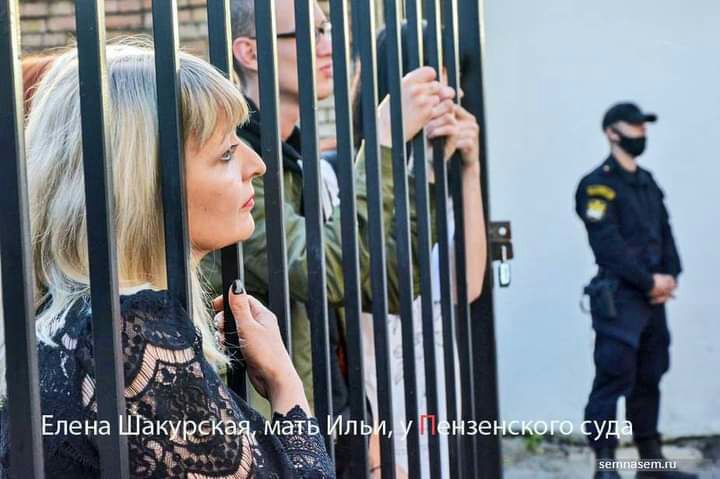
An appeal from Elena, mother of Ilya Shakursky:

My name is Elena Nikolaevna Bogatova, and I am the mother of political prisoner Ilya Alexandrovich Shakursky. I am crying out for help to save my son so that he does not rot away in solitary confinement.

They took my only son away when he was twenty-one years old. He is now twenty-nine. He has been tortured. He has serious health problems that we still cannot solve. He still has eight years to serve, and they could turn him into a disabled person. I cannot help him on my own, so I am asking all caring people to help us.

It is impossible for a mother to know that her child is being destroyed, and that she cannot save him!

Although he committed no crime, he is in prison under the harsh Article 205 [of the Russian Criminal Code; Article 205 proscribes “terrorist acts”], enduring all the hardships of prison life, without ever receiving any encouragement; we cannot even hope for parole. Right now, [the prison authorities] want to turn him into repeat offender so that he cannot have any visits, phone calls, letters, or packages. They want to take everything away from him.

I ask you to write an appeal. I understand that there are many of us now, and everyone is exhausted. But we must stand together for the sake of our loved ones, for the sake of the younger generation, which is currently being destroyed. Hear the cry of a mother who cannot bear the pain for her son and for all those behind bars. If we push with our shoulders, the walls will collapse….

https://t.me/ilyashakursky

Source: Elena Shakurskaya (Facebook), 28 November 2025. Translated by the Russian Reader


OVD-Info Faces a Critical Situation: We Have Lost All Our Ruble Donations

26.11.2025

Russian payment services have refused to continue working with us, without providing any explanation, and have cut off our ability to accept one-time and recurring donations. This has severed our connection to our main source of support—the 12,000 individuals who regularly transfer money to OVD-Info.

The services’ refusal to cooperate with us is one of the many manifestations of state pressure on human rights organizations and independent media. Some of them even had to close due to the loss of donations in rubles.

This is a severe blow to our work. With these donations we were able to pay for the work of defense lawyers and legal experts, travel to the regions, maintain our free hotline, and help those who are politically persecuted in Russia. Furthermore, regular donations allowed us to plan our long-term work and development.

We do not plan to close or reduce the scope of our work, because repression is not diminishing. Any political activity, expressing a view against the invasion of Ukraine, or criticism of Putin instantly becomes grounds for persecution. We simply cannot abandon Russians to face this brutal, repressive system alone. We are defending over 90 defendants in criminal cases, almost every day we send lawyers to police stations, courts, searches, penal colonies, and pre-trial detention centers. We answer dozens of messages and calls daily—and we want to continue doing this.

However, now everything depends on whether we can find another 12,000 people who will regularly support OVD-Info.

You can support us here.

Source: OVD Info


Yulia Lemeshchenko. Photo from the Memorial website

The Second Western Military District court in Moscow last week sentenced Yulia Lemeshchenko to 19 years’ imprisonment for high treason, sabotage, and preparing and training for an act of terrorism.

Yulia, 42, is a Russian citizen, born in Staryi Oskol, in Belgorod region. She lived in Voronezh in southern Russia, until 2014. Then she moved to Kharkiv, Ukraine, with her son and her husband, who had found work there. Later on the couple separated.

Yulia took up powerlifting and in 2021 was named Ukrainian women’s champion.

In 2024 Yulia did military training in Kyiv – firearms, explosives and flying drones – and returned to Russia, via a third country. She sabotaged power transmission infrastructure near St Petersburg, and in Voronezh conducted surveillance on Aleksei Lobodoi, an air force commander responsible for bombing Kharkiv.

Yulia was arrested in January this year. She did not deny the facts outlined in the prosecution case, but told the court that “from a moral standpoint” she considered herself not guilty. This is a translation of her final statement to the court, published by Mediazona.

=

Ukrainian Champion in a Russian Court: Yulia Lemeshchenko’s Final Statement

As you see, I don’t have any sheets of paper and I haven’t especially prepared, but I think I will improvise. I will now probably say a few things that were already said during this hearing, but let this be a sort of summing-up, in a monologue.

So I already spoke here about the fact that, in any war, two sides clash, and each side insists that it is right and that its cause is just. I took one of these sides. I am not a citizen of the country for which I decided to fight, but, all the same, for me, Ukraine is home. I love that country. And I love Kharkiv, with all my heart.

There is a district in Kharkiv called Severnaya Saltovka. About 500,000 people lived there. Half a million. A few people I knew lived there. My hairdresser lived there. After the Russian shelling and bombing, not a single house in that district was left undamaged. Not a single one. And I am not just talking about a few broken windows. I am talking about whole blocks of flats in ruins.

Right next to the block where I lived, there were explosions. In my block, on the ground floor, my neighbour Anya lived with her four-year-old son Nikita. A shell exploded right under their window. Their apartment was completely destroyed. What has happened to Anya and her son I don’t know. I don’t know whether they are still alive.

Friends of mine have died in this war, one relative – my second cousin – and colleagues of mine. War is monstrous. I could not stand aside. When war comes, people who are affected can either try somehow to fight, or they can flee. People flee – I don’t know – maybe because they are cowardly or weak. I don’t consider myself to be a cowardly or weak person. So I decided to fight back – to fight against Russian military aggression.

It is possible that, by saying these things, I am getting myself still deeper into trouble. But my honour, and my conscience, are important to me. I did what I believed to be necessary. I did what I could. To regret, to repent – who knows, maybe I will do that on my deathbed. But for now, what will be, will be. I have nothing further to say.

=

When the court hearing began, Mediazona reported that the judge, Vadim Krasnov, read out evidence that Yulia gave after being arrested in January. After the all-out Russian invasion of Ukraine in 2022, Yulia at first moved to Germany. In 2023 she returned to Ukraine and made contact with the “Free Russia” legion, but did not join.

In 2024, when she did her military training, the instructors – who did not answer questions about which part of the armed forces they served in – said that, by way of payment for her work, she could receive Ukrainian citizenship.

The judge asked if she had done so, to which she replied, with a smile, “not yet”.

During the hearing, Judge Krasnov asked Yulia why she had chosen such a radical method of struggle, rather than, for example, providing medical help to the wounded.

“I can only answer that question with another, rhetorical question”, she replied. “Why did Russia decide to use violent methods to destroy Ukrainian cities? A war had started. Do you understand?”

The judge responded that, by 2022, the war had already been underway for eight years. Yes, but it had become frozen, Lemeshchenko said. After the invasion, she wanted to help Ukraine however she could, and was invited to become a saboteur.

“How far were you prepared to go?” asked the judge. “I did not want to do anything that would take human lives”, Lemeshchenko replied. “They accepted that point. On that we had an agreement.”

The judge said that the sabotage Lemeshchenko carried out near St Petersburg left hospitals without electric light. She replied that the aim had been to paralyse a drone factory, that she was sincerely sorry if anyone in Petersburg had suffered. And that she and her son had many times sat in their apartment, without light, when Kharkiv was being bombed.

Lemeshchenko also told the court that, during interrogation, agents of the federal security service (FSB) had threatened to murder her, and pushed her head against a wall. She had tried to tell them the truth. She said that she did not retract her evidence – and nor would she complain about her treatment, as she did not believe that those responsible would be punished.

□ Here is Yulia’s statement in court, recorded with English interpretation. Yulia is recognised as a political prisoner by Memorial, and her case was reported by the Kharkiv Human Rights Protection Group.

□ The last word in court by Anton Khozhaev, a trainee officer accused of desertion to the Ukrainian side, and more on Russian anti-war protesters

□ Voices Against Putin’s War, just published by Resistance Books, includes 12 statements by anti-war protesters and associated material. The livestream of a launch event is here27 November 2025.

Source: “‘I decided to fight back. Ukraine is my home.’ Yulia Lemeshchenko’s final word in court,” People and Nature, 27 November 2025

Sunday Reader No. 6: Hell Is Full

On Chaplygin Street in Moscow. Photo by anatrrra. Used with their permission

EXTERIOR: A neo-classical building in Moscow’s old German quarter. A plaque on the wall reads, “Western District Military Court No 2”. A group of actors and journalists mill around on the lawn.

INTERIOR: A large hall with a grand staircase. Through the frame of a metal detector stands a statue of Lady Justice in her blindfold, holding scales in one hand and a sword in the other.

A commotion. Several portly guards in flak jackets, with a dog on a leash, escort two handcuffed women through the hall. One, about 5ft tall with big eyes and curly hair, is Yevgenia Berkovich, a 39-year-old poet and theatre director. She is dressed in a white shirt and black trouser-suit. The other, slightly taller, wearing jeans, a white T-shirt and large owlish glasses, is Svetlana Petriychuk, a 44-year-old playwright.

The two women are led into a courtroom and placed in a cage of bullet-proof glass. A bailiff lets in the spectators, who sit down on the upholstered, green benches. Berkovich mischievously sticks out her tongue as photographers’ cameras flash and click. Yuri Massin, the judge, looks towards Berkovich.

Massin: Are you ready for the proceedings?
Berkovich
: Well, it depends on what will happen.

What happened was a show trial that revealed the radicalisation of the Russian state in the past few years. By the time proceedings began on May 20th 2024, Berkovich and Petriychuk had already been in detention for more than a year, having been charged with “propaganda and the justification of terrorism”. In the eyes of the regime, they had committed a crime by writing and staging a play called “Finist, the Bright Falcon”. Part docu-drama, part fable, “Finist” tells the story of the thousands of Russian women who, from 2015, were seduced online by professional recruiters from Islamic State (IS), and travelled to Syria to marry jihadists. Many of these women received lengthy sentences on their return home. The play premiered in 2020 to critical acclaim and was performed across the country.

As with any show trial, this one’s outcome was preordained, and its purpose was to justify the existing system and demarcate the ideological limits of the state. In doing so, it elucidated the ultra-conservative, anti-Western belief system that has expanded across public life since the full-scale invasion of Ukraine in February 2022. Berkovich and Petriychuk were the first artists to be jailed since Soviet times for the content of their work—or, more precisely, the thoughts of their characters. But as theatrical professionals, they managed to turn the trial into their show.

Continue reading “Sunday Reader No. 6: Hell Is Full”

MOVE

Source: The Rookie, Season 3, Episode 11: “New Blood.” You can read more on the 1985 MOVE bombing here.


“I’m terrified at the moral apathy, the death of the heart, which is happening in my country. These people have deluded themselves for so long, they really don’t think I’m human. I base this on their conduct, not on what they say. And this means that they have become, in themselves, moral monsters.”
James Baldwin

LET’S GET THIS OUT OF THE WAY: When it comes to the recent deaths of immigrants being held in detention, it would be wrong to describe the situation as wholly unprecedented. Detainees died under Bush, Obama, and Biden. But detainee deaths have accelerated during President Donald Trump’s second term, with 17 already since his inauguration. During the Biden administration, there were 26 deaths in 48 months—roughly one death every two months. During Trump’s term, that rate has nearly quadrupled. And ICE, now one of the best-funded operations of the federal government, is planning to double detention space before the end of the year.

“It’s absolutely horrific,” Rep. Pramila Jayapal (D-Wash.), the ranking member of the immigration subcommittee, told me before jumping into the numbers above. In July, ICE was awarded $45 billion to expand its operations—its budget is now significantly larger than that of the federal prison system. And now, Jayapal points out, a little-known LLC has been awarded a $1.2 billion contract to build a facility in Texas despite never having previously won a federal contract for more than $16 million. Meanwhile, another $2.25 million contract was given to a Republican donor who received a presidential pardon from Bill Clinton in 2000 after having pleaded guilty to mail fraud.

“Contracts are being distributed to Trump’s buddies and people with no experience running detention centers, many of these contracts are no-bid,” Rep. Jayapal said. “They’re incarcerating people and allowing them to die, not providing medical facilities. There are no standards. It’s horrific.”

Most ICE and border patrol agents will continue working during the government shutdown; their status as “essential” will shield them from the layoffs OMB director Russell Vought has requested in lieu of furloughs from most agencies and departments. But the nature of immigration officers’ “essential” work has significantly changed over the past eight months to become something far more brutal than procedural; in some cases, it has come to appear simply heartless. We have entered a period in which it is becoming important to ask: What happens when our leaders and the people who work for them see immigrants not as human beings but as scum? And what happens when that way of thinking about people starts also to be applied to others, like journalists and political opponents?

Continue reading “MOVE”

Suffer the Children

LOCAL INSPIRATION of the day. This quilt by Joleigh Kambic is part of a larger quilt titled “Babies in Gaza Who Never Made It To Their First Birthday.” The quilt is composed of smaller quilts created by nearly 40 quilters from across the Monterey Bay, commemorating the children who were killed in the Israel-Hamas war. It is on display through Oct. 3 at the Unitarian Universalist Church of the Monterey Peninsula, 490 Aguajito Road in Carmel.

Source: Monterey County NOW newsletter, 29 September 2025


Special detention center for waifs and “troubled” teens. Moscow, 1988. Photos: Igor Stomakhin

Source: Igor Stomakhin (Facebook), 1 September 2025. The first of September (aka Knowledge Day) is the first day of the school year in Russia and other former Soviet countries.

Continue reading “Suffer the Children”

Eating Kimchi in Public

So the Korean Hyundai factory workers were racially profiled and yesterday SCOTUS said racial profiling is now constitutional. The workers were reported to ICE because someone saw a bunch of foreign workers. That is racial profiling.

Yesterday’s news made me think about when I was little and went on road trips with my family. My parents always insisted on preparing and eating Korean food at rest areas along the way. This was before Korean food became more well-known and I remember that if there were people nearby who could smell our food, they often made faces and comments about the smell. Eating kimchi in public was always an interesting experience back then. This was just embarrassing, but does the new Supreme Court ruling mean that in this scenario, it is now something much more ominous we should be worried about?

Now someone could call ICE on a foreign-looking family eating foreign-smelling food in a rest area. When ICE shows up we now would have to show papers to prove we are citizens based on a racially motivated tip, is that our reality? Also, remembering that my mother never became a citizen but had a green card and probably speeding tickets so she would have been deportable under the current regime? What if I can’t prove my citizenship because I don’t carry my passport or naturalization papers, I am detained until I can prove my citizenship and they have the legal authority to do all of this now?

Lawyers, please help me understand. Is this our reality now? Is eating kimchi in public while Korean enough to get ICE called on us?

And I want to add that racial profiling has always been used against Black Americans and to a lesser degree other less white adjacent communities forever in this country, whether it was deemed constitutional or not. This is not new for Black Americans and others and something I have to acknowledge.

Source: Son Mun (Facebook), 9 September 2025


Source: Clarence Patton (Facebook), 9 September 2025

Turning Her Back on Propaganda: Valeria Zotova

Valeria Zotova

Turning Her Back on Propaganda
What does daily life consist of in a prison camp? It consists of work, of course, work which is dull and exhausting. It consists of sleep, which is fitful, as sometimes there are inspections every two hours. And it consists of spending time with people whom you didn’t choose to spend time with. The wardens make sure to burden convicts so that they have nothing that is theirs alone, so that they have no time to think about anything, so that they are entirely subordinate to the powers that be. The goal of prison camp “re-education” is the same: breaking the will of the prisoners, turning them into obedient robots who obey all the orders of their superiors.

This is especially true for political prisoners—people who think independently and have their own principles. The overarching mission of the wardens is to attain voluntary submission, joyful and proactive submission, from political prisoners. But the wardens rarely succeed in this mission.

They have utterly failed with Valeria Zotova, a political prisoner at Kostroma Penal Colony No. 3. The wardens have insistently offered her a path to redemption, that is, cooperating with the authorities and taking part in “civic life.” Zotova has turned it down.

Recently, the prison camp’s club showed a movie, a Russian propaganda film titled Callsign: Passenger. Here is what Wikipedia says about the movie: “The movie is set in 2015. The movie’s main character is Nikolai Ryabinin, a trendy Moscow writer and carefree party animal. His brother volunteered for the war in Donbass and has gone missing. Nikolai goes looking for his brother and joins a separatist unit, the Aurora Battalion, in which his brother previously served. There, he gets the ironic nickname “Passenger” and under the leadership of the commander (callsign: Trigger) reevaluates his own life and comes to support the separatists.”

It’s an unimaginative piece of propaganda based on Alexander Prokhanov’s novel The Murder of Cities. It’s cheap trash, of course, like the writer himself, but the convicts are obliged to drink this cinematic concoction down to the dregs. All of them are herded into the club. Zotova refuses to go. Ultimately, it’s her right to watch the movie or not. But what do rights matter when it comes to Russian patriotism! Zotova is forcibly escorted into the auditorium. Watch our high art: look what talented filmmakers made it, what actors starred in it! But Lera Zotova turns her back on the screen and looks the other way.

Turning one’s back on propaganda is simple—simple but dangerous. The pressure on Valeria continues unabated. The harassment has been endless. The wardens summoned a friend of Zotova’s and stipulated to either: “Either freedom or Zotova—you choose.” They have been trying to create a vacuum around the political prisoner, depriving her of contact with those who are close to her in any way. The young woman is twenty-one years old, but she has been bullied like a hardened criminal. Because, as prison authorities envision it, she should be like everyone else: obedient, involved in the prison camp’s civic life, acting in plays, fulfilling the production quotas, and not smarting off to her superiors.

Source: Alexander Podrabinek (Facebook), 24 August 2025. Thanks to VA for the heads-up. Translated by the Russian Reader

603,628 Kilometers Square (Solidarity with Ukraine)


Dear Kyiv Independent readers,

Thank you for your continued support.

In case you missed it, we recently added a new T-shirt to our online store to help the charitable organization East SOS, continuing our commitment to support important Ukrainian initiatives through your purchases.

After Russia demanded that Ukraine cede five of its regions as a condition for a ceasefire, we designed a shirt to show solidarity with Ukraine — all 603,628 square kilometers of it.

In June, we introduced the “603,628 km²” T-shirt and are donating the profits to the Ukrainian charity East SOS. Thanks to readers like you, we’ve already raised more than $5,000 to help them rebuild homes in war-torn eastern Ukraine.

We’ll collect donations until Aug. 10, so you have six days left to grab your shirt and support the cause.

We also want to give you a closer look at East SOS. The organization provides comprehensive assistance to Ukrainians in front-line regions and internally displaced persons (IDPs) that were forced to flee the war. The charity was launched in 2015, focusing on providing essential supplies and humanitarian aid for those living in the front-line areas.

One project East SOS is currently raising money for is to repair houses in eastern Ukraine that have been damaged by Russia — this is the project that the Kyiv Independent will support. So far, East SOS has helped repair nearly 1,500 homes in Kharkiv and Donetsk oblasts, with another 300 households waiting for assistance. The charity works to repair private homes, prioritizing requests from elderly people living alone or individuals with disabilities — essentially those who are unable to carry out the work themselves.

East SOS employees restoring houses, damaged by Russian attacks.

The East SOS team steps in immediately after a house is damaged, fixing roofs and windows, preventing further damage from rain or snow. After an emergency response, the team returns in order to restore homes severely damaged by the Russian attacks.

It costs around $1,500 for East SOS to repair one house — thanks to your help, we have already raised funds to cover the repair of about three houses.

You can buy the “603,628 km²” T-shirt in white here or in black here.

Members of the Kyiv Independent community are also eligible for a 15% discount on everything sold in our online store. Join our community and find out more about membership benefits here.

You can also learn more about East SOS here or donate directly to them here.

Thank you for your support. If you have any questions regarding the T-shirt, please feel free to contact us store@kyivindependent.com.

Best,

The Kyiv Independent team

Source: Kyiv Independent newsletter, 4 August 2025. I ordered one of these new t-shirts today (as a gift to myself for my upcoming birthday), and would urge you to buy one too. ||| TRR


News from Ukraine Bulletin No. 157 (3 August 2025)

In this week’s bulletin: Russia’s mistreatment and disappearance of prisoners; politically motivated persecution in the occupied territories.
News from the territories occupied by Russia:  

Solidarity in grief: KVPU calls for support after deadly Russian attacks (KVPU August1st)

Melitopol journalist Iryna Levchenko abducted in 2023 ‘found’ imprisoned in Russian-occupied Donetsk (Kharkiv Human Rights Protection Group August 1st)

The Face of Resistance: The story of Crimean Tatar activist Ruslan Zeitullaiev (Crimea Platform August 1st)

Young Crimean couple could face life sentences for resistance to Russia’s war against Ukraine (Kharkiv Human Rights Protection Group July 29th)

Russia resettles ‘veterans’ and their families in occupied Ukraine, while deporting Ukrainians (Kharkiv Human Rights Protection Group July 28th)

 Russian invaders abduct young Ukrainian, sentence her to 12.5 years for helping Ukraine (Kharkiv Human Rights Protection Group July 28th)

CEPA published an article on the preservation of the Crimean Tatar language (Crimea Platform July 28th)

News from Ukraine:

Ukraine uncovers major bribery scheme in electronic warfare systems procurement: MP and officials involved (Ukrainska Pravda August 2nd)

Rebel, Love, fight corruption! Statement of student union Priama Diia (European Network for Solidarity with Ukraine August 2nd)

“Aren’t you tired of feeding people garbage?” Ukrainian parliament reverses anti-corruption law after street protests (Euromaidan Press July 31st)

`Fighting for our Future’: Kyiv protesters cheer return of anti-corruption safeguards (Kyiv Post July31st)

“More and more people don’t want to speak Russian”: How Ukrainians’ attitudes toward the Russian language changed during the war (The Insider, July 28th)

Aerial Terror in Kherson – A City Under Drone Siege (Byline Times, July 28th)

How the controversial Law No. 4555-IX undermines anti-corruption and reintegration — Alena Lunova on the JustTalk Context podcast (Zmina July 25th)

War-related news from Russia:

Recruiting for units with anti-authoritarians (Solidarity Collectives August 1st)

Denys Matsola: Updates from capitivity (Solidarity Collectives August 1st)

Ukrainian political prisoner vanishes after being abducted by FSB instead of released from Russian prison (Kharkiv Human Rights Protection Group July 31st)

Yulia Moskovskaya, Terrorist (Russian Reader, July 29th)

Cars for Ukraine (Russian Reader, July 27th)

News from the Front: 

A City Destroyed: Russia says it controls Ukraine’s Chasiv Yar after 16 months of fighting. But the battle grinds on, and only ruins remain (Meduza August 1st)

A fortress under threat: A year after reaching Pokrovsk, Russian forces appear ready to launch a full assault (Meduza July 30th)

Analysis and comment:

2000 Meters to Andriivka – the Ukrainian working class in war (Liam record, August 3rd)

Capital, Power and War: The crisis of Russia’s peripheral accumulation regime (Links August 1st)

Take back control of your gadgets: right to repair and the opportunity it presents for Ukraine (Commons.com, August 1st)

Wartime protest across Russia’s internal borders (Posle Media July 30th)

A political crisis that could weaken the war effort itself: What Zelensky’s anti-corruption U-turn means at a `precarious moment’ for Ukraine (Meduza July 30th)

Dying embers: Russia’s coal crisis triggers bankruptcies and mass layoffs (The Insider July 30th)

Ukraine between empire and revolution: Lev Yurkevych’s anti-colonial Marxism (Links July 29th)

Why the current wave of nationalization in Russia is more than just a redistribution of assets (IStories July 29th)

Ukraine’s New Cabinet: Neoliberal Reforms Threaten Wartime Solidarity (International Viewpoint, July 26th)

Research of human rights abuses:

ZMINA highlighted politically motivated persecution in the occupied territories at Helsinki+50 Conference side event (Zmina August1st)

Prisoners beaten, threatened with new sentences to force them to fight Russia’s war against Ukraine (Kharkiv Human Rights Protection Group August 1st)

OSCE and Participating States must act now to free its staff members from Russia’s captivity and prosecution (Zmina July 31st)

Abductions of Ukrainian Women and Girls (Kharkiv Human Rights Protection Group July 31st)

Silence—as a form of torture (Kharkiv Human Rights Protection Group July 31st)

A civil society manifesto on the 50th anniversary of the Helsinki Final Act (Zmina July 30th)

Do not legitimise the occupation: Mexican and Brazilian museums urged to refrain from collaborating with institutions in occupied territories (Crimea Human Rights Group July 30th)

Side event at the Helsinki+50 conference: “Crimea: 11 years of occupation – restoring justice, restoring OSCE commitments” (Crimea Human Rights Group July 30th)

Important Note: We will not be publishing a bulletin next week. The next bulletin, no. 158, will appear in two week’s time on 17 August 2025. 

==

This bulletin is put together by labour movement activists in solidarity with Ukrainian resistance. To receive it by email each Monday, email us at 2022ukrainesolidarity@gmail.com. To stop the bulletin, reply with the word “STOP” in the subject field. More information at https://ukraine-solidarity.org/. We are also on twitterBlueskyFacebook and Substack, and the bulletin is stored online here.

Source: Ukraine Information Group