Turning Her Back on Propaganda What does daily life consist of in a prison camp? It consists of work, of course, work which is dull and exhausting. It consists of sleep, which is fitful, as sometimes there are inspections every two hours. And it consists of spending time with people whom you didn’t choose to spend time with. The wardens make sure to burden convicts so that they have nothing that is theirs alone, so that they have no time to think about anything, so that they are entirely subordinate to the powers that be. The goal of prison camp “re-education” is the same: breaking the will of the prisoners, turning them into obedient robots who obey all the orders of their superiors.
This is especially true for political prisoners—people who think independently and have their own principles. The overarching mission of the wardens is to attain voluntary submission, joyful and proactive submission, from political prisoners. But the wardens rarely succeed in this mission.
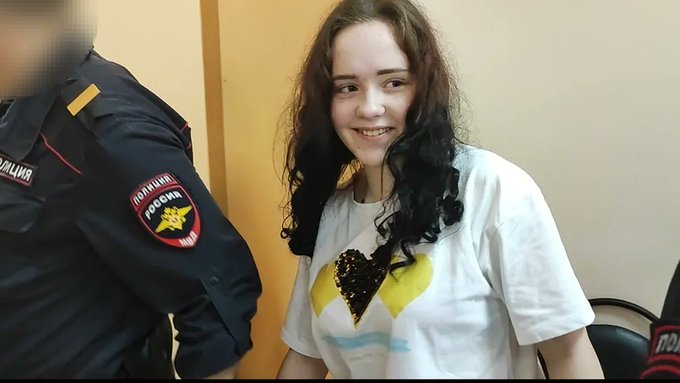
They have utterly failed with Valeria Zotova, a political prisoner at Kostroma Penal Colony No. 3. The wardens have insistently offered her a path to redemption, that is, cooperating with the authorities and taking part in “civic life.” Zotova has turned it down.
Recently, the prison camp’s club showed a movie, a Russian propaganda film titled Callsign: Passenger. Here is what Wikipedia says about the movie: “The movie is set in 2015. The movie’s main character is Nikolai Ryabinin, a trendy Moscow writer and carefree party animal. His brother volunteered for the war in Donbass and has gone missing. Nikolai goes looking for his brother and joins a separatist unit, the Aurora Battalion, in which his brother previously served. There, he gets the ironic nickname “Passenger” and under the leadership of the commander (callsign: Trigger) reevaluates his own life and comes to support the separatists.”
It’s an unimaginative piece of propaganda based on Alexander Prokhanov’s novel The Murder of Cities. It’s cheap trash, of course, like the writer himself, but the convicts are obliged to drink this cinematic concoction down to the dregs. All of them are herded into the club. Zotova refuses to go. Ultimately, it’s her right to watch the movie or not. But what do rights matter when it comes to Russian patriotism! Zotova is forcibly escorted into the auditorium. Watch our high art: look what talented filmmakers made it, what actors starred in it! But Lera Zotova turns her back on the screen and looks the other way.
Turning one’s back on propaganda is simple—simple but dangerous. The pressure on Valeria continues unabated. The harassment has been endless. The wardens summoned a friend of Zotova’s and stipulated to either: “Either freedom or Zotova—you choose.” They have been trying to create a vacuum around the political prisoner, depriving her of contact with those who are close to her in any way. The young woman is twenty-one years old, but she has been bullied like a hardened criminal. Because, as prison authorities envision it, she should be like everyone else: obedient, involved in the prison camp’s civic life, acting in plays, fulfilling the production quotas, and not smarting off to her superiors.
In case you missed it, we recently added a new T-shirt to our online store to help the charitable organization East SOS, continuing our commitment to support important Ukrainian initiatives through your purchases.
After Russia demanded that Ukraine cede five of its regions as a condition for a ceasefire, we designed a shirt to show solidarity with Ukraine — all 603,628 square kilometers of it.
In June, we introduced the “603,628 km²” T-shirt and are donating the profits to the Ukrainian charity East SOS. Thanks to readers like you, we’ve already raised more than $5,000 to help them rebuild homes in war-torn eastern Ukraine.
We’ll collect donations until Aug. 10, so you have six days left to grab your shirt and support the cause.
We also want to give you a closer look at East SOS. The organization provides comprehensive assistance to Ukrainians in front-line regions and internally displaced persons (IDPs) that were forced to flee the war. The charity was launched in 2015, focusing on providing essential supplies and humanitarian aid for those living in the front-line areas.
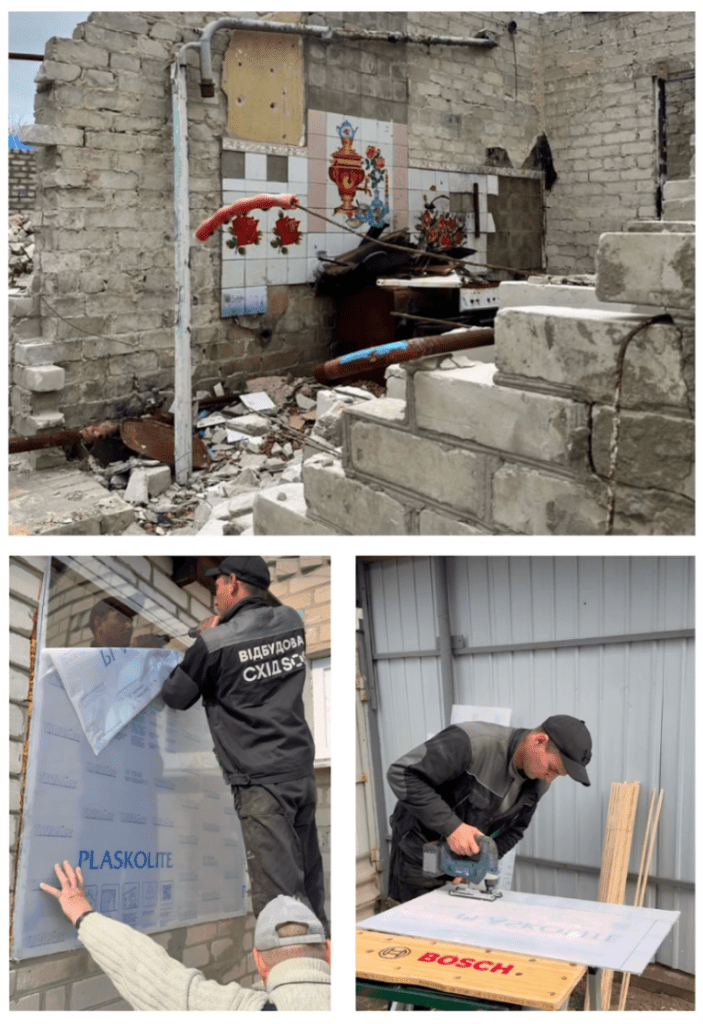
One project East SOS is currently raising money for is to repair houses in eastern Ukraine that have been damaged by Russia — this is the project that the Kyiv Independent will support. So far, East SOS has helped repair nearly 1,500 homes in Kharkiv and Donetsk oblasts, with another 300 households waiting for assistance. The charity works to repair private homes, prioritizing requests from elderly people living alone or individuals with disabilities — essentially those who are unable to carry out the work themselves.
East SOS employees restoring houses, damaged by Russian attacks.
The East SOS team steps in immediately after a house is damaged, fixing roofs and windows, preventing further damage from rain or snow. After an emergency response, the team returns in order to restore homes severely damaged by the Russian attacks.
It costs around $1,500 for East SOS to repair one house — thanks to your help, we have already raised funds to cover the repair of about three houses.
Thank you for your support. If you have any questions regarding the T-shirt, please feel free to contact us store@kyivindependent.com.
Best,
The Kyiv Independent team
Source: Kyiv Independent newsletter, 4 August 2025. I ordered one of these new t-shirts today (as a gift to myself for my upcoming birthday), and would urge you to buy one too. ||| TRR
News from Ukraine Bulletin No. 157 (3 August 2025)
In this week’s bulletin: Russia’s mistreatment and disappearance of prisoners; politically motivated persecution in the occupied territories.
News from the territories occupied by Russia:
Solidarity in grief: KVPU calls for support after deadly Russian attacks (KVPU August1st)
Melitopol journalist Iryna Levchenko abducted in 2023 ‘found’ imprisoned in Russian-occupied Donetsk (Kharkiv Human Rights Protection Group August 1st)
How the controversial Law No. 4555-IX undermines anti-corruption and reintegration — Alena Lunova on the JustTalk Context podcast (Zmina July 25th)
War-related news from Russia:
Recruiting for units with anti-authoritarians (Solidarity Collectives August 1st)
Denys Matsola: Updates from capitivity (Solidarity Collectives August 1st)
Ukrainian political prisoner vanishes after being abducted by FSB instead of released from Russian prison (Kharkiv Human Rights Protection Group July 31st)
Yulia Moskovskaya, Terrorist (Russian Reader, July 29th)
Do not legitimise the occupation: Mexican and Brazilian museums urged to refrain from collaborating with institutions in occupied territories (Crimea Human Rights Group July 30th)
Side event at the Helsinki+50 conference: “Crimea: 11 years of occupation – restoring justice, restoring OSCE commitments” (Crimea Human Rights Group July 30th)
Important Note: We will not be publishing a bulletin next week. The next bulletin, no. 158, will appear in two week’s time on 17 August 2025.
On 22 April 2025, Voronezh police raided the homes of activists believed by Center “E” [Russia’s “anti-extremism” police] to be connected to the Telegram channel Free People of Voronezh. The searches also involved severe beatings and threats, and some of the activists were forced to record videos supporting Putin and the war in Ukraine. Almost all the activists had previously been prosecuted on political charges, but now they feel so intimidated that they are afraid to file a torture complaint against the police.
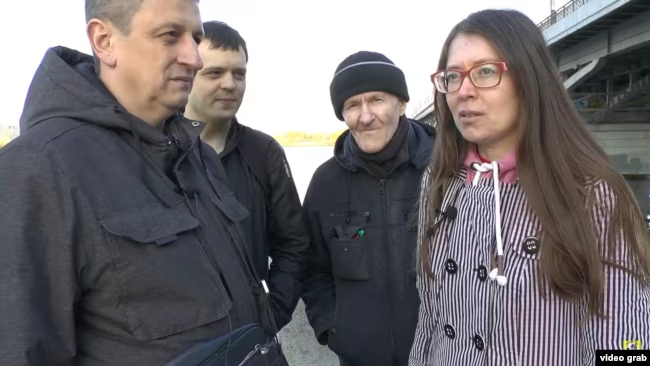
A 38-minute video was posted on the Free People of Voronezh channel on 16 April 2025. The video itself was viewed by less than three hundred people. In the video, four activists—Grigory Severin, Nadezhda Belova, Yuri Avsenyev, and Alexander Zheltukhin—discuss the news before jogging along an embankment of the Voronezh River. The genre is the “coffee klatch”: using the news as a springboard, the friends talk about the problem of alcoholism, apathy in society, increasing drug use, and the overall sense of doom and gloom.
Activists of the Telegram channel Free People of Voronezh: Grigory Severin, Alexander Zheltukhin, Yuri Avsenyev, and Nadezhda Belova
Nadezhda Belova sums up the video’s content at the very beginning.
“To cut it short, everything is bad, but it will get worse. To put it in a nutshell, the situation in this place is at the terminal stage,” she says.
She argues that Russia is inevitably moving in the direction “North Korea”—toward a mothballed, rotten dictatorship, because Russians “somehow still support it and want to live in it.” Belova has reason to be pessimistic: even before the war, the state had charged her with “condoning terrorism” for comments she had made on social media in the wake of Mikhail Zhlobitsky‘s [suicide] bombing of the Arkhangelsk FSB. in 2020, a military court sentenced Belova to pay a fine of 400,000 rubles. She was on Rosfinmonitoring’s list of “terrorists and extremists” for several years, and her family had to leave their home village and rent a flat in Voronezh, as their fellow villagers did not support Belova in her fight against the unjust charges.
The video posted on the Telegram channel Free People of Voronezh on 16 April 2025
“Again, the whole of Voronezh is covered with drug adverts. The law enforcement agencies run protection for [the illegal drug trade], and if they didn’t run protection for it, there wouldn’t be these adverts. At my neighborhood Pyaterka [convenience store], right at the entrance, there is a graffito painted in color on the doorstep: ‘Buying a stash is like going out for bread,'” says Alexander Zheltukhin. In previous years, Zheltukhin was fined for picketing against Belova’s persecution and arrested for protesting in support of Navalny. “And if it was not protected, I would argue, by the selfsame FSB, who probably take a percentage from it—”
“Watch out! You are discrediting the FSB,” Belova says, interrupting him. “I don’t agree! It cannot be!”
Caveats and omissions run through the entire conversation. The activists know that any free speech is potentially dangerous in today’s Russia, and they try to cover their bases whenever possible. (Spoiler: it didn’t work).
“They say it’s impossible not to confess”
A few days later, on 22 April, police raided the homes of all four people involved in the run, as well as those of other Voronezh activists. Searches were done at eight locations, allegedly connected with Free People of Voronezh. In most cases, the law enforcers acted extremely harshly. They used handcuffs and stun guns, beat people, intimidated the activists and their families, and emotionally abused them.
A photo posted by Nadezhda Belova
All the members of Belova’s family were shot with a stun gun. Belova later posted photos of her own bruises and the bloody marks on the bodies of her husband and son on Facebook. The police confiscated all their electronic devices and turned upside down their rented flat, which the landlady demanded that the Belovs vacate immediately after the search. The police threatened to send the son, a university student, to the war, and after the search, a policeman recorded a repentant video featuring Belova.
“Off camera, the [policeman beating Belova’s husband] says, ‘Do you support the [special military operation]?’ I say, ‘Yes.’ He says, ‘Do you support Putin?’ I say, ‘Yes.’ It’s light fare, but disgusting, especially when I saw a stun gun pressed against my son’s leg,” Belova told Okno.
The police recorded similar video “confessions” by several other people [caught up in the raids].
After the searches, Zheltukhin ended up in hospital with five broken ribs and several damaged vertebrae. He told OVD Info that he had tried to escape from the “punitive operation” and fell from the roof of a village house: “I broke my ribs when I fell, apparently, and they hit me [on those ribs]: it hurts a lot.” The police put a bag over his head and shocked him with a stun gun. His friends later photographed Zheltukin at hospital: his face was covered with bruises.
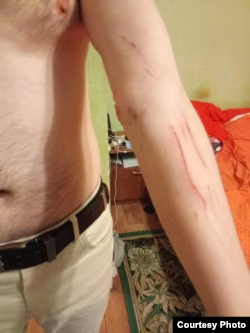
Fyodor Orlov, 36, was also beaten; after the experience, he says that he “did it all to himself.” He inflicted all the bruises and abrasions on himself, blindfolded himself with a scarf and sat like that for two hours, and fell into a briar bush on his own; there are photos of his back, entirely covered with flecks of blood. “Then someone—that is, I—drew a sex organ on my bald head just for fun,” he told OVD Info. The law enforcers also threatened to cut off one of his fingers, leaving behind telltale scratches.
Fyodor Orlov’s finger
“It was quite rough. As rough as possible, to the point that they say that now they understand why people confess to crimes they did not commit. Because, they say, it’s impossible not to confess. Orlov has several hundred stun gun marks [on his body]. Several hundred! They drove him into the woods. He thought they were taking him there to kill him,’” says Pavel Sychev, 38.
Sychev is a Voronezh activist and political consultant. He knows the administrators of the Free People of Voronezh channel from his past work as an activist: they crossed paths at pickets, but do not keep in close contact. Sychev’s home was also searched on 22 April, but there was no violence.
“[The police] search my home, as a rule, without breaking the law, and they never use force against me or my family. They have been coming to my home every year since 2022. These are just routine searches. I have always been searched as a witness in criminal cases to which I don’t even have an indirect connection,” says Sychev. “There is a federal case [for example, the case against Grigory Melkonyants and other activists of the Golos movement—Okno], and they do a series of searches all over the country, and they come and search my house for good measure.”
“Evil loves silence”
It is unlikely that the new series of searches was occasioned by the latest video posted on the Telegram channel. Our sources suggest, rather, that the reason for the raids was that Free People of Voronezh constantly writes and speaks about people convicted on charges of high treason and terrorism (for sabotaging railroad switch boxes, cell towers, etc.). The channel admins treat these people as anti-war resisters. For law enforcers, on the contrary, they are criminals convicted of violent crimes.
The formal pretext for the series of searches on 22 April was the criminal case, on charges of repeated discrediting of the army, brought against Grigory Severin. As follows from the indictment, while serving his sentence in a penal colony [he had been sentenced to two and half years in prison for “publicly calling for extremism”; he served his time and was released last autumn—Okno], Severin discredited the Russian armed forces. After the search, he was detained and placed under arrest.
Sychev believes that this criminal case was “canned.”
“You see, in Russia we have the practice of ‘desk drawer cases.’ Meaning you already have a criminal case against you: the entire case file is ready in advance, and it is lying in a desk drawer, waiting for its day to come. In the case of Severin, his first case was also ‘in a desk drawer.’ When he was arrested, it transpired that the entire case file had been readied a year earlier.”
It is not known what prompted the police to pull the case file from the drawer right now. But the fact that Severin faces prosecution does not surprise Sychev in itself.
“Everyone who knows Grigory, even in passing, realizes that he is a man who will not stay quiet. If anyone asks him directly how he feels about this or that situation, he will answer directly, even if the answer risks criminal charges. He is a man who will always try to prove to everyone the viewpoint which he espouses and defends. As far as I know, the first ‘discrediting of the armed forces’ case against him came from his explaining his philosophy of life to traffic police officers who had pulled him over. The second charge came from telling his cellmates about his stance. This in the order of things for him: he does not keep silent; he speaks openly, directly. So it was a matter of time. When a person speaks openly about a very dangerous and sensitive topic—and in our country the ‘special military operation’ is a sensitive topic—there are many chances that sooner or later they will be prosecuted.”
On the same day, a criminal case was opened against 65-year-old activist Yury Avsenyev, another person involved in the run along the Voronezh River embankment. His home was also searched on 22 April, but he was released on his own recognizance. Avsenyev is suspected of “publicly calling for extremism.”
Yuri Avsenyev
The Voronezh activists who fell victim to the police brutality have not yet worked up the courage to file complaints, and they fear excessive publicity.
“They are really spooked,” says Pavel Sychev. “The information I have now is that they will not file torture complaints, but I don’t know, maybe someone will persuade them to do it. They are very much afraid that if they do it, the law enforcers won’t be reprimanded in any way, but will just come and take revenge on them. They are all convinced that they will be killed. I told them that evil loves silence, and if you don’t react now, there is a greater chance of a repeat than if you do. But they said it’s very easy to judge from the outside when you haven’t been tortured. ‘We are afraid that they might do something to us,’ [they say].”
Our sources note that such official lawlessness had not previously occurred in Voronezh. Usually, searches at the homes of political activists and arrests were carried out by the book, without violence. The only widely known case of official lawlessness ended in criminal charges against the police officers involved and monetary compensation for the victims. In May 2018, criminal investigators Sergei Kosyanenko and Oleg Sokolovsky tortured university students Maxim Grebenyuk and Sergei Troyansky, hoping to force them to confess that they had stolen a mobile phone. The students were held at Police Station No. 4 in Voronezh’s Comintern District for six hours in handcuffs and strangled with a plastic bag. They refused to incriminate themselves, and afterwards they documented their injuries and filed a torture complaint with the Investigative Committee. In 2021, Grebenyuk was awarded one million rubles, and Troyansky, 500,000 rubles, in compensation for their suffering.
The Voronezh police’s current brutality may be due to the proximity of the front, suggests a source who requested anonymity. The fact is that, since the start of the full-scale invasion, Voronezh law enforcers have regularly been seconded to the so-called new territories, the occupied Donetsk and Luhansk regions.
“There are quite big problems with the law in those ‘new territories.’ And the practices that are used there are inhuman, I think. When they come back here, to their native land, they simply do not reconfigure themselves,” says our source, who is not connected with the Free People of Voronezh Telegram channel. “They consider themselves above the law. They think that they are involved in a good cause, and they can torture bad people for the sake of the good cause. When a person has tried their hand at it once, when they realize that they can get away with it absolutely scot-free, then it is quite difficult to put the brakes on, and it will grow.”
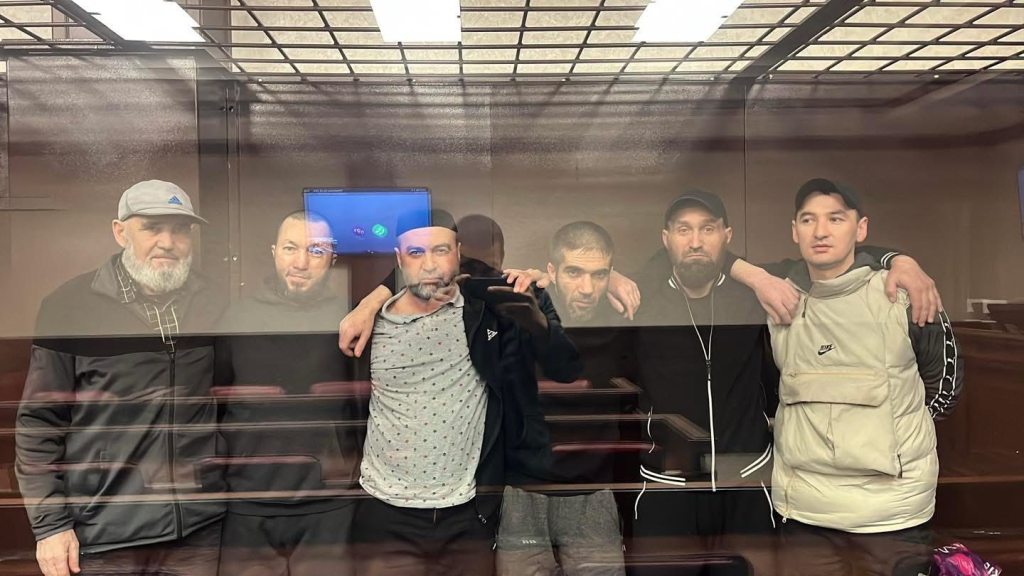
Today, a Russian military court sentenced six Crimean Tatars from the Dzhankoi District to terms in prison ranging from 11 to 14 years.
On the firing range of persecution, this is yet another sentence for Muslims in Crimea. For us, it means yet more broken lives, families separated for many years, and children who have also been sentenced to a life without their fathers. It is a river of grief.
I look at the grey-haired old man on the left of the photo, 69-year-old Khalil Mambetov, and in my mind’s eye I see the political prisoners Azamat Eyupov and Servet Gaziyev, who have already been sent into exile thousands of kilometers away from Crimea to serve their sentences. I look at Mambetov and think about his wife, Tata Lila, who is battling cancer. “We don’t know how to tell her that Agha Khalil has been sentenced to 14 years in prison,” say the wives of the other defendants.
Refat Seidametov, Leman Zekeryaev, Ekrem Krosh, and Osman Abdurazakov were also sentenced to 14 years’ imprisonment, with the first four years to be served in a closed prison and the remainder in a maximum security penal colony.
The court sentenced Aider Asanov to 11 years’ imprisonment, with the first three years to be served in a closed prison and the remainder in a maximum security penal colony, followed by one year’s custodial supervison.
Aider’s mother has a severe form of bronchial asthma. After her son’s arrest, her condition deteriorated further. Leman Zekeryaev’s mother has trouble walking. Ekrem Krosh’s brother Enver is also in the pretrial detention center in Rostov-on-Don, and the Almighty only knows how much pain their mothers are in.
When they will embrace their relatives on the outside, like hundreds of other women in Crimea, is also known to the Almighty alone. But we will continue to do everything in our power. And no matter how difficult it is, no matter how overcome we are by chronic fatigue, we continue to peacefully defend the supreme values of our people’s integrity. Because we cannot become inured to persecution.
Russia’s worst conveyor belt of repression in occupied Crimea has sunk to a new low with six recognized Crimean Tatar political prisoners from Dzhankoi facing sentences of 17 and 17.5 years. Not only are none of the men accused of any recognizable crime, but even the charges are those virtually copy-pasted from ‘trial’ to ‘trial’ since 2015, with the sole difference lying in the huge sentences demanded in this case against all the men. As well as in the fact that Khalil Mambetov is already 69, making this a near certain death sentence.
The ’trial’ of the six Crimean Tatars is coming to an end at the Southern District Military Court in Rostov-on-Don, with the prosecutor claiming, on 7 April 2025, that the men’s ‘guilt’ had been proven. He demanded 17.5-year sentences against Khalil Mamebetov (b. 1955) and Refat Seidametov (b. 1969) and 17-year sentences against Osman Abdurazakov (b. 1984); Aider Asanov (b. 1963); Ekrem Krosh (b. 1985); and Leman Zekeryaev (b. 1973). In each case, the sentence would be for maximum-security (or ‘harsh-regime’) imprisonment, with the prosecutor also seeking a one-year term of (seriously) restricted liberty should they survive the sentence in the appalling conditions of Russian penal institutions.
Lawyer Emil Kurbedinov told Crimean Solidarity that ‘each sentence in these cases is proof of political persecution. And with each sentence, the lawlessness takes on increasingly sophisticated and perverted forms.”
(From left) Leman Zekeryaev, Ekrem Krosh, Aider Asanov, Khalil Mambetov, Refat Seidametov, and Osman Abdurazakov. Photo: Crimean Solidarity
Although the sentences demanded are not necessarily those handed down, the fact that such horrifically long terms are demanded in all cases is unprecedented. It is especially worrying given that all of the men are accused of the lesser of two charges used in these conveyor belt trials.
Russia’s use of its legislation against any Ukrainian citizens on occupied territory is illegal, however these trials are especially cynical since the men are accused solely of unproven involvement in an organization which is legal in Ukraine. The pretext for bulk ‘trials’ of Crimean Tatar and other Ukrainian Muslims is a flawed and suspiciously secretive Russian Supreme Court ruling from 2003 declaring the peaceful, transnational Muslim organization Hizb ut-Tahrir ‘terrorist’. Since 2017, Russia has largely used such ‘trials’ as a means of trying to crush the Crimean Tatar human rights movement with civic journalists and activists, especially from Crimean Solidarity, increasingly targeted.
This was the second wave of such arrests in the Dzhankoi region of Crimea, with the first wave in August 2022 coming the day after a humiliating attack on a Russian military base in Crimea which Russia could not admit, but doubtless wanted to avenge. The link between these two ‘operations’ seemed clear given that the arrests on 24 January 2023 targeted the brothers of two of the men arrested in August 2022, with Ekrem Krosh the brother of civic activist Enver Krosh, seized in 2022, and Osman Abdurazakov the brother of Edem Bekirov. It also seemed likely because of the charges. In almost all such ‘trials’, one or more of the defendants is accused of ‘organizing’ a Hizb ut-Tahrir group under Article 205.5 § 1 of Russia’s criminal code. The others are accused of ‘involvement’ in such a ‘group’ (Article 205.5 § 2). Why one charge is laid, not the other, often seems arbitrary or about reprisals, but the difference in length of sentence has, up till now, been significant. All six defendants in the second Dzhankoi group are accused only of ‘involvement’, while the sentences demanded are those normally used against purported ‘organizers’. In occupied Crimea, it has become standard for all defendants to face the equally absurd charge of ‘planning to violently seize power’, under Article 278.
These ‘trials’ are not just a travesty because of the flawed charges. Essentially no evidence of actual involvement in Hizb ut-Tahrir is required. FSB-loyal ‘experts’ are used to provide ‘assessments’ of illicitly taped conversations about religion, politics, bringing up children, etc., with the supposed ‘experts’ providing the ‘conclusions’ demanded of them. The ‘trials’ also hinge on the so-called ‘testimony’ of anonymous witnesses who may well have never met the defendant. As reported, there have been absolutely glaring infringements in this case, with the FSB, for example, not even bothering to explain which part of a long conversation which they illicitly taped, proves the men’s ‘guilt’. The description given by one of the ‘secret witnesses’ did not match the photos used for the alleged identification parade.
Tragically none of this, nor the age of one of the defendants, will make a scrap of difference. The ‘case’ was passed to the court in Rostov in August 2023, and is being heard by a panel of judges, under presiding judge Viacheslav Alekseevich Korsakov, who has already demonstrated his willingness to provide the sentences demanded of him, however unwarranted.
The next hearing is scheduled for 15 April, with the defence beginning the final debate.
Russia jails dissident once targeted by Putin at KGB for 16 years
A court in St. Petersburg has sentenced Alexander Skobov, a 66-year-old Soviet dissident and activist, to 16 years in jail on charges of justifying terrorism and joining a terrorist group. Skovov was first arrested more than four decades ago and Vladimir Putin was among the KGB officers who worked on his case. Prosecutors said Skobov justified terrorist attacks on Russian territory and supported the Freedom of Russia legion, which Russia has deemed a terrorist organisation for fighting alongside Ukrainian forces.
Skobov will spend the first three years of his sentence in prison (typically reserved for highly dangerous criminals such as kidnappers and terrorists and repeat offenders), with the rest in a high-security penal colony. He will be 80 by the time he can be released, although it is questionable whether he will survive that long in Russia’s harsh prison system. The activist has many health problems, including diabetes, hepatitis C, asthma and glaucoma.
At the court hearing, Skobov made clear that he did not believe he was facing a fair trial. He refused to answer questions and did not stand when the judge addressed him. “Today they will ask me again – do I plead guilty? Well, now I’m the one asking,” he said in his closing statement. “It’s me asking the servants of Putin’s regime who are present here, who are small cogs in his repressive regime: do you plead guilty to complicity in Putin’s crimes? Do you repent of your complicity?”
In the USSR, Skobov was repeatedly charged with “anti-Soviet” offenses. He was first arrested in 1978 on charges of distributing anti-Soviet leaflets and was sentenced to two years in a psychiatric hospital (punitive psychiatry was widespread in the Soviet Union and used as one of the main tools of repression in the 1960s, 70s and 80s). Skobov was forcibly hospitalized again in 1982 for daubing anti-Soviet graffiti on the walls of a building and then released in 1985.
Vladimir Putin, who worked in the Fifth Department of the KGB that was tasked with combating “ideological sabotage,” was among the KGB officers that handled his original cases, independent media and rights groups reported.
Why the world should care
This is far from the first instance when somebody in Russia has been imprisoned for a post on social media. Since 2010, prosecutors have opened more than 1,000 such criminal cases. But a 16-year sentence for an elderly activist in frail health stands out as particularly punitive. It’s safe to say that treatment of dissidents in modern Russia is growing far tougher than it was in the post-Stalin Soviet Union.
“Illinois Governor JB Pritzker (D-IL) Speaks at the 2025 HRC Los Angeles Dinner,” Human Rights Campaign (YouTube)
The Trump administration and his Republican lackeys in Congress are looking to reverse every single victory this community has won over the last 50 years. And right now, it’s drag queens reading books and transgender people serving in the military. Tomorrow, it’s your marriage license and your job they want to take. Bending to the whims of a bully will not end his cruelty. It will only embolden him. The response to authoritarianism isn’t acquiescence. Bullies respond to one thing, and one thing only, a punch in the face.
But you see, that starts with fully acknowledging what is happening. The meme lords and the minions in the White House are intentionally breaking the American system of government so they can rebuild it in their own image. They’ve shut down cancer research and HIV prevention. They’ve eliminated drinking water and clean air regulations and upended the lives of veterans. They’ve said that a recession that Trump is likely to cause will be worth it, which is an assessment worthy of Trump University.
At its core, what Elon Musk and Donald Trump are doing isn’t about efficiencies or cost savings. It’s about giving their wealthy friends a tax break and making the middle class and veterans and public school kids pay for it. It’s a few idiots trying to figure out how to pull off the scam of their lives.
Meanwhile, the scariest part is that they’re using the power of the presidency to try to delight their base by targeting vulnerable people, people they think can’t fight back, calling them domestic enemies or claiming they’ll ruin American culture. Remember their slogan, “Make America Great Again.” Authoritarians target vulnerable minority communities first because they think that if they can conquer those that they deem weak, and they can show everyone else who’s boss, which is why we can’t sit back right now and wait to see what happens. If we wait, I guarantee you the battle will have already been lost.
Donald Trump cannot take anything from us that we don’t choose to give him. He and his henchmen don’t want people to realize that. But now is the time for us to wake up. The good news is every day I’m seeing more and more people across this country realize that they don’t want to give him much at all.
The question I get asked most right now is, “So what can I do? What can I do?” And I’m going to be blunt about this. Never before in my life have I called for mass activism, but this is the moment. Take to the streets, protest, show up at town halls. Jam the phone lines in Congress, 202-224-3121, and afford not a moment of peace to any elected representatives who are aiding and abetting Musk and Trump’s illegal power grab. This is not a drill, folks. This is the real thing.
Seize every megaphone you have. Go online and make a donation to the legal funds fighting Trump, to HRC, and to the candidates for Congress that vow to take this country backward. And don’t limit your voice to the traditional political channels. Be like Lucy Welch. When JD Vance went to vacation at the Sugarbush Resort in Warren, Vermont, Lucy, who writes the Sugarbush Daily Snow Report, used her report to defend her diverse and wonderful community, ending by saying, “I am using my relative platform as a snow reporter to be disruptive. What we do or don’t do matters.”
What we do and don’t do matters. It matters right now more than it ever has before. When my future grandkids look back on this moment, I want them to know that my voice was one of the loudest in the room, screaming for justice and fighting against tyranny.
And in the midst of this existential fight, this battle that seems to consume everything, well, let’s not take the soul-sucking path of sacrificing the most persecuted for that which we deem to be most popular. I know that there are transgender children right now looking out at this world and wondering if anyone is going to stand up for them and for their simple right to exist. Well, I am. We are. We will.
I know that amidst the ongoing assault on our institutions, it is easy for people to fall into despair about our democratic system. But I love this country too much not to fight for it. You’re here tonight because you do too. And when I think about that love, I think back to all the times in our history when our ancestors had to fight back against tyrants and racists and those who couldn’t understand that freedom and justice are our foundational promises in this country.
That group of people, that small group of people that got together in Chicago to found this country’s first known gay rights organization. Well, it was called the Society for Human Rights. It was 1924 and the flicker of light was brief. It only lasted a matter of months before social persecution and criminal prosecution bankrupted the promise of the group’s charter. But oh, that flicker ignited something. By whisper and by word of mouth, folks around the country started to catch wind of the idea. And eventually, it ended up in the ears of a man here in California who later said the idea of gay people getting together at all was an eye-opener for him.
Well, that man’s name was Harry Hay. And a couple of decades later, he went on to found the Mattachine Society right here in Los Angeles. It was the first sustained gay rights organization in the United States. Harry said that he was first told about the Chicago group as a warning that the idea was too dangerous and nobody should try to pull anything off like that ever again. How lucky the world is that Harry didn’t listen.
When we say history repeats itself, it’s not because the villains and battles don’t evolve with the ages. They do. But the fight itself remains elemental. It’s always men who would be king, blaming the suffering of the masses on those who look different or sound different or live differently. And since the dawn of time, the triumph of good over evil has relied on those who believe in empathy and kindness, summoning the steel spine needed to defend those values that by their nature leave us vulnerable to attack. This community knows that. You have lived and breathed this fight for generations. Our hope, our hope lies in this room.
The fact that we are still here today means that we have the faith and courage that we will win the battles that really matter. Now, when I first ran for governor in 2018, I started every single stump speech by saying, and this will tell you why Donald Trump doesn’t like me very much. I said at the beginning of every stump speech, everything we care about is under siege by a racist, misogynist, homophobic, xenophobic Donald Trump.
Our strange post-truth era turns everything upside down and paints black as white. It is vital that we remember the basics and not lose our bearings to avoid going crazy.
So I just want to remind you that:
Vladimir Putin is a dictator, murderer, and war criminal.
It is immoral and outrageous to work on Putin’s behalf and aid him.
The Russian army’s invasion of Ukraine is unlawful and unwarranted.
Ukraine is the victim of aggression.
Russia is a police state: it stifles dissent and persecutes its citizens for dissenting.
Any individual who resists Putin’s regime deserves our encouragement.
Alexei Navalny and Boris Nemtsov are Russian heroes.
There should be a regular transition of power in all countries.
California State Education Resources California Department of Education: Chief Deputy Superintendent: David Schapira Reminder of Obligation to Protect Immigrant Families’ Rights to Access Public Education
The letter from the California Department of Education (CDE) reminds schools of their obligation to protect the rights of immigrant families to access free public education, regardless of immigration status. It highlights the U.S. Supreme Court’s Plyler v. Doe ruling and California laws ensuring non-discrimination and safe school environments. The letter includes resources for training staff, legal guidance, and mental health support.
CA Office of the Attorney General: Promoting a Safe and Secure Learning Environment for All: Guidance and Model Policies to Assist California’s K-12 Schools in Responding to Immigration Issues
With the inauguration of President Trump at hand, Monterey County officials and community stakeholders showed a united front in their support of all immigrants who live, work and attend school in the region at a press conference.
On Jan. 15, Salinas Mayor Dennis Donohue, Monterey County Sheriff Tina Nieto and Monterey County Supervisors Luis Alejo, Kate Daniels and Chris Lopez joined leaders in education, agriculture, hospitality, health and social services to announce the passage of a resolution on Tuesday affirming the county’s commitment to protecting immigrants’ rights and launch a public “Know Your Rights” campaign.
The resolution reestablished the county as a “Welcoming County” for immigrants and refugees, reaffirming key provisions of various state laws including the California Values Act (Senate Bill 54) and is the product of an Ad Hoc Committee formed by the board of supervisors in December.
Monterey County’s resolution came the same day the Salinas City Council, at their first meeting of 2025, issued a statement reminding residents the city has been a “Welcoming City” since June 2017.
The city “is steadfast in our dedication to serving the entire community, ensuring public safety and fostering trust regardless of immigration status, citizenship status or nationality, said Mayor Dennis Donohue at the Tuesday council meeting.
The majority of immigrants in California are documented residents, according to California’s Public Policy Institute, in 2022, 83% of immigrants were either citizens or had some other legal residency status.
While California has 1.8 million immigrants that were undocumented in 2022, according to Pew Research, it is down from 2.8 million in 2007.
Many undocumented individuals live in “mixed-status” households, which includes people with legal status.
According to the California Immigration Data Portal, in 2021, more than 3.3 million people in California and one in five children lived in such “mixed-status” households.
After recent immigration enforcement in Kern County spurred online rumors of similar activity occurring locally that turned out to be false, Sheriff Nieto told the crowd outside the Monterey County Government Center on Wednesday, that her office had been fielding phone calls from concerned residents.
“My family’s afraid to go to the store, my family’s afraid to send their children to school, my family’s afraid to go outside of the house,” said Nieto, describing some of the calls to law enforcement. “I want to assure you that here in Monterey County, the sheriff’s office and your chiefs of police know what the rules are and understand with the Trust Act is, and we’re going to follow those rules.”
Enacted in 2014, the Transparency and Responsibility Using State Tools (TRUST) Act (AB 4) defines the circumstances in which local law enforcement agencies may comply with immigration detainer requests.
Monterey County Office of Education Superintendent Deneen Guss said she wanted to reassure parents that schools are safe spaces for students.
“Our administrators, our educators, and our school staff are dedicated to creating welcoming environments where students and their families feel seen, heard and safe,” Guss said. “I want to assure parents that under current federal laws, schools are considered protected areas and are generally prohibited from voluntarily granting access to campus, by immigration officers, in the absence of a judicial warrant or a court order.”
“I urge you to please keep sending your children to school every day and to also create an emergency plan, including designating someone who can care for your child if needed,” she added.
During the pandemic, workers in agriculture and the service industry were lauded as “essential workers” as many continued to work onsite while workers in other industries got to work remotely and shelter-in-place.
Executive Director for the Monterey County Farm Bureau Norm Groot said local workers in the county’s $4.3 billion agriculture industry should still be considered essential.
“Our fresh food supply and local economy are fully dependent on this workforce and we consider this a national security priority in a time of agricultural labor shortages — farming depends on a stable and reliable workforce not one under threat,” Groot said. “[The county agriculture industry] depends on 55,000 farm workers to harvest our crops each year — primarily immigrants.”
“We appreciate the farmworkers’ vital contributions to the national food supply as essential workers,” he said.
The second largest industry in the county, hospitality, employs 25,000 people.
Rick Aldinger from the Monterey County Hospitality Association said the local immigrant workforce are “hardworking individuals” and “part of the fabric of our local communities” and thanked Supervisors Alejo and Lopez for spearheading the county’s Ad-Hoc Committee.
“Huge progress has been made in a very brief period of time,” Aldinger said. “Avenues of communication have been established among key players and industry leaders and a comprehensive portfolio of resources has been put together that will help our workforce navigate, whatever might lie ahead.”
Individual rights under state and federal law is also something employers with an immigrant workforce must also understand.
“We are trying to not only educate our immigrant workforce but also trying to educate the employers and what their rights are,” Groot said. “It’s a much larger circle than just saying we need to inform immigrants what their rights are.”
“We are trying to work through that and understand how much information we have to push out at this point — it really depends on what happens after next Monday,” Groot said, referring to President Trump’s inauguration, “and how many Executive Orders we’re going to start seeing.”
For years, survivors of Assad and Russia’s chemical attacks in Syria were silenced. Today, we uncovered shocking evidence that many of these witnesses were forcibly taken to Moscow and pressured to lie – part of an extensive cover-up by the Russian state.
Now, with Assad no longer in power, these survivors are free to speak. In this video, they reveal the horrific reality of the chemical attacks – scenes of unimaginable suffering, children foaming at the mouth, and entire families wiped out.
As someone living in Ukraine, I’ve witnessed Russia’s war crimes firsthand – from white phosphorus to targeted civilian attacks. The patterns of brutality are clear, stretching from Syria to Ukraine.
This story exposes the disinformation campaign that echoed globally, amplified by figures like Aaron Maté and platforms like RT. But the truth matters now more than ever.
Watch as the survivors share their experiences and shed light on the true scale of Russia’s actions – crimes that continue to affect lives across multiple continents.
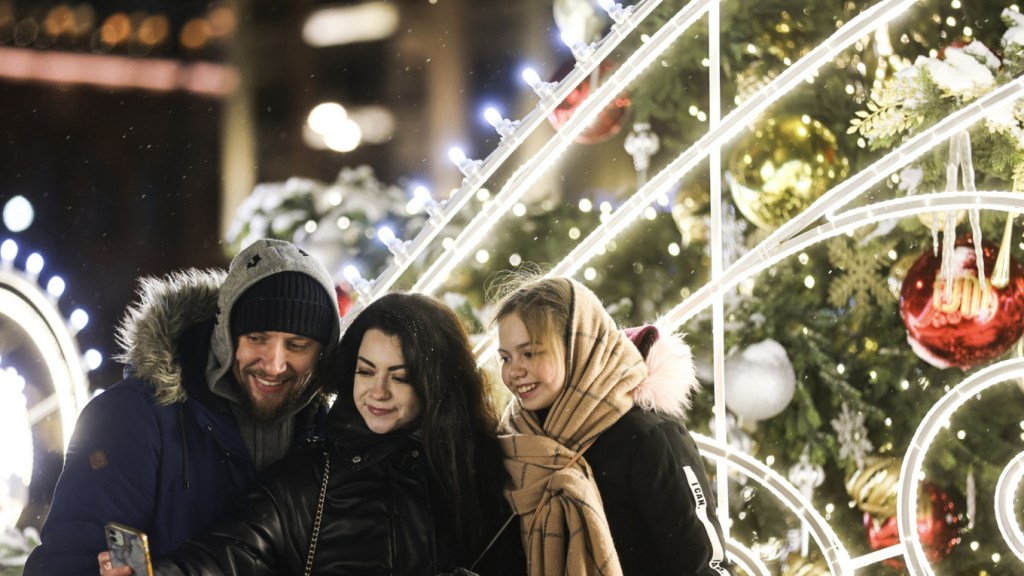
“Muskovites [sic] celebrating the New Year on Teatralnaya Square.” Photo: Yevgeny Messman/TASS (via Moscow Times)
Victimhood can be a tricky thing. Nobody doubts that ordinary Ukrainians are victims of this war. Russia’s political opposition, in exile, prison or dead, are also viewed as victims. But what of the country’s silent majority? What of the millions who stayed in Russia, kept their heads down and focused on living their ordinary lives, rather than the war and the online space it occupied?
Many things have changed in Russia since 2022. But one of the main constants has been the average Russian citizen’s desire for peace and ending the war. The majority have not been militantly opposed to or cheering the war effort on. Instead, they have been focused on living in the present, trying to salvage what remains of normality and longing for its imminent return – what some are calling the silent majority.
They are not happy with the war or satisfied with the current situation and have few ways of expressing that. Many do feel guilt on a certain (very private) level.
One thing hard not to notice in Russia throughout the conflict is how that silent majority has simply hunkered down and carried on. The war is very much in the background now. When I leave my building every morning, the same middle-aged man is defrosting his car, mothers are walking with strollers and children are heading to the local school.
When you eavesdrop on their conversations or stop to say hello, they sound normal – not like indoctrinated quasi-fascists, as some scholars are suggesting. They sound like any other school child whose teacher is just trying to get through the copious material thrown at them by the school director. The mothers just want their children to grow up in safety and comfort. Cheering on an expensive war pushing up the price of baby food is hardly a means of achieving that.
The war may come to an end in 2025. Negotiations are likelier than at any point since early 2022. And make no mistake, a peace agreement is inevitable. When the war ends, however, on whatever terms, Russia and its population of 146 million will still be there. It will not disappear or suddenly go away. The man defrosting his car as I write these words is not likely to have a huge epiphany when it does. His life has hardly changed since 2022. The increased number of women publicly wearing hijabs in our city is not doing so as a passive sign of resistance.
By living here, watching life unfold how it does, the more one cannot help but think something that many in the West will find unpopular. The war is not their fault. Tens of millions of innocent Russians are victims too. Their freedoms have been curtailed, their movements and opportunities restricted. Did they deserve that by virtue of where they were born? A classic liberal would argue not.
Like millions across the world, the average Russian is just trying to feed and raise their families, and get through the month. Many colleagues in academia have questioned from the comforts of the West, their tenured positions and with nothing to lose why many Russians do nothing to oppose the regime. What they neglect when arguing from their moral high ground is that those people I spoke of earlier do have a lot to lose being critical online. They have about as much power to topple the regime and change its course on the war, as the average Westerner does.
There will be blame to go around. Russian officials and the security apparatus, who carried out the decisions to invade Ukraine and suppress its own population, are obvious contenders. On the Ukrainian side, President Volodymyr Zelensky and his generals will have to answer for decisions they made. Kyiv’s Western allies clearly could have done more to support Ukraine, yet did not.
Russia’s silent majority will not want to be blamed and they must not be. They personally did not harm anybody or choose the war. Unlike routine acts of everyday life, the war was not their personal fault or responsibility. Collective guilt is too controversial; thousands protested, millions left and staying silent was, in its own way, an act of defiance by refusing to enter the discourse. Guilt by association is also not a tenable position. Not every Soviet citizen was responsible for the Stalinist Terror. Not every Russian citizen can be responsible for the war, especially not on the basis that they refused to cheer on Ukraine and their own country’s defeat.
Blaming those who are faultless will only cause resentment where there was none to begin with. In the long term, it will not make the world safer or more peaceful. Then comes one of liberal democracy’s sore spots that Ukraine, Georgia and even Moldova will have to reckon with on its European journeys: those people in the silent majority will still have a right to have an opinion – as will the pro-Russian segments of their populations. Dismissing these views or people will not make them, nor those in power, more rational.
If the West were serious, it would try to reach out to Russia’s silent majority, who can be won over. The Russian population at large do not hold the same positions as those in and around the Kremlin currently. Most of the population wants Russia to be an open, peaceful country, especially to the West. Make no mistake, westerners, their companies, money and popular culture will be welcomed back with open arms one day. Moreover, this part of Russian society will want to be welcomed back, too. Not doing so only will push the Kremlin into a closer alliance with the likes of China and North Korea.
Moreover, it is absolutely naive to assume that Russia’s social and economic problems will be fixed automatically by the sudden absence of Putin and the return of democracy. Although it stands a much better chance, we have been here before and there is no guarantee of success. Democracy will need to involve this silent majority beyond Moscow and the big cities – felt on the local level – seen to be actually working and fixing the people’s problems. If not, that silent majority will simply resign themselves, remaining disillusioned and ambivalent.
Gleb Pavlovsky once predicted what the end of the Putin regime would look like: it would collapse in a day and be replaced by something exactly the same. He may be proven right. If he is, that is the fault of those in power, not Russian society.
Pretrial Detention Center No. 2 in Taganrog (Rostov Region) was a place where, until 2022, minors, women, and mothers with children were detained. After the outbreak of full-scale war in Ukraine, Russian security forces cleared the detention center to make room for Ukrainian army soldiers and other prisoners of war, including the defenders of the Azovstal steel plant.
Pretrial Detention Center No. 2 gained a reputation as a gruesome torture camp for Ukrainian detainees. Many POWs in other detention centers are threatened with being sent to Taganrog and so forced not to oppose the prosecution. Few people have come forward to talk about the torture.
The story of Ukrainian Dmytro Lisovets was one of the first indications that the detention center in Taganrog had been turned into a torture camp. Lisovets had tried to flee with his family from occupied Mariupol, but failed to get through a filtration point in the Rostov Region. A former member of Ukrainian volunteer units, Lisovets was sent to the Taganrog detention center without being assigned any procedural status.
Lisovets’s lawyer toldMediazona that the Russian authorities “don’t pull any punches with the Ukrainians in this detention center”: “They burst into the cells in masks and beat everyone indiscriminately.” His client was also beaten and tortured in order to force him to admit that he had been involved in the hostilities. Consequently, Lisovets was sentenced to sixteen years in prison.
Once they were detained at Taganrog pretrial detention center, the Ukrainians were completely cut off from the outside world. According to one of the lawyers defending the prisoners, they were not allowed to talk to their clients in private, only in the presence of a police investigator. Moreover, the detention center staff forced the detainees to sign papers waiving their right to communicate with their defense lawyers.
The detainees were able to talk about the torture only after they had been transferred to other pretrial detention facilities.
“We were thrown from the back of KamAZ trucks—our hands tied and eyes blindfolded—and forced to line up against the wall under a hail of blows, where the beatings continued with hands, feet, batons and electric shockers,” one of the captured Ukrainians told his lawyers.
He also said that “at the offices” (that is, during interrogations) he would be bound with a leather belt, placed on the floor, and have a sandbag placed on his chest to make it harder for him to breathe. He would then be beaten with a rubber truncheon and tortured with a stun gun. “It was during such ‘procedures’ that [the Russians] extracted confessions of ‘war crimes,'” the Ukrainian wrote.
There were also mass beatings, including during rare walks outside in the yard. “At every turn of the walking route, a special forces soldier was stationed and was obliged to hit [the prisoners] with a stick,” said one of the convicts. Some officers were “humane” and did not beat wounded prisoners ands prisoners ofter fifty. “The attitude toward us in captivity depended on who was on duty in the prison. There were wardens who would beat all the prisoners,” saidYuriy Hulchuk, an Ukrainiian marine who spent time in Pretrial Detention Center No. 2.
There was no decent food in the detention center either. One of the defense lawyers of the Ukrainian prisoners, speaking on condition of anonymity, said that once a day the wardens “would feed them cabbage broth and quarters of black or white bread.” Ukrainian military officer Artem Serednyak was detained at the Taganrog detention center from September 2022 to the summer of 2023, during which time he lost twenty-two kilograms.
One of the prisoners calls Pretrial Detention Center No. 2 “hell with all its demons,” where it is scary to return: “Even the definition of ‘concentration camp’ would be too mild for Pretrial Detention Center No. 2,” he said. Human rights activists say that there was also sexualized violence against prisoners at the detention center: for example, prisoners had rubber truncheons shoved up their anus.
It was not only military personnel who were locked up in the detention center. For example, Ukrainian journalist Victoria Roshchyna, who was detained by the Russians in the occupied part of Donetsk Region, was sent to the Taganrog pretrial detention center for a year. She died last year: presumably, she was about to be exchanged for Russian prisoners. She did not have time to provide details about her life in the detention center. It is only known that Roshchyna was held in solitary confinement from May to September 2024.
The Russian authorities have not reacted in any way to the reports of torture. Russian human rights commissioner Tatyana Moskalkova visited the pretrial detention facilities where Ukrainian prisoners are held, but she did not report poor detention conditions either. Human rights activists say that the administrators of the detention centers would get ready for such inspections. “[T]hey prepared for this day: everyone was given new clothes, the grass was painted, the lawns were trimmed, and so on. They even gave them [the Ukrainian prisoners] biscuits, which they were extremely happy about, because the usual diet was very meagre,” [Irina Soboleva], one of the lawyers defending Ukrainian prisoners, says.
In the age of forever war, the use of mercenaries, paramilitary forces, and irregular troops have become increasingly common on the battlefield. But now Russia is resorting to luring unwitting civilians from Yemen and other countries across Asia with little to no military experience to fight alongside its troops in the war in Ukraine.
As reported by Ali Younes, a recruitment network run by a high-ranking Yemeni political and military official with ties to the Houthi government is tricking young Yemeni men desperate for jobs into signing employment contracts for work in Russia, only for them to find once they arrive that they cannot leave and are forced into military training camps and sent to the frontlines.
As the war in Ukraine approaches its fourth year with no end in sight, Russia has turned to recruiting unwitting young men from Yemen and other Arab countries to fight alongside its troops on the front lines. The men are lured under false pretenses, they tell Drop Site News, with promises of lucrative jobs and opportunities for migration, unaware that they are being forcibly recruited as mercenaries to fight in a foreign war despite having little to no military experience.
Two men who fell victim to the scheme told Drop Site they found out they were being sent to fight with the Russian army in the Ukraine war only once they had landed in Russia. Drop Site obtained a copy of an employment contract, corroborating photos and video, and spoke with a human rights organization that has documented the practice.
Mohamad, a Yemeni national who declined to give his last name for security reasons, said he was working in a restaurant in Oman in July when he was approached by Abdul Wali Al Jabri, a high-ranking Yemeni political and military official. Mohamad said they told him about job opportunities in Russia with a good salary and a hefty signing bonus and that he would be working for a civilian company according to his skills. He was eventually convinced to sign up through a company that recruits laborers in Yemen and Oman owned by Al Jabri, who is a general in the Yemeni armed forces of the Houthi government and a member of parliament in Sanaa.
Mohamad said the agreement between the Yemeni recruits and Al Jabri was a monthly salary of $2,500 with a signing bonus of $20,000. A copy of an employment contract written in both Arabic and English obtained by Drop Site lists the Al Jabri General Trading & Investment Co. SPC and Abdul Wali Al Jabri as the company representative. The contract outlines the company’s role in arranging for jobs in Russia “in the military, security, or civil field, based on…qualifications, experience, and capabilities” and says the contract ends after the signee “obtains Russian citizenship.” Mohamad said he was never told that he would be sent to fight for the Russian army in Ukraine and there is no indication in the contract.
Al Jabri has a fee built into the contract, whereby the signee is obliged to pay him $3,000 upon getting employed in Russia. Al-Jabri did not respond to repeated messages of inquiry from Drop Site for this story. However, Al Jabri did respond to questions posed by Tawfik Alhamidi, a Yemeni lawyer and human rights defender based in Geneva, Switzerland who runs the SAM Organization for Rights and Freedoms, and has documented the forced recruitment of poor young Yemeni men into Russia’s war with Ukraine.
Al-Jabri defended the practice to Alhamidi, saying he owns a “travel company” and that people in Yemen have asked him to “arrange for them to travel to Russia and join the army in order to obtain Russian citizenship and earn money to spend on their families back in Yemen.”
He dismissed criticism, adding that “he obtained a Russian approval for the Yemeni men to travel to Russia with good salaries but some political parties in Yemen who are currently fighting Ansar Allah [the Houthis] became worried that they might lose their soldiers to go fight with Russia and therefore created a social media storm over this issue.”
In September, Mohamad traveled to the Russian city of Nizhny [sic] via Dubai. He shared a video of himself with Drop Site on the plane, holding his boarding passes. He and a group of around 20 Yemeni men stayed in Nizhny for 24 hours before being shipped to the city of Rostov, a command base for the Russian army near the frontlines with Ukraine. They also discovered that their salaries were just $300 a month with a meager signing bonus.
Mohamad said that in both Nizhny and Rostov the Yemeni men were met by Russian soldiers. Mohamad said that they were forced to sign another contract, written in Russian, that obliged them to serve in the Russian military. “We were forced to sign contracts in the Russian language that we didn’t understand to serve in the Russian military,” Mohamad said. “We were very afraid.”
He said that in Rostov his group protested to the Russian officers that they didn’t want to fight in the war and demanded to go back to Yemen but they were prevented and ended up being forced to stay in Russia for months where they were forced into military training camps. Mohamed also shared a photo of a Yemeni recruit in full military fatigues and combat gear holding an assault rifle and another of a dog tag written in Cyrillic.
“We were trained by an Arabic-speaking Egyptian Russian military officer who told us that we are in Russia to fight for the Russian army and that we will be deployed to the front lines and not working as civilians,” Mohamad said. He said in the camp he met many men from Iraq, Syria, and Sudan and elsewhere receiving military training. Mohamed was finally able to return to Yemen at the end of October and he spoke to Drop Site from Sanaa.
Another video shared by Mohamed [sic] with Drop Site shows a group of about 10 Yemeni men inside a tent with wooden bunk beds in Nizhny. In the video, one man says, “We came from the sultanate of Oman for civilian work, everyone according their skills,” pointing to each one in turn, he adds, “This man is a metalworker, this man works with hydraulics, this man is an electrician, this man is a driver, this man works with electrical equipment. We are all civilians who work civilian jobs.” He goes on to say they were taken from the airport to Nizhny and they were “terrorized by armed soldiers and forced to sign contracts.” Pointing to a pile of camo backpacks on the floor, he says they were being taken to a training camp. “We are civilians and we know nothing of this,” he says in the video and calls on the Yemeni government to help them. “We are sons of Yemen and we fell into a trap.”
Drop Site also communicated via WhatsApp messages with Jalal, another Yemeni man recruited by the same network who is currently deployed as a soldier fighting for Russia in Ukraine. He told Drop Site he was lured into coming to Russia to escape poverty with the promise of a large salary and signing bonus as well as Russian citizenship. He said he ultimately decided to stay and fight in the war in the hope that he could earn enough money to be able to return to Yemen with savings as well as to possibly obtain Russian citizenship.
Alhamidi characterizes the recruitment practice as exploitative and a human rights violation.
“Dire poverty conditions in Yemen enabled human trafficking and recruitment networks to proliferate and lure young men to go to Russia under false promises of civilian work and high salaries,” Alhamidi told Drop Site, adding that Yemen’s laws contain many loopholes that [allow] Yemeni nationals to join foreign armies as mercenaries without being criminalized. “This has enabled powerful men in Yemen with connections to the Houthi government and Russia to mislead hundreds of young men into traveling to Russia to fight in Ukraine.”
A report by SAM published in November based on interviews with several Yemeni nationals who who were recruited by Al-Jabri and traveled to Russia titled, “With False Promises of Jobs and Attractive Salaries: Recruitment Networks Force Yemeni Youth into the Russia-Ukraine War,” found that: “The forced recruitment of Yemeni youth into the Russian-Ukrainian war through coercive networks constitutes a clear violation of international humanitarian law and human rights and rises to the level of human trafficking… The organization reported that once recruits arrive in Russia, they are subjected to severe abuses, including being forced to fight under harsh and inhumane conditions, being deprived of food and medical care, and suffering injuries or death from indiscriminate shelling on the battlefronts.”
According to Alhamidi, Al Jabri has traveled to Russia numerous times and has obtained visas to Russia for thousands of Yemenis to lure them into traveling there and forcing them into military training camps, though it is unclear how many have actually made the trip.
Similar recruitment networks in other countries have lured unwitting civilians to Russia with promises of work or other opportunities and then forced them to serve in the Russian army. One human trafficking network in India sent dozens of Indian nationals to Russia for combat training before being deployed to the front. Citizens of Nepal and Sri Lanka have also been illegally recruited in similar ways to fight for Russia in Ukraine.
Russia confirms revenge sentences against savagely tortured Crimean Tatar cousins, seized with Nariman Dzhelyal (Kharkiv Human Rights Protection Group, December 20th)
Abducted Kherson activist sentenced for ‘spying for Ukraine’ while in Russian captivity denied vital medical treatment (Kharkiv Human Rights Protection Group, December 19th)
Russia churns out surreal ‘terrorism’ sentences against Ukrainian POWs for defending Ukraine (Kharkiv Human Rights Protection Group, December 17th)
20-year-old from Mariupol sentenced to 11 years for argument opposing Russia’s war against Ukraine (Kharkiv Human Rights Protection Group, December 16th)
Human rights defenders: Ukrainian citizens under occupation need support (Zmina, December 13th)
Joint appeal of representatives of the coalition “Ukraine. Five in the Morning” and the Initiative “Tribunal for Putin” (Tribunal for Putin, December 21st)
Can a huge bail replace justice? (Kharkiv Human Rights Protection Group, December 18th)
Impact of War on Education and Neoliberal Reforms (Ukraine Solidarity Campaign, December 17th)
“We cannot allow this to happen to our children.” Discussion on “No Child of Ukraine Should Be Left Alone with the Experience of War” (Center for Civil Liberties, December 16th)
Over 16,000 Ukrainian civilians held captive in Russia – Ukraine’s ombudsman (Ukrainska Pravda, December 16th)
Upcoming events:
Saturday 18 January 2025, 12:00 midday. National March for Palestine. Assemble BBC, Portland Place, London. Unite the Struggles, Ukraine Information Group and others will march with our banner, “From Ukraine to Palestine, Occupation is a Crime”. Details of assembly point in the new year on our web site or by email.
Saturday 15 February 2025 11AM — 4PM, Conference: End the Russian invasion and occupation. National Education Union, Mabledon Place, London, WC1H 9BD. Register here.
This is the last News from Ukraine bulletin for 2022. The next one will appear on Monday 6 January. With best wishes for 2025 to our readers
This bulletin is put together by labour movement activists in solidarity with Ukrainian resistance. To receive it by email each Monday, email us at 2022ukrainesolidarity@gmail.com. To stop the bulletin, reply with the word “STOP” in the subject field. More information at https://ukraine-solidarity.org/. We are also on Twitter, Bluesky, Facebook and Substack, and the bulletin is stored online here.
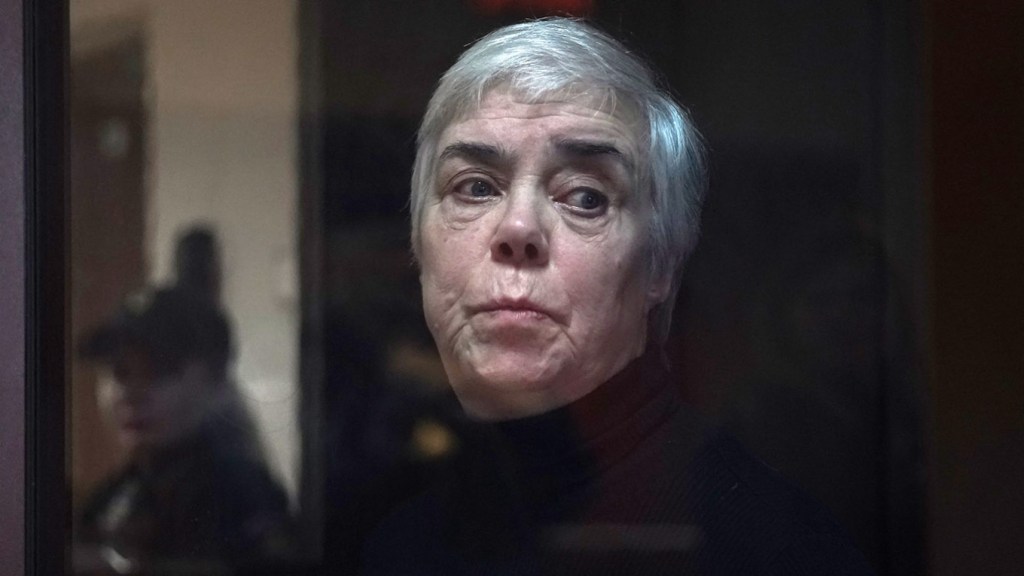
Nadezhda Buyanova. Photo: Tatyana Makeyeva/AFP, via Moscow Times
A pediatrician has been imprisoned on the strength of a denunciation by her patient’s mother. The pediatrician allegedly insulted the boy’s father, who had been killed in the war. There were no witnesses to the conversation, and it seems that the decisive factor in the verdict was the pediatrician’s birthplace — Lviv. Only recently I published the file of the criminal case against my great-uncle, who had allegedly spread rumors about the fall of Soviet regime among children at an orphanage. There, too, the accused’s background was an important point of the accusation: the arrested man’s father had once been a prosperous peasant. It was obvious to the investigators (and this was explicitly stated in the verdict) that the status of “kulak’s son” was in itself proof that the charges were true.
Lo and behold we’re back where we started: a person born in Lviv is guilty of course and must have said what they have been accused of saying.
I don’t know why we should measure things off in terms of milestones on the road to a familiar hell, but this is certainly a milestone.
A Moscow court on Tuesday sentenced a pediatrician to five and a half years in prison for criticizing the war in Ukraine during a patient visit earlier this year.
Nadezhda Buyanova, 68, was found guilty of spreading “fake” information on the Russian army under wartime laws used to silence dissent.
“I believe this is absurd,” she said in court Tuesday, moments before Judge Olga Fedina announced her sentence.
Buyanova was arrested in February after the ex-wife of a soldier who was killed in Ukraine, Anastasia Akinshina, said she had criticized Russia’s role in the conflict during an appointment.
Several of Buyanova’s supporters, mostly medical professionals, shouted “Shame on you!” in the court as the sentence was announced.
“We must empathize with one another and love others,” Buyanova said in court. “But there is no paradise on earth, there is no peace on earth.”
She protested her innocence throughout the trial.
“I am a pediatrician. I do not regret a single day,” Buyanova said.
Buyanova was prosecuted despite there being no public evidence that she criticized the war. Akinshina’s seven-year-old son testified against Buyanova in court.
Monday, 18 November, 6 p.m. “Political prisoners in Russia and the Occupied Territories of Ukraine”.
Panel discussion with Sergei Davidis (Memorial), Evgeny Zakharov (Kharkhiv Human Rights Protection Group), Bill Bowring (Birkbeck, University of London) and Judith Pallot (Gulag Echoes research project / University of Oxford).
At: Montague Lecture Centre, Graduate Centre, Queen Mary University of London, 327 Mile End Road, London E1 4NS. Also on line, via Zoom.
All welcome. Event organised by the Queen Mary University, London, Centre for Eurasian, Russian and East European Studies. Register on Eventbrite here.