
Russia’s Federal Security Service (FSB) is preparing a new case, for high treason, against Ruslan Siddiqi, the Russian-Italian anarchist serving a 29-year sentence for sabotaging a train carrying munitions to the Ukrainian front.
Siddiqi was convicted in May last year, and the Military Court of Appeal upheld the sentence on 1 July this year. In 2023 he blew up railway tracks in the Ryazan region, derailing a freight train carrying munitions, and organised a drone attack on the Dyagilevo military airfield.
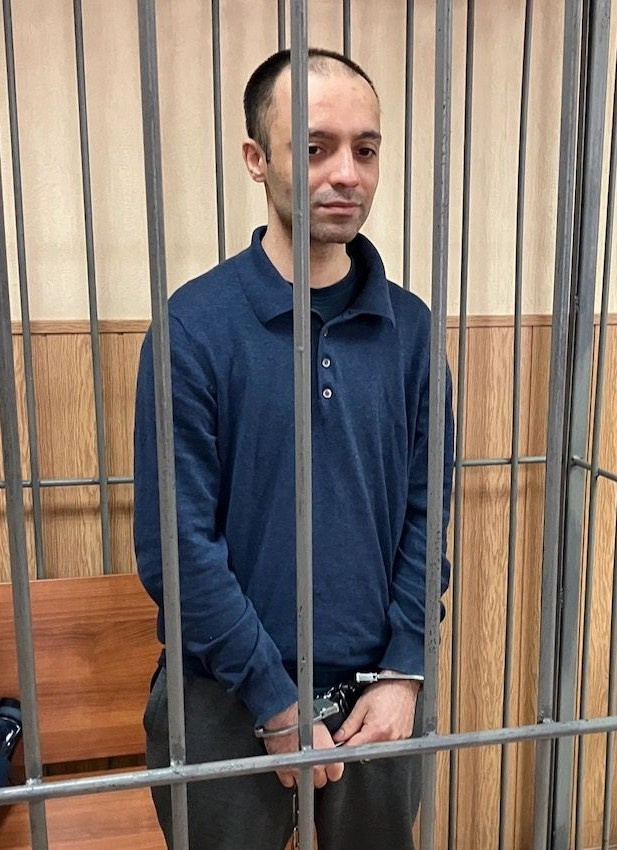
Siddiqi confessed to these actions and told the court he sees himself as a partisan, opposing Russia’s war on Ukraine. He denied a further charge of preparing another attack. He was tortured extensively during questioning, but the authorities have refused to investigate.
Fires of Freedom, who give legal and other support to Siddiqi, said that, although he should have been transferred to prison after conviction, he is being held at a pre-trial detention centre (SIZO) in Ryazan. Transfer has now been delayed because of the new case.
Here is a Facebook post about the new charges by Ivan Astashin, who campaigns in defence of political prisoners, translated by Giuliano Vivaldi:
“Isn’t that enough for them?” is the first thought that automatically springs to mind upon hearing the news of a new criminal case against anarchist Ruslan Siddiqi, who has already been sentenced to 29 years in prison for two anti-war acts of sabotage and has now also been charged with treason.
And yet for the security forces, everything is much more mundane, has a more practical raison d’etre. The sentence itself plays no role here.
It was the Investigative Committee [a federal agency answerable directly to the Kremlin] who took on the first case against Ruslan. And not just some district department, but the central bureau of the Investigative Committee — or, to be precise, the department for investigating war crimes, genocide, and the rehabilitation of Nazism, which [Investigative Committee chairman Aleksandr] Bastrykin established in 2022.
At the same time, under the Code of Criminal Procedure, only the Federal Security Service (FSB) can investigate cases of high treason. So if the Investigative Committee had “discovered” signs of high treason in Ruslan’s actions, it would have had to hand the case over to the security services.
Naturally, the Investigative Committee did not want to give such a juicy case to anyone else, so they “didn’t discover” high treason, but only terrorism, terrorism, and once again terrorism … which the Investigative Committee has the right to investigate on an equal footing with the FSB.
At the same time, the version that Ruslan was cooperating with Ukrainian military intelligence, which has now become the basis of the treason charge, was always foregrounded. Indeed, it was one of the central elements of the prosecution’s case.
The investigation explicitly proceeded on the assumption that Siddiqi coordinated his actions with representatives of Ukraine’s Chief Directorate of Intelligence. It was precisely through this framework that his actions were classified, among other things, as having been committed by an “organised group”.
So the evidence on which the FSB is now building a new treason case was already there in the materials of the first case. But turning this evidence into a separate charge based on the violation of Article 275 [on high treason] would have meant transferring the case to another agency, the FSB.
The central office of the Investigative Committee took on a high-profile case, “investigated” it itself, gathered the “evidence” itself, brought nine (!) criminal charges, and saw the case through to a conviction. There was absolutely no reason for it to hand such a case over to another agency.
Now the Investigative Committee’s work is finished. The verdict has been handed down; the appeal has been heard. And this is where the baton is already passed to the FSB Directorate for the Ryazan region.
For them, it’s a perfect case. The accused is already in custody. The skeleton of the case has been assembled by colleagues from another agency. All that remains is to rewrite the Investigative Committee’s material to fit the structure of the article of the criminal code on treason, and receive a ready-made crime against state security that has already been “solved”.
I have already told a similar story about Aleksander Leleko: he was convicted as a teenager for setting fire to railway relay cabinets, and several years later the FSB began reworking those same events into a new treason case. [Leleko, from the small Siberian town of Sharypovo, was arrested in 2023, then aged 16, and sentenced to six-and-a-half years. In April this year it was reported that he was in prison hospital, and being administered psychtropic drugs, while investigators sought to put together the new case.]
Therefore, the question “Really, is 29 years not enough for them?” hardly makes sense here. It’s not about the sentence, but about the crime-solving rate, which our investigative authorities so badly need to improve. Especially now, when generals are being blown up and shot at home.
This situation illustrates my point very well that a repressive system has rules. It can produce an utterly monstrous result, but internally it still remains a bureaucratic machine with jurisdictional boundaries, departmental interests, reporting requirements, and its own rules.
An all-powerful security official cannot simply take any desirable article of the Criminal Code and put it into his casework. Even when the decision to imprison someone has already been taken, you still have to properly document who exactly is supposed to imprison them and under which article.
Perhaps, in Ruslan’s case, there also exists a more personal motivation on the part of the Ryazan security services officers. They could not find Ruslan after the first action, caught him only three weeks after the second, and subjected him to brutal torture.
But a much more mundane and so perhaps more frightening mechanism is quite enough to explain the emergence of a new case: the agency needed a criminal case of its own; a ready-made defendant was available with a “body of evidence” already sitting on their desk.
For the security agencies, the people involved in these cases are primarily numbers in a report, not human beings.
□ Fires of Freedom, which supports Ruslan, is on Telegram (Russian only). In English, there are reports on Ruslan Siddiqi’s case, and information about how to give support, on the Autonomous Action site e.g. here, here and here. Ivan Astashin was interviewed here.
□ Ruslan Siddiqi’s final statement in court, and letters describing his anti-war action and arrest, are included in the book Voices Against Putin’s War, free to download here. The letters were published by the Russian Reader here.
Source: “Russia: jailed anti-war partisan Ruslan Siddiqi faces new treason charges,” People and Nature, 14 September 2026. Thanks to my comrades Giuliano Vivaldi and Simon Pirani for producing this important bulletin and encouraging me to repost it. }}}}}trr
