Ivan Davydov: A Poor Excuse for a Belarus

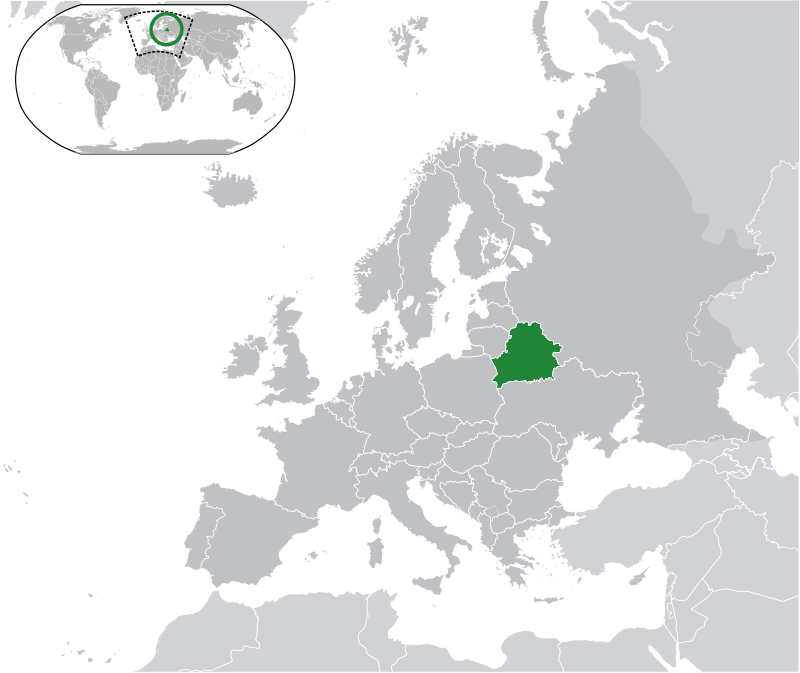
800px-Europe-Belarus.svgHow many Belaruses would fit into Mother Russia? Eighty-three! And yet, as Ivan Davydov argues, the current Russian regime is a “failed police state,” unlike the Belarusian regime. Neither fish nor fowl (although most certainly foul), Putin and his vassals have tanked their country’s economy while also signally failing to save people’s lives, nor have they been able to conjure away the coronavirus pandemic (rhetorically, if not in reality) as successfully as their frenemy the Belarusian dictator Alexander Lukashenko. Image courtesy of Wikipedia

A Poor Excuse for a Belarus: The Collapse of Vladimir Putin’s Police State
Ivan Davydov
Republic
May 14, 2020

My apartment looks onto the Yauza River and the park on the shore. In peacetime, there are crowds of people strolling there when the weather is good. And lots of shishkebabers, who are famously to blame for all our troubles.

For more than a month now, I have been locked up like all law–abiding Russians, making only occasional trips out of the house on urgent business. I watch the world mostly from my balcony, and my world has narrowed to the size of this selfsame park.

Going to parks has been prohibited in Moscow by a special decree of the city’s all-powerful mayor. In parks, the coronavirus is particularly brutal, tracking down rare passersby, lonely morning jogging enthusiasts, and mothers with children, attacking and devouring them. On construction sites, on the contrary, the virus is weak and cowardly: it is afraid of construction workers, whom it does not touch.

Parks are a different matter.

The irresponsible residents of my neighborhood would still go to the park. Not in droves, as was the case before, no. They would go in small groups, as families, apparently. Joggers occasionally popped up, and bicyclists flashed by. Children made their way to the playgrounds (which were also closed, of course). In other words, they violated the mayor’s wise orders.

To put a stop to this unbridled lawlessness, police patrols would come to the park. The guardians of law and order would park their car on a hillock and stand around smoking and watching people walking. Once, when it was particularly cold, wet snow was pouring down, and only a lone madman was sitting on a bench, they went up to the madman and forced him to sign some papers.

And once they went down to the park and fed the ducks, pointedly ignoring the people walking around, before returning to their car. Oh yes, and a couple of times they shouted into a megaphone about the fact that going to parks was temporarily prohibited, and that citizens should look out for themselves and their loved ones.

I will explain later what this pastoral sketch was all about, but in the meantime let us look through the window at our neighbor to the west. It is a fascinating story.

A Wonderful Neighbor
While the rest of the world has been in quarantine, Alexander Lukashenko has gained fame as a maestro of fiery speeches and colorful aphorisms. He has suggested treating the coronavirus with vodka, a bath, and field work. He has advised Belarusians who have lost their jobs to find a job and get to work. (It’s brilliant, really, and simple, like all brilliant solutions.) He advised overly light-minded men to be patient and not to mix with other men’s women for a while. Lukashenko is a president with real gusto, not a president who talks about ancient battles with the Polovtsy from his bunker.

To the frenzied delight of Russian jingoists, Lukashenko held a parade on May 9 [Victory Day], attracting crowds of people, including the elderly. And the very elderly—veterans, in fact. But that was only half the trouble. He also said that after the parade, the statistics on the incidence of pneumonia had gone down. He confessed (he’s an honest man) that he had feared an increase in the incidence of pneumonia, but it didn’t happen. “Well, what did we end up with? There has been a significant reduction in pneumonia in Minsk: it dropped by half yesterday. And I made the sign of the cross yesterday: God grant that we will continue giving hell to pneumonia like this.” Fresh air, he said, helps a lot.

And if Lukashenko had wanted, he could have said that people who died from the coronavirus had begun resurrecting after the parade. (As of May 12, according to the official statistics, 142 people in Belarus had died from the coronavirus.) Why? Because he can, that’s why. He can stamp out any protest. He can ignore the reports from the doctors.

It’s not even the Swedish model. The Swedish model, whose success is a matter of debate (a debate we will have later) stipulates that big public events not be held, and citizens behave responsibly. The Belarusian model assumes that there are no citizens. There is a populace that absolutely obeys the decisions of the supreme leader. Happily for us, the new virus is not the medieval black death: clearly, the country will not die off if you purposely avoid imposing a quarantine in order to save the economy. The Belarusian president made his choice by deliberately deciding to sacrifice a certain (non-essential) number of inhabitants, who cannot be saved by vodka or field work.

And after Vladimir Putin announced a “phased exit” from the semi-imposed non-quarantine, Lukashenko condescendingly praised his junior comrade, saying that Russia had followed the Belarusian path.

The Russian Miracle
But in fact, Russia has its own special path. The “non-working weeks” battered the economy considerably, but it is questionable whether they were able to protect residents. When the quarantine was imposed, there were very few cases. When the government started lifting the quarantine, Russia shot up to second place worldwide in the number of infected people.

Discussing the reliability of Russian statistics is a risky business: nowadays, the prosecutor’s office does not see much difference between well-founded criticism and “spreading fake news” about the coronavirus. But we will not make any arguments, we will just note what respected officials and politicians have been saying.

On May 12, Anna Popova, the head of [Russian federal consumer watchdog] Rospotrebnadzor, said that 28.4% of people identified in Russia as infected with the coronavirus were hospitalized. At the time, the total number of people identified as infected was around 230,000; a simple mathematical calculation gives us approximately 65,000 people in hospitals. (In fact, the real figure is another ten thousand less, since we are not taking into account the people who have recovered). But the next day, Health Minister Mikhail Murashko said at a cabinet meeting that there were more than 100,000 Russians hospitalized with the coronavirus. You would agree that all this makes it seem that our government is surprisingly footless and fancy-free with statistics, even with their own official statistics, with statistics intended for the public.

On May 13, the Moscow Health Department reported that 60% of those who died with a diagnosed coronavirus had not been included in the coronavirus fatality statistics for capital, because they had died from “obvious alternative causes.” The governor of Petersburg also reported that there had been a spike in the incidence of pneumonia in the city: the indicators were “five and a half times higher than the average.” Since the first of March, 694 residents of Petersburg have died from pneumonia, and 63 from the coronavirus.

Perhaps this is the reason for the Russian miracle of rather low mortality rates from the coronavirus infection. Especially if you remember that Russia is not only made up of capital districts and metropolitan areas, that in the regions, as a rule, all or almost all media outlets are controlled by the local administrations, and it is even easier for them to turn statistics from an enemy into an ally.

And why did the head honcho announce the end of the “non-working weeks”? Well, it’s not so hard to turn a terrible virus into a non-scary one. It’s like with elections: what matters is not what really happened, but who counts the votes and how they count them.

Amulets for MPs
But what’s really going on? In fact, our high officials are afraid, and they are trying to protect themselves by turning the nightmare into a joke and not standing on ceremony with the public. Saving your own life is more important than standing on ceremony.

On May 13, Igor Molyakov, an MP from A Just Russia, asked State Duma Speaker Vyacheslav Volodin why some of their colleagues were coming to sessions of parliament not wearing their MP pins, as required by law, but wearing quite different pins featuring a white cross on a black background. Molyakov added that he was a dog breeder himself and would like to know whether it would be possible for him to wear the pin of his kennel club instead of the Russian tricolor on his lapel.

Volodin’s answer, I hope, will go down in the annals: “Let’s ask the people who are wearing these pins, but as far as my colleagues have told me, they are special devices for repelling the virus.”

I wouldn’t be surprised if, one day soon, MPs ran naked around the State Duma building on Okhotny Ryad banging on pots: this method of fighting pestilence has been described by anthropologists. And we can only pray that no one tells them that fresh human flesh, for example, staves off the virus. They would believe them.

Dmitry Peskov, the president’s press Secretary, has fallen ill. And now he remembers regretfully the “virus blocker” that he wore and then stopped wearing after he was mocked in the press.

Here it is important to understand that the people wearing the miracle badges and warding off the virus with life-giving white crosses are the same people who explain why “phasing out restrictions” at the peak of the epidemic is justified, and make decisions that affect our lives.

Of course, they themselves get sick and get infected, but let’s not forget that we will be treated in slightly different hospitals, if push comes to shove.

It’s hard to stop. For dessert we have another intellectual delicacy, this time from Petersburg Governor Alexander Beglov. He has explained why masks cannot be distributed for free in the city during the mandatory mask regime: “Yesterday, we adopted a resolution not to give out free masks, but to hand out money. There are a lot of people in our city, both visitors and non-visitors, and people from other regions. How should we should distribute these masks? We should make you show your passport and ask where you are registered.”

The virus, you understand, asks to see people’s residence permits and attacks only native Petersburgers. It presents no danger to out-of-towners and migrant workers, nor can they themselves infect anyone. Governor Beglov is in charge of Russia’s second largest city, the home to millions of people and a “pneumonia outbreak” that, of course, has nothing to do with the coronavirus.

By the way, Beglov’s “money” amounts to 800 rubles [approx. 10 euros] for pensioners and members of large families to buy masks.

A Failed Police State
But let’s go back to my park. I started with it to illustrate the fact that the police state in Russia has failed. There has been a lot of overkill, and people all over Russia have been pretty annoyed, but the police have been unable to ensure compliance with the imposed restrictions. They are good at breaking up peaceful protest rallies, but bad at everything else.

The government had a choice. It could have engaged the citizenry in dialogue, rejected intimidation in favor of education, sought compromises where possible, and, of course, provided direct financial assistance to those forced to stay at home. It could have made Russia’s citizens its allies instead of making them the targets of an incoherent police dragnet. To do this, however, it would have had to see the populace as citizens, but we have a big problem with this sort of thing in Russia.

The government could have done it, but it was impossible—forbidden—for the government to do it.

It would have been possible to issue endless prohibitions of varying degrees of savagery and to force the population to comply with them using an old and proven argument—the police billy club. But that didn’t work out either. It turns out that there is no police state in these parts. There is a useless system of governance that starts to crumble at the first serious test. Ensconced in his bunker, the head honcho denounces the immorality of the Spartans, while his subordinates are decked out in life-saving amulets, expecting that by summer everything will have somehow worked itself out.

The reason they terminated the “non-working weeks” is that they simply could not enforce the lockdown measures. And they decided to rescue the economy since they had been unable to save people. But there was a tiny twist: they did this only after after the economy had been dealt a serious blow.

The Russian state makes war on Russian citizens as if they were the main threat when, in fact, there are no real threats to it, but it simply vanishes when there is a real threat. This is exactly what Putin has built over the last twenty years. This is the whole “Russian federal system”—terrifying, unsinkable, tending to totalitarianism. It’s a poor excuse for a Belarus. It’s a slightly rotten Belarus.

Take care of yourselves and help each other. No one else is going to help us.

Translated by the Russian Reader

Half a Million Migrants in Moscow Have Lost All Sources of Income

d8a5aa0e-9470-11ea-be48-fa163e074e61Photo by Sergei Lantyukhov for NEWS.ru

Study: Half a Million Migrants in Moscow Have Lost All Sources of Income
Sociologists say government should introduce social security for foreigners, otherwise “social tension” inevitable
Sergei Vilkov
NEWS.ru
May 12, 2020

More than half the migrants in Moscow have lost their jobs, and a significant portion of them have also lost all sources of income, according to a study done by a group of sociologists, led by Evgeni Varshaver, at the Center for Regional and Urban Studies in RANEPA’s Institute for Applied Economic Research. NEWS.ru took a look at their preliminary findings, which have been presented to the Russian government in the form of a briefing paper. The sociologists analyzed the risk of a sharp uptick in crime and social unrest among migrants, as well as making recommendations, one of which was to provide migrants with social security and health insurance. The lead author of the study backed up the findings with his own arguments.

An Invisible Army

While 32% of Moscow residents who are Russian nationals have lost their jobs or been sent on unpaid leave [due to the coronavirus pandemic], 54% of those who come from other countries have lost their jobs in the Russian capital. 32% of migrants have lost all sources of income, while among Muscovites who are Russian nationals this figure is 17%. Only about one in ten guest workers reported that their financial situation had not changed, the report says. (NEWS.ru has a copy of the report.)

If one extrapolates the data from the study to all migrant workers in Moscow, then, given that their number has been estimated by experts at about 1.5 million people, around 500,000 people have completely lost their livelihoods, according to the briefing paper. Reports continue to appear about migrants who have lost their homes and remain in the Russian Federation with no fixed abode [i.e., they are homeless de jure, if not de facto—a critical distinction in Russia, where everyone is required by law to be registered with the authorities at their actual residence]. Migrants often do not receive the free medical care to which they are entitled by law, and other forms of medical care are often too expensive for them.

As the researchers note, migrants are, at the same time, at special risk for the epidemic. The apartments that they rent are, on average, twice as densely inhabited as those of Russian nationals.

Speaking of a possible increase in crime among migrants due to the pandemic, the researchers argue that “although it is possible to assume a slight increase in the number of property crimes by this category of persons, expectations of an explosive increase in crime among migrant workers are not borne out.”

The researchers argue that there was no surge in criminal activity among guest workers during previous crises. This was partly due to oversight by diasporas and similar communities.

When NEWS.ru asked whether diasporas can really control their fellow countrymen, the head of the research group, Evgeni Varshaver, warns against extreme views on this issue. Migrants, he says, like all other people, listen to figures of authority. It is also important to understand that if such respected people have been living in Russia for a long time, they have often been incorporated into local elites (albeit, sometimes, as something exotic), and it is in their interests to prevent the growth of crime among migrants, because in the eyes of their “partners” in Russia, they are responsible for the behavior of their compatriots. Varshaver admits, however, that this influence is often exaggerated.

“However, this does not mean that it does not exist at all. It does exist, and the smaller the locality, the more intense the communication among elites and ordinary migrants, and the more these two groups rely on each other: the first can help with money or put in a word with the migration service; the second, if push comes to shove, can stage a protest rally.  In a large city, due to greater differentiation and multilayered social structure, this link is not so obvious, and the possibilities of atomization are greater. But now let’s get back to what prompted us to discuss diasporas, namely, whether migrants will commit more crimes. I think that they will, along, however, with other deprived groups, and this is understandable in circumstances of acute impoverishment, but this surge will not be as powerful as predicted in some pro-migrant and anti-migrant publications,” says Varshaver, a senior researcher and head of the Migration and Ethnicity Research Group at RANEPA.

In addition, the authors of the study refer to the findings of sociological studies of past years, indicating that among migrant workers in Russia, “the prevailing attitude has been to comply with the laws of the country of residence.”

In 2016, RANEPA sociologists surveyed 2,412 migrant workers in different regions of Russia. 83% of them indicated that it was absolutely necessary to comply with the laws of the host country. However, it would be strange to expect respondents to say the opposite, although even in that study, 3% of migrants chose the option “No, it’s okay if not all the rules are followed.”

A Reason for Welfare

Separately, the researchers considered measures to support migrants. They identified as positive the fact that the presidential decree of April 18 granted foreigners the right to stay in Russia regardless of the length of their residence permits. The requirement to obtain a work permit was then temporarily lifted, meaning that if migrants were out of work and their permit expired, they would not have to buy one. From the same decree, it followed that migrants no longer had to work in the region where they were issued a work permit. The ability to move to another region without bureaucratic barriers has significantly expanded the options of migrants for finding work in crisis conditions, according to the authors of the study. Simultaneously, volunteer aid programs have been implemented, and some migrants are now able to receive charitable support in the form of food and compensation for housing costs.

However, these measures do not solve the problem. According to the RANEPA researchers, it is necessary to ensure that the minimum needs for food and housing of migrants who remain in Russia are met until they have been employed or they can return to their countries of origin. During an epidemic, the link between the well-being of local residents and the circumstances of migrants is more pronounced than in other periods, including after the the risk of property crimes has been taken into account, they argue. In addition, it is necessary to ensure better access to medical care for migrants and to lessen the load on temporary detention centers for foreign nationals subject to deportation.

“This will inevitably be an unpopular decision; moreover, such assistance should be provided along with the assistance that is provided to non-migrants,” explains Varshaver. “A pained reaction on the part of nationalistically minded Russians to the decision to provide this assistance is inevitable, but on the other side of the scale you have total impoverishment accompanied by real hunger, a possible increase in crime, and other negative social consequences, and so it is necessary to make an informed decision, which obviously is to take care of all those who were forced to stay in Russia when the borders closed and hence cannot go anywhere.”

These measures seem to be necessary at the moment. Otherwise, a significant number of migrants will lose their livelihoods, which, regardless of how valid current alarmist expectations are, will lead to significant social tension, the authors of the study claim.

cd21b5aa-9471-11ea-a603-fa163e074e61Photo by Kirill Zykov for Moskva News Agency
When asked how the end of “non-workdays,” as announced by President Vladimir Putin, would affect the circumstances of migrants, Varshaver explains that it is difficult to make forecasts.

“On the one hand, there has been a lot of talk about the situation with migrants, and aid resources have been mobilized, which is why the crisis has been dampened as much as possible. On the other hand, every day of quarantine has a negative impact on the economy as a whole and on migrants in particular. On the third hand, yes, of course, the exit from the quarantine, for example, of the construction industry (I wonder if it has really gone into a full lockdown?) will also enable migrants working in construction to start earning money. On the fourth hand, not all migrants work in construction. There is also, say, the hospitality sector, which the crisis has affected and will continue to affect much more, and this is the second important area of migrant employment, and many who were employed, say, as waiters, are now out of work. On the fifth hand, the summer season is beginning, and this means dacha construction and agricultural work, which means additional jobs. Generally, predicting is not easy, but that the lives of migrants are now no bowl of cherries is a fact, and most likely they are no bowl of cherries to an even greater extent than life for Russian nationals,” says Varshaver.

In late March, NEWS.ru investigated how the crisis brought on by the coronavirus epidemic had severely affected people from Central Asia who work in Russia or even found themselves passing through the country. Transit areas in some of the capital’s airports experienced a collapse due to flight cancellations. Workers and visitors from neighboring countries faced not only being forced to wait for weeks to be sent home without having a source of income. NEWS.ru talked to migrants waiting to leave and found out how the spread of COVID-19 and related quarantine measures had affected these people. We also learned that problems with departing Russia were not the only ones that had impacted migrants, further aggravating the situation of one of the most vulnerable groups in Moscow.

Additional reporting by Marina Yagodkina

Translated by the Russian Reader

A Death Sentence for Yuri Dmitriev?

dmitriev
Yuri Dmitriev. Archive photo courtesy of 7X7

Karelian Supreme Court Refuses to Release Historian Yuri Dmitriev from Remand Prison Where Coronavirus Has Been Discovered
Denis Strelkov and Sergei Markelov
7X7
May 7, 2020

The Supreme Court of Karelia has turned down an appeal by the defense to not extend local historian and head of the Karelian branch of Memorial Yuri Dmitriev’s arrest in police custody, 7X7 has been informed by Dmitriev’s lawyer Viktor Anunfriev.

The defense had asked the court to change the pretrial restraints imposed on the 64-year-old Dmitriev because the local historian was at risk for the coronavirus infection since a couple of months ago he had suffered a severe cold. On April 30, Artur Parfenchikov, head of the Republic of Karelia, wrote on his social media page that two prisoners in Petrozavodsk Remand Prison No. 1 had been diagnosed with COVID-19.

More than 150 people, including famous actors and musicians, scientists and teachers, had signed an open letter expressing concern for the health and well-being of Dmitriev, who in the late 1990s uncovered at Sandarmokh and Krasny Bor the mass graves of Soviet citizens executed during the Great Terror of the 1930s.

In April 2018, the Petrozavodsk City Court acquitted Dmitriev on charges of producing child pornography. The charges were made after nude photos of his foster daughter were found during a police search of his house. Dmitriev claimed that he had taken the snapshots at the request of social and health services to keep track of the girl’s health. Expert witnesses at the trial testified that they did not consider the pictures pornographic. Two months later, the acquittal was overturned by the Karelian Supreme Court, and Dmitriev was charged, in addition to making the pictures, with sexual assault.

Translated by the Russian Reader

Presumption of Guilt

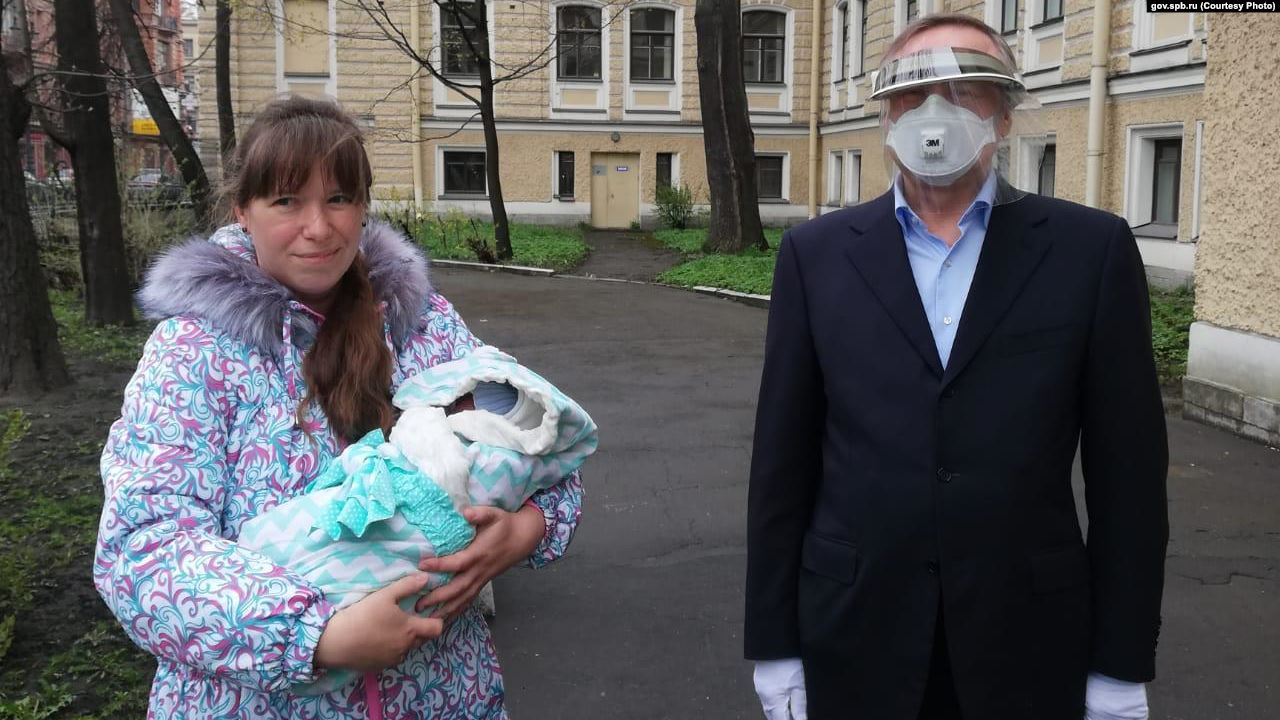
beglovPetersburg Governor Alexander Beglov (in mask, on right) visited the city’s Maternity Hospital No. 9 on May 3. Photo courtesy of Sever.Realii
Beglov Explains Outbreak at Vreden Center Through Failure of Employee to Self-Isolate After Returning from Turkey
Bumaga
May 1, 2020

Speaking on TV channel 78, Governor Alexander Beglov claimed that the source of the coronavirus outbreak at the Vreden Traumatology and Orthopedics Institute in Petersburg was an employee who had returned from Turkey and failed to self-isolate.

“Again, we’re talking about conscientiousness, about people’s other qualities . . . One employee at the Vreden Institute came back from Turkey. By law, he should have stayed home fourteen days in self-isolation. He went out on the fourth day, engaged in certain activities and, consequently, brought the infection into the hospital. And a large number of people were infected, on the order of 150 people. Naturally, the hospital had to be closed,” Beglov said.

Beglov noted that during this time, a large number of patients were discharged and released to other regions of the country, thus “spreading” the coronavirus.

The governor did not directly respond to a question about whether any measures would be taken against the employee who did not self-isolate. “The law stipulates criminal liability. We have already opened five criminal cases. This is no a joke, ” Beglov said. The governor also cited the closure of three maternity hospitals where women in labor “forgot to warn” staff about their recent trips.

The Vreden Institute of Traumatology and Orthopedics has been closed for quarantine since April 9 due to the coronavirus. Doctors reported a lack of personal protective equipment. There is no official information about the number of cases, but according to media reports, sixty out of 260 employees tested positive. TASS reports that 300 people at the hospital have been infected.

[. . .]

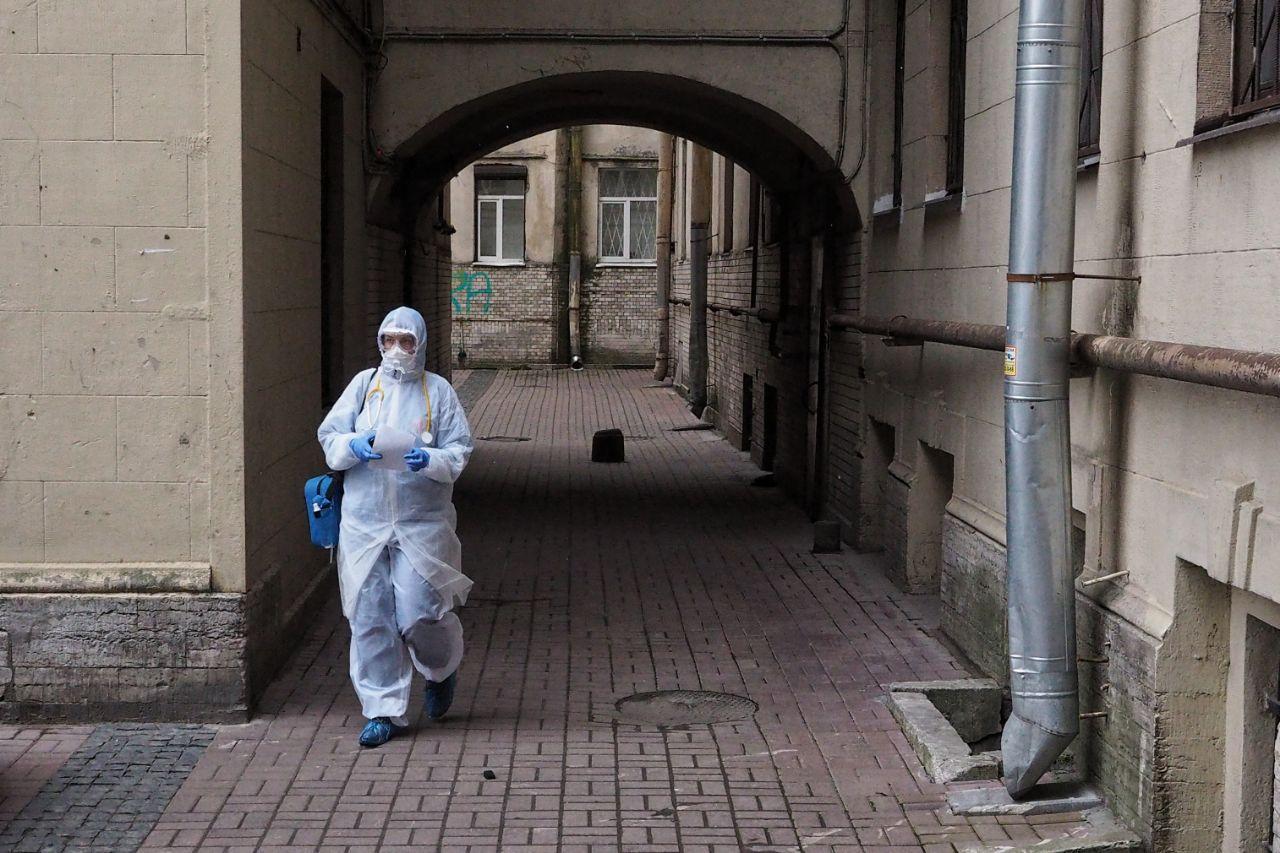
fontankaPhoto by Mikhail Ognev. Courtesy of Fontanka
Presumption of Guilt: Petersburg Doctors Warned They Should Die from the Coronavirus Correctly
Alexander Yermakov
Fontanka
May 1, 2020

Not all doctors infected with COVID-19 will receive financial compensation from the city. The municipal public health committee has made it possible to shift responsibility to health workers and thus save the municipal government money.

The Smolny [Petersburg city hall] has given head physicians at the city’s hospitals the right to decide whether health professionals were “correctly” infected with the coronavirus or took ill due to their own negligence. Occupation health and safety experts see this as an acute conflict of interests and predict a wave of refusals to make cash payments to people whom President Putin has compared to soldiers fighting on the front line.

The Smolny decided two weeks ago on the amount of lump-sum payments to health professionals who have suffered while treating patients with COVID-19. The death of a hospital or ambulance employee has been valued at one million rubles [approx. 12,000 euros]; disability, at 500,000 rubles [approx. 6,000 euros]; and infection with no particular health consequences, at 300,000 rubles [approx. 3,700 euros]. Thirty million rubles [approx. 368,000 euros] have been allocated for this purpose. The small matter of outlining the procedure for determining whether a health professional was a victim of the virus remained. The task was assigned to the city’s public health committee.

While the committee has been designing this procedure, Petersburg health professionals began contracting the coronavirus in large numbers and dying. As of April 30, around 250 cases of COVID-19 had been registered among the city’s doctors, paramedics, and orderlies.  If each of these cases had resulted in compensation, Smolny’s thirty-million-ruble limit would now have been surpassed: eight million rubles would have been paid to the families of the dead, and 75 million rubles to infected health professionals [for a total of approx. 981,000 euros].

A few days ago, a draft order appeared on the public health committee’s website, establishing the procedure for recognizing a medical worker as a victim. The document indicated that the families of those who died with a confirmed diagnosis of COVID-19 would automatically receive payments.

On Friday, April 30, the final version of the document was published on the Smolny’s website. A significant addition has been made to it. The death certificate must cite the novel coronavirus infection as the cause of the medical worker’s death. If the medical worker died of concomitant diseases, their family cannot claim compensation. As cynical as it might sound, the family of Sergei Beloshitsky, an emergency room anesthesiologist at the Alexander Hospital, would not have received the million rubles promised by Governor Beglov had Beloshitsky died after April 30. The death certificate lists pneumonia-induced cardiopulmonary failure as his cause of death.

“This item [on the exact cause of death] was added at the approval stage of the draft municipal government decree ‘On the procedure and conditions for providing lump-sum payments to injured medical workers’; it is a clarification,” Fontanka was informed by the public health committee.

According to the committee’s order, payment to infected health professionals is almost entirely contingent on the opinion of the head physician at the institution where the person works.

Medical workers must append a whole stack of documents to the compensation application, including—and this will be the main obstacle to receiving money—a “certification of injury caused by rendering assistance to sick patients.”

For a medical worker to obtain this certification, he or she will be subjected to an investigation carried out by a commission convened at the hospital where the infected person works. The commission will include the hospital’s deputy head physician, the worker’s immediate supervisor (for example, a department head), someone from the hospital’s occupational health and safety office, and a trade union member.

The hospital’s head physician will have to approve (or deny) the certification of injury.

The investigation must not merely confirm or deny that the health worker contracted the coronavirus in the line of duty (and not in the subway), but also name a specific factor, for example, violation of sanitary regulations, working conditions, failure of ventilation systems, or lack of personal protective equipment. In addition, the commission has the power to determine in percentages the degree of the medical worker’s own liability.

For example, on April 30, Sergei Sayapin, an emergency room anesthesiologist at the Pokrovskaya Hospital, filed an application to be certified injured as a result of having treated a patient with a confirmed case of COVID-19. Sayapin was infected and underwent treatment at the Botkin Infectious Disease Hospital.

The Pokrovskaya Hospital will investigate this claim. The investigation’s findings will be approved (or denied) by the head physician, Marina Bakholdina. Sayapin claims that he was infected due to a lack of personal protective equipment, which was allegedly not provided by Bakholdina. In order for Sayapin to be entitled to compensation in the amount of 300,000 rubles, his hospital’s head physician must declare herself guilty.

“No hospital director in their right mind will take responsibility and sign a certificate recognizing their employee as a victim,” said Oleg Shvalev, an occupational therapist and associate professor of occupational medicine at the Mechnikov Northwestern State Medical University. “Under the usual procedure for certifying occupational illnesses and injuries, an independent commission headed by an official from Rospotrebnadzor runs the investigation.”

It is obvious that head physicians are not interested in recognizing medical workers as victims. Rostrud (the Russian Federal Labor and Employment Service) has already proposed deeming each case of coronavirus infection an acute occupational illness, running an investigation (involving Rospotrebnadzor), and holding the management of medical institutions accountable. It is entirely possible that while a hospital’s own commission could deem individual medical workers guilty of their own infections (thus depriving them of the right to compensation from the Smolny), the social security disability assessment board would find the hospital liable.

A source at city hall told Fontanka that the city had already clearly decided on its method for counting COVID-19 cases and did not plan to change it.

“Our statistics include people who died from covid, not with covid,” the official said. “There are dozens of instances when patients with confirmed cases of the coronavirus have had cancer, heart failure, or pneumonia listed as their cause of death. The same method will be applied to medical professionals.”

The Petersburg public health committee confirmed that the death of every medical worker would be investigated by the commission for the analysis of deaths from influenza and severe forms of other SARS, including COVID-19. Only if the death certificate lists the cause of death as infection from the novel coronavirus will families of the deceased be eligible for compensation.”

Fontanka asked the Moscow health department how they keep their statistics. All patients with a positive test result for the novel coronavirus infection and a confirmed diagnosis of pneumonia are counted in Moscow. “The cause of death could be another concomitant disease, but it does not matter for our statistics,” an official at the department added.

According to the head of the working group on combating the coronavirus, Yevgeny Shlyakhto, director of the Almazov Medical Center, only half of the healthcare professionals in Petersburg who have fallen ill with COVID-19 contracted it directly through their work. Most likely, infected doctors working in non-specialized hospitals will not automatically be covered under the Smolny’s compensation order.

Thanks to Dmitry Kalugin and Vadim Klebanov for the heads-up. Translated by the Russian Reader

Fishers of Men

Riot Police Prevent Fishing Near Local Power Plant
SIA PRESS
April 27, 2020

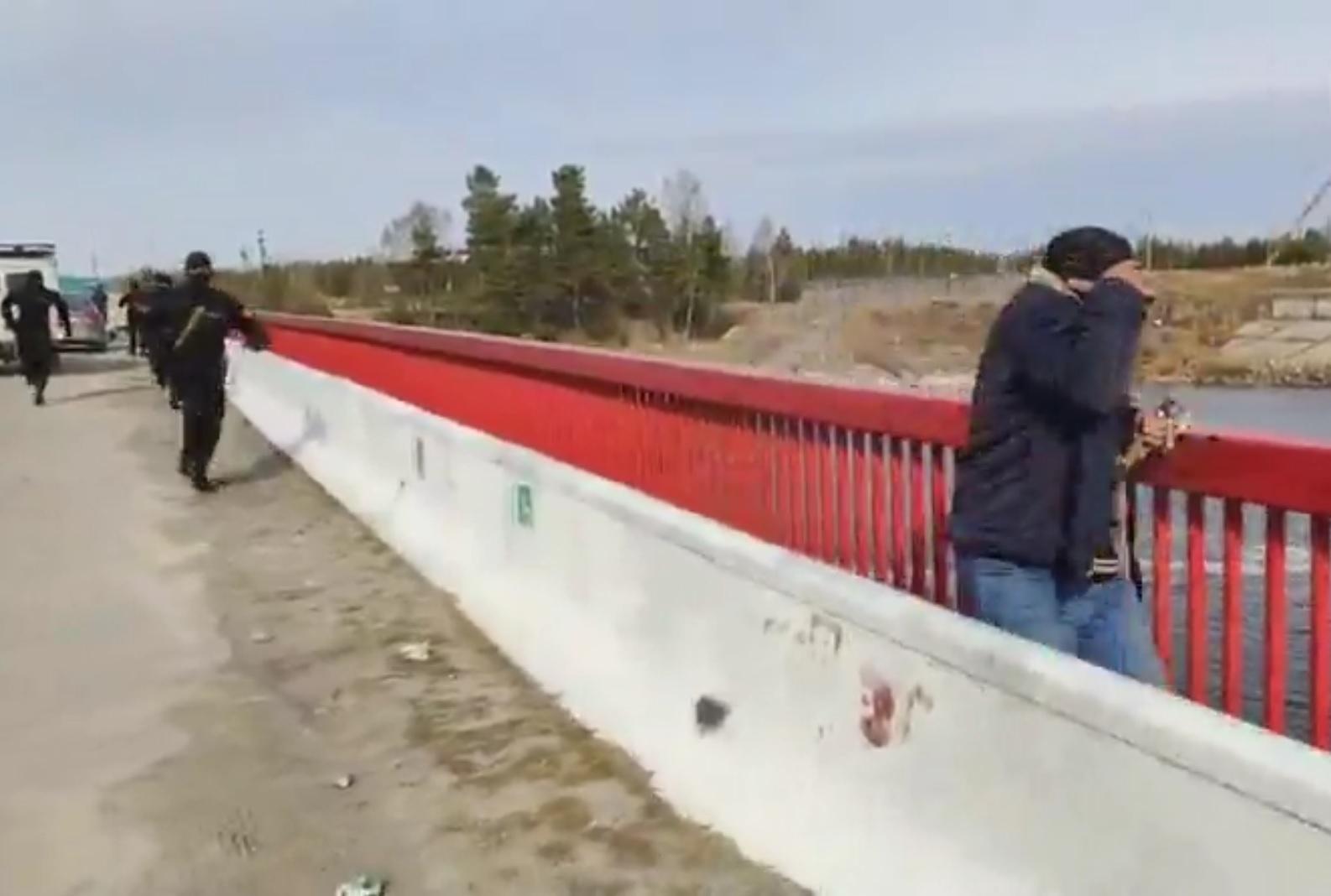
Riot police [OMON] in Surgut prevented fishing in a body of water near the local power plant. Some fishermen had to be caught on the run with machine guns at the ready, while others refused to fall afoul of the security forces and voluntarily returned their catch. No one was injured as a result of the operation.

Fishing is prohibited in Yugra till May 31 due to flowing ice and spawning. In addition, there is now a ban on people leaving their houses due to the self-isolation regime imposed to prevent the spread of the coronavirus.

As SIA PRESS learned, the regional fish conservancy has been carrying out raids at bodies of water and fining fishermen for violating the law. Inspectors have been assisted in their raids by the security forces, including regular police, riot police [OMON], and the Russian National Guard.

fishermanSurgut fisherman fleeing from riot police

All violators face two fines at once—the first, from one to thirty thousand rubles, for violation of isolation, and the second, for fishing. When bans are in effect, double penalties are applied to the entire catch, so the amount of the fine depends on how many fish the men managed to catch.

Image courtesy of SIA PRESS. Translated by the Russian Reader

Coronavirus Outbreak at Novatek Construction Site in Murmansk Region

Worker Tells of 1,900 Infected Construction Workers at Novatek Site
According to him, work team got hold of computer file containing actual numbers of infected and test results
Artyom Alexandrov
NEWS.ru
April 28, 2020

Workers employed by contractors Velesstroy Montazh at a Novatek construction site in Murmansk Region have refused to report for their shifts due to a coronavirus outbreak in the workers’ dormitories that management has preferred to ignore. NEWS.ru has talked to workers who allege that the results of their tests for the virus have been withheld from them, and both healthy and sick workers have been encouraged to work. To top it all off, the employees fear they won’t be paid.

Novatek’s Artic LNG 2 project involves the construction of a facility for the production of liquefied natural gas on the Gyda Peninsula in the Gulf of Ob. To implement the project, a center for the construction of large-capacity offshore facilities, which the local press has dubbed the “factory of factories,” is being erected near Belokamenka in Kola Bay in Murmansk Region. The agree to build the construction center was signed in 2015. Such a a large project has not been undertaken since Soviet times.

NOVATEK

Reports of a coronavirus outbreak at the construction site started appearing in the media and social networks in mid-April, and since then the situation has become more alarming. However, neither Novatek nor local authorities believed that work should be stopped. Construction workers were tested for the virus, but officially there was not talk of a serious outbreak.

Work has been halted, however, by a “grassroots initiative.” A construction worker named Ilya told NEWS.ru that everything changed dramatically after workers got hold of an Excel file in which management had allegedly recorded the real number of cases and actual test results.

“We were not informed of the test results. In fact, until now, almost all of us know them only thanks to the documents that surfaced. It turned out we have a huge number of cases in every house where workers live. There are 205 people in my dorm and 171 infected people. There are a total of 4,000 workers, and 1,900 have been infected,” said Ilya.

According to the crisis center in Murmansk, 867 people at the construction site were confirmed to have the coronavirus. However, the other figures for the numbers of infected were not a big surprise to the workers since many of them have long since complained of symptoms of COVID-19, including fever and loss of smell. But, as was mentioned above, despite the fact they submitted to tests in good faith, they were not told the results. Despite massive health problems among their employees, construction site management has pretended that everything is fine.

“I have gone to the GP four days in a row and still haven’t received any information. If you say you’re not feeling well, they don’t really treat you. They only hand out anti-fever medicine. Some of the guys have pneumonia, however, but there are no antibiotics. Management has told us to pack up and travel to the hospital if we want. The infectious disease hospital is located 128 kilometers from here, in Monchegorsk. And yet they’re also scaring us by saying that things are so bad there, we’d better stay here,” said Dmitry, another construction worker.

Several nurse practitioners work at the site, but according to the workers, they are not equipped to fight the epidemic. There is also an Emergencies Ministry mobile hospital near the site where thirty-nine of the most severely ill patients have been taken, as well as to the Murmansk Regional Hospital. Large-scale hospitalization of the workers has not occurred, however. For some reason, construction site management does not even want to separate healthy workers from sick workers in the dorms.

“The dorms haven’t even been disinfected. No one has been moved, although the infrastructure permits it. People could be grouped together, after all. There are one to three healthy people in each room, and they could be housed in one place, but no,” Dmitry said.

On April 11, Andrei Chibis, the region’s governor, publicly stated that “all measures for quarantining, separating, and strictly monitoring” the construction site had been implemented. Chibis later said that the COVID-19 outbreak had been localized with quarantine measures, the work site had been isolated, and new workers were not being transported to the facility.  Despite what Chibis said, however, according to Ilya, he was first tested for the coronavirus only on April 22, while many other workers were tested even later.

Consequently, the builders worked until April 17, after which they had refused to go to work.

“Nearly everyone has stopped working, except those who keep the dorm facility running—food suppliers, canteen workers, sewage cleaners, and so on. However, management has recently been threatening to put everyone back to work, sick and healthy alike. The foremen have been insisting we go to work, especially the machine operators. And yet they suggest we go back to work without any preferential treatment or incentives whatsoever. But how can we work when we’re sick? This is now even prohibited by law,” said Ilya.

Initially, the construction workers were told that they were in “self-quarantine,” and they would be paid in full. Later, there was talk they could switch to sick leave, but their wages would be docked accordingly. However, this was all talk, as no orders were issued. The workers are afraid that the downtime could be deducted from their wages. The situation should be clarified when they are paid an advance for the current month on April 30, while their salaries will be paid on May 15. At the same time, there have been no threats of penalties. Nor do the workers complain of a deterioration of living conditions—they are being fed and accommodated as before.

Neither the Murmansk Region governor’s office nor Velesstroy Montazh or Novatek responded to our requests for information before press time.

On April 28, the prosecutor’s office of Yakutia’s Lensk District launched a probe into whether the rights of rotational workers at Gazprom’s Chayanda field had been violated. The probe was prompted by the protests that several hundred rotational workers staged over unacceptable working conditions. Video footage of the uprising was posted online. Workers complain that management does not care about their health and safety during the pandemic. More than ten thousand people are employed at the field. Just as in Murmansk Region, disaffected workers alleged that the results of their COVID-19 tests had been withheld from them.

Thanks to Sergei Vilkov for the heads-up. Photo courtesy of Novatek and NEWS.ru. Translated by the Russian Reader. See all of my coronavirus coverage here.

Dirty Linen

burdenkoBurdenko Neurosurgery Institute in Moscow. Photo courtesy of TASS and  Current Time

Moscow Doctor Summoned to Prosecutor’s Office over Interview on Shortage of Protective Equipment
OVD Info
April 7, 2020

The Agora International Human Rights Group has reported on the Telegram channel Coronavirus Legal Aid Headquarters that the Tverskaya Inter-District Prosecutor’s Office has launched a probe of the Burdenko Neurosurgery Institute.

The probe was prompted by a interview, published on the website Current Time, in which Vsevolod Shurkhay, a neurosurgeon at the institute, said that doctors lacked personal protection equipment. As part of the probe, Shurkhay himself was summoned to the prosecutor’s office for questioning.

Entitled “One Mercury Thermometer for Forty People, and House Calls Without Protection: Russian Doctors Talk About Lack of Protection Against Coronavirus,” the article was published on March 24.  In the interview, Shurkhay discusses the shortage of face respirators for doctors in his department and UV lamps for air purification. In addition, according to Shurkhay, doctors in the department were asked to take their own temperature and issued a single mercury thermometer for forty employees.

According to Current Time, Shurkhay sent a written request to institute management, asking them to solve the problem, but they advised him not to “escalate” the situation. It was then that the doctor contacted supervisory bodies and journalists.

According to Agora’s legal aid headquarters, on March 25, Shurkhay was asked by the institute’s head physician to give a written explanation for the Current Time article. The human rights organization writes that Shurkhay was given to understand he could be dismissed for washing the institute’s “dirty linen” in public and reproached for immediately contacting the media.

Translated by the Russian Reader. You can read all my posts about the coronavirus epidemic in Russia here.

Petersburg Activist Faces Criminal Investigation for Posting “Fake News” About Coronavirus

Criminal Investigation Launched Against Activist in Petersburg for Post About Coronavirus
Sever.Realii (Radio Svoboda)
April 3, 2020

98584

Activist Anna Shushpanova has been placed under criminal investigation for disseminating fake information about the coronavirus. Officers of the Investigative Committee are searching her home, according to activist Krasimir Vransky. His report to Sever.Realii has been corroborated by Shushpanova’s sister Alyona.

Investigative Committee officers arrived at the Shushpanova home around 5 p.m. According to Alyona, her sister was shown the order to open the investigation. The officer are currently searching the home and have confiscated Anna Shushpanova’s telephone and computer. There are five Investigative Committee officers in the apartment. According to Alyona, the criminal investigation was launched due to a post Anna had published on the VK group page Sestroretsk Activist Group [Sestroretskii akvtiv].

According to Vransky, on April 2, Shushpanova posted information that a local outpatient medical clinic had, allegedly, sent home a patient diagnosed with the coronavirus who was exhibiting mild symptoms. The doctor who allegedly let the person with the coronavirus go home could have been asked to resign voluntarily. The incident was reported to Shushpanova by a local resident who witnessed the alleged situation.

“[Shushpanova] is a voting member of the local election commission, so there are special procedures for her. That is probably why the Investigative Committee came to her house. Instead of doctors who may have been negligent, they harass an activist,” said Vransky.

On Tuesday (March 31, 2020), the Federation Council approved the law on criminal liability  for spreading “fake news” about the coronavirus.

For spreading knowingly false information about the infection, the law stipulates a fine of 300,000 to 700,000 rubles [approx. 3,600 to 8,500 euros], one year of community service or three years’ imprisonment. If spreading the fake news caused harm to a person’s health, the stipulated criminal penalties are more severe: a fine of 700,000 to 1.5 million rubles [approx. 18,000 euros], three years of forced labor or three years’ imprisonment. If a person dies, a a fine of 1.5 million to 2 million rubles [approx. 27,000 euros], five years of forced labor or five years’ imprisonment are stipulated.

Thanks to Grigory Mikhnov-Vaytenko for the heads-up. Photo of Shushpanova courtesy of Grani.ru. Translated by the Russian Reader

Doctors at Petersburg Hospital Rebel over Coronavirus Unpreparedness

Doctors at Pokrovskaya Hospital in Petersburg Rebel over Lack of Protective Equipment, Oxygen and Drugs
Fontanka.ru
April 3, 2020

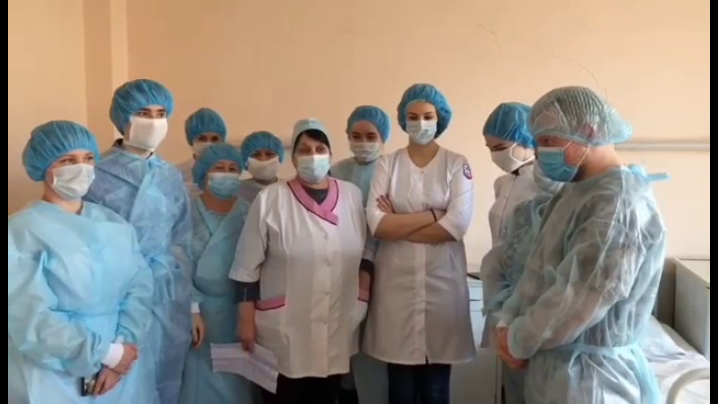
Doctors at Pokrovskaya Hospital have recorded a collective video message appealing for help. After their hospital was redesignated to treat patients with pneumonia, they do not have enough protective equipment and medications, and they claim not to have running oxygen in the wards. Management had threatened reprisals if they complained.

“We, employees of Pokrovskaya Hospital, appeal to the media for help. What prompted us to do this is that our hospital has been admitting all the pneumonia cases [in Petersburg], including pneumonia caused by the coronavirus. We have no protective equipment. What you see us wearing is no means of protection against viral infection,” begins the video message, which Fontanka.ru received on April 3.

“We are not refusing to work. We love our patients and want everyone to recover. But it is not possible to work in such unprotected conditions. No one is immune to infection. Nor does the status of doctor protect one: the virus is not selective. It spares no one: neither doctors, nor young people, nor the elderly,” the doctors said.

According to them, oxygen is required for the treatment of viral pneumonia, but there is no running supply of it to the wards at Pokrovskaya Hospital. Either this must be done urgently or oxygen tanks must be provided. The hospital does not have the necessary medications. The doctors say that management has already refused to help them, and has promised to “deal” with anyone who complains.

“But we are not afraid, because our lives and the lives of our loved ones are also dear to us. All of us have families, all of us return home after our shifts. And we want to go back to work healthy, and for the people near and dear to us to be healthy,” said the doctors.

The city’s public health committee has promised to comment on the situation later.

Thanks to Victoria Andreyeva for the heads-up. Translated by the Russian Reader

pokrov

Employees at Pokrovskaya Hospital recorded a video message about the lack of protective equipment. Their management says this is not true
Bumaga
April 3, 2020

Employees of the Pokrovskaya Hospital in Petersburg, which has been repurposed to treat patients with pneumonia, recorded a video message complaining about working conditions, as reported by Fontanka.ru.

In the video, employees talk about the lack of personal protective equipment, and also note that oxygen has not been supplied to the wards (to operate ventilators). Marina Bakholdina, head physician at Pokrovskaya Hospital, says that what her staff claimed was “not true.”

The city’s public health committee has commented on the appeal by the employees—they say that Pokrovskaya Hospital does not admit patients with the coronavirus. The committee explained that pneumonia is not an infectious disease, so doctors do not need anti-plague suits [sic] to work with patients.

At the same time, the committee admitted that the hospital does not have enough personal protective equipment.

Public Health Committee Press Service

In Petersburg, as in the rest of the world, there is a shortage of personal protective equipment. However, the city is increasing the volume of personal protective equipment. In the near future, the Ministry of Industry and Trade is planning to supply personal protective equipment to all regions of Russia, including Petersburg.

Earlier, the cardiology department at Pokrovskaya Hospital was closed for quarantine due to a patient with COVID-19.

Translated by the Russian Reader

Parents Demand Release of Network Defendants Due to Coronavirus

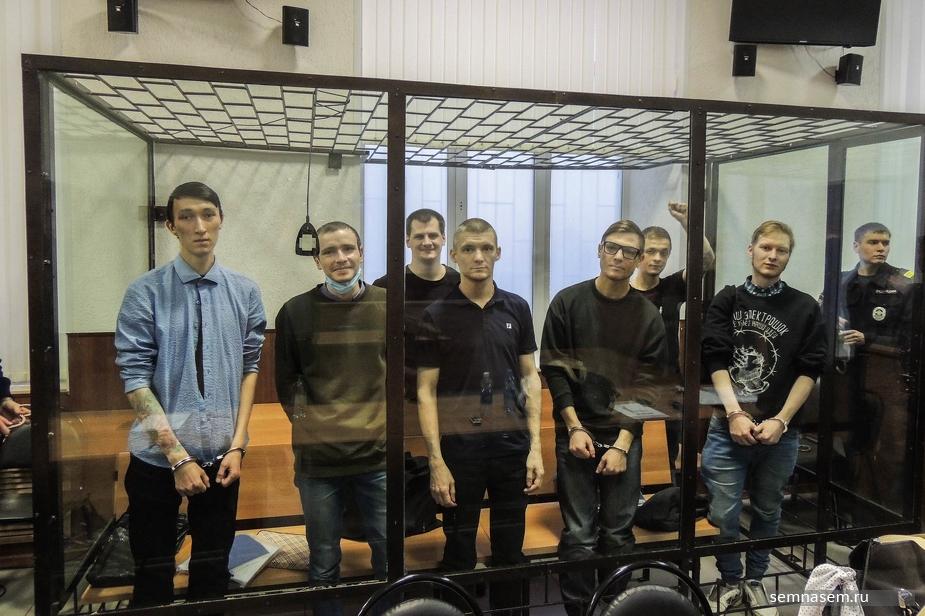
networkThe Network defendants in the courtroom in Penza. Photo by Yevgeny Malyshev. Courtesy of 7X7

Parents Demand Release of Network Defendants from Remand Prison Due to Coronavirus
Ekaterina Malysheva
7X7
April 1, 2020

Parents of the young men convicted in the Penza portion of the Network Case have demanded their children be transferred to house arrest due to the coronavirus. They have written appeals to this effect to the president of the Russian Federation, the prosecutor general, the heads of the Investigate Committee and the Federal Penitentiary Service, and the commissioner for human rights, as reported to 7X7 by Svetlana Pchelintseva, the mother of Dmitry Pchelintsev, one of the convicted men.

The parents also demanded that safety measures be put in place at detention facilities. They argue that being in remand prison during the COVID-19 outbreak is life-threatening. Of all the quarantine regulations, the parents say, only the ban on visits from relatives has been enforced at the remand prison since March 16.

“Not only is there no guarantee of protection from infection at the remand prison, but it is simply impossible,” the letter says. “Our sons are denied the right to remain alive during the global coronavirus pandemic. Unfortunately, the issue of safeguarding the health of people confined to detention facilities is not on the agenda today. And, of course, qualified specialized medical care, especially involving the hospitalization of inmates from remand prisons and penal colonies in civilian medical facilities, is not feasible. It is a myth.”

The parents claim that no preventive measures have been enacted at the Penza Remand Prison: disinfection and sanitation procedures have not been carried out, and employees don’t have masks. The greatest danger, according to the authors of the appeal, are the detention facility’s employees themselves, who are potential carriers of the virus. The parents note that reducing the number of inmates in the federal penitentiary system would help prevent disease.

The parents point out that Vladimir Putin said nothing about measures to protect inmates during his address to the Russian people about the coronavirus outbreak. According to the parents, none of the regulations on laboratory testing for COVID-19 defends the rights of people in detention facilities. The authors of the letter claim that inmates will not be tested or treat if they are infected.

Two of the young men convicted in the Network Case, the parents recall, have contracted tuberculosis in remand prison. This puts them at high risk during a pandemic and could be “tantamount to a death sentence.”

On March 30, the Penza regional office of the Russian Federal Penitentiary Service reported that in addition to the ban on visits to inmates in the system, visitors and employees with high temperatures and everyone who had been abroad in the last fourteen days were categorically prohibited from entering their facilities.

The office’s press service reported that a set of sanitary and anti-epidemic (preventive) was being organized and implemented at its facilities. It noted that if prisoners were suspected of having the coronavirus disease, the management of the regional office would hospitalize them in health care facilities.

The lawyers of the men convicted in the Network Case continue to visit their clients at Penza Remand Prison No. 1. According to them, conditions at the detention facility make it impossible to ensure the health and safety of prisoners during the epidemic. The lawyers are not allowed to bring certain personal protection gear into the facility. For example, latex medical gloves are not on the list of permitted items.

The lawyers have seen a mask only on the prison employee who inspects people at the entrance to the facility—the other employees were not wearing masks. According to the lawyers, the parents got the runaround in response to their previous complaints and appeals.

The last letter they sent, on February 5, was a request to Russian Federal Prosecutor General Igor Krasnov to investigate all the circumstances in the Network Case and launch a criminal case based on allegations that their children had been tortured by officers in the FSB’s Penza regional office.

In a response dated March 10, the prosecutor general’s office advised the parents to appeal (during the appeals phase of the main verdict in the Network Case) the admissibility of the evidence gathered. All the defendants and their defense lawyers have filed appeals with the Military Appeals Court in Moscow.

The parents organized a solidarity group of relatives against political repression, the Parents Network in spring 2018. In early November 2019, the relatives of defendants in several high-profile cases followed their example by uniting in the movement Mothers Against Political Repression. The movement has its own website, as well as group pages on Telegram and Facebook.

On February 10, the defendants in the Penza portion of the Network Trial were sentenced to terms in prison from six to eighteen years.

Translated by the Russian Reader. If you have not been following the Penza-Petersburg “terrorism” case aka the Network Case, and other recent cases involving frame-ups, torture, and violent intimidation by the Russian Federal Security Service (FSB) and other arms of the Russian police state, read and share the articles I have posted on these subjects.