

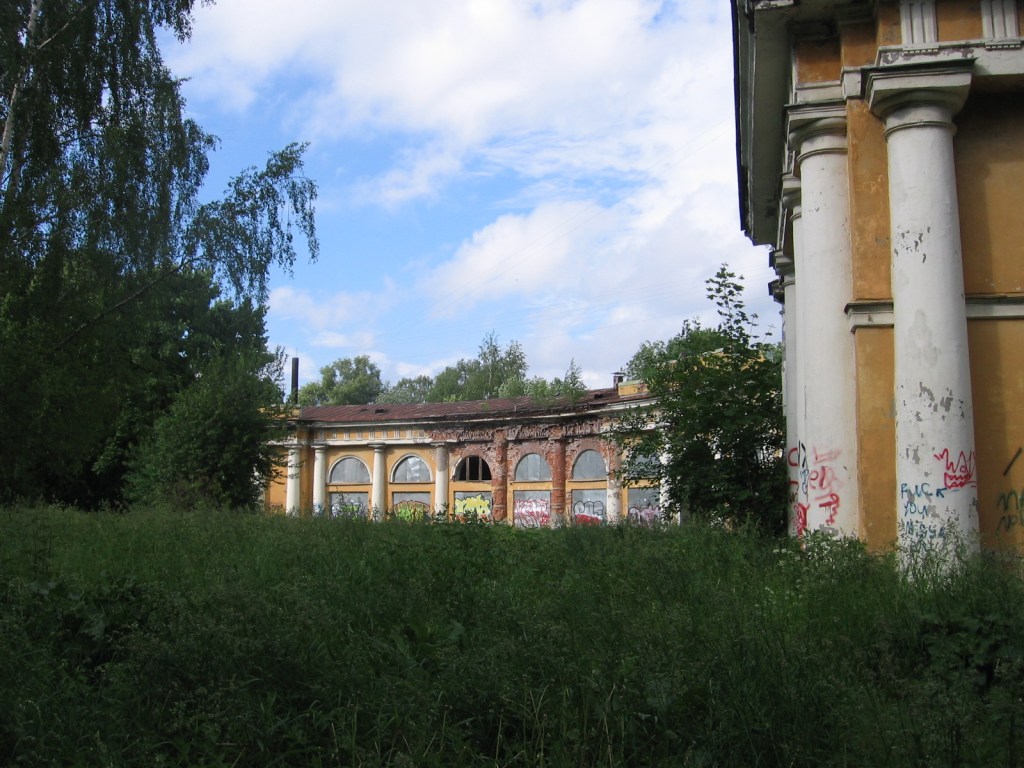
Utkina Dacha, St. Petersburg, 17 June 2012. Photos by the Russian Reader
Last week on a bus to Leningrad, as a bottle was passed around, I got angry for Finland. The Finns aboard found this very funny. For three hours we jolted on atrocious roads through [the] Karelia[n Isthmus], former Finnish heartland gobbled by Stalin in the Winter War of 1939, then regained and lost again during the Second World War. Amid forests of birch and pine, I glimpsed a long disaster. This was my first time in the USSR (my fourth in Finland). I was unprepared for the brokenness of every human thing, the old Finnish farmhouses and lakeside villas collapsing or collapsed, the travesties of farming apart from neat kitchen gardens. The once famously cosmopolitan Baltic port of Vyborg (Viipuri in Finnish), which could be the prettiest small city in the world, felt post-nuclear, its citizens (non-Finns, with whose forebears Stalin replaced the native population) listlessly wandering. Some gaped as our fancy tour bus wallowed by. The single purposeful activity I saw in [the] Karelia[n Isthmus] was that of a man painting an ornamental fence around a roadside ammunition bunker. The contrast to Finland’s grace and bustle was unbearable.
“Vyborg,” I said to the Helsinki art critic Markku Valkonen, who has Karelian roots. “You want it back.”
“Sure, I would like it back,” he said softly, “but I do not want to spoil my life with bitterness.”
[…]
I thought of it again in Leningrad, where apocalypse is now. The city is huge and grand beyond anything I expected. Its nineteenth-century buildings by C. L. Engel, who also worked in Finland, gave me a first impression of an imperial Helsinki, with aspects of Paris and Amsterdam thrown in. But the beauty is a patch that unravels within a block of the Winter Palace, exposing uniform squalor. The tour went to the Hermitage. There I was overwhelmed by the Rembrandts and by a room of Matisses that nearly forced me to my knees. Like other lovely things in Leningrad, the staggering holdings end abruptly in 1914. Meanwhile, in a separate building of the Hermitage, there was a show of—get ready—Peter Max. I wish I could find that amusing. But the evidence of near-term Soviet vulnerability to Western hustlers is too awful. With its stupid Revolution finished, the USSR may be in for a flood of imported stupidities.
Source: Peter Schjeldahl, “Baltic Views” (Village Voice, 11 June 1991), in Hot, Cold, Heavy, Light: 100 Art Writings, 1988–2018 (Abrams Press, 2019)
