Oleg Sentsov: 115 Days

115 Days“The 115th day of Sentsov’s hunger strike.” Image courtesy of Askold Kurov

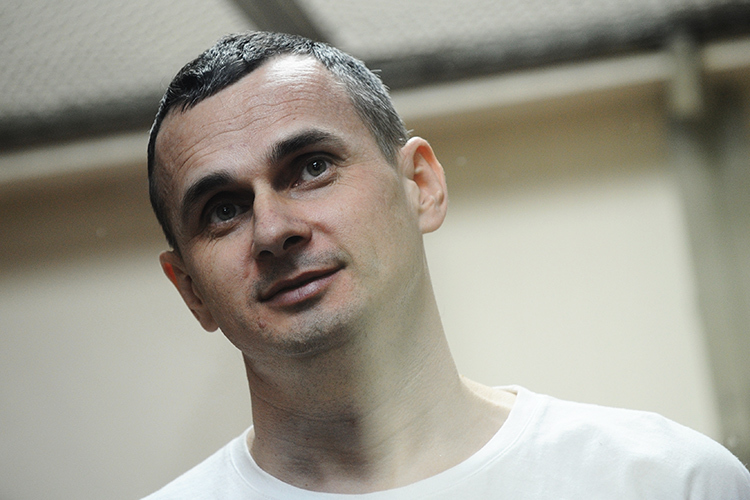
Ukrainian political prisoner Oleg Sentsov has been on hunger strike for 115 days in the Polar Bear Maximum Security Prison Camp in Labytnangi, Russia, where he has been serving a twenty-year sentence on trumped-up charges of “terrorism.”

Mr. Sentsov’s only crime was that he opposed the occupation of his native Crimea by neo-imperialist Russia.

Mr. Sentsov’s only demand is that Russian authorities release sixty-four other Ukrainian political prisoners they have incarcerated during their illegal war against Ukraine.

Do the Right Thing

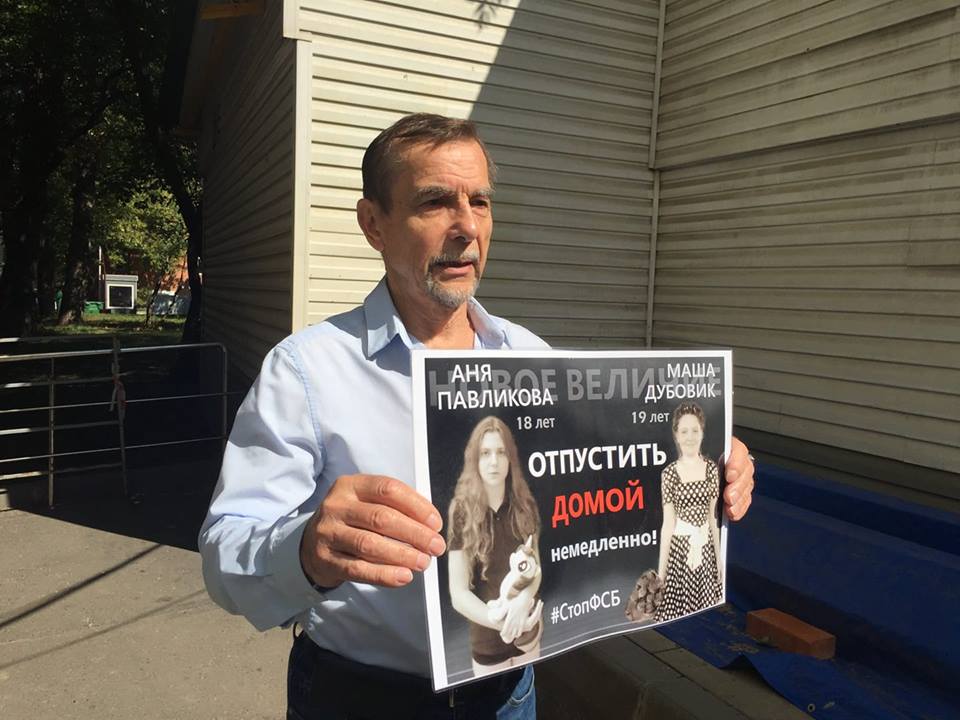
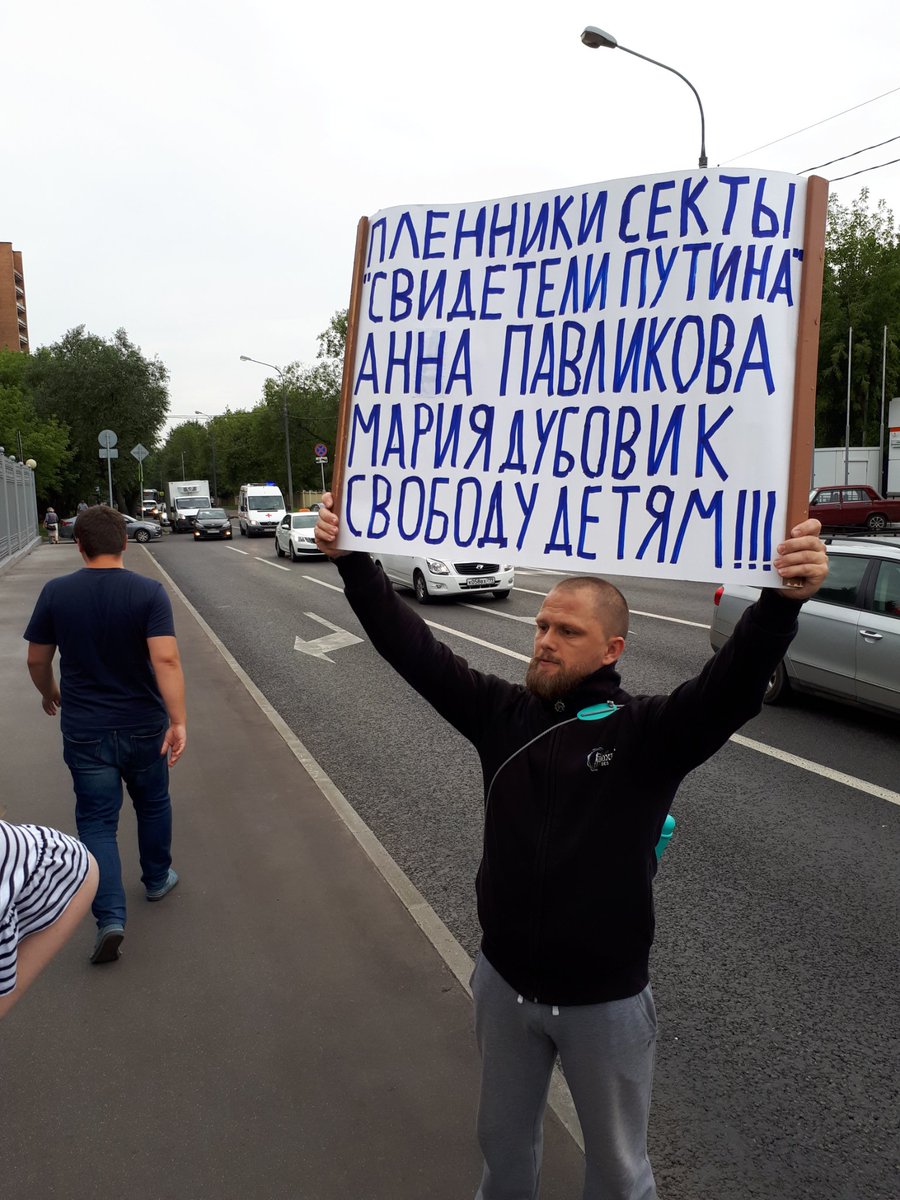
38072215_2021826408147215_5307798211635707904_n.jpgFamous Russian human rights activist Lev Ponomaryov picketing outside the Tverskoi District Court in Moscow on July 31, 2018. His placard reads, “Send Anya Pavlikova, 18, and Masha Dubovik, home immediately! #StopFSB.” Anna Pavlikova and Maria Dubovik are currently under in police custody in a remand prison, charged with involvement in a “terrorist community,” New Greatness, that by all accounts was concocted by undercover agents of the Russian Federal Security Service (FSB) as a means of entrapping the people who attended its political discussions, held, allegedly, in rooms rented by the FSB for the purpose and fastfood restaurants. The fact that two teenage girls are in jail, while four of the ten people charged in the case are under house arrest has outraged many people in Russia, as well as the torture-like treatment meted out to Ms. Pavlikova by the authorities. Photo courtesy of the Support Group for Suspects in the New Greatness Case, a public group on Facebook

My posts on the New Greatness case and related affairs:

_____________________________

Do you remember the controversy that erupted when Spike Lee’s Do the Right Thing was released in 1989? I do, as well as going to a rather heated showing of the film at a cinema in downtown Portland, Ore., at which moviegoers were evenly divided between frightened white liberals and screaming black kids. That was a hoot.

The funny thing is that, when I watched the movie again a year or two ago, I realized that, for all its tremendous performances and stunning cinematography, editing, and directing, the question that plagued Americans in 1989—namely, what was the right thing to do?—was answered quite plainly and simply by one of the main characters at the end of the film. He understood what the right thing to do was and he did it.

When it comes to the Putinist secret police whacking on people who did nothing wrong—people like Oleg Sentsov, Anna Pavlikova, and the eleven young men implicated in the Penza-Petersburg “terrorism” case—there’s no controversy. If we don’t publicize their cases, discuss them aloud, make a fuss, make a lot of noise, show our solidarity, and encourage other people to do the same, they will die in the effort to get other political prisoners released (i.e., Oleg Sentsov) or be tried in kangaroo courts and sent to prisons for many years for thought crimes or no crimes at all (i.e., Anna Pavlikova, her fellow New Greatness suspects, and the eleven Network lads).

Is that you want? It’s not what I want. But I don’t hear many of you making much noise about it. What are you scared of? Looking stupid? So what, “being cool” is more important than doing the right thing? Or do you thinking doing the right thing should make you look cool? In reality, most of the time, doing the right thing either goes wholly unnoticed or makes you look stupid, as in Spike Lee’s film.

There are people, however, who almost always know what the right thing to do is and have learned the simple lesson that solidarity is a two-way street. One of those people is the famous Russian human rights defender Lev Ponomaryov. {TRR}


Network: Parents versus the FSB

Network: Parents of Anarchists versus the FSB
Alexei Polikhovich and Ksenia Sonnaya
OVD Info
July 30, 2018

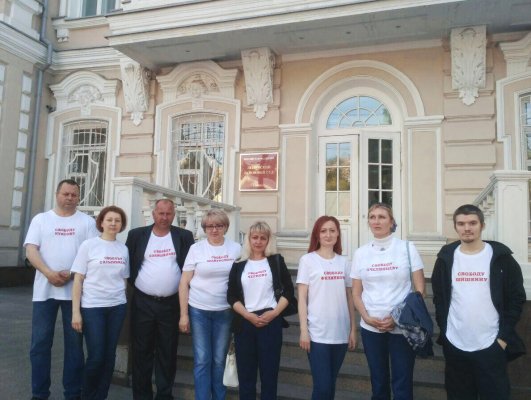
Members of the Parents Network. Photo courtesy of OVD Info

Eleven antifascists from Penza and Petersburg have been charged in the case against the alleged “terrorist community” known as the Network. Many people have got used to news of the violence, threats, and electrical shock torture used against the suspects in the case, but the accused themselves and their loved ones will probably never grow inured to such things. The parents of the accused came together in a committee known as the Parents Network. They have been trying to do something to help their loved ons.

The Russian Federal Security Service (FSB) claims the Network is an international organization. Aside from Penza and Petersburg, secret cells were, allegedly, established in Moscow and Belarus. Yet no one has been arrested either in Russia’s capital or abroad. Meanwhile, the Parents Network is definitely an international organization. Aside from Penza, Petersburg, Moscow, and Novosibirsk, the committee has members in Petropavlovsk, the city in Kazakhstan where Viktor Filinkov’s mother lives.

Members of the Parents Network have appeared at two press conferences, in April and May of this year. They have established a chatroom on Telegram where they discuss new developments in the case, exchange opinions, share impressions of hearings and interrogations, and give each other support. In addition, the parents try and force reactions from Russian government oversight and human rights bodies. They write letters to Russia’s human rights ombudsman and the Presidential Human Rights Council, and file complaints with the Investigative Committee and the Russian Bar Association.

OVD Info spoke with members of the Parents Network.

Tatyana Chernova, Andrei Chernov’s mother, shop clerk
All this kicked off in March at the next-to-last custody extension hearing in Penza.

I went to see Ilya Shakursky. I knew reporters and human rights advocates would be there. I just approached the people who had come to the hearing and asked for help. One of those people was Lev Ponomaryov, leader of the movement For Human Rights. He responded and proposed meeting in Moscow.

I didn’t know any human rights activists. I didn’t know where to go or to whom to turn, since I’d never dealt with this. When I’d discuss it with my daughter, she would scold me, telling me we had to wait or we might make things worse.

My husband and I went to see Lev Ponomaryov. We said we didn’t know what to do. We had a lawyer. Our lawyer did his job, while we, the parents, didn’t know how to help. We were told to take a pen and sign up, that the first thing to do was unite with all the other parents. I found their telephones numbers and gradually called all of them.

Andrei Chernov’s family

I couldn’t get hold of Lena Shakurskaya. I sent her an SMS, saying I’m so-and-so’s mom, I want to talk, if you want to talk, write. She called me right back. Everyone was probably waiting for it. We shared a misfortune, and it brought us together. Our first meeting was at Lev Ponomaryov’s office. Lena came to Moscow for the meeting. It was only there she heard the whole truth. Mikhail Grigoryan, Ilya’s former lawyer, had been telling her a different story. The Pchelintsevs met her. They told her what was going on. Lena was made sick by what she found out.

We try to have each other’s backs. The blows are such that it’s hard to take. Yes, I have friends. But I can call Sveta Pchelintseva or Lena Bogatova, say, knowing they’ll know where I’m coming from, because this is part of our personal lives.

Yelena Bogatova, Ilya Shakursky’s mother, shop clerk
We had a lawyer, Mikhail Grigoryan. He warned me against communicating with the relatives of the other lads. He said each of us had to defend their own son. Nothing good would come of fraternizing. I listened to him.

In March, I saw Andrei Chernov’s mom. Again, at Grigoryan’s insistence, I didn’t go up to her or chat with her. Later, I had doubts. I wanted to talk to someone. God was probably reading our minds: it was then Tatyana Chernova sent me an SMS. We got in touch on the phone. I went to Moscow without telling the lawyer. We met with human rights activists. We discussed how to talk about the kids.

It’s really rough when you’re on your own in these circumstances, but now we are together. You realized you’re not alone and our boys are not alone. What we do is mainly for them. We put on these t-shirts when we go to hearings so they can see we are fighting. We have gone to all the hearings together so they see we’re all together.

At first, I was a “cooperative” mom. I was friendly with the investigator. We would talk. He said unflattering things about the other parents. Grigoryan would ask me to meet with Ilya to “talk sense” into him. The investigator would talk to me, telling me that if I was a good mom, I would get the message through his head, that is, if we had a good relationship, as I had told him. Then I would get to see Ilya for ten minutes.

Yelena Bogatova and Ilya Shakursky

In February, when Ilya signed a statement saying he had not been tortured, his uncle and I persuaded him to sign the paper. We didn’t understand a thing, of course. Grigoryan said Ilya had to sign the paper. He said he was working for us and Ilya shouldn’t be obstinate, but should sign everything he asked him to sign.

Ilya stared at me.

“Mom, what are you doing?” he said. “I’m not guilty of anything.”

“Sign it or things will get worse for you, and I’ll have it worse. I won’t see you again,” I said to him.

I was selfish, drowning in my own grief. I pushed my son into doing it because I felt sorry for myself. The FSB used me. Yes, you can see him, but make him to sign this. Hold his hand.

It’s psychologically easier for me now. I feel strong inside. I have the confidence to keep going and try and rescue the boys from the paws of the FSB. I don’t have any friends per  se anymore. At first, they would call and ask about things, but then they would do it less and less often. I don’t know, maybe they’re afraid of the FSB. They’re afraid of calling me once too much because they know my phone is bugged.

On the other hand, I have a sense of how many friends Ilya has. I communicate with the Parents Committee and Ilya’s friends, who are not afraid of anything. We talk on the phone. They visit Ilya’s grandma and help. They water the garden and go to the store, just like Timur and his friends.

Natalya, Viktor Filinkov’s mom, businesswoman
It was like a bolt out of the blue. Viktor’s wife, Alexandra, wrote to me. I was ready to go see him that very minute, but I was told it would be better for me not to show up in Russia for the time being. I live in Petropavlovsk in northern Kazakhstan, which is not far from Omsk. It’s sixty kilometers to the Russian border.

Then I could not wait any longer. I said I was going to Petersburg, come what may. Everyone was surprised I was allowed to see him. I was the first parent allowed to see their child. But it was so little time. It was so hard to talk to him through the glass.

“Mom, I’ve been tortured,” he said.

I could see he had a scar. He told me to stay strong and be reasonable about what was happening.

Viktor Filinkov

I’d never been interested in politics. Now, though, I’m interested. I’m interested in Russian politics and Kazakhstani politics, and I read all the news straight through. I read about what incidents happened where, who was tortured where, who has been framed, who has been protected. I read everything about what’s happened to antifascists and anarchists everywhere.

I think about why I don’t live in Russia, in Petersburg. I cannot move right now. It’s complicated to do the paperwork, register as an immigrant, and get a temporary resident permit. The thing that causes me the most pain is the thought they could ban me from entering the country.

Nikolai Boyarshinov, Yuli Boyarshinov’s father, artist
It’s a terrible state, which everyone has been through, when you suddenly find out your son has been arrested, and the charges are so absurd. You have no idea at all what to do. It’s a wall against which you beat your head. You quite quickly realize you’re completely powerless.

I joined the Parents Network when it had quite a few members. I was completely crushed then. At first, I imagined it existed for its own sake, to keep from going insane. But then I noticed it got results. By then I had completely recovered from my initial state, so I did things, thought about things, and discussed things. Being involved in the Parents Network was my salvation.

We have a chat page on Telegram. In contrast to the Network, which the FSB concocted, we don’t hide the fact we have a Network. If you think our children organized a criminal Network, then our Network is probably criminal, too.

Our actions get few results, perhaps, but it is this way, bit by bit, that you build up the desire to do something to improve the conditions in which the boys are incarcerated.  Publicity was their salvation, after all. It’s not a matter of getting them released yet. We are still thinking about how to keep them alive.

That was how it happened with my son. I saw him at the first custody extension hearing, a month after his arrest. I saw what he looked liked when he arrived at the courthouse. He looked drab and battered. He had fresh bruises on his head. You could see that it couldn’t go on for long like that. His friends, thirty people or so, came to the next hearing. When he saw everyone, he was happy. A new phase began after that. It was clear that at least they wouldn’t kill him.


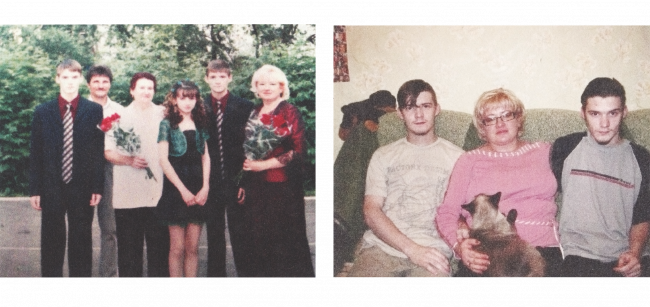
Yuli Boyarshinov in childhood

It was a turning point for me. When everything went public, it saved my son’s life. Yet now I’m afraid the publicity will die down and the boys will again be isolated, and the nightmare will recommence. That’s why I never turn down an interview.

I go out picketing on Fridays. I had doubts when the World Cup was underway. The first day I had the sense I was preventing people from enjoying themselves, but I decided to keep going out. Something unexpected happens each time. A young man came up to me and said he knew nothing about the Network. He walked away, apparently looked in the internet, and came back. I told him about the other boys.

“I don’t share those views,” he said.

“It doesn’t matter now whether you’re leftist or rightist,” I replied. “What matters is that you have views, and that is sufficient grounds to arrest you and charge you with a crime.”

The Parents Network is now like a family. We’ve agreed that when this travesty of justice is over, we will definitely have a reunion with everyone. Everyone has become family. Viktor’s mom lives in Kazakhstan, and his wife had to escape, so when I take care packages to Yuli, I take packages for Viktor, too. I really want to meet all the boys. I’m worried sick about all of them. My wife sometimes reads an article about Dima Pchelintsev or Viktor, and she cries. We feel like they’re our children.

Yelena Strigina, Arman Sagynbayev’s mother, chief accountant 
The first to get together were the people in Penza, the Pchelintsevs and the Chernovs. I joined along the way. The defense lawyers had to sign a nondisclosure agreement, so we had to go public with all our problems.

I live in Novosibirsk. We all stay in touch through a certain banned messenging site. When we were at the hearings in Penza, we made t-shirts emblazoned with the logo “Free [son’s surname].” It might look like a game to outsiders, but we have to stay afloat. It’s important to do something. And to publicize everything that happens.


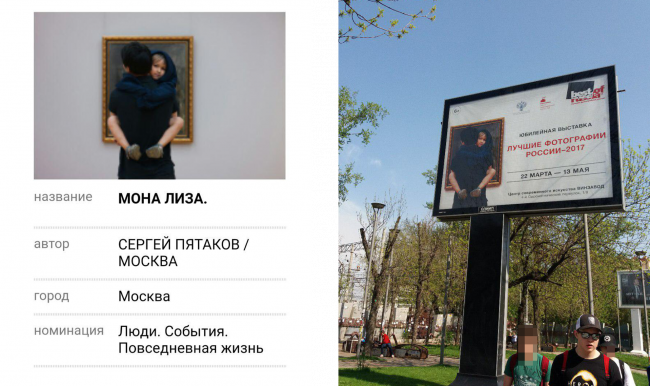
Arman Sagynbayev and his niece. Screenshot from the website of the Best of Russia competition (left); photo of a billboard in Moscow (right)

Arman has a serious chronic illness. There was no point in torturing him. His first testimony was enough to send him down for ten years. He testified against himself more than he did against the others. He was extradited from Petersburg to Penza. Along the way, the men who were transporting him opened the doors when they were in the woods and dragged Arman out. They promised to bury him alive. That was at night. In the morning, he was taken to the investigator for questioning. When people are under that kind of pressure, they would say anything. I would say I’d attempted to invade Kazan and blow up chapels.


Arman Sagynbayev in childhood

I kept the story secret from friends and relatives. But after the film about the case on NTV, everyone called and started looking funny at me. The news even made it to the school that Arman’s little brother attends. Imagine: your brother is a terrorist. It was a good thing honest articles had been published at that point. I would send people links to them. Thanks to those articles, people read a different take on events, and we have been protected from a negative reaction from society.

Svetlana Pchelintsev, Dmitry Pchelintsev’s mother, cardiologist
The Parents Network has empowered us a hundredfold. By joining together, we are no longer each fighting for our own son, we are fighting for all the boys. We love kids we don’t know at all, kids who are complete strangers, as if they were our own kids. Our hearts ache for each of them. I think it’s wonderful. A whole team of parents fighting for all the boys. What can stop parents? Nothing can stop them.

What has happened is terrible. Whether we like or not, we have to go on living while also helping the children. So, when one mom has a moment of weakness, she can telephone another mom, who is feeling the opposite emotions. It’s vital when a person hears that support.


Dmitry Pchelintsev in childhood

Dmitry Pchelintsev, Dmitry Pchelintsev’s father, engineer
We are a committee of parents. What we do is support each other. We live in Moscow, but our son is jailed in Penza. The parents who live in Penza visit our son. Our kids, as it turns out, belong to all of us. We were in Penza and we gave all the children all their care packages at the same time. If we talk with the warden of the remand prison, we speak on behalf of all the kids.

This has helped us and helped our children. We get emotional support. It’s one thing when you sit alone in a closed room and don’t know what’s happening to your child. It’s another thing when all the parents meet and discuss everything. Tiny facts come together into a big picture, and you more or less understand what’s happening.

In my view, publicity is quite effective. This has been borne out by the actions of the case investigator, Tokarev. If it makes Tokarev uncomfortable, if it makes Tokarev angry, it’s a good thing. As he said, “You raised this ruckus in vain. They would have been in prison long ago.” So, what’s bad for him is good for me. I visited the offices of the Investigative Committee in Penza. They couldn’t believe it was possible the FSB would torture people in a remand prison.

Lena, Ilya Shakursky’s mom, said Tokarev always referred to us and the Chernovs as “uncooperative” parents. He complained that, if it weren’t for us, our kids would have been sentenced to two years each in prison and that would have been it. How can a person say such things? You put a man in jail for nothing, and then you sit and clap.

The FSB are Putin’s hellhounds. Putin loosened their leash a little, and they grabbed everyone they could before the presidential election and the World Cup. Now it’s all coming to an end, and he’ll again say, “Heel!” Let’s see where it leads. Perhaps the plug will be pulled, unfortunately.

All photos courtesy of the parents and relatives of the accused and OVD Info. Translated by the Russian Reader.

***************

What can you do to support the Penza and Petersburg antifascists and anarchists tortured and imprisoned by the FSB?

  • Donate money to the Anarchist Black Cross via PayPal (abc-msk@riseup.net). Make sure to specify your donation is earmarked for “Rupression.”
  • Spread the word about the Network Case aka the Penza-Petersburg “terrorism” case. You can find more information about the case and in-depth articles translated into English on this website (see below), rupression.com, and openDemocracyRussia.
  • Organize solidarity events where you live to raise money and publicize the plight of the tortured Penza and Petersburg antifascists. Go to the website It’s Going Down to find printable posters and flyers you can download. You can also read more about the case there.
  • If you have the time and means to design, produce, and sell solidarity merchandise, please write to rupression@protonmail.com.
  • Write letters and postcards to the prisoners. Letters and postcards must be written in Russian or translated into Russian. You can find the addresses of the prisoners here.
  • Design a solidarity postcard that can be printed and used by others to send messages of support to the prisoners. Send your ideas to rupression@protonmail.com.
  • Write letters of support to the prisoners’ loved ones via rupression@protonmail.com.
  • Translate the articles and information at rupression.com and this website into languages other than Russian and English, and publish your translations on social media and your own websites and blogs.
  • If you know someone famous, ask them to record a solidarity video, write an op-ed piece for a mainstream newspaper or write letters to the prisoners.
  • If you know someone who is a print, internet, TV or radio journalist, encourage them to write an article or broadcast a report about the case. Write to rupression@protonmail.com or the email listed on this website, and we will be happy to arrange interviews and provide additional information.
  • It is extremely important this case break into the mainstream media both in Russia and abroad. Despite their apparent brashness, the FSB and their ilk do not like publicity. The more publicity the case receives, the safer our comrades will be in remand prison from violence at the hands of prison stooges and torture at the hands of the FSB, and the more likely the Russian authorities will be to drop the case altogether or release the defendants for time served if the case ever does go to trial.
  • Why? Because the case is a complete frame-up, based on testimony obtained under torture and mental duress. When the complaints filed by the accused reach the European Court of Human Rights in Strasbourg and are examined by actual judges, the Russian government will again be forced to pay heavy fines for its cruel mockery of justice.

***************

If you have not been following the Penza-Petersburg “terrorism” case and other recent cases involving frame-ups, torture, and violent intimidation by the Russian Federal Security Service (FSB) and other arms of the Russian police state, read and republish the recent articles the Russian Reader has posted on these subjects.

Moscow City Court Affirms Anna Pavlikova’s Remand in Custody

DjB2VnWWwAAuNc9A man picketing outside Moscow City Court, July 26, 2018. His placard reads, “Anna Pavlikova and Maria Dubovik are captives of the cult Putin’s Witnesses. Free the children!” Photo courtesy of Mediazona and Denis Styazhkin

Moscow City Court Affirms Remand in Custody of New Greatness Suspect Anna Pavlikova
OVD Info
July 26, 2018

Moscow City Court rejected an appeal of a lower court’s decision to remand in custody Anna Pavlikova, charged in the New Greatness case, It extended her remand in custody to August 13, writes Mediazona.

Moscow City Court thus shortened the young woman’s term in custody. Previously, the Dorogomilovo District Court had extended Pavlikova’s remand in custody until September 13.

Mediazona reports Pavlikova took part in today’s appeals hearing via video link from the remand prison. In her appeal, defense attorney Olga Karlova had asked the court to rescind the extension of her client’s remand in custody and impose a noncustodial pretrial restraint.

The defense attorney also drew the court’s attention to the fact that four of the people charged in the case are under house arrest, thus violating the principle of equality before the law. Karlova also claimed Pavlikova was not a flight risk, because both her domestic and foreign travel passports had been confiscated.

In May, Karlova had told the lower court her client’s heart problems had worsened in the remand prison. Pavlikova had developed severe tachycardia and cramps in her legs. In June, it transpired she had been transferred to the remand prison’s hospital. In July, Pavlikova was admitted to a civilian hospital for a day to undergo tests.

In May, a hearing to decide whether to extend Pavlikova’s remand in custody took place at the Dorogomilovo District Court. Pavlikova was not taken to the court, but was driven around in a paddy wagon. During the hearing, the judge read aloud parts of the case file  and retired to chambers to make her decision without hearing arguments from the parties to the case. In addition, Pavlikova was not informed of the court hearing. Her lawyer later informed her it had taken place.

In June, the Moscow City Court ruled this was a violation of the procedures for organizing court hearings and returned the case to the lower court.

Ten people have been charged in the New Greatness case. Judging by the case files, New Greatness was an organization established by undercover secret service agents. Six of the suspects are currently in remand prison, while the other four are under house arrest.

All ten suspects have been charged with organizing an “extremist” community (a violation of Russian Criminal Code Article 282.1). However, the prosecution’s case is based on the testimony of three men, none of whom has been arrested. One of them has said he infiltrated the group on the orders of his superiors. The interrogation transcripts of these individuals have mostly been excised from the case files. One of the three individuals drafted the group’s charter, collected money, and rented rooms for meetings.

Law enforcement officers threatened Pavlikova, who was seventeen at the time of her arrest, with violence.

Translated by the Russian Reader

Is Lydia Bainova an “Extremist”?

lydia bainovaLydia Bainova. Photo courtesy of Newsru.com and Tayga.info

FSB Files Charges against Khakassia Woman for Social Media Post Defending the Republic’s Indigenous Population
Newsru.com
July 24, 2018

The secret services have opened a criminal investigation into Lydia Bainova, a 30-year-old Abakan resident, after she published a post on the VK social media network. The mother of a young child, Ms. Bainova promotes Khakas culture. Tayga.info reports she has been accused of inciting ethnic hatred. According to the website, the FSB’s Khakassia office has charged the young woman with violating Article 280 Part 2 of the Russian Federal Criminal Code, which forbids public calls for “extremism” through the media or interent.

Tayga.info quotes the FSB’s indictment, which alleges Bainova “realized her criminal intentions using an Asus brand laptop with access to the internet.”

She posted a text containing the following passage: “At such moments, one feels like organizing a revolution, a coup, giving back power and land to our people, winning them back.”

FSB Investigator Marov decided the passage was a public call for “extremism,” Tayga.info reports.

However, the indictment does not quote Bainova’s entire post, which largely deals with cases of harassment suffered by Khakassia’s indigenous inhabitants. Bainova, for example, told her readers that children were told that only ethnic Russians were allowed in the playroom of an Abakan establishment.

“Some have been lucky not to encounter nationalism. During the twenty-nine years of my life in Abakan, I have encountered it constantly. My mother and father have constantly been the target of trenchant comments, like, ‘You’re Khakas and you got a three-room flat in the center of town,” or, ‘You’re a Khakas woman, but you dress so well,’ and so on,” Ms. Bainova wrote  on VK.

Ms. Bainova has denied her guilt. She believes it was her public outreach work that attracted the FSB’s attention. She popularizes Khakas culture, has been involved in an ethnic music festival, and advocates the preservation of Khakas traditions and the Khakas language.

Investigators commissioned a psycho-linguistic forensic examination of Ms. Bainova’s post. The examiners reached the same conclusion as the FSB. Ms. Bainova’s defense counsel said the forensic examination was performed “extremely unprofessionally.”

The maximum penalty for violating Article 280 Part 2 of the Russian Criminal Code is five years in prison. In early June, a court in Tver Region sentenced a local electrician to a two-year suspended sentence for publishing a post against Vladimir Putin. Earlier this year, a resident of Sevastopol was sentenced to two years in prison, while a Petersburg resident was sentenced to ten months in a penal colony on the same charges.

Translated by the Russian Reader

Crimean Farmer and Political Prisoner Vladimir Balukh Has Been on Hunger Strike for 104 Days

Vladimir Balukh’s 100 Days: The Crimean Euromaidan Supporter Has Been on Hunger Strike in Remand Prison for Over Three Months
Anna Kozkina
Mediazona
June 27, 2018


Vladimir Balukh. Photo by Anton Naumlyuk. Courtesy of RFE/RL

Today [July 1, 2018] is the [104th] day of a hunger strike by Vladimir Balukh, who awaits a verdict in his third criminal trial in Simferopol Remand Prison. In 2014, he refused to accept Russian citizenship, raising the Ukrainian flag over his house in solidarity with the Euromaidan protests. The first criminal case against Balukh was opened in 2015. It would be followed by two more case. In the article below, Mediazona catalogues the persecution the Crimean activist has endured and describes his hunger strike, during which he has lost at least thirty kilos.

On June 22, 2018, Balukh, who is imprisoned in Simferopol Remand Prison, said he was returning to the harsher form of hunger strike and would now only be drinking water. Balukh had been drinking fruit drink for some time.

Olga Dinze, Balukh’s defense attorney, said the cause was increased pressure from prison wardens. In court, Balukh had spoken of regular searches of his cell, including at night. According to him, prison wardens and guard have hinted it was time for him to “go down in the hole,” i.e., be sent to solitary confinement.

The following day, Ukrainian human rights ombudsman Lyudmila Denisova requested Pierre-Emmanuel Ducruet, head of the International Red Cross’s Simferopol office, visit Balukh at the remand prison and secure professional medical care for him.

The Flag, Heaven’s Hundred Heroes Street, and the Insulted FSB Agent
In late 2013, Crimean farmer Vladimir Balukh raised a Ukrainian flag over his house in the village of Serebryanka in solidarity with the Euromaidan demonstrators. The flag stayed there after the March 2014 referendum. Balukh did not recognize Crimea’s annexation by Russia and refused to apply for a Russian passport.

Police and Russian Federal Security Service (FSB) agents first paid him a visit in the spring of 2015. Balukh was not home when they arrived. When he heard about the visit to his home by the security services, he stayed with friends for several days. The police and FSB searched Balukh’s house and also paid his mother a call.

The security services visited Balukh for the second time in November 2015. Claiming he was suspected of auto theft, they searched his house again. After the search, the farmer was charged with insulting a government official, a violation under Article 319 of the Russian Criminal Code. Allegedly, Balukh had used “foul, insulting language when addressing field agent Yevgeny Baranov, which the latter found unpleasant.” Balukh did not deny he could have sworn at the field agent, since FSB officers had punched him in the kidneys and stepped on his head after throwing him on the ground.

In February 2016, the Razdolnoye District Court found Balukh guilty, sentencing him to 320 hours of community service. Subsequently, the Crimean Supreme Court sent the case back to the lower court for review, but in June the district court reaffirmed its original guilty verdict, again sentencing Balukh to 320 hours of community service.

The Ukrainian flag was torn down from the farmer’s house again and again, but he put it back up every time. On November 29, 2016, the third anniversary of the Euromaidan protests, Balukh hung a sign on his house, identifying the address as “Heaven’s Hundred Heroes Street, 18.” Two weeks later, police and FSB carried out yet another search of his house. This time, they allegedly found eighty-nine rounds of ammunition and several TNT blocks in the attic. After the search, the flag and the street sign were removed from Balukh’s house. Balukh was detained and later remanded to police custody.

Balukh was charged with illegal possession of weapons and explosives (Article 222 Part 1 and Article 222.1 Part 1 of the Russian Criminal Code). The farmer claimed his innocence and said his political stance was the reason for the criminal prosecution. He claimed the rounds of ammo and explosives were planted during the search. Police allegedly found them in the presence of a single official witness.

The Memorial Human Rights Center designated Balukh a political prisoner. It noted that he had received clear threats after hanging the street sign on his home memorializing the murdered Maidan protesters.

“It was after this that the chair of the village council and his deputies visited Balukh’s home and threatened that his independent behavior would have unpleasant consequences, including the ‘discovery’ in Balukh’s house of weapons or narcotics. He demanded  Balukh take the sign down,” wrote Memorial.

Memorial argued that the prosecution had not proven the ammunition actually belonged to Balukh, since his fingerprints were not found on the items.

Vladimir Balukh’s House. Photo courtesy of hromadske.ua

“Go to Ukraine and Treat Your Back There”
On August 4, 2017, the Raznodolnoye District Court sentenced Balukh to three years and seven months in a medium security penal colony and a fine of ₽10,000 [approx. €136] for possession of the ammunition and TNT.

A week after Balukh was sentenced, he had a run-in with Valery Tkachenko, warden of the Razdolnoye Temporary Detention Facility. According to Balukh, Tkachenko punched him in the shoulder and tried to kick him as well. He also, allegedly, made insulting remarks about the ethnicity of Balukh and his parents. Balukh’s attorney filed a complaint with the police.

Two weeks later, the Investigative Committee opened a case against Balukh himself, claiming he had violated Article 318 Part 1 of the Criminal Code (violence against a state official). Subsequently, Balukh’s alleged actions were reclassified as a violation of Article 321 Part 2 (disrupting the operations of penitentiary facilities). According to police investigators, on the morning of August 11, 2017, Balukh had elbowed the warden in the stomach while his cell was being inspected. He then, allegedly, entered his cell and struck Tkachenko’s arm.

In November 2017, the district court commenced its review of the ammunition possession case, and in December Balukh was transferred from the remand prison to house arrest.  After complaining of pain in his back and groin, Balukh was soon taken to hospital straight from the courtroom.

At the district hospital, medical staff merely measured his blood pressure and gave him a cardiogram. After listening to Balukh’s complaints, the local doctor said, “My back hurts, too. Should I not go to work or what?”

Balukh asked the court permission to travel to Simferopol or Feodosia for a medical examination, but his request was turned down. During his December 27 court hearing, the ambulance was called several times due to Balukh’s temperature, high blood pressure, and back pain. According to the news website Krym.Realii, the head physician of the local hospital’s emergency department, Nadezhda Drozdenko, told Balukh, “Go to Ukraine and treat your back there.” When the hearing went on for ten hours, Balukh lay down on the floor due to the severe pain.

In early 2018, the court again found Balukh guilty on the ammunition possession charge and sentenced him to three years and seven months in a work-release penal colony. The verdict was upheld on appeal, although the sentence was reduced by two months.

Balukh was again sent to the remand prison. He has continued to complain of back pain, whose cause doctors have never been able to diagnose.

“He Has Adopted a Stance of Hopelessness”
After the Crimean Supreme Court upheld the verdict in the ammunition possession case, Balukh went on an indefinite hunger strike as of March 19, 2018. He gave up all food, only drinking water and tea, protesting what he regarded as the illegal verdict against him.

In late March, Balukh was assaulted in the remand prison and hospitalized in the infirmary, as reported by Aktivatika, who quoted defense attorney Olga Dinze.

“The hunger strike has been difficult for him. Besides, the prison wardens have engaged in constant provocations. They have brought him delicious food, enticing him to eat. It destabilizes him a bit, but he has hung and kept his word,” said the lawyer.

Vladimir Balukh on June 22, 2018. Photo by Zair Semedlyaev. Courtesy of crimeahrg.rog

In mid April, his social defender, Archbishop Kliment of Simferopol and Crimea, reported Balukh had been assaulted by guards.

A month later, Vladimir Chekrygin, an expert with the Crimean Human Rights Group, told Krim.Realii Balukh was under pressure in the remand prison.

“We know the guards at the remand prison have periodically threatened Balukh for his actions. They have told him that sooner or latter he would be punished for his willfulness. They have been doing searches in his cell night and mornings. Searches are permitted, but at certain hours and under extraordinary circumstances. They are not letting him rest,” Chekrygin explained.

On May 18, Russian human rights ombudsman Tatyana Moskalkova visited the Simferopol Remand Prison. She wrote to her Ukrainian colleague, Lyudmila Denisova, that Balukh had no complaints either about the conditions of his incarceration or cruel treatment.

In May, the Raznodolnoye District Court began hearing the third criminal case against Balukh, involving his run-in with the temporary detention facility warden. During the trial, even the prosecution’s witnesses, guards at the facility, testified Balukh did not assault the wardeb. During the investigation, the alleged victim refused to take part in a face-to-face confrontation with Balukh, who described his behavior in great detail to the judge.

“He would come to my cell and try to insult me, to humiliate me for being Ukrainian and thus, as he thought, for being a member of Right Sector. He would say us Ukrainians should be murdered as a species, and so on,” said Balukh.

On June 10, Balukh was again transferred from Razdolnoye to the Simferopol Remand Prison. There he was put in the “glass,” a narrow cell in which one can only stand or sit, for two hours, Crimean human rights defenders reported.

The following day, it transpired the remand prison wardens no longer believed Balukh was on hunger strike. The guards had learned Balukh was drinking not only water but also oatmeal kissel. Archbishop Kliment had persuaded Balukh to make the compromise a month after he started his hunger strike.

“Vladimir agreed. We know  he began consuming only kissel. Sometimes, he has honey and bread crumbs at most. At some point, the prison wardens found out about the kissel and decided not to recognize his actions as a hunger strike. There are special rules when wardens decide a prisoner has gone on hunger strike. They have stopped following these rules when it comes to Balukh, since they believe he is no longer on hunger strike. But Vladimir has continued his protest. He has lost thirty kilos of weight. The doctor from the remand prison infirmary has stopped making regular checkups of Balukh, although he is obliged to do so when inmates go on hunger strike,” explained Olga Skripnik, head of the Crimean Human Rights Group.

Protesting constant inspections in the remand prison, Balukh returned on June 22, 2018, to the original form of his hunger strike. He has again been only drinking water. Olga Dinze explained the frequent searches of Balukh’s cell as a consequence of Balukh’s having filed a motion to be paroled for his first criminal conviction.

On June 25, Dinze told Mediazona her client’s condition had taken a turn for the worse.

“I think Balukh has suffered a pinched nerve. It is a quite serious case. He has been experiencing severe pain in his chest, neck, and shoulder blades. He feels unwell all the time,” Dinze said, adding the new symptoms were probably due to long-term back pain.

According to Dinze, Balukh was not receiving medical care.

“He refuses cares from the doctors in the remand prison. They cannot give him the medical care he needs, diagnose him, and prescribe him appropriate treatment. He has requested doctors from the Red Cross,” said Dinze.

The defense attorney added that, after Balukh stopped drinking oat kissel, he was transferred to a cell in the general population, but the conditions there were decent. He currently has no complaints against the wardens.

Earlier, Dinze told Krym.Realii Balukh had been hoping for a prisoner exchange.

“Vladimir is quite weary. He is emotionally exhausted. He has adopted a stance of hopelessness. He says no one will ever release him from prison. If they cannot keep him in prison on the current convictions, there will be new charges. So now he is finally talking. For the last few months we have been talking about how, if there is a prisoner exchange and everything goes well, he would really, really like to go to mainland Ukraine,” said Dinze.

The Ukrainian authorities have recently repeatedly stated their readiness to exchange Russian convicts for the sixty-four Ukrainian nationals imprisoned in Russian remand prisons and penal colonies, including Balukh and filmmaker Oleg Sentsov, who has been on hunger strike since mid May.

Closing arguments in Warden Tkachenko’s case against Balukh have been scheduled for July 2.

Thanks to Yegor Skovoroda for the heads-up. Translated by the Russian Reader

Maria Kuvshinova: What Sentsov Could Die For

What Sentsov Could Die For
Maria Kuvshinova
Colta.Ru
May 25, 2018

Detailed_pictureOleg Sentsov. Photo by Sergei Pivovarov. Courtesy of RIA Novosti and Colta.Ru 

On May 14, 2018, Oleg Sentsov went on an indefinite hunger strike in a penal colony located north of the Arctic Circle. His only demand is the release of all Ukrainian political prisoners in Russia. According to Memorial’s list, there are twenty-four such prisoners.

In August 2015, Sentsov was sentenced to twenty years for organizing a terrorist community and planning terrorist attacks. The second defendant in the case, Alexander Kolchenko, was sentenced to ten years in prison. Mediazona has published transcripts of the hearings in their trial. Around three hundred people have read them over the last three years. The transcripts make it plain the only evidence of the alleged terrorist organization’s existence was the testimony of Alexei Chirniy, who was not personally acquainted with Sentsov. It is police footage of Chirniy’s arrest while he was carrying a rucksack containing a fake explosive device that propagandists often pass off as police footage of Sentsov’s arrest.

Before his arrest, Sentsov was an Automaidan activist. In the spring of 2014, he organized peaceful protests against Crimea’s annexation by Russia.

“Yesterday’s ‘suicide bomber auto rally’ took place in Simferopol yesterday, but in quite abridged form,” Sentsov wrote on Facebook on March 12, 2014. “Only eight cars, six reporters with cameras, and twenty-five activists/passengers assembled at the starting point. I would have liked to have seen more. Unfortunately, most of the armchair revolutionaries who were invited were afraid to go. The traffic cops and regular police also showed up at the starting line, insisting we not leave for our own safety. We told them our protest was peaceful. We had no plans of breaking the rules, so we suggested they escort us to keep the peace for everyone’s sake.”

The second defendant, Kolchenko, admitted involvement in the arson of an office that was listed in the case file as belonging to the United Russia Party, but which in April 2014 was an office of Ukraine’s Party of Regions. The arson took place at night. It was meant to cause physical damage while avoiding injuring anyone.

The Russian authorities tried to prove both Sentsov and Kolchenko were linked with Right Sector, a charge that was unsubstantiated in Sentsov’s case and absurd in the latter case due to Kolchenko’s well-known leftist and anarchist convictions. Gennady Afanasyev, the second witness on whose testimony the charges against the two men were based, claimed he had been tortured and coerced into testifying against them.

Sentsov and Kolchenko’s show trial, like the show trials in the Bolotnaya Square Case, were supposed to show that only a handful of terrorists opposed the referendum on Crimea’s annexation and thus intimidate people who planned to resist assimilation. The Russian authorities wanted to stage a quick, one-off event to intimidate and crack down on anti-Russian forces. But two circumstances prevented the repressive apparatus from working smoothly. The first was that the defendants did not make a deal with prosecutors and refused to acknowledge the trial’s legitimacy. The second was that Automaidan activist Oleg Sentsov unexpectedly turned out to be a filmmaker, provoking a series of public reactions ranging from protests by the European Film Academy to questions about whether cultural producers would be capable of blowing up cultural landmarks. Segments of the Russian film community reacted to the situation with cold irritation. According to them, Sentsov was a Ukrainian filmmaker, not a Russian filmmaker, and he was not a major filmmaker. The owner of a computer club in Simferopol, his semi-amateur debut film, Gamer, had been screened at the festivals in Rotterdam and Khanty-Mansiysk, while release of his second picture, Rhino, had been postponed due to Euromaidan.

The Ukrainian intelligentsia have equated Sentsov with other political prisoners of the empire, such as the poet Vasyl Stus, who spent most of his life in Soviet prisons and died in Perm-36 in the autumn of 1985, a week after he had gone on yet another hunger strike. The Ukrainian authorities see Sentsov, a Crimean who was made a Russian national against his will and is thus not eligible for prisoner exchanges, as inconvenient, since he smashes the stereotype of the treacherous peninsula, a part of Ukraine bereft of righteous patriots. Sentsov’s death on the eve of the 2018 FIFA World Cup would be a vexing, extremely annoying nuisance to the Russian authorities.

Sentsov is an annoyance to nearly everyone, but he is a particular annoyance to those people who, while part of the Russian establishment, have openly defended him, although they have tried with all their might to avoid noticing what an inconvenient figure he has been. Although he was not a terrorist when he was arrested, he has become a terrorist of sorts in prison, because his trial and his hunger strike have been a slowly ticking time bomb planted under the entire four-year-long post-Crimean consensus, during which some have been on cloud nine, others have put down stakes, and still others have kept their mouths shut. Yet everyone reports on the success of their new endeavors on Facebook while ignoring wars abroad and torture on the home front. Sentsov represents a rebellion against hybrid reality and utter compromise, a world in which Google Maps tells you Crimea is Russian and Ukrainian depending on your preferences. To what count does “bloodlessly” annexed Crimea belong, if, four years later, a man is willing to die to say he does not recognize the annexation?

The success of Gamer on the film festival circuit, which made Sentsov part of the international film world, and his current address in a prison north of the Arctic Circle beg three questions. What is culture? Who produces culture? What stances do cultural producers take when they produce culture? There are several possible answers. Culture is a tool for reflection, a means for individuals and societies to achieve self-awareness and define themselves. It is not necessarily a matter of high culture. In this case, we could also be talking about pop music, fashion, and rap. (See, for example, the recent documentary film Fonko, which shows how spontaneous music making has gradually been transformed into a political force in post-colonial Africa.) On the contrary, culture can be a means of spending leisure time for people with sufficient income, short work days, and long weekends.

Obviously, the culture produced in Russia today under the patronage of Vladimir Medinsky’s Culture Ministry is not the first type of culture, with the exception of documentary theater and documentary cinema, but the founders of Theater.Doc have both recently died, while Artdocfest has finally been forced to relocate to Riga. The compromised, censored “cultural production” in which all the arts have been engaged has no way of addressing any of the questions currently facing Russia and the world, from shifts in how we view gender and the family (for which you can be charged with the misdemeanor of “promoting homosexualism”) to the relationship between the capitals and regions (for which you can charged with the felony of “calling for separatism”). Crimea is an enormous blank spot in Russian culture. Donbass and the rest of Ukraine, with which Russia still enjoyed vast and all-pervasive ties only five years ago, are blank spots. But cultural producers have to keep on making culture, and it is easier to say no one is interested in painful subjects and shoot a film about the complicated family life of a doctor with a drinking problem and a teetotalling nurse.

When we speak of the second type of culture—culture as leisure—we primarily have in mind Moscow, which is brimming over with premieres, lectures, and exhibitions, and, to a much lesser extent, Russia’s other major cities. So, in a country whose population is approaching 150 million people, there is a single international film festival staged by a local team for its hometown, Pacific Meridian in Vladivostok. All the rest are produced by Moscow’s itinerant three-ring circus on the paternalist model to the delight of enlightened regional governors. It matters not a whit that one of them ordered a brutal assault on a journalist, nor that another was in cahoots with the companies responsible for safety at the Sayano-Shushenskaya Dam, where 75 people perished in 2009. What matters is that the festival movement should go on. There is no room in this model for local cultural progress. There can be no free discussion generated by works of art when everyone is engaged in total self-censorship. After I went to Festival 86 in Slavutych, whose curators have been conceptually reassessing the post-Soviet individual and the post-Soviet space, I found it painful to think about Russian film festivals. This sort of focused conceptualization is impossible in Russia. It is of no interest to anyone.

There are two more possible answers to the question of what culture is. Culture is propaganda. Or, finally, culture is only the marquee on a commercial enterprise profiting at the taxpayer’s expense. It is not a big choice, and the kicker is that by agreeing today to be involved in churning out propaganda, milking taxpayers, supplying optional leisure time activities, producing censored works, and colonizing one’s own countrymen for the sake of money, status, and membership in a professional community, the people involved in these processes automatically stop making sense. It is naïve to think the audience has not noticed this forfeiture. It is no wonder the public has an increasingly hostile reaction to cultural producers and their work.

No one has the guts to exit this vicious circle even in protest at the slow suicide of a colleague convicted on trumped-up charges, because it would not be “practical.” The events of recent months and years, however, should have transported us beyond dread, since everyone without exception is now threatened with being sent down, the innocent and the guilty alike.

Post-Soviet infantilism is total. It affects the so-called intelligentsia no less than the so-called ordinary folk. Infantilism means being unable to empathize, being unable to put yourself in another person’s shoes, even if that person is President Putin, a man with a quite distinct sense of ethics, a man who has been studied backwards and forwards for twenty years. Apparently, the message sent to the creative communities through the arrest of Kirill Serebrennikov was not registered. If you want to be a dissident, start down the hard road of doing jail time for misdemeanor charges, facing insuperable difficulties in renting performance and exhibition spaces, becoming an outsider, and experiencing despair. If you want a big theater in downtown Moscow, play by the rules. Like your average late-Soviet philistine, Putin regarded the creative intelligentsia with respect at the outset of his presidential career. (See, for example, footage from his visit to Mosfilm Studios in 2003.) However, a few years later, he was convinced the creative intelligentsia was a rampantly conformist social group who would never move even a millimeter out of its comfort zone and would make one concession after another. A lack of self-respect always generates disrespect in counterparts.

By signing open letters while remaining inside the system and not backing their words with any actions whatsoever, the cultural figures currently protesting the arrests of colleagues are viewed by the authorities as part of the prison’s gen pop, while people who live outside Moscow see them as accomplices in looting and genocide. No one takes seriously the words of people who lack agency. Agency is acquired only by taking action, including voluntarily turning down benefits for the sake of loftier goals. The acquisition of agency is practical, because it is the only thing that compels other people to pay heed to someone’s words. I will say it again: the acquisition of agency is always practical. At very least, it generates different stances from which to negotiate.

Sentsov has made the choice between sixteen years of slow decay in a penal colony and defiant suicide in order to draw attention not to his own plight, but to the plight of other political prisoners. Regardless of his hunger strike’s outcome, he has generated a new scale for measuring human and professional dignity. It is an personal matter whether we apply the scale or not, but now it is impossible to ignore.

Thanks to Valery Dymshits for the heads-up. Translated by the Russian Reader

Brazil

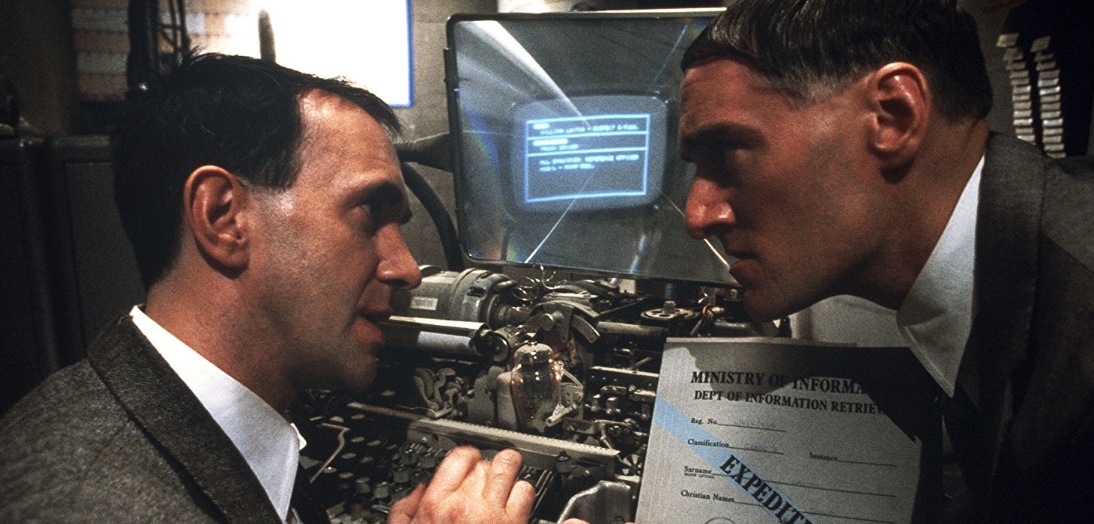
brazil.jpegJonathan Pryce and Terry McKeown in Brazil (1985). Courtesy of imdb.com

Authorized to Remain Silent
Why We Know Nothing about the Outcome of Most Criminal Cases and Verdicts against People Who, According to the Russian Secret Services, Planned or Attempted to Carry Out Terrorist Attacks 
Alexandra Taranova
Novaya Gazeta
April 27, 2018

High-ranking officials from the Russian Federal Security Service (FSB), the Russian Interior Ministry (MVD), and the Russian National Anti-Terrorist Committee (NAK) regularly report on the effective measures against terrorism undertaken by their agencies. If we add reports of constant counter-terrorist operations in the North Caucasus, especially in Dagestan and Chechnya, operations involving shootouts and the storming of houses, we might get the impression the level of terrorism in Russia is close to critical, resembling the circumstances somewhere in Afghanistan, the only difference being that Afghanistan does not have the FSB, the MVD, and the NAK to protect it.

Over the past two weeks, there were at least two such stories in the news.

A few days ago, the FSB reported it had “impeded the criminal activity of supporters of the international terrorist organization Islamic State, who […] had begun planning high-profile terrorist attacks using firearms and improvised explosive devices.”

The FSB’s Public Relations Office specified the terrorist attacks were to be carried out in goverment buildings in Stavropol Territory.

Earlier, TASS, citing the FSB’s Public Relations Office, reported that, since the beginning of the 2018, six terrorist attacks had been prevented (including attacks in Ufa, Saratov, and Ingushetia), while three crimes of a terrorist nature had been committed (in Khabarovsk Territory, Dagestan, and Sakhalin Region), and this had been discussed at a meeting of the NAK. Other media outlets quoted FSB director Alexander Bortnikov, who claimed that last year the security services had prevented twenty-five terrorist attacks, but four attacks, alas, had gone ahead.

For the most part, however, it is impossible to verify these reports, because, with rare exceptions, the terrorists, either potential terrorists or those who, allegedly, carried out terrorist attacks, are identified by name. Neither the Russian Investigative Committee (SKR) nor the FSB informs Russians about subsequent investigations, about whether all the terrorists and their accomplices have been rounded up. Likewise, with rare exceptions, we know nothing either about court trials or verdicts handed down in those trials.

Novaya Gazeta monitored reports about prevented terrorist attacks from November 2015 to November 2017. We analyzed all the media publications on this score: the outcome of our analysis has been summarized in the table, below. The veil of secrecy makes it extremely hard to figure out what reports merely repeat each other, that is, what reports relate to one and the same events, and we have thus arrived at an overall figure for the number of such reports. Subsequently, by using media reports and court sentencing databases, we have counted the number of cases that officially resulted in court sentences.

Most news reports about prevented terrorist attacks in Russia are not followed up. For example, at one point it was reported (see below) that five people with ties to Islamic State had been apprehended in Moscow and Ingushetia for planning terrorist attacks, and this same news report mentioned that a criminal case had been launched. But only the surname of the alleged band’s leader was identified, and he was supposedly killed while he was apprehended. There is no more information about the case. Over a year later, we have no idea how the investigation ended, whether the case went to trial, and whether the trial resulted in convictions and verdicts.

Other trends also emerged.

During the two-year period we monitored, reports about prevented terrorist attacks and apprehended terrorists encompassed a particular group of Russian regions: Moscow, Crimea, Petersburg, Kazan, Rostov, Baskortostan, Volgograd, Yekaterinburg, and Krasnoyarsk. When we turn to verdicts handed down in such cases, this list narrows even further. Rostov leads the country, followed by Crimea. There are two reports each from Krasnoyarsk and Kazan, and several isolated incidents. The largest number of news reports about terrorist attacks and acts of sabotage, i.e., 30% of all the reports we compiled and analyzed, originated in Crimea.

  FSB MVD NAK Russian Security Council (Sovbez)
Number of reports of prevented terrorists, November 2015–November 2017 3,505 reports (18,560 identical reports in the media) 1,702 reports

(3,571 identical reports in the media)

492 reports

(852 identical reports in the media)

236 reports

(1,122 identical reports in the media)

Outcomes: arrests, criminal charges, verdicts, etc. 13 verdicts,

14 arrests

3 verdicts,

2 arrests

2 incidents: in one case, it was reported that all the detainees had been killed; in the other, that the detainees awaited trial, but were not identified by name. It is impossible to find out what happened to any detainees, since no information was provided about them. The exception is Lenur Islyamov, who is currently at large and vigorously pursuing his objectives.

The Triumps of the Special Services with No Follow-Up
Here are the most revealing examples.

On November 12, 2016, RBC reported the security services had apprehended a group of ten terrorists, migrants from Central Asia. According to the FSB, they planned “high-profile terrorist attacks” in heavily congested areas of Moscow and Petersburg. Officials confiscated four homemade bombs, firearms, ammunition, and communications devices from the militants. The FSB claimed all the detainees had confessed to their crimes.

In the same news report, the FSB was quoted as having reported that on October 23, 2016 “there occurred an attack on police officers, during which two alleged terrorists were shot dead” in Nizhny Novgorod. The report stressed that, three days later, the banned group ISIL claimed responsibility for the attack, just as it had taken responsibility for an attack on a traffic police post in Moscow Region on August 18, 2016.

There were no names and no details. The outcomes of the investigations, the plight of the detainees, and judicial rulings were never made public, nor did state investigators or defense counsel share any information.

This same RBC article mentions that, four days before the alleged incident in Nizhny Novgorod, the SKR had reported the apprehension of an ISIL supporter who had been planning a terrorist attack at a factory in Kazan, while Interfax‘s sources reported the apprehension of a man who had been planning a terrorist attack in Samara.  It was also reported that in early May 2016 the FSB had reported the apprehension of Russian nationals in Krasnoyarsk who were “linked to international terrorist organizations and had planned a terrorist attack during the May holidays.”

No names were mentioned at the time. Later, however, details of the case were made public.

Thus, on April 7, 2017, Tatar Inform News Agency reported that the Volga District Military Court in Kazan had handed down a verdict in the case of Robert Sakhiyev. He was found guilty of attempting to establish a terrorist cell in Kazan. The first report that a terrorist attack had been planned at an aviation plant in Kazan was supplied by Artyom Khokhorin, Interior Minister of Tatarstan, during a meeting of MVD heads. According to police investigators, Sakhiyev had been in close contact with a certain Sukhrob Baltabayev, who was allegedly on the international wanted list for involvement in an illegal armed group. Using a smartphone, Sakhiyev had supposedly studied the plant’s layout via a satellite image.

On August 2, 2017, RIA Novosti reported that a visting collegium of judges from the Far East District Military Court in Krasnoyarsk had sentenced Zh.Zh. Mirzayev, M.M. Abdullayev, and Zh.A. Abdusamatov for planning a terrorist attack in Krasnoyarsk in May 2016 during Victory Day celebrations. Mirzayev was sentenced to 18 years in prison; Abdullayev, to 11 years in prison; and Abdusamatov, to 11 years in a maximum security penal colony. According to investigators, Mirzayev worked as a shuttle bus driver in Krasnoyarsk and maintained contact with Islamic State via the internet. Mirzayev decided to carry out a terrorist attack by blowing up a shuttle bus.

On January 26, 2017, TASS reported the police and FSB had identified a group of eight people planning terrorist attacks in Moscow in the run-up to State Duma elections. Oleg Baranov, chief of the Moscow police, had reported on the incident at an expanded collegium of the MVD’s Main Moscow Directorate.

We know nothing more about what happened to the “identified” would-be terrorists.

On January 31, 2017, RBC issued a bulletin that the Russian secret services had prevented an attempt to carry out terrorist attacks in Moscow during the 2016 Ice Hockey World Championships. The source of the news was Igor Kulyagin, deputy head of staff at the NAK. The militants were allegedly detained on May 2.

“We succeed in catching them as a result of a vigorous investigative and search operation in the city of Moscow,” the FSB added.

The names of the militants were not reported nor was there any news about an investigation and trial.

In the same news item, Mr. Kulyagin is quoted as saying, “In total, Russian special services prevented around [sic] 40 terrorist attacks, liquidated [sic] about [sic] 140 militants and 24 underground leaders, and apprehended about [sic] 900 people in 2016.”

According to Mr. Kulyagin, in Ingushetia on November 14, 2016, the authorities uncovered five militants who “had been planning terrorist attacks in crowded places during the New Year’s holidays, including near the French Embassy in Moscow.”

Again, the reading public was not provided with any names or information about the progress of the investigation. The only alleged terrorist who was identified was Rustam Aselderov, who had been murdered.

“According to the special services, [Aselderov] was involved in terrorist attacks in Volgograd in 2013 and Makhachkala in 2011.”

We have no idea whether an official investigation of his murder was ever carried out.

Lenta.Ru reported on February 1, 2017, that FSB officers in Krasnodar Territory had prevented a terrorist attack. The supposed terrorists had planned an explosion at New Year’s celebrations. A possible perpetrator of the terrorist attack, a 38-year-old native of a Northern Caucasus republic, was apprehended. No other particulars of the incident were reported, and they still have not been made public to this day.

On October 2, 2017, Russia Today, citing the FSB, reported an IS cell had been apprehended in Moscow Region. Its members has allegedly planned to carry out “high-profile terrorist attacks” in crowded places, including public transport. The FSB added that foreign emissaries had led the cell, whose members had included Russian nationals.

No names or details were subsequently provided to the public.

The same article reported that, on August 31, 2017, the FSB had apprehended two migrants from Central Asia, who had been planning terrorist attacks in congested places in Moscow and Moscow Region on September 1. RIA Novosti reported the same “news” in August 2017. The detainees were, allegedly, members of IS.

According to the FSB, one of the men had “planned to attack people with knives.” His comrade had planned to become a suicide bomber and blow himself up in a crowd. Supposedly, he had made a confession.

We know nothing about what happened to the two men and the criminal case against them.

On November 7, 2017, Izvestia reported MVD head Vladimir Kolokoltsev’s claim that a Kyrgyzstani national had been apprehended in the Moscow Region town of Khimki. The man had, allegedly, been planning to carry out a terrorist attack outside a subway station using a KamAZ truck. The detained man was not identified. We know nothing about what has happened to him or whether the investigation of the case has been completed.

Trials of Terrorists
On July 19, 2016, RIA Novosti reported the Russian Supreme Court had reduced the sentence (from 16 years to 15.5 years) of one of two radical Islamists convicted of plotting a terrorist attack in the mosque in the town of Pyt-Yakh in the Khanty-Mansi Autonomous Okrug. 

“The panel of judges has decided the verdict of the court, which sentenced Rizvan Agashirinov and Abdul Magomedaliyev to prison terms of 16 and 20 years, respectively, should be mitigated in the case of Agashirinov, and left in force in the case Magomedaliyev.”

On August 31, 2016, TASS reported the North Caucasus District Military Court had sentenced Russian national Rashid Yevloyev, a militant with the so-called Caucasus Emirate, to six years in a penal colony for planning terrorist attacks.

On February 15, 2017, Moskovsky Komsomolets reported the Moscow District Military Court had sentenced Aslan Baysultanov, Mokhmad Mezhidov, and Elman Ashayev. According to investigators, after returning in 2015 from Syria, where they had fought on the side of ISIL, Baysultanov and his accomplices had manufactured a homemade explosive device in order to carry out a terrorist attack on public transport in Moscow.

Baysultanov was sentenced to 14 years in prison; Ashayev, to 12 years, and Mezhidov, to 3 years.

On May 10, 2017, Interfax reported the North Caucasus District Military Court in Rostov-on-Don had sentenced ISIL recruiters who had been apprehended in Volgograd Region. The alleged ringleader, Raman Radzhabov, was sentenced to 4 years in prison after being found guilty of recruiting residents of Volgograd Region. His accomplices—Azamat Kurkumgaliyev, Gayrat Abdurasulov, Nurken Akhetov, and Idris Umarov—were found guilty of aiding and abetting Radzhabov, and given sentences of of 2 to 2.5 years in prison.

On May 30, 2017, RIA Novosti reported the ringleader of a failed terrorist attack in Kabardino-Balkaria, Adam Berezgov, had been sentenced to 7 years in prison. The defendant was found guilty of “planning a terrorist attack, illegally acquiring and carrying explosive substances or devices, and illegally manufacturing an explosive device.”

On July 27, 2017, TV Rain reported the Russian Supreme Court had increased by three years the sentence handed down to Ruslan Zeytullayev, who had been convicted and sentenced to 12 years for organizing in Crimea a cell of Hizb ut-Tahrir, an Islamist group banned in Russia. Zeytullayev’s sentence is now 15 years in prison.

On July 31, 2017, RIA Novosti reported the North Caucasus District Military Court had sentenced Ukrainian national Alexei Sizonovich to 12 years in a penal colony for involvement in planning a terrorist attack that was to have taken place in September 2016. The court ruled the 61-year-old defendant and an “unidentifed person” had, allegedly, established a group in Kyiv “for the commission of bombings and terrorist attacks in Ukraine and the Russian Federation.” It was reported the defendant “repented.”

On August 11, 2017, Lenta.Ru reported the North Caucasus District Military Court had sentenced 19-year-old Ukrainian national Artur Panov to 8 years in a medium-security penal colony for terrorism. Panov was found guilty of facilitating terrorism, planning a terrorist attack, and illegally manufacturing explosive substances. His accomplice, Maxim Smyshlayev, was sentenced to 10 years in a maximum-security penal colony.

At the trial, Panov pled guilty to calling for terrorism, and manufacturing and possessing explosives, but pled innocent to inducement to terrorism. Smyshlayev pled innocent to all charges.

On September 18, 2017, RIA Novosti reported a court in Rostov-on-Don had convicted defendants Tatyana Karpenko and Natalya Grishina, who were found guilty of planning a terrorist attack in a shopping mall. Karpenko was sentenced to 14.5 years in prison, while Grishina was sentenced to 9 years.

“The investigation and the court established Karpenko and Grishina were supporters of radical Islamist movements. […] From October 2015 to January 2016, the defendants planned to commit a terrorist attack in the guise of a religious suicide,” the Investigative Directorate of the SKR reported.

Fakes
On April 17, 2017, Memorial Human Rights Center issued a press release stating the case of the planned terrorist attack in the Moscow movie theater Kirghizia had been a frame-up. The human rights activists declared the 15 people convicted in the case political prisoners. It was a high-profile case. Novaya Gazeta wrote at the time that the MVD and FSB had insisted on pursuing terrorism charges, while the SKR had avoided charging the suspects with planning a terrorist attacking, accusing them only of possession of weapons in a multi-room apartment inhabited by several people who barely knew each other. It was then the case was taken away from the SKR.

Whatever the explanation for the trends we have identified, it is vital to note that Russian society is exceedingly poorly informed about the progress of the war on terrorism conducted by Russia’s special services, despite the huge number of reports about planned terrorist attacks. Due to the fact the names of the accused are hidden for some reason, and the court sentences that have been handed down are not made public in due form (even on specially designated official websites), it is impossible to evaluate the scale of the threat and the effectiveness of the special services, and to separate actual criminal cases from those that never went to court because the charges were trumped-up. Meanwhile, using media reports on prevented terrorist attacks for propaganda purposes contributes to an increase in aggressiveness and anxiety among the populace, who has no way of knowing whether all the apprehended terrorists have been punished, and whether this punishment was deserved.

Thanks to George Losev for the heads-up. Translated by the Russian Reader

Vladimir Balukh: Rough Justice in Russian-Occupied Crimea

The Balukh Trial: Testimony of Prosecution’s Witnesses Diverges
Grani.Ru
May 15, 2018

The testimony of the prosecution’s witnesses diverged during the latest hearing in the third trial of the Crimean Ukrainian political activist Vladimir Balukh, who allegedly assaulted Valery Tkachenko, warden of the Interior Ministry’s Temporary Detention Facility in the Razdolnoye District, reports the news website Krym.Realii.

93616

Duty officer Mikhail Shubin claimed Balukh wanted to attack Tkachenko, but the guards holding the political prisoner stopped him from doing it. At the same time, Shubin claimed Balukh had “taunted” the warden.

Meanwhile, the facility’s deputy warden, Dmitry Karpunov, testified he did not see the conflict itself. He could only report Tkachenko had entered Balukh’s cell, whence an “intense conversation” was audible, and then the warden exited the cell stained with some kind of liquid.

Karpunov said there had been no attack. Balukh had not committted any violations of prison regulations, not counting his refusal to put his hands behind his back.

The Crimean Human Rights Group reports a total of five witnesses were questioned during Tuesday’s hearing. Aside from Shubin and Karpunov, they included temporary detention facility staffers Seyran Mambetov, duty officer Sergei Tishin, and technician Alexander Konovalov, who extracted the recordings from the CCTV cameras. The Crimean Solidarity Facebook page identifies Konovalov as Balukh’s aquaintance.

Our correspondent reports that, during his testimony, Major Mambetov said, “We are not the Gestapo. We don’t assault people. We police officers do not offend anyone, and we treat all convicts the same.”

The next hearing was scheduled for Wednesday, March 16.

Balukh went on hunger strike on March 19, 2018. May 15 was thus the fifty-eighth day of his protest against the unjust verdict in his previous trial, in which he was convicted of illegally possessing ammunition. On Tuesday, the Crimean Human Rights Group published a letter from Baluch, in which the political prisoner wrote that, on the twenty-fifth day of his hunger strike, his social defender, Archbishop Kliment of the Simferopol and Crimean Ukrainian Orthodox Church of the Kyiv Patriarchate, urged him to moderate his hunger strike. Whereas earlier Balukh had consumed only water and tea, after his conversation with Kliment he drank two glasses of oatmeal kissel and ate fifty to seventy grams of dried breadcrumbs everyday, and added honey to his tea.

Balukh made the decision, he wrote, “To rule out the possibility of forced feeding and the use of medical means of life support I have not authorized, and also to avoid causing irreparable grief to my loved ones.”

Earlier, Balukh’s common-law wife Natalya had pointed out her husband suffered from liver disease, and it was unacceptable for him to go on hunger strike.

93614.jpgVladimir Balukh and his attorneys Olga Dinze and Taras Omelchenko, May 15, 2018. Photo by Alexandra Yefimenko. Courtesy of Grani.Ru
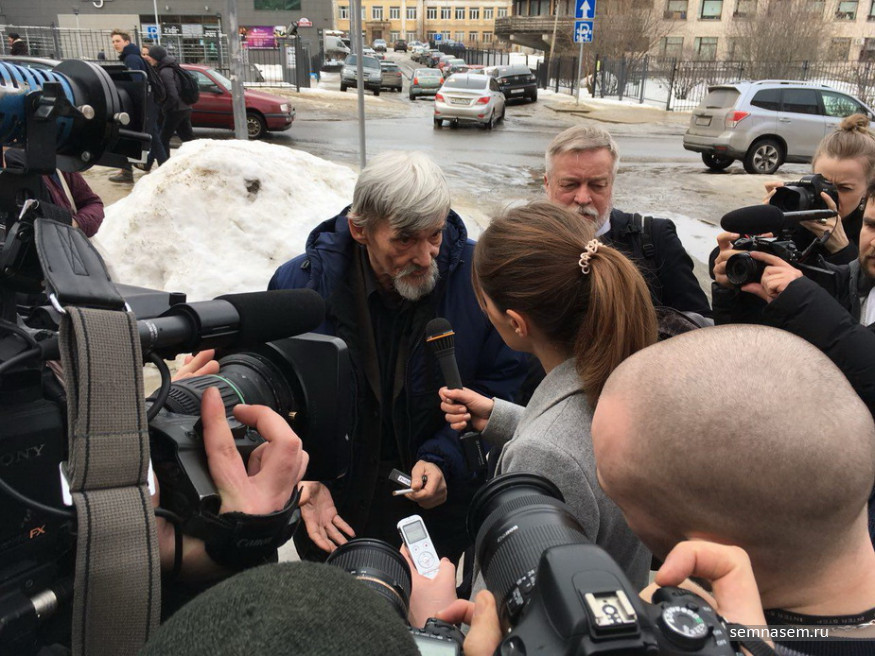
The hearing on the merits of Baluch’s third trial began April 2. Tatyana Pyrkalo, chair of the Razdolnoye District Court, which is controlled by Russia, has presided over the trial. Aside from Archbishop Kliment, Balukh is defended by three professional lawyers, Dmitry Dinze, Olga Dinze, and Taras Omelchenko. Ms. Dinze and Mr. Omelchenko were present at Tuesday’s hearing.

The 47-year-old Balukh, a farmer from the village of Serebryanka in the Razdolnoye District, has beeen charged under Article 321 Part 2 of the Russian Criminal Code (non-threatening violence against a penitentiary officer during performance of his duties), which is punishable by a maximum of five years in a penal colony. According to the prosecution, on August 11, 2017, during morning rounds of the cells at the Razdolnoye Temporary Detention Facility, where Balukh had been transferred from a remand prison while he attended his second trial, Balukh struck Warden Tkachenko in the stomach with his elbow while they were in the hallway, after which he went into his cell, grabbed a bottle of detergent, and struck the policeman on the arm.

Actually, Tkachenko himself assaulted Balukh, insulted his ethnicity, and swore at him. Moreover, these actions were captured by CCTV cameras. We also know the warden had verbally assaulted Balukh prior to the incident. Balukh was framed on the new charges after his defense lawyers filed a complaint against Warden Tkachenko with the police.

During the pretrial investigation, conducted by N. Bondarenko, an official with the Razdolnoye Interregional Department of the Russian Investigative Committee, Warden Tkachenko refused to report to a face-to-face confrontation with Balukh, although Russian law does not provide this right to victims.

Until today, only two hearings had been held in the case. Warden Tkachenko took the witness stand at the second hearing, on April 11.

As defense lawyer Dmitry Dinze noted after the hearing, “The funniest thing about the whole case is that the so-called victim has not evinced any get-up-and-go. The criminal charges did not interest him at all. He was ordered to file a report and draw up all the papers in order to get the case opened. Personally, he has no material and emotional gripes against my client. It transpires the Razdolnoye District Police Department had a stake in cooking up more criminal charges against Balukh.”

In December 2013, during the early weeks of the Revolution of Dignity, Balukh hung the red and black flag of the Ukrainian Insurgent Army (UPA) above his home in the village of Serebryanka. After awhile, the flag was surreptitiously torn down at night, and the farmer replaced it with the Ukrainian national flag. After Crimea was occupied, Balukh did not apply for Russian citizenship.

Balukh was convicted for the first time in 2016 and sentenced to 320 hours of community service for, allegedly, offending a government official, as stipulated by Article 319 of the Russian Criminal Code. The “victim” in this case was Lieutenant Yevgeny Baranov, a field officer with the Center for Extremism Prevention (Center “E”), who was involved in searching Balukh’s home in November 2015.

Balukh faced trumped-up charges for the second time after he attached a sign inscribed “Heaven’s Hundred Heroes Street, 18″ on his house. He was jailed in a remand prison, where he was imprisoned for nearly a year before he was transferred to house arrest. He was returned to the remand prison after his conviction on the second set of charges. Balukh was charged under Article 222 Part 1 (illegal trafficking of ammunitition) and Article 222.1 Part 1 (illegal trafficking of explosives) after police planted gunshells and TNT blocks in his home during a routine search. Earlier this year, Balukh was sentenced to three years and five months in an open penal colony.

Translated by the Russian Reader

Karelian Historian Yuri Dmitriev Acquitted of Trumped-Up Charges

333Yuri Dmitriev. Photo by Gleb Yarovoi. Courtesy of 7X7

Court Acquits Karelian Historian Yuri Dmitriev of Pornography Charges
Anna Yarovaya
7X7
March 5, 2018

In Petrozavodsk, Judge Marina Nosova acquitted Yuri Dmitriev, head of Memorial Karelia and a historian of the Great Terror, of charges he had produced pornography involving images of minors.

The judge acquitted Mr. Dmitriev on the charges of manufacturing pornographic matter depicting minors and committing nonviolent acts of sexual abuse. On the charge of illegal possession of a firearm, the judge sentenced Mr. Dmitriev to two years and six months of police supervision. Deducting the time Mr. Dmitriev already spent in the Petrozavodsk Remand Prison, he will be under police supervision for three months. During this time, he will have to report to a parole officer periodically.

Defense attorney Viktor Anufriev commented on the court’s decision.

“Yesterday, the media quoted the president’s statement that judges who failed to uphold the law should look for other jobs. Today’s verdict is confirmation the president’s statement was heeded. Yuri Alexeyevich has been acquitted on nearly all counts. The court awarded him the right to vindication and compensation for pain and suffering. He was convicted of possessing part of a smoothbore gun and sentenced to two years and six months of police supervision, meaning he must report to the parole inspector twice a month. He spent one year, one month, and fifteen days in police custody. One day in custody is equal to two days of community service, meaning he has already served two years and three months of his sentence,” said Mr. Anufriev.

Yan Rachinsky, chair of the International Memorial Society, came to Petrozavodsk for the reading of the verdict.

“It’s a completely outrageous case. When a man like this, the champion of a cause, is accused of god knows what, the accusation cannot be real. My natural reaction is to do what I can to voice my solidarity. Solidarity takes various shapes. But today is the day of the verdict. I have been more worried about the plight of a specific person than how it has affected Memorial. This is much more important. But yes, of course, various contemptible means of mass disinformation have glommed onto the story. What can you do? You cannot force anyone to be honest,” said Mr. Rachinsky.

Like the entire trial, the verdict was announced in closed chambers. [Verdicts must be read out in open court according to Russian law—TRR.] Before the hearing, court bailiffs blocked the hallway, and reporters, friends, and Mr. Dmitriev’s supporters were unable to approach the courtroom doors the entire time.

Mr. Dmitriev was detained on December 13, 2016. According to police investigators, he had photographed his foster daughter while she was naked. The historian’s defense counsel claimed the photos were part of a diary, charting the girl’s health, that Mr. Dmitriev kept for children’s protection services because his foster daughter was abnormally thin. Court-appointed experts corroborated these claims.

Mr. Dmitriev’s trial in Petrozavodsk City Court commenced on June 1, 2017. The case was heard in closed chambers. Mr. Dmitriev was charged under three articles of the Russian Federal Criminal Code: Article 242.2 (production of pornographic matter depicting minors), Article 135 (nonviolent sexual abuse), and Article 222 (illegal possession of a firearm).

During the investigation, the photographs in question were subjected to two forensic examinations. The first examination deemed the photographs pornographic. The second examination, on the contrary, found no traces of pornography in them.

On January 22, 2018, the Serbsky Institute performed a psychiatric examination of Mr. Dmitriev, for which purpose the historian was transported under armed guard to Moscow. On February 27, 2018, the court announced Mr. Dmitriev had been deemed mentally healthy.

On January 27, 2018, Mr. Dmitriev was released from remand prison on his own recognizance. In the first interview he granted after his release, he spoke of life in prison and his plans to finish a book.

On March 20, 2018, Petrozavodsk City Prosecutor Yelena Askerova asked the court to sentence Mr. Dmitriev to nine years in a maximum security penal colony. On March 22, 2018, Mr. Anufriev said the Dmitriev case was a mockery of the historian’s foster daughter. A series of solo pickets in support of Mr. Dmitriev took place in Petrozavodsk on March 25 and March 26, 2018.

Translated by the Russian Reader. Read my previous coverage of the Dmitriev case.