Defense in Dmitriev Case Asks for Acquittal of Historian on All Charges
Valery Potashov Chernika
March 22, 2018
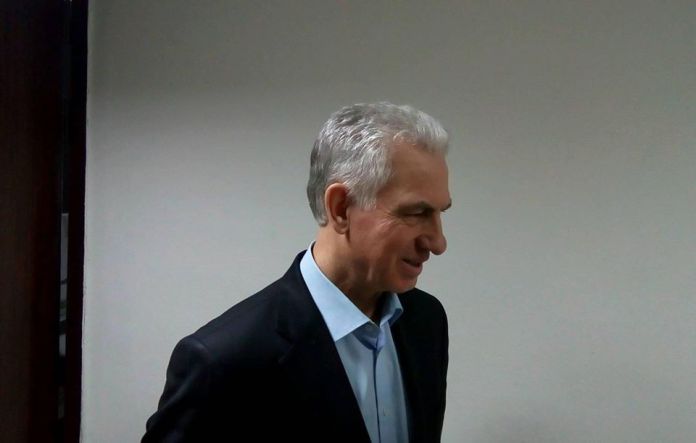
Yuri Dmitriev’s defense attorney Viktor Anufriev. Photo by Valery Potashov. Courtesy of Chernika
On March 22, defense attorney Viktor Anufriev made his closing arguments in Petrozavodsk City Court, where the criminal case against Yuri Dmitriev, the famous researcher of Stalin’s Great Terror, has been heard in closed chambers. Mr. Anufriev asked the court to acquit Mr. Dmitriev on all counts, including the main charge, production of child pornography using his foster daughter.
“I was given the time to make a closing argument, which is what I did. I asked that Yuri Alexeyevich be acquitted on all counts and explained to the court why it should do this,” Mr. Anufriev told reporters after the hearing.
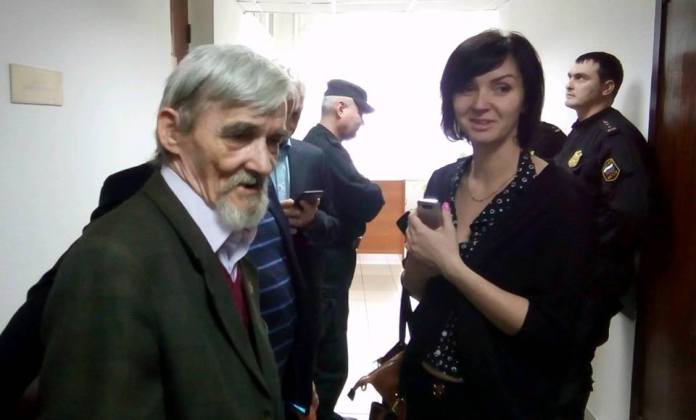
Defendant Yuri Dmitriev and his eldest daughter Katya in the courthouse hallway. Photo by Valery Potashov. Courtesy of Chernika
He noted that Mr. Dmitriev had indeed taken photographs of his foster daughter when she was naked, but that these actions were not evidence of the crime of which the historian had been accused.
“There was no sexual motive. He is not a pedophile. He is mentally fit, and he made the photographs in order to monitor the child’s health. His objectives were medical. This was the conclusion of the last two forensic examinations, which were trustworthy, I would say,” Mr. Anufriev emphasized.
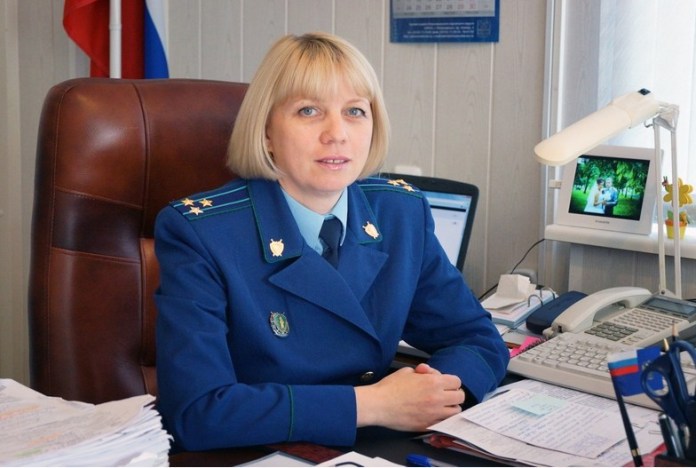
Commenting on the closing argument of Prosecutor Yelena Askerova, who two days earlier had asked the court to sentence Mr. Dmitriev to nine years in a maximum security penal colony, Mr. Anufriev noted that the criminal charges against the researcher had been filed unlawfully.
Petrozavodsk Prosecutor Yelena Askerova. Photo courtesy of Guberniya Daily and Chernika
“He was arrested without sufficient cause, and the foster daughter was removed from his custody and taken out of the city. This what was caused mental harm to the child, not Yuri Alexeyevich’s actions.”
Mr. Anufriev also voiced the opinion that Petrozavodsk Prosecutor Yelena Askerova’s decision to ask the court to find Mr. Dmitriev guilty on all counts of the original charges was made by the Karelian Prosecutor’s Office.
“The prosecutor’s office is an agency where everyone wears a uniform and has a rank. There is a chain of command. The law says prosecutor’s offices are independent. But they are not independent when it comes to stating their position today. They have vetted their position with the prosecutor’s office that oversees them, so it follows that the overseeing prosecutor gave the command to press for a guilty verdict,” Mr. Anufriev told reporters.
Judge Marina Nosova asked the bailiffs not to let people into the courtroom. Photo by Valery Potashov. Courtesy of Chernika
According to Mr. Anufriev, on March 27, the parties to the trial will be given time to make counterarguments, and then the judge will allow Mr. Dmitriev to make a closing statement before retiring to chambers to deliberate her decision. It is noteworthy that even before today’s hearing in the Dmitriev case, Judge Marina Nosova asked the court bailiffs not to let people who had come to support Mr. Dmitriev get near the courtroom doors.
Mr. Dmitriev’s trial in Petrozavodsk City Court began in June 2017. He was remanded in police custody for over a year and was only released from the remand prison after undergoing an inpatient forensic examination at the Serbsky National Medical Research Center for Psychiatry and Addiction Medicine in Moscow. The examining physicians concluded the defendant had no pedophilic propensities whatsoever.
Thanks to Victoria Andreyeva for the heads-up. Translated by the Russian Reader
Ping, Ping, Ping: A Report from the Remand Extension Hearing of the Defendants in the Penza “Terrorism” Case
Yegor Skovoroda Mediazona
March 16, 2018
Ilya Shakursky. Photo courtesy of Yegor Skvoroda and Mediazona
Yegor Svokoroda traveled to Penza, where, over the course of three days, the Lenin District Court considered whether to extend the remand in police custody of the antifascists who, according to the FSB, were part of a “terrorist community” known as The Network.
FSB Senior Investigator Valery Tokarev blushes gradually: first the tip of his nose, then his ears, and finally the bald patch that covers half his head. He is arguing with a lawyer, insting on a closed hearing in order to ensure “investigatory privilege.” The lawyer objects.
“The case is at the evidence gathering stage. We have not finalized all the witnesses or the defendants. A number of parties to the crime have not been identified or are on the wanted list,” says Tokarev, his forehead covered with sweat.
This scene was repeated several times in Penza’s Lenin District Court, where, between March 13 and March 15, the arrest in police custody of five antifascists apprehended and charged with involvement in a “terrorist community” was extended. Time after time, Judge Svetlana Shubina closed the hearings to the public and the press.
Ordering that yet another of the accused be remanded in custody to the local remand prison until June 18, Judge Shubina time after time bases her ruling by referring to the particularly complicated nature of the case and the allegation that each of the young men was a member of a “stable, highly secretive criminal group,” and that “firearms and ammunition” were involved. Shubina notes investigators had to finish their numerous forensic examinations and interrogations, and finally indict Sagynbayev, Pchelintsev, Shakursky, Chernov, Zorin, Kuksov, Ivankin, and Kulkov.
Yegor Zorin, a fourth-year student at the Belinsky Pedagogical Institute, was the first person detained in the investigation of the “terrorist community.” The FSB has alleged its members planned, during the March 18 presidential election and this summer’s FIFA World Cup, to “agitate the masses in order to further destabilize the political situation in the country” by setting off bombs; when the H-hour came, they would lead an armed insurrection. Zorin was apprehended on October 17, 2018. There are unconfirmed reports he signed a confession, which was the basis of Criminal Case No. 11707560001000036, concerning organization of and involvement in a terrorist community, per Article 205.4 Parts 1 and 2 of the Russian Federal Criminal Code.
Zorin’s time in the remand prison was not extended. He was jailed there until December 18 and subsequently transferred to house arrest. The press service of the Lenin District Court told Mediazona, however, that after December 18, investigators had not petitioned the court to extend his arrest.
Arman Sagynbayev. Photo courtesy of Yegor Skvoroda and Mediazona
The next to be apprehended were Zorin’s classmate Ilya Shakursky and their common friend Vasily Kuksov during the wee hours of October 19, 2017. On October 27, Dmitry Pchelintsev was detained; he knew Shakursky through the leftist activist scene and because they shared a hobby: airsoft. On November 6, Arman Sagynbayev was detained in Petersburg. He had been to Penza several times for airsoft practice sessions. He was transferred to the Penza Remand Prison. On November 9, Andrei Chernov, another airsoft player and an old friend of Pchelintsev’s was detained.
A passion for airsoft and a sympathy for leftist ideas, anarchism, and antifascism were what all the detainees had in common. The case files contain videos of training sessions in the woods outside Penza, sessions during which the young men used fireworks. The FSB has alleged that the group training sessions were preparation for the insurrection, while the hikes the young men took in the woods constituted “illegal mastery of survival skills in the woods and rendering of first aid.”The airsoft teams in which the antifascists played, Voskhod (“Sunrise”) and 5.11 (“November Fifth”), were cells of a terrorist organization known as The Network (Set’). Aside from Penza, The Network was alleged to have underground cells in Moscow, Petersburg, and Belarus.*
The FSB has alleged the Penzans divided up the roles in their “terrorist community.” Pchelintsev was the leader and ideologue. His deputy, nicknamed Redhead, handled reconnaissance and recruiting, while Sagynbayev, nicknamed Andrei Security, was the engineer and sapper, Shakursky (aka Spike), the tactician, Chernov (aka Twin), the signalman, Zorin (aka Grisha), the sniper, while a certain Boris was also a coordinator and ideologue.
Redhead is Maxim Ivankin, mentioned in the court’s new custody ruling, while in all likelihood the Boris referred to by the security services is M.A. Kulkov. According to our sources, both men have left Russia and are on the wanted list.
The Lenin District Court occupies a three-storey nineteenth-century mansion whose interior has been modernized. The courtroom where the custody extension hearings take place is located in a wing of the building accessible only through doors outfitted with an electronic lock. To gain access to the hallway leading to the courtroom you have to place a card on the lock, which sets off an obnoxious pinging sound. The squeaky alarm goes off constantly. Ping, ping, ping: terrorist community. Ping, ping, ping: investigative privilege. Ping, ping, ping: extend the arrests.
Ping, ping, ping, ping, ping, ping, ping.
Dmitry Pchelintsev and his wife Angelina. Photo courtesy of relatives
A broad-shouldered FSB guard escorts 25-year-old Dmitry Pchelintsev into the room, not taking his eyes off him the entire hearing. Guards just like him also escort the other detainees. Some of them wear balaclavas to conceal their identities, some wear Buff scarves over their faces. Viktor Filinkov, detained in Petersburg, and Pchelintsev himself recounted how they were tortured by men wearing such masks. Pchelintsev recalled how the officers who tortured him later escorted him to the remand prison.
“When I was tortured with electrical shocks, my mouth was full of ‘crushed teeth’ due to the fact I gritted my teeth since the pain was strong, and I tore the frenulum of my tongue. My mouth was full of blood, and at some point one of my torturers stuck my sock in my mouth,” Pchelintsev told his lawyer in order to explain why he had signed a confession.
Soon, after he was beaten again, Pchelintsev recanted his testimony about being tortured. Pchelintsev, who has thick, kinky eyebrows and slightly protruding ears, worked as a target practice instructor after serving in the army. He wears a checkered shirt whose collar he constantly buttons and unbuttons. Cautious at first, he thaws by the end of the hearing, when he manages to chat with his wife Angelina through the glass of the so-called fish tank in which defendants are held during trials and hearings.
Dmitry laughs, talking about books and Alina Orlova songs. He jokes that during the last hearing he was in handcuffs because “Arman was sitting next to me, and they thought I would attack him.”
Alina Orlova sings “I Stroll Around Moscow,” IKRA Club, Moscow, September 29, 2008
“What should I do with your car?” Angelina asks. The FSB claims to have found two grenades under the seat of the old Lada. Pchelintsev said they were planted there.
“Burn it,” says Dmitry, joking once more.
“I’m afraid I’d be arrested.”
“Yeah, you’d also go to jail for terrorism,” Pchelintsev quips. “Actually, I was told we should take it to the junkyard and sell it for scrap.”
Angelina presses her nose against the glass of the fish tank.
Ping, ping, ping, ping, ping, ping, ping.
Vasily Kuksov. Photo courtesy of relatives
29-year-old design engineer Vasily Kuksov appears to be the most confused and indifferent of all the prisoners. His wife Yelena says Vasily was cheerful and life-affirming prior to his arrest. He enjoyed drawing and was into music, performing a year ago at a Vladimir Vysotsky memorial festival at the Penza Philharmonic. Now his case file describes him as an “individual who leads an isolated lifestyle characterized by antisocial behavior.”
Vasily Kuksov performing at the Penza Philharmonic on January 25, 2017
Kuksov has not complained that FSB officers were violent with him, but his friend Ilya Shakursky recalled that, when they were taken to the FSB building in Penza, first he heard Kuksov’s groan and then later saw him, his face badly mangled. Nevertheless, Kuksov avoided testifying by invoking his right not to incriminate himself under Article 51 of the Russian Constitution.
A pistol was confiscated from his car. According to his loved ones, the gun had been planted there.
Kuksov is the only prisoner whom the investigator allows to talk with his mother for a long time during the recess [sic].
As he listens to the judge’s ruling, Kuksov zips and unzips the zipper of his black winter jacket.
Ping, ping, ping, ping, ping, ping, ping.
“They blindfolded me, tied my hands, and stuck a sock in my mouth. Then I thought they wanted to leave my fingerprints on something, but later they attached wires to my big toes. I felt the first surge of current, and I could not hold back the moaning and shaking. They repeated the procedure until I promised to say what they told me to say. After that, I forgot the word ‘no’ and said everything the officers told me to say,” recalled 21-year-old antifascist Ilya Shakursky.
Shakursky was a classmate of the first person arrested in the case, Yegor Zorin. Both of them were studying to be physics teachers.
Shakursky is a thin young man with a shaved head and a deep wrinkle on his forehead. He is a well-known activist in Penza. He used to be involved with Food Not Bombs, and he was himself always organizing everything from lectures to trips to the woods to pick up trash. Before the antifascist rally held annually on January 19, he sent friends a letter in which he wrote, “If I were on the outside, I would definitely attend the memorial event for two great heroes, Nastya Baburova and Stas Markelov.”
Recently, relations between him and Pchelintsev had been strained. The young men had fallen out over Shakursky’s ex-girlfriend Victoria Frolova. They had fought several days before Shakursky’s arrest. The FSB officers who were staking out the alleged terrorist group were surprised to see two members of the “stable” group brawling.
When the judge reads out the ruling, Shakursky, dressed in a gray track suit, lifts his left eyebrow slightly and folds his hands behind his back.
Shakursky’s mother sobs.
Ping, ping, ping, ping, ping, ping, ping.
When questioning 28-year-old Andrei Chernov’s mother after her son was arrested, the investigator wondered aloud whether she knew he had a secret nickname, Twin.
“He’s had the nickname since he was a kid,” Tatyana Chernova says, recalling her outrage. Next to her is Alexei Chernov, Andrei’s twin brother.
Andrei Chernov. Photo courtesy of Yegor Skvoroda and Mediazona
The Chernov brothers studied in the same department at the pedagogical institute as Zorin and Shakursky, but they dropped out before the other young men had enrolled there. Subsequently, Andrei went to work at a factory where he assembled water heaters. He was apprehended on the shop floor.
According to his defense attorney, Stanislav Fomenko, Chernov had not been subjected to violence by the FSB. Tatyana Chernova adds that her son signed a confession after Dmitry Pchelintsev, who had been tortured, spoke with him. Chernov has now recanted his testimony.
Andrei wrote to his mother that after human rights activists spoke out about the plight of the young men and the press published articles about the so-called Penza Case, the guards and wardens at the remand prison often visited his cell to perform spot checks, videotaping everthing he did.
Chernov was finally examined by an ophthalmologist (there were suspicions he had a detached retina). The doctor for some reason prescribed him antibiotics.
Chernov smiles the most of all the defendants. If it were not for the fish tank, it would be impossible to tell him apart from his brother.
“My son is not guilty of anything. Sure, he played airsoft and studied survival skills, but lots of people are into that. I will fight for my son till the end of my days,” says Tatyana Chernova.
Ping, ping, ping, ping, ping, ping, ping.
No one has come to the courtroom [sic] to support 25-year-old Arman Sagynbayev, transferred to Penza from Petersburg,** and yet he is cheerful and talkative.
Arman was born in Novosibirsk, where his mother, stepfather, ex-wife, and their five-year-old daughter still live.
He has spent the last several years in Petersburg, where he was convicted of petty theft (Article 158 Part 1 of the Criminal Code) and sentenced to a fine of 6,000 rubles. When Sagynbayev’s room was searched, the security services allegedly found a bucket of aluminum powder, four kilograms of ammonium nitrate, two alarm clocks, and various radio components.
After his arrest, Sagynbayev fully acknowledged his guilt. He is still cooperating with investigators. He has no objections when Deputy Prosecutor Sergei Oskolkov moved to extend his arrest.
“He has no complaints. He has not claimed he was tortured. He cooperates with the investigators and gets privileges in return for his cooperation. He was now given the chance to speak with his mother. He spoke with her the entire recess [sic]. Arman has a separate cell,” says his lawyer, Rakhmanova [sic].
In the remand prison, her client, who suffers from a serious illness, receives timely medical care, she emphasizes, without specifying what the illness is
At the beginning of the week, Sagynbayev was sent under armed guard to Saratov, where he was examined at the St. Sophia Regional Clinical Psychiatric Hospital. He is the only suspect in the case who has been made to undergo an inpatient forensic examination.
“He said lots of things to our experts about anarchy and social revolution. They said he was deluded and refused to render an opinion, recommending he be hospitalized,” Rakhmanova explains.
According to the attorney, the doctors in Saratov concluded Sagynbayev was mentally competent.
Ping, ping, ping, ping, ping, ping, ping.
*The name of the airsoft team 5.11 had nothing to do with the revolution allegedly scheduled by nationalist Vyacheslav Maltsev for November 5, 2017. According to various sources, the name refers either to a popular brand of tactical clothing and equipment or to the date when seventeen-year-old Penza anarchist Nikolai Pchelintsev was hanged in 1907. Historians Alexander Kolpakidi and Gennady Potapov write that Pchelintsev took the blame for the murder of a gendarme during a shootout, counting on the court’s mercy towards him as a juvenile, but instead was sentenced to death. His burial site in the Abrekov Woods near Penza is marked by a monument to fallen revolutionaries. Mediazona has been unable to ascertain whether Dmitry Pchelintsev is a distant relative of Nikolai Pchelintsev.
** The FSB apprehended antifascists in Petersburrg late January 2018. According to the FSB, the city was home to two cells of The Network, code-named Jordan and Field of Mars. The investigation of the Petersburg case, Case No. 11807400001000004, is supervised by FSB investigator Gennady Belyayev. After they were detained, Igor Shishkin and Viktor Filinkov confessed their guilt. Filinkov soon recanted what he claimed had been rehearsed testimony and gave a detailed account of how FSB officers had tortured him with an electric shocker. Shishkin has said nothing about torture, but doctors recorded bruises, abrasions, and a fracture to the lower wall of his eye socket, while members of the Petersburg Public Monitoring Commission found numerous traces on his body that resembled burns made by electric wires.
Translated by the Russian Reader
If you have not heard about the Penza-Petersburg “terrorism” case and the related crackdown against Russian grassroots and political activists on the eve of the March 18 Russian presidential election, you need to read the following articles and spread the word.
Arrests Made in the New Greatness Case in Moscow Grani.ru
March 15, 2018
Arrests and searches have been made in Moscow in the investigation of the New Greatness movement. The first source to report the news was Kremlin Washerwoman, a Telegram channel associated with the security services. More detailed information was soon published by OVD Info.
The detainees included the movement’s leader, Ruslan Kostylenkov, and two female activists, Maria Lapina and a juvenile whose name has not been disclosed. They were taken to the Kuntsevo Interdistrict Office of the Russian Investigative Committee. The female juvenile detainee was escorted by her father.
It is reported that during one of the searches a list containing the names of ten members of the movement was confiscated. According to uncorroborated reports, FSB investigators were present during the search.
There is information the juvenile detainee had earlier been subjected to pressure from Center “E” (Center for Extremism Prevention), after which her employer demanded she quit her job.
Photos of the search, as published on Kremlin Washerwoman, show campaign material for the so-called Voters’ Strike, a leaflet printed with New Greatness’s platform, and a t-shirt emblazoned with anarchist symbols.
Screenshot from the Telegram channel Kremlin Washerwomen. “Searches taking place at the home of supports of an obscure organization by the name of New Greatness. The guys drink a lot and cannot pin down their views.”
After lunch, Kremlin Washerwoman posted a video showing Kostylenkov’s confession. Out of breath, Kostylenkov recites a memorized text, mentioning in particular plans for “organizing a tribunal for members of the ruling elite” and “practice in shooting and throwing Molotov cocktails.”
The movement’s website contains only a home page featuring a notification that the site would be launched on March 15, that is, today. It also contains a brief, two-paragraph description of the movement’s objectives.
“We are the ones who will awake a sense of their own self-worth in people and help the nations of Russian acquire the energy for reviving the spirit of victors,” reads the text. “Only together can we build a strong country the rest of the world will respect and take into account.”
At the same time, both “pro-regime” and “opposition” forces are criticized for “divvying up spheres of influence,” while “ordinary people vegetate in poverty and dishonor, having forgotten the plight of the Motherland in which they live is in their hands.”
Screenshot of the homepage of New Greatness’s website
New Greatness began posting on its VK page on December 30 of last year. In late January, the movement encouraged people to take part in a rally demanding the preservation of trolleybus service in Moscow. The capital’s mayor has gradually been replacing trolleybus lines with bus line, which has sparked protests by environmentalists.
In February, New Greatness launched a large-scale campaign to paste anti-Putin leaflets around Moscow. The movement signaled it was in favor of boycotting the presidental election. On February 25, its activists were involved in the Boris Nemtsov Memorial March in Moscow.
On February 26, a pinned post was published on the movement’s VK page that read as follows: “Our young, ambitious, and quickly growing organization needs your help. If you are finally ready for the fight and willing to sacrifice your time and strength for the sake of our Motherland’s future by working in strong team led by an energetic leader, then join us. To do that, you must live in Moscow or Moscow Region and write to the message inbox on this page. If you cannnot help out physically, help us financially!”
The message is followed by an electronic address for transferring money.
On the evening of March 14, the Telegram canal A Copper Spills posted a message that opened as follows: “Evidence that an extremist organization has been established has been uncovered.”
The post’s author claimed Center “E” investigators in Moscow’s Southeastern District had discovered that “unidentified persons” had established “a group accessible to all [VK] users, which posted information about the creation of an informal political association whose main activity is involvement in popular insurrections, revolutionary actions, and clashes with the authorities.”
“The evidence is there, but for now we’ll keep quiet about everything else. When the times comes, we will tell all,” the author of the post concludes.
Kuntsevo is located in Moscow’s Western District, not in the Southeastern District. Besides, none of New Greatness’s posts contain calls for clashes with the authorities. In this connection, it is difficult to give an unequivocal answer to the question of whether the post on A Copper Spills had anything to do with the recent searches.
Thanks to Comrade Sammakko for the heads-up. Translated by the Russian Reader
P.S. Not that anyone much cares (I’m not trying to be smug: I really don’t get the sense there are huge numbers of people either in my reading audience, Russia or the great wide world who genuinely care about any of this), but I think we can extract three takeway lessons rom the war the Russian security services and police have unleased against grassroots activists in recent months.
1. When the director of the FSB or Putin (I forget who) said the other day the FSB had “prevented” fifty or a hundred or six thousand “terrorist attacks” last year, what they really had in mind is juvenile operations and investigations like the one described in the article above. That is, perfectly harmless young people with “funny ideas” and “informal” lifestyles are turned into “terrorist groups” with a little ultraviolence from the so-called security services.
The key is to scare, threaten or torture the harmless non-terrorists into confessing their non-guilt and signing confessions before letting them see a lawyer. Then their gooses are cooked for good, because cases concerning “terrorism” and “public safety” more generally have been removed from the remit of jurors in Russia, meaning they are tried by judges who know in advance what verdicts they are supposed to hand down.
A jury of more or less intelligent people would look at the flimsy evidence and the forced confessions and be tempted to acquit the defendants. If the Bolotnaya Square defendants, for example, had been tried by juries of their peers, I have no doubt most if not all of them would have been acquitted.
2. It has become extraordinarily dangerous to call for a boycott of the March 18 presidential election. Activists who have been calling for a boycott have painted big targets on their backs, and the authorities have spent the last few months shooting at them with increasing ferociousness. Depending on their ideological leanings, the activists have been sentenced to more or less long jail sentences or branded “terrorists,” as seems to be the case with the unfortunates described in the Grani.ru article, above.
I could be wrong, but this “minor terror” alone should be enough to discredit the election in the eyes of anyone with a conscience. By voting on Sunday, you will be saying to the authorities they can terrorize with impunity anyone who criticizes elections in Russia too vigorously and loudly, although that is exactly what needs to happen.
3. The only way to beat this racket is broad-based solidarity, but as we have seen with the accused in the Penza-Petersburg “terrorism” case and even with many of Navalny’s nominal supporters sent off to jail or beaten up for god knows what reason, people occupying different political camps are not too eager to show their solidarity.
The poor folks from the utterly harmless and helpless New Greatness movement, I am nearly certain, will elicit no solidarity or support from anyone whatsoever, except maybe the lawyers from Agora or Public Verdict, if they are lucky.
This points up the biggest flaw in the Russian grassroots democratic movement (if such a thing exists): its clannish, extremely partisan notions of solidarity. There are very few political activists who cross party lines to show their solidarity with their nominal opponents, and this is a huge, crippling problem for the anti-Putin, pro-democracy movement if it wants ever to move forward for real.
When it comes to folks like the New Greatness movement, it likely means they will be railroaded and sent off to a penal colony for ten years or twenty years without so much as anyone but their loved ones even noticing it happened.
After all, even silly, harmless people have human rights, such as the right to an attorney, the right to a proper investigation, and the right to a fair trial.TRR
Yuri Leiderman, St. Sebastian (Stitched from Whole Cloth) [Св. Себастьян (шито белыми нитками)], 2018. Oil and thread on paper, 42 cm x 30 cm. Courtesy of the artist. All rights reserved
“Young People Gathered to Voice a Silent Reproach”: Dmitry Borisov’s Closing Statement in Court OVD Info
February 21, 2018
Dmitry Borisov. Photo by Irina Yatsenko. Courtesy of OVD Info
Moscow’s Tverskoy District Court is scheduled to pass sentence on Dmitry Borisov at twelve noon on February 22. Borisov is a defendant in the so-called March 26 Case, involving various “forceful actions,” allegedly taken by protesters against policemen and Russian National Guardsmen on Pushkin Square during a March 26, 2017, rally inspired by Don’t Call Him Dimon, a video exposé posted on YouTube on March 2, 2017, by anti-corruption activist and would-be presidential candidate Alexei Navalny. The video accused Russian prime minister and former president Dmitry Medvedev of wide-ranging corruption. The prosecution has asked the judge to sentence Borisov to three years in prison.
The court heard the defense’s and prosecution’s closing arguments, as well as Borisov’s closing statement on February 20. According to our count, forty-six people came to the hearing to support Borisov, many of them wearing t-shirts emblazoned with his picture. Prosecutor Larisa Sergunyayeva rattled off her closing argument, a printed text that she read out to the court. During her speech, activist Ildar Dadin called her a few rude names. Dadin was removed from the courtroom, but Sergunyayeva did not slow down her rapid-fire delivery.
According to Sergunyayeva, the testimony given by policemen was believable, while the testimony of protesters could not be trusted because they had a stake in the case’s outcome. Borisov’s malicious intent was allegedly proven by the discovery of a chat session on Telegram chat on his elephone in which he had written about planning to go to the rally with friends. Many positive character references were made on Borisov’s behalf, and he had no criminal record, but if the prosecutor has her way, he will spend three years behind bars for violating Article 318 Part 1 of the Russian Criminal Code, which stipulates a maximum punishment of five years in prison.*
Borisov’s attorneys, Ilya Novikov and Nikolai Fomin, spoke for about an hour and a half. They explained Borisov had been standing calmly at the rally when, for no apparent reason, police seized his friend and dragged him to the paddy wagon. Borisov grabbed his friend. The police knocked Borisov to the ground and beat him. Four of them dragged him to the paddy wagon. The lawyers explained the prosecution’s claim Borisov had wrested a leg free from one of the policemen carrying him and kicked him in the helmet was untenable, since the policeman who had testified he had seen this was located somewhere where he could not have seen the incident. They also argued the policemen who were witnesses in the case had perjured themselves when discussing the administrative charges also filed in connection with the events of March 26, 2017. They argued that if Borisov really had kicked the policeman’s helmet, he probably would have broken his visor, because Moscow police are currently outfitted with extremely poor-quality helmets. Finally, the defense pointed out the alleged victim did not immediately file charges. He did so two months later, apparently under pressure from Investigative Committee detectives Alexander Uranov and Rustam Gabdulin, notorious for their involvement in the Bolotnaya Square case. They handled the investigation of the March 26, 2017, case in exactly the same manner.
The defense attorneys predicted the court would hand down the worst sentence possible.
OVD Info has published Dmitry Borisov’s closing statement in court, below. The transcript may contain a few mistakes, because the accused spoke softly.
Dmitry Borisov: Closing Statement in Court Your honor, the lawyers spoke very professionally, for which I am quite grateful. I did not use violence against police officers, nor did I intend to do so, because, at very least, it would have been senseless to do so. I had been captured by four policemen and was in a vertical position. All I could see was the sky.
I honestly do not understand why for nine months running I have been traveling to interrogations and court hearings not from home, but in trucks in which fifteen people sit in a three meter square cage. After sitting in this cage for seven hours, they faint and have to urinate in bottles, because the truck is parked in the garage of the Moscow City Court.
I also do not understand why I have spent many hours in the so-called assembly cells at the remand prison, that is, halfway between my cell and the trip to court. These cells are sixteen meters square, and fifty men, all of them smoking, are crammed into them. That is more than three persons per square meter. Try and imagine three men smoking in a one square meter space. Try and imagine how they feel. These cells are so filthy many people would not believe such a thing was possible in the capital of our mighty country. I do not want that to sound too sarcastic. I love my country, and that is a partial explanation of why I was in Pushkin Square on March 26. There are people who say you can judge a city by the cleanliness of its toilets. If you saw the toilet in the assembly cell you would think you were in a village on the outskirts of a godforsaken banana republic.
As for the cells in Butyrka Prison, they are scruffy, filthy dungeons with a view, for example, of an unimaginably dirty brick wall. That is the view in my cell. There is no heat. We have a single radiator in our cell, but it does not work. The ventilation consists of nine tiny holes, although the cell houses twenty-eight smokers.
My lawyers have spoken about how the case was politically motivated from the get-go. The actions of the investigators and their assistants were aimed from the very outset at proving my guilt. Although Ilya Novikov has spoken about it, I would like to mention the photograph of eight defendants in the Bolotnaya Square case that proudly hangs above Investigator Uranov’s desk, with the sentences they received written below each defendant in increasing order. If I am not mistaken, the longest sentence was four years. Apparently, Mr. Uranov is especially proud of this picture. I personally witnessed him getting on the internet and searching for news about how he had apprehended “enemies of the people.” He was upset when he discovered his name spelled incorrectly in one article. I cannot remember whether his first name is Alexei or Alexander, but it was written incorrectly in the internet. He was quite adamant on this point.
As for the case itself, my guilt consists only in the fact I tried to prevent my friend from being abducted. In the opinion of some people, he was in the wrong place at the wrong time on March 26 in Pushkin Square. I am convinced it is wrong to grab people in the center of our country’s capital as if they were animals and drag them to a paddy wagon without identifying yourself and explaining the charges, even if you are wearing a security services uniform.
And that day more than a thousand people were detained.
They were detained not for holding an unauthorized rally, but for making a silent reproach. It took me a long time to find the right word to express what happened there. Young people gathered there to voice a silent reproach, to force the authorities to think a little.
We did not gather to engage in bloody revolution, but to remind the authorities it is worth giving things some thought. Otherwise, their actions really will lead to hungry bloody riots. Therefore, I ask you to exonerate me. I am not guilty of anything. I have been in jail for nearly eight and a half months for no reason at all.
* “Use of violence that does not endanger human life or health, or threats to use violence against a representative of the authorit[ies], or his relatives, in connection with the discharge [of] his official duties, shall be punishable by a fine in the amount of 200 to 500 minimum wages, or in the amount of the wage or salary, or any other income of the convicted person for a period of two to five months, or by arrest for a term of three to six months, or by deprivation of liberty for a term of up to five years.”Source: The Criminal Code of the Russian Federation
••••••••••
OVD Info reported that on February 22, 2018, the Tverskoy District Court found Dmitry Borisov guilty as charged and sentenced him to one year in a medium-security penal colony.
“He Would Check My Pulse by Touching My Neck and Monitor My Condition.” Arrested Penza Antifascists Talk about Electric Shock Torture in Remand Prison Basement
Anna Kozkina and Yegor Skovoroda Mediazona
February 9, 2018
Dmitry Pchelintsev. Photo courtesy of his relatives and Mediazona
Ilya Shakursky and Dmitry Pchelintsev, arrested in Penza and charged with involvement in a “terrorist community,” have told their attorneys that Russian Federal Security Service (FSB) officers tortured them in the basement of the city’s remand prison. Mediazona has decided to publish the story told by Shakursky’s defense counsel and the transcript of what Pchelintsev relayed to his lawyer.
••••••••••
In October 2017, the FSB detained four antifascists in Penza: Yegor Zorin, Ilya Shakursky, Vasily Kuksov, and Dmitry Pchelintsev. In early November, they detained Andrei Chernov in Penza, and Arman Sagynbayev, who was in Petersburg at the time. All six young men have been accused of involvement in a “terrorist community” (a criminal offense under Article 205.4 Part 2 of the Russian Federal Criminal Code). According to the FSB, the six had established an organization, known as The Network (Set’). They planned a series of bomb blasts during the presidential election, in March, and the World Cup, in June and July, that would “sway the popular masses in order to subsequently destabilize the political situation [in Russia]” and set off an armed insurrection.
The Network allegedly had cells functioning in Moscow, Petersburg, Penza, and Belarus [an independent country]. On January 23, 2018, antifascist Viktor Filinkov was detained in Petersburg, followed two days later by Igor Shishkin. Friends and family could not find either of them for over a day. A court had remanded both of them in custody as members of the alleged “terrorist community.”
In Penza, relatives of the detained activists told how law enforcement officers had planted weapons in the men’s cars and flats, and subjected them to torture by shocking them with electrical wires and hanging them upside down. According to friends and loved ones, all the detained men had been airsoft enthusiasts.
“All they ever did was learn how to render first aid in field conditions and survive in the woods. Is that illegal?” Angelina Pchelintseva, Dmitry Pchelintsev’s wife, askedOVD Info.
Initially, all the men in custody, except Kuksov, who invoked his right not to incriminate himself, as stipulated by Article 51 of the Russian Constitution, confessed to their alleged crimes.
After he was detained, Viktor Filinkov said that siloviki had tortured him with an electric shocker and forced him to memorize the wording of his testimony in order to repeat it later to investigators. Ilya Kapustin, interrogated as a witness in the case, also spoke of torture. FSB officers had shocked him with an electric shocker and threatened to break his legs and abandon him in the woods.
Igor Shishkin has not said anything about torture. The case file contains a letter written by Shishkin after he was detained. It is addressed to Alexander Rodionov, head of the FSB’s Petersburg Office. In the letter, Shishkin explains he received all his injuries while playing sports. Doctors confirmed Shishkin suffered a fracture to the lower wall of one eye socket, as well as numerous bruises and abrasions. Members of the Public Monitoring Commission on Conditions in Places of Imprisonment who visited Shishkin in a remand prison made note of numerous traces on his body of what looked like burns from electrical wires. Recently, Shishkin sent a petition to the authorities asking to cooperate with the investigation and requesting a pretrial agreement.
A Letter by Igor Shishkin from the Remand Prison Greetings to friends, relatives, acquaintances, and sympathizers! In my stupidity, I got caught up in a very serious and unpleasant situation. I’ll skip the details. I just want to advise everyone to think a hundred times about what you are doing and how the consequences do not affect just you. I also want to send my sincerest apologies to the people whom my problem has affected. Sorry, guys! […] I really ask everyone not to generate a media buzz. We don’t need that right now.
“He Said, ‘I Couldn’t Take It. I Broke Down.'”
Attorney Anatoly Vahterov, Ilya Shakursky’s defense counsel, has written the following. Mr. Vahterov visited Mr. Shakursky in Penza Remand Prison No. 1 on February 7, 2018.
It follows from my client’s statement that he was one of six people simultaneously detained on suspicion of violating Article 205.4 of the Russian Federal Criminal Code. The article refers literally to “organization of a terrorist community.” During my conversation with my client, I did not have the slightest doubt he had not been involved in these actions.
I said to him, “I know that you signed a confession. How could that be?”
He wrote a note to me, “I was beaten.”
Later, he gave me a more detailed account of how he had been tortured in the remand prison.
He said the plan was to implicate them in the Maltsev case. He said this. I was surprised. What was the connection? In my view, this case was fabricated on formal grounds. They grabbed one comrade by the name of Zorin. He was the weakest of them and testified against all his friends. Moreover, his testimony is absolutely far-fetched. It was grounds for detaining the other guys on suspicion of having committed the particular crime.
This is where it gets interesting. According to my client, all of them were tortured in the basement of the remand prison. The torture was sophisticated. Officers in masks and camouflage uniforms would enter their cells. They took them to a room in the basement, forced them to strip, attached electrodes to their fingertips, and cranked up a so-called dynamo.
He just said, “I couldn’t take it. I broke down.”
Ilya Shakursky. Photo from personal archive and courtesy of Mediazona
Torture was also used against Pchelintsev, according to my client. They talk to each other in the remand prison. Sagynbayev has also been tortured. This is savagery, you realize? As if the year now were 1937.
There can be no question of any terrorist activity whatsoever. I would venture to say that during the preliminary investigation and trial we will try and prove it. The guys only played role-playing games. They were into airsoft and running round the woods. Yes, the guys gave each other nicknames. It was just easier for them to address each other that way. None of this is anything other than child’s play. Yes, there were nicknames, yes, there were assigned roles. Why not? We played war when we were kids. We also pretended to be medics, sappers, and snipers. Each had a role to play. There were role-playing games and nothing more.
The had their own group and their own music. They were involved in the antifascist movement and environmentalism. The authorities have been trying to accuse them of espousing anarchism, but the thing is that my client and the other comrades are antifascists. A person who opposes Nazism cannot preach Nazi ideas and chauvinism, engage in any kind of propaganda, and advocate overthrowing the social order.
Ilya Shakursky is a totally sensible, regular guy. I would say he is the salt of the Russian earth. He’s a normal, genuine, good Russian lad, raised in our society’s best traditions. He is not a criminal, that is for sure. But when he speaks, you can see the pain and resentment on his face. It happens. But he is hanging in there and hoping for a good defense. His mother was immediately fired from her job when the first articles about Pchelintsev and so on were published.
In order to be involved in a group, especially a terrorist group, a strict conspiracy, as my client has been accused of, there must be exclusively friendly relations, based on mutual respect, decency, and the knowledge that your comrade will not turn you over to the relevant authorities. But Shakursky and Pchelintsev had a falling-out over a young woman. They had fought with each other, and one even spit in the other’s eye.When there were conflicts like this, what kind of tightly knit team can we speak of?
In order to justify what I regard as groundless detentions, criminal charges, and remands in police custody, the men were accused of committing another crime, possession of weapons and explosives, Article 222 in the Criminal Code. Law enforcement planted two grenades and a pistol under the back seat of Shakursky’s car. If he and his friends were such conspirators, he would not have done something as amateurish as leaving two grenades in his car.
Ilya Shakursky’s letter to his girlfriend
Ilya Shakursky’s Letter to His Girlfriend Today is exactly three months since I’ve been in the remand prison. If I were on the outside I would definitely go to the event commemorating two great heroes, Nastya Baburova and Stas Markelov.
We now find ourselves in circumstances in which we miss these people like never before. They fought injustice and helped people who were in very difficult situations in life. I sincerely hope that with the help of friends, loved ones, and concerned citizens we can get out of this pickle, which is one enormous misunderstanding and injustice.
Goodness will triumph!
January 19, 2018
All my acquaintances and friends should see this text.
“My Mouth Was Full of Blood, and One of the Torturers Stuck My Sock in It”
On February 6, 2018, attorney Oleg Zaitsev visited Dmitry Pchelintsev and interviewed him. Like most of the defense attorneys in the case, the investigator made Zaitsev sign a non-disclosure agreement concerning evidence in the preliminary investigation. Zaitsev notes that, under the circumstances, he has not violated investigatory privileges, but nevertheless he felt obliged to discuss all the violations of rights his client has suffered. What follows is a transcript of his interview with Pchelintsev.
I can say the following. On October 27, 2017, I left the house at around six o’clock in the morning to meet my grandmother. Near the end wall of the building, as I was nearing my car, four men in plain clothes suddenly approached me. I was so surprised I put my hands up in front of me. These men immediately beat me up and threw me on the ground. Their faces were not covered. I could identify them. Later, some of them escorted me from the remand prison to the FSB office. One of them looked to be thirty-five years old. He had light-brown hair, was wearing a gray jacket, and had a stout face and thickset build. They asked me my surname and struck various parts of my body. They reproached me for having putting up my dukes when I was being detained by the FSB. They confiscated the keys to my flat and used them to enter the place when my girlfriend was sleeping and search the place.
On October 28, 2017, after the court had remanded me in custody to the remand prison on Karakozov Street, I was in solidarity confinement cell 5-1. It was around four o’clock in the afternoon when a special forces policeman, the senior shift officer, and a major from the local office of the Russian Federal Penitentiary Service entered my cell. They told me to exit the cell and go to the nearby punishment cell, which I did. Six or seven men immediately entered the cell. Half of them were in MultiCam camouflage uniforms, while the other half were in plain clothes. But all of them wore balaclavas. Despite the headgear concealing their faces, I could identify some of these people by their voices, physique, and clothes. Subsequently, I recognized some of them when I was being transported and escorted.
They told me what to do, and I followed their orders. I stripped to my shorts, sat down on a bench, stretched my arms backwards, and put my head down. At first, I thought this was some examination everyone sent to the remand prison had to undergo, so I voluntarily submitted to it. Then they taped my hands behind me, tied one of my legs to the foot of the bench with more tape, and stuck a wad of gauze in my mouth.
One of the men was wearing white rubber medical gloves. He took out a dynamo and set it on a table. He stripped two wires with a boxcutter and told me to stick out my big toe. Another man checked my pulse by touching my neck. He would subsequently do this more than once: he was monitoring my condition. He was surprised my pulse was normal and I was not agitated. That was because I did not realize at first what was happening.
Then the man in gloves cranked the dynamo. The current flowed to my knees. My calf muscles contracted, and I was seized by paralytic pain. I screamed. My back and head convulsed against the wall. They put a jacket between my naked body and the stone wall. This went on for about ten seconds, but when it was happening, it felt like an eternity to me.
One of them spoke to me.
“I don’t know the word ‘no.’ I don’t remember it. You should forget it. You got me?” he said literally.
“Yes,” I replied.
“That’s the right answer. Attaboy, Dimochka,” he said.
The gauze was stuck in my mouth again, and I was shocked four times, three seconds each time. […] Then I was tossed onto the floor. Since one of my legs was tied to the foot of the bench, when I fell, I seriously banged up my knees, which bled profusely. My shorts were pulled off. I was lying on my stomach. They tried to attach the wires to my genitals. I screamed and asked them to stop brutalizing me.
“You’re the leader,” they repeated.
“Yes, I’m the leader,” I said to make them stop torturing me.
“You planned terrorist attacks.”
“Yes, we planned terrorist attacks,” I would reply.
One of the men who measured my pulse put his balaclava on me so I would not see them. At one point, I lost consciousness for awhile. […] After they left, a Federal Penitentiary Service officer entered the room and told me to get dressed. He took me back to my solitary confinement cell.
The next day, October 20, 2018, I broke the tank on the toilet and used the shards to slash my arms at the wrists and elbows, and my neck in order to stop the torture. There was a lot of blood from the cuts on my clothes and the floor, and I collapsed onto the floor. They probably saw what I did via the CCTV camera installed in the cell. Prison staffers entered my cell and gave me first aid. Then the prison’s psychologist, Vera Vladimirovna, paid me a visit.
As regards the video cameras installed in my cell, as well as in the punishment cell and the corridor, I can say that when FSB officers show up, the cameras either are turned off or the recording is later erased, or something is done with the sensors. The FSB officers completely control the local Federal Penitentiary Service officers.
On November 8, 2017, at around five o’clock in the afternoon, the senior shift officer was getting ready to leave.
“Will everything be alright with me?” I asked him.
“Don’t worry, I’ll be right back,” he replied.
I had connected his departure with the fact that the last time he left, the day before, Saginbayev’s scream was audible on the floor. I realized he was being tortured. Later, our paths crossed, and he apologized for testifying against me.
A lieutenant from the Federal Penitentiary Service then came to my door.
“Am I safe here?” I wrote on a piece of paper that I showed to him.
“Yes,” he replied in big letters.
After that I showed him the enormous bruise on my chest and stomach to let him know I had been tortured. After awhile he opened the cell door, and four men wearing prisoner’s uniforms dashed into the cell. Civilian clothes were visible under these uniforms, all of which were baggy. They were all wearing what looked like Buff masks, black tube scarves.
They beat and kicked me in the stomach, kidneys, and head. I had bruises from their blows, but they hit me like in a gym, so they would leave fewer visible traces. They informed me they were from the “underworld committee”: because of me they had been put on lockdown. They gave me a week to solve my problems with the “pigs.” If I didn’t solve them, they would punk me. One of them filmed the whole thing on a smartphone. The Federal Penitentiary Service officer was outside in the hallway the entire time. The four FSB guys from the “underworld committee” left. Later, I also recognized some of them when I was being escorted and transported.
Then the senior shift officer, a captain, returned.
“How can I believe you when FSB guys just came into my cell and beat me up?” I asked him.
He looked puzzled.
Afterwards, FSB agents have visited me many times in the remand prison. They wear no masks and chat with me in the visiting room. When they talk with me, they exert psychological pressure on me. They threaten, blackmail, and manipulate me.
During an interrogation, the investigator told me it was he who gave the agents permission to visit me. They took their orders from him and they had their own work.
After I tried to commit suicide by slashing my veins open, I was put under special watch in the remand prison. The cuffs are not removed from my hands even when I am signing interrogation reports.
I want to add that, when I was tortured with electrical shocks, my mouth was full of “crushed teeth” due to the fact I gritted my teeth since the pain was strong, and I tore the frenulum of my tongue. My mouth was full of blood, and at some point one of my torturers stuck my sock in my mouth.
I was beaten so badly I had open wounds on my head.
••••••••••
According to Republic, which has seen the case file, the FSB has named Pchelintsev the organizer of The Network terrorist group. He met his accomplices at concerts and allegedly founded the organization in 2014. According to the FSB, since 2015, every member of The Network has had his own role. Investigators believe Pchelintsev is The Network’s leader and ideologue. He has a deputy, nicknamed Redhead, who recruits new members.
The case files indicate that, in the summer of 2016, several cells joined The Network. The Penza cell was dubbed 5.11 (November Fifth) or Sunrise; the Moscow cell, MSK (Moscow Standard Time); and the two Petersburg cells, Field of Mars and Jordan. In addition, investigators believe The Network has a branch in Belarus, and that the cells were managed out of Penza. The FSB refers to all the detainees as anarchists.
Translated by the Russian Reader. Thanks to NV and PK for the heads-up
Metropolitan Anarchist Coordinating Council – MACC
As part of the week of solidarity with Russian anarchist political prisoners there will be a demo at the Russian Consulate, 91st Street, today, February 7, 2:30 PM–4:00 PM.
#Antifa #Antifascism
More information on the recent arrest and torture of anarchist and antifascist political prisoners here:
Six anarchists have been arrested in Penza, Saint Petersburg, and Crimea, from October 2017 to February 2018, by officers of the Russian Federal Security Service (FSB) on charges of involvement in a terrorist group. During this period, there have been raids on the homes of anarchists and antifascist all over Russia. The arrested anarchists have been tortured into falsely confessing their involvement in the imaginary network. This is clearly a state-fabricated conspiracy being used to eradicate the anarchist movement.
As the support team says, “These repressions can only intimidate people and crush the anarchist movement. In this case it’s necessary to show that we are not afraid and we can’t be destroyed by their force. Otherwise, the repressions will be used every time when the anarchist movement attracts the notice of the FSB. We must show them that the stronger their crackdowns are, the more furious our resistance is.”
We are hosting a movie and information session about the broader anarchist and antifascist movement in Russia, and talking in more detail about this particular case.
About the movie Antifascist Attitude is the first-ever documentary film on the emerging Russian antifascist movement made by activists themselves. The movie features moderate NGO activists and radical grassroots activists and anarchists from three cities: Moscow, St. Petersburg, and Irkutsk. It also features the antifascist lawyer Stanislav Markelov, murdered by neo-Nazis in Moscow on January 19, 2009.
Come and learn about what’s happening and ways to support our comrades in Russia!
•••••••••••
Solidarity Dinner with Russian Antifascists
Twin Cities IWW General Defense Committee Local 14
5:30–8:00 p.m., Saturday, February 17, 2018
2101 Hennepin Ave, Minneapolis, MN, United States
Join the General Defense Committee for a dinner, discussion, and letter writing to support antifascists targeted by the FSB crackdowns in Penza and St Petersburg.
The far right rises in the US, in Russia, and across the world, attacking oppressed peoples, immigrants, and working class revolutionaries. Antifascists are fighting against nationalist hate across borders, and facing attacks from the ruling class’s governments. In Russia, the FSB (Federal Security Service) are hard at work arresting, torturing, and framing antifascist activists in Penza, St. Petersburg, and elsewhere.
The Anarchist Black Cross in Moscow and St. Petersburg has asked for international solidarity with the Russian anarchists facing repression. We will be holding a dinner in the IWW offices at 2101 Hennepin Avenue South, Suite 101, Minneapolis, on Saturday, February 17, 2018, from 5:30 p.m. to 8:00 p.m.
We’ll discuss the situation in Russia as well as the repression faced by anarchists in Belarus, Ukraine, and other countries. We’ll collect donations, provide a space for letter writing to the defendants, and facilitate discussion on further international solidarity work with political prisoners, labor organizers, and anti-authoritarians.
The Russian Federal Security Service or FSB enjoys breaking doors down in its pursuit of fictitious “extremists” and “terrorists.” Photo courtesy of Pinterest
The FSB Breaks Left A second anarchist from the mythical organization The Network (Set’) has been remanded to police custody at the request of counterintelligence. Viktor Filinkov and Igor Shiskin are suspected of planning an armed insurrection to seize power
Alexander Yermakov Fontanka.ru
January 27, 2018
The purge of the anarchist movement in Petersburg is due to no more and no less than alleged plans to violently overthrow Vladimir Putin. This is the background the FSB has invoked as it has arrested the young men. They are accused of involvement in a terrorist association about which the courts, the Justice Ministry, and the National Anti-Terrorist Committee have never heard.
Anarchist Igor Shishkin was sent to the remand prison on Shpalernaya Street in Petersburg on the evening of January 27. He was detained two days earlier by FSB officers, taken to their regional headquarters on Liteiny Prospect, and interrogated for nearly twenty-four hours, except for short breaks. His interrogators focused on Shishkin’s involvement in the anarchist movement and alleged plans for violent acts whose objective was overthrowing the current government through an armed insurrection.
As someone suspected of involvement in a terrorist network (Criminal Code Article 205.4 Part 2), the 26-year-old Shishkin was detained only this morning. After Petersburg’s Dzerzhinsky District made its ruling, he joined Viktor Filinkov, a 23-year-old programmer and Kazakhstani national, who had been remanded to police custody a day earlier, in the remand prison.
According to investigators, Shiskin, Filinkov, and unidentified persons who espoused the anarchist ideology were involved, allegedly, in the so-called Field of Mars (aka Mars) branch of the terrorist organization The Network no later than August 2016. Their purpose was to plan crimes and engage in terrorist activists that the Criminal Code defines quite clearly: the violent seizure of power and armed insurrection.
There is no mention of The Network (Set’) on the web, unless, of course, you do not count the eponymous organization set up by the pro-Kremlin youth organization Nashi. You will also not be able to find The Network in official documents. The Unified Federal List of Terrorist Organizations, as established by court rulings, contains twenty-seven organizations, including foreign and international organizations, but you will not find The Network on the list, a list that is published, in particular, on the websites of the FSB and the National Anti-Terrorist Committee.
Fontanka.ru has learned that the Petersburg anarchists were detained due to possible links with the failed albeit highly publicized “revolution of November 5, 2017,” as promised by Vyacheslav Maltsev, leader of the banned movement Artillery Barrage (Artpodgotovka).
Residents of Russian cities were urged to engage in mass protests. Most of the oppositionists were detained preventively two days before the event. The day passed peacefully in Petersburg, except for the comic arrest of a pacifist in a car chockablock with weapons, and a small gathering near the Smolny, Petersburg city hall. Five people were given jail time for not complying with lawful orders of the police: they refused to show police officers the contents of their bags.
Maltsev himself lives abroad, where he has been granted political asylum, but a wave of detentions has rolled across Russian cities. Among others, the Petersburg native Arman Sagynbayev was arrested in Penza. According to the human rights website OVD Info, Sagynbayev has also been charged with involvement in a terrorist organization. He has, allegedly, made a full confession.
According to our information, FSB officers asked Shiskin and Filinkov whether they knew Sagynbayev. Attorney Igor Mangilev, who has been representing Shishkin, corroborated that a transcript of Sagynbayev’s interrogation was included in the case file used at his client’s remand hearing. According to other sources, Filinkov and his wife Alexandra, who is currently located in Ukraine, met Sagynbayev around a year ago, in early 2017.
Criminal charges were filed against Filinkov and Shishkin on January 24, 2018. The case file contains testimony from a large number of witnesses, many of whom are classified.
The media have reported that the FSB managed to chat with another supporter of leftist views [sic], Igor Kapustin. Apparently, he was also interrogated and then released. He has told the press about the threats made by investigators.
Documented proof that the FSB used prohibited methods to pressure a suspect or witness in the case is available only with regard to Filinkov. He was detained on the evening of January 23 at Pulkovo Airport, and was identified formally as a suspect in the case around midnight on January 24. For over a day, he was in the hands of the FSB without any outside oversight. Yesterday, January 26, Filinkov was visited in the remand prison by members of the Petersburg Public Monitoring Commission, who filed a report substantiating numerous recent injuries to Filinkov’s body, including burns on his thigh and chest, produced by a electric cattle prod. Filinkov confirmed in writing he had been subjected to violence, and FSB officers had demanded he memorize his testimony and the names of people whom he, allegedly, knew. Attorney Vitaly Cherkasov confirmed to Fontanka.ru that his client was forced to confess his involvement with the Field of Mars branch of the terrorist organization The Network.
Filinkov and Shiskin have been remanded in police custody until March 23, 2018. In all likelihood, theirs will not be the last names on the list of Petersburg “Networkers.” According to our sources, the FSB has possession of electronic media [sic] that Filinkov tossed in trash containers before heading to Pulkovo Airport.
As for Vyacheslav Maltsev, the criminal case against him has been under investigation since November. He has been named as the organizer of a terrorist network (Criminal Code Article 205.4 Clause 1) and has been accused of pubicly calling for extremist actions (Criminal Code Article 280). Several suspects in the Maltsev case have been charged with planning a terrorist attack.
Translated by the Russian Reader
NB. Although Fontanka.ru has long been Petersburg’s most popular news website (or, at least, it has long claimed to be the city’s most popular website), the foreign reader should bear in mind that its founders, publishers, and editors have backgrounds in military intelligence and the Soviet and Russian police’s criminal investigative divisions. While this has no doubt come in handy over the years and permitted the website’s reporters to do what the name of its founding organization (AZhUR or Investigative Reporting Agency) suggests, there are other times when it is not clear whether Fontanka.ru believes the malarkey which Russia’s so-called siloviki are capable of spinning from whole cloth or whether it is mocking their incompetence. In this article, Fontanka.ru seems to want to have its cake and eat it, too. They suggest the FSB has invented a nonexistent terrorist network from scratch while at the same hinting the FSB has plenty of evidence the young men so far arrested in the case were actually involved in this nonexistent organization. Even a local reader with average intelligence and a healthy amount of skepticism would find this story and how it is reported by Fontanka.ru perplexing, to say the least. TRR
Viktor Filinkov. Photo courtesy of Filinkov’s wife and OVD Info
Petersburg Anarchist Viktor Filinkov, Arrested in Terrorism Case, Says He Was Tortured Mediazona
January 26, 2018
Antifascist Viktor Filinkov, arrested for alleged involvement in a terrorist network, has told members of the Public Monitoring Commission (PMC) he was tortured, according to the PMC’s report, which Mediazona has in its possession.
According to the PMC report, injuries “inflicted in the last two or three days” were discovered on Filinkov’s body, including numerous traces of burns from an electric shocker all over his right thigh, a hematoma on his right ankle, and burns from an electric shocker on his thorax.
Filinkov explained he suffered the injuries on January 24 in the car in which he was put by FSB officers after he was detained at Pulkovo Airport in Petersburg. The activist was then taken to the local Interior Ministry headquarters, and from there to a hospital. Filinkov was then driven into woodlands and held in the car for five hours.
FSB officers were seated in the front of the car, according to Filinkov. The middle row of seats was occupied by a man wearing a mask, while Filinkov and another man wearing a mask sat in the back of the vehicle. The injuries were inflicted between seven and eight o’clock in the morning.
According to the PMC’s report, “The FSB officers demanded that Filinkov confess, and having obtained his consent, they forced him to memorize the particular wording [of his confession].”
The masked men said very little, while the FSB officers threatened Filinkov that if he subsequently reneged on the confession, the beating they had given him would be a “light version” of the beating he would get later.
Afterwards, Filinkov signed a statement, addressed to the local Interior Ministry headquarters and the local FSB headquarters, in which he informed them of all the things he had been prompted to say. The FSB officers then demanded he not deny the statement in court, threatening to place him in a pretrial detention center with tuberculosis patients.
The only things the masked men said were “Stop twitching!” and “What you shouting for?”
Filinkov was transferred to another car in the woodlands, a Lada Priora, and taken to the local Interior Ministry headquarters. According to Filinkov, the masked men seemed to know their way around the building, as if they had been there many times. They also discussed the fact they should keep their faces hidden because of the security cameras in the building.
The PMC’s report notes that the men wiped the blood off Filinkov’s face with his own hat and with snow, and traces of bood were left on the hat. The leftist activist was also told that if he behaved badly, the FSB would “get to” his wife “even in Kyiv.”
On January 24, Filinkov’s wife toldOVD Info her husband had disappeared on his way to Petersburg’s Pulkovo Airport. The antifascist was scheduled to fly to Kyiv at eight o’clock in the evening on January 23. The last time they communicated that day was three o’clock in the afternoon, when Filinkov texted his wife that he was headed to the airport and would text her again after he arrived there.
On January 25, it transpired that the Dzerzhinsky District Court in Petersburg had remanded Filinkov to police custody for two months on suspicion of involvement in a terrorist network (per Article 205.4 Part 2 of the Russian Criminal Code). According to police investigators, Filinikov and unidentified persons who “supported the anarchist ideology” were branch members of a terrorist network whose purpose was to engage in terrorist activities, propaganda, and justification of terrorism.
Today, the wife of another Petersburg antifascist, Igor Shishkin, reported he was missing. Shishkin went missing after his home was searched and he was taken away by law enforcement officers.
Historian Yuri Dmitriev Released from Police Custody
Nikita Girin Novaya Gazeta
January 27, 2018
Historian Yuri Dmitriev has been released from the pretrial detention center in Petrozavodsk on his own recognizance, Dmitriev’s defense attorney Viktor Anufriyev has informed Novaya Gazeta.
“Yuri Alexeyevich was already home at eight in the morning. Everything is fine, his mood is good,” said Anufriyev.
On the eve of the release, the historian’s eldest daughter Yekaterina had been told by officials in the pretrial detention center that Dmitriev would be released only on Sunday, January 28.
Dmitriev has been accused of using his underage foster daughter to produce pornography. The case against him is based on nine photographs, found on his computer, in which his foster daughter is depicted without clothes. Dmitriev claimed he photographed the girl naked to monitor her development and report to children’s services. (There are hundreds of similar photographs on Dmitriev’s computer, but police investigators have no complaints with them). Novaya Gazeta has published the explanation that Dmitriev provided to investigators and psychiatrists.
On December 27, 2017, the court turned down the prosecutor’s request to extend Dmitriev’s term in police custody and ordered Dmitriev released on his own recognizance on January 28.

 Petrozavodsk Prosecutor Yelena Askerova. Photo courtesy of Guberniya Daily and Chernika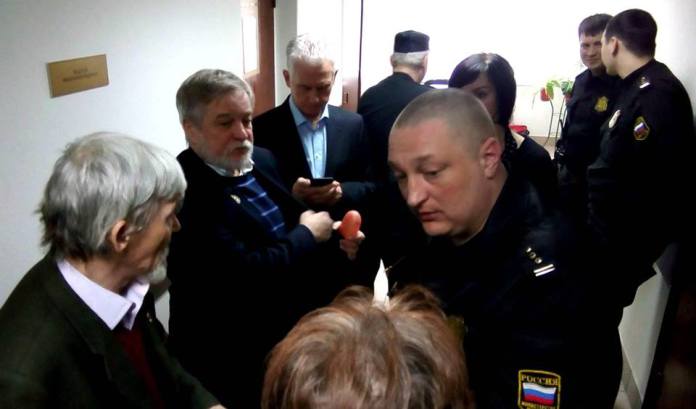

 Screenshot of Ruslan Kostylenkov’s alleged confession. Courtesy of
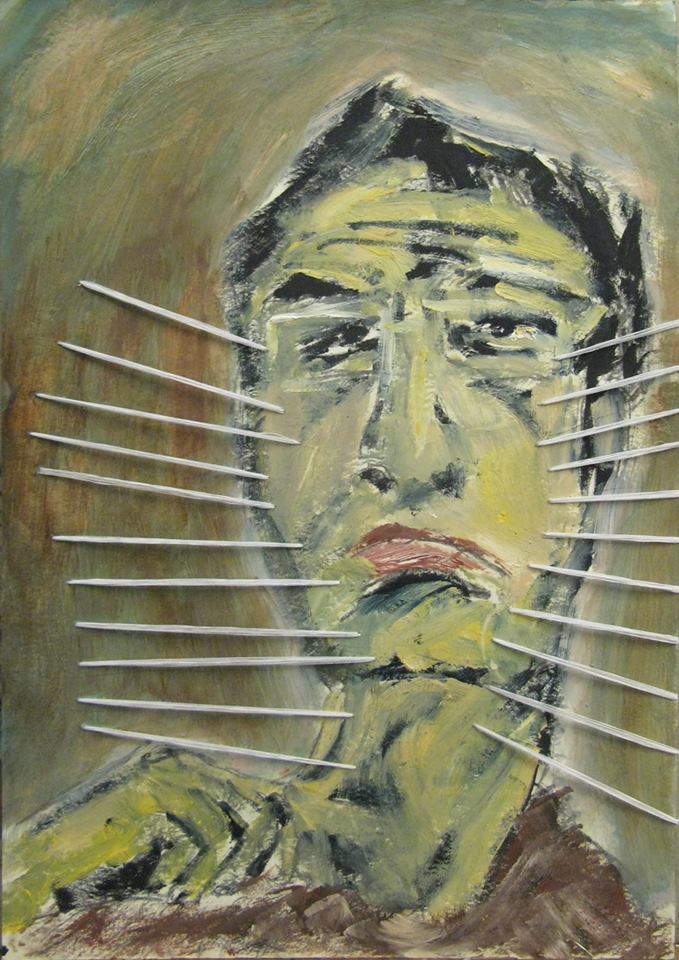 Yuri Leiderman, St. Sebastian (Stitched from Whole Cloth) [Св. Себастьян (шито белыми нитками)], 2018. Oil and thread on paper, 42 cm x 30 cm. Courtesy of the artist. All rights reserved
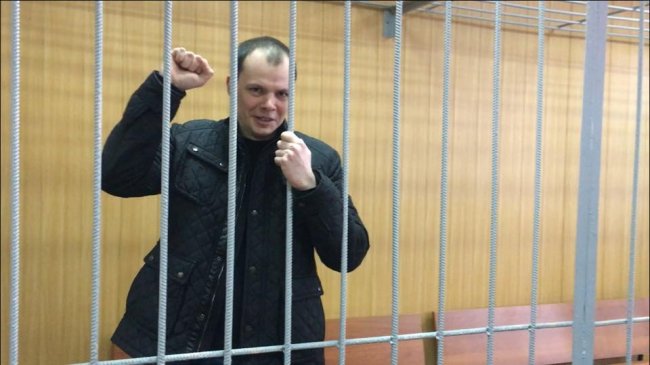 Dmitry Borisov. Photo by Irina Yatsenko. Courtesy of OVD Info
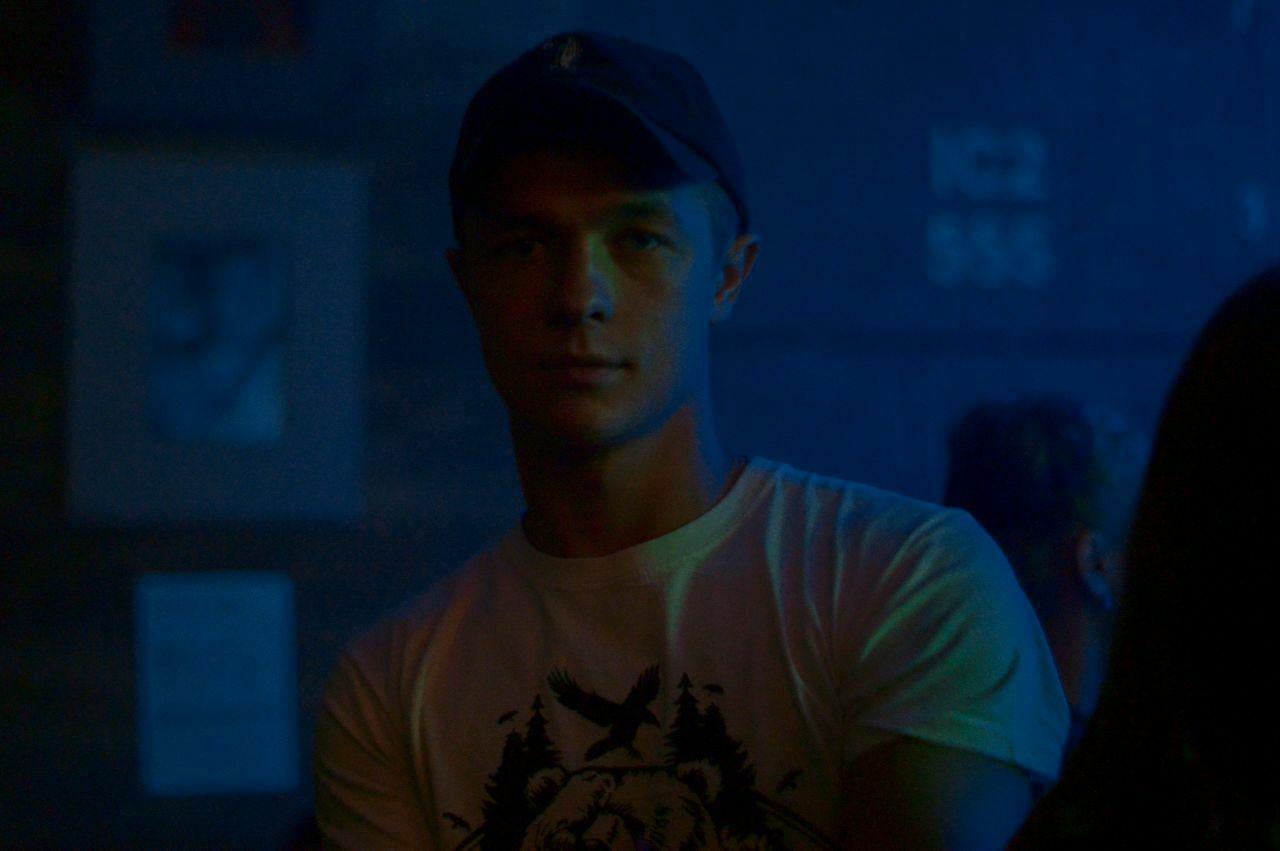 Ilya Shakursky. Photo from personal archive and courtesy of Mediazona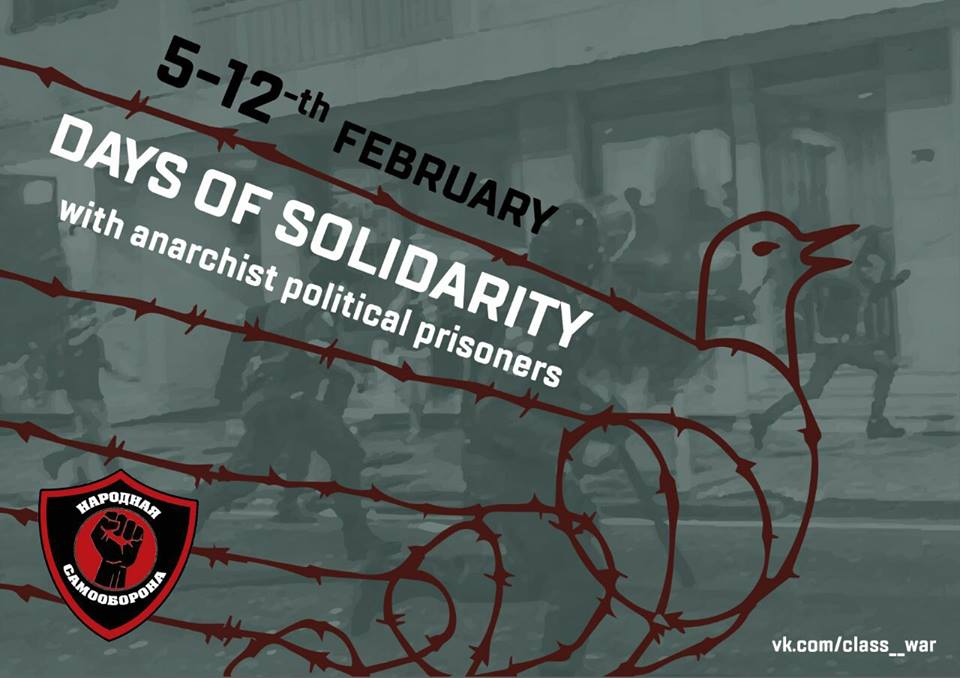
 The Russian Federal Security Service or FSB enjoys breaking doors down in its pursuit of fictitious “extremists” and “terrorists.” Photo courtesy of
  Viktor Filinkov. Photo courtesy of Filinkov’s wife and
 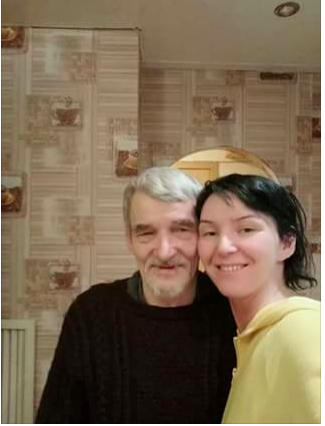 Yuri Dmitriev with his daughter Yekaterina Klodt. Courtesy of the