This Is What Antifascism Looks Like

Varya Mikhaylova
Facebook
May 11, 2018

We stood, too. Not because we believed it would change anything, but so nothing would change us.

The good news was that many passersby were aware of The Network Case, especially young people. Tons of schoolkids had their picture taken with me, promising to come out next time themselves. Amazing kids.

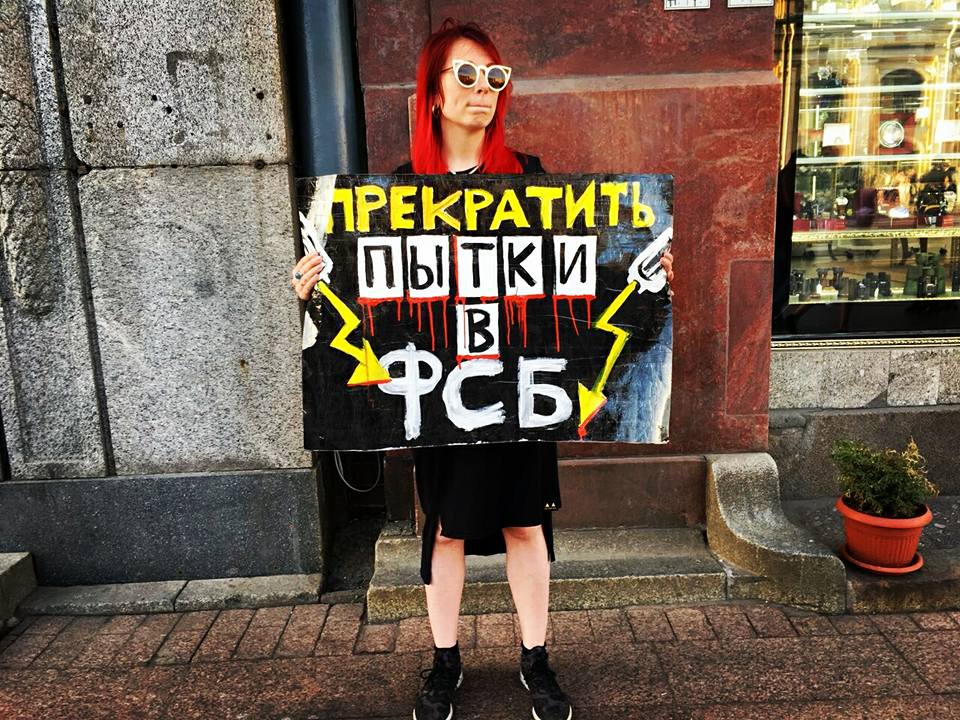
picket 1.jpg
“Stop torture at the FSB”

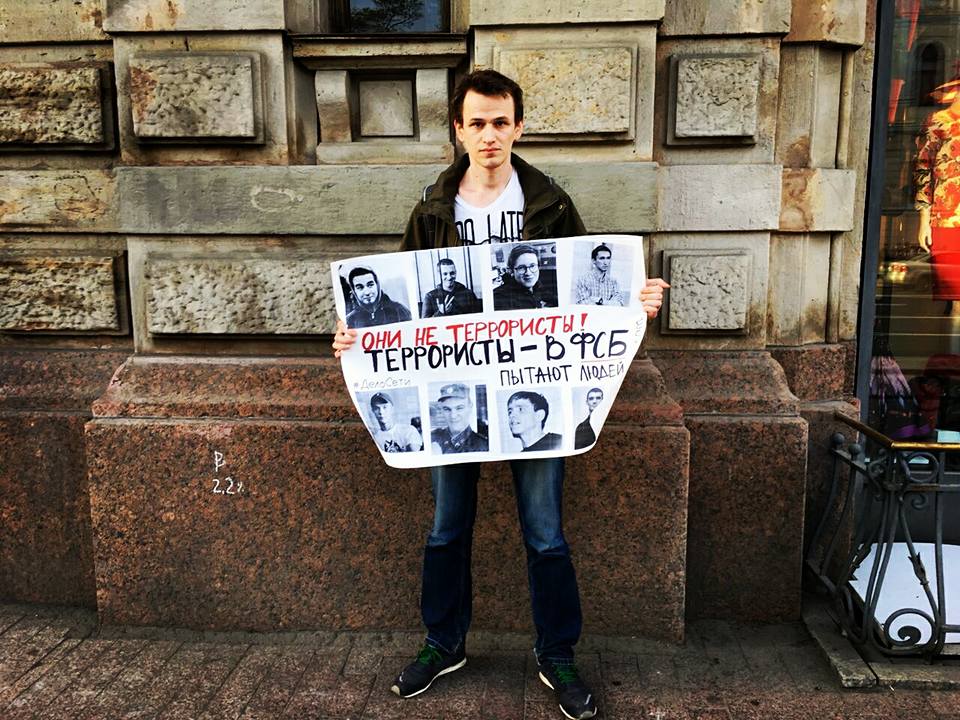
picket-2.jpg
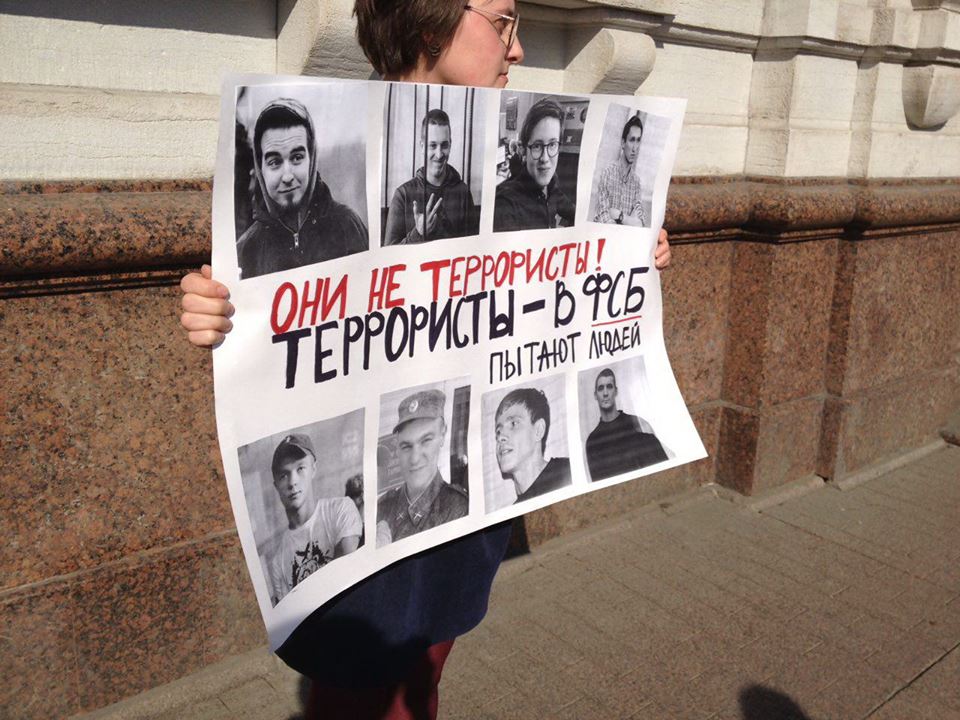
“They’re not terrorists. The terrorists are at the FSB, and they torture people.”

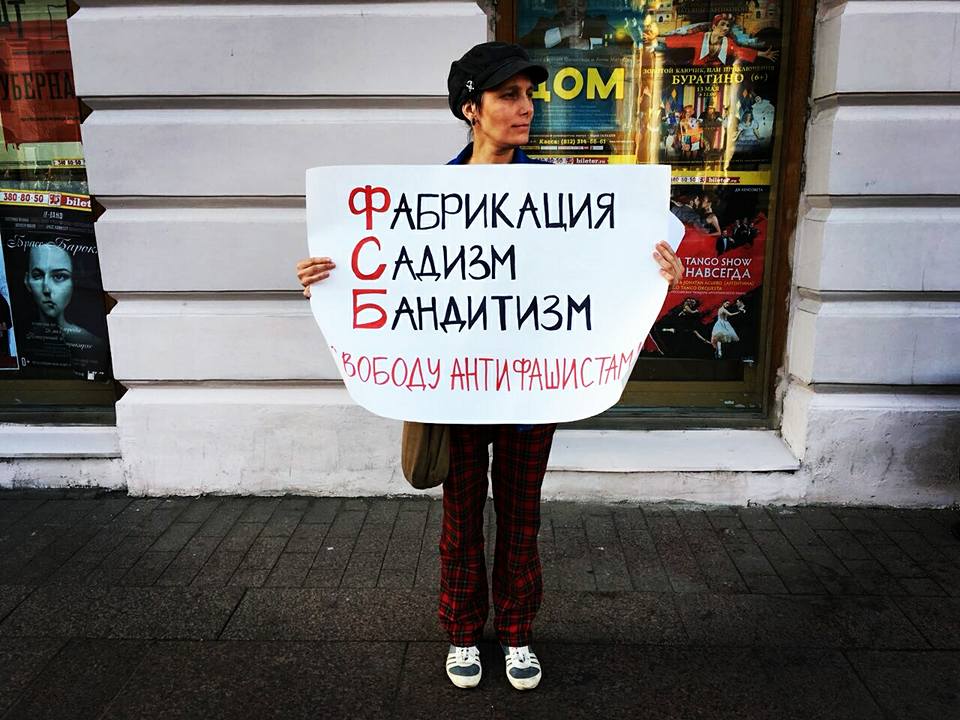
picket-3
“Frame-up, Sadism, Banditism (FSB). Free the antifascists!”

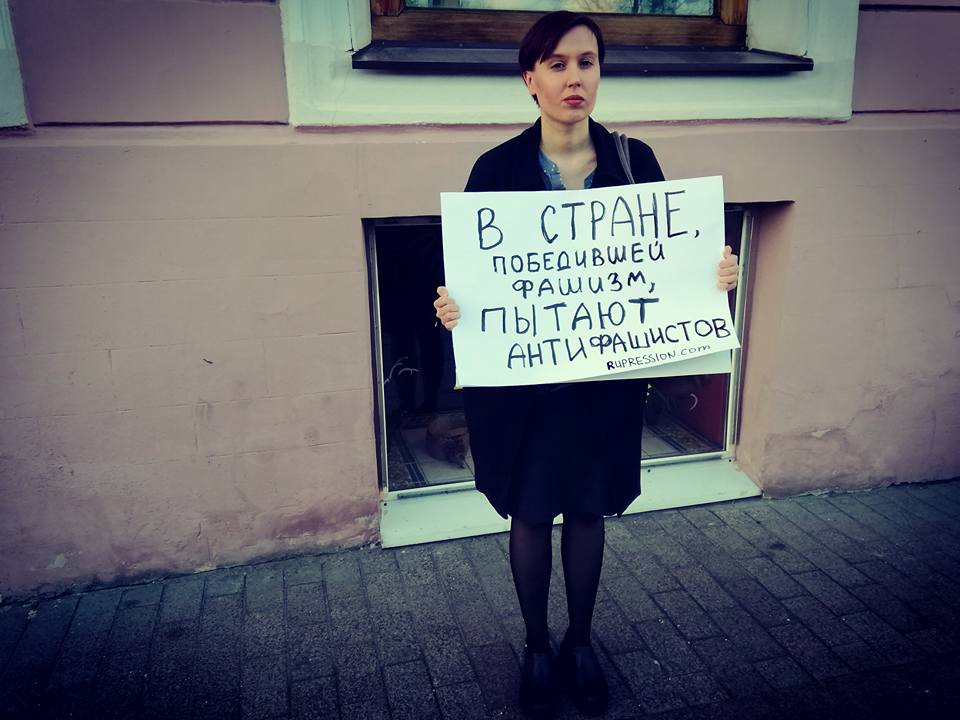
picket-4
“Antifascists are tortured in the country that defeated fascism. Rupression.com.”

picket-5
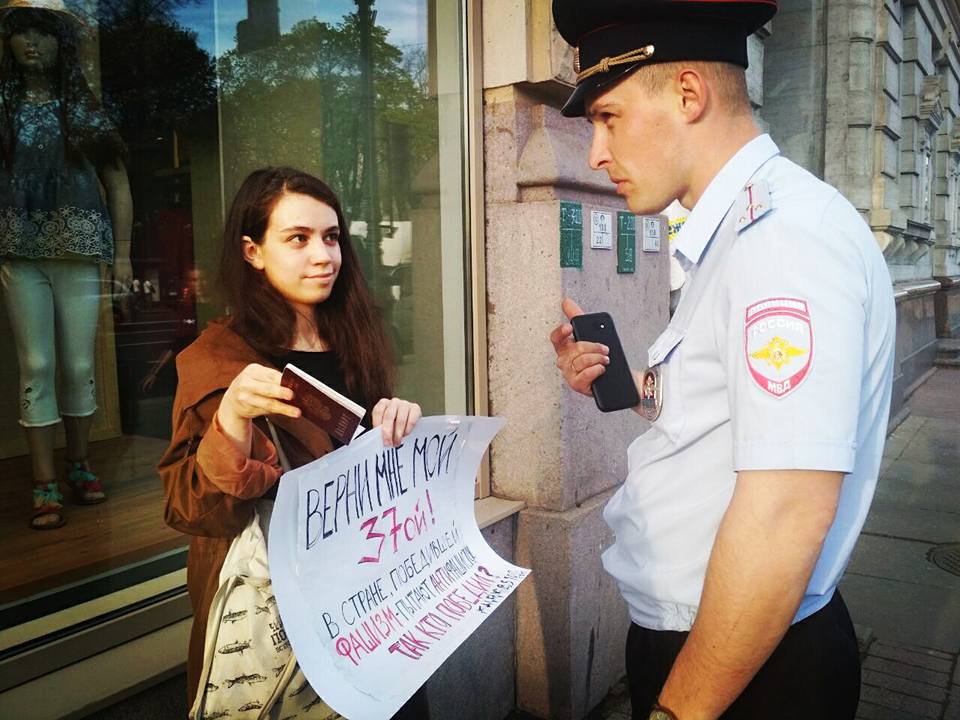
“Give me back my 1937. Antifascists are tortured in the country that defeated fascism. So who won? Rupression.com”

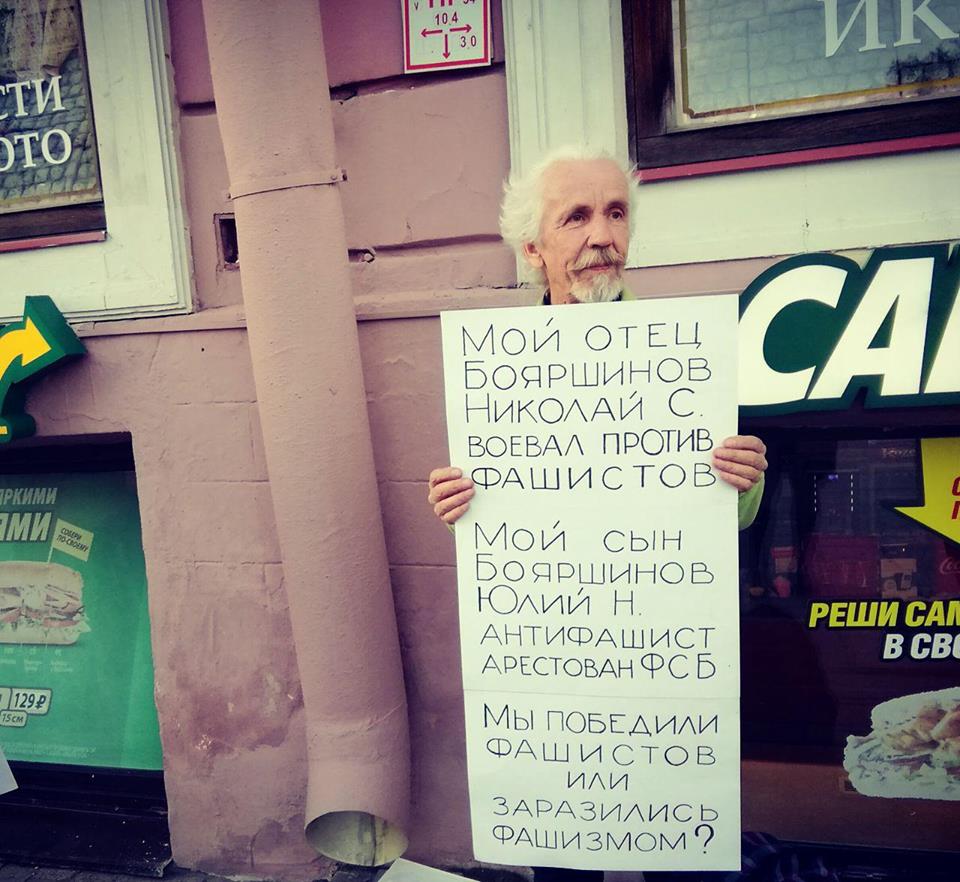
All photos by Jenya Kulakova

***************

Petersburg Anarchist Black Cross
Facebook
May 11, 2018

Nikolai Boyarshinov, father of Yuli Boyarshinov, a suspect in The Network Case, carried out a solo picket on Nevsky Prospect this evening. He held up a placard that read, “My father, Nikolai S. Boyarshinov, fought against the fascists. My son, Yuli N. Boyarshinov, an antifascist, has been arrested by the FSB. Did we defeat the fascists? Or have we been infected by fascism?”

picket 6

Nikolai Boyarshinov was joined by ten or so activists in a series of solo pickets. They also stood on Nevsky, holding up placards with slogans that read, “Antifascists are tortured in the country that defeated fascism,” “Stop torture at the FSB,” and “Free the antifascists.” They leafleted passersby. They also collected signatures on a group letter to the warden of Remand Prison No. 6 in Gorelovo, demanding Yuli Boyarshinov be housed in humane conditions.

The passersby included people who asked how to help, who thanked and shook the hands of the picketers, and who voiced their support to Nikolai Boyarshinov. There were also people who said it was not possible that antifascists were tortured in Russia, people who heatedly argued with the picketers.

Police offers warned the protesters a distance of fifty meters must be maintained between solo pickets. They checked the papers of the picketers. Standing next to Nikolai Boyarshinov, they waited an hour and a half for him to roll up his placard and leave Nevsky Prospect.

Thanks to everyone who came out today to voice their solidarity. Write letters to the arrested antifascists, support their parents, and strengthen the networks of solidarity.

Translated by the Russian Reader

***************

What you can do to support the Penza and Petersburg antifascists and anarchists tortured and imprisoned by the FSB

  • Donate money to the Anarchist Black Cross via PayPal (abc-msk@riseup.net) and make sure to specify that your donation is earmarked for “Rupression.”
  • Spread the word about The Network Case aka the Penza-Petersburg “Terrorism Case.” You can find more information about the case and in=depth articles translated into English on this website (see below), rupression.com, and openDemocracyRussia.
  • Organize solidarity events where you live to raise money and drawn attention to the plight of the tortured Penza and Petersburg antifascists. Go to the website It’s Going Down to find downloadable, printable posters and flyers. You can also read more about the case there.
  • If you have the time and means to design, produce, and sell solidarity merch, please write to rupression@protonmail.com.
  • Write letters and postcards to the prisoners. Letters and postcards must be written in Russian or translated into Russian. You will find the addresses of the prisoners here.
  • Design a solidarity postcard that can be printed out and used by others to send messages of support to the prisoners. Send your ideas to rupression@protonmail.com.
  • Write letters of support to the prisoners’ loved ones via rupression@protonmail.com.
  • Translate the articles and information at rupression.com and this website into languages other than Russian and English, and publish your translations on social media and your own websites and blogs.
  • If you know someone famous, ask them to record a solidarity video, write an op-ed piece for a mainstream newspaper or write letters to the prisoners.
  • If you know someone who is a print, internet, TV or radio journalist, encourage them to write an article or broadcast a report about the case. Write to rupression@protonmail.com or the email listed on this website, and we will be happy to arrange interviews and provide additional information. It is extremely important this case break into the mainstream media both in Russia and abroad. Despite their apparent brashness, the FSB and their ilk do not like publicity. The more publicity the case gets, the safer our comrades will be in remand prison from violence at the hands of prison stooges and more torture at the hands of the FSB, and the more likely the Russian authorities will be likely to drop the case altogether or release the defendants for time served if the case ever does go to trial. Why? Because the case is a complete frame-up, based on testimony obtained under torture. When the complaints filed by the accused reach the European Court of Human Rights in Strasbourg and are ultimately ajudicated, the Russian government will be forced to pay heavy fines for its cruel mockery of justice.

***************

If you have not been following the Penza-Petersburg “terrorism” case and other cases involving frame-ups, torture, and violent intimidation by the Russian Federal Security Service (FSB) and other parts of the Russian police state, read and repost the recent articles the Russian Reader has translated and published on these subjects.

May Day in Petersburg: “Your Torture Won’t Kill Our Ideas”

31715161_2002393253350140_6474713312398409728_n“Your torture won’t kill our ideas.” Anarchists and antifascists march down Nevsky Prospect in Petersburg on May Day 2018

St. Petersburg Anarchist Black Cross
Facebook
May 1, 2018

We, people who espouse anarchist and antifascist views, dedicated May Day this year to our comrades, arrested in The Network case, a frame-up by the Russian Federal Security Service (FSB). Despite the rain, we made common cause and march in the May Day demo. We carried placards inscribed with quotations from the diaries and testimony of the arrested men in which they talk of the torture to which FSB officers have subjected them.

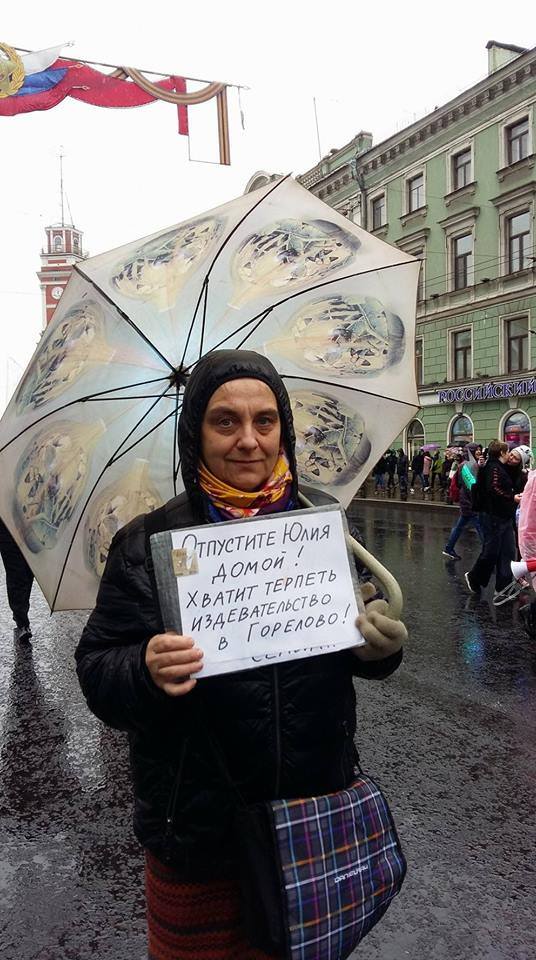
31688009_2002392766683522_1947585257179971584_n

“Send Yuli home! Stop the bullying in Gorelovo!” Yuli Boyarshinov’s mother at 2018 May Day demo in Petersburg.

It was the most important message to convey during this year’s May Day demo.

Six young men were detained in Penza in autumn 2017. FSB officers had planted weapons and explosives in the cars and homes of some of the men. Then FSB officers tortured the antifascists in the local remand prison. They attached electrodes to various parts of their bodies and sent electrical currents surging through them. They hung them upside down and brutally assaulted them. During the torture sessions, the secret services tried to force the activists to memorize the testimony they wanted the men to give to investigators, a story about how they had established a nonexistent “terrorist community” of which they were, allegedly, members.

In late January 2019, two more antifascists were detained in Petersburg. They were also beaten, tasered, and forced to incriminate themselves.

In April 2018, a third young man in Petersburg was charged with involvement in the same fictitious “terrorist community.”

31682379_2002392876683511_519457091652419584_n“Viktor Filinkov, programmer.” || “I screamed, ‘Tell me what to say. I’ll say anything!'” Anarchist and antifascists at 2018 May Day demo in Petersburg

Establishing the truth is the essential goal and only value of law enforcement and the institutions of state power that enforce the law. The language of violence is not the language of truth. Confessions and testimony obtained under torture cannot constitute the truth. They are knowingly false. The worldview offered to us by the investigators in the case of the Penza and Petersburg antifascists is completely unconvincing.

Fascists fight for the past. Antifascists fight for the future.

Free Dmitry Pchelintsev, Ilya Shakursky, Armen Sagynbayev, Vasily Kuksov, Andrei Chernov, Viktor Filinkov, Yuli Boyarshinov, and Igor Shishkin!

The Party of the Dead, LEFT FEM, and the Column of Free Trade Unions also voiced their solidarity with the imprisoned antifascists during the 2018 May Day march in Petersburg.

Translated by the Russian Reader. If you have not been following the Penza-Petersburg “terrorism” case and other cases involving frame-ups, torture, and violent intimidation by the Russian Federal Security Service (FSB) and other branches of the Russian police state, please read and repost the recent articles I have published on these subjects.

Welcome to St. Petersburg!

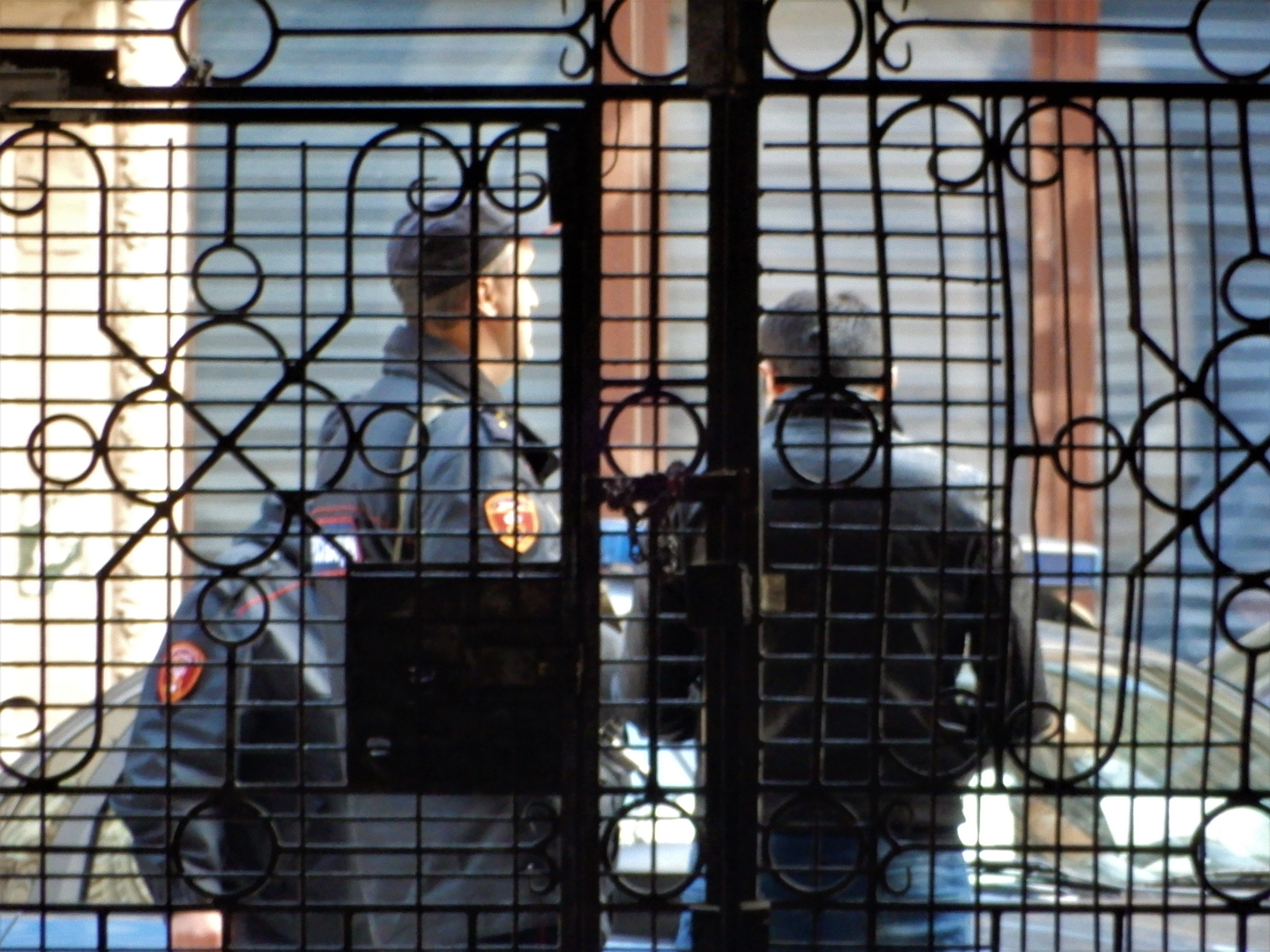
DSCN5677Two Russian National Guardsmen shake down a non-Russian and his friend (off camera) in the run-up to this summer’s FIFA World Cup. Photo by the Russian Reader

I remember when the G8 summit was held in Petersburg in July 2006. I will leave aside the counter-summit (aka the Russian Social Forum), held in then-already-doomed Kirov Stadium, that is, in a part of the city so far off the beaten path you had to want to be there very badly to get there, and the excellent job the Russian security services did making sure that social and political activists from other parts of the world’s largest country could not make it to Petersburg, much less to the forum.

I bring the summit up only because, the social forum aside, the city was pullulating with so many cops, riot cops (OMON), and Interior Ministry troops it was impossible not to notice them and realize how absurd and wasteful the security overkill was, especially since the summit per se was held in the newly refurbished Constantine Palace in the southern Petersburg suburb of Strelna, a site at least fifteen kilometers away from the central city and most of its inhabitants, and thus easily secured by a few hundred guards, policemen, and special forces troops.

Back in those halcyon days, I had a job that kept me moving round the city from morning to night, and so I would happen upon clusters of utterly idle cops, riot cops, and special forces troop in the oddest places on a regular basis while the summit was on. I remember how I once walked into an otherwise obscure, out-of-the-way courtyard late in the evening and found it chockablock with Russia police officers of some sort, possibly imported for the occasion from the other side of the country. They seemed almost ashamed to be hiding in that courtyard, protecting nobody at all from utterly nonexistent threats, and chainsmoking to kill the time.

Our beleaguered city’s next opportunity to shine in the international limelight will be during the 2018 FIFA World Cup, held in Petersburg and several other Russian cities from June 14 to July 15.

I was reminded by a tiny incident I witnessed earlier today of the Russian police state horrorshow literally everyone in the city with their heads screwed on straight expects during the month the World Cup is in town.

By the way, all locals with an ounce of sense in their brains are planning to be somewhere else, if only at their dachas in the countryside, during that month.

When I exited my building earlier today I immediately spotted two Russian National Guard officers hassling two young men of “non-Slavic appearance.” The officers were conducting their shakedown squarely in front of the gateway that accesses the yard of the building next to ours, the only courtyyard left on our street connecting it with the street running parallel to it.

Once upon a time not so long ago, central Petersburg was chockablock with interconnecting, walkthrough courtyards, and natives in the know could cover long distances in the inner city navigating this extensive network of courtyards without having to emerge onto the actual streets.

But when the new era of “capitalism” and “democracy” dawned, and Petersburgers privatized their flats and turned their courtyards into impromptu car parks, many of them gated, locked, and otherwise blocked off their courtyards, a move that in many cases was probably illegally, although no has ever gotten in trouble, so far as I know, for establishing their own little gated communities this way.

The guardsmen were reading the swarthy troublemakers the usual bored riot act about their having the wrong paperwork when I squeezed my way around them. One of them said they would have to take the swarthy men down to the precinct and write them up, which probably meant they would hold them there long enough to make their serious intentions plain before “fining” (bribing) them and letting them go.

The preparations for the 2018 World Cup have already been a debacle for Petersburg and many of the other host cities, as well as segments of the local populace that the authorities want to go away during the festivities, including university students, dogs and cats, antifascists tortured and framed as “terrorists,” and migrant workers.

I thus took the shakedown I witnessed as a sign of things to come: the full force of the utterly lawless, mendacious, and violent Russian law enforcement machine would be unleashed against migrant workers, people who look funny or out of place, and even completely ordinary, unprepossessing local residents while the World Cup was underway.

So, my message to you out there in the wide world is take a thought for us back here in the Motherland and keep your TV turned off during the World Cup. The “beautiful game” need not be played and enjoyed at such a high human cost to the World Cup’s Russian host cities, but since ultraviolence and the gleeful trampling of human rights are the only ways the current Russian regime knows how to handle mega events like the World Cup and the Winter Olympics, not to mention the country’s day-to-day governance, show a minimum of solidarity with us here in the line of fire and don’t watch any of the matches on TV. It won’t cost you a thing, but the world’s TV executives and advertisers will notice.

I won’t even bother appealing to the jetsetters who are planning to travel to Russia for the World Cup. You are beyond the pale in any case, since you choose to live your lives in such a thoughtless, wreckless way. My only hope for you is that, at some point during your expensive, wasteful trip, Russia’s real reality will burst through the carefully packaged and securitized experience the Russian authorities have planned for you, and you realize you paid Satan a lot of money to watch a few bloody football matches in person. // TRR

Bourgeois Baby Madness Brings Russia to Brink of Ruin

image001

Sure, babies are cute, but when they are born in Russia they have every chance of growing up to be “terrorists” and “extremists.” At least, that is how they are regarded by the Kremlin and its fascist guard dogs at the Russian Federal Security Service (FSB). Photo courtesy of New Kids Center

It’s amusing (actually, it’s disgusting) how much the former Soviet socialist republic known as the Russian Federation has been overtaken by bourgeois baby madness, while at the very same time conditions for raising children in a decent, safe place have been deteriorating by the minute in Russia.

Why would anyone in their right mind want to have a kid in a country where the country’s top law enforcement agency, the Federal Security Service (FSB) reserves the right to destroy a young person’s life because its officers are stupid thugs incapable of distinguishing actual terrorists from gifted young chemists?

This brings me to another, related point that has bothered me for a long time.

Former FSB officer Alexander Litvinenko, who was executed by Russian dictator Vladimir Putin in the most excruciating way possible for his alleged “treason,” is invariably referred to as a “spy” by the remarkably gullible Anglophone press. But Litvinenko was never a spy. He was an FSB officer whose bailiwick was combating organized crime. When he realized, in the late 1990s, that his own law enforcement agency had become as criminal and corrupt as the gangsters it was supposedly combating, he first tried to bring it to the Russian public’s attention.

Do you remember the heavily covered press conference where he spoke about these problems (including the fact he had been ordered to assassinate Boris Berezovsky), his face masked by a balaclava, along with several of his FSB colleagues?

When Litvinenko realized, however, that nothing would come of his campaign, and his life was in danger, he defected to Great Britain.

God knows that Mr. Litvinenko was probably a naïve man albeit a brave and honest one. I wish the same could be said of most of his fellow countrymen, who are crazy about babies but won’t rub two fingers together to make their country a place where young people are regarded as anything other than potential “terrorists” and “extremists.”

You don’t believe me? Then read this little horrorshow for good measure. // TRR

“Hug Your Son and We’ll Open Fire”

“Hug Your Son and We’ll Open Fire”
Sergei Yeremeyev
Zaks.Ru
April 19, 2018

Petersburg’s Krasnoye Selo District Court has extended the arrest of Yuli Boyarshinov, a 26-year-old industrial climber charged with involvement in The Network, an alleged “terrorist community.” The accused’s parents, who took the stand as witnesses during the court hearing, were grilled about their son’s vices, job, and hobbies. After listening to their account of a loving son whose health has suffered while he had been imprisoned in Remand Prison No. 6 in Gorelovo, the court remanded Boyarshinov in custody for another two months, until June 22.

Open and Closed
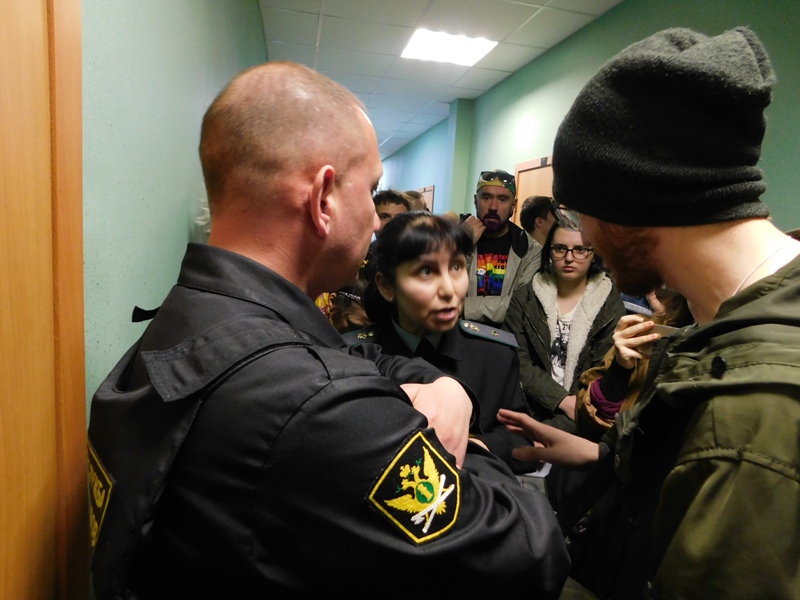
Boyarshinov’s custody hearing was held in open chambers for ten minutes or so, before the court granted the police investigator’s motion to hear the case in closed chambers. Two reporters and a member of the Human Rights Council, who had been admitted into the courtroom, had to go back out into the corridor, where the other thirty people who had attempted to attend the hearing and had not been admitted to the courtroom were writing complaints about their not having been admitted.

DSCN0951.JPG (171 KB)Mediazona journalist David Frenkel argues with court bailiffs.

Court bailiffs stood in front of the closed courtroom door, apparently defending it from attack by the indignant crowd. When asked by reporters why they were not being allowed in the courtroom, their only replies were “No comment” and “Don’t provoke us.”

However, even the reporters admitted into the courtroom found it hard to sit down. For the latest hearing in the high-profile “case of the antifascists” the authorities chose a tiny room with a single bench for the public that, in fact, could accommodate no more than three people.

Soon after the hearing was closed to the public and reporters, the accused man’s father and mother, Nikolai Boyarshinov and Tatyana Kopylova, were summoned one after the other into the courtroom to give testimony.

When he exited the courtroom, Boyarshinov’s father, barely holding back his tears, talked to reporters.

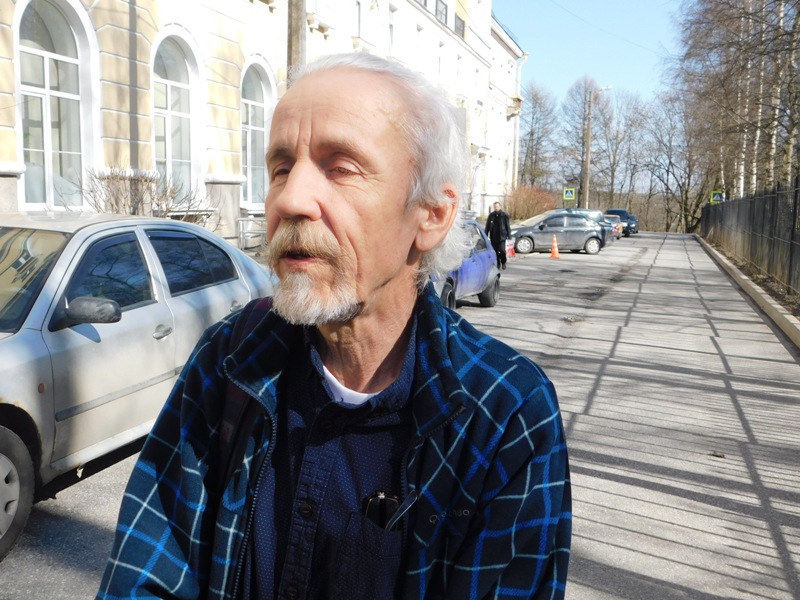
“I told the court I knew my son well and was certain not only he had not done anything bad but also had not planned to do anything bad. There were questions about his vices. I said he had never drunk or smoked. There were questions about his job. I said Yuli had a steady job, and thanks to it we made ends meet. My wife and I are artists, and lately we have had hardly any commissions. He took care of us,” said Nikolai Boyashinov.

DSCN0959.JPG (184 KB)Nikolai Boyarshinov

After reporters finished talking with him, two friends of his son approached Nikolai Boyarshinov.

“We are really glad to meet you. Hang in there. Everything will be fine,” they told Boyarshinov’s father.

“You know, I’m now often asked about Yuli’s friends, but I’m sure he wouldn’t bother handing out with bad people. If he is friends with people, they’re good people,” Nikolai Boyarshinov said to them.

When she exited the courtroom, Tatyana Kopylova reported that she had been asked similar questions.

“I was asked about his hobbies. I said he enjoyed traveling and reading. I was asked about his job. I said he was an industrial climber and he had been helping us out a lot. I also said my mother’s heart could not stand this worry. The press has informed me that some guys named Kostik, Dima, and Gennady Belyayev had been visiting him and threatening him. [Ms. Kopylova means an article in Novaya Gazeta in which it had been reported Boyarshinov had been visited by FSB officers who threatened him—Editor.] When I go to sleep I think about how Yuli’s night will pass. Why have these people been intimidating Yuli? As it is, the remand prison in Gorelovo is a torture chamber and a cesspool, where all the regulations are violated,” said Tatyana Kopylova.

According to her, Boyarshinov was being deliberately held in poor conditions to extort him into testifying. She also added the cells in Remand Prison No. 6 were so overcrowded her son had had to sleep on the floor, and when he had caught cold he did not receive proper medical treatment.

New Charges
Yuli Boyarshinov was apprehended on January 21, 2018, several days earlier than the other two Petersburgers accused of involvement in The Network, Viktor Filinkov and Igor Shishkin. However, Boyarshinov was initially charged only with illegal possession of explosives (Article 222.1 Part 1 of the Russian Federal Criminal Code): police found 400 grams of smoke powder, ordinarily employed in the production of fireworks, in the young man’s backpack during a random ID check. He was charged with involvement in a terrorist community (Article 205.4 Part 2 of the Russian Federal Criminal Code) only on April 11, 2018.

The particulars of the new charge are unknown: Boyarshinov’s defense attorney, Olga Krivonos, has signed a nondisclosure agreement regarding the preliminary investigation. The other young men caught up in the case, including Filinkov and witness Ilya Kapustin, have alleged they were tortured into testifying. Members of the Public Monitoring Commission also reported bruises, a fracture, and burns on Igor Shishkin’s body.

Shoot to Kill
After the court issued its ruling, Boyarshinov was escorted into the corridor, where Ms. Kopylova turned to the court bailiff maintaining order there.

“I haven’t seen my son or heard his voice for three months. Could I go up to him and give him a quick hug?” she asked.

The bailiff did not bother with procedural subtleties.

“We’ll open fire and shoot to kill,” he replied.

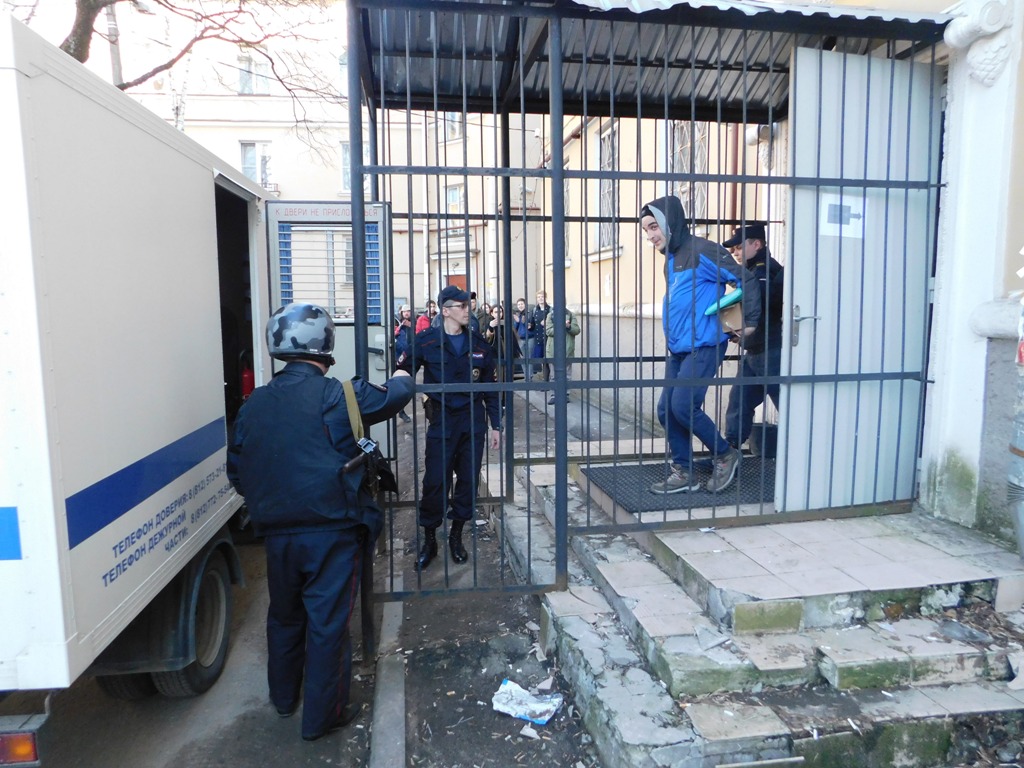
Twenty minutes later, the prisoner escort guards made the exact same threats to the accused’s friends, who had gathered in the yard of the courthouse to see their comrade one more time. A police escort guard officer did not like the fact some of the young people had cameras. On several occasions he announced either that everyone was too close to the police truck or he could see the people who had gathered were hiding next to the courtroom’s porch. For these offenses, he claimed he was willing to resort to the harshest measures, but push did not come to shove.

His friends greeted Yuli Boyarshinov with a round of applause. He was able to flash them a smile before he was put into the paddy wagon for the trip back to the remand prison.

DSCN0971.JPG (246 KB)Yuli Boyarshinov exits Krasnoye Selo District Court in Petersburg.

P.S. As Boyarshinov’s custody extension hearing was underway in Krasnoye Selo, police were searching the flat once occupied by Ilya Kapustin in the city’s Central District. Interrogated as a witness in The Network case, Kapustin alleged he had been tortured and applied for political asylum in Finland

All photos by Sergei Yeremeyev. Thanks to Nastia Nek for the heads-up. Translated by the Russian Reader

“Are You a Bitch Yet?” FSB Makes New Threats to Framed and Tortured Antifascist Viktor Filinkov

“Are You a Bitch Yet?”: Man Accused in The Network Case Talks about Mores of FSB Officers
OVD Info
April 24, 2018

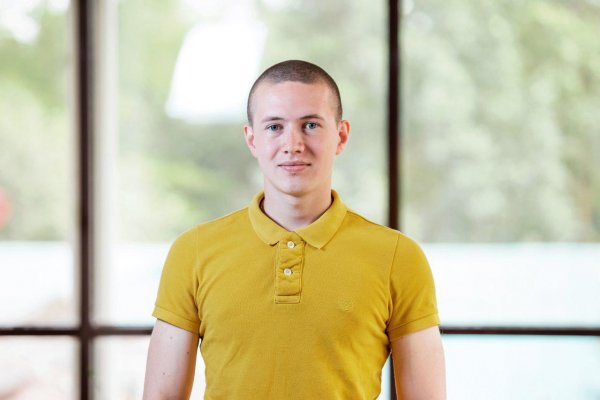
Viktor Filinkov. Photo courtesy of his wife, Alexandra, and OVD Info

On April 20, 2018, the Russian Investigative Committee officially declined to open a criminal case on the basis of a complaint filed by Viktor Filinkov, one of the young men accused in The Network case, who alleged he had been tortured by FSB officers. Moreover, these very same FSB officers are permitted to visit him in remand prison. OVD Info has published, below, the account Filinkov gave to his lawyer of how the secret service officers who tortured him now talk to him.

At around eleven o’clock on April 19, 2018, I was escorted from my cell in the supermax wing of Gorelovo Remand Prison and taken to a holding area before being led out of the prison, where I was handed over to two men, one of whom I recognized as Konstantin Bondarev, a special agent in the St. Petersburg and Leningrad Region Office of the Russian Federal Security Service (FSB). I have known Special Agent Bondarev since January 23, 2018, when he supervised my apprehension at Pulkovo Airport and then, along with other local FSB officers, subjected me to physical and emotional violence for approximately thirty hours while also depriving me of rest, sleep, and food.

When I was escorted out of the holding area, one of the FSB officers meeting me ordered me to put my my hands behind my back, which he handcuffed extremely tightly. I was placed in a silver-colored Škoda. Before putting me in the car, Special Agent Bondarev asked me a question.

“Well, well, Filinkov. Are you a bitch yet?”

“What’s the point of your question?” I asked.

“You’re the point, fuckhead!” Special Agent Bondarev answered aggressively.

He then got behind the wheel of the car. I was put in the backseat. After a while, the car drove through the gates of Remand Prison No. 6. During the entire ride to St. Petersburg, the FSB officers said nothing to me, but I was genuinely afraid that, at any moment, they could drive me to a deserted place and subject me to violence.

We were on the road for about an hour. Finally, I was brought to the local FSB building and taken to the office of Investigator Klimov, where my defense attorney, Vitaly Cherkasov, was waiting for me.

Mr. Cherkasov and I had a one-on-one private conversation during which I informed him I was in a depressed state, since I had been forced to travel for a long time in the same car as Special Agent Bondarev, who had been negative and aggressive towards me, using criminal slang to threaten me with possible rape in Remand Prison No. 6.

In addition, I explained I had recognized Investigator Klimov as one of the officers who on January 24, 2018, after I was brought to the FSB building, had taken part in a prolonged attempt to coerce me mentally into signing a confession. I assume Investigator Klimov could see I had been beaten, and I also needed rest, sleep, water, and food.

It was on this basis that, when Investigator Klimov asked me whether I was willing to testify, I said I would not refuse to testify, but I was currently in a stressful state of mind due to my encounters with Special Agent Bondarev and Investigator Klimov, whom I did not trust, either. Moreover, I had been brought to the FSB building, which is linked in my mind with the torture and bullying I endured there on January 24 and January 25, 2018. For this reason, I told the investigator I could give detailed and thoughtful testimony only in Remand Prison No. 6, where I felt calmer and more secure. I put this explanation in writing in the comments section of the interrogation report.

The investigative procedure was thus completed. Investigator Klimov summoned guards, and two men in plain clothes wearing balaclavas over their heads entered his office. They handcuffed my hands behind my back. They led me out of the room and took me outside, where I was placed in the backseat of the silver-colored Škoda. Special Agent Bondarev was at the wheel.

On the way back to Gorelovo, the officers continued to pepper me with questions.

“Well, bitch, is your asshole raw yet?” Bondarev asked.

Then he said the following.

“Now I’m going to methodically drag you through the mud. Cherkasov is trying to make a name for himself, but you and Agora are all going to rot in prison, and you are to going to do your time in the Arctic Circle, in Murmansk or Karelia. Life taught you a lesson, and it gave you a chance. Do the guys in Remand Prison No. 6 know your lawyer defends LGBT?”

One of the special agents in the car responded, “He didn’t learn his lesson, apparently.”

“It didn’t get through his head, but it will get through his legs,” Bondarev replied.

“It will get through his asshole!” the other special agent added.

They laughed merrily after this remark.

I also remember that one of the special agents said, “You can find a good husband in Gorelovo.”

Bondarev and his colleagues insulted my human dignity, emotionally injured me in a profound way, and put me in a stressful state by saying these and other things. In addition to being humiliated, I finally realized that in the ranks of the local FSB off there are unworthy officers who employ prison notions for their own purposes in their attempts to pressure inmates.

Chatting with me in this vein, the FSB officers took around two hours to drive me back to the remand prison. We got in the car outside the local FSB building around 1:30 p.m. and arrived at Remand Prison No. 6 at 4:00 p.m. I kept track of the time on the clock in the car.*

After talking with the FSB special agents, I returned to my cell in a depressed state, and I was completely sweaty from the nervous atmosphere and heat in the car. My heart ached, I lost my appetite, I refused supper, and my psoriasis acted up due to the stress. When I combed my hair I felt psoriatic plaques on my head.

I take the threats made to me by Bondarev and his colleagues completely seriously. I am afraid for my safety, health, and life itself.

My verbal statement has been recorded faithfully, and I have read it over. I give my permission to publish it in the media.

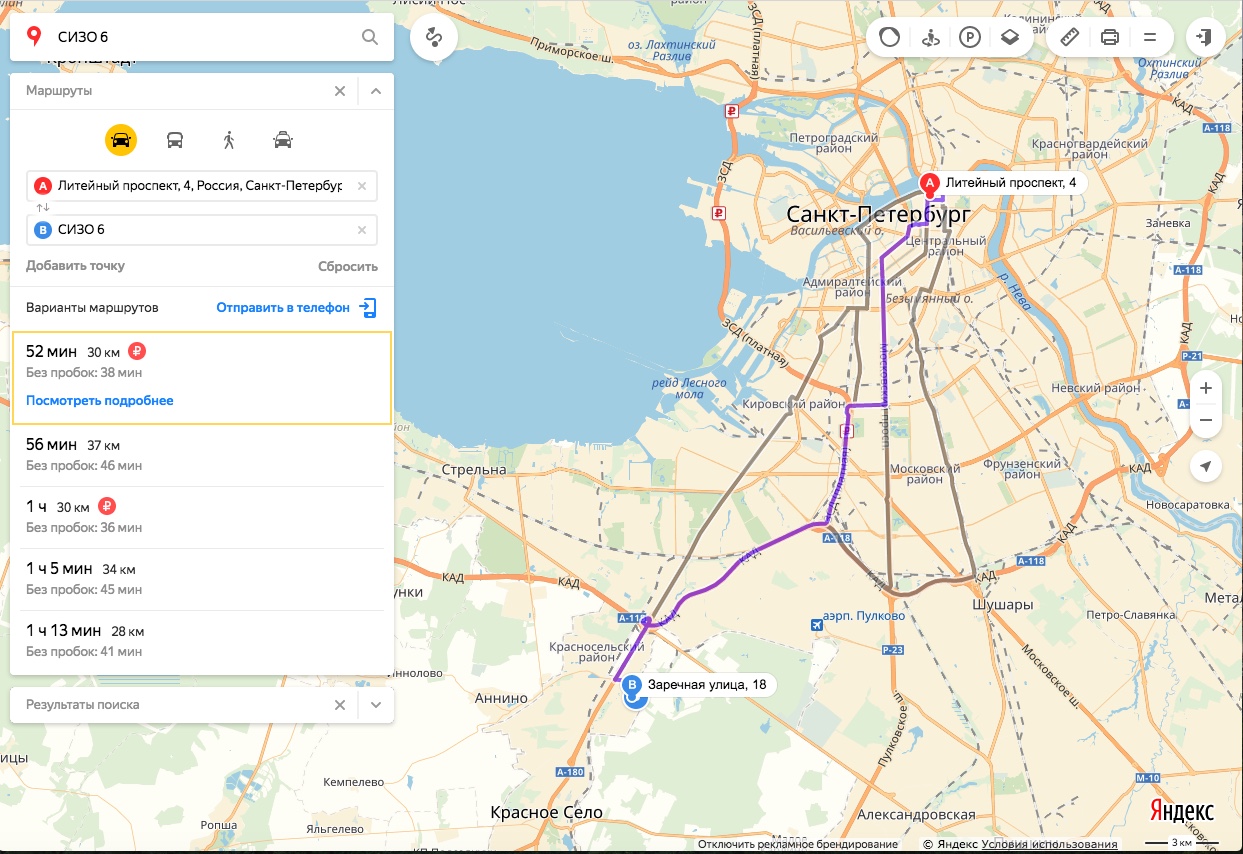
* A directions search on Yandex Maps reveals that the drive from the local FSB building (4 Liteiny Prospect, Petersburg) to Remand Prison No. 6 in Gorelovo should take one hour and thirteen minutes, at most, if there are no traffic jams, and thirty-six minutes, at least, if the traffic is good and the driver takes the optimal route. This would suggest that Special Agent Konstantin Bondarev deliberately drove in circles for a long time in order to bully and threaten Mr. Filinkov. TRR

road to gorelovo

Thanks to George Losev for the heads-up. Translated by the Russian Reader

If you have not been following the Penza-Petersburg “terrorism” case and related cases involving frame-ups, torture, and violent intimidation by the Russian police and secret services, please have a look at some of the recent articles I have published on these subjects.

Zoya Svetova: Interview with Petersburg Public Monitoring Commission Members Yana Teplitskaya and Yekaterina Kosarevskaya

The Network Case: “He Was Tortured in the Woods for Six Hours to Force Him to Testify, and Then Some More So He Would Memorize the Right Wording”
Zoya Svetova
MBKh Media
April 20, 2018
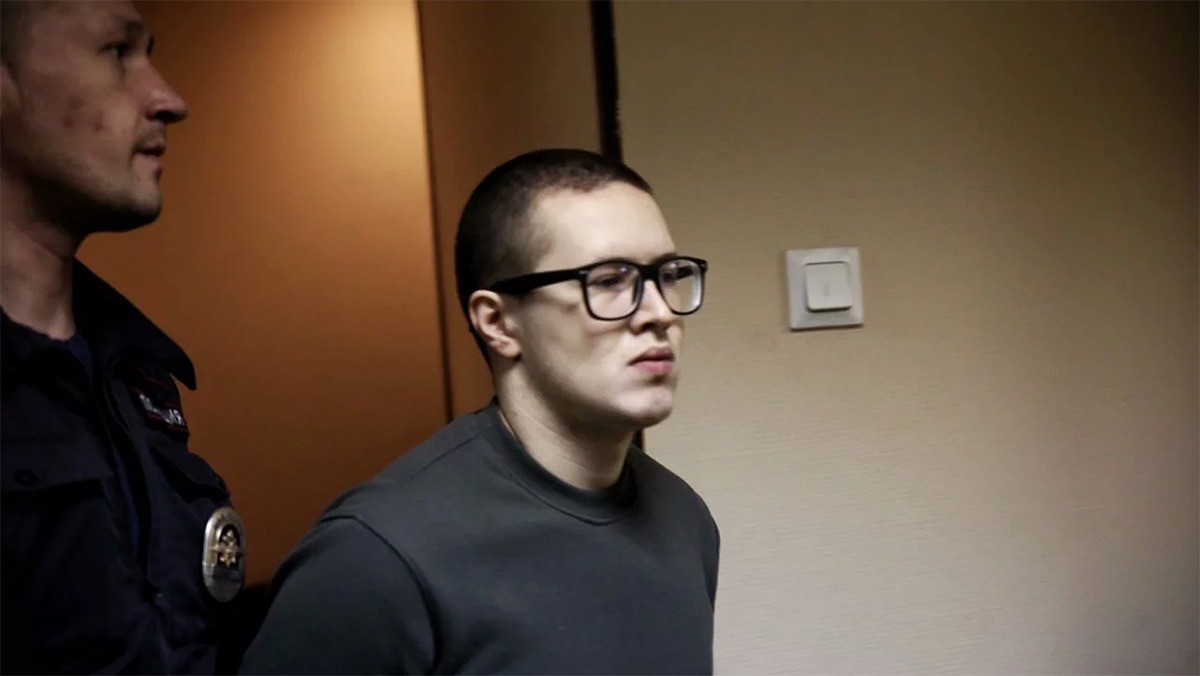
Снимок-экрана-2018-04-20-в-11.19.46Viktor Filinkov. Photo by David Frenkel. Courtesy of Mediazona

The Russian Federal Investigative Committee has refused to open a criminal case in connection with a complaint filed by Viktor Filinkov, one of the young antifascists accused in The Network case [aka the Penza-Petersburg “terrorism” case—TRR], who claims that Russian Federal Security Service officers tortured him. Yana Teplitskaya and Yekaterina (“Katya”) Kosarevyskaya, members of the Petersburg Public Monitoring Commission, were the first people Filinkov told he had been tortured. Now they are under police surveillance themselves.

The human rights activists talked to Zoya Svetova about why they decided to join the Petersburg Public Monitoring Commission, what goes on in Petersburg’s remand prisons and penal colonies, and how they have been harassed by reporters from Russian TV channel NTV.

____________________

Yana, Katya, and I talk in a cafe. They have come to Moscow for a day. They have many meetings scheduled, and the young women interrupt each while discussing what they have seen in remand prisons, but mostly they discuss the young men accused in The Network case, which has shaken them. It is not every day people tell you they have been brutally tortured and you see burns on their bodies left by tasers. As for me, this is my first meeting with these young and incredibly mature human rights defenders, who are only twenty-six years old.

Why did you decide to visit prisons and police precincts?

Yana: I wanted to join the Public Monitoring Commission (PMC) as soon was it was established, but you have to be at least twenty-five years old to join, so we didn’t end up on the previous commission. But we helped train other candidates and assisted them in their work. As soon as we turned twenty-five, we submitted our applications.

What do you do for a living?

Yana: I’m a mathematician.

Are you a schoolteacher?

No, I don’t teach. I do research.

Katya: I’m also a mathematician. I work at a school, but I also do research and teach math at a university, probability theory. We met before we studied at university, and then we went to university together. And we both decided to join the PMC.

How did you find out about the PMCs and public oversight?

Katya: I read Anna Karetnikova’s LiveJournal blog, I think. (Anna Karetnikova was a member of the Moscow PMC from 2009 to 2016 — ZS.)

Yana: When we got on the PMC, we already knew what it was, because we had been involved in shaping the PMC’s previous roster. We talked about the PMC to various people and organizations, and got them together.

Katya: And we worked with them when there were large-scale detentions at protest rallies. We found out who could visit detainees in police stations.

Who nominated you to the PMC?

Yana: We lucked out. We were nominated by Azaria, an organization of mothers against narcotics. Azaria is not on the list of “foreign agents” and looks completely innocent. In reality, it is a really cool organization. They are not afraid of anyone, and they really support and help us.

Yana Teplitskaya and Yekaterina Kosarevskaya outside Penal Colony No. 5

Until you found yourselves in the middle of the scandal surrounding The Network case defendants, was your work with the PMC completely routine?

Yana: We were not admitted to police stations seven times in a row, meaning that at some point the police just stopped letting us in to do inspections. The first time they didn’t let us in, they had detained young people coming home from a concert. Policemen stopped them and asked to see their papers. They refused to do that until the police had identified themselves by name and explained why they needed to see their papers. The policemen responded by pepper-spraying and detaining them. We were not let into the police precinct to see them. Subsequently, we were not let into police stations under different pretexts. Ultimately, we were able to overcome the problem. Fifteen Interior Ministry employees were brought to justice for not letting PMC members into police stations. We were not the only ones to file complaints. We posted our reports on the incidents, and our readers filed complains on the basis on this information.

Apparently, one of our readers on the social networks played a role. He filed complaints anywhere he could, and the authorities responded to his complaints, referring to him as “the PMC’s community volunteer.” The police officers who did the audit later told us that he had worn them down and asked us to tell him they would fix everything as long as he stopped complaining. Many other people helped out as well, including Human Rights Council member Andrei Babushkin. We also filed lots of detailed complaints ourselves. We managed to navigate around the problem, and this was a victory, of course, in whose wake our visits to police stations suddenly improved dramatically. The police were now afraid of us. Initially, we had good relations with the Federal Penitentiary Service (FSIN). The FSIN was inclined to cooperate, while the Interior Ministry [i.e., the police] was not. At our very first meeting with them, they told us we had to send notifications when we were planning to visit police stations only by fax, but we were not cool with that, of course. We ourselves had written the rules for how the PMC functioned. Our rules state that our rights as PMC members cannot be infringed. There is nothing in the rules about notifying a police station or remand prison by fax, as had been the case in the first two sittings of the PMC. Back then, only the PMC’s chair could notify penitentiary facilities about commission visits. He could do this only during business hours, because the fax was in his office.

How do you now notify the authorities you are coming to visit their facilities?

Yana: We give them five minutes’ warning. There is no need to notifiy the police ahead of time, whereas the FSIN does need to transfer staff to escort the PMC members around its prisons. We rarely need to catch the FSIN unawares with our visits, while the police often hide detainees from us, and try and take them out of precinct houses via emergency exits. Our latest conflict with them has to do with the fact that they must provide us with records of the people they detain and bring to their stations. They are convinced they do not need to show us these records.

How many people on the Petersburg PMC are on your side?

Katya: Four of the PMC’s twenty-five members.

Yana: It is not that they are all evil monsters. I think we have a fairly good working atmosphere in the commission. For example, there is one lovely lady. She doesn’t always feel well, but she goes out with us on inspections when she can.

When you met the young men accused in The Network case, was it the first time you had dealt with complaints of torture by people in police custody?

Katya: We had usually received really old reports about torture. We would go to a remand prison, where the inmates told us they had been tortured at a police station. There have been many such complaints, around twenty, concerning various police precincts.

What do you do with such reports?

Katya: If the individual is willing, which is not always the case, we publicize them. We try and describe the circumstances on our group page on Facebook, we write down the detainee’s full testimony in an official report, we file a criminal complaint, and send it off. But we don’t have the manpower to keep track of the complaint and file another complaint, about the lack of an official response, when the time comes. We usually try and find lawyers to take over the case, and we always find them.

Yana: So far, we have no criminal cases pending against police officers. On the contrary, the Interior Ministry’s Central District Petersburg office has filed suit against me. They were miffed when I published the story of a woman who claimed she was tortured at the 78th Police Precinct in Petersburg. The woman was pregnant, and police officers abused her. The lawsuit against me claims I published “information that undermines the reputation” or “discredits” the precinct. We published the women’s complaint on the social networks without revealing her last name. The news website Moi Rayon [My Neighborhood] reprinted it. The Interior Ministry mixed everything up, filing suit against me because they thought I’d written the article. In fact, we are involved in lots of lawsuits. We are usually the ones on the attack, and Team 29 helps us out with this.

You won the right to bring recording equipment into a penal colony in court, yes?

Katya: Yes. Recently, Petersburg City Court took the penal colony’s appeal of this ruling under consideration. We have not been let into the penal colony with recording equipment a single time even after the court’s decision came into force. The court ruled that the actions of a specific staff member of the penal colony who had not let us bring recording devices into the colony had been illegal, but this does not mean they have to let us and our equipment into the colony the next time round, although the FSIN’s public stance was originally that they would let us in if we informed them in advance that we planned to bring equipment. But then they changed their minds. We were not allowed to bring recording equipment into the remand prisons from the get-go.

Where are the young men accused in The Network case currently located?

KatyaSix of the accused in The Network case are in Penza, while the other three are in Petersburg and Leningrad Region. Two of them were originally jailed in Remand Prison No. 3 in Petersburg, a place we visit all the time. On March 15, Viktor Filinkov, who was the first person charged in the case to complain of torture, was transferred to a remand prison in Leningrad Region, which is considered a torture chamber. Immediately after he was detained, Filinkov himself was tortured in the wood for six hours, first to force him to testify, and then to make him memorize the right wording. Before his custody hearing, he was told that if he dared to recant his testimony, he would be sent to Remand Prison No. 6 in Gorelovo.

That is the torture chamber remand prison where he is currently in custody?

Yes, he was transferred after he was shown an “optimization” order, although there is room for fifty inmates in Remand Prison No. 3, and there are vacant spots in the cells. Gorelovo, on the other hand, is horribly overcrowded. The cells are meant for one hundred inmates, but there are one hundred and fifty inmates living in them. What kind of “optimization” are we talking about? Yuli Boyarshinov, the third Petersburg man charged in the case, is also being held in Gorelovo.

We cannot visit the remand prison in Gorelovo. The Leningrad Region PMC goes there. When we arrived in Remand Prison No. 3 on March 16, we were suddenly told Filinkov had been transferred to Remand Prison No. 6 in Gorelovo. We asked the Leningrad Region PMC to go out there. They made the trip and told us everything was okay, that Viktor was not being tortured. But they cannot visit him as often as we could.

Do you think he was transferred there so you would be unable to visit him?

That was not the only reason. First, Remand Prison No. 6 is the worst pretrial detention facility in Petersburg and Leningrad Region. Second, he refused to testfiy, so what use was he to the FSB? He had to be sent somewhere where we could not visit him.

Of the men charged in the case, which of them have been tortured, according to your evidence?

Viktor Filinkov and Igor Shishkin, whom we saw, were brutally tortured. Compared to the accounts from Penza, it would appear this was not the worst FSB operatives were capable of. According to testimony given to one of the defense attorneys, one of the accused men in Penza was tortured with electrical shocks for a month. In Penza, the FSB does not even bother to hide what they are doing. The FSB officers show up at the remand prison there, and take their man to another room, where they have a generator and electrical wires set up, and they torture the guy right in a cell in the remand prison. Defense attorney Olga Dinze said there was a secret prison in Moscow where inmates were constantly tortured with electrical shocks for a week. Why? Because they had to be forced to testify.

Have the accused in The Network case testified?

Katya: Yes. Viktor was tortured for six hours, but he agreed to confess after ten minutes. But then he was tortured simply so he would memorize his testimony. It was like animal training.

He told you this in the remand prison?

Yes, he told us, and then he provided a detailed written account of the first forty-eight hours after he was detained. He wrote us a letter and sent it to us by mail. When he was taken to the remand prison, the torture stopped. He had forty taser burns on his body, tiny spots on his thigh and around his groin. And on his chest. We didn’t see his groin area.

Traces of tasers burns on Ilya Kapustin’s body. Photo courtesy of his attorney and Mediazona

How did the staff at Remand Prison No. 3 react to the stories of torture?

Igor Shishkin had taser burns all over his back, buthe burns are listed as “bruises” in the prison’s medical journal.

One staff member forbade Igor from lifting his trousers and showing us the wounds he suffered when tortured. But we documented the injuries anyway. First, we examined Viktor’s taser burns, writing them down by hand, and then we drew pictures for each day, seeing as how the FSB investigators were in no hurry to show up. We documented all the injuries with the remand prison’s physician and warden present.

What was the reaction when you you went public with it?

Yana: Unfortunately, when Igor Shishkin was being tortured, there was not enough public pressure to stop the torture or get into the FSB building and see Igor. After we published our findings, we received support, and lots of it. (Igor Shiskin has not filed a complaint that he was tortured. He claims not to remember how he got the burn marks— ZS.)

How did the other members of the Petersburg PMC react?

The question was whether the PMC would interfere with our work or not. The commission members have not interfered in any way. A month after Shishkin and Filinkov were detained, the Petersburg human rights ombudsman and the chair of the Petersburg PMC visited them in the remand prison and wrote a very carefully worded report that did not gainsay our report. Of course, all traces of their injuries had vanished by that time.

What was the outcome of the Investigative Committee’s review of Filinkov’s torture complaint?

YanaOn Thursday, April 19, it transpired that the investigator refused to file criminal charges. His report says that not all the videos were preserved, the report by PMC members cannot be admitted into evidence, and Viktor was tasered, but only two times in order to prevent him from falling out of the vehicle and “escaping.”

Do you feel that you are being shadowed?

Yana: Yes, I have some notion the police have opened a dossier on us. We have the sense our telephones are tapped and we are being followed. There was a time when the surveillance was demonstrative. It was not a huge inconvenience.

On Friday, NTV will show a film about The Network case. Apparently, you are central characters in this film.

YanaAn NTV crew ambushed me on Sunday, and they ambushed Yekaterina on Saturday.

Katya, the NTV crew ambushed you during a scheduled visit to the Doctor Haass Prison Hospital. NTV asked two questions. Why do you defend terrorists? Why do you defend Ukrainians? Why do think that interested NTV?

Katya: The Ukrainian consul general in Petersburg visited Ukrainian prisoners with me and we wrote about it on Facebook. We visited an inmate in a penal colony who was convicted on drugs charges. He had not been receiving anti-retroviral therapy for a while.

They aren’t political prisoners?

No. Maybe they wanted to make a connection between The Network case and Ukraine? Or maybe they just took a gander at my Facebook page and read that I had spoken to the Ukrainian consul.

They started filming in Penza. There are many parents of the young men accused in the case there, and they have teamed up to defend their children.

An investigator with the Penza FSB summoned one of the mothers to his office and spent two and a half hours persuading her she would help her son out by going on camera and saying the right words, saying the young men were practicing to blow up the Lenin Mausoleum. When she left the FSB building, her husband was waiting for her, but she was put in a vehicle with the NTV crew, and the FSB officer got in with her. They took her to her house and taped the interview there. That was on April 11, I think, and I basically already guessed NTV had begun shooting a film, but I didn’t think I’d be in it.

Yana: They ambushed me at the exit of a house where I don’t spend much time, but where I’m officially registered as living. I had it a bit easier, because they taped Katya after a difficult visit to a hospital. She was tired, but I was rested. Besides, I was ready, because I knew about Katya’s so-called interview. So my time with them was much easier and shorter. The questions were literally the very same ones. There was no individual approach: they could not really tell me and Katya apart, nor could I tell them apart. I accused the young woman questioning me that yesterday she was Maria, and today she was Alexandra, because they looked a lot alike. She show me her ID, but she did not me show me her editorial assignment or tell me the name of the program. I heard the same thing Katya had heard: “You defend terrorists. Ukraine. Right Sector. You prey on the sorrow of parents.”

Yana runs off to catch a train to Petersburg, but Katya and I continue the conversation. I wanted to ask her about Petersburg’s prisons. There is much less known about them than about Moscow’s prisons.

How often do you visit remand prisons?

Katya: I sometimes don’t have the strength. On Saturday, I visited the Doctor Haass Prison Hospital, chatted with NTV, and went to Remand Prison No. 3. Previously, I had visited Remand Prison No. 5, but before that there had been a long break, because it didn’t work out. Sometimes it happens we don’t do any visits for several weeks, but then we do visits. For The Network case we were going to Remand Prison No. 3 on a daily basis. On average, we do around two visits a week.

Tell me about Petersburg’s remand prisons.

We have separate PMCs for Petersburg and Leningrad Region, although the FSIN has one office in charge of the city and the region. The very worst remand prison in Leningrad Region is in Gorelovo, but we are not allowed to visit it.

In Petersburg, there is the renowned remand prison The Crosses on the Arsenal Embankment. It is a historic landmark, and it has been closed. A work-release penal colony from the region was temporarily transferred there. There is talk the local FSIN office will move its headquarters there.

What about The New Crosses?

That remand prison was built to house 4,000 inmates, but something went wrong. Corruption charges have been filed, and so one of the two crosses (wings), designed to hold 2,000 inmates, is the subject of court battles, and it cannot be accessed. There are no inmates there. If it were opened, the inmates from Gorelovo would be transferred there.

The New Crosses remand prison

Are Petersburg’s remand prisons overcrowded?

The Old Crosses was overcrowded. Eight square meters per four inmates, which was two times less space than necessary, but there were always enough beds. There had bunk beds there.

Besides torture, what are the most egregious human rights violations in Petersburg’s remand prisons and penal colonies?

There is a penal colony in which a suspiciously high number of inmates die from cardiac arrest and a suspiciously high number of inmates are a brought injured to hospital and die from their injuries. There is a psychiatric ward in a remand prison that the PMC is not allowed to visit. Complaints about torture and abusive treatment came from the psychiatric ward of The Crosses.

Why are you not allowed into the remand prison’s psychiatric ward?

We are currently fighting a court battle over just this issue. The staff read the law on the provision of psychiatric care, which says individual members of public organizations can enter psychiatric wards only when accompanied by medical personnel. Then they incorrectly read the law on public oversight and decided PMC members are members of public organizations, so we also should be escorted by medical personnel. We get there and are told no medical staff are on duty. We have to wait a while, because they won’t let us in just like that. We are let in only during working hours and only in the company of a physician. We are allowed into the intensive care units only when the attending physician allows it. I appealed our not being admitted to the ward in court. A district court said it was fine we were not being allowed into the ward. Look at the Azaria website, said the judge: Yekaterina Kosarevskya is a member of a public organization. I’ve filed an appeal.

Have you dealt with the case of businessman Valery Pshenichny, who died in Remand Prison No. 4 in Petersburg? Have you heard about his death?

Yana and Roma, the chair of our PMC, went to the prison after the suicide. But they had no contact with the relatives, so it was impossible to do anything. The Investigative Committee had already confiscated the CCTV tapes, which was all the evidence there was, and the only hting Yana and Roma could do was talk with remand prison staff, and try and understand whether the story Pshenichny had committed suicide could be trusted. But they could not understand a thing.

But now, after the article in Novaya Gazeta, which claims that, according to the forensic examination, Pshenichny was murdered and raped, will you conduct a public investigation?

Probably. But it’s not very clear what we can do as PMC members. It is doubtful whether there is any evidence left in the remand prison.

Do you feel any danger due to the fact that you and Yana were the first people to to talk about Filinkov’s torture at the hands of the FSB?

At first, I probably felt danger, because I didn’t know how the FSB would react, and it didn’t know how to react. My nerves were on edge. But now? Everything is a source of danger, probably. NTV has shown its face.

Do you continue to keep track of Filinkov’s plight?

Yes. We continue to file various appeals. I write letters to Viktor, and we visit Igor Shishkin in Remand Prison No. 3.

What is Remand Prison No. 3 like? It probably resembles Lefortvo Remand Prison in Moscow.

It’s a tiny historical building. The warden once boasted of the various famous people who were jailed there. Various wings of the building are under repair all the time. The cells are eight measures square and have bunks for two people. The toilet is separated by a low wooden partition.

Who is jailed there?

There are people accused of treason. One just went to trial in Sevastopol. He lived in Crimea, where he had an interesting job. He was accused of spying for China against Russia, although the evidence in the case relates to 2013, when Crimea was part of Ukraine.

How do prisoners treat you? How do they react to the fact you are so young?

I listen to them carefully, and some PMC members get angry at me that I talk with the prisoners for so long. As for my youth, sometimes it can be an advantage, because certain inmates tell me a lot: a nice young lady has paid them a visit and they feel they can talk with me. So it is not as if these inmates are complaining, they are just having a chat with a nice young woman. When we are able to help them, they say the PMC is a good thing. When we are unable to help them, they complain they turned to us for help and we didn’t help them.

“No, we didn’t,” I say.

It is amazing that both you and Yana are mathematicians, and suddenly you’re inspecting prisons. Why such interest in human rights?

My parents, the books I read. Books about the Decembrists, the Harry Potter books. Grandfather consistently refused to join the Party. But I learned the KGB was a bad thing when I was nine years old, in 2000.

It is the first black hole that has sucked me in. I planned to join the PMC, because I had always been interested (the Peter and Paul Fortress was nearby), but it was one interest among others. I was interested in the rights of migrant workers, in books about social organization. I was certain that, at most, I would spend a third of my free time on the PMC, but then it dragged me in all on its own.

What dragged you in?

Prisons suck me in. It’s bad, of course. I was once driving from the Arsenal Embankment to the Sverdlovskaya Embankment, and I glanced at a building not far from the place where I grew up. I thought I should probably stop my involvement in this nonsense. I should earn money and buy a flat in that building, because it was a beautiful red-brick building, wonderfully designed, with a view of the Neva River. But then I realized that the building merele reminded me of The Crosses.

Thanks to Vladimir Akimenov for the heads-up. Translated by the Russian Reader. If you have not been following the Penza-Petersburg “terrorism” case, the case of the mysterious death in custody of Petersburg businessman Valery Pshenichny, and related cases involving alleged frame-ups and torture by the Russian police and secret services, please have a look at some of the recent articles I have published on these subjects.

TV Party Tonight!

Nothing spices up a TV party in Moscow or Vladivostok like sukhariki (oven-toasted stale bread strips), bounteously lathered in Novichok cold-pressed, KGB-recommended “ecological” sunflower oil.

novich sunflower oil (ben neal:leo vorush)

“Yakushev Ecofarm: Product for a Long Life. Limited series. Novichok cold-pressed sunflower oil. Special taste. Recommended by the USSR KGB.” 

If stale bread laced with Novichok is not enough to push you over the edge of cynicism, you can watch NTV’s latest pack of lies, “Dangerous Network,” a thirty-minute legally actionable slander fest about our antifascist comrades from Penza and Petersburg who have been arrested and tortured by the FSB (the ex-KGB whose seal Novichok sunflower oil bears so proudly) for their non-involvement in a fictitious “terrorist network,” codenamed The Network, and about the lawyers and human rights activists who have been defending them.

If you had ever wondered what Nazi Germany would have been like it if had television, you need look no further than Russia’s NTV and its odious series of hit jobs on everything and anyone that sticks their head above the weeds in the Motherland.

https://www.ntv.ru/peredacha/proisschestvie/m4001/o494876

If I were you I’d just skip the NTV mockumentary and slug down a whole bottle of Novichok cold-pressed KGB-approved sunflower oil. It will wash out innards real good, and it might not even kill you in the process. // TRR

Thanks to Ben Neal, Mark Teeter et al., for the heads-up. 

“They Are Not Terrorists! The Terrorists at the FSB Torture People”

30716533_1994906870765445_1419384209113350144_n“They are not terrorists! The terrorists at the FSB torture people.” Photo courtesy of St. Petersburg Anarchist Black Cross (@abc.russia.spb)

Anarchist Black Cross-SPb
Facebook
April 15, 2018

Today, April 15, a series of solo pickets took place on Nevsky Prospect in St. Petersburg to protest the frame-up of nine anarchists and antifascists, arrested in Petersburg and Penza, and charged with involvement in a “terrorist community” that the Russian security services have dubbed The Network.

Around fifteen activists took part in the pickets and leafletted passersby. The police showed up only when the picketers were rolling up their placards and heading home. The policemen were very sorry they were unable to write down the internal passport info of the picketers.

Many of the passersby who showed an interest in the pickets were informed about the case and sympathized with the arrestees.

On April 11, 2018, yet another Petersburger, Yuli Boyarshinov, was charged with involvement in the so-called terrorist community. He is currently being held in Remand Prison No. 6, located the village of Gorelovo, Leningrad Region. The prison is notorious as a torture chamber. Boyarshinkov is housed in a barracks with as many as one hundred and fifty other inmates, including murderers, rapists, and robbers.

“He has not been tasered, but the conditions in which my client is being held are tantamount to torture,” says his defense attorney, Olga Krivonos.

We demand the authorities close The Network case and release everyone who has been charged in it. We also demand the Russian Federal Security Service (FSB) officers who tortured the arrested men be brought to justice.

On April 14 and 15, Yekaterina Kosarevskaya and Yana Teplitskaya, members of the Petersburg Public Monitoring Commission, were assaulted by reporters from the pro-regime TV channel NTV, who insolently and intrusively asked the women how often they met with foreign diplomats and why they were aiding terrorists. Today as well, an NTV crew ambushed Vitaly Cherkasov, the defense counsel of Viktor Filinkov, a defendant in the case, outside the lawyer’s home and tried to interview him.

We continue to raise money to pay the defense attorneys for their work and pay for care packages for the arrested men.

Details for Donations
St. Petersburg Anarchist Black Cross Yandex Money Account: 41001160378989
PayPal: abc-msk@riseup.net (Moscow Anarchist Black Cross)

Show solidarity, support the prisoners!

Thanks to George Losev for the heads-up. Translated by the Russian Reader. If you want to learn more about the Penza-Petersburg “terrorism” case, read the extensive coverage on this website and listen to this interview with a member of the Moscow Anarchist Black Cross, recorded in March on The Final Straw Radio Podcast. Thanks to Ed Sutton for the heads-up.

The Network Case (January 2018-January 2021)

DSCN5441“Stay human”

This is a special post listing all of the articles on the Penza-Petersburg “terrorism” case and related developments published on this website from January 2018 to January 2021. This reference page will be updated and republished periodically as more articles appear on the website.