Psychoactive

“It’s an Exhibitionist Move to Proclaim You Have an Illness”: Who Marched with the Psychoactivists on May Day
Ilya Panin
Takie Dela
May 2, 2018

At this year’s May Day demo in Moscow, almost three dozen people marched with placards inscribed with slogans on the harm caused by stigmatizing mental illnesses. Police detained the marchers at the head of the Bolshomoskvoretsky Bridge and took them to police stations. Only a few marchers in the group managed to avoid being detained. Takie Dela found out what the psychoactivists wanted to say by marching. 
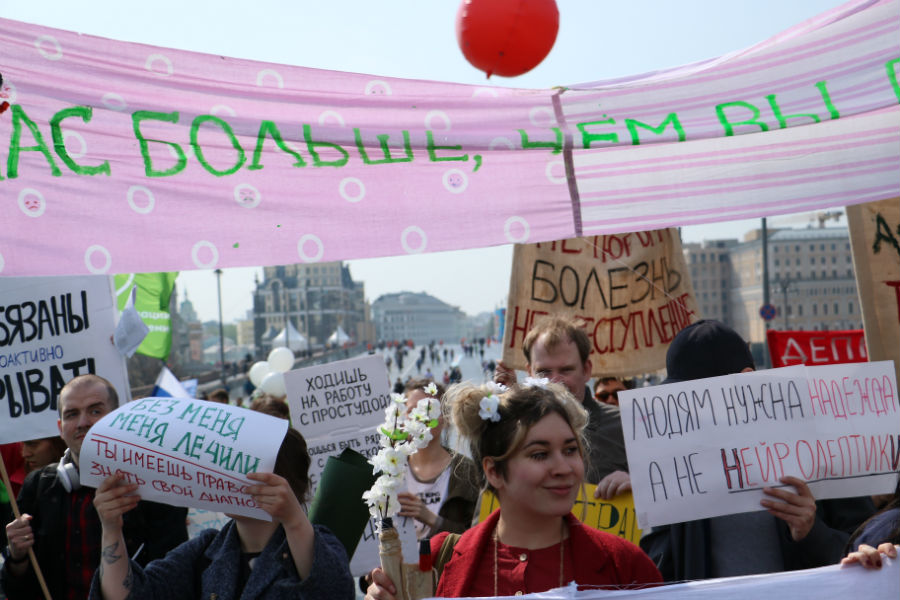

“I was treated without my knowledge: you have a right to know your diagnosis.” | “People need hope, not neuroleptics.” Psychoactivists at this year’s May Day march in Moscow. Photo by Ilya Panin. Courtesy of Takie Dela

This year, a group of psychoactivists—artists and human rights defenders, researching mental illnesses, mental quirks, and the boundaries between normal and abnormal—brought up the rear of the traditional procession organized by the Federation of Independent Trade Unions (FNPR). The marches carried placards inscribed slogans like “Antidepressants are a girl’s best friend,” “We’re coming out of the psycho-closet and expect acceptance, not a 100 years of solitude,” “I know my own diagnosis. Do you know yours?” “The affective class,” and “Stop romanticizing and depreciating us.” Ekaterina Nenasheva, an organizer of the Psychoactive Movement, leafleted passersby with flyers detailing how to behave if your loved one suffes from depression, anxiety or panic.

The group had managed to cross the Bolshoi Moskvoretsky Bridge, from the police checkpoint and the metal detectors to Basil’s Descent, when the activists were detained by regular police and riot police (OMON). As witnesses testified, the police roughed up the activists and ripped their placarads. The law enforcers could not settle on a reason for apprehending the activists. Some of them were told it was because of what written on the placards, while others were told it was because the march had not been authorized.

https://vimeo.com/267375166

The detainees were split up, loaded into paddy wagons, and taken to the Basmanny and Tagansky police stations. In the paddy wagons, policemen told the activists they should have vetted their placards with the rally’s organizer, the head of the Moscow Federation of Trade Unions. However, the rally’s website indicated all comers had been welcome to join the demonstration.

“We were asked to write statements and undergo preventive discussions. Each of us was assigned our own personal police officer, who said he was informing us that, by law, it was wrong to be involved in unauthorized rallies,” said Mikhail Levin.

The activists were released several hours later without having been charged with any offenses or fined. The detainees noted they had also been questioned by Center “E” (Extremism Prevention Center) officers, who photographed their placards.

Ekaterina Nenasheva
Artist, activist, organizer of the Psychoactive Movement and the May Day bloc
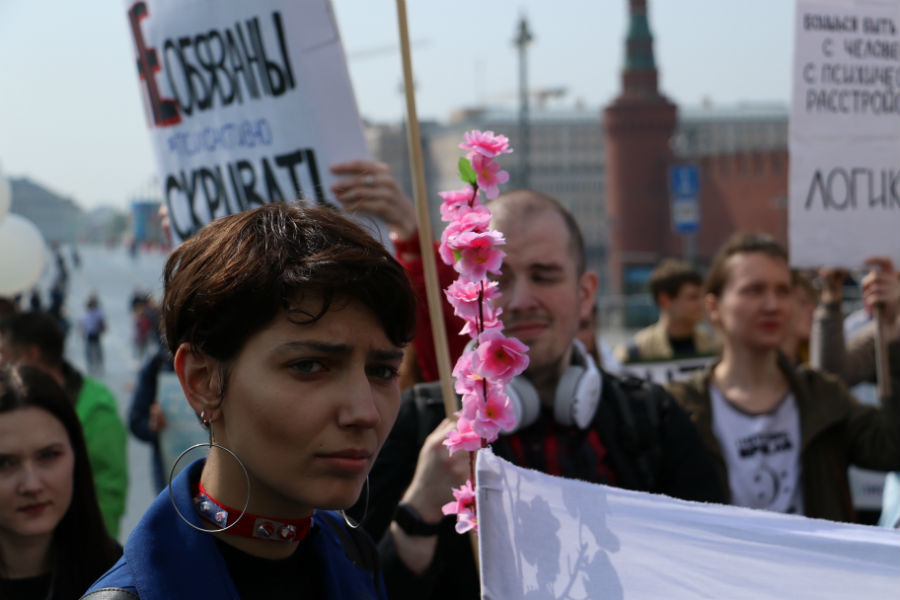

Katrin Nenasheva. Photo by Ilya Panin. Courtesy of Takie Dela

People who have mental illnesses still have no place to speak out and act. Organizing the May Day bloc was an attempt to create a discursive field for people who have mental illnesses or mental quirks. What does it do for them? According to the people who were with us yesterday, community gives them the important sense that they are not alone. There was a slogan to that effect on one of the placards: “You’re not the only one in the hood.”

It is believed that people with mental disorders can only be consumers of someone’s kindness, charity, tolerance, and pity. But they are completely capable of speaking out for themselves and being a social, political, and cultural force.

Mikhail Levin
Organizer of the Psychoactive Movement and the May Day bloc
It’s a slightly exhibitionist move to proclaim you have an illness. The guys and gals marched with very personal placards about their own quirks. We also want to demand reforms in psychiatric treatment and talk about the need for deinstitutionalizaton and our disagreement with plans to ban the import of certain medicines.

Marching with trade unions, with other workers, was an important statement. We wanted to say we also produce meaning, ideas, and work. This was the first attempt to do something like this, so it is fine that we are not a united fist, that we have different demands and opinions. What we wanted was just this: to bring together people with different mental makeups and show off this polyphony.

Sasha Starost
Artist, psychoactivist, organizer of the Psychoactive May Day bloc
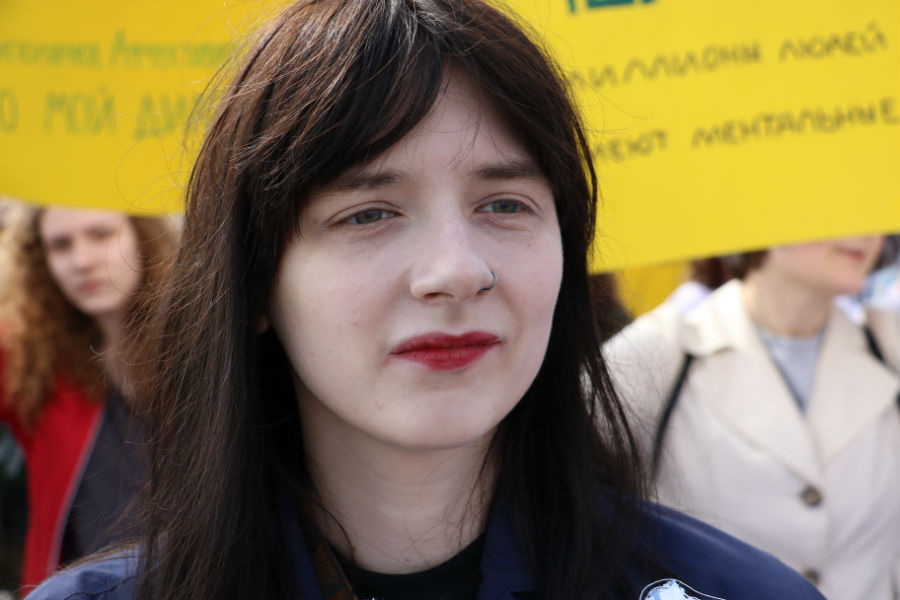

Sasha Starost. Photo by Ilya Panin. Courtesy of Takie Dela

I have paranoid schizophrenia. I have been hospitalized five time; three of those were involuntary. In the psychiatric field, I’m involved on an institutional level as a simultaneous interpreter and translator. Our May Day bloc was conceived as the Russian version of Mad Pride.  On the whole, however, we are more inclusive than Mad Pride, because in recent years they have shifted very hard towards antipsychiatry, and that is not for everyone. Yes, there is the system, and it is really poor organized. It contains neuropsychiatric residential care facilities and neuropsychiatric dispensaries in which nothing goes to plan and the rules are not followed, but this does not discredit the idea of psychiatry, the presence of illnesses, and the possiblity of treating them.

If we have taken the step of vetting our bloc, the demo’s organizers would have found excuses for not letting us march. I’m totally convinced that the cops saw a bloc of young people, some of them had tattoos, and they were carrying placards with slogans too boot. In their minds, there was a clear like with youth rebellions, and their immediate reaction was to remove us right away.

Alyona Agadzhikova
Media artist, journalist, photographer, organizer of the Psychoactive May Day bloc
Since childhood, I have had a few mental illnesses (OCD, agoraphobia accompanied by panic attacks, and  anxiodepressive disorder) and so for a long  time there was nowhere I could go and no one to go with me, because people’s awareness of mental health in Russia is somewhere around nil. So, I write and talk a lot about the visibility of people with similar quicks. I’m not afraid to say I have mental illnesses. I want the people in my life to pay attention to their own states of mind and offer help to people having trouble. I want the hate speech to disappear from the Russian language. People who do dumb or bad things should be not called psychos and schizos, and they do not need psychiatric treatment. All of these things have nothing to do with each other. Fortunately, things have been getting better lately, thanks to psychoactivists, journalists, and blogger doing outreach work on the rights of people with mental quirks and bringing the topic of psychiatry out of the gray zone.

What happened on May 1 was unprecedented, of course. It was the first Mad Pride in Russia, and it did not end the way everyone expected. We had come out to tell people that we people with mental illnesses existed. The people in our midst, the other marchers in the May Day demo, smiled at us, applauded us, and took our pictures. After reading our placards, several people decided to join our bloc. But then, twenty minutes or so later, a mob of riot police (OMON) and Russian National Guardsmen came running at us. They ripped our posters and our banner, confiscated all our placards, and dragged people away. Some people they practically dragged over the pavement, while they took other people by the arm. Many peole had severe panic attacks, including me. Fortunately, I always have my pills along. Otherwise, I simply would have passed out right there on the spot. That is how I react to unexpected, stressful circumstances.

My panic attack continued in the paddy wagon, but it was no longer so intense because I had taken a tranquillizer. But I suffer badly from claustrophobia, so I asked to be released from the cage, which opens from the outside. Fortunately, the riot  police immediately agreed. I think it had something to do with the fact that there have been precedents at the European Court of Human Rights, cases in which transporting claustrophobics in so-called cages and glasses has been deemed torture.

While we drove to the Basmanny police station, the law enforcers were keen to ask me why I was so nervous, what Psychoactive was about, who had diagnosed me, and why we had marched.

When I had described in detail how a panic attack works, one of the riot policemen  said, “Oh that’s nonsense. Try doing a five-kilometer cross-country run. Your heart is pumping so hard, it makes your head spin.”

I replied immediately.

“It’s the same feeling, only imagine you haven’t run five kilometers, that these feelings come on for no reason at all,” I snapped back.

The riot police exchanged glances and said, “Yeah, that’s harsh.”

Miroslava Podlesnykh
Ceramicist, animal rights advocate

Miroslava Podlesnykh. Photo by Ilya Panin. Courtesy of Takie Dela

Mental quirks and mental disorders are a topic means a lot to me, something I tried to live with for a long time without paying attention to it. Ultimately, however, I realized that living a full-fledged life meant accepting myself the way I was. I realized that if I wanted to changed the world I had to get a move on, to be around people who shared my values and views, to be part of a community.

The arrests were particularly hilarious when you could hear the announcers in the background talking about peace, labor, unity, and May, while the police were detaining a group that was just gaining the strength to assert itself, because this was an incredible effort for them. I know what a person who suffers from sociopathic disorders feels like in a crowd. Going on a demo is a huge effort, a big step towards a partial recovery.

**********

The psychoactivist community emerged in January 2018. Their projects have included Psychoactive, which focused on communication and creativity, and I’m Burnt Out, which dealt with emotional burnout. They also have their own brand of clothing and accessories.

Translated by the Russian Reader

Bourgeois Baby Madness Brings Russia to Brink of Ruin

image001

Sure, babies are cute, but when they are born in Russia they have every chance of growing up to be “terrorists” and “extremists.” At least, that is how they are regarded by the Kremlin and its fascist guard dogs at the Russian Federal Security Service (FSB). Photo courtesy of New Kids Center

It’s amusing (actually, it’s disgusting) how much the former Soviet socialist republic known as the Russian Federation has been overtaken by bourgeois baby madness, while at the very same time conditions for raising children in a decent, safe place have been deteriorating by the minute in Russia.

Why would anyone in their right mind want to have a kid in a country where the country’s top law enforcement agency, the Federal Security Service (FSB) reserves the right to destroy a young person’s life because its officers are stupid thugs incapable of distinguishing actual terrorists from gifted young chemists?

This brings me to another, related point that has bothered me for a long time.

Former FSB officer Alexander Litvinenko, who was executed by Russian dictator Vladimir Putin in the most excruciating way possible for his alleged “treason,” is invariably referred to as a “spy” by the remarkably gullible Anglophone press. But Litvinenko was never a spy. He was an FSB officer whose bailiwick was combating organized crime. When he realized, in the late 1990s, that his own law enforcement agency had become as criminal and corrupt as the gangsters it was supposedly combating, he first tried to bring it to the Russian public’s attention.

Do you remember the heavily covered press conference where he spoke about these problems (including the fact he had been ordered to assassinate Boris Berezovsky), his face masked by a balaclava, along with several of his FSB colleagues?

When Litvinenko realized, however, that nothing would come of his campaign, and his life was in danger, he defected to Great Britain.

God knows that Mr. Litvinenko was probably a naïve man albeit a brave and honest one. I wish the same could be said of most of his fellow countrymen, who are crazy about babies but won’t rub two fingers together to make their country a place where young people are regarded as anything other than potential “terrorists” and “extremists.”

You don’t believe me? Then read this little horrorshow for good measure. // TRR

The Kids Are (Not) Alright, Part 3: Are You Ready to Defend the Motherland?

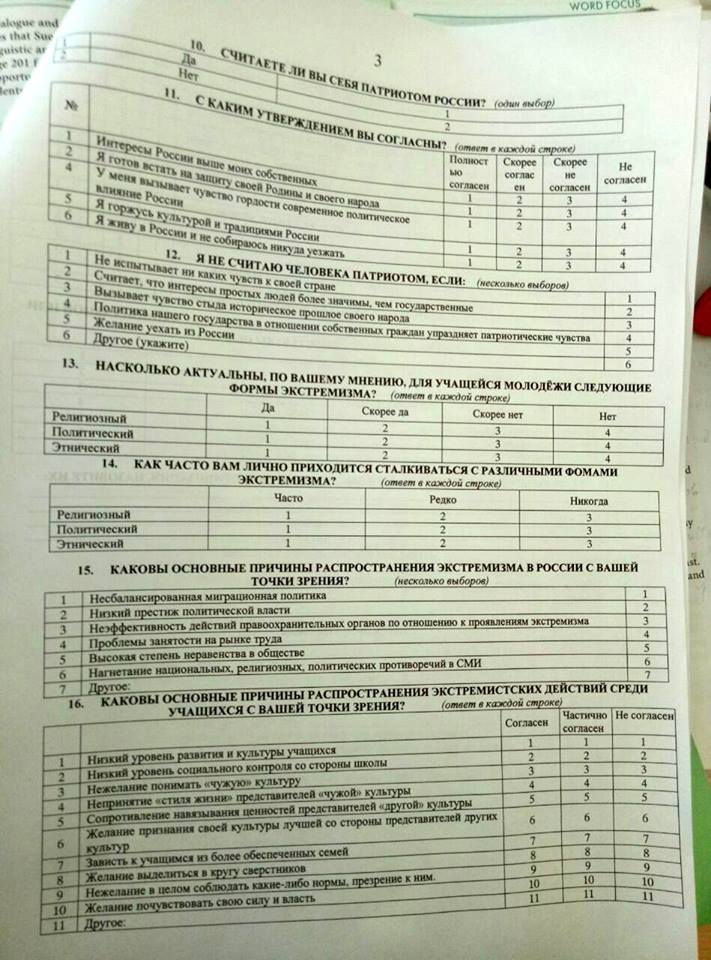
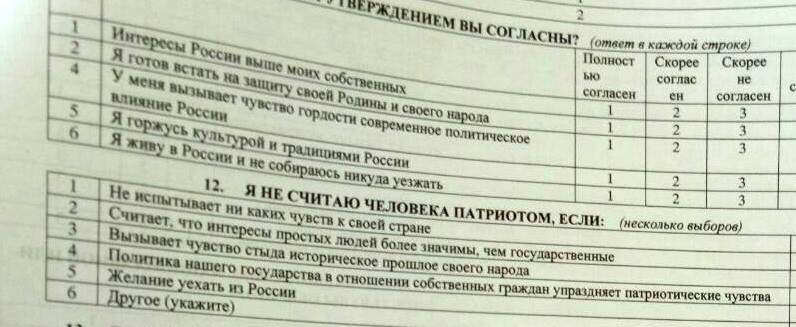
30707960_10156005294207203_9089823561300341523_nThe third page of a questionnaire focusing on “patriotism” and “extremism,” allegedly administered to schoolchildren in Petersburg’s Moscow District. Photo courtesy of Daniel Alexandrov, Jr.
Daniel Alexandrov, Jr.
Facebook
April 20, 2018

The most monstrous thing currently in the works is the forthcoming ban on imported drugs. Much has been written about it, emotions have flared, and I have nothing to add. I would imagine we have seen nothing like it in recent Russian history. People are cynicallly willing to sacrifice tens of thousands and hundreds of thousands of lives, by sending medical care forty or fifty years back in time, in order to increase the profits of several Russian companies.

But what kicked off the other day in Petersburg’s schools is no less vicious, although it is not such an obvious case of cannibalism. As Marina Tkachova, on whose page I saw the link, wrote correctly, a witch hunt has been launched.

In violation of Article 29 of the Russian Consitution,* which directly prohibits forcing people to voice their political views, the Moscow District Administration, assisted by the Center for Psychological, Pedagogical, Medical, and Social Aid, made schoolchildren fill out a questionnaire.

The questionnaire asked the schoolchildren, for example, to voice the extent to which they agreed with the following statements.

  • Russia’s interests are greater than my own.
  • I am ready to defend the Motherland and the people [narod = das Volk].
  • I feel proud of Russia’s current political influence.
  • I am proud of Russia’s culture and traditions.
  • I live in Russia and I do not plan to emigrate to another country.

31068869_10156005294157203_338838680958886823_nPart 12 of the questionnaire reads, “I don’t consider a person a patriot if . . . ” 1) He experiences no feelings for his country; 2) Believes the interests of ordinary people are more significant than the state’s interests; 3) The historic past of his people makes him ashamed; 4) The policies of our state towards its own citizens abolish patriot sentiments; 5) he want to leave Russia; 6) Other (specify).” Students could chose more than one answer. Photo courtesy of Daniel Alexandrov, Jr.

In addition, the pupils were asked to determine what social phenomena and psychological traits (!) generate nationalist or extremists moods among young people. The people who compiled the questionnaire openly provoked teenagers into violating Article 282 of the Russian Federal Criminal Code [which forbids “inciting the hatred and enmity” against other people based on ethnicity, religion, etc.] by asking them, “Are their religions or ethnic groups you dislike?” and “When faced with people different from you in appearance, ethniicity or religion, you usually . . .” One of the possible answers was, “I act aggressively.”

30742559_10156005294177203_1430095687740250696_nThe fourth and final page of the questionnaire focuses on the attitude of students toward different ethnic, religious, and social groups, thus encouraging them to violate Article 282 of the Russian Criminal Code, as Mr. Alexandrov points out. Photo courtesy of Daniel Alexandrov, Jr.

The Education Committee at Petersburg City Hall explained to Fontanka.ru that the questionnaire was part of a “comprehensive plan for preventing juvenile delinquency among minors during the 2017–2018 academic year.” It is a program for monitoring and identifying potential “extremists” among schoolchildren.

I have the sense these people either do not realize what they are saying or they do realize it, which is even worse.

Even the Soviet Union was bereft of such idiocy and meanness, as when minors were asked to fill out questionnaires with questions like, “How much do you love the Motherland on a scale from one to five?” or “Whom do you love more, the Motherland or Mom?”

I have learned the schools on Vasilyevsky Island have not administered the questionnaire—yet—but since the Education Committee has adopted the plan, it means the questionnaire will be administered, if not now, then in September.

This cannot be ignored. We cannot stay silent about this. Interrogating schoolchildren about their love of the Motherland and their willingness to sacrifice themselves, and suggesting they should rat on themselves are real manifestations of fascism, and there are no ifs, ands, or buts about it. Friends, city council members, human rights activists, public figures, and local journalists: do something about it.

Article 29 of the Russian Constitution:

1. Everyone shall be guaranteed freedom of ideas and speech.

2. Propaganda or agitation instigating social, racial, national or religious hatred and strife shall not be allowed. Propaganda of social, racial, national, religious or linguistic supremacy shall be banned.

3. No one may be forced to express his views and convictions or eject them.

4. Everyone shall have the right to freely look for, receive, transmit, produce and distribute information by any legal means. The list of data comprising state secrets shall be determined by federal law.

5. The freedom of mass communication shall be guaranteed. Censorship shall be banned.

Thanks to Valery Dymshits for the heads-up. Translated by the Russian Reader. I slightly edited the excerpted quotation from the Russian Constitution to make it more readable.

Extremism Inside Out

Illustration by Adelinaa. Courtesy of OVD Info

Extremism Inside Out
OVD Info
29 March 2018

Members of the previously unknown New Greatness movement were detained and then remanded in custody in mid March in Moscow, accused of organizing an “extremist community.” OVD Info has examined the case file. Apparently, the movement was led by undercover law enforcement officers.

The Plot
Police searched the homes of members of the opposition New Greatness (Novoye velichiye) movement on March 15 in Moscow, as reported by the Telegram channel Kremlin Washerwoman (here and here).

The grounds for the searches were not reported. As witnesses confirmed, a list containing the names of ten of the movement’s members was confiscated during one of the searches. According to unconfirmed reports, Russian Federal Security Service (FSB) officers were present at the search.

A bit later, a video of the movement’s leader, Ruslan Kostylenkov, confessing his guilt during an interrogation, was posted on the internet.

According to Kostylenkov, the organization’s objectives were “establishing order in the Russian Federation, organizing a tribunal for members of the ruling elite, and abolishing repressive laws and the Constitution.” When asked how the movement’s members intended to accomplish this, Kostylenkov replied they planned to organize rallies and carry out [militant] “actions” [aktsiyi] against law enforcers.

After the searches, Kostylenkov, an underage female, and seven other people were detained and sent to the Russian Investigative Committee’s Western Administrative District office in Moscow.

The next day, March 16, Dorogomilovo District Court in Moscow remanded seven members of New Greatness, including the underage girl, in police custody for two months. Two other members were placed under house arrest. All of them were charged under Article 282.1 Part 1 of the Russian Federal Criminal Code (“organization of an extremist community”). Kostylenkov was among those remanded in police custody.

On March 20, the Moscow News Agency reported that a criminal case had been opened on March 13, that is, two days before the searches and arrests.

Citing a source in law enforcement, Moscow News Agency also claimed that the organization’s objective had been the commission of crimes motivated by political hatred [sic] of the current Russian federal constitutional system. In addition, members of New Greatness had repeatedly organized sessions in Moscow and Moscow Region at which they had received training on how to participate in protest rallies. The agency’s source noted the training sessions involved the use of firearms and explosives.

The members of New Greatness have been charged under Russian Federal Criminal Code Article 282.1 Part 1, i.e., they have been accused of organizing an extremist community.

The Criminal Code defines an “extremist community” as a group of people organized for the planning and commission of “extremist crimes.” People found guilty of organizing an “extremist community” can be sentenced to a maximum of ten years in prison, while people found guilty of being members of the group (as covered by Article 282.1 Part 2) face maximum sentences of six years in prison. The Russian Supreme Court has ruled that criminal liability for violating the law begins at the age of sixteen.

The official commentary to Criminal Code Article 282.1 states that the group in question must be “stable,” meaning the people in the group had got together beforehand in order to plan and commit the crimes. The group must have an organizer and a stable membership, and the actions of the group’s members must be coordinated.

Judging by the case file, the members of New Greatness stand accused of planning to overthrow the government. Apparently, in keeping with the wording of Article 282.1, these actions should be interpreted as “crimes motivated by political hatred.”

The Characters
OVD Info has been able to examine the case file, which we received from the lawyer of one of the accused men. These documents let us take a slightly broader look at the members of New Greatness, their activities, and the roles they were assigned. The case file contains the following information about some of those in police custody and the members who avoided arrest.

Arrested

Maxim Roshchin, a 38-year-old unemployed man from Khimki, Moscow Region. Roshchin was not involved in shooting practice, and knows nothing about any other training sessions.

Pyotr Karamzin, 40 years old. He knows nothing about protest rallies timed to coincide with the presidential election and was not involved in discussing them. Karamzin tried to take part in the first training camp, but the group “got stuck in the snow.” Like all the other members, he gave money to Ruslan D (see below), with whom he once went to a protest rally. When Karamzin realized the rally had not been authorized by the authorities, he left.

Pavel Rebrovsky, a 31-year-old unemployed Muscovite. Rebrovsky was head of the so-called militant actions department. He treated his duties as a joke and ignored them. He did not engage in any serious discussions, since he realized it would be impossible for ten people to overthrow the government. He gave cash to Ruslan D.

Vyacheslav Kryukov, a 19-year-old student in his second year at the Russian State University of Justice. He moved to Moscow from Gelendzhik. He donated money to the group simply out of curiosity. He wanted to listen to discussions of Russian politics, but the meetings were closed to people who did not make donations. Like the other members, he gave money to Russlan D, who, according to Kryukov, also looked for rooms to hold meetings.

Ruslan Kostylenkov aka Ruslan Center, 25 years old, previously convicted of robbery. The group’s leader, as he himself recounts in the interrogation video published by Kremlin Washerwoman.

Not Arrested

The following members of the New Greatness community were interrogated on March 13. The same day witnessed the opening of the criminal case on whose basis nine people were detained and then remanded in custody on March 15. The testimony provided Konstantinov, Rostorguyev, and Kashapov was the basis for the charges filed against all members of the group remanded to custody. Moreover, their testimony has been excised from the case file, as handed over to the defense attorneys of the arrested members. Konstantinov, Rastorguyev, and Kashapov were not arrested themselves.

Alexander Konstantinov aka Ruslan D aka the Spaniard (not to be confused with Ruslan “Center” Kostylenkov). Konstantinov’s profile in the interrogation protocol is blank. He admits he was involved in New Greatness “in order to subsquently identify the members,” inspect documents, and gather important information to pass on to law enforcement. Konstantinov identifies himself as head of the financial department. However, as follows from the testimony of other members, as cited above, there was only one member who located and rented rooms for group meetings: Ruslan D aka Konstantinov. According to the group’s leader, Kostylenkov, it was Ruslan D who drafted the group’s charter.

Maxim Rastorguyev is a 29-year-old senior investigator and police captain. He was assigned to inflitrate the group. In his testimony, Rastorguyev said Ruslan D’s involvement in the group was part of a police investigation, a “strategic infiltration.” Along with Ruslan D and Ruslan Center (Kostylenkov), Rastorguyev was involved in organizing an assault squad. Identified as leader of the assault squad, Rastorguyev helped other members of the group make Molotov cocktails.

Rustam Kashapov is a 28-year-old military engineer. According to the testimony of one of the arrested members, it was Kapashov who brought weapons and ammunition to one of the group’s training sessions.

Conclusion

The case file makes it clear that:

  • Three members of New Greatness were interrogated three days before the searches and arrests: Konstantinov, Rastorguyev, and Kashapov.
  • The criminal case was opened after the three men were interrogated.
  • Their testimony is the basis for the charges against other group members.
  • According to the case file, all three men were involved in organizing the group and arranging the training sessions, drafting the charter, collecting dues, and renting space. According to the charges, these actions were, in fact, the grounds for detaining members of the New Greatness movement and remanding them in custody.
  • Konstantin, Rastorguyev, and Kashapov avoided arrest.
  • One of the three men—Rastorguyev—has testified he was assigned to infiltrate the group. The testimony of all three men has almost been entirely excised from the case file that was handed over to the arrested men’s defense lawyers.

Thanks to Comrade NN for the heads-up. Translated by the Russian Reader. It should be obvious by now the Russian security services were tasked with inventing domestic “terrorist” and “extremist” groups from scratch in the run-up to the March 18 presidential election and this summer’s FIFA World Cup, which Russia will host, and then unmasking, apprehending, and prosecuting the fruits of their own sadistic fantasies. To my mind, this should be a huge scoop just waiting for an ace reporter at a big-name western newspaper or magazine if only he or she would take the time to look over the ample Russian press coverage of the Penza-Petersburg “terrorism” case, the strange investigation of the real “terrorist” bombing that occurred in the Petersburg subway in April 2017, and the curious case of the the New Greatness movement, which, as the article above suggests, was conjured into existence by Russian undercover police themselves. The question is why, when this website and other activist websites have been at pains to give “real” reporters one and one and one, they cannot add them up and get three? Or they are simply too afraid of the collective Putin and its wrath to cover these flagrant miscarriages of justice? ||||| TRR

All in a Day’s Work

sdy_bxm7qd8Denis Mikhailov. Photo courtesy of the Navalny team’s VK page and OVD Info
Well-known Moscow activist Mark Galperin has been sentenced to two years probation for two videos. The videos, in which Galperin discusses a possible revolution, were deemed calls to extremism. The court forbade the activist frominvolvement in grassroots organizations for three years.

In Crimea, left-wing activist Alexei Shestakovich was transported after a police search with a plastic bag over his head. During the search, he lay on the floor in his underwear and handcuffs. Ultimately, Shestakovich was jailed for ten days.

At the same time, Crimean trade union activist Ivan Markov was detained and then jailed for ten days, but he was released ahead of schedule, as the appellate court overturned the decision to remand him in custody.

Denis Mikhailov was arrested twice for the same “crime.” The coordinator of Alexei Navalny’s presidential election boycott headquarters in Petersburg had just left the special detention center where he had spent thirty days for the January 28 Voters Strike protest rally, when he was detained, taken to court, and jailed for another twenty-five days, once again for the January 28 Voters Strike protest rally. Only in the first case, Mikhailov was tried as an organizer, while the second time he was tried as a participant.

An activist in Yekaterinburg was jailed for fifteen days after he was detained carrying a placard criticizing Putin. The placard was emblazoned with the slogan, “If you want another six years of lies and stealing, vote for Putin.” Sergei Tiunov was accused of a repeat violation of the rules for public events. He has gone on a dry hunger strike.

Source: OVD Info. The Week That Was, No. 45 (email newsletter). Translated by the Russian Reader

Extremists (The Serial)

Extremists (The Serial)
Grani.Ru
December 29, 2017

92073Extremists

Hundreds of people throughout Russia are being prosecuted or have already been convicted for voicing their own thoughts, which the current regime does not like. The campaign against dissent has been masked as a campaign against “extremism.” Our video project’s goal is to acquaint you more closely with several so-called extremists. The FSB and the Interor Ministry have spared neither time nor effort in combating them.

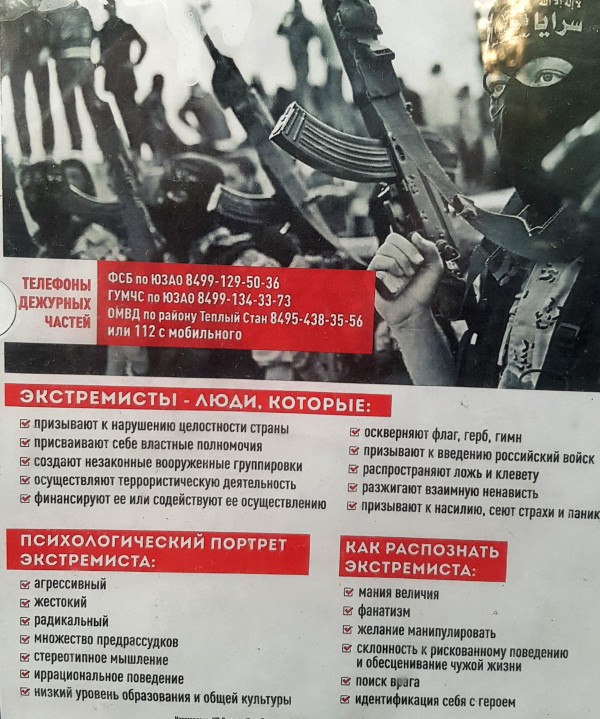
Propaganda represents extremists as dangerous people, ready at the drop of a hat to segue to terrorism. Posters hung on billboards in Moscow call on citizens to identify “extremists” on grounds such as the desire to manipulate, megalomania, identification with a hero, a low level of education and culture, and a tendency to risky behavior and devaluing the lives of others.

92070

Extremists are people ¶ who call for destruction of the country’s integrity, ¶ try and seize power, ¶ organize illegal armed bands, ¶ engaged in terrorist activity, ¶ finance or facilitate terrorist activity, ¶ besmirch the flag, seal, and anthem; ¶ call for the introduction of Russian troops [sic], ¶ spread lies and slander, ¶ incite mutual hatred, ¶ call for violent, sow fear and panic. Psychological portrait of an extremist: aggressive, cruel, radical, many prejudices, stereotypical thinking, irration behavior; low level of education and culture. How to identify an extremist: megalomania, fanaticism, desire to manipulate, tendency to risky behavior and devaluing the lives of others, the search for enemies, self-identification with a hero.” The poster also includes local telephone numbers for the FSB, police, and Emergency Situations Ministry.

Do the subjects of our video project fit the propaganda portrait?

Krasnoyarsk resident Semyon Negretskulov really likes Scandinavia. His blog on the social network VK mainly dealt with Finnish history and modern life in Finland. When he posted a few texts about the Greater Finland project and historical photographs of Vybog (Viipuri) that was enough for the FSB to charge him with promoting Finnish greatness. His call to help political prisoners was also deemed extremism.

Danila Buzanov had to spend a year and a half in prison for an ordinary brawl at the VDNKh in Moscow. “Anti-extremism” police officers from Center “E” turned a fight with a vendor selling Donetsk People’s Republic paraphernalia into charges under Article 282 of the Russian Criminal Code: inciting hatred and enmity towards the social group “ethnic Russians/Russian citizens who support the Donetsk People’s Republic and Lugansk People’s Republic.”

Boris Yakovlev, a musician from the town of Dno, believes that sooner or later a revolution will happen in Russia. People are poor, the authorities are thieves. When Prime Minister Dmitry Medvedev said Russia had exhausted its limit of revolutions, Yakovlev reacted like this, “Hey,  Medevedev, who exhausted it? You, the Rotenbergs, the Putins, the Chaykas? We haven’t exhausted our limit, Medvedev. He doesn’t want revolutions. Kiss my ass, Medvedev! He doesn’t want revolutions. But we want them to get rid of you Medvedevs and all the rest. What part of his body does this guy think with, huh?”

The FSB regarded this and similar posts as calls to extremism. Yakovlev would have been sentenced to five years in prison, but he did not wait around to hear the verdict and requested asylum in Finland.

Darya Polyudova decided to troll the authorities, who in 2014 demanded the federalization of Ukraine. Polyudova organized a March for the Federalization of the Krasnodar Region. As a result, she was the first person in the Russian Federation to be convicted of calling for federalism.

Alexander Byvshev, a teacher of German in the village of Kroma in Oryol Region has gone to court to face a third set of charges for poems he wrote in support of Ukraine, and a fourth criminal case is in the works. More frightening than the revenge of law enforcement agencies has been the reaction of his fellow villagers.

These are just a few of the many hundreds of cases of Russians who have been prosecuted for words, opinions, and reposts. You can find a collection of banned “extremist” content at  zapretno.info.

Translated by the Russian Reader


You’ve Lost Control Again

OLYMPUS DIGITAL CAMERA

Black Lists and Total Monitoring: Agora’s New Report on the Surveillance of Russians
A person’s life is utterly transparent to the secret services
Damir Gainutdinov
Republic
August 22, 2017

The Agora International Human Rights Group has released a report entitled “Russia under Surveillance 2017: How the Authorities Are Setting Up a Total System for Monitoring Citizens.” Damir Gainutdinov, the report’s co-author, discusses its key points. The Russian state has been harvesting an unprecedented amount of information about its citizens and wants to collect other kinds of information. It maintains a system of black lists that categorize different types of citizens and has been engaged in a relentless assault on internet anonymity. (You can read the full report in Russian.)

In recent years, Russia has been assembling a complex system for monitoring grassroots activists, reporters, and members of the opposition, a system that encompasses at least several thousand people. Under the pretext of public safety, and fighting extremism and terrorism, the security forces have been monitoring people’s movements around the country and when they cross national borders, wiretapping their phone conversations, intercepting their SMS and email messages, staking them out and surveilling them with audio and video equipment, and analyzing and systematizing biometric information. They have made vigorous use of illegal methods, for example, hacking internet accounts.

The key problem is the absolute lack of control over the state’s invasion of our private lives. The courts rubber stamp decisions taken by the security services. There is almost no chance of successfully challenging the decisions in court. Hence, over the past ten years, the courts have on average approved 98.35% of motions by the state to limit a person’s privacy of correspondence. The upshot is that any law-abiding resident of Russia is now constantly exposed to the risk of arbitrary access to her private life through the internet, mobile telephones, video surveillance, random contacts with the police, when using money, pubic transportation, and driving her car, and applying for a job at a number of workplaces, as well as traveling abroad, carrying weapons, and exercising her other rights.

Privacy and the presumption of innocence are meaningless, and the intensity of the interference has been constantly increasing. The number of requests to eavesdrop on telephone conversations and intercept correspondence have alone more than tripled since 2007.  A person is faced with a choice: either accept total surveillance as a given or look for ways of guarding her privacy. The state, however, regards the latter as illegal, the attempt to hide something criminal.

Complusory Biometrics
The Russian authorities have been vigorously engaged in gathering biometric information: fingerprints, DNA samples, and photographs. By law, this can be done without the individual’s consent if it is a matter of national security, for example. Aside from voluntary fingerprinting (anyone can go to a police and submit his fingerprints), the procedure is obligatory for a large number of people ranging from security services officers to people applying to work as private detectives, from suspects in criminal cases to people who have only committed administrative offenses if there is no other way to identify them, from large numbers of foreigners to stateless persons. Since 2015, anyone over the age of twelve who applies for a biometric foreign travel passport must also submit prints of two fingers. Meaning that, currently, we are talking about at least 25 million people. [Russia’s current population is approximately 143 million.]

Despite the clear list of grounds for compulsory biometric registration, there are regular reports of patently illegal attempts to fingerprint, photograph, and do saliva swipes for DNA tests. Participants of public events such as protest rallies, political activists, and reporters have been the victims of these attempts.

For example, on March 23, 2017, in Moscow, police detained supporters of Alexei Navalny who were handing out stickers in support of his campaign to be allowed to run in the 2018 presidential elections. The detainees were all taken to the Arbat Police Precinct for “preventive” discussions, during which the information in their internal passports was copied and they were fingerprinted. In another incident, which took place on April 6, 2017, at a market in Simferopol, around fifty people of “non-Slavic appearance” were detained, allegedly, because they were mixed up with Crimean Tatar activists in Crimea. Lawyer Edem Semedlyaev said all the detainees were forcibly fingerprinted, photographed, and swabbed for DNA samples.

Video Surveillance
As of 2015, the so-called Secure City complex has begun to be installed in all regions. Secure City is an extensive system of video surveillance and facial recognition. In Moscow alone, 184.6 billion rubles [approx. 2.6 billion euros] have been allocated on implementating the program until 2019. As of 2016, 86.3% of residential neighborhoods in Moscow were covered by CCTV systems. 128,590 cameras had been installed, 98,000 of them in stairwells. The Secure City video archive is stored for five days, and direct access to the recordings is enjoyed not only by the Interior Ministry [i.e., the police] but also by other state agencies.

Under the pretext of getting ready for international sports events, the authorities have improved their surveillance capacities. Sports complexes are equipped with CCTV systems featuring facial recognition functions, even in towns not hosting sporting events. Moscow’s railway stations have been expanding the areas covered by cameras that identify faces and record car license numbers. The Russian government has issued a decree ordering local authorities to draw up lists of places where more than fifty people can gather. They all must be equipped with CCTV systems. The recordings will be stored for thirty days.

Special systems for identifying people have been used at authorized public events [i.e., permitted protest rallies]. For example, officials have admitted they could have identified absolutely everyone who passed through the inspection line on June 12 on Sakharov Avenue.

Tracking Movements
When you buy a ticket, stay at a hotel or use public-access Wi-Fi in Russia, you are informing the regime about your whereabouts.

When you have anything to with with almost any form of long-distance public transportation, the authorities will at very least learn your name, date of birth, type and number of identity card, sex, nationality, departure and destination points, route, and other information using a round-the-clock interactive system.

The practice of scanning passports is widespread in hotels, since management is obliged to inform the Interior Ministry about the registration of guests within twenty-four hours.

The information obtained is sufficient to determine the whereabouts of a person of interest at any moment. The information is used, among other things, to track the movements of activists and human rights workers, and exert pressure on them. This was how Agora lawyer Alexander Popkov was followed when he arrived in one of the regional centers of Krasnodar Territory to take part in the trial of a police officer accused of rape and murder. Arrivign at the train station, Popkov was swiftly met by police investigators, who immediately informed him he was listed in a Russian Interior Ministry database, and so they wanted to know his purpose for visiting the city. The policemen knew his route and means of transportation, his place of residence, and the particulars of his documents.

Eight Years of Administrative Supervision
In May 2017, the use of administrative supervision for persons released from imprisonment increased. A court has ordered that an acknowledged political prisoner, Tatar activist Rafis Kashapov, will be placed under administrative supervision for eight years after being released from prison. In 2015, Kashapov was sentenced to three years in a prison colony for publishing texts critical of Russia’s actions in Ukraine. Now, after he is released, Kashapov must register with the police within three days, inform them of all his travel plans and changes of places of residence and work, and report to a police station to give testimony when required by the police. Police officers can conduct individual preventive work with him, ask his employer about his behavior, freely enter his house, and forbid him from making short trips even, for example, when a relative dies.

In addition to administration supervision, which is on the record, there is also clandestine surveillance. Formally, putting someone on preventive registration is part of the beat cop’s routine work. In practice, it has turned into a means for surveilling “suspicious” people, which includes not only ex-cons and registered drug addicts but also people who have committed crimes against public safety at mass events [i.e., committed minor or wholly fictitious infractions at protest rallies], as well as members of “informal youth organizations.”

Lists of the Disloyal
Aside from putting people on preventive registration, the Russian authorities maintain a number of different lists and databases, chockablock with “unreliable” people and organizations. If you end up on one of these lists, you are guaranteed increased attention from law enforcement, including constant checks, detentions, and inspections. Here are only a few of these lists.

Rosfinmonitoring (Federal Financial Monitoring Service) publishes a list of organizations and peoples involved, allegedly, in extremism or terrorism. The list includes the names, dates and places of the birth of the people, and the relevant information about the organizations. A court order banning an organization or sentencing someone for a crime is not required for inclusion on the list. The list features not only people convicted of terrorism but also people suspected of terrorism. It suffices that a prosecutor or the Justice Ministry has suspended an organization’s work or brought charges or declared someone a suspect in the commission of one or more of twenty-two crimes listed in the Criminal Code, including the most “popular” anti-“extremist” crimes. Currently, the list includes 7,558 Russian citizens, 411 foreign nationals, and 182 organizations.

Inclusion in the list means the state has total control of your financial transactions and disposal of your property. All transactions to which a person on Rosfinmonitoring’s list is a party are subject to mandatory control by banks. If they fail to exercise this control, they will be punished by the Russian Central Bank. By default, all transactions are frozen, but you can spend 10,000 rubles per month per family member [approx. 143 euros]  from the wages you earn, and you can also spend the welfare payments you receive. It often happens that people placed on the list discover it after the fact, when they call the bank to find out why a transaction has not been completed.

Of course, there is also the list of NGOs declared “foreign agents,” which the Justice Ministry requires to submit additional reporting on property, expenditures, and management. The Justice Ministry also keeps lists of “undesirable” and “extremist” organizations (currently, there are 11 and 61 of these organizations, respectively). When they are accorded this status, the authorities are obliged to identify their rank-and-file members. When it is a matter of large organizations, thousands and, sometimes, hundreds of thousands of people find themselves targets of surveillance. Thus, in the wake of the banning and forced closure of the Jehovah’s Witnesses in Russia in 2017, up to 150,000 of its followers in Russia face the prospect of criminal investigations and criminal prosecutions.

Groups that used to be on the periphery of public life, for example, football fans, have also faced increased attention from the authorities. After a law was amended in 2016, the Interior Ministry began publishing lists of people banned from attending sporting events. The listed included 319 names at the the end of July.

Schoolchildren are yet another group that has faced increased police surveillance. Thus, in the Education Ministry’s recommendations on criminal subcultures [sic], schoolteachers are practically delegated the role of police investigators vis-à-vis minors. They are obliged to divulge information to the police about the private lives of their pupils and their families. This means that the children are entered into the record and put in various police databases.

The Attack on Anonymity
In 2016, the authorities launched a vigorous campaign against anonymity on the internet. The so-called Yarovaya anti-terrorist package of amendments to existing laws could have supplied the secret services with unsupervised access to all communication among users if it were not for the resistance of some providers and standard end-to-end encryption. The Yarovaya package continued the policy of nationalizing and deanonymizing the Runet, which could provide full control over the information flows inside Russia.

The next steps were the laws on messengers and anonymizers, signed by the president on July 30, 2017. The first law, in particular, stipulates the obligatory identification of users by mobile telephone numbers. The second law is essentially an attempt to establish total control over anonymizers and VPNs.

In August 2017, the Communications Ministry published draft requirements for internet providers, as listed in the register of information distribution companies. The draft includes a list of information that must be accessible to the FSB (Federal Security Service): the date and time the user was registered, and the latest update of the registration form; nickname, date of birth, address, full name, passport particulars, other identity documents, languages spoken, information about relatives, and accounts with other providers; the receipt, sending, and processing of messages, images, and sounds; recipients of messenges; financial transactions, including payees, amounts paid, currency, goods and services paid for; and client programs and geolocation information, among other things. Providers are required to store and transmit to the security services not only sent and received messages, but draft messages as well.

And yet public opinion polls show the majority of Russians are not terribbly worried about maintaining privacy for the time being. [Russian opinion polls are worthless as measures of real opinion—TRR.] For activists, reporters, and members of the opposition, however, the refusal of internet companies to cooperate with the authorities and the capacity to withstand hacking are the only guarantees of their security.

Without access to encrypted correspondence, the Russian state, apparently has had to resort to the services of hackers. Thus, on October 11, 2016, Google and Yandex warned several dozen activists, reporters, and NGO employees about an attempt by “pro-government hackers” to hack their accounts.

The Burden of Information
Despite establishing legal grounds for harvesting information about nearly everyone in Russia, there is a huge amount of evidence the regime is technologically and financially incapable of gathering, storing, and qualitatively processing it.

The most obvious example of this is, perhaps, the Yarovaya package itself. During an economic crisis, the authorities are clearly not willing to incur the huge expenses required to implement the entire range of e-surveillance of the populace, which, according to various estimates, could cost from 130 billion rubles [approx. 1.86 billion euros] to 10 trillion rubles [approx. 143 billion euros]. Consequently, the duties of collecting and saving traffic have been sloughed off onto the telecoms and internet providers, who are likewise not at all happy about such a “gift” and have already begun to raise their rates. Meaning that the surveilled themselves have been asked to pay for the ability of the secret services to read their correspondence and view their personal photographs, to pay a kind of “shadowing” tax. Meanwhile, since more than half the world’s internet traffic is already transmitted in encrypted form, the regime, even though it has access to exabytes of user correspondence, has been forced to demand that providers supply them with encryption keys.

Aware of its limited resources, the Russian state has focused on more diligent work with specific groups. Hence, the enthusiasm over different types of black lists, as well as the delegation of surveillance duties to telecoms, internet providers, banks, and transportation companies. On the one hand, they have access to the information; on the other hand, they depend on the state, make their money from government contracts or receive their licenses and permits from the state.

The authorities are willing to chuck the black lists, which have proved ineffective, just as they gave up on the bloggers register. This would enable them to focus resources on various risk groups. When necessary, they could include people of special interest in the groups while surveilling the populace as a whole.

Consequently, the security departments of many commercial organizations have been ratting on their clients to the security forces, headmasters have been forced to gather dirt on schoolchildren, and internet providers to monitor the traffic of users. Even as it stores this growing mountain of information on Russians, the authorities care little for their safety. Increasingly, user data has become publicly accessible, often deliberately.

Damir Gainutdinov is a legal analyst at Agora. Photo and translation by the Russian Reader

Report to UN on Racial Discrimination in Russia Banned

Report to UN on Racial Discrimination in Russia Banned
Takie Dela
August 17, 2017

Russian federal media watchdog Roskomnadzor has placed a report to the UN on racial discrimation in Russia on its list of banned information, reports the SOVA Center.

The alternative report in question is entitled “The Russian Federation’s Observance of the International Convention on the Elimination of All Forms of Racial Discrimination” and covers the period 1996–2001. The report has been published on several websites, including the Kharkov-based human rights website Human Rights in Ukraine.

doklad screen shotScreenshot from Roskomnadzor website

In June 2015, the Yelniki District Court in Mordovia ruled the report information prohibited for dissemination. On August 11, the page on the Human Rights in Ukraine website containing the report was registered on Roskomnadzor’s list of banned materials, reports SOVA.

“The ruling itself has not been published, and we are unaware of the court’s arguments. In order for a court to rule information prohibited for dissemination in Russia, it must contain matter previously deemed extremist by a court.  Of course, the report on racial discrimination contained no such matter, so it is completely unclear in this case what triggered the lawsuit and the court’s ruling,” SOVA’s press service commented.

The report was compiled by the Memorial Human Rights Center with the assistance of twenty-five Russian NGOs involved in counteracting racism and discrimination. It was submitted to the UN Committee on the Elimination of Racial Discrimination.

The report discusses the discrimination or promotion of discrimination against Meskhetian Turks, Chechens, and Romani. It also criticizes Russian authorities for insufficient efforts to counteract discrimination and creating appropriate mechanisms for counteracting discrimination.

In 2016, the Russian Federal Justice Ministry declared SOVA Center a “foreign agent.” SOVA Center staff do not consider their work political, the alleged determining criterion for ruling a Russian NGO receiving foreign funding a “foreign agent.”

Thanks to Maria Turovets and Mari Davtyan for the heads-up. Translated by the Russian Reader

Nikolay Mitrokhin: God-Given “Extremists”

God-Given “Extremists”
Nikolay Mitrokhin
Takie Dela
April 26, 2017

I met Jehovah’s Witnesses in the mid 1990s in the former Soviet Central Asian republics. I was researching the region’s religious life. When I arrived at each regional capital, I would survey all the prominent communities in turn. The Witnesses were different in one respect from other western-inspired Christian communities. There were lots of them and they were everywhere.

Like now, many were certain back then the Witnesses were a product of the perestroika era’s freedoms. This, however, was not the case. The Witnesses were a legacy of the Soviet Union.

An American Salesman’s Religion

The Witnesses are a typical American eschatological religious group. Put crudely, they believe the world will end soon, during their lifetimes. They believe in one God, Jehovah, a name used during Christianity’s first century. On Judgment Day, Jehovah will destroy sinners and save the elect. The Witnesses reject the Christian doctrine of the Trinity (God the Father, God the Son, and the Holy Spirit). They do not consider Christ God, but they revere him. The day of his death is the only holiday they celebrate.

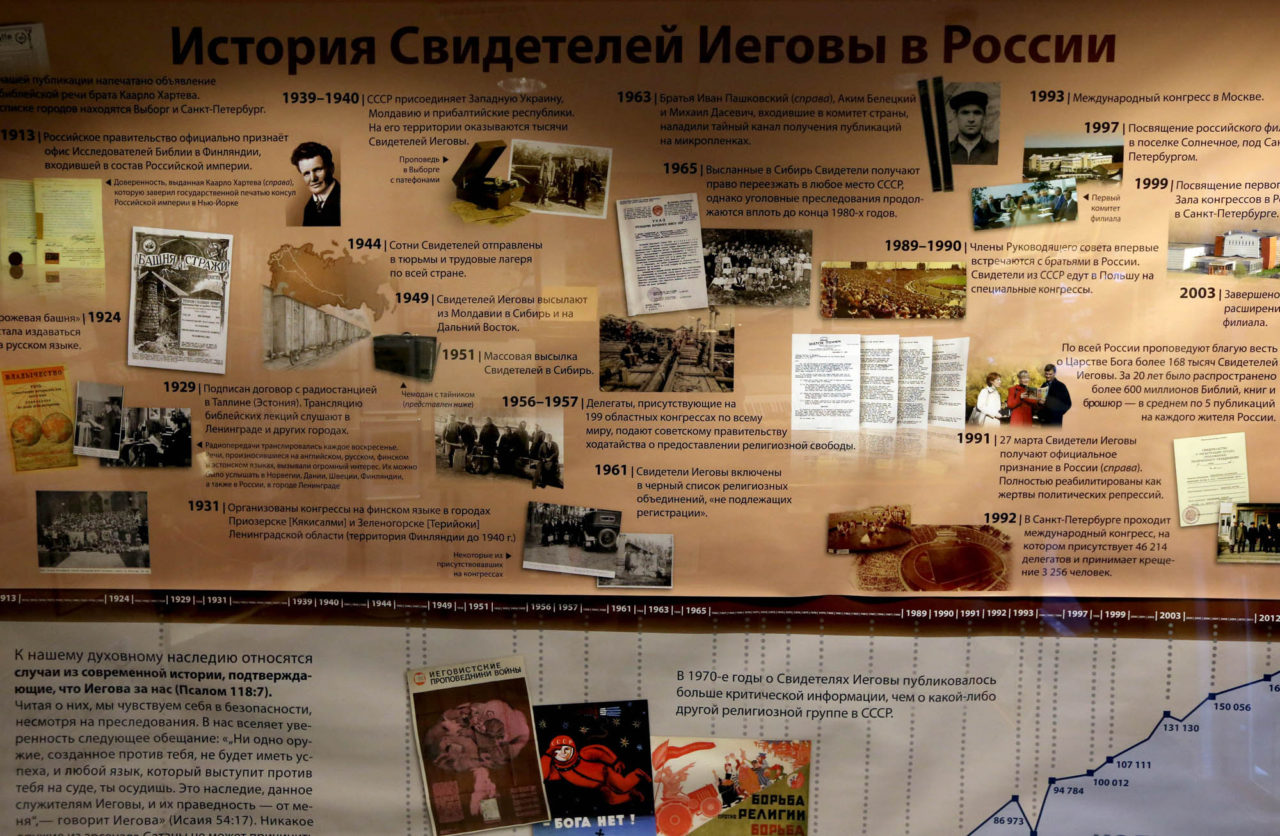
“A History of the Jehovah’s Witnesses in Russia,” a display in the museum at the Administrative Center of the Jehovah’s Witnesses in Russia, located in St. Petersburg. Photo courtesy of Alexander Demyanchuk/TASS

A completely and regularly revised theology has produced a set of permissions and prohibitions aimed at maintaining the way of life and behavior of a decent traveling salesman from the lower middle classes.

The Witnesses are allowed the moderate use of alcohol (immoderate use is cause for expulsion) and the use of contraceptives. Premarital sex and smoking are forbidden. The Witnesses must not “rend to Caesar what is Caesar’s”: they are forbidden from being involved in elections, engaging in politics, honoring state symbols, and serving in the army. They are most roundly criticized by outsiders for forbidding blood transfusions and organ transplants. The Witnesses suddenly had something to say when the AIDS epidemic kicked off. They support blood substitutes.

Something like family monasteries—”administrative centers”—have been organized for the most ardent followers. The schedule in the centers is strict, but the conditions are relatively comfortable. The Witnesses can live and work in them, practically for free, for as little as a year or as along as their entire lives.

Waiting for the world’s imminent end is an occupation common to many religious groups, from Russian Old Believers to the Mayan Indians. Such groups isolate themselves from a sinful world, some by retreating into the wilderness, others, by restricting their contact with outsiders.

OLYMPUS DIGITAL CAMERA
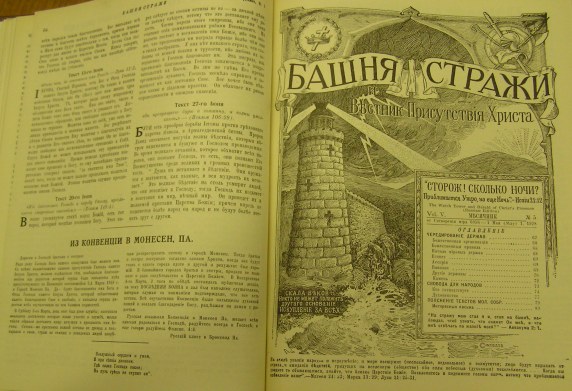
The cover of a 1928 Russian-language edition of The Watchtower. When the Russian edition was founded in 1925, it was originally entitled The Guard Tower, but in 1964 the name was changed to The Watchtower. Photo courtesy of Boris Alexeyevich/Wikipedia

The Witnesses differ from similar movements in terms of how they disseminate and maintain their doctrine. The method is based on the commercial practice of distributing magazines in the nineteenth century. Essentially, the entire organization meets twice weekly to read its main journal, The Watchtower, which is produced by church elders in Brooklyn and then translated and disseminated in dozens of languages. Members pay a nominal fee for subscribing to and reading the journal, fees that are scrupulously collected and sent along the chain: from local groups to the regional office, then to the national headquarter and, finally, to the head office in Brooklyn. Free distribution of the magazine and going door to door asking people whether they want to talk about God are aimed at the same thing: increasing the audience who subscribes to and collectively reads the magazine.

Ninety-five percent of today’s public find these religious activities strange and ridiculous, although from a sociological viewpoint they barely differ from going to political party meetings, networked sales of cosmetics, visiting sports clubs, getting a tattoo, the Russian Healthy Lifestyle Movement (ZOZh) or stamp collecting.

If you believe the Jehovah’s Witnesses’ own figures, they operate in 240 countries, which is more than belong to the UN.  At the same time, the organization is numerically quite compact, albeit growing rapidly. It has a total of 8.3 million members.

A Religion for Soviet Individuals

The story of how the Witnesses took root in the Soviet Union has been well told in a book published three years ago by Emily Baran, Dissent on the Margins: How Soviet Jehovah’s Witnesses Defied Communism and Lived to Preach About It. Polish and Romanian peasants and market traders adopted the doctrine of the Witnesses at the turn of the 1920s and 1930s, and before the war they unexpectedly were made Soviet citizens when the Soviet Union occupied parts of Poland and Romania.

The Soviet authorities did not tolerate large groups who maintained constant links with foreign countries, so it decided to send the core group of Witnesses, five thousand people, to Siberia. A considerable number were sent to the camps, while the rest were exiled. The crackdown was a misfortune for the victims, but it was a godsend for the exotic doctrine.

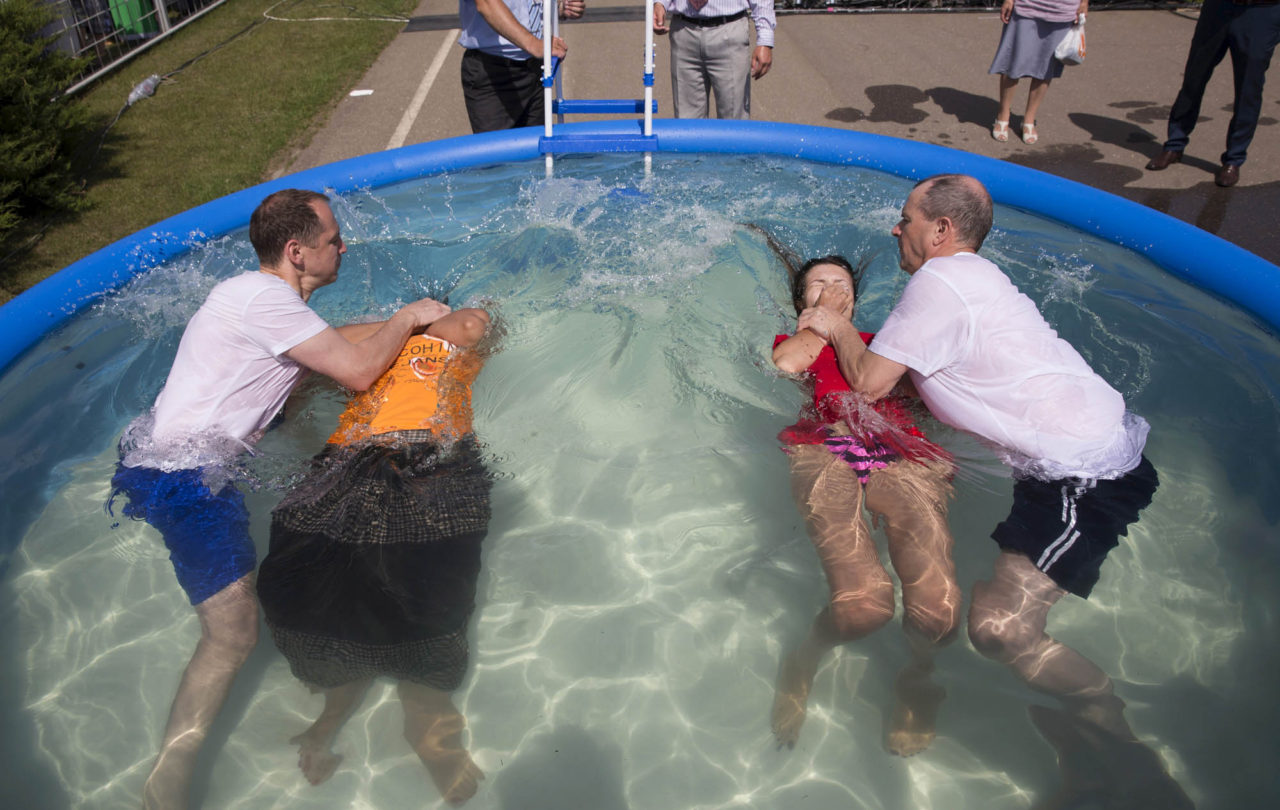
The Moscow Jehovah’s Witness community worshiping at the velodrome in the city’s Krylatskoye District, 2000. Photo courtesy of Alexander Fomin/PhotoXPress.ru

As early as the 1950s, the largest communities of Witnesses had emerged in the main place of exile, Irkutsk Region. In the 2000s, the official websites of Irkutsk Region and the neighboring Republic of Buryatia claimed the Jehovah’s Witnesses were a traditional religious community in the region. Irkipedia provides the following figures for 2011: “Around 5,500 people in Irkutsk Region are members of the Jehovah’s Witnesses religious organization. Around 50 of their assemblies operate in Irkutsk Region, each of them featuring 80 to 150 members. The assemblies are united into three districts: Usolye-Sibirskoye, Irkutsk, and Bratsk.”

The camps proved a suitable place for proselytizing, the radically minded youth, especially Ukrainian speakers, eager listeners, and the half-baked amnesty of political prisoners, an excellent means of disseminating the doctrine nationwide. As early as the late 1950s, all over northern Kazakhstan, former members of the Ukrainian Insurgent Army (UPA), who were banned from returning home, and former Russian criminals, who had taken jobs as farm machinery operators and welders, were digging dugouts in the steppes to hide DIY printing presses for printing The Watchtower.

Why did peasants, traders, brawny lads from the working classes, graduates of provincial technical schools, mothers of large families, and pensioners need to become Jehovah’s Witnesses? I have the same explanation as the preachers do: to radically change their selves and their lifestyles. The everyday frustrations of ordinary people, their perpetually predetermined lives, and their uselessness to anyone outside their narrow family circle (in which there is so often so little happiness) are things that torment many people. Prescriptions for effectively transfiguring oneself are always popular. However, they usually don’t work, because it is hard to stick to the program.

Jehovah’s Witnesses in Minsk, 2015. Photo courtesy of Vasily Fedosenko/Reuters/Pixstream

Like other religious groups, the Witnesses offer their members a disciplinary model for joint action. You can sit at home, chewing through your miserly pension, and watching TV, or you can feel like a “pioneer” again (the title given to missionaries who proselytize on the streets and door to door), do the right thing, hang out with other enthusiastic people like yourself, and make friends with young people. You are a young bricklayer. You are facing a lifetime of laying bricks, but your soul yearns for change and career growth. After spending six months in the Jehovah’s Witnesses, our bricklayer might be leading a grassroots group, and two years later he might have made a decent career in the organization. His wife is satisfied. Her husband doesn’t drink, their circle of friends has expanded, and during holidays the whole family can go visit other Witnesses in other parts of Russia. The children grown up in a circle of fellow believers with a sense of their own uniqueness. Free evenings are spent on the work of the organization, but that is better than drunken quarrels, and better than what most “ordinary” Soviet and post-Soviet folks are up to in the evenings.

Wholehearted Atheists

In 2006, I interviewed Vladimir Saprykin, a former employee of the Soviet Communist Party Central Committee’s Propaganda Department. His career had kicked off with a vigorous campaign against the Witnesses in Karaganda Region. I was able to get a glimpse into a period when the Party was on the warpath against the Witnesses. In the early 1960s, literally hundreds of people were sent to the camps as part of the campaign against religion per se.

Âèäû Ñàíêò-Ïåòåðáóðãà
The Jehovah’s Witness Congress Hall in St. Petersburg. Photo courtesy of PhotoXPress

Saprykin had campaigned against the Witnesses wholeheartedly and passionately, and that passion still burned in him fifty years after the events in question. He had dreamed of making them “completely free,” of “returning them to their essence.” He was backed up then by a whole group of provincial demiurges from among the local intelligentsia. They had collectively tried to re-educate the local group of Witnesses through debate, and then they had intimated them and pressured their relatives. Subsequently, they had tried to buy them off before finally sending the group’s core to prison with the KGB’s backing.

Their rhetoric is surprisingly similar to the declarations made by the Witnesses’ current antagonists.

“We stand for individual freedom of choice in all domains, including religion. […] So read, compare, think, disagree, and argue! Critical thinking is in inalienable sign of a person’s freedom. Let’s not abandon our freedom so easily.”

This is not an excerpt from a statement by a libertarian group, but an excerpt from a declaration published by a group of Russian Orthodox clergymen attached to the Holy Martyr Irenaeus of Lyons Center for Religious Studies. It was these clergymen who have now got the Jehovah’s Witnesses banned.

In the early 1960s, the KGB and such local enthusiasts managed to deliver several serious blows to the infrastructure of the Jehovah’s Witnesses in the Soviet Union. Successive leaders of the organization and hundreds of grassroots leaders and activists were arrested and convicted, and archives, correspondence, and printing presses were seized.

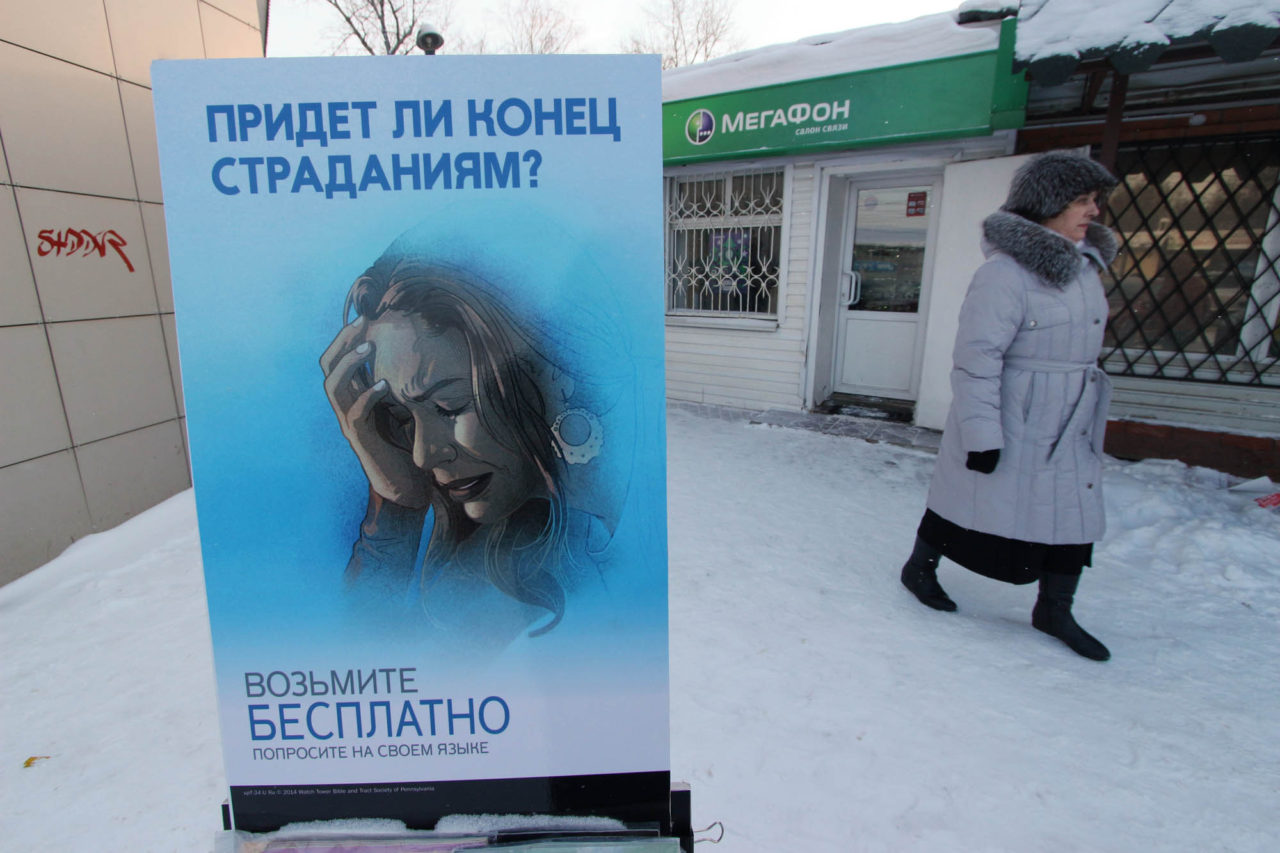
“Is there an end to your suffering? Take a copy for free in your own language.” Tuchkovo, Moscow Region. Photo courtesy of Alexander Artemenkov/TASS

This, however, did not lead to the eradication of the Jehovah’s Witnesses. Besides the three regions where they had constantly been active—Western Ukraine, Moldova, and Irkutsk Region—groups and organizations emerged in the sixties and seventies throughout nearly the entire Soviet Union from Arkhangelsk Region to the Maritime Territory, and from Turkmenistan to Uzbekistan.

The movement was spread by ex-camp convicts, labor migrants from regions where the doctrine was strongly espoused, and missionaries.

Soviet construction sites, new cities, and workers’ dorms were propitious environments for the spread of new religious doctrines. The young people who arrived to work there were cut off from their usual lifestyles, family ties, and interests. They wanted something new, including self-education and self-transfiguration—to gad about in suits and have their heads in the clouds. Most of these cadres were promoted through the ranks by the Communist Youth League and other authorities, but there were plenty of pickings for the religious organizations.

By the way, in 1962, Saprykin campaigned to get not just anyone to leave the Witnesses, but Maria Dosukova, a chevalier of the Order of Lenin, a longtime Party member, a plasterer, and an ethnic Kazakh. During an assembly at her construction company, Dosukova had refused to support a resolution condemning the religious organization in which several people in her work team were members.

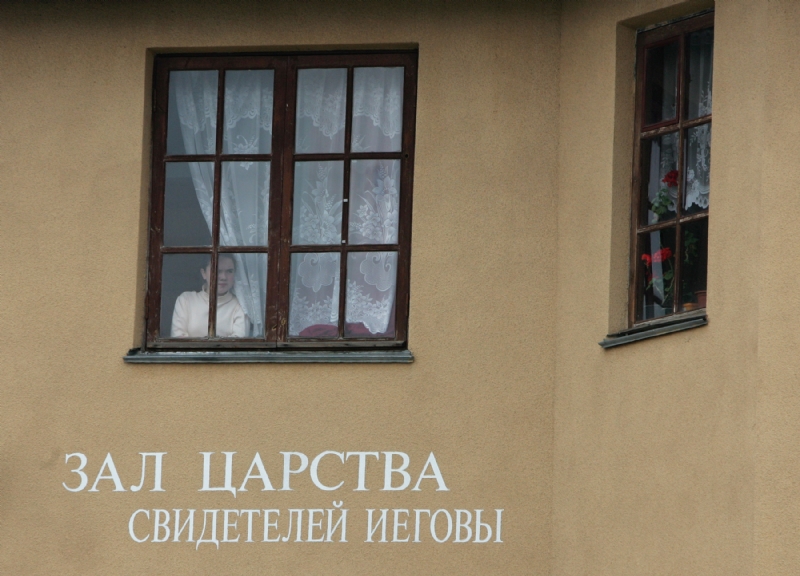
Kingdom Hall of the Jehovah’s Witnesses in Sochi, 2007. Photo courtesy of Natalya Kolesnikova/PhotoXPress

After Krushchev’s resignation, the systematic arrests of the Witnesses stopped, although some were sent to prison as a warning to the others.  Everyone else was subject to the decree, issued by the Supreme Soviet of the RSFSR, on March 18, 1966, “On Administrative Responsibility for Violating the Legislation on Religious Cults.” You could be fined fifty rubles—a week’s pay for a skilled worker—for holding a religious circle meeting in your home. In his book About People Who Never Part with the Bible, religious studies scholar Sergei Ivanenko records that, during the seventies and eighties, attempts to combat the Witnesses by fining them and tongue-lashing them at assemblies were just as useless. 

Wholehearted Anticultists

Perestroika legalized the Jehovah’s Witnesses throughout the post-Soviet space. This freedom did not last for long, however. The new states of Central Asia and the Transcaucasia followed the Soviet Union’s path in their treatment of the Witnesses, achieving similar outcomes.

In Russia, the Witnesses were officially registered in March 1991 and had no serious problems for a long time. They built their central headquarters, Bethel, in the village of Solnechnoye near St. Petersburg, as well as several dozen buildings for prayer meetings.  Of course, due to their activity, relative openness, and American connections, the Witnesses (along with the Hare Krishna, the Mormons, the Scientologists, and the Pentecostals) were targeted by the various hate organizations that emerged in Russia in the late 1990s, including the Cossacks, neo-Nazis, and professional anticultists.

Protest rally against the activity of Jehovah’s Witnesses in St. Petersburg, 1997. Photo courtesy of TASS

Anticultism was imported to Russia by the ex-Moscow hippie Alexander Dvorkin, who emigrated to the US in the 1970s and got mixed up in Orthodox émigré circles there. In the early 1990s, he left his job at Radio Liberty and returned to Russia, where he made a successful career at the point where the interests of the Moscow Patriarchate and Russian law enforcement agencies intersect. The above-mentioned Irenaeus of Lyons Center is, basically, Dvorkin himself.

Professor Dvorkin has worked for several years at St. Tikhon’s Orthodox University of the Humanities. Until 2012, he was head of the department of sectology. In 2009, he headed the council for religious studies forensic expertise at the Russian Federal Justice Ministry. (He now holds the post of deputy chair). It is curious that Justice Minister Alexander Konovalov is also a St. Tikhon’s alumnus and is quite proud of that fact.

005-5.jpg
Professor Alexander Dvorkin. Photo courtesy of Yevgeny Mukhtarov/Wikipedia

By supporting the Justice Ministry’s campaign to ban the Jehovah’s Witnesses, the Russian Supreme Court has not only put the “sectarians” in a difficult position but also the Russian authorities. In Russia, the Witnesses have over 400 local organizations and around 168,000 registered members. Only full-fledged members are counted during registration, but a fair number of sympathizers are also usually involved in Bible readings, The Watchtower, and other religious events. We can confidently say the ban will affect at least 300,000 to 400,000 Russian citizens. Labeling them “extremists” does not simply insult them and provoke conflicts with their relatives, loved ones, and acquaintances. In fact, this means abruptly increasing the workload of the entire “anti-extremism” system the Russian authorities have been setting up the past twenty years.  The soldiers of the Russian National Guard will find it easy to raid prayer meetings and spread-eagle these “extremists” on the floor. However, given the scale of the organization, they will have to do this a lot and often. And, as experience shows,  there won’t be much point to what they are doing.

Not a single country in the world has forcibly dissolved the Jehovah’s Witnesses, and it is hard to imagine that these 400,000 people will all emigrate or otherwise disappear. Even now, as news of the ban has spread, the Jehovah’s Witnesses have received completely unexpected support from all manner media and numerous public figures, including Russian Orthodox priests. Given these circumstances, the successful state campaign to discredit, dissolve, and brush a major religious community under the rug is doomed to failure.

Marquee being taken down from the Surgut office of the Jehovah’s Witnesses in connection with their ban in Russia, April 24, 2017. Photo courtesy of Alexei Andronov/Ura.Ru/TASS

The authorities will have to decide. Either they will sanction the mass arrests of the organizations leaders and activists and send hundreds and thousands of people to the camps, which ultimately will facilitate the growth of the movement’s reputation and dissemination, as in Soviet times, or they will pinpoint those who, according to the Interior Ministry and the FSB, are “especially dangerous” while turning a blind eye to the actual continuation of the organization’s work.

I would like the country’s leadership to have second thoughts and find a legal way to rescind the Supreme Court’s decision. There is little hope of that, however.

Translated by the Russian Reader

“Extremism” Ruling Against Jehovah’s Witnesses: The Popular Will?

OLYMPUS DIGITAL CAMERA Was it the “popular will” that 500 hectares of land be reclaimed in the Neva Bay right off Petersburg’s Vasiliyevsky Island and developed into densely built high-rise estates, causing untold amounts of environmental and aesthetic damage? No, it wasn’t. In fact, locals were bitterly opposed to the project and they mounted a loud resistance back in the day. But their will was roundly ignored by Petersburg city hall and developers. Under the present authoritarian regime, “popular will” is a friendly phantom, at best, an irritant, at worst. Photo by the Russian Reader

The Russian Supreme Court has gone ahead and banned the Jehovah’s Witnesses and ordered their property confiscated. This is a colossal insult to hundreds of thousands of law-abiding Russian citizens. A huge new underground has been generated. Massive crackdowns for their faith, new political prisoners, and mass immigration are around the corner. The Russian authorities and Moscow Patriarch Kirill, who is personally responsible for this operation, have curious ideas about the joy of Easter.
—Nikolay Mitrokhin, Facebook, April 21, 2017

Perhaps this is what is most disheartening about the recent legal battle. The state may be the central actor, but its actions reflect the popular will of Russians who, by and large, have decided that Witnesses have no place in their society.
—Emily Baran, “Jehovah’s Witnesses Ban Spells End for Russia’s Religious Diversity,” Moscow Times, April 24, 2017

When did Russians decide this? Did they hold a referendum recently? Are most Russians even aware of how the Justice Ministry has used the Russian Supreme Court to declare the Jehovah’s Witnesses “extremists,” allegedly, at the insistence of the Russian Orthodox Church’s Patriarch Kirill? I very much doubt it.

Professor Baran only mentions actions by state or quasi-state actors, such as the central press in Soviet and post-Soviet times. Yet they were and have been somehow acting on behalf of the “popular will,” a symbiosis she makes no real attempt to prove in her op-ed piece for the Moscow Times, as quoted above.

As for real popular sentiment, I imagine there are as many Americans as Russians who have reflexively negative attitudes toward Jehovah’s Witnesses. Just think of all the jokes about JWs you have heard in your lifetime that cast them in a negative or ridiculous light, or how many times you have seen their likenesses figuring as the villains on TV medical dramas who refuse proper care for desperately sick children? Then why aren’t they banned in the US? At worst, the American “popular will” sees them as outsiders and obscurantists, at best, as an annoyance.

I can imagine that tenure-track professors in the US have a hard time understanding how disempowered and disconnected the grassroots are in a country that now has the world’s largest income inequality gap, and a long, brutal history of minorities, including Jehovah’s Witnesses, getting hammered by the powers that be while putative “majority” either did not mind, looked the other way or did not even notice.

But does Tennessee, where Professor Baran teaches, have an utterly different history when it comes to protecting the rights of its minorities?

The Russian Supreme Court’s decision to declare the Jehovah’s Witnesses extremist is completely despicable in every possible way, but Russians who bother to care about minorities and “minority” interests (like the environment, civil and social rights, corruption, labor rights, migrant rights, and historical preservation and sound urban planning) are often too few and far between to fight every battle and put out every fire. And many of those fighters are themselves currently under the state’s gun. The same Justice Ministry that has gone after Russia’s Jehovah’s Witnesses like a pit bull has also been branding NGOs, research institutes, and grassroots organizations “foreign agents” like it was at a fire sale.

That is no excuse for the judicial execution the Russian state has just performed on the Jehovah’s Witnesses, but it was a decision made at the top by the political, ecclesiastical and judicial elites, including the ROC’s Patriarch Kirill. It was not the state’s response to a nonexistent, utterly imaginary “popular will.” {TRR}