Important Stories

The following two stories turned up next to each other in my inbox several mornings ago. The first story (about the hidden costs of common areas in Petersburg’s new estates) was promoted as its “Article of the Week” by the business daily Delovoi Peterburg, whose chronicles of post-Soviet capitalism on the march in my favorite city I have been reading and sharing here for two decades, usually against the grain. The second story (about how the authorities in Kaliningrad hushed up the recent death by self-immolation of an antiwar protester at the city’s main WWII memorial) was published by the exiled investigative journalism website Important Stories aka IStories, which is celebrating its sixth birthday. Seemingly written on different planets in different languages, they give an accurate sounding of the bewildered, muted condition of the “Russian soul” (i.e., Russian society) after four-plus years of a vicious, genocidal war unleashed by a thoroughly corrupt “post-fascist” dictatorship. ||||| TRR
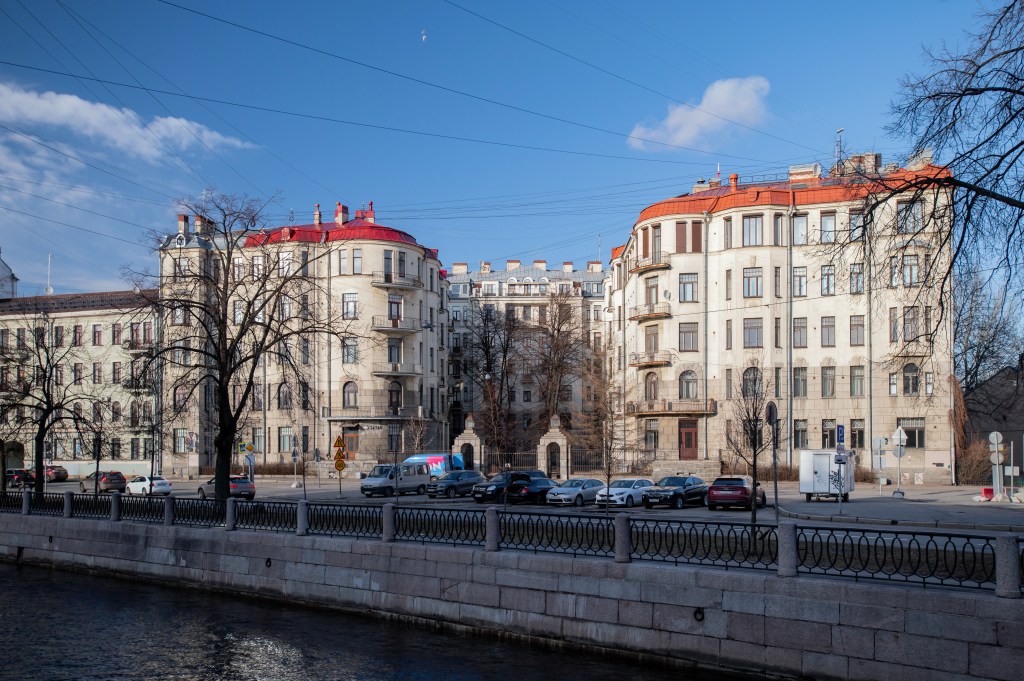

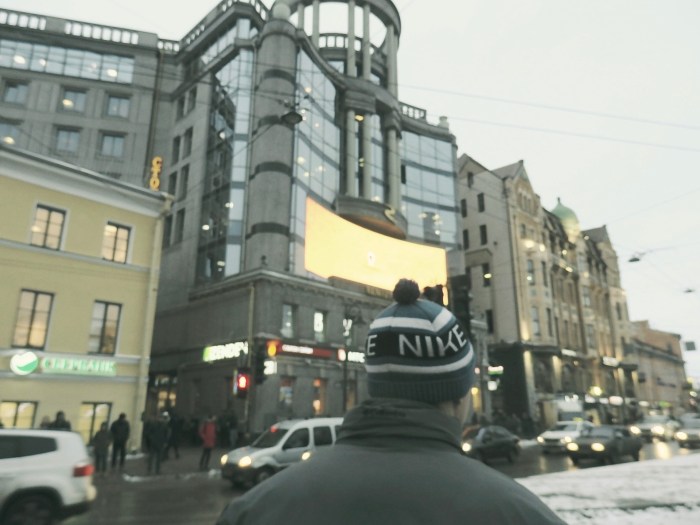
Photo: Sergei Yermokhin/Delovoi Peterburg

When she buys a flat—a fifty-square-meter flat, for example—a tenant also gets into the bargain several hundred square meters of lobbies, corridors, and stairways, for whose upkeep she will pay monthly. Those same square meters determine whether she will be able to squeeze past her neighbor in the lift lobby, whether it is easy to push a pram into the building , and whether coming home is a pleasurable experience.

The common areas are the only part of the apartment block the buyer does not choose although she passses through them every day.

How many square meters are not allocated to flats

The proportion of sellable space in apartment blocks depends primarily on their category.

“In the comfort class, the average is sixty-five to seventy percent; in the business segment, sixty to sixty-five; in the premium class, sixty; and it’s fifty to sixty for the elite class,” explains Olga Ryankel, head of residential property research at Nikoliers.

ELEMENT product director Alexander Matyushkin cites a target figure of up to seventy percent in his firm’s projects, with the actual average standing at around sixty-five percent

Lenstroytrest reports a ratio of seventy-five to eighty-two percent, and considers this to be balanced. According to Maxim Zhabin, development director at the Edino Group, the range for market heavy hitters hovers between sixty-five and eighty-five percent.

“If a developer artificially ‘squeezes’ common areas for the sake of the ratio, this is usually interpreted in practice as cutting corners on the facilities,” he says.

What constitutes non-residential space

An increase in total floor area is determined not by a single factor, but by a combination of factors, and the contribution of each depends on the project category and architectural designs.

In the mass-market segment, the primary contributors to floor area are landings, corridors, and stairwells. And yet, an increase in the number of lifts expands the non-sellable area by fifteen to twenty percent, smoke-free stairwells add a further eight to ten percent, and complexly designed building exteriors also increase the non-sellable perimeter, notes Matyushkin.

Zhabin also cites lift lobbies and stairwells as primary factors, adding to them the utility areas and entrance lobbies.

Optional spaces the developer includes over and above the standard requirements comprise a separate category.

Natalia Kukushkina, head of product and analytics at the CDS Group, differentiates between two categories of common spaces.

“The total floor area includes both essential elements, such as stairwells, basements, entrance lobbies, and communal facilities on each floor, spaces without which a building cannot be constructed, as well as spaces added at the developer’s discretion. These may include non-essential spaces such as spacious lobbies, coworking spaces, pram storage rooms, gyms, swimming pools, communal terraces on top floors, and so on.”

Where comfort ends and excess begins

Ultimately, each developer decides for themself how much common space to include in their project. Yekaterina Zaporozhchenko, chief executive officer at PRO Aparty, suggests a specific indicator: arrears on maintenance fees exceeding ten percent are a sign that residents do not feel the spaces they are paying for are value for their money.

“There should be just enough common spaces for them to be used, and the maintenance budget should not exceed the average figures for the segment,” she explains.

Yudita Grigaite, marketing director at Lenstroytrest, is convinced that excessive common space increases costs and operational burdens without adding any value.

Matyushkin highlights the reverse risk: excessive optimization is also dangerous. A shortage of lifts or narrow corridors diminish the quality of the built environment more than is apparent when a tenant is purchasing an apartment.

“A well-designed common space sets down a clear daily route from courtyard to flat without imposing unnecessary obstacles, and it provides practical arrangements for dealing with prams and deliveries, adequate ventilation and lighting, and clearly defined areas of liability,” says Zhabin in describing the working model.

Inefficiency arises when maintenance costs are high yet residents are unclear about what exactly they are paying for.

How square meters of common space are converted into a line item on the bill

The ratio of sellable space to total floor area translates into two figures residents encounter on a regular basis: the price per square meter at the time of purchase and the maintenace charges they pay after they move into their flat.

The math is straightforward: the higher the percentage of common space, the more expensive each square meter of living space. Developers figure the cost of building and finishing common space into the price of flats.

“The ratio between living space and total floor area directly impacts both the cost of a square meter and future operating expenses, all of which are reflected in the maintenance rates. Therefore, a building’s economic model should be balanced. The comfort of the common areas should be in line with the project’s class and the buyer’s expectations, while maintenance costs should be reasonable,” says Anzhelika Alshayeva, commercial director at the KVS Group, when asked to describe the process.

The difference in maintenance bills among segments is tenfold.

According to PRO Aparty, the difference ranges from sixty to six hundred rubles per square meter. Kukushkina warns of the scenario that this gap generates in practice.

“All additional expenses in a maintenance bill are regarded as too high, and some residents absolutely refuse to pay them. Ultimately, a building might end up with a swimming pool which is closed, a common terrace which is not cleaned, and facade lighting which is turned off.”

The third factor is density which, as Zhabin reminds us, is manifested in “queues to the lift, acoustics, and the amount of traffic in the courtyard,” that is, in factors which are not visible when potential buyers look at flats but which are felt daily.

What buyers don’t see

Ryankel notes a systemic problem in the mass-market segment: prams.

“Unfortunately, the spaces for storing prams and bikes are not separated n the majority of new apartment blocks, ultimately giving rise to a conflict of interests and the impossibility of organizing the space comfortably. And yet, developers often mention a pram storage area without specifying its size. As a result, a space of just seven square meters ends up trying to accommodate prams, bicycles, and tires.”

“Up to eighty percent of the user experience is shaped not inside their flat, but on the way there: from the building’s entrance to their front door. This includes logistics, how the lift works, acoustics, traffic flow, and the convenience of the infrastructure,” says Matyushkin.

There is also a time-related factor that is not taken into account at all when purchasing a flat.

Zaporozhchenko points out the costs of renovating furniture in common areas and maintaining the building’s utility systems after five to seven years, as well as keeping the building’s exterior clean—expenses that no buyer factors into their budget when signing the contract.

Zhabin adds that without a cleaning schedule and proper ventilation even the most luxurious finishes in a building’s entrance lobby will cease to feel “upscale” after a few years.

According to the market players surveyed, pressure on profit margins in the mass-market and comfort-class segments will soon compel developers to increase the share of floor space sold while maintaining visible indicators of quality, such as high ceilings in lobbies and high-quality finishes in entrance areas.

Club-style venues—coworking spaces, community centers, and gyms—will remain a key marketing tool, but some of them will be switched to a fee-based model or be leased out to external management companies on a commercial basis to ease the burden on utility bills.

The gap between rates in the mass-market and premium segments will continue to grow, along with the number of conflicts over maintenance bills in buildings whose infrastructure is at odds with the financial solvency of its residents.

Source: Pavel Nikiforov, “The non-residential building: what the tenant gets along with the flat,” Delovoi Peterburg, 5 May 2026. Translated by the Russian Reader


Information about the self-immolation of a resident of Kaliningrad born in 1988 in protest against the war was first published in an open report of the Estonian Foreign Intelligence Service. The authors of the report did not disclose the name of the deceased. We managed to find out the details of the incident together with Delfi Estonia and Lithuanian broadcaster LRT. We reconstructed what happened based on Russian Investigative Committee documents, conversations with Okunev’s relatives and colleagues, and European security sources.

Five CCTV cameras are installed in front of the 1200 Guardsmen Memorial in Kaliningrad, the USSR’s first monument to soldiers killed in the Great Patriotic War, 1941–1945. In the center of the memorial is the Eternal Flame. From time to time, various incidents occur near the memorial, which are then widely reported in the local news, and their perpetrators become the subjects of criminal cases. Since last year, for the “desecration of war memorials,” a sentence of up to five years in prison has been [stipulated].

Thus, in February this year, a drunken Kaliningrad resident wanted to light a cigarette from the fire and warmed his feet over the flames. In January 2026, a couple of residents stole a basket of flowers from the monument. In September 2025, another couple had sex at the memorial.

Six months before that, around 5 am on February 24, 2025, 37-year-old Kaliningrad resident Alexander Okunev burned himself alive at the memorial to 1200 Guardsmen in protest against the war — and no one found out about it.

“He was sitting in a corner, not where all the people were”

In the 2010s, Kaliningrad earned the title of the protest capital of Russia, and a series of large-scale rallies even led to the replacement of Governor Georgy Boos.

However, since the start of the full-scale war in Ukraine, the city has not exhibited any notable protest activity. In the first days of the invasion, a wave of anti-war actions swept through Kaliningrad. At one point, the city became a leader in the number of protocols issued for “discrediting” the army. But almost immediately, protests died down as they did throughout the country. Igor Luzin, a Kaliningrad activist and former employee of Navalny’s local headquarters, explains that the “political field” in Kaliningrad has been cleaned up just like the rest of Russia.

Alexander Okunev was not an activist. He avoided talking politics at work (he was a sysadmin at a firm selling retail equipment), did not argue about the full-scale war with his family, and apparently was not active on social media. Okunev had almost no friends, had no girlfriend, and lived alone.

He practically did not talk to his colleagues, could ignore even his superiors: he could keep silent in response to a greeting or not answer the questions. At corporate parties, New Year’s Eve, for example, he tried not to leave his office.

“Was sitting there in a corner, not where all the people … Somehow always in himself, lived his own life,” recalls his former colleague. “Closed. Strange.” However, there were no complaints about his work: “His programmer’s brains were cool”. His colleague believes that Alexander could have made a good career, “but it feels like he didn’t care much about money”. When Okunev decided to quit (about six months before the incident), everyone was upset.

“We asked him, have you found another job? No. Are you going somewhere? Maybe. No one had any idea what or why he left,” says his former colleague. Acquaintances call Okunev “kind, responsive, fair”: “He always helped everyone”. He was fond of origami, and when one of his colleagues had a birthday, he could secretly put “some flowers” on their table. Regarding his hobbies, people close to him say that he liked to watch movies and ride a bicycle.

After the dismissal, Okunev really did not find another job. “Sat at home, practically did not communicate with anyone,” heard his ex-colleague.

Cleanup

Having decided on such a desperate protest act as self-immolation, Alexander Okunev did not seem to be trying to attract attention. Maybe he was afraid that someone could stop him. But he obviously chose the date (the anniversary of the Russian full-scale invasion of Ukraine) and the place (the main war memorial in the city) for a reason. Perhaps the time too: the Russian missile struck Kyiv on February 24, 2022, began just about five in the morning.

Okunev’s charred corpse, despite the numerous cameras at the memorial, was discovered by a random passerby only at around 6:40 a.m. The snow appears to have been spray-painted with the words “No to War”. Employees of the investigative department for the Leninsky district of Kaliningrad went to the scene. In the report of the events of the night, Okunev’s self-immolation is mentioned along with reports of two other corpses and a ninth-grade girl who had left home.

The incident was reported to the head of the city administration, Elena Dyatlova. She immediately took everything under her control, the European intelligence officer knows. She was assisted by Evgeny Maslov, head of the local service for the protection of cultural heritage. The main thing for them was to quickly get rid of the body and the words on the snow — the officials were worried mostly that journalists would know what happened. The Minister of Culture and Tourism of the Kaliningrad Oblast, Andrey Yermak, was especially worried that the self-immolation took place near the monument of the Great Patriotic War — too symbolic.

Everything was settled by 9:15 am. Traces of the incident were removed, and authorities were relieved to report to the local governor and other local officials that no one had seen anything, the source of IStories Media said.

Information about the self-immolation of an unnamed Kaliningrad resident first went public only along with a report by Estonian intelligence in the winter of 2026: “On the third anniversary of Russia’s full-scale war, at five o’clock in the morning on February 24, 2025, a man born in 1988 wrote ‘No to War’ in the snow near the monument to a Russian soldier in Kaliningrad and set himself on fire in protest.”

None of the Kaliningrad media ever reported the news. There were no local or propaganda Telegram channels or other social media posts about Okunev. [Alexander’s] family did not spread the word about the incident either. “What’s the point of somehow publicizing and telling all this? What for?” one of them told reporters.

“There is another way”

An acquaintance of Okunev says that on the eve of his suicide, he behaved “absolutely normally.” There was no hint of what he was going to do, and “what happened came as a shock to everyone.” Okunev’s relatives speak of some “expert examinations” conducted as part of the investigation, which found that “there was no outside influence” on A[l]exander. The family was questioned by the local Investigative Committee; the police came to Okunev’s former colleagues for a “character [profile]” but came away with “Worked well, did not communicate with anyone.”

A close friend of Okunev recounted to IStories Media the content of his suicide note.

“He wrote that there is another way. Apparently, he meant a world with peace. And he didn’t want to live in the world we have, so he made this decision… But we are all aware that world peace is a utopia.”

The note also shows that Okunev understood that “most likely, it will not be in the news anywhere, it will not be widely covered anywhere,” the source tells IStories Media.

Elena Maslova, head of the Kaliningrad administration, and Evgeny Maslov, head of the cultural heritage protection service, have not responded to journalists’ requests.

Culture Minister Andrei Yermak replied that he was not familiar with the results of the investigation of this “accident”, so he would not comment on anything. He expressed confidence that law enforcement agencies “will comment on the situation as soon as the investigation is finalized.”

“These people are afraid not of the people, but of their superiors”

In January 1969, the self-immolation of Jan Palach, a philosophy student at Charles University, brought tens of thousands of people onto the streets and became a symbol of resistance to the Soviet occupation in Czechoslovakia. The self-immolation of street vendor Mohammed Bouazizi provoked mass protests in Tunisia, which eventually led to the resignation of the country’s president.

In Russia, the self-immolations of journalist Irina Slavina and Udmurt scientist Albert Razin did not lead to any notable collective action. Could Okunev’s suicide have provoked some protest if people had learned about it?

Sociologist Margarita Zavadskaya thinks not.

“Self-immolation is a powerful symbolic act,” she says, “but public outrage alone is not enough to trigger large-scale collective action under conditions of severe repression and limited access to information.”

So why did the Russian authorities try so hard to conceal information about what happened? To prevent “protest contagion” and imitation, she explains. Moreover, such an anti-war suicide contradicts the government’s theory of a universal public consensus on war. And local officials would look incapable of maintaining control in the eyes of their superiors.

Political scientist Ekaterina Shulman also does not believe that fear of further protests was behind the Kaliningrad authorities’ actions.

“Local authorities are not afraid of the people, not of protests. They are afraid of their superiors,” she says, “they were afraid to hear: ‘You oversaw, allowed a scandal, there are media publications, what do you eat your bread for?'”

“Authoritarian regimes are afraid of symbolic sparks. They understand that a single act of protest may not cause an immediate mass movement, but can become a moral symbol around which scattered anxiety and discontent begin to crystallize,” says Lithuanian political scientist Nerijus Malukiavicius. “That is why such regimes seek to ‘clean up’ the scene, silence history, and discredit the victim.”

Source: Maria Zholobov et al., “He Burned Himself Alive to Protest Russia’s War in Ukraine. The State Tried to Erase Him,” Important Stories, 6 May 2026. A disturbing caveat appears above the English-language version of the article: “AI based translation. If you find a mistake, please highlight it and press Ctrl + Enter.” ||||| TRR

Yegor Galkin: “You Look Out and See Everything Is Ugly”

“You Look Out and See Everything Is Ugly”: How a Barnaul Resident Took Charge of the City’s Grassroots Urban Activist Group
Alexandra Romantsova
Takie Dela
October 17, 2019

In a series of monologues entitled “Close to the Heart,” Takie Dela hands the microphone to residents of Russia’s regions whose personal involvement and willingness to act are gradually changing their local communities. The star of our second installment is Barnaul resident Yegor Galkin, head of Spire, a local grassroots group.

How do I want my city to look? How can I change the space in which I live? Five years ago, a schoolboy from Barnaul sought answers to these questions, learned about the work of Spire, and became interested in urban planning.

galkinYegor Galkin. Photo courtesy of Mr. Galkin and Takie Dela
Spire, a grassroots group, emerged in 2013 amid the popularization of urban planning in Russia. Its founder, Sergei Ustinov, is a well-known big data expert: he created a nation-wide map of road accidents in Russia. In 2013, the group established its presence on social networks and started doing walks in the city and making photographs. I joined the project in 2014, which was when we launched a map of grassroots proposals in Barnaul. This has been our group’s main focus.

We developed a large interactive map of Barnaul where any resident could leave his or her proposal for beautifying and improving the city. Any user could vote these proposals up or down. Based on the results of the voting, we would send requests to the authorities. We wanted to interact directly with Barnaul city hall and the government of the Altai Territory, but we were ignored. We had over 500 proposals, for which 3,000 votes were cast on our website. Those were huge numbers for Barnaul. After a while, some of the proposals were implemented. This was due to our written requests, but also because some of them were too obvious to ignore.

We still are not in a direct dialogue with officials. Instead, we have learned how to work through the media: they hear us and react. If we have found an irregularity, they try to fix it. For example, the city had a contract for erecting fences, but they were not erected, although they existed on paper. After we wrote about this, the fences went up the next day. I am against fences, but an irregularity is an irregularity.

Our work can be divided into several categories: planning (like the map of grassroots proposals), fighting for green areas, work on the city’s master plan, and daily work by experts, including environmentalists and urban activists. They find irregularities in the city’s improvement and road repair projects, check them against the official paperwork, and publish their findings. This is all done for free: we have no funding. Our desire to change the city and our initiative drive everything we do.

When urbanism first came to Russia,  people didn’t know what it was and how it could improve their lives. When they went to Europe, people sensed things could be different in Russia. We quickly found a common language with people like this. We would tell them what we could do in Barnaul to make life more comfortable, such as introducing dedicated bus and bike lanes and improving public transport.

At first, many people had a hostile reaction to these ideas. They said we needed to expand roads to accommodate more cars. Every group that tackles urban problems is confronted with this reaction. When we started talking about public spaces, however, we found lots of new allies.

Everything always begins with the individual: how would I like to see the city? Personal comfort is important. That was why it captivated me. I began studying the subject, reading a lot and looking at different proposals and projects. Now it is a scholarly interest because I am studying political science. Urban planning and urban reform are impossible without politics. I am curious about the evolution of cities, demographic processes, and gentrification’s impact on urban development. I’m a grassroots urban activist and I want the city to be better.

We have been fighting for Barnaul’s green areas. In 2015, we did our first big project about city parks, which dealt with their current state. While everyone in Moscow knew what was happening in the city’s parks, people in Barnaul didn’t know anything. In 2016, we did the project again, this time in cooperation with a local news website and professional photographers. We made a video using quadcopters. And we spelled out the problem: nobody was taking care of the parks. Some of them had been subjected to deforestation, while others were so badly neglected it was dangerous to go there.

Barnaul has a population of 700,000, and there used to be six city parks. Now there is one official park that is still open. The other parks lost their official status and no one has been managing them. This is a big problem for Barnaul. We are surrounded by old-growth forests, but there are few green spaces in the city itself.

The bulk of the people who subscribe to our group’s social media pages signed on when we raised these issues. People voiced their support and willingness to engage in joint action. Half of Emerald Park was logged, sparking a lively protest over the fact that the city’s green areas were neglected. Whereas there had been no reaction from the authorities in 2015–2016, the issue has finally been raised at the regional level in 2019. Recently, we had a round table at the Altai Territory Legislative Assembly on the topic of green areas in the city.

We raise the hot-button issues in Barnaul. If they are written about, people know about them, and city officials have to react. Our experts are so good that when city hall officials hear their names they freak out. All of the publications posted on our social media pages are read by the prosecutor’s office and the investigative agencies. If there are irregularities, they conduct inquiries.

We have now been trying to establish relations with the district councils. We are getting ready to present our draft project for a park area, a project we did in keeping with all the canons of urban planning. We did surveys of the area in summer, autumn, winter, and spring, as well as research on how people navigate parks. The project for this park will soon be open to feedback from any and all residents of Barnaul. I think it will be interesting and beneficial. I don’t recall that a grassroots undertaking like this has ever been implemented in the regions.

Judging by polls, people want to see quality. The canons of urbanism and notions of proper improvements to amenities can be captured in the phrase “quality infrastructure,” meaning infrastructure that is sound, convenient, comfortable, and safe. People have the same idea: they want to live in a safe and pleasant green space. There is popular demand for quality urban improvements.

An important thought for all grassroots groups is that you need to do what you do and do it well. If you see a problem you need to make sense of it and talk about it. You have to recruit experts and not be afraid of communicating with the authorities, of building a dialogue with regional parliamentarians, city councilors, and district councilors so everyone has a stake in solving the problem. You have to voice your proposals and, most importantly, spark the interest of groups that can impact decision-making. Merchants, authorities, city councilors, political parties: you need to interact with everyone. An urban activist is a person who thrives on interaction and dialogue.

Translated by the Russian Reader

Atlantic City

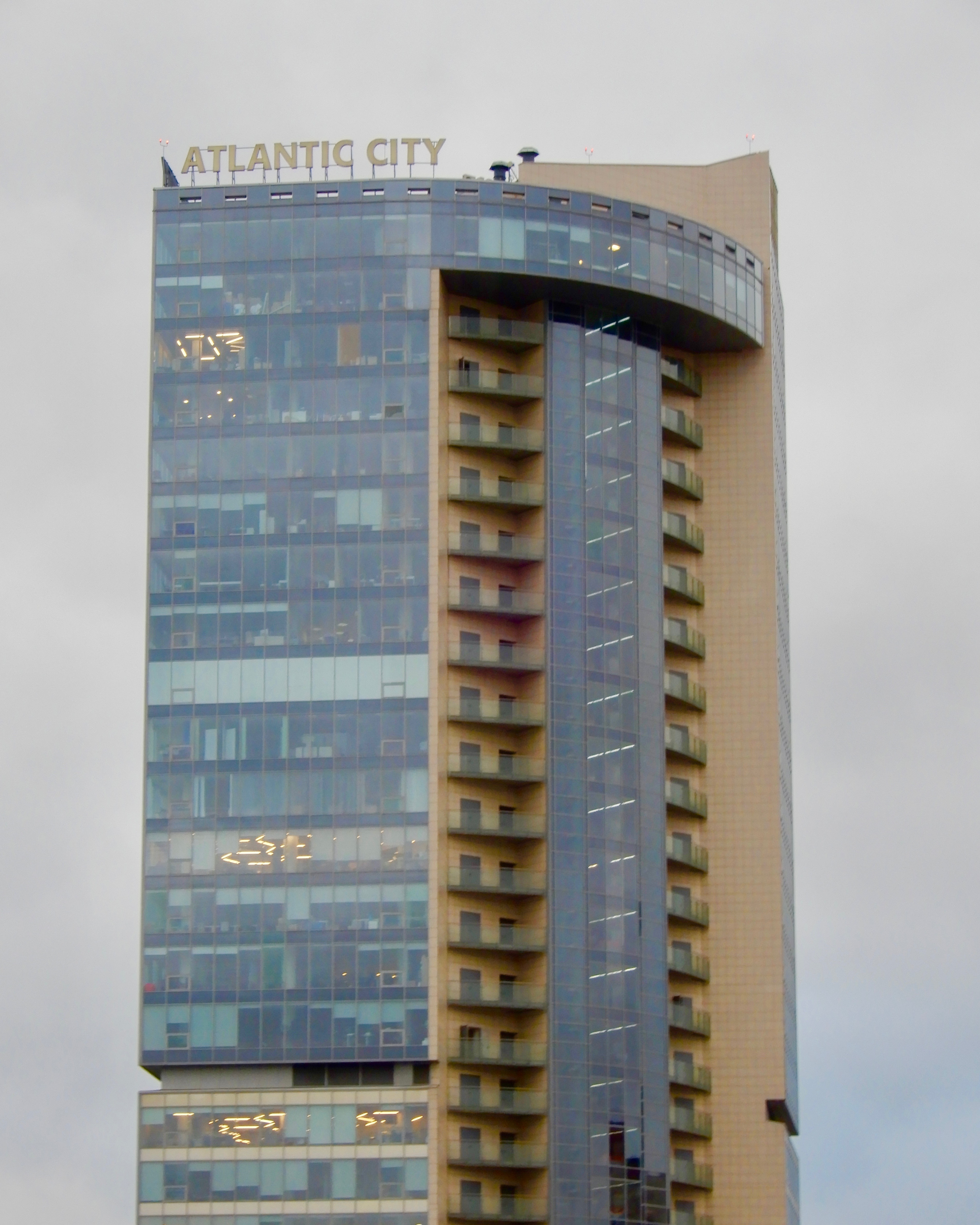
There could hardly be a place in Petersburg more dispiriting than the far west end of Savushkin Street (of troll factory fame), but the sheer dreadfulness of the post-Soviet new estates, business centers, and shopping malls that have sprung up there and all around the city’s outskirts is exacerbated by the tendency of their developers to burden them with impossibly escapist and chirpy monikers. So, I emerged from the new Begovaya subway station last Sunday to find myself (briefly) in Atlantic City. {TRR}

atlantic city-1

atlantic city-2

Photos by the Russian Reader

________________________________

The Gated Community

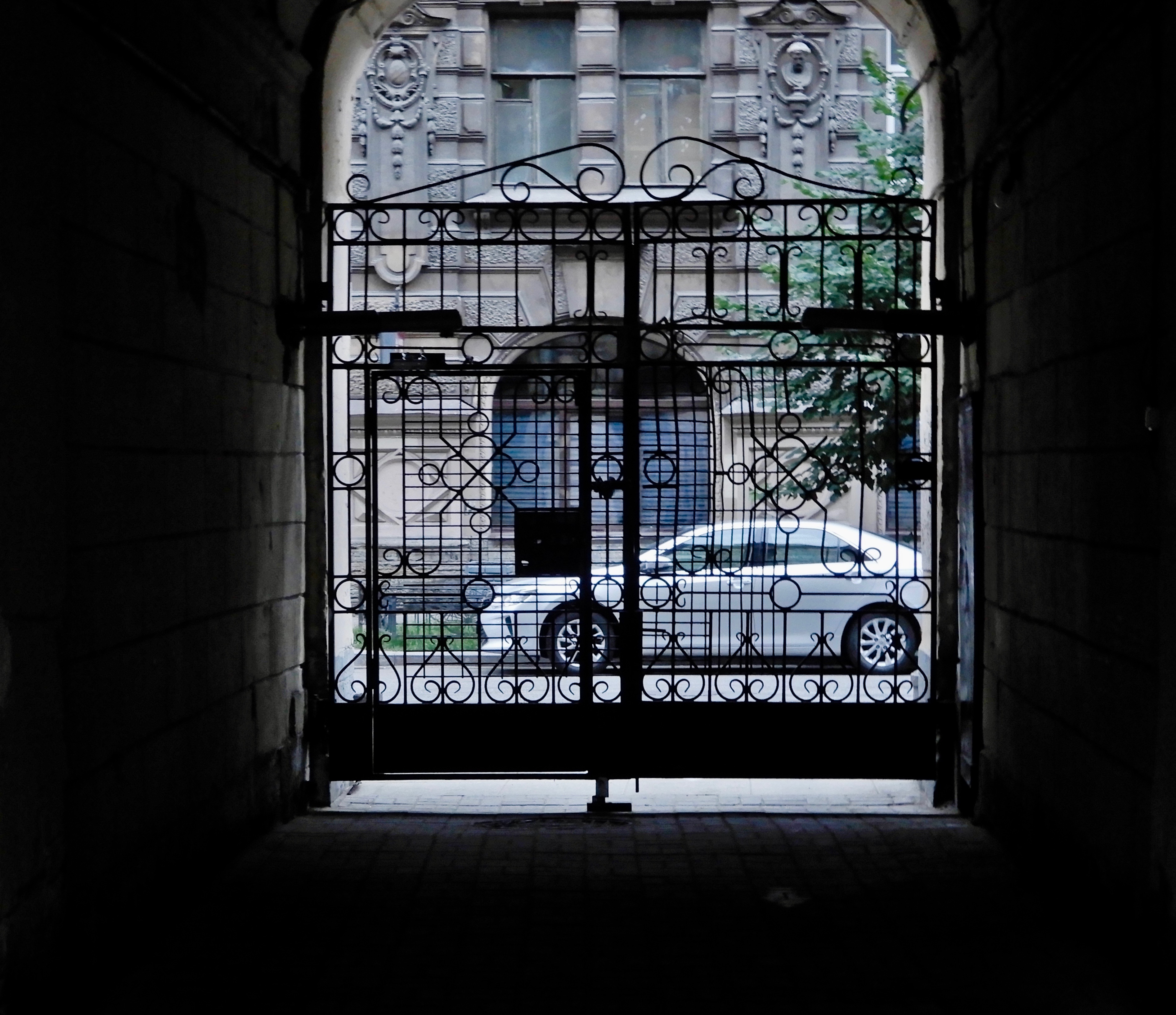
DSCN9429Courtyard gate in Petersburg’s Central District. Photo by the Russian Reader
Behind a Fence
Dmitry Ratnikov
Delovoi Peterburg
September 27, 2018

Remember the golden days when you could walk into any courtyard in central Petersburg and get a taste of the city’s flip side, or simply shorten your way from one alley to another by taking the backstreets? Yes, you would find yourself in the midst of unsightly façades, graffitti, and smells. But these things have not gone away, while navigating the city on foot has been made more complicated by endless gates and intercoms.

After the terrorist siege of the school in Beslan, large numbers of educational institutions suddenly fenced off their grounds, as if the cause of the tragedy had been the absence of a fence. Consequently, the numerous footpaths in the bedroom communities which ordinary folk had used for decades to shorten their way from subway to home, for example, vanished.

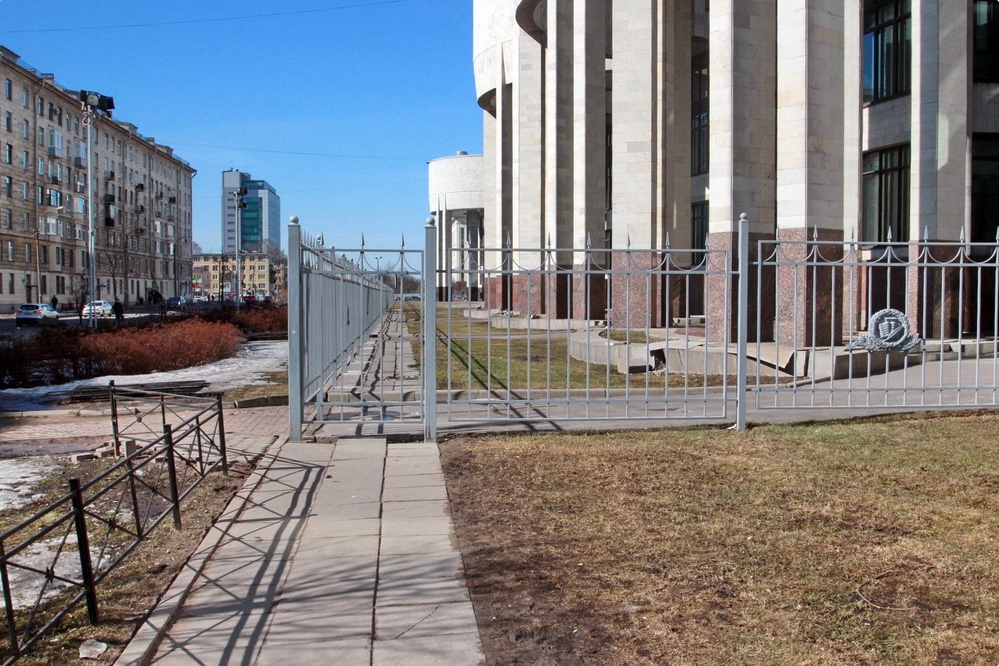
It was not only schools that hid themselves behind bars. Nearly all state institutions did the same thing. The Russian National Library is a vivid example of this. Its old building on Moscow Avenue can be freely approached, while its new building on Warsaw Street is protected by a metal fence that cuts off the library’s paved footpaths. I would urge the library’s director, Alexander Vershinin, to remove the fence. No one is planning to steal your books. It’s stupid.

ratnikov-warsawkaRussian National Library building on Warsaw Street in Petersburg. Photo by Dmitry Ratnikov. Courtesy of Kanoner

Fenced lawns have been proliferating at an incredible rate in the yards and on the streets. The lawns are not protected from wayward drivers, but from planned footpaths. People find it convenient to walk directly from a traffic light to a store, but thanks to thoughtless officials, they have all instantly become potential lawbreakers, because planners designed a path with a ninety-degree angle.

And what do you make of the fences around gardens and parks? One would imagine these are places of public access, but no, entrance is strictly limited. Why is a fence now being erected around the park of the Orlov-Denisov Estate in Kolomyagi? People got along fine without it. Why was the grille around the Upper Garden in Krasnoye Selo restored? Why is the garden outside Vladimir Cathedral nearly always closed to parishioners?

“To keep drunks from staggering around there,” a female attendant at the cathedral once told me.

The argument is absurd. What is the percentage of drunks amongst those who would enjoying sitting on a bench in the cathedral garden? It’s tiny.

gate-2Courtyard gate in Petersburg’s Central District. Photo by the Russian Reader
There are other cases when public green spaces are completely fenced off from the public. You cannot enter Edward Hill Square, for example. The question begs itself. Why did Petersburg Governor Georgy Poltavchenko endow the square with that name when there was an intercom on the gate? You cannot get into the little garden on the corner of Kirillovskaya and Moiseyenko Streets, or the little square at 6 Svechnoy Alley. How do local officials respond to these problems? They either postpone making a decision for years, as happened in Svechnoy Alley, or they make a great show of opening the gate during an official inspection, as happened on Moiseyenko Street.

There are also positive examples, however. The unauthorized DIY fences at 3–5 Troitsky Avenue have recently been dismantled.

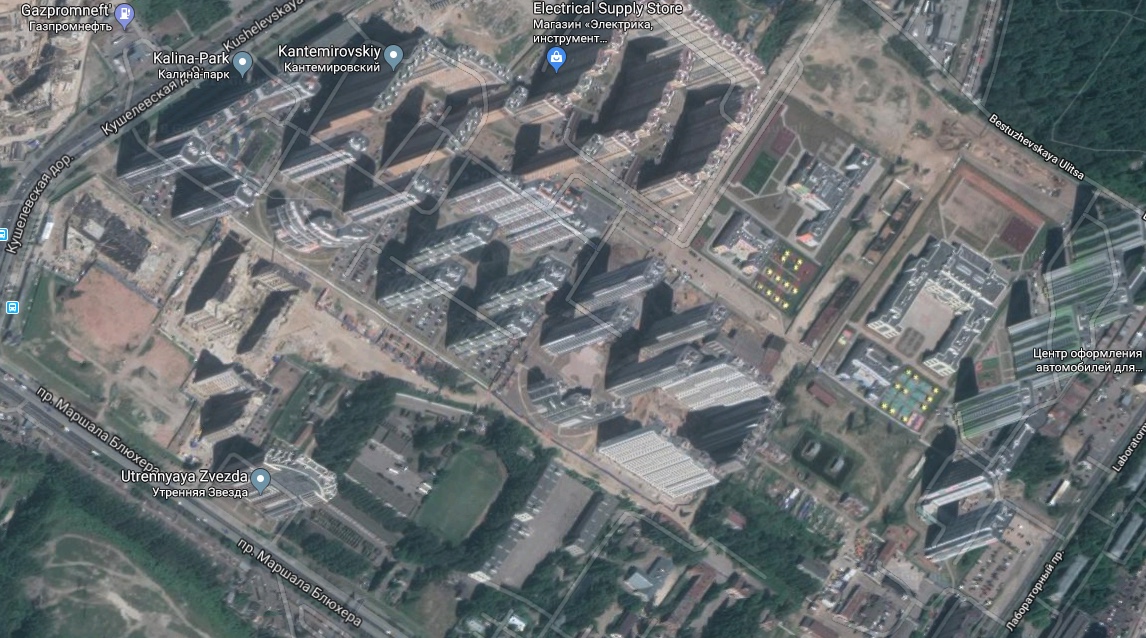
A scandal has, allegedly, erupted in the new, densely populated area between Kushelev Road and Laboratory Avenue. The local property owners association voiced the desire to erect a fence around the perimeter of its grounds, thus cutting off the way to the local school. Ultimately, the locals report, they would have had to take their children more than a kilometer around the fence instead of walking a few hundred meters in a straight line, as they do now. Residents wrote things like “If they put it up, I’ll cut it down at night with an angle grinder” on the local internet forum.  This is not to mention the stupidity of the planned fence. It is no problem to gain access to the courtyard due to the huge numbers of residents going back and forth through the gate every thirty seconds, if not more frequently.

kushelev-laboratoryA satellite view of the new estate between Kushelev Road and Laboratory Avenue, in the north of Petersburg. Courtesy of Google Maps

In southwest Petersburg, a petition is making the rounds to close the entire courtyard of a new residential complex to cars. But what does that mean now that many developers are themselves advertising such monstrous car-free courtyards? You wonder why I have used the word “monstrous”? Because developers should solve the parking problems in their new estates, not the municipal government. If developers build a hundred flats, they should provide a hundred free parking spots. Due to the fact that Seven Suns Development erected a huge “anthill” on Krylenko Street, featuring a “car-free courtyard,” all the lawns and clumps of land in the vicinity have been turned into a single hefty parking lot that has made it difficult to drive down the street to boot. Why should the city permit a commercial firm to generate a problem from scratch that the city will have to solve, for example, by spending public monies on parking barriers?

seven suns krylenkoAn artist’s rendering of the “anthill” on Krylenko Street. Courtesy of Kanoner

And what kind of fences do we build at our summer cottages? Instead of pretty, cozy hedgerows, many of us prefer sheets of corrugated steel without a single break in them.

Given our maniacal, senseless desire to hide from the world around us, what will become of us? Are we headed towards the city-state depicted in Zamyatin’s novel We?

Dmitry Ratnikov is editor of Kanoner, an online newspaper that indefatigably reports on developments in architecture, city planning, and historical preservation in Petersburg. Translated by the Russian Reader

Vladimir Mayakovsky, “Zigzags in the Evening”

astral plane.jpg

Vladimir Mayakovsky
Zigzags in the Evening

The windows shattered the city’s colossal hell
Into minuscule light-sucking hellets
The cars cavorted like rust-colored devils
Horns exploding in the ear like rockets

And under the sign for herring from Kerch
An oldster, run over, groped for his glasses
And wept when amid the evening’s lurch
A tram threw up its pupils at a dash

While in the holes of skyscrapers where ore blazed
And tunnels were piled by the iron of trains
The aeroplane yelled crashing into the place
Where the injured sun’s eye drained

And finally balling up the blankets of gaslights
Loved out the night was drunken and a mess
While somewhere beyond the suns of streets
Hobbled the moon flabby and utterly useless

Photo and translation by the Russian Reader. Thanks to Comrades Stas and Lena for the heads-up. Originally published in the Futurist anthology Milk of Mares (Moscow: Gileya, 1914), the poem was later republished in a slightly different rendering, featuring punctuation marks, as “The City’s Colossal Hell.”


Quarenghi in the Concrete Jungle

Quarenghi in the Four Fools District
Natalia Vvedenskaya
Gradozaschitnyi Peterburg
October 13, 2017

I have lived nearly all my life in a neighborhood built in the mid 1980s and nicknamed by locals the “four fools district” in honor of the street names: Mentors Avenue, Shock Workers Avenue, Pacesetters Avenue, and Enthusiasts Avenue. The neighborhood is populated with late-Soviet cookie-cutter buildings: a block of 16- and 14-storey residential buildings, a supermarket, school, and kindergarten, following by another block of identical residential buildings, a post office, medical clinic, an identical supermarket, and identical school.

But sometimes you encounter remnants of the previous civilization among the gigantic prefab Lego sets.

“Zhernovka, a Forgotten Eighteenth-Century Suburban Manor on the Okhta River” was the title of an article published by Nikolai Lansere. The article actually reopened the landmark to architecture lovers. You could write an article about Zhernovka with the exact same title now, nearly a hundred years later, because the estate, which has miraculously survived on the border of an industrial park and high-rise housing district, has been abandoned and forgotten once again.

The renowned architect Giacomo Quarenghi eretcted the manor’s main building in the 1790s. It was built for Gavrila Donaurov, an official in the chancellery of Emperor Paul I. Quarenghi also built an entrance gate and pavilion-cum-pier on the banks of the Okhta, which have not survived. The estate was surrounded by a landscape park.

In the mid nineteenth century, the estate was taken over by the Bezobrazov family, and so it is also referred to as the Bezobrazov Dacha.

Zhernov’s plight after 1917 was tragic and typical. First, it served as a club for workers, then a warehouse, and then a cowshed. The interiors were destroyed to make way for a dormitory, after which “the building’s architecture was disfigured by a reconstruction that was not completed.” The landscape park disappeared after the war.

In 1973, Zhernovka was transferred to Orgprimtvyordsplav, a Soviet enterprise that worked with restorers for ten years to revive the building. Extensions were demolished, the pond was dredged, new trees were planted, and two main rooms, the parlor and a bedroom, were restored.

In 2014, the Soviet company’s successor, Kermet, Ltd., ceded its rights to the estate. Since then, the building has been managed by the Agency for the Management and Use of Historical and Cultural Landmarks (AUIPIK), which has been trying to find a new owner for it, so far unsuccessfully.

However, if you compare Zhernovka with a nearby eighteenth-century landmark on the Okhta, the Utkin Dacha, Zhernovka looks halfways decent. Although the building is not in use, it is guarded and heated, and work has been underway to reinforce the foundations.

By the way, the park is open to visitors in the afternoons. You just have to push open the impressive gate with the coded lock on it.

You can find a detailed history of the estate on the Walks around Petersburg website (in Russian).

My excursion was arranged by Open City, a project for familiarizing Petersburgers with the city’s cultural heritage and opening the doors of historical and cultural landmarks, many of which are inaccessible to the general public for various reasons.

The editors of GP thank Open City for the chance to visit the estate. They also thank tour guide and Okhta landmarks researcher Natalia Stolbova.

Translated by the Russian Reader


Stanislav Dorochenkov: Afterword to the Pamphlet of 1942

Afterword to the Pamphlet of 1942
A film by Stanislav Dorochenkov, 2012
28’46”
Featuring Maxim Egorov, O.A. Belobrova, Lydia Smirnova
Camera: Boris Belay
Editing: Claire Beuneux
Directed by Stanislav Dorochenkov
Re:voir Films Paris

In 2010’s stifling heat in St. Petersburg, the regime and the mafia orchestrate the destruction of the city’s heritage for the sake of the nouveaux riche’s luxury. The attempt to remember helps me. I present a little known text by someone who defended this city, Dmitry Likhachev. Several times, he saved it alone by opposing the collective decisions of the Communist Party, thus rebutting an old Russian saying that I would translate roughly as “One man cannot fight an army.”

One can.

I see the phrase “Death will more likely be afraid of us than we of it,” engraved on one of the three stelae at the Piskaryov Memorial Cemetery, placed over the endless mass graves where the millions who died during the Siege of Leningrad lie.

With my Éclair camera, I walk the city during the White Nights to rediscover the  magnificent light of transparent twilight that transforms Petersburg into “the most fantastic city in the world.” The texts of the Russian chronicles (The Hypatian Chronicle, The Laurentian Chronicle, and The Lay of Igor’s Campaign) appear before me, following a broadcast inspired by Likhachev. I become aware of the ancient words, the most accurate account of the disaster of human forgetfulness.

Source: Dérives.tv

Annotation translated, from the French, by Comrade Koganzon and the Russian Reader

Farewell to Matyora

imag2621

Experts Predict the Closure of All Rural Hospitals by 2023 
Ilya Nemchenko
RBC
December 9, 2016

If the number of social welfare institutions continues to decrease at the same pace, there will be no hospitals in rural areas within seven years. Experts argue that all rural schools and medical clinics could be closed within seventeen to twenty years.

Due to “optimization” processes, over the past twenty years, rural areas have lost much of their social infrastucture, experts at the Center for Economic and Political Reform (CEPR) have concluded. In report entitled “Russia, Land of Dying Villages,” they note the numbers of hospitals, schools, and clinics in rural areas will continue to decline in the coming years. RCB has a copy of the report.

Based on Rosstat’s data, the CEPR has calculated that, over the past fifteen to twenty years, the number of rural schools had shrunk by nearly 1.7 times (from 45,100 in 2000 to 25,900 in 2014), the number of rural hospitals by four times (from 4,300 to 1,060), and the number of rural clinics by 2.7 times (from 8,400 to 3,060).

The upshot is that all rural hospitals could close in seven years, while all rural schools and clinics could close in seventeen to twenty years, claims the report.

“It is clear that this is not possible and that all ‘optimizations’ have their limits. However, there are fears that social welfare institutions will continue to close in the countryside in the coming years, albeit at a much less impressive pace,” write the report’s authors.

The optimization of schools and hospitals is often justified by decreases in population, although it is socio-economic problems that facilitate flight to the cities. The experts argue the government has deliberately pursued a policy of depopulating rural areas and has deprived the countryside of its “last hope for the future.” They call the current circumstances a vicious circle. Optimization of social welfare facilities has proceeded at a much faster rate than rural depopulation and the abandonment of villages.

According to the report, the rural population has been in constant decline over the past twenty years. This has happened due both to migration outflows and the fact that the death rate has exceeded the birth rate. The number of deserted villages increased by more than six thousand from 2002 to 2010, to 19,500. Moreover, less than one hundred people live in more than half of all rural settlements.

The experts note that while the number of depopulated villages has continued to grow in Central Russia and the north, rural areas have been developing vigorously in the south. In 2016, the North Caucasus Federal District had the largest population in terms of percentages (50.9%), while the Northwest Federal District had the lowest (15.8%).

The study underscores that the main causes of depopulation in the countryside are social and economic problems. The standard of living is low in rural areas, while unemployment is relatively high, and this has spurred a growth in the crime rate. The experts note that prices in rural areas are high, so country dwellers spend more money on food than city dwellers do.

Population outflow has also been due to the poor quality of utilities and housing. According to the CEPR, only 57% of rural housing stock is supplied with running water, while only 33% of houses have hot water. The condition of the water mains in the countrsyide has constantly grown worse: only 54.7% of residents are supplied with safe drinking water. The experts note that only 5% of villagers have sewers. (This figure has not changed since 1995.) However, the provision of natural gas is relatively better. According to Rosstat, approximately 75% of the rural housing stock is supplied with pipeline or liquefied gas.

The CEPR’s researchers write that the government policy has concentrated capital, jobs, and people in the large cities, while attempts to maintain the rural population have failed, because there are no conditions for developing the villages. The experts believe that comprehensive socio-economic reforms are needed to solve the problem. Otherwise, the number of deserted villages will have increased by the time of the next census.

Translation and photo by the Russian Reader

See some of my previous posts on life in the Russian countryside:

Victoria Lomasko: Truckers, Torfyanka, and Dubki

Victoria Lomasko
Truckers, Torfyanka, and Dubki: Grassroots Protests in Russia, 2015–2016

In late February 2015, politician Boris Nemtsov, a leader of the Russian opposition, was gunned down near the Kremlin.

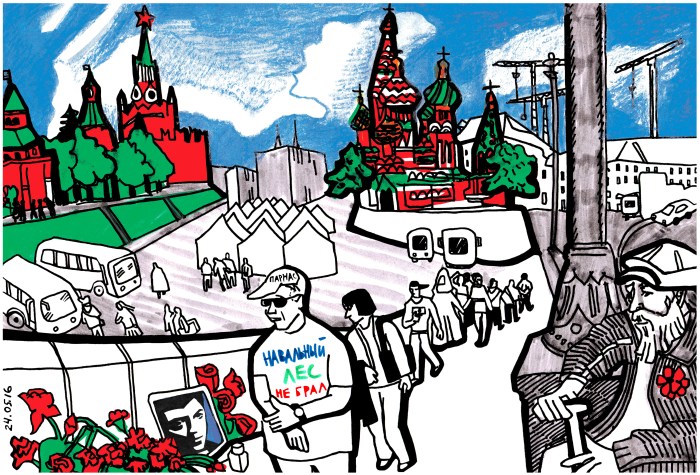
Grassroots activists immediately set up a people’s memorial, made up of bouquets, photos, drawings, and candles, at the scene of the crime, on Bolshoi Moskvoretsky Bridge. For over a year, they have been taking shifts guarding the memorial from members of various nationalist movements and bridge maintenance workers, who routinely haul away the flowers and photos as if they were trash.

Slogan on man’s t-shirt: “Navalny didn’t steal the timber.” May 24, 2016

“The assaults on the memorial occur like pogroms in a Jewish shtetl: it’s the luck of the draw,” these two people on vigil at the memorial told me. “They pick a time when the people on duty have let down their guard, like three or four in the morning.”

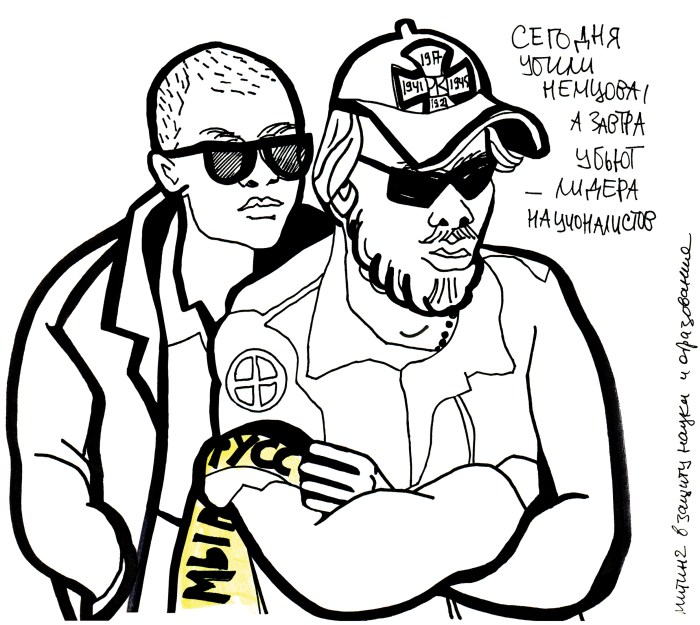
Woman: “People will take to the barricades only when food runs out in the stores.” Slogan on her shirt: “The ‘Russian world’ has no use for science and education.’” Rally in defense of science and education, June 6, 2015

Headed by opposition leaders and attended by thousands of people, the 2012 rallies and marches for fair elections and a “Russia without Putin!” ended with the show trials of 2013 and 2014 against opposition leaders (Alexei Navalny and Sergei Udaltsov) and rank-and-file protesters (the so-called prisoners of May 6).

In 2015 and 2016, the Marches of the Millions have given way to small-scale rallies and protests. People far removed from politics have tried to defend their own concrete rights.

I made these drawings at a rally in defense of the Dynasty Foundation. An NGO founded to support scientific research and science education in Russia, it had been declared a “foreign agent” by the Justice Ministry.

“Today, they killed Nemtsov. Tomorrow, they’ll kill a nationalist leader.” Rally in defense of science and education

Torfyanka

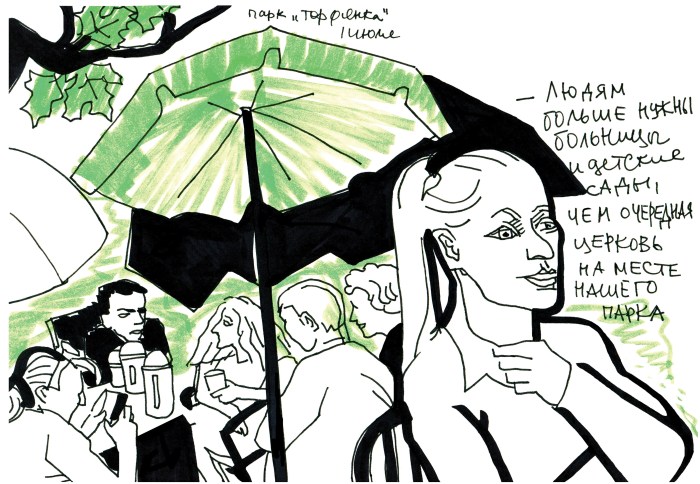
In June 2015, residents of Moscow’s Losiny Ostrov (Moose Island) District came together to stop construction of a church in their local park, Torfyanka. The building had been planned as part of the Russian Orthodox Church’s 200 Churches Program.

“People need hospitals and kindergartens more than another church on the site of our park.” Torfyanka Park, July 1, 2015

Residents set up a tent camp in the park and stood watch in shifts to keep construction equipment from entering the site. They also filed a lawsuit, asking the court to declare the public impact hearing on the construction project null and void. The hearing had been held without their involvement. Continue reading “Victoria Lomasko: Truckers, Torfyanka, and Dubki”