Sergey Yermakov: Protest Duckies and the Actionism of Fact

a21474785_0
Inflated rubber duckie at June 12, 2017, anti-corruption protest rally in Petersburg. The duckie was later detained by police. Photo courtesy of The Poke

Sergey Yermakov
Protest Duckies and the Actionism of Fact

The final performances by Voina’s so-called Petersburg faction could be termed “actionism of fact” by analogy with “literature of fact,” a project the LEF mob tried and failed to realize in the 1920s.

Voina took ordinary actions from the repertoire of protest and resistance, actions requiring no special skills—turning over a police car, torching a paddy wagon, dousing policemen with urine—and simply did them in their performances.

What happened to the performances due to their actions?

First, the performances simply were carried out, like ordinary actions, bereft of aesthetic and symbolic depth. (We will bracket the question of Alexei Plutser-Sarno’s defamiliarizing press releases.) “They really did it.”

Second, the actions were glorified by the very fact they were performed by the actionists. They were bathed in an aura of glory, but note that this aura was totally colorless. It had no density whatsoever, and it produced no distortions in the albedo. This was because the actions were as commonplace as could be, actions available to everyone, actions to which nothing was added except their execution. (Well, yes, and the group’s signature.)

The actionist readymade (or “readydone”) and actionism of fact, unlike the classic artistic readymade, have no need of a special aesthetic space, such as a museum. Unlike literature of fact (if this literary project had actually been implemented in the twenties), actionism may well avoid the traps of language and representation.

Voina thus directly took on the issue of politically effective action. There is a certain actionist Platonism to it, but if we bypass Plato (no matter how we regard the violence of his gesture) we cannot ask ourselves about art’s attitude and access to politics.

In the Republic, Plato does not suggest banishing all poets for fobbing off the phantom of excellence (εἰδώλων ἀρετῆς) on citizens instead of virtue (i.e., the thought of action). He would let the non-mimetic poets, who glorify the gods and sing the praises of good men (ἐγκώμια τοῖς ἀγαθοῖς), stay in the city. Voina’s Petersburg faction non-mimetically sang the praises not of citizens themselves, but certain actions as such, simply by performing them. Their implicit message was something like: Look, this is up for grabs for everyone, and yet if you carry out this glorious deed, you will not be unoriginal and overshadowed by us, because this is basically something anyone could do. This is a kind of democratic and non-hierarchical political Platonism.

Voina did these performances before the May 6, 2012, clashes between protesters and police on Bolotnaya Square in Moscow. They seemingly had offered the demos who took to the streets a possible repertoire of elementary actions. (Of course, the total number of such actions is much greater, and not all of them are either criminal or so primitive. What matters in this case is only the dimension itself.) But the demos did not heed their call, preferring to play at making witty posters, from the December 2011 rally on Sakharov Avenue to this day, and exchanging anti-regime memes in the social networks. (That is, the circumstances are in some way symmetrical to the exile of the poets. In this case, however, the demos itself has turned its back on genuinely political artists, immersing itself in the carnivalesque mimesis of the meme.) By rejecting the dimension of the glorious deed, however, the demos has refused to be itself, because it is eventful, rather than substantial, in contrast to the phantasm of the ethnos.

It took Pyotr Pavlensky half a dozen performances to get close to the place where Voina had arrived in the spring of 2011, that is, in order to torch the front door at FSB headquarters in Moscow. In many ways, the performance was a step backwards, for example, when it came to the question of withdrawal. The guerillas of Voina insisted on retreating in a well-conceived way and unexpectedly returning to strike again. (This is the only worthwhile “We’ll be back!” It is a far cry from Navalny and Co.) But Pavlensky, in many respects by way of accommodating an aesthetic impulse, stood his ground to the bitter end. He has thus proven to be a more direct follower of the National Bolsheviks than Voina when it comes to this issue.

So Voina is still waiting for its demos and valiant citizens back in the spring of 2011, scornfully gazing at rubber duckies, meme politics, and witty anti-Kremlin t-shirts.

Translated by the Russian Reader. Sergey Yermakov is a professional translator who was involved in several of Pyotr Pavlensky’s performances. My thanks to Mr. Yermakov for his kind permission to publish this essay here.

No Protest Is Illegal

taubinskaya-moscow protest
Anti-corruption protester detained on Tverskaya Street in Moscow, June 12, 2017. Photo courtesy of Mayorova.net and Irina Taubinskaya

Below, you will find a brief, eyewitness account of the rough custom to which people detained at the anti-corruption protest rally on the Field of Mars in Petersburg on June 12, 2017, have been subjected by police as the have been slowly “processed,” sometimes with no legal representation and in gross violation of their rights as detainees, by the police and courts.

The Russian “legal and law enforcement” systems are shambles, for the simple reason they don’t exist at all. They are fictions.

What does exist is the supreme will of the blood monkey who answered questions all day yesterday on TV or something like that, and the lesser wills of his cronies and satraps.

Those exist.

So when asking the question of who exactly ordered the arrests of the six hundred and fifty some arrestees of June 12, 2017, and the harsh sentences of five to fifteen days in the hoosegow and fines of up to 15,000 rubles most of them were handed by the city’s district courts (again, in conditions where many of them were dehumanized constantly, despite the best efforts of Petersburg’s wonderful Aid to Detainees Group and other volunteers and well-wishers to support them) you need look no farther than the head blood monkey in the Kremlin and his precious “power vertical.” They are the ones who gave the orders to treat the protesters this way, not anyone on the ground.

I was irked to hear the BBC’s Moscow correspondent refer, the other day, to the concurrent protests on Tverskaya, in Moscow, where a similarly large number of people were arrested, as “illegal.” Setting aside for a second the rights to free assembly and free speech enjoyed by all Russian citizens, as enshrined in the 1993 Russian Federal Constitution, the Petersburg authorities several years ago designated the Field of Mars as the city’s “Hyde Park,” the place where city dwellers could go, supposedly, to air their grievances without making a special application to the authorities. (This need to apply for permits is itself a mostly unconstitutional practice, backed, of course, by the country’s kangaroo higher courts, who are also a part of its so-called telephone justice system).

In reality, Petersburg authorities have let their so-called Hyde Park be used the way it was intended only when the numbers of protesters or their particular grievances have not been threatening enough, although, of course, police are still always on hand to photograph, videotape, and ID the protesters, and even copy down the slogans on their placards, which they immediately radio to their superiors. Just in case, you know, and to make sure the protesters know the state is monitoring them

When, on the other hand, the topics raised and/or numbers of protesters have not been to the liking of the powers that be, local or otherwise, Petersburg’s “Hyde Park” has instantly been deemed yet another no-go zone, the protests declared “illegal,” and the protesters and, sometimes, the counter-protesters, dragged off into paddy wagons and taken to police precincs.

Sometimes, the protesters are merely held in police custody for a few hours or overnight, and then released scot-free. But when the regime wants to teach them a lesson about how much freedom they really have in the world’s largest “sovereign democracy,” they get the book thrown at them, as we have seen over the past several days in Petersburg. That is, for one and the same legal/illegal act, either nothing will happen to you or your life will be scuttled for two weeks or a month (as in the case of “ringleaders” like Alexei Navalny, who was arrested at the door to his block of flats before he could get to the “illegal” protest and sentenced to thirty days in the slammer), and your already meager finances will have a nice dent put into them.

So, if I were a BBC or other foreign correspondent, I wouldn’t be so quick to dub any protest in Putinist Russia “illegal.” That’s tantamount to saying that the police and courts have the right to do with Russians detained for real or imaginary offenses what they will.

It’s also an admission on the part of these foreign correspondents that, in the case of the protesters, they don’t understand the offenses are wholly imaginary, i.e., trumped-up, that they are, in fact, a little bit of the ultra-violence, meted out in smallish doses to discourage the kids from coming out again. TRR

* * * * *

16% of the St. Petersburg Public Monitoring Commission
Facebook
June 15, 2017

I am deciphering my conversations with arrestees:

“We were driven to the courthouse in handcuffs, and tied to each other. We arrived, they untied us, and took us upstairs to the courtroom. We had no defense counsel. The court sentenced us to five days in jail and a fine. We were driven back to the police precinct, where we cuffed to chairs and each other. (The cuffs immediately caused pain to the second person.) The guy with the keys to the handcuffs went off somewhere. We were cuffed for two and a half hours. We asked to go to the toilet, to uncuff us, but our requests were ignored. This happened next to the cells. The cells were not locked.

“Then they uncuffed us from the chair, cuffed us to each other, put us in a van, and took us to [the temporary detention center at] Zakharyevskaya Street, 6.”

This incident occurred on June 13, at the 78th Police Precinct, in St. Petersburg’s Central District

Translated by the Russian Reader. Thanks to Jenya Kulakova for the heads-up on the link and Sasha Feldberg for the photo.

Happy Russia Day 2017

Office of the Guidance Counselor, Saint Petersburg State University of Film and Television
VK
9:11 p.m., June 9, 2017

Dear students,

June 12 is a public holiday, Russian Sovereignty Day [sic]. Certain people have been trying to use our national holiday to destabilize the situation in the country. Alexei Navalny has called for Russians to take to the streets of their cities in protest against the current regime.

The administration of Saint Petersburg State University of Film and Television asks you to approach the question of involvement in such events responsibly, not to yield to such calls and other provocative proposals whose objective is inveigle young people in unauthorized mass actions and marches aimed at destabilizing public order, calls and proposals that are transmitted via social networks and other sources of information. We cannot let these people achieve their political ambitions illegally.

Thanks to Comrade VS for the heads-up

happy russia day
“⚡️Gas sprayed on Pushkinskaya Square. Police in gas masks. If you smell gas, wet t-shirts and breathe through them. #12june.”

Alexandra Krylenkova
Facebook
June 12, 2017

So, 658 people were detained [in Petersburg]. Minors whose parents were able to come and get them and people with disabilities have been released. Nearly everyone else will spend the night in jail.

There will be court hearings tomorrow. Everyone who can make it should come. The hearings will take place at the Dzerzhinsky District Court [in downtown Petersburg]. The first detainees are scheduled to arrive at the court at 9:30 a.m. Considering the number of detainees, we will probably be there into the night.

happy russia day-2
Field of Mars, Petersburg, June 12, 2017. Photo courtesy of Alexandra Polukeyeva/Rosbalt

Alexei Gaskarov
I was invited to speak at the rally on Sakharov Avenue. I planned to talk about why it was important to support the anti-corruption campaign despite our political differences. In short, in order to put a stop to reaction, dissenters need to be represented on a massive scale, so the elites would not even think about just trampling them or not noticing them.  Everyone has the same goal right now: resurrecting political freedoms. The contradictions among people are secondary. Considering the scale of protests nationwide, things turned out quite well. You can see that people have stopped fearing crackdowns, and that intimidation no longer works. In Moscow, switching the rally to a stroll down Tverskaya was an absolutely apt response to the Kremlin’s behavior. Everyone who wanted to avoid arrest had the chance to do that. There were downsides as well, but given the colossal confrontation, they don’t seem important.

Ilya Budraitskis
Of course, one cannot help but welcome today’s protests on a nationwide scale. We are witnessing the continuing rise of a new protest movement that emerged on March 26. This movement is indivisible from Alexei Navalny’s presidential campaign and owes both its virtues and weaker aspects to that campaign. Despite the fact that Navalny’s campaign could have launched a broad grassroots movement, on the contrary, it has been built like a personalistic, vertical political machine in which decisions made by a narrow group of experts and approved by the leader are mandatory for the rank-and-file. This raises the majority’s political consciousness to the degree necessary at each specific moment of the campaign. The leader’s political strategy, his objectives, and the meaning of decisions are not up for discussion. Navalny must be believed like a charismatic CEO. What matters is that he is personally honest and “he has a plan.” On the eve of the protest rally, authorized for June 12 in Moscow, the rank-and-file found out a new particular in the plan: everyone had to go to an unauthorized protest march, which would predictably end in arrests and criminal charges along the lines of the March 26 protests. The rationale of the organizers is understandable. They have to pull out all the stops to keep the campaign moving at a fever pitch, keep it in the public eye, and use the threat of riots to pressure the Kremlin. Moreover, this radicalization in the media reduces the complicated picture presented by Russian society to a simple confrontation: the thieves in the Kremlin versus the honest leader who has united the nation. This set-up renders all forms of public self-organization and all social movements secondary and insignificant, and their real interest ultimately boils down to making Navalny president. However, even Navalny’s most dedicated supporters should pause to think today, the day after June 12. Would his campaign be weakened if it were opened up to internal criticism, if horizontal discussions of his political program and strategy were made possible, and the political machine, now steered by a few people, turned into a real coalition, where differences did not get in people’s way but helped them agree on common goals?

Anna Ivanova
“Sakharov Avenue is out,” Navalny said in his morning video message.

Navalny’s adviser Leonid Volkov put it more democratically.

“The hypocritical scum who dreamed up the ‘opposition rally on Sakharov’ will fry on a separate frying pan.”

The rally on Sakharov happened anyway. It was mainly attended by opponents of Moscow’s new law on the large-scale renovation of residential buildings: urban activists and residents of the buildings slated for demolition, as well as defrauded investors in residential building projects, foreign currency mortgage holders, and other victims of the construction sector. Many fewer of them came out, however, than on May 14, even considering that some of the outraged Muscovite anti-renovation protesters followed Navalny over to Tverskaya. Protests rise and ebb like the sea, and this time round the excitement was muted. These people—old women, families with children, old men—were not suitable for getting arrested at an unauthorized protest. Although they realize that Moscow’s problems are merely one logical outcome of the Russian political system, they are in no hurry to support Navalny and other inveterate oppositionists, for what is at stake are their housing and property, not supreme civil liberties.

happy russian day-4
“Day of Russian Cops” on Tverskaya in Moscow, June 12, 2017

Meanwhile, on Tverskaya, young folks realized that A.C.A.B. Around 700 people were detained in Moscow, and the social networks were flooded with even more photographs of derring-do amidst the so-called cosmonauts [riot cops]. The ultimate damage from the protest might be acknowledged only over time, when we know whether there will be new criminal cases, and if there are, what charges are laid against the protesters. But everyone loves looking at riot porn (and being involved in it), although this hobby devastates and dulls the senses as much as watching ordinary porn. This is the danger of protests “for all things good,” of protests focused on a certain political agenda or figure: neither fat nor thin, neither old nor young, neither socialist nor nationalist, but generally sweet and better than the old protest rallies. In this case, protest risks degenerating into a social order in which everything is decided by Sturm und Drang. Not the worse prospect, some would argue, but others would argue it would be a disaster. But whether you like it or not, “Russia has thousands of young people dreaming of revolution,” for the time abstractly encapsulated in the slogan “Dimon must answer for his actions,” and they have been taking to the streets.

Two worlds did not in fact meet in Moscow today. One world is the world of people who are mostly old, people whose property is threatened with eminent domain and who imagine politics as a way of building an urban environment. The second world is the world of bold young people (and their slightly older idols), who are hellbent on regime change. It would not be a bad thing if these worlds met and acted in concert. This is the only way for a democratic politics to emerge from this.

Source: openleft.ru

happy russia day-3
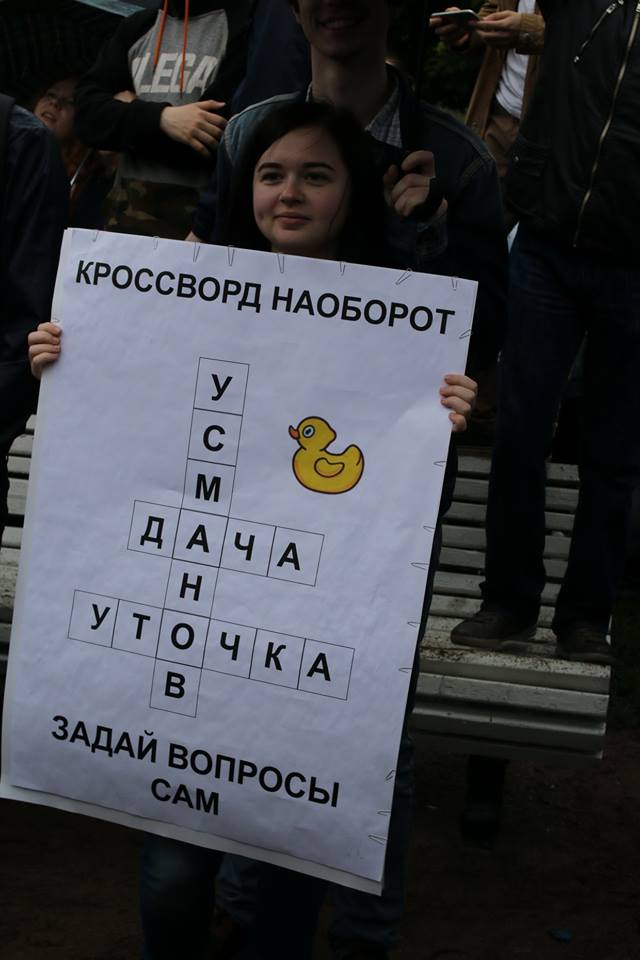
“A crossword in reverse. USMANOV, DACHA, DUCKIE. You provide the clues.”

Carine Clement
Facebook
June 13, 2017

Notes from the field (the Field of Mars). Putting aside emotions:
1. It’s true there were lots of young people. And they are not afraid of anything.
2. There were many young families, who are likewise not afraid for their children.
3. “We’re fed up” is the key phrase.
4. There were slogans about healthcare, infrastructure, and pension. Well, and about corruption, too.
5. The out-of-town students came out because “it is wrong to drive the regions into a pit like this.”
6. There was a sense of support and public acceptance.
7) The people who came out were true patriots genuinely worried about the country’s future.
8) A spirit of freedom . . .

Photos courtesy of Protestnaya Moskva, Rosbalt, anatrrra, and Vadim F. Lurie. Translated by the Russian Reader

P.S. On the Six O’Clocks News last night, BBC Radio 4’s Moscow correspondent had the temerity to refer to yesterday’s protest march on Tverskaya as “illegal.” Is this the new tariff for keeping one’s press accreditation under Putin’s perpetual reign? TRR

A Rainbow May Day in Petersburg vs. The Dead in Chechnya

Varya Mikhaylova
Facebook
May 1, 2017

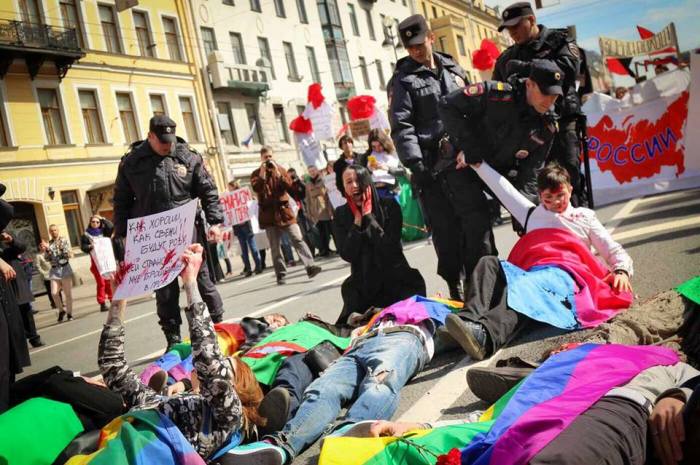
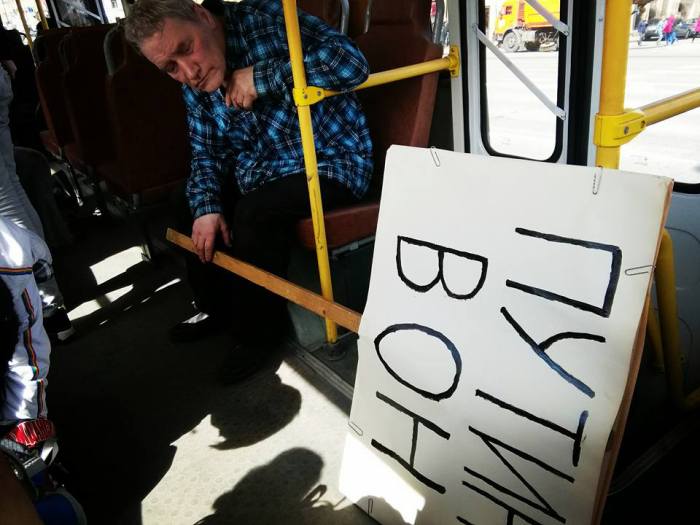
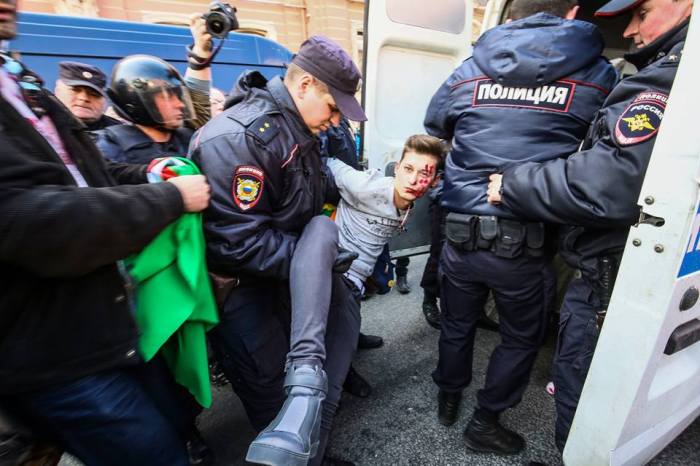
I don’t know what else to do on May 1 when LGBT people in Chechnya are facing flagrant genocide, so today this was how it went down. Now we have been detained and taken to the 43rd police precinct. A man who came out bearing a placard that read, “Putin, go away. Putin is evil” was detained with us. It’s forbidden to say that now, too.

Chechen Mothers Mourned Their Bloodied Children on Nevsky

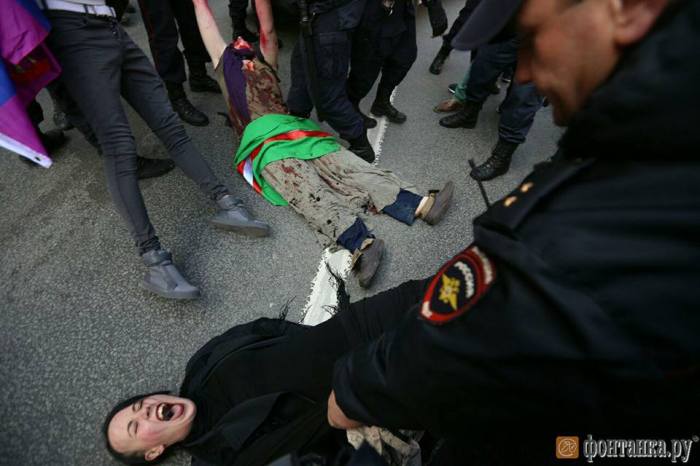
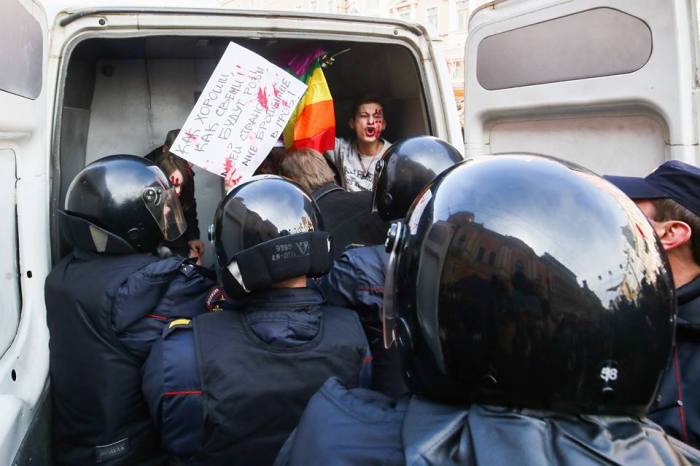
On May 1, 2017, activists staged a performance on Nevsky Prospect, the city’s main boulevard, during which Chechen mothers mourned and sprinkled their children with earth. Prone on the ground, the bodies of the LGBT people were covered with rainbow and Chechen flags. The performance was meant to express solidarity with the people of the Republic of Chechnya as well as draw attention to the horrifying events occurring there now.

Since the beginning of the year in Chechnya, which is part of Russia, there have been numerous illegal detentions, torture, and executions of homosexual men, including men deemed homosexual. We know of hundred of victims, dozens of them murdered. Even as they deny the occurrence of genocide, local officials have publicly justified these atrocities by citing medieval “ethnic traditions” and “Muslim values.”

The persecution of LGBT people in Chechnya and the North Caucasus is nothing new. The region has long been plagued by rampant corruption, violence, and murder, affecting everyone who lives there. However, targeted mass killings are a new phenomenon. Both local and federal authorities are to blame for the state terror. On the one hand, they have vigorously popularized “traditional religious values.” On the other, they have proved incapable of opposing the spread of radical Islam and ensuring the enforcement of the Russian Constitution and human rights. Impunity on the ground encourages terrorism and radicalization, leading to the deaths of civilians not only in Chechnya but outside its borders. Consequently, terrorists exploded a bomb in the Petersburg subway for the first time in the city’s history.*

“Cruelty is a severe infection that is prone to pandemic. It is not a one-off event. They started with the people of Chechnya and, although many imagined that would be the end of it, they continued with ‘their own kind,’ as is now the ‘patriotic’ expression,” wrote Anna Politkovskaya.

The escalation of terror is a vivid example of how the violation of human rights and violence against a particular group can quickly balloon into violence against everyone.

We demand the strict observance of Russian federal laws in Chechnya and preservation of the Russian state’s secular nature. We demand that religious fanatics who are calling for violence be punished according to the law. We demand an investigation of allegations of widespread torture and executions of gays in Chechnya and severe punishment for the guilty parties, including government officials.

#MayDay #Chechnya #MayDayLGBT  #RainbowMayday #LGBT

Photographs by David Frenkel, Alexandra Polukeyeva, and Fontanka.ru. Translated by the Russian Reader

* NB. I have translated and posted the above out of a sense of solidarity and friendship with the people who staged this action during today’s May Day marches on the Nevsky in Petersburg.

However, I would be remiss not to note the striking Alexei Navalny-like anti-Caucasus/anti-Muslim rhetoric in the protesters’ communique, which, of course, is not unique to the otherwise admirable anti-corruption fighter, but is a commonplace in the non-thinking of many “ethnic” Russians. As thoroughly deplorable and despicable as the persecution of gay men in Chechnya and anywhere else is (what, are gay men not persecuted in “Russia proper”?), the activists quote the slain journalist and human rights activist Anna Politkovskaya while seemingly forgetting why she was assassinated: because she wrote truthfully about what Russian federal armed forces and police were doing in Chechnya. Moscow’s successive bloody invasions of Chechnya in the 1990s and the 2000s, involving the torture and rape of non-combatants, the wholesale slaughter of civilians, and mass displacement of the local populace might seem to be more appropriately described by the word “genocide” than what has been happening recently to the republic’s gay men, however horrifying. Not to put too fine a point on it, “Russians proper,” with the notable exception of Politkovskaya and a brave but tiny minority of others, have never been able to assign the responsibility for what happened in Chechnya where it belongs, and they have been aided and abetted by the other “world powers” (i.e., the “former” colonial and imperial powers), who were only too happy to turn a blind eye to what first Yeltsin and then Putin were up to in their own backyard, so to speak. If Chechnya is now an out-of-control autocracy, run by an “Islamist” strongman-cum-madman, Russians have only to look in the mirror to find out who is to blame for this deplorable state of affairs.

Nor, finally, is it a given that the recent bombing in the Petersburg subway (which wasn’t even the first such bombing, in fact) was the work of “radicalized Islamists.” Of course, that is one possibility. But there are other possibilities, as any “Russian proper” who hasn’t had his or her memory erased would realize.

When the St. Petersburg Legislative Assembly passed its infamous homophobic law several years ago, there was no popular outcry against the law on the part of Petersburgers, the vast majority of whom are not Muslim and thus cannot be suspected of adhering to “medieval Muslim values.” Nobody but a handful of people “rioted” in the streets, and as far as I can tell, Petersburgers still, inexplicably, regard themselves proudly as “Europeans,” although they have this disgusting “medieval” law on the books, and many of the same local Petersburg riot cops (OMON) who wearily drag them into paddy wagons and kettle them when they occasionally want to exercise their constitutional rights to freedom of speech and assembly were, as is well known, on active combat duty in Chechnya during the First and Second Chechen Wars and are, possibly, guilty of God knows what war crimes against the “uncivilized” Chechens, whose tiny, beautiful corner of the world has been ravaged at least three times in living memory by their Great Russian rulers. TRR

Popular Protests in Novosibirsk Defeat Governor’s Plans to Raise Rates

15d79279103beccafa39e874d08fab60
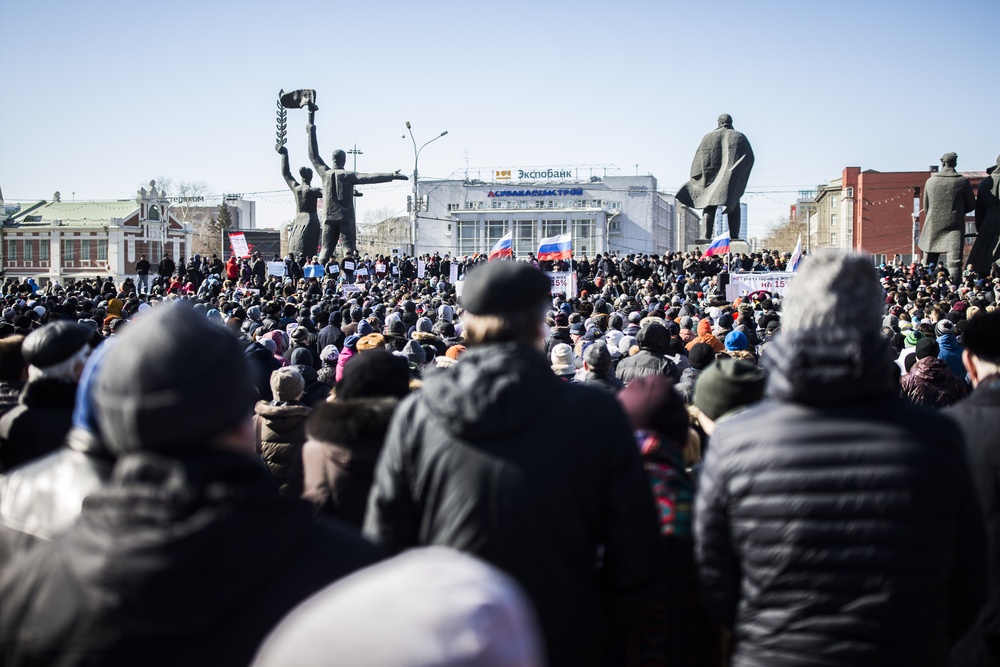
Rally against planned building maintenance and utility rate hikes, March 19, 2017, Novosibirsk. Photo courtesy of navalny.com

Novosibirsk Cancels Sharp Hike in Utility Rates in Wake of Protests
Yevgeny Kalyukov
RBC
April 19, 2017

Seven protest rallies in the region’s capital have forced regional leaders to give up their plan to raise rates for housing services and utilities by 15%.

RBC Novosibirsk has reported that Vladimir Gorodetsky, governor of Novosibirsk Region, has announced he will not raise rates for residential building maintenance and utilities by 15% beginning July 1, 2017.

During a briefing on Wednesday in Novosibirsk, Gorodetsky said he had signed an amendment to a decree adopted in December 2016. The amendment lowers the maximum rate rise to 4%.

Seven protest rallies have taken place in Novosibirsk in recent months. Protesters demanded the authorities either give up plans to increase rates so sharply or resign. Opposition politician Alexei Navalny was involved in the third rally.

“I hadn’t imagined the degree to which the protesters were dissatisfied. It’s a rare thing when my speech is more moderate in mood than the slogans shouted by rallygoers. My overall feeling was that the city had had it. Clearly, no one here can pay the new rates. And it’s a sure bet no one wants to pay for someone else to live well. We also have to understand the rate rise hasn’t come into force yet. Meaning the people coming out to the rallies realize there will other figures on their bills come June. I’m curious to see what will happen here in August when the summons to take to the streets, contained in the building maintenance and utilities bill, arrives in everyone’s apartment,” Navaly wrote in his blog after the rally.

On April 17, a petition calling for cancellation of the rate hike, signed by several thousand people, was delivered to Gorodetsky’s office.

“Believe me, I don’t listen just to the opinions of the people at the rallies. I have meet with the trade unions, the Public Chamber, and the Russian People’s Front. People said the burden was heavy,” Gorodetsky said on Wednesday by way of explaining his decision.

In keeping with the decree “On Maximum Increases in Payments Made by Citizens for Communal Services in the Municipalities of Novosibirsk Region in 2017,” signed on December 16, 2016, the amount of money charged to consumers of communal services would have increased by 15% as of July 1, 2017, in a number of towns and villages in the region, including Novosibirsk itself.

Translated by the Russian Reader

It Was a Good Week in the Supah Powah, or, The Return of the Green Lanterns (OVD Info)

‘In 2016, Donald Trump rode a wave of popular discontent to the White House on the promise that he would “make America great again.” As Russia’s presidential election, scheduled for March 2018, draws nearer, President Vladimir Putin may try a similar tactic — by contending that he has already restored Russia’s greatness.’

Blogger Norwegian Forester

The authorities have been using every trick in the book to counteract the plans of Alexei Navalny’s supporters to hold events against corruption on March 26 in scores of cities. Authorities have been refusing to authorize the protests under different pretexts. Rally organizers in different regions have been arrested on trumped-up changes, summoned to the police, fined for inviting people to rallies on the social networks, and written up for holding meetings with activists. Volunteers have been detained for handing out stickers.

More Navalny

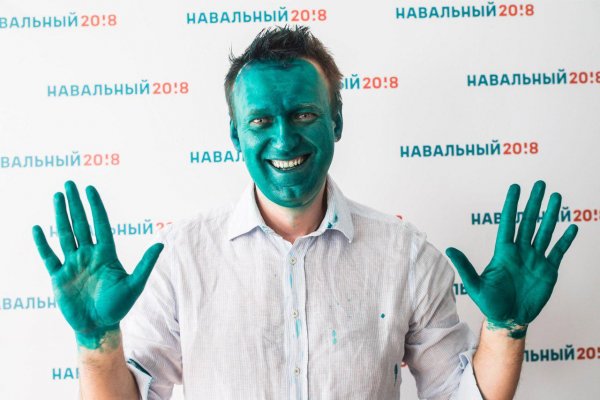
At the same time as he has been getting ready for the anti-corruption protests, Navalny has been opening election campaign headquarters in different cities. These events have also been subject violent attacks. In Barnaul, Navalny was doused with Brilliant Green antiseptic (zelyonka). In Petersburg, the door of his headquarters was set on fire. In Volgograd, Navalny was dragged by his feet and nearly beaten.

Alexei Navalny

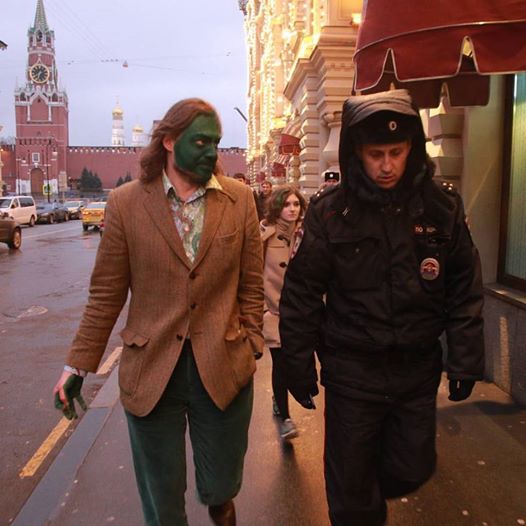
In Bryansk Region, a schoolboy was sent to the police for setting up Navalny support groups on the social networks: the police demanded he delete the accounts. In Krasnoyarsk University, a lecturer was fired for showing Navalny’s exposé of PM Dmitry Medvedev, Don’t Call Him Dimon. In Orenburg, a coordinator of the Spring youth movement was summoned to the rector, who asked him questions about Navalny. In Moscow, famous blogger Norwegian Forester was detained for going onto Red Square, his face painted green, in support of Navalny.

Not Only Navalny: Crackdowns on Freedom of Assembly

Long-haul truckers have planned a nationwide strike for March 27. Around twelve people were detained during a meeting of truckers in Vladivostok. Police claimed they had received intelligence on a meeting of mafia leaders. In Krasnodar Territory, an activist got three days of arrest in jail for handing out leaflets about the upcoming strike.

Krasnodar farmers have planned a tractor convoy for March 28. However, organizer Alexei Volchenko was arrested for twelve days for, allegedly, not making alimony payments. Another tractor convoy participant, Oleg Petrov, had his internal passport confiscated by police.

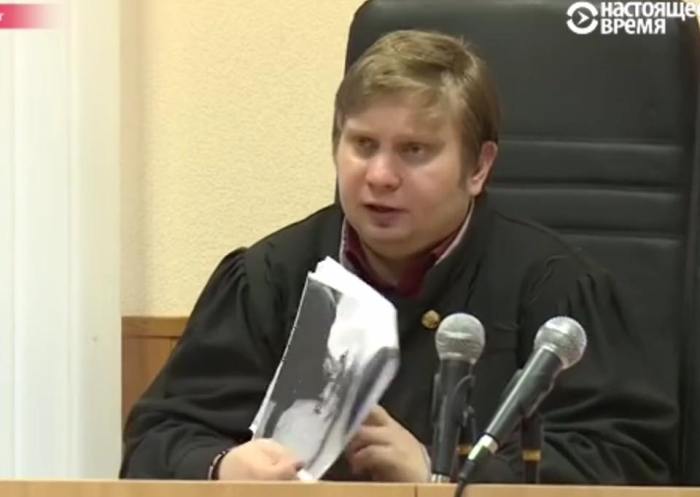
Judge Vladimir Vasyukov

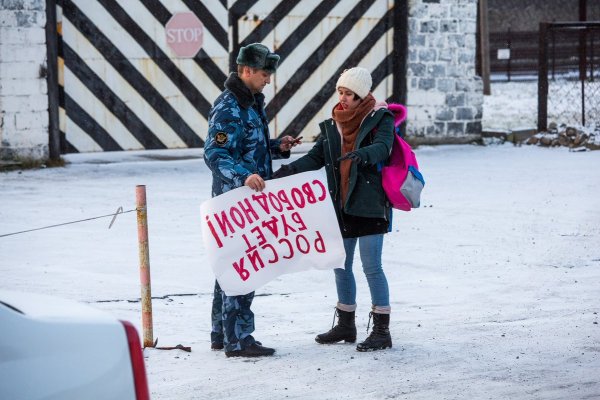
In Petersburg, Dzherzhinsky District Court Judge Vladimir Vasyukov during the past week imposed fines of 10,000 rubles [approx. 160 euros] each on three women, involved in a feminist protest on International Women’s Day, March 8, 10,000 rubles [approx. 160 euros], elderly activist Igor “Stepanych” Andreyev, accused of walking along a building during a solo picket, and activist Varvara Mikhaylova for picketing outside the Segezha Men’s Penal Colony in Russian Karelia in support of civic activist Ildar Dadin, who was recently released.

Varvara Mikhaylova. Photo courtesy of David Frenkel

In Murmansk, the authorities refused to authorize three marches against inflated utilities rates, food prices, and public transportation costs, while Moscow authorities refused to authorize a protest rally against the planned massive demolition of five-storey Soviet-era apartment buildings. In addition, Moscow police demanded a party at Teatr.doc be cancelled.

Moscow City Court ruled that meetings of lawmakers with their constituents should be regarded as the equivalent of protest rallies.

The Constitutional Court ruled the police can detain a solo picketer only if it is impossible to ensure security. The very next day, two solo picketers bearing placards on which Vyacheslav Makarov, speaker of the St. Petersburg Legislative Assembly, was depicted as a demon were detained by police.

Criminal Prosecutions and Other Forms of Coercion

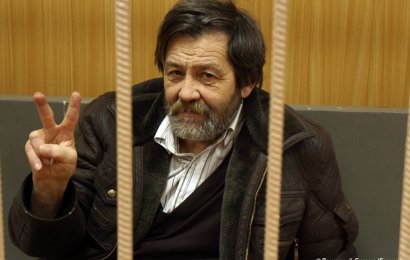
Sergei Mokhnatkin, whose spine was broken in prison, was sentenced to two years in a maximum security penal colony for, allegedly, striking a Federal Penitentiary Service officer.

Sergei Mokhnatkin

As for talk of a new Thaw, two Ufa residents, accused of involvement in Hizb ut-Tahrir, had their suspended sentences changed to four years in a penal colony.

In Stavropol, Kirill Bobro, head of the local branch of Youth Yabloko, was jailed for two months, accused of narcotics possession. Bobro himself claims police planted the drugs on him.

Kirill Bobro

A graduate student at Moscow State University was detained and beaten for flying a Ukrainian flag from the window of his dormitory. In addition, he was forced to sign a paper stating he agreed to be an FSB informant. Ukrainian journalist Roman Tsymbalyuk was detained while trying to interview the graduate student.

What to Read

LGBT activist Dmitry Samoilenko describes how he has been persecuted in Kamchatka for a brochure about the history of gender identity in the Far North. Activist Rafis Kashapov, an activist with the Tatar Social Center, who was convicted for posts on the social networks, sent us a letter about life in a prison hospital.

Rafis Kashapov

The Week Ahead (March 26—April 1)

Closing arguments are scheduled for March 27 in the trial of Bolotnaya Square defendant Maxim Panfilov, who has been declared mentally incompetent. Prosecutors will apparently ask the judge to sentence him to compulsory hospitalization.

On March 29, an appeals court is expected to hear the appeal against the verdict of Alexander Belov (Potkin), co-chair of the Russians Ethnopolitical Movement.

Thanks for Your Attention

We continue to raise money for our monitoring group, which collects information on political persecution and takes calls about detentions at protest rallies. Thanks to all of you who have already supported us. You can now make monthly donations to OVD Info here.

Translated by the Russian Reader

Three Years Later: Suicide by Crimea

Suicide by Crimea
Nikolay Klimenyuk
oDR
March 17, 2017

As long as Russia maintains its grip on the Ukrainian peninsula, significant changes for the better at home are impossible.

In the three years that have passed since the annexation of Crimea, a consensus has taken shape in Russia. Everything having to do with the Ukrainian peninsula is Russia’s internal affair, and far from the most important one.

The “accession” of Crimea has even quite succesfully happened in the heads of the regime’s opponents. In November 2016, while arguing on Facebook with Crimean Tatar journalist Ayder Muzhdabaev, Mikhail Khodorkovsky expressed a stance then supported by many publicly prominent liberals, including activists and intellectuals. Russian society, he argued, wants to deal with other problems. The opposition’s biggest task is regime change, but returning Crimea to Ukrainian jurisdiction by democratic means would be impossible because public opinion would be opposed. Crimea is not mentioned at all in Alexei Navalny’s 2018 presidential campaign platform.

Russian media outlets generally considered “liberal” (these media usually eschew the word “opposition”) havealso swallowed the annexation and most of the rhetoric surrounding it without a peep. TV Rain, RBC (even before its top editors were replaced), and the online Meduza, which operates out of Latvia and is not not subject to Russian laws, have all long routinely called and depicted Crimea as part of Russia. The standard explanation—it is required by Russian law, and insubordination is fraught with penalties—sounds like an excuse. The law does not require that questions about Crimea be included in a quiz on knowledge of Russian cities (which was amended after public criticism) or that reporters term the annexation a “reunification” (Meduza edited the latter term to “absorption.”)

At the same time, Russian reporters usually have no problem demonstratively violating Ukrainian laws (which require them to enter the occupied territory through the checkpoint at Perekop) and flying to Crimea from Russia (as Deutsche Welle reporter Yuri Resheto did), because it’s cheaper, faster, and simpler, and because Ukraine’s rules are cumbersome, inconvenient, and nonbinding.

After that, you can write critical reports on human rights violations in Crimea till the cows come home, but it won’t change what matters. The voluntary observance of inconvenient Ukrainian rules is tantamount to acknowledging Ukraine’s sovereignty over Crimea, and hardly anyone in Russia wants to do that.

In fact, the seizure of Crimea has been the cause of many pressing problems in Russia that have been on the Russian opposition’s agenda. It has laid bare peculiarities of Russian society that existed longer before the attack on Ukraine.

For example, not only did the extent of imperialist moods become clear but also Crimea’s place in how Russians see themselves as a society and a nation. The imperial myth, still alive and well in Russia, was concocted during Catherine the Great’s reign. From the moment they were implemented, Peter the Great’s reforms had provoked a mixed response. They smacked of “sycophancy,” and modeling the country on Holland seemed somehow petty.

Catherine, on the contrary, conceived a great European power, rooted in antiquity, Byzantine’s direct heir, the Third Rome, a Europe larger than Europe itself. Her ambitious Southern Project, which involved defeating Turkey, uniting all the Orthodox countries in a single empire, and installing her grandson the Grand Duke Constantine on the throne in Constantinople, was brought low by political reality. The only one of her great fantasies she made come true was seizing the Crimean Khanate, in 1783.

The conquest was extremely atypical of Russia. A troublesome neighbor was not subjugated. Rather, the annexed lands were completely reimagined and rewritten. The rewriting was attended by the first mass expulsion of the Crimean Tatars. They did not fit at all into the pictures of the radiant past that Grigory Potemkin was painting in reality on the annexed lands. Crimea was resettled with Plato and Aristotle’s Orthodox descendants: Pontic Greeks, Great Russians, and Little Russians (i.e., Ukrainians). Naturally, all these particulars have been forgotten long since. What has not been forgotten is Crimea’s central place in the self-consciousness of a “great European nation,” as manifest, for example, in the absurd, endlessly repeated expression, “Crimea has always been Russian.”

The saying perfectly illustrates the peculiarities of historical memory in Russia. Crimea’s current “Russianness” is the outcome of over two hundred years of the uninterrupted genocide and displacement of the “non-Russian popuation,” which culminated during the Second World War. After the two Soviet deportations of 1941 and 1944 (ethnic Germans, Greeks, Bulgarians, Italians, Armenians, Karaites, and Crimean Tatatrs were deported), losses during battles, and the Nazi extermination of Jews and Crimeans, only a third of Crimea’s pre-war inhabitants were left. It was resettled with people from Russia and Ukraine, especially by military officers and veterans of the Party and the secret services.

Naturally, few people in Russia today regard Crimea as a conquered and ravaged country, in which a full-fledged state existed until relatively recently, an indigenous culture was long maintained, and Russians were never the ethnic majority even during the lifetimes of the present elder generation.

Regarding Crimea as a territory, not a society, and treating Crimeans as an annoying inconvenience, was a habit in Catherine’s times and has survived into the present. The formal excuse for the Russian incursion was the “defense of Crimea’s Russophone population,” and yet the “Crimea is ours” attitude of Russians to the peninsula’s residents has been quite skeptical from the get-go. They imagine the main business of Crimeans is leaching off tourists, and the only thing that attracts them about Russia is high wages.

Moreover, this opinion is common across the entire political spectrum. Sergei Parkhomenko, a liberal journalist and public figure, expressed it in a very telling way.

“If first you take five days to explain to the population of Crimea that if they return to Ukraine’s jurisdiction, their wages and pensions will be increased, and they’ll also be permitted to build even more chicken coops for holidaymakers in the coastal zone, and only then you ask them to vote in a referendum, 95% will vote for going back. […]  These people have proved they could not care less what country they belong to. And if there is anyone for whom I now feel not an ounce of sympathy as I read about how they are being fooled, robbed, milked, and put under the rule of gangsters pretending to be officials and bosses, it is the population of Crimea.”

The massive support of Russians for the annexation has much more serious and immediate consequences than a display of deeply rooted chauvinism. Having signed off on “Crimea is ours,” Russians have deemed their own power above the law and sanctioned its use in violating all laws and treaties for the sake of higher interests or “justice.” The Russian authorities had behaved this same way previously, but now they have obtained the relevant mandate from society. Quite naturally, the crackdown following the seizure of Crimea has been chockablock with spectacular acts of lawlessness.

One such act was the demolition of commercial kiosks and pavilions in Moscow, which happened despite legalized property rights and court rulings. There was nothing accidental about the fact the Moscow authorities justified their actions by citing the law adopted for settling real estate disputes in Crimea. And the twenty-year-sentence handed down to Oleg Sentsov set a new ceiling for verdicts in political trials. Before Crimea, activists would get a dvushechka (two years) for especially vigorous protests. After Crimea, the Russian authorities have been sentencing people for reposts on VK and holding solo pickets.

Actually, any regime that tasks itself with establishing the rule of law in Russia will first have to annul this “mandate to lawlessness.” The Russian opposition’s attitude to Crimea shows the rule of law is not among its priorities at all. Bewitched by the figure of Putin, the opposition does not regard regime change as a product of the rule of law. The fact that it cannot offer a realistic scenario for regime change is not a problem in itself. Russia’s currrent regime does not presuppose a peaceful change of power. Systemic change might happen as it did in the Soviet Union, at the behest of the bigwigs and under the impact of external circumstances: the state of the economy, public sentiment, foreign policy factors.

The opposition’s most serious problem is that it doesn’t have a meaningful outline of what would come next.

If we believe the alternative to Putin is neither Navalny, Khodorkovsky nor anyone else, but a democratic state based on the rule of law, there are two obstacles in our way: Crimea and Chechnya. The opposition has no vision of how to establish control over Chechnya and incorporate it into Russia’s legal system, but it is possible in theory, at least. There is no such possibility with Crimea. It is impossible to hope for international recognition of the peninsula as part of Russia, and if we keep regarding it as part of Russia, it will thus remain a legal anomaly. Moreover, no rule rule of law is even formally possible without observance of international law.

When discussing Crimea, the Russian opposition evinces a notion of democracy that differs little from Putin’s, although it is consonant with the rhetoric of Donald Trump and the European populists: that democracy is rule based on majority support and not burdened by the observance of laws, procedures, and international obligations. Khodorkovsky, for example, considers “democratic procedure” not the restoration of law, but the adoption of a decision on Crimea based on the opinion of the majority, which, allegedly, is against giving Crimea back to Ukraine. Navalny has suggested holding a new, “normal” referendum.

Yet what the majority really thinks, whether there is such a thing as public opinion on any issue and how to measure it, obviously means nothing at all either to Khodorkovsky, Navalny or many other members of the opposition. By the same token, since Putin is supported by the majority of the Russian population, there is nothing for the opposition to do at all. All these contradictions can be eliminated only by unconditionally recognizing both the illegality of Crimea’s annexation and the total impossibility of keeping it in the Russian Federation on any grounds.

With Crimea in tow, Russia has no positive alternative to the current regime. And as long as the Russian opposition is concerned only about regime change and avoids discussing Crimea, the only thing it can offer is a Putinist Russia sans Putin. Whoever ends up in his place, however, the changes won’t be too noticeable.

Nikolay Klimenyuk writes about politics and culture in Germany and Russia. He was an editor at Forbes Russia, Bolshoi Gorod, and other periodicals. He has lived in Berlin since 2014 and writes for Frankfurter Allgemeine Zeitung and other German mass media. Translation and photo by the Russian Reader

Russia Isn’t a Basket Case?

960x0
Villanova University basketball team in action. Photo courtesy of Forbes.com

“Russia is neither the juggernaut nor basket case it is varyingly made out to be. A well-reasoned Russia policy begins by quelling one’s hysteria long enough to recognize this and then engaging it accordingly.”
—Mark Lawrence Schrad, “Vladimir Putin Isn’t a Supervillain,” Foreign Policy, March 2, 2017

Try telling a great many people in Russia that the country isn’t a basket case, or that Putin and his regime aren’t a total menace, especially to Russians themselves, as Mark Lawrence Schrad argues in the article I’ve quoted above. They would laugh in your smug face.

I wonder if this useful idiot and assistant professor in political science at Villanova has ever lived in the country long enough to figure this home truth out. Probably not.

Villanova has a great basketball team this year, however. Maybe I should focus on them.

Somehow, I have to stay positive in the midst of the dawning awareness that lots of Anglo-American Slavists would, seemingly, like to work for the KGB if they could. Or are simply too clueless to do their jobs.

At very least, Professor Schrad’s article would have been accepted for publication in Russian Insider as is. TRR

_____________

17016781_10154597941078402_1412973065814591476_o
“For Rent.” Photo by TRR

Exhibit One: Downtown Petersburg’s Commercial Property Glut

This is what a “non-basket case” looks like in real life, not from one’s office in Philadelphia.

“Arenda” (“For Rent”) is definitely the most popular shop sign in the neighborhood around Voznesensky and Izmailovsky Prospect when I went there the other day to do a couple of errands, and it is complemented by lots of shops that aren’t flying the “Arenda” banner just yet, but which are definitely closed for business forever, like this Chinese restaurant, now known as “Khui” (if you read the fine print on the plasterboard that has replaced the broken glass in the door).

17038686_10154597949793402_944343543808199784_o
“Fuck.” Photo by TRR

Except for a few parts of central Petersburg where commercial spaces never stay empty for long, even in bad times, this is the visual-economic landscape you would see all over town. It is a landscape of “mixed and uneven development,” to put it charitably.

I don’t see how any self-respecting scholar wouldn’t start with this grassroots reality when analyzing Russia’s current state, rather than with a grab bag of rank speculations, half truths, and outright falsehoods he or she has read in English-language newspapers, magazines, and websites.

But that’s mostly how the new, actually quite fairly hysterical “anti-hysteria”/”anti-Russophobia” school of half-baked journalism and “Russia hands” scholarship operates. Its adepts sit far from Russia and tells Russians how good they’ve got it. TRR

__________________

Exhibit Two: How the Russian Countryside Is Dying

How the Russian countryside is dying.

A sad name for a reportage. But first of all one feels for the people in the reportage, who have worked the land for many years.

I visited the hinterland just yesterday at the request of the workers at the Vegetable Integrated Agricultural Production Company in Tonshalovo, Cherepovets District, Vologda Region. The fact is that everything there has been frozen, and the company has been put on the road to bankruptcy. The prosecutor’s office is looking for the guilty parties, but instead of reading thousands of words, I suggest you watch the video. The inhabitants of our country utter many wonderful, sincere words in the video. What is happening with agriculture nowadays all over Russia is quite sad.

#VO35 #VologdaRegion #Tonshalovo #Vegetable #Prosecutor #Authorities #Bankruptcy #Unemployment #Agriculture

Source: vk.com/vologda_net

Nettle Info, How the Russian Countryside Is Dying. YouTube video, in Russian. Posted January 23, 2017, by Nettle Info

Translated by the Russian Reader. Thanks to Comrade Koganzon for the heads-up

__________________

Exhibit Three: Russia’s Wildly Corrupt Prime Minister

Russian opposition politician Navalny links PM Medvedev to billion euro property empire
Deutsche Welle
March 2, 2017

Navalny alleges Medvedev took bribes from key Russian oligarchs under the guise of donations to charities. In a 49-minute exposé, Navalny even flies drones over lavish properties he alleges were bought with corrupt money.

Russian opposition politician Alexei Navalny accused Prime Minister Dmitry Medvedev of massive corruption in a report accompanied by a Youtube video he posted on Thursday.

The anti-corruption activist alleged Medvedev controls a property empire including mansions, yachts and vineyards financed by bribes from oligarchs to a network of non-profit organisations.

“Based on the documentation disclosed, we can confirm that at least 70 billion rubles (1.3 billion euros or US$1.19 billion) have been transferred in cash and assets to Medvedev’s foundations,” said Navalny, who heads the Anti-Corruption Foundation.

Medvedev “practically openly created a corrupt network of charitable foundations through which he receives bribes from oligarchs and frantically builds himself palaces and vacation homes across the whole country,” the report alleged.

The report was welcomed by Transparency International Russia, a non-profit organization that targets corruption, though it questioned some of its conclusions.

Findings met with skepticism

Navalny has sworn that he will be a candidate in upcoming elections despite being dogged by legal problems

“There are certain doubts in the story of Ilia Yeliseyev, the deputy chairman of the Gazprombank. It is doubtful that Yeliseyev is just a scarecrow. Despite the fact he was a classmate of Medvedev, he is an important figure. He could have earned that fortune himself,” spokesman Gleb Gawrisch told DW.

Gawrisch also said although it looked suspicious it wasn’t actually illegal for Medvedev to use real estate owned by non-profit organizations

“Corrupt officials often use non-profit organizations to hide financial flows and property,” he conceded in a statement to Deutsche Welle.

“The problem is finding out who the ultimate beneficiary is, and we are delighted that the Anti-Corruption Foundation has succeeded in presenting such an extraordinary investigation.”

Medvedev, a lawyer from Saint Petersburg, was president from 2008 to 2012 while Vladimir Putin served as premier between presidential terms. Medvedev intended to run in the 2018 presidential election.

Navalny, also a lawyer, garnered notoriety for his denunciations against corruption and was sentenced to five years in prison with a suspended sentence for embezzlement, which forbid him from being a candidate in the elections.

His [49]-minute video amassed several hundred thousand views in a few hours on YouTube.

Anti-Corruption Foundation, Don’t Call Him Dimon: Palaces, Yachts, and Vineyards—Dmitry Medvedev’s Secret Empire. YouTube video, with subtitles in English. Posted March 2, 2017, by Alexei Navalny


Navalny said that the foundations receive “donations” from oligarchs and companies, which are then used to purchase lavish properties for Medvedev, who is never registered as the owner.

“The prime minister and his trusted friends have created a criminal scheme, not with companies registered in tax havens as usual, but with non-profit foundations, which makes it virtually impossible to determine the owner of the assets,” he said.

“Medvedev can steal so much and so openly because Putin does the same, only on a bigger scale,” he wrote, presenting his team’s online report.

Navalny said he was able to establish the links to Medvedev by tracing the purchases online.

Medvedev’s spokeswoman dismissed the allegations as promotion for Navalny’s presidential bid.

“Navalny’s material is clearly electioneering in nature,” Natalya Timakova told RIA Novosti state news agency. “It’s pointless to comment on the propagandistic attacks of an oppositional convict,” she added.

_____________

P.S. An acquaintance just told me the average monthly salary at the world-renowned St. Petersburg Conservatory is 11,000 rubles a month (approx. 178 euros), but employees there have not been paid since the end of last year.

And you would still say Russia is not a “basket case,” Mark Lawrence Schrad, assistant professor in political science at Villanova? Could you live on 178 euros a month while also not being sure you would actually be paid that measly sum on time every month?

I imagine that Professor Schrad was paid more than a paltry 178 euros for his wildly misleading article in Foreign Policy.

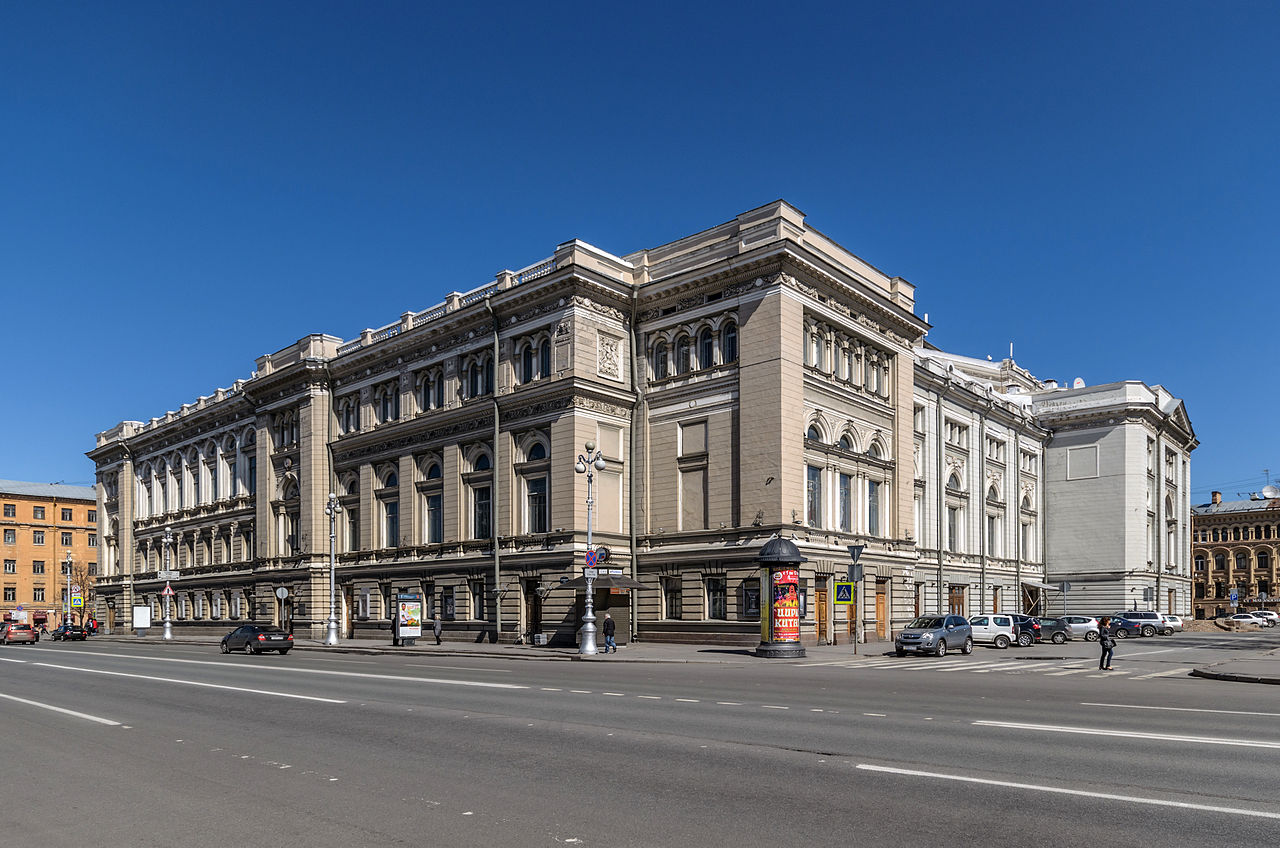
1280px-saint_petersburg_conservatory
St. Petersburg Conservatory. Photo courtesy of Wikipedia

Alexei Gaskarov: A 25,000 Ruble Minimum Monthly Wage Is a Good Idea

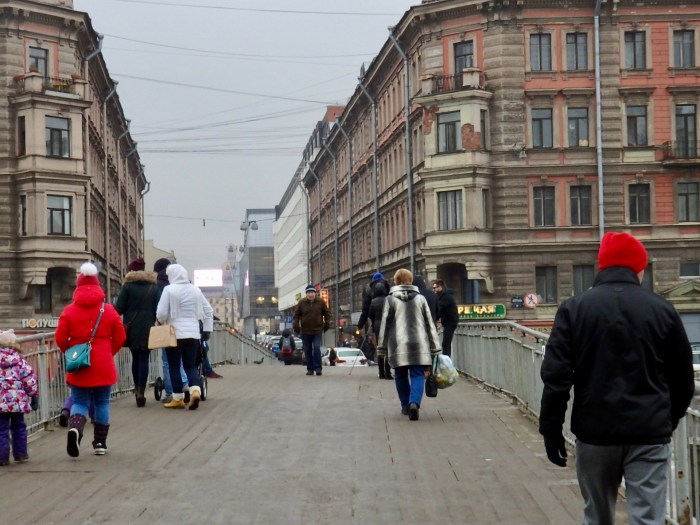
Rank-and-file Russians deserve a mandatory minimum wage, argues Alexei Gaskarov, and it would be good for the economy. Street scene near Haymarket Square in Petersburg, 4 February 2017. Photo by TRR

A 25,000 Ruble Minimum Monthly Wage Is a Good Idea
Alexei Gaskarov
Snob
February 8, 2017

How would a high minimum wage help Russia turn into a developed country? Why is Alexei Navalny’s campaign pledge not stupid at all? Financial analyst Alexei Gaskarov shares his opinion. 

What’s Wrong with Russia?
Russia ranks at the very top in international ratings of social inequality.

There are different means of combating inequality, including progressive taxation and raising unemployment benefits. But as soon as someone proposes a solution to the problem, he is immediately dubbed a populist.

This fate has befallen Alexei Navalny. In his presidential election program, he proposed setting a minimum wage of 25,000 rubles a month [approx. 400 euros at current exchange rates].

Is This Populism?
Let’s see how the structure of Russia’s GDP would change if this measure were implemented under current macroeconomic parameters. And let’s compare Russia’s GDP with the GDPs of the G20 countries.

GDP is the market value of all goods sold and services rendered in the country during the year. Costs are always someone’s income, so GDP can be calculated not only in terms of consumption, investment, government expenditures, and net exports but also in terms of income.

STRUCTURE OF RUSSIAN GDP IN TERMS OF INCOME IN % (PER ROSSTAT)
2015 2016 2017
GROSS DOMESTIC PRODUCT 100.0 100.0 100.0
Compensation of employees, including wages and mixed income not captured by direct statistical methods 47.2 45.0 46.6
Net taxes on manufacturing and imports 13.9 11.1 10.7
Gross economic profit and gross mixed income 38.9 43.9 42.7

There are three types of income:

  1. Compensation of employees, includes expenditures on insurance and pensions.
  2. Net taxes on production and imports. Essentially, this is revenue from the extraction of natural resources and their subsequent import abroad.
  3. Business income: company profits, capital gains, incomes of individual entrepreneurs.

The table shows that business income is nearly equal to the income of all employees.

Indirect taxes (e.g., income tax and VAT) are not included in GDP in order to avoid duplication, since they are based on the same profits and wages.

This is what average income distribution looks like in the G20 countries:

Source: The Labour Share in G20 Economies (ILO, 2015)

The labor share in Russia is 6–7% lower than the average for the G20 countries. The reason for the difference is the weakness of democracy and civic institutions in Russia. Election results do not depend on the opinion of the populace, trade unions are weak, and protests against social policy are far and few between. So it makes no sense to redistribute incomes to benefit employees.

How Much Would We Spend?
72,323,000 people are employed in Russia. We have to subtract entrepreneurs [i.e., the self-employed] from this figure. According to the Unified State Register of Individual Entrepreneurs (EGRIP), they amount to approximately 3.5 million people. We also have to subtract those people who work part-time: according to Rosstat, there are around one million such people, if we discount those involved in small business. So the upper limit of full-time employees in Russia is 67,820,000 people. Within this group, 50.3% earn less than 25,000 rubles a month.

However, 1.4% of employees earn between 5,000 and 5,000 rubles a month, and 20.9%, between 17,000 and 25,000 rubles a month. Another 50 percent of employees receive an average monthly wage of 15,329 rubles [approx. 240 euros].

Accordingly, the poorest wage earners would benefit most of all from the introduction of a mandatory minimum wage. On average, every employee currently earning less than 25,000 rubles a month would be paid an additional 9,671 rubles (i.e., 25,000 rubles – 15,329 rubles = 9,671 rubles ).

We would thus have to reallocate almost 3.96 trillion rubles annually: 9,671 rubles (the average pay rise) x 67,820,000 (the number of employees) x 50.3% (the share of those currently earning less than 25,000 rubles a month) x 12 (months) ≈ 3.96 trillion rubles.

Let us add in insurance premiums and pension contributions, which amount to 30.2%. The overall total would be around 5.15 trillion rubles (3.96 trillion x 1.302).

Russia’s GDP in 2015 was 83.23 trillion rubles. If we reallocate 5.15 trillion rubles from profits to wages, we arrive at the following ratio.

2015 2015 (%) 2015* 2015* (%)
GROSS DOMESTIC PRODUCT 83.233 trillion rubles 100 82.233 rubles 100
Compensation of employees 37.471 trillion rubles 45 42.621 trillion rubles 51
Net taxes on manufacturing and imports 9.272 trillion rubles 11 9.272 trillion rubles 11
Gross economic profit and gross mixed income


36.489 trillion rubles 44 31.339 trillion rubles 38

In the resulting structure, the share of labor income is slightly higher than the average figure among the G20 countries.

Obviously, many people would lose their jobs after a minimum wage of this kind was introduced, primarily those people who dig pits with a shovel where an excavator should be doing the work. These jobs are safe nowadays only because you can pay people almost nothing in Russia.

In turn, employers would seek to maintain profits by increasing prices for finished products. In aggregate, these effects would shape an economy typical of developed countries.

What Do We Risk?
Many people fear inflation. Let’s evaluate the risks. To introduce a mandatory minimum wage of 25,000 rubles a month, according to the structure indicated above, we would have to increase wage costs by 13.7%. The share of labor costs in the economy is 45%. Accordingly, to cover the increased costs, the price of finished products would have to be increased by 6.165% (13.7% x 45% = 6.165%). That would be the upper limit of possible inflation.

In reality, however, a rise in prices decreases consumption and forces prices to creep downwards. In addition, unemployment and inflation are inversely proportional to one another, meaning the higher the unemployment rate, the lower the rate of inflation.

Additional inflation would be two or three percent, and for the most part it would be spread out over the whole of society, meaning that people who earn a lot would forfeit this percentage of income, while the incomes of the poorest workers would increase significantly.

Of course, such a drastic rise in wages is a rather radical measure, given that the minimum wage is currently even below the subsistence level, and it is bound up with a variety of social benefits that would also automatically increase. But the tenor of the reform is absolutely correct and corresponds to successful examples in world practice.

The introduction of a statutory minimum wages in Germany has lead neither to inflation nor unemployment. In the US, increases in the minimum wage have increased the salaries of low-paid workers while maintaining employment.

Translated by the Russian Reader. Thanks to Alexei Gaskarov for the heads-up. For another take on the Russian economy’s performance and the figures provided by Rosstat, see yesterday’s featured post, “Lies, Damned Lies, and Statistics,” a translation of an op-ed piece by liberal economist Sergei Aleksashenko.

Where’s the Beef?

“But People Cannot, Excuse My Expression, Chow Down Normally”
The Russian government concludes beef too expensive for Russians
Irina Shcherbak
Znak
June 9, 2016

The Russian government argues that beef has become too expensive for Russians. These are the findings of an analytical report on the outcome of the produce embargo in 2015.

“Due to a shift in demand for cheaper produce, beef will taken on the characteristics of an expensive niche product, so massive support of this segment is inexpedient,” says the report.

The report likewise notes that the anti-sanctions have had no negative consequences. On the whole, however, “downward trends in the quality of consumption have been observed, including in response to the population’s falling real incomes.” This, the authors of the report argue, takes the shape of “switching to goods in a lower price segment.”

“The situation in the economy does not allow for a quick recovery of demand in produce markets, which will be accompanied both by a further shift in demand towards the cheaper segment in each segment [sic] and by a shift in demand from fish to meat, as well as the revival of significant subsistence production for personal consumption in the fruit and vegetable sectors,” says the report.

“We got up off our knees and have been threatening the west. We are in a confrontation with America, you see. We are paying for the restoration of Palmyra. 30% of the budget goes to defense spending. But people cannot, excuse my expression, chow down normally. In the next report, the government will probably recommend moving beef to the desserts and sweets section,” commented opposition politician Alexei Navalny.

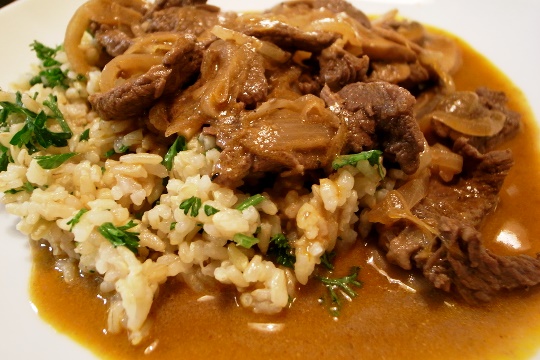
Farewell, Beef Stroganoff?
Farewell, Beef Stroganoff? Image courtesy of Viator Things to Do: Russia

According to a recent study by the Analytical Rating Agency, consumers currently are showing a marked preference for bread, potatoes, and dairy products over vegetables, fruits, fish, seafood, and alcohol.

“In the future, a further shift in consumer preferences towards cereals, flour, oil, seasonal vegetables, and sugar is possible,” the analysts predicted.

The Russian food embargo was introduced in August 2014 in response to sanctions against Russia [sic] by western countries. A ban on the import of beef, pork, fruits and vegetables, poultry, fish, cheese, milk, and most dairy products from the US, the EU, Canada, Australia, and Norway was imposed. Subsequently, Russia has combated the re-export of banned European produce, introducing restrictions on imports from Belarus and Serbia. In addition, on May 1, 2015, the import of peanuts and, on May 26, 2015, live poultry from the US was banned.  On June 4, 2015, imports of canned fish from Latvia and Estonia were banned.

On June 24, 2015, Vladimir Putin signed a decree extending the food embargo until August 5, 2016.

Translated by the Russian Reader. Thanks to Valentin Urusov for the heads-up