Russian riot police paddy wagon parked in downtown Petersburg, 11 November 2016. Photo by the Russian Reader
Putin Calls for Assessing Police Actions at Protest Rallies
Natalya Demchenko and Pavel Kazarnovsky RBC
October 30, 2017
The president argued that instead of organizing protests, critics of the authorities should ensure their presence [sic] on the internet and in the media. He also said that “disrupting life in big cities” was wrong, but that freedom [sic] must be guaranteed.
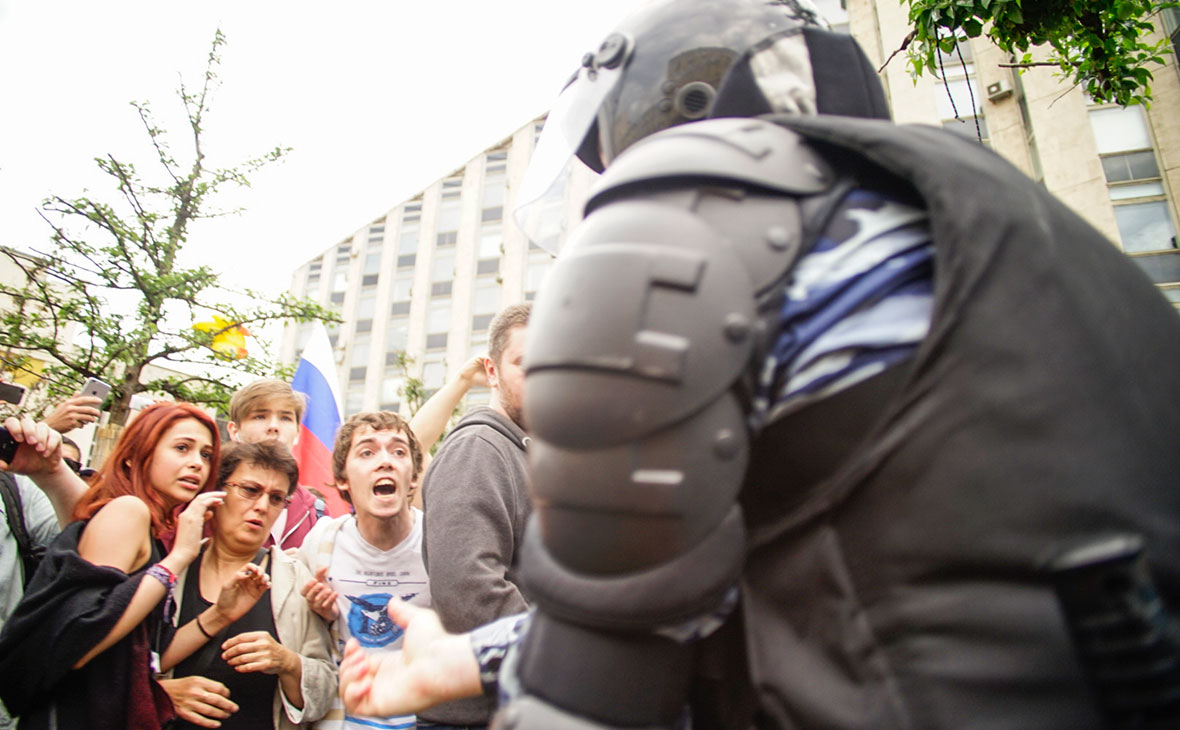
During a meeting of the Presidential Human Rights Council, Vladimir Putin suggested analyzing the actions of law enforcement agencies vis-à-vis protesters, noting that freedom must be guaranteed. The president’s address was broadcast live by TV channel Rossiya 24.
“Freedom must be guaranteed. I completely agree with you. We must always analyze established practices in our country,” he said in reply to a question from council member Nikolai Svanidze.
According to Putin, however, “some groups of protesters” and rally organizers deliberately aggravate the situation “in order to attract attention,” whereas in order to “state their position and criticize the authorities” it suffices to secure a presence on the internet and in the media [sic].
“I can imagine that the authorities drive these protests over the hill since they have no desire whatsoever to show them up and close. But deliberately interfering with life in the big cities, deliberately triggering aggression, is also wrong. We must work with both parties to this process,” said Putin.
According to him, hysterical outbursts occur from time to time in Russia due to protest rallies.
“Outbursts happen. Look at what has been going on in the US. There are hysterics there,” noted the president.
According to him, these outbursts are a natural phenomenon. There is no need to expect complete calm.
“There never was such a thing and there never will be.”
It is necessary, however, to minimize the negative aftermath of the outbursts.
A series of anti-corruption rallies, organized by Alexei Navalny’s Anti-Corruption Foundation, were held this past March in Russia. The events were authorized [sic] by the authorities in 24 cities, although organizers advertised events in a hundred cities across Russia. The best attended rallies took place in Moscow, St. Petersburg, Novosibirsk, Yekaterinburg, Chelyabinsk, and Vladivostok.
In Moscow, a protest on Tverskaya was not agreed by the authorities, who did not propose an alternative venue to the organizers [as required by law]. Navalny thus announced that, in according with a Constitutional Court ruling, he considered the protest rally authorized and encouraged his supporters to come to Tverskaya. Consequently, according to OVD Info, over a thousand people were detained by police. (According to official police figures, the number was around 500.)
Presidential spokesman Dmitry Peskov later said the Kremlin respected people’s civic stances and the right of Russians to voice them in a manner agreed with the authorities, but the March protest rally on Tverskaya had been a provocation.
When asked why the national TV channels did not cover the anti-corruption rallies in Moscow and other Russian cities, Peskov said the TV channels showed what they considered “important and meaningful.”
Translated by the Russian Reader
There is actually no evidence the Russian authorities have any respect for such basic human freedoms as freedom of speech and freedom of assembly, as guaranteed by the Russian Constitution and the international conventions to which Russia is a signatory.
Here are the highlights of my coverage of the recent clashes between Russian protesters, many of them young people, and Russia’s “lawlessness” enforcers, encouraged by the “legal anarchy” on display once again in President Putin’s remarks earlier today, as quoted above. TRR
Delovoi Peterburg, a business daily, has just published its ranking of Petersburg’s alleged ruble billionaires.
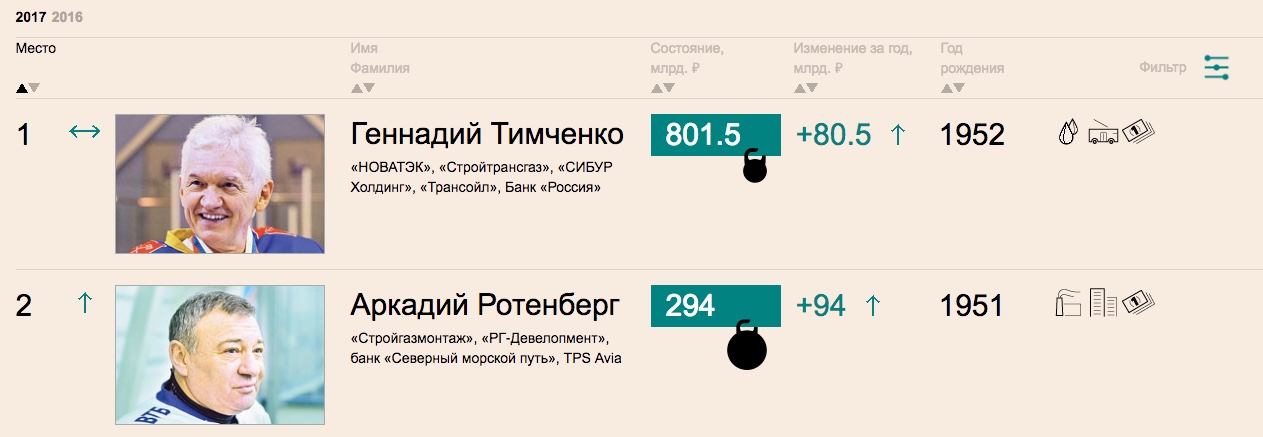
It is no surprise that Putin’s cronies Gennady Timchenko (I thought he was a Finnish national?) and Arkady Rotenberg topped the list of 304 capitalists, with alleged net worths of 801.5 billion rubles and 294 billion rubles, respectively. (That is approximately 11.8 billion euros and 4.3 billion euros, respectively.)
Screenshot, from Delovoi Peterburg, showing Putin cronies Gennady Timchenko and Arkady Rotenberg in the number one and two slots of the business daily’s 2017 ranking of Petersburg’s ruble billionaires
There are lots of other pals of Putin and Medvedev in the top fifty, but I was disappointed to see the personal fortunes of my own favorite Russian super villain, former head of Russian Railways Vladimir Yakunin, had faded a bit in the past year. He has dropped to the number twenty-six spot in the ranking, claiming a net worth of a mere 37.07 billion rubles, which means that in Old Europe, where Yakunin is now dispensing Russian softpowerish wisdom to decision-makers and academics via his newly opened Dialogue of Civilizations Research Institute, in Berlin, he would be a regular old euro millionaire, with a measly net worth of 548 million euros.
Screenshot, from Delovoi Peterburg’s website, showing Yakunin’s number 26 spot in its list of Petersburg’s ruble billionaires.
Another thing that struck me when I surveyed the list was the signal lack of women among the city’s ruble billionaires. Women appear on the list only towards the very bottom, which means they are not really billionaires, but dollar or euro millionaires, at most, and maybe not even that. And there are no more than ten such women in a list of 304 names.
So, the Delovoi Peterburg ranking is not only more evidence of Russia’s extreme wealth inequality—which is a matter of elite practice, if not of explicit government policy—but of the fact that this extreme wealth inequality has an even more extreme gender bias.
Even if Putin crony and Russian oligarch Vladimir Yakunin had named his newish Berlin think tank the “Vladimir Putin Institute for Peace and Freedom,” this would have had no effect, I am afraid, on all the decision-makers and academics who are prepared to rush into Yakunin’s embrace at the drop of a hat, forgiven, as it were, by the squirrelier name he has has chosen, Dialogue of Civilizations.
Yesterday and today, DOC Berlin has been holding a bang-up conference, dealing, like all conferences these days, with the centenary of the October Revolution.
Georgy [sic] Derluguian, Professor of Social Research and Public Policy, New York University Abu Dhabi
Michael Ellman, Professor Emeritus, Amsterdam University
Domenico Nuti, Professor of Comparative Economic Systems, University of Rome “La Sapienza”
Vladimir Popov, Professor, DOC RI Research Director and a Principal Researcher in Central Economics and Mathematics Institute of the Russian Academy of Sciences
Beverly J. Silver, Professor and Chair, Department of Sociology, Director of the Arrighi Center for Global Studies, The Johns Hopkins University, Baltimore, USA
Andres Solimano, International Center for Globalization and Development
Vladislav Zubok, Professor, Department of International History,London School of Economics, UK
Kevan Harris, Assistant Professor,Department of Sociology, University of California-Los Angeles, USA
But they are there, holding forth on “revolution” on the Putinist dime, while Yakunin, who clearly loves these powwows (there are tons of videos from past DOC gatherings on YouTube and elsewhere in which this is apparent), and is eager to show he is running the show, laughs his silent “former KGB officer” laugh.
While you are at it, check out this rogues’ gallery of useful idiots. Even if you have only a few toes in the world of academia, as I do, you will immediately recognize several of the people serving Yakunin on his think thank’s “supervisory board” and “programme council.”
Screenshot from the Dialogue of Civilizations Research Institute websiteScreenshot from the Dialogue of Civilizations Research Institute website
But what about the quality of the research supposedly underway at this so-called research institute? Here is a little sample, the abstract of a paper, downloadable for free, entitled “Church and politics: Russian prospects,” written by someone named Boris Filippov.
The paper is an attempt to make a brief overview of the Russian Orthodox Church’s state in the Post-Soviet Russia. Author notes, that the Church’s role in building civil society in Russia is potentially very considerable, since the Orthodox community’s ability to self-organize is rare for the post-Soviet Russia. He provides abundant empiric material illustrating Christian Orthodox community’s high capacities to contribute to building a prosperous society, for, as he shows, believers have gone much further on the way of consolidation than Russian society as a whole.
Is everyone who is speaking at today’s conference in Berlin and everyone who serves on Yakunin’s supervisory board and programme council kosher with obscurantist Russian Orthodox nationalism masquerading as scholarship? Do all of them know that “Russian Orthodoxy” (as interpreted by Patriarch Kirill and his intemperate followers) is now being used in Russia as an ideological battering ram to quash dissent and difference and reinforce Putin’s seemingly endless administration, as “Marxism-Leninism” was similarly used in the Soviet Union?
Do they know that their generous benefactor Vladimir Yakunin, in one of his other guises, wholeheartedly supports just this variety of aggressive Russian Orthodox nationalism?
The merging of political, diplomatic and religious interests has been on vivid display in Nice, where the Orthodox cathedral, St. Nicholas, came under the control of the Moscow Partriarchate in 2013.
To mark the completion of Moscow-funded renovation work in January, Russia’s ambassador in Paris, Aleksandr Orlov, joined the mayor of Nice, Christian Estrosi, for a ceremony at the cathedral and hailed the refurbishment as “a message for the whole world: Russia is sacred and eternal!”
Then, in a festival of French-Russian amity at odds with France’s official policy since the 2014 annexation of Crimea, the ambassador, Orthodox priests, officials from Moscow and French dignitaries gathered in June for a gala dinner in a luxury Nice hotel to celebrate the cathedral’s return to the fold of the Moscow Patriarchate.
Speaking at the dinner, Vladimir Yakunin, a longtime ally of Mr. Putin who is subject to United States, but not European, sanctions imposed after Russia seized Crimea, declared the cathedral a “corner of the Russian world,” a concept that Moscow used to justify its military intervention on behalf of Russian-speaking rebels in eastern Ukraine. Church property from the czarist era, Mr. Yakunin added, belongs to Russia “simply because this is our history.”
This entry has the title it does, not because I wanted an excuse to insert a recording by a beloved band of my salad days, which I did anyway, but because when I draft editorials like this on Facebook, as I often do, I usually endure stony silence from my so-called friends and readers after I post them. It is not that they are usually so garrulous anyway, but I do know they read what I write, because they are capable of responding enthusiastically to other subjects.
Writ large, this stony silence is what has helped Vladimir Yakunin operate his Dialogue of Civilizations hootenannies (usually held annually in Rhodes until the recent upgrade and move to Berlin) under the radar for nearly fifteen years with almost no scrutiny from the western and Russian press and, apparently, no due diligence on the part of the hundreds and maybe thousands of non-Russian academics, politicians, experts, and other A-league movers and shakers who have attended and spoken at these events.
So can we assume, for example, that Georgi Derluguian, Anatol Lieven, Walter Mignolo, and Richard Sakwa (I am only picking out the names of scholars with whose work I am familiar) condone the Kremlin’s occupation of Crimea, the Kremlin’s invasion of Eastern Ukraine, the Kremlin’s downing of Flight MH17, the Kremlin’s repeat invasion and wholesale destruction of Chechnya, during the early day of Putin’s reign, and the Kremlin’s extreme crackdown on Russian dissenters of all shapes and sizes, from ordinary people who reposted the “wrong” things on social networks to well-known opposition politicians, journalists, and activsts shot down in cold blood for their vocal dissent, including Anna Politkovskaya, Boris Nemtsov, and Stanislav Markelov, a crackdown that has been intensifying with every passing year Putin has remained in power?
A resounding “yes!” would be refreshing to hear, but we will never get any response from the members of Vladimir Yakunin’s semi-clandestine fan club. It is their dirty little open secret, and only someone who is uncouth, someone unfamiliar with the ways of the world’s power brokers and their handmaidens and spear carriers, would even think about asking them to reveal it. ||| TRR
Member of HRC Describes Putin’s New Term: Everything Under the Sun Will Be Banned
Alexei Obukhov Moskovsky Komsomolets
October 10, 2017
Pavel Chikov argues Russia will become isolated internationally, and federalism and regional economies will be jettisoned.
Pavel Chikov, a member of the Russian Presidential Human Rights Council, has forecast what politics in Russia will be like if Vladimir Putin is re-elected to another term. According to Chikov, the situation in the country will deteriorate rapidly, and more and more areas of public life will be off limits.
Pavel Chikov. Photo courtesy of Facebook/MK
Foreign mass media will be the first to be banned. This has been borne out, says the human rights activist, by the threat to shutter Radio Svoboda, which the media outlet received from the Justice Ministry last Monday.
In Chikov’s opinion, the country will also be stripped of religious freedom, as witnessed by “the huge criminal cases against and expulsion from the country” of members of various non-traditional religious movements, from Jehovah’s Witnesses, who have been declared “extremist” banned in the Russian Federation, to supporters of non-mainstream Buddhist and Muslim groups.
These measures, writes the human rights activist on his Telegram channel, will be paralleled by Russia’s renunciation of its international commitments. It will exit the Council of Europe and end its cooperation with the European Court of Human Rights. (Valentina Matviyenko, speaker of the Federation Council, said yesterday this was a probable scenario.) Russian’s relations with many European countries, from the Baltic states to Germany, will deteriorate, and their embassies will be closed. Restrictions will be placed on Russian nationals traveling outside the country, and the practice of stripping refugees and asylum seekers of their Russian citizenship and confiscating their property will be broadened.
Finally, Chikov writes, the country’s economy and domestic politics will deteriorate. The regions will lose the last remnants of their autonomy (Chikhov cites Vladimir Vasilyev’s recent appointment as acting head of Dagestan, although the United Russia MP has no experience in the republic), and the assets the regions have left will be placed under the control of Putin’s inner circle.
Translated by the Russian Reader. Thanks to Vasily Zharkov for the heads-up
Petersburgers Congratulated Putin on His Birthday by Blocking Liteiny Avenue
Timofei Tumashevich Activatica
October 7, 2017
An unauthorized [sic] rally of Alexei Navalny’s supporters in Petersburg turned out to be an unexpectedly serious, well-attended event. Most supporters of the unregistered candidate for the Russian presidency had expected the rally to be poorly attended. A few days before the rally, workers were replacing gravel on the Field of Mars, the announced venue for the rally. On Palace Square, a massive motorcycle rally, featuring the pro-regime motorcycle club Night Wolves, drew hundreds of bikers.
Motorcycle rally on Palace Square, October 7, 2017
In addition, on October 7, an “event whose purpose [was] to inform people about society’s complicated attitude towards the homeless, orphans, and HIV-infected people” had been authorized for the Field of Mars. A few days earlier, on October 3, police had confiscated stickers promoting the rally at Navalny’s campaign office in Petersburg and detained local campaign coordinator Polina Kostyleva.
Most of all, however, activists were amused to hear announcements, broadcast through a loudspeaker, inviting people to a free screening of the patriotic blockbuster Crimea at the nearby Rodina cinema. The oppositionists greeted the announcements with laughter.
Navalny supporter holding the Russian flag and sporting a humorous “Navalny 2018” t-shirt on the Field of Mars in Petersburg, October 7, 2017.
Navalny supporters and anti-Putin protesters milling about on the Field of Mars, Petersburg, October 7, 2017.
At 6:15 p.m., the people gathered on the Field of Mars chanted “Putin is a thief,” “Navalny,” “Freedom,” and even “Happy birthday!,” as the protest was timed to coincide wwith President Putin’s sixty-fifth birthday. On the Field of Mars itself, the protesters encountered no resistance from the numerous police officers on hand. They merely asked photographers to climb down from the walls of the memorial surrounding the eternal flame. Seemingly spontaneously, the crowd headed in the direction of Pestel Street. When the column of marchers spread out, it was obvious that no fewer than two or three thousand people were involved in the unauthorized [sic] march.
Otherwise, it would be hard to explain how the rally attendees easily managed to stop traffic on Pestel and, subsequently, on Liteiny Avenue, one of the main thoroughfares in downtown Petersburg. The marchers chanted, “Down with the tsar!,” “Free Navalny!,” “We are the power here!,” “This is our city!,” and even “St. Isaac’s Cathedral is a museum!” An Interior Ministry press release would later claim that 1,800 protesters made it to Liteiny Avenue.
Protesters abandoning the Field of Mars, where on June 12, 2017, around a thousand of their comrades were arrested for standing in place.
Anti-Putin protesters marching down Pestel Street, Petersburg, October 7, 2017
Police commenced to detain people roughly only at the intersection with Nekrasov Street. Police officers formed up in a line. Among the detaineed were well-known former political prisoner Ildar Dadin and photo journalist David Frenkel. Marina Bukina, an activist with the Detainees Support Group, was struck on the head by police. It has been reported that she suffered a concussion and had to have stitches. She was taken to St. Elizabeth’s Hospital. Polina Kostyleva, Navalny’s campaign manager in Petersburg, was once again detained by police. Georgy Alrubov, an employee of Navalny’s Anti-Corruption Foundation, reported his own arrest on Twitter. A number of bloggers have reported that Alrubov arrived on the Field of Mars only after most of the other protesters had left.
Police forming a line on Liteiny Avenue
Reporter David Frenkel during his arrest by police. He was later released from the paddy wagon.
Nevertheless, the police line on Liteiny was unable to shut down the protest march completely. Activists bypassed the roadblock by taking side streets and regrouped on Insurrection Square on the plaza near the entrance to the Galereya shopping center. Several hundred people made it there. At approximately 8:05 p.m., announcements were made inside the shopping center that it was closing immediately due to “technical difficulties.” A mob of shoppers flooded out of the shopping center and mixed with the protesters.
Protester outside Galereya shopping center: “No to Moscow Fascism. Putin, go away! We’re going in a different direction.”
Protesters, press, and police confront each other on Ligovsky Avenue, outside the Galereya shopping center and Moscow Station. Petersburg, October 7, 2017
Maxim Reznik, an MP in the city’s Legislative Assembly, was on hand for the rally.
“I gather that people headed spontaneously from the Field of Mars to Insurrection Square. This is the main problem, in fact. The regime itself has done everything it can to let the situation get out of control. Since they don’t allow people to assemble and arrest the organizers, people will take to the streets where they will,” the MP told Activatica.
Reznik personally witnessed the most serious incident outside Galereya. An unknown provocateur threw a beer bottle at a police officer. Subsequently, a fight broke out between people in civilian clothing. Protesters suggested the provocation was incited by plainclothes policemen. [That is certainly how it appeared on Radio Svoboda’s live stream coverage of the event—TRR.]
Fight outside Galereya shopping center between person unknown, some of whom were probably plainclothes policeman.
Around 10 p.m, a group of protesters decided to assemble again, this time on Palace Square, where the concert portion of the motorcycle rally had wrapped up. Around a hundred people came to the square. There was a discussion on certain Telegram channels whether they should spend the night there.
At least forty people were detained during the protests in Petersburg. Two workers in Navalny’s Petersburg campaign office who were detained at the protest have been fined 40,000 rubles each [approx. 585 euros].
Interfax reports that a woman who lived on Kolokolnaya Street, in downtown Petersburg, died waiting for an ambulance due to the fact that Navalny supporters partially blocked traffic on several central streets. [In a post published yesterday on Facebook, reporter David Frenkel explained why this report sounds implausible—TRR.]
Protester holds photo of President Putin aloft outside Galereya shopping center. In Russian tradition, the black ribbon indicates the person in the picture has just died.
Alexei Navalny’s supporters held rallies in eighty Russian cities on October 7. Navalny himself was arrested in early October and sentenced to twenty days in jail for urging people to attending an unauthorized [sic] rally and meeting in Nizhny Novgorod.
Protesters outside Galereya shopping center shouting slogans and waving flyers that read, “Navalny 2018.”
Translated by the Russian Reader. All photos courtesy of Timofei Tumashevich/Activatica
Russian anti-corruption crusader and opposition politician Alexei Navalny has been sentenced to 20 days in the slammer for “repeated appeals to take part in unauthorized rallies.”
That “repeated appeals” business sounds like a particularly pernicious crime.
What is the difference between messing with Navalny this way constantly and beating Catalonians over the head?
I don’t see any.
Or, actually, I do.
At the end of the day, after the Madrid government’s fine performance in Catalonia yesterday, with the whole world watching, the Catalonians might get what a lot of them seem to want: independence.
But they will get it, if they do, because millions of them have united and fought for it.
Alexei Navalny, on the other hand, has to pretend to be “two million Catalonians” all on his lonesome.
“Russia will be free” someday, but at the moment only Navalny and a handful of his countrymen want to act in a concerted, deliberate way to end the Putinist tyranny.
Everyone else is—to tell you the truth, I don’t know what they are doing.
What they definitely are not doing (at least, so far) is acting even remotely like “two million Catalonians.”
So, my reaction to the savage behavior of the Spanish police yesterday would definitely not be to gloat and suggest the police in so-called democratic countries are worse.
Actually, the police in Russia are much worse.
When push comes to shove, they wouldn’t hesitate to outdo their Spanish colleagues. And in any case there is a whole army of police, investigators, and prosecutors in Russia who could only be termed “political” police, because they spend all or most of their working days pursuing, interrogating, framing, trying, and imprisoning various “extremists.”
Tell me this hasn’t had a totally chilling effect on grassroots politics in Russia. It has. Why else would I, more or less a nobody, personally know so many Russians who have fled the country in fear of arrest and persecution or because they had simply been prevented by government agencies like the Justice Ministry, Center “E”, the FSB, and the Investigative Committee from doing the social justice work or political activism they had been doing in their own homeland for years?
But Russians are people like everybody else, and people sometimes are way too inclined to let their country’s powers that be off the hook, when they should be fighting them in the streets like “two million Catalonians.” TRR
Thanks to Erik Syring for the heads-up. Photo courtesy of Life on the Left
OPR Leader Andrei Bazhutin Picketing in Yoshkar-Ola: “Until 2015, I Also Sat and Watched TV”
Dmitry Lyubimov 7X7
August 1, 2017
The Association of Russian Carriers (OPR) picketed Nikonov Square in Yoshkar-Ola on July 31. The picket was part of a cross-country road rally, led by OPR chair and trucker Andrei Bazhutin. On June 14, he announced his candidacy for the Russian presidency. A 7X7 correspondent attended the picket.
Several picketers arrived on Nikonov Square at 7 p.m., bearing placards. Local OPR members held banners that were more informational, while road rally participants held up smaller banners sporting slogans such as “Plato Won’t Save the Roads, It’s Only for Oligarchs,” and “Stop Lying, Stealing, and Fighting Wars.”
Picketer bearing a t-shirt that reads, “Popular Movement for Housing. Together We’ll Take Back Our Abode. #ForHousing. ndza.ru.”
Several members of the Popular Movement for Housing (NDZA) joined the road rally. Andrei Svistunov, civic activist and founder of an independent trade union, came out to support the truckers with colleagues and friends from the local Alexei Navalny campaign headquarters.
“We have never been in government, and we have no ties with any oligarchs. We’re ordinary people,” said Andrei Bazhutin. “We want to change the system. We don’t have rose-tinted glasses. We realize our road is a hard road. We’ll see what obstacles they throw in our path. Until 2015, I also sat and watched TV. I went on trucking runs and watched TV. Nowadays, I don’t watch it at all. I trust the internet, but only partly. Here we are, outside, among people. Everywhere the doors have been slammed shut in our face. Our association has tried to make contact with the government and the president’s staff. The people in our association are grown men, and they’ve been through their share of hot spots. We own our own big rigs. People know who we are, and that’s a good thing.”
Andrei Bazhutin, chair of the Association of Russian Carriers (OPR)
The road rally has taken place in an abbreviated form. Previously, big rigs were involved in it, but now the convoy consists of only two cars and a minibus. Residents of Murmansk, Vologda, Tver, Moscow, and St. Petersburg have been involved in the rally. It has been paid for by participants themselves and private donors. During their meetings with the people in the towns where they stop, the truckers talk about different problems, including housing and hoodwinked investors in cooperative residential buildings.
“Initially, the Communists actively supported us. I met with Vladimir Rodin and Valery Rashkin, CPRF MPs in the State Duma. But they probably will not keep supporting us in the future, since we talk about the fact that Russia’s current party-based political system is rotten to the core. We are categorically opposed to the structure that has now been established in Russia. We believe the future lies with social movements, who must nominate grassroots candidates. That is probably the most positive know-how from the late-period Soviet Union that we can borrow. Power must rotate,” argues Bazhutin.
According to Bazhutin, the interests of the OPR and Alexei Navalny intersect, and the truckers are involved in his protest rallies. At pickets in Moscow, the drivers pasted placards with images of rubber duckies on their trucks. (The rubber ducky is a symbol of the “Don’t Call Him Dimon” campaign, whose supporters demand that authorities respond to the Anti-Corruption Foundation’s video exposé of Russian Prime Minister Dmitry Medvedev.)
Anti-Corruption Foundation, Don’t Call Him Dimon: Palaces, Yachts, and Vineyards—Dmitry Medvedev’s Secret Empire. YouTube video, with subtitles in English. Posted March 2, 2017, by Alexei Navalny
“2015 was the year of our camp in Khimki: our entire movement was launched there. Navalny filed a petition in the Commercial Court to reveal the terms of the public-private partnership agreement [establishing the Plato road tolls system], and many of our guys attended the hearing. Navalny wanted to visit our camp. But our goal was to keep the camp up and running, and if Navalny had shown up, we didn’t know whether it would have a positive or negative impact. So we turned him down. It led to a slight misunderstanding. Nowadays, we don’t say that Navalny has been going about things the wrong way. We see circumstances slightly differently. This concerns, for example, a united candidate from the opposition. He might not make it to the election. Those comrades over there [Bazhutin points to the law enforcement officers keeping an eye on the picket] might not allow it. If there is no such candidate, then what is left? We need candidates representing movements and grassroots organizations. Let ordinary folk nominate their own candidates. We shall see. Let them get themselves registered, and then we’ll decide whom to support,” said Bazhutin.
The truckers of the OPR have been on an indefinite strike since March 27. They have made six demands, including sacking the current government and expressing no confidence in the Russian president, to abolishing the Plato road tolls system and recalculating the excise tax on fuel.
The next stop on OPR’s road rally is Nizhny Novgorod.
All photos by Anna Pyatak and courtesy of 7X7. See the rest of her photos from the picket by clicking on the link to the original article, above. Translated by the Russian Reader. Thanks to Comrade Koganzon for the heads-up
Analysts Claim Number of Protests Sharply on the Rise in Russia
Yevgenia Kuznetsova RBC
July 10, 2017
The number of social and political protests in Russia has risen in the second quarter by 33% compared to the beginning of the year. Experts attribute the rise to seasonal activeness and the growth of social tension.
Photo courtesy of Oleg Yakovlev/RBC
Protest Factors
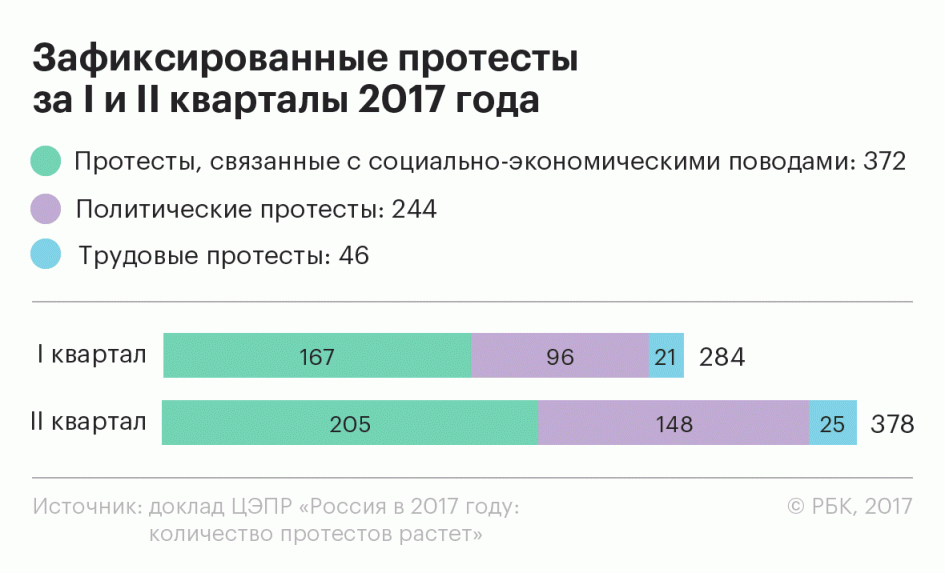
During the second quarter of 2017, the number of protests in Russia rose by a third compared to the start of the year. There were 284 protests in the first quarter of the year, while 378 protest events were recorded in the second quarter, the Center for Economic and Political Reform (CERP) reported in its paper “Russia in 2017: The Number of Protests Grows.” RBC has a copy of the paper.
The CERP’s analysts divide protests into political protests and social protests. The latter include protests over the violation of social rights, declines in living standards, loss of work, and nonpayment of back wages. Over the second quarter, the number of both types of protest grew. The paper’s authors recorded 148 political protests from April to July, compared to 96 in the first three months of the year, while the number of protests provoked by social injustices rose from 167 to 205. The analysts collected their information about protests from the media, social networks, regional analysts, and workforces, who recorded the protests on the ground.
The paper claims the level of protests was high both in 2016 and early 2017. Last year, however, the majority of protests touched on specific issues—wage arrears, the demands of defrauded investors and residential building stakeholders, increases in utility rates, the launch of the Plato system of road tolls for truckers, etc. The authorities did not solve these problems, and so protests have been politicized this year. People involved in them have taken to the streets with more general slogans, for example, anti-corruption slogans, the paper’s authors note. In their opinion, this is the cause of the increase in political protests.
Protests recorded in the 1st and 2nd quarters of 2017. [Green] Protests caused by socio-economic issues: 372. [Violet] Political protests: 244. [Light blue] Labor protests: 46. 1st quarter: 167 social protests, 96 political protests, 21 labor protests = 284 protests. 2nd quarter: 205 social protests, 148 political protests, 25 labor protests = 378 protests. Source: Center for Political and Economic Reform, “Russia in 2017: The Number of Protests Grow.” Copyright 2017, RBC
The growth of protests is explained by another factor: seasonality, CERP director Nikolay Mironov told RBC. People protest less at the start of the year than in the spring months. According to Mironov, the regime uses the seasonality of protests to decide when to schedule elections. In 2012, analysts at the Central Electoral Commission determined the populace was politically most active, including in terms of turnout, during two seasons: late March, April, and May, and late October, November, and December. Therefore, the regime moved the nationwide parliamentary and local legislative assemblies election day to September to lower the turnout while announcing the presidential election for March 2018 to raise the turnout
Other eventful factors in the second quarter of this year were the adoption of the law on residential housing renovation and the large-scale protests by Alexei Navalny’s supporters. But the main factor, according to Mironov, was the overall increase in tension due to the fact that the problems that have given rise to protests have not been solved or have been solved on a case-by-case basis.
“This is the Kremlin’s election strategy: solve problems on an ad hoc basis, because it is impossible to solve them as a whole. But you can go to a region and resolve a specific problem in a flashy way for the TV cameras,” Mironov explained.
Mironov argues that the federal authorities also expect that, after a public flogging during the president’s televised call-in show and his trips to the regions, local authorities will start solving problems on their own.
The increase in the number of political protests partly has to do with how the media covers the protests, Mironov argues. According to him, journalists usually pay more attention to political protests than to social protests, and this has a dampening effect on protests. People about whom reporters don’t write are “a priori less protected.”
Localization
The CEPR’s conclusions about the growth of protests have been indirectly confirmed by research carried out by the Levada Center. According to one of its surveys, the number of people who agree that political protests are possible in their town has risen from 14% in February to 23% in June, Levada Center sociologist Stepan Goncharov told RBC. The number of people willing to take part in political protests has increased from eight to twelve percent. An even greater number of people predicted social protests would break out in their towns. When asked, “Are protests against decreased living standards possible in your town right now?” 28% of respondents in June said they were, as opposed to only 19% in February.
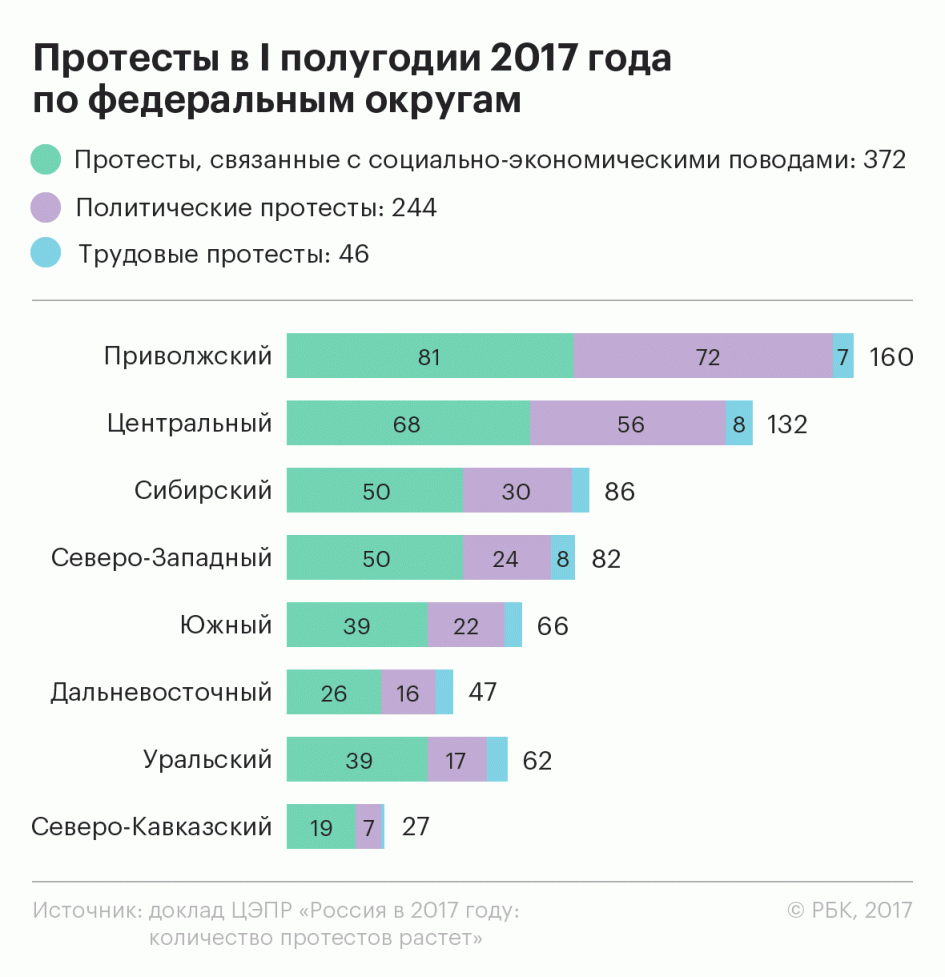
Protests in the 1st quarter of 2017 by federal district. [Green] Social protests: 472. [Violet] Political protests: 244. [Light blue] Labor protests: 46. Volga Federal District: 160 protests. Central Federal District: 132 protests. Siberian Federal District: 86 protests. Northwest Federal District: 82 protests. Southern Federal District: 66 protests. Far Eastern Federal District: 47 protests. Ural Federal District: 62 protests. North Caucasus Federal District: 27 protests. Source: Center for Political and Economic Reform, “Russian in 2017: The Number of Protests Grow.” Copyright RBC, 2017
It would be wrong to say there have been considerably more social protests in recent months, argues Mikhail Vinogradov, head of the Petersburg Politics Foundation, based on the results of his own research. According to Vinogradov, the number of political protests has increased mainly due to protests by Navalny’s supporters, but the number of social protests has remained at the same level. It would also be wrong to say the number of social protests depends directly on how the authorities resolve the issues that provoke them, says Vinogradov. According to him, the authorities do not have an overall algorithm. In some locales, they resolve issues immediately, fearing protests, while in other places they ignore problems or get bogged down in talking about them. The problem is that the authorities are not always able to determine the real cause of protests and react correctly to it.
Discontent is growing, but the majority of protests remain local for the time being, argues political scientist Konstantin Kalachev.
“The regime is fairly good at solving problems by nipping them in the bud,” argues Kalachev.
Although we cannot be sure social protests will not segue into political protests.
“For the time being it all comes down to demands to dismiss one governor or another, nothing more,” says Kalachev.
This is what is meant by ruchnoye upravlenie or “hands-on governance” in Russia.
“In a stage-managed gesture of benevolence a year ahead of a presidential election, Russia’s Vladimir Putin flew 1,200 km (750 miles) to call in on a woman living in squalor and ordered her to be rehoused immediately” (Gleb Stolyarov, “Eyeing election, Russia’s Putin stages visit to voter’s rundown home,” Reuters, June 28, 2017).
None of the other candidates (?), especially Alexei Navalny, who was officially sidelined by the Central Electoral Commission the other day, can hand out new houses and trips to Sochi to the needy. If they could and did, they would probably be brought up on charges for influence peddling or something like that.
But Putin can do it. The problem is that he cannot and will not do it for everyone, and certainly not in the systematic way implied by the clause in the 1993 Russian Federal Constitution that declares (emptily, as it would turn out) that the Russian Federation is a “social state,” i.e., a welfare state in the best sense of the word. That would mean bankrupting the current Russian state, i.e., the capitalist oligarchy run by Putin and his cronies in “manual mode” for their own benefit and one else’s.
I love the headline: “Eyeing election…” There are virtually no real elections in Russia, and in the few elections where a real, well-meaning person might, theoretically, be able to sneak past the watchful eyes of the elections boards—say, if she ran as a candidate in a lowly municipal district council (not even for city council or regional legislative assembly, where the winners do have nominal or real power and, at least, in Petersburg, personal discretionary budgets for spending on pet projects)—she would end up serving on a entity that has almost no budget (to hand out largesse, like Putin did in this case, or to do something that benefits all or many of her constituents) and no power whatsoever.
Putin will limit his campaigning to a few feel-good demonstrations of “manual control” like this one, where he unwittingly reproduces the role played more cheerfully and persuasively by Ty Pennington on ABC’s popular reality TV program Extreme Makeover: Home Edition, which probably did more for the needy than Putin has ever done and ever wants to do. TRR
Russia’s regions grow increasingly hostile to Mr. Navalny. Alexey Navalny’s campaign coordinator in Barnaul was stabbed by two men when trying to enter the local city hall building to apply for a demonstration permit. Artem Kosaretsky told reporters that he sewed up the wound himself and didn’t need to be hospitalized. Police have detained the attackers, though security guards at city hall reportedly refused to believe that Kosaretsky had been stabbed, attributing his wound to a scratch or even a mosquito bite. Hours earlier, unknown persons in Barnaul reportedly tried to set fire to Navalny’s local campaign headquarters.
(Source: Meduza’s daily “The Real Russia. Today” e-mail newsletter, June 26, 2017)
How do these incidents, no doubt arranged by the local security forces, prove that “Russia’s regions have grown increasingly hostile” to Navalny?
Everyone needs to make the Supreme Leader happy once in a while, even Russian media “exiled” to Latvia.
P.S. Or is the guy who writes Meduza’s English summaries increasingly hostile to Navalny? I can easily imagine that’s the case. Just as I can easily imagine that he doesn’t live in Russia, Latvia or anywhere in the vicinity. These days, you can just phone it in, so to speak, while living the good life in Albuquerque or Austin.
“The Regime Is Making New Enemies with These Arrests”
Irina Tumakova Fontanka.ru
June 22, 2017
The arrestees who served ten days in jail after Russia Day shared their plans for the future. They once again included the Field of Mars, and Navalny, and the special detention center on Zakharyevskaya Street they had just left.
Ksenia Morozova, holding a placard that reads, “Freedom is within.” Photo courtesy of Sergei Mikhailechenko/Fontanka.ru
A new group of prisoners, who had finished serving the jail sentences they were given after Russia Day, was released on Thursday, June 22, from the Interior Ministry’s special detention center on Zakharyevskaya Street in central Petersburg. They had been sentenced to ten days in police custody, meaning they had committed violations of “moderate severity.” The die-hard violators, who were sentenced to fifteen days in jail, will not be released until next week. The least malicious violators, who had already been released, greeted their recent cellmates with soda pop, flowers, and rounds of applause. The former prisoners were cheerful and praised the prison food. They came out of jail with the same clear conscience they had when they left the Field of Mars in paddy wagons.
The Interior Ministry’s special detention center on Zakharyevskaya is a historical landmark. Vladimir Ulyanov (Lenin) and Felix Dzerzhinsky had done time there prior to 1917. In June 2017, people who attended an anti-corruption rally on Russian Independence Day were jailed there.
Around 10,000 people had gone to the Field of Mars on the national holiday. Some people celebrated, while others were arrested. Nearly six hundred hundred left the celebrations in paddy wagons, headed to police precincts round the city. From June 13 on, the city’s district courts worked like a conveyor belt for meting out punishment. The arrestees were sentenced for going to the anti-corruption rally and for failing to obey police orders to leave the rally, i.e., they had violated two articles in the Administrative Offenses Code. The majority of those detained at the event got off with 10,500-ruble fines [approx. 158 euros], but a hundred and fifty people were sent to jail, sentenced to terms of three to fifteen days.
The release of the prisoners whose time in jail ended on June 22 was due to start at two o’clock in the afternoon, when the lunch break ends on Zakharyevskaya. At the very same time, as recorded in their arrest records, exactly 240 hours had passed since the first of the “ten-dayers” had been detained. In fact, they had been detained and hauled to the courts wholesale. But the law enforcement machine was carefully counting off the minutes. One prisoner could be released at 2:30 p.m., but another had to be released at 4:00 p.m.
The Support Group
At a quarter to two, people holding plastic bags form a semi-circle at the exit from the detention center. Two vehicles are cruising nearby. One, emblazoned with Open Russia’s logo, is ready to give the released detainees a lift to the courts, where lawyers are waiting to appeal their fines. The other, emblazoned with the police’s logo, is also ready to take them somewhere.
“I’m going to detain you for jaywalking,” a policeman standing on the sidewalk warns me.
“Please arrest me for jaywalking,” I smile back at him, standing on the same sidewalk. The policeman goes back to his car.
The bags of the people waiting outside the detention center are stuffed with bottles of soda pop. There is also a bunch of pink chrysanthemums. Later, the chrysanthemums will be divided and given to the liberated comrades. Everybody knows who nice it is when people are waiting for you with chrysanthemums when you get out of jail. And you are also really thirsty when you get out. The greeters know all of this from personal experience.
“I was in for five days and got out last week,” says a man standing near the gates of the detention center. “And today the guy I shared a cell with is getting out.”
The man’s name is Oleg Maksakov. He is forty-three. He doesn’t know why he was sentenced to five days, while his young cellmate got ten days. They didn’t know each other before they were jailed, but they made friends in the cell.
“The propaganda has no effect on the people aged eighteen to twenty-five who came to the Field of Mars,” Maksakov says of his “accomplice.” “What matters even more is that they’re not afraid. They’re not downtrodden. They have no experience of the Soviet repression machine. I mean, now they are finding out, of course. But it doesn’t scare them. It only makes them mad.”
Another person who celebrated Russia Day at the Field of Mars approaches us. In terms of age, Pavel Ilatovsky is one of the “non-downtrodden.” You could say he lucked out. He got off with a 10,500-ruble fine and spent two days at police precinct while he waited for his court hearing.
“Yeah, I was lucky,” Ilatovsky agrees. “I had my hearing at the Krasnoye Selo District Court, and the judges were okay. They said right off the bat there was no room in the cells, and so they were going fine us.”
The figures assembled by volunteers back up what Ilatovsky says. The Krasnoye Selo District Court heard 59 cases, and no one was sentenced to time in jail. The Kalinin District Court proved to be the most cruel and greediest. Among the 44 cases it heard, around three fourths (the volunteers don’t know for certain) resulted in fines alone, while the rest resulted in fines and jail time. The same court handed down the harshest sentence: fifteen days in jail plus a 20,000-ruble fine.
Ilatovsky volunteers with the detainees assistance group. The group brought care packages to Zakharyevskaya all ten days and raised money to pay the fines. And now they have brought a vehicle, soda pop, and chrysanthemums. This system of assistance improves with every series of arrests. It has started working like a well-oiled machine.
“There are lots of us,” says Ilatovsky. “And we know that if someone wasn’t detained this time round, he or she could be detained next time. When I was at the police precinct, they brought us water and helped out with food. They even brought us shawarmas.”
We are chatting next to the prison’s entrance. Everyone’s mood is upbeat, even joyful. Finally, the iron door opens and a young man exits holding his passport. He is carrying a backpack, and a container of liquid soap pokes out from the pocket. A yellow-and-blue ribbon is pinned to his jacket.
“Oh!” says Oleg Maksakov, rushing towards him. “I spent five days in a cell with that guy!”
“I Hung Out with Interesting People”
Denis Uvarov went to the Field of Mars with a purpose. He wasn’t celebrating the holiday, but combating corruption.
“This dude was walking around with a bullhorn and ordering everyone to disperse, but no one dispersed. Therefore, they did not obey [the police’s orders],” he says by way of explaining why he was convicted of disobeying the police.
Besides, Uvarov chanted slogans offensive to our president, and what is worse, waved the flag of Ukraine, with which he sympathizes. He caught flak for it: ten days in the slammer. He admits it could have been worse. He twice received care packages of food from complete strangers, and that amazed him most of all.
“Of course, we didn’t really need anything in the cell, but it’s nice knowing that you’re in there, and somebody cares,” says Uvarov.
In the two-person cells in which the June 12 arrestees were held, they really did not need anything. Uvarov compared it to a hospital, adding, only, that he couldn’t go into the hallway. But they were taken out for walks every day.
“The biggest problem was not being able to wash up,” he says. “They let us take a shower only once over the ten days. Well and, excuse me for mentioning it, but going to the toilet when you’re not alone in the cell, is, you know . . . Otherwise, it was okay. There was nothing to do, so I read a pile of books, slept in, studied English a bit, and hung out with interesting people.”
The interesting people were other prisoners sentenced to jail for June 12. Uvarov says it was the first protest many of them had attended. Some of them ended up there by accident and were not interested in politics.
“Now they say they’re going to be more active and angrier,” Uvarov continues. “So the regime is deliberately making new enemies with these arrests, as it were. You can do fifteen days in jail, after all. As long as there is a point.”
“What about twenty?” I ask. “That’s nearly a month.”
“Twenty?” says the young man thoughtfully. “Yes, I could probably do it.”
“Yeah, but don’t you need to be arrested twice in six months,” Uvarov asks uncertainly. “I’ll probably need to take that into account. I’ll think it over.”
“I’ll Go to Jail Again”
Ivan Gerasimyuk is one of the young people who collided head on with politics at the special detention center. He looks about twenty years old.
“I was just hanging out on the Field of Mars,” says the young man. “There was a celebration of four eras taking place there. I looked at pre-revolutionary tanks, and then I went to eat kasha in the field kitchen. That’s where the police grabbed me. In court, I said I wasn’t interested in politics, but the judge didn’t believe me and gave me ten days in jail. It turns out you cannot attend celebrations in our country.”
Gerasimyuk thought jail was awful, especially the fact the prisoners were fed not according to schedule, but whenever. And his cell was very dirty.
“I don’t want to go back there,” Gerasimyuk frowns. “But I’ll definitely go to a protest rally now. We have to combat this lawlessness. Well, so I’ll go to jail again. But then other people won’t have to go.”
Alexander, who refuses to tell me his surname, works in a school. He won’t say what he does there, but he deals with young people like Gerasimyuk, only a bit younger.
He shakes his head.
“I don’t talk with the kids about politics at all. I don’t need to. They know it all anyway. They read about Navalny and Putin in the internet. Although what gets them hot and bothered is memes and all, not politics. But their teachers propagandize them, and they see it doesn’t synch with what is happening around them. That generates distrust in them.”
Alexander went to the Field of Mars knowing a rally was supposed to take place there, but he had no plans of taking part in the protest. He only wanted to watch.
“The numbers of true believers who were arrested were small, in fact,” he grins. “It was the rubberneckers like me who got caught. After doing time in jail, some of them are now true believers. But I’ve also spoken with other people, who say they would never do it again. As for me, I’m definitely going next time.”
Vladimir Drofa, who is released right after Alexander, has become a true believer. Or, at least, he says so.
“Until my arrest I was a sympathizer,” he says, looking at my dictaphone. “But now I’m a convinced revolutionary. I will devote the rest of my life to making sure I change places with the people who put me in here.”
“You want to sentence them to ten days in jail?” I ask.
“I’d start with ten at least.”
Drofa knows that, before him, his namesake Vladimir Ulyanov was imprisoned in a nearby cell.
“Let Them Bust Me!”
The convicts opened the iron door one after another. The young women who were released were mobbed by other young women, who gave them bouquets and squealed in delight, as if they were greeting movie stars. The female arrestees who were the last to be released wearily thanked the public and refused to talk to the press, because they wanted to go home. Ksenia Morozova, a social media marketing manager for Sobaka.ruwho had become famous over the last ten days, set her bags on the pavement. She held up a placard reading, “Freedom is within.” She did not hold it up very high, only as high as her own neck
“This is my first picket on the outside!” she yelled. “Let them bust me if they want!”
She was not busted. Her girlfriend grabbed her bags, and the flock of young women ran off towards the subway.
The young people were applauded as they left the jail. They were also given flowers, the very same pink chrysanthemums, until the entire bunch had been divvied up and was gone. The press drifted away. The bus emblazoned with Open Russia’s logo left, taking with it those who wanted to appeal their sentences to meet with lawyers. The last of the dozen and a half “ten-dayers” emerged from the jail after four o’clock, saying almost exactly the same things their special detention center cellmates said. None of them broke their toothbrushes at the doors of the prison.
Translated by the Russian Reader. Thanks to Comrade Uvarova for the heads-up





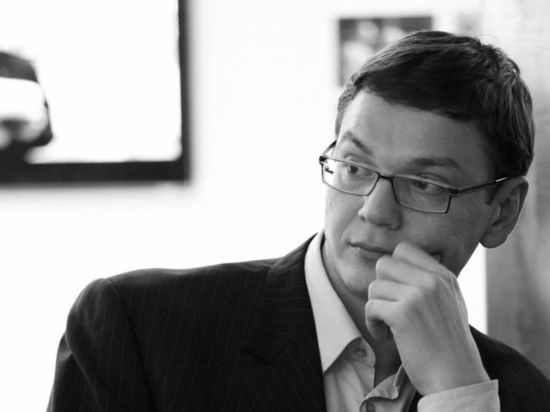 Pavel Chikov. Photo courtesy of Facebook/MK
 Motorcycle rally on Palace Square, October 7, 2017
 Navalny supporter holding the Russian flag and sporting a humorous “Navalny 2018” t-shirt on the Field of Mars in Petersburg, October 7, 2017.
 Navalny supporters and anti-Putin protesters milling about on the Field of Mars, Petersburg, October 7, 2017.
 Protesters abandoning the Field of Mars, where on
  Anti-Putin protesters marching down Pestel Street, Petersburg, October 7, 2017
 Police forming a line on Liteiny Avenue
 Reporter David Frenkel during his arrest by police. He was later released from the paddy wagon.
 Protester outside Galereya shopping center: “No to Moscow Fascism. Putin, go away! We’re going in a different direction.”
 Fight outside Galereya shopping center between person unknown, some of whom were probably plainclothes policeman.
 Protester holds photo of President Putin aloft outside Galereya shopping center. In Russian tradition, the black ribbon indicates the person in the picture has just died.
 Protesters outside Galereya shopping center shouting slogans and waving flyers that read, “Navalny 2018.”
![Catalonia independence_thumb[1]](https://therussianreader.com/wp-content/uploads/2017/10/catalonia-independence_thumb1.jpg)