The Moscow Timesbuys the “Cossack” myth hook, line and sinker:
“The Cossacks are an ethnic group within Russia with a strong military tradition. They often take on roles as police or security guards to maintain peace in Russia’s streets.”
In this still from video provided by Anapa Today, “Cossacks” throw milk at opposition leader Alexei Navalny, center right, at the Anapa Airport in southern Russia, Tuesday, May 17, 2016. A group of “Cossacks” attacked Russian opposition leader Alexei Navalny and his associates outside the airport, injuring Navalny and six others, his spokeswoman said. Courtesy of Dmitry Slaboda and Anapa Today via AP. (The quotation marks are mine – TRR.)
Maybe there are real cowboys left in the US, but wearing a cowboy hat does not make a you a cowboy, even though lots of Americans do just that: put on a cowboy hat and imagine they are “cowboys.” The same thing goes for the “Cossacks” flooding and terrorizing Russian public space the past several years.
Meaning, it has recently became fashionable for violent pro-regime thugs or recovering alcoholics or just plain old security guards to dress up as “Cossacks” and behave dreadfully or just gad about looking anachronistic and as if they are in charge, although no one put them in charge of anything, and if the police had any moxie they would haul them away to the hoosegow on sight.
I’ve seen such “Cossack” security guards with my own eyes slouching around Our Lady of Vladimir Church, in my hometown of Petersburg, the achingly lovely church where Dostoevsky was a parishioner in the later years of his life.
Another thing I have been told at least three dozen times by various folk in the Motherland over the years is that lapta—an alleged Russian bat-and-ball game not played by anyone for at least two centuries and that no one (least of all, the folks telling me about it) has ever seen played by anyone—is the “Russian equivalent of baseball.” Some even claim it inspired the invention of baseball in the US.
Modern young people pretending to play lapta so there would be a photograph of modern young people playing it to put in the Wikipedia article on lapta. Courtesy of Wikipedia
I think an actual nationwide lapta fad would be a great way of diverting the aggressive energies of all the thugs, alcoholics, and security guards currently pretending to be “Cossacks.” We should see if we can make it happen.
Of course then maybe the ex-“Cossacks” would start running around whacking Navalny & Co. with their new lapta bats. It’s a risk we’ll have to take.
Hello! One of the main events of the past week for us was not Putin’s “Direct Line,” but the arrest of a man who spoke with Putin a year ago. Anton Tyurishev, a construction worker at the Vostochny Cosmodrome in the Russian Far East, complained to the president that he and his mates were not being paid their wages. Putin promised to get to the bottom of it, but a year on nothing had changed. Tyurishev promised that in response protests would kick off. Later, he was summoned to the police station, where the “Law on Rallies” was read out to him. The day before the “Direct Line” broadcast, he was detained and sent to jail for five days, allegedly, for swearing in public.
Criminal Prosecution
The new defendant in the Bolotnaya Square Case, Maxim Panfilov, who suffers from Tourette’s syndrome and yet was taken into police custody, is not getting the medicines he needs. Instead, he is being administered substitutes that do not alleviate his condition. Panfilov has been appointed an outpatient psychiatric examination. The investigator has agreed to let defense attorneys attend it.
Ildar Dadin, convicted of “multiple violations of the rules for holding public events,” was convoyed from Moscow to Petersburg right on his birthday, which means he will serve his sentence in Leningrad Region.
Ildar Dadin
Last week, it transpired that Magomednabi Magomedov, imam of the Eastern Mosque in Khasavyurt, had been arrested, accused of incitement to terrorism and inciting religious and ethnic hatred. Magomedov, who was transported from one place of confinement to another over several days, complained he had been tortured. Pretrial detention facility officers had beaten him and forced him to kneel, demanding that he confess to the charges.
Euromaidan participant Alexander Kostenko, convicted of harming a Berkut riot police officer, was transferred to solitary confinement shortly before a hearing where his request for parole was to be examined. Naturally, Kostenko’s parole request was rejected.
Alexander Kostenko
It seems soon Alexei Navalny will have no allies who are not undergoing criminal prosecution. Ivan Zhdanov, head of the Anti-Corruption Foundation’s legal service, and a candidate for the council of deputies in the Moscow suburb of Barvikha, has been charged with evading conscription.
Freedom of Assembly
In Ulyanovsk, police diligently searched for activists who had blocked a road in connection with construction of a residential complex. They visited one activist at work, and telephone another and asked him to report for questioning. When he demanded an official summons, they threatened him with criminal charges. Administrative charges have been filed against three people.
In Volgograd, the leader of the regional Union of Entrepreneurs and Freight Haulers has been slapped with three administrative charges for calling people to a protest rally before the rally was authorized. The court threw out two of the three charges, while the third resulted in a fine.
In Podolsk, three men attacked Maxim Chekanov, a past participant of protest rallies. The incident began when they called Chekanov by name, asked him questions about the “Kiev junta,” called him a “Banderite scumbag,” and then invited him to go round the corner. During the ensuing fight they smashed Chekhanov’s face.
Popular Chechen singer Hussein Betelgeriev, who disappeared in late March, has returned home beaten. It is unknown where he was all this time. Relatives and friends suggest he was abducted, and connect the abduction with his comments on social networks and the fact he ignored the call to attend a pro-Kadyrov rally on March 23.
OVD Info is an independent human rights media project dedicated to political persecution in Russia. We are engaged in daily monitoring of detentions at public events, and publish information about other kinds of political persecution. We believe that information liberates and protects, and analyzing the data we collect can help change the situation for the better in the future.
Editor’s Note. OVD Info sends out a weekly email news roundup, in Russian, to its supporters. I thought that, despite its brevity, this week’s roundup provided a fairly eloquent picture of the state of affairs in this country at present and not just this particular week. You can sign up to the mailing list by going to the bottom of any page n the OVD Info website and entering your email address where you see the phrase ПОДПИСАТЬСЯ НА РАССЫЛКУ.
Putin Proclaims National Idea Fontanka.ru
February 3, 2016
In Russia, there can be no other unifying idea than patriotism, argues President Vladimir Putin, as reported by TASS.
“This is, in fact, the national idea,” the head of state announced during a meeting with the Leaders Club, which brings together entrepreneurs from forty of the country’s regions.
According to Putin, this idea is not ideologized and is not linked to the work of a particular party, reports RIA Novosti.
“It is a common rallying point. If we want to live better, the country has to be more attractive to all citizens and more effective,” the president stressed.
_________
Who Killed a Transsexual in Ufa and Why? Ufa1.ru
February 2, 2016
On Monday, February 1, Angela Likina was stabbed in the chest and killed in Ufa. The Ufa resident had gained notoriety in 2014, when a video recorded on a traffic police dashcam entitled “Ufa Traffic Cops Stop a Transvestite” [sic] went viral on the Web. Ufa1.ru found out who killed Oleg Vorobyov, who had changed his sex and become Angela Likina, and why.
Angela Likina. Photo courtesy of Ufa1.ru
The controversial video from the traffic police car dashcam recorded an inspector checking the papers of a female motorist. It transpired, however, that the motorist’s name, according to his internal passport, was Oleg Vorobyov. The inspector was very surprised by this. The motorist was a transsexual who had been preparing for a sex change operation for several years, becoming Angela Likina. The restricted video was leaked to the Web.
Later, the State Auto Inspectorate conducted a review of the incident, because the restricted footage should have not ended up on the Web. Angela Likina also commented on the video herself. She was surprised the incident had provoked so much interest among Web users.
“People die in accidents, children get hurt, cars are stolen, blood is needed to save someone’s life. Gentlemen, why are you setting records for likes and reposts about me? I honestly don’t understand,” said Likina, adding, “I don’t care how you live, what you do, and so on, so long as you are alive, healthy, and happy. But my life does not concern you in absolutely any way.”
How Did Oleg Live?
Ufa1.ru spoke with friends and acquaintances of Angela Likina, who talked about the life of the murdered woman. We found out this sad ending had emerged from a number of factors. Before becoming Angela Likina, Oleg Vorobyov had been married. Acquaintances confess that, outwardly, the couple were seemingly happy. They were raising two daughters, now aged fourteen and nine. The family lived in a private house, which also housed Oleg’s auto repair garage. Many of the people with whom we spoke said automobile owners were satisfied with Oleg’s work, that he had a magic touch.
Over five years ago, Oleg realized he was living in someone else’s body. He understood he wanted to change his sex and become the person he thought he was. Oleg began calling himself Angela Likina and started the complicated process of preparing to change his sex. He took hormone pills and began dressing like a woman. According to his internal passport, however, he remained Oleg Vorobyov. He could only change his name after finally changing his sex.
Five years ago, the Vorobyovs divorced, but the former husband and wife and their two children kept living under the same roof. The house was the wife’s property, and her former husband had an established business there. Several of the family’s acquaintances believe that Angela did not want to lose her income from the auto repair garage and spend money on renting a place to live. After all, she had to save up a large sum of money for the operation, and the medicines she took to prepare for the procedure were expensive. Close friends emphasize that Angela worked a lot, sometimes seven days a week.
At the same time, Ufa1.ru’s sources noted the Ufa resident simply had no choice.
“He once tried to rent a flat, but was kicked out. A neighbor had said, ‘I don’t want my children to see this!’ Consequently, he was evicted and didn’t even get his money back,” said one of our sources.
Friends of the family noted that those who have lived under the same roof with ex-spouses can imagine the atmosphere that prevailed in the Vorobyov house. Some say that the rows over living arrangements caused the Vorobyovs to come to blows. Things were aggravated by the fact that the head of the family had become a woman. Their children also became the targets of reproaches and ridicule at school.
“They would come home in tears, and sometimes refuse to go to school, but Angela loved her daughters and gave them a lot of time,” acquaintances noted.
Who Killed Angela?
According to friends, a boyfriend came to visit Oleg’s ex-wife on the ill-fated evening. The criminal investigation will shed more light on what exactly happened in the house. For now, the family’s acquaintances have their own hypotheses. Perhaps the man intervened in yet another family row. Maybe he stood up for his girlfriend and wanted to intimidate Angela by demanding she pack her things and leave. The row, however, escalated into something bigger.
“She was stabbed in the chest near the heart. She did not die immediately. She made it to a neighbor’s house, told him what had happened and who had done it, and an ambulance was summoned. Then Angela died in the neighbor’s arms. It was apparently too late to help her. I don’t know what was happening in the family. Angela was a good person, but strangers often beat her up. Her neighbors respected her choice. It is a bad thing when a person steals, kills or rapes, but everything else is a private matter,” said an acquaintance of Angela’s.
“The best human qualities—kindness, fairness, compassion, and unselfishness—were powerfully manifested in her. Unfortunately, that is a rarity nowadays. And she really never held a grudge against anyone, although there were a fairly large number of people who wished her ill. Most of them, it is true, were people who did not know her at all. They insulted and mocked her. You could say she was understanding about it: far from everyone in our city, or even our country, is ready to comprehend the decision to have a sex change. And that is another reason I have endless respect for her: the determination to go her own way to the end, to change her life fundamentally, the willingness to take one and overcome all the difficulties,” another girlfriend of Angela’s confided to Ufa1.ru.
“Apparently, Angela sensed her impending death. Not long before this she had asked forgiveness from her wife for all the rows that had happened between them,” said another family acquaintance.
__________
Fire at Moscow workshop kills 12 people, including 3 children Boston Globe
January 31, 2016
ASSOCIATED PRESS, JANUARY 31, 2016, MOSCOW — A fire at a textile workshop in Moscow has killed 12 people, including three children, officials said.
The victims were not identified but were reportedly immigrants.
The Investigative Committee, the top state investigative agency, said the fire broke out late Saturday in northeastern Moscow, damaging more than 32,000 square feet of the structure.
Investigators said they are looking at negligence or arson as possible causes.
Russia’s children’s rights ombudsman, Pavel Astakhov, said Sunday on his Twitter account that three children were among those who died, including a baby. He said the victims were migrant workers who lived next to their workplace.
Several dozen fire engines responded to the blaze, and it took firefighters about five hours to extinguish the blaze.
Investigators continued to sift through the rubble Sunday for evidence.
Many immigrants work in Russian factories, some of which have been investigated for hazardous working conditions. In April, a blaze on the outskirts of Moscow killed 17 migrant workers.
__________
The death toll of Kyrgyz citizens (according to the Embassy of the Kyrgyz Republic in the Russian Federation):
1. Sajida Masaliyeva, born 1988. Home address: Village of Kyzyl-Bel, Batken District, Batken Region.
2. Toktokan Saliyeva, born 1983. Home address: Village of Tayan, Batken District, Batken Region.
3. Uulkan Saliyeva, born 1997, sister of Toktokan Saliyeva.
4. Isa kizi Aizat, born 1995. According to available information, Isa was a native of the Village of Kaiyndy, Batken Region.
5. Milikajdar uulu Koshonbay, born 1990.
6. Tologon Kozuyev, born 1991.
7. Manas, born 1995; brother of Tologon Kozuyev; no other details.
8. Daniel, 4-5 years old, son of Ergeshbay Japarov, a Russian national who perished in the fire; born in the village of Rout, Batken District, Batken Region; according to the victims, Daniel was a citizen of the Kyrgyz Republic.
[Elena Bobrova:] You are something of a patriot yourself?
[Nikolai Kolyada:] How else should I relate to Russia? I love her whatever she be like. Like Gogol I can tell the whole unvarnished truth about her. And Nikolai Vasilyevich said such awful things about Russia. He sobbed bloody tears when thinking about the country. But not because he hated it. On the contrary, because he loved it. When foreigners start speaking badly about Russia, I begin to boil: “Shut up, it is none of your business. I have the right to say anything about her, but you do not.” Well, it is okay when Europeans or Americans sling mud at us: they have a hard time coping with the fact we are different, unpredictable, and freer than they are. But when our own people hate their own country, that is terrible. This morning, I was reading Facebook and I thought, “Why do you live here if you hate Russia so much?”
[Bobrova:] But you just said yourself we have a right to chew out Russia because we live here.
[Kolyada:] Chew out but not hate. But Facebook is just seething with hatred.
—Excerpted from “20% of the Petersburg audience are loonies,” Gorod 812 (print edition), February 1, 2016, page 34
Items one, two, four, and six translated by the Russian Reader
Kadyrov Is Not Chechnya
Grigory Tumanov Snob
January 26, 2015
Kommersant newspaper correspondent Grigory Tumanov has returned from a trip to Grozny and reports everything you hear about modern Chechnya and its bloodlust is a myth invented by Ramzan Kadyrov
Photo: Dmitry Korotayev/Kommersant
If you said the pro-Ramzan Kadyrov rally, held last Friday in Grozny, was a kind of vote for Kadyrov, you would have to admit it was a failure. It has long been argued the event was meant to hide some of the Chechen leader’s deeper problems, and he had begun to haggle with Moscow not by offering stability in exchange for a free hand, but by offering the explosive situation in the region. But on the ground it turned out all the stories about how, as soon as Kadyrov resigns and loosens his grip, the entire republic would secede from Russia, immediately impose sharia law, and establish a free Ichkeria are a myth.
I remember January 19, 2015, in Grozny: the rally for the Prophet, which had also been organized not without the involvement of the local authorities, to put it mildly. The vast majority of the people at the rally had, of course, never seen any Charlie Hebdo cartoons on the web, the cartoons that sparked the brutal murders of the magazine’s journalists. Despite this, however, from early morning there was a huge traffic jam even on Chechnya’s border with the neighboring republics of Ingushetia and Dagestan. Yes, there were state employees. Yes, ralliers were bussed into Grozny. Yes, there were quotas and roll calls, and prototype placards imposed by the higher-ups, and campaigning in dean’s offices. It is odd, of course, to try and assess the degree to which those people went involuntarily to the Heart of Chechnya Mosque that day, but it should be said they stayed on the square both at twelve o’clock to perform the midday prayer and afterwards.
Several days later, every other car was still sporting a “We Support the Prophet!” placard. It made sense. How, in a Muslim region, would you say no to the question, “Are you going to the rally for the Prophet?” You wouldn’t say it, of course.
“I have not seen the cartoons, but I am a Muslim, so I have no choice but to come out. Rally or no rally, how could I not come out? For some reason you all say we should not be offended by cartoons about something that matters to us. But why should you decide for us? You don’t believe in it!” one rally attendee told me.
It was a conclusive victory for Kadyrov. People really did come out for the rally, driven not only by official lobbying but also by their own indignation. So it was a great way for Kadyrov to announce his candidacy for the post of chief defender of Muslims in Russia.
Photo: Said Tsarnayev/RIA Novosti
Contrary to the official Instagrams posted by Chechen officials and Kadyrov himself, it turned out that the personal pull exerted by the head of the republic was still not comparable to that of Muhammad. The Chechen Interior Ministry reported that over a million people gathered on the squares of Grozny last Friday. This is not true. I stood on the roof of the judicial department of the republic’s Supreme Court and saw with my own eyes that there were hardly 100,000 people in attendance. And as soon as the officials moderating the rally announced it was over, all those one hundred thousand people literally evaporated from the square. It was impressive. I was especially touched by the way that people who were not employed in the state sector proudly said they would not be going to the rally.
“Oh no, I am going to stock up on potato chips and sunflower seeds and plop down on the sofa. If it is a day off, then let it be a day off. No one is going to force me to come out for the tsar,” a private entrepreneur in Grozny told me.
“Maybe we will not be allowed to work on this day, but we are not going anywhere, so if you suddenly feel like some tea, stop by,” the proprietors of a kebab place near the hotel where I stayed told me on the eve of the rally.
While it was true there was no smoke coming from their grills the next morning, all the place’s employees were in fact at work, watching with curiosity as state-sector workers carrying placards shuffled by them on their way to the Heart of Chechnya Mosque.
Yes, everyone with whom I spoke in the crowd on the square spouted off rote phrases about how Kadyrov had raised the republic from ruins, and that he needed support, since Ilya Yashin had launched a real vilification campaign against him. But it was no less impressive to see how people squinted and smiled ironically as they said this, to see placards embossed with slogans about Kadyrov and against Navalny just lying in the flowerbeds after the rally, and how policemen quickly tried to clean them up when they noticed the interest they aroused among photojournalists.
All of today’s Chechnya is a myth invented by Kadyrov. The bloody seriousness and the obsession with sports and Islam are a myth. Another such myth is the stability Kadyrov provides, thus reining in the unbearable craving of Chechens for secession from Russia and terrorism. Talking about politics in the republic frightens everyone, especially talking about politics with reporters. There is the risk you will find yourself on a treadmill with your pants pulled down. Both critics and supporters of the regime agree on the main point, however: the wars are over, the bombing has stopped. However, if you get both critics and supporters to talk, all of them will admit that the choice between nocturnal visits by men in cars with KRA license plates [i.e., marked with Kadyrov’s initials] and Russian bombing raids is not great.
Photo: Dmitry Korotayev/Kommersant
Ruslan has a cafe. If you walk down Putin Avenue and then turn into the courtyards, walk past the houses, go down into a basement, and push the door with a yellow sign featuring a guitar, inside you will find something resembling the Mos Eisley Cantina in the first Star Wars movie. The place is terribly smoky, and there are strange groups of people sitting all round it. Only the drum kit is empty. The alien band that produced the whimsical sounds in the movie has been replaced by a young boy now quite long-windedly showing his support for FC Bayern Munich, whose match is on the telly.
Ruslan was a physical education teacher and was about to get housing in a dormitory when the first Chechen campaign started. On the day Russian forces stormed Minutka Square, he was trying to find bread. Ruslan says he cannot eat supper without bread.
Ruslan also cannot live without the blues. While he never has learned to play the guitar, he knows so many artists by heart it would blow your mind. The cafe is not even a business to him but the chance to live as he likes. Sometimes, friends come to the bar and perform jam sessions, and a bottle of cognac can always be found for regulars.
“Around the New Year it was totally excellent here. Everyone would dance until dawn to Pink Floyd, and they were barely standing when they would go home early in the morning,” says Ruslan.
He understands that even in Moscow a blues cafe is a very niche establishment, not to mention Grozny, but this is how he wants to live.
“I would have long ago earned money from the cafe by showing football matches and letting customers make bets. It is quite profitable, but in Chechnya you are not allowed to engage in bookmaking. It is permitted all over Russia, but here it is forbidden. It is forbidden, and that is that. Why should I regard this as normal?” he says, incensed.
Here it is not the custom to say out loud that there is anything wrong with Kadyrov, but the cafe owner does not like having to choose between war and autocracy.
“Look, no one here has any illusions. By all means, let it be Ramzan and Ramzan. But could they just leave us in peace? I want to work in peace, not to be hassled by anyone. People have nothing to eat, but all day long they show on the telly how Kadyrov went for a sleigh ride, what car he drove and where. It is like a reality show,” says another resident of Chechnya, who has a small business.
For him, the pro-Kadyrov rally was an additional irritant. I do not know whether some good people in Moscow actually explained to the Chechen leader he should not appear before his happy people on Friday or maybe he figured it out himself, but I heard a fair number of jokes about the big theatrical production without the main character on stage.
On the eve of the rally, there were rumors in Grozny that now as never before Kadyrov had to demonstrate people’s gratitude to him, and so the presence of media at the rally that were not subordinate to local authorities was undesirable. Allegedly, the nervousness of the local government had reached such levels that members of patriotic youth clubs had been instructed to seek out federal and foreign journalists in the crowd and prevent them from doing their jobs any way they could.
Ultimately, this did not happen, but such a nervous atmosphere could hardly have arisen if the leader were confident if not in the people’s absolute loyalty then at least in its absolute fear.
Some wonder what to do with the republic’s zombified population when Kadyrov goes. But it turns out that nothing in particular has to be done at all. Kadyrov is not Chechnya, and the Chechens are not the pumped men in camouflage you see in the Instagrams, signed with nicknames ending with the number 95 [i.e., the regional code for Chechnya on Russian license plates].
These are people who are insulted to hear they are wasting Moscow’s money. These are people who are afraid men will come for them in the night. These are people who want to open the kinds of cafes they want to open, and who do not want to stand holding identical placards at eight in the morning instead of going to work, and who do not want war. And what sets them apart from the vast majority of Russian citizens (it has become all the rage lately to oppose the two groups) is that they remember war quite well.
Translated by the Russian Reader. Thanks to Comrade AK for the heads-up. See Sergey Abashin’s recent comment on the same topic, as posted on this website.
Pyotr Pavlensky rang in 2015 by starting a bonfire on a Moscow quay.
“You spend the year the way you ring it in,” said Pavlensky as he left the Guelman Gallery, where we were seeing in 2015, and went off to an icy quay on the River Yauza to start a fire.
In November 2015, Petya pulled off the biggest art action of the year by torching the doors of the FSB. Pavlensky will greet the New Year in a cell at Butyrka remand prison.
As 2015 ended, arrests in the Bolotnaya Square case continued. Anarchist Dmitry Buchenkov was arrested on December 3. The defense claims he was not at Bolotnaya Square on May 6, 2012.
Gallerist Guelman held a charity auction at his gallery in support of the Bolotnaya Square prisoners. The result was that the Guelman Gallery was no longer Guelman’s gallery. He was not forgiven by the powers that be for the auction, and the gallery was wrested away from him.
And, while you are sleeping, to dream of Pyotr Pavlensky, Oleg Navalny, and Bolotnaya Square political prisoner Alexei Gaskarov celebrating the New Year in their prison cells and pouring Duchesse, a domestic carbonated beverage, into recycled plastic instant mashed potato cups.
Amen.
Translated by the Russian Reader. Image of Duchesse soda bottles courtesy of Frutto
Since this blog is anarchist in its editorial methods, if not, usually, in its takes on events, I was happy today to learn about this valuable new attempt at socking it to the Man:
On DailyPaywall.com, tens of thousands of articles have been gleaned daily from mainstream online news sources such as the Wall Street Journal, Financial Times, and The Economist.
After signing up for paid accounts with the targeted news sources, the artist created a script that automatically pulled entire articles from these sites and reposted them onto DailyPaywall.com. With a sophisticated exploit into the authentication system, these media outlets have been forced to release all their published content, with an average of 200 items a day, fetching in total over 50,000 articles during the whole year of 2014.
The artist then sifted through hundreds of articles, collecting the most significant to unveil contradictions surrounding contemporary global economy. He then edited and published a few issues of his own financial newspaper, Daily Paywall, which is publicly available online and in printed form for distribution as a free paper in newsracks disseminated throughout NYC.
On DailyPaywall.com, the artist designed an interface to allow people to read and search through the huge database of articles for free. Online users can also participate in the project through sharing and rating the articles as well as suggesting questions and answers for selected news.
Ultimately, the artist has formulated a system for readers to submit their answers to quizzes on a few featured articles, and has planned to implement a payment process which will be able to issue funds to readers who’ve answered these questions correctly and also to journalists that readers have opted to pay.
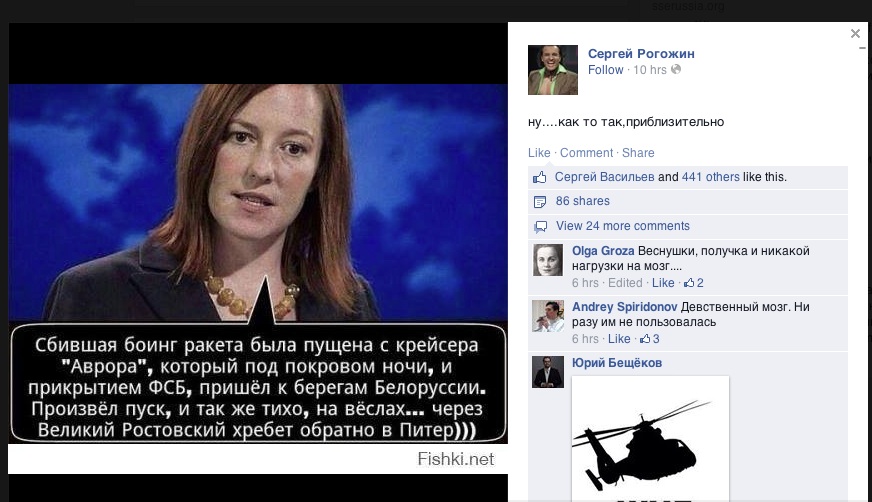
Here is an amazing bit of “folk art” I just captured on Facebook. What’s amazing about it is that it turns on their head all the impossible contortions that Russian state and mainstream media, and segments of Russian social media have been going through, over the past week, to befuddle the Russian public as to who might have shot down Flight MH17 (as described here, for example, by the indispensable Peter Pomerantsev), attributing them instead to US State Department spokesperson Jen Psaki. In the past couple months, Psaki has been elevated by the “pro-Russian” crowd (meaning the same state/”grassroots” media synergy behind the contortionist act) into a Great Satan figure, emblematic of American stupidity and ignorance.
The missile that shot down the Boeing was launched from the cruiser Aurora, which, under the cover of night, and escorted by the FSB, arrived on the shores of Belarus. It launched the missile and just as quietly rowed back, via the Great Rostov Ridge, to Petersburg.
Jen Psaki became one of the favorite targets of the Russian media. RG.ru published an article entitled “Jen Psaki found mountains in Rostov Oblast.” The article attributes direct quotes supposedly obtained by journalist Matt Lee about Ukrainian refugees to Russia, whom Psaki was said to have referred to as “tourists traveling to enjoy Rostov’ mountains.” Matt Lee promptly denied ever having such a conversation with Psaki, asserting that the claims in the article were false. In spite of Lee refuting claims in the article, the same allegations were regurgitated by Komsomolskaya Pravda and other news outlets, some of which attributed the fake quotes to Associated Press. Lenta.ru published an apology to Jen Psaki for re-printing the said false claims. None of the other outlets apologized, but instead went on to pontificate about Psaki’s prior commentary, continuing to attack her credibility.
__________
While society at large is complicit in this hysteria, to say the least, it cannot be stressed too many times how much of this “folk wisdom” about current affairs and “popular support” for whatever way the Putinist line is bending, has been generated either by state media outright or by covert paid commentators (i.e., Internet trolls), operating out of offices like this in the Petersburg suburb of Olgino:
Local reporters have infiltrated a covert organization that hired young people as “Internet operators” near St. Petersburg and discovered that the employees are being paid to write pro-Kremlin postings and comments on the Internet, smearing opposition leader Alexei Navalny and U.S. politics and culture.
Journalists from the MR7.ru website and the Novaya Gazeta newspaper have reacted to a posting by St. Petersburg local Natalya Lvova, who wrote on the Russian VKontakte social network about an interview she attended on Aug. 30 at what she described as a “posh cottage with glass walls” in Olgino, a village in St. Petersburg’s Kurortny District.
According to Lvova, the office occupying two rooms reminded her of an “internet club with lots of computers and people.” Employees in one room wrote blog posts for social networks, while those in the other room specialized in comments.
“To my question about a technical task — what exactly should be written in the comments — a young guy, a coordinator, told me, briefly and clearly, that they were having busy days at the moment and that yesterday they all wrote in support of [Moscow acting mayor Sergei] Sobyanin, while ‘today we shit on Navalny,’” she wrote on her VKontakte page.
According to Lvova, each commenter was to write no less than 100 comments a day, while people in the other room were to write four postings a day, which then went to the other employees whose job was to post them on social networks as widely as possible.
Employees at the company, located at 131 Lakhtinsky Prospekt, were paid 1,180 rubles ($36.50) for a full 8-hour day and received a free lunch, Lvova wrote.
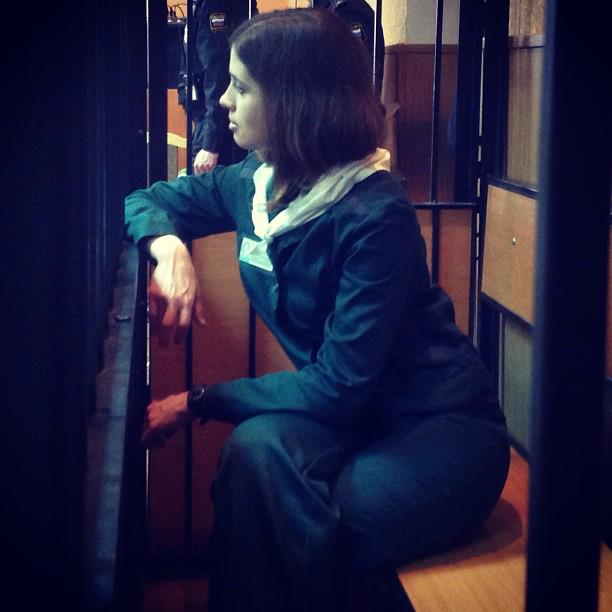
Yesterday, April 26, 2013, a district court in Zubova Polyana, Mordovia, denied imprisoned Pussy Riot activist Nadezhda Tolokonnikova’s request for parole. According to Radio Free Europe/Radio Liberty, Judge Lidiya Yakovleva agreed with arguments made by prison authorities that it would be “premature” to release Tolokonnikova given that she “had been cited for prison rules violations and expressed no remorse,” and had not participated in such prison activities as the “Miss Charm Prison Camp 14 beauty contest.” Judge Yakovleva made her ruling without allowing the defense to make a closing argument, thus allegedly violating the Criminal Procedure Code. Tolokonnikova had written her statement out in advance. The translation below is of the Russian original as published in full on the web site of RFE/RL’s Russian Service (Radio Svoboda). Photos courtesy of the Free Pussy Riot Facebook page.
_____
“Has the convict started down the road to rehabilitation?” This is the question asked when a request for parole is reviewed. I would also like us to ask the following question today: What is this “road to rehabilitation”?
I am absolutely convinced that the only correct road is one on which a person is honest with others and with herself. I have stayed on this road and will not stray from it wherever life takes me. I insisted on this road while I was still on the outside, and I didn’t retreat from it in the Moscow pretrial detention facility. Nothing, not even the camps of Mordovia, where the Soviet-era authorities liked to send political prisoners, can teach me to betray the principle of honesty.
So I have not admitted and will not admit the guilt imputed to me by the Khamovniki district court’s verdict, which was illegal and rendered with an indecent number of procedural violations. At the moment, I am in the process of appealing this verdict in the higher courts. By coercing me into admitting guilt for the sake of parole, the correctional system is pushing me to incriminate myself, and, therefore, to lie. Is the ability to lie a sign that a person has started down the road to rehabilitation?
It states in my sentence that I am a feminist and, therefore, must feel hatred towards religion. Yes, after a year and two months in prison, I am still a feminist, and I am still opposed to the people in charge of the state, but then as now there is no hatred in me. The dozens of women prisoners with whom I attend the Orthodox church at Penal Colony No. 14 cannot see this hatred, either.
What else do I do in the colony? I work: soon after I arrived at Penal Colony No. 14, they put me behind a sewing machine, and now I am a sewing machine operator. Some believe that making political-art actions is easy, that it requires no deliberation or preparation. Based on my years of experience in actionism, I can say that carrying out an action and thinking through the artistic end-product is laborious and often exhausting work. So I know how to work and I love to work. I’m no stranger to the Protestant work ethic. Physically, I don’t find it hard to be a seamstress. And that is what I am. I do everything required of me. But, of course, I cannot help thinking about things while I’m at the sewing machine (including the road to rehabilitation) and, therefore, asking myself questions. For example: why can convicts not be given a choice as to the socially useful work they perform while serving their sentences? [Why can they not chose work] in keeping with their education and interests? Since I have experience teaching in the philosophy department at Moscow State University, I would gladly and enthusiastically put together educational programs and lectures using the books in the library and books sent to me. And by the way, I would unquestioningly do such work for more than the eight hours [a day] stipulated by the Russian Federation Labor Code; I would do this work during all the time left over from scheduled prison activities. Instead, I sew police pants, which of course is also useful, but in this work I’m obviously not as productive as I could be were I conducting educational programs.
In Cancer Ward, Solzhenitsyn describes how a prison camp detective stops one convict from teaching another convict Latin. Unfortunately, the overall attitude to education hasn’t changed much since then.
I often fantasize: what if the correctional system made its priority not the production of police pants or production quotas, but the education, training, and rehabilitation of convicts, as required by the Correctional Code? Then, in order to get parole, you would not have to sew 16 hours a day in the industrial section of the colony, trying to achieve 150% output, but successfully pass several exams after broadening your horizons and knowledge of the world, and getting a general humanities education, which nurtures the ability to adequately assess contemporary reality. I would very much like to see this state of affairs in the colony.
Why not establish courses on contemporary art in the colony?
Would that work were not a debt, but activity that was spiritual and useful in a poetic sense. Would that the organizational constraints and inertia of the old system were overcome, and values like individuality could be instilled in the workplace. The prison camp is the face of the country, and if we managed to get beyond the old conservative and totally unifying categories even in the prison camp, then throughout Russia we would see the growth of intellectual, high-tech manufacturing, something we would all like to see in order to break out of the natural resources trap. Then something like Silicon Valley could be born in Russia, a haven for risky and talented people. All this would be possible if the panic experienced in Russia at the state level towards human experimentation and creativity would give way to an attentive and respectful attitude towards the individual’s creative and critical potential. Tolerance towards others and respect for diversity provide an environment conducive to the development and productive use of the talent inherent in citizens (even if these citizens are convicts). Repressive conservation and rigidity in the legal, correctional, and other state systems of the Russian Federation, laws on registration [of one’s residence] and promotion of homosexuality lead to stagnation and a “brain drain.”
However, I am convinced that this senseless reaction in which we now forced to live is temporary. It is mortal, and this mortality is immediate. I am also certain that all of us—including the prisoners of Bolotnaya Square, my brave comrade in arms Maria Alyokhina, and Alexei Navalny—have the strength, commitment, and tenacity to survive this reaction and emerge victorious.
I am truly grateful to the people I have encountered in my life behind barbed wire. Thanks to some of them, I will never call my time in prison time lost. During the year and two months of my imprisonment, I have not had a single conflict, either in the pretrial detention facility or in prison. Not a single one. In my opinion, this shows that I am perfectly safe for any society. And also the fact that people do not buy into state media propaganda and are not willing to hate me just because a federal channel said that I’m a bad person. Lying does not always lead to victory.
Recently, I got a letter containing a parable that has become important to me. What happens to things different in nature when they are placed in boiling water? Brittle things, like eggs, become hard. Hard things, like carrots, become soft. Coffee dissolves and permeates everything. The point of the parable was this: be like coffee. In prison, I am like that coffee.
I want the people who have put me and dozens of other political activists behind bars to understand one simple thing: there are no insurmountable obstacles for a person whose values consist, first, in her principles and, second, in work and creativity based on these principles. If you strongly believe in something, this faith will help you survive and remain a human being anywhere.
I will surely use my experience in Mordovia in my future work and, although this will not happen until completion of my sentence, I will implement it in projects that will be stronger and politically larger in scale than everything that has happened to me before.
Despite the fact that imprisonment is a quite daunting experience, as a result of having it we political prisoners only become stronger, braver, and more tenacious. And so I ask the last question for today: what, then, is the point of keeping us here?