Raising the Retirement Age in Russia

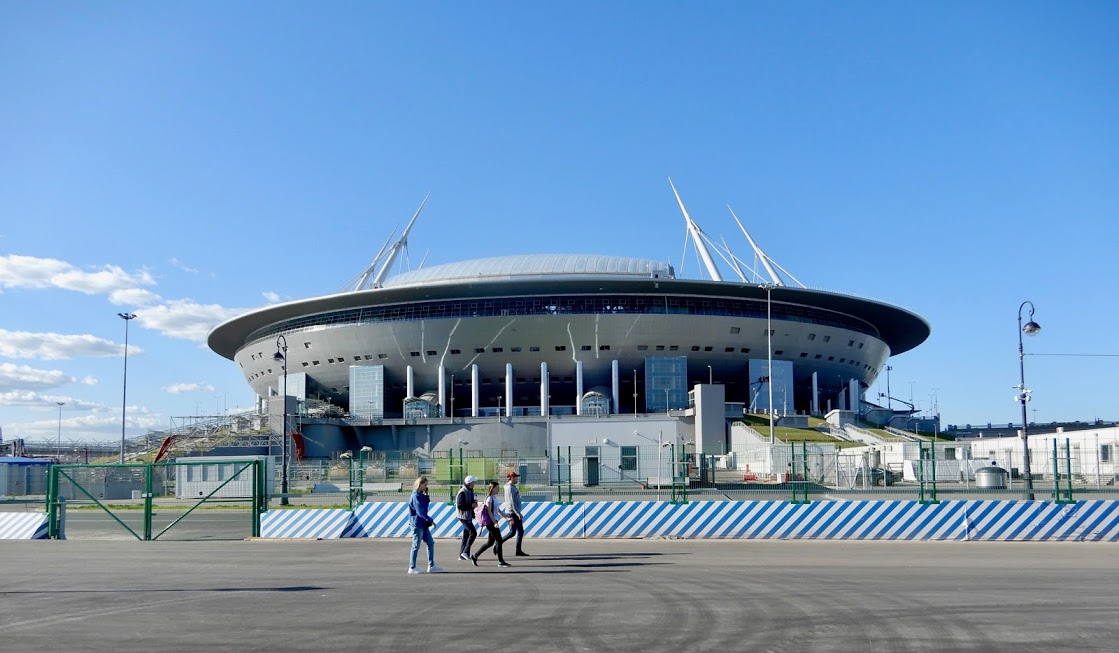
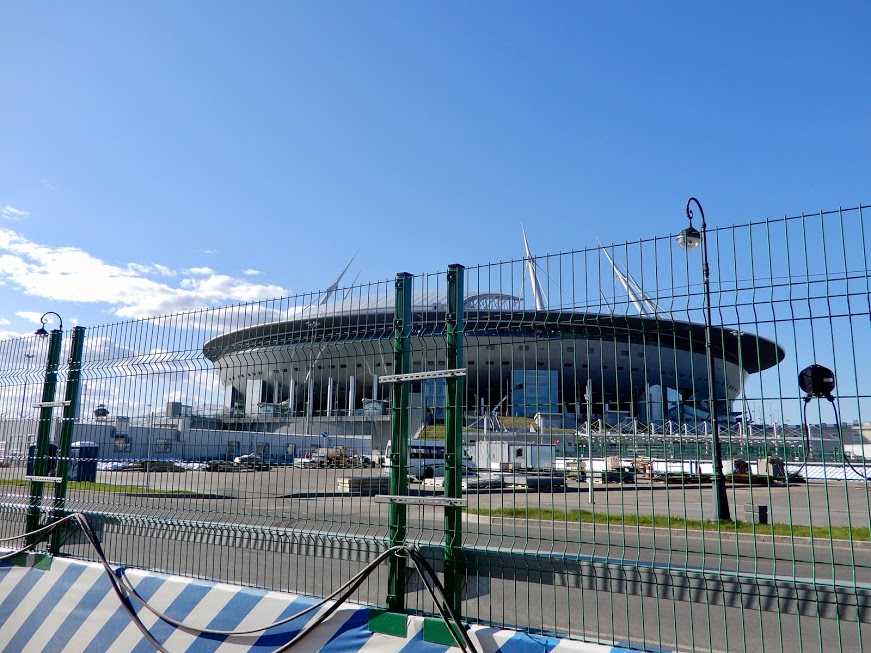
zenit arenaRussia has the money to build stadiums like Zenit Arena, in Petersburg,  the world’s most expensive football stadium, and stage incredibly expensive mega events like the 2018 FIFA World Cup and the 2014 Sochi Winter Olympics, but it cannot afford to pay its workers decent pensions without raising the retirement age beyond the current life expectancy for forty percent of Russian men. Photo by the Russian Reader

Alex Gaskarov
Facebook
June 4, 2018

It is quite likely a draft law on raising the pension age will be tabled in the State Duma in the very near future. The authorities probably want to take advantage of the restrictions on large-scale rallies during the 2018 FIFA World Cup. Raising the retirement age is not entirely an economic issue. The Pension Fund has been running a huge deficit because 40% of wages are paid under the table. This is a colossal amount. Even the most incompetent revenue service could easily reduce this figure.

It appears there is an implicit consensus between the regime and a segment of the business world that the latter agrees not to get involved in politics, while the regime agrees not to try very hard at auditing businesses. It is a commonplace that only suckers pay taxes to the current regime. Admittedly, there are grounds for this.

Nevertheless, wage laborers are the clear losers, and it is also obvious why. If the majority of people are so easily gulled during elections, as we saw recently, what reason does the regime have to keep its campaign promises and bother about reducing poverty?

I really hope liberals will also support the campaign against raising the pension age. There are market-based means of fixing the problem, for example, reducing mandatory pension deductions while simultaneously raising the corporate profits tax. When salary deductions come to 43%, while the corporate profits tax is 20%, it makes financial sense to understate salaries even without resorting to illegal gimmicks.

The trade unions have launched the campaign, but everyone is free to join it.

*********

KTR Launches Campaign against Raising the Retirement Age
Confederation of Labor of Russia (KTR)

The Executive Committee of the Confederation of Labor of Russia (KTR) has issued a statement concerning plans by the Russian federal government to raise the retirement age. […] To sign the statement and join the grassroots campaign in your city, write to  ktr@ktr.su or call +7 495 737-7250 or +7 903 140-9622.

Statement by the Executive Committee of the Confederation of Labor of Russia (KTR) on Plans by the Russian Federal Government to Raise the Retirement Age 

On May 8, 2018, during a plenary session of the State Duma, Dmitry Medvedev spoke of the need to make a decision about raising the retirement age. Currently, various government proposals for implementing a decision are vigorously being discussed in the media.

The Executive Committee of the Confederation of Labor of Russia (KTR) argues that plans to raise the retirement age are not based on the available official statistics and do not meet the objectives set by the Russian president for the government. The KTR does not support solutions of this sort and announces the kickoff of a broadly based grassroots campaigns to oppose their implementation.

According to the Russia Federal Statistics Service (Rosstat), the average life expectancy in sixty-two regions of the Russian Federation is less than 65 years for men, while in three regions it is less than 60 years. If overall demographic trends in Russia remain generally the same, 40% of men and 20% of women will not live till the age of 65. Enacting proposals to raise the retirement age mean a considerable number of Russians will not live to enjoy retirement.

For many years, the Russian government has pursued an economic policy that has produced a deficit of 40–45 % in the Pension Fund. The KTR believes the deficit emerged primarily because a huge number of employees work without the benefit of an employment contract. Their wages are paid off the books, and mandatory pension contributions are not deducted from their wages. The Pension Fund’s managers estimate that regular deductions are made for only 43.5 million people out of a total working-age populace of 77 million people.

Rosstat has estimated that 10 trillion rubles in wages are paid under the table annually. This means that, annually, at the current rate of 22%, the Pension Fund does not receive 2.2 trillion rubles in deductions.

So, the current rate of deductions could be maintained and the Pension Fund would not show a deficit if all employment were legal and on the books. Moreover, average pension payments could be increased.

Illegal employment is grounded in the disenfranchisement of workers due to ineffective procedures for protecting their right to employment contracts and collective bargaining. The KTR argues that positive outcomes could be generated by increasing the liability of employers who pay employees off the books and fail to make tax and pension deductions. Overcoming powerlessness, however, necessarily involves changing the laws and restoring real rights to organize and join a trade union, bargain collectively and strike, and protect trade union organizers from summary dismissal.

The fight against informal employment must be the primary solution to the Pension Fund’s deficit.

If plans to raise the retirement age are enacted, the absence of government-funded retraining programs, automation of production, and the bleeding of low-skilled jobs from the labor market will generate a millions-strong army of elderly people who have no jobs and no pensions.

As an association of independent trade unions, the KTR appeals to all forces in society, political parties, and social movements to oppose the increase of the retirement age and get involved in the grassroots protest campaign.

We propose organizing an open headquarters for running the national campaign to protect the rights of workers to pensions.

June 1, 2018, Moscow

Boris Kravchenko, president, KTR
Igor Kovalchuk, chair, KTR Executive Committee
Sergei Kovalyov, secretary general, KTR; president, Russian Federal Flight Controllers Union
Oleg Shein, vice-president, KTR

Translated by the Russian Reader

The Conscience of Petersburg, The Conscience of Ukraine

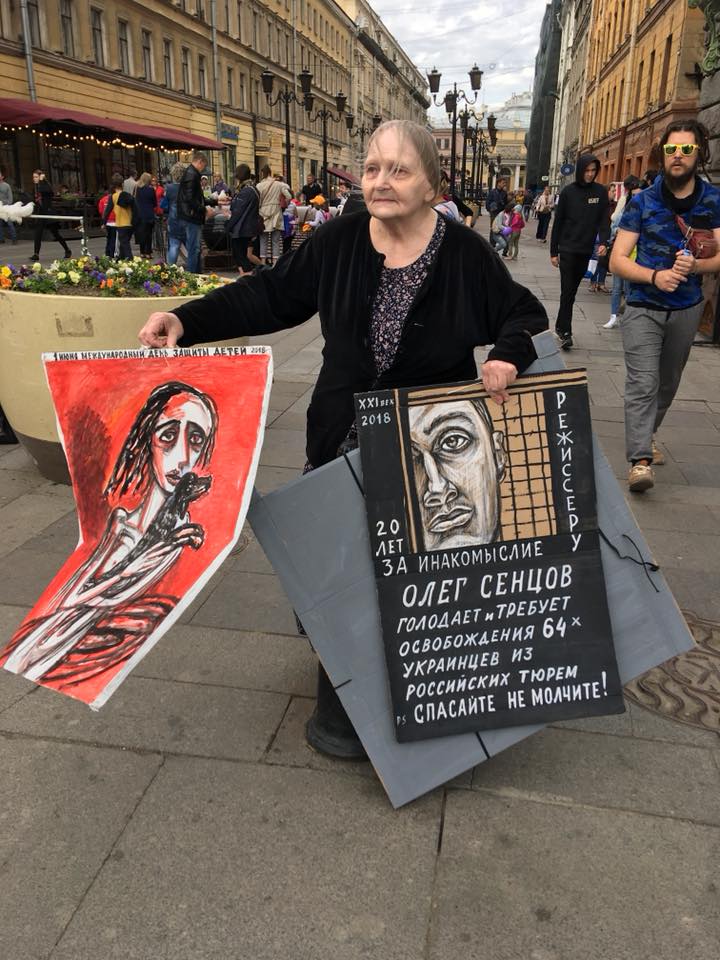
osipova-sentsov-nevsky-1 june 2018Artist Yelena Osipova, protesting on the corner of Nevsky Prospect and Malaya Sadovaya in Petersburg four hours ago. Her placard reads, “2018, the 21st century. A filmmaker gets twenty years [in prison] for dissidence. Oleg Sentsov is on hunger strike. He demands the release of sixty-four Ukrainians from Russian prisons. Save him. Don’t be silent.” Photo by Yekaterina Bogach

UPDATE. Yelena Osipova was detained by police two hours later. Grigory Mikhnov-Voytenko captured the arrest on video. Thanks to Comrade Nastia for the heads-up. 

______________________

Fears grow for hunger-striking Ukrainian film director Sentsov
AFP
June 1, 2018

Fears grew on Thursday for the health of Ukrainian film director Oleg Sentsov who has declared a hunger strike in a Russian prison, with a politician who spoke to him via video link saying he appeared unwell and warning “this could end badly.”

The 41-year-old went on hunger strike on May 14, demanding that Moscow release all its Ukrainian political prisoners as Russia prepares to host the 2018 World Cup next month.

Sentsov, a pro-Ukrainian activist and documentary director, was detained in Crimea in 2014 after Russia annexed the peninsula. He was accused of masterminding arson attacks.

Sentsov, who denied the allegations, is serving a 20-year sentence after being convicted on terrorism charges.

Politician and media star Ksenia Sobchak said she spoke to Sentsov in a video call on Thursday and tried to persuade him to halt his hunger strike but he refused.

“I am horrified because I understand that he looks like a man who will go all the way,” she told liberal radio Echo of Moscow.

“And, honestly speaking, this frightened me,” she said, adding that her mother, Lyudmila Narusova, [a member of the Federation Council], helped organize the call to Sentsov’s prison.

“I have a feeling that this hunger strike will end badly,” she said.

“He is very pale, very thin,” she said, adding that his teeth have begun to crumble.

On Monday, Russia’s prison service said Sentsov agreed to “receive supportive therapy,” without providing further details.

The prison service said his condition was “satisfactory.”

Sentsov’s lawyer Dmitry Dinze said on Thursday he had no recent contact with his client but was going to visit him on Monday.

He said the director was stable, but confirmed Sentsov had lost two teeth.

“The climate does not agree with him,” he said, adding that there was no dentist in his prison so teeth have to be pulled out.

Top opposition leader Alexei Navalny, who is serving a 30-day sentence over organising an illegal protest, called on President Vladimir Putin to release more than 60 “Ukrainian political prisoners” including Sentsov.

“His feat, and his sacrifice, and his death will put him on a par with Bobby Sands, (Anatoly) Marchenko, and other titans of humankind,” he wrote on his blog, adding Putin should want to avoid this.

Irish nationalist Sands died in prison in 1981 after 66 days on hunger strike, while Soviet dissident Anatoly Marchenko died in prison in 1986 after a three-month-long hunger strike for the release of Soviet prisoners of conscience.

The Policemen’s Ball

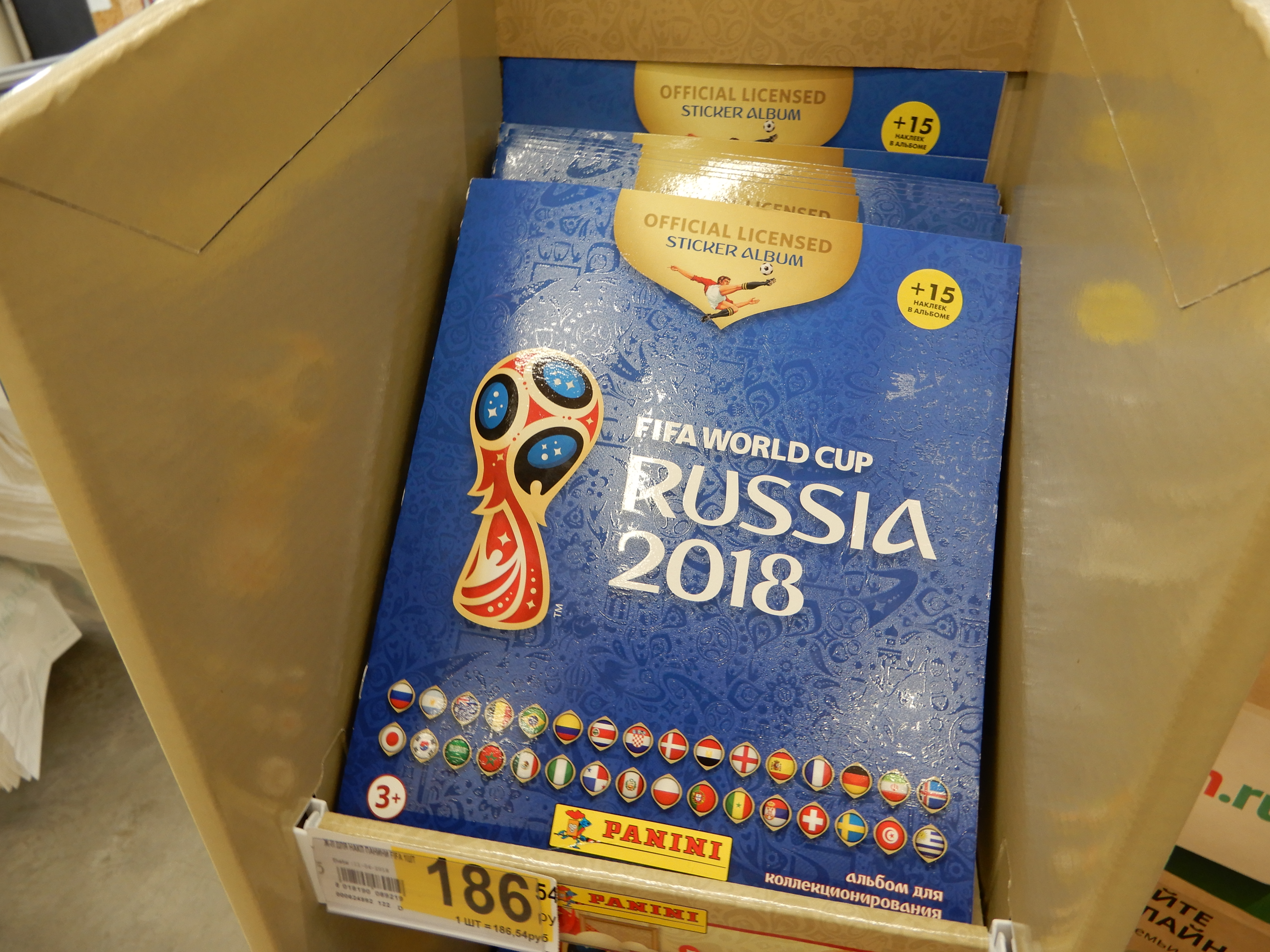
DSCN6837At €2.50, the official licensed sticker album of the 2018 World Cup is a steal. Russian officials also plan to steal the civil rights of their own citizens during the month-long tournament. Photo by the Russian Reader

Restrictions on Movement and Freedom of Assembly during the 2018 FIFA World Cup
Denis Shedov and Natalya Kovylyayeva
OVD Info
May 25, 2018

Russia welcomes the 2018 FIFA World Cup with Presidential Decree No. 202, which places restrictions on the movements of people and the staging of public rallies in cities hosting the matches. According to the decree, “enhanced safety measures” will be enforced from May 25 until July 25 (although the first match, between Russia and Saudi Arabia, will not be played until June 14). Denis Shedov and Natalya Kovylyayeva studied the decree specially for OVD Info.*

The restrictions will be introduced on May 25, 2018. They will be enforced in the cities and regions hosting 2018 World Cup matches: Moscow, Petersburg, Volgograd Region, Sverdlovsk Region, Nizhny Novgorod Region, Samara Region, Rostov Region, Kaliningrad Region, Krasnodar Territory, the Republic of Tatarstan, and the Republic of Mordovia.  Additionally, the decree also applies to certain neighboring regions where, in particular,  competing teams will be accommodated: Moscow Region, Leningrad Region, Kaluga Region, Voronezh Region, Stavropol Territory, and the Republic of Chechnya.

It is worth noting Decree No. 202 applies absolutely to everyone who is located in the regions listed during the period the decree is in force. In this light, OVD Info felt it was vital to discuss these changes.

Monitored and Restricted Areas
The decree introduces “monitored and restricted areas,” which will either be entirely off limits to people or will have restricted access. These areas include training grounds (including at other stadiums), team headquarters, hotels where teams and referees are staying, cargo inspection points, the broadcast center at Crocus Expo in Moscow, fan festival venues, press centers, and parking lots for special transport. You will be able to enter these “monitored areas” only after security guards have conducted a thorough inspection of all your belongings.

In addition, there will be special pedestrian security zones, so-called last miles, consisting of areas of one to two kilometers in radius around the stadiums where the matches will be held. Aside from World Cup transport, only residents of nearby buildings, equipped with special passes, will have access to these zones. To obtain the passes you need your internal passport and the papers for your car and your flat. Information about these zones has been posted on the official municipal websites of the cities hosting matches and published in local periodicals.

  • During the 2014 Winter Olympics in Sochi, the city was off limits to cars from other cities, i.e., cars not registered in Sochi, with the exception of vehicles owned by the secret services and vehicles that had received accreditation as municipal maintenance and 2014 Winter Olympics support vehicles. Vehicles registered in Sochi were restricted from traveling in “monitored areas.” 

Mandatory Registration for Everyone
Upon arrival in a city, you must register with the local immigration authorities within three days. This rules applies to everyone except those who are registered to live permanently in the particular city. Additionally, special rules for registering domiciles and temporary stays will be introduced in the cities where World Cup matches are scheduled.

Russian nationals and foreign nationals must register with the police within 72 hours of arriving. Usually, during “normal” times, Russian nationals have the right to spend up to 90 days in another Russian region without registering, while foreign nationals have seven days to register. Decree No. 202 specifies that the party hosting the visitor, i.e., the hotel, spa, holiday home, etc., must notify the proper authorities of the arrival of foreign nationals within 24 hours, as stipulated by Russian federal law.

Immigration authorities in the regions mentioned in the decree will be open for business daily during the World Cup, including weekends and holidays. There are several ways of registering your stay in another city:

  • Submitting an application to the management of the hotel, hostel, camping ground or youth hostel where you are staying, or the management company, proprietor or landlord, if you are staying in a private flat.
  • Reporting to the local immigration authorities yourself.

Foreign nationals must personally present their papers to the regional office of the Interior Ministry (i.e., the police) or a multi-service center, or their official hosts must do it for them. It is forbidden to register via the post office or a government services website.

Arriving foreign nationals are obliged to provide notification of their arrival, a copy of their identity card (e.g., passport or either ID), a copy of their Russian visa, and a copy of their migration card. This rule applies to all foreign nationals, regardless of their nationality and status in Russia. If the host party is a legal entity, this organization must supply the authorities with a complete set of documents.

Private individuals who act as hosts need only present their Russian internal passports, proving they are permanent residents, a copy of their passports, and a copy of their ownership deed to the dwellings where they will house foreign nationals.

If these rules are violated, Russian nationals will be obliged to pay an administrative fine. In Moscow and Petersburg, the fine will range from three to five thousand rubles, while in the regions it will range from two to three thousand rubles. Foreign nationals who violate these rules can be expelled from Russia.

Restrictions on Freedom of Assembly
According to the decree, from May 25 to July 25, 2018, assemblies, rallies, demonstrations, marches, and pickets that have nothing to do with the 2018 FIFA World Cup can be held only in places, along routes, and at times approved by the authorities. The authorities can also determine the number of attendees and the duration of the event.

Decree No. 202 was first enforced during last year’s Confederations Cup, also hosted by Russia. A large number of activists involved in group protests and solo pickets were apprehended at that time. Some of the people detained during solo pickets were subjected to “explanatory discussions” by the police, while others were written up for violating the rules for holding public events and fined as much as 20,000 rubles.

  • In May 2017, five activists from the local headquarters of opposition leader Alexei Navalny were detained for setting up a campaign booth on the main square in Kazan. Law enforcement said the action had not been authorized by the authorities. All the detainees were sentenced to ten to twelve days in jail, as well as 35 hours of community service.
  • During the Navalny-inspired anti-corruption rallies that took place in a number of cities on June 12, 2017, including Petersburg, Moscow, and Sochi, police detained protesters on the basis of Paragraph 11 of the decree, as paraphrased above. Although in Krasnodar, where the rally against corruption had been authorized, no one was apprehended, despite the special security regime.
  • During the protest rally “Farewell to the Communications Ministry,” in Moscow in June 2017, a teenager was detained when he tried to leave flowers outside the ministry due to restrictions on freedom of speech in Russia, including the possible blockage of the Telegram messenger service. The arresting officer cited the presidential decree restricting rallies during the Confederations Cup and the 2018 World Cup when he detained the boy. The teenager was taken into a police station for questioning before being released.
  • In mid-June 2017, fifteen people holding solo pickets against Moscow’s massive “renovation” program were detained outside the entrance to the State Duma.
  • Several activists who held solo pickets in support of mathematician Dmitry Bogatov and demanded an end to the prosecution of nationalist Dmitry Demushkin were detained on June 24, 2017, in Moscow.
  • Solidarity Party activist Mikhail Lashkevich was detained on July 4, 2017, while holding a solo picket demanding the people behind opposition leader Boris Nemtsov’s assassination be found. The police admitted he had a right to carry out a solo picket and released him from Basmanny Police Precinct in Moscow without writing him up. Subsequently, Roman Petrishchev, another Solidarity Party activist, was detained for a solo picket.
  • In early July 2017, five activists of Protest Moscow were detained in different parts of the city while they held solo pickets against censorship. All of them were charged with violating the rules for holding public events, punishable under Article 20.2 Part 5 of the Administrative Offenses Code.
  • On July 5, 2017, the well-known democracy activist Ildar Dadin was detained during a solo picket outside FSB headquarters in Moscow, since his protest had not been authorized by law enforcement. On July 7, 2017, the Meshchansky District Court found him guilty of violating the “rules of solo pickets” and fined him 20,000 rubles.

In May 2017, Alexander Pomazuyev, a lawyer with Navalny’s Anti-Corruption Foundation (FBK) asked that Paragraph 11 of the decree be declared null and void in a suit he filed with the Russian Supreme Court. Pomazuyev claimed he had been denied the right to hold a solo picket. He also argued the presidential decree infringed on civil liberties guaranteed by the Russian Constitution, including the right to free speech and freedom of assembly. The court threw out Pomazuyev’s suit, thus rubber-stamping the restrictions on rallies and pickets during the Confederations Cup and the 2018 FIFA World Cup.

In February 2018, organizers of the Boris Nemtsov Memorial March in Nizhny Novgorod wrote an open letter to FIFA president Gianni Infantino asking him to protect freedom of assembly in Russia in the run-up to the World Cup. The football functionary did not react to the letter, apparently.

“Although the decree restricts certain rights only from May 25 to July 25, 2018, even the smallest pickets have been turned down by the authorities on the grounds of the terrorist threat,” the march organizers wrote on their Facebook page.

Commentary by Lawyer and Human Rights Activist Alexander Peredruk
Yes, Presidential Decree No. 202, dated May 9, 2017, definitely violates people’s constitutionally guaranteed rights to freedom of assembly in Russia.

If you want to hold a public rally from May 25 to July 25, 2018, at a venue of your choosing, there is no guarantee you will pull it off. The authorities could turn you down on the grounds the venue you have chosen was not vetted by the Interior Ministry and the FSB. 

As last year showed, when several applications to hold rallies were filed simultaneously, the authorities would reject all the applications. However, when the applications were filed, the authorities had not yet determined what venues could be used. They drew up a list of permissible venues only after looking over the first applications. It was thus a “complete coincidence” that the venues indicated in the applications that were submitted to the local authorities were not on the list of permissible venues. 

In other words, the rejections were perfunctory and practically groundless. The authorities were not interested in conducting a proportionality test, in striking a balance between public and private interests.

In addition, questions are raised about the legitimacy of the division between public sporting events, which are permitted during this period, and public political events, which are virtually banned. Russian citizens are thus subject to discrimination.

During the 2014 Winter Olympics in Sochi, a local man, David Hakim, was detained while holding a solo picket in defense of the convicted environmentalist Yevgeny Vitishko. (Hakim was jailed for four days for his “crime.”) Agora used his case to challenge the president’s Olympic decree in the Russian Constitutional Court. However, the court refused to examine whether the decree complied with the Constitution, since it had expired by the time the complaint was examined. 

* If you are worried about how Presidential Decree No. 202 will affect foreign fans traveling to Russia for the World Cup, you shouldn’t be. They are required to purchase special “fan IDs” that will exempt them from most if not all of the decree’s strictures. // TRR

Denis Shedov is a lawyer with the Memorial Human Rights Center in Moscow. Natalya Kovylyayeva is a journalist. Translated by the Russian Reader

“Popular”

32729013_1730140783711212_4715134261416427520_nA selfie taken by elections observer and Golos coordinator David Kankiya in Krasnodar. He writes: “Dear Veniamin Kondratyev [governor of Krasnodar Territory], I would like to know what you think about the fact I was beaten up today and the continuing pressure exerted on political and grassroots activists by law enforcement. This is how you see the region’s image right before the World Cup?”

Vladimir Putin is not “popular” in any meaningful sense of the term. He is the head of what may be the world’s largest mafia gang. Unless forces emerges within the gang to challenge his leadership, which seems unlikely, he will remain head of the gang (aka the Russian Federation’s ruling elite) until he dies of natural or other causes. It is as simple as that.

How do I know it? Because of the sheer amount of main violence and rabid intimidation visited upon anyone who challenges Putin’s unchallengeable rule in any way, even in ways that are almost imaginary, as in the case of Crimean filmmaker Oleg Sentsov, now on the sixth day of a hunger strike in a Siberian prison. Sentsov was sentenced to twenty years in prison by Putin’s mafia gang after it illegaly invaded and occupied Sentsov’s home of Crimea, part of the sovereign state of Ukraine.

Here is another example, closer to home and the notion that Putin is “popular” and was  thus “popularly” elected. The day after Putin’s “reelection” this past March, NPR filed a story that contained this passage.

A month before Russia’s presidential election, observer David Kankiya was informed by the police that his car might have been used to commit a crime, Reuters reported. He was detained, charged with disobeying police and sent to jail for five days. “I was detained and charged on a false pretext,” Kankiya told the news agency. “It’s political pressure.”

Police say Kankiya didn’t produce identification during a routine check.

As the presidential election drew closer, Kankiya’s car tires were slashed and pro-Kremlin journalists accosted him in two separate incidents, he told Reuters.

Kankiya is a coordinator at Golos, a nongovernmental election watchdog that was labeled a “foreign agent” because it received foreign aid. Volunteers from Golos — a word that translates to both “vote” and “voice” — say when entering or leaving Russia, they are often stopped by border staff who accuse them of having terrorist links, according to Reuters.

Now word has come that Mr. Kankiya was assaulted and battered by two men in the stairwell of his own home yesterday. The word comes from Mr. Kankiya himself, writing on Facebook.

Меня избили в подъезде дома. 2 амбала. Били руками и ногами. Пшикали перцовкой. Очень больно, но это тоже переживу. Господа, силовики, большое спасибо за такое внимание к моей скромной персоне. Но вы уже хотя бы прямо сказали чего вам от меня надо? То аресты, то слежка с избиением. Зачем вы так позоритесь?

I’ve been beaten up in the stairwell of my building. It was two palookas. They hit me and kicked me. They zapped me with pepper spray. I hurt like hell, but I’ll live through this, too. Dear security forces guys, a big thanks for the attention you pay to little old me. But didn’t you already tell me straight to my face what you wanted from me? But first you jail me, then you have me tailed and beaten up. Why do you behave so shamefully?

I could supply you with a thousand more stories like Mr. Kankiya’s. And people like him who are on the frontlines of the fight against Putin’s mafia rule in Russia, including a friend of his and a friend of mine who informed me yesterday about the attack on Mr. Kankiya, could tell you ten thousand more stories like it.

When you add all those stories up, you do not conclude that the country in question is ruled by a truly “popular” leader.

What you conclude is that, for nearly two decades running, a gang of violent thugs has been pummeling, scapegoating, jailing, murdering, intimidating and otherwise silencing its real and imagined enemies—in the world’s biggest country, the list of those enemies has proven almost endless—while a troika of absolutely shameless pollsters (Levada, FOM, VTsIOM), eager beyond belief to stay in the mafia boss’s good graces and “scientifically prove” his “popularity,” has been monitoring, almost by the day, sometimes by the hour, to test whether the rest of the Russian “populace” gets it, whether they realize they have only one choice: “like” their “popular” president for life or “dislike” him and face the unpleasant consequences faced by the likes of Mr. Sentsov and Mr. Kankiya.

The pseudo-pollsters are just as shamelessly seconded by a whole battalion of “Russia hands” and “veteran Moscow correspondents,” like Stephen Cohen and Mary Dejevsky, to name two of the most loathsome, who are ready to tell any lie or fib to justify or explain away Putin’s tyrannical rule and the punishments he and his secret services rain down on their enemies, real and imagined, great and small.

That is the whole story. Anyway who says otherwise really is a liar or a sophist or a “Russia expert” resident in Ottawa or New Haven. // TRR

Cossacked

18A so-called Cossack lashes protesters with a plaited whip (nagaika) at the He’s No Tsar to Us opposition protest rally at Pushkin Square in Moscow on May 5, 2018. Photo by Ilya Varlamov

Сossacks Were Not Part of the Plan: Men with Whips Take Offense at the Opposition
Alexander Chernykh
Kommersant
May 8, 2017

The Presidential Human Rights Council (PHRC) plans to find out who the Cossacks were who scuffled with supporters of Alexei Navalny during the unauthorized protest rally on May 5 in Moscow. Meanwhile, the Moscow mayor’s office and the Central Cossack Host claimed they had nothing to do with the Cossacks who attempted to disperse opposition protesters. Kommersant was able to talk with Cossack Vasily Yashchikov, who admitted he was involved in the tussle, but claimed it was provoked by Mr. Navalny’s followers. Human rights defenders reported more than a dozen victims of the Cossacks have filed complaints.

The PHRC plans to ask law enforcement agencies to find out how the massive brawl erupted during the unauthorized protest rally on May 5 in Moscow. PHRC chair Mikhail Fedotov said “circumstances were exacerbated” when Cossacks and activists of the National Liberation Front (NOD) appeared at the opposition rally.

“It led to scenes of violence. We must understand why they were they and who these people were,” said Mr. Fedotov.

“Our main conclusion has not changed: the best means of counteracting unauthorized protest rallies is authorizing them,” he added.

On May 5, unauthorized protest rallies, entitled He’s No Tsar to Us, called for by Alexei Navalny, took place in a number of Russian cities. In Moscow, organizers had applied for a permit to march down Tverskaya Street, but the mayor’s officers suggested moving the march to Sakharov Avenue. Mr. Navalny still called on his supporters to gather at Pushkin Square, where they first engaged in a brawl with NOD activists and persons unknown dressed in Cossack uniforms. Numerous protesters were subsequently detained by regular police. Approximately 700 people were detained in total.

The appearance on Pushkin Square of Cossacks armed with whips has provoked a broad response in Russia and abroad. The Guardian wrote at length about the incident, reminding its readers that Cossacks would be employed as security guards during the upcoming 2018 FIFA World Cup in Russia. The Bell discovered a Central Cossack Host patch on the uniform of one of the Cossacks photographed during the brawl. According to the Bell, which cites documents from the Moscow mayor’s office, the Central Cossack Host was paid a total of ₽15.9 million for “providing security during large-scale events.”

However, Vladimir Chernikov, head of the Moscow Department of Regional Security, stressed, during an interview with Kommersant FM, that on May 5 “no Cossacks or any other organization were part of the plan and the means of providing security.”

Chernikov said police and the Russian National Guard acted impeccably. Spokesmen for the Central Cossack Host also said they had not dispatched any Cossacks to guard Pushkin Square, and that the Cossacks who, wearing their patches, did go to the square, had “voiced their civic stance.”

Bloggers have published information about the Cossacks they have been able to identify from photos and video footage of the rally. One video depicts a bearded man who grabs a placard, bearing the slogan “Open your eyes, you’re the tsar’s slave!”, from a young oppositionist before arguing with Open Russia coordinator Andrei Pivovarov. The Telegram channel BewareOfThem reported the man was Vasily Yashchikov, member of the Union of Donbass Volunteers. Mr. Yashchikov has confirmed to Kommersant he was, in fact, at the rally and was involved in the brawl with opposition protesters. Yet, he claimed, most of the Cossacks at Pushkin Square had nothing to do with the Central Cossack Host, as claimed by the Bell. According to Mr. Yashchikov, the brawlers mainly consisted of nonregistered (i.e., unaffiliated with the Russian government) Cossacks from two grassroots organizations, the First Hundred and the Crimean Regiment. Moreover, they allegedly showed up at the rally independently of one another.

“The rally was discussed in Cossack groups, and someone suggested we go and talk to people,” Mr. Yashchikov told Kommersant. “We have nearly a hundred people in the  Hundred, but only fifteen decided to go. At the square, we met Cossacks from the Crimean Regiment, which is actually not Crimean, but from the Moscow Region. But our organizations are not friendly, so we were there separately.”

He admitted there were several people from the Central Cossack Host at Pushkin Square, but his group did not interact with them, either.
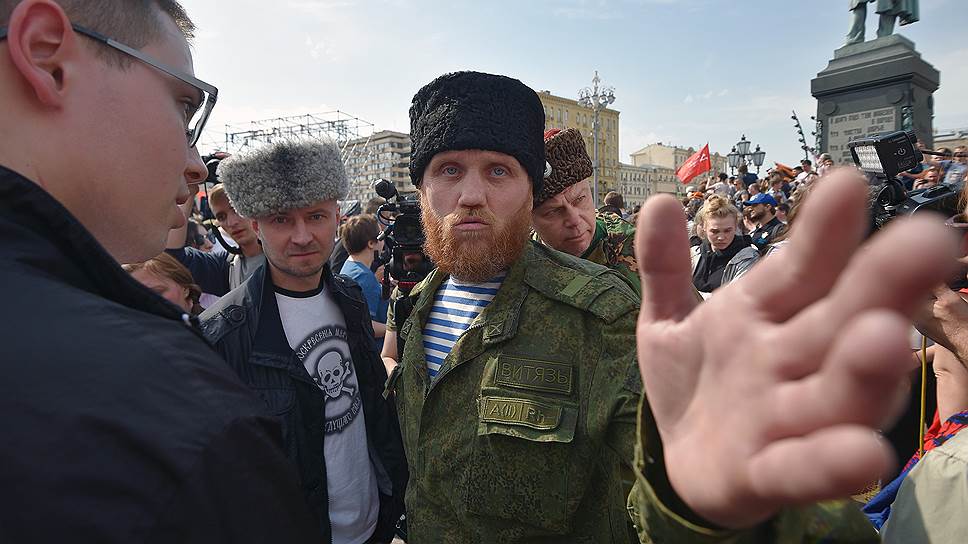
KMO_165050_00034_1_t218_200833So-called Cossacks at the He’s No Tsar to Us opposition rally at Pushkin Square, Moscow, May 5, 2018. Photo by Alexander Miridonov. Courtesy of Kommersant

According to Mr. Yashchikov, the Cossacks came to Pushkin Square to talk with Mr. Navalny’s supporters, but had no intention of being involved in dispersing the rally.

“There were one and half thousand people there [the Moscow police counted the same number of protesters—Kommersant]. There were thirty-five of us at most, and we had only two whips. You could not have paid us to wade into that crowd,” claimed Mr. Yashchikov.

Mr. Yashchikov claimed he managed to have a friendly chat with Mr. Navalny, but opposition protesters were aggressive, he alleged.

“Someone picked on us, asking why we had come there, that it was their city. Another person tried to knock my cap off, while they swore at other Cossacks and blasphemed the Orthodox faith,” Mr. Yashchikov complained. “Well, we couldn’t take it anymore.”

People who attended the rally have denied his claims.

“The Cossacks acted cohesively, like a single team,” said Darya, who was at the rally [Kommersant has not published her surname, as she is a minor]. “They formed a chain and started pushing us towards the riot police, apparently, to make their job easier. The Cossacks kicked me, while they encircled my boyfriend and beat him. They retreated only when they realized they were being film and photographed.”

Darya planned to file a complaint with the police charging the Cossacks with causing her bodily harm. Currently, human rights defenders from Agora, Zona Prava, and Public Verdict have documented more than fifteen assault complaints filed against the Cossacks.

Oppositionists have claimed the police mainly detained protesters, allegedly paying almost no attention to the Cossacks and NOD activists. Kirill Grigoriev, an Open Russia activist detained at the rally, recounted that, at the police station where he was taken after he was detained, he pretended to be a NOD member, and he was released by police without their filing an incident report.

“When we arrived at the Alexeyevsky Police Precinct, a policeman immediately asked who of us was from NOD. I jokingly pointed at myself. He took me into a hallway and asked me to write down the surnames of other members of the organization,” said Mr. Grigoriev.

He wrote down the surnames of ten people, after which everyone on the list was given back their internal Russian passports and released.

*********

Cossacks Confront Navalny Supporters for First Time
Regime Prepares for Fresh Protests, Including Non-Political Ones, Analysts Argue 
Yelena Mukhametshina and Alexei Nikolsky
Vedomosti
May 6, 2018

He’s No Tsar to Us, the unauthorized protest rally in Moscow held by Alexei Navalny’s supporters, differed from previous such rallies. On Tverskaya Street, provocateurs demanded journalists surrender their cameras. By 2:00 p.m., the monument to Pushkin was surrounded by activists of the National Liberation Front (NOD). When protesters chanted, “Down with the tsar!” they yelled “Maidan shall not pass!” in reply. Behind the monument were groups of Cossacks, who had never attended such rallies. In addition, for the first time, the police warned people they intended to use riot control weapons and physical force, and indeed the actions of the security forces were unprecedentedly rough. The riot police (OMON) detained protesters by the hundreds, and Cossacks lashed them with plaited whips.

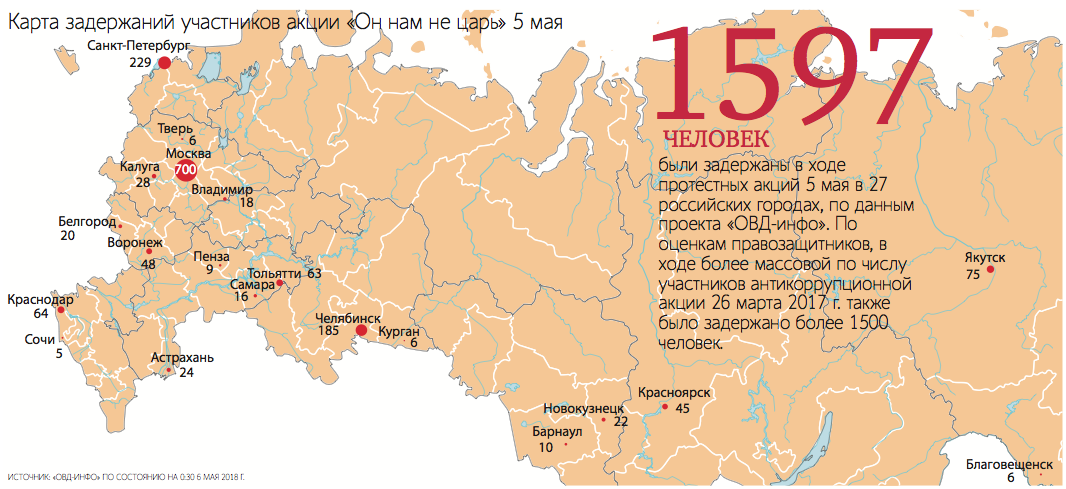
The Moscow police counted 1,500 protesters at the rally, while organizers failed to provide their own count of the number of attendees. Navalny said the nationwide rallies were a success. His close associate Leonid Volkov argued that “in terms of numbers, content, and fighting spirit, records were broken,” also noting the police’s unprecedented brutality. According to OVD Info, around 700 people were detained in Moscow, and nearly 1,600 people in 27 cities nationwide. Citing the PHRC, TASS reported that 658 people were detained in Moscow.
fullscreen-1sdb.png

“He’s No Tsar to Us, May 5: A Map of Arrests. 1,597 people were detained during protest rallies on May 5, 2018, in 27 Russian cities, according to OVD Info. According to human right activists, during nationwide anti-corruption protests on March 26, 2017, more than 1,500 people were detained. Source: OVD Info.” Courtesy of Vedomosti

PHRC member Maxim Shevchenko demanded the council be urgently convoked due to “the regime’s use of Black Hundreds and fascist militants.” According to a police spokesman, the appearance at the rally of “members of different social groups” was not engineered by the police, while the warning that police would use special riot control weapons was, apparently, dictated by the choice of tactics and the desire to avoid the adverse consequences of the use of tear gas.

According to NOD’s leader, MP Yevgeny Fyodorov, 1,000 members of the movement were involved in Saturday’s rally.

“We wanted to meet and discuss the fact the president must be able to implement his reforms. Because we have been talking about de-offshorization and withdrawing from a unipolar world for five years running, but things have not budged an inch,” said Fyodorov.

NOD did not vet their actions with the Kremlin, the leadership of the State Duma or the Moscow mayor’s office, Fyodorov assured reporters.

On Sunday, the Telegram channel Miracles of OSINT reported that, in 2016–2018, the Central Cossack Host, whose members were at the rally, received three contracts worth nearly ₽16 million from the Moscow Department for Ethnic Policy for training in the enforcement of order at public events. As Vedomosti has learned, according to the government procurement website, the Central Cossack Host received eleven contracts, worth nearly ₽38 million, from the Moscow mayor’s office over the same period.

Gleb Kuznetsov, head of the Social Research Expert Institute (EISI), which has ties to the Kremlin, argued there was no brutality at the rally.

“In Paris, the scale of protests is currently an order of magnitude higher, but no one speaks about their particular brutality. In Russia, so far the confrontation has been cute, moderate, and provincial. The only strange thing is that, in Russia, people who are involved in such protests, which are aimed at maximum mutual violence, are regarded as children. But this is not so. Everything conformed to the rules of the game, common to the whole world. If you jump a policeman, don’t be surprised if he responds with his truncheon,” said Kuznetsov.*

The Russian government has allied itself with the Cossacks and NOD, which are essentially illegal armed formations, argued Andrei Kolesnikov, a senior fellow at the Moscow Carnegie Center.

“This does not bode well. Apparently, in the future, such formations will be used to crack down on protests,” said Kolesnikov.

The authorities are preparing for the eventuality there will be more protests. Even now the occasions for them have become more diverse, and they are spreading geographically, noted Kolesnikov.

Grassroots activism has been growing, and the authorities have realized this, political scientist Mikhail Vinogradov concurred. They are always nervous before inaugurations. In 2012, there was fear of a virtual Maidan, while now the example of Armenia is fresh in everyone’s minds, he said.

“The security services had to flex their muscles before the new cabinet was appointed. Although, in view of the upcoming FIFA World Cup, law enforcement hung the regime out to dry contentwise,” said Vinogradov.

* In September 2017, the Bell reported that state corporations Rosatom and RusHydro were financing EISI to the tune of ₽400 million each, and it could not be ruled out that the so-called social research institute was receiving subsidies from other state companies.

Translated by the Russian Reader
Welcome to St. Petersburg!

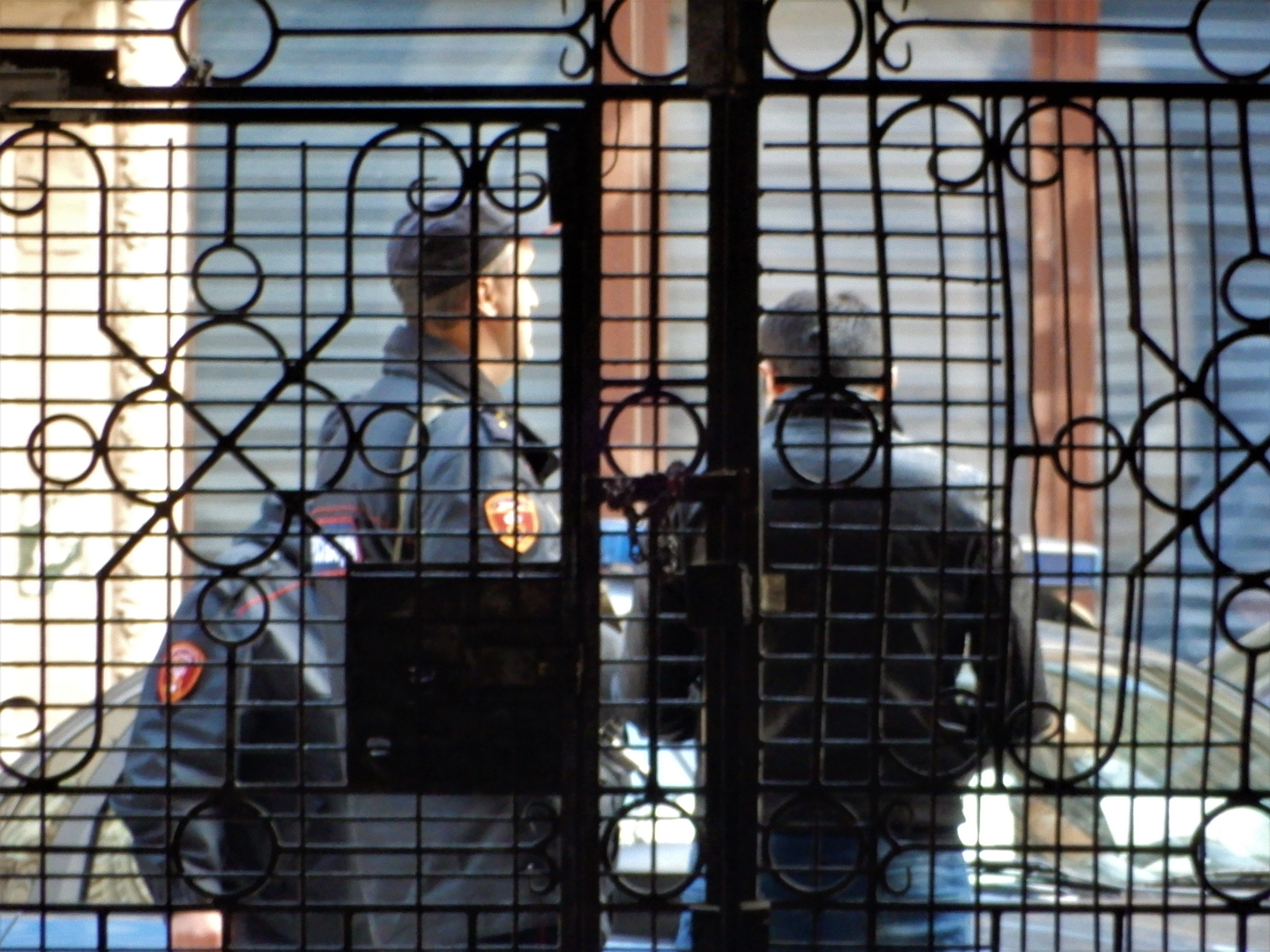
DSCN5677Two Russian National Guardsmen shake down a non-Russian and his friend (off camera) in the run-up to this summer’s FIFA World Cup. Photo by the Russian Reader
I remember when the G8 summit was held in Petersburg in July 2006. I will leave aside the counter-summit (aka the Russian Social Forum), held in then-already-doomed Kirov Stadium, that is, in a part of the city so far off the beaten path you had to want to be there very badly to get there, and the excellent job the Russian security services did making sure that social and political activists from other parts of the world’s largest country could not make it to Petersburg, much less to the forum.

I bring the summit up only because, the social forum aside, the city was pullulating with so many cops, riot cops (OMON), and Interior Ministry troops it was impossible not to notice them and realize how absurd and wasteful the security overkill was, especially since the summit per se was held in the newly refurbished Constantine Palace in the southern Petersburg suburb of Strelna, a site at least fifteen kilometers away from the central city and most of its inhabitants, and thus easily secured by a few hundred guards, policemen, and special forces troops.

Back in those halcyon days, I had a job that kept me moving round the city from morning to night, and so I would happen upon clusters of utterly idle cops, riot cops, and special forces troop in the oddest places on a regular basis while the summit was on. I remember how I once walked into an otherwise obscure, out-of-the-way courtyard late in the evening and found it chockablock with Russia police officers of some sort, possibly imported for the occasion from the other side of the country. They seemed almost ashamed to be hiding in that courtyard, protecting nobody at all from utterly nonexistent threats, and chainsmoking to kill the time.

Our beleaguered city’s next opportunity to shine in the international limelight will be during the 2018 FIFA World Cup, held in Petersburg and several other Russian cities from June 14 to July 15.

I was reminded by a tiny incident I witnessed earlier today of the Russian police state horrorshow literally everyone in the city with their heads screwed on straight expects during the month the World Cup is in town.

By the way, all locals with an ounce of sense in their brains are planning to be somewhere else, if only at their dachas in the countryside, during that month.

When I exited my building earlier today I immediately spotted two Russian National Guard officers hassling two young men of “non-Slavic appearance.” The officers were conducting their shakedown squarely in front of the gateway that accesses the yard of the building next to ours, the only courtyyard left on our street connecting it with the street running parallel to it.

Once upon a time not so long ago, central Petersburg was chockablock with interconnecting, walkthrough courtyards, and natives in the know could cover long distances in the inner city navigating this extensive network of courtyards without having to emerge onto the actual streets.

But when the new era of “capitalism” and “democracy” dawned, and Petersburgers privatized their flats and turned their courtyards into impromptu car parks, many of them gated, locked, and otherwise blocked off their courtyards, a move that in many cases was probably illegally, although no has ever gotten in trouble, so far as I know, for establishing their own little gated communities this way.

The guardsmen were reading the swarthy troublemakers the usual bored riot act about their having the wrong paperwork when I squeezed my way around them. One of them said they would have to take the swarthy men down to the precinct and write them up, which probably meant they would hold them there long enough to make their serious intentions plain before “fining” (bribing) them and letting them go.

The preparations for the 2018 World Cup have already been a debacle for Petersburg and many of the other host cities, as well as segments of the local populace that the authorities want to go away during the festivities, including university students, dogs and cats, antifascists tortured and framed as “terrorists,” and migrant workers.

I thus took the shakedown I witnessed as a sign of things to come: the full force of the utterly lawless, mendacious, and violent Russian law enforcement machine would be unleashed against migrant workers, people who look funny or out of place, and even completely ordinary, unprepossessing local residents while the World Cup was underway.

So, my message to you out there in the wide world is take a thought for us back here in the Motherland and keep your TV turned off during the World Cup. The “beautiful game” need not be played and enjoyed at such a high human cost to the World Cup’s Russian host cities, but since ultraviolence and the gleeful trampling of human rights are the only ways the current Russian regime knows how to handle mega events like the World Cup and the Winter Olympics, not to mention the country’s day-to-day governance, show a minimum of solidarity with us here in the line of fire and don’t watch any of the matches on TV. It won’t cost you a thing, but the world’s TV executives and advertisers will notice.

I won’t even bother appealing to the jetsetters who are planning to travel to Russia for the World Cup. You are beyond the pale in any case, since you choose to live your lives in such a thoughtless, wreckless way. My only hope for you is that, at some point during your expensive, wasteful trip, Russia’s real reality will burst through the carefully packaged and securitized experience the Russian authorities have planned for you, and you realize you paid Satan a lot of money to watch a few bloody football matches in person. // TRR

Wife of Tortured Antifascist Seeks Asylum in Finland

P6240121In Finland

Wife of Antifascist Filinkov Seeks Political Asylum in Finland
Mediazona
April 10, 2018

Alexandra Aksyonova, wife of antifascist Viktor Filinkov, who spoke of being tortured by Russian Federal Security (FSB) officers and is currently being held in a remand prison outside Petersburg, has left Kyiv and requested political asylum in Finland. She reported the news to Mediazona herself.

She flew to Finland yesterday, April 9, and today she reported to a police station, where she requested political asylum. In conversation with Mediazona, she explained she had feared for her safety in Ukraine, noting there had been incidents in the past when Russian political activists had been abducted by the Russian security services in Ukraine, while local human rights defenders had told her it was nearly impossible to obtain political asylum in Ukraine.

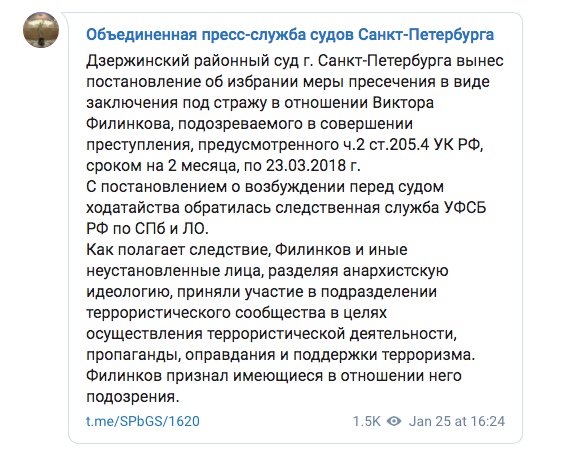
In late January of this year, Ms. Aksyonova reported her husband, Viktor Filinkov, had disappeared on his way to Petersburg’s Pulkovo Airport, whence he was due to fly to Kyiv. Soon, the Telegram channel of the Petersburg court system’s press service reported Filinkov had been remanded in custody on suspicion of involvement in a terrorist community, a crime under Article 205.4 Part 2 of the Russian Federal Criminal Code. Filinkov had, allegedly, confessed his guilt.

filinkov telegramScreen shot of the message posted about Viktor Filinkov’s arrest on the Telegram channel of the Joint Press Service of the St. Petersburg Courts, January 25, 2018

Subsequently, during a visit by members of the Petersburg Public Monitoring Commission (PMC) to the Petersburg remand prison where he was jailed, Filinkov said he had confessed his guilt after being tortured with a taser by FSB officers. Mediazona published Filinkov’s account of the first days after he was detained, an account in which he described in great detail how FSB officers had tortured him and threatened his wife. In March, Filinkov was transferred to a remand prison just across the border from Petersburg in Leningrad Region, which is thus off limits to the Petersburg PMC members who had regularly visited him in the Petersburg remand prison.

Petersburg antifascist Igor Shishkin also vanished in late January only to turn up later as an arrestee in the same case. He confessed his guilt. Despite the fact that members of the Petersburg PMC found evidence of injuries on his body, Shishkin said nothing about torture.

However, Petersburger Ilya Kapustin, detained as a witness in the very same case, claimed he had been tortured by the FSB. In February, he filed a complaint with the Russian Investigative Committee. He left Russia in March to seek asylum in Finland.

The Petersburg antifascists were detained as part of a case against an alleged “terrorist community,” code-named The Network. Online news and commentary website Republic, which was granted access to the case files, wrote that the FSB believed the alleged “terrorist community” had cells in Moscow, Petersburg, Penza, and Belarus. Members of the alleged terrorist group had supposedly planned a series of bomb blasts during the March 18 presidential election and this summer’s FIFA World Cup, which will be held in Russia.

The criminal case kicked off in October 2017 with the arrest of four antifascists in Penza. A fifth suspect in Penza was placed under house arrest, while a sixth suspect was detained in Petersburg and transferred to the Penza Remand Prison. Several of these young men subsequently recounted how the FSB had tortured them and planted weapons in their cars and flats. In particular, Ilya Shakursky and Dmitry Pchelintsev reported they had been tortured. Pchelintsev soon retracted his testimony.

Translation and photo by the Russian Reader

NB. If you are just now happening on this horrifying tale of torture and “law enforcement” run amok, read the first major international media report on the case, in Newsweek, and then read my translations of articles from Mediazona, OVD Info, and the other independent Russian media outlets who have been covering the story since it broke in late January 2018.

Samara Culling Cats and Dogs in Run-Up to 2018 World Cup

rtxyfzu_0

According to “‘Putin Loves Only His Own Dogs’: Animals Are Being Killed For the World Cup’s Sake,” an article by Dmitry Volchek, published yesterday, February 17, 2018, on the Radio Svoboda website, authorities in Samara, one of the host cities of the 2018 World Cup, have been paying to have homeless cats and dogs hunted down and killed in the city and the surrounding area.

Here is an excerpt from the article.

“As I understand it, there is fascism in Russia,” says Irina Yevdokimova. “Fascists run the country. It’s unequivocal to me. Problems are solved only by murder. We do not ask for much. We ask only that things be done as they are done abroad, so there is not this bloody mess.”

Samara will host World Cup matches in late June, and the municipal services have been tasked with exterminating homeless animals so that, god forbid, no fan is bitten by a dog. Cats do not attack football players and their fans, but money has been allocated from the budget to kill cats as well. Samara has decided to spend ₽9 million [approx. €128,600] solving the problem, while Togliatti will spend ₽2 million [approx. €28,000].

“A cull is taking place here in Samara Region and Togliatti,” says Yevdokimova. “The cheapest way is to up and shoot the animals, but often as not family pets are killed because they have adapted to interacting with people. There is Sergei Madyankin’s firm, which has been doing the cull. The authorities find it quite advantageous to collaborate with them. They charge ₽500 [approx. €7] for a dead animal. They shoot it, retrieve it, and drive away: quick and cheap.”

You can read the entire article (in Russian) on the Radio Svoboda website. I simply don’t have the heart or stomach to translate the rest of it. TRR

Photo courtesy of Newsweek

We Will Stop at Nothing to Make Sure You Have Fun

fullsizeoutput_976A migrant maintenance worker fixes a rooftop on Kolomenskaya Street in downtown Petersburg, September 25, 2017. Photo by the Russian Reader

Immigrant Janitors to Be Evicted from Tenement Houses for World Cup
Maria Tirskaya
Delovoi Peterburg
January 15, 2018

The scandal caused by plans to evict students from dormitories in order to house the Russian National Guardsmen and policemen who will provide security at this summer’s World Cup matches in Petersburg has taken an unexpected turn. Accommodations for the law enforcement officers have now been found in city-owned tenement houses.

In November 2017, it transpired that the Russian Federal Education and Science Ministry and the Russia 2018 World Cup Organizing Committee had recommended to major universities in several cities where matches would take place to evict out-of-town students from their dormitories before the football tournament kicked off. The plan was the rooms thus freed would house the regular policemen and Russian National Guardsmen who would be policing the sporting events. To this end, universities in Nizhny Novgorod, Samara, Saransk, and Yekaterinburg were forced to amend their curricula and examination timetables so students would be able to take their exams and clear out of their dormitories before the World Cup began. A scandal ensued. The Russian Student Union asked Prime Minister Dmitry Medvedev to prevent the forcible eviction of students.

Petersburg officials have come up with another way to find temporary housing for police and the Russian National Guard during the World Cup.

The city’s Housing Committee has drafted a municipal government decree that would provide housing to “legal entities performing tasks related to the provision of enhanced security measures during the 2018 FIFA World Cup in Petersburg” in commercial housing stock under lease agreements. The draft decree has been published on the Housing Committee’s website.

In other words, the Housing Committee plans to house law enforcement officers in tenement houses owned by the city.  The first tenement house designed to accommodate out-of-town janitorial and maintenance workers was opened in 2010. Currently, the city’s State Housing Fund owns seventeen tenement houses, which are located both in the city’s central and outlying districts. The cost of renting a single bend in these houses ranges from 2,900 rubles [approx. 42 euros] to 4,600 rubles [approx. 66 euros] a month. We can assume the most popular spots will be in the tenement house at 22 Karpovka Embankment on the Petrograd Side, since it is located closest to the stadium on Krestovsky Island, where all World Cup matches hosted by Petersburg are schedule to be played.

The Housing Committee declined to comment on its undertaking.

Earlier, it was reported most of the events relating to the 2018 World Cup would be policed by Russian National Guard units. They would be responsible for the personal safety of players, coaches, and referees, and monitoring stadiums, fan zones, training pitches, and areas around the stadiums, including the transport infrastructure sites that will handle the movement of fans.

In 2017, during the FIFA Confederations Cup, which took place from May 26 to July 2, and was considered a rehearsal for the World Cup, security in Petersburg was ensured by over 15,500 officers and servicemen from units of the Russian National Guard’s Northwestern District.

The World Cup will take place in Russia from June 14 to July 15 of this year. The matches will be played in Moscow, Petersburg, Yekaterinburg, Sochi, Samara, Nizhny Novgorod, Kaliningrad, Volgograd, Kazan, Rostov, and Saransk.

Translated by the Russian Reader

Offside: Number of Migrant Workers in Petersburg to Be Reduced Ahead of World Cup

DSCN2000A migrant worker shovels snow and ice in central Petersburg, December 21, 2017

Offside: Number of Migrant Workers in Petersburg to be Reduced Ahead of World Cup
Yelena Dombrova and Marina Vasilyeva
Delovoi Peterburg
January 11, 2018

Petersburg is preparing for the World Cup by tightening the residence rules for migrant workers. New federal laws could prevent restoring the flow of migrant workers, without whom the city’s economy is still unable to manage.

This year might prove critical for migrant laborers working in Petersburg. The flow of workers from other countries, which had picked up again last year after devaluation of the ruble, will be subject this year to legal restrictions, including restrictions occasioned by the World Cup.

Petersburg is one of the Russian cities where, from May 25 to July 25, 2018, the registration of foreigners at place of stay or place of residence will be executed within twenty-four hours from the date of arrival, rather than within seven days, as now. Such measures are stipulated by Presidential Decree No. 202, dated May 9, 2017, says Olga Duchenko, senior lawyer in the corporate and arbitration department at the firm Kachkin and Partners. People who violate the law in Petersburg will face fines between 5,000 rubles and 7,000 rubles [between 70 and 100 euros, approximately]. Foreigners can also be expelled from Russia.

The World Cup will be held in Russia between June 14 and July 15 of this year. The matches will be played at twelve stadiums in eleven Russian cities, including Petersburg. Our city will host matches between Morocco and Iran (June 15), Russia and Egypt (June 19), Brazil and Costa Rica (June 22), and Argentina and Nigeria (June 26). In addition, the city will host a second round match, a semi-finals match, and the third-place match.

This year, a number of laws on the registration of migrant workers will be tightened. The Russian parliament is thus currently discussing a law bill, now at the amendments stage, that would toughen criminal liability for fictitious registration of a foreigner or stateless person, says Duchenko. At the preliminary review stage are changes to the law on immigrant registration that would permit employers to cancel the registration of dismissed migrant workers.

The Recovery Will Become More Difficult
The number of migrant workers in Petersburg grew last year Thus, Petrostat, which relies on place of stay and place of residence registration data, has reported on the first nine months of 2017. 22,300 migrant workers from the CIS countries registered in Petersburg during this period, which is 71.5% more than during the same period the previous year. 10,300 migrant workers left the city, which is 20% fewer than the previous year.

Influx of Migrant Workers from CIS Countries to Petersburg, January–September 2017 

migration flows graphic-dp
The list of countries is as follows: Azerbaijan, Armenia, Belarus, Kazakhstan, Kyrgyzstan, Moldova, Tajikistan, Turkmenistan, Uzbekistan, and Ukraine. Courtesy of Petrostat and Delovoi Peterburg

This year’s figures could prove to be exactly the opposite. Russia has already reduced the quota for temporary registrations issued by nearly 20% compared with 2017. Only 90,400 permits are planned for 2018. The reduction has affected the Northwestern Federal District as well.  The quota for obtaining temporary residence permits in 2018 will be 6,600 permits, as opposed to 9,300 permits in 2017. This is the most noticeable decline in recent years. In 2016, the quota was 10,000 permits; in 2015, it was 11,100 permits.

Nevertheless, a shortage of workers in Petersburg and Leningrad Region is not anticipated [sic].

“The overall number of migrant workers never exceeded five percent in the Losevo Group of Companies,” says Valeriya Ivanova, a development specialist with Losevo. “They are most employed at the dairy and on the farms as unskilled workers in accordance with immigration law.”

Ivanova stresses the group’s main production facility is located in Leningrad Region, far from Petersburg. Therefore, Losevo’s management is keen on employing local residents, i.e., the residents of the town of Svetogorsk and the village of Losevo, in the region’s Vyborg District.

Fire Them Just in Case
Changes to quotas could prove more palpable in the Petersburg labor market. Now, according to Russian Federal Government Decree No. 1467, as of January 1, 2018, employers can hire no more than 15% foreigners to work in retail alcohol and tobacco shops, and no more than 28% in companies engaged in passenger and freight transportation. As of January 1, migrant workers are forbidden to work in street trading and produce markets altogether. The proprietor, in possession of a license, should be the only person behind the counter.

“On the other hand, the quota for migrant workers in agriculture has been raised to fifty percent of jobs,” notes Chermen Dzotov, founder of the legal firm Dzotov and Partners.

Yuri Ragulin, owner of a chain of trading pavilions, is indignant.

“What is this? Tolerance or something? The fact is that, historically, Azeris have worked in the vegetable trade, for example. Why clamp down on this? What does it do for us? People have been in the business for eleven generations, they know what they’re doing. What I don’t understand is how I’m going to go out tomorrow and sell vegetables by myself.”

Ragulin believes that quotas in the retail trade will cause many people to go underground, leading to an increase in expenses, including bribes, and this will be reflected in the prices of goods.

“As for the World Cup, first, it lasts a month, and second, I have no clue why my shop at the train station in Zelenogorsk, for example, should be affected by the World Cup,” Ragulin concludes.

Petersburg human rights activists who deal with migrant workers note that many city policemen know how to say “Pay me 5,000 rubles” in Uzbek.

Ashot Efendiyev, owner of Monolith LLC, says that hiring foreigners to work behind the counter of a shop, market stall or kiosk has already been forbidden since May 2013.

“We don’t do it, because it’s simple dangerous. The fines run as high as 800,000 rubles [approx. 12,000 euros],” says Efendiyev. “The ban deals specifically with retail trade work behind a counter. If a person has a license, he can be hired for other work. So we have employed foreign electricians and stevedores. But now I’ve fired them just in case.”

Our sources in private universities that enroll foreigners say document checks of migrant workers have become more frequent. Paid enrollment is one way migrant workers from the near abroad use to stay in Russia legally.

“I think everyone will be expelled now, and our center will soon be shut down altogether,” says a female employee at one such university.

She says their students have always attended classes irregularly, but document checks began in the last several months, and the university administration has started expelling students who have missed several lectures in a row.

Photo and translation by the Russian Reader