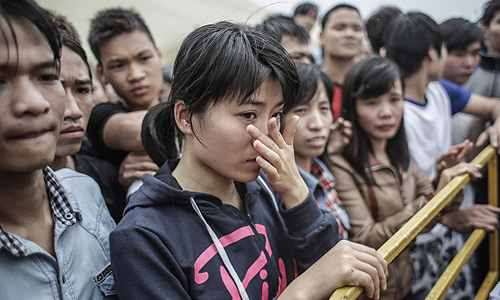
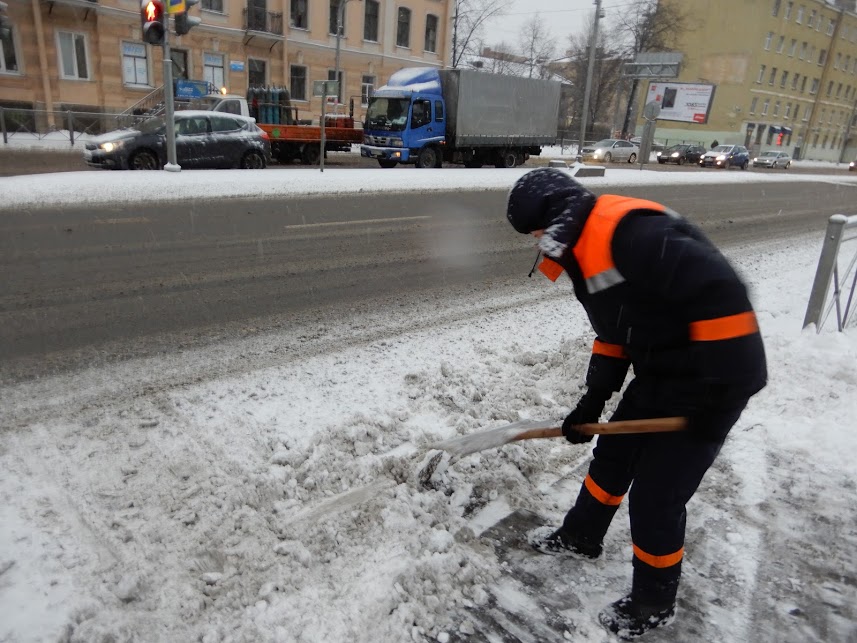
A migrant worker shovels snow and ice in central Petersburg, December 21, 2017
Offside: Number of Migrant Workers in Petersburg to be Reduced Ahead of World Cup
Yelena Dombrova and Marina Vasilyeva Delovoi Peterburg
January 11, 2018
Petersburg is preparing for the World Cup by tightening the residence rules for migrant workers. New federal laws could prevent restoring the flow of migrant workers, without whom the city’s economy is still unable to manage.
This year might prove critical for migrant laborers working in Petersburg. The flow of workers from other countries, which had picked up again last year after devaluation of the ruble, will be subject this year to legal restrictions, including restrictions occasioned by the World Cup.
Petersburg is one of the Russian cities where, from May 25 to July 25, 2018, the registration of foreigners at place of stay or place of residence will be executed within twenty-four hours from the date of arrival, rather than within seven days, as now. Such measures are stipulated by Presidential Decree No. 202, dated May 9, 2017, says Olga Duchenko, senior lawyer in the corporate and arbitration department at the firm Kachkin and Partners. People who violate the law in Petersburg will face fines between 5,000 rubles and 7,000 rubles [between 70 and 100 euros, approximately]. Foreigners can also be expelled from Russia.
The World Cup will be held in Russia between June 14 and July 15 of this year. The matches will be played at twelve stadiums in eleven Russian cities, including Petersburg. Our city will host matches between Morocco and Iran (June 15), Russia and Egypt (June 19), Brazil and Costa Rica (June 22), and Argentina and Nigeria (June 26). In addition, the city will host a second round match, a semi-finals match, and the third-place match.
This year, a number of laws on the registration of migrant workers will be tightened. The Russian parliament is thus currently discussing a law bill, now at the amendments stage, that would toughen criminal liability for fictitious registration of a foreigner or stateless person, says Duchenko. At the preliminary review stage are changes to the law on immigrant registration that would permit employers to cancel the registration of dismissed migrant workers.
The Recovery Will Become More Difficult
The number of migrant workers in Petersburg grew last year Thus, Petrostat, which relies on place of stay and place of residence registration data, has reported on the first nine months of 2017. 22,300 migrant workers from the CIS countries registered in Petersburg during this period, which is 71.5% more than during the same period the previous year. 10,300 migrant workers left the city, which is 20% fewer than the previous year.
Influx of Migrant Workers from CIS Countries to Petersburg, January–September 2017
The list of countries is as follows: Azerbaijan, Armenia, Belarus, Kazakhstan, Kyrgyzstan, Moldova, Tajikistan, Turkmenistan, Uzbekistan, and Ukraine. Courtesy of Petrostat and Delovoi Peterburg
This year’s figures could prove to be exactly the opposite. Russia has already reduced the quota for temporary registrations issued by nearly 20% compared with 2017. Only 90,400 permits are planned for 2018. The reduction has affected the Northwestern Federal District as well. The quota for obtaining temporary residence permits in 2018 will be 6,600 permits, as opposed to 9,300 permits in 2017. This is the most noticeable decline in recent years. In 2016, the quota was 10,000 permits; in 2015, it was 11,100 permits.
Nevertheless, a shortage of workers in Petersburg and Leningrad Region is not anticipated [sic].
“The overall number of migrant workers never exceeded five percent in the Losevo Group of Companies,” says Valeriya Ivanova, a development specialist with Losevo. “They are most employed at the dairy and on the farms as unskilled workers in accordance with immigration law.”
Ivanova stresses the group’s main production facility is located in Leningrad Region, far from Petersburg. Therefore, Losevo’s management is keen on employing local residents, i.e., the residents of the town of Svetogorsk and the village of Losevo, in the region’s Vyborg District.
Fire Them Just in Case
Changes to quotas could prove more palpable in the Petersburg labor market. Now, according to Russian Federal Government Decree No. 1467, as of January 1, 2018, employers can hire no more than 15% foreigners to work in retail alcohol and tobacco shops, and no more than 28% in companies engaged in passenger and freight transportation. As of January 1, migrant workers are forbidden to work in street trading and produce markets altogether. The proprietor, in possession of a license, should be the only person behind the counter.
“On the other hand, the quota for migrant workers in agriculture has been raised to fifty percent of jobs,” notes Chermen Dzotov, founder of the legal firm Dzotov and Partners.
Yuri Ragulin, owner of a chain of trading pavilions, is indignant.
“What is this? Tolerance or something? The fact is that, historically, Azeris have worked in the vegetable trade, for example. Why clamp down on this? What does it do for us? People have been in the business for eleven generations, they know what they’re doing. What I don’t understand is how I’m going to go out tomorrow and sell vegetables by myself.”
Ragulin believes that quotas in the retail trade will cause many people to go underground, leading to an increase in expenses, including bribes, and this will be reflected in the prices of goods.
“As for the World Cup, first, it lasts a month, and second, I have no clue why my shop at the train station in Zelenogorsk, for example, should be affected by the World Cup,” Ragulin concludes.
Petersburg human rights activists who deal with migrant workers note that many city policemen know how to say “Pay me 5,000 rubles” in Uzbek.
Ashot Efendiyev, owner of Monolith LLC, says that hiring foreigners to work behind the counter of a shop, market stall or kiosk has already been forbidden since May 2013.
“We don’t do it, because it’s simple dangerous. The fines run as high as 800,000 rubles [approx. 12,000 euros],” says Efendiyev. “The ban deals specifically with retail trade work behind a counter. If a person has a license, he can be hired for other work. So we have employed foreign electricians and stevedores. But now I’ve fired them just in case.”
Our sources in private universities that enroll foreigners say document checks of migrant workers have become more frequent. Paid enrollment is one way migrant workers from the near abroad use to stay in Russia legally.
“I think everyone will be expelled now, and our center will soon be shut down altogether,” says a female employee at one such university.
She says their students have always attended classes irregularly, but document checks began in the last several months, and the university administration has started expelling students who have missed several lectures in a row.
Human languages are amazing things. In English, for example, it is relatively easy to change a word’s part of speech simply by using it as a different part of speech. So, we can wonder (verb) when I will publish something really worthy of wonder (noun) on this blog.
Since Russian, on the other hand, is a so-called synthetic language (i.e., a language whose nouns, verbs, adjectives, and pronoun are fully declined and conjugated) you have to do a bit of prestidigitation to turn, say, a noun into a verb. The easiest (though by no means the only) way to do this is to add the verbalizing suffix -ovat’ to the noun or other part of speech in question.
One of my favorite such newfangled verbs is vangovat’, which means “to predict, to prophesy.” It has a heavily ironic connotation, since it was formed from the familiarized Christian name of the blind Bulgarian mystic and clairvoyant Vangelia Gushterova, née Dimitrova (1911–1996), more popularly known as Baba Vanga or Grandmother Vanga.
Despite having passed away over twenty years ago, Baba Vanga and her prophecies are still extraordinarily popular amongst Russians who go in for what an old friend of mine once referred to as “spooky knowledge,” while she is an object of ridicule amongst sane Russians. I have no evidence to prove it, but I take it that it was a member of the latter group who coined the verb vangovat’, which we will translate as “to vanganize.”
An innocent enough feature, you would think, before I realized that Vedomosti‘s caption writer might have engaged in some full-blown vanganizing, to wit:
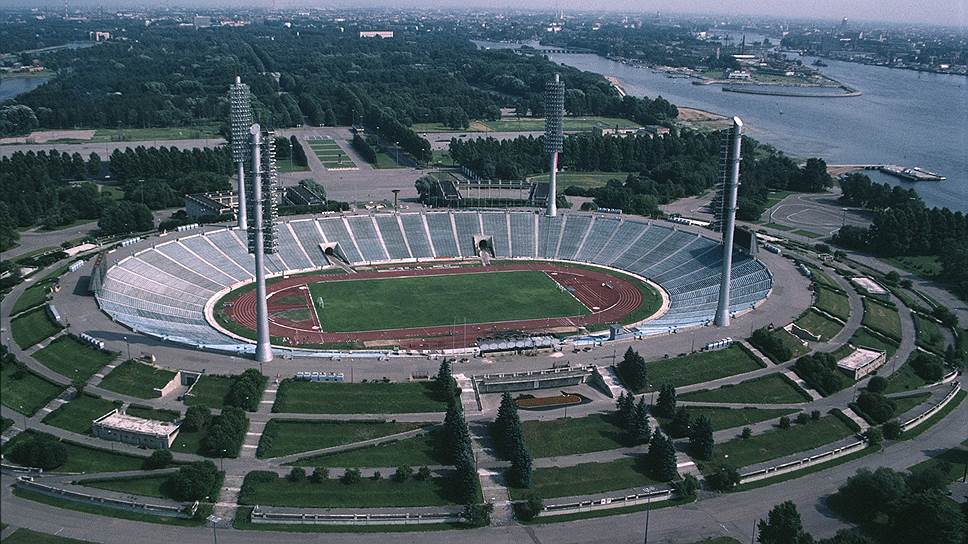
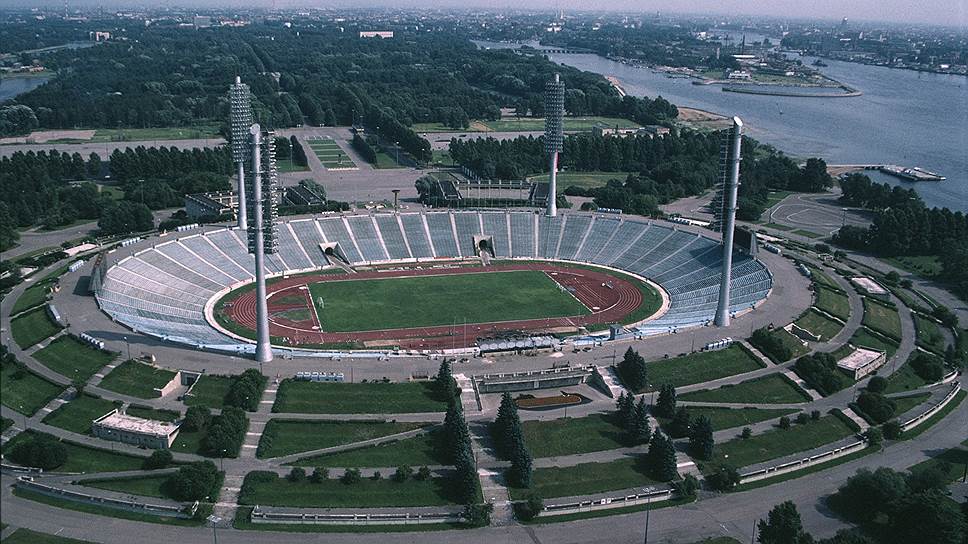
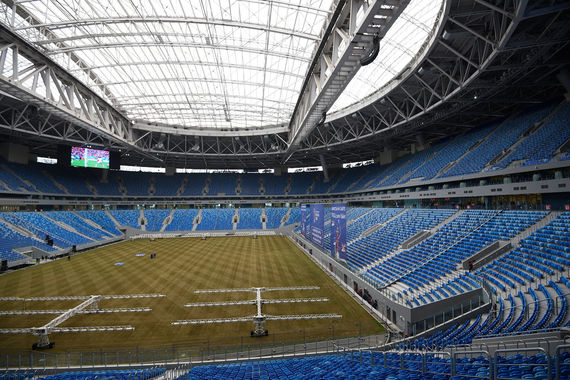
“The arena in St. Petersburg is meant for 67,000 spectators. Here, the Russian team will play one match in the group stage and will get through the semifinals.” Photo courtesy of Yevgeny Yegorov/Vedomosti
But maybe not. The original caption (“Арена в Петербурге рассчитана на 67 000 зрителей. Здесь сборная России сыграет один из матчей группового этапа и пройдет полуфинал”) could also be translated as follows: “The arena in St. Petersburg is designed for 67,000 spectators. Here, the Russian team will play one match in the group stage, and the semifinals will take place.” That is, with or (probably) without the Russian team.
Whatever the case, the so-called Zenit Arena, situated on the western tip of Krestovsky Island, has been like a bad Baba Vanga prophecy from the very start. First of all, to make way for its eventual construction, the old Kirov Stadium, a lovely immense thing designed by the great constructivist architect Alexander Nikolsky, a grand oval open to the sky, the sea, the sun, and all the elements, and surrounded by a beautiful park, was demolished in 2006. Quite illegally, I might add, because it was a federally listed historical and architectural landmark.
The Kirov Stadium in the summer of 2006, when it briefly served as the site of a sparsely attended alterglobalist counterforum, organized in response to a G8 summit, hosted by President Putin in the far south of the city, in the newly restored Constantine Palace in the suburb of Strelna. Enclosing the alterglobalists in the already condemned Kirov Stadium was a brilliant move on the part of local authorities, who thus invisibilized the entire event and made it nearly inaccessible to the general public. Although a subway station has been planned for the new stadium, it was not in operation in 2006 and probably will not be online in time for the World Cup, either. Photo by the Russian Reader
Since then, the project to construct the new stadium has been a raucous debacle, involving endless delays and extreme cost overruns; the employment of North Korean slave laborers, one of whom was killed on the job; the multiple firings and hirings of general contractors and subcontractors; and numerous revelations of newly discovered structural defects.
The construction of Zenit Arena has also been part of the general uglification and rampant redevelopment of the so-called Islands, a series of parklands situated on several smallish islands in Petersburg’s far north. It now seems that city officials and developers thought all those parks and all that greenspace were taking up too much valuable potential real estate and pumping too much oxygen into the atmosphere, because in recent years they have gone after the Islands and their environs with a vengeance.
Zenit Arena, the Western High-Speed Diameter (ZSD), and Gazprom’s Lakhta Center skyscraper are merely the most visible aspects of this mad greedfest, its crowning jewels.
Gazprom’s Lakhta Centre skyscraper, under construction, as seen in April 2017 from another site of urban planning greed and madness, a nearly 500-hectare “reclaimed” island plopped in the Neva Bay immediately west of Vasilyevsky Island. The new island, which remains nameless, will eventually be built up with high-rise apartment blocks. Local residents vigorously protested the land reclamation project in the planning stages, but the authorities roundly ignored them. Photo by the Russian Reader
Getting back to my original topic, I think the Vedomosti captioner might have been taking the piss out of readers, after all. Here is another photo and caption in the series:
“The stadium in Yekaterinburg is a cultural heritage site. Part of the historical façade has remained after the reconstruction.” Photo courtesy of Sport Engineering Federal Unitary Enterprise
When I slipped this photograph onto my desktop, the filename caught my eye: “default-1huy.jpg.” I took this to mean that someone at Vedomosti was not terribly impressed with Yekaterinburg’s blatantly criminal attempt at “historical preservation” and decided to tag it with one of the most powerful cursewords in a language positively crawling with them. But since this a family-oriented, Christian-values website, I will let the experts explain the particulars.
Like the Sochi Olympics, I vanganize that the 2018 World Cup will be an unmitigated disaster for any and all locals who do not manage to escape the vicinity of the venues in time. I would also vanganize that the World Cup has already been a disaster for cities such as Petersburg and Yekaterinburg, which had venerable, heritage-listed stadiums put to death for the purpose, but I don’t think you can vanganize retroactively. TRR
“No sodomists allowed,” Tverskaya Street, Moscow, 14 November 2017. Photograph by Vadim F. Lurie. Thanks for his permission to reproduce it on this website
“We Are Treated like Schmucks”: How and Why Volga Region Pensioners Have Rebelled against the Regime
Yeveniya Volunkova Takie Dela
April 4, 2017
What Happened?
Certain benefits for pensioners, disabled people, and other beneficiaries were cut in Samara at the beginning of 2017. Monthly payments for housing services and utilities were replaced by compensation for actual expenses. People now have to pay their bills first, then show the authorities the receipts, and only after that, if they have no debts, are they compensated for their expenses. The system has not been put through its paces and does not function, so there have been problems with assembling documents and getting compensation. In addition, a charge for major renovations has been added to the housing maintenance bill, a charge that many people do not pay as a matter of principle. Also, free public transportation for working pensioners has been abolished, and the number of free rides on the subsidized transport pass has been limited to fifty. This lasts many people two weeks; moreover, people complain the “rides” disappear more quickly. The frosting on the cake was the cancellation of monthly cash payments for working pensioners, who number 175,000 in Samara Region. People have lost their supplementary pensions, which ranged from 600 to 1,200 rubles. Non-working pensioners, whose pensions are over 19,500 rubles, have also been stripped of supplementary payments. The Samara administration did not give permission to hold a protest rally on the city’s central square, allowing it only in a remote neighborhood. Despite these precautions, the protesters packed the square.
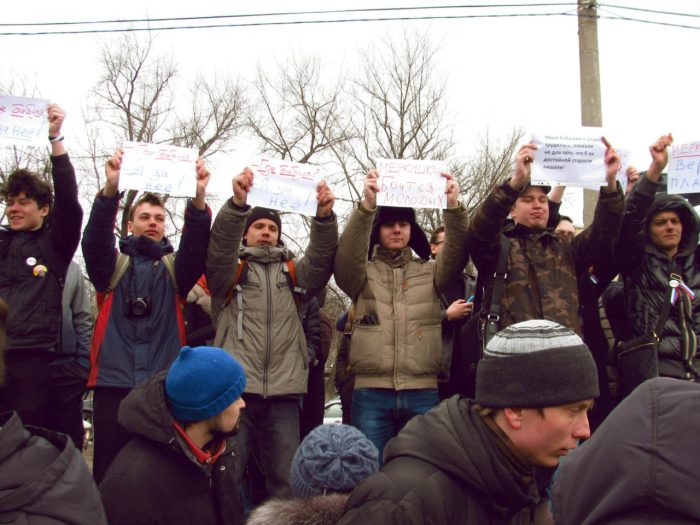
The fourth large-scale protest by pensioners took place in Samara on April 2. The old folks first rebelled against Samara Region Governor Nikolai Merkushin in early February, when around 300 people attended a protest rally. The number of protesters has grown each time, and yesterday, according to unofficial statistics, around 4,000 people gathered on the square near the Athletics Palace. The protesters told our correspondent Yevegniya Volunkova what they were protesting and how they had succeeded in coming together when the rallies have not been mentioned on television at all.
***
Nina Dmitrievna and Tamara Petrovna
Both women are seventy-nine years old. They heard about the rally from flyers and the internet. Their main complaints are Mordovian produce in the city and a fountain during the plague.
We’re upset about our poverty, the judicial system, and very many other things. But first of all, we want to see Merkushkin replaced. He squanders money and imports everything from Mordovia, including crushed stone, paving tile, and cement. Whatever shop you go to, the produce is all Mordovian. It’s no wonder his nickname is the Mordvin Pasha. During these hard times for the region, he wants to build the best fountain in Europe on the river embankment. Is now the time for it? Replace the pavement and benches, sure, but why the heck do we need a fountain right now? My friends and two children live in poverty, and it’s hard to buy bread. But this stadium [Samara is one of the host cities for the 2018 World Cup — TD], good God, how much money they’ve embezzled, and it’s not clear whether they’ll finish it or not. They took their kickbacks, but there’s no money left to build the thing. If we could see that everything was being done on behalf of the people, we would put up with it, but they have been stealing. Merkhushkin pumped three million into the wall on Samara Square [the Wall of Honor on Glory Square, which cut off a beautiful view of the Volga and Zhiguli Mountains, popularly known as the Wailing Wall — TD). It’s in terribly bad taste! And so much money was spent.
Mikhail Viktorovich
Seventy years old, he heard about the rally from friends. His main complaint: how can he survive on his pension?
How the mean regime deals with veterans! Yesterday, villagers told me their family had a monthly pension of 8,000 rubles [approx. 133 euros] or so. What is that? How can a person survive? Today, I went to get milk and bread. I also bought some biscuits and something to put in a soup. 600 rubles [approx. 10 euros] was gone just like that. Is the governor here? He didn’t show up? Shame on him! He stole kopecks from pensioners. Down with our government! They have not made a single effective move to improve the well-being of veterans.
Irina Olegovna
Sixty years old, she heard about the rally from a girlfriend. Her main complaint is that she has been forced to work to survive.
My monthly pension is 7,700 rubles, and I used to get a veteran’s bonus. I worked as an educator my whole life. Merkushkin took way the 621 rubles I got as a veteran’s bonus. I have no husband and no support. I’m forced to work to survive, but I have a whole passle of ailments. Should I approve his policies? He can go back to his native Mordovia. Besides, he lies and lies and lies. He shamelessly lies that he gives us a pension. I wrote a letter to him asking him to help me find work. Do you think he helped me? He didn’t do a damn thing for me.
Valentina Andreyevna
Sixty-three years old, she found out about the rally from the internet. Her main complaint is shamefully low pensions.
I came out of a sense of solidarity. I don’t receive any discount benefits: my length of service was too short. There should other slogans here: “Decent pensions!” Give us a decent pension and we wouldn’t need discounts. We’ll pay for public transport passes, for apartment maintenance costs, and so on. But it’s impossible to live on our miserly pensions.
Twenty-two years old, he found out about the rally from the internet. His main complaint is bad roads.
I came to the rally to voice my dissatisfaction with Nikolai Merkushkin’s social policies. It’s a pity our pensioners have to stand in the cold, demanding a few miserable kopecks. I’m sick of the state of the roads in this country. I’m tired of the fact the regime treats me hypocritically not only as a disabled person but also as an individual. It treats everything as a resource that can be sent off to war, god knows where. And yet it cannot organize a decent urban infrastructure, a decent life. I think the government needs to revise its policy of restricting the number of rides on public transport one can take if you have a discounted travel pass. I ride public transport all the time and I travel around town more than the authorities think I do.
Emma Viktorovna
Seventy years old, she heard about the rally on the internet. Her main complaint is that the governor was decorated “for his contribution to cosmonautics.”
Merkushkin is impudent. He’s an outsider in Samara. My colleagues, who have worked all their lives at the cosmodrome, were decorated for their service. But why the hell did they did stick an honorary pin on him for his contribution to cosmonautics? He has made no contribution whatsoever to cosmonautics. A persons should be more modest. Yet our colleagues where shown on TV standing off to the side, while he was shown in close-up. How did Samara manage without Merkushkina? Probably, it didn’t manage. But little Nikolai showed up, and it has been once achievement after another since then.
“Roads are Samara’s second misery. The fools in power are the first.” Roads are one of Samara’s worst problems. Photo courtesy of Yevgeniya Volunkova/Takie Dela
Roman
Sixty-five years old, he heard about the rally from his grandson. His main complaint is that the restricted number of trips on the discounted public transport travel pass make it hard for him to travel to the Volga.
Can you deceive people like that? They compare us with Penza, where forty-eight rides is more than enough, supposedly. Samara is a huge city: fifty trips a month is not enough here. When I’m traveling, all my rides get eaten up by he transfers. It’s a huge city. In the summer, I want to go to the Volga to swim. How many transfers is that? Fifty trips runs out in two weeks. Then there are housing services and utilities. We are forced to pay for utilities, but the discounts come later, after we’ve paid. Yet officials have included a fee for major house renovations in our bills. I don’t want to pay it. What am I paying for? I’ve lived half my life in the same building, which is falling apart at the seams. Major renovations have never once been carried out in that building.
Sixty-nine years old, she heard about the rally from reading flyers. Her main complaint is how the money owed to pensioners has been used to pay for the governor’s palaces and the World Cup.
That scumbag Merkushkin took away all our benefits. How did he dare? He built himself palaces on Rublyovka, four palaces at three hundred million each. Does he have a conscience? Today, he was on Channel Two saying he built all the roads for us. The roads are all good, and everything in Samara is good. Only our pensions will have to pay for the World Cup. He’s a real bastard, a scumbag. We should send him packing back to Mordovia, where he can choke on his sons and relatives. Let’s keep coming out for protest rallies and demanding he resign.
Irina Olegovna and Lyubov Andreyevna
Forty-six and seventy-seven, they heard about the rally on the internet. Their main complaint is that the regime embezzles money and treats people like schmucks.
Irina Olegovna: I’m not a pensioner, but I came to stick up for them. I’m outraged by the injustice that flourishes in our country. The authorities have found the right people to rip off: pensioners. They holler about being a super power, that they defeated the fascists. Who beat whom? What’s the standard of living in Germany and the standard of living in Russia? Who did they defeat? Pensioners and sick children?
Young people attended the rally this time to support the pensioners. Photo courtesy of Yevgeniya Volunkova/Takie Dela
Lyubov Andreyevna: We’ve been spat on from all sides. You cannot get in anywhere to talk to anyone, whether it’s housing services and utilities or healthcare. Everywhere they could not care less about us. I’m seventy-seven. I use the internet and I know everything. I was a decision-maker when I was employed, but now I’ve been utterly humiliated. Thank you, Navalny, that you exposed Medvedev. We must send him packing
IO: It’s absolutely clear to everyone that regime embezzles money, and the fact they are silent is additional proof that thievery is going on. What happened to Serdyukov and Vasilyeva are proven facts. There was a trial, and they were let go. They sold off the property of the defense industry and lined their pockets. I don’t understand who needed this demonstrative flogging. They pulled out their dirty underwear, showed it to everyone, and put it away. I’ll be damned!
LA: Because they consider us idiots.
IO: Stupid schmucks!
LA: Stupid schmucks, cows, that’s who we are!
IO: I agree with you completely. But ultimately they have to understand a point of no return will be reached, when it all goes to hell. What, are they waiting until people come after them with pitchforks? The country has already reached the boiling point. What the heck do we need Crimea for when our country is poor? I used to support Putin. He inherited a heavy burden, the country was in ruins. He seemed decent. I believed he’d put the country in shape. But then I realized what was what.
LA: Putin works for the oligarchs, not for himself. And we cows will all die off.
Vasily Petrovich
Eighty-two years old, he found out about the rally from a flyer. His main complaint is that payments have not been made to people who went through the war as children.
Look, I’ve brought a newspaper from 2014. Merkushkin promised to make monthly payments of 1,000 rubles to people who went through the war as children. But he didn’t give us fuck-all. We spent the war on a collective farm. Cold and hungry, we supplied the front and the cities with produce, while we ourselves ate grass and dirt. We survived, we were victorious, and now what? Now we are dying in poverty.
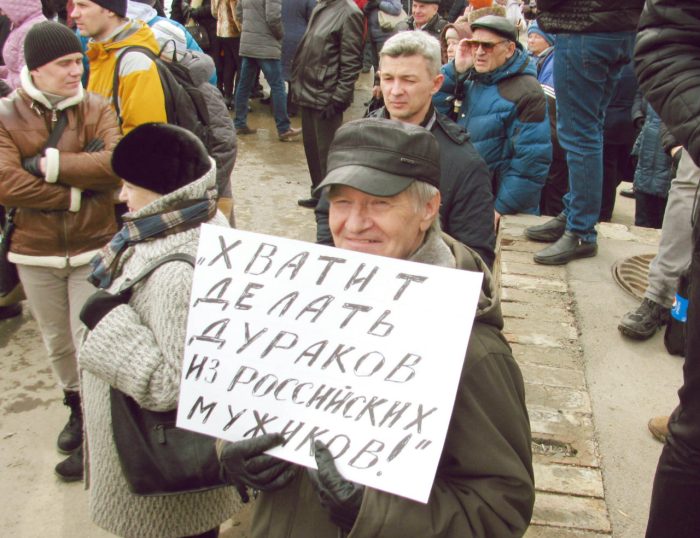
“Stop Making Fools of Russian Dudes!” Protest rally in Samara. Photo courtesy of Yevgeniya Volunkova/Takie Dela
Lydia Nikolayevna
Sixty-eight years old, she heard about the rally on the internet. Her main complaint is that her family has been stripped of all benefits, and that the regime takes people for idiots.
I’m a history teacher, I worked my whole life. Three years ago, my daughter died, leaving me to take care of my granddaughter Lada. She’s thirteen and in the sixth grade. By order of the city administration, the city paid the difference in the housing services and utilities bills for her as an orphan for the whole of 2016. The payment was small, but it made a difference. I’m a veteran of pedagogical work and disabled. We were supposedly divided into two groups: “rich” pensioners, who got 19,000 rubles a month, and poor pensioners. Money was taken away from us under the pretext of giving it to the poor. Money was taken from 175,000 people and then returned, allegedly, but we still haven’t got the money back. I don’t think they took the money in order to give it back. I take my granddaughter to school. I have to transfer, and I use four rides on my discounted travel pass. When they limited the number of trips to fifty, they took us for idiots. They also sucker us out of rides. My friends recorded every trip and noticed that they were shorting us by ten rides. They run out before the month ends, and they kick us off public transport. They’re secretly stealing even from these crumbs, from the fifty rides, as if we couldn’t check how many rides we were getting. I feel ashamed of this regime. We worked honestly our whole lives, and now they’re punishing us, punishing orphaned children and disabled people. It’s disgusting.
Nadezhda
Sixty-one years old, she heard about the rally on the internet. Her main complaint is the thieves in the government.
I have been denied the chance to travel by public transport. I need to drop off and pick up my granddaughter nearly every day. Of course, the number of rides on the travel pass is not enough. It’s just digusting. Why did they decide to limit us? What made them think fifty rides was enough for us? Merkushkin says that somebody made a thousand trips in a month on a seasonal pass. That’s utter rubbish. Even if it’s true, does that mean everyone has to have their benefits slashed? How many crooks and thieves are in the government? How many cases of corruption have been proven? In keeping with Merkushkin’s line of reasoning, all governors should be hauled into the Investigative Committee, no?
Organizing People through Their Wallets
“Let’s Reforge Medvedev’s Palaces into Unlimited Rides for Veterans.” The fifty rides they get on their free transport passes is not enough for residents. Photo courtesy of Yevgeniya Volunkova/Takie Dela
The main organizer of the rallies, Mikhail Matveev, a Communist MP in the Samara Regional Duma, is certain that his best organizer, the person who gets people out to the protest rallies, is Governor Merkushkin himself, the man whose decisions have driven people to the edge.
“Our old ladies don’t just read newspapers and watch TV. They’re not as backwards as they seem. They read social networks and blogs. Young people tell them things. Plus, we leaflet mailboxes and residential building entryways. We printed around 15,000 leaflets for the March 19 rally. The printing was paid for by the party and by ordinary people. It’s not a lot of money, but we don’t have anymore. Residents help us by leafletting for free and printing the leaflets at home on their printers. But the main organizing factor is people’s wallets, and the main organizer is Merkushkin. It used to be that pensioners weren’t aware that the number of trips on public transport was limited, but suddenly they were kicked off buses. The pension checks arrived, they were 700 rubles less, and so on. Dissatisfaction has been growing. We are grateful to Governor Merkushkin for the fact that his blunt propaganda pisses people off. There are all the phrases he tosses off at meetings with constituents, like, ‘It was you who did it so that we did nothing for you,’ and so on. They make the rounds. There will be more protest rallies until we get the pensioners their benefits back and send the governor packing.”
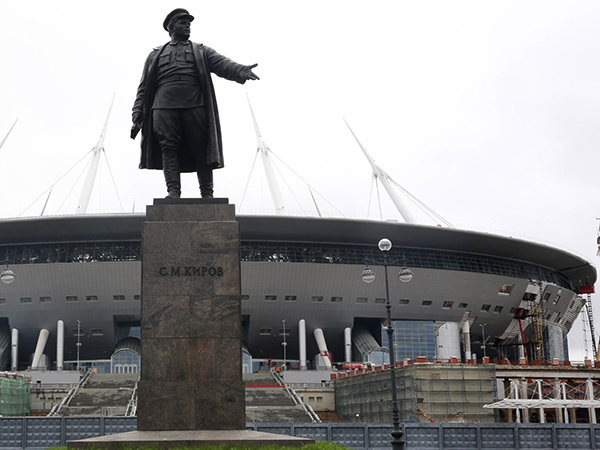
The new football stadium on Petersburg’s Krestovsky Island, still unfinished after years of delays and rampant cost overruns. In the foreground is a monument to former city boss Sergei Kirov, murdered under mysterious circumstances in 1934. Photo courtesy of Pyotr Kovalyov/Delovoy Peterburg
Schools, Kindergarten, and Hospitals Sacrificed to the Stadium Antonina Asanova Fontanka.ru
August 15, 2016
The Smolny [Petersburg city hall] will finance construction of the football stadium on Krestovsky Island twice over. The advances of 2.6 billion rubles that have not been returned by VTB Bank and Transstroy will be issued to new contractor Metrostroy. Schools and kindergartens will have to wait.
To finish the stadium on Krestovsky, the Smolny is ready to sacrifice the completion dates of three dozen facilities, including kindergartens, schools, and hospitals. 2.6 billion rubles, earmarked for social infrastructure, will be “redeployed” to Petersburg’s construction project of the century. City hall is counting on recouping the reinvested funds later, and figures it can afford not to hurry with the construction of public facilities.
The Construction Committee has prepared a draft decree on reallocating its 2016 budget. By law, the agency can redirect up to 10% of the funds in its targeted investment program, i.e., 2.8 billion rubles, a committee spokesperson said on the record.
Off the record, sources at the Smolny have explained that the stadium’s former general contractor, Inzhtransstroy-SPb, has not run through the 3.6 billion rubles it received as an advance. The company can still deliver part of the construction work and purchased materials before August 25, a month after its contract with the city was terminated. But if the city does not succeed in offsetting the entire sum, it will have to try and collect the money either from the contractor or VTB Bank, which issued the guarantee for completion of the work.
Experience shows it is not worth counting on the good will of companies when it comes to giving back money. The Construction Committee is still in the midst of suing VTB for the return of funds issued under contracts for the construction of indoor ice rinks, which were terminated over a year ago.
A strategy of protracted litigation does not suit the Smolny at all. Completing the stadium before year’s end is a matter of honor to the city government. So the Construction Committee has decided to redeploy part of the funds allocated for new kindergartens and schools to Petersburg’s main construction project. Only facilities whose completion was planned for this year have not been touched.
The city’s calculation is simple. Construction of public facilities will be slowed down a bit for the time being. But when the stadium is delivered at the end of the year, and the monies that were advanced are returned to the budget, the long-awaited construction projects will again be accelerated to a proper speed.
Health clinics and hospitals will be most affected by the budget cuts. The Construction Committee has decided to withdraw nearly a billion rubles from construction of these facilities.
Expenditures on one of the city’s most protracted construction projects, a perinatal center at Maternity Hospital No. 9 on 47 Ordzhonikidze Street, have been reduced by a quarter billion rubles. Doctors were preparing to nurse premature and sick newborns in the facility, and spoke of modern operating rooms and a modern intensive care unit. The building, in fact, was supposed to be delivered at the end of 2015. But now the contractor, Stroykomplekt, owned by former Baltstroy top manager Dmitry Torchinsky and Alexei Torchinsky, has a new deadline: the end of 2017.
People in the suburb of Kolpino will also have to wait for the opening of the new surgical wing at Hospital No. 33. Only one million rubles has been left in this year’s budget for its completion, while 155 million rubles will be transferred to erecting the football stadium. However, the construction site on Pavlovskaya Street has already been idle for a year. The Construction Committee terminated its contract with the previous contractor, but has not yet found a new contractor.
The residents of Kolpino will not have to wait alone, however. Among the facilities where construction will be slowed down are health clinics in Strelna and Krasnoye Selo, an ambulance substation in Metallostroy, and a childen’s tuberculosis sanatorium in Ushkovo.
Residents of the housing project on Badayev Street will also have to be patient. The city has stripped their future school of 90 million rubles in financing.
Finally, kindergartens will hardly suffer at all: funding of their construction will be reduced only by 310 million rubles. The biggest loser, to the tune of 130 million rubles, is the future kindergarten in the Golden Bay residential complex, near Tricentennial Park. Its completion has been postponed for a year, until the end of 2017.
The Smolny is even ready to cut funding for construction of a site directly linked to the new stadium: the waterfront near the Novokrestovskaya subway station, currently under construction. The contractor, Leokam, will have its funding for making improvements to the waterfront cut by nearly 240 million rubles. Apparently, the company will have to catch up next year. Under the terms of its contract, it has to deliver the works before the end of 2017.
The site of the new stadium was previously occupied by the Kirov Stadium, a federally listed architectural landmark. Designed by world-famous constructivist architect Alexander Nikolsky and opened in 1950, it was unceremoniously demolished in 2006. Photo courtesy of Kommersant.
However, what matters is that the stadium on Krestovsky Island will be delivered before the end of this year, and cost estimates of its construction will not increase, formally speaking.
A total of 42 billion rubles [approx. 582 million euros] have been allocated on the stadium, Petersburg’s principal protracted construction project.
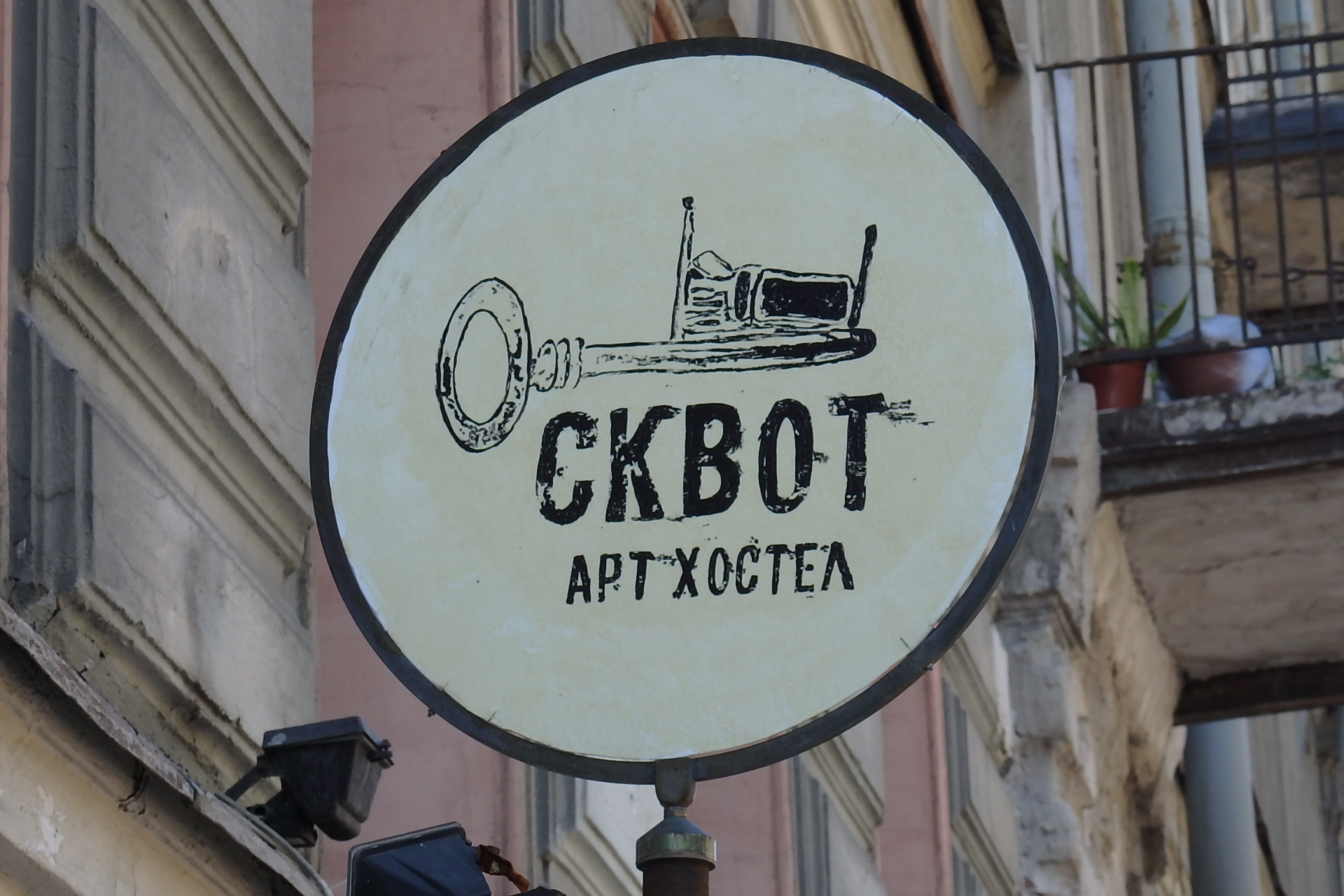
Sign for the Squat Art Hostel in central Petersburg. According to an article in the March 2, 2015, issue of Ekspert Severo-Zapad magazine, the city had between 1,250 and 1,270 budget accommodations, including 270 hostels. As of today’s writing, Airbnb listed over 300 rentals in the city. Photo by the Russian Reader
MPs Plan to Evict Hostels from Apartments But entrepreneurs don’t intend to pull up stakes yet
Elena Gorelova Vedomosti
May 12, 2016
At its Friday session [Friday, May 13, 2016], the State Duma will consider a bill that could ban Russian hoteliers from housing hostels in apartment buildings. Galina Khovanskaya, chair of the Duma’s committee on housing and communal services, had tabled the amendment back in September 2015. According to MPs, mini hotels violate the rights of residents in adjacent apartments. If the changes take effect, it will be possible to install hotels in residential buildings only after rezoning the spaces from residential to non-residential. Mini hotels will have to be equipped with soundproofing, fire safety equipment, and security alarms. They will have to be located on the first floor and have a separate entrance.
The ban would have a catastrophic impact on hosteliers, argues Yevgeny Nasonov, chair of the committee on budget accommodations at the Moscow branch of Opora Russia and general director of Clover, a network of hostels. A study conducted by the League of Hostels in December 2015 showed that around 80% of Moscow’s mini hotels and serviced apartments are located in the city’s residential housing stock. In Petersburg, Crimea, and Krasnodar Territory, those percentages are even higher.
From 2012 to 2014, mini hotels were most often opened in residential buildings, says Roman Sabirzhanov, who owns sixteen hostels, including the Fabrika and the Croissant. But residents dissatisfied with their new neighbors then began complaining and showered the prosecutor’s office with lawsuits. Seeing the risks of doing business in residential buildings, Sabirzhanov opened his own hostels in non-residential buildings from the very beginning. It is not always more expensive, he claims. For example, Sabirzhanov has invested 3.5 million rubles [approx. 47,000 euros—TRR] in a new, 225-square-meter hostel on Chistye Prudy. 40% of the money went for rent; 40%, on repairs; and the remaining 20% on obtaining permits and undergoing classification. As of July 1, 2016, all hotels must be classified, receiving from one to five star, while hostels will receive the the no-stars category.
Even if the bill is not passed into law, hostels in residential buildings will be banned sooner or later, Sabirzhanov believes. At the moment, big cities are in the process of being purged of dubious flophouses in the run-up to the 2018 World Football Cup, and hostels have been subjected to more frequent inspections, he says. Even normal hotels might get the axe, the hotelier is convinced. Over the past five years, the number of beds in discount hotels and serviced apartments has grown twentyfold in Moscow, and the major hotel chains that have been lobbying the ban on hostels are not pleased with this redivision of the market, Sabirzhanov claims. He advises hoteliers against making hasty decisions. For the time being, he says, they should operate as they have before, recoup their investments, clean up their premises, and settle conflicts with building residents. At the same time, however, they should think about relocating if they have the means, launching a new hostel in a non-residential space, and going through classification. In the end, you can close the hostel and put the apartment up for rent, says Pavel Gorbov, executive director of Re:Sale Expert.
Launching a small hostel in Moscow runs you approximately two million rubles, estimates Nasonov. But rezoning a space as non-residential is quite expensive for small businesses. Nasonov cites the example of an entrepreneur he knows who has been attempting to build a separate entrance for a store in a residential building near Vykhino subway station. (The procedure for obtaining permissions is the same as for hostels.) He has already spent 1.5 million rubles on construction.
Events are unfolding in plain sight, and strange as it might seem, the flood of disinformation cannot prevent us from seeing a quite simple picture.
The subway workers’ union had long warned of the danger, and there had generally been a lot of reports in the press on the growing number of accidents in the Moscow Metro, and now there has been a new fatal accident.
The last couple of weeks, Russian media had reported constantly about how deftly the separatists had learned to use the Buk surface-to-air missile system and how many Ukrainian airplanes had been shot down. Just before news of the Malaysian airliner broke, reports had managed to surface—in “Strelkov’s dispatches,” in the media, everywhere—that the militants had shot down another Ukrainian transport plane. The plane turned out to be the civilian jetliner.
Recent articles in Vedomosti newspaper and especially leaks at b0ltai.wordpress.com make it easy to piece together the fiscal and economic situation in Russia. The country is in an “autonomous” recession, meaning one caused by internal factors. The resources for growth have been exhausted, and there is no money for Crimea or for executing Putin’s May 2012 presidential decrees. The government is preparing to respond with austerity measures: the abolition of free medical care for nonworking citizens, tax increases, and another raid on retirement savings. For now the situation is rough but not catastrophic. At the same time the overall trajectory is clear: there will be less and less money, and it will be ordinary people who pay the bills.
However, there is no one to protest: all the country’s internal contradictions, which were somehow politically articulated in 2011-2013, have been crushed by the Crimean steamroller, and the opposition is divided and marginalized. The population has closed ranks around the new Putin “geopolitics,” becoming an aggressively frightened mass. Any possibility of electoral protest has been completely blocked off: with stunning cynicism, the field has been purged in the run-up to municipal elections in Moscow and Petersburg.
We can see that the new system is closed upon itself: the geopolitical adventures are needed, ultimately, only to strengthen Putin’s personal power, to maintain his sky-high rating. The exact same role is performed by mega-events like the Olympics and the 2018 World Cup. Yet the economic cost of the geopolitics and mega-events will be huge, and people themselves will foot the bill (for sanctions, for Crimea, for kickbacks). However, the imperialist ideology surrounding the events for which they are paying out of their pockets will prevent them from articulating their protest politically. It is a paradox, but a paradox that has already been observed in history. Recall, for one, Marx’s remark that Louis Bonaparte ruled in the name of the peasant masses (who supported him at elections) but against the interests of these masses.
This new period of stability might last as long as the previous one. No, it is no longer the apolitical period of stability of the noughties, but it might prove no less stable.
Ilya Matveev is an editor of OpenLeft.Ru, a member of the PS Lab research group, a lecturer in political theory at the North-West Institute of Management (Petersburg), a PhD student at the European University (Petersburg), and a member of the central council of the University Solidarity trade union.
Welfare Chainsaw Massacre
Ivan Ovsyannikov (Russian Socialist Movement)
September 30, 2013 anticapitalist.ru
A “welfare chainsaw massacre” is exactly what we might call the government’s actions and statements over the last few months. The ruling class is once again attempting to pay for the latest uptick in the economic crisis from out of the pockets of workers.
On September 1, while speaking to students at the Far East Federal University, Putin announced the transition to a policy of austerity and reduced social spending. “The world economy has slumped a bit, and ours is hunkering down behind it,” the president said in his typical manner by way of explaining the upcoming unpopular measures. And he supported an earlier proposal, voiced by Minister of Finance Anton Siluanov, to replace the “maternity capital” program with “targeted assistance to poor families.”
However, a few days later, Dmitry Medvedev said that the maternity capital program would not be cancelled. “But it will be modified,” Minister of Labor and Social Affairs Maxim Topilin added in a whisper.
The fact that public opinion has been probed on such a sensitive point is quite significant. The maternity capital program is almost the only widely publicized social achievement of the Putin era. Putin has repeatedly stated it was his idea. And now this essential element of Putin’s social populism has been openly questioned.
No less provocative looking are the experiment with introducing social norms for electricity consumption (see Andrei Zavodskoi, “Cruel Economy”) and the de facto raising of the retirement age, which has long been discussed and is today closer than ever to realization. According to Deputy Primer Minister Olga Golodets, “We are not discussing raising the [retirement] age for any category of workers. We’ve gone another direction by promoting voluntary postponement of retirement. That is our principled position, and the government’s position.” However, such tricks are unlikely to mislead anyone.
The most scandalous revelations, however, are the statements made by government officials concerning labor relations. If, until recently, Mr. Topilin based his ministry’s decision not to index Russia’s penny-ante unemployment benefits on the fact that “at present there remains a high probability of finding employment in the labor market,” Mr. Medvedev has now said the exact opposite. He argues it is time to get away from the policy of preserving employment at all costs and not be afraid of cutting inefficient jobs: “The times all of us now face are not the easiest. […] Some people—perhaps a significant portion of the population—will have to change not only their jobs but also their professions and place of residence.” There is no doubt we have fallen on hard times, but the Prime Minister is clearly disingenuous when he talks about “all of us.” Russia’s ruling elite has no intention of depriving itself of jobs and handsome profits. So, in a conversation with François Fillon, Mr. Putin elegantly hinted that he would “not exclude” the possibility of seeking a fourth term as president.
But has the Russian economy “hunkered down” badly enough to warrant such painful experiments on the population? Isn’t “stagnation” only a plausible excuse for implementing the longstanding plans of the gentlemen from the Russian Union of Industrialists and Entrepreneurs?
As was reported in late August, the Ministry of Finance planned to save 1.1 trillion rubles [approx. 25 billion euros] over three years by eliminating the maternal capital program and reducing expenditures on pensions. At the same time, federal and regional budget expenditures on preparations for the 2018 World Cup should amount to 438 billion rubles, that is, almost half a trillion. The mass protests and riots in Brazil, sparked by excessive government spending on the 2014 World Cup, are still fresh in everyone’s minds. Russians could learn a lesson or two from Brazilians.
But maybe massive sports venue construction projects will generate many new jobs and return the taxpayer money spent on them? No, they will not. Unlike the great construction projects of the Soviet era, when funds were invested primarily in developing production, Olympiads, Universiades, and World Cups are, by definition, loss makers for national governments. Many analysts trace the current economic disaster in Greece to the 2004 Summer Olympics, which enriched transnational corporations while depleting public finances. The London Olympics have also been declared unprofitable. As for the 2014 Sochi Winter Olympics, its unprofitability has been recognized by nearly all serious experts, including Vnesheconombank chair Vladimir Dmitriev, who said in an interview with Vedomosti newspaper that “a serious percentage of [Olympics-related construction] projects are calculated to make a loss.” According to Dmitriev, “Given the current model and market trends, there are big problems with returns on investments. For example, one million square meters of hotel space are being built in the Imereti Lowland. When this space goes onto the market after the Olympics, a sixty percent occupancy rate will be hard to achieve. The costs of many projects have seriously risen as they have been implemented. […] For many sites, there is no complete project documentation or confirmed cost estimates. All this confirms our doubts.”
As for jobs, they really will be generated—for thousands of migrant workers. Federal Law No. FZ-108, adopted specifically for the World Cup, leaves no doubt about that. First, the law establishes special lightweight entry requirements for foreign workers involved in preparations for the World Cup. Second, it limits the applicability of a number of existing labor laws, effectively legalizing slavery. As the Confederation of Labor of Russia (KTR) declared in their statement on the subject, “The potential for runaway importation and recruitment of cheap labor, undermining the national labor market, and leading to a decrease in wages and legal guarantees in the area of labor relations, and an increase in the level of unemployment among the population, has been legally enshrined in the Russian Federation.”
The government could not care less about the fortunes of workers during the crisis, and it does almost nothing to hide it. How else can we account (to cite just one example) for Mr. Topilin’s proposal to deny free health care to all informally employed and unemployed people not registered with an employment bureau?
In light of the foregoing, the Kremlin’s actions aimed at reconciliation with the liberal opposition also become intelligible, as do unexpected initiatives to put the “against all” option back on voting ballots. The authorities fear that public discontent will grow and want to channel it in a direction that presents no danger to the ruling elite. Whether this political maneuver succeeds depends in part on the willingness of leftist political forces and trade unions to win over public opinion and make the fight against austerity measures as much of a mobilizing factor as it has been in Greece, Spain, and other countries facing the consequences of the capitalist system’s crisis.
Translated by the Russian Reader. Photo courtesy of deviantart.net
iuf.ru
September 2, 2013 The Cost of the World Cup FZ-108 primarily threatens hundreds of thousands of Russian workers
A serious discussion has erupted since the contents of the notorious “2018 World Cup Law” (or FZ-108, for short)* were revealed to the general public. The focus of the discussion has been the consequences of removing restrictions on employing migrant laborers and the possibility of their runaway exploitation if the law’s clauses on voluntary contracts (which place them beyond the reach of a number of articles in the Labor Code) are enforced.
However, the people most threatened by FZ-108 are Russian citizens.
When the discussion of FZ-108 was getting underway, many in Russia were disturbed by the fledgling campaign against “illegal migration” recently undertaken by law enforcement and local authorities in several areas of the country, a campaign involving police raids and mass imprisonment of migrants in special camps, where they were forced to live almost on the bare pavement, without electricity and other basic conveniences. Given this background, it was unsurprising and even natural that the public would pay more attention to the clauses in FZ-108 dealing with the employment of foreign nationals and stateless persons. The perception exists that the law has nothing to do with Russian citizens.
But is this really true? The answer is simple: no, it isn’t!
* * * * *
Major sporting events like the World Cup always entail the generation of tens of thousands of jobs in construction, light industry, building maintenance, catering, retailing, transportation and so on. Yes, these jobs appear only for a few years, but wise use of such opportunities can give the economy a stimulus for decades to come. Increasing employment leads to growth in domestic spending and private savings, which, in turn, improve demographics. These are the three pillars of sustainable economic development.
But all that happens only when the new jobs are decent, meaning the wages they pay allow people to spend money, including on major and long-term purchases (e.g., home appliances, furniture and cars), and maybe even take out a home loan, and the terms of employment enable them to feel confident in the future, save money, and start and raise a family.
However, the wording of FZ-108 makes it clear that none of these things are expected to happen in Russia. Instead, the authorities are planning to tackle the job of preparing and staging the 2018 World Cup with slave labor, thus definitely ruling out any positive effects both for workers and the economy as a whole. The only outcome of this championship will be the personal gain of a few.
Why is such a conclusion warranted? The fact is that FZ-108, unlike, say, FZ-310 (which deals with the 2014 Sochi Olympics),** expressly stipulates significant exceptions to labor laws, exceptions that will diminish job quality. They are mainly concentrated in the controversial Article 11 (Chapter 4), “The Characteristics of Work Related to the Staging of the Events.”
First, Article 11 gives employers the right to establish long working hours unilaterally (Section 1).
Second, Article 11 allows employers to define the manner of payment for work at night, on weekends and on public holidays without regard to the stipulations of Articles 154, 113 and 153 of the Labor Code. Moreover, this can be done through collective bargaining, through the inclusion of such clauses in individual employment contracts or, more generally, through the enactment of “local regulations,” that is, yet again, unilaterally (Sections 2 and 3).
Third, overtime pay is abolished. Employers may simply compensate for overtime by “providing additional leisure time,” but the wishes of workers are not taken into account, and Article 152 of the Labor Code is effectively revoked (Section 4).
Finally, Section 5 abolishes such nonsense as the provision of elective annual leaves at times convenient for workers (such guarantees are given in Article 122 of the Labor Code, for example, to women before and after maternity leave). Like the rest of the lives of employees, holidays are governed by the “work plans of relevant organizations for preparing and staging the sporting events.”
However, as Vladimir Yurasov, a partner at the Moscow law firm Knyazev and Partners, rightly noted during an interview on RBK-TV, all these rules are clearly contrary to the Russian Federal Constitution. Article 37 of the Constitution states that everyone has the right to remuneration for work without suffering any form of discrimination, and that employment contracts guarantee workers statutory working hours, weekends and holidays, and paid annual leave, as stipulated by federal law. FZ-108 assumes that if workers are employed in the “preparation and staging” of the World Cup, this may very well serve as grounds for discriminating against them in terms of compensation, working hours and the right to paid leave and time off. In this case, “local regulations” are declared primary, rather than the Labor Code and Constitution.
Of course, these draconian measures do not apply to all workers in Russia, only to “FIFA employees, FIFA subsidiaries, FIFA business partners, confederations, national football associations, the Russian Football Union, the Russia 2018 Organizing Committee and its affiliated organizations, whose work activities are related to the staging of events.” The most interesting phrases in this clause are “FIFA business partners” and “work activities […] related to the staging of events.” Let us consider them in the order they appear.
As Article 2 of the law explains, a “FIFA business partner” is a “legal or natural person that has a contractual relationship with FIFA or its subsidiaries and is involved in events.” The list of such individuals and companies could prove to be quite long, because all commercial partners (including sponsors and licensees), suppliers, agents, broadcasters and so on will be included. Moreover, the provisions of the law apply not only to the “business partners” themselves but also to their subcontractors and subsidiaries.
Because preparations for the World Cup have just kicked off, the list of “FIFA business partners” is still incomplete. At present, for example, we know the names of only three companies that will serve as corporate partners to the 2018 World Cup: Coca-Cola, Hyundai-Kia and Anheuser-Busch InBev. In all, FIFA will have thirty-four such partners by 2018. Of course, all these companies have subsidiaries and subcontractors—personnel and temp agencies, construction and security companies, cleaning and catering companies, firms involved in maintaining equipment and buildings, supplying brand-name goods, producing and placing ads, and so on.
Another way to assess the scope of the problem is to compare the 2018 World Cup with another sporting event that will be hosted by Russia, the 2014 Winter Olympics in Sochi. We already know the names of all its suppliers, partners and licensees. Let’s take a look at the list.
• Worldwide Partners of the Olympic Games: Coca-Cola, AtoS, Dow Chemical, General Electric, McDonald’s, OMEGA, Panasonic, Procter & Gamble, Samsung, Visa
• General Partners of Sochi 2014: Aeroflot, Megafon, Rostelecom, Bosco di Ciliegi, Volkswagen Group Rus, Sberbank of Russia, Russian Railways, Rosneft
• Official Partners of the 2014 Olympic Games: Ingosstrakh, PwC
• Suppliers of Sochi 2014: Avaya, Baltika, EF English First, Kommersant Publishing House, Abrau Durso, Adecco Group, EXECT Business Training, Kelly Services CIS, Detech, Microsoft Russia, GAZ Group, Scania-Rus
In addition, nearly seventy companies have signed licensing agreements with the Sochi 2014 Organizing Committee.
It is obvious there will be no fewer companies wishing to link their logos to the World Cup. Only unlike the employees of Olympics partners, employees of FIFA’s business partners will be forced to waive many of their workplace rights.
But perhaps only a small number of workers will be affected by this restriction of rights? Unfortunately, the wording of the law gives no grounds for such a hypothesis. The law mentions employees whose work is related to the preparation and staging of the World Cup. However, the wording is utterly unspecific. How do we differentiate the work a company does in preparation for the World Cup from its other activities? For example, Coca-Cola produces beverages emblazoned with the World Cup logo. Does this constitute work performed as a FIFA business partner or not? Can it be construed as having to do with the preparation and staging of the World Cup? What about cellular network development work done by mobile phone companies? Or the introduction of new direct flights by air carriers? Without going out of our way to abuse common sense, we can construe nearly all commercial activity by FIFA business partners as preparation for the World Cup.
Of particular concern is the more than probable inclusion among the business partners of such companies as Adecco Group, EXECT Business Training and Kelly Services CIS – that is, companies still operating in the legal gray zone of personnel services. Given that Bill No. 451173-5, better known as the law banning contingent labor, which has already suffered serious damage and almost been stripped of its original intent, was returned for a second reading in the State Duma, the de facto support and promotion of these companies by official Russian sporting organizations and state agencies looks like a targeted attack on the quality of employment.
How many Russians will be affected by these measures at the end of the day? If we accept the flawed logic of FZ-108, we can agree with Russian Sports Minister Vitaly Mutko that the concept of the World Cup has been developed and adopted by FIFA in such a way that almost seventy percent of the country’s population will be involved in preparing for it and staging it.
Does this mean, as some journalists have predicted, the return of serfdom? The answer depends largely on the actions of the trade unions.
_____
* The full text (in the original Russian) of the Russian Federal Law “On the Preparation and Staging of the 2018 FIFA World Cup and 2017 FIFA Confederations Cup in the Russian Federation and the Amendment of Certain Russian Federal Legislative Acts” can be found here: http://www.rg.ru/2013/06/11/chempionat-dok.html
** The full text (in the original Russian) of the Russian Federal Law “On the Organization and Staging of the Twenty-Second Olympic Winter Games and Eleventh Winter Paralympic Games of 2014 in Sochi, the Development of Sochi as a Mountain Resort and the Amendment of Certain Russian Federal Legislative Acts” can be found here: http://www.rg.ru/2011/06/06/olimp-dok.html
iuf.ru Migrant Labor in Russia: From Golyanovo to the 2018 World Cup
On July 11, 2013, the Russian Federal Law “On the Preparation and Staging of the 2018 FIFA World Cup and 2017 FIFA Confederations Cup in the Russian Federation and the Amendment of Certain Russian Federal Legislative Acts” came into force without any uproar, something inadmissible in such delicate matters. (Hereafter referred to as FZ-108 for brevity’s sake, the full text of the law in the original Russian can be found here.)
While the name of the law might not sound too promising, its content opens up truly outstanding prospects for any Russian employer even tangentially connected with the 2018 World Cup. FZ-108 establishes special conditions for the employment of “foreign nationals and stateless persons” (i.e., migrant laborers) involved in the preparations and staging of the World Cup and Confederations Cup.
Article 9 Chapter 4 generously eliminates the need to obtain permits for the employment of migrant labor and notify the relevant authorities of the conclusion or termination of contracts with foreign workers, or of their arrival or departure. Nor are migrant workers themselves required to obtain work permits. Quotas for the issuance of visas and work permits are waived for those employers involved with the 2018 World Cup. Article 10 is even more interesting: it abolishes all regulation and control over the recruitment of foreign nationals and stateless persons as volunteers—that is, it practically and plainly permits employing migrants without remuneration. Article 11 exceeds all limits of generosity. It allows employers to set long working hours right in the contracts of all workers “employed in the preparation and staging of the events” (with no explanation of what that phrase means) and waives the requirements for the compensation of night work, the compensation of work on weekends and holidays, and the duration and compensation of overtime (as stipulated by Articles 154, 113, 153, and 152, respectively, of the Russian Federal Labor Code). The icing on the cake is Article 56 Chapter 14, which exempts all payments made to migrants under labor, civil, and volunteer contracts from obligatory social security and insurance deductions.
This simplified hiring procedure is a clear incentive for employers to employ foreign workers on the widest possible scale.
Here we should stop and ask ourselves to whom FZ-108 applies. The answer: any entity that is a “FIFA business partner.” By law, this means any legal or natural person in a contractual relationship with FIFA or its subsidiaries and involved in “events.” This might be a commercial partnership agreement or an agreement for provision of services, but in any case the provisions of the law apply to the subsidiaries and subcontractors of all these “business partners.”
Thus, the list of organizations with special rights vis-à-vis workers employed in preparing the “events” is very broad. We can safely include in this list the general contractors and subcontractors involved in building the stadiums, suppliers, FIFA sponsors (all thirty-four of them!), FIFA licensees (i.e., companies that have the right to use the World Cup logo on their products), firms providing security at the World Cup, and so on. Of course, all these companies have subsidiaries and contractors—personnel and temp agencies, construction and security companies, manufacturing facilities, cleaning and catering companies, firms involved in maintaining equipment and buildings, supplying brand-name goods, producing and placing ads, and so on and so forth. By the way, the recruiting agency Kelly Services is among the official suppliers of the 2014 Winter Olympics in Sochi. In light of the new law, we can easily imagine the consequences if this or any similar firm signs a contract with FIFA.
It is reasonable to assume the Russian authorities understand they will be unable to get ready for the World Cup employing only Russian citizens and are thus counting on migrant workers. Employers in construction, residential building maintenance, cleaning, retail, and other sectors where the skill requirements are low and cheap labor is the source of profits have long ago discovered this magic wand.
But we cannot help noticing that all these measures have been proposed and ratified by the same government that is literally right now organizing actual raids on migrants and imprisoning them in special camps in Moscow, Saint Petersburg, Yekaterinburg, Volgograd, Samara, Rostov-on-Don, and Kaliningrad. Does this mean that the right hand of the Russian state doesn’t know what the left hand is doing? Not in the least.
All the above-named cities are hosting the 2018 World Cup.
In accordance with FZ-108, any migrant worker needs to do just one thing to obtain legal status: become involved with the preparation and staging of the World Cup or Confederations Cup, that is, enter into an employment, civil or volunteer agreement with one of the organizers of the events, or with their contractors or subcontractors. Thus, for example, a migrant from Vietnam now being held at the camp in Golyanovo, after signing a contract with some subcontractor of a World Cup licensee manufacturing mascot dolls for the championship, will be legalized de jure. De facto, however, he or she will go back to another semi-underground workplace, but now no one will be able to exercise any oversight or supervision. Now the migrants who are liberated from slavery or buried after they burn to death in sweatshops locked from the outside will be absolutely legal. It’s a sleight of hand, as they say.
The anti-migration campaign of the authorities stokes openly racist attitudes in society, shifting public attention from societal and labor issues (which had recently come to the forefront) to the search for scapegoats. Meanwhile, there is no guarantee that the practice of stripping migrant workers who are employed in the preparations for the 2018 World Cup of their rights will not be extended to all foreign workers tomorrow, and incorporated in the Russian Federal Labor Code the day after tomorrow, thus fulfilling the most cherished dreams of the Russian Union of Industrialists and Entrepreneurs.
The fight against xenophobia, the persecution of migrants and the violation of their rights must, therefore, become one of the main issues on the agenda of the trade union and labor movement in Russia.
The name Golyanovo had been linked with migration even earlier, however. In the photo we see the liberated “slaves of Golyanovo,” who had been held for years in the basement of a grocery store, and their saviors from non-governmental organizations. Despite the best efforts of human rights activists, the criminal case against the slave owners has fallen apart. Photo courtesy of the LiveJournal blog Living Tomorrow.
During a fire at a garment factory in Yegorievsk, fourteen migrants from Vietnam perished. They were locked in the factory and thus could not escape to safety. A year later, punishment for the perpetrators of this crime is still a distant prospect. Photo courtesy of 1.tv.ru.
 A migrant worker shovels snow and ice in central Petersburg, December 21, 2017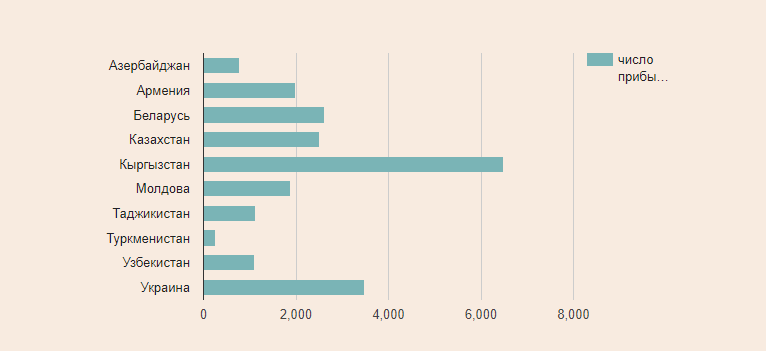
 “The arena in St. Petersburg is meant for 67,000 spectators. Here, the Russian team will play one match in the group stage and will get through the semifinals.” Photo courtesy of Yevgeny Yegorov/Vedomosti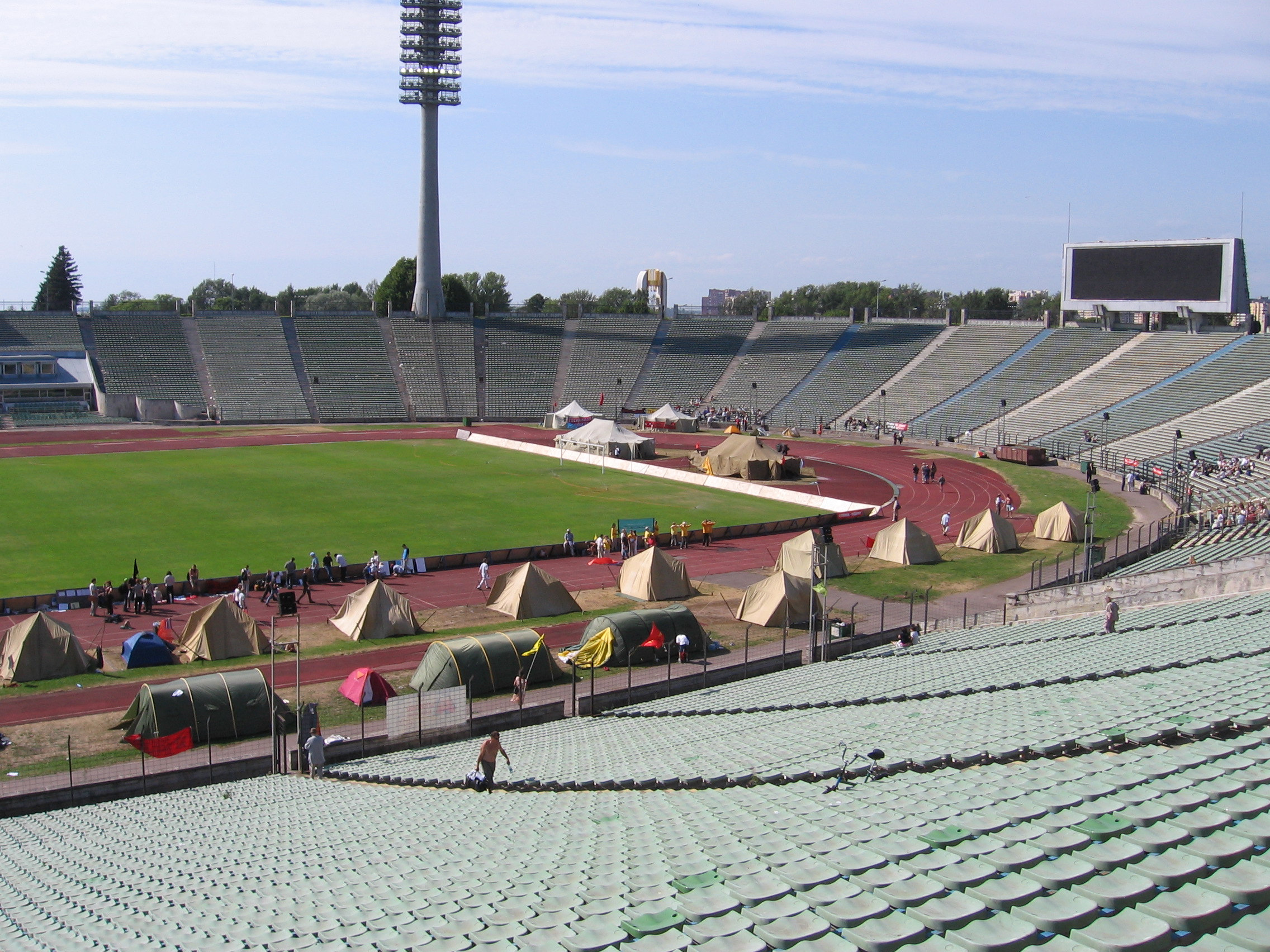
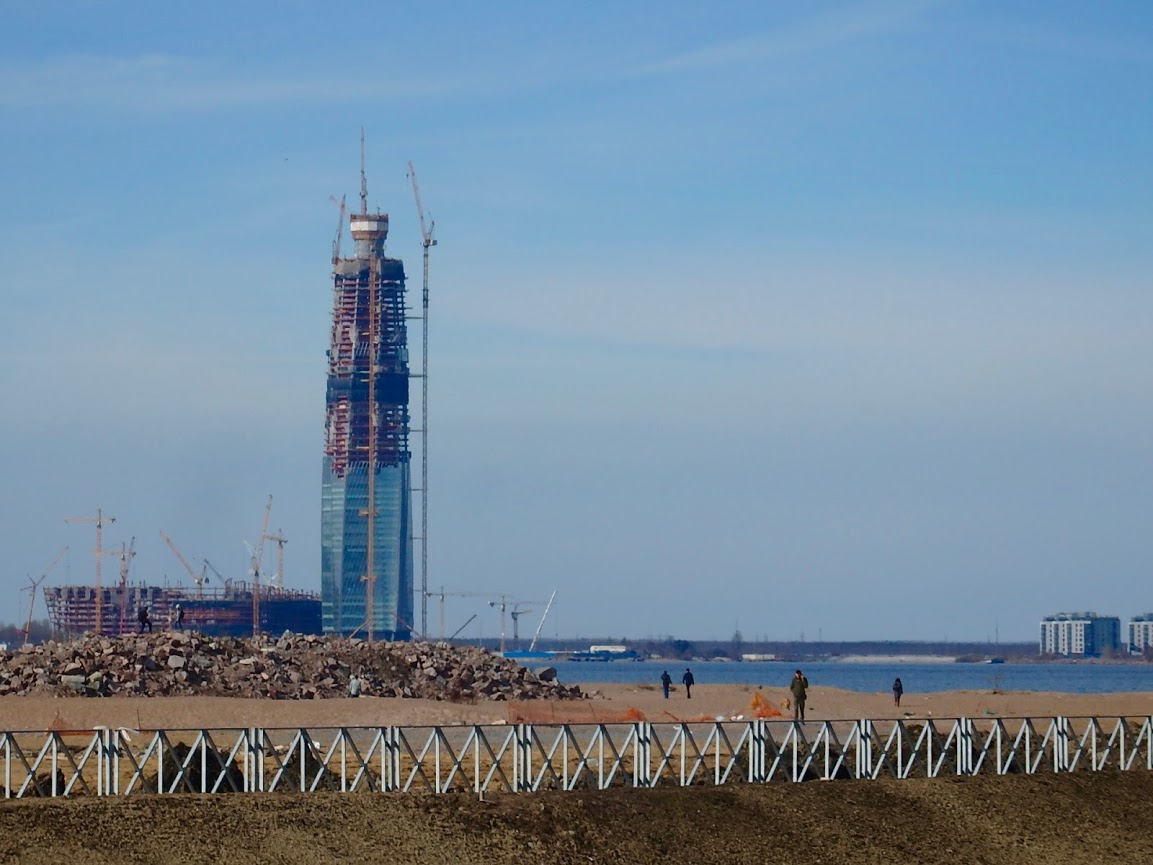 Gazprom’s Lakhta Centre skyscraper, under construction, as seen in April 2017 from another site of urban planning greed and madness, a nearly 500-hectare “reclaimed” island plopped in the Neva Bay immediately west of Vasilyevsky Island. The new island, which remains nameless, will eventually be built up with high-rise apartment blocks. Local residents vigorously protested the land reclamation project in the planning stages, but the authorities roundly ignored them. Photo by the Russian Reader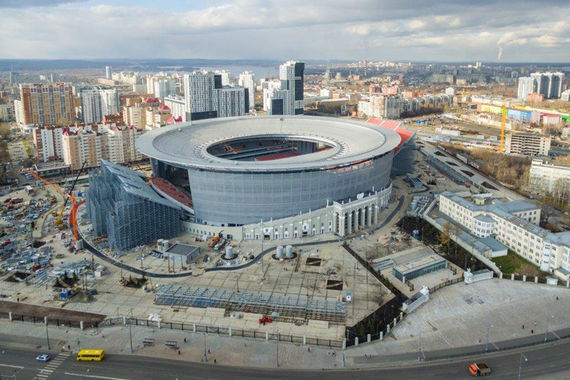
 “No sodomists allowed,” Tverskaya Street, Moscow, 14 November 2017. Photograph by