Crossing Jordan: Day Three of the Network Trial

Jordan and Maidan: The Network Trial, Day Three
Sergei Kagermazov
OVD Info
April 11, 2019

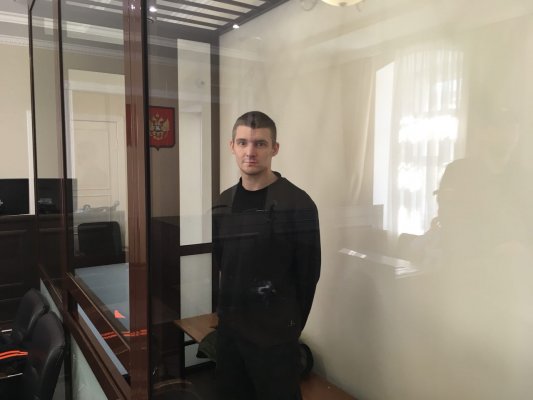
ovd1Yuli Boyarshinov in court. Photo by David Frenkel. Courtesy of OVD Info

The left-wing radical community Network existed, but its young anarchists were training to fend off attacks by ultra-rightists when and if a coup like the one that took place in Ukraine kicked off in Russia. In any case, this was the takeaway message of the testimony given by defendant Yuli Boyarshinov. Echo of Moscow in Petersburg correspondent Sergei Kagermazov describes day three of the Network trial for OVD Info.

The Guerrilla School
The courtroom at the 224th Garrison Military Court in Petersburg is unable to accommodate everyone. Some members of the public are left standing on the far side of the metal detector. The bailiffs claim there is no room and do not let people into the hallway even.

Later, it transpires that several university students who had not heard of the case wormed their way into the courtroom. Someone asked them to attend the hearing, and so reporters from Novaya Gazeta, TASS, and Rosbalt are unable to get into the courtroom. Subsequently, one of the students was identified as a member of the local branch of United Russia’s Young Guard (Molodaya gvardiya). Fontanka.ru would write that the FSB were behind the restricted access to the courtroom.

The highlight of day three of the trial is defendant Yuli Boyarshinov’s testimony. He pleaded guilty and moved to have his case tried separately under a special procedure involving elimination of the evidence phase, but the court denied his motion.

According to Boyarshinov, he knew he was an antifascist approximately since 2009. Six years later, he met another person accused [and convicted] in the case, Igor Shishkin. Shiskin also pleaded guilty, made a deal with case investigators, and was sentenced to three and a half years in prison.

“Around 2015 or 2016, I came to think a violent coup was possible in Russia. On the internet, I learned about radical right-wing groups planing something like what happened in Ukraine in 2014,” says Boyarshinov, who speaks as if he were reading the case file aloud.

People ordinarily do no talk like this.

Boyarshinov insists he was interested only in self-defense in the event radical nationalists emerged in Russia. He learned to handle weapons at the Guerrilla Club, a place in Petersburg affiliated with the DOSAAF [Voluntary Society for Assisting the Army, Air Force and Navy]. Other suspects in the Network case, whom Boyarshinov identified as Yegor and Polina, also took instruction there. Boyarshinov cannot recall their surnames. The young people purchased mock-ups of Kalashnikov rifles and practiced with them. However,  their only goal was self-defense. Boyarshinov emphasizes the young people were not planning any attacks.

It was also then the suspect [sic] met Alexandra Aksyonova, who introduced herself as Olya. Aksyonova is the wife of another defendant in the case, Viktor Filinkov, who is being tried together with Boyarshinov. The young woman is currently in Finland, where her application for political asylum is under review. NTV has reported Aksyonova was one of the leaders of the Network and alleged she had ties with Ukrainian nationalists.

As for the Guerrilla Club, it was also a place where future Donetsk People’s Republic and Lugansk People’s Republic volunteer fighters trained, as well as the Swedes responsible for the bomb attacks in Gothenburg in 2016 and 2017. But none of these people had yet piqued the FSB’s curiosity. When Filinkov asks whether Boyarshinov knew numerous nationalists trained at the Guerrilla Club, Judge Roman Muranov disallows the question as having no bearing on the case.

Jordan 1
Boyarshinov also testifies that, in the early summer of 2016, he was invited to a meeting in the Priozersk District of Leningrad Region. The meeting was attended by Yegor, Polina, and Shishkin, as well as Anton and Pasha, Network members from Penza (the men’s real names were Maxim Ivankin and Dmitry Pchelintsev, who are two more defendants in the case), and two other people. Since the Petersburgers did not know the people from Penza, they also used pseudonyms. Boyarshinov introduced himself as Yura, Yegor as Matvei, and Shishkin as Maxim.

At the meeting, the young men from Penza showed the others a document they called “The Code.” It was a draft project for a community called the Network. Boyarshinov says “The Code”{ ran to around fifteen pages, but only a couple of pages were read aloud to him. The case file contains a document resembling “The Code,” but that is the problem: it only resembles it. Boyarshinov was able to read the entire text of “The Code” only during the pretrial investigation. The young men from Penza said [at the meeting in the Priozersk District] they wanted to encourage the cooperation of different groups involved in self-defense.

ovd2Yuli Boyarshinov in court. Photo by David Frenkel. Courtesy of OVD Info

“So, formally, I joined the Network community,” Boyarshinov admits.

Due to security considerations, it was decided to identify the Petersburg group as “Jordan 1.”

Subsequently, members of the Network would choose different specialties for themselves. Since he had studied demolition and explosives at the Guerrilla Club, Boyarshinov became the group’s sapper.

Another meeting was held in western or northwestern Moscow Region in the woods. Six people attended, including members from Moscow. A third meeting took place in the winter of 2016 at Shishkin’s mother’s dacha. There were also several meetings in the autumn of 2016.

It was at one of these meetings that Boyarshinov met Filinkov. After Boyarshinov has testified, the people in the courtroom learn that, according to the case file, the FSB was already staking out both defendants at the time.

In February 2017, another meeting was held in a rented flat in Petersburg. Shishkin did not come to the meeting, but Filinkov, the Muscovites, and Pchelintsev and Ivankin were present. It was at this meeting that what the FSB identifies as “the minutes” was left behind, finding its way into the case file.

“I cannot corroborate what is described in the minutes of the meeting: I did not take notes. But the description seems more or less accurate,” says Boyarshinov.

When he read the minutes of the meeting, he realized the Network had decided not just to learn self-defense, but to try and destroy the regime.

“I don’t believe in violence, in violence against state authorities. I am sorry I was in such a community,” Boyarshinov repents.

Boyarshinov was detained by police. He claims to have found the smoke powder [with which police apprehended him] on the the roof of a building, since he worked as an industrial climber. He found the powder interesting, since he was studying demolition and explosives. When it was reported Pchelintsev had been detained, Boyarshinov decided to throw the powder away. He left his house and was caught by police.

“Russia’s Falling Apart, We Have to Leave”
The next to testify is Stepan Prokofiev, in whose flat Filinkov lived while he was looking for a place to rent. Prokofiev’s flat was searched by the FSB after they detained Filinkov.

The defendant [Filinkov] immediately points out Prokofiev might commit perjury and slander him.

“The FSB coerced the witness,” argues Filinkov.

[On the day of the search at his flat], Prokofiev was awoken, forced to lie face down on the floor, and handcuffed. He would spend the night at a police station. When Filinkov’s defense attorney, Vitaly Cherkasov, asks whether police explained to him why spent the night at a police station, Judge Muranov disallows the question as having no bearing on the case.
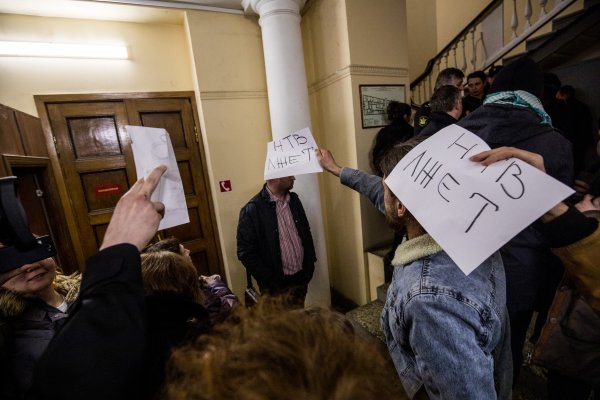
ovd3At the courthouse: members of the public holding pieces of paper inscribed with the message “NTV lies.” Photo by David Frenkel. Courtesy of OVD Info

“Filinkov went to Ukraine to see his wife. When he got back, he told me he had met someone who had fought in Donbas while he was in Kyiv. Filinkov told me a couple of times that Russia was falling apart and we had to leave. He said it would happen after the [March 2018 Russian] presidential election. He would talk about leaving for Georgia or Ukraine after this happened, because it was cheaper to live there,” Prokofiev recounts.

Filinkov counters that he never mentioned talking with anyone who fought in Donbas.

Prosecutor Yekaterina Kachurina is more interested in two guns that were legally registered in Filinkov’s wife’s name. However, it follows from the testimonies of Filinkov and the witness that, for the time being, there is nothing for the prosecution to get its hooks into.  The papers for the guns were in order, and the guns were kept in a safe.

The day ends with an attack by an NTV crew on the attorneys and parents of the defendants. However, members of the pubic cover the lens of NTV’s camera with pieces of paer inscribed with the message “NTV lies” and rattle the young woman holding the microphone by peppering her with absurd questions. Meanwhile, the defense attorneys are able to escape, while the parents get into taxis and quickly quite the scene.

_____________________________________________________________________

Vitaly Cherkasov
Facebook
April 10, 2019

Today, defendant Yuli Boyarshinov, while generally admitting his guilt, did not corroborate the prosecution’s position.

The prosecution has insisted that the members of the Network terrorist community, via “direct involvement in training sessions” that took place in St. Petersburg, Leningrad Region, and Penza Region, mastered “tactical methods of seizing buildings, facilities, and individuals” in order to “forcibly capture and eliminate” state authorities and “change the constitutional order.”

When examined in court, Boyarshinov corroborated the testimony he had given during the pretrial investigation: the goal of the training sessions was to master the skills of self-defense against ultra-nationalists. Defense, not offense!

[…]

_____________________________________________________________________

He Admitted His Guilt But Did Nothing Wrong: Yuli Boyarshinov’s Testimony at Network Trial Gives Prosecution’s Case No Trump Cards
Тatyana Likhanova
Novaya Gazeta in Petersburg
April 11, 2019

The authorities decided to restrict access to the trial of the so-called terrorist community Network, which is an organization now officially banned in Russia.

The high-profile case is being heard by a circuit panel of judges from the Moscow District Military Court at the Garrison Military Court in Petersburg. The hearings have been held in a cramped courtroom with two rows of benches accommodating ten people each. It is thus out of wildly out proportion with the heightened attention paid to the case by the public and the media.

On Tuesday, journalists from several periodicals appealed to the Moscow District Military Court to provide them with normal working conditions. On Wednesday morning, the approaches to the courtroom were occupied by groups of students from the Chemical and Pharmaceutical University and Herzen University’s law school.

The former said they had been sent there by a university official responsible for military training and patriotic education, while the latter claimed they had come to witness a high-profile case they had long been following, although they could not answer a single question about what was at stake in the case.

Among those crowded around the door to the courtroom was a young man bearing a resemblance to Vlad Girmanov, secretary of the military and patriotic club at the Pharmaceutical University, as well as people who had picketed the Petersburg office of [Russian opposition politician and anti-corruption crusader] Alexei Navalny.

nip1Yuli Boyarshinov arriving at the courthouse. Photo by Elena Lukyanova. Courtesy of Novaya in Petersburg

The influx of “extras” was an excuse to limit the access of the press and the public to the trial. The bailiffs refused to let correspondents from Deutsche Welle, TASS, Fontanka.ru. Bumaga, Rosbalt, and other media outlets into the courthouse to cover the trial, as well as Petersburg Public Monitoring Commission member Yekaterina Kosarevskaya. Complaints were filed with the head of the St. Petersburg bailiff service and the chairs of the Petersburg Garrison Military Court and the Moscow District Military Court. They were asked to verify the legality of the actions taken by the bailiffs and secure a courtroom large enough to accommodate everyone interested in witnessing this high-profile case. According to Fontanka.ru, the order to restrict access to the courtroom was made by FSB officers, who thus bypassed the top officials in the Petersburg judicial system.

The hearing opened with testimony by Yuli Boyarshinov, who has pleaded guilty. He said he had been an antifascist since 2009. In the winter of 2015–2016, he concluded that riots involving violence by nationalist groups (“along the lines of the events in Ukraine in 2014”) were possible in Russia. In order to acquire self-defense skills, Boyarshinov attended a month-long course at the Guerrilla Tactical and Firearms Training Center. (Its website says it is affiliated with the DOSAAF [Voluntary Society for Assisting the Army, Air Force and Navy] and “teaches civilians survival skills in local armed conflicts, social unrest, and martial law.”) The course included instruction in handling firearms, surviving in the woods, first aid, radio communication, and mines and explosives.

Boyarshinov attended the classes with his friend Yegor and a young woman identified as Polina. In addition to lectures, training sessions were held at a shooting range near the village of Olgino, during which Boyarshinov used a mock-up of a Kalashnikov assault rifle he acquired. Alexandra Askyonova, co-defendant Viktor Filinkov’s future wife, also went to the shooting range.

In the summer of 2016, Boyarshinov was invited to a meeting with “guys from Penza who were also interested in self-defense.” The meeting took place in the woods of Leningrad Region.

“We made bonfires, discussed different social problems and issues of self-defense, and trained with dummy weapons,” he said.

The attendees used fictitious names because they did not yet trust each other. One of the four attendees would later be identified as Dmitry Pchelintsev, another as Maxim Ivankin.

According to Boyarshinov, the Penza attendees talked about a project provisionally entitled the Network, designed to unite different groups for self-defense classes.

They presented their vision of the organization in a manifest of sorts, entitled “The Network Code,” one or two pages of which were read aloud.

Boyarshinov claimed he did not take what he heard seriously, and when someone later sent him the entire text of “The Code,” he did not bother to read it from cover to cover. He read the full text, nearly twenty pages, only when he was recently reviewing the criminal investigation case file. He was unable to corroborate whether what he read was identical to what had been sent to him earlier, but he said it seemed similar.

The document also outlines possible areas for studying self-defense skills: tactician, medic, signalman, and other roles, with no reference to specific people.

“These areas correspond to the disciplines I studied during the course at the Guerrilla Center,” Boyarshinov noted.

nip2Yuli Boyarshinov’s father Nikolai in the courtroom. Photo by Elena Lukyanova. Courtesy of Novaya Gazeta in Petersburg

The second meeting that summer took place in the Moscow Region. Several young people from the capital joined the attendees of the first meeting. Boyarshinov remembered only that one of them was named Lev. There were more conversations around campfires and training sessions with dummy weapons.

In the winter of 2016–2017, the group traveled to Igor Shishkin’s mother’s dacha, spending their time in much the same way.

Boyarshinov stressed they worked only on fending off attacks during all the meetings and training sessions: they never practiced raids and assaults. Political issues were not discussed, and there was no talk of drilling for terrorist-like crimes.

Shishkin, who made a deal with case investigators, also noted the absence of violent actions during the training when he described the trip to his mother’s dacha in his testimony.

Boyarshinov corroborated that Filinkov did not attend the first two meetings. Aksyonova introduced Boyarshinov to Filinkov in the autumn of 2016. Filinkov took part in a couple of training sessions at the firing range near Olgino. One dealt with first aid and evacuating the wounded, while the second focused on fending off attacks of VIPs [sic] by employing the methods of private security companies. No knives or firearms were used during the training sessions, only dummy machine guns.

As for the group’s allegedly strict conspiratorial methods, among which case investigators identified the use of messengers and encrypted correspondence, Boyarshinov explained they had been his usual means of communication in the years prior to his involvement with the group.

The third meeting with the young men from Penza and several Muscovites took place in a rented flat in Petersburg in February and March 2017. In the case file, this meeting has been identified as a “national congress of the Network terrorist community.”

Boyarshinov, on the contrary, described a two- or three-day meeting, involving approximately a dozen people. They discussed a little of everything, from music to social, environmental and antifascist events. Filinkov was in attendance, but Boyarshinov could not remember him giving a report, showing any initiative or shouldering any responsibilities for further action.

Boyarshinov could not say who organized the meeting and who kept the minutes of the meeting. (A printed file entitled “Minutes of the Congress” was entered into physical evidence.) He could not corroborate whether Filinkov was present the entire time or whether he came and went, since he had himself had come to and gone from the meeting. As far as he could remember, “The Network Code” was also discussed.

However, some of those present said the group should prepare vigorously to fend off potential violent actions when circumstances in Russia deteriorated, while others had advocated “provoking actions themselves,” Boyarshinov recalled uncertainly.

Only after carefully reading the redaction of “The Network Code” provided to him by case investigators did Boyarshinov discover “it had been proposed to establish combat cells and target the authorities.”

“I have never espoused terrorism and I am sorry I wound up in this community,” he added.

However, Boyarshinov was unable to clarify who he believed had authored the document, how its contents were regarded by any of his current co-defendants, and whether it had been backed by someone specifically.

UPDATE
The next day, April 11, the hearing started nearly two hours late. (Allegedly, the armed escort bringing the defendants to court had got stuck in traffic, although it takes fifteen minutes to drive from the remand prison to the courthouse.)

The hearing was brief. The court heard the testimony of the two janitors who had served as official witnesses during the search of Filinkov’s place of residence. The presiding judge then announced the trial was adjourned until May 14.

One explanation for such a long adjournment is the reluctance of Petersburg investigators to wind the case up before the scandal surrounding the lead investigator in the main part of the Network case, Valery Tokarev, a senior investigator in the FSB’s Penza Region office, has been cleared up.

The previous day’s evening news broadcast on state TV channel Russia 24 featured a segment on fugitive businessman Alexei Shmatko.

Shmatko, who complained he was tortured by Tokarev, has been granted political asylum in Great Britain. (The segment starts at the fifty-minute mark.)

This was not the first time the All-Russia State Television and Radio Broadcasting Company had discussed the vicissitudes of this Penza businessman’s career. Shmatko had been on federal business ombudsman Boris Titov’s list of fugitive Russian businessmen who had voiced a desire to return home. But Tokarev’s name had never been mentioned on the air before. (Although Shmatko claims he had mentioned it during previous TV interviews.)

This time round, the presenter on state television was insistent, encouraging the businessman to dot his i’s and cross his t’s. Who had bribed him? What was the reason?

“He subjected me to torture,” Shmatko said, specifying his charges against Tokarev, “and accepted a bribe from me to release me from remand prison.”

Shmatko complained he had informed the Russian Investigative Committee about this incident in a written statement, but they “had not batted an eye.” He also assured the news presenter he was willing to return to Russia if his case were transferred to the feds, investigated thoroughly, and Senior Investigator Tokarev were arrested.

If this happened, Shmatko would return to Russia for Tokarev’s trial and testify against him.

The interview with Shmatko was chockablock with quotations from the President’s Address to the Federal Assembly on the need to criminalize illegal investigations and punish those responsible for launching them.

On April 10, Prosecutor General Yuri Chaika, speaking in the Federation Council, reported the number of corrupt FSB officers who had been outed had more than doubled. He also drew attention to “egregious cases of cruelty toward inmates.”

Three defendants in the Network case in Penza—Dmitry Pchelintsev, Ilya Shakursky, and Arman Sagynbayev—complained they had been tortured with electric shocks in an attempt to force them to incriminate themselves and others, including the Petersburg defendants.

Translated by the Russian Reader. You can find links to my previous coverage of the Network case here.
Network Trial Begins in Petersburg

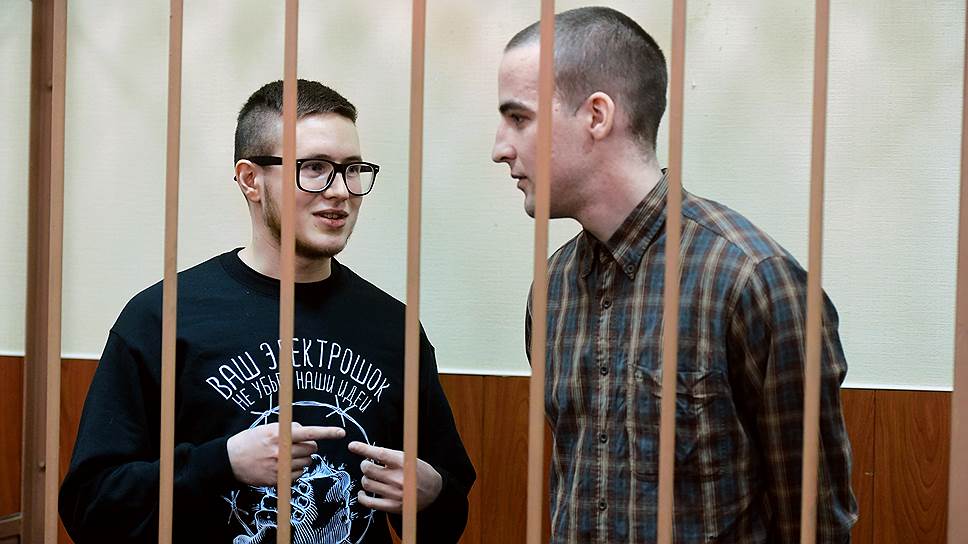
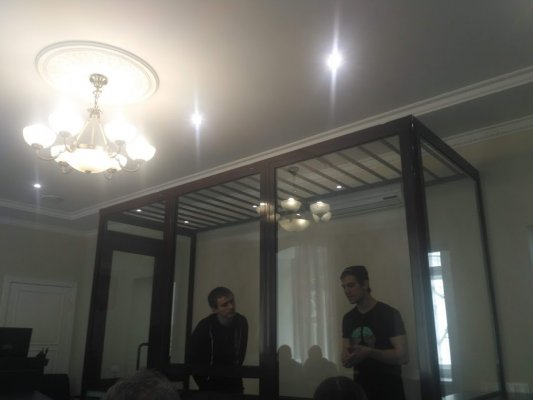
filinkov and boyarshinov-komm.jpgNetwork case defendants Viktor Filinkov and Yuli Boyarshinov in the cage at court yesterday. Filinkov (left) wears a sweatshirt emblazoned with the slogan, “Your taser can’t kill our ideas.” Photo by Alexander Koryakov. Courtesy of Kommersant

The Defendants Were Assigned Roles: Network Trial Gets Underway in Petersburg
Anna Pushkarskaya
Kommersant
April 9, 2019

The court trial in the case of the “anarchist terrorist community” Network got underway in St. Petersburg. Viktor Filinkov, a 24-year-old programmer, and Yuli Boyarshinov, a 27-year-old industrial climber, have been charged with involvement in Network. Federation Council member Lyudmila Narusova, who attended the hearing, pointed out the “ability to throw grenades,” which the prosecution included in the evidence against the defendants, was taught officially to members of the patriotic youth movement Yunarmiya.

“This case has nothing to do with the rule of law,” Narusova noted.

Filinkov and Boyarshinov’s case is being tried in St. Petersburg by the Moscow District Military Court. In January, the same court sentenced Igor Shishkin, who made a deal with case investigators, to three and a half years in prison. Subsequently, the FSB placed Network on the Russian federal list of banned organizations.

The courtroom could not accommodate everyone who wanted to attended the trial. Narusova and ex-State Duma member and civil rights activist Yuli Rybakov were in the gallery.

The defendants were applauded by the gallery as armed guards led them into the courtroom.

During the investigation, Filinkov and three young men in Penza also charged in the case publicly stated they had been tortured with electrical shocks. Boyarshinov claimed conditions in the remand prison were tantamount to torture. Both men have filed complaints with the European Court of Human Rights (ECHR) in Strasbourg.

Lawyer Vitaly Cherkasov motioned the court to let his defendant, Filinkov, sit beside him during the hearing, rather than in the cage, since he had no criminal record or history of conflicts with the law.

The presence in the courtroom of riot police, regular police, and court bailiffs, as well as Cherkasov’s mention of international norms, how things were done at the EHCR, and Prime Minister Dmitry Medvedev’s order to his underlings to explore options for banning the use of the cage in Russian courtrooms made no impression on the court. Both defendants were kept in the cage for the entire hearing.

According to the indictment, the so-called anarchist terrorist community was established no later than May 2015 by Dmitry Pchelintsev (who was arrested in Penza) and an unidentified person. They recruited the seven defendants in the case who have been investigated by the FSB’s Penza office. After cementing the group, they are alleged to have “assigned roles among themselves and explored ways of committing crimes” in order to overthrow the regime. According to the prosecution, to accomplish this objective, they planned on “establishing combat groups and recruiting individuals who shared their anarchist ideology.”

The FSB’s Petersburg office has claimed the defendants were among these recruits. Filinkov has been accused of volunteering to be the group’s “radioman,” while Boyarshinov was, allegedly, their “sapper.”

After the indictment had been read, Judge Roman Muranov asked the defendants whether they understood it.

“No,” Filinkov replied.

The prosecution claims Filinkov promised to “familiarize himself with the community’s charter, employ a pseudonym, data encryption software,  and conspiratorial methods, and acquire and improve [his] combat skills.”

In addition, Filinkov was supposed to have “supplied members with communications devices,” taught them encryption, “recruited other individuals, discussed and planned crimes during meetings, attended classes on tactics, reconnaissance, sabotage, and combat, and the use of weapons and explosive devices, and acquired the knowledge necessary in extreme circumstances and combat conditions.”

“When the time came to shift to active operations for accomplishing the objective part of the crimes [sic],” Filinkov, allegedly, agreed to “mobilize and be ready to achieve the terrorist community’s objectives.”

“I don’t understand the source of these letters, nor how the indictment could be a fiction, rather than something emerging from the evidence,” said Filinkov.

After hearing similar charges made against him, Boyarshinkov said he admitted his guilt and was willing to testify before the examination of evidence.

After the hearing, MP Narusova said the incidents of combat training, as described in the indictment, had nothing to do with the law.

“The Yunarmiya officially engages in combat training under the patronage of Defense Minister Sergei Shoigu. Children are taught to throw grenades, and they learn combat tactics. Ask Shoigu why the entire Yunarmiya is busy learning combat skills?” Narusova wondered.

“A fellow Federation Council member recently said children should be able to throw grenades,” Narusova continued.

She referred to a recent statement by Federation Council member Viktor Bondarev, who had proposed reinstating basic combat training in Russian schools. He claimed to be outraged children did not know how to throw grenades and were afraid of machine guns.

Ms. Narusova said she was drafting a law bill that would criminalize torture. She also said planned to get to the bottom of the Network case.

“This case has nothing to do with the rule of law,” Narusova noted.

In their testimony, the defendants insisted they were learning the alleged skills as a matter of self-defense, given the numbers of antifascists murdered in different parts of Russia in recent years.

In particular, Filinkov mentioned the murders of Timur Kacharava, Stanislav Markelov, and Anastasia Baburova. He reported that, during his studies at Omsk University, he and his friends had been attacked by “right-wing radicals, neo-Nazis, and fascists,” including provocateurs who, he alleged, had ties with law enforcement agencies.

According to Filinkov, the assailants in these clashes had been armed with “blades and stun guns.”

After the investigation was completed, the headmaster of the school Filinkov attended submitted a glowing letter of recommendation. The letter claims the defendant had always shown respect for the law, and was friendly, conscientious, and responsible. He had been an excellent student and won a prize at an academic astronomy competition at Baikonur.

Kommersant will be following the trial’s progress.

Translated by the Russian Reader

__________________________________________

What can you do to support the Penza and Petersburg antifascists and anarchists who have been tortured and imprisoned by the Russian Federal Security Service (FSB)?

  • Donate money to the Anarchist Black Cross via PayPal (abc-msk@riseup.net). Make sure to specify your donation is earmarked for “Rupression.”
  • Spread the word about the Network Case aka the Penza-Petersburg “terrorism” case. You can find more information about the case and in-depth articles translated into English on this website (see below), rupression.com, and openDemocracyRussia.
  • Organize solidarity events where you live to raise money and publicize the plight of the tortured Penza and Petersburg antifascists. Go to the website It’s Going Down to find printable posters and flyers you can download. You can also read more about the case there.
  • If you have the time and means to design, produce, and sell solidarity merchandise, please write to rupression@protonmail.com.
  • Write letters and postcards to the prisoners. Letters and postcards must be written in Russian or translated into Russian. You can find the addresses of the prisoners here.
  • Design a solidarity postcard that can be printed and used by others to send messages of support to the prisoners. Send your ideas to rupression@protonmail.com.
  • Write letters of support to the prisoners’ loved ones via rupression@protonmail.com.
  • Translate the articles and information at rupression.com and this website into languages other than Russian and English, and publish your translations on social media and your own websites and blogs.
  • If you know someone famous, ask them to record a solidarity video, write an op-ed piece for a mainstream newspaper or write letters to the prisoners.
  • If you know someone who is a print, internet, TV or radio journalist, encourage them to write an article or broadcast a report about the case. Write to rupression@protonmail.com or the email listed on this website, and we will be happy to arrange interviews and provide additional information.
  • It is extremely important this case break into the mainstream media both in Russia and abroad. Despite their apparent brashness, the FSB and their ilk do not like publicity. The more publicity the case receives, the safer our comrades will be in remand prison from violence at the hands of prison stooges and torture at the hands of the FSB, and the more likely the Russian authorities will be to drop the case altogether or release the defendants for time served if the case ever does go to trial.
  • Why? Because the case is a complete frame-up, based on testimony obtained under torture and mental duress. When the complaints filed by the accused reach the European Court of Human Rights in Strasbourg and are examined by actual judges, the Russian government will again be forced to pay heavy fines for its cruel mockery of justice.

***************

If you have not been following the Penza-Petersburg “terrorism” case and other recent cases involving frame-ups, torture, and violent intimidation by the Russian Federal Security Service (FSB) and other arms of the Russian security state, read and share the articles the Russian Reader has posted on these subjects.

Jenya Kulakova: A New Year of Sorts

jenya-napkin“January 17: Room 33, City Court. Viktor, 12:00 p.m., Yuli, 2:00 p.m. January 19: Open Space. Exhibition, reading, 7:00 p.m.” Image courtesy of Jenya Kulakova

Jenya Kulakova
Facebook
January 15, 2019

Viktor and Yuli, 12:00 p.m. and 2:00 p.m., January 17, Room 33, Petersburg City Court.

I have been getting into the “New Year’s mood” only now. What I mean is that is only now I have realized it will soon be a year since news a friend had been detained by the cops marked the start of a new life that has been going on in my head nonstop since then: care packages, remand prison, torture, parcels, remand prison, transfers, letters, remand prison, court hearings, remand prison.

I have been corresponding with nearly all the suspects in the so-called Network case. I have no idea how they manage to keep fighting, making jokes, and drawing goofy pictures.

The main question I tried out on myself during the past year was how you can endure having to support a loved one who is in jail by yourself or even as a part of a single family.

To put it bluntly, how do you make sure he has food to eat, clothes to wear, books to read, and medical care?

My opinion is that you cannot do it, no way, no how. There are a lot more than one of us trying to take care of the Network suspects, but there are so many things to do, an endless list of daily chores.

I am amazed my job still puts up with it.

The approach of this “new year” makes me really sad.

Actually, this has been my attempt to write a post about the upcoming custody extension hearings of Viktor Filinkov and Yuli Boyarshinov.

Since a “new year” in remand prison is just around the corner for them, the Petersburg City Court will decide whether extend their police custody.

There is a glass-enclosed statue of Themis at the city court. There is also a chance we won’t be herded into the basement, as happened during their last hearing at the Dzerzhinsky District Court. Maybe we will even be permitted to wave at the guys as they are marched past us by the guards and bailiffs.

Anyone who has the time and energy should come to the hearings. It would be great if there were tons of us there, so the guys could see us and have cause to rejoice. It would also be great if we were admitted into the courtroom before the hearing was once again declared closed to the public.

Such are the paltry and huge hopes you foster.

Viktor, Yuli and us, 12:00 p.m. and 2:00 p.m., January 17, Room 33, Petersburg City Court.

January 19 is the tenth anniversary of the murders of Anastasia Baburova and Stanislav Markelov. The authorities in Petersburg have refused to authorize any rallies or marches on the occasion. In the afternoon, people will lay flowers in their memory at Mikhail Shemyakin’s sphinxes, the monument to victims of political terror directly across the Neva River from the old Crosses prison.  (Why go there all of sudden? I have no could.)

In the evening, an exhibition dealing with both the Network case, and Baburova and Markelov opens at seven o’clock at Open Space. It will feature prison drawings and poems, pieces by artists who are in solidarity with the Network suspects, and a group reading of antifascist texts, as well as of letters sent by the guys from remand prison.

You should come to that, too.

This was how Dmitry Pchelintsev signed his final letter of 2018 to me: “Here’s wishing you a good 2019, the last episode of the season.”

My thanks to Ms. Kulakova for her permission to translate and publish this text here. 

__________________________________


818c25b6ca9ea366405b1f5ce30741c1Viktor Filinkov. Photo by Jenya Kulakova. Courtesy of Mediazona

Court Extends Police Custody of Penza Case Suspects Viktor Filinkov and Yuli Boyarshinov
Mediazona
January 17, 2018

St. Petersburg City Court extended the police custody of Viktor Filinkov, accused of involvement in the so-called terrorist community known as the Network, reports the Petersburg Judicial Press Service.

During the hearing, the case investigator argued Filinkov’s police custody should be extended because he needed to review the final eight volumes of the seventeen-volume case file. Besides, the investigator noted, Filinkov had refused to give testimony in the case and admit his guilt.

Filinkov’s defense attorney asked the judge to put him under house arrest, but, allegedly, had failed to file papers confirming this would be possible. The defense attorney also told the that his client was a law-abiding national of another country [Kazakhstan] who would be willing to give testimony, but not to investigators who had tortured him.

Later the same day, St. Petersburg City Court extended the police custody of another suspect in the Penza Case, Yuli Boyarshinov, for two months.

Earlier in the week, a court in Penza concurred with similar arguments made by the investigator there and extended the police custody of the other suspects in the case until April 18.

Translated by the Russian Reader

______________________________________

What can you do to support the Penza and Petersburg antifascists and anarchists who have been tortured and imprisoned by the Russian Federal Security Service (FSB)?

  • If you are in London or can get to London on January 19, join the solidarity demo at the Cable Street Mural at 2 p.m. The demonstration is supported by Anarchist Communist Group, Anarchist Federation, Brighton Antifascists, Bristol Anti-Fascists, Brazilian Women against Fascism, Feminist Fightback, London Antifascists, London Anarchist Black Cross, North London Anti-Fascists, Plan C LDN, RS21, and Labour Briefing. Please email london19jan(at)riseup.net to add your organization to the list of supporters. More information about the Cable Street Mural and its location can be found on its Facebook page.
  • Donate money to the Anarchist Black Cross via PayPal (abc-msk@riseup.net). Make sure to specify your donation is earmarked for “Rupression.”
  • Spread the word about the Network Case aka the Penza-Petersburg “terrorism” case. You can find more information about the case and in-depth articles translated into English on this website (see below), rupression.com, and openDemocracyRussia.
  • Organize solidarity events where you live to raise money and publicize the plight of the tortured Penza and Petersburg antifascists. Go to the website It’s Going Down to find printable posters and flyers you can download. You can also read more about the case there.
  • If you have the time and means to design, produce, and sell solidarity merchandise, please write to rupression@protonmail.com.
  • Write letters and postcards to the prisoners. Letters and postcards must be written in Russian or translated into Russian. You can find the addresses of the prisoners here.
  • Design a solidarity postcard that can be printed and used by others to send messages of support to the prisoners. Send your ideas to rupression@protonmail.com.
  • Write letters of support to the prisoners’ loved ones via rupression@protonmail.com.
  • Translate the articles and information at rupression.com and this website into languages other than Russian and English, and publish your translations on social media and your own websites and blogs.
  • If you know someone famous, ask them to record a solidarity video, write an op-ed piece for a mainstream newspaper or write letters to the prisoners.
  • If you know someone who is a print, internet, TV or radio journalist, encourage them to write an article or broadcast a report about the case. Write to rupression@protonmail.com or the email listed on this website, and we will be happy to arrange interviews and provide additional information.
  • It is extremely important this case break into the mainstream media both in Russia and abroad. Despite their apparent brashness, the FSB and their ilk do not like publicity. The more publicity the case receives, the safer our comrades will be in remand prison from violence at the hands of prison stooges and torture at the hands of the FSB, and the more likely the Russian authorities will be to drop the case altogether or release the defendants for time served if the case ever does go to trial.
  • Why? Because the case is a complete frame-up, based on testimony obtained under torture and mental duress. When the complaints filed by the accused reach the European Court of Human Rights in Strasbourg and are examined by actual judges, the Russian government will again be forced to pay heavy fines for its cruel mockery of justice.

***************

If you have not been following the Penza-Petersburg “terrorism” case and other recent cases involving frame-ups, torture, and violent intimidation by the Russian Federal Security Service (FSB) and other arms of the Russian security state, read and share the articles the Russian Reader has posted on these subjects.

No Amnesty for “Terrorists”

boyarshinovAmnesty International, the world’s premier human rights organization, thinks there is a chance Network case suspect Yuli Boyarshinov (pictured here) and his ten comrades can get a fair trial in Russia, which has a 99% conviction rate. Photo courtesy of Rupression

Despite what I wrote to a comrade yesterday, it turns out Amnesty International did issue a report on the Network case—just as last year was ending, meaning well over a year since the ugly, insulting mess kicked off in Penza.

But you might wish Amnesty International had not bothered to write anything, especially after you read the report’s conclusion.

Amnesty International is urging the Russian authorities to review the Network case and if the evidence received during such review demonstrates that the case was, indeed, fabricated, all charges against the co-accused individuals must be dropped and they must be immediately released. If there are legitimate grounds to continue their prosecution, the Russian authorities should fully respect the right to a fair trial and, amongst other things, open the trial in the Network case to members of the public.

If the suspects in the sickening torture carnival and flagrant frame-up known as the Network case go to trial, there is a 99% chance that, as in the recent case of two other well-known convicted “terrorists,” Oleg Sentsov and Alexander Kolchenko, the Networkers will be tried in closed chambers by a military tribunal in a city like Rostov-on-Don, which has the added advantage of being quite far from the Networkers’ homes in Penza and Petersburg, making it extraordinarily  difficult for their family and friends to make the trip so they can, at best, stand in the hallway of the courthouse or outside it and, perhaps, every once in a while catch a glimpse of their loved ones as they are shuttled back and forth between hearings by heavily armed bailiffs and guard dogs.

Correspondingly, the Networkers will be found guilty on all charges and sentenced to hefty terms in prison like Kolchenko and Sentsov, who were just as obviously the victims of a blatant frame-up, meant to teach Crimeans and the world a brutal lesson about the new bosses in the Crimean Peninsula.

Given these circumstances, what prevented Amnesty International from declaring the Networkers prisoners of conscience and turning their case into a full-fledged international solidarity campaign is beyond me.

Amnesty International must think there is a chance the Networkers are “real” terrorists, meaning the world’s greatest human rights advocates have become either hopelessly naive in their late middle age or abysmally cynical. {TRR}

Thanks to Comrade Koganzon for finding AI’s dismal report.

______________________________________

What can you do to support the Penza and Petersburg antifascists and anarchists who have been tortured and imprisoned by the Russian Federal Security Service (FSB)?

  • If you are in London or can get to London on January 19, join the solidarity demo at the Cable Street Mural at 2 p.m. The demonstration is supported by Anarchist Communist Group, Anarchist Federation, Brighton Antifascists, Bristol Anti-Fascists, Brazilian Women against Fascism, Feminist Fightback, London Antifascists, London Anarchist Black Cross, North London Anti-Fascists, Plan C LDN, RS21, and Labour Briefing. Please email london19jan(at)riseup.net to add your organization to the list of supporters. More information about the Cable Street Mural and its location can be found on its Facebook page.
  • Donate money to the Anarchist Black Cross via PayPal (abc-msk@riseup.net). Make sure to specify your donation is earmarked for “Rupression.”
  • Spread the word about the Network Case aka the Penza-Petersburg “terrorism” case. You can find more information about the case and in-depth articles translated into English on this website (see below), rupression.com, and openDemocracyRussia.
  • Organize solidarity events where you live to raise money and publicize the plight of the tortured Penza and Petersburg antifascists. Go to the website It’s Going Down to find printable posters and flyers you can download. You can also read more about the case there.
  • If you have the time and means to design, produce, and sell solidarity merchandise, please write to rupression@protonmail.com.
  • Write letters and postcards to the prisoners. Letters and postcards must be written in Russian or translated into Russian. You can find the addresses of the prisoners here.
  • Design a solidarity postcard that can be printed and used by others to send messages of support to the prisoners. Send your ideas to rupression@protonmail.com.
  • Write letters of support to the prisoners’ loved ones via rupression@protonmail.com.
  • Translate the articles and information at rupression.com and this website into languages other than Russian and English, and publish your translations on social media and your own websites and blogs.
  • If you know someone famous, ask them to record a solidarity video, write an op-ed piece for a mainstream newspaper or write letters to the prisoners.
  • If you know someone who is a print, internet, TV or radio journalist, encourage them to write an article or broadcast a report about the case. Write to rupression@protonmail.com or the email listed on this website, and we will be happy to arrange interviews and provide additional information.
  • It is extremely important this case break into the mainstream media both in Russia and abroad. Despite their apparent brashness, the FSB and their ilk do not like publicity. The more publicity the case receives, the safer our comrades will be in remand prison from violence at the hands of prison stooges and torture at the hands of the FSB, and the more likely the Russian authorities will be to drop the case altogether or release the defendants for time served if the case ever does go to trial.
  • Why? Because the case is a complete frame-up, based on testimony obtained under torture and mental duress. When the complaints filed by the accused reach the European Court of Human Rights in Strasbourg and are examined by actual judges, the Russian government will again be forced to pay heavy fines for its cruel mockery of justice.

***************

If you have not been following the Penza-Petersburg “terrorism” case and other recent cases involving frame-ups, torture, and violent intimidation by the Russian Federal Security Service (FSB) and other arms of the Russian security state, read and share recent articles the Russian Reader has posted on these subjects.

Relentless Repression in Russia: Why Londoners Are Demonstrating on January 19

Relentless repression in Russia: why we will demonstrate on Saturday 19 January
People and Nature
14 January 2019

On Saturday, January 19, we will demonstrate in London in solidarity with Russian antifascists. Eleven of them, who have been arrested, tortured, and accused of fabricated “terrorism” charges, are awaiting trial. Many others have faced a relentless campaign of persecution by officers of the Federal Security Service (FSB) and the police, as summarized in the following article.

Please join us on Saturday to support the Russian antifascists and strengthen international solidarity against fascism, xenophobia, and state terror. Please repost and share this article.

Details of our London event here.

2018 summary

By Misha Shubin, 31 December 2018 (Original Russian text here)

I’ve also decided to sum up the year. Not my own year, but rather to remember what happened to anarchists and leftists in Russia in 2018. This post will be long, and many of you know  or heard something about the events I recount here.

But I think it is very important not to forget all this. [Note. Links from the original article to Russian-language sources are included. Links to English translations or relevant articles in English added where available. Translator.]

The Network Case

Eleven anarchists and antifascists have been arrested. They are accused of setting up a terrorist group and planning terrorist attacks. According to the Federal Security Service (FSB), they wanted to organise an armed uprising in Russia.

Almost all the evidence has been gathered on pain of torture. The detainees were beaten up. Some of them were tortured using shocks from a stationary electric dynamo, others with tasers. At least one of the accused, Dmitry Pchelintsev, was hung upside down.

The accused are Yegor Zorin, Ilya Shakursky, Vasily Kuksov, Dmitry Pchelintsev, Arman Sagynbayev, Andrei Chernov, Viktor Filinkov, Igor Shishkin, Yuli Boyarshinov, Mikhail Kulkov, and Maksim Ivankin.

What to read:

“How the FSB is manufacturing a terrorist case against antifascists in Russia”

What else you need to know about this case:

“A witness in the ‘network’ case, Ilya Kapustin, was tortured with a hand-held electric shocker.” Subsequently, he left for Finland, where he has applied for political asylum.

Viktoria Frolova, Ilya Shakursky’s girlfriend, was detained on Russia’s border with Ukraine. (Link in Russian.) Shakursky was threatened that “it would be bad” for his girlfriend if he did not make a confession.

The case of anarchist Yevgeny Karakashev

In early February 2018, anarchist Yevgeny Karakashev was arrested in Crimea [the peninsula annexed by Russia from Ukraine in 2014]. They brought him to the police station with a bag over his head. There were fresh bruises on his temples and his knees. On the basis of

two videos that he had uploaded to various chat forums, he was accused of making public calls for terrorist activity.

What to read:

“A rifle stock to the heart, a fist to the gut: how left-wing activists are persecuted in Crimea”

(And more in Russian.) [And a report of Karakashev’s subsequent court appearance is here.]

What else you need to know about this case:

The main prosecution witness is a former comrade of Karakashev’s.

In the autumn, 16 people from various Russian regions were summoned to the Russian Investigative Committee for interrogations. Many of them have expressed left-wing views. Some of them did not even know Karakashev.

Torture of anarchists in Chelyabinsk

Anarchists in Chelyabinsk staged an event on the night of 14–15 February in solidarity with the Network Case defendants. They displayed a banner outside the FSB headquarters and threw a flare over a fence. The banner read, “The FSB is the chief terrorist.”

Three days later, five people were arrested: Dmitry Semenov, Dmitry Tsibukovsky, Anastasia Safonova, Maksim Anfalov, and their friend Maksim. Tsibukovsky and Anfalov were beaten up and tortured with electric shockers.

Over the summer, the criminal case against theChelyabinsk anarchists was dropped.

What to read:

“The main thing at that moment, in that situation, was to come out alive”

What else you need to know about this case:

In November, a new criminal case was opened against anarchists Tsibukovsky, Safonova, Grigory Potanin, Mikhail Perkov, and Dmitry Dubovoi. This time, they were charged with vandalism during their protest of the government’s pension reform.

The broken window in United Russia’s office and torture of Svyatoslav Rechkalov

On 31 January, persons unknown broke a window at the office of United Russia [the largest party in the Russian parliament, which supports President Putin] and threw a smoke bomb. A criminal investigation into vandalism was launched. Sixteen days later, Yelena Gorban and Aleksei Kobaidze were arrested. After questioning, they were released on their own recognizance.

On 14 March, searches were conducted of the homes of anarchists from the People’s Self-

Defence organisation in connection with the case. Subsequently, Svyatoslav Rechkalov and Andrei were detained; the latter, most likely, was released.

Rechkalov was driven around the city for several hours, blindfolded. Then security services officers beat him and tortured him with electric shocks. They warned that, if he did not make the necessary confession, he would end up a defendant in the Network Case. After being tortured, Rechkalov was released. He emigrated to France.

What to read:

“The horror continues”, and “They put a bag on my head, cuffed my hands behind my back and tortured me with a taser”.

What else you need to know about this case:

In November, Rechkalov started getting threats from the FSB. (Link in Russian.)

Torture of Left Bloc activist Maksim Shulgin

In late April, Left Bloc activist Maksim Shulgin was detained in Tomsk. On the way to his interrogation, security service officers beat him up in their vehicle and held his face against a heater. To protect his face from burns, Shulgin put his arms against the heater

and received first- and second-degree burns. Shulgin was accused of inciting hatred towards the police after posting songs on VK [a Russian social network similar to Facebook].

Shulgin filed a complaint about his having been tortured. In late December, he was again detained. This time, law enforcers tried to choke him to force him to withdraw the accusations he had made against FSB officers.

What to read:

Arrest in April. “Is Maxim Shulgin An Extremist?” and “Tomsk resident tortured for posting songs about police on VK.”

Torture in December. (Link in Russian.)

What else you need to know about this case:

Another nine Left Bloc activists were detained with Shulgin. They were forced to make confessions under threat of torture. (Link in Russian.)

Explosion in Arkhangelsk, interrogation of anarchists and leftist activists, and torture of Vyacheslav Lukichev

On 31 October there was an explosion at the FSB headquarters in Arkhangelsk, set off by Mikhail Zhlobitsky [who died at the scene]. As a result, all over Russia the police detained and brought anarchists, left-wingers, and those who hold alternative political views in for so-called discussions. (Link in Russian.)

In early November, anarchist Vyacheslav Lukichev was arrested in Kaliningrad. He was accused of vindicating the explosion set off by Zhlobitsky. It was later established that after Lukichev’s arrest he was beaten by six people. He was questioned for 36 hours.

What to read:

“Vyacheslav Lukichev: interrogated for 36 hours and beaten”

What else you need to know about this case:

After the explosion, a 14-year old who, allegedly, had contact with Zhlobitsky was detained in Moscow on suspicion of planning bombings. (Link in Russian.)

What else happened this year?

■ In March, the police checked the documents of participants in a football tournament organised by antifascists. (Link in Russian.)

■ In July, police and FSB officers went to the Pryamukhino Readings [an event held annually to discuss the ideas and legacy of Mikhail Bakunin, at his birthplace in Tver Region]. The conference theme was “Revolution and Culture”. The security service officers checked participants’ passports, and then detained Artem Markin, an anarchist from Belarus. He was detained for three days for allegedly using psychotropic substances. See: “A Funny Thing Happened in Pryamukhino”.

■ In August, officers from Centre “E” [Center for Combating Extremism] turned up at the Icebreaker [Ledokol] punk festival. They arrested two people, tried to persuade them to turn informer, and asked about the People’s Self-Defence group. (Link in Russian.)

■ In October, anarchist Ilya Romanov was sentenced to five-and-a-half years on charges of incitement to terrorism. He allegedly published on Facebook a video recording of jihadists and an occult ritual featuring a puppet named Vladimir. All the indications are that the criminal case was a frame-up. See: “Meet Russian anarchist Ilya Romanov. He’s spent nearly twenty years in prison”.

■ In late December, the anarchist Aleksandr Kolchenko [from Crimea, who since 2015 has been serving a ten-year sentence in Russia on trumped-up charges] was transferred, on a formal pretext, to a punitive isolation cell, where he saw in the new year. (Link in Russian.)

Moloko plus siloviki

[Moloko is Russian for “milk”. Siloviki is a widely used term for the heads and officers of Russia’s numerous, overlapping security services, including the FSB, Centre “E”, the Russian National Guard, and the Russian Investigative Committee.]

In mid June, there was a gathering in Krasnodar of members of the collective that publishes the countercultural almanac moloko plus. Sofiko Arifdzhanova and Pavel Nikulin had planned to present the latest issue of the almanac, on the topic of revolution. On the day before the event, the police arrested Sofiko and a volunteer [who helped with printing], Anastasia Kkhukhurenko. The police would not release them and demanded a meeting with Pavel. They then forced Sofiko and Anastasia to sign an undertaking not to organise unauthorised mass gatherings and warned them about the punishments for extremist activity before releasing them

The next day, persons unknown attacked Sofiko and Pavel with pepper spray. A few hours later, at the presentation, the police arrived and confiscated almanac’s print run.

In September, there was another presentation, in Petersburg, and FSB officers turned up. In this case, everything turned out relatively peacefully. They just got up and left.

After another two weeks, there was a presentation here in Nizhny Novgorod. A few minutes after it began, officers from Centre “E” burst in, with armed back-up. Sofiko, Pavel, and I were arrested and taken to the police station. Ninety copies of the almanac were confiscated, along with some gas cylinders [sic]. Pavel was detained for two days on charges of insubordination to a police officer. The issue of moloko plus is now being checked for any indications of extremism. There is a big text about our adventures in Russian here.

I am sure I have forgotten something and so not included it. Generally speaking, that was the sort of year we had.

More on defending Russian political prisoners:

 The Rupression site

 “Convoyed”, on The Russian Reader

Thanks to People and Nature for their generous permission to republish this important article and solidarity appeal here. I have lightly edited the original text to make it hew more closely to this website’s imaginary style guide. {TRR}

Solo

nikolai boyarshinov

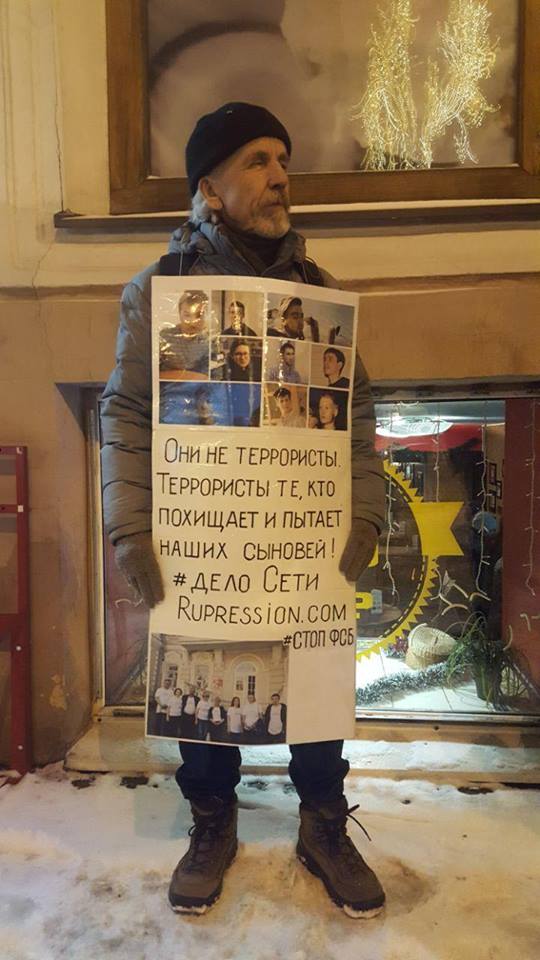
“They are not terrorists. The terrorists are the ones who kidnap and torture our sons! #NetworkCase, rupression.com, #StopFSB,” reads the placard held in this photo by Nikolai Boyarshinov, father of Network frame-up “suspect” Yuli Boyarshinov.

Mr. Boyarshinov has been going to Petersburg’s main street, Nevsky Prospect, and getting out his message by picketing alone every Friday for a long while now.

By law, solo pickets are a perfectly legal tool of protest and dissent in Russia. They do not require prior authorization or notification from local authorities, unlike mass protests.

(Mass protests actually don’t require prior authorization, either, only prior notification, but the Putinist authorities forcibly shut down all “unauthorized” mass protests as a matter of practice.)

And yet Mr. Boyarshinov was arrested by police yesterday for no reason whatsoever.

His arrest is the latest in a series of arrests and harassment of solo picketers in Russia’s former capital.

It would seem the Putin regime is not happy ordinary Russians like Mr. Boyarshinov still enjoy the freedom to protest in public at all, so they have decided to try out illegal arrests of perfectly legal solo picketers in Russia’s second largest city by way of further intimidating the country’s grassroots and opposition. {TRR}

Thanks to Natalia Vvedenskaya and Solidarity Saint Petersburg for the heads-up.

***************

What can you do to support the Penza and Petersburg antifascists and anarchists tortured and imprisoned by the FSB?

  • If you are in London or can get to London on January 19, join the solidarity demo at the Cable Street Mural at 2 p.m. The demonstration is supported by Anarchist Communist Group, Anarchist Federation, Brighton Antifascists, Bristol Anti-Fascists, Brazilian Women against Fascism, Feminist Fightback, London Antifascists, London Anarchist Black Cross, North London Anti-Fascists, Plan C LDN, RS21, and Labour Briefing. Please email london19jan(at)riseup.net to add your organization to the list of supporters. More information about the Cable Street Mural and its location can be found on its Facebook page.
  • Donate money to the Anarchist Black Cross via PayPal (abc-msk@riseup.net). Make sure to specify your donation is earmarked for “Rupression.”
  • Spread the word about the Network Case aka the Penza-Petersburg “terrorism” case. You can find more information about the case and in-depth articles translated into English on this website (see below), rupression.com, and openDemocracyRussia.
  • Organize solidarity events where you live to raise money and publicize the plight of the tortured Penza and Petersburg antifascists. Go to the website It’s Going Down to find printable posters and flyers you can download. You can also read more about the case there.
  • If you have the time and means to design, produce, and sell solidarity merchandise, please write to rupression@protonmail.com.
  • Write letters and postcards to the prisoners. Letters and postcards must be written in Russian or translated into Russian. You can find the addresses of the prisoners here.
  • Design a solidarity postcard that can be printed and used by others to send messages of support to the prisoners. Send your ideas to rupression@protonmail.com.
  • Write letters of support to the prisoners’ loved ones via rupression@protonmail.com.
  • Translate the articles and information at rupression.com and this website into languages other than Russian and English, and publish your translations on social media and your own websites and blogs.
  • If you know someone famous, ask them to record a solidarity video, write an op-ed piece for a mainstream newspaper or write letters to the prisoners.
  • If you know someone who is a print, internet, TV or radio journalist, encourage them to write an article or broadcast a report about the case. Write to rupression@protonmail.com or the email listed on this website, and we will be happy to arrange interviews and provide additional information.
  • It is extremely important this case break into the mainstream media both in Russia and abroad. Despite their apparent brashness, the FSB and their ilk do not like publicity. The more publicity the case receives, the safer our comrades will be in remand prison from violence at the hands of prison stooges and torture at the hands of the FSB, and the more likely the Russian authorities will be to drop the case altogether or release the defendants for time served if the case ever does go to trial.
  • Why? Because the case is a complete frame-up, based on testimony obtained under torture and mental duress. When the complaints filed by the accused reach the European Court of Human Rights in Strasbourg and are examined by actual judges, the Russian government will again be forced to pay heavy fines for its cruel mockery of justice.

***************

If you have not been following the Penza-Petersburg “terrorism” case and other recent cases involving frame-ups, torture, and violent intimidation by the Russian Federal Security Service (FSB) and other arms of the Russian police state, read and share recent articles the Russian Reader has posted on these subjects.


The Media’s Russia Obsession?

trumputin

Let’s talk about the media’s so-called Russia obsession for a few minutes.

What is meant by this is that the mainstream press have devoted tons of coverage to the substantial allegations that the Kremlin mounted a massive operation, mostly via social media, to influence the outcome of the 2016 US presidential election and, further, that the campaign of the candidate who won the election actively colluded with the Kremlin, among other things, in order to discredit the candidate’s main opponent in the election. The press has also focused a lot on Robert Mueller’s special investigation of these allegations.

Is all of this press coverage sterling? No. Does the press get the story wrong sometimes? Yes.

But this has always been the case with the nominally free press in nominally democratic societies ever since the free press emerged in the eighteenth century in a few countries groping their way towards democracy. It always been biased, prone to mistakes, and otherwise wildly imperfect. And yet it has always been subject to intense scrutiny, at least in my lifetime—and the really infantile desire on the part of certain social and political forces that it be perfect—that is, perfectly biased and ventriloquizing only their viewpoints—although these same forces are rarely so critical of either themselves or other important social institutions.

In this case, the social and political forces that routinely complain about the media’s so-called Russia obsession seem to mean, in fact, that the mainstream press and the press in general should simply stop covering what is surely the story of the century: allegations that the world’s largest country massively intervened in a presidential election in the world’s most powerful country, and that the man who won the election and members of his campaign and transition team were in close contact with agents of the world’s largest country during the campaign and transition.

What kind of press would we have if they completely ignored this story?

We would have a press much like the press in the world’s largest country, which routinely ignores or severely undercovers really big stories—such as the country’s involvement in putting down a popular revolution in a third country whose people have never down anything bad to the people of the world’s largest country—or which engages in outright Goebbels-like propaganda nearly every day, leaving the really important stories to opposition liberal newspapers and online media outlets that are read and accessed by a tiny fraction of the country’s populace.

Finally, the mainstream media have not been obsessed with Russia itself, but with the alleged actions of the Kremlin, Russian secret services, and Russian internet trolls in connection with the 2016 US presidential election. Period.

There is a another Russia, populated by 143 million people, that had nothing whatsoever to do with the story of the century. They did nothing to skew the outcome of the 2016 US presidential election and, in the main, their lives, aspirations, and actions are roundly ignored by the so-called mainstream media in the west and Russia itself. They are roundly ignored by the so-called alternative media, too, for the simple reason that much of the alternative media in the west operate under the delusion that Putin is an “anti-imperialist.” By definitions, Russians who oppose his sagacious rule must be “puppets of the west.”

If all of this weren’t the case, I would have expected that one or more of these “Russia-obsessed” or “anti-Russian-obsessed” newspapers, magazines, TV channels or websites would have picked up and covered, for example, the shocking story of the Penza-Petersburg “terrorism” case aka the Network case, in which eleven young anarchists and antifascists have been accused of involvement in a “terrorist community” dubbed “the Network.”

Most of the accused men have told the same grisly tale of being abducted by FSB-KGB field agents, who took them to remote areas in minivans or to the basements of their headquarters and tortured them for hours, using tasers and bare electrical wires, and severe beatings, attempting to force them to memorize the “confessions” they would later make (or, in some cases, refuse to make) to FSB investigators, who would then petition the courts to send them to remand prisons, where all of them are still imprisoned to this day.

The allegations of torture have been confirmed by Russian civil rights activists and defense attorneys who spoke with some of the men soon after their arrests and, in a few cases, they were also confirmed by physicians who examined the men when their wounds were still fresh.

In any case, a small but growing group of very determined people, including the men’s parents, friends, reporters, human rights activists, and concerned citizens, have been working as hard as they can over the last year to bring the case to the attention of the wider Russian public, force prosecutors to investigate the allegations of torture by FSB officers, and otherwise prove that, as seems to be the case, the FSB conjured the entire tale of the “terrorist community” from whole cloth and then handpicked a dozen or so completely innocent young men to be the fallguys, trying to torture and pummel them into admitting their “guilt” although they were guilty of no crime at all.

You would think the “Russia-obsessed” corporate media would jump on a story like this, but except for one article in the New Yorker, the western corporate media have utterly ignored the story of the Network “terrorists,” despite the efforts of actual alternative media like openDemocracyRussia (oDR) and my own blog, the Russian Reader, to write about it any chance we can and translate Russian coverage of the case, as published in such as liberal, leftist and civil rights media outlets as Mediazona, OVD Info, and Novaya Gazeta.

The campaign to save the Network boys scored a minor victory the other day during a meeting of the Presidential Council for Civil Society and Human Rights, when several members of the council brought up the case and a similar case no less shocking, the New Greatness case, and forced President Putin to talk about them.

A KGB-FSB officer to the core, Putin pretended not to have heard of the cases, which both pivot on allegations of extreme entrapment, torture, and fabrication by other KGB-FSB officers.

Putin hemmed and hawed, lied and prevaricated, feigned that he couldn’t believe what he was hearing, etc., but he did promise to look into the cases and get to the bottom of them.

It’s entirely possible he won’t do that, but it’s just as possible he will make the cases quietly go away to avoid embarrasment.

Who knows.

What I do know, though, is that western mainstream and alternative media, all of them “obsessed” with Putin (but not Russia) in their own way, have shown no interest in this story and thousands of other similar and dissimilar but no less fascinating stories from the real Russia inhabited by most Russians.

There was a slight uptick in their interest in grassroots Russia during the 2011–2012 fair elections protests, but since that movement was roundly defeated, western press coverage has been firmly refocused on the beloved hated figure of the supreme leader, thus once again denying nearly all the other 143 million Russians of agency, their own opinions, and their own lives.

If you’re interested in the Network case and related stories, please check out the coverage on oDR and the Russian Reader. Outside of Russia, practically speaking, there has been no coverage of the case anywhere else, and most things you read on international anarchist and antifascist websites are reprints of the stories we have translated and published.

So, let’s put this canard about the media’s Russia obsession to rest, okay? It’s deeply offensive to ordinary smart Russians, whose numbers are much greater than you would be led to think by the mostly lazy coverage of the country in the western press, and just as offensive to the handful of non-Russians who care deeply about what goes on here. {TRR}

P.S. You can support the Network suspects and their families concretely by donating to a solidarity campaign organized by comrades in London on their behalf. Your support will help to offset their legal costs, organizing humanitarian support for the arrested and offering support to their relatives. The resources gathered have so far been distributed according to the financial circumstances of the respective families and the needs of the arrested. Further financial support is being distributed according to the choices made by those arrested throughout the investigation.

Cartoon courtesy of JA and Union Thugs 

Network Case Suspects Go on Hunger Strike

Network Case Suspects Go on Hunger Strike
OVD Info
December 2, 2018

andrei chernovAndrei Chernov in court. Photo courtesy of Mediazona and OVD Info
Dmitry Pchelintsev and Andrei Chernov, residents of Penza and suspects in the so-called Network case, have gone on hunger strike, claiming remand prison officials and FSB officers have intimidated them during their review of their criminal case file, something to which they are entitled by Russian law. Several Penza suspects in the case have claimed they have been put in solitary confinement, handcuffed to radiators, and threatened with violance.

Pchelintsev and Chernov went on hunger strike on November 29, as reported by the Parents Network, a support group established by the mothers and fathers of the young men, who have been accused of involvement in a “terrorist community” that, allegedly, was planning an armed uprising during the March 2018 presidential election and 2018 FIFA World Cup, held in Russia this past summer.

It was on November 29 that wardens put Pchelintsev in solitary, demanding he admit to breaking the rules by talking with other inmates during yard time. He responded by going on hunger strike, and Chernov joined him as a token of support and solidarity. On November 30, wardens again tried to bargain with Pchelintsev and threaten him.

The Parents Network notes that the pressure on their sons has increased now that the suspects are officially reviewing the case file.

Lawyer Anatoly Vakhterov told the group that Network case suspect Ilya Shakursky had been been visited by Penza Remand Prison Warden Oleg Iskhanov, who asked him how quickly he was reviewing the file. On November 20, immediately after the incident, Shakursky was reprimanded for greeting other inmates during yard time. The alleged violation was written up, and the same day Shakursky was issued a special uniform for his upcoming stint in solitary confinement. He managed to avoid going there by filing a complaint with Penza Regional Prosecutor Natalya Kantserova.

Earlier, Maxim Ivankin spent five days in solitary. This was proceeded by a visit from Warden Iskhanov, who likewise asked Ivankin how quickly he was reviewing the case file.

As the defense lawyers explained to the Parents Network, the suspects had been reviewing the case file not only at the remand prison but also at the local FSB office. Under Russian law, suspects may review case files for up to eight hours a day. Allegedly, the Network suspects were handcuffed to radiators and stairway railings the entire time. Vasily Kuksov and Arman Sagynbayev were handcuffed to each other. As the Parents Network has noted, the suspects not only experienced physical discomfort but were also unable to examine the case file freely and take notes.

Shakursky and Pchelintsev refused to go through the procedure in such conditions. In turn, they were threatened with violence. According to them, the man who threatened them was a certain A. Pyatachkov, who had been involved in torturing them when they were initially detained in the autumn of 2017.

Mikhail Kulkov said that after handcuffing him to the staircase, FSB officers videotaped him. As they filmed him, they said, “Look at Network terrorists reviewing the case file.”

The suspects requested their lawyers be present during the review. Consequently, the authorities stopped taking them to the FSB office. Currently, all case file materials are brought directly to the remand prison.

kuksov and pchelintsevVasily Kuksov and Dmitry Pchelintsev in court. Photo courtesy of Rupression and OVD Info

“Obviously, all these measures are methods of mental and physical violence,” argues Vakterov. “There are signs that the group of FSB investigators, led by Senior Investigator Valery Tokarev, have been putting pressure on the suspects. Why? To speed up the review process and make it impossible to verify the complaints of torture made by the suspects. They want to intimidate the lads, who are fighting back any way they can under the circumstances.”

These events have spurred the Parents Network to issue a communique, which we publish here in an abridged version.

We, the parents of the suspects in the Penza Case, bear witness to the numerous violations suffered by our children during their review of the case file.

To avoid allowing the time necessary to investigate the claims made by our sons that they were tortured by FSB officers, the group of investigators, led by Valery Tokarev, has done everything possible to speed up the process of reviewing the Network case file. To this end, the investigators have engaged in daily acts of emotional and physical violence against the suspects, to wit:

  1. Our sons have been prevented from reviewing the case file with their lawyers present. When they have attempted to refuse lawfully to review the case file, they have been subjected to physical preventive measures: they have been handcuffed to whatever metal structures came to hand and handcuffed to each other. During the review of the case file, at least one hand of each suspect has been handcuffed. These actions have prevented them from concentrating on reading the file and thoughtfully preparing to defend their rights in court. This testifies to the fact that investigators have doubts about the case, and so they would like to hand it over to the court as quickly as possible. 
  2. FSB field officers who were involved in torturing our sons have been among the people allowed to be present during the investigative case file review. They have been brought to the review to exert pressure on our children. The FSB officers in question have threatened them with physical violence if they refuse to continue with the case file review. The point of their actions is to speed up the review process, intimidate the suspects, and interfere with a potential investigation of the acts of torture they perpetrated. 
  3. Our demands that a lawyer be present during the proceedings and that the act of reviewing the case file not be hindered by handcuffing the hands of the suspects to tables, chairs, radiators, and stairways have led to our children being placed in solitary confinement, where they have once again been visited by FSB officers and investigators, who have tried to speed up the review process by threatening them. 

We speak constantly of incidents of torture. They say there is no smoke without fire. We are unfamiliar with the contents of the criminal investigative case file due to the nondisclosure agreement signed by all the defense lawyers. If our children have violated the law, they will answer to society to the full extent of the law. In the present circumstances, however, they are unable to answer to society. They answer to people who believe that physical violence, beatings, and electric shock torture can be legally used to make other people’s lives conform to the canons and stories that will get them new assignments and promotions.

It is impossible to defend the rights of our sons in the current circumstances. We cannot prove they were tortured. We have exhausted all the legal resources we have in Russia. But we, our sons, the Public Monitoring Commissions, reporters, civil rights activists, and politicians must and will go on fighting for the sake of one big goal: making the Russian legal and justice system more humane.

We call on Russian Federal Human Rights Ombusdman Tatyana Moskalkova, Mikhail Fedotov, chair of the Presidential Council for Civil Society and Human  Rights, and Yevgeny Myslovsky, a member of the council, to visit the Penza Case suspects. You are our last hope for help in combating torture in Russia. This joint task is our primary responsibility to society.

As we face the inevitability of double-digit sentences for our sons, we hope that all of us will have someone whose example will inspire us. It will be not the people who tortured our sons. Then none of this would make any sense at all.

The lawyers of the Penza suspects in the Network case say their clients have reached out to Tatyana Moskalkova and Mikhail Fedotov, asking them to visit and requesting their help in investigating the incidents of torture. Moskalkova and Fedotov have not yet replied to their appeals, although in November a member of the Presidential Council for Civil Society and Human Rights did visit the Petersburg suspects in the Network case.

[…]

Translated by the Russian Reader

***************

What can you do to support the Penza and Petersburg antifascists and anarchists tortured and imprisoned by the FSB?

  • Donate money to the Anarchist Black Cross via PayPal (abc-msk@riseup.net). Make sure to specify your donation is earmarked for “Rupression.”
  • Spread the word about the Network Case aka the Penza-Petersburg “terrorism” case. You can find more information about the case and in-depth articles translated into English on this website (see below), rupression.com, and openDemocracyRussia.
  • Organize solidarity events where you live to raise money and publicize the plight of the tortured Penza and Petersburg antifascists. Go to the website It’s Going Down to find printable posters and flyers you can download. You can also read more about the case there.
  • If you have the time and means to design, produce, and sell solidarity merchandise, please write to rupression@protonmail.com.
  • Write letters and postcards to the prisoners. Letters and postcards must be written in Russian or translated into Russian. You can find the addresses of the prisoners here.
  • Design a solidarity postcard that can be printed and used by others to send messages of support to the prisoners. Send your ideas to rupression@protonmail.com.
  • Write letters of support to the prisoners’ loved ones via rupression@protonmail.com.
  • Translate the articles and information at rupression.com and this website into languages other than Russian and English, and publish your translations on social media and your own websites and blogs.
  • If you know someone famous, ask them to record a solidarity video, write an op-ed piece for a mainstream newspaper or write letters to the prisoners.
  • If you know someone who is a print, internet, TV or radio journalist, encourage them to write an article or broadcast a report about the case. Write to rupression@protonmail.com or the email listed on this website, and we will be happy to arrange interviews and provide additional information.
  • It is extremely important this case break into the mainstream media both in Russia and abroad. Despite their apparent brashness, the FSB and their ilk do not like publicity. The more publicity the case receives, the safer our comrades will be in remand prison from violence at the hands of prison stooges and torture at the hands of the FSB, and the more likely the Russian authorities will be to drop the case altogether or release the defendants for time served if the case ever does go to trial.
  • Why? Because the case is a complete frame-up, based on testimony obtained under torture and mental duress. When the complaints filed by the accused reach the European Court of Human Rights in Strasbourg and are examined by actual judges, the Russian government will again be forced to pay heavy fines for its cruel mockery of justice.

***************

If you have not been following the Penza-Petersburg “terrorism” case and other recent cases involving frame-ups, torture, and violent intimidation by the Russian Federal Security Service (FSB) and other arms of the Russian police state, read and disseminate recent articles the Russian Reader has posted on these subjects.

Convoyed

convoyedHow is the all-too-common Russian verb etapirovat’ translated into English? Screenshot of the relevant page from the website dic.academic.ru
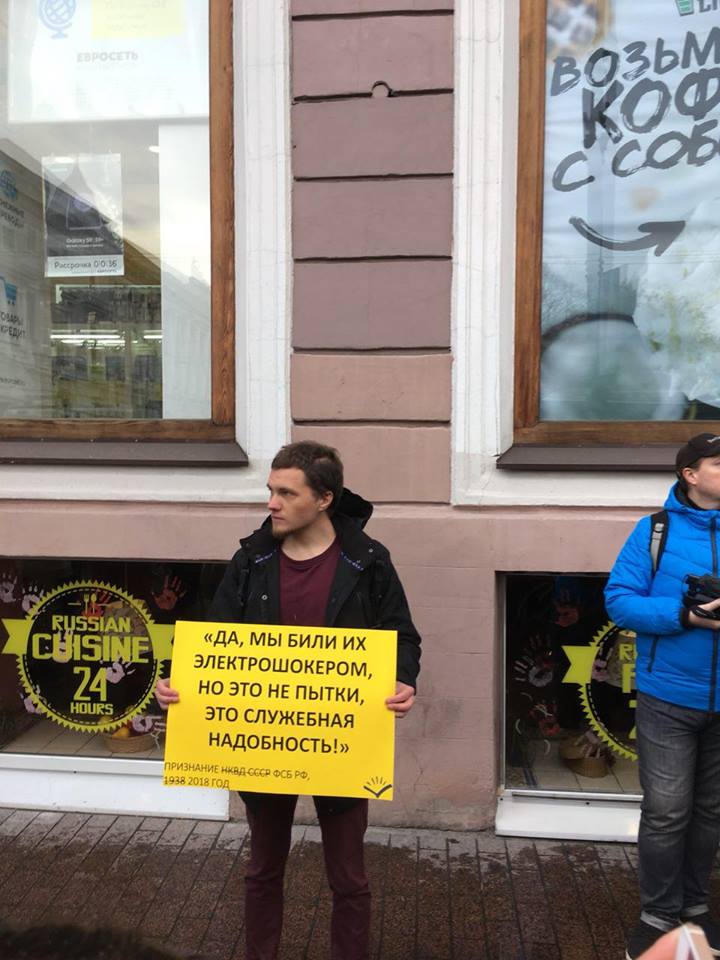
Yekaterina Kosarevskaya
Facebook
October 30, 2018

Viktor Filinkov has arrived in Petersburg. He’s now in Remand Prison No. 4 on Lebedev Street, but apparently he will be transferred from there to Remand Prison No. 3 on Shpalernaya Street. Yana Teplitskaya and I chatted with him for two hours until lights out.

And yesterday Roma and I chatted with Yuli Boyarshinov.

Viktor’s in a very sad state healthwise.

He took ill at every stop along the way during his convoy without having recovered from the previous stop. In Yaroslavl on Friday, before the last leg of his journey, Viktor was suddenly unable to walk. He doesn’t understand what it could have been, and he has never had anything like it before. His cellmates summoned the doctor. Viktor was taken to the dispensary. He was brought to his senses with smelling salts, given a injection of something, and left there until it was time to go.

It took three days for Viktor to get to Petersburg. They were on the road from Saturday to Tuesday, traveling only at night. During the day, the train car in which he was convoyed stood unheated and idle on the tracks.

He says he was really glad to go to Penza and hang out with [all the other prisoners in the Network case], although he did not enjoy the trip itself. The Penza Remand Prison was at such pains to show that none of the suspects in the Network case was being tortured anymore that every evening all ten suspects were inspected. They were forced to strip and undergo a full look-over, after which they were told to sign their names in a notebook. Viktor got tired of signing his name, so he took to drawing smileys, but no one followed his lead.

I wonder what it will mean when the wardens stop keeping this notebook.

Viktor told us about other remand prisons as well. He told us about Larissa the rat. He thought one inmate had made friends with her, but then he woke up and, finding the rat at the foot of his bed, he moved to a top bunk.

It transpired that the censor at the Nizhny Novgorod Remand Prison expunged not only the phrase “Public Monitoring Commission” from Yana’s letters but everything else he found unfamiliar, including “vegan,” “Homo sapiens,” and “transhumanism.”

Viktor also told us Yegor Skovoroda had written to him in a postcard that he was a nudnik. Viktor wrote a three-page letter proving it wasn’t the case, but then he thought better of it and didn’t mail the latter.

Yana and I tried to recall the latest news. We told Viktor about Saturday’s protest rallies, about our latest report, about who had successfully defended their dissertation (it wasn’t me), and who still hadn’t defended their dissertation and could thus invite Viktor to their defense (that would be me).

Yuli is in Remand Prison No. 3 on Shpalernaya Street and is fine. The only thing is that the prison’s censor has again gone on holiday, so Yuli doesn’t get any letters. So far he hasn’t received a single letter on Shpalernaya.

The censor at Remand Prison No. 4 has also gone on holiday.

UPDATE. I forgot to write that when we were traveling to Remand Prison No. 3 yesterday, Yana and I agreed that if I found out Viktor was there, I would exit the prison and telephone her so that she could travel there, too. I was worried I would waste a lot of time getting my telephone out of the box at the entrance to the prison, turning it on, and entering all the passwords. It transpired that Viktor was not there, but someone had made sure I didn’t waste any time. My telephone was turned on, and the password entry window was on the screen.

Translated by the Russian Reader

***************

What can you do to support the Penza and Petersburg antifascists and anarchists tortured and imprisoned by the FSB?

  • Donate money to the Anarchist Black Cross via PayPal (abc-msk@riseup.net). Make sure to specify your donation is earmarked for “Rupression.”
  • Spread the word about the Network Case aka the Penza-Petersburg “terrorism” case. You can find more information about the case and in-depth articles translated into English on this website (see below), rupression.com, and openDemocracyRussia.
  • Organize solidarity events where you live to raise money and publicize the plight of the tortured Penza and Petersburg antifascists. Go to the website It’s Going Down to find printable posters and flyers you can download. You can also read more about the case there.
  • If you have the time and means to design, produce, and sell solidarity merchandise, please write to rupression@protonmail.com.
  • Write letters and postcards to the prisoners. Letters and postcards must be written in Russian or translated into Russian. You can find the addresses of the prisoners here.
  • Design a solidarity postcard that can be printed and used by others to send messages of support to the prisoners. Send your ideas to rupression@protonmail.com.
  • Write letters of support to the prisoners’ loved ones via rupression@protonmail.com.
  • Translate the articles and information at rupression.com and this website into languages other than Russian and English, and publish your translations on social media and your own websites and blogs.
  • If you know someone famous, ask them to record a solidarity video, write an op-ed piece for a mainstream newspaper or write letters to the prisoners.
  • If you know someone who is a print, internet, TV or radio journalist, encourage them to write an article or broadcast a report about the case. Write to rupression@protonmail.com or the email listed on this website, and we will be happy to arrange interviews and provide additional information.
  • It is extremely important this case break into the mainstream media both in Russia and abroad. Despite their apparent brashness, the FSB and their ilk do not like publicity. The more publicity the case receives, the safer our comrades will be in remand prison from violence at the hands of prison stooges and torture at the hands of the FSB, and the more likely the Russian authorities will be to drop the case altogether or release the defendants for time served if the case ever does go to trial.
  • Why? Because the case is a complete frame-up, based on testimony obtained under torture and mental duress. When the complaints filed by the accused reach the European Court of Human Rights in Strasbourg and are examined by actual judges, the Russian government will again be forced to pay heavy fines for its cruel mockery of justice.

***************

If you have not been following the Penza-Petersburg “terrorism” case and other recent cases involving frame-ups, torture, and violent intimidation by the Russian Federal Security Service (FSB) and other arms of the Russian police state, read and disseminate recent articles the Russian Reader has posted on these subjects.

Yevgenia Litvinova: October 28, 2018

october 28Petersburg democracy activist Pavel Chuprunov, holding a placard that reads, “‘Yes, we tasered them, but it wasn’t torture. We were doing our jobs!’ Admission by the Soviet NKVD Russian FSB, 1938 2018.” Nevsky Prospect, Petersburg, 28 October 2018. Photo by Yevgenia Litvinova

Yevgenia Litvinova
Facebook
October 29, 2018

October 28 was the day chosen for publicly supporting people accused of extremism and locked up in jail, i.e., the suspects in the Network and the New Greatness cases. Petersburgers had no choice but to be involved in this international event, since some of the suspects in the Network case are from Petersburg.

The day before, I had listened to Yekaterina Kosarevskaya and Yana Teplitskaya’s brilliant but very heavy report about the use of torture in the FSB’s St. Petersburg and Leningrad Region Directorate. In particular, the report recounts how the young men accused in the Network case were tortured. All we can do is constantly talk about these people publicly, about what happened to them over the last year (they were arrested nearly a year ago), and what is happening to them now.

The rally in support of the young folks locked up in remand prisons on trumped-up charges was not approved by the authorities, although the organizers—Open Russia, Vesna, and Bessrochka (Endless Protest)—suggested a variety of venues in the downtown area. Everywhere was off limits.

You can protest in Udelny Park, in the far north of Petersburg, that is, in the woods. It’s a great place to have a stroll and get some fresh air, but who would be there to see your protest? The squirrels? This proposal is better than the garbage dump in Novosyolki, which the authorities always used to suggest as an alternative venue, but it’s not a suitable place for a political rally.

All that remained was the only form of political protest that doesn’t require prior approval from the authorities: solo pickets.

The protesters had different placards, but all of them were quite persuasive. They got to the heart of these frame-ups, which crush and maim people in order to earn promotions for the policemen and security services officers who dream them up.

Solo pickets had always been safe in Petersburg, unlike in Moscow, Krasnodar, and so on. That was why many people found them monotonous and boring.

“Oh, solo pickets again,” people would complain.

The plan was to take it in turns to stand holding placards on the corner of Nevsky and Malaya Sadovaya. But the folks from NOD (National Liberation Movement) read announcements for the upcoming protests and got there early. We had to move away from Malaya Sadovaya and closer to the pedestrian underpass to the subway. It’s an uncomfortable, narrow spot.

NOD has been a little sluggish lately. What happened to their weekly vigils? When there’s no money, there’s no NOD. But suddenly they had reappeared, which meant they had been asked to take to the streets by people whose offer you can’t refuse.

Recently, solo pickets have ceased to be “boring,” but there’s no reason for rejoicing. Solo pickets started becoming a staple of news reports around a month ago, when Alexander Beglov was appointed Petersburg’s acting governor. Since then, police have made a habit of detaining people at solo pickets. They make up excuses for their actions on the fly.

I knew this, of course, but I naively counted on logic and common sense winning the day. I compiled and printed out a number of laws proving that I and other “favorites” of Lieutenant Ruslan Sentemov, a senior police inspector in the public order enforcement department of Petersburg’s Central District, had to the right to speak out via solo pickets. I was planning to hand these papers to Sentemov on camera. But I didn’t see him at the rally. I thought he hadn’t come at all. Nor did he see me.

I got lucky. Because what logic had I imagined? What common sense? What laws? What right to hold solo pickets?

Sentemov did see another of his “favorites,” Dmitry Gusev. He pointed at him and said, “Detain him.”

Dmitry was not holding anything at all, much less a placard. He had no plans to be involved in the picketing. But that was that, and now he is detained at a police precinct, like dozens of other people. I counted over thirty detainees. But Alexander Shislov, Petersburg’s human rights ombudsman, writes that around fifty people were detained. Around one hundred people were at the protest.

Several detainees were released without charges, while others were charged with violating Article 20.2 Part 5 of the Administrative Offenses Code, but most of the detainees will spend the night in police stations. They have been charged with violating Article 20.2 Part 2, which is punishable by jail time.*

The detainees were dispersed to different police stations, some of them quite far away. They needed food, water, and toiletries. Police stations usually don’t have any of these things, although they are obliged to provide them if they detain someone for more than three hours.

Over ten people who were present with me at the protest traveled the police stations to check on the detainees. The rest came from the Observers HQ at Open Space. We constantly called and wrote each other, makingsure no one had been left without assistance. I hope that was how it worked out. The detainees should have everything they need for this evening, overnight, and tomorrow morning.

Natalia Voznesenskaya and I had planned to go to the 28th Police Precinct, but all the detainees there had been released.

We went instead to the 7th Precinct. The internet told us it was near the Kirovsky Zavod subway station. We wandered for a long time amidst the nice little houses built after the war, supposedly by German POWs. We arrived at the police station only to find that its number had recently changed. It was no longer the 7th Precinct, but the 31st Precinct.

We went to the real 7th Precinct, on Balkanskaya Street. Elena Grigoryeva, Dmitry Dorokhin, and two other men were detained there. (One of the men had been taken away by ambulance.) Unexpectedly, the 7th Precinct was a decent place. It was no comparison with the 76th and 78th Precincts, in the Central District. The police officers on duty there accepted our food packages and spoke politely with us.

We ran into Alexander Khmelyov at the station. Wielding a power of attorney as a social defender, he had come to see what kind of mattresses and linens had been issued to the detainees. There were no bedbugs. What was more, the police officers brought the detainees supper from a nearby cafe. They were obliged to do it, but their colleagues at other precincts never do it, and detainees usually don’t even get breakfast.

So, now the stomachs of the detainees were full, and they could take the food we had brought with them to court. Court hearings can last eight hours or more, although it happens that fifteen minutes is all the time a judge needs. There is usually no difference. The court’s rulings have been written in advance.

Before leaving the house to go the protest in support of the suspects in the New Greatness and Network cases, I listened to a program on Echo of Moscow about the case of Elena Kerenskaya, sister of Alexander Kerensky, chair of the Provisional Government in 1917. Kerenskaya was executed by the NKVD in Orenburg on February 2, 1938.

I don’t want to blow things out of proportion, but it has become easier and easier to under how the trials of the 1930s happened the way they did.

* Article 20.2 of the Russian Federal Administrative Offenses Code covers “violation[s] of the established procedure for organizing and holding meetings, rallies, demonstrations, marches, and pickets.” Part 2 stipulates punishments for people who organize or hold rallies without notifying the authorities in advance. They can be jailed for up to ten days or fined up to 30,000 rubles (400 euros).

Translated by the Russian Reader