Terry Burke: Russiagate, Syria, and the Left

dezaOnce again, years of experience and research have been poured into an article challenging entrenched narratives on the anglophone institutional left, and once again, fear of retaliation from the purveyors of these entrenched narratives has made this challenge unpalatable even to left and liberal publishers with an obvious interest in countering them.

So, once again, the Antidote Writers Collective is pleased to participate in a decentralized effort to bring this challenge out into the open.

The following was initially published on CounterVortex with the understanding that the website’s publisher would be backed up by cross-posts from sympathetic websites in order to reduce the authoritarian left’s ability to target one vulnerable person with their classic arsenal of trolling, threats, abuse, and lawsuits.

Comrade of the zine Terry Burke has been a dedicated peace activist her entire life and has already heard the worst of it even from former comrades who have unthinkingly taken on Putinist narratives and allowed themselves to be played against the emergence of effective opposition to rising fascism in the United States. We salute her years of persistence and are proud to have her back. Enjoy.
Antidote Zine

Russiagate, Syria, and the Left
Terry Burke
CounterVortex
June 27, 2019

The last major national protest in the US was “Families Belong Together” in June 2018. Hundreds of thousands of people across the country demonstrated against the Trump administration’s policy of separating children and families at the border. People who had never protested before brought their families. It’s now a year later and the situation for immigrant families has only gotten worse. Where is the outrage?

Plans for an ICE raid targeting millions of immigrants. Initiating a military strike on Iran and then canceling it. Environmental policies that disregard climate change. Pulling the US out of treaties. Rising alt-right and nationalism around the world. Ignoring congressional subpoenas. Corrupt, incompetent people heading every federal agency. The list of destructive Trump policies seems endless.

Trump’s recent visit to London brought tens of thousands of protesters into the streets. Where are the protests in the US? Where are the coalitions in the US organizing against Trump’s anti-democratic, inhumane policies? Where is the left?

Part of the problem is the enormous amount of disinformation that has been specifically directed at the left, disinformation that most people don’t recognize. The disinfo uses anti-imperialist language and is posted on “left” and “progressive” sites that usually have nominally accurate stories on Palestine, Israel, climate change, corporate corruption, and other progressive issues. In addition to the disinfo media sites, respected left authors have confused their readers by dismissing Russiagate as a hoax, claiming that Russian interference in the US elections has been greatly exaggerated to provide the Democrats an excuse for Clinton’s loss.

Eight years of steady disinformation on Syria have created a split in the peace movement. The enormous amount of time and energy spent debating Syria could have gone to building the peace movement instead of dividing it. The doubts raised repeatedly about Russian interference and Mueller’s investigation have weakened the opposition to Trump. Some people don’t know which news sources they can trust. Others restrict themselves only to sources that support their ideological line.

Steve Bannon famously said, “The Democrats don’t matter. The real opposition is the media. And the way to deal with them is to flood the zone with shit.” That is exactly what has happened. There are thousands of new and unaccountable media organizations on the internet.

As Syria solidarity activists, we have been struggling against extensive, sophisticated disinformation regarding Syria for years—and it’s largely not from the US mainstream media. Syria is not Iraq, where the New York Times helped Bush lead us into war with fake information about WMDs. Syria is not Kuwait, where there were false stories planted about babies in incubators.

The mainstream media articles “demonizing” Assad are fundamentally true: his regime is one of the world’s most repressive, with a police and prison torture system of historic proportions. Unlike Iraq and Iran, and contrary to the propaganda claims, the CIA did not instigate a serious covert regime change operation in Syria. The US efforts in Syria are well documented in Shane Bauer’s recent two-part article for Mother Jones. He writes, “American involvement in Syria has been as fragmented and volatile as the conflict itself.” In this groundbreaking article, he documents how the US has spent billions, initially aiding the Free Syrian Army, but ultimately focused on combating ISIS, forbidding US-backed groups from fighting Assad’s forces.

His article corroborates the stories of anti-Assad Syrians of a genuine uprising against a brutal dictator evolving into a proxy war; of Assad bombing and starving civilians. The Syrian people were caught up in the fervor of the Arab Spring and surprised themselves (and the CIA) by going to the streets in the hundreds of thousands, demonstrating for democracy, overcoming their deep fears of reprisal.

However, most of the peace movement still doesn’t recognize the legitimacy of the Syrian people’s eight-year struggle against the Assad dictatorship. There have been so many articles in “progressive” media promoting Assad’s narrative of another US regime change effort that they have buried the voices of Syrians.

The voices of Syrian communists, anarchists, democracy activists, writers, artists, intellectuals, and nonviolence activists have rarely been represented in “progressive” media. The majority of these media’s articles on Syria have been written by non-Syrians and they usually promote Assad’s line that he is protecting his sovereign country from US-backed terrorists.

Research from the University of Washington has shown how dominant the pro-Assad political messaging is from an “echo system” of sites that follow Russian, Iranian, and Syrian government-funded media. Researchers examined Twitter conversations about the White Helmets (a Syrian volunteer rescue group) in the summer of 2017. There were four times as many tweets from the echo system as there were from other media sources. Articles from the echo system claimed the White Helmets were a “propaganda construct,” “crisis actors” who staged events, and “they worked with or were themselves terrorists.”

The UW study noted that this echo system of sites claiming to be “independent” and “alternative” shared the same stories and writers. A few of these sites are Global ResearchRTMint Press NewsSputnik NewsFree Thought ProjectThe Anti-Media21st Century WireVeterans TodayZero Hedge, and many others.

For Syria activists, the UW research wasn’t a surprise. It confirmed our experiences over the last six years, that our struggle to get the truth out was up against a substantial, coordinated disinformation effort. We were familiar with this “echo-system” well before the UW study. While they claim to be “independent,” their political line was almost always the same on Syria, Crimea, Putin, and Trump. They played a role in electing Trump by bashing Clinton, equating Clinton and Trump, going easy on Trump, and disparaging voting.

While the sites claim to be funded by their readers and ads, they actually have very few ads and do not disclose information on their funding sources. In 2013, a former writer at Mint Press News, Joey LeMay, told BuzzFeed News, “It was incredibly secretive.” The article goes on to say there were “barely any ads on the website, and whenever LeMay asked about where they got their money, ‘it was brushed off as a non-issue. I would go home feeling not squeaky clean,’ he said.”

The sites in this echo system have all also posted numerous Russiagate articles. It’s understandable that progressives would question how extensive and effective Russian propaganda was in the 2016 elections. The mainstream media hasn’t examined Russian propaganda that targets the left. The UW research has not been mentioned in mainstream or progressive media. But it’s not an either/or proposition: we can criticize Clinton’s campaign and still acknowledge that Russian interference helped Trump win in an election where Clinton won the popular vote by a substantial margin.

The claim that a few Facebook ads bought with Russian rubles could have influenced the 2016 election may have seemed preposterous back in 2016. However, since then, there have been numerous exposés of Russia’s sophisticated use of social media and information warfare—something we had thought was mainly the province of our CIA.

While Russian disinformation is a new concern for Americans, not so for Europeans. In June 2017 the Washington Post reported that “across the [European] continent, counterintelligence officials, legislators, researchers, and journalists have devoted years—in some cases, decades—to the development of ways to counter Russian disinformation, hacking and trolling.” There have been numerous articles on how Swedenthe Baltic statesFinlandGermany, France, Italy, and others are dealing with Russian cyber attempts to influence elections and sway popular opinion.

When well-known left writers like Glenn GreenwaldMatt TaibbiKatrina vanden HeuvelNorman Solomon, and Max Blumenthal immediately denounced the evidence of Russian interference back in 2016, it had a silencing effect. After that, few well-known left writers pursued the serious possibility of effective Russian involvement. In the two and a half years since Trump’s election, there have continued to be new articles and research on Russian bots, trolls, Twitter campaigns, fake accounts, and continued Russian interference in the EU, but the Russiagate authors have ignored this information. Dark Money author Jane Mayer has also written on how Russia helped elect Trump.

After the release of the highly biased Barr summary which seemed to vindicate them, Chris HedgesGlenn GreenwaldStephen CohenMatt TaibbiAaron MatePaul Street in Counterpunch, and Katie Halper from FAIR castigated the US press for its extensive coverage of the Russia/Trump allegations.

However, they wrote nothing revising their Russiagate-is-a-hoax position after the subsequent release of the redacted Mueller report in April and Mueller’s public statement in May. The Mueller report explicitly documents extensive Russian interference in the 2016 elections, but they have refused to acknowledge this.

Greenwald wrote on April 18 that “the actions in which Trump engaged were simply not enough for Mueller to conclude that he was guilty of criminal obstruction.” After Mueller clearly stated on May 29 that he would not exonerate the president for obstruction of justice, Greenwald wrote a series of articles on Brazil and wrote nothing to correct his earlier misstatements about obstruction.

It is critical to understand that the Russiagate narrative is Trump’s narrative. By insisting for over two years that Russian interference was overblown, these authors have been defending the worst president in US history.

The UW-identified echo system of “alternative” media sites has also had numerous articles promoting Russiagate skepticism and Barr’s disingenuous summary of the Mueller Report. Global ResearchMint Press NewsFree Thought ProjectThe Anti-MediaZero Hedge21st Century WireActivist Post, and others have also continued to argue for the Russiagate conspiracy thesis, despite Mueller’s statement and all the information on Russian cyberwarfare.

Even Fox News occasionally departs from supporting Trump’s position on Russian interference, as summed up in a May 2019 Newsweek headline: “Fox News Legal Analyst Says Mueller Evidence Against Trump ‘Remarkably Similar’ to Nixon, Clinton Impeachment Charges.” But the left’s Russiagate skeptics have not conceded anything. Stephen Cohen recently wrote that Russiagate “is the worst and […] the most fraudulent political scandal in American history.”

The echo system and the Russiagate authors have published very little criticism of Putin’s Russia. They have many articles criticizing the US mainstream media, the corporate ownership of US media, “censorship” by Facebook and YouTube, but nothing on the new law in Russia whereby people can be jailed for fifteen days for “disrespecting” the Russian government online. An open internet in the US means there are thousands of sites with articles criticizing the US, but even one site with critical articles in Russia could result in fines and jail time. The difference is dramatic, and there have been no articles from the Russiagate skeptics on this oppressive law.

It’s rarely mentioned that Hedges has had a weekly show on RT (formerly Russia Today) since June 2016, which is funded by the Russian government. He’s scathing in his criticism of the US, but it’s hard to find his criticisms of Russia. After the Barr summary, he chastised the US press for “one of the most shameful periods in modern American journalism” and somehow never mentions the Russian restrictions on “disrespecting” the Russian government online.

Rania Khalek is also paid by the Russian government. Her site In the Now is one of three that were recently exposed as being owned by RT. Facebook briefly took them down until a small mention of RT’s involvement was placed on the page – a mention most people will never notice.

It is difficult to determine the motivation of the Russiagate writers and the echo system. Kate Starbird at the University of Washington writes about the echo system that “[their] efforts […] consist of diverse individuals and organizations who are driven by a variety of different motivations (including political, financial, and ideological).”

There is a certain amount of hyperbole to the Russiagate articles. The investigation is blamed for “Manufacturing War with Russia,” for “Endangering American Security,” for “Media Malpractice,” for being “This Generation’s WMD,” for “Target[ing] Any Dissent in US,” and so forth. When examining these authors’ lists of articles, one would prefer they had spent as much analysis on the dangers of a Trump presidency as they have spent on promoting their Russiagate thesis.

Stephen Cohen talks about the origins of the allegation that Trump was an agent of the Kremlin. Was it “begun somewhere high up in America by people who didn’t want a pro-détente president?” He suggests that “this originated with Brennan and the CIA.” It is all speculation, with no corroborating evidence.

For a starkly different perspective, consult authoritarianism scholars Sarah Kendzior or Timothy Snyder’s interviews, writings, and videos for detailed documentation of Trump’s dealings with Russia. They have been warning for the last three years about the dangers of the US sliding into autocracy under Trump. They have researched Trump’s ties to Russia in the decades before the 2016 elections and have tried to warn us about what is coming.

Contrast Cohen’s speculation with Snyder’s detailed factual information. Snyder is a Yale historian who wrote The Road to Unfreedom about Russia’s return to an authoritarian government under Putin and the rise of nationalism in Europe and America. He has put together a series of videos to explain what is happening here and internationally. In a concise Twitter thread, he documents fifty very specific reasons (with citations) why Trump owes a debt to Putin. He discusses the people in Trump’s campaign and in the Trump administration: “It is astounding how many of them are more directly connected to the Russian Federation than to the US.”

Kendzior lived in Uzbekistan during its transition from democracy to autocratic rule. When she started covering the Trump campaign in 2016, it reminded her of what she’d seen from the regime in Uzbekistan. Her website and podcast Gaslit Nation, which she presents together with journalist Andrea Chalupa, is an unparalleled source of information about Trump and his Russian connections and crimes. Kendzior and Chalupa advocate impeachment hearings so that the rest of the country can learn about these crimes.

Snyder and Kendzior have no doubts about the Trump-Russia collusion. There are other independent authors and researchers who are documenting and exposing what’s happening. Even without the Mueller report, there is an enormous amount of public information about Trump’s ties to the Kremlin, Russian interference, and the loss of our democracy.

When Syria solidarity activists first read the November 2016 Washington Post article about Russian propaganda influencing the 2016 elections, we were relieved. Finally, the Russian propaganda we had struggled against for years was being exposed! We assumed the propaganda on Syria would also be exposed. We thought the propaganda sites on the internet would be discredited.

We didn’t anticipate that prominent left writers would immediately denounce the Russian propaganda story as the “new McCarthyism” and Russiagate and that they would still be defending this narrative two and a half years later, in the face of so much evidence.

We didn’t understand how difficult it would be for the techies at Facebook, YouTube, and Twitter to discern propaganda from the truth and how clumsy they would be in taking down sites, usually with almost no explanation, and occasionally taking down legitimate sites at the same time.

From our viewpoint as Syria solidarity activists, we are still in the same position now as we were in November 2016. Disinformation still dominates the internet. Syrian and Russian planes have been bombing civilians in Idlib for the last month, initially bombing twenty-five hospitals. While Physicians for Human Rights and Amnesty International have condemned the strikes on hospitals, sounding the alarm, there is no international pressure on Russia and Syria to end them. The echo system of media sites is distracting the left with disinformation about Assad’s 2018 chemical attack on civilians in Douma being supposedly “staged” by the rebels.

The persistent Russiagate articles from prominent left writers have many progressives feeling unsure what to believe. It has put us in the strange position of claiming that a former FBI director is more trustworthy than Chris Hedges or Stephen Cohen. But there is much more information validating what Mueller has reported than there is for the Russiagate skeptics and Trump.

There is no easy solution to the problem of massive disinformation on the internet. Certainly, we should be listening to the voices of progressive Syrians, Venezuelans, Palestinians, Ukrainians, Sudanese, not media pages that follow Putin’s line. Information about who is funding web pages would be one step towards transparency. Independent university research labs could evaluate the accuracy of media sites.

Another voice we should be listening to now is the authoritarianism scholar based in St. Louis. Sarah Kendzior says the Trump administration is a transnational crime syndicate masquerading as a government and he should be impeached. It’s time for us to be in the streets.

Terry Burke is an activist with the Committee in Solidarity with the People of Syria (CISPOS) in Minneapolis. Thanks to Comrade Ed Sutton and Antidote Zine for the heads-up. The article has been edited slightly to meet this website’s unwritten standards. Photograph by the Russian Reader, December 15, 2018, Ligovsky Prospect, Petersburg. In Russian slang, the word deza means “disinformation.”
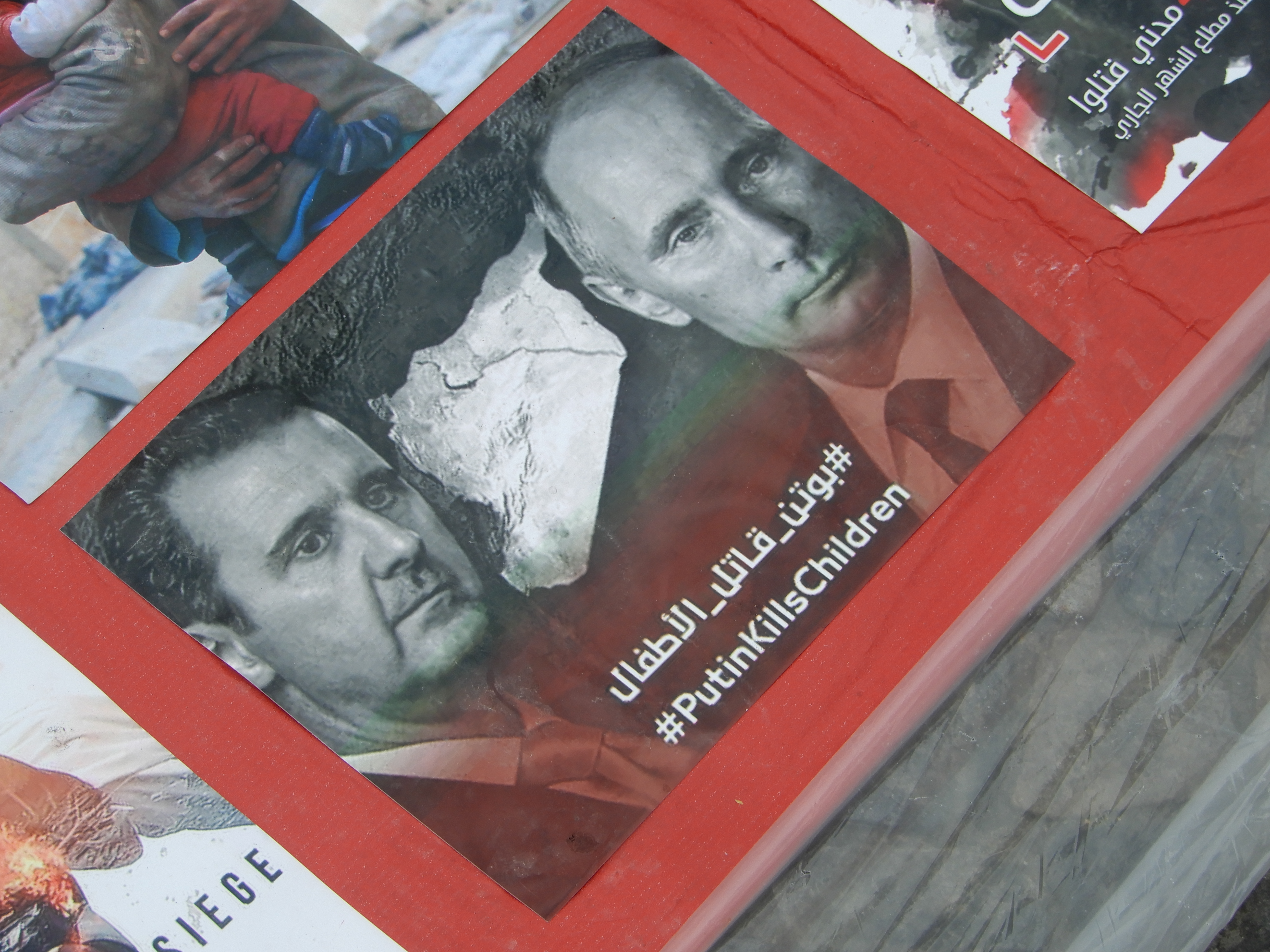
#PutinKillsChildren

putinkillschilren.JPGPoster at a rally in support of Idlib, 15 June 2019, Pariser Platz, Berlin. Photo by the Russian Reader

As the extraordinarily eloquent photographs a friend of mine took six days ago in Moscow show, another “look at us revolution” has been taking place there.

Like the previous “look at us revolution” of 2011–2012, staged almost exclusively for social media and international media consumption, the implicit message has been, “W are smart white people and we deserve better. Marvel at our clever placards. Look deeply into our educated white faces. In every single way that matters, we are just like you Herrenvolk in Europe and the US. The fact we live under a vicious tyranny is an unhappy accident for which we bear almost no responsibility.”

Beyond that, apparently, there is no plan, program or coordination, so it would be a mistake to imagine the detention of these protesters by the hundreds means the Putin regime is afraid of them. No, the regime is discouraging the protesters and potential protesters and, more importantly, it is gathering information on the detainees, information it can use in future crackdowns.

There will be a real revolution in Moscow when the super smart “white people” there not only learn how to get much larger numbers of people on the street, coordinate their movements, push back against the police’s attempts to detain them, and make real political demands but also discover the existence of the rest of the world and Moscow’s increasingly baleful effect on it.

If a hundred thousand people marched in the streets of Moscow demanding Putin immediately withdraw all Russian troops and mercenaries from Syria, this would not only signal the beginning of the end of Putin’s long reign but it would also mean anti-regime Russians had realized solidarity is a two-way street.

You cannot expect people in other parts of the world to empathize with your struggle for democracy and justice when your country’s armed forces, internet trolls, mercenaries, spies, and military proxies are fighting and fueling armed conflicts and political crises in dozens of other countries.

Russia might have more natural resources than any other country in the world, but the reserves of goodwill toward the country and its people will eventually dry up.

It has been said before by hundreds of activists and commentators, but if the US had allied itself with Assad to bomb the hell out of his opponents in Syria, the whole world, especially the leftist part, would be up in arms.

Russia has been bombing the hell out of Syria and doing lots of other nasty stuff elsewhere, including poisoning people in broad daylight and shooting down airliners, but it troubles almost no one, relatively speaking.

What is more, no one bothers to ask why it does not bother all the nice “white people” in Moscow, who would never think to demonstrate en masse against their country’s attacks on lesser folk in third-world countries. {TRR}

#PutinKillsChildren

Syria Is Only Three Syllables

It is pointless to say anything more about the near-total non-reaction of Russians to their government’s ruthless, quasi-genocidal bombing campaign against civilians in Syria, but I will say one last thing before giving up the subject entirely on this blog. It is important for eyewitnesses to important historical events to write down what they saw, heard, and read. Otherwise, decades from now, posterity might be reading about a nonexistent “Russian anti-war movement” during the Putin era.

Anything is possible in our fallen world.

Like Chechens, Crimean Tatars, Ukrainians, and Central Asians, Syrians are viewed as civilizational subhumans by Russians, as “natural-born terrorists” who deserve to be destroyed, as they would put it in the blunt lingo of Russian TV propagandists.

Educated Russians feel solidarity only towards a very limited segment of other Russians and northern Europeans, and even then only under extraordinarily limited circumstances, as witnessed by the self-love and virtue-flagging festival currently underway on the Runet.

The whole point of it is not to save the life of an investigative journalist framed by the police on drugs charges but to show to themselves (and the world) they can “fight back” against their corrupt government, that they are not as bad as they imagine themselves to be and, in fact, really are.

Indeed, Russians can fight back, as has been proven hundreds of times during the last twenty years. But this has been proven not by today’s virtue-flaggers, but by other Russians, Russians who have been fighting for their lives, livelihoods, natural and urban environments, workplaces, you name it. They live in the twenty-first century, too, and so they also have made use of the internet as needed for their campaigns, but their campaigns have had real objectives, and the militants in these campaigns have often been less bashful in their methods.

Look up, for example, anything you can find about the grassroots movement against plans to mine copper and nickel in Voronezh Region, which reached a crescendo four or five years ago. One of the leaders of that protest was an “ordinary” woman who worked at the local produce market. She virtually commanded battalions of other locals, including local Cossacks, in a knock-down, drag-out fight against mining companies and police.

Not surprisingly, these skirmishes have generally garnered much less attention in Russian society at large, the Russian press, and the international press.

It has been easier for all those groups to imagine the Russian provinces as “Putin’s base,” as a wasteland filled with aggressive vatniki, as they are derogatorily called. (The reference is to the humble gray quilted jacket favored, allegedly, by regime-loving proles in Russia’s regions.)

I have spent at least a third of my time on this blog and its predecessor trying to show this is not the case. It is a thankless and nearly pointless business, however, because it is not trendy to care about hicks in the sticks anymore anywhere, so almost no one reads these dispatches.

Putin’s real power bases are and always have Moscow and Petersburg, but you would never know that from the cool spin residents of the “capitals” put on every gesture in the direction of protest they make, even when they are not really protesting anything at all. If anyone has benefited from Putin’s promises of stability and prosperity, it is them, not the hicks in the sticks. But none of this has led to a “bourgeois revolution,” as some were expecting. Quite the opposite has happened.

Of course, there are activists and grassroots politicians in the capitals who are every bit as smart, fierce, and savvy as their counterparts in the provinces, but they do not outnumber them, despite what certain large-scale, protests in the recent past might have suggested.

So, what is up now? Sooner or later, every ambitious Russian with a social media profile and any sights on the west realizes it is not great to look like too much of a conformist. It is okay for Putin to kill Syrian babies by the truckload. Or, rather, it is not okay, but you are only asking for trouble if you protest something a) no one else is protesting, and b) that looks to be really important to the powers that be, so important they would squash you like you a fly if you made a peep about it.

The grassroots “Free Golunov!” campaign is perfect for anyone who wants to pad out their protest resume because a) everyone is protesting it, and b) the real powers that be probably do not care so much about prosecuting Golunov to the full extent of their lawlessness.

At his next public appearance, Putin could well be asked about the case by reporters. If he is asked, I would not be surprised if he said it was a bloody mess that shows how much work needs to be done before Russian law enforcement has been thoroughly purged of corruption.

Heads would then roll, and Golunov would be released as a gesture to the Russian moral one percent’s “yearning for justice.”

People with shaky protest resumes—meaning nearly every member of the intelligentsia in the capitals and major cities—want to jump on a bandwagon that has half a chance of making it to its destination, not light out for the territory with no chance of winning.

On the other hand, the Kremlin could neutralize these virtue-flaggers for good by throwing the book at Golunov, despite the overwhelming evidence he is innocent, and sending him down for fifteen years.

In reality, this sort of thing happens all the time. It happens routinely to “politicals” and ordinary blokes, to businessmen and Central Asian migrant workers, etc. But no one bothers to go ballistic when these people are framed by the wildly unscrupulous Russian police and security services because a) everyone leads really busy lives, and b) these victims of Russian legal nihilism do not have reporters and editors going to bat for them and publishing their names in big letters on the front pages of their newspapers.

What will “rank-and-file” protesters do if, despite their extraordinary efforts, Golunov is sent to prison for a crime he did not do? What will become of their “movement”? Will they up their game? Will they embrace more radical methods to free their beloved here.

Their movement will evaporate in seconds. We will never hear or see any political statements from most of these people ever again because if they can live peaceably with everything done by the Putin regime at home and abroad in their name over the last twenty years except this one thing, they can go on swallowing or, really, ignoring a double and even triple portion of the more of the same until Putin finally keels over thirty or so years from now.

Or they will leave the country. It is not as if they actually give a flying fuck about it. If they did, I would have written a very different outburst than this one. I would have written it a long time ago, in fact. || THE RUSSIAN READER

idlibThe bombing of Idlib is stirring memories of Guernica, as portrayed by Picasso. Photo by Abdulaziz Ketaz. Courtesy of AFP, Getty Images, and the Sunday Times
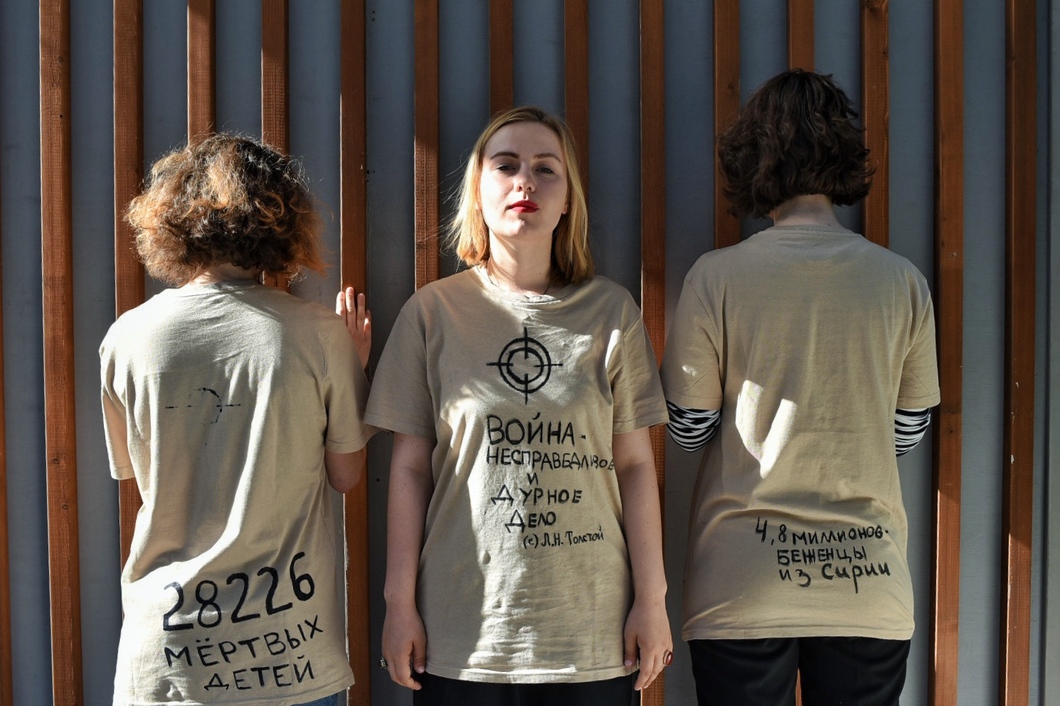
Syria: Russians refine slaughter in Idlib
Observers say Moscow is using the Syrian province as a kind of Guernica, while casting innocent victims as terrorists
Louise Callaghan
The Sunday Times
June 9, 2019

The fighter jet screamed over the town at about 8.30am, while the family was still asleep in the cool morning air. Mahmoud Ali Alsheikh, his wife and their three children were shaken awake by the first bomb.

Ahmad, the youngest, was 10 months old. His father held him as the second bomb exploded further down their street. His mother, Fatma, 29, held her hands over his ears. Nour and Salah, 8 and 7, crouched next to them.

The next bomb hit the house. Shrapnel ripped into Ahmad’s stomach, killing him. “I was trying to protect him,” said his father, a sweet-maker.

Ahmad was just one victim of Russia’s bombing campaign in Idlib, a rural province in northern Syria where a renewed assault by pro-regime forces has killed at least 347 civilians since the end of April, according to local doctors with the aid group Uossm. Twenty-five medical facilities have been bombed, many of them far from the front lines.

It is a horrifying escalation in a conflict in which Moscow and Damascus have an overwhelming military advantage as the eight-year-old civil war winds down. Analysts suspect that Russia, which has bragged about testing more than 200 new weapons in Syria, is cynically using Idlib to refine the bombing techniques it has developed during the conflict.

“Idlib for the Russians now could be what Guernica was for the Germans ahead of the Second World War. It’s a conflict in which they tested all of their techniques, rolled out their new doctrine,” said James Le Mesurier, a former British Army officer who founded the organization that trains and supports the White Helmets rescue group.

The Nazis’ use of the Spanish town of Guernica for bombing practice in 1937 during the Spanish Civil War allowed them to break new ground in the mass killing of civilians from the air and refine techniques that would later become invaluable to their war machine. The aftermath of the bombing was immortalized in a painting by Pablo Picasso.

For Russia, disinformation techniques have become as vital as military tactics. Moscow and the Syrian regime portray Idlib as a terrorist haven under the control of hardline groups — justifying the bombing campaign on the grounds that they are fighting jihadists.

Russia has put great effort into an online campaign portraying Idlib as a vipers’ nest of terrorists. The truth is more complicated. While groups such as Hayat Tahrir al-Sham, formerly an al-Qaeda offshoot, control large swathes of the province, some key towns are held by more moderate rebels.

A rebel counter-attack last week took back several villages from pro-regime forces. But the rebels have no air power.

Mixed in among them — and vulnerable to Russia’s supremacy in the air — are tens of thousands of terrified civilians: both locals and others from across the country who were bused to Idlib when their homes were retaken by the regime of President Bashar al-Assad.

After ousting rebel forces in much of the country, the regime is now renewing the attack on Idlib, which it has pledged to claw back at all costs.

A ceasefire, negotiated last year in Sochi, the Russian Black Sea resort, is in tatters after an assault by pro-regime forces targeted civilian and rebel targets alike with cluster bombs and barrel bombs. Videos appear to show incendiary weapons being used.

Diplomats say that, for the moment, an all-out military assault on Idlib is unlikely. The aim of the bombing campaign is to wear away at the ceasefire, grind down the rebels and force Turkey — which maintains military observation points in Idlib and backs some opposition groups — to agree to a handover of the province to the regime.

“A full-on assault is not imminent. But I do think the option will be kept on the table so that people can use that as a way of increasing influence,” said a senior western diplomat working on Syria.

Turkey, which is one of the guarantors of the ceasefire, has been outwardly maintaining a balanced relationship with Moscow, even as it reportedly funnels weapons to opposition groups in Idlib.

The Turkish border with Idlib is closed to the tens of thousands of civilians who have fled to it in search of safety. Last week residents told The Sunday Times that entire villages in Idlib’s interior were deserted, and displaced people were camping out in olive groves near the border without food or water.

Among them were the surviving members of Ahmad’s family.

“I don’t know what will happen but I hope the regime won’t advance because they will kill and arrest everyone,” said his father, who was badly injured in the airstrike that killed the baby. “The Assad regime is targeting our town all the time.”

He said his home town, Kafranbel — which used to be famous for its figs and is about 30 miles from the Turkish border — is not controlled by jihadists but by remnants of the Free Syrian Army.

Other locals and analysts confirmed this. But for Russia and the Syrian regime, rebels, jihadists and civilians alike are regarded as terrorists.

“Since the beginning, the Russians, Iran, Assad regime and Hezbollah are saying that,” he said. “Because their military policy is burning and killing everyone who lives in the opposition areas.”

Using Russian state-funded broadcasters and websites, Moscow has muddied the waters of the Syrian conflict by attempting to push the narrative that anyone who is against Assad is a terrorist, and that no news from opposition-held areas can be trusted.

Its disinformation campaign particularly targets the White Helmets, portraying its members as jihadists who stage their work. Slick video content, purporting to show the White Helmets faking chemical attacks by the regime, is often presented as impartial news and shared across the world.

Last month a Syrian government television channel took this technique a step further in a “fake news” comedy sketch that lampooned the White Helmets. A glamorous actress portrayed a crying woman as “White Helmets” staged a fake rescue mission. She later apologized for causing offense but made clear she still believed that attacks and rescues were often faked by the White Helmets.

Impartial observers, who credit the White Helmets with saving many lives and drawing attention to the regime’s atrocities, say there has been no proof that they have faked anything.

Additional reporting: Mahmoud al-Basha

Thanks to Pete Klosterman and the Facebook public group Free Syria for the heads-up. {TRR}

“War Is Not Fashionable” (Anti-Syrian War Demo in Moscow)

“War Is Not Fashionable”: Activists Protested Launch of Rapper Timati’s Fashion Collection for Defense Ministry
Novaya Gazeta
June 4, 2019

Three activists—Anna Etkina, Elisabetta Corsi, and Anna Romashchenko—carried out a protest action, “War Is Not Fashionable,” at the debut of Black Star Wear’s new collection on Novy Arbat.

Video by Victoria Odissonova. Edited by Gleb Limansky. Courtesy of Novaya Gazeta

The rapper Timati designed the new collection in collaboration with Voentorg’s Russian Army clothing brand. Timati has promoted the collection as clothes for the country’s patriots, while spokespeople for Voentorg said the collection was based on values  like “strong leadership, patriotism, attention to detail, and full confidence in each new step.”

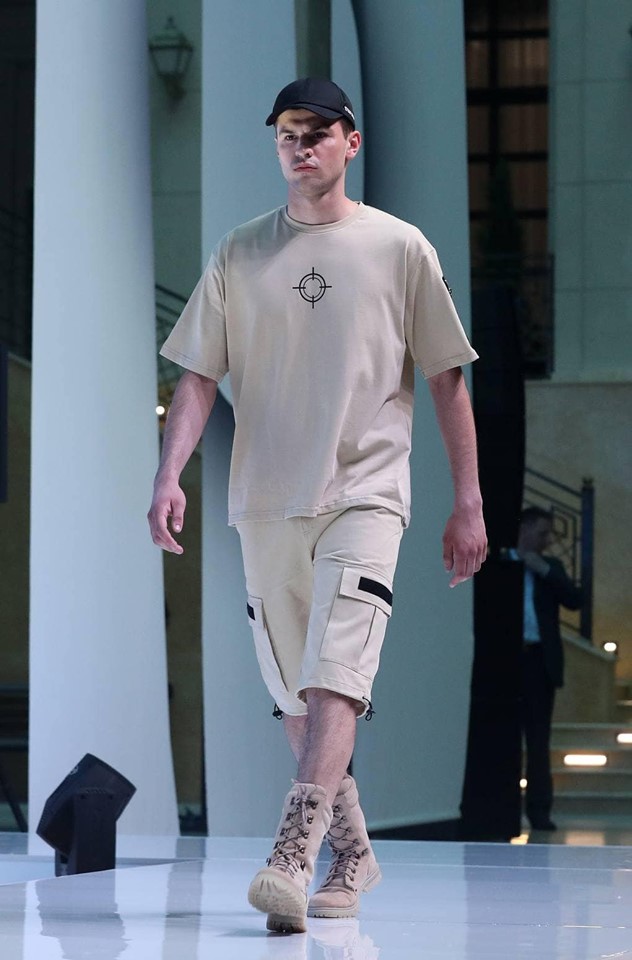
A target is depicted on the front of the t-shirts in Black Star Wear’s new collection, while the word “Syria” is embossed on the back.

The activists arrived at the protest in t-shirts similarly embossed with targets, but the backs of their shirts featured figures showing the costs of the war in Syria: the number of children killed (28,226), the number of Syrian citizens killed (223,161), and the number of refugees (4.8 million).

voina-1The slogans on the women’s t-shirts read, “28,226 dead children,” “War is an unjust and foolish business © Leo Tolstoy,” “4.8 million refugees from Syria.” Photo by Victoria Odissonovoa. Courtesy of Novaya Gazeta
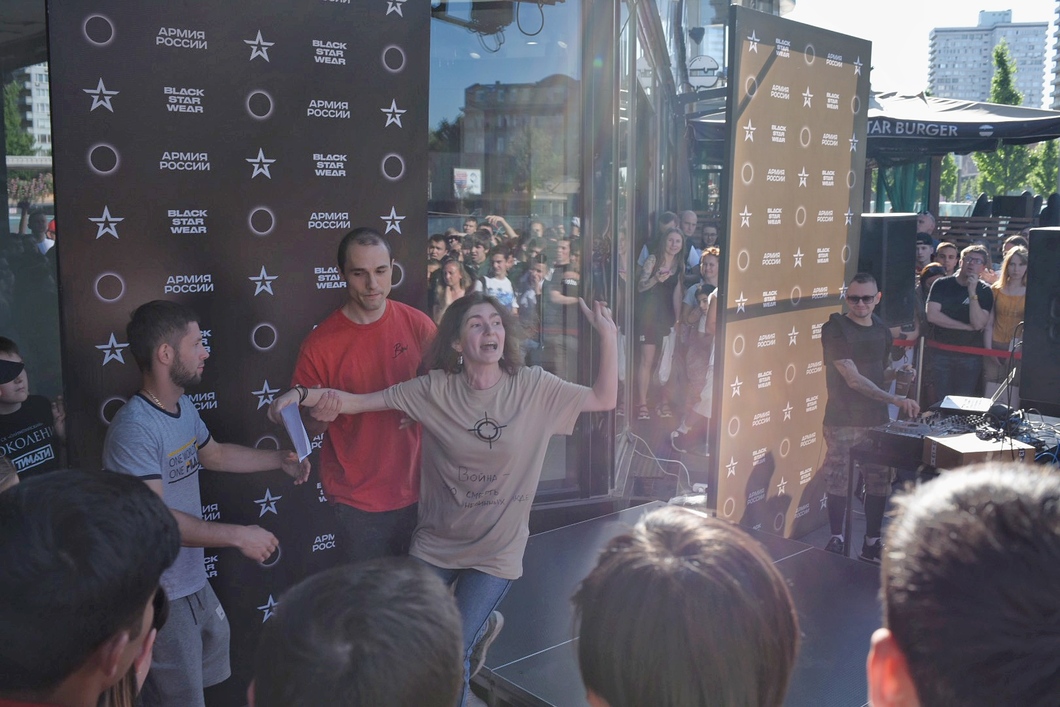
“We made t-shirts that resemble the t-shirts in Timati’s new collection,” said Corsi, “because war should not be depersonalized. What he is doing is hyping himself using the war. Many people associate Syria only with Islamic State. But it is mostly innocent people who perish from the allegedly pinpoint strikes.”

The activists handed out leaflets entitled, “Say No to War-Based Hype!” They also shouted the slogans “War is not fashionable!” and “War is murder!”

voina-2Elisabetta Corsi ran onto the stage towards the emcee. A minute later, she was dragged away. Photo by Victoria Odissonova. Courtesy of Novaya Gazeta

According to our correspondent, around one hundred people came to the launch of Timati’s collaboration with the Defense Ministry. Some took the leaflets and read them attentively, while others handed the pamphlets back or ripped them up.

Translated by the Russian Reader

Techwear for War Criminals

Timati’s new clothing collection includes a T-shirt with a target emblazoned on the front and the word “Syria” embossed on the back. Photos courtesy of Buro 24/7 and YZ

Timati Shows Collection Designed in Collaboration with Russian Army Brand : Check Out the T-Shirts with “Syria” Logos
Buro 24/7
May 27, 2019

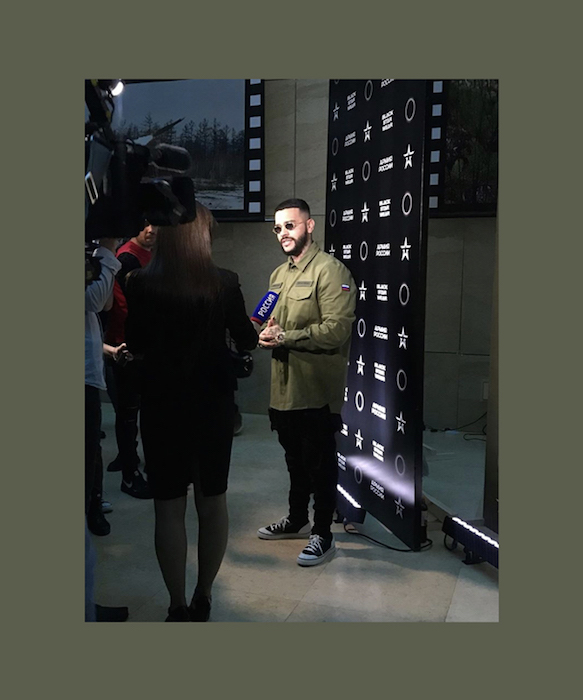
Today, in the Russian Defense Ministry’s Main Building on the Frunze Embankment in Moscow, Timati showed the clothing collection his brand Black Star Wear designed in collaboration with Russian Army brand clothing. It includes cargo shorts, sweatshirts, jackets, and everything captured by the concise Anglicism techwear. The Russian rapper worked on the collection for over six months. The undershirts and T-shirts embossed with the logo “Syria” are of particular note.

timati-5Timati speaking to state TV at the premiere showing of his new clothing collection. Courtesy of Buro 24/7

“This is quite a historic event. Right now I’m at one of the most secret facilities, the Russian Federal Defense Ministry. And I want to announce that right here in the Defense Ministry, as part of the collaboration between the Russian Army brand and Black Star, the collection will be shown,” Timati wrote on his Instagram page on May 21.

Ekaterina Korotkova, director general of Voentorg, also confirmed the brands’ plans.

Black Star Wear and Russian Army’s “Syria” T-shirt can be ordered in advance for 2,900 rubles (approx. 40 euros) at blackstarwear.ru. Courtesy of YR

“Yes, Russian Army brand and Black Star really do have such a collection. It will be premiered at a show in the Main Building of the Defense Ministry on May 27, just as Timati announced,” TASS quoted her as saying.

Thanks to YR for the heads-up and images. Translated by the Russian Reader.

No One to Call Them on the Carpet

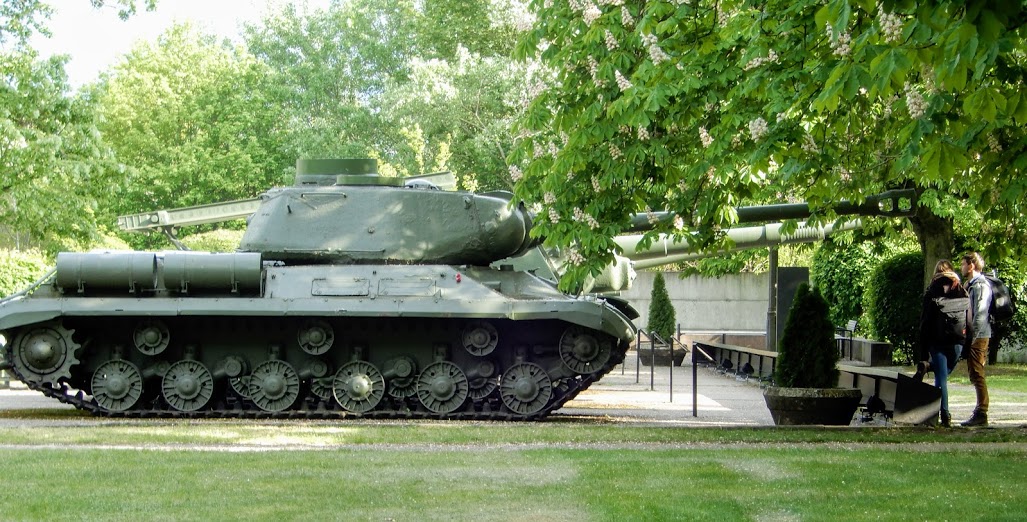
karlshorst tankA WWII-era Soviet tank, its muzzle pointed toward downtown Berlin, in the yard of the so-called German Russian Museum in the city’s Karlshorst neighborhood. Until 1994, it was known as the Capitulation Museum, since German high command formally surrendered to the Soviet high command in the building that houses the museum. Photo by the Russian Reader

At this point in their downward spiral towards worldwide moral and intellectual superiority, it is sometimes as hard to compliment Russians as it to make common cause with them or, on the contrary, argue with them.

I was thinking about this in a different connection when my attention was drawn to this column by Masha Gessen, published two days ago by the New Yorker.

The column is an odd beast.

First, Ms. Gessen makes a sound argument, based on hard, easily verifiable facts, but then she does an about-face and acts as her argument’s own resentful, miserably uninformed whataboutist, drawing false parallels between commemorations of the Second World War in Russia and the US, and the roles played by Putin and Trump in tarnishing these memorial events with their own sinister political agendas.

She is thus able to set readers up for the column’s takeaway message: “[T]he Trumpian spin on [the Second World War] is all maga, which makes it essentially the same as Putin’s.”

Ms. Gessen once was one of my favorite reporters, especially back in the days when she wrote for the weekly Russian news magazine Itogi.  Later, I adored her poignant, richly rendered dual portrait of her grandmothers and the turbulent times of their younger years. I would still urge anyone curious about what the Soviet Union was really like under Stalin and after his death to put the book, Ester and Ruzya, at the top of their reading lists.

Nowadays, however, Ms. Gessen finds herself in what should be the unenviable position of having no one willing to call her on the carpet. Whatever she writes and says is regarded as the gospel truth, apparently, by her editors, readers, and listeners. In any case, I have never come upon any criticism of her work, at least in Anglophonia.

Her editor at the New Yorker, David Remnick, himself a Russia expert of sorts, has gone missing in action when it comes to editing critically what she writes about the country of her birth, and so has everyone else who could be bothered to notice the sleights of hand and sophistry in which she now indulges all too often.

In this case, it is simple. In the United States, there has been nothing like the overbearing politicization of victory in the Second World War as there has been in Russia since Putin took power twenty years ago.

The US does not even have a public holiday commemorating victory in the war, whether on the European front or the Pacific front. I think this says something. Maybe what it says is bad, but the importance of the “victory” for US society, especially now that nearly seventy-five years have passed since the victory was declared, has been waning with every passing day.

More to the point, whatever deplorable uses Trump may have made of the war, he has had a mere two years in office to do his damage, while “decisive victory” in the Great Fatherland War (as the war is called in Russian) has long played a central role in Putin’s eclectic, opportunist but extraordinarily reactionary ideology.

It is an rather odd stance, since the Kremlin regularly speaks and acts almost as if the Putin regime and the current Russian Armed Forces achieved victory over the Nazis in 1945, rather than the Stalin regime and the Red Army.

Victory in the war has been used as much to bludgeon the regime’s “traitors” and “enemies” into submission as it has been used to brainwash the Russian people into a false sense of national unity and international moral superiority.

Of course, there have been periods since 1945 when victory in the war was politicized by the US establishment, too. We need only think of Tom Brokaw’s “greatest generation” and, years before that last gasp, the ways movies and TV shows about the war functioned as surrogates for reinforcing western capitalist ideology during the Cold War.

As should naturally be the case, however, since the war ended a long time ago, and most of the people who witnessed it and fought in it have died, it has meant less to the rising generations in the US than it did to the generations of my grandparents (who fought in the war, if only on the home front) and my parents (who were born just before or during the war), and even to my own generation (who grew up in a vernacular culture still permeated by memories of the war, sometimes embodied in our own grandparents and their age mates, and a popular culture still awash in books, comic books, TV serials, movies, toys, and other consumerist junk inspired by the war).

A gradual waning of interest in the war should have happened in Russia as well,  albeit in a manner that acknowledged and honored the war’s much greater impact on the country and all the other former Soviet republics.

In the nineties, under the “villainous” Yeltsin, this was on the verge of happening.

I remember going to the Victory Day parade on Nevsky Prospect in Petersburg in 1995. It was the fiftieth anniversary of the war’s end in Europe, but the main event consisted only of columns of real war veterans, some in uniform, some in civilian dress, all of them wearing their medals, marching down the Nevsky accompanied by a few marching bands and a military honor guard, if memory serves me.

Tens of thousands of Petersburgers lined the pavements, cheering the veterans, crying, and occasionally running out into the parade to hand them flowers, kiss their cheeks, and thank them personally for their courage.

It was simple, dignified, and moving.

But then a new mob took over Russia. The new mob wanted to rob the country blind and install themselves in power for as long as they could, so they had to convince their victims, the Russian people, of a number of contradictory things.

One, the highway robbery, as committed by the new mob, was for their own good. Two, the highway robbery was making them better and their country great again; it would bring “stability.” Three, the highway robbery was spiritually underwritten by the former country’s former greatness, as demonstrated, in part, by its victory over the Nazis in the Great Fatherland War.

It is not true that all or even most Russians have swallowed all or even most of this dangerous nonsense.

Putinism, however, has destroyed politics in Russia not only by demolishing all democratic institutions and persecuting grassroots activists and opposition politicians in ever-increasing numbers.

It has also disappeared most real political issues and replaced them with non-issues, such as nonexistent “threats” to the glory of Russia’s victory in WWII, as posed by “traitors” and hostile foreign powers, the completely astroturfed “upsurge” in “love for Stalin,” and several other fake zeitgeist events that have been designed purposely to set the country’s dubious troika of official pollsters polling like never before and take up oodles of space in the real media, the social media, and ordinary people’s minds and their bar-stool and dinner-table conversations with strangers, friends, relatives, and coworkers.

I am much too fond of French philosopher Jacques Rancière’s distinction between “politics”—what happens in the public space around real sources of political and social conflict in democratic societies or societies striving towards freedom and equity) and “police”—the opposite of “politics,” the utter control of public space and a monopoly on decision-making by a tiny anti-democratic elite.

“Police” as a concept, however, encompasses not only real policemen kicking down the doors of “extremists” and “terrorists,” and casing and tailing everyone suspicious and “unreliable” every which way they can.

In Russia under Putin, it has also involved tarring and feathering all real political discourse and political thinking, while promoting sophistry, scuttlebutt, moral panics, two minutes hate, and intense nationwide “debates” about non-issues such as “the people’s love of Stalin” and “victory in the war.”

The point of substituting artificial “police” discourses for wide-open political debate has been to prevent Russia from talking about bread-and-butter issues like pensions, the economy, healthcare, housing, the environment, war and peace, and increasingly violent crackdowns against political dissenters, businessmen, migrant workers, ethnic minorities, and religious minorities.

Russians are capable of talking about these things and do talk about them, of course, but a steady diet of nothing, that is, immersion in a topsy-turvy world in which the state, mainstream media, and many of your own friend will try, often and persistently, to engage you in “serious” conversations about chimeras and phantoms, has had an innervating effect on serious political discourse generally.

Try and talk to Russians about politics and, often as not, you will soon find yourself talking “police” instead.

If Ms. Gessen had decided to write a substantive article about the Putin regime’s use and abuse of the “victory,” popular acquiescence to its campaign, and grassroots pushbacks against, it would have familiarized Ms. Gessen’s readers with a story about which they know either nothing or almost nothing.

I cannot imagine anyone better qualified to tell the story than Ms. Gessen herself.

But, as is the case with many other Russians, the straight talk in Ms. Gessen’s recent printed work and media appearances about what has been happening in Russia under Putin has been veering off, sooner or later, into whataboutism and a series of well-worn memes whose hysterical repetition passes for political argument these days.

There is a different but curiously overlapping set for every political tribe in Putinist Russia, from nominal nationalists to nominal liberals and leftists.

What is my own takeaway message?

There can be no politics in Russia in the Rancierean sense or any other sense until the Russian liberal intelligentsia (with whom Ms. Gessen has explicitly identified herself on several occasions, obviously considering them vastly superior intellectually and morally to the American mooks with whom she has been condemned to spend too much time, Russiansplaining everything under the sun to them as best she can, mostly to no avail) and all the other intelligentsias and political tribes in Russia give up their pet sets of non-issues and non-solutions and revive the deadly serious politics and political discourses of the pre-Revolutionary period, if only in spirit.

However, the efficacy of “police” under Putin has been borne out by the way in which nearly everyone has united, time and again, around the very non-issues the regime and state media has encouraged them to discuss.

On the contrary, several painfully real issues, for example, Russia’s ruinous, murderous military involvement in Syria, have never been vetted by “police” for public hand-wringing of any kind.

As if obeying an unwritten rule or a tape reeling in their heads, nobody ever talks about them, not even the great Masha Gessen. {TRR}

Thanks to Comrade GF for bring Ms. Gessen’s column to my attention.

Marrying the Mob

DSCN1068

On Facebook, I regularly push stories about Syria and, especially, Russia’s criminally disastrous involvement there. Unfortunately, it has had no visible effect on any of my Russian Facebook friends with one exception.

I should thank Allah for that many “converts.”

In international politics, marriages of convenience among dictators and wannabe dictators always lead to mayhem and unintended fallout for the innocent bystanders in their immediate vicinity.

Let us pretend, for the sake of argument, that Trump and his campaign really did not collude with Putin and other Russian government officials to sway the 2016 US presidential election.

Even if that were the case, Trump’s overweening admiration for Putin’s style of bad governance has still had catastrophic effects on the country he is supposed to be leading

For someone like me who is all too familiar with the bag of tricks known, maybe somewhat inaccurately, as Putinism, it has been obvious Trump wants to steer the US in a quasi-Putinist direction.

While the republic, its states, and the other branches of government can mount a mighty resistance by virtue of the power vested in them, Trump can still cause lots of damage as an “imperial” president, even if he is booted out of the White House two years from now.

Likewise, Russians can imagine there is a far cry between living in a country whose cities are besieged and bombed by the country’s dictator, and what Putin has been doing in Syria. What he has been doing, they might imagine, mostly stays in Syria, except for Russian servicemen killed in action there, whose names and numbers are kept secret from the Russian public.

In reality, it is clear that the Kremlin’s neo-imperialist turn in Ukraine, Syria, etc., has made the regime far more belligerent to dissidents, outliers, weirdos, “extremists,” and “terrorists” at home.

Over the last five years, more and more Russians have fallen prey to their homegrown police and security services either for what amount to thought crimes (e.g., reposting an anti-Putinist meme on the social network VK or organizing nonexistent “terrorist communities”) or what the Russian constitution does not recognize as a crime at all, such as practicing one’s religion (e.g., Muslims and Jehovah’s Witnesses do)

Putin has adopted an Assadist mindset, therefore. He, his cronies, and the ever-expanding Russian security services, whose mission is making the paranoia of their superiors come true by meeting quotas of harassed, interrogated, arrested, tortured, jailed and convicted “extremists” per quarter, have come to imagine the only way to avoid the mess in which Assad found himself is to hammer anyone in Russia who sticks their necks out too far, whether intentionally or not, that everyone else will get the clue dissent and even plain difference come with a heavy price tag and reduce theirs to an invisible minimum.

Things were not exactly peachy during the first years of the Putin regime, but they became a hell of a lot worse after the Kremlin invaded Ukraine and went flying off to Syria to save Assad’s bacon from the fire of popular revolution.

As long as Russia remains entrenched in those places, there can be no question of progress on the home front, especially when the vast majority of Russians pretend very hard not to know anything about Syria and their country’s involvement there, and have grown accustomed to the Ukrainian muddle, meaning they mostly avoid thinking about what has really been happening in Eastern Ukraine, too. {TRR}

Thanks to the fabulous Sheen Gleeson for the first link. Photo by the Russian Reader

Sergei Vilkov: Everything You Thought You Knew About the Russian Working Class Was Wrong

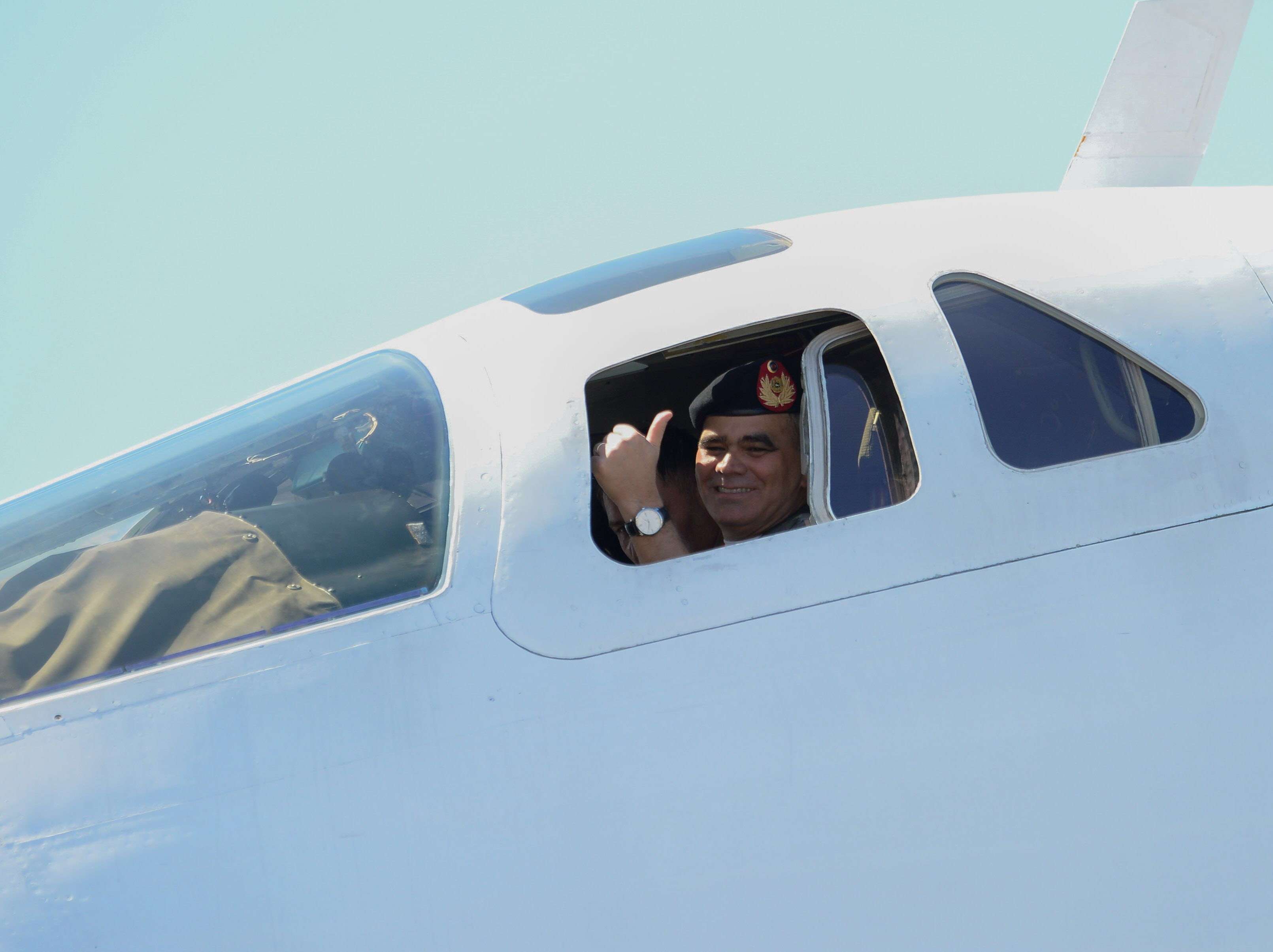
kalashnikov workersWorkers of the Kalashnikov plant in Izhevsk, Russia, on September, 20, 2016. Photo by Mikhail Svetlov (Getty Images). Courtesy of Fortune
The Heroes of the Day: What We Know about the Russian Working Class
How the Proletariat Stopped Fearing TV and Came to Dislike It
Sergei Vilkov
News.ru
April 30, 2019

It has been a tradition on the eve of May Day to recall the working class, which in Russia has seemingly been usurped by televised images of the “patriots” and regular blokes who work at the Uralvagonzavod plant in Nizhny Tagil.

Actually, Russia’s workers are a genuine black hole to sociologists. No one had seriously researched their circumstances, sentiments, and views for thirty years.

The first tentative attempts to research today’s Russian industrial laborers have produced a portrait that many had not expected. It transpires that today’s proletarians, at least, the most politically and civically dynamic among them, almost never watch television. They have a sober take on politics. They are immune to state propaganda. They have a relatively relaxed attitude toward migrant workers.

They regard themselves as outside observers in the debates between the regime and the opposition, not finding their own interests reflected in them. They are more likely to feel trampled upon by plant management than by a new law passed in the State Duma.

It is the factory where they fight their battles, which are usually invisible to official statisticians. Most important, according to researchers, they have more in common with early twentieth century social democrats than with current parties who try and speak on behalf of workers. However, the new research leaves a lot to be desired, to put it mildly. News.ru took a look at it.

They Got What They Fought For
According to official data, 26 million people in Russia or over 36% of the able-boded population are employed in industry, transport, agriculture, fishing, and several similar sectors. These figures do not include, for example, the large numbers of people employed in commerce and services. Overall, however, sociologists estimate that workers make up 40% of Russia’s population. They identify them as the largest group in society.

These people dwell on the dark side of Russia’s moon, as it were. It would be hard to say when someone last tried to examine them through an academic lens. However, understanding the nature of Russian society and its largest segments is, perhaps, the most ambitious humanities research project in the country today.

In government reports, Russia’s workers are imagined as a passive, homogeneous milieu that positively exudes tranquility. In 2017, Rosstat, the state statistics service, recorded only one strike, while in the preceding years their official number oscillated between two and five strikes annually.

By comparison, in 2005, according to official data, there were 2,600 strikes in Russia. And yet the following year, Rosstat claimed the number of strikes had decreased by a factor of 325. Since then, according to official statistics, it has remained consistently scanty, despite the economic crises of 2008 and 2014.

However, the Center for Social and Labor Rights, which has monitored the situation on its own, claims there were an average of 240 labor protests between 2008 and 2014. In 2016, when the political opposition was quiet, there were twice as many labor protests, while in the first six months of 2018, the last period for which it has data, the center recorded 122 strikes and acts of civil disobedience. Nearly half of these incidents led to workers downing tools.

Since 2014, a year dominated by an apparent “patriotic” consensus in politics, the number of strikes has increased abruptly due to an upsurge of resistance in provincial cities, including district seats. The largest number of walkouts and protests occurred in industry, especially the machine building and metalworking sectors, which have accounted for 28% of the overall number of strikes. The transport sector has accounted for the same percentage of strikes and protests, despite the fact they have mainly been carried out by employees of private transport companies based in the cities. The construction industry has accounted for 19% of strikes and protests during the period.

The main cause of protests and strikes remains unpaid back wages, which accounted for 60% of incidents. Demands to raise pay were factors in 19–20% of incidents.

The Center for Social and Labor Rights noticed a curious thing. In 2018, the number of spontaneous, unorganized protests by workers rose abruptly by 22%. Trade unions were involved in a mere 17% of all strikes and protests. The experts claim this was partly due to the fact that the Russian hinterlands, where there have been no real trade unions for the last one hundred years, have taken the lead in labor activism, along with sectors dominated by precarious employment.

Shop Floor Intellectuals
Someone has been organizing these strikes and protests, however. It is evident there is a core of energetic progressive activists among Russia’s workers.

On April 22, Alexander Zhelenin gave a lecture at a round table held in the offices of Novaya Gazeta newspaper.

Zhelenin is a well-known expert on workplace conflicts, and part of his talk dealt with a research study on the Russian proletariat. In July and September 2018, he and his fellow researchers did a small-scale qualitative sociological research study in Kaluga and Omsk that focused on the self-identification and sociopolitical views of workers.

A total of twenty-three people were interviewed. The small sample was offset by a thorough probing, through in-depth interviews, of the respondents’ attitudes and views, which are never revealed by run-of-the-mill public opinion polls. The workers interviewed by the sociologists were somehow connected to independent trade unions, which had, apparently, supported the research study. However, in the main, the interviewees were not politically engaged: only one of them was a member of a political organization.

We should also not forget it is usually the most energetic people who agree to be interviewed for ordinary official public opinion polls, which affects their outcomes.

In Kaluga, the respondents worked in the food industry and the new auto assembly plants, while in Omsk, they were employed at old Soviet military-industrial complex plants. They ranged in age from twenty to fifty, and included women and men. They were quite well-paid technicians who were proud of their contributions to society. On the other hand, they had a constant sense of their status as subordinates. They tended to strongly associate themselves with their workplaces. Family “labor dynasties” were a possible factor in their outlooks.

Most of the workers interviewed at the auto plants had been abroad one or more times, and this partly had to do with Volkswagen’s work exchange programs. One of the things they had learned on these trips was independent trade unions were ordinary, valuable organizations.

On the contrary, a foreign-travel passport was a rarity among the workers of the old defense plants, and yet both groups of workers tended to spend their holidays on the Black Sea coast. Some respondents in Omsk said they had never seen the sea or had seen it in early childhood.

Mortgages were the main financial obstacles to holidays away from home. Financially, the skilled workers felt they were members of the so-called middle class. In terms of standards of living in their regions, however, they noticed the gap between the more affluent segment of the populace and themselves. Thus, they had a keen sense of the difference in life chances for their children and the children of rich families, talking about it with great indignation.

Pavel Kudyukin, ex-minister of labor and employment and a lecturer in public administration at the Higher School of Economics, commented on the growing social segregation in Russia.

“It comes to the fore when talk turns to children’s futures. It is an aspect that will become more acute, because we are moving from segregation to social apartheid. I think it will facilitate [grassroots] civic activism,” he said.

The authors of the report did not hide their amazement at the fact that the respondents were quite well-educated, intelligent people. Nearly a third of them had a higher education or an uncompleted university degree. Many of them pointed out it was ordinary to find university-educated workers on the shop floor.

Tellingly, a man from Kaluga, identified as Anatoly, who did not finish his university degree, and whose outward appearance (a bespectacled intellectual), cultivated manner of speaking, and hobbies (music and organizing non-profit music festivals) gave the researchers the impression he was a local intellectual, although he said he had been employed as a skilled laborer for over eleven years. Like some other respondents, Anatoly noted he had become a laborer because life had worked out that way and he had to earn money. Industry was the only place where it was possible to earn a more or less decent wage, the study noted.

They Have Their Own Values
And yet 74% of of the respondents unambiguously identified themselves as workers, stressing their difference from other groups in society and their direct involvement in production. The remaining 26% preferred to call themselves “employees” and supported the notion of so-called social partnerships with management. However, despite their decent standard of life, it followed from the interviews that the workers believed they occupied one of the lowest rungs on the social ladder. This had to do with their palpably subordinate positions at work and the lack of prestige in their occupations. This circumstance was painfully apparent in the tension between blue-collar and white-collar workers at one plant, a tension exacerbated by the arrogance of the latter towards the former.

The workers were very annoyed by the fact that, as Sergei, a grinder who was involved in the Omsk focus group, said, “In terms of wages and education, the blue-collar workers often outperform the office workers, but the latter still treat them as inferiors.”

In Omsk, for example, the wages of workers fluctuated between 20,000 and 30,000 rubles a month, but workers at some defense plants could earn up to 70,000 or 80,000 rubles a month. However, according to the same interviewee, the well-paid jobs were “inherited.”

Besides, he said, to earn such a wage, one virtually had to live at the factory, working twelve hours a day and enjoying only one day off a week, something not all workers would do. Meanwhile, office workers at the same plant could earn only 20,000 rubles a month, but they treated the workers “as if they were above [them],” said Sergei.

“A really interesting thing is the split in self-identification as workers and members of the middle class,” said Kudyukin. “It clearly manifests the pressure exerted in society by hegemonic views. It is like what Marx wrote: ‘The ideas of the ruling class are in every epoch the ruling ideas, i.e. the class which is the ruling material force of society, is at the same time its ruling intellectual force.’ Since the notion of the middle class is constantly in the air, people give no thought to the fact that it’s a sociological fiction. People realize they are workers. They work on an assembly line or operate a machine. Yet in terms of income they identify themselves as middle class in the sense that they are neither rich nor poor. Maybe this has to do with the notion that the middle class is formally defined by income.”

“Russia is a quite highly stratified country, and it is constantly becoming more stratified,” explained Gregory Yudin, a professor at the Moscow School of Social and Economic Sciences. “It’s not a matter of income gaps, but of what these people say: the sense of symbolic superiority in cases where there is no income gap. When this sense takes root at a particular factory, what happens is quite predictable. In this sense, Marx was more or less right.”

Speaking about their place in production, the workers voiced the opinion their plants could run without managers, but without them the shop floors would grind to a halt. However, they sensed the arrogant attitude towards manual labor that had emerged in other parts of society. They realized that, from this perspective, their status was not considered prestigious at all. The factory laborers responded by opposing the values of their milieu to “other” values, saying that nowadays the chic thing to do was to steal and mooch, to make lots of money for doing nothing.

“I think this is an ordinary means of compensation, a psychological defense mechanism. We are considered impoverished in some way, whereas in fact we are the salt of the earth, and everything would grind to a halt without us. Their sentiments are quite justified. Despite the importance of managerial work, if you got rid of the management staff, the shop floor would function all the same. But if the workers suddenly disappeared, the plant would shut down,” said Kudyukin.

The research study showed the respondents perceived Russian politics as an established system that ignored their interests. This applied not only to the government but also to the opposition. Nearly half of the respondents consciously refrained from voting. By comparison, during the last presidential election, in March 2018, the Central Electoral Commission reported that 32.5% of registered voters did not vote.

Some of the respondents voted for the CPRF (Communist Party of the Russian Federation), A Just Russia, and LDPR [Vladimir Zhirinovsky’s party], although they noted these parties were entangled in establishment and supported workers’ interests more in words than in actual deeds. They were not a serious opposition.

What they had to say on the matter was telling.

“I have little trust in politicos and parties. I have more faith in the people here, the people with whom I work, the people I know. Here, at the local level, there are decent people among the members of different [political] movements. But the leadership is usually a bloody shambles,” said Sergei, 35, a grinder at the Aggregate Plant in Omsk.

“There are currently no parties that would defend workers’ interests. We need to create such a party,” said Sergei, who works at the Volkswagen plant in Kaluga.

Volodya, who also works at Volkswagen in Kaluga, was likewise certain such parties did not exist.

“All of them are against us [workers]. They represent business and big money, even the CPRF and A Just Russia. Those parties just use the ‘movements’ to score political points. They have great jobs. United Russia try and pass bad laws. They have the majority in the Duma, so [the three other parties represented there] can pretend to oppose them, since the bad laws will be passed all the same,” he said.

He quoted Mark Twain.

“If voting made any difference they wouldn’t let us do it.”

The federal government was a source of considerable irritation to the workers, especially in connection with the pension reform.

Roman, a 45-year-old worker at Volkswagen in Kaluga, was the only respondent in either city who said he had always voted for Putin and United Russia, but since the pension reform had passed, he was severely disenchanted and was more inclined to vote for the CPRF.

Vladislav, a 28-year-old worker at Volkswagen in Kaluga, had a confession to make despite the fact he had never voted.

“I was never opposed to Putin. But I did not believe to the last that he would say yes to this cannibalistic reform,” he said.

“Their statements jibe with what we see in other studies,” said Yudin. “People are depoliticized, yes. They distrust the system profoundly. This distrust grew even deeper last year. It’s a typical Russian scenario, and I am not entirely certain it has something specifically to do with workers. It typifies many segments of the populace. People who espouse this worldview serve as the base for different populist projects.”

Researchers describe their views as a contradictory mix of spontaneous anarchism and paternalistic expectations from the state. They would like to see the state solving society’s problems and intervening in the economy to raise wages, create jobs, and distribute incomes more fairly.

Igor, a worker from Omsk, had a typical view of the matter.

“The government should definitely solve these issues if workers have hired them to serve the people. When are they going to handle all of this if they work six and seven days a week? They just don’t have the time to deal with their own improvement [sic],” he said.

However, their political beliefs were more leftist and democratic than conservative and reactionary, even when it came to ethnic, religious and gender issues.

“The workers with whom we spoke, irrespective of whether they believed in God, wanted to lived in a secular state, while hoping the Russian Orthodox Church would be behave more modestly when it came to secular issues and would be less politicized. The views of workers on gender roles, the place of women in families, society, and the state were generally quite democratic. In terms of their worldviews, the workers had more in common with classic leftists than with a good number of current leftist parties and movements in Russia,” write the study’s authors.

Cool Heads
The researchers claim the workers they surveyed were clearly not victims of government propaganda. Their attitude towards Russia’s involvement in the conflicts in Ukraine and Syria was generally very restrained, if not sharply negative. Many of them argued that Russia’s foreign policy, as defined by the country’s leadership, had nothing to with their interests and was even capable of harming them. They also had a skeptical attitude to the promotion of great-power patriotism, seeing it as a means of distracting working people from real problems. But while they openly voiced their attitudes to foreign policy, the workers were cautious about discussing it, emphasizing a lack of information on the subject.

Many of them said society was not told everything.

To the surprise of the sociologists, most of the interviewees (78%) identified the internet as their main source of information, despite the fact they were asked about this part of their lives in a way that mentioned television and newspapers first, while the internet was among the information sources listed last.

By comparison, in March 2018, Levada Center published a poll claiming 85% of Russians got most of their information by watching television; moreover, 72% of respondents preferred watching state-controlled Channel One. On the contrary, only five of the workers (22% of the focus group) watched news and political programs on television. They regarded what they saw on television quite skeptically, trying to detect the influence of certain third-party interests.

They had a rather low opinion of the state of the nation.

“Lately, I’ve been ashamed of my people,” said Roman, a worker at Volkswagen in Kaluga.

Another worker, Vladimir, countered Roman.

“To stop feeling ashamed of your nation, just don’t identify yourself with it. Russia, the people, and the nation are illusions that have been pounded into our heads. There is just the earth and the people who live on it. The people who lived before us dreamed up border: here is Russia, there is Ukraine, here is America. In fact, we are all people. If you look at things from this standpoint, everything falls into place. For example, I don’t acknowledge the existence of national Olympic squads. My world is the people I know. When they say, “Our guys are playing football,” I think of “our guys” as my neighbors, workmates, family members, and the clerks at the shop. I could not care less what is going on in Syria and Donbas,” said Vladimir.

The researchers got rather unexpected and ambivalent results when they asked the workers about their attitudes towards migrant workers. In July 2018, Levada Center reported that 67% of Russians regarded them negatively. It is such sentiments that currently fuel nationalism and xenophobia. Among the workers in the survey, however, the intensity of these sentiments was considerably lower.

The different focus groups were split in their opinions of migrant laborers.

“Why hide it? I have a positive attitude toward them, because they are former brothers [within the Soviet Union]. We have the same troubles as they do. They get paid under the table, and so do we. And sometimes they are not paid at all,” said Mikhail, a 55-year-old freight handler.

“I tend to believe we need to create jobs for our own people first, and only then can we create jobs for migrants. As a worker, I consider them competitors, but as a human being I have no problems with them. On the other hand, how do we employ Russians if no Russians want to work as janitors?” said Svyatoslav, a truck driver at the Volkswagen plant.

Ultimately, 45% of the respondents took anti-migrant worker stances. In Omsk, the breakdown between migrantophobes and internationalists was six to four. In Kaluga, on the other hand, where the focus groups and in-depth interviews were dominated by workers from modern, foreign-owned production facilities, there were seven internationalists, as opposed to three migrantophobes.

The study’s authors argue the discrepancies are due to the different types of industry in the two cities, contrasting the workers from the old Soviet defense plants with the employees of foreign companies. However, we would be remiss not to note the relatively low level of nationalism in all the groups surveyed.

“In our view, this is because the workers have closer and more frequent contacts with migrant workers, and thus have more personal experience with them, something that always shatters stereotypes. It is yet another testimony to the fact that the dominant media coverage in Russia has less impact on the views of workers,” argue the study’s authors.

As for attitudes towards religion, twelve of the twenty-three respondents identified themselves as believers, while eleven identified themselves as atheists or agnostics. Two of the respondents regarded themselves as deeply religious Russian Orthodox believers. However, all the respondents said they wanted to live in a secular country in which the Russian Orthodox Church should have a smaller role in secular issues and politics.

The views of the workers on gender relations and the place of women at home and in society were quite democratic. According to the researchers, nearly all the men agreed women had the right to pursue any career or calling. They would not stop their own wives from getting involving in public life and politics or pursuing a career.

However, they regarded female politicians in the State Duma quite skeptically, since they did not see them as politicians who hailed from the grassroots. The respondents named German Chancellor Angela Merkel and Croatian President Kolinda Grabar-Kitarović as positive examples of women involved in politics.

At the same time, both of the experts we interviewed, Pavel Kudyukin and Gregory Yudin, agreed the research study had serious methodological flaws. Besides, it gave its readers no sense of the particular life experiences that had prompted the workers to embrace particular outlooks.

Thanks to Alexander Zamyatin for the heads-up. Translated by the Russian Reader

Squandering Its Way to Superpowerdom

“Squandering”: Did the US Secretary of State Grasp the Russian Approach to Budget Spending?
The Kremlin Accused the State Department of Tactlessness and Unprofessionalism, Yet Pompeo’s Remarks Were on the Mark
Yevgeny Karasyuk
Republic
December 13, 2018

padrino.jpgVenezuelan Defence Minister Vladimir Padrino gives his thumb up as he sits on the cockpit of a Russian Tupolev Tu-160 strategic long-range heavy supersonic bomber after it landed at Maiquetia International Airport, north of Caracas, on December 10, 2018. Courtesy of Federico Parra/AFP/Getty Images

Russian’s decision to send strategic bombers on a junket to an airport near Caracas elicited a curious reaction from US Secretary of State Mike Pompeo, who publicly expressed his pity for Russian taxpapers, whose money the Kremlin, habitually disregarding the costs, has been spending on its geopolitical moves.

“The Russian and Venezuelan people should see this for what it is: two corrupt governments squandering public funds, and squelching liberty and freedom while their people suffer,” Pompeo wrote.

The Russian Foreign Ministry responded by calling Pompeo’s statement “utterly unprofessional” and even “villainous.” Pompeo’s remarks, which the Kremlin, in turn, dubbed “inappropriate” and “undiplomatic,” were apparently really lacking in nuance: the hardships of Russians, fortunately, cannot yet be compared with the suffering of Venezuelans. But, hand on heart, was Pompeo so wrong when he talked about the losses to the Russian federal budget and lack of oversight?

Russian society has an extremely vague notion about how much the Kremlin’s expansionism has ultimately cost the country. According to calculations made by IHS Jane’s at the outset of Russia’s operations in Syria in autumn 2015, Russia could have been spending as much as $4 million a day. Later, the Yabloko Democratic Party, which is not seated in the Russian parliament, estimated the Kremlin had spent a total of 108–140 billion rubles [between $1.6 and $2.1 billion] on Syria. A more accurate assessment would be difficult to make. Experts doubt that anyone, including the Finance Ministry, keeps tabs on such expenditures. Thus, nobody knows the real cost of Russia’s involvement in the Syrian conflict, argues the Gaidar Institute’s Military Economics Laboratory.

The budget’s fading transparency has been a trend in recent years. In 2016, secret and top-secret allocations accounted for 22% of total federal budget expenditures, a record for the entire post-Soviet period, and much higher than secret allocations in comparable countries, according to RANEPA’s March 2015 report on the Russian economy.

Quite naturally, this state of affairs has not improved the quality of the state’s financial decisions. In terms of effective state spending, Russia ranked nineteenth in a new rating of twenty-five countries, compiled by the Higher School of Economics using data from the World Bank and OECD. Since they are not priorities for the current regime, problems with child mortality and life expectancy were among the reasons Russia ranked so low in the survey: the government spends more on the army than on healthcare—4.3% of GDP versus 3.8% of GDP, respectively. In these circumstances, the chances the Kremlin’s strategic projects in the Middle East and Africa (e.g., the Central African Republic, Burkina Faso, the Democratic Republic of the Congo, and Mozambique) will be decently funded are always much greater than the national healthcare project, which stipulated increased government spending on cancer treatment. The government nixed the plan over summer.

Since it remains largely Soviet in spirit, Russia’s foreign policy has been categorically blind to history’s lessons. The Soviet Union’s exorbitant geopolitical ambitions and support for fringe regimes around the world left the country with a legacy of mostly toxic multi-billion-dollar debts. The process of writing them off has been disguised as a form of international charity or, speaking diplomatically, official development assistance (ODA). According to RANEPA, writing off the debts of developing countries accounted for 35% of all such “international aid” last year or $425 million. It has been the Russian government’s usual way of doing business. Previously, the Russian government wrote off the debts of Nicaragua ($6.3 billion), Iraq ($21.5 billion), North Korea ($10.9 billion), Syria ($9.8 billion), Afghanistan ($11 billion), and Cuba ($29 billion), among other countries. Venezuela risks joining this sad list. Over the past twelve years, Russia has invested a total of $17 billion in the country.

Russia’s Expenditures on Official Development Assistance (Excluding Humanitarian Aid), 2005–2017, in Millions of Dollars. Sources: OECD, Russian Finance Ministry. Courtesy of Republic

Since it was paid for by the Russian federal budget, which has been running a deficit for the last seven years, Russian officials probably did not see the transatlantic flight of its strategic bombers as too expensive. On the contrary, they saw it as a flashy display of Russia’s military prowess and proof of its influence in the region. However, the government of Nicolás Maduro signed off on the stunt. Subject to growing pressure from creditors and an angry, desperate population, it lives day by day. In all likelihood, it will soon collapse, leaving behind a mountain of unpaid bills and unfulfilled obligations to its allies. If this is the case, can we evaluate the Russian government’s action better than the tactless Mike Pompeo did? Probably not.

Translated by the Russian Reader

Ivan Davydov: The Russian Protest Federation

614352f5bad27acc282af798084aa5e3Protest rally in Abakan against plans to raise the retirement age. Photo by Alexander Kryazhev. Courtesy of RIA Novosti and Republic

The Russian Protest Federation: How Moscow Has Stopped Shaping the Political Agenda. Will Ordinary Russians Realize Pension Reform and Geopolitical Triumphs Are Linked?
Ivan Davydov
Republic
September 27, 2018

The people who took to the streets long ago on Moscow’s Bolotnaya Square and Sakharov Avenue deserve the credit for the reinstatement of gubernatorial elections in Russia. It was a time that would be unimaginable now. There was no war with Ukraine. Crimea had not been annexed. No one had given Syria a second thought. It still makes you wonder why the Kremlin took fright then, albeit briefly. Instead of guessing, we should note it was the capital that led the national protest movement then, confirming yet again the centripetal nature of life in Russia. Over a 100,000 people attended the first two protest rallies in Moscow, on December 10, 2011, and February 4, 2012. Petersburg took second place, sending 25,000 people onto the streets for its February 2012 rally, but no one other city was even close. Protests took place in dozens of cities, including all the major ones, but the best the regions achieved was something on the order of 5,000 people in attendance. In most places, the average crowd numbered around a thousand people.

The opposition failed just like the regime. It transpired the national agenda and the agenda of Muscovites were the same thing. The farther you went from Moscow, the less people were worried about the issues exercising newspaper reporters. Least of all were they worried about their own real problems, about local issues, and thus there was no chance of changing things in Russia.

But the credit for transforming gubernatorial elections into something really resembling elections, albeit quite remotely, must go to the regions. The takeaway message is that the regime’s electoral fiasco in the regions on September 9 is a nationally significant event. The rank-and-file voters there, who cast their ballots for sham candidates from parties other than United Russia as a way of registering their disgust with the local political bosses, have turned circumstances inside out. The regions are now dictating their agenda to Moscow, as governors who seemed invulnerable only recently look shaky, and even Putin himself has been forced to break a sweat.

Airbag
As befits a myth, the Moscow myth that, putting it as succinctly as possible, Moscow is not the real Russia, is not true at all. But, like any good myth with life in it, it is based on real things. As I write this column, water is gurgling in the radiators of the standard Moscow high-rise where I live, because the heating season has kicked off. It is ten degrees Celsius outside, and Moscow’s tender inhabitants would freeze otherwise. Meanwhile, all the news agencies are reporting as their top news item that a place in the queue to buy the new iPhone at Moscow stores will set you back 130,000 rubles [approx. 1,700 euros]. That is expensive, of course, but you would let yourself be seen as an outdated loser at your own peril.

Muscovites protest often, although in fewer numbers than during the fair elections movement. To outsiders, however, protesting Muscovites almost always look like whimsical people who are too well off for their own good. Everyone knows Moscow has wide pavements, new subway stations, the Moscow Central Ring, and perpetual jam festivals and nonstop carnivals on Nikolskaya Street. People who live in places where even today anti-tank trenches pass for roads, and the mayor nicked the benches from the only pedestrian street (urbanism is ubiquitous nowadays, no longer a Moscow specialty) and hauled them to his summer cottage, find it really hard to take seriously people who are up in arms over a new parks whose birches were imported from Germany, and holiday lighting whose cost is roughly the same as the annual budget of an entire provice somewhere outside the Black Earth Region. The residents of “construction trailer accretions” (you will remember that during one of President Putin’s Direct Lines, the residents of a “construction trailer accretion” in Nyagan came on the air to complain) find it hard to understood people protesting so-called renovation, as in Moscow, that is, people who protest the demolition of their old residential buildings and being resettled in new buildings. For that is how it appears when geographical distance obscures the particulars.

The regime has skillfully manipulated this gap. Remember the role played by the “real guys” from the Uralvagonzavod factory during the fair elections movement, or the out-of-towners bussed into the capital for pro-Putin rallies on Poklonnaya Hill and Luzhniki Stadium. But the gap functions as yet another airbag for the Kremlin even when it makes no special effort to manipulate it. Moscow is part of Russia when we are talking about national issues and the fact those issues are debated in Moscow as well, but since any sane non-resident of Moscow believes Moscow is no part of Russia, the big issues end up being issues that exercise Muscovites, but do not interest people beyond Moscow.

The Main Political Issue
Alexei Navalny has bridged the gap slightly. His attempt to set up regional presidential campaign offices seemed absurd since everyone, including Navalny, realized he would not be allowed on the ballot and there would be no reason to campaign. He ran a campaign anyway, and his campaign offices turned into local pockets of resistance, into needles that hit a nerve with the regime while simulatneously stitching Russia together and removing Moscow’s monopoly on national politics. His campaign offices are manned by bold young people willing to take risks and good at organizing protest rallies. Of course, even now more people in Moscow attend Navalny’s protest rallies than in other cities, but people have still been taking to the streets in dozens of cities for the first time since the fair elections protests of 2011–2012. Navalny’s campaign offices splice issues that the locals get with national issues, thus producing the fabric of real politics. When I discussed the subject of this column with the editors of Republic, one of them joked Navalny was a “franchise.” The joke has a point, but the point is not offensive.

It was Vladimir Putin, however, who really turned the tide or, rather, the federal authorities, of which Putin is the living embodiment. The pension reform has made it abundantly clear the Russian authoritarian state no longer intends to be paternalist. The state has suddenly discovered what people actually liked about it was the paternalism. Or they put up with the paternalism. It is hard to say what word would be more precise. But they did not put up with it due to its victories on the geopolitical front.

The pension reform has erased the line between the big issues, debated by well-fed people in Moscow, and the real issues that constitute the lives of real people. This is quite natural, since being able to claim Russia’s miserly pensions a bit earlier in life is more important in places where life is harder. Moscow is definitely not the worse place in Russia to live. Despite the myth, Moscow is no heaven on earth, either, but the central heating has already been turned on, for example.

So, even a dull, boring, well-rehearsed formality like gubernatorial elections has become an effective tool of protest. The regime made a single mistake, a mistake to which no one would have paid attention to a year ago. (Since when has vote rigging seriously outraged people in Russia? Since days of yore? Since 2011?) The mistake set off a chain reaction. The new single nationwide election day had been a boon to the Kremlin, its young technocrats, and its not-so-young handpicked “businesslike” governors. If the elections had not taken place simultaneously everywhere, and the fiasco in the Maritime Territory had occurred at the outset of the elections season, it is not clear how powerful a victory the no-name candidates from the loyal opposition would have scored.

Maybe Zyuganov and Zhirinovsky would have had to disband their parties for fear of reprisals from the regime, since, the way they have long seen things, there is nothing more terrifying than success, and nothing more dangerous than real politics.

A Moscow municipal district council member from the opposition can easily make a coherent, meaningful speech about how the war in Syria has impacted the clumsiness of Mayor Sobyanin’s hired hands, relaying the tile in some unhappy, quiet alley for the third time in a single year. The council member’s speech would elicit laughter, and the laughter would be appropriate. But amidst the customary laughter we need to be able to discern the main question of a reemergent Russian politics.

The issue is this. Will ordinary Russians understand—and, if so, how quickly—that the pension reform (the first but not the last gift to the common folk from their beloved leaders) is part and parcel of the mighty Putin’s geopolitical triumphs, their inevitable consequence, rather than a betrayal and a rupture of the social compact, as certain confused patriotic columnists have been writing lately?

Ultimately, it is a matter of survival for Russia and for Putin. One of the two must survive. As in the films about the immortal Highlander, only one will be left standing at the end of the day.

Ivan Davydov is a liberal columnist. Translated by the Russian Reader