Moscow City Court Affirms Anna Pavlikova’s Remand in Custody

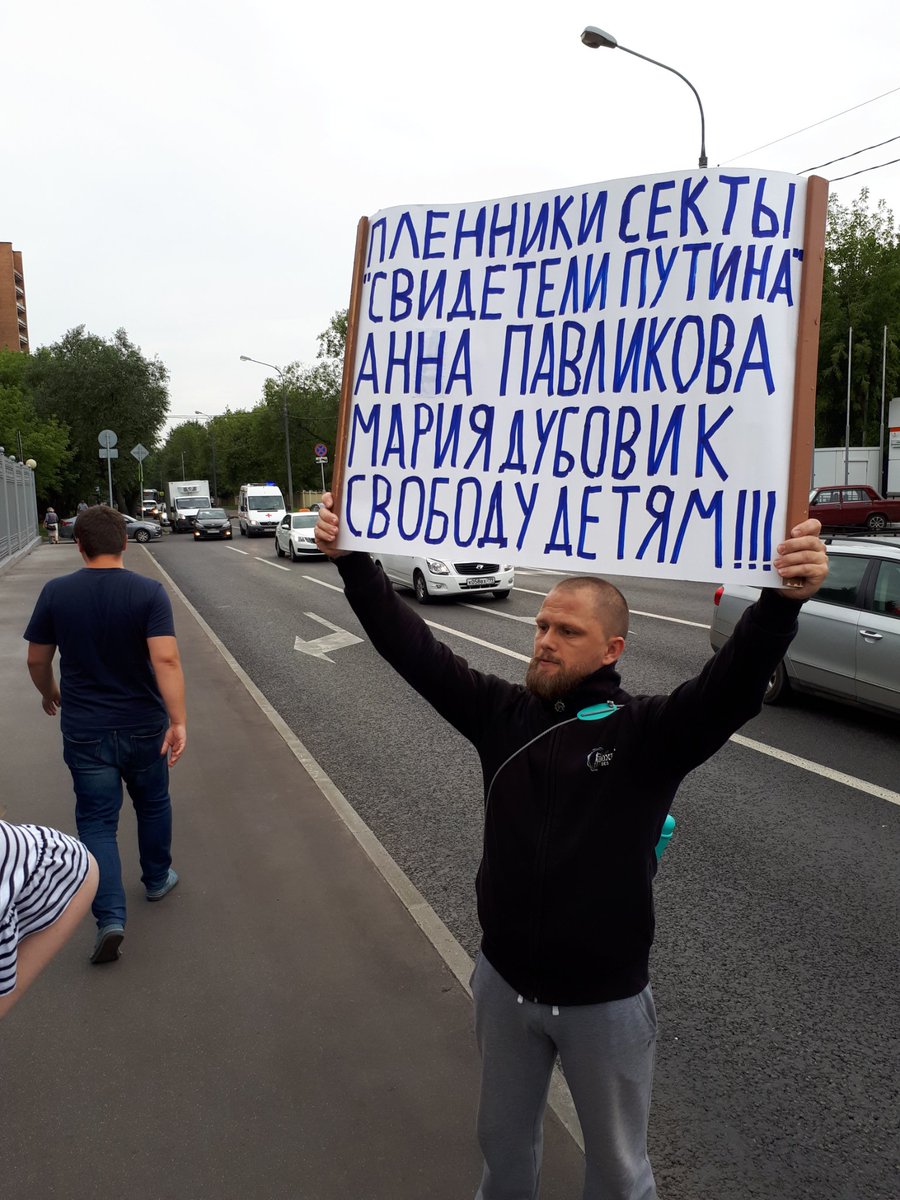
DjB2VnWWwAAuNc9A man picketing outside Moscow City Court, July 26, 2018. His placard reads, “Anna Pavlikova and Maria Dubovik are captives of the cult Putin’s Witnesses. Free the children!” Photo courtesy of Mediazona and Denis Styazhkin

Moscow City Court Affirms Remand in Custody of New Greatness Suspect Anna Pavlikova
OVD Info
July 26, 2018

Moscow City Court rejected an appeal of a lower court’s decision to remand in custody Anna Pavlikova, charged in the New Greatness case, It extended her remand in custody to August 13, writes Mediazona.

Moscow City Court thus shortened the young woman’s term in custody. Previously, the Dorogomilovo District Court had extended Pavlikova’s remand in custody until September 13.

Mediazona reports Pavlikova took part in today’s appeals hearing via video link from the remand prison. In her appeal, defense attorney Olga Karlova had asked the court to rescind the extension of her client’s remand in custody and impose a noncustodial pretrial restraint.

The defense attorney also drew the court’s attention to the fact that four of the people charged in the case are under house arrest, thus violating the principle of equality before the law. Karlova also claimed Pavlikova was not a flight risk, because both her domestic and foreign travel passports had been confiscated.

In May, Karlova had told the lower court her client’s heart problems had worsened in the remand prison. Pavlikova had developed severe tachycardia and cramps in her legs. In June, it transpired she had been transferred to the remand prison’s hospital. In July, Pavlikova was admitted to a civilian hospital for a day to undergo tests.

In May, a hearing to decide whether to extend Pavlikova’s remand in custody took place at the Dorogomilovo District Court. Pavlikova was not taken to the court, but was driven around in a paddy wagon. During the hearing, the judge read aloud parts of the case file  and retired to chambers to make her decision without hearing arguments from the parties to the case. In addition, Pavlikova was not informed of the court hearing. Her lawyer later informed her it had taken place.

In June, the Moscow City Court ruled this was a violation of the procedures for organizing court hearings and returned the case to the lower court.

Ten people have been charged in the New Greatness case. Judging by the case files, New Greatness was an organization established by undercover secret service agents. Six of the suspects are currently in remand prison, while the other four are under house arrest.

All ten suspects have been charged with organizing an “extremist” community (a violation of Russian Criminal Code Article 282.1). However, the prosecution’s case is based on the testimony of three men, none of whom has been arrested. One of them has said he infiltrated the group on the orders of his superiors. The interrogation transcripts of these individuals have mostly been excised from the case files. One of the three individuals drafted the group’s charter, collected money, and rented rooms for meetings.

Law enforcement officers threatened Pavlikova, who was seventeen at the time of her arrest, with violence.

Translated by the Russian Reader

Crimean Farmer and Political Prisoner Vladimir Balukh Has Been on Hunger Strike for 104 Days

Vladimir Balukh’s 100 Days: The Crimean Euromaidan Supporter Has Been on Hunger Strike in Remand Prison for Over Three Months
Anna Kozkina
Mediazona
June 27, 2018
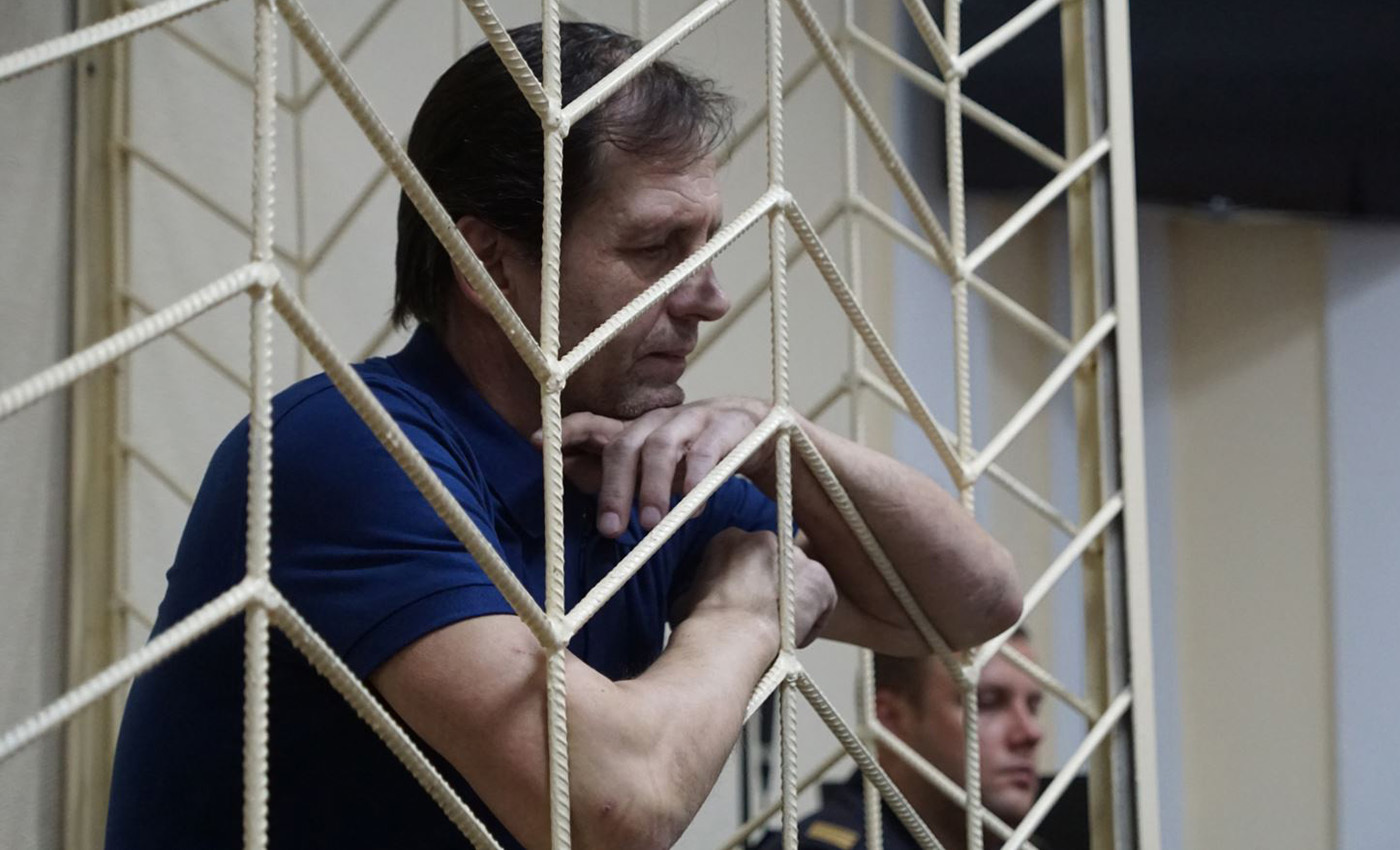

Vladimir Balukh. Photo by Anton Naumlyuk. Courtesy of RFE/RL

Today [July 1, 2018] is the [104th] day of a hunger strike by Vladimir Balukh, who awaits a verdict in his third criminal trial in Simferopol Remand Prison. In 2014, he refused to accept Russian citizenship, raising the Ukrainian flag over his house in solidarity with the Euromaidan protests. The first criminal case against Balukh was opened in 2015. It would be followed by two more case. In the article below, Mediazona catalogues the persecution the Crimean activist has endured and describes his hunger strike, during which he has lost at least thirty kilos.

On June 22, 2018, Balukh, who is imprisoned in Simferopol Remand Prison, said he was returning to the harsher form of hunger strike and would now only be drinking water. Balukh had been drinking fruit drink for some time.

Olga Dinze, Balukh’s defense attorney, said the cause was increased pressure from prison wardens. In court, Balukh had spoken of regular searches of his cell, including at night. According to him, prison wardens and guard have hinted it was time for him to “go down in the hole,” i.e., be sent to solitary confinement.

The following day, Ukrainian human rights ombudsman Lyudmila Denisova requested Pierre-Emmanuel Ducruet, head of the International Red Cross’s Simferopol office, visit Balukh at the remand prison and secure professional medical care for him.

The Flag, Heaven’s Hundred Heroes Street, and the Insulted FSB Agent
In late 2013, Crimean farmer Vladimir Balukh raised a Ukrainian flag over his house in the village of Serebryanka in solidarity with the Euromaidan demonstrators. The flag stayed there after the March 2014 referendum. Balukh did not recognize Crimea’s annexation by Russia and refused to apply for a Russian passport.

Police and Russian Federal Security Service (FSB) agents first paid him a visit in the spring of 2015. Balukh was not home when they arrived. When he heard about the visit to his home by the security services, he stayed with friends for several days. The police and FSB searched Balukh’s house and also paid his mother a call.

The security services visited Balukh for the second time in November 2015. Claiming he was suspected of auto theft, they searched his house again. After the search, the farmer was charged with insulting a government official, a violation under Article 319 of the Russian Criminal Code. Allegedly, Balukh had used “foul, insulting language when addressing field agent Yevgeny Baranov, which the latter found unpleasant.” Balukh did not deny he could have sworn at the field agent, since FSB officers had punched him in the kidneys and stepped on his head after throwing him on the ground.

In February 2016, the Razdolnoye District Court found Balukh guilty, sentencing him to 320 hours of community service. Subsequently, the Crimean Supreme Court sent the case back to the lower court for review, but in June the district court reaffirmed its original guilty verdict, again sentencing Balukh to 320 hours of community service.

The Ukrainian flag was torn down from the farmer’s house again and again, but he put it back up every time. On November 29, 2016, the third anniversary of the Euromaidan protests, Balukh hung a sign on his house, identifying the address as “Heaven’s Hundred Heroes Street, 18.” Two weeks later, police and FSB carried out yet another search of his house. This time, they allegedly found eighty-nine rounds of ammunition and several TNT blocks in the attic. After the search, the flag and the street sign were removed from Balukh’s house. Balukh was detained and later remanded to police custody.

Balukh was charged with illegal possession of weapons and explosives (Article 222 Part 1 and Article 222.1 Part 1 of the Russian Criminal Code). The farmer claimed his innocence and said his political stance was the reason for the criminal prosecution. He claimed the rounds of ammo and explosives were planted during the search. Police allegedly found them in the presence of a single official witness.

The Memorial Human Rights Center designated Balukh a political prisoner. It noted that he had received clear threats after hanging the street sign on his home memorializing the murdered Maidan protesters.

“It was after this that the chair of the village council and his deputies visited Balukh’s home and threatened that his independent behavior would have unpleasant consequences, including the ‘discovery’ in Balukh’s house of weapons or narcotics. He demanded  Balukh take the sign down,” wrote Memorial.

Memorial argued that the prosecution had not proven the ammunition actually belonged to Balukh, since his fingerprints were not found on the items.
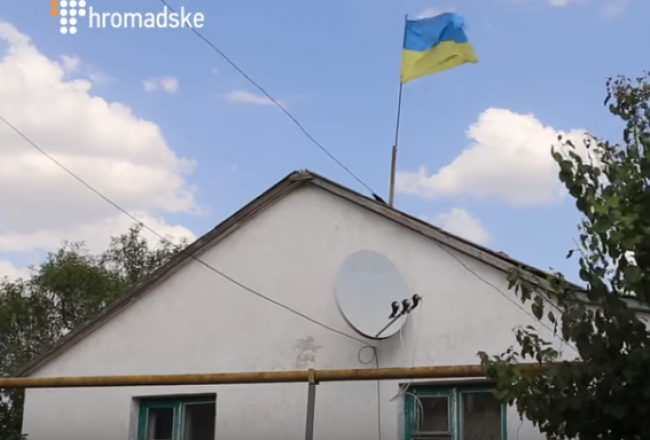
Vladimir Balukh’s House. Photo courtesy of hromadske.ua

“Go to Ukraine and Treat Your Back There”
On August 4, 2017, the Raznodolnoye District Court sentenced Balukh to three years and seven months in a medium security penal colony and a fine of ₽10,000 [approx. €136] for possession of the ammunition and TNT.

A week after Balukh was sentenced, he had a run-in with Valery Tkachenko, warden of the Razdolnoye Temporary Detention Facility. According to Balukh, Tkachenko punched him in the shoulder and tried to kick him as well. He also, allegedly, made insulting remarks about the ethnicity of Balukh and his parents. Balukh’s attorney filed a complaint with the police.

Two weeks later, the Investigative Committee opened a case against Balukh himself, claiming he had violated Article 318 Part 1 of the Criminal Code (violence against a state official). Subsequently, Balukh’s alleged actions were reclassified as a violation of Article 321 Part 2 (disrupting the operations of penitentiary facilities). According to police investigators, on the morning of August 11, 2017, Balukh had elbowed the warden in the stomach while his cell was being inspected. He then, allegedly, entered his cell and struck Tkachenko’s arm.

In November 2017, the district court commenced its review of the ammunition possession case, and in December Balukh was transferred from the remand prison to house arrest.  After complaining of pain in his back and groin, Balukh was soon taken to hospital straight from the courtroom.

At the district hospital, medical staff merely measured his blood pressure and gave him a cardiogram. After listening to Balukh’s complaints, the local doctor said, “My back hurts, too. Should I not go to work or what?”

Balukh asked the court permission to travel to Simferopol or Feodosia for a medical examination, but his request was turned down. During his December 27 court hearing, the ambulance was called several times due to Balukh’s temperature, high blood pressure, and back pain. According to the news website Krym.Realii, the head physician of the local hospital’s emergency department, Nadezhda Drozdenko, told Balukh, “Go to Ukraine and treat your back there.” When the hearing went on for ten hours, Balukh lay down on the floor due to the severe pain.

In early 2018, the court again found Balukh guilty on the ammunition possession charge and sentenced him to three years and seven months in a work-release penal colony. The verdict was upheld on appeal, although the sentence was reduced by two months.

Balukh was again sent to the remand prison. He has continued to complain of back pain, whose cause doctors have never been able to diagnose.

“He Has Adopted a Stance of Hopelessness”
After the Crimean Supreme Court upheld the verdict in the ammunition possession case, Balukh went on an indefinite hunger strike as of March 19, 2018. He gave up all food, only drinking water and tea, protesting what he regarded as the illegal verdict against him.

In late March, Balukh was assaulted in the remand prison and hospitalized in the infirmary, as reported by Aktivatika, who quoted defense attorney Olga Dinze.

“The hunger strike has been difficult for him. Besides, the prison wardens have engaged in constant provocations. They have brought him delicious food, enticing him to eat. It destabilizes him a bit, but he has hung and kept his word,” said the lawyer.
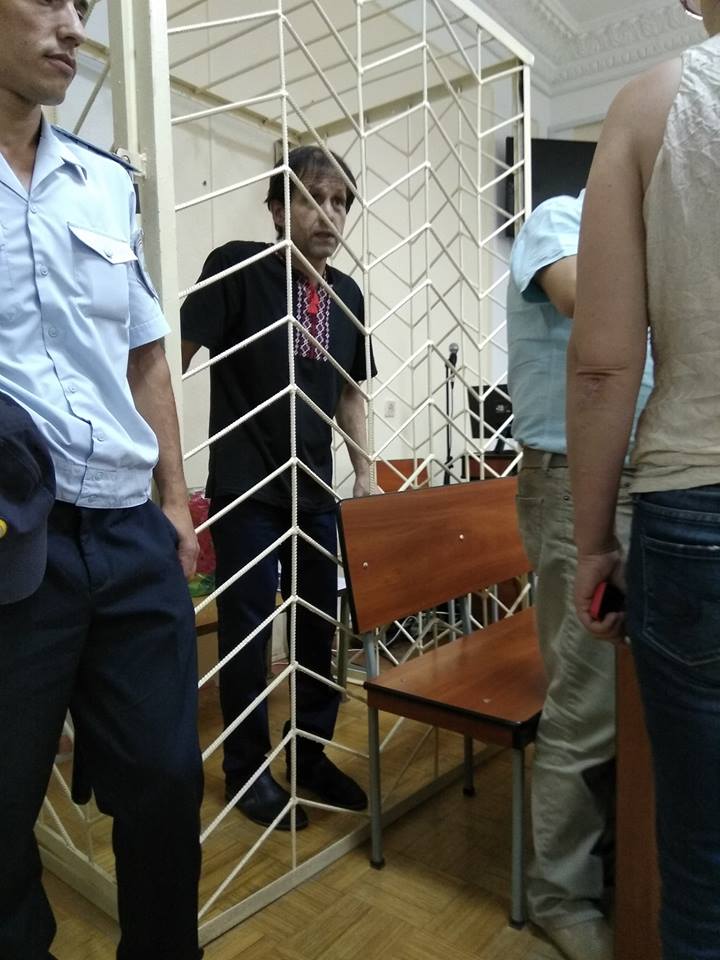
Vladimir Balukh on June 22, 2018. Photo by Zair Semedlyaev. Courtesy of crimeahrg.rog

In mid April, his social defender, Archbishop Kliment of Simferopol and Crimea, reported Balukh had been assaulted by guards.

A month later, Vladimir Chekrygin, an expert with the Crimean Human Rights Group, told Krim.Realii Balukh was under pressure in the remand prison.

“We know the guards at the remand prison have periodically threatened Balukh for his actions. They have told him that sooner or latter he would be punished for his willfulness. They have been doing searches in his cell night and mornings. Searches are permitted, but at certain hours and under extraordinary circumstances. They are not letting him rest,” Chekrygin explained.

On May 18, Russian human rights ombudsman Tatyana Moskalkova visited the Simferopol Remand Prison. She wrote to her Ukrainian colleague, Lyudmila Denisova, that Balukh had no complaints either about the conditions of his incarceration or cruel treatment.

In May, the Raznodolnoye District Court began hearing the third criminal case against Balukh, involving his run-in with the temporary detention facility warden. During the trial, even the prosecution’s witnesses, guards at the facility, testified Balukh did not assault the wardeb. During the investigation, the alleged victim refused to take part in a face-to-face confrontation with Balukh, who described his behavior in great detail to the judge.

“He would come to my cell and try to insult me, to humiliate me for being Ukrainian and thus, as he thought, for being a member of Right Sector. He would say us Ukrainians should be murdered as a species, and so on,” said Balukh.

On June 10, Balukh was again transferred from Razdolnoye to the Simferopol Remand Prison. There he was put in the “glass,” a narrow cell in which one can only stand or sit, for two hours, Crimean human rights defenders reported.

The following day, it transpired the remand prison wardens no longer believed Balukh was on hunger strike. The guards had learned Balukh was drinking not only water but also oatmeal kissel. Archbishop Kliment had persuaded Balukh to make the compromise a month after he started his hunger strike.

“Vladimir agreed. We know  he began consuming only kissel. Sometimes, he has honey and bread crumbs at most. At some point, the prison wardens found out about the kissel and decided not to recognize his actions as a hunger strike. There are special rules when wardens decide a prisoner has gone on hunger strike. They have stopped following these rules when it comes to Balukh, since they believe he is no longer on hunger strike. But Vladimir has continued his protest. He has lost thirty kilos of weight. The doctor from the remand prison infirmary has stopped making regular checkups of Balukh, although he is obliged to do so when inmates go on hunger strike,” explained Olga Skripnik, head of the Crimean Human Rights Group.

Protesting constant inspections in the remand prison, Balukh returned on June 22, 2018, to the original form of his hunger strike. He has again been only drinking water. Olga Dinze explained the frequent searches of Balukh’s cell as a consequence of Balukh’s having filed a motion to be paroled for his first criminal conviction.

On June 25, Dinze told Mediazona her client’s condition had taken a turn for the worse.

“I think Balukh has suffered a pinched nerve. It is a quite serious case. He has been experiencing severe pain in his chest, neck, and shoulder blades. He feels unwell all the time,” Dinze said, adding the new symptoms were probably due to long-term back pain.

According to Dinze, Balukh was not receiving medical care.

“He refuses cares from the doctors in the remand prison. They cannot give him the medical care he needs, diagnose him, and prescribe him appropriate treatment. He has requested doctors from the Red Cross,” said Dinze.

The defense attorney added that, after Balukh stopped drinking oat kissel, he was transferred to a cell in the general population, but the conditions there were decent. He currently has no complaints against the wardens.

Earlier, Dinze told Krym.Realii Balukh had been hoping for a prisoner exchange.

“Vladimir is quite weary. He is emotionally exhausted. He has adopted a stance of hopelessness. He says no one will ever release him from prison. If they cannot keep him in prison on the current convictions, there will be new charges. So now he is finally talking. For the last few months we have been talking about how, if there is a prisoner exchange and everything goes well, he would really, really like to go to mainland Ukraine,” said Dinze.

The Ukrainian authorities have recently repeatedly stated their readiness to exchange Russian convicts for the sixty-four Ukrainian nationals imprisoned in Russian remand prisons and penal colonies, including Balukh and filmmaker Oleg Sentsov, who has been on hunger strike since mid May.

Closing arguments in Warden Tkachenko’s case against Balukh have been scheduled for July 2.

Thanks to Yegor Skovoroda for the heads-up. Translated by the Russian Reader

Petersburg Court Bailiffs Attack Reporter at Network Case Hearing

Mediazona’s Petersburg Correspondent Accused of Disobeying Court Bailiffs
Mediazona
June 19, 2018

David Frenkel, a Mediazona correspondent, has informed us that bailiffs at Petersburg’s Dzerzhinsky District Court have cited him for violating Article 17.3 of the Administrative Code (“failure to comply with the orders of a judge or court bailiff”).

Frenkel attended the custody extension hearing of Penza-Petersburg “terrorism” case suspect Viktor Filinkov. Journalists and the public were not admitted to the courtroom during the hearing and the judge’s ruling. When the hearing was over, and Filinkov was escorted from the courtroom, the public, around forty people, applauded him.

It was then that court clerk Yelena Krasotkina, outraged the public supported the prisoner, ordered the bailiffs to detain Frenkel, who at the time was standing in the corridor and not applauding.

Yekaterina Kosarevskya, a member of the Petersburg Public Monitoring Commission, said she heard Krasotkina say to the bailiffs, “Write somebody up for something.”

One of the bailiffs suggested detaining Frenkel. Ten minutes later, another bailiff threatened to detain Kosarevskaya.

When the bailiffs detained Frenkel, they broke his glasses. They claimed he screamed.

The bailiffs cited him Frenkel for violating Adminstrative Code Article 17.3 Part 2 (“Failure to obey the lawful request of a court bailiff for establishing order in the court and stopping actions violating court rules”).

Frenkel sent a photo of the citation to his Mediazona colleagues: he was unable to read it, since a bailiff, surnamed Vikulov, had broken his glasses. The citation claimed Frenkel “made noise, clapped, shouted, and urged the crowd to take illegal actions.”

Frenkel was then taken to the 78th Police Precinct. The policemen swore when they found out why Frenkel had been brought to the police station. He was released after approximately fifteen minutes.

Viktor Filinkov’s term in remand prison was extended four months, until October 22, 2018.

When Frenkel was escorted from the corridor, it transpired the bailiffs had run out of blank arrest sheets.

Around forty people had gathered before the hearing in the second-floor corridor of the courthouse. They included the parents of Yuli Boyarshinov, another suspect in the Penza-Petersburg “terrorism” case, whose remand to police custody was extended later in the day. No member of the public was able to attend the hearing. Before escorting Filinkov from the holding cell, the guards and bailiffs ordered the public to go down to the first floor. They claimed their request had to do with “safely escorting” their prisoner.

The members of the public were reluctant to leave the second floor. Court clerk Yelena Krasotkina emerged from the office of the Dzerzhinsky District Court’s presiding judge. Krasotkina announced the decision to hold both hearings in closed chambers had been made earlier and ordered the public to leave the courthouse.

View image on TwitterView image on TwitterDavid Frenkel (@merr1k): “I get the sense the brass has taken the Dzerzhinsky District Court to task, and so they are avoiding the use of force. They are swearing and getting mad, but they’re putting up with us. 11: 12 a.m., July 19, 2018.”

The bailiffs placed a bench at the entrance of the corridor to courtroom, forbidding members of the public from going around the bench. Krasotkina reprimanded the bailiffs, complaining , “They’re all still here,” meaning the members of the public. Armed guards in masks escorted Filinkov into the courtroom as this was happening.

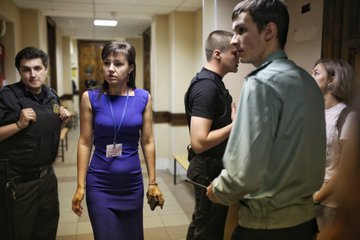
Inside the Dzerzhinsky District Court, June 19, 2018. Photo by David Frenkel. Courtesy of Mediazona  

Members of the public and the bailiffs argued with each other. A man who was possibly in charge of the armed guard joined them. He warned the public they would not be admitted to the courtroom to hear the judge’s ruling in the cases of Filinkov and Boyarshinov.

“How is that?” asked a member of the public.

“Well, if the judge permits it, the public gets in. If the judge doesn’t, they don’t,” replied the man.

“How do we find that out?” asked perplexed members of the public.

“When the hearing is over, they’ll come out and tell you,” he concluded.

Krasotkina periodically emerged from the presiding judge’s office, taking a photograph of the members of the public on one such occasion.

Filinkov’s defense counsel, Vitaly Cherkasov, a lawyer with the Agora International Human Rights Group, then emerged from the courtroom, telling the crowd the defense had asked the judge to transfer Filinkov to house arrest.

Finally, after the court had rendered its ruling, Frenkel was detained by the bailiffs.

Armed guards escort Viktor Filinkov at the Dzerzhinsky District Court. Photo by David Frenkel. Courtesy of Mediazona 

This was not the first time a member of the press has been cited for violating Article 17.3 at the Dzerzhinsky District Court. On March 22, 2018, bailiff Ivan Lozovsky cited journalist Sasha Bogino for violating the administrative law. He ordered her to stop “live streaming,” although the Mediazona correspondent was sitting in the courtroom with her laptop open and not filming anything. In late May, a court ordered Bogino to pay a fine of 500 rubles.

Filinkov and Boyarshinov have been in police custody since January of this year. On June 18, 2018, the Dzherzhinsky District court extended the term in custody of the third Petersburg suspect in the Penza-Petersburg “terrorism” case, Igor Shishkin. Another six young men are in police custody in Penza as suspects in the same case.

According to the Russian Federal Security Service (FSB), the members of the alleged “terrorist community” known as “The Network” had planned “to stir up the popular masses in order to destabilize the political circumstances” in Russia on the eve of March’s presidential election and the 2018 FIFA World Cup, which is currently underway. In addition, on June 15, 2018, it transpired that three new charges had been added to the case.

Three of the suspects, who have been charged with violating Article 205.4 of the Russian Criminal Code (“involvement in a terrorist community”), Viktor Filinkov, Ilya Shakursky, and Dmitry Pchelintsev, have claimed they were tortured into confessing after they were detained by FSB field officers. In addition, Alexei Poltavets, an acquaintance of the suspects, has claimed he was tortured into testifying against them.

The Russian Investigative Committee has so far refused to refuse to file abuse of authority charges against any FSB officers. In the case of Ilya Kapustin, who was tortured during his interrogation by the FSB as a witness, the Investigative Committee decided Kapustin’s taser burns were “consistent with injuries caused by skin diseases or insect bites.”

The suspects’ loved ones have formed a Parents Network. In April 2018, the group held a press conference in Moscow.

Translated by the Russian Reader

***************

What can you do to support the Penza and Petersburg antifascists and anarchists tortured and imprisoned by the FSB?

  • Donate money to the Anarchist Black Cross via PayPal (abc-msk@riseup.net). Make sure to specify that your donation is earmarked for “Rupression.”
  • Spread the word about The Network Case aka the Penza-Petersburg “terrorism” case. You can find more information about the case and in-depth articles translated into English on this website (see below), rupression.com, and openDemocracyRussia.
  • Organize solidarity events where you live to raise money and publicize the plight of the tortured Penza and Petersburg antifascists. Go to the website It’s Going Down to find downloadable, printable posters and flyers. You can also read more about the case there.
  • If you have the time and means to design, produce, and sell solidarity merchandize, please write to rupression@protonmail.com.
  • Write letters and postcards to the prisoners. Letters and postcards must be written in Russian or translated into Russian. You canfind the addresses of the prisoners here.
  • Design a solidarity postcard that can be printed out and used by others to send messages of support to the prisoners. Send your ideas to rupression@protonmail.com.
  • Write letters of support to the prisoners’ loved ones via rupression@protonmail.com.
  • Translate the articles and information at rupression.com and this website into languages other than Russian and English, and publish your translations on social media and your own websites and blogs.
  • If you know someone famous, ask them to record a solidarity video, write an op-ed piece for a mainstream newspaper or write letters to the prisoners.
  • If you know someone who is a print, internet, TV or radio journalist, encourage them to write an article or broadcast a report about the case. Write to rupression@protonmail.com or the email listed on this website, and we will be happy to arrange interviews and provide additional information.
  • It is extremely important this case break into the mainstream media both in Russia and abroad. Despite their apparent brashness, the FSB and their ilk do not like publicity. The more publicity the case receives, the safer our comrades will be in remand prison from violence at the hands of prison stooges and torture at the hands of the FSB, and the more likely the Russian authorities will be to drop the case altogether or release the defendants for time served if the case ever does go to trial.
  • Why? Because the case is a complete frame-up, based on testimony obtained under torture and mental duress. When the complaints filed by the accused reach the European Court of Human Rights in Strasbourg and are reviewed, the Russian government will be forced to pay heavy fines for its cruel mockery of justice.

***************

If you have not been following the Penza-Petersburg “terrorism” case and other cases involving frame-ups, torture, and violent intimidation by the Russian Federal Security Service (FSB) and other arms of the Russian police state, read and repost the recent articles the Russian Reader has translated and published on these subjects.

23 Days (#SaveOlegSentsov)

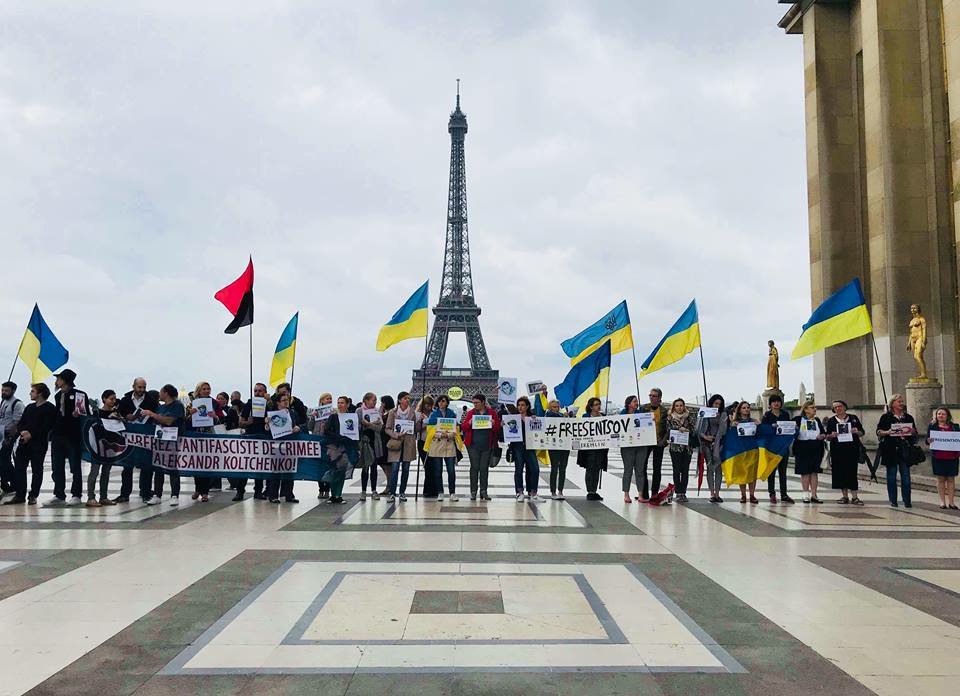
DesDUX8W4AM7n18Rally in support of Oleg Sentsov in Paris. Photo courtesy of Krym.Realii and Mediazona

Mediazona journalist Yegor Skovoroda writes that Ukrainian political prisoner and filmmaker Oleg Sentsov has been on hunger strike in a Russian penal colony for 23 days.

Filmmaker Askold Kurov, who made a terrific documentary film about Sentsov’s case, The Trial, has been to visit him there.

“He didn’t know any news. He didn’t know that [his co-defendant Simferopol anarchist Alexander] Kolchenko had gone on hunger strike. He didn’t call on anyone to join the hunger strike, especially Kolochenko, who is not in very good shape. But he feels solidarity with everyone who supports him. He knew nothing about the international campaign to support him, and he was quite grateful to everyone for not forgetting him,” said Kurov. “He continues to write and edit screenplays and stories. He has written a novel.”

Read the rest at Mediazona (in Russian) by following the link, below.

*****

Egor Skovoroda
Facebook
June 4, 2018

Олег Сенцов голодает уже 23-й день. Режиссер Аскольд Куров встретился с ним в колонии

«Он не знал никаких новостей, не знал, что Кольченко объявил голодовку. Он никого не призывает присоединяться к голодовке, особенно Кольченко, который в не очень хорошем физическом состоянии. Но он солидарен с каждым, кто его поддерживает. Он ничего не знал про всемирную кампанию в его поддержку, и он очень благодарен всем за то, что его не забывают, — рассказал Куров. — Он продожает писать, поправлять уже готовые свои сценарии, рассказы; он написал роман».

https://zona.media/chronicle/sentsov-strike

Comrade to Comrade

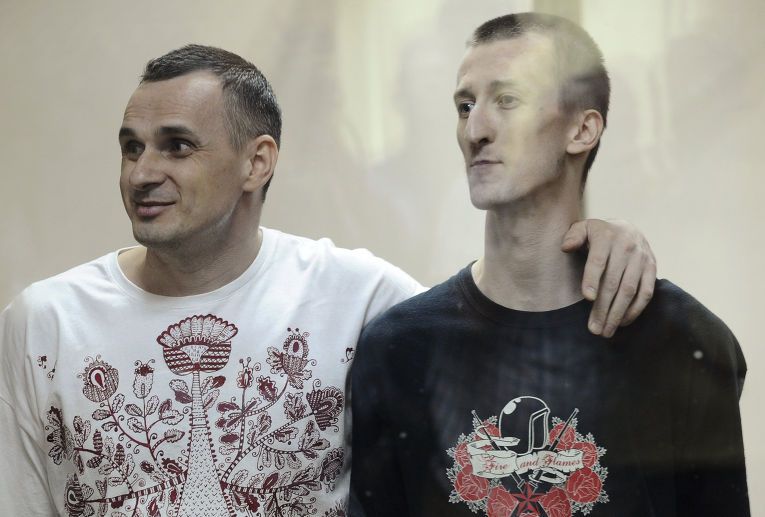
1465990524-5252Crimean political prisoners Oleg Sentsov and Alexander Kolchenko during their so-called trial by a Russian kangaroo court. Photo courtesy of Unian Information Agency

Alexander Kolchenko, Convicted in the Case of the “Crimean Terrorists,” Writes a Letter to Oleg Sentsov
Mediazona
May 22, 2018

Antifascist Alexander Kolchenko, convicted in the Case of the “Crimean Terrorists,” has written a letter to filmmaker Oleg Sentsov, who is in the ninth day of a hunger strike meant to force the Russian authorities to release all Ukrainian political prisoners from the country’s prisons. Mediazona was told about the letter by attorney Svetlana Sidorkina.

According to Sidorkina, Kolchenko was afraid the censor would not pass the letter on to Sentsov, so he gave her a detailed acount of its contents when she visited Kolchenko at Corrective Colony No. 6 in the town of Kopeysk.

“In the letter he wrote that, in his opinion, a hunger strike was an effective means of defense only in cases in which a country valued its reputation. Alexander believes that, in Oleg’s case, Russia could ignore his hunger strike, but not let him die by forcibly feeding and sending him off for a psychiatric examination. Sergei Magnitsky’s death changed nothing in Russia. Instead, the Dima Yaklovev Law was adopted. He did not try and dissuade Oleg, since he knows Oleg is stubborn and does not change his mind. He is quite concerned for his health, since he knows what the climate and living conditions are like in Labytnangi from prisoners he met when he and Oleg were in transit to the prisons where they would serve their sentences. Although Alexander doesn’t agree with Oleg’s method, he respects his stance on freeing Ukrainian political prisoners from Russian prisons and is ready to support Oleg if he needs to,” said Sidorkina.

Sidorkina tried to dissuade Kolchenko from a possible hunger strike by pointing to his health problems and the fact he is underweight. Because of this, he is on a special diet.

Aside from the letter to Sentsov, Kolchenko wrote a letter to Vladimir Putin demanding he intervene in the situation and release Sentsova. Kolchenko, however, was afraid the censor would also prevent the letter from reaching its addressee.

Kolchenko added he had no complaints about conditions in the penal colony. According to Sidorkin, he looked cheerful, but was quite worried about Sentsova. Sidorkina had wanted to show him articles about the Ukrainian filmmaker’s hunger strike, but penal colony staff stopped her from doing so.

In 2015, a court sentenced Kolchenko and Sentsov to ten years and twenty years, respectively, in maximum security penal colonies. According to police investigators, in 2014, Sentsov established a “terrorist community” (illegal under Article 205.4 Part 1 of the Russian Criminal Code). Members of the alleged community supposedly set fire to the doors of the Russian Community of Crimea and the windows of a United Russia Party office. These actions were deemed terrorist attacks, punishable under Article 205 Part 2 Paragraph A of the Criminal Code.

In addition, police investigators insisted members of the alleged “terrorist community” were planning to blow up a monument to Lenin and the Eternal Flame, punishable under Article 30 Part 1 and Article 205 Part 2 Paragraph A. Sentsov was also charged with trafficking in arms and explosives as part of a group, punishable by Article 222 Part 3. Kolchenko was found guilty of involvement in the alleged terrorist community and planning terrorist attacks on the Crimean Peninsula. Both men have denied their guilt.

In the spring of 2016, Sentsov was transported to a penal colony in Yakutia, but in 2017 he was transferred to the White Bear Colony in Labytnangi. In the winter of 2017, the Ukrainian authorities announced they were prepared to exchange Russian prisoners for Sentsov and Kolchenko. On May 14 of this year, Sentsov announced he was going on an indefinite hunger strike to secure the release of all Ukrainian political prisoners in Russia.

Translated by the Russian Reader

Lemmy Kilmister vs. Vladimir Putin

Mother of Man Accused in Penza Case Files Complaint Against Lawyer Mikhail Grigoryan, Who Concealed Son’s Torture from Her
Mediazona
May 14, 2018

Yelena Bogatova, mother of antifascist Ilya Shakursky, one of the young men accused in the so-called Penza-Petersburg “terrorism” case (aka The Network case) has filed a complaint against attorney Mikhail Grigoryan with the Moscow Bar Association and the Penza Bar Association. Mediazona has a copy of the complaint in its possession. In the complaint, Ms. Bogatova reports that, in October 2017, she signed an agreement with Mr. Grigoryan. According to the agreement, he agreed to defend her son, for which she paid him ₽100,000 [approx. €1,360]. According to Ms. Bogatova, over the six months during which the investigation of the Penza case was underway, Mr. Grigoryan “grossly violated the basic principles of attorney ethics.”

Thus, Mr. Grigoryan did not convey to Ms. Bogatova her son’s account of how security services officers tortured him with electrical shocks. Mr. Grigoryan also convinced Mr. Shakursky he must confess his involvement in a “terrorist community,” thus depriving him of professional services.

In addition, without obtaining Ms. Bogatova and her son’s consent, Mr. Grigorayn “used the information confided to him and interpreted it in an unethical manner,” acted against Mr. Shakursky’s will, and “made public statements that his client’s guilt had been proven, despite his denial of guilt.”

Mikhail Grigoryan, sporting a leather jacket and a Motorhead t-shirt against the backdrop of a Vladimir Putin calendar. Photo courtesy of Mr. Grigoryan’s VK page and Mediazona

Mr. Grigoryan, for example, gave an interview to the BBC’s Russian Service in which he discussed the “serious set of evidence” the case investigators had assembled against the accused young antifascists.

“According to Grigoryan, during the investigation, FSB officers showed him a large ‘tome,’ a methodology that had, allegedly, been confiscated from one of the accused, describing the rules for recruiting new group members,” wrote BBC reporters Olga Prosvirova and Oksana Chizh in the article.

“Believe me, it was not written by twentysomething young men. I think it was drafted somewhere in the depths of the secret services. Not our secret services, of course. I’ll leave the rest to your imagination,” they quoted Mr. Grigoryan as saying.

Mr. Grigoryan also was interviewed by Russian TV channel NTV, excerpts of which were used in their documentary film on the Penza case. In the interview, Mr. Grigoryan claims his client “was well aware” he was involved in a terrorist community.

“Why were they learning to shoot firearms? Here there seems to be awareness of what they were doing. Can we say they were playing cops and robbers? I don’t think these are little kids. They are not Young Pioneers. They went out to practice. Why were they learning to shoot firearms?” Mr. Grigoryan told NTV reporters.

As Ms. Bogatova wrote in her complaint, she expected Mr. Grigoryan to defend her son, not act as his accuser. She asked the bar associations to take disciplinary measures against Mr. Grigoryan.

The FSB launched an investigation into the “The Network terrorist community” in October 2017. Most of the young men who have been accused and arrested in the case are antifascists and anarchists. According to the FSB, the members of the alleged community were planning terrorist attacks during the March 2018 presidential election and this summer’s FIFA World Cup in order to “sway the masses and further destabilize the political situation” in Russia, ultimately inciting an armed uprising.

Yegor Zorin, Ilya Shakursky, Vasily Kuksov, Dmitry Pchelintsev, and Andrei Chernov were detained last autumn in Penza and remanded in custody. Arman Sagynbayev was apprehended in Petersburg and transferred to the remand prison in Penza.

Viktor Filinkov and Igor Shishkin were apprehended and remanded in custody in the same case this past January in Petersburg. In April, a third Petersburger, Yuli Boyarshinov, was charged in the case.

Pchelintsev, Shakursky, and Filinkov have testified FSB officers tortured them, demanding they confess to the charges against them.

Translated by the Russian Reader

***************

What you can do to support the Penza and Petersburg antifascists and anarchists tortured and imprisoned by the FSB

  • Donate money to the Anarchist Black Cross via PayPal (abc-msk@riseup.net) and make sure to specify that your donation is earmarked for “Rupression.”
  • Spread the word about The Network Case aka the Penza-Petersburg “Terrorism Case.” You can find more information about the case and in=depth articles translated into English on this website (see below), rupression.com, and openDemocracyRussia.
  • Organize solidarity events where you live to raise money and drawn attention to the plight of the tortured Penza and Petersburg antifascists. Go to the website It’s Going Down to find downloadable, printable posters and flyers. You can also read more about the case there.
  • If you have the time and means to design, produce, and sell solidarity merch, please write to rupression@protonmail.com.
  • Write letters and postcards to the prisoners. Letters and postcards must be written in Russian or translated into Russian. You will find the addresses of the prisoners here.
  • Design a solidarity postcard that can be printed out and used by others to send messages of support to the prisoners. Send your ideas to rupression@protonmail.com.
  • Write letters of support to the prisoners’ loved ones via rupression@protonmail.com.
  • Translate the articles and information at rupression.com and this website into languages other than Russian and English, and publish your translations on social media and your own websites and blogs.
  • If you know someone famous, ask them to record a solidarity video, write an op-ed piece for a mainstream newspaper or write letters to the prisoners.
  • If you know someone who is a print, internet, TV or radio journalist, encourage them to write an article or broadcast a report about the case. Write to rupression@protonmail.com or the email listed on this website, and we will be happy to arrange interviews and provide additional information. It is extremely important this case break into the mainstream media both in Russia and abroad. Despite their apparent brashness, the FSB and their ilk do not like publicity. The more publicity the case gets, the safer our comrades will be in remand prison from violence at the hands of prison stooges and more torture at the hands of the FSB, and the more likely the Russian authorities will be likely to drop the case altogether or release the defendants for time served if the case ever does go to trial. Why? Because the case is a complete frame-up, based on testimony obtained under torture. When the complaints filed by the accused reach the European Court of Human Rights in Strasbourg and are ultimately ajudicated, the Russian government will be forced to pay heavy fines for its cruel mockery of justice.

***************

If you have not been following the Penza-Petersburg “terrorism” case and other cases involving frame-ups, torture, and violent intimidation by the Russian Federal Security Service (FSB) and other arms of the Russian police state, read and repost the recent articles the Russian Reader has translated and published on these subjects.

Wife of Tortured Antifascist Seeks Asylum in Finland

P6240121In Finland

Wife of Antifascist Filinkov Seeks Political Asylum in Finland
Mediazona
April 10, 2018

Alexandra Aksyonova, wife of antifascist Viktor Filinkov, who spoke of being tortured by Russian Federal Security (FSB) officers and is currently being held in a remand prison outside Petersburg, has left Kyiv and requested political asylum in Finland. She reported the news to Mediazona herself.

She flew to Finland yesterday, April 9, and today she reported to a police station, where she requested political asylum. In conversation with Mediazona, she explained she had feared for her safety in Ukraine, noting there had been incidents in the past when Russian political activists had been abducted by the Russian security services in Ukraine, while local human rights defenders had told her it was nearly impossible to obtain political asylum in Ukraine.

In late January of this year, Ms. Aksyonova reported her husband, Viktor Filinkov, had disappeared on his way to Petersburg’s Pulkovo Airport, whence he was due to fly to Kyiv. Soon, the Telegram channel of the Petersburg court system’s press service reported Filinkov had been remanded in custody on suspicion of involvement in a terrorist community, a crime under Article 205.4 Part 2 of the Russian Federal Criminal Code. Filinkov had, allegedly, confessed his guilt.

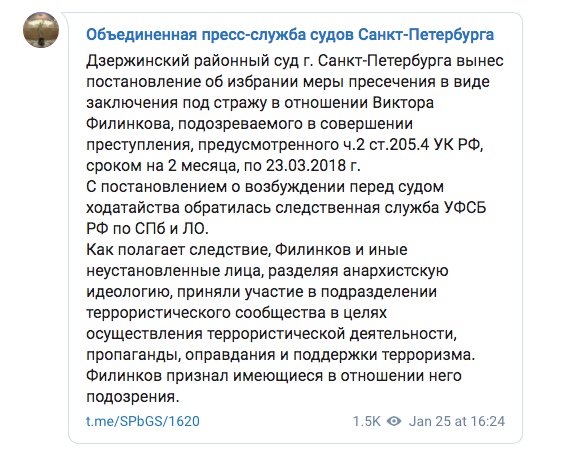
filinkov telegramScreen shot of the message posted about Viktor Filinkov’s arrest on the Telegram channel of the Joint Press Service of the St. Petersburg Courts, January 25, 2018

Subsequently, during a visit by members of the Petersburg Public Monitoring Commission (PMC) to the Petersburg remand prison where he was jailed, Filinkov said he had confessed his guilt after being tortured with a taser by FSB officers. Mediazona published Filinkov’s account of the first days after he was detained, an account in which he described in great detail how FSB officers had tortured him and threatened his wife. In March, Filinkov was transferred to a remand prison just across the border from Petersburg in Leningrad Region, which is thus off limits to the Petersburg PMC members who had regularly visited him in the Petersburg remand prison.

Petersburg antifascist Igor Shishkin also vanished in late January only to turn up later as an arrestee in the same case. He confessed his guilt. Despite the fact that members of the Petersburg PMC found evidence of injuries on his body, Shishkin said nothing about torture.

However, Petersburger Ilya Kapustin, detained as a witness in the very same case, claimed he had been tortured by the FSB. In February, he filed a complaint with the Russian Investigative Committee. He left Russia in March to seek asylum in Finland.

The Petersburg antifascists were detained as part of a case against an alleged “terrorist community,” code-named The Network. Online news and commentary website Republic, which was granted access to the case files, wrote that the FSB believed the alleged “terrorist community” had cells in Moscow, Petersburg, Penza, and Belarus. Members of the alleged terrorist group had supposedly planned a series of bomb blasts during the March 18 presidential election and this summer’s FIFA World Cup, which will be held in Russia.

The criminal case kicked off in October 2017 with the arrest of four antifascists in Penza. A fifth suspect in Penza was placed under house arrest, while a sixth suspect was detained in Petersburg and transferred to the Penza Remand Prison. Several of these young men subsequently recounted how the FSB had tortured them and planted weapons in their cars and flats. In particular, Ilya Shakursky and Dmitry Pchelintsev reported they had been tortured. Pchelintsev soon retracted his testimony.

Translation and photo by the Russian Reader

NB. If you are just now happening on this horrifying tale of torture and “law enforcement” run amok, read the first major international media report on the case, in Newsweek, and then read my translations of articles from Mediazona, OVD Info, and the other independent Russian media outlets who have been covering the story since it broke in late January 2018.

Families of Penza-Petersburg “Terrorists” Form Committee

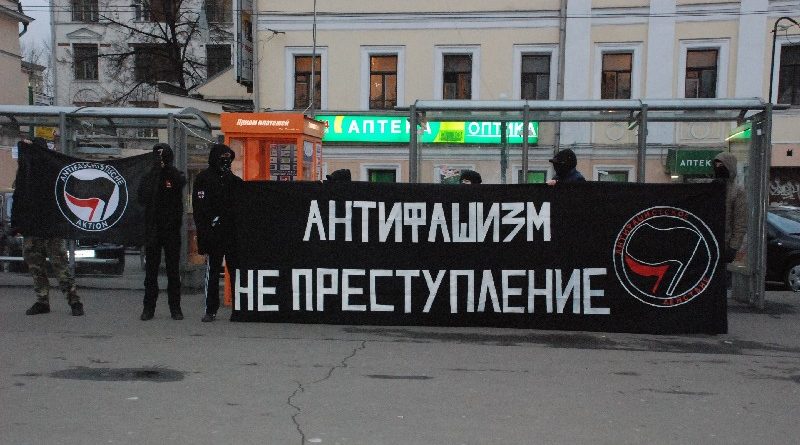
Антифашизм-800x445“Antifascism is not a crime.” Photo courtesy of Movement For Human Rights

Relatives of Defendants in Penza-Petersburg “Terrorism” Case Form Parents Network
Mediazona
April 9, 2018

The website of the Movement For Human Rights (MFHR) reports parents of the arrestees in the Penza-Petersburg “terrorism” case have come together to form The Parents Network: A Committee for Relatives of Arrested Anarchists.

The human rights activists report that a meeting of relatives of the young men accused in the case took place in Moscow on April 7. The loved ones of almost all the defendants in the case came to MFHR’s offices, while two relatives participated in the meeting via Skype.

The arrested men’s loved ones talked about the pressure put on their children and husbands, and the illegal actions of law enforcement officials. At the end of the meeting, the relatives decided to form an organization whose goal would be to mutually support each other as well as interact with the authorities and human rights organizations. MHFR’s website list contact information for the committee’s officers.

In October 2017, Russian Federal Security Service (FSB) officers detained four antifascists in Penza: Yegor Zorin, Ilya Shakursky, Vasily Kuksov, and Dmitry Pchelintsev. In early November 2017, Andrei Chernov was detained in Penza, while Arman Sagynbayev was detained in Petersburg. In January 2018, Igor Shishkin and Viktor Filinkov were detained in Petersburg.

All eight men have been accused of involvement in a “terrorist community,” a crime under Article 205.4 Part 2 of the Russian Federal Criminal Code. The FSB claims the antifascists were members of a terrorist organization, code-named The Network, whose members planned to set off bombs during the March 2018 Russian presidential election and the FIFA World Cup, schedule for this summer in Russia, and thus “sway the popular masses to further destabilize the political circumstances in the country” and spark an armed insurrection.

Several of the defendants, including Pchelintsev, Shakursky, and Filinkov, as well as Ilya Kapustin, a witness detained in Petersburg, said FSB officers tortured them to make them to confess. Members of the Petersburg Public Monitoring Commission certified they found signs of beating and traces of taser burns on Filinkov’s and Shiskin’s bodies. It later transpired that Kapustin left Russia, and Pchelintsev withdrew his testimony after he was beaten in the Penza Remand Prison.

Translated by the Russian Reader. Please read my earlier posts on the Penza-Petersburg  case and two other current cases that also seem to be FSB frame-ups. Also check out the first major international press coverage of the case in Newsweek.

Ping, Ping, Ping: The Remand Extension Hearing of the Penza “Terrorists”

Ping, Ping, Ping: A Report from the Remand Extension Hearing of the Defendants in the Penza “Terrorism” Case
Yegor Skovoroda
Mediazona
March 16, 2018


Ilya Shakursky. Photo courtesy of Yegor Skvoroda and Mediazona

Yegor Svokoroda traveled to Penza, where, over the course of three days, the Lenin District Court considered whether to extend the remand in police custody of the antifascists who, according to the FSB, were part of a “terrorist community” known as The Network.

FSB Senior Investigator Valery Tokarev blushes gradually: first the tip of his nose, then his ears, and finally the bald patch that covers half his head. He is arguing with a lawyer, insting on a closed hearing in order to ensure “investigatory privilege.” The lawyer objects.

“The case is at the evidence gathering stage. We have not finalized all the witnesses or the defendants. A number of parties to the crime have not been identified or are on the wanted list,” says Tokarev, his forehead covered with sweat.

This scene was repeated several times in Penza’s Lenin District Court, where, between March 13 and March 15, the arrest in police custody of five antifascists apprehended and charged with involvement in a “terrorist community” was extended. Time after time, Judge Svetlana Shubina closed the hearings to the public and the press.

Ordering that yet another of the accused be remanded in custody to the local remand prison until June 18, Judge Shubina time after time bases her ruling by referring to the particularly complicated nature of the case and the allegation that each of the young men was a member of a “stable, highly secretive criminal group,” and that “firearms and ammunition” were involved. Shubina notes investigators had to finish their numerous forensic examinations and interrogations, and finally indict Sagynbayev, Pchelintsev, Shakursky, Chernov, Zorin, Kuksov, Ivankin, and Kulkov.

Yegor Zorin, a fourth-year student at the Belinsky Pedagogical Institute, was the first person detained in the investigation of the “terrorist community.” The FSB has alleged its members planned, during the March 18 presidential election and this summer’s FIFA World Cup, to “agitate the masses in order to further destabilize the political situation in the country” by setting off bombs; when the H-hour came, they would lead an armed insurrection. Zorin was apprehended on October 17, 2018. There are unconfirmed reports he signed a confession, which was the basis of Criminal Case No. 11707560001000036, concerning organization of and involvement in a terrorist community, per Article 205.4 Parts 1 and 2 of the Russian Federal Criminal Code.

Zorin’s time in the remand prison was not extended. He was jailed there until December 18 and subsequently transferred to house arrest. The press service of the Lenin District Court told Mediazona, however, that after December 18, investigators had not petitioned the court to extend his arrest.


Arman Sagynbayev. Photo courtesy of Yegor Skvoroda and Mediazona

The next to be apprehended were Zorin’s classmate Ilya Shakursky and their common friend Vasily Kuksov during the wee hours of October 19, 2017. On October 27, Dmitry Pchelintsev was detained; he knew Shakursky through the leftist activist scene and because they shared a hobby: airsoft. On November 6, Arman Sagynbayev was detained in Petersburg. He had been to Penza several times for airsoft practice sessions. He was transferred to the Penza Remand Prison. On November 9, Andrei Chernov, another airsoft player and an old friend of Pchelintsev’s was detained.

A passion for airsoft and a sympathy for leftist ideas, anarchism, and antifascism were what all the detainees had in common. The case files contain videos of training sessions in the woods outside Penza, sessions during which the young men used fireworks. The FSB has alleged that the group training sessions were preparation for the insurrection, while the hikes the young men took in the woods constituted “illegal mastery of survival skills in the woods and rendering of first aid.”The airsoft teams in which the antifascists played, Voskhod (“Sunrise”) and 5.11 (“November Fifth”), were cells of a terrorist organization known as The Network (Set’). Aside from Penza, The Network was alleged to have underground cells in Moscow, Petersburg, and Belarus.*

The FSB has alleged the Penzans divided up the roles in their “terrorist community.” Pchelintsev was the leader and ideologue. His deputy, nicknamed Redhead, handled reconnaissance and recruiting, while Sagynbayev, nicknamed Andrei Security, was the engineer and sapper, Shakursky (aka Spike), the tactician, Chernov (aka Twin), the signalman, Zorin (aka Grisha), the sniper, while a certain Boris was also a coordinator and ideologue.

Redhead is Maxim Ivankin, mentioned in the court’s new custody ruling, while in all likelihood the Boris referred to by the security services is M.A. Kulkov. According to our sources, both men have left Russia and are on the wanted list.

The Lenin District Court occupies a three-storey nineteenth-century mansion whose interior has been modernized. The courtroom where the custody extension hearings take place is located in a wing of the building accessible only through doors outfitted with an electronic lock. To gain access to the hallway leading to the courtroom you have to place a card on the lock, which sets off an obnoxious pinging sound. The squeaky alarm goes off constantly. Ping, ping, ping: terrorist community. Ping, ping, ping: investigative privilege. Ping, ping, ping: extend the arrests.

Ping, ping, ping, ping, ping, ping, ping.


Dmitry Pchelintsev and his wife Angelina. Photo courtesy of relatives

A broad-shouldered FSB guard escorts 25-year-old Dmitry Pchelintsev into the room, not taking his eyes off him the entire hearing. Guards just like him also escort the other detainees. Some of them wear balaclavas to conceal their identities, some wear Buff scarves over their faces. Viktor Filinkov, detained in Petersburg, and Pchelintsev himself recounted how they were tortured by men wearing such masks. Pchelintsev recalled how the officers who tortured him later escorted him to the remand prison.

“When I was tortured with electrical shocks, my mouth was full of ‘crushed teeth’ due to the fact I gritted my teeth since the pain was strong, and I tore the frenulum of my tongue. My mouth was full of blood, and at some point one of my torturers stuck my sock in my mouth,” Pchelintsev told his lawyer in order to explain why he had signed a confession.

Soon, after he was beaten again, Pchelintsev recanted his testimony about being tortured. Pchelintsev, who has thick, kinky eyebrows and slightly protruding ears, worked as a target practice instructor after serving in the army. He wears a checkered shirt whose collar he constantly buttons and unbuttons. Cautious at first, he thaws by the end of the hearing, when he manages to chat with his wife Angelina through the glass of the so-called fish tank in which defendants are held during trials and hearings.

Dmitry laughs, talking about books and Alina Orlova songs. He jokes that during the last hearing he was in handcuffs because “Arman was sitting next to me, and they thought I would attack him.”

Alina Orlova sings “I Stroll Around Moscow,” IKRA Club, Moscow, September 29, 2008

“What should I do with your car?” Angelina asks. The FSB claims to have found two grenades under the seat of the old Lada. Pchelintsev said they were planted there.

“Burn it,” says Dmitry, joking once more.

“I’m afraid I’d be arrested.”

“Yeah, you’d also go to jail for terrorism,” Pchelintsev quips. “Actually, I was told we should take it to the junkyard and sell it for scrap.”

Angelina presses her nose against the glass of the fish tank.

Ping, ping, ping, ping, ping, ping, ping.


Vasily Kuksov. Photo courtesy of relatives

29-year-old design engineer Vasily Kuksov appears to be the most confused and indifferent of all the prisoners. His wife Yelena says Vasily was cheerful and life-affirming prior to his arrest. He enjoyed drawing and was into music, performing a year ago at a Vladimir Vysotsky memorial festival at the Penza Philharmonic. Now his case file describes him as an “individual who leads an isolated lifestyle characterized by antisocial behavior.”

Vasily Kuksov performing at the Penza Philharmonic on January 25, 2017

Kuksov has not complained that FSB officers were violent with him, but his friend Ilya Shakursky recalled that, when they were taken to the FSB building in Penza, first he heard Kuksov’s groan and then later saw him, his face badly mangled. Nevertheless, Kuksov avoided testifying by invoking his right not to incriminate himself under Article 51 of the Russian Constitution.

A pistol was confiscated from his car. According to his loved ones, the gun had been planted there.

Kuksov is the only prisoner whom the investigator allows to talk with his mother for a long time during the recess [sic].

As he listens to the judge’s ruling, Kuksov zips and unzips the zipper of his black winter jacket.

Ping, ping, ping, ping, ping, ping, ping.

“They blindfolded me, tied my hands, and stuck a sock in my mouth. Then I thought they wanted to leave my fingerprints on something, but later they attached wires to my big toes. I felt the first surge of current, and I could not hold back the moaning and shaking. They repeated the procedure until I promised to say what they told me to say. After that, I forgot the word ‘no’ and said everything the officers told me to say,” recalled 21-year-old antifascist Ilya Shakursky.

Shakursky was a classmate of the first person arrested in the case, Yegor Zorin. Both of them were studying to be physics teachers.

Shakursky is a thin young man with a shaved head and a deep wrinkle on his forehead. He is a well-known activist in Penza. He used to be involved with Food Not Bombs, and he was himself always organizing everything from lectures to trips to the woods to pick up trash. Before the antifascist rally held annually on January 19, he sent friends a letter in which he wrote, “If I were on the outside, I would definitely attend the memorial event for two great heroes, Nastya Baburova and Stas Markelov.”

Recently, relations between him and Pchelintsev had been strained. The young men had fallen out over Shakursky’s ex-girlfriend Victoria Frolova. They had fought several days before Shakursky’s arrest. The FSB officers who were staking out the alleged terrorist group were surprised to see two members of the “stable” group brawling.

When the judge reads out the ruling, Shakursky, dressed in a gray track suit, lifts his left eyebrow slightly and folds his hands behind his back.

Shakursky’s mother sobs.

Ping, ping, ping, ping, ping, ping, ping.

When questioning 28-year-old Andrei Chernov’s mother after her son was arrested, the investigator wondered aloud whether she knew he had a secret nickname, Twin.

“He’s had the nickname since he was a kid,” Tatyana Chernova says, recalling her outrage. Next to her is Alexei Chernov, Andrei’s twin brother.


Andrei Chernov. Photo courtesy of Yegor Skvoroda and Mediazona

The Chernov brothers studied in the same department at the pedagogical institute as Zorin and Shakursky, but they dropped out before the other young men had enrolled there. Subsequently, Andrei went to work at a factory where he assembled water heaters. He was apprehended on the shop floor.

According to his defense attorney, Stanislav Fomenko, Chernov had not been subjected to violence by the FSB. Tatyana Chernova adds that her son signed a confession after Dmitry Pchelintsev, who had been tortured, spoke with him. Chernov has now recanted his testimony.

Andrei wrote to his mother that after human rights activists spoke out about the plight of the young men and the press published articles about the so-called Penza Case, the guards and wardens at the remand prison often visited his cell to perform spot checks, videotaping everthing he did.

Chernov was finally examined by an ophthalmologist (there were suspicions he had a detached retina). The doctor for some reason prescribed him antibiotics.

Chernov smiles the most of all the defendants. If it were not for the fish tank, it would be impossible to tell him apart from his brother.

“My son is not guilty of anything. Sure, he played airsoft and studied survival skills, but lots of people are into that. I will fight for my son till the end of my days,” says Tatyana Chernova.

Ping, ping, ping, ping, ping, ping, ping.

No one has come to the courtroom [sic] to support 25-year-old Arman Sagynbayev, transferred to Penza from Petersburg,** and yet he is cheerful and talkative.

Arman was born in Novosibirsk, where his mother, stepfather, ex-wife, and their five-year-old daughter still live.

He has spent the last several years in Petersburg, where he was convicted of petty theft (Article 158 Part 1 of the Criminal Code) and sentenced to a fine of 6,000 rubles. When Sagynbayev’s room was searched, the security services allegedly found a bucket of aluminum powder, four kilograms of ammonium nitrate, two alarm clocks, and various radio components.

After his arrest, Sagynbayev fully acknowledged his guilt. He is still cooperating with investigators. He has no objections when Deputy Prosecutor Sergei Oskolkov moved to extend his arrest.

“He has no complaints. He has not claimed he was tortured. He cooperates with the investigators and gets privileges in return for his cooperation. He was now given the chance to speak with his mother. He spoke with her the entire recess [sic]. Arman has a separate cell,” says his lawyer, Rakhmanova [sic].

In the remand prison, her client, who suffers from a serious illness, receives timely medical care, she emphasizes, without specifying what the illness is

At the beginning of the week, Sagynbayev was sent under armed guard to Saratov, where he was examined at the St. Sophia Regional Clinical Psychiatric Hospital. He is the only suspect in the case who has been made to undergo an inpatient forensic examination.

“He said lots of things to our experts about anarchy and social revolution. They said he was deluded and refused to render an opinion, recommending he be hospitalized,” Rakhmanova explains.

According to the attorney, the doctors in Saratov concluded Sagynbayev was mentally competent.

Ping, ping, ping, ping, ping, ping, ping.

* The name of the airsoft team 5.11 had nothing to do with the revolution allegedly scheduled by nationalist Vyacheslav Maltsev for November 5, 2017. According to various sources, the name refers either to a popular brand of tactical clothing and equipment or to the date when seventeen-year-old Penza anarchist Nikolai Pchelintsev was hanged in 1907. Historians Alexander Kolpakidi and Gennady Potapov write that Pchelintsev took the blame for the murder of a gendarme during a shootout, counting on the court’s mercy towards him as a juvenile, but instead was sentenced to death. His burial site in the Abrekov Woods near Penza is marked by a monument to fallen revolutionaries. Mediazona has been unable to ascertain whether Dmitry Pchelintsev is a distant relative of Nikolai Pchelintsev.

** The FSB apprehended antifascists in Petersburrg late January 2018. According to the FSB, the city was home to two cells of The Network, code-named Jordan and Field of Mars. The investigation of the Petersburg case, Case No. 11807400001000004, is supervised by FSB investigator Gennady Belyayev. After they were detained, Igor Shishkin and Viktor Filinkov confessed their guilt. Filinkov soon recanted what he claimed had been rehearsed testimony and gave a detailed account of how FSB officers had tortured him with an electric shocker. Shishkin has said nothing about torture, but doctors recorded bruises, abrasions, and a fracture to the lower wall of his eye socket, while members of the Petersburg Public Monitoring Commission found numerous traces on his body that resembled burns made by electric wires.

Translated by the Russian Reader

If you have not heard about the Penza-Petersburg “terrorism” case and the related crackdown against Russian grassroots and political activists on the eve of the March 18 Russian presidential election, you need to read the following articles and spread the word.


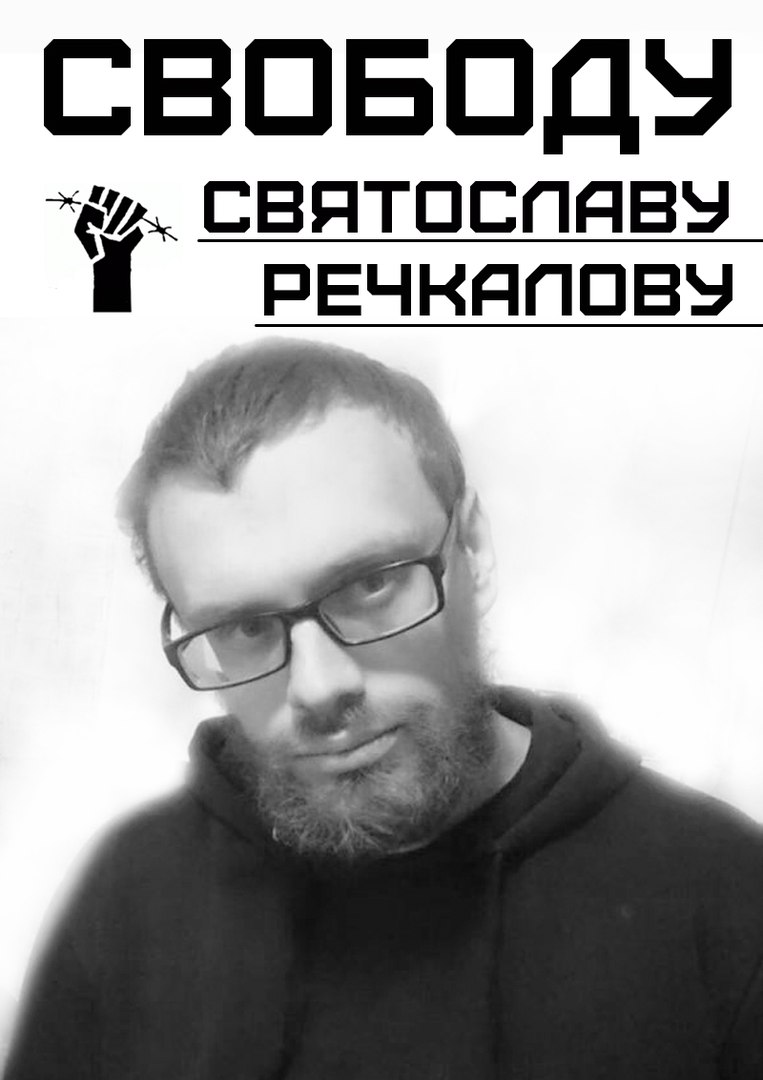
Svyatoslav Rechkalov: “They Proceeded to Pull Down My Trousers, Threatening to Shock Me in the Groin”

“They Proceeded to Pull Down My Trousers, Threatening to Shock Me in the Groin”: Anarchist Svyatoslav Rechkalov Relateds How He Was Tortured and Beaten after Police Detained Him in Moscow
Mediazona
March 15, 2015

Anarchist Svyatoslav Rechkalov, apprehended by police on March 14, has told Yevgeny Yenikeyev and Kogershyn Sagiyeva, members of the Moscow Public Monitoring Commission (PMC), how he was tortured with electric shocks and beaten in police custody. To corroborate his statement, he showed the members of the PMC the traces left by the electric shocker: “[D]ifferently sized red dots on the outside of the hips and the knee.” The injuries were recorded by a paramedic at the Temporary Detention Center where Rechkalov is currently incarcerated. He and several other people were detained as part of the investigation of an attack in January on a United Russia party office in the Moscow neighborhood of Khovrino. Persons unknown shattered a window in the office and tossed a smoke grendade [sic: Grani.ru has reported it was a lighted flare] into the premises. Yelena Gorban and Alexei Kobaidze were detained on charges of vandalism, but were later released on their own recognizance. Below, we have published a transcript of Rechkalov’s handwritten statement. Yevgeny Yenikeyev posted a scan of the statement on his blog.

* * * * * * * * * *

At seven a.m. on March 14, 2018, police officers came to the flat where I live, at [address deleted], to search it. They knocked down the door, and then the search took place. Around twelve noon, I was taken from the building. I was blindfold with black adhesive tape, my hands were tied, and I was put in a minivan. I was driven around the city for several hours, and then placed in a GAZelle van containing police officers. My flatmates E. Sergeyeva and Yevgeny Popov were also in the van. Before I was placed in the van, the tape was removed from my eyes and my hands were untied.

After some time, I was put back in the minivan. A plastic bag was put over my head and I was handcuffed. In the minivan, two men whom I did not know asked me questions about the anarchist movement Popular Self-Defense (Narodnaya samooborona) and different people. How had I ended up in the movement? What did I have to do with it? What protests had I been involved in? What were the same people they had asked me up to? When I would refuse to answer or give an unsatisfactory reply, I was shocked with electrical current on the outside of my hips and the vicinity my knee (above and below the knee). They mostly shocked me in the left leg. At the moment, traces of the shocks are visible on my legs in the form of red dots.

From time to time, my interlocutors would get out of the minivan, and then two or three men would punch me in the body and legs, and shock my legs. The punches were mainly aimed at my lower back and were not hard. The electric shocks were their main method of working me over. The duration and intensity of the shocks increased. The men demanded I answer all their questions.

When they proceeded to pull down my trousers, threatening to shock me in the groin, I made up mind to incriminate myself in the vein in which the men were demanding I do. I confessed I was admin of Popular Self-Defense’s VK page, and a leader and organizer of the movement. If I refused to testify [later] to the investigator or went public with the fact I had been tortured and beaten, the men threatened to take me on a second trip with the electric shocker, a longer and more harrowing trip, and they promised to charge me in The Network case [meaning the so-called terrorist community The Network. The FSB has detained several anarchists in Penza and Petersburg in the case, and many of them have claimed they were tortured—Mediazona] and make the conditions of my stay in the Temporary Detention Center and Remand Prison difficult. My sense is I spent around an hour in the minivan.

Svyatoslav Rechkalov

I was then taken to a police precinct near the Tulskaya subway station, but maybe it was the Moscow police’s investigative department; I don’t know for sure. Around four p.m. I was taken into a room where Center “E” (Extremism Prevention Center) officers were seated. There, in the presence of Investigator Kostin, I repeated what the men in the minivan had demanded I say. One of the Center “E” officers in the room had been at my place during the search in the morning.

I was then taken off to be interrogated as a witness in the investigation of the case of vandalism against the United Russia party office. Aside from the investigator, whose surname I cannot remember, there were men in plain clothes in the room, including Center “E” officers. I testified in the vein in which I had been asked to testify, identifying myself as an admin of Popular Self-Defense’s VK page and an organizer of the movement. The men demanded I incriminate other people, which I refused to do. In the presence of the investigator, the men in plain clothes in the room threatened to take me on another trip in the minivan, after which I refused to give any more testimony. As a result of threats and coercion, I signed a transcript of my earlier testimony to the effect that I was a leader, organizer, and admin of Popular Self-Defense. That testimony was obtained through torture and threats of further torture.

My interrogation as a witness ended at approximately six p.m., after which I was kept at the police precinct until around nine-thirty p.m. Before this, I had demanded to call a lawyer of my choice, but I was not allowed to do this and was provided with a state-appointed lawyer. During my interrogation as a suspect, I repeated the testimony I had given earlier as a witness. I testifed because I was afraid they would torture me again and because I had given the same testimony as a witness. The interrogation ended at eleven p.m.

I spent the next eight hours in the police precinct until I was taken to the Temporary Detention Center by armed guards at around seven in the morning on March 15.

I am afraid the torture and pressure will continue, that my testimony, obtained through torture, will be entered into the case file, and that the threats to implicate me in The Network case will be carried out.

Thanks to Comrade TR for the heads-up. Translated by the Russian Reader
If you haven’t heard about the Penza-Petersburg “terrorism” case and the related crackdown against Russian grassroots and political activists on the eve of the March 18 Russian presidential election, you need to read the following articles and spread the word.