When the Russian Security Services Torture You, It’s Not a Crime

0604a889ed61d14cc21d41136fb478e8_1400x850 (1)

FSB and Russian Interior Ministry Oppose Criminalizing Torture
Mediazona
January 29, 2019

The FSB (Russian Federal Security Service) and Russian Interior Ministry have opposed amending the Russian Criminal Code to define torture as a discrete instance of official criminal misconduct, arguing it would be “superfluous,” according to the security service’s published response to a recommendation made by the Russian Presidential Council for Civil Society and Human Rights.

According to the FSB, torture was covered by Russian Criminal Code Articles 117.2.d (“maltreatment involving torture”) and 286.3.a  (“abuse of authority involving torture”).

The Interior Ministry voiced a similar opinion, listing the articles of the Criminal Code that, in its opinion, “fully” treat actions meeting the definition of torture.

The FSB has also opposed establishing a single database of detainees that would enable  loved ones of criminal suspects and people charged with crimes, as well as lawyers and members of the Public Monitoring Commissions, to discover their whereabouts.

The FSB argued this would enable people not involved in criminal investigations but who had a stake in their outcome, including criminal accomplices, to access information. It noted a database of this sort could threaten national security when cases of treason and espionage were investigated.

In September 2018, the Presidential Council for Civil Society and Human Rights held a special sixty-fourth session dealing with observation of the principles of openness and legality in penal institutions.

The council made a point of recommending the criminalization of torture per se in order to bring Russian criminal law into compliance with the UN Convention against Torture and Other Cruel, Inhuman or Degrading Treatment or Punishment.

The UN Committee against Torture has on several occasions recommended that Russia explicitly criminalize torture, but Russian authorities have ignored the recommendations, citing the articles in the Russian Criminal Code dealing with “maltreatment.”

“The conclusion here is that the Russian Federation is unable to explain how it prosecutes torture. This is simply not good enough,” Jens Modvig, chair of the UN Committee against Torture, said during a July 26, 2018, meeting in Geneva to discuss the sixth periodic report by the Russian Federation on its efforts to implement the Convention against Torture.

Translated by the Russian Reader. Illustration by Anna Morozova. Courtesy of Mediazona

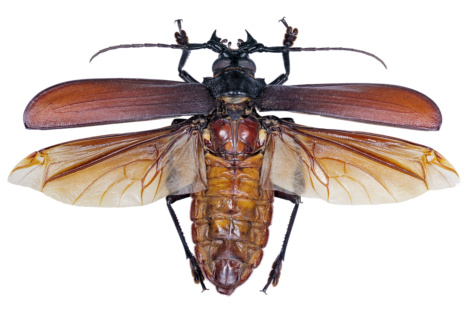
Titan Beetles

titan beetle

“The titan beetle (Titanus giganteus) is a neotropical longhorn beetle, the sole species in the genus Titanus, and one of the largest known beetles. […] The short, curved and sharp mandibles are known to snap pencils in half and cut into human flesh. […] The adults defend themselves by hissing in warning and biting, and have sharp spines, as well as strong jaws.” Source: Wikipedia. Photo courtesy of Fluencia

Russian Government Approves Bills to Punish Fake News and “Flagrant Disrespect for the State” on the Internet
Mediazona
January 24, 2019

The Russian government has approved a bill criminalizing “flagrant disrespect for the state on the internet,” as well as stipulating fines for disseminating fake news, reports Interfax, which quotes Pavel Krasheninnikov, chair of the State Duma’s state building and legislation committee.

According to Krasheninnikov, the government’s commentary on the two law bills, which his committee had been waiting for, arrived tonight. Both reviews were positive.

Yesterday, the Prosecutor General’s Office sent the Duma a positive comment on the law bills, although previously it had refused to approve them.

In December 2018, MPs from the United Russia party tabled a law bill that would amend Article 20.1 of the Administrative Offenses Code (petty misconduct) by criminalizing the dissemination on the internet of information that “expresses in indecent form” a flagrant disrespect for society, the state, state symbols, and state bodies.

The law bill stipulates punishing violators with fines of up to 5,000 rubles or fifteen days in jail.

In addition, the bill’s drafters propose fines between 30,000 rubles and a million rubles for publishing false information.

Translated by the Russian Reader

“If It Were Up to Me, I Would Kill You”

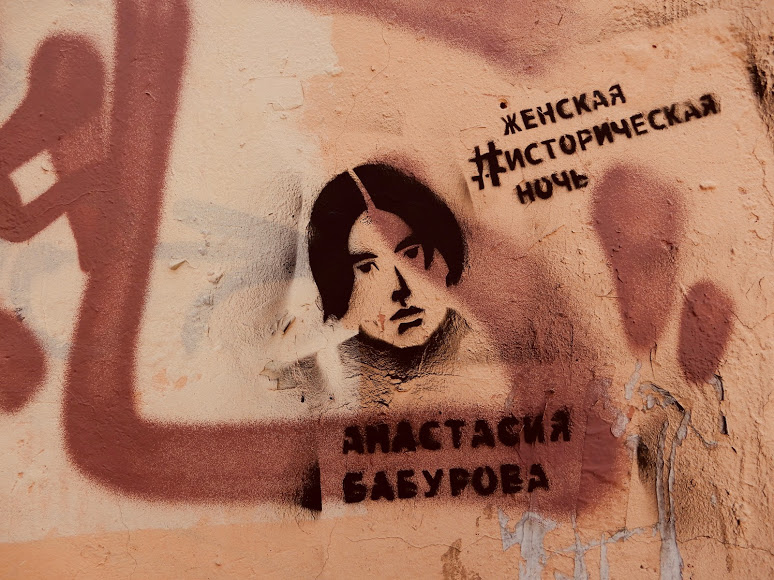
baburova-women's historical night“Anastasia Baburova. #Women’s History Night,” Central Petersburg, May 22, 2018. Photo by the Russian Reader

Marchers Detained at Markelov and Baburova Memorial Event in Moscow
Mediazona
January 19, 2019

Police have detained people attending a march in Moscow marking the tenth anniversary of the murders of human rights lawyer Stanislav Markelov and Novaya Gazeta reporter Anastasia Baburova, Kommersant reporter Alexander Chernykh has reported on his Telegram channel.

According to Chernykh, police have detained journalist Igor Yasin, who was carrying a rainbow-colored flag, and five other people. The reasons for their arrests are unknown. The march has been halted.

OVD Info has reported that four people have been detained. Aside from Yasin, the detainees include Nikolai Kretov, Dmitry Borisenko, and Mikhail Komrakov.

Komrakov told OVD Info that when he was detained, a policeman said to him, “If it were up to me, I would kill you.”

According to Kretov, policemen hit him after he was put in a paddy wagon.

The Markelov and Baburova memorial march began at two o’clock on Tverskaya Boulevard and was scheduled to end with the laying of flowers at the spot where they were murdered on Prechistenka Street.

On January 19, 2009, Nikita Tikhonov, a member of the Russian neo-Nazi organization BORN (Combat Organization of Russian Nationalists), shot and killed Markelov and Baburova in downtown Moscow in broad daylight. Tikhonov and his accomplice Yevgenia Khasis were subsequently convicted and sentenced to life imprisonment and eighteen years in prison, respectively.

Translated by the Russian Reader

Jenya Kulakova: A New Year of Sorts

jenya-napkin“January 17: Room 33, City Court. Viktor, 12:00 p.m., Yuli, 2:00 p.m. January 19: Open Space. Exhibition, reading, 7:00 p.m.” Image courtesy of Jenya Kulakova

Jenya Kulakova
Facebook
January 15, 2019

Viktor and Yuli, 12:00 p.m. and 2:00 p.m., January 17, Room 33, Petersburg City Court.

I have been getting into the “New Year’s mood” only now. What I mean is that is only now I have realized it will soon be a year since news a friend had been detained by the cops marked the start of a new life that has been going on in my head nonstop since then: care packages, remand prison, torture, parcels, remand prison, transfers, letters, remand prison, court hearings, remand prison.

I have been corresponding with nearly all the suspects in the so-called Network case. I have no idea how they manage to keep fighting, making jokes, and drawing goofy pictures.

The main question I tried out on myself during the past year was how you can endure having to support a loved one who is in jail by yourself or even as a part of a single family.

To put it bluntly, how do you make sure he has food to eat, clothes to wear, books to read, and medical care?

My opinion is that you cannot do it, no way, no how. There are a lot more than one of us trying to take care of the Network suspects, but there are so many things to do, an endless list of daily chores.

I am amazed my job still puts up with it.

The approach of this “new year” makes me really sad.

Actually, this has been my attempt to write a post about the upcoming custody extension hearings of Viktor Filinkov and Yuli Boyarshinov.

Since a “new year” in remand prison is just around the corner for them, the Petersburg City Court will decide whether extend their police custody.

There is a glass-enclosed statue of Themis at the city court. There is also a chance we won’t be herded into the basement, as happened during their last hearing at the Dzerzhinsky District Court. Maybe we will even be permitted to wave at the guys as they are marched past us by the guards and bailiffs.

Anyone who has the time and energy should come to the hearings. It would be great if there were tons of us there, so the guys could see us and have cause to rejoice. It would also be great if we were admitted into the courtroom before the hearing was once again declared closed to the public.

Such are the paltry and huge hopes you foster.

Viktor, Yuli and us, 12:00 p.m. and 2:00 p.m., January 17, Room 33, Petersburg City Court.

January 19 is the tenth anniversary of the murders of Anastasia Baburova and Stanislav Markelov. The authorities in Petersburg have refused to authorize any rallies or marches on the occasion. In the afternoon, people will lay flowers in their memory at Mikhail Shemyakin’s sphinxes, the monument to victims of political terror directly across the Neva River from the old Crosses prison.  (Why go there all of sudden? I have no could.)

In the evening, an exhibition dealing with both the Network case, and Baburova and Markelov opens at seven o’clock at Open Space. It will feature prison drawings and poems, pieces by artists who are in solidarity with the Network suspects, and a group reading of antifascist texts, as well as of letters sent by the guys from remand prison.

You should come to that, too.

This was how Dmitry Pchelintsev signed his final letter of 2018 to me: “Here’s wishing you a good 2019, the last episode of the season.”

My thanks to Ms. Kulakova for her permission to translate and publish this text here. 

__________________________________


818c25b6ca9ea366405b1f5ce30741c1Viktor Filinkov. Photo by Jenya Kulakova. Courtesy of Mediazona

Court Extends Police Custody of Penza Case Suspects Viktor Filinkov and Yuli Boyarshinov
Mediazona
January 17, 2018

St. Petersburg City Court extended the police custody of Viktor Filinkov, accused of involvement in the so-called terrorist community known as the Network, reports the Petersburg Judicial Press Service.

During the hearing, the case investigator argued Filinkov’s police custody should be extended because he needed to review the final eight volumes of the seventeen-volume case file. Besides, the investigator noted, Filinkov had refused to give testimony in the case and admit his guilt.

Filinkov’s defense attorney asked the judge to put him under house arrest, but, allegedly, had failed to file papers confirming this would be possible. The defense attorney also told the that his client was a law-abiding national of another country [Kazakhstan] who would be willing to give testimony, but not to investigators who had tortured him.

Later the same day, St. Petersburg City Court extended the police custody of another suspect in the Penza Case, Yuli Boyarshinov, for two months.

Earlier in the week, a court in Penza concurred with similar arguments made by the investigator there and extended the police custody of the other suspects in the case until April 18.

Translated by the Russian Reader

______________________________________

What can you do to support the Penza and Petersburg antifascists and anarchists who have been tortured and imprisoned by the Russian Federal Security Service (FSB)?

  • If you are in London or can get to London on January 19, join the solidarity demo at the Cable Street Mural at 2 p.m. The demonstration is supported by Anarchist Communist Group, Anarchist Federation, Brighton Antifascists, Bristol Anti-Fascists, Brazilian Women against Fascism, Feminist Fightback, London Antifascists, London Anarchist Black Cross, North London Anti-Fascists, Plan C LDN, RS21, and Labour Briefing. Please email london19jan(at)riseup.net to add your organization to the list of supporters. More information about the Cable Street Mural and its location can be found on its Facebook page.
  • Donate money to the Anarchist Black Cross via PayPal (abc-msk@riseup.net). Make sure to specify your donation is earmarked for “Rupression.”
  • Spread the word about the Network Case aka the Penza-Petersburg “terrorism” case. You can find more information about the case and in-depth articles translated into English on this website (see below), rupression.com, and openDemocracyRussia.
  • Organize solidarity events where you live to raise money and publicize the plight of the tortured Penza and Petersburg antifascists. Go to the website It’s Going Down to find printable posters and flyers you can download. You can also read more about the case there.
  • If you have the time and means to design, produce, and sell solidarity merchandise, please write to rupression@protonmail.com.
  • Write letters and postcards to the prisoners. Letters and postcards must be written in Russian or translated into Russian. You can find the addresses of the prisoners here.
  • Design a solidarity postcard that can be printed and used by others to send messages of support to the prisoners. Send your ideas to rupression@protonmail.com.
  • Write letters of support to the prisoners’ loved ones via rupression@protonmail.com.
  • Translate the articles and information at rupression.com and this website into languages other than Russian and English, and publish your translations on social media and your own websites and blogs.
  • If you know someone famous, ask them to record a solidarity video, write an op-ed piece for a mainstream newspaper or write letters to the prisoners.
  • If you know someone who is a print, internet, TV or radio journalist, encourage them to write an article or broadcast a report about the case. Write to rupression@protonmail.com or the email listed on this website, and we will be happy to arrange interviews and provide additional information.
  • It is extremely important this case break into the mainstream media both in Russia and abroad. Despite their apparent brashness, the FSB and their ilk do not like publicity. The more publicity the case receives, the safer our comrades will be in remand prison from violence at the hands of prison stooges and torture at the hands of the FSB, and the more likely the Russian authorities will be to drop the case altogether or release the defendants for time served if the case ever does go to trial.
  • Why? Because the case is a complete frame-up, based on testimony obtained under torture and mental duress. When the complaints filed by the accused reach the European Court of Human Rights in Strasbourg and are examined by actual judges, the Russian government will again be forced to pay heavy fines for its cruel mockery of justice.

***************

If you have not been following the Penza-Petersburg “terrorism” case and other recent cases involving frame-ups, torture, and violent intimidation by the Russian Federal Security Service (FSB) and other arms of the Russian security state, read and share the articles the Russian Reader has posted on these subjects.

The Media’s Russia Obsession?

trumputin

Let’s talk about the media’s so-called Russia obsession for a few minutes.

What is meant by this is that the mainstream press have devoted tons of coverage to the substantial allegations that the Kremlin mounted a massive operation, mostly via social media, to influence the outcome of the 2016 US presidential election and, further, that the campaign of the candidate who won the election actively colluded with the Kremlin, among other things, in order to discredit the candidate’s main opponent in the election. The press has also focused a lot on Robert Mueller’s special investigation of these allegations.

Is all of this press coverage sterling? No. Does the press get the story wrong sometimes? Yes.

But this has always been the case with the nominally free press in nominally democratic societies ever since the free press emerged in the eighteenth century in a few countries groping their way towards democracy. It always been biased, prone to mistakes, and otherwise wildly imperfect. And yet it has always been subject to intense scrutiny, at least in my lifetime—and the really infantile desire on the part of certain social and political forces that it be perfect—that is, perfectly biased and ventriloquizing only their viewpoints—although these same forces are rarely so critical of either themselves or other important social institutions.

In this case, the social and political forces that routinely complain about the media’s so-called Russia obsession seem to mean, in fact, that the mainstream press and the press in general should simply stop covering what is surely the story of the century: allegations that the world’s largest country massively intervened in a presidential election in the world’s most powerful country, and that the man who won the election and members of his campaign and transition team were in close contact with agents of the world’s largest country during the campaign and transition.

What kind of press would we have if they completely ignored this story?

We would have a press much like the press in the world’s largest country, which routinely ignores or severely undercovers really big stories—such as the country’s involvement in putting down a popular revolution in a third country whose people have never down anything bad to the people of the world’s largest country—or which engages in outright Goebbels-like propaganda nearly every day, leaving the really important stories to opposition liberal newspapers and online media outlets that are read and accessed by a tiny fraction of the country’s populace.

Finally, the mainstream media have not been obsessed with Russia itself, but with the alleged actions of the Kremlin, Russian secret services, and Russian internet trolls in connection with the 2016 US presidential election. Period.

There is a another Russia, populated by 143 million people, that had nothing whatsoever to do with the story of the century. They did nothing to skew the outcome of the 2016 US presidential election and, in the main, their lives, aspirations, and actions are roundly ignored by the so-called mainstream media in the west and Russia itself. They are roundly ignored by the so-called alternative media, too, for the simple reason that much of the alternative media in the west operate under the delusion that Putin is an “anti-imperialist.” By definitions, Russians who oppose his sagacious rule must be “puppets of the west.”

If all of this weren’t the case, I would have expected that one or more of these “Russia-obsessed” or “anti-Russian-obsessed” newspapers, magazines, TV channels or websites would have picked up and covered, for example, the shocking story of the Penza-Petersburg “terrorism” case aka the Network case, in which eleven young anarchists and antifascists have been accused of involvement in a “terrorist community” dubbed “the Network.”

Most of the accused men have told the same grisly tale of being abducted by FSB-KGB field agents, who took them to remote areas in minivans or to the basements of their headquarters and tortured them for hours, using tasers and bare electrical wires, and severe beatings, attempting to force them to memorize the “confessions” they would later make (or, in some cases, refuse to make) to FSB investigators, who would then petition the courts to send them to remand prisons, where all of them are still imprisoned to this day.

The allegations of torture have been confirmed by Russian civil rights activists and defense attorneys who spoke with some of the men soon after their arrests and, in a few cases, they were also confirmed by physicians who examined the men when their wounds were still fresh.

In any case, a small but growing group of very determined people, including the men’s parents, friends, reporters, human rights activists, and concerned citizens, have been working as hard as they can over the last year to bring the case to the attention of the wider Russian public, force prosecutors to investigate the allegations of torture by FSB officers, and otherwise prove that, as seems to be the case, the FSB conjured the entire tale of the “terrorist community” from whole cloth and then handpicked a dozen or so completely innocent young men to be the fallguys, trying to torture and pummel them into admitting their “guilt” although they were guilty of no crime at all.

You would think the “Russia-obsessed” corporate media would jump on a story like this, but except for one article in the New Yorker, the western corporate media have utterly ignored the story of the Network “terrorists,” despite the efforts of actual alternative media like openDemocracyRussia (oDR) and my own blog, the Russian Reader, to write about it any chance we can and translate Russian coverage of the case, as published in such as liberal, leftist and civil rights media outlets as Mediazona, OVD Info, and Novaya Gazeta.

The campaign to save the Network boys scored a minor victory the other day during a meeting of the Presidential Council for Civil Society and Human Rights, when several members of the council brought up the case and a similar case no less shocking, the New Greatness case, and forced President Putin to talk about them.

A KGB-FSB officer to the core, Putin pretended not to have heard of the cases, which both pivot on allegations of extreme entrapment, torture, and fabrication by other KGB-FSB officers.

Putin hemmed and hawed, lied and prevaricated, feigned that he couldn’t believe what he was hearing, etc., but he did promise to look into the cases and get to the bottom of them.

It’s entirely possible he won’t do that, but it’s just as possible he will make the cases quietly go away to avoid embarrasment.

Who knows.

What I do know, though, is that western mainstream and alternative media, all of them “obsessed” with Putin (but not Russia) in their own way, have shown no interest in this story and thousands of other similar and dissimilar but no less fascinating stories from the real Russia inhabited by most Russians.

There was a slight uptick in their interest in grassroots Russia during the 2011–2012 fair elections protests, but since that movement was roundly defeated, western press coverage has been firmly refocused on the beloved hated figure of the supreme leader, thus once again denying nearly all the other 143 million Russians of agency, their own opinions, and their own lives.

If you’re interested in the Network case and related stories, please check out the coverage on oDR and the Russian Reader. Outside of Russia, practically speaking, there has been no coverage of the case anywhere else, and most things you read on international anarchist and antifascist websites are reprints of the stories we have translated and published.

So, let’s put this canard about the media’s Russia obsession to rest, okay? It’s deeply offensive to ordinary smart Russians, whose numbers are much greater than you would be led to think by the mostly lazy coverage of the country in the western press, and just as offensive to the handful of non-Russians who care deeply about what goes on here. {TRR}

P.S. You can support the Network suspects and their families concretely by donating to a solidarity campaign organized by comrades in London on their behalf. Your support will help to offset their legal costs, organizing humanitarian support for the arrested and offering support to their relatives. The resources gathered have so far been distributed according to the financial circumstances of the respective families and the needs of the arrested. Further financial support is being distributed according to the choices made by those arrested throughout the investigation.

Cartoon courtesy of JA and Union Thugs 

Out Through the In Door, or, The Victim Is Always the Guilty Party

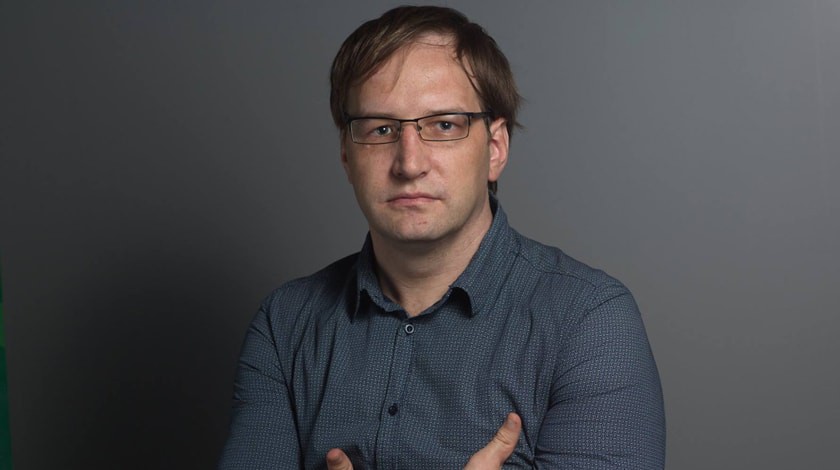
yevgeny kurakinYevgeny Kurakin. Courtesy of Facebook and Daily Storm
Journalist Yevgeny Kurakin Detained after Release from Special Detention Facility 
Mediazona
September 30, 2018

Journalist Yevgeny Kurakin has been detained in the Moscow Region city of Elektrostal. Kurakin was scheduled to be released from a special detention facility after ten days in jail for an administrative violation, Vera Makarova, who had planned to meet Kurakin when he left the facility, told OVD Info.

According to Makarova, the journalist was scheduled to be released at 5:30 p.m. At 5:30 p.m., five people in plain clothes entered the facility, soon emerging with Kurakin in their custody. They put him in an unmarked car and drove away.

Kurakin managed to tell Makarov that three of the people in plain clothes were police officers, while the other two were official witnesss. The people detaining Kurakin told him they had an order to take him into custody without giving him any of the details. Makarova thought Kurakin may have been taken to the police station in Balishikha.

On September 21, a court in Reutov sentenced Kurakin to ten days in jail after finding him guilty of failure to pay a fine (Administrative Offenses Code 20.25 Part 1), which he had been ordered to pay in June after he was found guilty of violating Administrative Offense Code 6.1.1 (battery).* In addition to the fine, he was then also sentenced to fifteen days in jail. According to Kurakin, he paid the fine immediately.

*“Kurakin was detained on his way to a public meeting with Moscow Region Governor Andrei Vorobyov. Kurakin said the cause of his arrest was an incident that had taken place at the Territorial Electoral Commission during the March 2018 presidential election. According to Kurakin, who was involved in the commission, he discovered “systematic blockage of telephone and internet connection at polling stations in the city in order to hinder election observers.” When Kurakin attempted to switch off a blocking device, a member of the electoral commission at Polling Station No. 2639 assaulted him. The man subsequently filed charges against Kurakin with the police.” Source: Mediazona

Translated by the Russian Reader

Shakursky and Pchelintsev Formally Indicted for Organizing “Terrorist Community”

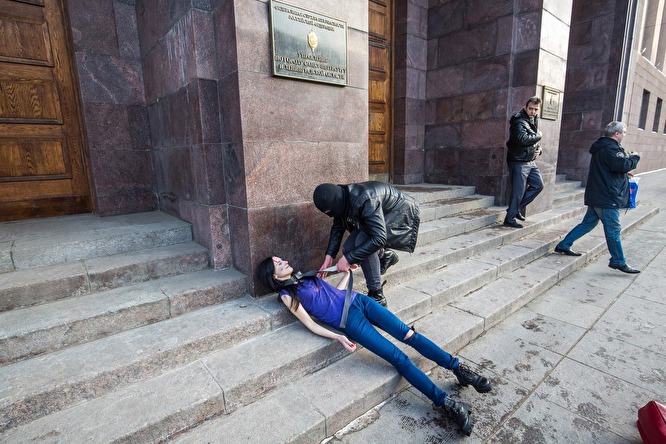
znakcom-1838828-666x444Protest against the Penza-Petersburg “terrorism” case on the steps of FSB headquarters in Petersburg, February 2018. Photograph by David Frenkel. Courtesy of Znak.com

Penza-Petersburg “Terrorism” Case Suspects Shakursky and Pchelintsev Charged with Organizing Terrorist Community
Mediazona
September 10, 2018

Penza-Petersburg “terrorism” case suspects Dmitry Pchelintsev, Ilya Shakursky, and Arman Sagynbayev have been formally indicted. Now Pchelintsev and Shakursky, who earlier were accused of involvement in the alleged “terrorist community” the Network, have been indicted for organizing it, per Article 205.4 Part 1 of the Russian Federal Criminal Code. Mediazona heard the news from the Parents Network, a committee formed by relatives of the young men arrested and accused in the case.

In keeping with previous accusations, Sagynbayev was indicted for involvement in a “terrorist organization,” per Russian Criminal Code Article 205.4 Part 2. During the reading of the indictment, he recanted his previous testimony, saying he had given it under duress. Mediazona has published Sagynbayev’s deposition to his defense attorney, in which he recounts how FSB field agents tortured him after after they detained him in Petersburg.

With the lawyer present, an FSB investigator pressured Sagynbayev for approximately five hours, but the accused man nevertheless failed to confess his guilt. Subsequently, a FSB field agent visited Sagynbayev in the Penza remand prison and threatened to send him “to the north, to Sentsov,” but explained he still could change his testimony.

As our sources in the Parents Network recounted, during the reading of the indictment, the FSB investigator showed Pchelintsev two written conclusions. In the first, it said Pchelintsev had confessed his guilt and was charged with violating Criminal Code Article 205.4 Part 2, which stipulates a penalty of five to ten years in prison. In the second, it said Pchelintsev had not admitted his guilt and was charged with violating Article 205.4 Part 1, punishable by fifteen to twenty years in prison.

None of the indicted men pleaded guilty.

Translated by the Russian Reader

***************

What can you do to support the Penza and Petersburg antifascists and anarchists tortured and imprisoned by the FSB?

  • Donate money to the Anarchist Black Cross via PayPal (abc-msk@riseup.net). Make sure to specify your donation is earmarked for “Rupression.”
  • Spread the word about the Network Case aka the Penza-Petersburg “terrorism” case. You can find more information about the case and in-depth articles translated into English on this website (see below), rupression.com, and openDemocracyRussia.
  • Organize solidarity events where you live to raise money and publicize the plight of the tortured Penza and Petersburg antifascists. Go to the website It’s Going Down to find printable posters and flyers you can download. You can also read more about the case there.
  • If you have the time and means to design, produce, and sell solidarity merchandise, please write to rupression@protonmail.com.
  • Write letters and postcards to the prisoners. Letters and postcards must be written in Russian or translated into Russian. You can find the addresses of the prisoners here.
  • Design a solidarity postcard that can be printed and used by others to send messages of support to the prisoners. Send your ideas to rupression@protonmail.com.
  • Write letters of support to the prisoners’ loved ones via rupression@protonmail.com.
  • Translate the articles and information at rupression.com and this website into languages other than Russian and English, and publish your translations on social media and your own websites and blogs.
  • If you know someone famous, ask them to record a solidarity video, write an op-ed piece for a mainstream newspaper or write letters to the prisoners.
  • If you know someone who is a print, internet, TV or radio journalist, encourage them to write an article or broadcast a report about the case. Write to rupression@protonmail.com or the email listed on this website, and we will be happy to arrange interviews and provide additional information.
  • It is extremely important this case break into the mainstream media both in Russia and abroad. Despite their apparent brashness, the FSB and their ilk do not like publicity. The more publicity the case receives, the safer our comrades will be in remand prison from violence at the hands of prison stooges and torture at the hands of the FSB, and the more likely the Russian authorities will be to drop the case altogether or release the defendants for time served if the case ever does go to trial.
  • Why? Because the case is a complete frame-up, based on testimony obtained under torture and mental duress. When the complaints filed by the accused reach the European Court of Human Rights in Strasbourg and are examined by actual judges, the Russian government will again be forced to pay heavy fines for its cruel mockery of justice.

***************

If you have not been following the Penza-Petersburg “terrorism” case and other recent cases involving frame-ups, torture, and violent intimidation by the Russian Federal Security Service (FSB) and other arms of the Russian police state, read and republish the recent articles the Russian Reader has posted on these subjects.

Arman Sagynbayev: I Was Tortured by the FSB

“Two Wires Came Out of the Box”: Penza-Petersburg “Terrorism” Case Suspect Arman Sagybayev Says FSB Tortured Him with Electrical Shocks in Minivan
Mediazona
September 6, 2018

sagynbayevArman Sagybayev. Photo courtesy of Mr. Sagynbayev and Mediazona
Antifascist and anarchist Arman Sagynbayev, who was arrested and remanded in custody as part of the Penza-Petersburg “terrorism” case, had until recently admitted his guilt. On September 4, he withdrew his confession, explaining that initially he had been tortured into testifying against himself and other young men arrested in the case, and then had been afraid to go against case investigators. His defense counsel has sent a statement to the Russian Federal Investigative Committee. Mediazona has published Sagynbayev’s deposition to his lawyer, in which Sagynbayev recounts how FSB field agents tortured him after detaining him in Petersburg.

In November 2017, officers of the Russian FSB [Federal Security Service] used unlawful investigative methodw (torture) against me. The circumstances were as follows.

On 5 November 2017, at approximately six o’clock in the morning, the doorbell of an apartment at [omitted] in St. Petersburg, where I was located at the time, rang. I opened the door, since when I had asked who was there, I was told the neighborhood beat cop was at the door. As soon as I opened the door, at least four men burst into the apartment. They yelled that they were from the FSB. They pushed a weapon (pistol) into my face before making me face the wall and handcuffing me with my hands behind my back. The men searched the apartment.

When the search was over, I was taken to a burgundy colored minivan parked next to the house whose address I have given. I would be hard pressed to name the vehicle’s make and model. A cloth sack was put over my head when I was in the vehicle. One of the men hit me in the body and head, demanding I tell them where I actually lived in St. Petersburg.

I could see through the fabric of the sack over my head that the man beating me was thickset and had blue eyes. I also made out the tattoo on the backside of his left hand: “For the Airborne Forces.” Later, I heard the other FSB officers call him [omitted].

Unable to withstand the beating, I told them where I actually lived in St. Petersburg: [omitted]. I was taken to the address I gave them, and there the men conducted a search without producing a warrant and without having official witnesses present [as required by Russian law].

When the search was finished, I was again put in the minivan and the sack was put over my head. At some point, I realized we were leaving St. Petersburg, but I had no way of knowing where we were going. I had a sack over my head and was handcuffed during the entire trip.

As we drove, I noticed that the man with the Airborne Forces tattoo, who had assaulted me, pulled a brown box from under his seat. There were two switches of some kind on the sides of the box. I cannot say what they were for. It is possible they controlled the intensity of the electrical current. Two wires came out of the box, which were attached to my thumbs. I was told they would check whether they had a current or not. I then experienced agonizing pain. I realized they were shocking me with electric currents. Meanwhile, the men in the vehicle asked me different questions. For example, I was asked to identify people whom I did not know, and when I said I did not know them, I would be shocked with the electrical current.

The men also hit me hard over the head with an object that resembled a day planner. When they realized I could not identify the people they named, they asked me other questions, for example, how to manufacture explosive devices and what parts were used in those devices. When my answers did not satisfy the men, I was hit over head and shocked with electrical current until I told them what they wanted to hear. They also told me that if I were not cooperative, they could do anything whatsoever to me and my loved ones, and they would get away with it, because I was a terrorist. They told me they could rape (“gang-bang”) my girlfriend [omitted], cut off her hands and my hands, and burn us with a soldering iron.

The torture lasted for around four hours, but I cannot say for sure, since I had no way of keeping track of the time, and I was in a great deal of pain.

When I was delivered to Penza Regional Remand Prison No. 1, there were burns from the electrical shocks on my hands, but no one paid any mind to these injuries, and the doctors did not record them when I was given a medical exam. Since I have been in custody in Penza Regional Remand Prison No. 1, no more illegal actions—beatings, torture, etc.—have been taken against me.

Fearing for the lives of my close relatives, for the life of [omitted], and for my own life, due to my health, which has worsened due to a serious illness, and due to the torture I endured, I testified against [Dmitry] Pchelintsev and myself, saying we had organized the so-called Network,  which was not really true.

Attorney Timur Miftakhutdinov: Did you report the circumstances you have described and the unacceptable investigative methods used on you to the public defender and the case investigator?

Saginbayev: I told attorney O.V. Rakhmanova everything and showed her the injuries from the electrical shocks on my hands. But I flatly refused to file a statement about the incident, since I still feared for the lives and safety of my relatives and the people I love. I thus forbade attorney O.V. Rakhmanova from reporting the incident to anyone and especially from sending complaints to the prosecutor’s office and the Investigative Committee. That was why I wrote to you in February 2018 that I had not been subjected to torture.

Miftakhutdinov: What position do you now intend to pursue with regard to the criminal case?

Saginbayev: My position, which I communicated to the case investigator when I was interrogated, has not changed for now.  I ask you to stick to it.

The deposition was conducted on May 31, 2018. Since then, Arman Sagynbayev has changed his stance. On September 4, 2018, he denounced his confession and decided to file a torture complaint.

The Penza-Petersburg “Terrorism” Case
The criminal case against the so-called Network “terrorist community” was launched by the FSB in October 2017. Over the course of a month, Yegor Zorin, Ilya Shakursky, Vasily Kuksov, Dmitry Pchelintsev, and Andrei Chernov were detained in Penza. Arman Sagynbayev was detained in Petersburg and extradited to Penza. Two Penza residents, Maxim Ivankin and Mikhail Kulkov, left Russia and were put on the wanted list.

In January 2018, Viktor Filinkov and Igor Shiskin were detained in Petersburg as part of the same case. On April 11, 2018, charges were filed against another Petersburger, Yuli Boyarshinov.

Most of the young men charged in the case are antifascists and anarchists, and many of them share a passion for the game airsoft. The FSB claims that all the arrested men belonged to an underground organization known as the Network and, allegedly, had plans to “arose the popular masses to further destabilize the political situation” in Russia and instigating an armed revolt by setting off a series of explosions during the March 2018 Russian presidential election and the 2018 FIFA World Cup. The Network supposedly had cells operating in Moscow, Petersburg, Penza, and Belarus.

The relatives of the accused in Penza have related that when the young men were detained, weapons were planted in their homes and cars, and late they were tortured. Viktor Filinkov, Dmitry Pchelintsev, and Ilya Shakursky have provided detailed accounts of their torture at the hands of the FSB. Ilya Kapustin, who was released as a witness, also spoke of being interrogated by the FSB as they tasered him. Like Filinkov’s wife Alexandra, Kapustin subsequently left for Finland, where he requested political asylum.

Pchelintsev and Shakursky claimed FSB officers tortured them with electrical shocks in the basement of the Penza Remand Prison. Shishkin made no statement about torture, although doctors found that the lower wall of his eye socket had been fractured, and that he had suffered numerous bruises and abrasions. Members of the Petersburg Public Monitoring Commission who visited him in remand prison noted numerous traces on his body of what looked like electrical burns.

The Investigative Committee has refused to open criminal cases in connection with Filinkov and Kapustin’s claims of torture. The lead investigator decided that in Filinkov’s case the taser had been employed legally, while the spots on Kapustin’s body had been caused by flea bites, not electrical burns.

Valery Tokarev heads the team of investigators handling the case in the FSB’s Penza office, while in Petersburg the investigation has been led by Investigator Gennady Belyayev.

The relatives of the accused have formed a support committee known as the Parents Network.

The accused have been charged with violating Russian Federal Criminal Code Article 205.4 Part 2, i..e., involvement in a terrorist community, which carries a punishment of five to ten years in prison.

Translated by the Russian Reader

***************

What can you do to support the Penza and Petersburg antifascists and anarchists tortured and imprisoned by the FSB?

  • Donate money to the Anarchist Black Cross via PayPal (abc-msk@riseup.net). Make sure to specify your donation is earmarked for “Rupression.”
  • Spread the word about the Network Case aka the Penza-Petersburg “terrorism” case. You can find more information about the case and in-depth articles translated into English on this website (see below), rupression.com, and openDemocracyRussia.
  • Organize solidarity events where you live to raise money and publicize the plight of the tortured Penza and Petersburg antifascists. Go to the website It’s Going Down to find printable posters and flyers you can download. You can also read more about the case there.
  • If you have the time and means to design, produce, and sell solidarity merchandise, please write to rupression@protonmail.com.
  • Write letters and postcards to the prisoners. Letters and postcards must be written in Russian or translated into Russian. You can find the addresses of the prisoners here.
  • Design a solidarity postcard that can be printed and used by others to send messages of support to the prisoners. Send your ideas to rupression@protonmail.com.
  • Write letters of support to the prisoners’ loved ones via rupression@protonmail.com.
  • Translate the articles and information at rupression.com and this website into languages other than Russian and English, and publish your translations on social media and your own websites and blogs.
  • If you know someone famous, ask them to record a solidarity video, write an op-ed piece for a mainstream newspaper or write letters to the prisoners.
  • If you know someone who is a print, internet, TV or radio journalist, encourage them to write an article or broadcast a report about the case. Write to rupression@protonmail.com or the email listed on this website, and we will be happy to arrange interviews and provide additional information.
  • It is extremely important this case break into the mainstream media both in Russia and abroad. Despite their apparent brashness, the FSB and their ilk do not like publicity. The more publicity the case receives, the safer our comrades will be in remand prison from violence at the hands of prison stooges and torture at the hands of the FSB, and the more likely the Russian authorities will be to drop the case altogether or release the defendants for time served if the case ever does go to trial.
  • Why? Because the case is a complete frame-up, based on testimony obtained under torture and mental duress. When the complaints filed by the accused reach the European Court of Human Rights in Strasbourg and are examined by actual judges, the Russian government will again be forced to pay heavy fines for its cruel mockery of justice.

***************

If you have not been following the Penza-Petersburg “terrorism” case and other recent cases involving frame-ups, torture, and violent intimidation by the Russian Federal Security Service (FSB) and other arms of the Russian police state, read and republish the recent articles the Russian Reader has posted on these subjects.

The Injustice Ministry

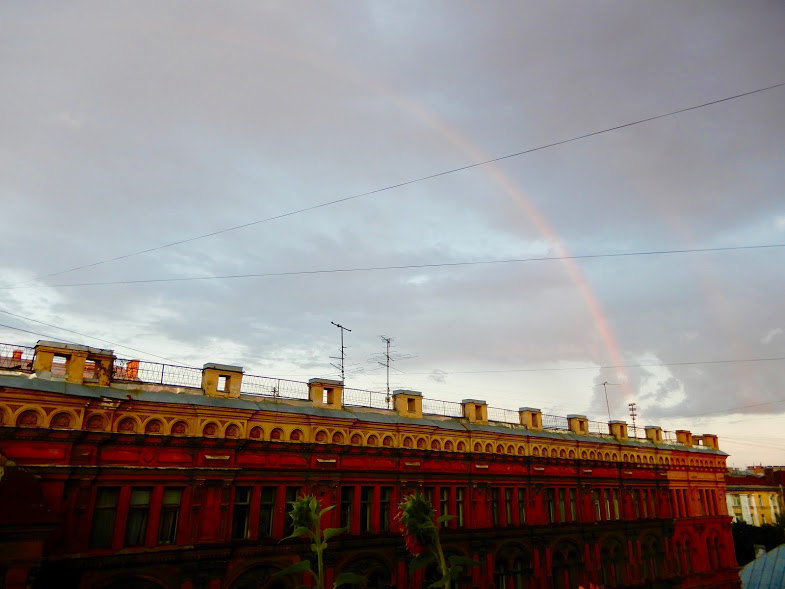
rainbowWhile rainbows do occasionally appear in the skies above Russia, the Putin regime has pursued a consistent course of official homophobia and avoidance of the country’s out-of-control HIV epidemic. Photo by the Russian Reader
Russian Justice Ministry Proposes Tightening Oversight of Foreign HIV Prevention Programs
Mediazona
September 3, 2018

The Justice Ministry has drafted a law bill that would introduce a new procedure for running foreign programs in Russia for preventing the spread of HIV. The text of the draft law has been published for public discussion.

The ministry proposes introducing a mandatory notification procedure for all noncommercial organizations planning to combat HIV in Russia, but which receive foreign funding, whether from other countries, international organizations, foreign nationals, stateless persons, their representatives, and Russia legal entities and individuals receiving money and other property from these sources.

After receipt of such a notification, the Justice Ministry will have a month to review it. It will then either have to issue permission to operate in Russia or a substantiated rejection. If a noncommercial organization continues to work on preventing HIV after receiving a rejection notice, it will be abolished.

As the BBC has noted, four foundations preventing the spread of HIV in Russia have been registered as “foreign agents” by the Justice Ministry.

Approximately a million Russians are infected with HIV. In July, RBC reported a spike of infections in Moscow. The Russian Health Ministry responded to the report by claiming the situation was stable. It urged journalists to focus only on official statistics.

Translated by the Russian Reader