Sevastopol Security Services Search Homes of Leftist Activists Planning Rally Calling for Presidential Election Boycott Mediazona
1 March 2018
Security services showed up at the flat of the Vorobyov family in Sevastopol, members of the VK community group Anarchists of Sevestapol, activist Alyona Vorobyova has reported to OVD Info. According to Vorobyova, she and Artyom Vorobyov were not home when the search took place. Only their seven-year-old child and relatives were at the flat. It is not known which Russian security service conducted the search and in connection with what case.
Another Sevastopol activist told Mediazona a search was also probably underway at the home of anarchist Alexei Shestakovich: a large number of police officers had gathered outside his house. The activist surmised searches could also be underway at the homes of the Anarchists of Sevastopol group’s admin, Alexei Prisyazhnyuk, and leftist activist Igor Panyuta. The two men were currently incommunicado.
Shestakovich, Prisyazhnyuk, and Panyuta had planned today to submit a notification for a protest rally calling for a boycott of the March 18 Russian presidential election. The rally was to be entitled “The Presidency Is a Monarchist Atavism,” said Mediazona‘s source.
Shestakovich announced plans to submit the notification on the Anarchists of Sevastopol VK page.
“The event’s aim is to remind people of their constitutional right not to take part in election, to inform the populace about the rules for conducting a robust boycott, and to have a public discussion of self-government in society,” he wrote.
In addition, the local online news website Krymskie Novosti reported that Republic of Crimea Center “E” and FSB officers carried out a “mopping up of the republic’s anarchist cell.” As the website’s sources reported, searches had been carried out today at the homes of the cell’s leaders and members both in the Republic of Crimea and and the Federal City of Sevastopol.
“According to available information, this group of people planned provocations during the Russian federal presidential election, scheduled for 18 March 2018,” wrote Crimean news website Informer.
Informer claimed the Crimean cell had “kept in touch” with other radical leftist groups operating in Russia. Without identifying its sources, Informer also claimed the Crimean anarchists were financed by persons residing in Ukraine.
Update.OVD Infowrites that masked men armed with machine guns came to the home of Anarchists of Sevastopol admin Alexei Prisyazhnyuk, confiscated his computer equipment, and took him to a police station. Mediazona has also been informed of a police search at the home of activist Ivan Markov.
Translated by the Russian Reader. This article has been lightly edited to eliminate several minor errors regarding local media sources. Thanks to Egor Skovoroda for the heads-up. Photo courtesy of Wikipedia
If you have been following the Penza-Petersburg “terrorism” case on this website, you should now make your way over to oDR (openDemocracy Russia), where coverage of the case continues with these frightening accounts by Viktor Filinkov and his wife Alexandra of Viktor’s abduction and torture by the Russian Federal Security Service (FSB), and Alexandra’s attempts to find out what happened to her husband, who had been scheduled to join her in Kyiv when he was disappeared by the FSB.
Meanwhile, as Mediazona correspondent Yegor Skovoroda writes, the FSB has, allegedly, tortured two anarchists in Chelyabinsk for the crime of protesting its barbaric actions in Penza and Petersburg.
“He Would Check My Pulse by Touching My Neck and Monitor My Condition.” Arrested Penza Antifascists Talk about Electric Shock Torture in Remand Prison Basement
Anna Kozkina and Yegor Skovoroda Mediazona
February 9, 2018
Dmitry Pchelintsev. Photo courtesy of his relatives and Mediazona
Ilya Shakursky and Dmitry Pchelintsev, arrested in Penza and charged with involvement in a “terrorist community,” have told their attorneys that Russian Federal Security Service (FSB) officers tortured them in the basement of the city’s remand prison. Mediazona has decided to publish the story told by Shakursky’s defense counsel and the transcript of what Pchelintsev relayed to his lawyer.
••••••••••
In October 2017, the FSB detained four antifascists in Penza: Yegor Zorin, Ilya Shakursky, Vasily Kuksov, and Dmitry Pchelintsev. In early November, they detained Andrei Chernov in Penza, and Arman Sagynbayev, who was in Petersburg at the time. All six young men have been accused of involvement in a “terrorist community” (a criminal offense under Article 205.4 Part 2 of the Russian Federal Criminal Code). According to the FSB, the six had established an organization, known as The Network (Set’). They planned a series of bomb blasts during the presidential election, in March, and the World Cup, in June and July, that would “sway the popular masses in order to subsequently destabilize the political situation [in Russia]” and set off an armed insurrection.
The Network allegedly had cells functioning in Moscow, Petersburg, Penza, and Belarus [an independent country]. On January 23, 2018, antifascist Viktor Filinkov was detained in Petersburg, followed two days later by Igor Shishkin. Friends and family could not find either of them for over a day. A court had remanded both of them in custody as members of the alleged “terrorist community.”
In Penza, relatives of the detained activists told how law enforcement officers had planted weapons in the men’s cars and flats, and subjected them to torture by shocking them with electrical wires and hanging them upside down. According to friends and loved ones, all the detained men had been airsoft enthusiasts.
“All they ever did was learn how to render first aid in field conditions and survive in the woods. Is that illegal?” Angelina Pchelintseva, Dmitry Pchelintsev’s wife, askedOVD Info.
Initially, all the men in custody, except Kuksov, who invoked his right not to incriminate himself, as stipulated by Article 51 of the Russian Constitution, confessed to their alleged crimes.
After he was detained, Viktor Filinkov said that siloviki had tortured him with an electric shocker and forced him to memorize the wording of his testimony in order to repeat it later to investigators. Ilya Kapustin, interrogated as a witness in the case, also spoke of torture. FSB officers had shocked him with an electric shocker and threatened to break his legs and abandon him in the woods.
Igor Shishkin has not said anything about torture. The case file contains a letter written by Shishkin after he was detained. It is addressed to Alexander Rodionov, head of the FSB’s Petersburg Office. In the letter, Shishkin explains he received all his injuries while playing sports. Doctors confirmed Shishkin suffered a fracture to the lower wall of one eye socket, as well as numerous bruises and abrasions. Members of the Public Monitoring Commission on Conditions in Places of Imprisonment who visited Shishkin in a remand prison made note of numerous traces on his body of what looked like burns from electrical wires. Recently, Shishkin sent a petition to the authorities asking to cooperate with the investigation and requesting a pretrial agreement.
A Letter by Igor Shishkin from the Remand Prison Greetings to friends, relatives, acquaintances, and sympathizers! In my stupidity, I got caught up in a very serious and unpleasant situation. I’ll skip the details. I just want to advise everyone to think a hundred times about what you are doing and how the consequences do not affect just you. I also want to send my sincerest apologies to the people whom my problem has affected. Sorry, guys! […] I really ask everyone not to generate a media buzz. We don’t need that right now.
“He Said, ‘I Couldn’t Take It. I Broke Down.'”
Attorney Anatoly Vahterov, Ilya Shakursky’s defense counsel, has written the following. Mr. Vahterov visited Mr. Shakursky in Penza Remand Prison No. 1 on February 7, 2018.
It follows from my client’s statement that he was one of six people simultaneously detained on suspicion of violating Article 205.4 of the Russian Federal Criminal Code. The article refers literally to “organization of a terrorist community.” During my conversation with my client, I did not have the slightest doubt he had not been involved in these actions.
I said to him, “I know that you signed a confession. How could that be?”
He wrote a note to me, “I was beaten.”
Later, he gave me a more detailed account of how he had been tortured in the remand prison.
He said the plan was to implicate them in the Maltsev case. He said this. I was surprised. What was the connection? In my view, this case was fabricated on formal grounds. They grabbed one comrade by the name of Zorin. He was the weakest of them and testified against all his friends. Moreover, his testimony is absolutely far-fetched. It was grounds for detaining the other guys on suspicion of having committed the particular crime.
This is where it gets interesting. According to my client, all of them were tortured in the basement of the remand prison. The torture was sophisticated. Officers in masks and camouflage uniforms would enter their cells. They took them to a room in the basement, forced them to strip, attached electrodes to their fingertips, and cranked up a so-called dynamo.
He just said, “I couldn’t take it. I broke down.”
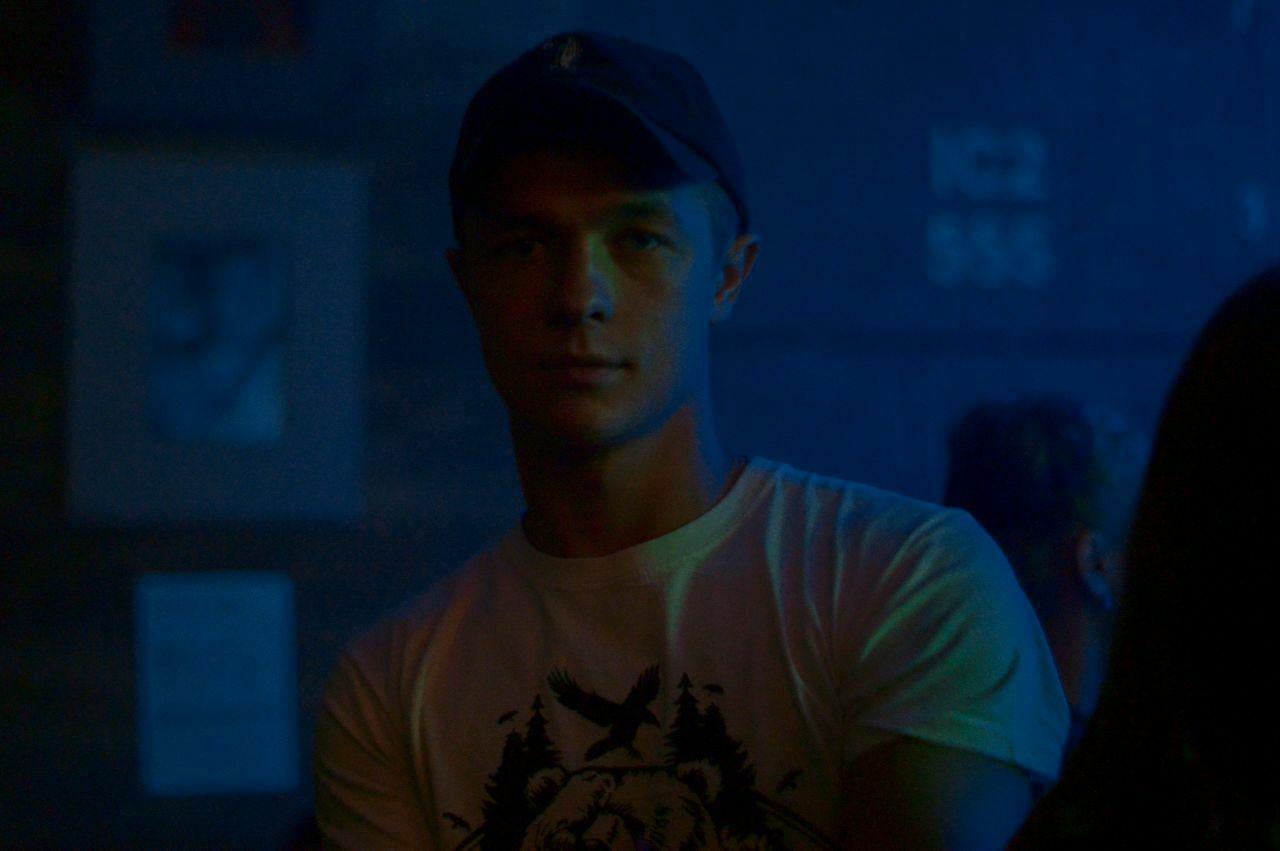
Ilya Shakursky. Photo from personal archive and courtesy of Mediazona
Torture was also used against Pchelintsev, according to my client. They talk to each other in the remand prison. Sagynbayev has also been tortured. This is savagery, you realize? As if the year now were 1937.
There can be no question of any terrorist activity whatsoever. I would venture to say that during the preliminary investigation and trial we will try and prove it. The guys only played role-playing games. They were into airsoft and running round the woods. Yes, the guys gave each other nicknames. It was just easier for them to address each other that way. None of this is anything other than child’s play. Yes, there were nicknames, yes, there were assigned roles. Why not? We played war when we were kids. We also pretended to be medics, sappers, and snipers. Each had a role to play. There were role-playing games and nothing more.
The had their own group and their own music. They were involved in the antifascist movement and environmentalism. The authorities have been trying to accuse them of espousing anarchism, but the thing is that my client and the other comrades are antifascists. A person who opposes Nazism cannot preach Nazi ideas and chauvinism, engage in any kind of propaganda, and advocate overthrowing the social order.
Ilya Shakursky is a totally sensible, regular guy. I would say he is the salt of the Russian earth. He’s a normal, genuine, good Russian lad, raised in our society’s best traditions. He is not a criminal, that is for sure. But when he speaks, you can see the pain and resentment on his face. It happens. But he is hanging in there and hoping for a good defense. His mother was immediately fired from her job when the first articles about Pchelintsev and so on were published.
In order to be involved in a group, especially a terrorist group, a strict conspiracy, as my client has been accused of, there must be exclusively friendly relations, based on mutual respect, decency, and the knowledge that your comrade will not turn you over to the relevant authorities. But Shakursky and Pchelintsev had a falling-out over a young woman. They had fought with each other, and one even spit in the other’s eye.When there were conflicts like this, what kind of tightly knit team can we speak of?
In order to justify what I regard as groundless detentions, criminal charges, and remands in police custody, the men were accused of committing another crime, possession of weapons and explosives, Article 222 in the Criminal Code. Law enforcement planted two grenades and a pistol under the back seat of Shakursky’s car. If he and his friends were such conspirators, he would not have done something as amateurish as leaving two grenades in his car.
Ilya Shakursky’s letter to his girlfriend
Ilya Shakursky’s Letter to His Girlfriend Today is exactly three months since I’ve been in the remand prison. If I were on the outside I would definitely go to the event commemorating two great heroes, Nastya Baburova and Stas Markelov.
We now find ourselves in circumstances in which we miss these people like never before. They fought injustice and helped people who were in very difficult situations in life. I sincerely hope that with the help of friends, loved ones, and concerned citizens we can get out of this pickle, which is one enormous misunderstanding and injustice.
Goodness will triumph!
January 19, 2018
All my acquaintances and friends should see this text.
“My Mouth Was Full of Blood, and One of the Torturers Stuck My Sock in It”
On February 6, 2018, attorney Oleg Zaitsev visited Dmitry Pchelintsev and interviewed him. Like most of the defense attorneys in the case, the investigator made Zaitsev sign a non-disclosure agreement concerning evidence in the preliminary investigation. Zaitsev notes that, under the circumstances, he has not violated investigatory privileges, but nevertheless he felt obliged to discuss all the violations of rights his client has suffered. What follows is a transcript of his interview with Pchelintsev.
I can say the following. On October 27, 2017, I left the house at around six o’clock in the morning to meet my grandmother. Near the end wall of the building, as I was nearing my car, four men in plain clothes suddenly approached me. I was so surprised I put my hands up in front of me. These men immediately beat me up and threw me on the ground. Their faces were not covered. I could identify them. Later, some of them escorted me from the remand prison to the FSB office. One of them looked to be thirty-five years old. He had light-brown hair, was wearing a gray jacket, and had a stout face and thickset build. They asked me my surname and struck various parts of my body. They reproached me for having putting up my dukes when I was being detained by the FSB. They confiscated the keys to my flat and used them to enter the place when my girlfriend was sleeping and search the place.
On October 28, 2017, after the court had remanded me in custody to the remand prison on Karakozov Street, I was in solidarity confinement cell 5-1. It was around four o’clock in the afternoon when a special forces policeman, the senior shift officer, and a major from the local office of the Russian Federal Penitentiary Service entered my cell. They told me to exit the cell and go to the nearby punishment cell, which I did. Six or seven men immediately entered the cell. Half of them were in MultiCam camouflage uniforms, while the other half were in plain clothes. But all of them wore balaclavas. Despite the headgear concealing their faces, I could identify some of these people by their voices, physique, and clothes. Subsequently, I recognized some of them when I was being transported and escorted.
They told me what to do, and I followed their orders. I stripped to my shorts, sat down on a bench, stretched my arms backwards, and put my head down. At first, I thought this was some examination everyone sent to the remand prison had to undergo, so I voluntarily submitted to it. Then they taped my hands behind me, tied one of my legs to the foot of the bench with more tape, and stuck a wad of gauze in my mouth.
One of the men was wearing white rubber medical gloves. He took out a dynamo and set it on a table. He stripped two wires with a boxcutter and told me to stick out my big toe. Another man checked my pulse by touching my neck. He would subsequently do this more than once: he was monitoring my condition. He was surprised my pulse was normal and I was not agitated. That was because I did not realize at first what was happening.
Then the man in gloves cranked the dynamo. The current flowed to my knees. My calf muscles contracted, and I was seized by paralytic pain. I screamed. My back and head convulsed against the wall. They put a jacket between my naked body and the stone wall. This went on for about ten seconds, but when it was happening, it felt like an eternity to me.
One of them spoke to me.
“I don’t know the word ‘no.’ I don’t remember it. You should forget it. You got me?” he said literally.
“Yes,” I replied.
“That’s the right answer. Attaboy, Dimochka,” he said.
The gauze was stuck in my mouth again, and I was shocked four times, three seconds each time. […] Then I was tossed onto the floor. Since one of my legs was tied to the foot of the bench, when I fell, I seriously banged up my knees, which bled profusely. My shorts were pulled off. I was lying on my stomach. They tried to attach the wires to my genitals. I screamed and asked them to stop brutalizing me.
“You’re the leader,” they repeated.
“Yes, I’m the leader,” I said to make them stop torturing me.
“You planned terrorist attacks.”
“Yes, we planned terrorist attacks,” I would reply.
One of the men who measured my pulse put his balaclava on me so I would not see them. At one point, I lost consciousness for awhile. […] After they left, a Federal Penitentiary Service officer entered the room and told me to get dressed. He took me back to my solitary confinement cell.
The next day, October 20, 2018, I broke the tank on the toilet and used the shards to slash my arms at the wrists and elbows, and my neck in order to stop the torture. There was a lot of blood from the cuts on my clothes and the floor, and I collapsed onto the floor. They probably saw what I did via the CCTV camera installed in the cell. Prison staffers entered my cell and gave me first aid. Then the prison’s psychologist, Vera Vladimirovna, paid me a visit.
As regards the video cameras installed in my cell, as well as in the punishment cell and the corridor, I can say that when FSB officers show up, the cameras either are turned off or the recording is later erased, or something is done with the sensors. The FSB officers completely control the local Federal Penitentiary Service officers.
On November 8, 2017, at around five o’clock in the afternoon, the senior shift officer was getting ready to leave.
“Will everything be alright with me?” I asked him.
“Don’t worry, I’ll be right back,” he replied.
I had connected his departure with the fact that the last time he left, the day before, Saginbayev’s scream was audible on the floor. I realized he was being tortured. Later, our paths crossed, and he apologized for testifying against me.
A lieutenant from the Federal Penitentiary Service then came to my door.
“Am I safe here?” I wrote on a piece of paper that I showed to him.
“Yes,” he replied in big letters.
After that I showed him the enormous bruise on my chest and stomach to let him know I had been tortured. After awhile he opened the cell door, and four men wearing prisoner’s uniforms dashed into the cell. Civilian clothes were visible under these uniforms, all of which were baggy. They were all wearing what looked like Buff masks, black tube scarves.
They beat and kicked me in the stomach, kidneys, and head. I had bruises from their blows, but they hit me like in a gym, so they would leave fewer visible traces. They informed me they were from the “underworld committee”: because of me they had been put on lockdown. They gave me a week to solve my problems with the “pigs.” If I didn’t solve them, they would punk me. One of them filmed the whole thing on a smartphone. The Federal Penitentiary Service officer was outside in the hallway the entire time. The four FSB guys from the “underworld committee” left. Later, I also recognized some of them when I was being escorted and transported.
Then the senior shift officer, a captain, returned.
“How can I believe you when FSB guys just came into my cell and beat me up?” I asked him.
He looked puzzled.
Afterwards, FSB agents have visited me many times in the remand prison. They wear no masks and chat with me in the visiting room. When they talk with me, they exert psychological pressure on me. They threaten, blackmail, and manipulate me.
During an interrogation, the investigator told me it was he who gave the agents permission to visit me. They took their orders from him and they had their own work.
After I tried to commit suicide by slashing my veins open, I was put under special watch in the remand prison. The cuffs are not removed from my hands even when I am signing interrogation reports.
I want to add that, when I was tortured with electrical shocks, my mouth was full of “crushed teeth” due to the fact I gritted my teeth since the pain was strong, and I tore the frenulum of my tongue. My mouth was full of blood, and at some point one of my torturers stuck my sock in my mouth.
I was beaten so badly I had open wounds on my head.
••••••••••
According to Republic, which has seen the case file, the FSB has named Pchelintsev the organizer of The Network terrorist group. He met his accomplices at concerts and allegedly founded the organization in 2014. According to the FSB, since 2015, every member of The Network has had his own role. Investigators believe Pchelintsev is The Network’s leader and ideologue. He has a deputy, nicknamed Redhead, who recruits new members.
The case files indicate that, in the summer of 2016, several cells joined The Network. The Penza cell was dubbed 5.11 (November Fifth) or Sunrise; the Moscow cell, MSK (Moscow Standard Time); and the two Petersburg cells, Field of Mars and Jordan. In addition, investigators believe The Network has a branch in Belarus, and that the cells were managed out of Penza. The FSB refers to all the detainees as anarchists.
Translated by the Russian Reader. Thanks to NV and PK for the heads-up
“They Said They Could Break My Legs and Dump Me in the Woods.” Petersburger Ilya Kapustin Recounts How FSB Officers Tortured Him
Yegor Skovoroda Mediazona
January 27, 2018
Traces of handcuffs on Ilya Kapustin’s hands. Photo courtesy of his attorney and Mediazona
This week, FSB officers searched the homes of several Petersburg antifascists and anarchists. The searches were authorized by order of a Penza court. In October 2017, six activists were detained in Penza. One of them, Arman Sagynbayev, had lived for a time in Petersburg. They were charged with involvement in a terrorist network (Russian Criminal Code Article 205.4).
On January 24, 23-year-old antifascist Viktor Filinkov was detained at Pulkovo Airport in Petersburg. The following day it transpired he had been remanded to police custody as the member of a terrorist network and had “confessed the suspicions about him.” Filinkov recounted that after he was detained he had been beaten and tortured with an electric cattle prod, presumably by FSB officers.
“Most of all I was shocked by the burn marks on the hips from the taser (as Viktor assures me). During my long struggles against police lawlessness I have never seen such injuries, and I have over fifty torture and bullying convictions of police officers under my belt,” attorney Vitaly Cherkasov wrote on his Facebook page after visiting Filinkov in Petersburg’s Pretrial Detention Center No. 3.
On January 25, the security services searched at least two more flats. After one such visit, antifascist Igor Shiskin disappeared. Neither his loved ones nor his attorney have been able to find him. During her interrogation, Shishkin’s wife was asked about the movements or groups The Network (Set’) and November Fifth (5.11), and also asked whether she professed anarchist views. [Shiskin turned up at the same pretrial detention center on the evening of January 27—TRR.]
Ilya Kapustin was seized by masked secret service officers on the evening of January 25. The young man says he was tortured with an electric cattle prod while being asked questions about an aquaintance of his in Petersburg who had recently been arrested, the anarchist movement, and Penza, a city Kapustin has never visted. Mediazona presents his firsthand account of torture, his interrogation as a witness, and the search conducted by officers from the FSB’s Petersburg and Leningrad Region Office.
••••••••••
It so happened I am acquainted with a person who was recently arrested in Petersburg. I am an industrial climber, and I knew him from work. I telephoned him with a job officer right when he was being detained, which definitely caused what happened.
When I was returning home in the evening and was quite close to my house, five or so men in black uniforms and masks attacked me from different directions. They pushed me on the ground and dragged me into a minivan while kicking me. I tried to call for help. I yelled, but to no avail. I was knocked down on the floor of the vehicle, and the men searched me while continuing to kick me. I was handcuffed me very tightly, so tightly I still have cuts on my hands.
The vehicle drove off, and I was interrogated. When I did not know the answer to a question, when I did not understand who or what they were talking about, they shocked me with a tazer near my groin or the side of my stomach. They shocked me so I would say some acquaintance of mine or another was planning to do something dangerous. There were questions about whether I was a member of certain organizations, where I had traveled, and whether I had been to Penza. They asked me to tell them details about the lives of my acquaintances.
So, from time to time they poked me with the taser. At some point, one of them said they could dump me in the woods somewhere and break my legs. I was looking forward to this moment when it would all be over, because they had tortured me for such a long time it was quite unbearable.
Traces of tasers burns on Ilya Kapustin’s body. Photo courtesy of his attorney and Mediazona
I was in the vehicle from roughly nine-thirty in the evening to one-thirty in the morning, when we arrived, apparently at an FSB office. When they took me out, they pulled a hood over my head and forced me to look down, and I could not figure out where we were, but later, when they took me home to search my flat, I guessed that it was a corner on Shpalernaya Street of the FSB building [whose main entrance is on Liteiny Avenue in downtown Petersburg—TRR]. I saw just as many secret service people in the office, only they were not wearing and were dressed in plain clothes. An investigator questioned me for something like an hour. Other secret service guys would sometimes stop by. One of them told me that if I did not want a second round, I should answer all the questions.
Then we went to the flat where we live, and there they let us read a search warrant issued by a court in Penza. During the search, I refused to switch on my laptop and telephone. That made them act very stridently. They threatened to hide a grenade and come back in a couple of days and find it in a search. Ultimately, they confiscated my laptop, telephone, and hard drive.
When they left, I went to the emergency room and documented the fact I had been beaten. I was issued a certificate in which all my injuries are listed. I am now looking for a lawyer to file a complaint. I am not mixed up in anything, but out of the blue I was tortured for several hours.
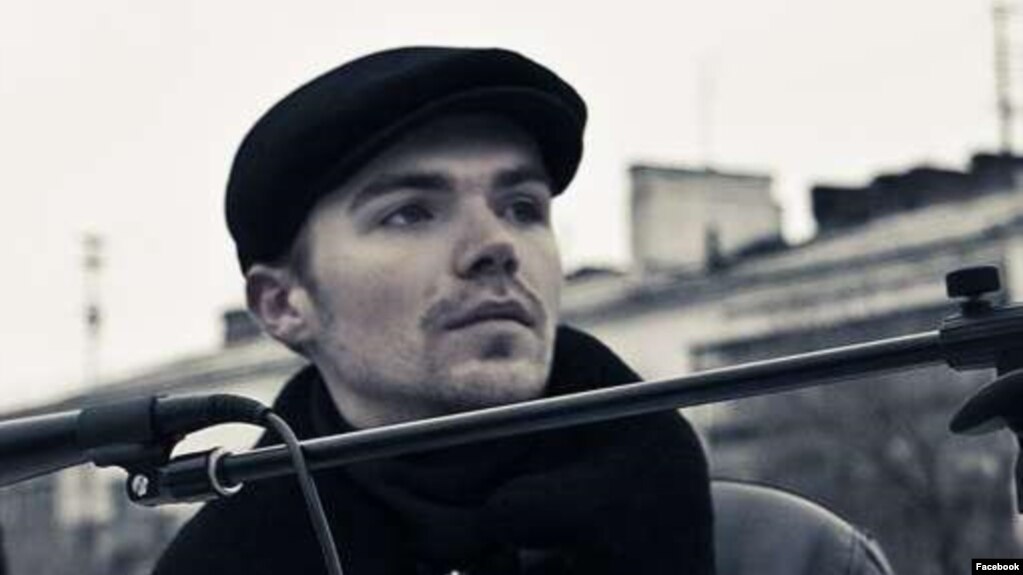
Viktor Filinkov. Photo courtesy of Filinkov’s wife and OVD Info
Petersburg Anarchist Viktor Filinkov, Arrested in Terrorism Case, Says He Was Tortured Mediazona
January 26, 2018
Antifascist Viktor Filinkov, arrested for alleged involvement in a terrorist network, has told members of the Public Monitoring Commission (PMC) he was tortured, according to the PMC’s report, which Mediazona has in its possession.
According to the PMC report, injuries “inflicted in the last two or three days” were discovered on Filinkov’s body, including numerous traces of burns from an electric shocker all over his right thigh, a hematoma on his right ankle, and burns from an electric shocker on his thorax.
Filinkov explained he suffered the injuries on January 24 in the car in which he was put by FSB officers after he was detained at Pulkovo Airport in Petersburg. The activist was then taken to the local Interior Ministry headquarters, and from there to a hospital. Filinkov was then driven into woodlands and held in the car for five hours.
FSB officers were seated in the front of the car, according to Filinkov. The middle row of seats was occupied by a man wearing a mask, while Filinkov and another man wearing a mask sat in the back of the vehicle. The injuries were inflicted between seven and eight o’clock in the morning.
According to the PMC’s report, “The FSB officers demanded that Filinkov confess, and having obtained his consent, they forced him to memorize the particular wording [of his confession].”
The masked men said very little, while the FSB officers threatened Filinkov that if he subsequently reneged on the confession, the beating they had given him would be a “light version” of the beating he would get later.
Afterwards, Filinkov signed a statement, addressed to the local Interior Ministry headquarters and the local FSB headquarters, in which he informed them of all the things he had been prompted to say. The FSB officers then demanded he not deny the statement in court, threatening to place him in a pretrial detention center with tuberculosis patients.
The only things the masked men said were “Stop twitching!” and “What you shouting for?”
Filinkov was transferred to another car in the woodlands, a Lada Priora, and taken to the local Interior Ministry headquarters. According to Filinkov, the masked men seemed to know their way around the building, as if they had been there many times. They also discussed the fact they should keep their faces hidden because of the security cameras in the building.
The PMC’s report notes that the men wiped the blood off Filinkov’s face with his own hat and with snow, and traces of bood were left on the hat. The leftist activist was also told that if he behaved badly, the FSB would “get to” his wife “even in Kyiv.”
On January 24, Filinkov’s wife toldOVD Info her husband had disappeared on his way to Petersburg’s Pulkovo Airport. The antifascist was scheduled to fly to Kyiv at eight o’clock in the evening on January 23. The last time they communicated that day was three o’clock in the afternoon, when Filinkov texted his wife that he was headed to the airport and would text her again after he arrived there.
On January 25, it transpired that the Dzerzhinsky District Court in Petersburg had remanded Filinkov to police custody for two months on suspicion of involvement in a terrorist network (per Article 205.4 Part 2 of the Russian Criminal Code). According to police investigators, Filinikov and unidentified persons who “supported the anarchist ideology” were branch members of a terrorist network whose purpose was to engage in terrorist activities, propaganda, and justification of terrorism.
Today, the wife of another Petersburg antifascist, Igor Shishkin, reported he was missing. Shishkin went missing after his home was searched and he was taken away by law enforcement officers.
Muscovites are pretenaturally calm and dressed unseasonably warmly as the world hurtless toward senseless nuclear conflagration. Photo courtesy of RBC
I am only sharing this news flash from RBC with you because of the fabulous photo that accompanied it on RBC’s Facebook news feed, and the way it illustrates the article’s point—sideways, as it were.
“‘It is necessary to remain calm,’ the Russian Foreign Ministry said after North Korea tested a hydrogen bomb. The ministry called for a return to dialogue as ‘the only possible way of comprehensively settling the Korean Peninsula’s problems.'”
Remember, comrades: he’s already been in the Kremlin for eighteen years.
But the photo is terrific. The people in it are not calm. They could not care less about anything.
Or if they do care, they are not going to let on to it whilst walking down the street in the middle of Moscow.
In any case, RBC originally ran this photo in April of this year to accompany an article about how my friends at Mediazona were suing the Foreign Ministry for refusing to reply to its written request for information about contacts between Russian diplomats in the US and members of the Trump presidential campaign.
What goes around comes around, so just step sideways. TRR
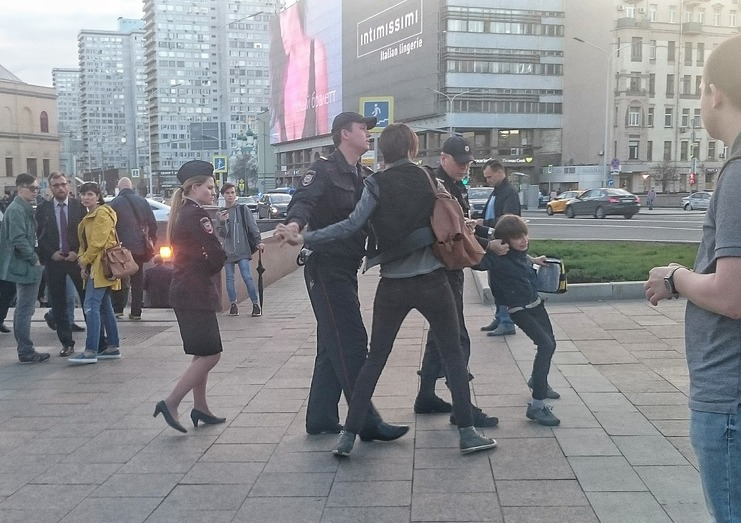
Eyewitness photo of incident. Courtesy of Mediazona
Moscow Police Detain Child Reciting Poetry Takie Dela
May 26, 2017
Police detained a child reading poetry aloud on Moscow’s Vozdvizhenka Street. Takie Dela was informed about the incident by the website OVD Info‘s person on duty.
The child, reportedly ten years old, and his mother were relaxing near Arbatskaya subway station. The mother was sitting on a bench and reading, while the boy recited poetry a little ways away from her. A police patrol stopped near the boy, and police officers forced the boy into their car. They refused to let the mother talk to her son, explaining he would be charged with begging. In addition, the police pushed the woman, causing her to drop and smash her tablet computer.
The boy was taken to Arbat Police Precinct. He was transported there without his parents. Later, his mother was brought to the same precinct. The child’s father arrived at Arbat Police Precinct later.
According to unconfirmed reports, the father could be charged with the administrative offense of insulting a police officer. He refused to sign a charge sheet accusing the parents of not fulfilling their parental duties, since he did not agree with the charges. The child is currently at the police precinct. As of this writing, Arbat Police Precinct is refusing to answer their telephone.
An eyewitness has posted a video showing the child screaming inside the police car.
Update, 10:10 p.m. The boy’s father, Ilya Skavronski, has told Mediazona that the boy goes to a theater workshop and was reciting Hamlet. The police officers in question conversed with the boy for a time at a distance of twenty to twenty-give meters from his mother, who approached them only when the boy had been forced into their car. According to Skavronski, the policemen cursed and behaved rudely while detaining his son. He added that the precinct’s deputy head had threatened to detain the boy’s mother on charges of resisting law enforcement officers.
Update, 12:00 a.m. The Moscow Police’s Information Response Department explained that the boy had been detained because he was alone and had been going up to “one car after another.” According to OVD Info, he has been released from the police precinct. Skavronski has been charged with violating Article 5.35 of the Administrative Offenses Code (non-fulfillment by parents of their child-raising duties of minors). Earlier, attorneys had arrived at the precinct, as well as Anatoly Kucherena, chair of the Interior Ministry’s Public Council. The lawyers are filing complaints against the actions of the police.
Translated by the Russian Reader. Image courtesy of Mediazona
Vladislav Ryazantsev has been assaulted in Rostov-on-Don. Vlad and I covered the entire Sentsov-Kolchenko trial and Nadiya Savchenko’s Donetsk saga together. I arrived in Rostov the first time a couple of days before the Sentsov trial to get my bearings. The next day, I was joined by cameraman Nikita Tatarsky, and we shot a short report about how even the local opposition knew nothing about the trial that was going to take place in their city. Amongst the people we interviewed was Vlad.
Later on, he, a journalist from Mediazona, and I were often the only reporters at the hearings in Donetsk City Court. When people say that Ukrainian media did a great job of covering the Savchenko trial, I recall Vlad sitting alone in the courtroom with his laptop. Mediazona’s correspondent and I would be sitting just as alone in the room where the trial was broadcast. It wasn’t always like this, of course, but it happened.
I would be remiss not to mention the fact that the attack was literally preceded by threats from Chechnya made to the editor-in-chief of Caucasian Knot, for which Vlad wrote. Another Knot correspondent, Zhalaudi Geriev was sentenced in Chechnya to three years in prison for narcotics possession a day before he was scheduled to attend a conference in Moscow entitled “The Media and the Constitutional Court.” You get my drift? It’s not a fact that the attack was connected with the threats. Maybe the local Center “E” guys did their best: they are active in Rostov. Maybe it was pro-Russian militants and mercenaries, who have flooded through Rostov on their way to Donbass. Vlad had publicly taken a pro-Ukrainian stance, and he had a falling out with Sergei Udaltsov‘s leftists and his wife over this point. Maybe it was these leftists who got to him. Whatever the case, threats and aggression towards journalists, made by people who enjoy a special extrajudicial status, open the way to unchallenged violence by anyone whomsoever.
Chop It All Down! Molotov Cocktails versus Woodland Defenders in the Town of Zhukovsky
Maria Klimova Mediazona
July 13, 2016
Photo by Fyodor Karpov
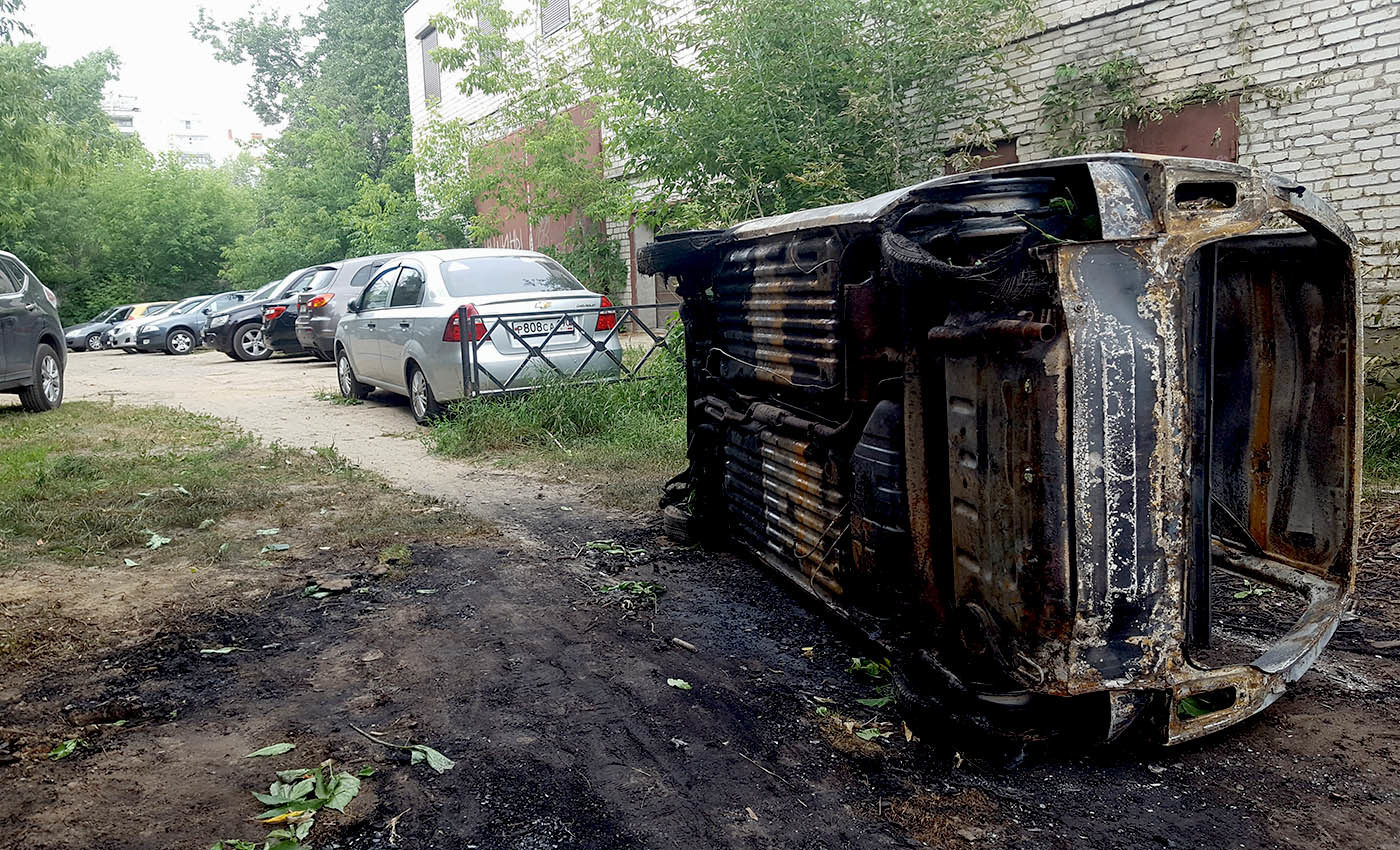
Over the past month, several environmentalists in the Moscow Region town of Zhukovsky fighting against the illegal logging of trees to make way for construction have suffered at the hands of persons unknown. Two of them have had their cars set on fire and burned, while a female activist had a Molotov cocktail thrown at her windows. Municipal authorities see no reason to worry yet, although the victims are certain someone has been trying to intimidate them.
Around four o’clock in the morning on June 15, a Molotov cocktail was tossed at the windows of the flat occupied by Zhukovsky activist Olga Deyeva, who lives on the first storey of a block of flats. Hearing a bang, which set off the alarms of cars parked in the yard, she looked out the window and saw shards of glass on the pavement. What turned out to be a broken bottle was wrapped in electrical tape and a thick layer of solvent-soaked cloth. According to police summoned to the scene by Deyeva, the persons unknown had failed to ignite the cloth, which had been soaked in a flammable liquid. According to Deyeva, the assailants had aimed at her window but had missed, and the bottle had hit the window frame.
A week and a half later, on June 27, a Ford Focus owned by Mikhail Yuritsin, an environmentalist and member of the grassroots organization Lyubimy Gorod (Beloved City), was torched and burned. According to Yuritsin, he heard the loud sound of glass being broken at around three in the morning, looked out the window, and saw his car burst into flames. Yuritsin was unable to extinguish the fire, and the car was completely destroyed. Cars parked next to it were mildly damaged, as firefighters arrived quickly on the scene.
In addition, a car used Svetlana Bezlepkina, a Yabloko Party member who sits on the Zhukovsky city council, was torched in the early hours of July 7. Although the car was registered to the council member’s sister-in-law, Bezlepkina often used it herself.
“Yes, I have used the car. I used it for business when I needed, and everyone knew it. You couldn’t think of anything more cynical: my brother and sister-in-law had their wedding that day. After celebrating at a cafe, they came home and parked the car, and during the night it was torched. Then the police showed up, took our testimony, and that was all. They didn’t really take a hard look at anything. On the other hand, what do you expect from a police force who back in the day guarded loggers chopping down a forest,” said Bezlepkina.
A suspicious incident happened the same day to Fyodor Karpov, leader of the Yabloko Party’s Zhukovsky branch. Persons unknown torched an abandoned car, which had recently been left outside the gate to his garage.
Karpov related the sequence of events.
“The abandoned car drifted around the yard for two weeks, and then it ended up in front of my gate. I gently shoved it away from the gate, but on a day I was attending a court hearing on illegal construction in the forest, it was torched.”
Except Karpov, all the victims are plaintiffs in a lawsuit against Zhukovsky city hall and businesswoman Irina Gorodnova, who has been given permission to build a consumer services center on Nizhegorodskaya Street and a children’s center on Semashko Street. Both lots slated for construction are located on woodlands in the city limits.
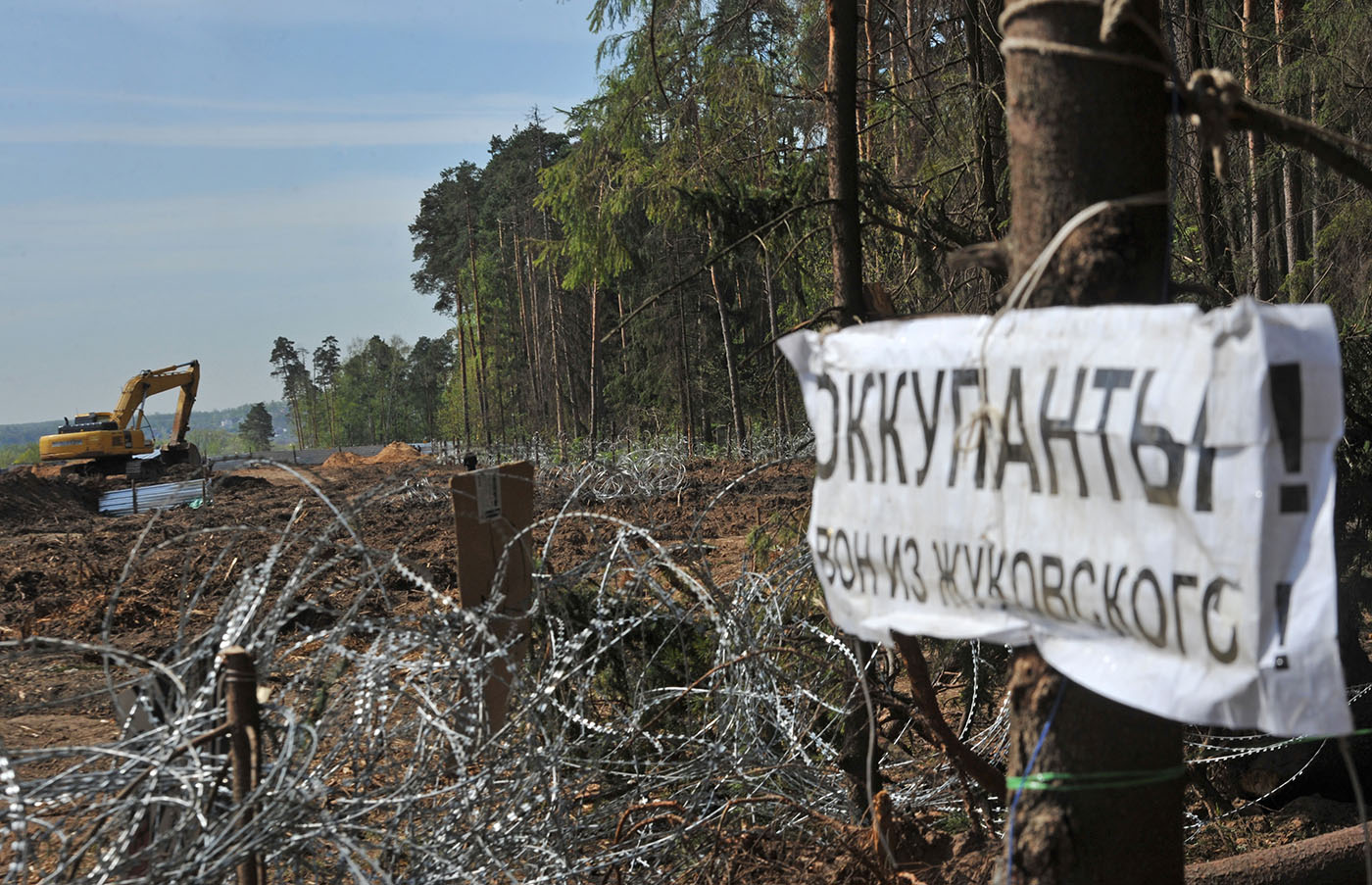
Local residents began vigorously fighting to save their woodlands in 2012, when the authorities announced the construction of an access road from the M5 Ural Highway that would pass through the Tsagov Forest. When workers began clear-cutting a twelve-hectare site, grassroots protests erupted throughtout the city, and activists set up a camp in the woods, later dispersed by private security guards. The protesters proposed several alternate routes for the road. Several months later, Sergei Shoigu, who had recently been appointed governor of Moscow Region, intervened in the conflict. He criticized the actions of the Zhukovsky authorities and spoke of the need for dialogue with the public, but his statements had no impact on the situation. The access road to the city was built through the forest.
A placard in the camp of people defending the Tsagov Forest in Zhukovsky, May 2, 2012. The placard reads, “Occupiers! Get the hell out of Zhukovsky.” Photo: Artyom Zhitenyov/RIA Novosti
A year after the conflict over clear-cutting in the Tsagov Forest broke out, Alexander Bobovnikov, mayor of the city, lost his post. He resigned after a meeting with Andrei Vorobyov, who had succeeded Shoigu as governor of Moscow Region. Andrei Voytyuk was elected to Bobovnikov’s post. In 2013, protests against logging in Zhukovsky broke out again when it transpired that municipal authorities had issued long-term leases to woodland lots. 5,000 square meters of woodland were allocated for construction of a consumer services center on Nizhegorodskaya Street, while another lot measuring 6,000 square meters was allocated for construction of a leisure center in the woods near the railroad station. Activists entered into a prolonged legal battle with city hall and the potential developer.
“According to the documents, in 2010, Natalya Lebedeva, head of Stimul-K, Ltd., obtained preliminary permission to rent the lot. But Lebedeva herself claims she never came to Zhukovsky in 2010, and signed no rental agreement. In 2012, she decided to get rid of the company and she transferred it to another person so he would close it. But he failed to do this and, apparently, used the company. Later, the lot was transferred to Gorodnova,” explains Olga Deyeva.
According to Deyeva, permission to lease the lot had been issued, apparently, by Stanislav Suknov, Bobovnikov’s deputy, who served as acting mayor of Zhukovsky for a couple of months in 2013.
“We have been trying to prove in court there was no preliminary agreement to rent the land. The paperwork was drawn up after the fact so as not to violate the city’s General Development Plan, adopted in 2012,” explains Deyeva.
The right to rent the woodland lots now belongs to businesswoman Irina Gorodnova. Zhukovsky activists are afraid municipal authorities might try and bypass the 2012 General Development Plan and rezone the woodland lots to permit construction of residential buildings and shopping centers on them. That, ultimately, was what happened to the lot on Nizhegorodskaya Street. Without holding public hearings and without involving city council members, the Zhukovsky City Court rezoned the area from recreational use to residential use and thus suitable for redevelopment. Immediately after obtaining the construction permit, Gorodnova also obtained a permit from municipal authorities to fell deadwood. According to Deyeva, however, workers cut down healthy pine trees while clearing the deadwood.
“When this came to light, Gorodnova batted her eyes and said, ‘I don’t know how it happened. I was abroad at the time.’ Policemen guarded the logging process. Ultimately, the ‘illegal’ loggers were not located and punished, but the story made such a big splash that Gorodnova was unable to open the consumer services center she had built on the lot. On the basis of this violation, the municipal authorities went to court and terminated the lease on the land,” says Deyeva.
Now it was Gorodnova’s turn to go to court. She demanded the court recognize her ownership of the consumer services center, and in October 2015, Zhukovsky City Court granted her claim. Activists asked city hall to appeal the decisions, but the local authorities failed to do this.
“City hall was not about to challenge the ruling. They could not even explain why. So now we have been handling the litigation ourselves,” explains city council member Bezlepkina.
The appeal hearing has been scheduled for July 25.
The status of the second woodland lot, on which Gorodnova’s company had planned to build a leisure center, has not yet changed. It is still zoned for recreational uses, where it is forbidden to erect any structures.
In February 2015, however, activists discovered large round holes in the bark of pine trees on the site of a planned clear cutting. The holes had been presumably made with a drill. A total of seventy-eight trees had been damaged in this way. Local residents marked each of the trees with green paint and photographed them, subsequently filing a complaint with the police. After an inspection was carried out, police refused to open a misdemeanor investigation. Staff at the Zhukovsky municipal environmental and land management technologies department had assured police there was no danger of the trees weakening and dying. Many of the damaged pine trees that once grew on the lot slated for development have now indeed died. The forest’s defenders believe they were damaged deliberately. Developers thus decided to get rid of trees that were preventing them from launching construction.
According to Valentin Ponomar, who has been representing Gorodnova’s interests in court, the land plot rented for construction of the leisure center is now not being used by anyone in any way.
“The lease runs out soon, in 2017. During this time, the city has to issue a construction permit. There is no permit at present, just as there are no plans to build the children’s center,” Ponomar explained to Mediazona.
According to Ponomar, without such permission, the development company cannot commence construction in a green belt zone. Moreover, city authorities cannot issue such a permit due to the land plot’s status. Ponomor was unable to explain why his client concluded an agreement with the city on such conditions.
In an interview with Mediazona, Zhukovsky Mayor Andrei Voytyuk said he was unaware of the arsons of the urban activists’ cars, although he had heard about the Molotov cocktail thrown at Deyeva’s window.
“I’ll tell you this. If they had wanted to set fire to her, they would have done it,” the mayor commented on the incident.
He expressed his willingness to meet with the urban activists victimized by criminals.
“They can meet and talk with me if they wish, but so far no one has reached out to me,” said Voytyuk.
Bezlepkina is certain the torching of the cars will never be investigated.
“Now it is a matter of intimidation, but no one knows how far it might go. Our families are fearful. They have asked us not to attend the court hearings. They are afraid they might be in danger,” says the city council member.
The case of the Molotov cocktail tossed at Deyeva’s window has been assigned to the local beat cop.
“I went to see him, but, apparently, they are not planning to make any complicated moves in this connection. There was no damage either to my health or my flat. So I wouldn’t rule out the police will be working in keeping with the principle ‘No body, no case,” Deyeva admits.
Trampled by the Madding Herd
Darina Shevchenko 16-year-old Gleb Astafiev is being tortured in a psychiatric hospital because of his picket in support of Pyotr Pavlensky Radio Svoboda
June 11, 2016
In late May, Gleb Astafiev, a 16-year-old resident of the village of Ketovo in Kurgan Region, held a solo picket in defense of artist Pyotr Pavlensky, then on trial in Moscow for setting fire to the doors of FSB headquarters. The young man sewed his mouth shut, grabbed a placard on which he had written the inscription “Pyotr Pavlensky’s action was a replay of Varg Vikernes‘s famous gesture,” and stood next to a store in downtown Kurgan. This was a reference to Pyotr Pavlensky’s first action, Seam (July 23, 2012), in which the artist sewed his mouth shut and took to the streets of Petersburg with a placard that read, “Pussy Riot’s action was a replay of the famous action by Jesus Christ.”
Astafiev was taken to a police station, and then sent to the Kurgan Regional Neuropsychiatric Hospital.
On the day Pavlensky was released, Astafiev was able to access the Internet for the first time during the thirteen days of his incarceration at the mental hospital and contact the outside world. He told Radio Svoboda how he had wound up in the hospital and what was happening to him.
Gleb, who sent you to the psychiatric hospital?
After the police detained me when the picket was over, my mother talked for two hours with them. I think they did a number on Mom, because she came back for me accompanied by an ambulance crew, and I was hauled off to the looney bin. My mom thinks I am crazy. She is convinced that normal people don’t sew their mouths shut and take to the streets bearing placards. Mom is a simple woman, and she doesn’t understand my action was an artistic metaphor. The closed mouth is a symbol of the absence of freedom of speech in Russia. My mom watches TV too much, so her mind has been warped by propaganda. It’s very hard to explain the message of my action to her. Mother did not support my creative experiments, but after the action she got angry at me. She doesn’t even bring food to the hospital. Grandmother, on the contrary, has been treating me better since the action. Now she sympathizes with me. The relatives are not planning to spring me from the nuthouse for the time being. The doctors have not said anything to me about the subject.
You sound very calm and confident. How do you feel? Have you been forced to take meds?
They tried to vegetate me with pills, but I spit them out. The first five days I was held in the special supervision ward. They tossed me in with the worst crazies, but I was forbidden to leave the ward. I was in there with eight oldsters. Three of them rarely showed any signs of life. The other five screamed at night, beat the floor with their fists, and raved. They tried to force me to kowtow: to wash the floor and clean up. I refused. I am currently under routine supervision, but I cannot leave the wing.
Do you know that Pyotr Pavlensky has been released? Do you regret you wound up in the mental hospital because of your action in support of the artist?
Of course not. I am very glad for Pavlensky! Maybe it was thanks to the support of different people, including me, that he was released. The regime really doesn’t like people like Pavlensky, because a real actionist is a free spirit and openly declares it. I think I did my bit for free speech with my action, which was, of course, a reference to Pavlensky’s actions.
What were your feelings when you were standing there alone holding a placard, surrounded by strangers who were probably aggressive to you? Did anyone support you during the action?
I thought up and did the whole thing myself. My action was entitled F.P.P. (an abbreviation for “Free Peter Pavlensky”). Passersby reacted differently. Mainly, people were surprised. There were lots of riffraff there. One creep swore at me at the top of his lungs for twenty minutes. Some people came up to me and had their pictures taken. There was an old couple who stood next to me the whole time. Once, the old woman came up to me and said, “You’re a fool. One man does not make an army.” The old man periodically yelled loudly, “Look, people! He is holding opposition placards!” I ignored all of it.
Around thirty minutes after I started the action, two grown louts in black vests (security guards, apparently) came out of the Pushkin Shopping and Entertainment Center. One of them jumped me and tried to grab the placard. I wouldn’t give it up. A dude who was around twenty saw the scene from the window of his car. The fellow jumped out of his ride and told the guard to leave me alone. It’s a pity that many people don’t understand the difference between art and hooliganism and madness. Actionism is lovely! I really love actionism, especially Viennese actionism.
Why are you able to see the difference?
Hard to say. I’m an ordinary schoolboy from a simple family. I read a lot, especially science fiction. I think a lot about what’s going on with my own head. I want to have a vivid, interesting life, not a life like the majority’s: home, work, and television. I can’t talk anymore. I see the medical staff coming.
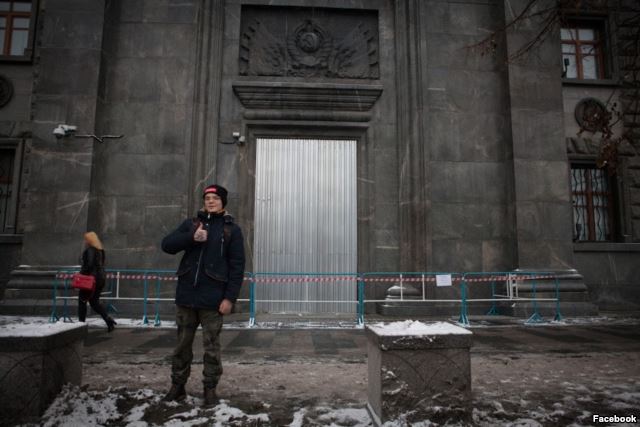
Gleb Astafiev standing next to the door at FSB headquarters that Pyotr Pavlensky set on fire
Gleb Astafiev’s action has sparked a fierce debate among Kurgan Region residents on social media. Some Internet users have admired the young actionist’s audacity and honesty. Others have written that Astafiev is as abnormal as Pavlensky. Astafiev has said he is uninterested in the negative feedback of philistines. He is suffering from a lack of communication most of all now. A girlfriend has been visiting Gleb at the hospital. She asked that her name not be printed, because she did not want to attract any public attention.
“That hospital is a hellish place: closed, stuffy, and miserable. Gleb is now all alone there. He is very depressed: almost no one comes to visit him. He doesn’t even have anything to read. Gleb asked me to buy him science fiction books. Gleb’s pupils are dilated: apparently, they are medicating him. I don’t know Gleb that well. Before his incarceration in the hospital, we had seen each other only five times. We met by chance at a concert by a local band. He wanted to have his picture taken with me and my ex-boyfriend. Then Gleb seemed like a cheerful, carefree, very dear and open boy, a young idealist with a dream. He and my ex-boyfriend then traveled to a Krovostok concert. A bit later, I realized that Gleb was very independent and intelligent, and had a very strong spirit for his age. Even today at the hospital he didn’t complain and didn’t ask for anything special except a couple of books and a bit of food. I know nothing about Pavlensky, but Gleb had the right to support him. I am surprised his mother sent Gleb to the hospital, but he is definitely not a whacko, as the majority thinks. The opinion of the herd is often wrong.”
Pyotr Pavlensky is not the only artist whom Astafiev has tried to support. In November of last year, the team at the news website Mediazona shot a documentary film about Astafiev. The reporters there were touched by the story of a young man who had borrowed money to travel from his village to the trial of the band Krovostok. In November 2015, Yaroslavl Regional Court considered rescinding a district court’s decision to ban the group’s songs and block its website. The trial resembled a comedy with a happy ending: the court took the side of the musicians. The members of Krovostok liked Astafiev so much that when the trial was over they took him along with them to Moscow for a big concert.
Margarita Filippova, photo and video editor, Mediazona:
“We were making a series of documentaries about the Krovostok trial. I noticed a long commentary by Gleb on Instagram. He wanted to know when the next hearing was and whether he could come to Yaroslavl to get the autographs of the guys in Krovostok. The photographs in Instagram initially made him look too eccentric. But when we saw him at the train station, we realized he was a very modest, friendly guy. That was when it occurred to me to show this absurd trial through the eyes of a touching 16-year-old boy who made the long trip from Kurgan to support his idols. Gleb is like a kid from another world, a world distant from our reality where we lazily follow insane trials on our iPhones, sighing and voicing our dissent, at best, on Twitter.
“Gleb sees the world like an artist, but at the same time he has a very rational attitude to reality. He has a good sense of the country in which he lives, and he really wants to change his life. I’m sure it will work out for him. Gleb feels responsible and concerned about other people. When I was sixteen I wasn’t worried about protesting artists, and I sure didn’t know what a court trial was.”
Zarina Kodzayeva, camera woman, Mediazona:
“Gleb is a very independent and open person. It seemed to me that Gleb didn’t have a drop of the infantilism you would expect from a teenager. He argues things sensibly and behaves like an adult. He and I chatted a lot when we were shooting the film. I found it very interesting to listen to him. Gleb writes things himself. When he speaks, you can tell he loves the Russian language. I got the sense this kid believed in the power of deeds. It really was important to him to support Krovostok and Pavlensky. One of the most important questions in documentary filmmaking is who can be a main character, the hero, and who cannot. Aside from the context, which might turn into a story, there is always an intuitive understanding that probably has to do with a person’s energy. I think Gleb is an absolute hero. And now he continues to prove it with his actions.”
Translated by the Russian Reader. Thanks to Comrade AM for the heads-up. Photos courtesy of Radio Svoboda

 Balaklava Bay, Sevastopol
 Ilya Shakursky. Photo from personal archive and courtesy of Mediazona
 Viktor Filinkov. Photo courtesy of Filinkov’s wife and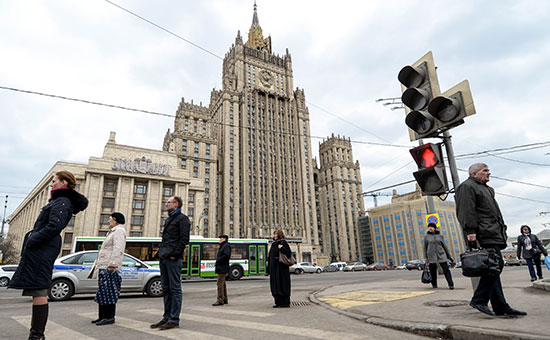


I was in the vehicle from roughly nine-thirty in the evening to one-thirty in the morning, when we arrived, apparently at an FSB office. When they took me out, they pulled a hood over my head and forced me to look down, and I could not figure out where we were, but later, when they took me home to search my flat, I guessed that it was a corner on Shpalernaya Street of the FSB building [whose main entrance is on Liteiny Avenue in downtown Petersburg—TRR]. I saw just as many secret service people in the office, only they were not wearing and were dressed in plain clothes. An investigator questioned me for something like an hour. Other secret service guys would sometimes stop by. One of them told me that if I did not want a second round, I should answer all the questions.
Then we went to the flat where we live, and there they let us read a search warrant issued by a court in Penza. During the search, I refused to switch on my laptop and telephone. That made them act very stridently. They threatened to hide a grenade and come back in a couple of days and find it in a search. Ultimately, they confiscated my laptop, telephone, and hard drive.
When they left, I went to the emergency room and documented the fact I had been beaten. I was issued a certificate in which all my injuries are listed. I am now looking for a lawyer to file a complaint. I am not mixed up in anything, but out of the blue I was tortured for several hours.
Translated by the Russian Reader