Crossing Jordan: Day Three of the Network Trial

Jordan and Maidan: The Network Trial, Day Three
Sergei Kagermazov
OVD Info
April 11, 2019

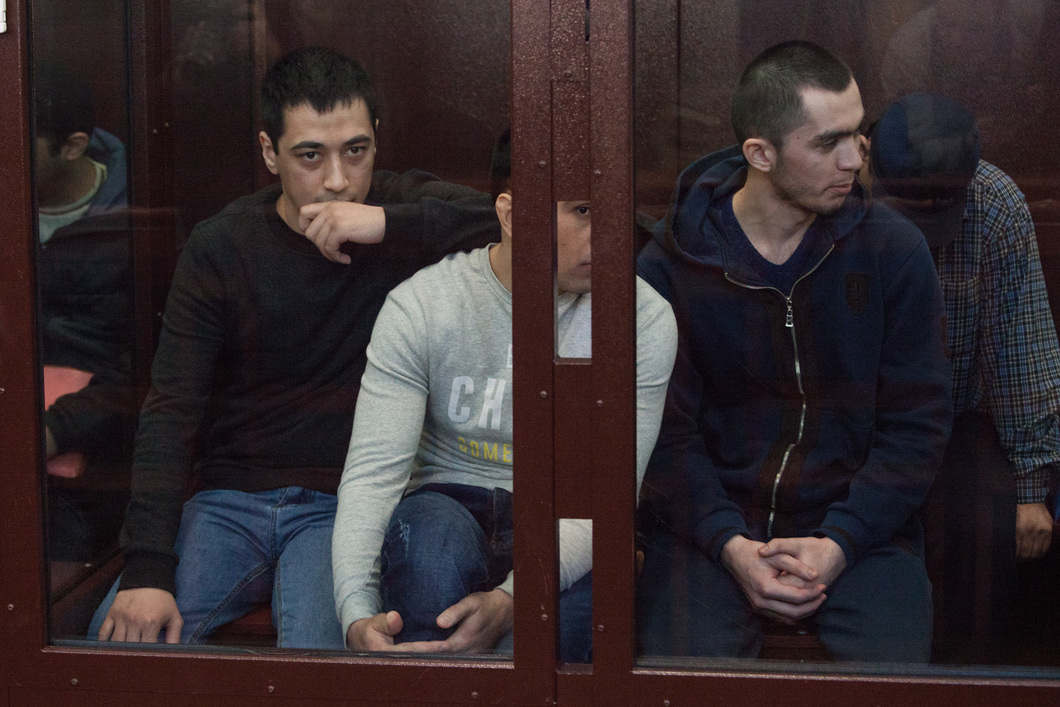
ovd1Yuli Boyarshinov in court. Photo by David Frenkel. Courtesy of OVD Info

The left-wing radical community Network existed, but its young anarchists were training to fend off attacks by ultra-rightists when and if a coup like the one that took place in Ukraine kicked off in Russia. In any case, this was the takeaway message of the testimony given by defendant Yuli Boyarshinov. Echo of Moscow in Petersburg correspondent Sergei Kagermazov describes day three of the Network trial for OVD Info.

The Guerrilla School
The courtroom at the 224th Garrison Military Court in Petersburg is unable to accommodate everyone. Some members of the public are left standing on the far side of the metal detector. The bailiffs claim there is no room and do not let people into the hallway even.

Later, it transpires that several university students who had not heard of the case wormed their way into the courtroom. Someone asked them to attend the hearing, and so reporters from Novaya Gazeta, TASS, and Rosbalt are unable to get into the courtroom. Subsequently, one of the students was identified as a member of the local branch of United Russia’s Young Guard (Molodaya gvardiya). Fontanka.ru would write that the FSB were behind the restricted access to the courtroom.

The highlight of day three of the trial is defendant Yuli Boyarshinov’s testimony. He pleaded guilty and moved to have his case tried separately under a special procedure involving elimination of the evidence phase, but the court denied his motion.

According to Boyarshinov, he knew he was an antifascist approximately since 2009. Six years later, he met another person accused [and convicted] in the case, Igor Shishkin. Shiskin also pleaded guilty, made a deal with case investigators, and was sentenced to three and a half years in prison.

“Around 2015 or 2016, I came to think a violent coup was possible in Russia. On the internet, I learned about radical right-wing groups planing something like what happened in Ukraine in 2014,” says Boyarshinov, who speaks as if he were reading the case file aloud.

People ordinarily do no talk like this.

Boyarshinov insists he was interested only in self-defense in the event radical nationalists emerged in Russia. He learned to handle weapons at the Guerrilla Club, a place in Petersburg affiliated with the DOSAAF [Voluntary Society for Assisting the Army, Air Force and Navy]. Other suspects in the Network case, whom Boyarshinov identified as Yegor and Polina, also took instruction there. Boyarshinov cannot recall their surnames. The young people purchased mock-ups of Kalashnikov rifles and practiced with them. However,  their only goal was self-defense. Boyarshinov emphasizes the young people were not planning any attacks.

It was also then the suspect [sic] met Alexandra Aksyonova, who introduced herself as Olya. Aksyonova is the wife of another defendant in the case, Viktor Filinkov, who is being tried together with Boyarshinov. The young woman is currently in Finland, where her application for political asylum is under review. NTV has reported Aksyonova was one of the leaders of the Network and alleged she had ties with Ukrainian nationalists.

As for the Guerrilla Club, it was also a place where future Donetsk People’s Republic and Lugansk People’s Republic volunteer fighters trained, as well as the Swedes responsible for the bomb attacks in Gothenburg in 2016 and 2017. But none of these people had yet piqued the FSB’s curiosity. When Filinkov asks whether Boyarshinov knew numerous nationalists trained at the Guerrilla Club, Judge Roman Muranov disallows the question as having no bearing on the case.

Jordan 1
Boyarshinov also testifies that, in the early summer of 2016, he was invited to a meeting in the Priozersk District of Leningrad Region. The meeting was attended by Yegor, Polina, and Shishkin, as well as Anton and Pasha, Network members from Penza (the men’s real names were Maxim Ivankin and Dmitry Pchelintsev, who are two more defendants in the case), and two other people. Since the Petersburgers did not know the people from Penza, they also used pseudonyms. Boyarshinov introduced himself as Yura, Yegor as Matvei, and Shishkin as Maxim.

At the meeting, the young men from Penza showed the others a document they called “The Code.” It was a draft project for a community called the Network. Boyarshinov says “The Code”{ ran to around fifteen pages, but only a couple of pages were read aloud to him. The case file contains a document resembling “The Code,” but that is the problem: it only resembles it. Boyarshinov was able to read the entire text of “The Code” only during the pretrial investigation. The young men from Penza said [at the meeting in the Priozersk District] they wanted to encourage the cooperation of different groups involved in self-defense.

ovd2Yuli Boyarshinov in court. Photo by David Frenkel. Courtesy of OVD Info

“So, formally, I joined the Network community,” Boyarshinov admits.

Due to security considerations, it was decided to identify the Petersburg group as “Jordan 1.”

Subsequently, members of the Network would choose different specialties for themselves. Since he had studied demolition and explosives at the Guerrilla Club, Boyarshinov became the group’s sapper.

Another meeting was held in western or northwestern Moscow Region in the woods. Six people attended, including members from Moscow. A third meeting took place in the winter of 2016 at Shishkin’s mother’s dacha. There were also several meetings in the autumn of 2016.

It was at one of these meetings that Boyarshinov met Filinkov. After Boyarshinov has testified, the people in the courtroom learn that, according to the case file, the FSB was already staking out both defendants at the time.

In February 2017, another meeting was held in a rented flat in Petersburg. Shishkin did not come to the meeting, but Filinkov, the Muscovites, and Pchelintsev and Ivankin were present. It was at this meeting that what the FSB identifies as “the minutes” was left behind, finding its way into the case file.

“I cannot corroborate what is described in the minutes of the meeting: I did not take notes. But the description seems more or less accurate,” says Boyarshinov.

When he read the minutes of the meeting, he realized the Network had decided not just to learn self-defense, but to try and destroy the regime.

“I don’t believe in violence, in violence against state authorities. I am sorry I was in such a community,” Boyarshinov repents.

Boyarshinov was detained by police. He claims to have found the smoke powder [with which police apprehended him] on the the roof of a building, since he worked as an industrial climber. He found the powder interesting, since he was studying demolition and explosives. When it was reported Pchelintsev had been detained, Boyarshinov decided to throw the powder away. He left his house and was caught by police.

“Russia’s Falling Apart, We Have to Leave”
The next to testify is Stepan Prokofiev, in whose flat Filinkov lived while he was looking for a place to rent. Prokofiev’s flat was searched by the FSB after they detained Filinkov.

The defendant [Filinkov] immediately points out Prokofiev might commit perjury and slander him.

“The FSB coerced the witness,” argues Filinkov.

[On the day of the search at his flat], Prokofiev was awoken, forced to lie face down on the floor, and handcuffed. He would spend the night at a police station. When Filinkov’s defense attorney, Vitaly Cherkasov, asks whether police explained to him why spent the night at a police station, Judge Muranov disallows the question as having no bearing on the case.
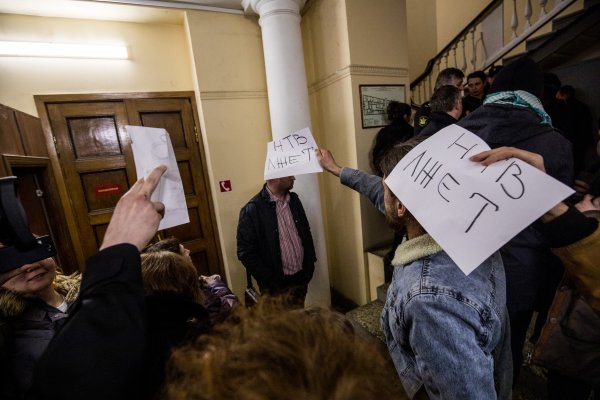
ovd3At the courthouse: members of the public holding pieces of paper inscribed with the message “NTV lies.” Photo by David Frenkel. Courtesy of OVD Info

“Filinkov went to Ukraine to see his wife. When he got back, he told me he had met someone who had fought in Donbas while he was in Kyiv. Filinkov told me a couple of times that Russia was falling apart and we had to leave. He said it would happen after the [March 2018 Russian] presidential election. He would talk about leaving for Georgia or Ukraine after this happened, because it was cheaper to live there,” Prokofiev recounts.

Filinkov counters that he never mentioned talking with anyone who fought in Donbas.

Prosecutor Yekaterina Kachurina is more interested in two guns that were legally registered in Filinkov’s wife’s name. However, it follows from the testimonies of Filinkov and the witness that, for the time being, there is nothing for the prosecution to get its hooks into.  The papers for the guns were in order, and the guns were kept in a safe.

The day ends with an attack by an NTV crew on the attorneys and parents of the defendants. However, members of the pubic cover the lens of NTV’s camera with pieces of paer inscribed with the message “NTV lies” and rattle the young woman holding the microphone by peppering her with absurd questions. Meanwhile, the defense attorneys are able to escape, while the parents get into taxis and quickly quite the scene.

_____________________________________________________________________

Vitaly Cherkasov
Facebook
April 10, 2019

Today, defendant Yuli Boyarshinov, while generally admitting his guilt, did not corroborate the prosecution’s position.

The prosecution has insisted that the members of the Network terrorist community, via “direct involvement in training sessions” that took place in St. Petersburg, Leningrad Region, and Penza Region, mastered “tactical methods of seizing buildings, facilities, and individuals” in order to “forcibly capture and eliminate” state authorities and “change the constitutional order.”

When examined in court, Boyarshinov corroborated the testimony he had given during the pretrial investigation: the goal of the training sessions was to master the skills of self-defense against ultra-nationalists. Defense, not offense!

[…]

_____________________________________________________________________

He Admitted His Guilt But Did Nothing Wrong: Yuli Boyarshinov’s Testimony at Network Trial Gives Prosecution’s Case No Trump Cards
Тatyana Likhanova
Novaya Gazeta in Petersburg
April 11, 2019

The authorities decided to restrict access to the trial of the so-called terrorist community Network, which is an organization now officially banned in Russia.

The high-profile case is being heard by a circuit panel of judges from the Moscow District Military Court at the Garrison Military Court in Petersburg. The hearings have been held in a cramped courtroom with two rows of benches accommodating ten people each. It is thus out of wildly out proportion with the heightened attention paid to the case by the public and the media.

On Tuesday, journalists from several periodicals appealed to the Moscow District Military Court to provide them with normal working conditions. On Wednesday morning, the approaches to the courtroom were occupied by groups of students from the Chemical and Pharmaceutical University and Herzen University’s law school.

The former said they had been sent there by a university official responsible for military training and patriotic education, while the latter claimed they had come to witness a high-profile case they had long been following, although they could not answer a single question about what was at stake in the case.

Among those crowded around the door to the courtroom was a young man bearing a resemblance to Vlad Girmanov, secretary of the military and patriotic club at the Pharmaceutical University, as well as people who had picketed the Petersburg office of [Russian opposition politician and anti-corruption crusader] Alexei Navalny.

nip1Yuli Boyarshinov arriving at the courthouse. Photo by Elena Lukyanova. Courtesy of Novaya in Petersburg

The influx of “extras” was an excuse to limit the access of the press and the public to the trial. The bailiffs refused to let correspondents from Deutsche Welle, TASS, Fontanka.ru. Bumaga, Rosbalt, and other media outlets into the courthouse to cover the trial, as well as Petersburg Public Monitoring Commission member Yekaterina Kosarevskaya. Complaints were filed with the head of the St. Petersburg bailiff service and the chairs of the Petersburg Garrison Military Court and the Moscow District Military Court. They were asked to verify the legality of the actions taken by the bailiffs and secure a courtroom large enough to accommodate everyone interested in witnessing this high-profile case. According to Fontanka.ru, the order to restrict access to the courtroom was made by FSB officers, who thus bypassed the top officials in the Petersburg judicial system.

The hearing opened with testimony by Yuli Boyarshinov, who has pleaded guilty. He said he had been an antifascist since 2009. In the winter of 2015–2016, he concluded that riots involving violence by nationalist groups (“along the lines of the events in Ukraine in 2014”) were possible in Russia. In order to acquire self-defense skills, Boyarshinov attended a month-long course at the Guerrilla Tactical and Firearms Training Center. (Its website says it is affiliated with the DOSAAF [Voluntary Society for Assisting the Army, Air Force and Navy] and “teaches civilians survival skills in local armed conflicts, social unrest, and martial law.”) The course included instruction in handling firearms, surviving in the woods, first aid, radio communication, and mines and explosives.

Boyarshinov attended the classes with his friend Yegor and a young woman identified as Polina. In addition to lectures, training sessions were held at a shooting range near the village of Olgino, during which Boyarshinov used a mock-up of a Kalashnikov assault rifle he acquired. Alexandra Askyonova, co-defendant Viktor Filinkov’s future wife, also went to the shooting range.

In the summer of 2016, Boyarshinov was invited to a meeting with “guys from Penza who were also interested in self-defense.” The meeting took place in the woods of Leningrad Region.

“We made bonfires, discussed different social problems and issues of self-defense, and trained with dummy weapons,” he said.

The attendees used fictitious names because they did not yet trust each other. One of the four attendees would later be identified as Dmitry Pchelintsev, another as Maxim Ivankin.

According to Boyarshinov, the Penza attendees talked about a project provisionally entitled the Network, designed to unite different groups for self-defense classes.

They presented their vision of the organization in a manifest of sorts, entitled “The Network Code,” one or two pages of which were read aloud.

Boyarshinov claimed he did not take what he heard seriously, and when someone later sent him the entire text of “The Code,” he did not bother to read it from cover to cover. He read the full text, nearly twenty pages, only when he was recently reviewing the criminal investigation case file. He was unable to corroborate whether what he read was identical to what had been sent to him earlier, but he said it seemed similar.

The document also outlines possible areas for studying self-defense skills: tactician, medic, signalman, and other roles, with no reference to specific people.

“These areas correspond to the disciplines I studied during the course at the Guerrilla Center,” Boyarshinov noted.

nip2Yuli Boyarshinov’s father Nikolai in the courtroom. Photo by Elena Lukyanova. Courtesy of Novaya Gazeta in Petersburg

The second meeting that summer took place in the Moscow Region. Several young people from the capital joined the attendees of the first meeting. Boyarshinov remembered only that one of them was named Lev. There were more conversations around campfires and training sessions with dummy weapons.

In the winter of 2016–2017, the group traveled to Igor Shishkin’s mother’s dacha, spending their time in much the same way.

Boyarshinov stressed they worked only on fending off attacks during all the meetings and training sessions: they never practiced raids and assaults. Political issues were not discussed, and there was no talk of drilling for terrorist-like crimes.

Shishkin, who made a deal with case investigators, also noted the absence of violent actions during the training when he described the trip to his mother’s dacha in his testimony.

Boyarshinov corroborated that Filinkov did not attend the first two meetings. Aksyonova introduced Boyarshinov to Filinkov in the autumn of 2016. Filinkov took part in a couple of training sessions at the firing range near Olgino. One dealt with first aid and evacuating the wounded, while the second focused on fending off attacks of VIPs [sic] by employing the methods of private security companies. No knives or firearms were used during the training sessions, only dummy machine guns.

As for the group’s allegedly strict conspiratorial methods, among which case investigators identified the use of messengers and encrypted correspondence, Boyarshinov explained they had been his usual means of communication in the years prior to his involvement with the group.

The third meeting with the young men from Penza and several Muscovites took place in a rented flat in Petersburg in February and March 2017. In the case file, this meeting has been identified as a “national congress of the Network terrorist community.”

Boyarshinov, on the contrary, described a two- or three-day meeting, involving approximately a dozen people. They discussed a little of everything, from music to social, environmental and antifascist events. Filinkov was in attendance, but Boyarshinov could not remember him giving a report, showing any initiative or shouldering any responsibilities for further action.

Boyarshinov could not say who organized the meeting and who kept the minutes of the meeting. (A printed file entitled “Minutes of the Congress” was entered into physical evidence.) He could not corroborate whether Filinkov was present the entire time or whether he came and went, since he had himself had come to and gone from the meeting. As far as he could remember, “The Network Code” was also discussed.

However, some of those present said the group should prepare vigorously to fend off potential violent actions when circumstances in Russia deteriorated, while others had advocated “provoking actions themselves,” Boyarshinov recalled uncertainly.

Only after carefully reading the redaction of “The Network Code” provided to him by case investigators did Boyarshinov discover “it had been proposed to establish combat cells and target the authorities.”

“I have never espoused terrorism and I am sorry I wound up in this community,” he added.

However, Boyarshinov was unable to clarify who he believed had authored the document, how its contents were regarded by any of his current co-defendants, and whether it had been backed by someone specifically.

UPDATE
The next day, April 11, the hearing started nearly two hours late. (Allegedly, the armed escort bringing the defendants to court had got stuck in traffic, although it takes fifteen minutes to drive from the remand prison to the courthouse.)

The hearing was brief. The court heard the testimony of the two janitors who had served as official witnesses during the search of Filinkov’s place of residence. The presiding judge then announced the trial was adjourned until May 14.

One explanation for such a long adjournment is the reluctance of Petersburg investigators to wind the case up before the scandal surrounding the lead investigator in the main part of the Network case, Valery Tokarev, a senior investigator in the FSB’s Penza Region office, has been cleared up.

The previous day’s evening news broadcast on state TV channel Russia 24 featured a segment on fugitive businessman Alexei Shmatko.

Shmatko, who complained he was tortured by Tokarev, has been granted political asylum in Great Britain. (The segment starts at the fifty-minute mark.)

This was not the first time the All-Russia State Television and Radio Broadcasting Company had discussed the vicissitudes of this Penza businessman’s career. Shmatko had been on federal business ombudsman Boris Titov’s list of fugitive Russian businessmen who had voiced a desire to return home. But Tokarev’s name had never been mentioned on the air before. (Although Shmatko claims he had mentioned it during previous TV interviews.)

This time round, the presenter on state television was insistent, encouraging the businessman to dot his i’s and cross his t’s. Who had bribed him? What was the reason?

“He subjected me to torture,” Shmatko said, specifying his charges against Tokarev, “and accepted a bribe from me to release me from remand prison.”

Shmatko complained he had informed the Russian Investigative Committee about this incident in a written statement, but they “had not batted an eye.” He also assured the news presenter he was willing to return to Russia if his case were transferred to the feds, investigated thoroughly, and Senior Investigator Tokarev were arrested.

If this happened, Shmatko would return to Russia for Tokarev’s trial and testify against him.

The interview with Shmatko was chockablock with quotations from the President’s Address to the Federal Assembly on the need to criminalize illegal investigations and punish those responsible for launching them.

On April 10, Prosecutor General Yuri Chaika, speaking in the Federation Council, reported the number of corrupt FSB officers who had been outed had more than doubled. He also drew attention to “egregious cases of cruelty toward inmates.”

Three defendants in the Network case in Penza—Dmitry Pchelintsev, Ilya Shakursky, and Arman Sagynbayev—complained they had been tortured with electric shocks in an attempt to force them to incriminate themselves and others, including the Petersburg defendants.

Translated by the Russian Reader. You can find links to my previous coverage of the Network case here.

Alexander Podrabinek: Murder in Tyumen

“Russian counter-terrorism police say they prevented an imminent Islamic State attack in the Siberian city of Tyumen, as two armed terror suspects were eliminated in an intense raid with heavy gunfire and explosions. The militants, who were holed up in a private home, refused to lay down their arms and opened fire at the law enforcement on Friday. ‘They were neutralized during a gunfight,’ the National Anti-Terrorism Committee (NAC) said. There were no casualties among civilians and security personnel as a result of the exchange of fire. The terrorists were planning an attack in [a] public place in the city and the decision to launch an operation was made swiftly, the NAC said. Numerous unconfirmed videos on social media appeared to show the nighttime operation in full swing, with heavy gunfire, a building on fire, and a score of police cars and military vehicles amassed in the streets.” Published on April 12, 2019, by user AS2017

Murder in Tyumen
Alexander Podrabinek
Grani.ru
April 14, 2019

The killing of two suspected terrorists in Tyumen has been spun as a showcase counter-terrorist operation. It went off without a hitch, that is, you do not count the spontaneous undertaking by curious locals who attempted to livestream it on the internet. On the other hand, Tyumen Regional Governor Alexander Moor had lots of nasty things to say about local video bloggers, commentators, and social media users.

On Friday, security forces cordoned off the area around Amur Street in Tyumen. They claimed two Islamic State terrorists had holed themselves up in a private house in the street. The cordoned-off area was declared a counter-terrorist operation zone, and approximately one hundred local residents were forcibly evacuated from the area. I think it superfluous to ask whether the suspected terrorists noticed the evacuation or not. If the terrorists had been real terrorists and the operation itself risky, not a staged textbook operation, the security forces would have tried to use the element of surprise. But no, all possible eyewitnesses were first removed from nearby houses, and only then did the security force go after the “terrorists.”

tyumen“Counter-terrorism operation” in Tyumen. Photo by Maxim Slutsky. Courtesy of TASS

The two people who had been designated terrorists were killed, of course. Half of their one-storey wooden house was burnt to the ground. This makes sense: the fire destroyed inconvenient evidence. The Russian Investigative Committee reported that two machine guns, two explosive devices, and religious pamphlets were found in the house, along with twenty-first-century weaponry in the shape of electronic devices. In short, they predictably found the usual kit of the modern “terrorist.”

Surprisingly, the fire did not damage the damning evidence. The explosive devices did not explode, the religious pamphlets were not reduced to ashes, the smartphones did not melt. If we recall that in many other cases the Russian security forces planted weapons and narcotics on “suspects,” nothing surprising happened. The “clues” the investigators need will be entered into physical evidence, while the stuff it does not need will not be registered anywhere.

We might learn the identities of the dead men in the coming days. Someone must have known them, and someone will tell us about them. The security forces identify them as “terrorists,” but the charges filed are not for terrorism, but conspiracy to murder and attempted murder of a law enforcement officer. This is odd, as is the fact that the FSB carried out the counter-terrorist operation, while the Investigative Committee has headed the investigation.

The Investigative Committee and FSB claim the “terrorists” were Islamic State members who were planning massacres in public places. They have not made any details of the case public, much less the overall circumstances. We are asked to take their word on it, although after the “bags of sugar” in Ryazan, Alexander Litvinenko’s murder, the attempted assassination of the Skripals, and many other exploits, the security forces cannot imagine the public will trust them.

The Tyumen “terrorists” have been accused of conspiracy to commit a crime (Russian Federal Criminal Code Article 30), but they were unable to commit any crimes because their lives were taken. Along with their lives, they were deprived of the chance to defend themselves and attempt to prove their innocence in court.

Is it possible they were real terrorists and eliminating them was necessary to ensure the safety of others? Of course, it is possible. On the other hand, are we not aware of numerous instances when the security forces provoked crimes only to kill the “suspects” while covering their tracks—their own tracks more than the tracks of the “criminals”? I have in mind not only the crimes of the NKVD but also the events of the past two decades, especially in Dagestan and the rest of the North Caucasus?

One of the most telling examples of this kind was the so-called Nord-Ost hostage crisis at the Dubrovka Theater in Moscow in 2002. While freeing the hostages, the security forces killed all thirty-six terrorists. Most of them were killed by being shot in the back of the head while lying unconscious, knocked out by the poisonous gas the special forces released in the theater’s auditorium. They thus got rid of the defendants and the need for a trial, a trial during which parts of the story that shed an unflattering light on the regime could have come out.

Heir of the old Soviet ways, the current regime has aspired to conduct all cases and campaigns against people who have opposed it under arms and people who have fought it with words and people who have been the accidental victims of deliberate provocations by the security services in secret. Reporters are not allowed into counter-terrorist operation zones, inconvenient eyewitnesses are rubbed out, defense attorneys are made to sign nondisclosure agreements, and court trials are held in closed chambers.

Consequently, we have no reliable means of judging whether a particular individual has committed a crime or not. We are well aware, however, that despotism and lawlessness are fond of silence but no friends of publicity. We have been through this before. So, every time a clandestine operation is carried out, every time “criminals” and witnesses are eliminated, and every time a trial is heard in closed chambers, we have every reason to suspect the security forces of provocation, dishonesty, and fraud.

Thanks to Nastia Nek for the heads-up. Translated by the Russian Reader

Framed?

A Speedy Trial?
Maxim Leonov
Novaya Gazeta
April 2, 2019

It took law enforcement agencies over a month to deliver eleven suspects and 127 volumes of criminal case files to Petersburg. At the first hearing in the case, on April 2, the reporters who were present got the impression that the Moscow-based judges trying the case had no intentions of dragging the trial out. Nearly all the lawyers who had come onto the case, replacing state-appointed defense attorneys, were turned down in their request to be granted additional time to review the case files.

“Coordinate it during the recesses,” said presiding judge Andrei Morozov.

The indictment claims all the defendants were associated with a certain Sirojiddin Muhtarov aka Abu Salah. He was not among the defendants on trial. Investigators claimed he was currently in the vicinity of Aleppo, along with Uzbek national Bobirjon Mahbubov (code-named Ahmed), who had turned 22-year-old Akbarjon Jalilov into an Islamic suicide bomber.

Investigators claimed Muhtarov and Mahbubov communicated with the defendants on Telegram. Their recruitment into the ranks of the alleged terrorist organization had also, apparently, taken place on the internet, because almost none of the defendants had been abroad except for Jalilov.

content_IMG_2426

_______________________________

The Terrorist Attack
An explosion rocked the Petersburg subway at 2:33 p.m. on April 3, 2017. Twenty-two-year-old Akbarjon Jalilov is alleged to have to set off a homemade bomb on a section of the subway between Sennaya Ploshchad and Tekhnologicheskii Institut stations. The train’s driver, Alexander Kaverin, was able to get the damaged train to Tekhnologicheskii Institut, where the wounded were assisted.

According to the Russian Emergency Situations Ministry and the Russian Health Ministry, eleven people died in the explosion, including the suicide bomber. Another victim died en route to hospital, while two more died upon arrival. The total number of people killed was thus sixteen. Eighty-nine people sought medical attention after the blast; fifty-one of them were hospitalized.

The same day, it transpired that two simultaneous blasts had been planned instead of the one. Another bomb, three times more powerful than the one set off, allegedly, by Jalilov, was found camouflaged as a fire extinguisher by Albert Sibirskikh, an inspector at Ploshchad Vosstaniia subway station. A cursory examination of the bomb revealed it would have been detonated by a mobile phone.

_______________________________

content_IMG_2827

The mother of one of the defendants, Mahamadusuf Mirzaalimovasked reporters not call her son a “terrorist.”

“He was merely at the wrong place at the wrong time,” she said.

The place where most of the defendants were found at the wrong time was the Lesnoye Cafe in Moscow Region’s Odintsovo District, where Jalilov worked as a cook between December 2016 and March 2017. Another such place was a flat at 22/1 Tovarishchesky Prospect in Petersburg. It was here, while they arrested five of the suspects on April 5, 2017, that FSB officers were alleged to have found components of an explosive device. The indictment claims that Jalilov and five of the defendants lived in the flat.

Investigators allege that brothers Abror and Akram Azimov had acted as Abu Salah’s agents in Russia. He supposedly sent them money to buy parts for the explosive device.

Defendants are typically reluctant to talk to the press [sic], but in this case it was quite the opposite. During the hearing, both Azimov brothers petitioned the court to have their testimony televised.

content_IMG_2361

“We are willing to explain how we got mixed up in this case and how we were forced to testify. We are only random Muslims. We have done nothing else wrong,” the Azimov brothers told the court.

Judge Morozov rejected their motion to have their testimony filmed, arguing that only the reading of the verdict could be recorded.

All the defendants in the case have refused to plead guilty to involvement in terrorism. Yana Teplitskaya, a member of the Petersburg Public Monitoring Commission (PMC), told us that she had information the defendants had been tortured. According to Teplitskaya, the Muhamadusup brothers [sic] and Ibrahim Ermatov had related to PMC members that investigators had subjected them to physical violence, but their injuries had not been officially certified by medical personnel. PMC members promised to released more detailed information in the near future.

Defense lawyers also claimed their clients were ordinary people who had accidentally been caught up in the juggernaut of the investigation.

“He pleads not guilty,” Ketevan Baramiya, defense attorney for Ibrahim Ermatov, told us. “It’s a great pity the court rejected the motion to videotape the testimony. The defendants are willing to explain how they got mixed up in this case.”

content_IMG_2757

However, it was not only defense lawyers who had the impression the FSB had chosen the “terrorist conspirators” at random.

“Frankly speaking, they don’t really look like terrorists,” said Yuri Shushkevich, who was injured in the terrorist attack, “especially that woman.”

He meant Shohista Karimova, who has been charged with aiding and abetting the alleged terrorists by buying SIM cards for mobile phones and storing an F1 grenade, which she claims was planted in her domicile by FSB field officers.

“They all look like ordinary guys, but how would I know what terrorists look like?” wondered Shushkevich.

All photos by Elena Lukyanova and courtesy of Novaya Gazeta. Translated by the Russian Reader. See my previous post on this case, “The Strange Investigation of a Strange Terrorist Attack” (12 February 2018), for a more detailed account of the case.

Article 318: Criminalizing Protest in Russia

wehatecops

Criminalizing Protest Has Become a Tool for Combating Rallies
Experts Studied Use of Law Criminalizing Violence Against Authorities
Anastasia Kornya
Vedomosti
February 28, 2019

Defending Protest (Apologiya protesta), an organization that provides assistance to people detained at protest rallies, has analyzed the use of Russian Criminal Code Article 318 against people involved in protest events. Article 318 makes violence against authorities a criminal offense. Between 2009 and 2017, a total of 65,046 people were convicted on this charge. Typically, the charge has been filed against people involved in drunken brawls broken up by police units or people involved in roadside altercations with traffic police. But Article 318 has also become the primary tool for charging activists with using violence against the security forces.

Demonstrative Cruelty
There are no separate figures for protesters charged with violating Article 318, but between 2013 and 2015 the number of people convicted on such charges rose annually by 600 to 800 people before decreasing slightly. The authors of Defending Protest’s report argue this increase stemmed from a rise in the number of protests and protesters in 2012: it was on May 6, 2012, that the March of the Millions took place, leading to the show trials of the Bolotnaya Square Case. After the protests peaked in 2015, there was a cooling off period, and the number of convictions nearly returned to their 2009 levels. However, there has been a growing tendency to sentence people convicted under Article 318 to actual prison time.

The experts note that when defendants confess their guilt and are tried in special expedited trials, it should theoretically mitigate their punishments, but in reality it does not increase chances they will be sentenced to probation or other non-carceral penalties. Besides, courts in Moscow have made a point of not invoking the option, stipulated by law, of dismissing cases because the parties have been reconciled or defendants have sincerely apologized for their crimes, since, in the opinion of Moscow judges, cases cannot be dismissed in so-called double-ended crimes, crimes committed not only against the victim as such but also against law and order.

The report notes that customary Russian methods of criminal investigation and judicial procedure have now been applied to the cases of grassroots activists, including double standards in weighing evidence, the presumption that law enforcement officers tell the truth, and giving priority to testimony made by suspects prior to their trials. The experts note the charges in such cases can be trumped up easily. The key evidence in these cases is the testimony of the victim and witnesses, all of them police officers. If necessary, their statements can be coordinated and entered into the court record in literally identical form.

Nonpunishable Violence
The flip side of the process is the inability to hold police officers criminally liable for using violence against demonstrators, says Alexei Glukhov, head of Defending Protest. If justice is served, this happens only if and when the European Court of Human Rights rules on a case, although Russian policemen and security services officers have been dispersing peaceful demonstrations and detaining grassroots activists and random bystanders with ever-greater ferocity. But nearly the only well-known case in which a Russian police officer was held criminally liable for violence against protesters was the case of Vadim Boyko, the so-called Pearl Sergeant, who hit a man over the head with a rubber truncheon at a demonstration in Petersburg in July 2010. In 2011, Sergeant Boyko was sentenced to three and half years of probation.

It is common practice to reject complaints filed by victims of police violence by claiming they are means of self-defense against the counter charges faced by the complainants. Thus, in the formal refusal to open a criminal case based on the complaint filed by lawyer Mikhail Benyash, the police investigator wrote, “M.M. Benyash’s testimony should be treated skeptically because he is thus attempting to build his own defense against criminal charges and thereby avoid prosecution.” In turn, the police officers who denied they had beaten Benyash testified he had beaten his own head against the window, door, and other parts of the car in which they abducted him, and when they dragged him out of the car, he beat his head against the pavement.

No less noteworthy were the reasons police investigators gave for refusing to open a criminal case based on a complaint filed by Danil Bolshakov and Daniil Markelov of Krasnoyarsk. Their testimony was not corroborated since Markelov was a supporter of Alexei Navalny, “who is a well-known opponent of the leadership of the Russian Federation, as headed by President V.V. Putin.”

Crackdown
Generally, the police crackdown has been intensifying. Lawyer Dmitry Agranovsky agreed Article 318 has been used to intimidate people.

“I would encourage everyone to compare the verdicts in the Bolotnaya Square Case, in which a demonstrator brushed away a policeman’s arm and was sentenced to three and a half years in prison, with the sentences handed down in the wake of the recent unrest in France, in which protesters have been fined or sentenced to a few months in jail at most,” he said.

In fact, Agranovsky explained, any physical contact with Russian police would result in the “offender” being charged under Article 318. Ultimately, people have become wary of attending protest rallies, although, formally speaking, Russia has signed all the relevant international conventions encouraging  peaceful protest.

Agranovsky recalled that ex-Russian MP Vladimir Bessonov was stripped of the right to engage in politics after he was charged with using violence against police officers at a protest rally.

Opposition politician Dmitry Gudkov agreed the police crackdown has intensified.

“There is a desire to extinguish protests, and that is something you can only do with a stick. The powers that be have run out of carrots,” he said.

Gudkov argued all the available tools have been brought into play in order to artificially criminalize protest. For example, the so-called Ildar Dadin article in the criminal code had been revived after it was all but outlawed by the Russian Constitutional Court. The article criminalizes repeated involvement in “unauthorized” protest rallies.

Translation and photo by the Russian Reader

“Expressive Eyebrows”: Azat Miftakhov Jailed After Secret Witness Testifies

shark.JPG

Anatrr Ra
Facebook
February 12, 2019

Azat Miftakhov, a mathematics and mechanics graduate student at Moscow State University,  has been remanded in custody until March 7, 2019

Golovina District Court Judge Sergei Bazarov has remanded Azat Miftakhov in custody for a month, until March 7, at the request of police investigators. The police suspect Miftakhov of involvement in a January 13, 2018, incident in which a window in the Khovrino office of the United Russia party was broken and a smoke bomb was thrown inside.

The only evidence in the case is the testimony of a secret “witness” who emerged three days ago. Allegedly, the witness was near the United Russia office the night of the incident. He saw six young people. Three of the young people smashed the window and threw a smoke bomb in it, while the other three stood off to the side. The so-called witness supposedly recalled Miftakhov as being among the group who stood and watched, yet he was unable to describe neither what Miftakhov was wearing or his facial features, only his “expressive eyebrows.” The witness, however, did not contact the police for an entire year since, he explained, his phone had gone dead at the time and, subsequently, he had been busy with his own affairs.

Miftakhov was detained by law enforcement officers on the morning of February 1 on suspicion of making explosives, a criminal offense as defined by Article 223 Part 1 of the Russian Federal Criminal Code. He was held for twenty-four hours at the Balashikha police station, where law enforcement officers tortured him, demanding he make a full confession. Only on the evening of February 2 was Miftakhov officially detained and sent to the Balashikha Temporary Detention Facility.

On February 4, however, a court refused to remand him in custody due to a lack of evidence. Over the next three days, police investigators were unable to muster any evidence against Miftakhov, and so, on February 6, he was released from the temporary detention facility without charge.

As Miftakhov was leaving the detention facility, he was detained by men in plain clothes and taken to the Interior Ministry’s headquarters for Moscow’s Northern Administrative Division, where he was told he had been detained in another case, an investigation of alleged disorderly conduct outside the United Russia office in Khovrino on January 13, 2018. An investigation into vandalism (Criminal Code Article 214 Part 1) had been opened in January 2018, but Russian law does not stipulate remanding vandalism suspects in custody during investigations.

In an amazing coincidence, just as Miftakhov was detained a second time, the case was reclassified as an investigation of disorderly conduct, as defined by Criminal Code Article 213 Part 2. People suspected of disorderly conduct can be remanded in custody, and Miftakhov suddenly had become the main suspect in the case. On February 10, the Golovina District Court in Moscow refused to remand Miftakhov in custody, postponing the hearing until February 12.

Miftakhov denies the charges against him. He believes he has been framed because of his anarchist views.

Over a thousand lecturers, professors, researchers, and students from leading Russian and international universities have signed a petition in Miftakhov’s defense, include MIT linguistics professor Noam Chomsky and Viktor Vasilyev, president of the Moscow Mathematics Society. Mikhail Finkelberg, professor at the Higher School of Economics and Skoltech, Boris Kravchenko, president of the Confederation of Labor of Russia (KTR) and member of the Russian Presidential Human Rights Council, and Russian MP Oleg Shein have agreed to stand surety for Miftakhov.

Translation and photo by the Russian Reader. Please read my earlier posts on the Khovrino vandalism case and the Russian police state’s senseless, relentless persecution of Azat Miftakhov.

Torture First, Ask Questions Later (The Case of Azat Miftakhov)

азатAzat Miftakhov. Courtesy of Autonomous Action

Detained Moscow State University Mechanics and Mathematics Grad Student Tells Lawyer Security Forces Beat Him
Mediazona
February 3, 2019

Defense lawyer Svetlana Sidorkina reported to Mediazona that Azat Miftakhov, a graduate student in the mechanics and mathematics department at Moscow State University, told her he was beaten by security forces officers after they detained him.

“In the office [at the Balashikha police station — Mediazona] where he was held, they demanded he confess and were upset he asked to call family members or a lawyer. As he told me, one of the officers pressed an object that appeared to be a screwdriver to his chest and said he would use it if [Miftakhov] did not do as they asked,” Sidorkina told us.

“Then he was beaten on the arms and face. As [Miftakhov] said, they kicked and punched him in the chest. But there were no visible injuries. Then [one of the security forces officers]  wanted to stick the screwdriver in his anus. [Miftakhov] took the threat seriously, but [the officers] did nothing. Ultimately, [Miftakhov] did not tell them anything nor did he sign a confession,” said Sidorkina.

She noted that, aside from a bruise on Azat’s ear and a mark made by the screwdriver, there were no visible injuries on his body.

Miftakhov did not know what security agency the men who beat him represented.

Sidorkina added that Miftakhov was detained as part of an investigation into a violation of Russian Criminal Code Article 223.1 Part 1 (illegal manufacture of explosives).

According to Sidorkina, Miftakhov was detained on the morning of February 1. After his dwelling was searched, he was delivered to the Balashikha police station. In the evening, after he was interrogated by security services officers, he was taken to hospital, where he was treated for abrasions from the screwdriver and injected with a sedative. He was driven back to the police station, but held in the car until three in the morning.

Sidorkina suspects the security forces did not know how to charge the detained graduate student.

Ultimately, Miftakhov was placed in a room for people detained on administrative charges in the Balashikha police station’s other building, which houses its investigative department.

On the morning of February 2, however, he was taken back to the first building. According to Miftakhov, he was held in a office there for the entire day, but he was handcuffed. Around seven o’clock in the evening, he was driven back to the Balashikha police station’s investigative department, where the written record of his detention was read out to him.

At least eleven other people were detained as part of the explosives investigation. Except for Miftakhov, all of them have been released.

Mediazona has spoken with six of the former detainees. Daniil Galkin told us that, after the search, FSB officers tortured him with a taser and tried to force him into testifying against Miftakhov and doing an interview with a news crew from Channel One.

Translated by the Russian Reader

Torture (The Case of Pavel Zlomnov)

mediazona-van
Illustration for Mediazona by Maria Tolstova. Courtesy of Mediazona

Man Who Said He Was Tortured by FSB Released from Remand Prison and Immediately Rearrested on New Charges 
Mediazona
January 31, 2019

Petersburg resident Pavel Zlomnov, who claimed he had been tortured by FSB officers, was released on his own recognizance on charges of arms trafficking (Article 222 of the Russian Criminal Code) and immediately detained on new charges, his brother Mikhail has informed Mediazona.

Zlomnov is suspected of having violated Article 205.1 Part 1 of the Russian Criminal Code: “public calls for terrorism, vindication or promotion of terrorism.”

“Today, he was released on his own recognizance in the old case that kept him in Remand Prison No. 6 for a year and was immediately detained as part of a new case,” said Mikhail Zlomnov.

According to the written order to institute legal proceedings, a copy of which Mediazona has in its possession, on October 31, 2018, Zlomnov, who was in Remand Prison No. 6, called the person who caused the explosion in the FSB’s Arkhangelsk office [sic] a “real hero of the people.” According to investigators, he also “publicly made appeals recognizing the ideology of violence, including appeals that were poetic in terms of their rhetorical structure [sic].”

The case is being investigated by the FSB.

Mikhail Zlomnov said that investigators have once again requested that his brother be remanded in custody. His custody hearing will take place on January 31.

Zlmonov was initially detained on January 31, 2018, on charges of arms trafficking. Zlomnov’s family reported that, when he was detained, FSB officers “jumped up and down on him, injuring his kidneys, head, and arm.”

Roman Grozdov, another defendant in the case, also reported being tortured.

Mediazona published a detailed account of the case in August 2018.

In late January of this year, Pavel Zlomnov’s brother Mikhail and their father Andrei, who are lawyers, were charged with insulting FSB investigator Dmitry Sablin, per Article 319 of the Russian Criminal Code, which makes publicly insulting officials a criminal offense.

Translated by the Russian Reader

FSB May Have Used Neo-Nazi Provocateur to Frame Network Suspects

Russian Security Services May Have Used Agent Provocateur to Frame Up Antifascists
People and Nature
January 31, 2019

Antifascists have launched an international campaign to defend Russian activists who have been arrested, tortured in detention, and charged with terrorism-related offences in the Network case.

The Federal Security Service (FSB) claims that 11 people arrested in St Petersburg and Penza were part of an underground terrorist group seeking to sow disorder ahead of the 2018 Russian Presidential elections and the football World Cup.

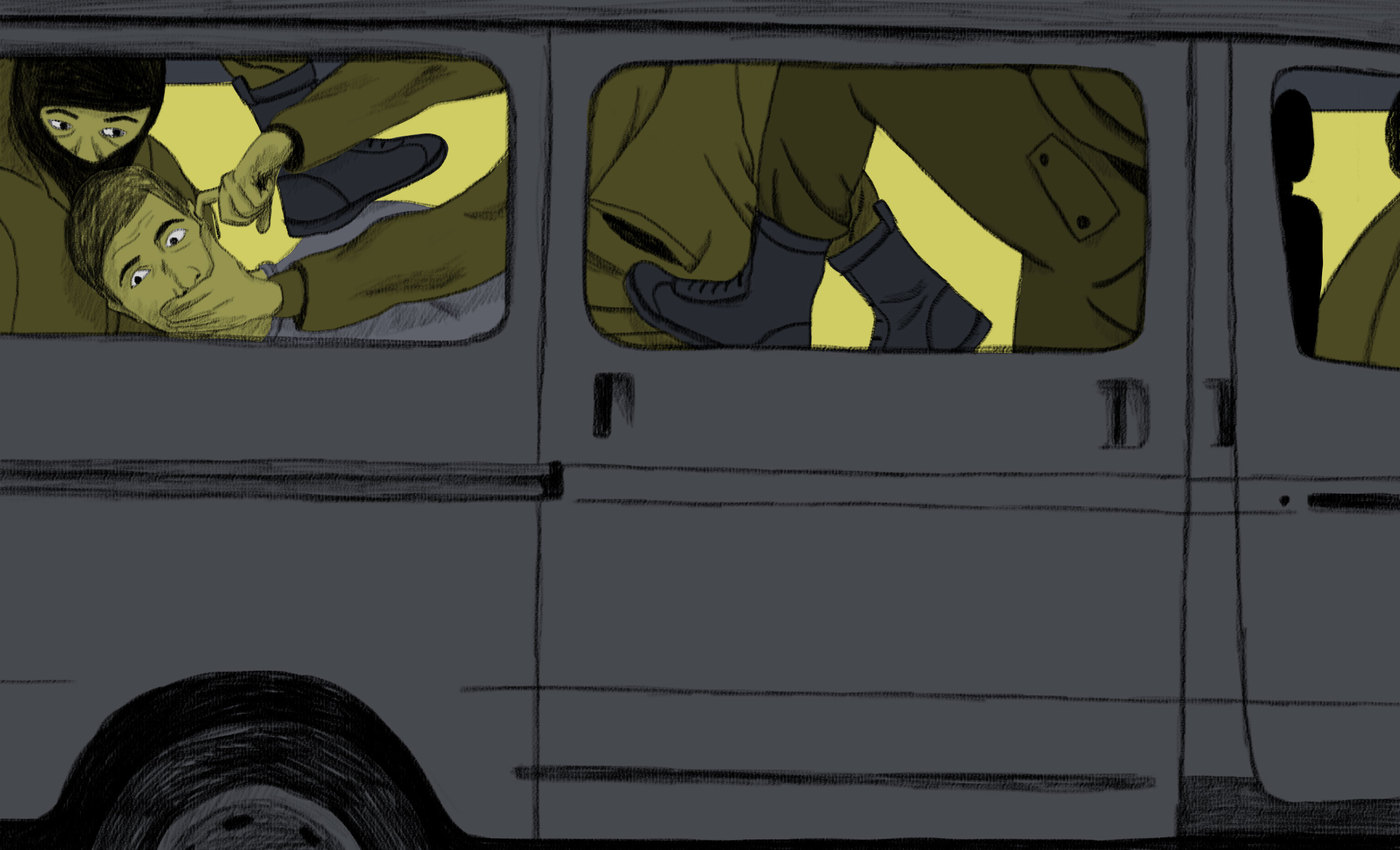
Several of the detainees have described in detail how they were tortured by the FSB. For example, Viktor Filinkov described how he was tortured with an electric shocker after being detained at St. Petersburg’s Pulkovo Airport in January 2018. Filinkov stated that FSB officers put him in a minivan, and then drove him around the city while torturing him into learning a forced confession.

pan-antifaDemonstrators showing their solidarity with Network defendants on January 19, 2019, in London. Photo courtesy of People and Nature

The quasi-official St. Petersburg Public Monitoring Commission has compiled evidence of torture, and the issue was raised at a meeting of the Kremlin’s own Presidential Council for Civil Society and Human Rights. Nevertheless, preparations for what the defendants and their families describe as a show trial continue.

On 19 January, demonstrations in solidarity with the defendants were held in Moscow, St. Petersburg, Kyiv, London, and other European and North American cities. (Information on the London event here and here.)

On 17 January, defendant Igor Shishkin received three and a half years for involvement in a terrorist organization. Shishkin admitted his guilt and came to a pretrial agreement with the investigation. Most other defendants have renounced their confessions, citing the fact that they were tortured by FSB officers.

The following article, by Tatyana Likhanova of the independent Russian newspaper Novaya Gazeta, describes the use of what appears to be an agent provocateur in the Network case. This agent, who attended the same sports club as one of the case investigators in Penza, previously gave information to Ilya Shakursky, one of the defendants, and appears to have encouraged Shakursky to take radical action. We translated it with the author’s permission.

***

Following the conviction of Igor Shishkin, his lawyer Dmitry Dinze published several extracts from the case materials in a Facebook post. According to the post, a certain “V.I. Kabanov (an agent who possesses audio files of conversations with members of the Network)” features on the list of witnesses who testified against the defendants.

Ilya Shakursky, one of the Penza-based defendants in the Network case, reported that this agent came into contact with the antifascists previously, in a statement made last April. Having introduced himself as “Vlad Dobrovolsky,” the agent encouraged them to take radical measures against the Russian authorities and engage in violent acts against law enforcement officials. Shakursky’s statement was given to Senior Investigator Valery Tokarev and attached to the case files. But this evidence was not verified by law enforcement.

At a recent court hearing on the extension of pretrial custody for Shakursky, the following statement by the defendant was read out by the presiding officer (the session was open to the public, and journalists made audio recordings):

In autumn 2016, I met a young man named Vlad Dobrovolsky on the VKontakte social network [a Russian network similar to Facebook]. His name and surname may not be real. He was of an average height, with short dark hair, a beard, and strong build. I can identify him. I also know that he was studying at Penza State University. Vlad had given me important information about upcoming attacks by neo-Nazis on antifascist events. According to him, he did it because of a personal grudge against the Penza Nazis.

He also told me that some neo-Nazis maintained close relations with officers from the counter-extremism department, who, in turn, do not prevent the organisation of neo-Nazi events (tournaments, meetings, concerts).

Vlad found out later that I play airsoft, and offered to give me a few training sessions on tactics. At one of his training sessions, he showed me his Wild Boar firearm.

Later, he told me that a radical neo-Nazi organisation operates in Siberia; its aim is to fight for the autonomy of Siberia. As a committed antifascist, I felt it was my duty to learn more about this organization in order to expose it later on by writing articles in the media. That is why I deliberately misled Dobrovolsky when I spoke about my views and supported his proposals. My goal was to gain his trust to learn more about the neo-Nazis.

In spite of his constant requests to meet, I rarely met Vlad. Communication with him was not a priority for me. I was busy with my studies and my personal life. At the last meeting in summer 2017, he talked about his desire to move on to radical action and try to make an explosive device. I thought he was a crazy fanatic and stopped talking to him, ignoring his calls.

In court, Shakursky clarified that the man called “Dobrovolsky” is known in Penza as a neo-Nazi.

Novaya Gazeta found a user with the same name on the Ask.fm social network. His jokes in the comments have a nationalist flavor.

Talking with relatives during breaks, Shakursky also said that he recorded conversations with Vlad on his smartphone. He also saved the correspondence with him and photographs of “Dobrovolsky” from several meetings (a friend of Shakursky’s, at his request, photographed them secretly).

pan-shakurskyIlya Shakursky

Law enforcement confiscated the smartphone and computer. According to Shakursky, the investigating officers showed his correspondence with “Dobrovolsky” to Dmitry Pchelintsev, another defendant, but this correspondence is not in the file. As for the audio recordings, they were added to the case file, but with omissions that allow the remaining phrases to be used against the defendants. The defense has no access to the original records, since Shakursky’s electronic devices remain in the possession of the investigation.

pan-pchelintsevDmitry Pchelinstev

When Ilya’s acquaintances showed a photo of “Dobrovolsky” to students at Penza university, they recognized a Penza State University student called Vlad Gresko. As Novaya Gazeta has noted, on Ask.fm, people address user wlad8 as “Gres.” Web searches revealed yet another coincidence: “Dobrovolsky” trains at the same sport club as investigator Valery Tokarev. Both appear in pictures on the zavod58_sport_club online community.

During breaks in court hearings, Shakursky also managed to report that, after one of his meetings with Vlad, a sporty-looking man came up to him on the street and tried to provoke a fight. Subsequently, after his arrest, Shakursky saw this same man in the FSB office. The man turned out to be Dmitry N., an investigating officer with the Penza branch office of the FSB.

According to Shakursky, the officer “listened to Nazi bands […] and talked to officer Shepelev about his desire to ‘shoot shavki’ [Russian neo-Nazi slang for antifascists – Novaya Gazeta]. I pretended that I did not recognize him.”

Indeed, according to Shakursky’s statement on torture, it was Captain Shepelev who subjected Shakursky to torture in an effort to force him to confess to terrorism charges. During a court session break, Shakursky said:

This man [Shepelev] participated in my torture and the torture of Dima [Dmitry Pchelintsev, another defendant]. He threatened to rape me. […] When the human rights ombudsperson [Elena Rogova] visited us, which was a while ago, when Dima and I couldn’t see each other, she asked me to draw the locations [in investigation detention] where I had been tortured. I drew them. In the office next door, Dima drew the same thing. She compared them, and it was the same place. Although I was not being kept there officially [according to the Military Investigative Commission’s investigation into the claims of torture – Novaya Gazeta].

There were three people there — Shepelev held me down, tied me up with black tape. [….] I was wearing only my underwear. He took my underwear off and said he was going to rape me.

Elena Bogatova, Shakursky’s mother, told journalists that when law enforcement searched her son’s apartment, officers went straight to a hole under the kitchen window. There, they found “an improvised explosive device camouflaged as a fire extinguisher”. When Shepelev ordered officers to look under the couch, a pistol was found.

The initial forensic test did not find any DNA or fingerprint traces belonging to Shakursky on these items. Then, after Shakursky gave a saliva sample, a second test was conducted. This test showed traces of Shakursky’s DNA on a piece of electrical tape stuck to the explosive device. But, as Elena Bogatova recalls, and photographs of the search confirm, after the device was found, it was left on the apartment floor for a period of time. Given that Shakursky had lived there for a significant period of time, there were bound to be traces of his DNA.

According to Bogatova, Captain Shepelev also tried to force her to give a “correct comment” to the television channel NTV when they interviewed her. She was advised not to deny the existence of a terrorist organization and not insist on her son’s innocence. Otherwise, Bogatova says, Shepelev threatened he would spread rumors in prison that her son was a pedophile.

■ A cash appeal to support the Network case defendants (for legal expenses and support of their families), initiated by the organizing committee for the 19 January demonstration in London, will close in nine days’ time on 8 February. It has raised more than £3000, surpassing the original target of £2000. But we are making a final push to try to hit £4000. You can see the details, and donate, here.

Thanks to Gabriel Levy for permission to republish the article. It has been edited very lightly to conform with our style guide. {TRR}

__________________________________________

What can you do to support the Penza and Petersburg antifascists and anarchists who have been tortured and imprisoned by the Russian Federal Security Service (FSB)?

  • Donate money to the Anarchist Black Cross via PayPal (abc-msk@riseup.net). Make sure to specify your donation is earmarked for “Rupression.”
  • Spread the word about the Network Case aka the Penza-Petersburg “terrorism” case. You can find more information about the case and in-depth articles translated into English on this website (see below), rupression.com, and openDemocracyRussia.
  • Organize solidarity events where you live to raise money and publicize the plight of the tortured Penza and Petersburg antifascists. Go to the website It’s Going Down to find printable posters and flyers you can download. You can also read more about the case there.
  • If you have the time and means to design, produce, and sell solidarity merchandise, please write to rupression@protonmail.com.
  • Write letters and postcards to the prisoners. Letters and postcards must be written in Russian or translated into Russian. You can find the addresses of the prisoners here.
  • Design a solidarity postcard that can be printed and used by others to send messages of support to the prisoners. Send your ideas to rupression@protonmail.com.
  • Write letters of support to the prisoners’ loved ones via rupression@protonmail.com.
  • Translate the articles and information at rupression.com and this website into languages other than Russian and English, and publish your translations on social media and your own websites and blogs.
  • If you know someone famous, ask them to record a solidarity video, write an op-ed piece for a mainstream newspaper or write letters to the prisoners.
  • If you know someone who is a print, internet, TV or radio journalist, encourage them to write an article or broadcast a report about the case. Write to rupression@protonmail.com or the email listed on this website, and we will be happy to arrange interviews and provide additional information.
  • It is extremely important this case break into the mainstream media both in Russia and abroad. Despite their apparent brashness, the FSB and their ilk do not like publicity. The more publicity the case receives, the safer our comrades will be in remand prison from violence at the hands of prison stooges and torture at the hands of the FSB, and the more likely the Russian authorities will be to drop the case altogether or release the defendants for time served if the case ever does go to trial.
  • Why? Because the case is a complete frame-up, based on testimony obtained under torture and mental duress. When the complaints filed by the accused reach the European Court of Human Rights in Strasbourg and are examined by actual judges, the Russian government will again be forced to pay heavy fines for its cruel mockery of justice.

***************

If you have not been following the Penza-Petersburg “terrorism” case and other recent cases involving frame-ups, torture, and violent intimidation by the Russian Federal Security Service (FSB) and other arms of the Russian security state, read and share the articles the Russian Reader has posted on these subjects.

Frame-Up in Pskov: Liya and Artyom Milushkin Punished by Police for Political Activism

open russia-milushkinsLiya and Artyom Milushkin. Photo courtesy of Open Russia

Team Open Russia
Facebook
January 17, 2019

Last night, police investigators in Pskov detained Liya Milushkina, Open Russia’s coordinator for Pskov, and her husband, Artyom Milushkin, an activist with another political movement.

The young couple, parents of two small children, have been charged with a very serious crime: wholesale drug dealing.

Artyom and Liya are well known in Pskov as perennial organizers and participants of political protests. Liya was also involved in animal rights protection.

We know that when the Milushkins were brutally detained before a protest on Vladimir Putin’s birthday, police officers threatened to plant narcotics on them.

During the incident, the Milushkins were pulled over and dragged from their car as their children watched.

This background and the ways of the Russian police have forced us to take this case extremely seriously.

Their interrogations began at 12:00 p.m. Lawyers from Open Russia Human Rights were present.

Translated by the Russian Reader