Five Crimean Tatars Sentenced to as Long as 17 Years in Prison in Rostov-on-Don

800px-Flag_of_the_Crimean_Tatar_people.svgThe Crimean Tatar national flag. Courtesy of Wikipedia

Five Crimean Tatars Sentenced to as Many as 17 Years in Prison in Rostov-on-Don
Anton Naumlyuk
Radio Svoboda
June 18, 2019

The North Caucasus Military Court in Rostov-on-Don has rendered a verdict in the Simferopol Hizb ut-Tahrir trial.

Five Crimean Tatars were detained after searches of their homes in October 2016. They were charged with involvement in Hizb ut-Tahrir, an organization that has been banned in Russia. One of the five defendants, Teimur Abdullayev, was also charged with organizing cells for the organization in Simferopol.

During closing arguments, the prosecution has asked the court to sentence the defendants to between 11 and 17 years in prison. However, except for Abdullayev, who was sentenced to 17 years in a maximum-security prison camp, the other four defendants were given longer sentences than the prosecutor had requested. Uzeir Abdullayev was sentenced to 13 years in prison. Emil Jemandenov and Ayder Saledinov were sentenced to 12 years in prison, while Rustem Ismailov was sentenced to 14 years in prison.

The convicted men had pleaded innocent to the charges. Their defense team plans to appeal the verdict.

“We are not terrorists. We have not committed any crimes,” Uzeir Abdullayev said in his closing statement. “I would also like to say that the criminal case [against us] was a frame-up, a fabrication. The secret witness alone was proof of that—and he was proof of our innocence. […] I thus want to show that human rights are violated in Russia and you violate your own Constitution.”

Nearly 70 individuals have been arrested in Crimea, occupied by Russia since 2014, as part of the criminal investigation into Hizb ut-Tahrir, an organization that is not illegal in Ukraine and most European countries. Most of the suspects and defendants in the case, include the Crimean Muslims convicted today, have been declared political prisoners by the International Memorial Society, an alliance of human rights organizations headquartered in Moscow.

Translated by the Russian Reader

Beat the Crimean Tatars, Save Russia!

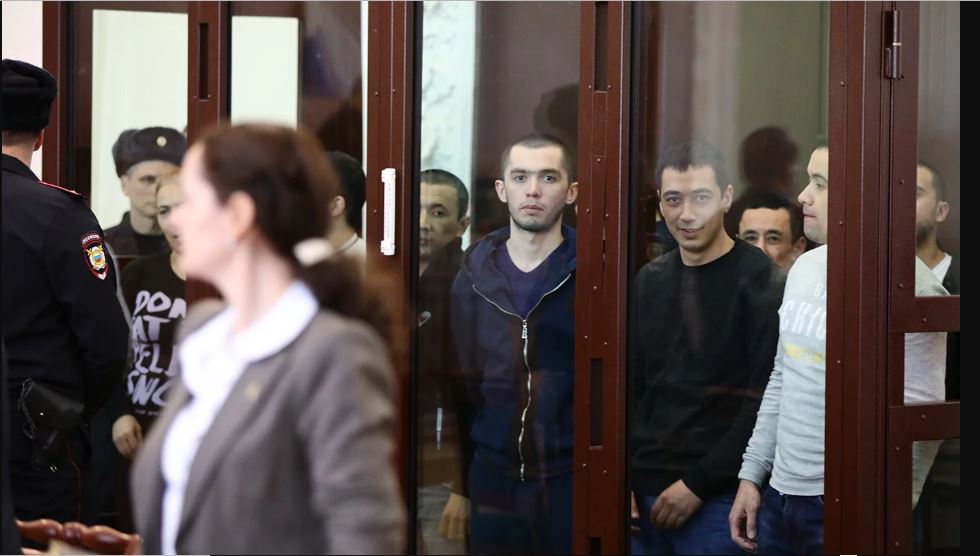
simferopolThe defendants in the Simferopol Hizb ut-Tahrir trial in Rostov-on-Don. Photo courtesy of Crimean Solidarity and Krym.Realii

Numerous Searches Underway in Crimean Tatar Homes in Connection with “Terrorism” Case, Several Men Detained
OVD Info
June 10, 2019

Police have been carrying out numerous searches in the homes of Crimean Tatars in several Crimea towns and villages. One man has been charged with organizing a terrorist organization or involvement in one. This news was reported on the Facebook page of Crimean Solidarity activist Luftiye Zudiyeva and the movement’s official Facebook page.

It is known that four people have been detained. Eldar Kantimirov was taken from the village of Zarechnoye in an unknown direction. According to activists, he was charged with organizing a terrorist organization or involvement in one (Russian Criminal Code Article 205.2). The particulars of the case, like Kantimirov’s whereabouts and his official status in the case, are still unknown. They may have to do with the religious organization Hizb ut-Tahrir, which has been declared a terrorist organization in Russia.

Riza Omerov, who lives in Belogorsk, was taken to FSB headquarters. His sister is married to Rustem Ismailov, a defendant in the Simferopol Hizb ut-Tahrir trial. Omerov has three children. His wife, who is seven months pregnant, has now gone into premature labor.

Ayder Jepparov was detained in the village of Zuya in the Belogorsk District. He was also taken to FSB headquarters.

Eskender Suleymanov was detained in Stroganovka, a village in the Simferopol District. He is the brother of Ruslan Suleymanov, a defendant in the Hizb ut-Tahrir trial. The activist was taken to FSB headquarters in Simferopol.

The homes of Ruslan Mesutov, in the village of Maly Mayak, and Lenur Halilov, chair of the religious community in the village of Izobilnoye, both located in the Alushta District, were also searched.

UPDATE. Ruslan Mesutov has been detained. Like Eldar Kantimirov, he has been accused of involvement in a terrorist organization (Russian Criminal Code Article 205.5 Part 2).

Lenur Halilov has been accused of organizing terrorist activities (Russian Criminal Code 205.5 Part 1).

Ayder Jepparov, Riza Omerov, and Eskender Suleymanov remain in police custody. It is still not known whether they have been charged as part of the criminal case.

A search has also been underway in the home of Enver Omerov, Riza Omerov’s father. FSB officers stopped his car and detained him during the night. OVD Info has been unable to ascertain whether the security forces have released him.

FSB investigator Sergei Makhnev, who has been involved in the case of the second Simferopol Hizb ut-Tahrir group, led the search. Makhnev has already stated Suleymanov’s case would be incorporated into this case.

UPDATE 2. Crimean Solidarity has reported that Riza Omerov, Enver Omerov, Ayder Jepparov, and Eskender Suleymanov were remanded in custody until August 5.

Russia has declared Hizb ut-Tahrir a terrorist organization. Its members have been charged and sentenced to long terms in prison only for gathering at people’s homes, reading religious books, and recruiting new members.

According to numerous experts, Hizb ut-Tahrir was wrongly declared a terrorist organization since its members in Russia have never advocated violence or been involved in terrorist attacks.

_________________________________________________

Rostov: Prosecutors Ask Court to Sentence Simferopol Hizb ut-Tahrir Trial Defendants to 17 Years in Prison
Krym.Realii
June 10, 2019

Our correspondent reports the prosecution in the first Simferopol Hizb Ut-Tahrir trial has asked the North Caucasus Military District Court in Rostov-on-Don to sentence the defendants to long terms in prison camps.

The prosecutor asked that Teimur Abdullayev be sentenced to 17 years, Rustem Ismailov, to 13 years, Uzeir Abdullayev and Ayder Saledinov, to 12 years, and Emil Jemadenov, to 12 years.

On October 12, 2016, five homes in Crimea were searched by police and security services. Consequently, the five men currently on trial in Rostov-on-Don were detained and charged with involvement in Hizb ut-Tahrir, an organization that was banned in Russia and Crimea, which Russia occupied in 2014.

On December 6, 2018, it transpired the five men had been transferred to a remand prison in the Russian city of Rostov-on-Don.

On February 19, 2019, a secret witness was interrogated during a hearing of the Simferopol Hizb ut-Tahrir case by the North Caucasus Military Court in Rostov-on-Don.

Hizb ut-Tahrir, an international Islamic political organization, says its mission is to unite all Muslim countries in an Islamic caliphate, but it rejects terrorism as a means of attaining their goal. They claim they have been unjustly persecuted in Russia and Crimea, which was occupied by Russia in 2014.

The Russian Supreme Court banned Hizb ut-Tahrir in 2003, placing it on a list of organizations deemed “terrorist.”

Defenders of the Crimeans convicted and arrested in the Hizb ut-Tahrir case argue they have been persecuted on religious grounds. Lawyers note that, while it has mainly been Crimean Tatars who have been persecuted by Russian law enforcement as part of the case, Ukrainian, Russians, Tajiks, Azeris, and non-Tatar Crimeans who practice Islam have also been persecuted.

International law forbids an occupying power from enforcing its own laws in occupied territory.

Translated by the Russian Reader

Police Intimidating Azat Miftakhov’s Family into Testifying

azatAzat Miftakhov. Photo courtesy of Radio Free Europe/Radio Liberty

Police Pressuring Azat Miftakhov’s Family to Testify
OVD Info
June 14, 2019

During an interview at the Nizhnekamsk police department, police officers promised Moscow State University (MSU) graduate student Azat Miftakhov’s stepfather problems if he did not testify and submit Miftakhov’s younger sister, who is finishing ninth grade, to routine monitoring by the police, OVD Info has learned from the MSU Pressure Group.

Svetlana Sidorkina, Miftakhov’s defense counsel, corroborated the news. According to her, the police want Miftakhov’s family to testify. Sidorkina underscored that Miftakhov’s mother, stepfather, and sister have the right not to testify since they are close relatives.

Azat Miftakhov is a suspect in a criminal case involving a broken window at a United Russia party office.

According to the MSU Pressure Group, police officers visited the Miftakhov family home on June 6, telling them to come to the police station for an interview. As they were leaving, they hinted Miftakhov was guilty. Subsequently, police officers telephoned the Miftakhovs several times, demanding they report to the police station.

On June 10, during the interview, police officers showed Miftakhov’s stepfather a video in which his younger sister is seen pasting stickers in his defense. The police officers demanded that the girl stop supporting her brother overtly. Otherwise, she would have problems at school, and they would make a habit of detaining her, summon her for interviews, and put her on their routine monitoring list.

Miftakhov’s stepfather was asked by the police officers how long he had known his stepson, how often he visited Nizhnekamsk, and what people in Moscow the family members were in contact regarding the criminal case.

After the interview, a police officer telephoned Miftakhov’s mother, apologized for taking to her in a raised voice, and hinted at her son’s guilt. He demanded that she stop communicating with activists, and take her daughter in hand.

Miftakhov told Public Monitoring Commission member Yevgeny Yenikeyev about pressure on him in the remand prison where he has been jailed since his arrest. In late April, Miftakhov was taken to the investigation room, where two men wanted to have an “informal” chat with him. When Miftakhov turned them down, they threatened him. They said he would have problems at the remand prison and face a second set of criminal charges.

A graduate student in mechanics and mathematics at MSU and an anarchist, Miftakhov was arrested on charges of disorderly conduct (Russian Criminal Code Article 213 Part 2). The charges were filed due to the events during the early hours of January 31, 2018, when persons unknown broke a window at the United Russia party office in Moscow’s Khovrino District and threw a smoke bomb inside.

Police detained Miftakhov on February 1, 2019. Subsequently, Miftakhov told a lawyer he had been tortured with a screwdriver. Eleven other people were detained the same day, and several of them reported they were tortured, too. Over the next eleven days, Miftakhov’s time in police custody was extended under various pretexts.

[…]

Translated by the Russian Reader

Valentin Urusov: A Worker’s Struggle (August 2012)

One of the most egregious frame-ups on drug charges in Russia in recent memory was the case of Yakutia trade union activist Valentin Urusov.

The weekly magazine Russian Reporter told Urusov’s story in August 2012, after he had been in police custody and then prison for over three years.

The article was, in fact, part of a second international campaign, led by Russia’s independent trade unions, to persuade the Russian authorities to release Urusov from prison.

This time around, their efforts paid off, and after his release, Urusov was awarded the Arthur Svensson Prize, the “Nobel Prize” of international trade unionism.

When I posted the following translation of the Russian Reporter article on January 25, 2013, Urusov was still in prison, doing time for crimes everyone who knew anything about the case knew he had not committed.

It is silly to compare these things, but I think Urusov’s story is much more horrifying than the much more recent story of Meduza reporter Ivan Golunov. First, it happened at the end of the earth, geographically speaking. Second, Urusov’s supporters had neither the social capital or the numbers to instantly launch a widespread moral panic to secure his immediate release.

Powerful men, including the men who run Alrosa, Russia’s state-owned diamond mining company (whose board at the time included Alexei Kudrin, laughably regarded as a “liberal” by people who do not want to know any better), wanted Urusov to go down, and so he went down, despite the absurdity of the charges against him, despite the fact that the police officer who engineered his frame-up was later found guilty of fraud and abuse of authority, and despite the fact that the Yakutia Supreme Court overturned his conviction in May 2009. (It was reinstated by the original, lower court a little over a month later.)

In fact, although Urusov’s story is a central episode in the recent history of independent trade union activism in Russia, I would wager a large amount of money that the vast majority of Russians have never heard of Urusov and his horrifying ordeal at the hands of Russian “law enforcement.” || TRR

__________________________

A Worker’s Struggle
How an attempt to create a real labor union lands you in a penal colony
By Andrei Veselov
Russian Reporter
August 23, 2012

It is now acceptable to talk about political prisoners in Russia—it has become good form. But for some reason, bankers and financiers now and again end up on lists of “prisoners of conscience.” Their troubles are discussed in great detail, and there is sincere sympathy for them. Little is said about the fact that for the last four years Valentin Urusov, a rank-and-file worker, has been doing time at the penal colony in Verkhny Vestyak, Yakutia, for attempting to establish an independent labor union. Russian Reporter has decided to rectify this.

“When they drove off the road into the taiga, I hear, ‘Take out the plastic sheet so nothing gets splattered.’ That, as they say, is when I bid farewell to life, calmed down and resigned myself. I lay on the floor of the car and waited. Hands cuffed behind my back. They pulled me out, put me on my knees and fired three shots over my head. But they didn’t kill me.”

urusov

Valentin Urusov. Photo by Aleskey Maishev for Russian Reporter

The senior officer for education at the colony listens attentively to my conversation with Valentin Urusov, a prisoner at Penal Colony No. 3 in the Sakha Republic (Yakutia) and former leader of the independent labor union local in the town of Udachny. After the interview, the officer comes up to me and says, “You know, maybe he is really innocent. But if five percent are wrongly convicted in America, what can you expect from us?”

“What a terrific job!”

The idea that a full-fledged rather than puppet labor union could emerge in Udachny occurred to Valentin, a rank-and-file employee at Almazenergoremont, a subsidiary of the local mining and processing plant, after the scandalous “affair of the sandblasters.” Urusov himself is a local man, although he was born in Karachay-Cherkessia: he has lived in Yakutia since he was two years old and worked here since he was sixteen, mostly at facilities run by the state-owned diamond mining company Alrosa. There are few other options here.

Udachny is a town fourteen kilometers from the Arctic Circle, and one of the three main sites, along with Mirny and Aikhal, where diamonds are mined. Among the workers involved in the mining process are the so-called abrasive blasters or, more simply, sandblasters, whose job is to work solid surfaces with an abrasive, high-pressure stream of air pumped through a hose. It is not a job that is good for the health of the worker, to say the least: pulmonary silicosis is the occupational illness. Neither a safety helmet nor a [hazmat] suit, like cosmonauts wear, helps.

In 2007, a team of these sandblasters demanded overtime pay, which at that time went chronically unpaid. The workers filed a lawsuit and even managed to win their case: the Labor Code was clearly on their side.

“A special commission arrived in Udachny to arbitrate the dispute directly,” explains Andrei Polyakov, an Alrosa spokesman. “The company agreed with the validity of the claims, an agreement settling all grievances was signed, and compensation was paid out. The managers who were in direct dereliction of their duties were punished.”

This happened, it is true, but later. The main scandal occurred when the dispute was still being settled: the semi-official labor union at Alrosa, Profalmaz, negotiated not on the side of the workers, but on behalf of . . . management. This provoked astonishment and outrage in Udachny.

So, on the one hand, Profalmaz’s authority was undermined. On the other, the feeling arose that one’s labor rights could be protected—moreover, in a civilized manner, through the courts and arbitration, the European way, so to speak.

“I just found it interesting. I’m a generally curious person, and that is probably why I’m in prison,” jokes Valentin. “I went online and came across Sotsprof, a trade union association that is an alternative to the FNPR (the Federation of Independent Trade Unions of Russia). I wrote an email to its leader, who was then Sergei Khramov. He replied by sending me documents on how to create a new union.”

“But why a new one?” I ask. “Was it really impossible to make things work within the existing union?”

“All [organizations] belonging to Mikhail Shmakov’s FNPR, including Profalmaz, are not labor unions but appendages of personnel departments. All they do is allocate vacation vouchers. They will never oppose management.”

“Was the only problem overtime and the fact it wasn’t being paid then?”

“Of course not. There were a lot of problems! And then, you understand, this is very difficult work: you have to work night and day, and on holidays, and take someone else’s shift, whatever management says. But you get paid for an eight-hour day. And then there are the working conditions and safety. In the department where I worked, the equipment should have been scrapped twenty years ago, at best. There are a lot of accidents as a result. The ones that were made public were like a speck in a big heap of sand. I got a big piece of flesh taken out of my hand, and that was nothing. Of course, it’s hard to hush up fatal incidents. But fractures and injuries are different. There are thousands of them and nobody cares. It was a shame that the company was so wealthy, that it built five-star hotels and all kinds of business centers, but scrimped on us.”

In Moscow, I met with Sergei Khramov, to whom Valentin had sent the email and who had instructed him on creating a union local.

Udachnaya_pipe

The open pit of the Udachnaya Diamond Mine, Russia, from a helicopter, July 17, 2004. Photo by Alexander Stepanov

“Add to this the aggressive water in the gully where they mine diamonds.” Khramov hands me a complaint from Udachny miners addressed to Vladimir Putin. “It’s nearly acid and it penetrates their rubber suits. Here they write, ‘We don’t know what it is we are breathing when the ventilation equipment is lubricated with used oil.’ Or there’s this one: ‘Cold, unheated air is pumped into the mine, even in winter.’ And it’s minus forty-fifty in winter there. What a terrific job!”

How to frighten a republic’s leadership

Right at this time, in August 2008, the so-called Siberian Social Forum was held in Irkutsk. “Free” trade unions were among the forum’s founders. Urusov’s new acquaintances invited him there, too. In fact, it was a small event, attended by no more than two hundred people, but it made a strong impression on Valentin.

“[Civil rights lawyer] Stanislav Markelov, who was later murdered in Moscow, lectured on legal issues. He was a very competent, energetic, lively man—it’s a shame [what happened] to him. He talked about how to act in this or that situation so as not to set oneself up and achieve [your goals] at the same time. And then the call came. Problems with pay had begun at the second motor depot, and the guys had decided to organize a strike.”

Events unfolded rapidly. In a small suburban home outside of Udachny, Urusov met with motor depot drivers and mechanics in an almost conspiratorial atmosphere and began persuading them to join the union. Armed with new knowledge, Urusov tried to prove to his comrades that if a strike began they would immediately be fired for trumped-up excuses, and there would be no one left to work on getting them reinstated. During the second “conspiratorial” meeting, sixty-two people joined Urusov’s union local.

There were two options as to how to proceed. First, a classic strike. But the Udachny miners had no experience with strikes, and therefore they could easily have been fired for “absenteeism.” And even if they had managed to get fired workers reinstated, they would have lost the initiative, and the remaining workers would have been demoralized. The second option was a hunger strike. Everyone goes to work; there is no downtime and, therefore, nothing for management to complain about. But demands are loudly declared and, basically, a scandal erupts. They chose the second option.

“At first, [management] demonstratively paid no attention to us. Then they see we aren’t going to back down. That is when they began dropping by,” Urusov laughs. “People came from the police, from plant security, from the company itself, trying to talk us out of it. In exchange for setting up a conciliation commission, we suspended the hunger strike.”

However, the commission was unable to achieve a compromise. Management made no concessions.

“We decided to hold an open union meeting right on the town’s central square. It wasn’t a [protest] rally, and by law, we weren’t required to notify anyone. On the first day, all the motor depot workers came, plus another two hundred people. The director of the plant came and tried to say something. But he couldn’t answer a single question and left. And right there on the square, people began joining the union. By the end of the day, something like three hundred people had joined. We decided to repeat the meeting. The second time, more than eight hundred people gathered. There was no rioting and no laws were broken. We didn’t even have a loudspeaker. By evening, I remember it even now, 1,012 people had joined the union.”

We have to remember that Udachny is a very small town with a population of slightly over ten thousand, and such developments outright scared both the local authorities and certain people in high places. The situation was headed towards a citywide strike and a potential stoppage of diamond mining in the Udachnaya kimberlite pipe—the largest in the world, by the way.

“We have enormous enterprises in our country. Often [they] monopolize their regions, and so a strike or simply a large [industrial] action could freeze an entire industry,” explains Alexander Zakharin, Urusov’s friend and colleague, and chair of the Sotsprof local in Surgut. “And if you organize such an action, you risk running into a brutal response. From the owners and from the authorities. But it happens that milder measures don’t work. Then you need to choose: take a risk or keep your mouth shut.”

At Alrosa itself, the union’s activities in Udachny are seen primarily as an attempt at self-promotion.

“A media effect—promoting awareness of Sotsprof and the number of times it got mentioned in the press—was probably the main objective for some of its executives,” argues company spokesman Polyakov.

As during the [dispute in 2007], Profalmaz adopted a peculiar position in the new confrontation. Its leader, Il Tumen (Sakha Republic State Assembly) deputy Pavel Tretyakov, not only failed to help the workers but also asked the republic’s leaders to reason with the “rebels.” Profalmaz’s executive committee sent an appeal to the President of Yakutia, Vyacheslav Shtyrov, and FNPR head [Mikhail] Shmakov asking them to prevent “incitement of a conflict.”

Tretyakov later, in a similar vein, told Vasily Gabyshev, the Mirny town prosecutor, “It’s surprising that law enforcement authorities didn’t respond to attempts by various persons to artificially incite conflicts, to calls for illegal hunger strikes and [labor] strikes.”

The Yakutia presidential administration composed a panicked memo on the basis of Tretyakov’s appeals. The President instructed law enforcement agencies to figure out what was happening. (Russian Reporter has all these documents in its possession.) What exactly Shtyrov wanted from the security services is still unclear, but the local office of the FSKN (the Federal Drug Control Service) reacted to the situation, let’s say, in an extremely original way.

Udachny—Aikhal—Mirny

“Then what happened? Then the third of September came. I was leaving my place. I heard a car door open. I instinctively turned around.  It was a simple UAZ[-452], a “Pill” [i.e., a van] with tinted windows. Out came three guys in leather jackets and jeans with shaved heads. I didn’t know them. I immediately knew something was wrong and ran. They caught up to me and knocked me down.”

“Did they show you any identification?”

“Absolutely nothing. They restrained me and brought me to the van. First, they handcuffed me with my hands in front. Later, in the van, they tried to cuff me with my hands behind my back. I clasped my hands and held on. They pulled and pulled, broke my finger, and finally handcuffed my hands behind my back. They threw me to the floor and one of them sat on top of me. We drove for a long time.”

It subsequently emerged that Lieutenant Colonel Sergei Rudov, the head of drug control in the Mirny District, had personally led this “operation.” In order to apprehend Urusov, he and his subordinates had driven six hundred kilometers [to Udachny]: [his] “Hunter” [i.e., jeep] was waiting for the “Pill” on the outskirts of the town. In court, Rudov claimed to have had “operational information” that Urusov was involved in selling drugs.

“We asked the court to confirm or refute Rudov’s testimony, and requested written confirmation that the ‘operational information’ had been registered in the police operational ledger,” says Urusov’s attorney Yevgeny Chernousov, a former police colonel who specializes in narcotics cases. “We didn’t demand that this information itself or its source be revealed. We just wanted to confirm that the information had existed. The court did not fulfill our request. There is thus no evidence of its existence. In light of this, Rudov’s unwarranted trip to Udachny and back seems more than suspicious.”

Valentin says that Rudov was on the phone with a certain Alexei Yurevich or Yuri Alexeyevich the whole time, reporting to him that they had “taken” Urusov and wanting to know what to do next. After one of these conversations, the van pulled off into the taiga. There the narcotics officers spread out plastic sheeting and fired a few shots over Urusov’s head, recounts Urusov.

“They were shooting the whole time,” says Valentin. “They shot at birds, and at trees. Apparently, they wanted to frighten me. We had already driven far from town, and basically, they could have done whatever they wanted with me.”

At a fork in the Udachny-Aikhal-Mirny road, the car of Grigory Pustovetov, head of security at the Aikhal mining and processing plant, drove up to Rudov’s group “entirely by accident.” Only then did the police decide to search Urusov for drugs. Pustovetov and his driver acted as official witnesses. The search was a complete success: sixty-six grams of hashish oil were found in the union activist’s pocket.

“A number of questions arise,” says an outraged Chernousov. “First, when the arrest happens in one place, but the [official] search with witnesses happens dozens of kilometers away, it’s a clear sign that the drugs could have been planted. Second, if the head of one of a company’s security units serves as a witness when an employee in a labor dispute with that company is being searched, it also gives rise to the most unpleasant thoughts.”

Urusov himself claims the hashish was planted on him in the car after the fake execution. He says that hash oil was specially applied to his hands so that traces of the drug would later be detected when his hands were swabbed.

“When we were organizing the miners’ union in Neryungri (a major industrial center in Yakutia), I was reminded of this story,” says Valery Sobol, first secretary of the Neryungri Communist Party City Committee. “I won’t name the names [of the persons involved] because I live there. Employees of the so-called organs [i.e., the security services] invited me to a pub. We hung out there for a while. Then at another place, and then another. I myself didn’t drink, [but] they drank a lot. And, as if it was an afterthought, though they had summoned me there [to deliver just this message], one of them says, ‘You remember that thing with Urusov? You also better not be naughty. If anything happens, we’ll plant a gun [on you] or whatever.’ And then he laughed. Like it was a joke.”

Several months ago, Sobol nearly won the election for the head of the Neryungri District. He came in second by only a small margin. And if a potential district head can be threatened almost openly, then the kidnapping of a simple working stiff like Urusov, who has no political backing at all, does not seem farfetched.

Sobol and I sat in the kitchen of Sergei Yurkov, an engineer, businessman, and leader of [an organization called] the Russian Community of Yakutia. He met Urusov in a pre-trial detention facility. I ask him how he had ended up there.

“My story is simple. Transneft was building a pipeline here. They didn’t want to pay normal wages to the locals. So when the locals balked, they brought in rural Chinese willing to work for peanuts and live in barracks. When we organized a rally and put up flyers saying this wasn’t how things were done, I was arrested under Article 282 of the Criminal Code for ‘incitement of interethnic hatred.’ What does ‘incitement’ have to do with it? I was sentenced to two years in prison.”

Drugs via the Special Courier Service?

It must be said that the theme of drugs, with which they decided to shut Urusov up, did not arise by accident. Drug use is a local scourge. And this makes sense. There are few other ways to have fun in small towns and villages in the North. That is why on the surface Urusov’s prosecution under a drug statute was meant to have appeared more or less plausible.

“It’s a big problem here, as is drinking,” says Maxim Mestnikov, a Sotsprof spokesman in Yakutia. “When Friday comes, hang onto your head: there is a deluge of knife wounds [and] head injuries.”

But Urusov, in fact, never had the reputation of a mischievous drug addict. In his youth, at the beginning of the 2000s, he and a few friends created an organization called Youth for an Athletic Movement-North, whose activists patrolled the city monitoring places where drugs were sold. Eventually, the mayor of Udachny even suggested that they create a branch of City Without Drugs on the line of [Yevgeny] Roizman’s [controversial anti-drugs organization].

The relationship between certain local [Alrosa] subcontractors and drug dealers, however, may require a separate investigation. Russian Reporter has in its possession an official memo written by Sergei Denisov, the predecessor of [Grigory] Pustovetov (the man who acted as a witness during the police search of Urusov) as head of security at the Aikhal mining and processing plant.

The memo is addressed to Yuri Ionov, former vice-president for security at Alrosa, and it deals with the overall crime situation in the area. Among many others, the memo contains the following passage: “It is impossible to ignore the fact that a drug trafficking network has developed in the village. According to operational information from the Mirny office of the FSB, the delivery of drugs is carried out by the [Federal] Special Courier Service, with which Alrosa has a contractual relationship for the transportation of diamonds.” Moreover, the memo shows that confidential and friendly relations exist between certain high-ranking Alrosa executives, law enforcement officers, and outright criminals.

“I’ll say this: the criminal world is generally in first place here,” [Sotsprof’s] Mestnikov says with conviction. “In this respect, it is still the nineties here. Something needs to be done so you go to them and they handle it. And this could also have happened with Valentin. Perhaps it was better that they sicked the cops on him and not the wise guys.”

After he presented the memo to Ionov, Denisov was forced to resign and move to Novosibirsk.

“No decision was taken on my report. Ionov showed me the door and said he didn’t need any unnecessary problems. As for Urusov, I can say that it’s a pure frame-up,” [Denisov says].

In May 2010, Lieutenant Colonel Rudov was sentenced to three years of probation for fraud and abuse of authority. According to [Urusov’s other] lawyer Inga Reitenbakh, “He was charged with receiving 2.5 million rubles from Alrosa for the purchase of an apartment in Mirny.” The investigators and Rudov himself categorically denied any connection between this case and the Urusov case. Nevertheless, the funds were allocated to Rudov shortly after Urusov’s arrest. According to Russian Reporter’s source, Rudov now works as a procurements specialist in the repair and construction office at the Mirny mining and processing plant.

“He shoots before he thinks”

Urusov was also unlucky in that he had set about creating a Sotsprof local in Udachny exactly when the union’s leadership had entered the complex process of building relations with the Kremlin.

“Beginning in 2007, people from the Russian Presidential Administration began to pressure us very actively,” says Sergei Khramov. “We were strongly recommended to name Sergei Vostretsov from the United Russia party as [our] new leader. I had good reason to believe that if we didn’t, we would simply be destroyed. And I figured, the heck with him, let Vostretsov be the leader and do public relations, while I, as Sotsprof’s general labor inspector, will do the day-to-day work.”

The first outcome of this “castling” move was that the formerly oppositional Sotsprof supported Dmitry Medvedev in the 2008 presidential elections.

”And when they began pressuring Valentin, Vostretsov told me not to make any unnecessary noise, because he would fix everything anyway. I knew that the Vostretsov family—his younger brother was the youngest FSB colonel in the country—was very close to General Alexander Mikhailov, the then-director of the Federal Drug Control Service. I thought that Valentin’s case would be decided with a single phone call.”

For the sake of fairness, we should note that complicated events were underway at the Federal Drug Control Service at the time. Viktor Ivanov had replaced Viktor Cherkesov, who had famously publicized the existence of a war within the security services in an article [entitled “We Can’t Let Warriors Turn into Traders”]. In October, General Mikhailov left the FSKN as well. There was simply no one left to make that “single phone call.”

Subsequently, Vostretsov pushed Khramov out of Sotsprof altogether, and the organization became completely loyal to the Kremlin.

In December 2008, the Mirny District Court sentenced Valentin Urusov to six years in prison for drug possession. Vostretsov tried to fight it, but more from behind the scenes: he met with officials from the Yakutia administration and officials of the security services, and even, allegedly, raised the issue of Urusov with Medvedev. It was no use.

Khramov, in contrast, acted publicly. It was he who got the famous lawyer Chernousov to take the case. Chernousov convinced the Yakutia Supreme Court to overturn the verdict (on procedural grounds: the judge had not retired to chambers while considering a motion to dismiss), after which the case was retried.

“I had absolutely no illusions,” Valentin smiles. “After the Supreme Court decision, many people thought I would be exonerated.  I was certain of the opposite, that now I would be ‘shut down’ for sure. This was evident from the faces of those in the courtroom at the second trial. After the first hearing, I gathered my belongings, put on the track suit I’d been wearing while traveling between pre-trial detention facilities and prisons, and from then on I went to hearings in this outfit.”

In Udachny, there is a small newspaper with the humorous name of Gorodok [“The Burg”], edited by a local journalist named Alla Demidova. After Urusov was released, she published a short article. Immediately, the very same day, she got a call from Maxim Dobarkin, one of the police investigators who had participated in Urusov’s “arrest.”

“Dobarkin called me at home,” says Demidova. “Drunk. He told me how many bullets he would put in me, said that ‘he shoots before he thinks,’ that he knows where I live, and that he would ‘get’ me ‘whether in Udachny or in Sochi.’”

“What did you do?”

“I filed a complaint with the FSB.”

“Did they respond?”

“They responded by sending me a one-line answer: ‘There is no threat.’”

Dobarkin, however, was promoted to the rank of lieutenant colonel and together with Rudov took command of the Federal Drug Control Service’s interdistrict department in Mirny.

Another Yakutia journalist, Aitalina Nikiforova, was also threatened for covering Urusov’s case.

“I reported on every hearing during the trial from the courtroom. Rudov called me over during one of the hearings and said word for word, ‘Your oldest daughter is fifteen. It would be interesting to see how you’ll defend Urusov after some old drug dealers drug her up and pass her around.’ This definitely sounded like a threat. At the time I was working as editor-in-chief at the only independent newspaper in Mirny, Moya Gazeta. The only printing plant in town refused to print us. Local Federal Drug Control Service agents began coming to my house, allegedly because of anonymous tips that I also used and dealt drugs. Some of [the agents] were insolent and rude; others were ashamed because the last visits took place when I was six to seven months pregnant with my third child.”

After that Nikiforova decided it would be safer to leave her hometown and move to Yakutsk.

In June 2009, the Mirny District Court delivered a new verdict in the Urusov case that completely upheld the previous verdict, but in September the Yakutia Supreme Court lightened Urusov’s prison sentence by one year. The Sotsprof local in Udachny had been crushed. The second motor depot has been completely shut down. The company has had no more problems with the workforce in this town.

“Valentin, who do you tend to blame for what happened to you?” I finally asked.

“Alrosa is a state-run company. It is owned by the government, by the state, so . . . you understand.”

1345633951216469_big_photo

Valentin Urusov. Photo by Aleskey Maishev for Russian Reporter

***

“Our government is fascist,” Yurkov, the leader of the Russian Community of Yakutia, suddenly declares, and it sounds quite equivocal.

Sobol, the man who missed becoming head of the Neryungri District by a heartbeat, turns and stops smoking next to the window.

“We have to be precise with our terms: neither Nazi nor nationalist, but precisely fascist as it is understood in Mussolini’s theory of the corporate state, as Franco, Salazar, and even Pinochet understood it. In our country, the authorities and big business are intertwined in a ball. And anyone who gets in their way is crushed. Here in Yakutia, in the provinces, it’s just more clearly felt.  But it’s the same thing all over the country.”

Translated by Sean Guillory and Chtodelat News. Slightly different versions of the same translation were published by n+1 and Sean’s Russian Blog.

Circassian Activist Martin Kochesoko Arrested in Drugs Frame-Up

martin-2

Shown here protesting a law bill that would make Russia’s minority languages an elective part of the curriculum, Circassian grassroots activist Martin Kochesoko was detained and charged with narcotics possession on June 7 in Nalchik, the capital city of the Kabardino-Balkar Republic. Will the nationwide grassroots movement that, allegedly, forced police in Moscow to drop identical charges against investigative reporter Ivan Golunov reemerge as forcefully to demand justice for Kochesoko? Photo courtesy of Radio Svoboda

Circassian Activist Martin Kochesoko Detained in Nalchik
Vera Zherdeva
Caucasian Knot
June 8, 2019

On June 7, police searched the offices of the civic organization Habze, detaining its leader Martin Kochesoko and other activists, our sources have informed us.

The security forces arrived at Habze’s office at around eleven in the morning. They confiscated the office’s computers.

According to preliminary reports, Kochesoko has been remanded in custody on charges of drugs possession, a Habze activist told us.

The other Habze activists detained with Kochesoko were soon released, Kavkaz. Realii reports, citing its own sources.

In late May, Kochesoko reported his parents had been paid a visit by local officials, who told them their son should “slow down” his activism. The incident took place after Kochesoko had organized a round table on federalism in Nalchik.

“A man from the district council visited my parents. He told them he had been sent by the top bosses and I should slow my activism down. I know this man personally. He has my phone number and email address, and he and I could have met. I was taken aback he chose this way of doing things. I would thus like to underscore the fact I use only legal methods. I want the laws and the Russian Constitution to be obeyed. I am not hiding from anyone. I am constantly in the public eye,” Kosechoko wrote in an article, “Solving the Crisis of Federalism: Grassroots Activism,” published May 29 on Habze’s website.

Caucasian Knot has written about Kochesoko’s work. We have often cited his critical comments on controversial public issues.

In April 2019, for example, Kochesoko criticized the ban of an auto rally on Circassian Flag Day in Nalchik and the treatment of Circassian returnees by Russian officials. He also lambasted the controversial law bill to make the study of minority languages an elective rather than a mandatory part of the school curriculum.  Activists and public figures from twelve of Russia’s ethnic republics, including Kabardino-Balkaria, denounced the law bill.

Kochesoko took part in the September 2018 horse ride commemorating the 310th anniversary of the Battle of Kanzhal. The event provoked clashes between Kabardians and Balkars, and regular police, riot police, and Russian National Guardsmen intervened.

In his article for Caucasian Knot, “Kanzhal as a Knife in the Governor’s Back,” Denis Sokolov, a senior adviser at the Center for Strategic and International Studies (CSIS) in Washington, discussed Kochesoko’s role as a peacemaker during the events in question, which occurred when residents of the Balkar village of Kendelen refused to let the riders pass through their town.

“Due to a willingness to compromise on the part of Kendelen negotiators, Kochesoko was on the verge of peacefully leading the Circassian march out of the Balkar village, but the crude actions of the security forces rendered their agreement null and void,” wrote Sokolov.

Thanks to Comrade GJ and Anna Etkina for the heads-up. Translated by the Russian Reader. NB. The accounts of Mr. Kochesoko’s arrest here and on the Radio Svoboda-affiliated website Kavkaz.Realii differ considerably in their details.  When and if a definitive account of Mr. Kochesoko’s arrest is published, I will update this post.

They Are Who They Are

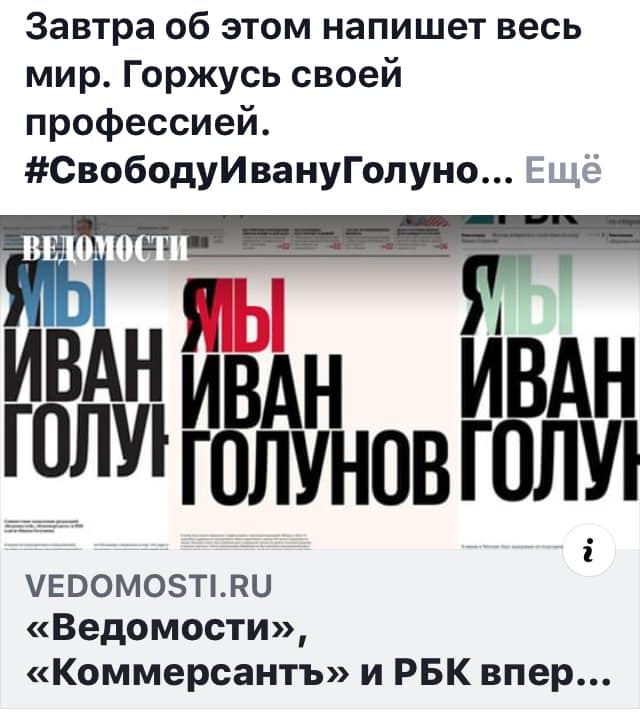
gorzhush“Tomorrow, the whole world will write about this. I am proud of my profession. #FreeIvanGolunov…” Vedomosti.ru: Vedomosti, Kommersant, and RBC will for the first time…” Screenshot of someone’s social media page by Ayder Muzhdabaev. Courtesy of Ayder Muzhdabaev

Ayder Muzhdabaev
Facebook
June 9, 2019

Russia’s “liberal opposition journalists” have been vying to praise each other as they celebrate a feast of “disobedience.” They just stood in the crossfire, that is, in timid solo pickets. And now, risking having their offices torched, three newspapers have produced editions with the same headline in defense of a colleague detained by police on trumped-up charges.

They have never nor would they ever publish a newspaper with the headline “I Am/We Are Crimean Tatars,” a people their country has been murdering and imprisoning on trumped-up charges by the hundreds for the last five years.

They have never nor would they publish a newspaper with the headline “I Am/We Are Ukrainians,” a people their country has been murdering by the thousands and imprisoning by the hundreds on trumped-up charges for the last five years.

It suffices to say they would even find printing the headline “I Am/We Are Oleg Sentsov” terrifying. It would never occur to them because they know how life works in the Reich, where Ukrainians are “fascists,” and Crimean Tatars are “terrorists,” just like Oleg Sentsov. So “I-ing” and “we-ing” is taboo to them.

They are delicately integrated into the Russian Reich. They feel it in their bones. They are one of the regime’s vital props. The hybrid dictatorship badly needs to pretend there is a political struggle in Russia and the country has a free press. They help it in its quest to destroy the western world and attack other countries.

They always only do things that won’t get them in serious trouble. They would never do anything that poses the slightest risk of exposing them as real enemies of the Reich.

We enter this in #TheChroniclesOfTheRussianReich.

Translated by the Russian Reader

i-we

The front page of Vedomosti, June 10, 2019: “I Am/We Are Golunov.” Courtesy of Vedomosti

Joint Communique on the Ivan Golunov Case by the Editors of Vedomosti, Kommersant, and RBC 
We Demand Maximum Transparency from Investigation
Vedomosti
June 9, 2019

Ivan Golunov, an investigative reporter with Meduza, was detained on June 6 on suspicion of attempting to produce and distribute narcotics.

We welcome the fact that the court has ordered house arrest for Golunov rather than remanding him in custody in a pretrial detention facility.

However, we do not find the evidence of Golunov’s guilt, as provided by police investigators, convincing, while the circumstances of his arrest raise serious doubts that laws were not broken in the conduct of the initial investigation.

We cannot rule out the possibility that Golunov’s arrest has something to do with his work as a journalist.

We demand a detailed inquiry into whether the Interior Ministry officers who were complicit in Golunov’s arrest acted legally. We insist that the outcome of this inquiry be provided to the media.

We expect law enforcement to comply strictly with the law. We demand maximum transparency from the investigation. We will closely monitor the investigation’s progress. We encourage relevant public organizations to join us.

We believe implementation is fundamentally important not only to Russa’s journalism community but also to Russian society as a whole. We demand that everyone obey the law and the law be obeyed with regard to everyone.

Translated by the Russian Reader

upside down cake

Pineapple upside-down cake. Stock photo

Nearly the entire leftist and liberal Russian intelligentsia have thrown their ferocious but scattered energies into a campaign to free a well-known journalist on whom the cops planted narcotics. It is obviously a frame-up and rightly makes folks in the world’s largest country indignant.

But it also makes people think they are fighting the good fight when most of the fights they should be fighting or should have been fighting long ago they ignore altogether, like the fight against what their own government and armed forces have been doing in Syria, or the kangaroo court trials against antifascists in Penza and Petersburg (the so-called Network trials), and the alleged (Muslim Central Asian) accomplices of the alleged suicide bomber who, allegedly, blew himself up in the Petersburg subway in April 2017.

I shouldn’t even mention the case of the so-called New Greatness “movement,” an “extremist group” set up, concocted, and encouraged from its miserable start to inglorious finish by the FSB (the newfangled KGB). Its so-called members did nothing but attend a couple of “political” discussions organized by the selfsame FSB.

All these young people have been framed, and many of them have plausibly claimed they were tortured by FSB officers into “confessing.”

That is, whole groups of innocent people (mind you, I am only scratching the surface here, leaving out scores if not hundreds if not thousands of the regime’s other victims at home and abroad) have been railroaded by the mighty Putinist state, but they have not been granted an audience, so to speak, by progressive Russian society because progressive Russian society cannot identify with any of them in any way.

But it can identify with the nice white middle-class reporter from Moscow. And it does want to remind itself of its essential goodness and compassion from time to time, so everyone has jumped on the bandwagon to get the reporter out of jail.

Or, rather, everyone has engaged in a frenzy of virtue signaling that may not actually get him out of jail.

Bully for them, but no one notices that many of these grassroots campaigns are patterned like hysterias and moral panics. They are also identical to other suddenly emergent internet-powered fads, like the recent craze for Game of Thrones or “Facebook flash mobs” that involve, say, posting a picture of yourself from twenty years ago and explaining what you were up to way back then.

It has to be something, anything, except the things that matter a million times more, like the Russia air force’s endless bombing of Syrian children and Syrian hospitals, and the Putin regime’s endless, vicious hunt for “extremists” and “terrorists” like the Jehovah’s Witnesses, the Network “terrorists,” the “New Greatness” extremists, the conspicuously othered (and, thus, forgotten) Petersburg subway “terrorists,” and on and on.

These witch hunts are discussed publicly by virtually no one, and their victims (this is especially the case with the Central Asian “subway bombers”) are mostly left to fend for themselves.

What matters about the reporter is that he is white, innocent, and “one of us.” Apparently, he doesn’t believe in “extremist” nonsense like anti-fascism, anarchism, Islam or Jehovah’s Witness doctrine.

The reaction to the case is a symptom of liberalism that is utterly white and nationalist, meaning it is not liberalism at all.

It is white nationalism with a human face, Great Russian chauvinism turned upside down.

“They cannot do this to one of us.”

But “they” have done to it to thousands of non-white, non-Russian others over the years, including Chechens, antifascists, Syrians, Crimean Tatars, businessmen, Muslims, Jehovah’s Witnesses, Krasnodar’s farmers, truckers, environmentalists, anarchists, LGBTQ+ activists, Central Asian migrant workers, Ukrainians, anti-“reunification” Crimeans, the passengers of MH17, US voters, etc.

Almost no one batted an eye when they were “destroyed” (this is the regime’s pet dehumanizing verb for when it murders or obliterates its enemies), neutralized or otherwise royally fucked over by the Putin regime.

It is all over but the shouting unless the shouting quickly becomes a lot more inclusive. June 9, 2019 || THE RUSSIAN READER

redman.JPGPhoto by the Russian Reader

“This is too much, even for Russia.”
Meduza editor on BBC Radio 4 morning news broadcast, commenting on the arrest of Meduza reporter Ivan Golunov, 9 June 2019

But declaring all Jehovah’s Witnesses “extremists” and organizing a witch hunt against them is not too much, “even for Russia”?

I had it with Meduza after the hamfisted, blatantly misogynist way it handled its recent in-house #MeToo scandal. The scandal revealed the actual shallowness of the website’s liberalism.

Of course, Meduza should defend its reporter from police railroading.

But the fact it has managed to make the story go international in a matter of days and then, using this bully pulpit, suggest there is nothing worse going on in Russia than Golunov’s persecution, also reveals something about the depth of its liberalism or, rather, about what passes for liberalism in Russia.

Unlike liberalism in other countries, Russian liberalism has no time for anybody but the rather narrow segment of Russians it recognizes as full-fledged human beings.

I would guess this amounts to less than one percent of the entire population, but I am probably being too generous. June 9, 2019 || THE RUSSIAN READER

crisisRussia does not have to worry about a crisis of democracy. There is no democracy in Russia nor is the country blessed with an overabundance of small-d democrats. The professional classes, the chattering classes, and much of the underclass, alas, have become accustomed to petitioning and beseeching the vicious criminal gang that currently runs Russia to right all the country’s wrongs and fix all its problems for them instead of jettisoning the criminal gang and governing their country themselves, which would be more practically effective. Photo by the Russian Reader
Free the Network case defendants, the Jehovah’s Witnesses facing charges and the ones already doing jail time, ditto for the Crimean Tatars, Oleg Sentsov and Alexander Kolchenko, the Ukrainian sailors, Yuri Dmitriev, the Petersburg subway bombing defendants, the myriads of Russian businessmen in prison after they were set up by rivals and taken down by the FSB for a good price, the New Greatness kids, and hundreds of other Russian “outlaws” whose names I cannot remember or, worse, have never heard.

Free them first, and the day after you free them, free Ivan Golunov.

While you are at it, stop making war in Eastern Ukraine and stop bombing innocent Syrians. And bring the people responsible for shooting down Flight MH17 and killing everyone on board to justice.

The day after you have done all these things, free Ivan Golunov.

But don’t be such arrogant, self-important pricks as to appear on the world’s most respected radio and TV network and claim the Golunov case is the worst thing that has happened under Putin’s reign.

Anna Politkovskaya was murdered, for God’s sake. And so were Stanislav Markelov and Anastasia Baburova.

I could start another list of reporters, activists, politicians, etc., who were murdered, probably on the orders of the Kremlin or with its blessing, over the last twenty years.

Boris Nemtsov was murdered only a few hundred meters from the Kremlin.

God forbid I should mention “convicted pedophile” Sergei Koltyrin. Even the most hardcore human rights advocates in Russia have abandoned him and made mention of his name taboo, although I am reasonably certain he was set up just like the saint-like Ivan Golunov, only on charges so devastating that his former allies abandoned him and he abandoned himself to the nonexistent mercies of Russia’s nonexistent justice system.

But, definitely, the worse thing that has happened under Putin’s reign is the house arrest of Meduza reporter Ivan Golunov on what are undoubtedly trumped-up drug charges. June 9, 2019 || THE RUSSIAN READER

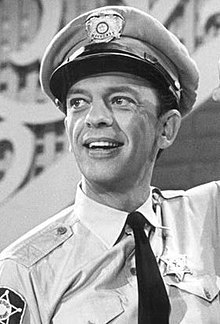
barney fife

P.S. As I was assembling this collage of reflections inspired by the collective hysteria among the Russian liberal intelligentsia over reporter Ivan Golunov’s dubious arrest, it occurred to me that, perhaps, my own reaction and that of Ayder Muzhdabaev, whose “outburst” leads off this montage, were not sufficiently charitable.

But then I read and translated what the editors of Kommersant, RBC, and Vedomosti published on the front pages of their newspapers today. Their milquetoast appeal to Russian law enforcement—a multi-headed hydra that has spent the last thirty years proving again and again it is one of the most brutal, vicious criminal gangs in the world, an army of thugs who routinely terrorize the people they have sworn to protect, a mob of degenerates who will stop at nothing, including the routine use of torture, to get their man—sounds more like an appeal to US TV sitcom cops Barney Miller and Barney Fife.

Do these hardened (?) newspaper reporters really believe an appeal like this will have a real effect on the investigation of Golunov’s nonexistent crimes?

It is also worth remembering (as Sergey Abashin did on his Facebook page earlier today) that the free press warriors at Kommersant recently fired a reporter for writing negative comments about Valentina Matviyenko, formerly Putin’s satrap in Petersburg, currently chair of the Federation Chamber, which rubber-stamps all the odious, wildly unconstitutional laws sent its way. In protest at the firing, the newspaper’s entire political desk immediately resigned as well.

That, by the way, is real solidarity, although it probably won’t get them their jobs back, quite the opposite.

Meanwhile, RBC has been a shell of its former militant self after its owners fired three top editors three years ago and, again, a whole slew of reporters resigned along with them.

RBC used to have an investigative reporting desk that would be the envy of any newspaper anywhere in the world. Nowadays, it mostly reports the kinds of “news” its oligarch owners and the Kremlin want it to report.

The 2011–2012 fair elections protests were mostly an extended exercise in virtue signaling and “creativity,” not a serious attempt by the grassroots to force the Kremlin to hold fair elections, much less to attempt regime change. Russian society has paid heavily for its frivolousness then.

Why, then, has it not yet figured out what its foe is really like? Why does it appeal for justice and fairness to authorities who have proven beyond a reasonable doubt they are hardened criminals? Finally, why does it imagine that reposting Ivan Golunov’s articles on Facebook is real solidarity? Does it think the regime will fall if, say, a million people repost these articles? Five million?

Photo of Don Knotts as Barney Fife courtesy of Wikipedia

Vocalese (The Network Trials)

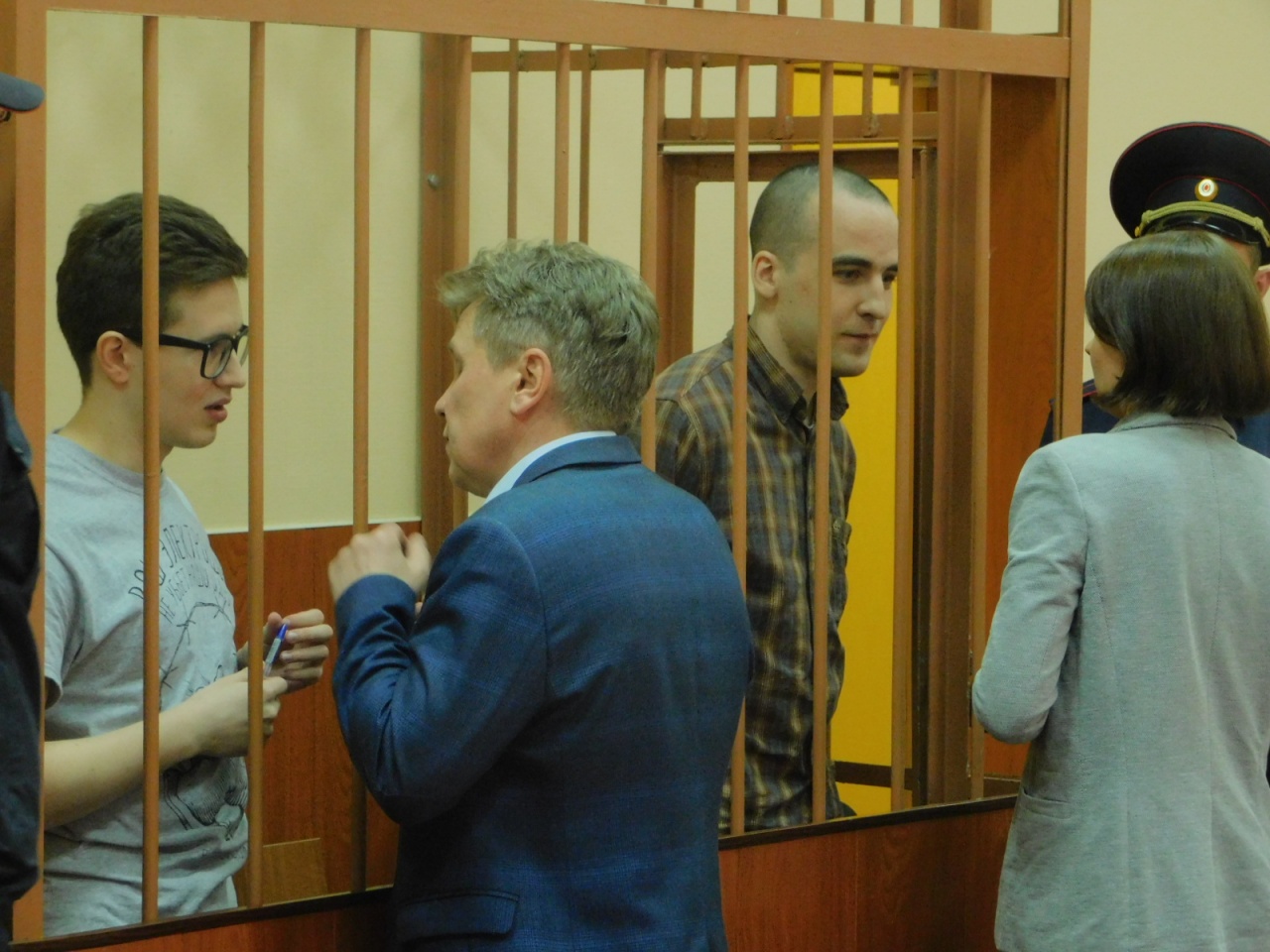
DSCN0045Viktor Filinkov (left) and Yuli Boyarshinov (right) in the dock at the Network trial in Petersburg, discussing matters with their defense lawyers. Photo courtesy of Zaks.ru

Petersburg Defendants in Network Case Remanded in Custody till September 11
Zaks.ru
June 4, 2019

On Tuesday, June 4, a panel of judges from the Moscow Military District Court, presiding at a circuit hearing in Petersburg, extended the remand in custody of anarchists Viktor Filinkov and Yuli Boyarshinov, defendants in the trial of the so-called Network terrorist community, until September 11.

The defendants’ previous remand in custody would have expired on June 11. The prosecution insisted it be extended. The defendants asked to release them on house arrest. Filinkov and Boyarshinov have been imprisoned for nearly a year and a half.

Earlier in the hearing, the court granted a motion, made by Filinkov’s defense counsel, Vitaly Cherkasov, to order a phonoscopic forensic examination of an audio recording in the case files containing, allegedly, a conversation between the Petersburg defendants.

As part of the forensic examination, FSB Captain Maxim Volkov recorded their voices in the courtroom. They were told to say anything they liked in the microphone.

Filinkov spoke for around eleven minutes about what happened during the early days after he was detained by the FSB, including  the electrical shock torture to which he had previously accused the FSB officers who detained him of subjecting him.

Boyarshinov recounted the time he had spent in remand prison, his loved ones, and his passion for traveling.

The trials of the Network defendants have been taking place simultaneously in Petersburg and Penza.

There are nine defendants in the dock. They have been charged with establishing a terrorist organization that, allegedly, wanted to carry out terrorist attacks against officials and security services officers. They also, allegedly, planned to overthrow the government.

On the contrary, the defendants claim they practiced airsoft together and discussed anarchist ideas, but had no plans to commit any crimes whatsoever.

Translated by the Russian Reader

_________________________________________

They took a dynamo out of a bag and put it on the table. All the agents were wearing balaclavas and medical gloves.

They strapped my hands behind my back, I was only in my underpants, they strapped my legs to the bench with tape. One agent, Alexander, stripped the wires with a craft knife and attached them to my toes. They didn’t ask any questions, they simply started cranking the dynamo.

I felt electric currents in my legs up to the knees. It feels like you are being skinned alive, but when it stops, it’s as if nothing happened at all. There’s no pain when the electricity stops.

Well, it’s impossible to endure this. They hit me [with electric shocks] maybe about five times without asking any questions, probably, to stun me or something like that. Then they told me: if you haven’t figured it out, you are in the hands of the FSB, we are not going to play games, you will have to answer our questions now. The answers “no”, “I don’t know”, “I don’t remember” are wrong answers.

Excerpt from Network defendant Dmitry Pchelintsev’s testimony at the Penza Network trial, as published by People and Nature on June 4, 2019. Read the rest of Pchelintsev’s nearly unbearable story there.

The Sex Beat

Two Petersburg Activists Remanded in Custody on Suspicion of Sexual Relations with 14-Year-Old Girl 
Bumaga
February 21, 2019

This afternoon, a court in Petersburg remanded in custody two 18-year-old political activists: Vladimir Kazachenko, of the Vesna (Spring) Movement, and Vadim Tishkin, who attended opposition protests.

Police investigators suspect them of sexual relations with a female juvenile.

On the eve of their arrests, Kazachenko was visited at home by policemen who asked him questions about bomb threats. In early February, he had been involved in a protest on Nevsky Prospect. Tishkin claims police planted drugs in his house.

Civil rights activists argue the case bears all the hallmarks of political persecution.

Bumaga has summarized everything known about the case.

Kazachenko is an activist in the Vesna (Spring) Movement. After he was detained on Nevsky on February 9 while carrying a placard that read, “Open Russia Instead of Putin,” in support of arrested Open Russia activist Anastasia Shevchenko, he was charged with two administrative offenses, disorderly conduct and involvement in an unauthorized protest.

On February 19, Kazachenko was scheduled to appear in Petersburg’s Kuibyshev District Court at a hearing on both counts.

Kazachenko claimed that, a day earlier, at approximately eight o’clock in the evening, two plain clothes police officers knocked on his door and asked to be let in.

“They said through the door they needed to question us about the bomb threats of the last several days,” said Kazachenko.

As of today, February 21, there have been bomb threats leading to evacuations of public buildings in Petersburg for six consecutive days.

Our sources in Vesna informed us that officers at a neighborhood police station corroborated Kazachenko’s story about being visited by police due to the bomb threats. The police explained they needed him to make a statement.

Fontanka.ru writes that the police officers left around one in the morning. Kazachenko claims, on the contrary, the officers spent around an hour outside his door, but he did not let them in.

According to his lawyer, the next day, Kazachenko went missing an hour before his scheduled court hearing. By evening, activists from the Aid for Detainees Group discovered Kazachenko was being held in the criminal investigative department at the 15th Police Precinct. Another activist, Vadim Tishkin, was with him.

It is not known when and how they were detained.

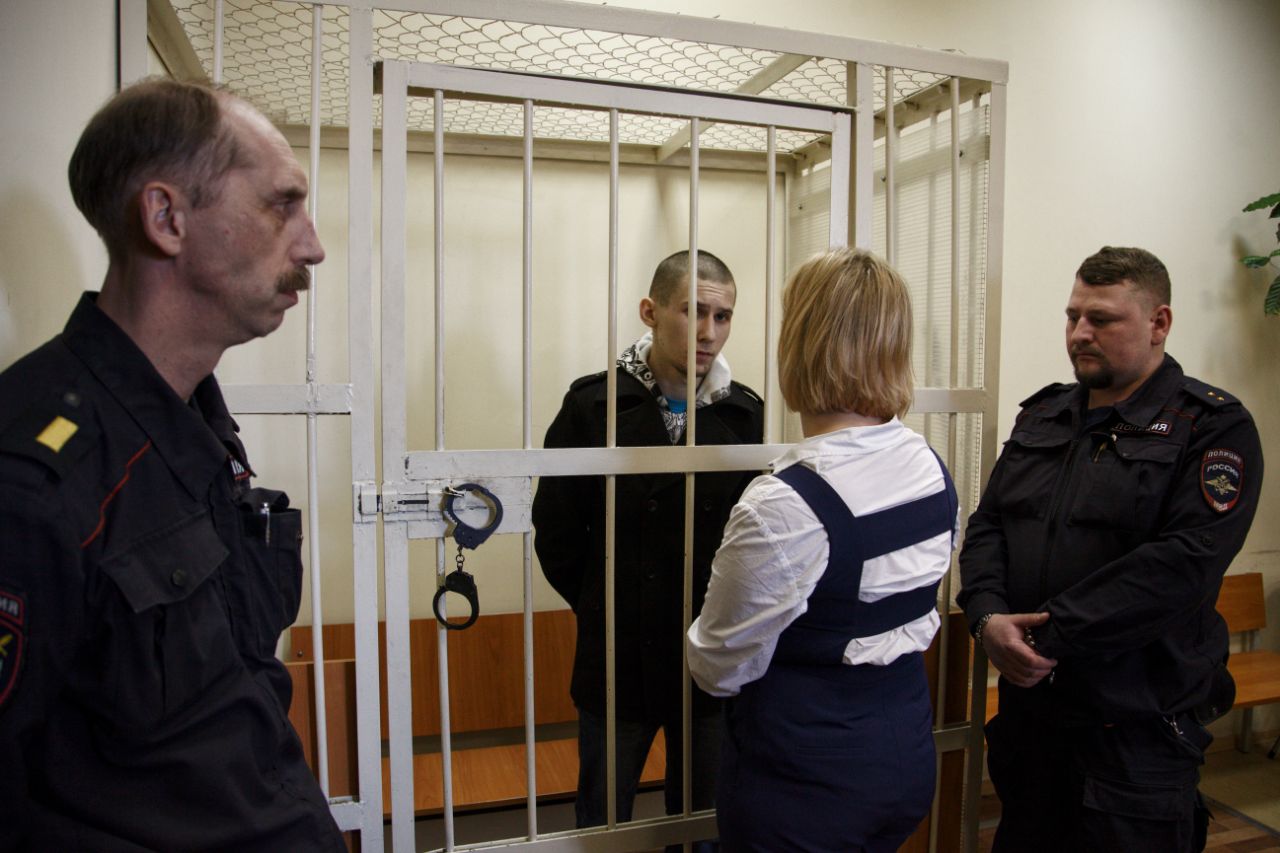
sb1Vladimir Kazachenko in court on February 21. Photo by Georgy Markov. Courtesy of Bumaga

The media wrote the activists had been detained on sex-related charges. This was corroborated, allegedly, by photographs posted on Telegram channels. Citing sources in law enforcement, Fontanka.ru wrote that Kazachenko and Tishkin had been detained, allegedly, for sexual relations with a 14-year-old female Vesna activist. 78.ru also noted  police had found a beige-colored powder-like substance among Tishkin’s personal effects.

Several anonymous Telegram channels published similar reports. The posts featured photos from the so-called orgy, which took place under a Navalny campaign poster and involved the two activists and two young women. According to the Telegram channels, police found the photos when they were interrogating one of the female minors and confiscated her telephone. The faces of the alleged orgiasts were blurred in the published photos. Vesna argues the photos were deliberately leaked to the Telegram channels to make the case public.

According to an article published on the website Moika 78, the parents of the two female juveniles pictured in the photos filed criminal complaints against Kazachenko.

Later, the Aid to Detainees Group reported that Kazechenko and Tishkin were suspected of violating Article 135 of the Russian Federal Criminal Code (“Commission of indecent acts without violence by a person who has reached the age of eighteen against a person who has not reached the age of sixteen”).

Fontanka.ru wrote that the activists confessed their guilt, but the Aid to Detainees Group denies this. According to the civil rights activists, Tishkin admitted a narcotic substance was found among his personal effects, but he claims it was planted there.

sb2Vadim Tishkin in court on February 21. Photo by Georgy Markov. Courtesy of Bumaga
On February 20, the Petersburg office of the Russian Investigative Committee reported that two local residents, born in 2000, had been detained on suspicion of committing indecent acts.

“The evidence gives us grounds to believe that, on February 18, 2019, the suspects committed indecent acts against a female juvenile, born in 2004, in an apartment on Grazhdansky Prospect,” wrote the agency.

The Investigative Committee stressed, however, it had “conclusive evidence” of the arrested men’s involvement in the crime: photos and videos found on the mobile telephones of the suspects and victims.

“The involvement of the suspects in political organizations of whatever kind has nothing to do with the current criminal case,” the Investigative Committee underscored.

According to the Aid for Detainees Group, the arrested activists initially received legal assistance from Russia Behind Bars and Memorial since, according to the civil rights activists, the case bore the hallmarks of political persecution.

Varya Mikhaylova, a spokesperson for the Aid for Detainees Group, explained to Bumaga that civil rights activists had made this assumption because Kazachenko had been involved in Vesna’s protests, while Tishkin had been detained during a protest against the pension reform on September 9, 2018. According to Mikhaylova, the two female minors were also involved in political activism.

sb3Vladimir Kazachenko in the cage. Photo by Georgy Markov. Courtesy of Bumaga  

The Vesna Movement also believe the case is politically motivated.

“I doubt whether they would put so much pressure on [Kazachenko] and make such a big deal of the case if he weren’t an activist. Besides, it would appear that he was missing for several hours before police investigators went public with their suspicions. None of the police precincts told us he was in their custody,” said Anzhelika Petrovskaya, the Vesna Movement’s press secretary.

Vesna commented on news of Kazachenko’s arrest on the evening of February 19. It said it believing meddling in the personal lives of activists was wrong.

Subsequently, Vesna has commented on the case on its Telegram channel.

“We hope people realize this is a victimless crime. Vladimir did nothing bad from an personal viewpoint. There was no violence involved. The movement believes we should help and support him,” wrote Petrovskaya.

Vesna has no intention of expelling Kazachenko from the movement. On the contrary, its activists are planning a crowdfunding campaign to support him in remand prison.

Two days after the activists were detained police, a court remanded them in custody. Their hearings took place in closed chambers.

Kazachenko was charged with having sexual relations with a minor in collusion with other individuals, a violation under Article 135 Part 4 of the Russian Federal Criminal Code, which stipulates a maximum punishment of fifteen years in prison.

Petrovskaya said Kazachenko had been sent to Remand Prison No. 1 for two months.

sb4Vadim Tishkin in the cage. Photo by Georgy Markov. Courtesy of Bumaga

Tishkin was also jailed for two months. The Petersburg judicial system’s joint press service did not mention the drugs charge, only that Tishkin was suspected of having sexual relations with a minor as part of a group.

Fontanka.ru writes that Tishkin is also suspected of attempting to steal a mug from a Starbucks on Nevsky Prospect.

____________________________

Yana Teplitskaya
Facebook
February 27, 2019

[…]

We spoke with Vadim Tishkin. He looked like a teenager, confused and completely ignorant of what a remand prison was. We spoke with him on Monday. He was delivered to the remand prison in the early hours of Friday morning. He had been without bed linens and other necessities the entire time. When police searched his house, they had let him take some things with him, but he had not chosen the best things to take. The remand prison should have issued him bed linens, of course, but apparently you have to insist on it for it to happen.

Concerning the criminal case, he said the police had not beaten him. They only insisted he take part in a drug sting, promising to plant drug in his home or on his person if he refused to cooperated. He refused to cooperate, and the police planted lots of drugs on him.

They knew right away the types and quantities of drugs they “found.” No forensic examination was needed.

The sting would have targeted his friend the political activist Vladimir Kazachenko.

(I wrote the first sentence of this story because I think it is terribly important that the first and second paragraphs are about the same person. A confused adult, who was a juvenile until recently, was made to choose between a prison term and a sting operation. Since he has a state-appointed defense lawyer, he will probably get a long prison sentence.)

We asked about telephones, because the Telegram channels who had sources in the police said the girl had voluntarily surrendered her telephone to police officers. In fact, as Vadim told us, she had not surrendered it voluntarily. It was forcibly confiscated, and the police had guessed the password since it was simple.

[…]

Thanks to Comrade K. for the heads-up.

____________________________

Former Sandarmokh Caretaker Sergei Koltyrin Sentenced to Nine Years in Pedophilia Case
Sergei Markelov
Novaya Gazeta
May 27, 2019

The Medvezhyegorsk District Court in Karelia has sentenced Sergei Koltyrin, former director of the district’s museum, to nine years in a medium-security prison camp and forbidden him to engage in teaching for ten years. The other defendant in the case, Severomorsk resident Yevgeny Nosov, was sentenced to eleven years in a prison camp.

Koltyrin was charged with indecent acts against a juvenile male in collusion with other individuals (Russian Criminal Code Article 135, Parts 2 and 4), sodomy against a juvenile male in collusion with other individuals (Article 134, Parts 3 and 5), and illegal possession of a weapon (Article 222, Part 1).

Nosov was indicted on the same charges, except the weapon possession charge. Both defendants refused to comment on the verdict.

The prosecution had asked the court to sentence Koltyrin to sixteen years, and Nosov to eighteen years, in a maximum-security prison camp. Prosecutor Andrei Golubenko told reporters the prosecution was satisfied with the verdict, but it would first have to read the text of the court’s ruling to decide whether to appeal it.

When asked how many victims there had been and whether the defendants had confessed their guilt, Golubenko refused to answer, citing the fact he could not divulge the particulars of the trial, since the evidence in the case had been presented in closed chambers.

Koltyrin’s defense lawyer, Konstantin Kibizov, was not present for the reading of the verdict, but he said his proxy would probably appeal the verdict.

Koltyrin and Nosov were arrested on October 3, 2018. According to police investigators, the men had repeatedly raped Nosov’s distant relative, who was twelve at the time. Both defendants partially admitted their guilt [sic]. The men were subsequently accused of having sexual intercourse with a juvenile male.

In August 2018, Koltyrin was appointed curator of the excavations in the forested area of Sandarmokh, as conducted by the Russian Military History Society. He had spoken negatively about the hypothesis that the site contained the graves of victims of the Finnish occupation of Soviet Karelia during 1941–1944. Koltyrin insisted the memorial site contained the remains of Soviet citizens executed during the Stalinist purges.

The mass graves of Stalin’s victims at Sandarmokh were discovered by a group led by Memorial Society historian Yuri Dmitriev, who was arrested in 2016 and charged with producing pornography depicting his juvenile foster daughter.

In April 2018, the Petrozavodsk City Court acquitted Dmitriev on the charges. However, the prosecutor’s office appealed the verdict, after which the case was sent to the Karelian Supreme Court for review.

In the summer of 2018, Dmitriev was indicted on new criminal charges. In addition to producing pornography, he was charged with committing violent sexual acts against his foster daughter.

Translated by the Russian Reader

_____________________________________

This post deals with four criminal cases against two very young opposition political activists in Petersburg and two middle-aged opposition historians in Russian Karelia who have played prominent roles in researching and publicizing the extent of the Great Terror in their part of the world.

What the cases have in common is that the men have all been accused and, in one case convicted, of sexual offenses against minors.

In the first case, two very young political activists in Petersburg stand accused of having sex with women only a few years younger.

In the cases in Karelia, the charges seem more serious—sexual acts against minors on the part of middle-aged men—but the article in the Russian Criminal Code is the same. If the activists and researchers caught up in the machinery of the Russian police state are found guilty (as one of them has been, only yesterday), they can be sentenced to long terms in prison.

I get the sense that most of the Russian civil rights community, the Russian press, the Russian opposition, and their supporters in the west do not want to touch these cases with a ten-foot pole, lest the taint of “sexual assault” and “pedophilia” touch them as well.

In fact, I would not have heard of the first two cases if I had not met another young Russian political activist who had the good sense to flee Russia when it was obvious the Prigozhin-controlled local press and social media set them up for the same charges as the ones now faced by Vladimir Kazachenko and Vadim Tishkin.

The whole world should know Karelian historian Yuri Dmitriev by now and understand the Putin regime simply cannot let its absurd frame-up, quashed once by the Petrozavodsk City Court, fall to pieces, so it upped the ante by accusing him of sexually assaulting his juvenile stepdaughter.

I know of at least one very large Russian civil rights organization that was so impressed by this obvious trickery they avoided sending a representative to Petrozavodsk for Dmitriev’s new trial.

They were scared to be seen there, apparently.

Maybe it has occurred to a lot of people who are determined not to open their mouths, but the police and security services in Russia have demonstrated in recent years they will stop at nothing to get their man or woman.

People who care about solidarity and glasnost have to be able to get over their squeamishness and see these cases for what they really are—a convenient means of sending the Russian opposition the message that no holds are barred in the regime’s war against them. At least, we have to presume innocence and admit the possibility the regime has no qualms about accusing anyone of any crime, no matter how heinous or, as in the case of the “teen sex orgy” in Petersburg, allegedly involving political activists, how banal.

It thus should go without saying that, when they are indicted on statutory rape or sexual assault charges, jailed in one of Russia’s harsh remand prisons, and abandoned by their former friends and political allies to the tender mercies of prison wardens, police investigators, and prosecutors, some people despair and let themselves be railroaded, knowing that the conviction rate of Russia’s courts is over 99%. {THE RUSSIAN READER}

The Network Trials: Pinning the “Code” on the Defendants

filinkov-boyarshinovPetersburg Network Trial Defendants Viktor Filinkov and Yuli Boyarshinov. Photo by Alexander Koryakov. Courtesy of Kommersant
Prosecution Tries to Pin “Code” on Network Defendants
Anna Pushkarskaya
Kommersant
May 21, 2019

The Volga District Military Court rejected the defense’s motion to send the Penza segment of the so-called Network case back to prosecutors. The prosecution has alleged the defendants established the Network (an organization now officially banned in the Russian Federation), a “terrorist community” of anarchists, in order to overthrow the regime.

Today in Penza the prosecution will begin presenting its case against the seven defendants.

This stage of the trial has been completed in Petersburg, where Viktor Filinkov and Yuli Boyarshinov are on trial for their alleged involvement in the community. Their defense attorneys have moved to disallow key pieces of evidence in the prosecution’s case and summon Penza FSB investigator Valery Tokarev and Petersburg FSB field officer Konstantin Bondarev to the stand. The two FSB officers have been accused by the defendants of torturing them with electrical shocks. The Moscow District Military Court, which is hearing the case in Petersburg, postponed its consideration of these motions until June 4.

The trial in Penza began later than the trial in Petersburg. During the second hearing in Penza, on May 15, after the indictment was read aloud, the defense moved to send the case back to the prosecutor’s office for further investigation. It argued the case had been carelessly patched together, and some of the evidence had been obtained under pain of torture. It was nearly impossible to mount a coherent defense against such an “absurd, vague, and inconsistent” indictment, they said.

Prosecutor Sergei Semerenko argued the trial should proceed, although he refused to rule out the possibility the indictment would ultimately be withdrawn and resubmitted on less serious charges.

The judges reacted to this turn of event unexpectedly. They withdrew to chambers and never returned to the courtroom. A court clerk eventually told the lawyers, waiting for a ruling on their motion, the hearing was adjourned, after which armed guards led the defendants away.

The next day it transpired the trial would resume on May 21.

In the Penza trial, Dmitry Pchelintsev and Ilya Shakursky have been charged with running the Network terrorist community. They face twenty years in prison if convicted. Arman Sagynbayev, Vasily Kuksov, Andrei Chernov, Mikhail Kulkov, and Maxim Ivankin have been charged with involvement in the alleged community. They face ten years in prison if convicted.

A number of the defendants have also been indicted on other charges, including weapons possession and drug trafficking.

In Petersburg, Viktor Filinkov and Yuli Boyarshinov also face charges of involvement in the alleged community. Boyarshinov has also been charged with possession of gunpowder.

Filinkov has claimed he was tortured and denies his guilt. Boyarshinov has complained of torture-like conditions in remand prison but has confessed his guilt.

The subject of torture also came during when a witness in the trial, Igor Shishkin, was questioned. Mr. Shishkin has already been convicted on charges of involvement with the alleged Network as part of a plea agreement with investigators. Members of the Petersburg Public Monitoring Commission found the most serious injuries on his body after he was initially detained and questioned by the FSB in January 2018.

When Mr. Shishkin was asked whether unacceptably violent methods had been used on him and whether had testified voluntarily, he smiled and replied, “The military investigator carried out a brilliant investigation: nothing of the sort was found.”

The Moscow Military District Court finished its examination of the evidence in Petersburg on May 17 after holding a video conference with witnesses in Penza, including the defendants on trial there. All the witnesses testified they had not seen Viktor Filinkov at training sessions in the woods.

However, Mr. Pchelinitsev and Mr. Sagynbayev testified they had not been questioned about the Petersburg case. The transcript of this interrogation had been copied from testimony they gave to FSB investigator Valery Tokarev in Penza while they were tortured. They later withdrew their testimony.

Mr. Filinkov, who worked as a programmer before his arrest, also claimed investigators had falsely interpreted physical evidence seized during searches and reached the wrong conclusions during their investigation.

In particular, he claimed he had not “zigzagged” around Petersburg on the day before his arrest before discarding the hard drives FSB field agents later found in a trash bin. The images and photos on the drives, which had been entered into evidence, were of the kind one would find in the possession of any punk. They had been produced by his wife Alexandra Askyonova as a teenager.

Ms. Aksyonova was granted political asylum in Finland last week.

Mr. Filinkov made a point of noting that Petersburg field officer Konstantin Bondarev, who had compiled the case file on him, should be charged with torture.

Ultimately, the court agreed to summon Mr. Tokarev and Mr. Bondarev to the witness stand, but so far they have failed to appear at the hearings.

The key evidence of the alleged anarchist community’s terrorist inclinations are two documents, seized from two of the Penza defendants: the so-called Code, which outlines the Network’s alleged goals and organizational structure, and the minutes of an interregional “congress” held in a Petersburg flat in 2017, featuring responses from the movement’s alleged cells to socio-political issues.

The FSB has claimed the cells were armed units. The minutes contain neither the names nor the pseudonyms of the respondents.

When Vladimir Putin discussed the Network case with the Presidential Human Rights Council, he referred to a report drafted for him; the report claimed that “founding and programmatic documents had been seized from the terrorist community.”

However, the defendants and witnesses have denied the existence of the documents, claiming they only held discussions during their meetings but did not ratify or sign documents.

Mr. Shishkin, who made a plea agreement with investigators, corroborated this.

Prosecutor Ekaterina Kachurina asked him, “Why did you become interested in anarchist ideology?”

“And why did you become a prosecutor?” he replied, explaining anarchism was interesting to him.

Mr. Pchelintsev said there had been no “congress,” only “a seminar by consensus.”

Vitaly Cherkasov, Mr. Filinikov’s defense attorney, said in court there was every reason to believe “an unlimited number of Petersburg and Penza FSB officials had illegal access over a lengthy period of time” to the hard drive and laptop on which the files containing the “Code” and the “Minutes” had, allegedly, been discovered, due to improprieties in the secure storage and unsealing of the physical evidence.

Mr. Boyarshinov’s assistant defense attorney, Olga Krivonos, moved to have the court declare the documents inadmissible as evidence, along with the FSB’s linguistic forensic investigation, which concluded the “Code” was a “set of instructions outlining the basic organizational principles of a network of combat units capable of resisting the current powers that be.”

The court has adjourned until June 4.

Translated by the Russian Reader. You can read more about the Network case and stories related to the case here.

My Generation

frenkel-subway trialThe defendants in the Petersburg subway bombing trial. Photo by David Frenkel

After a terrific, well-attended solidarity talk in support of the defendants in the Network case, held here in Berlin the other night, I spoke to a lovely young Russian activist.

I said to them that there were, of course, many more instances of wild injustice in Putinist Russia with which an engaged foreign audience could be regaled, such as the ongoing trial of several Central Asians, accused of complicity in the alleged terrorist suicide bombing in the Petersburg subway on April 3, 2017.

Like the Network case, the Petersburg subway bombing case has all the hallmarks of a frame-up. As in the Network case, there have been numerous allegations the defendants have been tortured by investigators.

“But the difference,” the young person interrupted me, “is racism.”

They meant that, since all the defendants hailed from Central Asia, there was no way to mount the successful solidarity campaign that has shown a harsh light on the Network case and garnered it widespread notoriety, especially within Russia.

The young person went on to tell me that a friend of theirs had been attending the subway bombing trial. She had told them it was horrific. The defendants had been assigned state-appointed lawyers who did nothing to defend them. The trial was such a flagrant frame-up the interpreters working it had banded together to try and do anything they could to help the young people, who in all likelihood have been accused of terrible crimes they did not commit.

It goes without saying that all of them will be found guilty and sentenced to long terms in prison.

The case has been covered spottily by Petersburg and Russian media outlets, but I have seen very little outrage or even mild concern about it from my acquaintances on Russophone social media, most of whom live in Petersburg.

Many of these same people are now visibly bent out shape about the goings-on in Israel-Palestine. In the past few days, they have been treating virtual friends like me to generous helpings of unsubstantiated hasbara.

Are they unconcerned about the miscarriage of justice perpetrated on nearly a dozen young Central Asians because they think all Muslims are terrorists and, by definition, guilty of every charge of terrorism laid at their door?

It has been a commonplace of Russian quasi-liberal thinking that Stalinism affected Russians so deeply it infected their collective DNA. The Stalinist bug, so this spurious argument contends, has been passed on to the new generation as well, even though the Soviet Union collapsed almost thirty years ago, before my interlocutor and huge numbers of other terrific young Russian social and political activists I know were born.

Supposedly, several generations must pass before the Stalinist bug will finally be expunged from the national genetic code and Russians can build a more democratic polity in their country.

In reality, there is a great deal of anecdotal evidence pointing to the new generation’s eagerness and readiness to live that way right now.

On the contrary, it is my own age mates, the so-called last Soviet generation, who were born after Stalin died, who seem most afflicted by a kind of cognitive and emotional Stalinism that, often as not, emerges in their thoughts and deeds not as nostalgia or admiration for the real Stalin, but as dogmatic worldview that makes events in, say, Israel more real and important than most events in their own country and cities.

Given recent oddities around the Network trial and the unwonted negative publicity the case has generated for the FSB, I think there is a slight chance the powers that be might have decided to ratchet things down a bit. I could be wrong, but I would not be surprised if, when the trials in Penza and Petersburg resume after a long, unexplained recess, the defendants were indicted on lesser charges and then immediately released on probation, taking into account the long time all of them have spent in remand prisons since their arrests in late 2017 and early 2018.

There is no chance this will happen in the subway bombing trial for the simple reason that almost no one in Petersburg can be bothered to go to bat for a group of non-Russian Muslims or even bat an eye when they are tortured and framed exactly like their non-Muslim contemporaries. {TRR}

__________________________________________________

The Russian Reader is a website that covers grassroots politics, social movements, the economy, and independent culture in Russia and the Russian-speaking world.

All the work on the website is done for free.

Unless otherwise noted, everything published on the Russian Reader can be reproduced elsewhere so long as the Russian Reader is indicated clearly as the source, and a link back to the original blog entry is included in the republication. In fact, you are encouraged to post these articles on social media and share them wherever you like.

Growing numbers of readers are the only way I know whether the Russian Reader is accomplishing its mission: to make news and views from the other Russias more accessible to the outside world.

You can also help the Russian Reader by donating money by pressing the buttons marked “Donate” and “Buy me a coffee,” on the left side of this page, or by clicking on the advertisements that appear occasionally on this site.