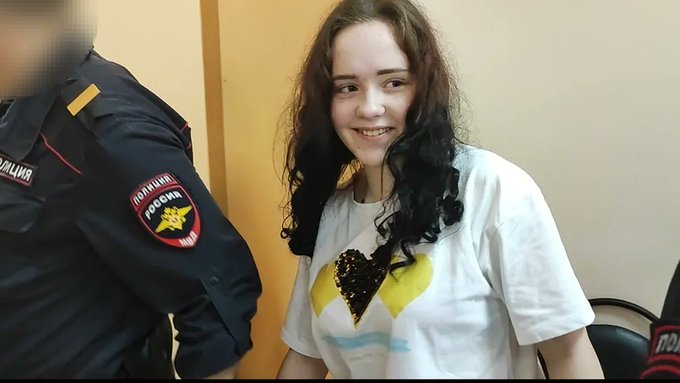
Alexander Lukashenko, exdirector de una granja estatal soviética convertido en dictador de Bielorrusia dijo alguna vez que jamás una mujer gobernaría su país. Entonces, tres mujeres lo desafiaron.
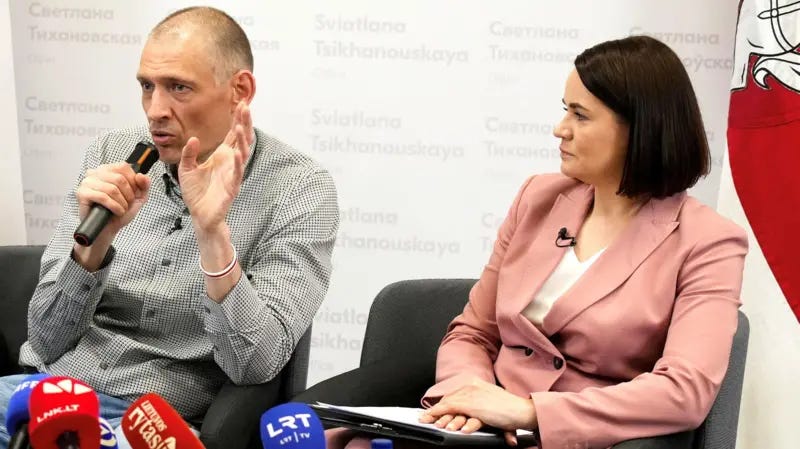
Cinco años después de las protestas más grandes en la historia de Bielorrusia, Svetlana Tikhanovskaya y Veronika Tsepkalo, ambas en el exilio actualmente, hablan con la BBC sobre el precio que tuvieron que pagar para inspirar a cientos de miles de bielorrusos a salir a las calles para exigir un cambio.
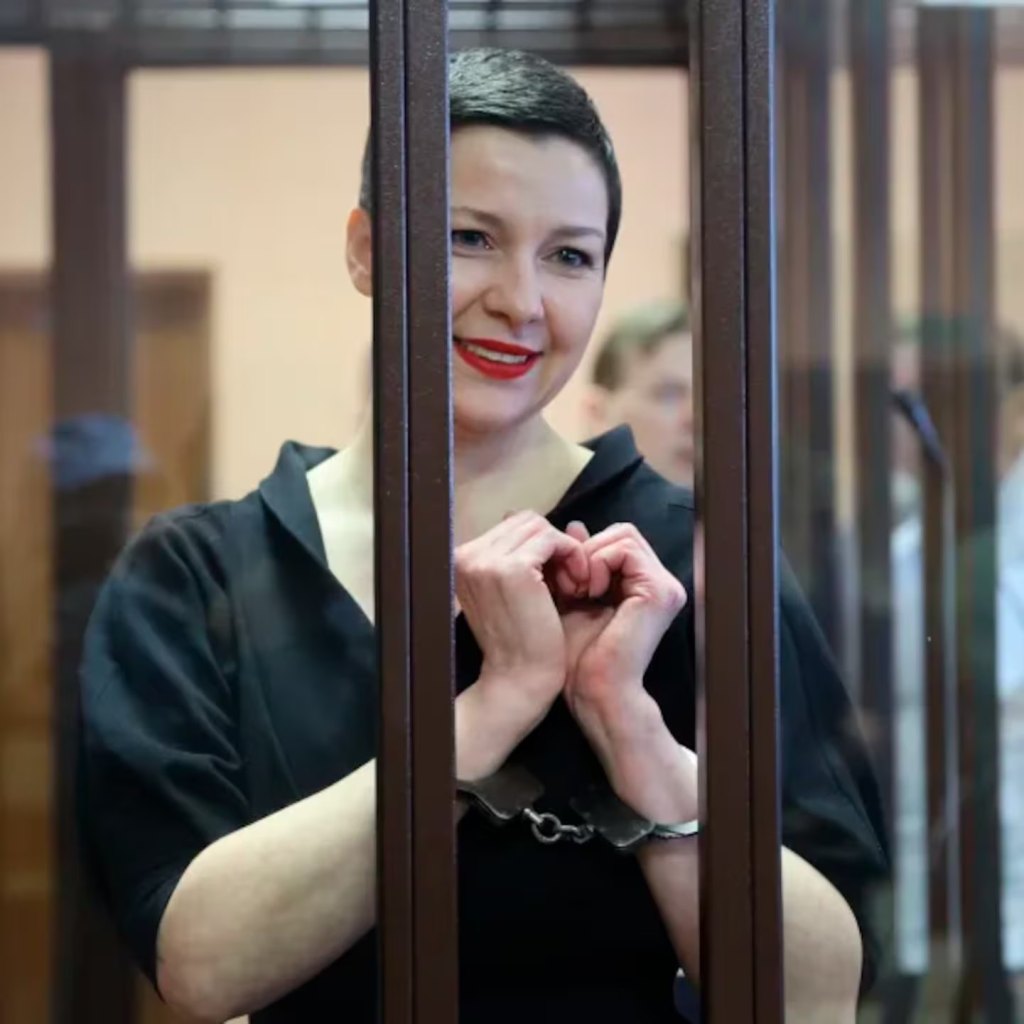
Maria Kolesnikova, su ex compañera de campaña, se encuentra ahora en una prisión bielorrusa, condenada a 11 años, el 2021, por extremismo y conspiración para derrocar al gobierno.
Su hermana, Tatsiana Khomich, ha dicho a la BBC que su familia no ha tenido noticias de Maria desde el año pasado.
Las tres mujeres unieron fuerzas en agosto de 2020, cuando los candidatos de la oposición a los que apoyaban fueron obligados a retirar sus candidaturas presidenciales.
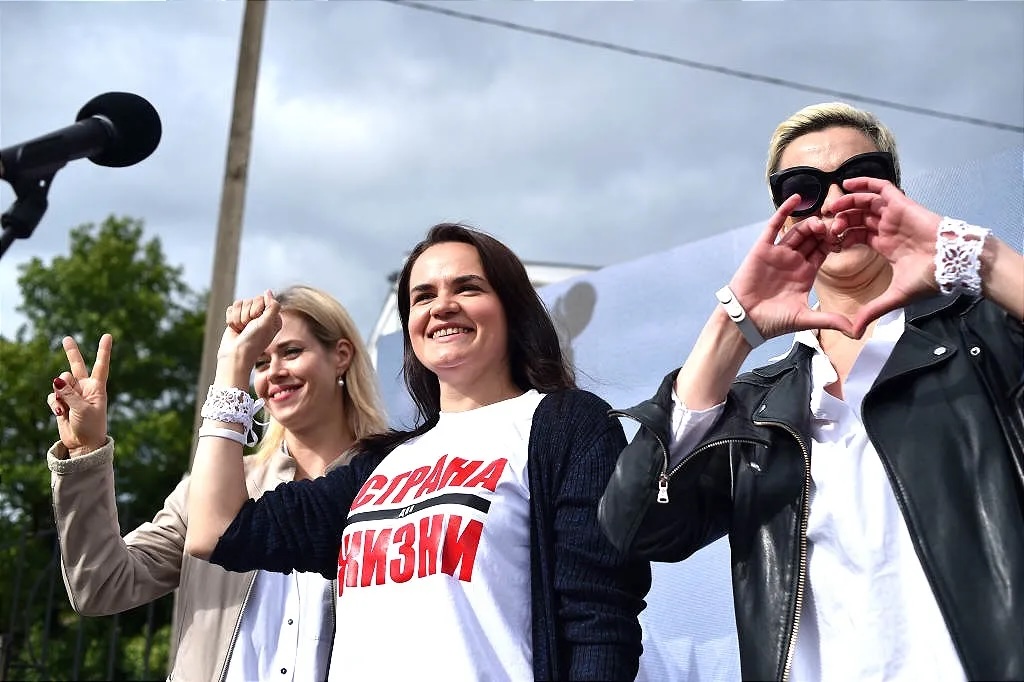
Su efímera alianza y sus imágenes mostrando un corazón, un puño y un signo de victoria con las manos estuvieron en titulares de todo el mundo
Afirman que les tomó 15 minutos ponerse de acuerdo para unir fuerzas contra Lukashenko, que se aferra al poder en Bielorrusia desde 1994.
“Fue muchísimo más rápido de lo que les tomaría a los hombres”, dijo Veronika Tsepkalo en ese momento.
Ella quedó a cargo de la campaña de su esposo, Valery Tsepkalo, después de que al ex embajador bielorruso en Estados Unidos se le prohibiera registrarse como candidato y tuviera que huir del país por temor a ser arrestado.
Maria Kolesnikova hizo campaña a favor del banquero Viktor Babaryko, a quien también se le impidió presentarse como candidato y fue arrestado antes de las elecciones.
Pero fue Svetlana Tikhanovskaya quien terminó en la cédula de votación reemplazando a su esposo, el activista y popular videobloguero Sergei Tikhanovsky, después de que este también fuera encarcelado.
Juntas, las tres mujeres viajaron por todo el país, convocando multitud de seguidores ansioso por un cambio. La promesa era sencilla: libertad para todos los presos políticos y, entonces, elecciones libres y justas.
En 2025 Svetlana Tikhanovskaya habla del “aliento emocional” que todos sintieron durante esos días.
“Logramos unir a los bielorrusos”, declaró a la BBC.
Cuando el día de las elecciones llegó, el 9 de agosto, la gente acudió en masa a las urnas. Los partidarios de Svetlana estaban convencidos de su victoria, pero Alexander Lukashenko se atribuyó un triunfo categórico.
Esto desencadenó masivas manifestaciones, sin precedentes en todo el país, que duraron varios meses. Las autoridades respondieron con una brutal represión. Al menos cuatro personas murieron, muertes que han sido atribuidas a las fuerzas de seguridad.
Pero ninguna de las tres mujeres que electrizaron la campaña electoral estaban allí para liderar las protestas.
Tsepkalo abandonó Bielorrusia justo antes de las elecciones. Tikhanovskaya fue detenida por la KGB un día después de la votación y, entonces, fue obligada a abandonar el país bajo amenaza de ser encarcelada y de que sus hijos pasaran a la tutela del Estado.
María Kolesnikova se quedó. Fue arrestada en septiembre tras romper su pasaporte en la frontera con Ucrania para evitar una expulsión forzosa.
Junto con su ex jefe Viktor Babaryko, es una de los más de mil presos políticos que aún permanecen detenidos en Bielorrusia según el grupo de derechos humanos Viasna.
Desde el 2020, decenas de miles de personas han sido arrestadas por oponerse al régimen y muchas afirman haber sufrido tortura y vejaciones durante su detención.
Hoy en día en Bielorrusia cualquier disidencia pública es eliminada.
“Sinceramente creí que el régimen de Lukashenko caería”, comentó Veronika Tsepkalo a la BBC.
Al igual que cientos de miles de bielorrusos que abandonaron el país tras el 2020, ahora vive en el extranjero con su familia y trabaja en una gran empresa tecnológica del Reino Unido.
“Era una estrategia de todo o nada”, dice Tatsiana Khomich, hermana de Kolesnikova, quien ahora lidera una campaña por la liberación de los presos políticos bielorrusos. “Nos sobreestimamos y subestimamos la capacidad de las autoridades”.
Svetlana Tikhanovskaya dice que ahora entiende que no tenían ningún plan y “no estaban preparados para ningún cambio radical”.
Esta mujer, que en su día era una madre ama de casa y admitió ser tímida y carecer del carisma de su marido, ahora es reconocida como líder de la oposición democrática en el exilio y se reúne periódicamente con jefes de Estado y presiona para que se impongan sanciones contra el gobierno de Lukashenko.
«Si pudiera aplicar mis conocimientos actuales y mi experiencia de hace cinco años, sin duda me habría sentido más segura», dice Tikhanovskaya. «He aprendido algo de diplomacia, a hablar con políticos y a sentirme cómoda con personas influyentes».
Hace menos de dos meses, Svetlana recuperó inesperadamente a su marido: Sergei Tikhanovsky fue liberado junto con otros 13 presos políticos y enviado a Lituania con su familia.
Después de haber dicho que había ingresado en la política “por amor” a su marido, Tikhanovskaya ahora admite que desde entonces también se ha enamorado de Bielorrusia y de la visión que tiene de su país.
“No vamos a competir con Sergei sobre quién es más importante, quién tiene más seguidores, etc. Sergei encajará a la perfección en nuestro movimiento”, afirma.
Tikhanovskaya rara vez habla con Veronika Tsepkalo y en la entrevista con la BBC no quiere entrar en detalles de lo que pasó con su relación.
Tsepkalo es más sincera: acusa a su ex “compañera de armas” de secuestrar el movimiento y expulsarla.
“El trío se disolvió”, afirma Tatsiana Khomich.
Khomich, quien todavía forma parte del equipo de su hermana, dice que todas tienen sus propios proyectos ahora.
Svetlana Tikhanovskaya dice que su prioridad es trabajar por la liberación de los presos políticos y enumera como sus logros ayudar a los bielorrusos en el extranjero y mantener a Bielorrusia en la agenda internacional.
Veronika Tsepkalo se muestra escéptica ante estos éxitos y los califica de “acción por la acción”.
De regreso al equipo de su marido, ha estado haciendo campaña para llevar a Alexander Lukashenko ante la justicia internacional.
Tatsiana Khomich considera que intentar forzar un cambio de régimen desde el extranjero “no tiene sentido”.
“En realidad, ahora estamos mucho más lejos que hace cinco años”, afirma.
Tanto Tikhanovskaya como Tsepkalo creen que en algún momento en el futuro Bielorrusia será libre y democrática.
Ante las críticas de que haber puesto sus propias ambiciones por delante de las de su equipo, Tikhanovskaya responde: “Quizás eso es lo que dicen quienes no me conocen de verdad. Me gustaría que por fin celebrácemos nuevas y justas elecciones, pero, desde luego, no participaré en ellas.
Kapela (ensemble) Rej es un grupo de música tradicional bielorrusa. Sus instrumentos principales son la duda (gaita bielorrusa) y el violín.
El ensemble en la grabación:
Vital Voranau: duda
Ursula Oleksiak: violín, voz
con Sergi Llena (España): tambor de marco, gaita de boto
Las grabaciones se realizaron en Serbia durante el festival Rog Banata en las ciudades de Zrenjanin (2024, pistas 1-9) y Bečej (2023, pistas 10-13). La foto de la portada del álbum fue tomada de la actuación en Belgrado el 2024 por Sandra Crepulja.
Maria Kalesnikava, música, activista y prisionera política, fue detenida un día como hoy en 2020. Secuestrada en una calle de Minsk por las autoridades bielorrusas, fue llevada a la frontera de Bielorrusia y Ucrania para ser expulsada del país al día siguiente. Pero rompió su pasaporte y por consiguiente no pudo cruzar la frontera. El 2021, fue condenada a 11 años de prisión junto a Maksim Znak, quien recibió 10 años. Actualmente se encuentra recluida en la prisión de mujeres de Homiel.
Kalesnikava tiene mi edad y ya ha pasado cinco años de su vida en prisión. Desde febrero del 2025, María y su familia no han intercambiado cartas ni llamadas… Al menos, no está en régimen de aislamiento, sino con otras prisioneras.
Llevo un tiempo sin escribir sobre la situación política en Bielorrusia, pero no porque esta haya mejorado. No, cada día leemos sobre nuevas detenciones. Esta semana, defensores de derechos humanos han reconocido a 14 nuevos presos políticos y las autoridades han añadido 68 nombres a la llamada “lista de extremistas”. En total, sabemos ahora de 1197 presos políticos, entre ellos 32 ciudadanos extranjeros. Un caso reciente: una ciudadana británica de 52 años (que también tiene ciudadanía bielorrusa) fue detenida al entrar al país y condenada a 7 años de prisión (https://spring96.org/en/news/118604).
Pero otros cientos de personas siguen sin ser reconocidas por diversas razones. Sin una Bielorrusia libre, no habrá paz en Europa.
Escribía ayer sobre los cinco años que llevaba ya Maria Kalesnikava en prisión y sobre los 1197 presos políticos en Bielorrusia. Y hoy nos enteramos de otra muerte.
Andrei Padniabenny, ciudadano ruso de 36 años y prisionero político ha muerto en la prisión n. 15 de Mahiloŭ. Él fue enjuiciado dos veces con acusaciones criminales y sentenciado a 16 años y ochos meses de prisión en una colonia de seguridad media. Llevaba casi cuatro años tras las rejas. Se desconoce la causa de su muerte.
Su madre Valiantsina informó en su perfil de Facebook: “Mis queridos nietos se quedan sin padre… El único consuelo que queda es que ya nadie podrá torturar a mi hijo, ni física ni psicológicamente… Creo que la justicia de Dios alcanzará a los culpables y ningún crimen quedará impune…”
Según la publicación, Andrei murió el 3 de septiembre. Esta es la novena muerte de un preso político en Bielorrusia y la segunda muerte de un ciudadano ruso tras las rejas.
Otros presos políticos que murieron en cautiverio:
a Map of the Kyzylsu catchment. The names of the main glaciers are indicated in black. The elevation information is taken from the AW3D Digital Elevation Model (DEM), while the hillshade was derived from high-resolution Pleiades DEMs acquired in 2022 and 2023. Glacier outlines and debris extents are from the RGI 6.0 inventory. Lakes were manually delineated from a Pléiades 2022 ortho-image. The inset maps show the location of the study site in Central Asia with a base map from Esri, along with glaciers shown as blue areas and sub-regions outlines from the RGI 6.0 inventory. b Picture taken by Jason Klimatsas in September 2023 of the on-glacier automatic weather station, located on the debris-covered portion of Kyzylsu Glacier. Maidakul Lake can be seen in the background,as indicated by an arrow. c Pluviometer station photographed by a time-lapse camera in March 2022, with the snow-covered terminus of Kyzylsu Glacier visible in the background.
This week’s episode of the CAPS Unlock podcast opens with a discussion about a show of diplomatic unity in Central Asia. Following Israel’s strike on Qatar, all five governments of the region quickly issued statements of condemnation. Some went as far as calling the strike an act of aggression. We examine why these unusually swift and aligned reactions matter, how they highlight the region’s growing ties with Gulf states, and what they reveal about Central Asia’s selective application of principles such as territorial integrity.
Our interview segment features Achille Jouberton, visiting scientist at the Swiss Federal Institute for Forest, Snow and Landscape Research, and lead author of a major new study on the glaciers of Tajikistan’s Pamirs. Long thought relatively stable compared to the shrinking ice fields of the Himalayas and Tien Shan, the Pamirs are now losing mass at troubling rates. Jouberton explains how declining snowfall since 2018, measured through field stations, pressure sensors, and climate reanalysis, is reshaping water availability in the region. He discusses the role of large-scale climate systems, the combination of less snow and hotter summers, and the downstream implications for agriculture and hydropower.
We close by looking at President Kassym-Jomart Tokayev’s State of the Nation address in Kazakhstan. Among an eclectic mix of themes, including long passages on artificial intelligence, Tokayev floated the possibility of transforming Kazakhstan’s bicameral parliament into a single chamber. Though short on detail, the proposal hints at possible institutional re-engineering ahead of 2029, when Tokayev’s presidential mandate ends. We assess what this might mean for Kazakhstan’s political system and why even seemingly technical reforms can reshape the balance of power.
For years, the Pamir-Karakoram anomaly stood as a rare outlier in global climate trends: a region where glaciers remained relatively stable despite accelerating global warming. Now, new research from the Institute of Science and Technology Austria (ISTA) confirms that even these “last strongholds” have begun to lose mass at an alarming rate.
Snow Deficit and Rising Heat
Data collected from a climate monitoring station on the Kyzylsu glacier in the northwestern Pamirs, active from 1999 to 2023, reveals a sharp shift. According to an international research team led by Francesca Pelliccotti, the tipping point came in 2018, when a significant decline in snow cover and precipitation irreversibly altered the glaciers’ mass balance.
Once past this “point of no return,” glaciers began rapidly depleting their own reserves to compensate for the lack of new snowfall, a process accelerating their melt.
Since 2018, the region has experienced a persistent snow deficit. Snow depth has fallen by approximately 40 cm, and annual precipitation has declined by 328 mm, about one-third of the historical average. Seasonal snow melts earlier, is less stable in spring, and is no longer sufficient to replenish glacier mass.
July 2022 was the hottest month on record, and during this period, the Kyzylsu glacier recorded unprecedented mass loss, melting at a rate eight times faster than the 1999-2018 average. Scientists identify increasingly hot summers and a lack of precipitation as the primary causes.
Even the intensified ice melt has not made up for reduced snowfall: water inflow into rivers dropped by roughly 189 mm in water equivalent. The contribution of glacial runoff to total river flow rose from 19% to 31%, but this increase was still insufficient to offset the overall decline in water volume.
The situation is most severe at altitudes above 4,000 meters, where solid precipitation has declined sharply. Snow from avalanches, which previously helped sustain the glaciers, has dropped nearly threefold from 0.21 to 0.08 m per year.
Implications for Central Asia
Experts warn that this is not a localized issue. The Pamir and Karakoram glaciers feed the Amu Darya and Syr Darya rivers, lifelines for millions across Central Asia. Diminishing glacial mass threatens freshwater availability, agriculture, hydropower generation, and overall socio-economic stability.
“Due to the lack of accurate forecasts, we cannot yet say definitively whether the Pamir glaciers have passed the point of no return. However, since 2018, the processes have changed dramatically, and the reduction in precipitation has had a critical impact on their stability,” said ISTA researcher Achille Joubert.
Data Gaps and New Monitoring Efforts
Following the collapse of the Soviet Union, glacier monitoring in the region was largely suspended for nearly two decades. Systematic observations resumed only in 2021, when international researchers reinstalled instruments on the Kyzylsu glacier, one of the Vakhsh River’s primary sources.
These new measurements confirmed a drastic drop in precipitation and snow thickness starting in 2018, with consistently unfavorable conditions persisting since.
Compared to the late 1990s, spring and summer snow now melts much faster, and the “cold reserves” that once preserved glacier stability are disappearing rapidly.
The study’s findings were published in Communications Earth & Environment, reinforcing that even the most resilient glaciers in Central Asia are succumbing to climate change.
“The disappearance of glaciers means not only a shortage of water, but also a threat to climate stability,” the researchers warn.
The loss of these natural freshwater reserves could trigger cascading effects from reduced electricity generation to ecosystem degradation.
The end of the Pamir-Karakoram anomaly is not just a regional alarm bell. It signals the urgency of coordinated international climate action. Without it, scientists say, the process may already be beyond reversal.
For Central Asia, this carries profound geopolitical and economic implications. Water stress is already a driver of tension between upstream and downstream states, and shrinking glaciers will exacerbate disputes over allocation and dam construction. Governments are under pressure to accelerate adaptation strategies – modernizing irrigation, investing in alternative energy, and expanding regional cooperation on water-sharing agreements.
Researchers also stress the importance of filling data gaps with sustained monitoring. Long-term, high-resolution observations are critical for forecasting river flow and planning infrastructure. International support, they argue, could help countries like Tajikistan and Kyrgyzstan upgrade their hydrological networks, while linking local data into global climate models.
Ultimately, the fate of the Pamir and Karakoram glaciers will not be decided in the mountains alone. Their survival, or disappearance, depends on global emissions trajectories and the political will to implement serious mitigation measures. What happens here, at the heart of Asia’s water towers, will ripple far downstream into the lives of millions.
Alexander Lukashenko, the former Soviet state farm director turned Belarus strongman, once said that a woman could never run his country. Then three of them challenged him.
Five years on from the biggest protests in Belarusian history, Svetlana Tikhanovskaya and Veronika Tsepkalo, both now in exile, have been speaking to the BBC about the price they paid for inspiring hundreds of thousands of Belarusians to take to the streets to call for change.
Their former teammate, Maria Kolesnikova, is now in a Belarusian prison, sentenced in 2021 to 11 years for extremism and plotting to overthrow the government.
Her sister Tatsiana Khomich tells the BBC the family haven’t heard from her since last year.
The three women joined forces in August 2020, when the opposition candidates they were supporting were all forced to end their presidential bids.
Their short-lived alliance made global headlines with pictures of them showing a heart, a fist, and a victory sign with their hands.
They claimed it took them 15 minutes to agree to join forces against Lukashenko, who has been in charge of Belarus since 1994.
“Far quicker than it would take men to do it,” said Veronika Tsepkalo, at the time.
She was left in charge of her husband Valery Tsepkalo’s campaign after the former Belarusian ambassador to the US was barred from registering as a candidate and fled the country fearing arrest.
Maria Kolesnikova campaigned for banker Viktor Babaryko, who was also prevented from standing and arrested ahead of the election.
But it was Svetlana Tikhanovskaya who ended up on the ballot, stepping in for her husband, the activist and popular video blogger Sergei Tikhanovsky, after he too was thrown in jail.
Together the three women travelled around the country, drawing big crowds of supporters eager for change. Their promise was simple: release all political prisoners, then hold a free and fair election.
In 2025, Svetlana Tikhanovskaya speaks about the “emotional uplift” all of them felt during those days.
“We managed to unite Belarusians”, she tells the BBC.
When election day came on 9 August, people flocked to the polls. Svetlana’s supporters were convinced she had won the vote, but Alexander Lukashenko claimed a landslide victory.
This sparked unprecedented mass demonstrations across the country, which lasted for several months. The authorities responded with a brutal crackdown. At least four people were killed – their deaths blamed on the security forces.
But none of the three women who had electrified the campaign, were there to lead the protestors.
Tsepkalo left Belarus just before the election. Tikhanovskaya was detained by the KGB a day after the vote and forced out of the country under threat of being jailed and losing her children to state care.
Maria Kolesnikova stayed behind. She was arrested in September, after tearing up her passport at the border with Ukraine to prevent a forceful expulsion.
Along with her former boss Viktor Babaryko, she is one of more than a thousand political prisoners still held in Belarus, according to a human rights group Viasna.
Since 2020 tens of thousands of people have been arrested for opposing the regime, many say they have suffered torture and mistreatment while in detention.
Today, any public dissent in Belarus is crushed.
“I sincerely believed that Lukashenko’s regime would fall”, Veronika Tsepkalo tells the BBC.
Like hundreds of thousands of Belarusians who are estimated to have left the county after 2020, she now lives abroad with her family, working at a big tech company in the UK.
“It was this all-or-nothing approach”, says Tatsiana Khomich, Kolesnikova’s sister who is now campaigning for release of Belarusian political prisoners. “We overestimated ourselves and underestimated what the authorities are capable of.”
Svetlana Tikhanovskaya says she now understands they had no plan and “weren’t ready for any radical change”.
Once a stay-at-home mum who admitted to being shy and lacking her husband’s charisma, she is now recognised as leader of the democratic opposition in exile, and regularly meets heads of state and lobbies for sanctions against Lukashenko’s government.
“If I could transfer my present knowledge, my experience to myself five years ago, I would definitely have felt more confident,” Tikhanovskaya says. “I’ve learned a bit of diplomacy, how to talk to politicians, how to be comfortable around powerful people”.
Less than two months ago Svetlana unexpectedly got her husband back: Sergei Tikhanovsky was released along with 13 other political prisoners and sent to Lithuania to his family.
It is thought that Donald Trump’s administration was key in securing their release.
Having said in the past that she went into politics “out of love” for her husband, Tikhanovskaya now admits she’s since also fallen in love with Belarus and the vision for her country.
“We’re not going to compete with Sergei about who’s more important, who has more followers et cetera. Sergei will be a natural fit for our movement,” she says.
Tikhanovskaya rarely speaks to Veronika Tsepkalo and in the interview with the BBC doesn’t want to go into details of what happened to their relationship.
Tsepkalo is more candid: she accuses her former “sister-in-arms” of hijacking their movement and pushing her out.
“The trio has broken up”, states Tatsiana Khomich.
Khomich, who is still part of her sister’s team, says all of them now have their own projects.
Svetlana Tikhanovskaya says her priority is working towards the release of political prisoners and lists helping Belarusians abroad and keeping Belarus on the international agenda as her achievements.
Veronika Tsepkalo is sceptical of these successes, calling them “action for action’s sake”.
Back in her husband’s team, she has been campaigning to bring Alexander Lukashenko to international justice.
Tatsiana Khomich thinks that trying to force regime change from abroad is “meaningless”.
“In reality, we’re now much further away from it than we were five years ago”, she says.
Both Tikhanovskaya and Tsepkalo believe at some point in the future there will be a free and democratic Belarus.
When asked to respond to criticism that she had put her own ambitions before her team, Tikhanovskaya says:
“Maybe that’s the kind of thing people who don’t really know me would say. I’d like us to finally hold new and fair elections but I certainly won’t be taking part in them.”
Kapela (ensemble) Rej is a group performing traditional Belarusian music. Their main instruments are the duda (Belarusian bagpipe) and the violin.
The ensemble on the recording: Vital Voranaŭ: duda Ursula Oleksiak: violin, vocals featuring Sergi Llena (Spain): frame drum, gaita de boto
The recordings were made in Serbia during the Rog Banata festival in the towns of Zrenjanin (2024, tracks 1-9) and Bečej (2023, tracks 10-13). The album cover photo was taken at the performance in Belgrade in 2024 by Sandra Crepulja.
Maria Kalesnikava, musician, activist, and political prisoner, was detained on this day in 2020. She was kidnapped on the Minsk street by the Belarusian authorities and the next day taken to the Belarusian-Ukrainian border to be thrown out of the country. But she tore up her passport and thus could not cross the border. In 2021, together with Maksim Znak, she was sentenced to 11 years of imprisonment (Maksim got 10 years). Now she is kept in Homiel women’s colony.
Kalesnikava is of my age, and five years of her life she has already spent in jail. Since February 2025, Maria and her family have exchanged no letters or calls… At least, she is not in solitary confinement but kept together with other female prisoners.
I’ve not been writing about the political situation in Belarus for a while, but that is not because there is some improvement. No, every day we read about new detentions. This week human rights defenders have recognized 14 new political prisoners, and the authorities have added 68 names to the so-called “extremist list”. All in all, we now know about 1197 political prisoners, 32 foreign citizens among them. A recent case: a 52-year old British citizen (she also has the Belarusian citizenship) was arrested while crossing the Belarusian border and sentenced to 7 years of prison (https://spring96.org/en/news/118604).
But still hundreds stay unrecognized because of different reasons. Without free Belarus, you won’t have peace in Europe.
Yesterday, I wrote about the five years Maria Kalesnikava had already spent in jail and about 1197 political prisoners in Belarus. And today, we’ve learned about another death.
Political prisoner Andrei Padniabenny, a 36-year-old Russian citizen, has died in Mahiloŭ penal colony No. 15. He was tried twice on criminal charges and sentenced to 16 years and eight months in a medium-security penal colony. He had been behind bars for nearly four years. The exact cause of his death is unknown.
His mother Valiantsina, reported on Facebook:
“My precious grandchildren are left without a father… The only consolation is that no one will be able to torture my son anymore, either physically or psychologically… I believe that God’s justice will reach the guilty, and no crime will go unpunished….”
According to the publication, Andrei died on September 3. This is the ninth death of a political prisoner in Belarus and the second death of a Russian citizen behind bars.
A Russian National Guard serviceman checks residency documents during a raid outside the Apraksin Dvor clothing market, in St. Petersburg, Russia, Friday, July 4, 2025. (AP Photo/File)
The immigrant worker from Uzbekistan entered the bank in Moscow, but when he reached the teller, she refused to serve him and she wouldn’t say why.
For him and others from impoverished countries across Central Asia who seek better lives in Russia, such hostility is woven into everyday life. Sometimes it bursts into outright violence.
“Mostly you notice it when you go to the hospital, a clinic, a government office: You stand in line and everyone shoots you dirty looks,” said the man, who spoke to the Associated Press on condition of anonymity because he feared repercussions.
Such xenophobia clashes with economic realities at a time when Russia has a labor shortage, primarily due to its war in Ukraine. In the first quarter of 2025, over 20% of Russian businesses said they were hindered by a lack of workers, according to the Central Bank.
But rather than welcoming laborers, Russian officials are fomenting anti-migrant sentiment and increasing restrictions on immigrants, which the government says number 6.1 million, but is probably higher. The government is tracking their movement, clamping down on their employment and impeding their children’s rights to education.
A massacre and a backlash
The continued crackdown comes as a trial began this month for four Tajik nationals who are accused of the shooting and arson attack at a Moscow concert hall in March 2024 that killed 149 people. The four were arrested within hours of the attack and appeared in court with signs of being severely beaten. An Islamic State group claimed responsibility but Russia sought to blame Ukraine for the bloodshed.
Anti-migrant rhetoric had been growing in Russia since the early 2020s. But the massacre in particular launched a wave of “terrible violence” against immigrants, said lawyer Valentina Chupik, who has worked with the immigrant community for over 20 years. In the eight days after the killings, she received 700 reports of injuries to immigrants, including “faces smashed against the doors of police stations,” she said.
Parliament speaker Vyacheslav Volodin captured the public mood after the massacre, saying “migration control is extremely important” to ensure foreign nationals carrying out “illegal activity” could be deported without a court order.
The violence drew concern from human rights groups.
“Central Asian migrants seeking work in Russia due to dire economic conditions in their countries of origin today face ethnic profiling, arbitrary arrests, and other harassment by police in Russia,” Human Rights Watch said in a report on the anniversary of the attack.
“The heinous massacre cannot justify massive rights abuses against Central Asian migrants in Russia,” said its author, Syinat Sultanalieva.
Raids, roundups and restrictions
While some violence has subsided, it hasn’t disappeared. In April, police raided a Kyrgyz-run bathhouse in Moscow with video showing masked men forcing half-naked bathers to crawl across the floor and deliberately stepping on them before covering the lens of a security camera.
Police also reportedly rounded up immigrants in raids on warehouses, construction sites and mosques, then coerced them into joining the military to fight in Ukraine. Some are threatened with having their residency documents withheld, while others are recently naturalized citizens who failed to register for military service. In such cases, serving in the military is presented as the only alternative to prison or deportation. For others, a fast track to Russian citizenship is offered as an incentive for enlisting.
Speaking in St. Petersburg in May, Alexander Bastrykin, head of Russia’s Investigative Committee, said “20,000 ‘young’ citizens of Russia, who for some reason do not like living in Uzbekistan, Tajikistan (and) Kyrgyzstan” were serving in Ukraine.
Those immigrants who have avoided violence still are subject to new anti-migrant laws. Much of this is targeted specifically toward workers from Central Asia.
In 2024, 13 Russian regions banned immigrants from certain jobs, including in hospitality, catering and finance, and even as taxi drivers. A pilot program starting in September in the Moscow region requires migrants who enter Russia without a visa to be tracked via an app. Those failing to comply are added to a police watchlist, impeding access to services like banking, and subjecting them to a possible cutoff of cellphone and internet connectivity.
A nationwide law banned children of immigrants from attending school unless they could prove they could speak Russian. Less than six weeks after the law came into force, officials told local media that only 19% of children who applied for the language test were able to take it, and the most common reason for rejection was incomplete or inaccurate documents.
Another man from Uzbekistan who has worked in Russia for almost two decades and lives in St. Petersburg said he’s had to wait in line for over seven hours to get needed residency documents. The man, who also spoke to AP on condition of anonymity for fear of reprisals, hopes to stay in Russia but says the climate has worsened.
“It’s hard to get paperwork,” he said. “There just isn’t the time.”
The oppressive laws sometimes force immigrants to resort to paying bribes. Chupik, the lawyer, believes that Russia’s system results in “violations that cannot be avoided.”
“This is exactly what this mass regulation is striving for: not for all migrants to be here legally, but for everyone to be illegal,” she said. “That way, they can extract bribes from anyone at any moment and deport anyone who resists.”
Encouraging anti-migrant sentiment
Anti-migrant sentiment is unlikely to diminish anytime soon, mostly because it’s encouraged by authorities like the Investigative Committee’s Bastrykin, who said immigrants “physically occupy our territory, not just with their ideology but with specific buildings” — referring to sites such as mosques.
Ultra-nationalist lawmaker Leonid Slutsky said foreign workers “behave aggressively, causing conflicts and potentially dangerous situations.”
Migrants are an easy scapegoat for many social ills, and not just in Russia, said Caress Schenk, an associate professor of political science at Nazarbayev University in Kazakhstan.
“Closing borders, conducting migrant raids and tightening policies are all tools that are easy go-tos for politicians the world over,” she said. “It goes in cycles that are sensitive to geopolitical pressures, as we’re seeing now, but also things like election campaigns and domestic political rivalries.”
A surge of “anti-migrant propaganda” has dwarfed previous rhetoric of recent years, according to the Moscow-based Uzbek immigrant who was ignored by the bank teller.
“If every person paying attention to the TV, the radio, the internet is only told that migrants are ‘bad, bad, bad,’ if they only show bad places and bad people, of course, that’s what people are going to think,” he said.
Such anti-migrant rhetoric has become part of the nationalist narrative from President Vladimir Putin and others used to justify the 2022 invasion of Ukraine — that Russia is under constant threat.
“Russia has started lumping together all of ‘the external enemies’ that it’s created over the years for itself: the migrants, the Ukrainians, the West,” said Tajik journalist Sher Khashimov, who focuses on migration, identity and social issues. “It all becomes this part of this single narrative of Russia being this castle under siege, and Putin being the only person who is on the lookout for ordinary Russians.”
The Uzbek immigrant in Moscow said Russia has created conditions “supposedly to help people, to help migrants.”
“But the rules do not work,’ he added. ”Special barriers are created that migrants cannot pass through on their own.”
A prominent nonviolent activist from Moroccan-occupied Western Sahara has been detained by federal immigration officers. Jamal Fadel was seized by masked ICE agents at Manhattan’s notorious federal building at 26 Federal Plaza on August 25 after a routine immigration hearing — an arrest that was caught on video.
Fadel is from the occupied city of Boujdour in Western Sahara. He’s been protesting nonviolently against Morocco’s occupation since he was a high school student, and was threatened by Moroccan authorities so many times that he left to seek political asylum in the United States.
Fadel is currently being held by ICE at the Moshannon Valley Processing Center in Pennsylvania. His attorney expects ICE will move for an expedited removal hearing. If deported, Fadel faces lengthy imprisonment, torture — or worse.
I spotted some of the Trump administration’s wanted men on Tuesday, the day after the U.S. Supreme Court granted immigration agents virtually unchecked permission to continue the “largest Mass Deportation Operation” in America’s history.
The wanted stood outside of a U-Haul truck rental outlet in the San Gabriel Valley. They polished other people’s BMWs and Range Rovers at a Pasadena car wash. I saw the wanted women too, walking to jobs as nannies and housekeepers.
They looked suspicious, all right, by the definition outlined Monday by Supreme Court Justice Brett M. Kavanaugh. They were natives of Mexico and Central America, seeking “certain kinds of jobs, such as day labor, landscaping, agriculture, and construction.”
They were suspect to many Californians too, but only of wanting to work, wanting to earn a little cash, wanting to pay their bills and feed their families. One hundred and seventy five years to the day after land that once belonged to Mexico became the 31st American state, California felt to many people Tuesday like it had reverted to a kind of frontier justice, where racial profiling had become the law of the land.
“I am just working hard and paying taxes,” said Mario, 50, between sips of coffee on the sidewalk outside the U-Haul station. Even before the Immigration and Customs Enforcement raids began three months ago, the Honduran immigrant said, life for street-corner workers was not easy.
“People are just looking for work. Some of them are even homeless,” said Mario, who declined to give his last name. “But some people are showing them hate, sometimes even hitting or kicking the homeless. We see it out on the street.”
At the Pasadena car wash where six workers were carted away in late August, those left behind continued their buffing and polishing Tuesday.
“It feels like we have come down low, really low,” said Cesar, between checking in customers. Though he was born just blocks away at Pasadena’s Huntington Hospital, he said he does not feel immune from the raids.
“If now they are just going to judge you by how you look, or maybe how you talk, I can get pulled over. Anyone can get pulled over,” said Cesar, who did not give his last name. “It’s gonna be harder for people to live a normal life. They’re gonna just have to deal with harassment. That’s not something I would want anyone to have to go through.”
Earlier raids by Trump immigration agents have spread far beyond snagging the criminals and drug traffickers the president and his allies claimed to be after. With 10 million Latinos living in the seven Southern California counties covered by the court’s order, a rights group said the high court’s action cleared the way for “an extraordinarily expansive dragnet, placing millions of law-abiding people at imminent risk of detention by federal agents.”
“We should not have to live in a country where the Government can seize anyone who looks Latino, speaks Spanish, and appears to work a low wage job,” Justice Sonia Sotomayor wrote. “Rather than stand idly by while our constitutional freedoms are lost, I dissent.”
The action offered portentous echoes of the mistreatment and greater violence unleashed on Chinese immigrants in the late 1800s. Today, it had U.S.-born citizens, such as The Times’ Gustavo Arellano, feeling they will have to carry their passports to prove their citizenship.
Outside the U-Haul, Mario said he holds a green card. So he will continue waiting on the sidewalk for his next job.
“I believe in God,” he said. “We might think different things, but we all have the same heart. There should be the same heart for everyone. Everyone.”
The United States deported 39 Uzbek nationals on a charter flight to Tashkent, the U.S. Embassy confirmed in what it described as part of ongoing efforts to remove migrants without legal status. Earlier this year, more than 100 Central Asians, mostly Uzbeks, were repatriated in a similar U.S.-funded operation. The deportations attest to close cooperation between Washington and Tashkent on migration enforcement. That partnership has been accompanied by political overtures. Last week, Presidents Shavkat Mirziyoyev and Donald Trump held a phone call in which they pledged to broaden their strategic partnership ahead of an expanded dialogue session this autumn. U.S. officials have pointed to investment opportunities in Uzbekistan, particularly in critical minerals, while both sides also highlight cooperation on security and migration.
Yesterday’s news made me think about when I was little and went on road trips with my family. My parents always insisted on preparing and eating Korean food at rest areas along the way. This was before Korean food became more well-known and I remember that if there were people nearby who could smell our food, they often made faces and comments about the smell. Eating kimchi in public was always an interesting experience back then. This was just embarrassing, but does the new Supreme Court ruling mean that in this scenario, it is now something much more ominous we should be worried about?
Now someone could call ICE on a foreign-looking family eating foreign-smelling food in a rest area. When ICE shows up we now would have to show papers to prove we are citizens based on a racially motivated tip, is that our reality? Also, remembering that my mother never became a citizen but had a green card and probably speeding tickets so she would have been deportable under the current regime? What if I can’t prove my citizenship because I don’t carry my passport or naturalization papers, I am detained until I can prove my citizenship and they have the legal authority to do all of this now?
Lawyers, please help me understand. Is this our reality now? Is eating kimchi in public while Korean enough to get ICE called on us?
And I want to add that racial profiling has always been used against Black Americans and to a lesser degree other less white adjacent communities forever in this country, whether it was deemed constitutional or not. This is not new for Black Americans and others and something I have to acknowledge.
En caso de que te lo hayas perdido, hace poco agregamos una nueva camiseta a nuestra tienda en línea para ayudar a la organización benéfica East SOS y así mantener nuestro compromiso de apoyar importantes iniciativas ucranianas gracias a tus compras.
Después de que Rusia exigiera que Ucrania cediese cinco de sus regiones como condición para un alto el fuego, diseñamos una camiseta para mostrar solidaridad con Ucrania: sus 603 628 kilómetros cuadrados.
En junio, lanzamos la camiseta “603 628 km²” y donamos las ganancias a la organización benéfica ucraniana East SOS. Gracias a lectores como tú, ya hemos recaudado más de 5000 USD para ayudar a reconstruir hogares devastados por la guerra en el este de Ucrania.
Recopilaremos donaciones hasta el 10 de agosto, por lo que te quedan seis días para conseguir tu camiseta y apoyar la causa.
También queremos acercarles a East SOS. Esta organización brinda asistencia integral a ucranianos en regiones del frente de guerra y a desplazados internos que se han visto obligados a huir (IDPs). La organización fue fundada el 2015 y se enfoca en proporcionar suministros esenciales y ayuda humanitaria a quienes viven en zonas del frente de guerra.
Un proyecto para el que East SOS está actualmente recaudando fondos es la reparación de viviendas afectadas por ataques rusos en el este de Ucrania, proyecto que contará con el apoyo de TheKyiv Independent. Hasta la fecha, East SOS ha ayudado a reparar casi 1500 viviendas en las provincias de Járkov y Donetsk, mientras que otras 300 familias están en lista de espera. El proyecto benéfico trabaja en la reparación de viviendas particulares, priorizando las solicitudes de personas mayores que viven solas o con discapacidad que no pueden realizar tales obras por sí mismos.
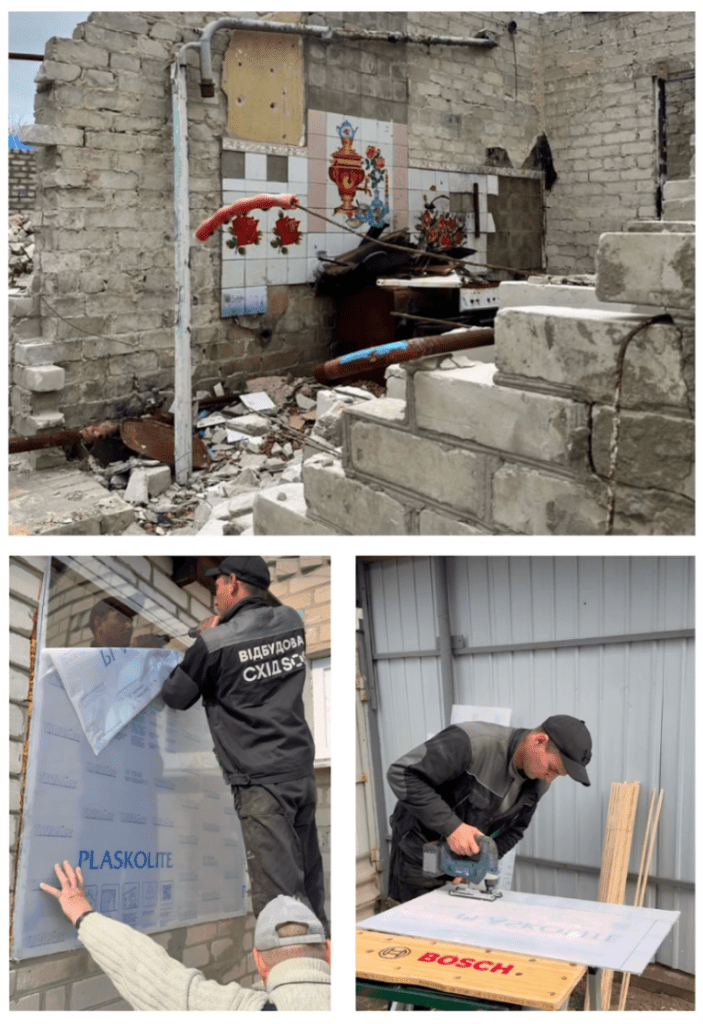
Personal de East SOS restauran casas dañadas por ataques rusos.
El equipo de East SOS interviene inmediatamente cuando una casa es afectada, se reparan techos y ventanas, y se previenen daños adicionales por lluvia o nieve. Después de esta respuesta de emergencia, el equipo regresa a restaurar viviendas gravemente dañadas por los ataques rusos.
A East SOS le cuesta aproximadamente $1,500 reparar una casa; con tu ayuda ya hemos recaudado fondos para cubrir la reparación de tres casas.
Noticias del Boletín ucranianio n.º 157 (3 de agosto del 2025)
En el boletín de esta semana:Maltrato y desaparición de prisioneros en Rusia; persecución por motivos políticos en los territorios ocupados.
Noticias desde los territorios ocupados por Rusia:
Solidaridad en el dolor: KVPU pide ayuda tras los mortíferos ataques rusos (KVPU 1 de agosto)
La periodista Iryna Levchenkol, de Melitopol, secuestrada el 2023, ha sido hallada en prisión en Donetsk, región ocupada por Rusia (Grupo de Protección de los Derechos Humanos de Járkov, 1 de agosto).
Una joven pareja crimea podría ser condenada a cadena perpetua por resistirse a la guerra rusa contra Ucrania (Grupo de Protección de los Derechos Humanos de Járkov, 29 de julio)
Ucrania expone una importante trama de sobornos en la adquisición de sistemas de guerra electrónica: diputados y funcionarios implicados (Ukrainska Pravda, 2 de agosto)
¡Rebeldía, amor, lucha contra la corrupción! Declaración del sindicato estudiantil Priama Diia (Red Europea de Solidaridad con Ucrania, 2 de agosto)
Cómo la controvertida Ley 4555-IX socava la lucha contra la corrupción y la reintegración — Alena Lunova en el podcast JustTalk Context (Zmina, 25 de julio)
Rescoldos moribundos: la crisis del carbón en Rusia provoca quiebras y despidos masivos (The Insider, 30 de julio)
Ucrania, entre el imperio y la revolución: el marxismo anticolonial de Lev Yurkevych (Links, 29 de julio)
Por qué la actual ola de nacionalizaciones en Rusia es más que una simple redistribución de activos (IStories, 29 de julio)
Nuevo gabinete de Ucrania: reformas neoliberales amenazan la solidaridad en tiempos de guerra (International Viewpoint, 26 de julio)
Investigación de abusos de derechos humanos:
ZMINA destaca, en un evento paralelo en la Conferencia Helsinki+50, la persecución con motivos políticos en los territorios ocupados (Zmina, 1 de agosto)
Presos golpeados y amenazados con nuevas condenas son obligados a luchar en la guerra rusa contra Ucrania (Grupo de Protección de los Derechos Humanos de Járkov, 1 de agosto)
No legitimar la ocupación: se urge a museos mexicanos y brasileños a abstenerse de colaborar con instituciones en territorios ocupados (Grupo de Derechos Humanos de Crimea, 30 de julio)
Evento paralelo en la conferencia Helsinki+50: «Crimea: 11 años de ocupación, restableciendo la justicia y los compromisos de la OSCE» (Grupo de Derechos Humanos de Crimea, 30 de julio)
Nota importante: No publicaremos el boletín la próxima semana. El próximo boletín, el n.º 158, se publicará en dos semanas, el 17 de agosto del 2025.
==
Este boletín es elaborado por activistas del movimiento obrero en solidaridad con la resistencia ucraniana. Para recibirlo por correo electrónico cada lunes, envíenos un correo electrónico a 2022ukrainesolidarity@gmail.com. Para dejar de recibirlo, responda con la palabra “STOP” en el asunto. Más información en https://ukraine-solidarity.org/. También estamos en X (antes Twitter), Bluesky, Facebook y Substack, y el boletín se encuentra en línea aquí.
¿Cómo es la vida cotidiana en un campo de prisioneros? Significa, sobre todo, trabajar, actividad repetitiva y agotadora. Significa dormir un sueño intermitente, ya que, a veces, las inspecciones son cada dos horas. Y significa pasar tiempo con personas a las que no te acercarías por tu propio deseo. Los guardias se aseguran de agobiar a los presos para que no tengan nada propio, para que no tengan tiempo para pensar en nada, para que estén completamente subordinados a quienes mandan. El objetivo de la “reeducación” en los campos de prisioneros es el mismo: doblegar la voluntad de los prisioneros, convertirlos en obedientes máquinas que obedezcan todas las órdenes de sus superiores.
Esto se cumple sobre todo con los presos políticos, quienes piensan con independencia y tienen sus propios principios. La misión principal de los guardias es conseguir la sumisión voluntaria, dichosa y proactiva de los presos políticos. Pero los guardias rara vez tienen éxito en esta misión.
Con Valeria Zotova, presa política de la Colonia Penal n.º 3 de Kostromá, han fracasado estrepitosamente. Los guardias insistentemente le han ofrecido una vía de redención: cooperar con las autoridades y participar en la vida cívica. Zotova la ha rechazado.
Recientemente, el club del campo de prisioneros proyectó una película de propaganda rusa titulada “Callsign: Passenger”. En Wikipedia se describe así el filme: “La película está ambientada en 2015. El protagonista es Nikolai Ryabinin, un escritor moscovita de moda y fiestero despreocupado. Su hermano, voluntario en la guerra en el Donbás, ha desaparecido. Nikolai va en busca de su hermano y se une a una unidad separatista, el Batallón Aurora, en el que su hermano sirvió anteriormente. Allí, recibe el irónico apodo de “Pasajero” (Passenger) y, bajo el liderazgo del comandante (callsign: Trigger), repiensa su propia vida y se une a los separatistas”.
Esta pieza de propaganda carente de imaginación está basada en una novela de Alexander Prokhanov, El asesinato de las ciudades. Es, por supuesto, basura barata, tanto como el propio escritor, pero los convictos están obligados a beber este cóctel cinematográfico hasta la última gota. Todos son arreados al club. Zotova se niega a ir. En última instancia es su derecho decidir si ve la película o no. ¡Pero qué importan los derechos cuando se trata del patriotismo ruso! Zotova es llevada a la fuerza al auditorio. Observen nuestro arte: ¡miren el talento de los cineastas que lo crearon, los actores que lo protagonizaron! Pero Lera Zotova le da la espalda a la pantalla y no ve la película.
Darle la espalda a la propaganda es simple, simple pero peligroso. La presión sobre Valeria continúa sin cesar. El acoso ha sido incesante. Los guardias llamaron a una amiga de Zotova y le espetaron: «Libertad o Zotova, tú eliges». Han intentado crear un vacío en torno a la presa política, privándola de todo contacto con sus allegados. La joven tiene veintiún años, pero ha sido acosada como una criminal avezada. Porque, según las autoridades penitenciarias, debería ser como todos los demás: obediente, involucrada en la vida cívica del campo de prisioneros, en obras de teatro, cumpliendo con las cuotas de producción y no arrogante para con sus superiores.
Turning Her Back on Propaganda What does daily life consist of in a prison camp? It consists of work, of course, work which is dull and exhausting. It consists of sleep, which is fitful, as sometimes there are inspections every two hours. And it consists of spending time with people whom you didn’t choose to spend time with. The wardens make sure to burden convicts so that they have nothing that is theirs alone, so that they have no time to think about anything, so that they are entirely subordinate to the powers that be. The goal of prison camp “re-education” is the same: breaking the will of the prisoners, turning them into obedient robots who obey all the orders of their superiors.
This is especially true for political prisoners—people who think independently and have their own principles. The overarching mission of the wardens is to attain voluntary submission, joyful and proactive submission, from political prisoners. But the wardens rarely succeed in this mission.
They have utterly failed with Valeria Zotova, a political prisoner at Kostroma Penal Colony No. 3. The wardens have insistently offered her a path to redemption, that is, cooperating with the authorities and taking part in “civic life.” Zotova has turned it down.
Recently, the prison camp’s club showed a movie, a Russian propaganda film titled Callsign: Passenger. Here is what Wikipedia says about the movie: “The movie is set in 2015. The movie’s main character is Nikolai Ryabinin, a trendy Moscow writer and carefree party animal. His brother volunteered for the war in Donbass and has gone missing. Nikolai goes looking for his brother and joins a separatist unit, the Aurora Battalion, in which his brother previously served. There, he gets the ironic nickname “Passenger” and under the leadership of the commander (callsign: Trigger) reevaluates his own life and comes to support the separatists.”
It’s an unimaginative piece of propaganda based on Alexander Prokhanov’s novel The Murder of Cities. It’s cheap trash, of course, like the writer himself, but the convicts are obliged to drink this cinematic concoction down to the dregs. All of them are herded into the club. Zotova refuses to go. Ultimately, it’s her right to watch the movie or not. But what do rights matter when it comes to Russian patriotism! Zotova is forcibly escorted into the auditorium. Watch our high art: look what talented filmmakers made it, what actors starred in it! But Lera Zotova turns her back on the screen and looks the other way.
Turning one’s back on propaganda is simple—simple but dangerous. The pressure on Valeria continues unabated. The harassment has been endless. The wardens summoned a friend of Zotova’s and stipulated to either: “Either freedom or Zotova—you choose.” They have been trying to create a vacuum around the political prisoner, depriving her of contact with those who are close to her in any way. The young woman is twenty-one years old, but she has been bullied like a hardened criminal. Because, as prison authorities envision it, she should be like everyone else: obedient, involved in the prison camp’s civic life, acting in plays, fulfilling the production quotas, and not smarting off to her superiors.
Jade Bird, “American Pie” (Don McLean cover). Thanks to the amazing Dick Gregory for the heads-up.
Nearly 3 million Americans identify as transgender, including one in 30 of those aged 13 to 17, according to a new report. But data on the country’s trans community may soon be hard to come by, its authors warned, as the Trump Administration and a number of GOP-led states seek to limit the recognition, and rights, of transgender people.
The UCLA Williams Institute has been publishing reports about transgender Americans since 2011, tracking information such as the race, ethnicity, age, regional location, and mental health of transgender individuals.
Trans adults and youth make up 1% of Americans aged 13 and older and 3.3% of 13-to 17-year-olds, according to the institute’s Wednesday report. Researchers found that younger adults, those aged 18 to 34, were more likely to identify as transgender than their older counterparts, making up more than 50% of the country’s transgender population.
For its initial 2011 report, the institute relied on just two state-level population surveys. Researchers noted that they have since been able to access broader and higher-quality data through the Centers of Disease Control and Prevention (CDC): To generate the most recent findings, they used data from the CDC 2021-2023 Behavior Risk Factor Surveillance System and 2021 and 2023 Youth Risk Behavior Survey. The report authors noted that the Youth Risk Behavior Survey in particular “currently provides the best available data for our estimates of the size and characteristics of youth who identify as transgender in the U.S.”
But the agency will no longer collect information on transgender people in compliance with President Donald Trump’s Executive Order calling for federal recognition of only two biological sexes.
Since Trump returned to office in January, information regarding trans people and health resources for LGBTQ+ people has been quietly removed or modified on federal websites. And the Department of Health and Human Services (HHS) has stepped away from its previous practice of supporting gender-affirming-care, in spite of numerous statements from all major medical associations in the U.S., including the American Medical Association and the American Academy of Pediatrics, declaring the care as best practice. In May, HHS called for “exploratory therapy” or psychotherapy to treat individuals with gender dysphoria instead of the medically recommended care.
Multiple states have also sought to restrict access to gender-affirming care, particularly for minors, amid broader global efforts to target such care for trans youth. A June Supreme Court decision upholding a Tennessee state-level ban on gender-affirming-care for youth delivered a heavy blow to the U.S. LGBTQ+ community, permitting similar bans that have been enacted across the country and presenting a significant obstacle to future efforts to challenge restrictions in the courts.
Amid the current political climate, the authors of Wednesday’s Williams Institute report say they are unsure whether survey respondents will accurately respond to questions regarding their gender identity moving forward. In addition to the uncertain future of data on the U.S. transgender population, they wrote, “It is also unclear whether individuals’ willingness to disclose on surveys that they identify as transgender will remain unchanged in the years to come.”
Despite those looming challenges in gathering information, however, the authors noted it is already clear that younger people are more likely to identify as transgender and they anticipate that to continue being true.
“This has implications for institutions in our society, including educational institutions, the U.S. Armed Forces, civilian workplaces, health care settings, and other areas, regarding how to meet the needs of and provide opportunities for current youth and future generations,” they said.
Jade Bird, “I’ve Been Everywhere” (Johnny Cash cover)
In the Central Coast, where my father farmed strawberries, the land is mostly flat for miles in every direction so it was easy to spot the green vans and trucks of the Immigration and Naturalization Service heading our way in the distance, kicking up a cloud of dust in their wake. It was the late ‘70s and raids were an occasional part of working in the ag industry.
When the trucks were spotted — most often by a worker — a loud call would go out: “La Migra, la migra.” That’s when immigrant workers without legal status would drop what they were doing and sprint away, either for a nearby riverbed or over a set of raised railroad tracks adjacent to the fields. The immigration raids on my father’s strawberry fields fascinated me when I was a boy. It wasn’t until I was older that I understood the impact on the workers who were rounded up and deported, as well as the effects on the families left behind. I now recall them in a more somber light.
My father worked as a sharecropper in the Central Coast. He oversaw several acres of strawberries and managed up to a dozen workers for Driscoll Inc., the berry company headquartered in my hometown of Watsonville.
From the time I was about 6 or 7 years old until I was 16, I spent my summers and most weekends in the fall in my dad’s strawberry fields. It was backbreaking work. I have the chiropractor invoices to prove it.
Immigration raid methods have changed. The toll they take has not
The ICE raids of the past few months across Southern California reignited my boyhood memories of the strawberry field raids.
What has not changed is the impact on the immigrant families, especially the children. Children of immigrants sustain deep emotional scars from immigration raids.
A study published last month on Psychiatry News said immigrant children or children of mixed-status parents endure serious trauma when their parents are deported.
“Forced family separations, particularly those resulting from immigration enforcement (e.g., detention, deportation), introduce acute psychological risks,” according to the study, which list the results as an “elevated risk of suicidal ideation, externalizing behavior and alcohol use.”
Even living under the threat of having a parent deported is traumatizing to children.
“These fears have been shown to lead to school absenteeism, academic disengagement, and heightened emotional distress,” the study says.
Even as a boy, the fear and desperation were palpable
When I worked in the fields, the raids came about once or twice a summer. I didn’t witness this myself, but the family lore includes the story of a worker who was so desperate to escape the INS that he jumped into a nearby port-a-potty — hiding among the feces and urine in the holding tanks — until the INS agents departed.
Each summer, two or three of my father’s workers would be deported, only to return the following season. That was more common back in the ‘70s than it is today. My dad tried to help his workers without green cards by connecting them with legal aid groups or lawyers so they could straighten out their legal status. Not all of them did and some who had green cards ran at the sight of INS trucks anyway.
In a recent conversation with my younger brother, Peter, he recalled panicking during the first raids he witnessed. He said he asked my older siblings if he should run from the agents, too.
“No, you’re an American. Just shut up,” they told him.
Jade Bird, “Grinnin’ in Your Face” (Son House cover)
[…]
A lost white race of Bible giants—literally bigger, stronger, and whiter than everyone else—fashioned as a symbol of everything conservatives wanted to remake America into, is an all-too-convenient bit of lore for the conspiracy-besotted right. (Never mind that the Nephilim were technically the villains in Genesis!) And the Smithsonian was, if anything, a useful foil for a fringe movement looking for an enemy to accuse of suppressing the truth.
Soon enough, claims that the Smithsonian intentionally hid the bones of Bible giants went mainstream, presaging the country’s own rightward shift. By the 2010s, the Smithsonian’s secret giants appeared in popular paranormal books, on late-night radio shows, in multiple cable TV documentaries (including at least two separate History Channel shows), and across a network of evangelical and far-right media outlets.
Among the most popular of these were the Christian DVDs and later podcasts produced by Steve Quayle and his Nephilim-hunting partner, Timothy Alberino. Quayle, an archconservative, blamed Bible giants for “teaching” men to be gay. He and Alberino were regulars on the right-wing podcast circuit in the 2010s, often appearing with figures like Alex Jones and Jim Bakker so Quayle could hawk their merch, attack Democratic politicians as demonic, and advocate for a targeted genocide of Nephilim-controlled liberals.
Burlinson told Blaze TV that he had been radicalized against the Smithsonian through Alberino’s podcasts and videos. In his podcasts, Alberino has described Bible giants as a “superior race society.”
In recent years, Alberino has made moves to go more mainstream. He has appeared on Ancient Aliens, the History Channel show advocating historical conspiracies, where David Childress is a featured star. That same show also hosted Tucker Carlson, Tennessee Republican Representative Tim Burchett, and others to peddle conspiracies about government cover-ups of space aliens, interdimensional beings, demons, and more.
For the far right, the E.T.s of Ancient Aliens—the same ones Congress is currently hunting in various UFO hearings—are actually angels and demons, and those demons are the souls of the giants who died in the Flood, according to a nonbiblical text Alberino endorses. Burlinson said in 2023 that he thinks UFOs could be angels, and more recently he promised that a congressional UFO hearing to be held on September 9 would feature witnesses who “handled the bodies” of these beings.
Conspiracies about Bible giants are basically the Christian version of UFOs and aliens, and it’s no wonder there is significant cross-pollination between believers in the two camps, even in Congress, where several representatives like Burlinson and Burchett have publicly discussed their belief in both. In fact, both conspiracies give pride of place to the Nephilim narrative from Genesis 6:4 as proof of either fallen angels or alien intervention.
It would be laughable if the Smithsonian conspiracy theory and tales of Bible giants now being spread on Blaze TV, on Joe Rogan’spodcast, and across right-wing media, were not a kind of Trojan horse to soften up the public to accept political propaganda in place of history and complete the assault on America’s museums that failed in the 1990s. But the conspiracists continue to spread their lore, and mainstream conservative politicians continue to escalate their attacks on the Smithsonian—a far-right pincer movement directed at an institution that is both the nation’s premier repository of historical fact and a potent bolsterer of America’s civic fabric. And that is no laughing matter.
THE BIZARRE TWISTS AND TURNS of Donald Trump’s Ukraine peacemaking project continue: Just three days after the president announced in a triumphant Truth Social post that Vladimir Putin was willing to meet with Volodymyr Zelensky—either one on one or in a trilateral summit with Trump—and to accept an arrangement in which NATO countries would provide postwar security guarantees for Ukraine, the Putin regime has unequivocally shot down both proposals. Russian foreign minister Sergei Lavrov (last seen sporting a “USSR” sweatshirt on his trip to Alaska) has made it clear that there won’t be a meeting with Zelensky until “all the issues” have been resolved—including the question of Zelensky’s legitimacy as president, given that Ukrainian elections have been put on hold on account of the war—and that Russia will not accept the presence of foreign troops, presumably other than its own, on Ukrainian soil.
Trump’s stormy bromance with Putin seems to be off again, too: in social media posts on Thursday, he criticized “crooked and grossly incompetent” Joe Biden for not allowing Ukraine to strike back at Russia and (speciously) compared his chummy-seeming interaction with Putin in Alaska with Richard Nixon’s confrontation with Nikita Khrushchev in Moscow in 1959.
It’s impossible to tell whether Trump’s social-media posturing will translate into action. There is still no word, for instance, on whether the administration is greenlighting Ukraine’s proposal, unveiled after the Monday White House meeting, for $100 billion in U.S. arms shipments to Ukraine (with the Europeans footing the bill) and an additional $50 billion project for joint U.S.-Ukrainian drone production. Nor is there any word on whether or when new sanctions will kick in.
WHILE THE CIRCUS PLAYS ON in Washington and Moscow, the war on the ground—and in the air—continues in Ukraine, and sometimes in Russia. Ukraine is in an undeniably tough position, though nowhere near the desperate predicament imagined both by haters and by worriers who keep predicting an imminent “collapse” of its defenses. On August 12, just before the Alaska summit, many thought they saw a sign of such collapse in a Russian “breakthrough” not far from the long-contested city of Pokrovsk (Donetsk region), near the former coal-mining town of Dobropillia, where Russian forces managed to make rapid advances past severely undermanned Ukrainian lines, move about nine miles forward, seize three villages (now mostly deserted, though some residents who have not been able to get out still remain there), and cut off a vital supply route for Ukrainian troops. These gains appeared to augur the fall of Pokrovsk itself, a prospect that has been discussed since late last year.
But a few days later, the supposed catastrophic defeat turned into an impressive Ukrainian victory thanks to the quick deployment of new units from the Armed Forces of Ukraine and the National Guard, which retook two of the captured villages as well as four previously occupied settlements and cleared the area of Russian troops, reportedly inflicting significant losses. As for Pokrovsk itself, there have been some clashes inside the city, with incursions by small Russian units; but observers such as expatriate Russian military expert Yuri Fedorov think it’s extremely unlikely that the city will fall before inclement weather forces the Russian offensive to wind down.
It is true that momentum is on Russia’s side, in the sense that only Russia is currently conducting offensive operations. But Russian forces’ progress is snail-paced and intermittent, with the Ukrainians often successful in pushing them back (and using drones to make up for manpower and ammunition shortages). The result, more often than not, is a ghastly tug-of-war over small patches of devastated land—contests in which a “win” may consist of planting a flag in a ghost settlement.
Overall, analysts agree that Russia has no chance of capturing the entirety of the Donetsk region—as it has tried to do since the start of Putin’s covert war in Eastern Ukraine in 2014—anytime in the foreseeable future; doing so would require taking heavily fortified urban areas, and even the most cavalier willingness to sacrifice men may not accomplish that goal without several more years of costly fighting. Hence Russian demands for Ukraine to surrender the remainder of the region without a fight.
Ukraine also continues to score successes in its aerial war on strategic Russian targets such as oil refineries, arms and ammunition depots and factories, and trains carrying weapons and fuel to the frontlines. (Russian troops aren’t the only ones feeling the effects: there are reported miles-long lineups for gasoline in parts of Russia.) And, Western arms deliveries aside, Ukraine is making strides in developing its own weaponry, like the new Flamingo long-range cruise missile capable of hitting targets more than 1,800 miles away; Zelensky has said that it could be mass-produced by February.
In other words: Ukraine is still not losing. But there is no question that it is exhausted—and that the enemy’s continuing terrorism against its civilian population is taking its toll. On Wednesday night, Russia launched one of its heaviest assault waves yet: 574 drones and 40 missiles, with targets located as far away from the frontlines as Lviv and Transcarpathia. Most were intercepted by Ukrainian defenses, but one person was killed and over a dozen wounded.
Was this a deliberate middle finger to Trump over his supposed peace effort? It sure looks like it, especially considering the bombing of an American factory in the Transcarpathian city of Mukachevo—the premises of Flex Ltd., a manufacturer of civilian electronic goods. At the very least, it shows that Russia is not de-escalating. Likewise, it’s unclear whether the incursion of a Russian drone that crashed and burned in a rural area in eastern Poland during the overnight attack on Ukraine was a deliberate provocation, as the Polish government charged. But it certainly doesn’t tell us that Putin wants peace.
He can still be forced into it, however. A scenario in which Ukraine drives Russian troops and occupation forces out of its territory is as impossible as one in which Russia makes major territorial gains in Ukraine; but there may come a point, perhaps soon, when the war’s economic and political burdens for the Putin regime become too heavy. Even with rigged elections and a thoroughly owned population, Putin still cannot afford too much discontent among the Russian middle class—or among the elites. There is a reason he has not undertaken another round of mobilization since 2022. But right now, recruitment is dropping, soldiers recovering from wounds or suffering from serious physical and mental health problems are being forced into combat, and mobilization may be the only way to keep the war going. The war will end when Putin starts to see its costs as too high and the chances of achieving his aims, stated and unstated, as too low.
U.S. policy could be instrumental in making that happen. But for that, the Trump administration would have to commit to a firm and consistent pro-Ukraine policy. For starters, the president’s promises of “very severe consequences” if Putin stands in the way of peace should mean something more than memes and empty talk. (And the vice president shouldn’t keep fawning about the “soft-spoken” Kremlin dictator who “looks out for the interests, as he sees it, of Russia.” Sorry, JD, but you sound like a jackass.)
Yet here we are, with Putin doing everything to sabotage any meaningful peace talks but put up an “I ♥ WAR” neon sign on the Kremlin walls—and what is Trump’s response? Another deadline: this time, he says, we’ll know whether a deal can be made “within two weeks”—famously, Trump’s “placeholder” unit of time. No doubt they’re quaking in their boots in the Kremlin.
The Trump administration has quietly rescinded long-standing guidance that directed schools to accommodate students who are learning English, alarming advocates who fear that schools will stop offering assistance if the federal government quits enforcing the laws that require it.
The rescission, confirmed by the Education Department on Tuesday, is one of several moves by the administration to scale back support for approximately 5 million schoolchildren not fluent in English, many of them born in the United States. It is also among the first steps in a broader push by the Trump administration to remove multilingual services from federal agencies across the board, an effort the Justice Department has ramped up in recent weeks.
The moves are an acceleration of President Donald Trump’s March 1 order declaring English the country’s “official language,” and they come as the administration is broadly targeting immigrants through its deportation campaign and other policy changes. The Justice Department sent a memorandum to all federal agencies last month directing them to follow Trump’s executive order, including by rescinding guidance related to rules about English-language learners.
Since March, the Education Department has also laid off nearly all workers in its Office of English Language Acquisition and has asked Congress to terminate funding for the federal program that helps pay for educating English-language learners. Last week, education advocates noticed that the guidance document related to English learning had a new label indicating it was rescinded and remains online “for historical purposes only.”
On Tuesday, Education Department spokeswoman Madi Biedermann said that the guidance for teaching English learners, which was originally set forth in 2015, was rescinded because it “is not in line with Administration policy.” A Justice Department spokesman responded to questions by sending a link to the July memorandum and said he had no comment when asked whether the guidance would be replaced.
For decades, the federal government has held that failing to provide resources for people not proficient in English constitutes discrimination based on national original under Title VI of the Civil Rights Act.
In rescinding the guidance, the Trump administration is signaling that it may stop enforcing the law under that long-standing interpretation. The Education and Justice departments have been responsible for enforcing the law.
In the July memorandum, Attorney General Pam Bondi cited case law that says treating people, including students, who aren’t proficient in English differently does not on its face amount to discrimination based on national origin.
Other guidance related to language access for people using services across the federal government is also being suspended, according to the memo, and the Justice Department will create new guidance by mid-January to “help agencies prioritize English while explaining precisely when and how multilingual assistance remains necessary.” The aim of the effort, Bondi said in a statement published alongside the memo, is to “promote assimilation over division.”
The consequences for school districts were not immediately clear, but advocates worry that rescinding the 2015 guidance could open the door for weaker instruction for English learners and upend decades of direction from the federal government to provide English-language services to students who need them.
“The Department of Education and the Department of Justice are walking away from 55 years of legal understanding and enforcement. I don’t think we can understate how important that is,” said Michael Pillera, an attorney who worked at the Office for Civil Rights for 10 years and now directs the Educational Opportunities Project at the Lawyers Committee for Civil Rights.
Without pressure from the federal government to comply with the law, it is possible that some school districts will drop services, Pillera said, particularly as many districts struggle with financial pressures.
“It’s going to ripple quickly,” he predicted. “Schools were doing this because the Office for Civil Rights told them they had to.”
Many districts will probably not change their services, but rescinding the guidance opens the door, said Leslie Villegas, an education policy analyst at New America, a think tank. Advocates may watch for changes in districts that previously had compliance problems or those that had open cases with the Office for Civil Rights related to English-language instruction, she noted.
“The rescission of this guidance may create the mentality that no one’s watching,” Villegas said.
In recent months, the Justice Department notified at least three school districts — in Boston; Newark; and Worcester, Massachusetts — that the government was releasing them from government monitoring that had been in place to ensure they offered services to English-language learners.
Officials in Worcester said they expected the action even before Trump took office. But in Boston, some parent advocates questioned why the monitoring had ended, the Boston Globe reported.
Supporters of immigration restrictions argued that relieving pressure on schools to provide these services might be helpful, especially given the costs to districts.
“If you devote all these resources to these kids coming in [to school] completely unprepared, inevitably it will diminish the quality of education others are getting,” said Ira Mehlman, spokesman for the Federation for American Immigration Reform.
Todd DuBois, communications director for U.S. English, a group that advocates for English as the official and common language, said some education is needed to help “bridge the gap” for students who do not speak English, but the group is concerned that multilingualism “gets in the way of teaching English literacy earlier in life.”
The requirement to serve English-language learners in school is based on two federal statutes. The first is Title VI of the Civil Rights Act, which bars discrimination based on national origin, among other traits. Alandmark 1974 Supreme Court case, Lau v. Nichols, interpreted this law to include a mandate for English-language services in schools.
The second federal law at issue is the 1974 Equal Educational Opportunities Act, which requires public schools to provide for students who do not speak English. A 1981 case decided in federal appeals court, Castañeda v. Pickard, laid out a test to determine whether schools were properly providing services to English learners in school.
In 2015, the Justice and Education departments published their 40-page guidance document, explaining how schools can properly comply with these laws and avoid potential federal investigations and penalties.
“For a teacher, it was kind of like the Bible,” said Montserrat Garibay, who headed the Office of English Language Acquisition under the Biden administration. “If, in fact, we want our students to learn English, this needs to be in place.”
In her memorandum, Bondi said that in addition to cutting back on multilingual services the administration deems “nonessential,” federal agencies would be tasked with boosting English education and assimilation.
“Instead of providing this office with more capacity and more resources to do exactly what the executive order says — to make sure that everybody speaks English — they are doing the total opposite,” Garibay said.
Mark Krikorian, executive director of the Center for Immigration Studies, which supports immigration enforcement measures, suggested the federal government should not direct how school districts offer services. But he also said that teaching children English is consistent with efforts to make sure people living in the United States speak English.
“I’m all for English-language education. We probably need to do even more of that,” he said. “If you’re going to let people in who don’t speak English, then you want them to be acquiring English as soon as possible.”
Sean Trischka, “Something I Learned Today” (Hüsker Dü cover)
Marxism did not make many inroads in Indian thought in North America – as opposed to its adoption by Indigenous thinkers elsewhere in the Americas – until the Second World War. Six decades before theories of settler colonialism were developed by Maxime Rodinson for Israel and, in their current academic configuration, by Patrick Wolfe for Anglo-settler states, Karl Kautsky refined the distinction between ‘work’ colonies, where Europeans settled and conducted extermination, and ‘exploitation’ colonies, where the aims were more purely extractive and relied on local labour. But the importance of radical politics for Native American thinkers wasn’t merely abstract. Lenin’s policies on safeguarding Indigenous cultures in the Soviet Union were looked on by many Native Americans as preferable to the forced assimilation initiatives of the US Bureau of Indian Affairs. When Native nations petitioned to attend the Versailles Peace Conference, the Wilson administration dismissed them out of hand.
In 1932, the Marxist Nez Perce anthropologist Archie Phinney travelled from Idaho to the Soviet Union. He completed a doctorate at the Leningrad Academy of Science in which he favourably contrasted Soviet management of minority peoples with US federal Indian policy. As Benjamin Balthaser has noted, of particular interest to Phinney was the way that – in theory, if not in practice – the Indigenous peoples of Russia maintained dual identities as Soviet citizens and custodians of their cultures, which retained the right to outright self-determination. Phinney acknowledged the necessity of the developmentalism imposed by the US state but pointed out that it was hardly in Indian interests to become proletarians at the same level as the poorest people in the country. ‘The US government,’ he wrote, ‘feels compelled to rehabilitate [the Niimíipu] and bring them up “to the level equal to that of the average rural white family”. Yet that “average rural white family” is itself in need of a strong dose of “rehabilitation”.’ He argued instead for reforging traditions of common ownership on reservations into democratic co-operatives which would allow Indians to pursue – and exhibit to the rest of the country – alternative paths towards social transformation.
Native-Soviet mutual admiration reached its zenith in 1942, when Chief Fallen Tree of the Mohawk nation presented an Indian war bonnet to a representative of Stalin, whom the Indian Confederation of America voted ‘warrior of the year’. But the rest of the decade saw radicalism weaken dramatically. The interest in Marxism vanished with the Cold War consensus, as figures such as Luther Standing Bear – who starred as an Indian gardener in the Red Scare film Bolshevism on Trial – became a standard bearer for the ‘progressive’ Indian cultural movement of the 1940s and 1950s. More materially, 45,000 Indigenous soldiers had enlisted in the Second World War (the US military relied on code based on the Navajo language). But there were good reasons for Indigenous activists to think that the US state was starting to move in their favour. Roosevelt’s New Deal had included an ‘Indian New Deal’, in the form of the Indian Reorganisation Act, which counteracted some of the measures that had divided Indian lands. His administration closed down Indian boarding schools and other vehicles of violent assimilation, and also sought to re-sovereignise Native lands, including by means of legal jurisdiction. The Reorganisation Act went so far as to include provisions for the state to buy land and restore it to Indian reservations. As a further counter-thrust legal advocates for Natives such as Felix Cohen sought to bring the states back into submission by, for instance, suing them in federal court for withholding welfare payments to tribes. In the following decade, Roosevelt’s Indian New Deal was undermined by Western senators who sought to terminate the status – and take over the territorial holdings – of tribes by using the language of civil rights to insist on their members becoming fully integrated citizens of the nation.
One of Roosevelt’s more enduring reforms was the policy of hiring Native Americans to work at the Bureau for Indian Affairs. Many of the leading Indian activists of the postwar decades held jobs at the bureau, transforming it into a laboratory for reform. They conceived of their mission as preserving New Deal gains and their particular foe was the postwar drive for ‘termination’, by which politicians sought to cut off federal land grants to tribes deemed sufficiently assimilated. The 1956 Indian Relocation Act accelerated this process by moving Indians into cities en masse. The result was predictable: a new revolutionary movement of Native Americans who channelled their sense of dislocation into a new wave of activism known as Red Power.