Just as Ukraine was learning how to parry Russia’s drone attacks, Moscow has moved the goal posts with a new generation of innovative jet-powered weapons.
New Geran drones and Banderol cruise missiles are lethal reminders that Russia still has the resources and supply chains to field fresh threats, this time packed with advanced electronics that allow them to find targets accurately and evade interception. Crucially, the leap forward was enabled in large part by components sourced from China, in violation of international sanctions, say Ukraine and others, based in part on wreckage from the few shot down so far.
China has said it regulates exports of technologies that could be used in war.
Russia’s new and relatively inexpensive weapons show its military remains adaptable and innovative, say analysts and diplomats. Russia developed and fielded both weapons within a couple of years by modifying earlier models, combat-testing them and quickly starting mass production, say analysts.
In doing that, Moscow stole a march on its adversaries. Ukraine has shown it can move quickly—it developed one of the first effective jet drones—but lacks production resources and much capacity to think beyond the near future.
The U.S. and its allies in the North Atlantic Treaty Organization, meanwhile, are struggling to increase production of vital arms such as Patriot interceptors. Western governments are also grappling with how to accelerate turning innovations into mass-produced equipment.
“Here in the West, we tend to underestimate Russia, but they can go very fast from idea and experimentation to production,” said Kateryna Bondar, a senior fellow at the Center for Strategic and International Studies’ Wadhwani AI Center in Washington. “This loop is something Western militaries should learn from Russia.”
Russia has largely directed its weapons at Ukraine, part of a campaign against civilian life and infrastructure. Some Russian drones and missiles have also entered NATO airspace, either accidentally due to electronic warfare or intentionally in an attempt to probe NATO defenses. Either way, say military analysts, NATO must learn from—and be ready for—Russia’s ability to unleash a range of aerial weapons at different altitudes, speeds and cost levels.
Moscow’s developments also directly affect the U.S. because Russia, Iran and North Korea share military know-how. Innovations from the war in Ukraine are appearing in America’s war with Iran and vice versa.
Moscow has managed to field its new weapons despite Ukraine’s increasingly damaging strikes on critical nodes in Russia’s economy. President Vladimir Putin has used his iron grip on the country to largely reorient it behind his conquest of Ukraine, allowing him to funnel cash from the budget and state-owned banks into the defense sector. He has mobilized in a way that NATO’s democracies haven’t considered doing since World War II.
Banderol and Geran both address a need for cheap yet capable one-way weapons—an economic middle ground that Ukraine and Western countries are also pursuing. The new weapons are a mix of upgraded low-end arms and simplified high-end ones. They each represent a different mix of cost, range, speed, explosive power and ability to reach a target without interception.
Banderol and Geran-5 are both estimated to cost around $100,000 each. High-end U.S. Tomahawk cruise missiles and comparable Russian models cost more than $2 million each.
Geran drones began as versions of relatively slow, propeller-driven Iranian Shahed drones, which Ukraine has become adept at intercepting after heavy investment in equipment and training to counter the threat. Russian engineers, through successive iterations, added speed and survivability thanks to better electronics for navigation and communications, overcoming much of Ukraine’s defenses.
DroneSec analysts concur with Ukrainian assessments that Russia relies heavily on Chinese components including jet engines, navigation computers and communications electronics.
“Russia is critically dependent on Chinese components” for its drone program, said Monnik.
Most of the Chinese gear is commercially available, so-called dual-use components made for civilian or military applications, say analysts. Russian engineers are skilled at exploiting off-the-shelf equipment to maximum benefit, such as in creating antennas that thwart electronic countermeasures and communication networks that overcome jamming.
Once designs are adopted, Russian companies quickly move to large-scale production, which fulfills another strategic goal of all sides today: volume. Since the Cold War, the U.S. and its rivals have largely pursued expensive, exquisite weapons systems, which proved effective in limited conflicts.
“Now we see that mass is a huge part of success,” said Bondar.
For Ukraine, Moscow’s advances are confounding because it also faces Russian ballistic missiles, which carry massive explosive payloads and are especially difficult to intercept. Russia is also pummeling Ukrainian troops with glide bombs dropped from warplanes, which Ukraine has almost no way to stop. The pounding threatens Kyiv’s ability to maintain its front lines.
“While the drones are a problem, by far the biggest problem for Ukraine is glide bombs,” said Justin Bronk, a research fellow at the Royal United Services Institute, a British think tank.
For the U.S. and its allies, Russia’s improved drones create an economic headache. American forces in the Persian Gulf and NATO have resorted to using expensive equipment like Patriots and jet fighters to intercept inexpensive drones and missiles. Kyiv and Western governments are seeking cheaper ways to thwart low-cost attacks.
Western military-tech companies that have been developing interceptors for propeller drones are scrambling to create faster models. Merops interceptors, produced by a company backed by former Google CEO Eric Schmidt and deployed by U.S. forces both along NATO’s eastern flank and in the Persian Gulf, are now being redesigned in a jet-powered version. Auterion, a leading software supplier to Ukrainian drone makers, is working with partners on high-speed propeller interceptors and jet-powered ones, said CEO Lorenz Meier.
Sourcing inexpensive jet engines for interceptors is a big challenge for the West. Chinese jet engines for Gerans cost $45,000 or less, DroneSec estimates, and defenders generally fire several interceptors at each incoming weapon.
Blurred lines among classes of weapons call for defenses that are more integrated and prepared for a spectrum of threats aiming to overwhelm air defenses, say military specialists. Bronk said NATO would be well served to set up a specialized multinational counterdrone force that constantly trains to down all kinds of drones and missiles. He said this could be done using relatively affordable equipment like radar-guided antiaircraft cannons and simple jet planes used to train combat pilots.
“It’s not an inherently difficult problem,” said Bronk. “It’s just not one we’re optimized for.”
U.S. and NATO officials say they are tackling the problem.
“We must apply and adapt all available tools and capabilities to the realities we face today,” said Army Col. Martin O’Donnell, spokesman for NATO’s top military commander, Air Force Gen. Alexus Grynkewich. He said that NATO members at their recent summit pledged to invest more than $40 billion over five years in counterdrone capabilities.
Anticipating future development waves will be critical, said Bondar. She noted that Ukraine has had indications for several years that Russia was working on jet-powered drones and inexpensive cruise missiles, yet Kyiv has been unprepared for their large-scale use.
“It was obvious quite a while ago that we’d end up here,” said Bondar. “I’m surprised everyone is surprised.”
Source: Daniel Michaels, “Russia Is Churning Out Smart, Cheap New Weapons Faster Than Ukraine or the U.S.,” Wall Street Journal, 13 September 2026. I am paid subscriber to the digital edition of this newspaper, and so I am happy to share articles like this with my own readers. }}}}} trr
As wars in the Middle East and Ukraine drive the price of diesel to record highs, inflation-weary consumers can expect to pay more for practically everything.
As of Friday, the average retail price of diesel fuel stood at $6.06 per gallon, according to AAA, up from $3.71 a year ago.
The New England average price is virtually identical to the national average, but far lower than that in California, which at $7.98 is the highest in the nation.
“It makes us a lot more expensive than we used to be,” said Charlie Itz, president of Itz-Ohlson Transport, a trucking company in Lynnfield.
It’s happening because, even though the US is the world’s leading producer of diesel, much of the nation’s production is exported to countries that can no longer obtain fuel from refineries in the Middle East or Russia due to military conflicts.
“The United States is experiencing this because it’s part of a global, interconnected market,” said Mason Hamilton, vice president of economics and research at the American Petroleum Institute, or API.
The pervasive effects from those higher prices shows up across the economy. On Friday the US Bureau of Labor Statistics reported that inflation for August ran at a 3.4 percent annual clip, with gas and fuel oil major culprits in keeping consumer prices elevated.
Consumers usually pay closer attention to gasoline prices, which climbed 3.9 percent last month according to Friday’s inflation report.But diesel is just as vital to the US economy, because it’s the primary fuel for the large trucks and freight trains that deliver most of the nation’s goods. Diesel also powers many seagoing ships. Higher diesel pricesmean we pay more for products shipped to homes and retail stores.
Moreover, the price of diesel has climbed much faster than that of gasoline, which is up by about $1 a gallon from last year. That’s largely because many US refineries are optimized to produce gasoline, helping to keep prices in check.
It all means higher fuel prices for truckers such as the independent contractors who drive for Itz-Ohlson Transport.
The company mostly handles short-range jobs, like moving shipping containers in and out of the Port of Boston. The company charges a base rate of $401 for trips within 30 miles of the port, then adds a surcharge to cover the cost of diesel. In March, the surcharge stood at 38 percent of the base rate, or $152. Now it’s up to 57 percent, or $228.
“Our customers are pretty understanding,” said Itz. “I think they’re resigned.”
Costly diesel is bad news for James Knott, chief executive of Riverdale Mills, a Northbridge-based maker of steel wire mesh used in products ranging from fences to lobster traps.
“High diesel costs affect us at virtually every stage of the supply chain,” said Knott. The company uses steel from US and Canadian suppliers, then ships its wire mesh to customers throughout the US and around the world.
When diesel gets more expensive, “those costs do not simply disappear,” Knott said. “Manufacturers must absorb them, find efficiencies elsewhere, or eventually pass some portion along to customers.”
Dean Croke, principal industry analyst at DAT Freight & Analytics, an online marketplace for truckers and shippers, said the impact of higher diesel may depend on the value of the goods being shipped. For instance, if a company is shipping costly computers, a price increase to cover fuel is hardly worth noticing. “A few hundred dollars of fuel,” said Croke, “is like a rounding error.”
But it’s a different story with lower-cost products shipped over long distances, he said. Consumers can expect to pay a significant fuel premium for iceberg lettuce shipped from California, for instance.
While the nominal price is the highest on record, diesel is still going for well below the all-time high reached during the 2008 financial crisis, which after adjusting for inflation to today’s dollars, topped out at $7.20, according to the US Energy Information Administration.
The diesel price hikes have arrived just as the US trucking industry had begun to recover from a four-year slump. A spike in demand that began during the COVID pandemic put hundreds of thousands of new drivers on the roads. But demand fell again, pushing down the price of truck deliveries and driving many small- and medium-sized truckers out of business.
Croke said the slump would be even worse if not for the recent surge in construction of data centers to support artificial intelligence systems.These huge buildings require thousands of truckloads of construction materials and electronic gear.
“Absent that,” said Croke, “demand would be way down.”
But the trucking market has begun to recover, as a shortage of workers means fewer trucks on the road. One major reason: the Trump administration’s crackdown on noncitizen drivers, who now must have visas that allow them to workand prove they speak English well enough to drive safely on US highways. The Department of Transportation estimates that enforcing those standards will force 200,000 drivers off the roads. That’s around 9 percent of the 2.2 million tractor-trailer drivers in the US workforce, according to the Bureau of Labor Statistics.
“We’re seeing the largest single-driver-removal event in modern history,” said Croke.
As a result, spot rates for shipping a truckload of merchandise have hit their highest levels in four years. And now, the cost of diesel is driving prices even higher.
The increase stems from tight supplies worldwide. The 2022 diesel price spike was driven by a halt in US purchases of diesel fuel from Russia. The European Union followed suit. But Russia was still able to sell its oil in other countries including Turkey and Brazil.
In all, Russia once exported over 800,000 barrels of diesel per day, making it the world’s second-largest exporter after the United States, which increased shipments to the EU to cover for lost Russian oil.
But this year Ukrainian airstrikes against Russian refineries have forced Russia to halt virtually all diesel exports. That means a big decline in worldwide diesel production, and upward pressure on prices.
The battle over the Strait of Hormuz has also had an impact. A Goldman Sachs analyst recently estimated that despite US government efforts to keep the strait open, shipments of refined oil products like gasoline and diesel are only at 35 percent of their prewar levels.
And then in March, China, a major exporter of diesel to Asian markets, halted all foreign sales to protect its domestic supply, though the Chinese government this summer allowed some exports to resume.
The US produces over 5 million barrels a day of distillate fuel oil, which includes diesel and home heating oil. That’s more than any other nation.
But there’s no way to open the tap any wider. “Basically every single refinery in the United States right now is running full out,” said Hamilton of API.
And much of their output is exported to Europe and Latin America. The US imports millions of barrels as well, with, ironically, much of New England’s diesel coming from Canada, with whom President Trump has just started a massive trade war. So far, diesel has not been caught up in the tit-for-tat retaliations by either country.
In short, the market for diesel is global and supply shortfalls anywhere lead to high prices everywhere, even in New England.
Source: Hiawatha Bray, “Diesel prices soar past $6 a gallon, affecting the cost of nearly everything else,” Boston Globe, 11 September 2026. I am paid subscriber to the digital edition of this newspaper, and so I am happy to share articles like this with my own readers. }}}}} trr
U.S. President Donald Trump on Sunday called on Ukrainian President Volodymyr Zelenskyy to halt strikes on Russian oil refineries and other infrastructure used to produce and distribute diesel, saying the attacks are causing a global shortage. He spoke after diesel prices in the U.S. hit a record on Friday, soaring past $6 a gallon on average.
Ukraine has for months been targeting Russia’s oil and gas industry with long-range strikes, prompting fuel rationing across the country and causing Moscow to ban diesel exports in July, removing supplies from the already tight global market.
But the global crunch also came after the war on Iran curtailed oil shipments through the Strait of Hormuz.
Fuel prices are weighing on Americans as they prepare to vote in midterm elections in November.
Trump was asked by a reporter if he had spoken with Zelenskyy following his recent conversation with Russia’s Vladimir Putin. He responded by calling on Zelenskyy to halt strikes against Russia.
“Mr. Zelenskyy has to do one thing. He has to stop knocking out diesel fuel in Russia,” Trump told reporters on the sidelines of the Irish Open, which is being played at his Doonbeg golf club.
“We spoke to Mr. Zelenskyy about it. There are plenty of other targets. Don’t hit diesel fuel, because that’s hurting, that’s hurting the world,” he said.
According to a report published Friday by the International Energy Agency, net exports of diesel and gasoil from the Gulf countries in August stood at “just over a quarter” of what they were before the war on Iran began in February.
“Disruptions to Russia’s refining system and a near-halt to product exports following intensified Ukrainian attacks have compounded these losses,” the IEA wrote. It added that in February, combined next exports of diesel and gasoil from the Gulf and Russia “accounted for almost 45% of global seaborne trade.”
Kyiv says Russia’s oil industry both funds and directly fuels Moscow’s more than four-year-old invasion of Ukraine.
Russia has ramped up its air campaign against Ukraine in recent weeks, using ballistic missiles and jet-powered drones to pierce Ukraine’s defenses. Moscow’s attacks have targeted Ukraine’s power grid ahead of winter in what officials say is meant to demoralize civilians.
Civilians were killed and injured overnight into Sunday as Russia and Ukraine exchanged large-scale drone strikes.
Two people were killed and 14 more wounded near an oil and industrial hub in Russia’s Tatarstan, according to local officials, while Ukrainian authorities reported on Russian drones pummeling the Black Sea port of Odesa and starting a fire near a border crossing with Poland.
The two Russian civilians died after a drone slammed into a tree near their parked car in the city of Nizhnekamsk, according to the office of regional head Rustam Minnikhanov. Nizhnekamsk houses a key cluster of oil refineries and other industrial plants. Mayor Radmir Belyaev said that a fire had broken out at an unspecified “enterprise.”
Ukraine also claimed to have hit a major oil refinery in Slavyansk-on-Kuban, in Russia’s Krasnodar region near Crimea. The Defense Intelligence of Ukraine (DIU) agency said its drones struck a key oil processing unit and the refinery’s tank farm overnight into Sunday.
Krasnodar authorities said the strike on “an enterprise” in Slavyansk-on-Kuban injured three people and damaged an oil pipeline.
Russian forces shot down 389 Ukrainian drones during the night, Russia’s defense ministry said Sunday.
In Ukraine, at least nine people were injured in a “massive” Russian nighttime attack on Odesa, according to Serhii Lysak from the city’s military administration. Odesa is home to Ukraine’s main port hub on the Black Sea and has faced sustained drone and missile strikes, with Kyiv accusing Moscow of trying to choke off its exports.
A Russian drone attack on Saturday struck a residential high-rise in Odesa, killing two people and injuring 26 others, Ukrainian officials said.
Russian overnight strikes also pounded western Ukraine, though there were no immediate reports of casualties. One drone set fire to a gas station near the Yahodyn-Dorohusk border crossing with Poland, according to Ukraine’s top diplomat and a spokesperson for the local customs force.
“This is Putin’s terror ‘knocking’ directly on the doors of the EU and NATO. Russian barbarians are at your gate, dear partners,” Ukrainian Foreign Minister Andrii Sybiha wrote on X.
Ukraine’s border crossings with Poland are a conduit for much of the military and humanitarian aid sent by Western allies.
Valentyna Chernysh, a spokesperson for the Volyn Customs Office, told The Associated Press that the Yahodyn crossing was intact and no one was harmed.
Earlier this week, two people died when Russian drones hit the Starokozache border crossing between Ukraine and Moldova on Tuesday. The following day a “direct threat” to a Polish-Ukrainian crossing point was avoided due to the cooperation between Warsaw and Kyiv, according to Polish Prime Minister Donald Tusk.
Ukraine’s air force said its air defenses shot down or suppressed 409 Russian drones of various types overnight, including a newer jet-powered version that is faster and more difficult to intercept. It said Russia had attacked Ukraine with 453 drones in total.
Source: “Trump calls on Ukraine to halt strikes on Russian diesel fuel, citing a global shortage,” Associated Press (via ABC News), 13 September 2026
On May 24, Donald Trump Jr. was celebrating in the Bahamas, as scantily clad dancers in stilettos and sailor caps performed for him and his guests. It was the last night of his wedding, a lavish, three-day party held across a pair of ultra-exclusive private islands. A five-tier funfetti cake had been airlifted in from Florida, and helicopters and seaplanes descended on the islands before guests settled into their oceanfront villas. That night on the beach, Trump Jr. lifted his bride into the air while fireworks launched from a barge over the sea.
“It was everything we dreamed of and more,” his wife later wrote on Instagram.
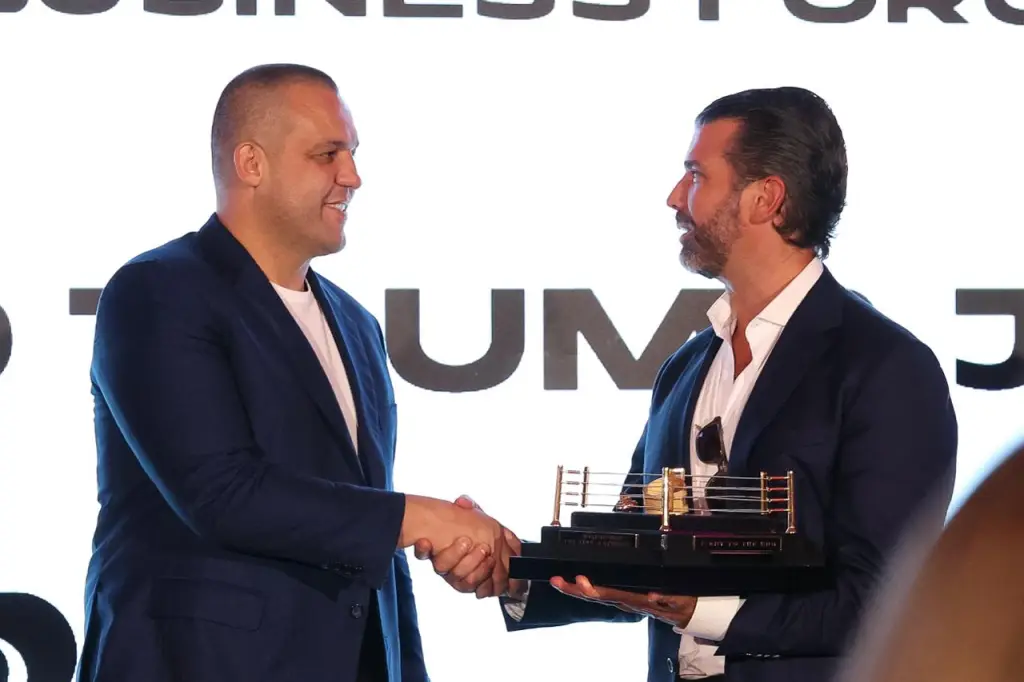
That dream was heavily funded by a secret benefactor: Umar Kremlev, a Russian oligarch close to President Vladimir Putin.
Kremlev footed the bill for hundreds of thousands of dollars of wedding expenses, according to records reviewed by ProPublica and interviews with three people familiar with the event. The oligarch paid to rent out one of the private islands, where a reception was held and where guests slept. He also covered other big-ticket items, like the fireworks show, and his team helped plan the event. Kremlev is the head of the International Boxing Association, a scandal-plagued sports group that has been financed by the Russian state-owned energy giant Gazprom. The wedding payments came from an IBA-affiliated entity in Dubai that the boxing association uses for financial transactions.
The guest list numbered around 50. It included Trump Jr.’s brother-in-law Jared Kushner, Eric Trump — and Kremlev, an imposing man with a shaved head who speaks limited English. The oligarch was part of a large group whose presence puzzled other attendees. They sometimes stood off by themselves, speaking Russian.
“It was really small, like, just really close friends,” Trump Jr. later said on his podcast. “Tried to keep it really tight. And it was just awesome.”
Kremlev’s previously unreported relationship with Trump Jr. represents an extraordinary development: a member of Putin’s circle financially supporting the president’s son and gaining intimate access to the Trump family. For a decade, Putin’s government, regarded as a chief adversary of the U.S., has been accused of efforts to influence American elections. Attempts by Russia to make inroads with the Trumps before the 2016 election exploded into controversy that dogged much of the president’s first term.
National security experts expressed alarm at Trump Jr. accepting the oligarch’s largesse, saying it raised an urgent question: What motivated Kremlev to spend a fortune cultivating the connection?
“If I’m paying for your wedding, at some point, you’re going to owe me something,” said Frank Montoya Jr., a retired career FBI official who held senior counterintelligence roles. Oligarchs like Kremlev often act in coordination with the Russian government. While it’s unclear if that happened here, Trump Jr. put himself in a precarious position, Montoya said. “This should be unthinkable for the son of the president. End of story.”
Holden Triplett, who served as Trump’s counterintelligence director on the National Security Council during his first term, said Russian intelligence frequently seeks to build ties with U.S. government officials and their family members. “Money is a tried-and-true method to gain access,” said Triplett, who also worked for the FBI in Moscow.
In the days leading up to Trump Jr.’s wedding, Kremlev was in China as part of the delegation accompanying Putin, according to Chinese state media. The month before, Putin had bestowed him with a state honor, the Order of Friendship. The Ukrainian government has imposed sanctions on Kremlev personally, citing his closeness to Putin and Russian security services.
It’s not clear why Kremlev helped pay for Trump Jr.’s wedding. The men appear to have met only recently. Public reporting suggests Trump Jr. could have afforded it himself, with Forbes recently estimating his net worth at roughly $300 million.
In response to detailed questions, a spokesperson for Trump Jr. did not dispute the wedding payments from Kremlev. “Umar is a personal friend of Don,” he said. The spokesman said that Kremlev is “not someone he has a business relationship with” and that the men met through a mutual friend in the hunting world and bonded over their love of boxing and the outdoors.
A spokesperson for Trump Jr.’s brother Eric said of Kremlev: “Eric has absolutely no clue who this person is, nor has never heard his name.”
In a statement, Kremlev’s press office said, “Mr. Kremlev and Mr. Trump Jr have a friendly relationship” and they first met “a couple of years ago.”
The press office described Kremlev as a businessman and philanthropist, adding, “Mr. Kremlev has never discussed political matters with any of his American friends and acquaintances,” including Trump Jr. They said the boxing organization itself did not incur expenses for the wedding but did not comment on the payments from the Dubai entity. The press office also said that when Putin and Kremlev were in China recently, Kremlev was not part of Putin’s “official delegation.”
Kushner, who has been helping lead the U.S. government’s negotiations with Russia over Ukraine, did not respond to requests for comment. The White House and the Russian government did not respond either.
The revelations come as Trump Jr. has emerged as a political power center in his own right. Beloved by the MAGA base, he reportedly played an active role in vetting White House cabinet picks for Trump’s second term and was dubbed his father’s “most essential political adviser” by The Wall Street Journal. “I certainly don’t think I’d be sitting here as the VP nominee without Don’s help,” Vice President JD Vance told the outlet in late 2024.
This account is based on records and interviews with dozens of current and former IBA officials and contractors, wedding attendees and other people in Trump Jr.’s and Kremlev’s circles.
Trump Jr. exchanged vows with socialite Bettina Anderson on a private island that was featured in “Pirates of the Caribbean” and the 2006 James Bond movie “Casino Royale.” They had their first dance on a second private island nearby that can rent for around $100,000 a night, paid for by Kremlev. The company that put on the fireworks display charges around $70,000 for such shows. (Kremlev did not attend the ceremony itself, which was held on the first day and had just 18 guests, Trump Jr.’s spokesperson said.)
The atmosphere was Monte Carlo meets frat party — helicopters in and out, a beachside DJ set, beer pong tournaments. One day, the men went spearfishing. Artisans at the London fashion house Safiyaa spent 150 hours embroidering Anderson’s bespoke silk reception outfit. The president’s son had undergone treatment to better define his jawline for the occasion.
Some longtime friends of Trump Jr. told associates they were disappointed not to be invited, though a few of his closest business partners — executives at the Trump family crypto company, World Liberty Financial, and the venture capital firm 1789 Capital — did make the cut. President Trump himself skipped it. (“He’d like me to go, but it’s going to be just a small, little private affair,” the president told reporters beforehand. “I said, you know, this is not good timing for me.”) But many of the guests were immediate family of the bride and groom.
That made the large contingent of Russians all the more conspicuous. “What are they doing here?” one person recalled thinking. At least one of the Russian guests had been with Kremlev on his China trip: Alexander Lagutin, a businessperson who has served in senior roles at a Russian defense contractor and a state-backed energy company. Kremlev’s right hand at the IBA, Elena Sobol, attended the wedding too.
Since the wedding, the Trumps have released scores of photos and videos of the festivities. While they show many of the guests, the Russians have been absent from all of them. (The top of Kremlev’s head is visible in the back of one group photo posted on Instagram by a friend of the bride.) After the party was over, on his “Triggered” podcast, Trump Jr. emphasized the event’s privacy: “The people that were there — if you’re on that list, you weren’t talking.”
In 2009, Umar Kremlev did not yet exist.
He was in his late 20s, with a criminal record for extortion and battery, still going by his birth name, Umar Lutfulloyev, according to the Russian independent news outlet Proekt. But he was about to rapidly ascend in Russia to a position of wealth and influence, with the help of a powerful friend. (“Mr. Kremlev has a completely clean legal record,” his press office said.)
In 2010, he changed his name to Kremlev. He soon joined a Russian government-backed biker gang called the Night Wolves, eventually taking a leadership role, according to news reports. That is what first brought him close to Alexei Rubezhnoi, who now leads Putin’s presidential security service, Proekt reported. In 2017, Kremlev took over the Russian Boxing Federation, after Rubezhnoi personally intervened to put him at the helm.
In 2020, Kremlev became president of the IBA. The association was something akin to FIFA but for boxing and had long overseen the sport in the Olympics. But it had been beset by corruption allegations and was on the brink of insolvency. Kremlev brought money to the table from Gazprom, the state-owned company that operates as an arm of Putin’s government. Gazprom publicly became the IBA’s financial backer, filling its coffers with tens of millions of dollars.
Former high-level IBA officials said that Kremlev had a clear political agenda. “Umar is guided by Putin. It was using the sport for soft political power,” a former IBA board member told ProPublica. “It’s geopolitics. That it’s boxing is just happenstance.” Kremlev, 43, is also heavily involved in an organization called Healthy Fatherland, run by his 23-year-old wife’s twin sister. The group — which promotes healthy eating and youth sports — is under Ukrainian sanctions for its alleged role in a program of abducting Ukrainian children from occupied territories and relocating them under the guise of “rehabilitation.” (Healthy Fatherland did not respond to a request for comment.)
Kremlev’s cozy relationship with the government has made him rich. Putin used the levers of the state to make Kremlev a dominant player in the Russian sports betting industry, according to Proekt, and one of his companies was chosen to operate the national lottery. After Putin nationalized Russia’s largest car dealership company in 2023, Kremlev became the owner of that too.
He now flaunts that wealth through his boisterous public persona. In one video Kremlev posted on social media, he surprises a young mother by giving her a free car. In another, he criticizes his young female aide’s outfit as not feminine enough and makes her change. He shadowboxes with ostriches and brings in celebrities like Rick Ross and Naomi Campbell for IBA events; he praises Stalin and rides private jets.
Following the Russian invasion of Ukraine in 2022, the U.S. began to indict Russian oligarchs and seize yachts and other assets. Kremlev repeatedly told associates he was worried about being targeted by a U.S. government probe, according to a person close to IBA leadership. “He was very afraid of American sanctions,” the person added. (Kremlev does not appear on public U.S. sanction lists.)
With the business environment in Europe growing more hostile to Russia, Kremlev moved much of the IBA’s operations from Switzerland to the United Arab Emirates. A new Dubai entity, IB Challenger, would later pay wedding expenses for Trump Jr. The current sources of the IBA’s funds are murky, and, in recent years, top executives have given conflicting accounts of the status of its relationship with Gazprom. (Kremlev’s press office told ProPublica the IBA’s sponsorship contract with Gazprom “expired long ago.”) People close to the organization said they understood that its money still comes from Russia.
In 2023, the International Olympic Committee stripped Kremlev’s IBA of its role organizing Olympic boxing. It has cited a host of governance issues and the group’s refusal to “transparently explain the sources of its financing or to explain its full financial dependency, at the time, on a single state-owned company.”
It was a major setback that deprived the IBA of a key source of its international influence. Kremlev has raged against the Olympic committee ever since and has said that his IBA predecessor, who he blames for the problems, “must be shot.”
Kremlev saw a potential ally in President Trump. After Trump’s second inauguration, in January 2025, Kremlev sent an open letter to the president asking him to look into the Olympic committee’s actions in advance of the 2028 Los Angeles Games. “We look forward with great optimism to the possibility of working together to make the Olympic movement great again,” he wrote.
In September 2025, the IBA brought in Trump Jr. for a panel discussion in Istanbul about boxing. With his then-girlfriend, Anderson, sitting offstage, he criticized transgender women competing in women’s sports and reminisced about watching Saturday night fights as a child. Trump Jr. shared the stage with Kremlev, the boxer Manny Pacquiao and Muhammad Ali’s daughter Rasheda. (Trump Jr.’s spokesperson said he was not paid for the appearance and was already in Turkey for an unrelated event.)
The president’s son had reason to be attuned to the sensitivity of cozying up with a Putin associate, especially while his father navigates the Russia-Ukraine war. Trump Jr.’s June 2016 meeting with a Russian attorney in Trump Tower became a major focus of the Robert Mueller investigation.
The Trump Tower meeting was arranged after an email offering Trump Jr. damaging information about Hillary Clinton as “part of Russia and its government’s support for Mr. Trump.” Trump Jr. famously responded, “If it’s what you say I love it especially later in the summer.” Trump Jr. later dismissed the matter as a “witch hunt,” and the Mueller report concluded that there was not enough evidence to convict him of a crime.
Recently, Kremlev has been working to expand into the U.S. market. In July, his group hosted a bare-knuckle boxing event in Miami, a chance to showcase a particularly bloody form of the sport in which contenders fight without gloves. But the debut was overshadowed when manosphere influencer Andrew Tate, who the IBA had brought in to host, was arrested by U.S. Marshals outside the arena. (Tate is facing rape and sex trafficking charges in the United Kingdom, which he has denied.)
Much about Kremlev’s relationship with Trump Jr., and where it is headed, remains unknown. In a press release after the Istanbul panel, the IBA hinted there was more to come.
“President Kremlev and Donald Trump Jr made it clear – this alliance will not remain symbolic,” the press release read. “More joint initiatives will follow.”
Do you have any information we should know about Donald Trump Jr., his businesses or Umar Kremlev? Justin Elliott can be reached by email at justin@propublica.org and by Signal or WhatsApp at 774-826-6240. Brett Murphy can be reached by email brett.murphy@propublica.org and by Signal or WhatsApp at 508-523-5195. Josh Kaplan can be reached by email at joshua.kaplan@propublica.org and by Signal or WhatsApp at 734-834-9383.
Source: Justin Elliott et al., “Donald Trump Jr.’s Bahamas Wedding Was Secretly Bankrolled by Russian Oligarch Close to Putin,” Pro Publica, 14 September 2026. I just made a donation to ProPublica to thank them for this and other groundbreaking investigations they have published over the years. }}}}} trr