Anything Goes

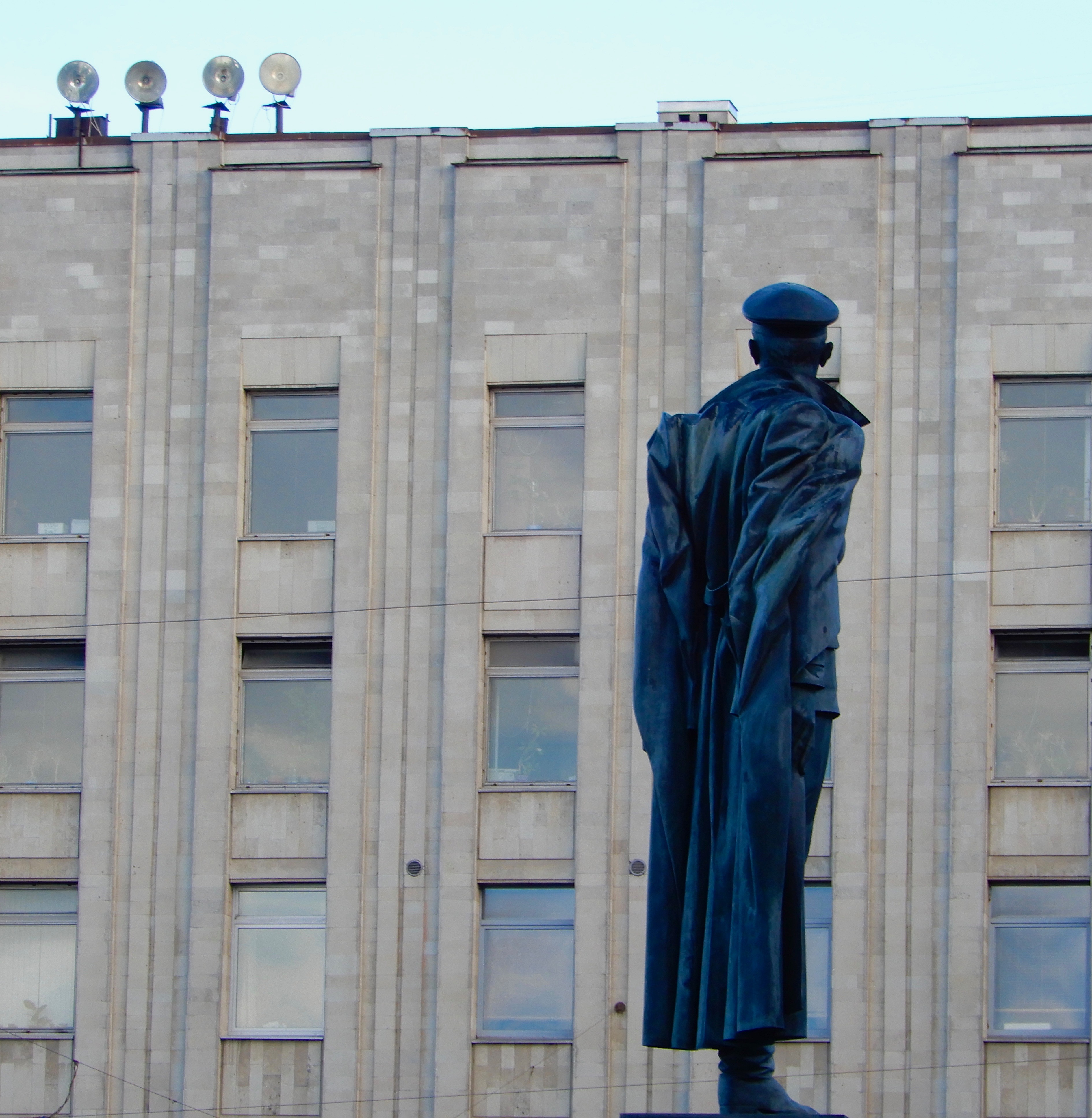
DSCN6137A monument to Felix Dzerzhinsky, founder of the Soviet secret police, in central Petersburg, 6 May 2018. Photo by the Russian Reader

Ukrainian political prisoner Oleg Sentsov has been on hunger strike for sixty-six days.

Can you imagine not eating for sixty-sixty days? I can’t.

Instead of supporting Mr. Sentsov, most of the world decided to turn its back on him by staying glued to their TV sets during Vladimir Putin’s expensive celebration of his despotic regime’s extraordinary ability to pull the wool over nearly everyone’s eyes.

Certainly he didn’t get any pushback yesterday from the putative “leader of the free world,” who is a vain, spineless traitor who has probably never heard of Oleg Sentsov.

Solidarity with Oleg Sentsov doesn’t mean you have to stop eating, too, but it should mean not having your cake and eating it, too.

The World Cup was cake. Nobody can live for a month on a diet of cake without getting sick. The world has just done it, and now, at least as I see it, the world is a lot sicker than before the World Cup.

When infants are baptized in the Lutheran church, the priest asks the godparents and parents whether they “renouce the Devil and all his ways.”

Putin is a devil. You cannot embrace some of his ways while denouncing others. You either take the whole package or reject it. If you reject it, you show a little bit of willpower—for the sake of Crimean political prisoners Vladimir Balukh and Oleg Sentsov, for the sake of people bombed by the Russian airforce in Syria, for the sake of persecuted Karelian historian Yuri Dmitriev, for the sake of Russian Jehovah’s Witnesses, now branded “extremists” and subject to increasingly numerous arrests, for the sake of the innocent young people framed in the New Greatness and Network “terrorist” cases, for the sake of ordinary Russians everywhere fighting the government’s plans to drastically raise the pension age—and you don’t have anything to do with the World Cup or anything else sponsored, promoted, and supported by the current Russian regime.

The sheer number of people, including my own acquaintances, who could not bear to show solidarity with any of these people at all, if only for one month, has shocked me.

Please don’t pretend now that you’re really opposed to the Putin regime. You’ve shown your true colors.

Anything goes, right? || TRR

“A Truly Great Competition”: Yegor Yekimov Jailed in Petersburg for Picketing in Solidarity with Oleg Sentsov

37117187_528244187619896_1623487471700410368_n

St. Petersburg Group for Assistance to Detainees
Facebook
July 15, 2018

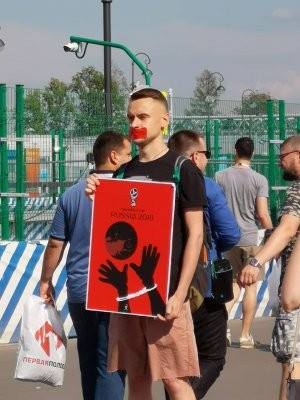
On Saturday, Yegor Yekimov was detained in the Petersburg 2018 FIFA World Cup Fan Zone for holding a solo picket in solidarity with Oleg Sentsov and handing out leaflets.

The activist spent the night at the 71st Police Precinct.

Today, the Petrograd District Court sentenced him to five days in jail.

Mr. Yekimov has an illness that requires constant maintenance therapy. He must strictly avoid catching any infection whatsoever.

This fact, however, did not stop Judge Irina Grechishko, who sentenced Mr. Yekimov to jail.

Additionally, Mr. Yekimov is a voting member of an election commission, and the court had no right to try him without authorization from a prosecutor.

Mr. Yekimov has been taken to the detention facility on Zakharyevskaya Street in central Petersburg. Attorney Daniil Semyonov will file an appeal of the verdict tomorrow.

Translated by the Russian Reader

#SaveSentsov

Kicker Conspiracy

Go to Russia for a few World Cup fixtures, get rip-roaring drunk, hit on a married Russian woman, and you are an instant “Russia expert,” fit for print in the bloody Guardian.

And don’t forget to thank the Russian security forces for their professionalism in keeping your jet-setting, neo-colonialist, neo-imperialist ass safe while you’re making an ass of yourself.

Huge congratulations must go to the law enforcement that’s been put in place to stop both the most fighty Russians and the most fighty English from making their presence felt. But those responsible for the headlines with TOO MANY CAPITAL LETTERS should be ashamed. Not just for denying England fans these experiences, but for allowing the Russian people to feel demonised, and indeed for allowing Putin to capitalise on this othering of the Russian people to support his us-against-them narrative. Every English person that has a positive interaction with a Russian person is a step further away from letting the people in power turn us against each other … is what I drunkenly mumbled into Anastasia’s ear a few minutes before I learned she had a husband, and a few minutes after she’d said there are no good computer hackers in Russia, and about 20 minutes after I’d been singing “Football’s coming home”. We’re all living in our own fantasies I suppose.

_________________________________________

I wish everyone could read this detailed interview with the fearless Russian human rights activist Anatoly Kalyapin and head of the Committee for the Prevention of Torture about the nearly ubiquitous use of torture by Russian law enforcement.

Under ordinary circumstances, I might even think about translating the interview and publishing it on this website.

But these are not ordinary circumstances. As the Putin regime ratchets up its “Great Terror Lite” apparatus, a frighteningly large segment of apparently educated and even liberal Russians and non-Russians have persuaded me that having fun, partying like it’s 1999, and staying glued to their TV sets watching World Cup fixtures trump petty considerations like human rights and international solidarity.

So, if you’d like to read this interview with a knowledgeable, brave man, run it through whatever online translation machine you prefer and see what miserable gobbledygook comes out the other end.

It has finally dawned on me how few people, both inside and outside Russia, really care to know anything about the real Russia, especially since Don Putin started kicking magical, psychedelic, multi-colored sand in their face with his twelve-billion-dollar “kicker conspiracy.”

I have no hope for a planet whose most powerful, empowered, and well-off inhabitants have such a strong will to be fooled and such an insuperable desire to kick up their heels as if they were teenagers. // TRR

Thanks to Lika Frenkel for the heads-up and the late Mark E. Smith (March 5, 1957–January 24,  2018) for not refusing his vision and sharing it with us so generously for so many years.

_________________________________________

Kicker, Kicker Conspiracy

J. Hill’s satanic reign
Ass-lickers, Keegan’s Team

Kicker, Kicker Conspiracy

In the marble halls of the charm school
How flair is punished
Under Marble Millichip, the F.A. broods 
On how flair can be punished
Their guest is a Euro-State magnate
Corporate-u-lent

Kicker, Kicker Conspiracy 

In the booze club, George Best does rule
How flair is punished
His downfall was a blonde girl,
but that’s none of your business!

Kicker, Kicker Conspiracy

Football fan at the bus stop
Stretched on the balls of his feet
In the Christmas rush
Had in his hands two lager cans
Talks to himself
At the back
At the top

But in the pavement on the club unit
Plastic, Slime, Partitions, Cocktail, Zig-Zag, Tudor Bar

Pat McCat. Pat McCat, the very famous sports reporter is
talking there.

Fans remember, you are abroad!
Remember the police are rough!
Remember the unemployed!
Remember my expense account!

Hot dogs and seat for Mr. Hogg!
Hot dogs and seat for Mr. Hogg
And his grotty spawn!

Lurid brochures for ground unit
How style is punished

Kicker, Kicker Conspiracy
Remember, don’t collect with the rough
Kicker, Kicker Conspiracy

Kicker, destroy the facilities!

Kicker Conspiracy

Source: The Fall, “Kicker Conspiracy” (1983); lyrics courtesy of The Annotated Fall

The Bill for the 2018 World Cup

Russia and Brazil World Cup’s Leading Spenders over Last Twenty Years
Delovoi Peterburg
June 18, 2018


Photo by Sergei Konkov

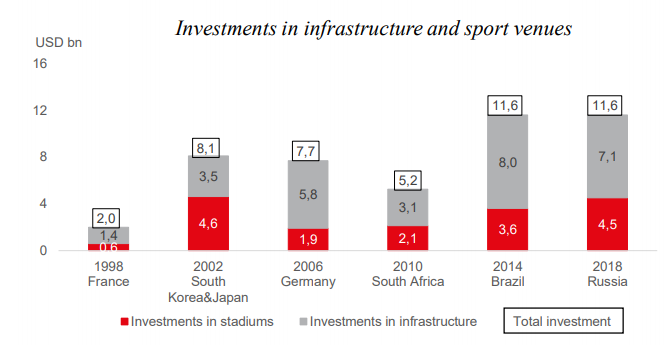
Russia and Brazil took first place in terms of the cost of readying their countries to host the FIFA World Cup since 1998. A report by JLL, a consultancy company, shows each country spent $11.6 billion on organizing the event.

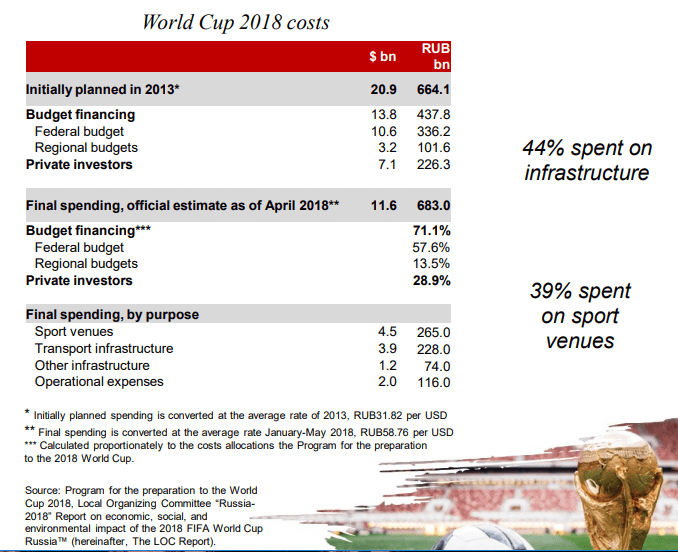
The report’s authors note that, according to the latest data available, Russia has spent ₽683 billion [approx. €9.3 billion] to host the World Cup. Thirty-nine percent of this money, or ₽265 billion, has been spent on building and repairing sports facilities.

The report’s authors also note that Russia has been the only recent host of the World Cup to build or renovate all twelve venues.

They write that Russia has set the per stadium record, spending an average of $380 million on each venue.

By way of comparison, South Korea and Japan spent $8.1 million on the 2002 World Cup; Germany, $7.7 billion on the 2006 World Cup; and South Africa, $5.2 billion on the 2010 World Cup. The most modest preparations were made by France for the 1998 World Cup. France spent only $2 billion on organizing the event.

infrastructure vs. venues

Russia spent the most money on infrastructure while preparing for the World Cup. The country invested $7.1 billion in infrastructure, including $3.9 billion on transportation infrastructure. Meanwhile, it spent $4.5 billion on stadiums.

Russia yields only to South Korea and Japan in expenditures on stadiums. They spent a total of $4.6 billion.

world cup 2018 costs

Overall, Russia spent ₽18.9 billion [approx. €256 million] more on getting ready for the World Cup than was planned in 2013.

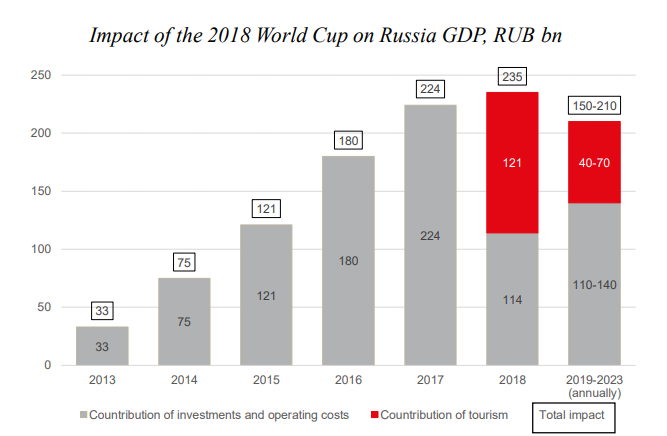
According to the 2018 FIFA World Cup Organizing Committee’s preliminary estimate, as cited in JJL’s report, the summary economic impact of the 2018 World Cup on Russia during the period 2013–2018 will be ₽867 billion [approx. €11.8 billion] or roughly one percent of annual GDP. The primary effect will be achieved through investments and operating expenses. It is expected to reach ₽746 billion.

impact


The 2018 FIFA World Cup takes place in twelve stadiums in eleven Russian cities from June 14 to July 15, 2018.

Diagrams excerpted from “Investing into [sic] Football Passion: The Effect of the World Cup in Russia.” Article translated by the Russian Reader

Plato Re-Elaborated

rus yachts.jpg

That city would not lack a yacht club, would not lack

a soccer club. Noting the absence of smoke from the brick

factory chimneys, I’d know it was Sunday,

and would lurch in a bus across town, clutching a couple of bucks.


I’d twine my voice into the common animal hoot-

ing on that field where what the head begins is finished by the foot.

Of the myriad laws laid down by Hammurabi

the most important deal with corner kicks, and penalty kicks to boot.


—Joseph Brodsky, “Plato Elaborated,” trans. George L. Kline, New Yorker, March 12, 1979, p. 40


***********************

It would be nice, wouldn’t it, to be a regular guy, to immerse oneself in enjoying life, in a pleasant job, and forget that a dictatorship for life has taken root in our country? It would be nice, wouldn’t it, to forget the dictatorship wages war against neighboring countries? It would be nice, wouldn’t it, to forget it has destroyed all constitutional rights, the freedom of speech, secularism, the right to a pension, the right to one’s native language, and the right to forget things and be happy?

—Sergey Abashin, Facebook, June 24, 2018

Photo and translation by the Russian Reader

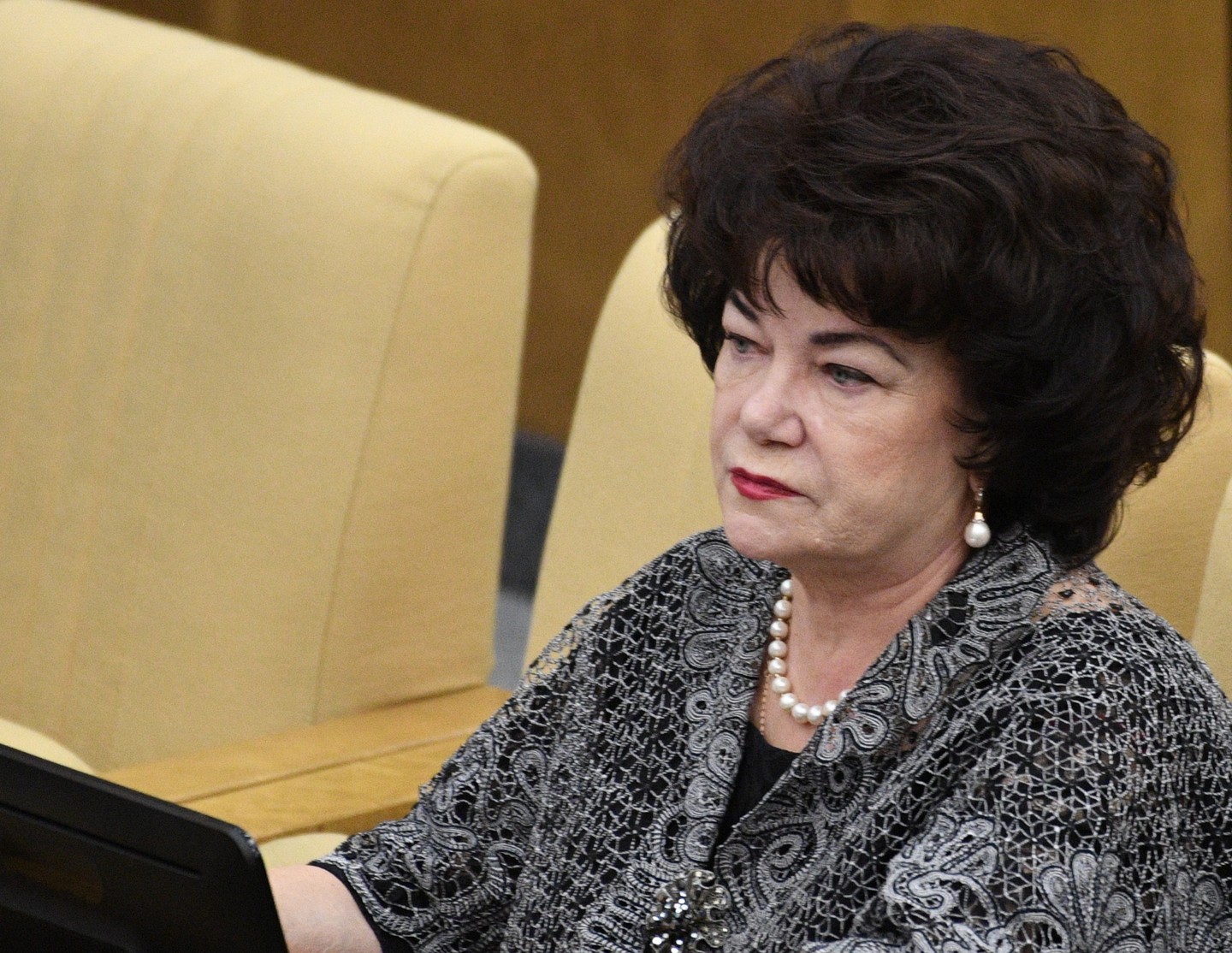
MP: Russian Women Should Avoid Sex with Foreign Men during World Cup

плетневаVeteran Russian MP Tamara Pletnyova (CPRF) has urged Russian women to avoid sex with foreign men during the 2018 World Cup, which kicks off tomorrow in Moscow. Photo courtesy of Life.ru

Russian Women Urged “Not to Engage in Sexual Relations” during 2018 World Cup
Fontanka.ru
June 13, 2018

Tamara Pletnyova, chair of the Russia State Duma’s Committee on Family, Women, and Children has urged Russian women not to engage in sexual relations with foreign men during the 2018 Football World Cup.

As the MP said this afternoon on radio station Moscow Speaking, inappropriate behavior on the part of Russian women would lead to the birth of children in single-parent families. Even if the foreign men married their sexual partners, it would not end well, the MP argued.

“Even if they marry the women and take them abroad, later on the women won’t know how to come back home. Women like that come to my committee for help. They cry, telling us how their husbands grabbed their children and left the country with them. I would like women in our country to marry men for love, no matter what their ethnicity, as long as they are Russian nationals who would build good families, live in harmony, have children, and raise them,” said Pletnyova.

The Duma committee chair argued many women became single mothers in the aftermath of the 1980 Moscow Olympics.

“These kids have suffered since Soviet times. If the parents were from the same race, it was better than nothing, but if they were from different races, the kids had it bad. I’m not a nationalist, but nonetheless. I know the children suffer. Then they are abandoned, and that is that: they are left with their mothers,” Pletnyova said in conclusion.

Thanks to Sergey Abashin for the heads-up. Translated by the Russian Reader

La Belle Vie

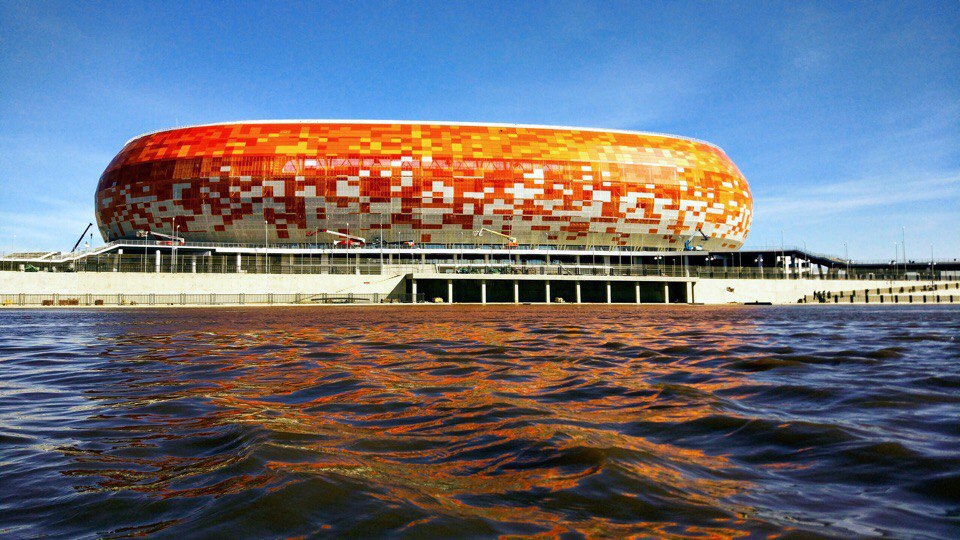
Стадион_Mordovia_arenaMordovia Arena in Saransk, one of the venues of the 2018 FIFA World Cup. Photo courtesy of Wikimedia Commons

Miracles of OSINT
Telegram
June 6, 2018

You would like to attend World Cup matches, but you have no money? Take a cue from Russian officials and employees of Russian state-owned companies. You will be footing the bill for their tickets.

The Mordovia Mortgage Corporation, a state-owned company, has spent 750,000 rubles [approx. 10,000 euros] on 100 tickets for the matches taking place in Saransk. What about helping people in the queue to improve their living conditions? Are you kidding? What about the epic battle between Peru and Denmark?

The Russian Foreign Ministry’s Main Office for Servicing the Diplomatic Corps has purchased 58 tickets for a total of 1.3 million rubles [approx. 18,000 euros], including 18 tickets to the semifinals. Do you know who the Foreign Ministry purchased the tickets for, according to the Public Procurement Website? For the Moscow Country Club, run by the ministry.

The Sports Training Center in Kratovo, in Moscow Region, decided not to limit themselves to a single city. They have spent 260,000 rubles [approx. 3,500 euros] on tickets to matches in Moscow, Kazan, and St. Petersburg. They have bought from two to four tickets to every match, so they probably won’t be doling them out to talented kiddies, but to the folks who run the center, all the more so because the training center in Kratovo specializes in training the Russian national badminton squad.

But you watch the matches on TV and be glad that, while foreigners are flooding Russia, the local authorities won’t turn off your hot water.

Translated by the Russian Reader

The Cabbies Left While the Cossacks Stayed: Rostov-on-Don on the Eve of the World Cup

rostov arena-2Rostov Arena. Photo courtesy of ftbl.ru

The Cabbies Left, The Cossacks Stayed
Gleb Golod
Takie Dela
June 8, 2018

The banks of the Don River in Rostov were always quite different. The right bank was landscaped, featuring bars and restaurants suited to every taste, singing fountains, and amusements. The left bank featured a wild beach chockablock with sand and trees. It was a favorite spot for picnickers and outdoor shish kebab cookouts. People used to swim there until the Don was completely polluted.

The new Rostov Arena has been built on the the left bank. Nine months and 913 million rubles [approx. 123 million euros] turned the wild beach into a landscaped park and river embankment. All that is left of the levberdon, as Rostovians call it, is a pier that extends nearly to the middle of the mighty river.  Over the long years it has been there, it has rusted, and there are holes in its covering here and there. The locals loved it, however. In the evenings, you would always find a couple in love, a photographer and his model, a small group of friends, and an old fisherman who had good luck catching herring in the middle of the Don.

Since May 1, when the park on the left bank officially opened, it has been standing room only on the pier. Locals stroll there with their children, joined by the foreigners who have arrived earlier in Rostov-on-Don. Someone worried about safety decided to limit the number of people on the pier and welded an iron grille to the entrance, but this has not stopped the flood of visitors. Cyclists toss their bikes over it, men help their female companions climb over it, and parents ferry their children from one side of the grille to the other.

Every half hour, an improvised river taxi docks alongside the pier. It charges adults 500 rubles for a ride. Children sail for free.

“Business? What business? The main thing we sell are emotions. River cruises are soothing. Adults can relax while the kids doze,” a man in a sailor’s hat and striped shirt advertises a short cruise on the Don while docking at the pier.

“Business has been good, of course, since so many people started coming here,” he admits. “I would give the embankment a ‘C’ for now. There is not much in the way of infrastructure or development. We’ll see how it looks a year from now.”

The boat pilot does not waste any time. He has struck up a conversation with a young boy, whom he has given a tennis ball. The boy persuades his parents to go for a ride on the boat. They quickly give in. The vessel weighs anchor and speeds off toward the other shore.

The Stadium and the Park
The boat pilot gave the new park a “C,” but the locals like the new sports facilities and playgrounds, and the fact the park is well maintained. But it lacks trees, many of which were cut down during the beautification.

“There is a lot of exercise equipment, and the air is fresh, but I probably won’t be coming here in the summer. There are few trees and little shade. But you know what the heat is like here in July. You could kick the bucket,” says a young woman in workout gear.

The local are not imagining things. There really are many fewer trees. The park was built without consideration of the place’s specific features. Consequently, the “city’s green shield” was left with huge gaps in it, says Alexander Vodyanik, environmentalist and assistant secretary of the Russian Public Chamber.

The “wild” green area on the left bank, which stretched all the way to Bataysk, a suburb of Rostov-on-Don, moistened the winds sweeping in from the Kalmyk steppes, winds that are especially palpable in the spring. It was the primary source of fresh air, supplying it just as ably as a forest, says Vodyanik. The place had to be beautified, but a completely different park should have been built, a wetlands park.

“Historically, this place functioned as a city beach, and it should have been turned into a city beach. People swim at a beach, but the Don has been so badly polluted for so long that swimming was definitely off limits in this part. In that case, swimming pools could have been set up while simultaneously purifying the water. This has been done in Germany on the Rhine, which is much dirtier than the Don, and the project has been a success,” says Vodyankik. “But a park was built here instead. An instant lawn, which has already gone bad, was rolled out. Eighty percent of the poplars were cut down. We had problems with our woodlands as it was, but they were damaged even further.”

The so-called Tourist Police are identified as such on the armbands they wear. A female student from Namibia leads a tour for her friends, who have arrived to enroll at the Don State Technical University. A young man named Aman hopes to get a ticket to the match between Brazil and Switzerland. If it does not work out, however, he will just go for a stroll around the city.

“I really like it here. The city is pretty and has an interesting history. Things are good, the park is good. Everything is terrific and cozy,” he says in English. “By the way, could you tell me where the stadium is? All the signs are in Russian, which I don’t actually understand.”

Rostov Arena was built at a distance from residential areas, so loud fans will not bother locals even on match days. The stadium is accessible by bus and taxi. True, fans will have to walk the last 500 meters to the turnstiles. This decision was made for security reasons.

Cabbies Leave the Fan Zone
Specially accredited taxi drivers will ferry fans from the left bank to the right bank and the fan zone on Theater Square. The most popular taxi services in Rostov-on-Don, Uber and Leader, accessible on the Rutaxi app, will not be working during the World Cup because they are not officially registered as commercial transport services.

Among the major cab companies, Yandex Taxi and Taxi 306 have been accredited to work during the World Cup. Roman Glushchenko, executive director of Taxi 306, told us  a total of 500 cars had been accredited in Rostov-on-Don, but he refused to discuss whether that would be enough cars to handle all comers.

According to gypsy cab driver Leonid, around 150 drivers of the ten thousand drivers affiliated with the company 2-306-306 have been accredited. Cabbies like Leonid mainly work for themselves rather than licensed carriers, which are practically nonexistent in the city, he explains. The gypsy cabbies use Yandex, Uber, Gett, and Leader as dispatchers, either directly or through small intermediary firms. So, when the issue of accreditation for the World Cup arose, it was a problem for drivers, who had to obtain permits, sign a contract with a licensed carrier, and paint their cars yellow or white. The Rostov Regional Transport Ministry issued the full list of requirements for accreditation.

“I’m not going to lift a finger to get accreditation,” Leonid admits. “Why should I give myself a headache by getting permits that would mean I would start making a loss? Licensed cars must be stickered with the taxi company’s ID tag. I don’t want to have this for a number of reasons. I would also have to register as an independent entrepreneur, get a license from the Transport Ministry, which was free until this year, and insure my cab, although premiums are higher than usual. And that’s over and above the 25% cut I give to Yandex. I know lots of gypsy cabbies. Not a single one of them has bothered to get accreditation. It’s just bad business for them.”

To prevent the few accredited taxis from jacking up rates for Rostovians and fans, the Transport Ministry has established a single rate for the entire World Cup.

Leonid plans to spend the World Cup in Sochi. He says the transport system there is better, applying for a license is easier, and the city is generally better prepared after hosting the 2014 Winter Olympics.

“Who wants to sit in traffic jams driving back and forth to the stadium?” he grumbles.

Although the World Cup lasts only four weeks, Theater Square, which will house a fan zone that can accommodate 22,000 fans, was closed to car traffic and public transport on May 13 and will remain closed until July 21. In the mornings and evenings, buses are already stuck in traffic on Sholokhov Avenue. When the World Cup kicks off, share taxis (marshrutki) will be removed from Red Army Street. Officials have promised they will be replaced with new buses.

There are plans to show all the matches on giant screens, organize entertainment for fans, and open food courts on Theater Square. The fan zone is a few hundred meters from the ruins of an entire residential neighborhood, destroyed by fire last year.

The square itself is home of the Gorky Drama Theater, hence the square’s name. It is one of two Russian buildings whose models are exhibited in the Museum of Architecture in London. (The other is St. Basil’s Cathedral.) The late constructivist landmark resembles a stylized caterpillar tractor. Corbusier called it a “gem of Soviet architecture.” Unfortunately, the fan will not be able to see it. The theater could not be cleaned up in time for the World Cup and has been draped with several banners.

Rostov-on-Don-Maxim-Gorky-Drama-TheatreThe Maxim Gorky Drama Theater in Rostov-on-Don. Postcard image courtesy of Colnect

Painted Residents Greet Cossacks
The authorities promised to repair and reconstruct many historic buildings and entire streets in preparation for the 2018 World Cup, but with a few weeks left before the championship, it was clear they would run out time.

Residents of Stanislavsky Street, in the downtown, recount how workers have been laboring outside their houses round the clock, trying to finish their work not by June 1, as city officials had promised, but at least by June 14, when the World Cup kicks off. When you are in a hurry, mistakes are inevitable: a female pensioner was unable to exit her building because the door was blocked by paving slabs. Other houses wound up a meter lower than the newly beautified street, and residents have had to jury-rig stairways to the pavements.

Around fifty buildings in Rostov-on-Don’s historic center have been hung with giant photographs of the buildings or World Cup banners because they could not be repaired in time. Among them is the famous house of Baron Wrangel, where the leader of the Whites during the Russian Civil War spent his childhood and youth. The house is a neoclassical architectural landmark. The mansion was nationalized during the Soviet period and turned into a kindergarten. The kindergarten shut down in the nineties, and the building was abandoned. Over the years, it has become quite dilapidated and has been repeatedly vandalized, so it looks hideous.

But when only a few months remained until the World Cup, no one had any brighter idea than to drape the landmark with a picture.
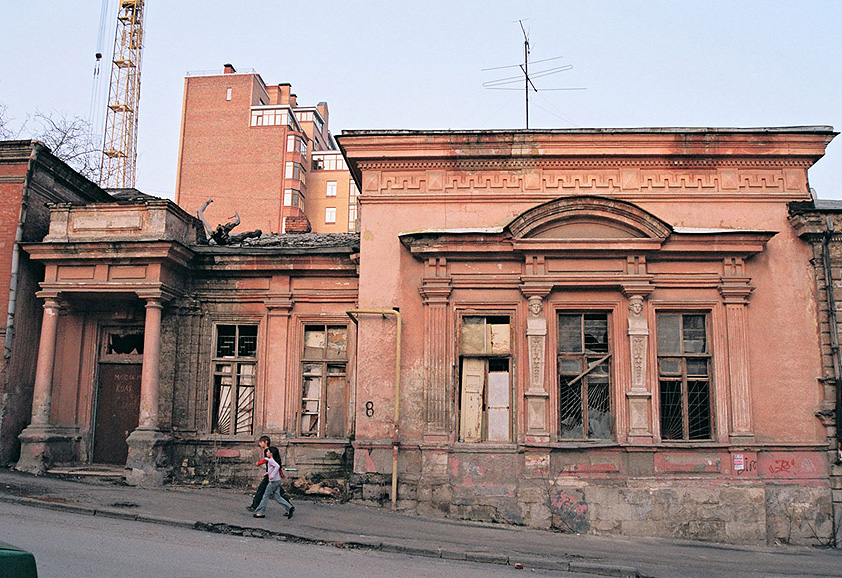
2010_04_24_domvrangelyaThe Wrangel House in Rostov-on-Don. Photo courtesy of RostovNews.Net

The Rostov branch of the Russian Society for the Protection of Historical and Cultural Landmarks (VOOPIK) tried to persuade city officials a dilapidated Wrangel House would look better than a picture emblazoned on a tarp. They circulated a petition and sent a letter to Governor Vasily Golubev, all to no avail.

“We got a reply less than half a page long. It acknowledged receipt of our letter, but there had been an onsite meeting of a commission chaired by Deputy Governor Sergei Sidash. On the basis of arguments made by commission members, they had decided to drape it in banners,” says Alexander Kozhin, head of VOOPIK’s Rostov branch.
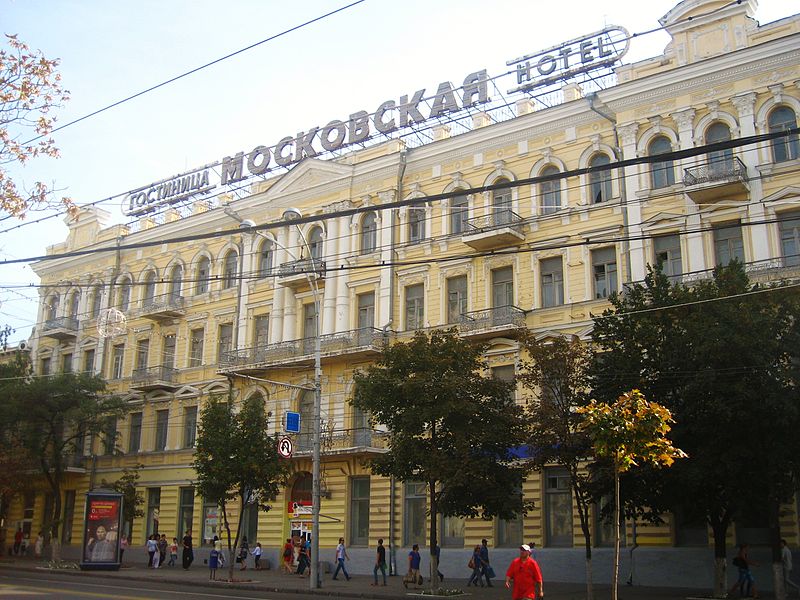
800px-Гостиница__Московская_The Moscow Hotel, in downtown Rostov-on-Don, before the 2007 fire. Photo courtesy of Wikimedia Commons

The same plight befell the Moscow Hotel, a nineteenth-century eclecticist building. In 2007, it was badly damaged in a fire and has been awaiting reconstruction ever since. The dilapidated Gorky Library (originally the Sagiyev Family Tenement House, an Art Nouveau landmark) is covered in scaffolding. It has been decided to demolish the Pavlenkova Tenement House, on long-suffering Stanislavsky Street, altogether.
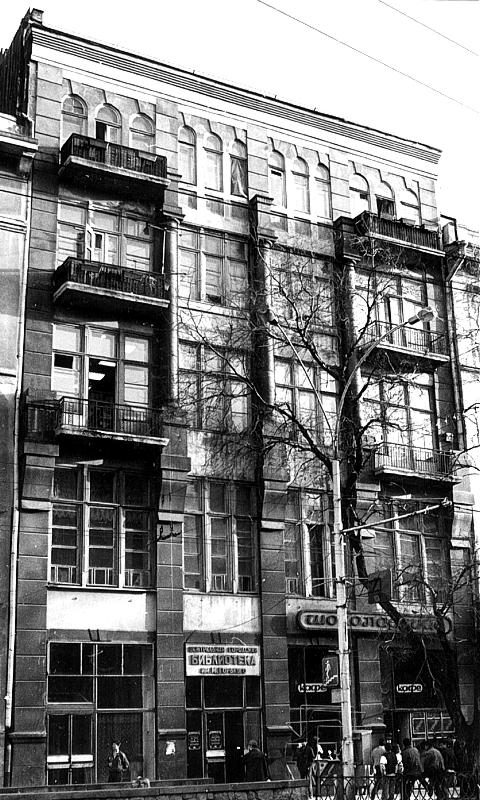
sar-htosThe Sagiyev Family Tenement House aka the Gorky Library, in downtown Rostov-on-Don. Photo courtesy of voopiik-don.ru


1526621588_pavlenkovoyThe ruins of the Pavlenkova Tenement House, in downtown Rostov-on-Don. Photo courtesy of Rostov.ru

A few weeks before the start of the World Cup, images of a building on Sholokhov Avenue appeared in the news and social media. Happy residents peered from the windows: a fiddler holding his instrument, an artist at an easel, a girl blowing soap bubbles, a football fan wearing a Spartak FC scarf, and patriots with the Russian tricolor draped on their backs. The balconies are adorned with balloons and potted plants.

All of them were painted images on yet another banner covering up unfinished repairs.

The upcoming championship has not changed the life of Rostov-on-Don’s real residents all that much. Schoolchildren and university students started and finished their final exams earlier, so schools and universities would be closed when the World Cup kicked off. The old airport was shut down, replaced by the new Platov Airport outside the city. All political rallies and marches have been prohibited during the World Cup.

The police will not be alone in enforcing this and other prohibitions. In early May, Don Cossacks in Rostov announced that three hundred Cossacks, included mounted Cossacks, would be keeping the peace on the streets as “volunteers.” They have assured the public that, at their own behest, they would not engage in violence and would leave their whips at home. If the police, however, are breaking up a fight, the Cossacks will back them up. The volunteers in papakha hats will pay particular attention to LGBT fans.
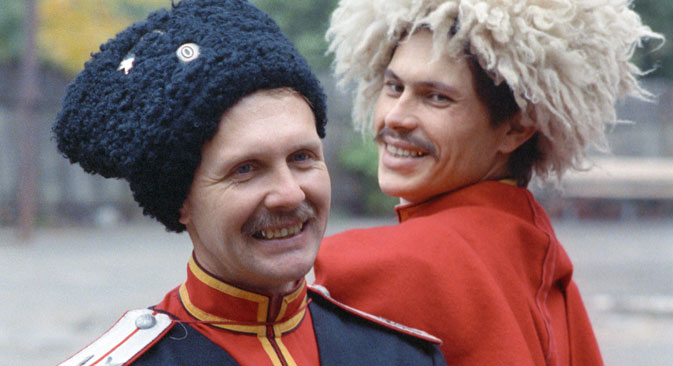
TASS_1044980_673“Cossacks.” Photo courtesy of Russia Beyond

“If two men kiss at the World Cup, we will tell the police to check them out,” they said.

The first World Cup match in Rostov-on-Don kicks off on June 17. A total of five matches will be played on the left bank of the Don: four matches in the group stage and one match in the round of sixteen.

Translated by the Russian Reader
“Popular” (Who Will Foot the Bill for the 2018 FIFA World Cup?)

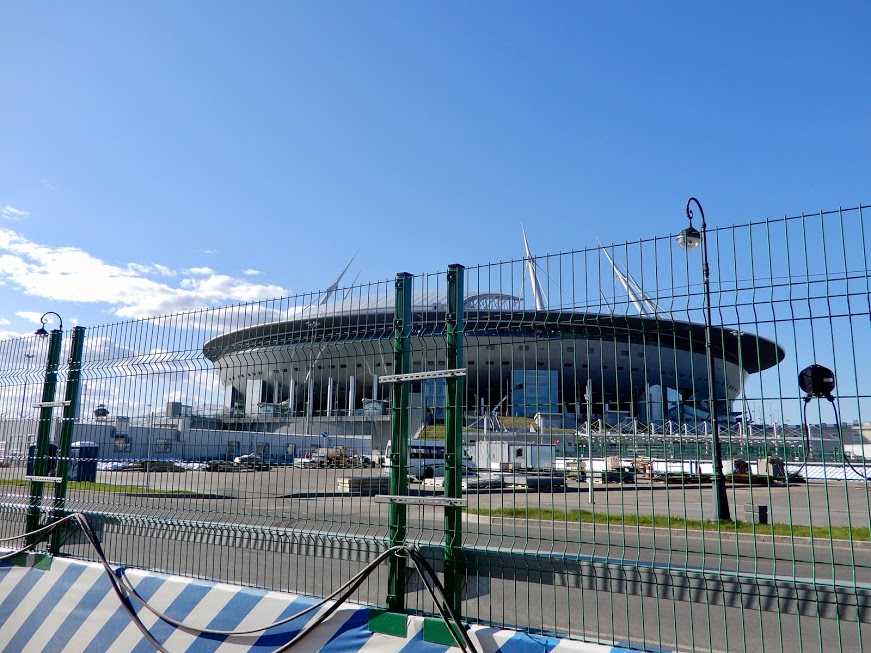
zenit arena-3The Zenit Arena in Petersburg is the most expensive football stadium in history. And one of the ugliest. Photo by the Russian Reader
Mega events like the 2014 Winter Olympics and the 2018 World Football Cup are held in Russia not for compelling or eve merely sound economic reasons, but to satisfy the destructive, overwhelming vanity of the country’s president for life and his clique of gangster-cum-satraps.

Do you think ordinary Russians are unaware of this? If they are aware of it, maybe the current Russian regime isn’t nearly as “popular” as the press and Russia’s troika of loyalist pollsters (Levada, FOM, VTsIOM) would have us believe?

Why would a regime so remarkably bad at the basics of governance be “popular”? Because Russians are less intelligent than other people?

Or is it because the current regime has treated them from day one like inhabitants of foreign country it has recently occupied by brute fore? // TRR

_______________________________________

The initial plan had been that as of 2019 each region would be responsible for its own arenas. But local authorities estimate that this would create costs of 200 million to 500 million rubles (€2.6 -6.5 million/$3.2-8 million) — a tremendous financial burden for seven of the cities hosting World Cup matches.

Several do not even have teams that play in Russia’s top football division. The most successful squads in Volgograd, Kaliningrad, Nizhny Novgorod and Samara play in the country’s second tier. This season, home games in those regions drew just 1,000 to 5,000 spectators. Saransk’s team plays in the third division; Sochi does not even have a professional squad. So generating sufficient money through ticket sales will prove challenging at best.

And even the more-elite clubs Yekaterinburg and Rostov, which respectively attract some 4,500 and 9,000 fans per match, will struggle to generate enough income to cover the hefty running costs of their huge football stadiums.

The Conscience of Petersburg, The Conscience of Ukraine

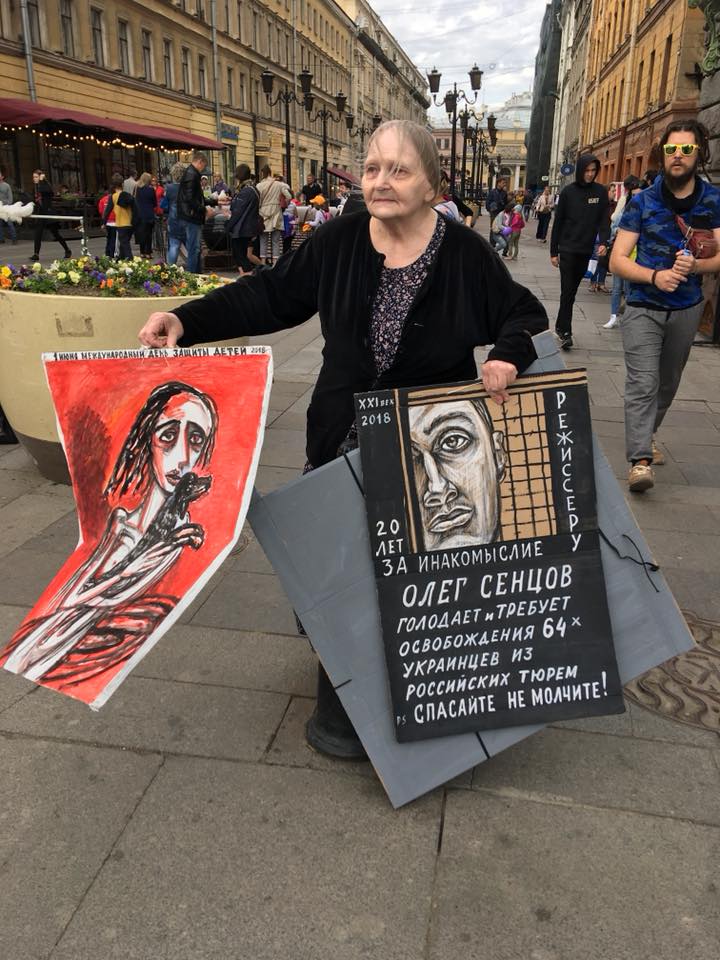
osipova-sentsov-nevsky-1 june 2018Artist Yelena Osipova, protesting on the corner of Nevsky Prospect and Malaya Sadovaya in Petersburg four hours ago. Her placard reads, “2018, the 21st century. A filmmaker gets twenty years [in prison] for dissidence. Oleg Sentsov is on hunger strike. He demands the release of sixty-four Ukrainians from Russian prisons. Save him. Don’t be silent.” Photo by Yekaterina Bogach

UPDATE. Yelena Osipova was detained by police two hours later. Grigory Mikhnov-Voytenko captured the arrest on video. Thanks to Comrade Nastia for the heads-up. 

______________________

Fears grow for hunger-striking Ukrainian film director Sentsov
AFP
June 1, 2018

Fears grew on Thursday for the health of Ukrainian film director Oleg Sentsov who has declared a hunger strike in a Russian prison, with a politician who spoke to him via video link saying he appeared unwell and warning “this could end badly.”

The 41-year-old went on hunger strike on May 14, demanding that Moscow release all its Ukrainian political prisoners as Russia prepares to host the 2018 World Cup next month.

Sentsov, a pro-Ukrainian activist and documentary director, was detained in Crimea in 2014 after Russia annexed the peninsula. He was accused of masterminding arson attacks.

Sentsov, who denied the allegations, is serving a 20-year sentence after being convicted on terrorism charges.

Politician and media star Ksenia Sobchak said she spoke to Sentsov in a video call on Thursday and tried to persuade him to halt his hunger strike but he refused.

“I am horrified because I understand that he looks like a man who will go all the way,” she told liberal radio Echo of Moscow.

“And, honestly speaking, this frightened me,” she said, adding that her mother, Lyudmila Narusova, [a member of the Federation Council], helped organize the call to Sentsov’s prison.

“I have a feeling that this hunger strike will end badly,” she said.

“He is very pale, very thin,” she said, adding that his teeth have begun to crumble.

On Monday, Russia’s prison service said Sentsov agreed to “receive supportive therapy,” without providing further details.

The prison service said his condition was “satisfactory.”

Sentsov’s lawyer Dmitry Dinze said on Thursday he had no recent contact with his client but was going to visit him on Monday.

He said the director was stable, but confirmed Sentsov had lost two teeth.

“The climate does not agree with him,” he said, adding that there was no dentist in his prison so teeth have to be pulled out.

Top opposition leader Alexei Navalny, who is serving a 30-day sentence over organising an illegal protest, called on President Vladimir Putin to release more than 60 “Ukrainian political prisoners” including Sentsov.

“His feat, and his sacrifice, and his death will put him on a par with Bobby Sands, (Anatoly) Marchenko, and other titans of humankind,” he wrote on his blog, adding Putin should want to avoid this.

Irish nationalist Sands died in prison in 1981 after 66 days on hunger strike, while Soviet dissident Anatoly Marchenko died in prison in 1986 after a three-month-long hunger strike for the release of Soviet prisoners of conscience.