Peace for Our Time

Trump didn’t win the Nobel Peace Prize, but he’s a lock for the Kremlin’s Employee of the Month.

Source: Andy Borowitz (Facebook), 22 November 2025


The 28-point Russia–Ukraine peace plan—put on the table this week by Steve Witkoff, President Donald Trump’s emissary, and Kirill Dmitriev, a Kremlin aide equally inexperienced at diplomacy—grants Kyiv two favors but otherwise amounts to a Moscow wish list.

It is worth noting that neither Ukrainian President Volodymyr Zelensky nor any European leader was consulted in the backroom drafting. Spokesmen for Russian President Vladimir Putin say, a bit improbably, that they haven’t seen the deal either. Even if its outlines were acceptable to both sides, several of its planks are ambiguous, requiring extensive negotiation. Still, Trump has demanded that Ukraine accept the plan before Thanksgiving.

This timetable seems unlikely, as does the notion that peace is now at hand.

The plan allows Ukraine to apply for membership to the European Union—a significant point, given that, in some ways, the war began back in 2014, when Putin deposed a Ukrainian president who was on the verge of striking a deal with the EU. The plan also commits $100 billion in seized Russian assets to rebuild war-torn areas of Ukraine.

However, the rest is a shambles. It hands much of Ukrainian territory to Russia—including Crimea and the eastern Donbas districts of Luhansk and Donetsk. It reduces the size of the Ukrainian army to 600,000 troops (it currently has about 880,000), while putting no cap on the number of Russian troops on Ukraine’s borders. It demands that Ukraine revise its constitution to prohibit membership in NATO, bars NATO troops from being stationed in Ukraine, and forbids Ukraine from attacking Moscow or St. Petersburg with missiles (a peculiar clause—as Lawrence Freedman asks, “But [attacking] Rostov is OK?”), without barring Russia from firing missiles at cities in Ukraine.

Finally, Ukraine must hold elections within 100 days (nothing about how security might be kept at polling stations in areas still under dispute), all combatants and politicians are granted amnesty (so much for war-crimes trials), and Russia “will be reintegrated into the global community,” complete with restored membership in the G8 and the dropping of sanctions.

A few other articles seem to favor Ukraine at first glance, but not so much upon scrutiny. For instance, “Russia is expected not to invade neighboring countries” (italics added), which sounds like a courteous request, not a legal demand. (By contrast, the same plank—in fact, the same sentence—states, “NATO will not expand further.”)

Another: “Ukraine will receive reliable security guarantees,” but there isn’t a hint on what Moscow would find acceptable in this department. Similarly, “Russia will codify a non-aggression policy toward Europe and Ukraine,” thus allowing Putin to load the codification with whatever loose language and loopholes he’d like.

The plan calls for the creation of a “humanitarian committee” to oversee an “all for all” exchange of prisoners, detainees, and kidnapped children. That’s good, but there’s nothing about who appoints the committee members or how the trades are enforced; for instance, who sends police into Moscow homes to retrieve Ukrainian babies and adolescents? Even assuming the best of intentions (a dubious assumption), this will take a while to formalize.

Similarly, the plan says that Donetsk will be turned into a “demilitarized zone,” with no Ukrainian or Russian troops allowed to enter. Again, fine, but who supplies the armed peacekeepers to enforce this rule—and why should Moscow accept it, given that the deal recognizes Donetsk as Russian territory?

These are not small points. Article 28, the plan’s final plank, states, “Once all parties accept this memorandum, a ceasefire will take effect immediately after both sides withdraw to the agreed points for the start of the agreement’s implementation.” In other words, all of the plan’s ambiguities, loose ends, and remaining disputes have to be settled—and then troop withdrawals have to be completed, not merely started—before a ceasefire takes hold.

This is the opposite of the 20-point peace plan that Trump helped impose on Israel and Hamas in Gaza. It shrewdly demanded a ceasefire and hostage exchange as the deal’s first steps. It is not at all clear that details about the remaining points will ever be negotiated, much less implemented (in fact, most of those points seem politically dead on arrival), but the important thing—Trump and his Arab partners realized—was to stop the killing and to keep it stopped for as long as possible.

The Russia–Ukraine plan does the opposite: It imposes a ceasefire after agreement and action on all the other steps toward a peace—and an unjust peace at that.

The main problem with the plan is that, like its American authors, it fails to recognize the true nature of the war: namely, that Ukrainians are fighting for their sovereignty as an independent nation, while Putin is fighting for the restoration of the old Russian empire, which entails, among other things, the total subjugation of Ukraine.

A Kremlin spokesman said as much on Friday, when he said that any peace deal must address the war’s “root causes.” Putin has made clear a number of times that he regards, as the war’s main root cause, the insistence by the government in Kyiv—which he denounces as an illegitimate “neo-Nazi dictatorship”—that Ukraine exists as a nation with its own history, culture, and language.

The best way to end the war is for Trump to realize this fact—and to convince Putin that the West will not let this imperial dream come true. Short of that, all the rest, including the 28-point peace plan, is at best a distraction and at worst a recipe for democratic Ukraine’s surrender.

Source: Fred Kaplan, “The Closer You Look at Trump’s Ukraine Peace Plan, the Worse It Looks for Ukraine,” Slate, 21 November 2025


Ukraine’s president Volodymyr Zelensky addressed the Ukrainian people today. The current moment, he said, is “one of the most difficult” for the country. “Ukraine may soon face an extremely difficult choice. Either the loss of dignity or the risk of losing a key partner. Either 28 complicated points or the hardest winter yet—and the risks that follow,” Zelensky said.

Zelensky’s use of the word “dignity” recalled Ukraine’s 2014 “Revolution of Dignity” that ousted Russian-aligned president Viktor Yanukovych and turned the country toward Europe.

Zelensky was responding to a 28-point “peace” plan President Donald J. Trump is pressuring him to sign before Thanksgiving, November 27. The plan appears to have been leaked to Barak Ravid of Axios by Kirill Dmitriev, a top ally of Russia’s president Vladimir Putin, and reports say it was worked out by Dmitriev and Trump’s envoy Steve Witkoff. Ukrainian representatives and representatives from Europe were not included. Laura Kelly of The Hill reported on Wednesday that Congress was blindsided by the proposal, which Mark Toth and Jonathan Sweet of The Hill suggest Russia may be pushing now to take advantage of a corruption scandal roiling Ukraine’s government.

Luke Harding of The Guardian noted that the plan appears to have been translated from Russian, as many of the phrases in the text read naturally in that language but are awkward and clunky in English.

The plan is a Russian wish list. It begins by confirming Ukraine’s sovereignty, a promise Russia gave Ukraine in 1994 in exchange for Ukraine giving up its nuclear weapons but then broke when it invaded Ukraine in 2014.

The plan gives Crimea and most of the territory in Ukraine’s four eastern oblasts of Kherson, Zaporizhzhia, Donetsk, and Luhansk to Russia, and it limits the size of the Ukrainian military.

It erases any and all accountability for the Russian attacks on Ukrainian civilians, including well-documented rape, torture, and murder. It says: “All parties involved in this conflict will receive full amnesty for their actions during the war and agree not to make any claims or consider any complaints in the future.”

It calls for $100 billion in frozen Russian assets to be invested in rebuilding and developing Ukraine. Since the regions that need reconstruction are the ones Russia would be taking, this means that Russian assets would go back to Russia. The deal says that Europe, which was not consulted, will unfreeze Russian assets and itself add another $100 billion to the reconstruction fund. The plan says the U.S. “will receive 50 percent of the profits from this venture,” which appears to mean that Europe will foot the bill for the reconstruction of Ukraine—Russia, if the plan goes through—and the U.S. and Russia will split the proceeds.

The plan asserts that “Russia will be reintegrated into the global economy,” with sanctions lifted and an invitation to rejoin the Group of Seven (G7), an informal group of countries with advanced economies—Canada, France, Germany, Italy, Japan, the United Kingdom, and the United States, along with the European Union—that meets every year to discuss global issues. Russia was excluded from the group after it invaded Ukraine in 2014, and Putin has wanted back in.

According to the plan, Russia and “[t]he US will enter into a long-term economic cooperation agreement for mutual development in the areas of energy, natural resources, infrastructure, artificial intelligence, data centres, rare earth metal extraction projects in the Arctic, and other mutually beneficial corporate opportunities.”

The plan requires Ukraine to amend its constitution to reject membership in the North Atlantic Treaty Organization (NATO). It says “[a] dialogue will be held between Russia and NATO, mediated by the US, to resolve all security issues and create conditions for de-escalation to ensure global security and increase opportunities for cooperation and future economic development.”

Not only does this agreement sell out Ukraine and Europe for the benefit of Russia—which attacked Ukraine—it explicitly separates the U.S. from NATO, a long-time goal of Russia’s president Vladimir Putin.

NATO grew out of the 1941 Atlantic Charter. Months before the U.S. entered World War II, U.S. president Franklin Delano Roosevelt and British prime minister Winston Churchill and their advisors laid out principles for an international system that could prevent future world wars. They agreed that countries should not invade each other and therefore the world should work toward disarmament, and that international cooperation and trade thanks to freedom of the seas would help to knit the world together with rising prosperity and human rights.

The war killed about 36.5 million Europeans, 19 million of them civilians, and left many of those who had survived homeless or living in refugee camps. In its wake, communism backed by the Soviet Union began to push west into Europe. In 1949, France, the U.K., Belgium, the Netherlands, and Luxembourg formed a military and economic alliance, the Western Union, to work together, but nations understood that resisting Soviet aggression, preventing the revival of European militarism, and guaranteeing international cooperation would require a transatlantic security agreement.

In 1949 the countries of the Western Union joined with the U.S., Canada, Portugal, Italy, Norway, Denmark, and Iceland to make up the twelve original signatories to the North Atlantic Treaty. In it, the countries reaffirmed “their desire to live in peace with all peoples and all governments” and their determination “to safeguard the freedom, common heritage and civilisation of their peoples, founded on the principles of democracy, individual liberty and the rule of law.”

They vowed that any attack on one of the signatories would be considered an attack on all, thus deterring war by promising strong retaliation. This system of collective defense has stabilized the world for 75 years. Thirty-two countries are now members, sharing intelligence, training, tactics, equipment, and agreements for use of airspace and bases. In 2024, NATO countries reaffirmed their commitment and said Russia’s invasion of Ukraine had “gravely undermined global security.”

They did so in the face of Russian aggression.

Putin invaded Crimea in 2014 after Ukrainians ousted Yanukovych, earning economic sanctions and expulsion from what was then the G8. But Crimea wasn’t enough: he wanted Ukraine’s eastern oblasts, the country’s industrial heartland. Former secretary of state Hillary Clinton, who was running for the U.S. presidency against Donald Trump in 2016, would never stand for that land grab. But Trump was a different story.

According to Special Counsel Robert Mueller’s 2019 report on Russian interference in the 2016 presidential election, in summer 2016, Trump campaign manager Paul Manafort discussed with his business partner, Russian operative Konstantin Kilimnik, “a ‘backdoor’ means for Russia to control eastern Ukraine.” According to the Republican-dominated Senate Intelligence Committee, the plan was for Trump to say he wanted peace in Ukraine and for him to appoint Manafort to be a “special representative” to manage the process. With the cooperation of Russian and Russian-backed Ukrainian officials, Manafort would help create “an autonomous republic” in Ukraine’s industrialized eastern region and would work to have Russian-backed Yanukovych, for whom Manafort had worked previously, “elected to head that republic.”

According to the Senate Intelligence Committee, the men continued to work on what they called the “Mariupol Plan” at least until 2018. Putin has been determined to control that land ever since. And now it appears Russia is pushing Trump to deliver it.

This plan, complete with its suggestion that the U.S. is no longer truly a part of NATO but can broker between NATO and Russia, would replace the post–World War II rules-based international order with a new version of an older order. In the world before NATO and the other international institutions that were created after World War II, powerful countries dominated smaller countries, which had to do as their powerful neighbors demanded in order to survive.

Source: Heather Cox Richardson, Notes of an American, 21 November 2025


Donald Trump’s “peace plan” for Ukraine has caused an international firestorm—perhaps because its origins are surrounded by mystery.

We know the plan is the love child of Trump special envoy Steve Witkoff and Vladimir Putin’s emissary, financier Kirill Dmitriev. But what did Trump know about it? (Apparently not much.) Where does Marco Rubio stand? Did Vladimir Putin greenlight this plan on the Russian side? Does he want it implemented? Can it be implemented? What exactly is in it, and how is it being revised? It’s the proverbial Winston Churchill line about Kremlin politics as a “bulldog fight under a rug”—only now with Jared Kushner under there, holding a leash.

There is widespread agreement that the 28-point proposal is devastating for Ukraine: it would lose the entirety of the Donetsk and Luhansk provinces (including the roughly 15 percent of these territories currently in Ukrainian hands) and the occupied parts of the Kherson and Zaporizhia provinces. The part of the Donetsk province currently controlled by Ukraine is to be converted, after Ukrainian withdrawal, into a “neutral demilitarized buffer zone” de facto recognized as Russian but off-limits to Russian troops. What does that mean? Who will police that zone, especially considering that the proposal rules out NATO troops in Ukraine? Those details are, we imagine, currently being filled in.

The plan also includes a proposed cap on the Ukrainian military that is outrageous in principle since it infringes on Ukrainian sovereignty. The one positive spin may be that the 600,000 cap does not include the National Guard and many other types of troops. And while it’s a substantial reduction from the current 900,000 troop size of the Ukrainian armed forces, that number is elevated precisely because the country is currently at war. Moreover, in their spring 2022 peace talk proposal, the Russians had demanded an 85,000 cap.

Still, many other provisions of the plan are infuriating not only for Ukraine but for the civilized world in general. There is, among other things, the failure to name Russia as the aggressor even once, and Russia’s proposed reintegration into the G-7 and other international structures. And yet some strongly pro-Ukraine analysts, such as expatriate Russian journalist Michael Nacke, argue that the proposal has some equally unacceptable elements for Vladimir Putin. Most notably, it stipulates a guarantee of Ukrainian security similar to NATO’s Article 5: an attack on Ukraine would be treated as an attack on the entire transatlantic structure.

Maybe Russia regards this clause as meaningless and believes NATO will never go to war with Russia over Ukraine. It is also worth noting that Putin has continued to insist that Russia intends to achieve all the goals of the “special military operation”—which would include the demilitarization of Ukraine and its de facto relegation to a Russian satellite. Nacke, like a number of other commentators, believe that whatever Ukraine does, Putin will not sign the Trump peace plan.

So the plan may not be a Kremlin wish list. But it does have a distinct Russian flavor. It’s possible that, as investigative journalist Christo Grozev has suggested, the Russian side of the plan comes not from Putin but from the “dovish” Kremlin faction concerned primarily with trade and improved relations with the West.

In this interpretation, the plan represents not so much a proposal for Ukrainian surrender as Trump administration amateur hour: a plan that was cooked up by a real estate developer and a financier that won’t be acceptable to either side. Will current attempts to revise it yield a better version? They’re happening as we hit send on this email. So stay tuned.

Source: Cathy Young, “Moscow’s Mule,” The Bulwark, 24 November 2025


“Do I understand correctly that there is now a dispute within the administration about whether this ‘peace plan’ was written by Russians or Americans?” foreign affairs journalist Anne Applebaum asked last night on social media.

Applebaum was referring to confusion over a 28-point plan for an end to Russia’s war on Ukraine reported by Barak Ravid and Dave Lawler of Axios last week. After the plan was leaked, apparently to Ravid by Kirill Dmitriev, an ally of Russian president Vladimir Putin who is under U.S. sanctions, Vice President J.D. Vance came out strongly in support of it.

But as scholar of strategic studies Phillips P. OBrien noted in Phillips’s Newsletter, once it became widely known that the plan was written by the Russians, Secretary of State Marco Rubio tried to back away from it, posting on social media on Wednesday that “[e]nding a complex and deadly war such as the one in Ukraine requires an extensive exchange of serious and realistic ideas. And achieving a durable peace will require both sides to agree to difficult but necessary concessions. That is why we are and will continue to develop a list of potential ideas for ending this war based on input from both sides of this conflict.”

And yet, by Friday, Trump said he expected Ukraine president Volodymyr Zelensky to sign onto the plan by Thanksgiving: next Thursday, November 27. Former senate majority leader Mitch McConnell (R-KY) said: “Putin has spent the entire year trying to play President Trump for a fool. Rewarding Russian butchery would be disastrous to America’s interests.”

Yesterday a group of senators, foreign affairs specialists gathered in Halifax, Nova Scotia, for the Halifax International Security Forum, told reporters they had spoken to Rubio about the plan. Senator Angus King (I-ME) said Rubio had told them that the document “was not the administration’s position” but rather “a wish list of the Russians.” Senator Mike Rounds (R-SC) said: “This administration was not responsible for this release in its current form.” He added: “I think he made it very clear to us that we are the recipients of a proposal that was delivered to one of our representatives,” Rounds said. “It is not our recommendation, it is not our peace plan.”

But then a spokesperson for the State Department, Tommy Pigott, called the senators’ account of the origins of the plan “blatantly false,” and Rubio abruptly switched course, posting on social media that in fact the U.S. had written the plan.

Anton La Guardia, diplomatic editor at The Economist, posted: “State Department is backpedalling on Rubio’s backpedal. If for a moment you thought the grown-ups were back in charge, think again. We’re still in the circus. ‘Unbelievable,’ mutters one [of the] disbelieving senators.”

Later that day, Erin Banco and Gram Slattery of Reuters reported that the proposal had come out of a meeting in Miami between Trump’s special envoy Steve Witkoff, Trump’s son-in-law Jared Kushner, and Dmitriev, who leads one of Russia’s largest sovereign wealth funds. They reported that senior officials in the State Department and on the National Security Council were not briefed about the plan.

This morning, Bill Kristol of The Bulwark reported rumors that Vice President J.D. Vance was “key to US embrace of Russia plan on Ukraine, Rubio (and even Trump) out of the loop.” He posted that relations between Vance and Rubio are “awful” and that Rubio did, in fact, tell the senators what they said he did.

Yaroslav Trofimov, chief foreign affairs correspondent of the Wall Street Journal, posted: “Foreign nations now have to deal with rival factions of the U.S. government who keep major policy initiatives secret from each other and some of which work with foreign powers as the succession battle for 2028 begins, is how one diplomat put it.”

[…]

Source: Heather Cox Richardson, Letters from an American, 23 November 2025


This!

Source: Andy Borowitz (Facebook), 24 November 2025

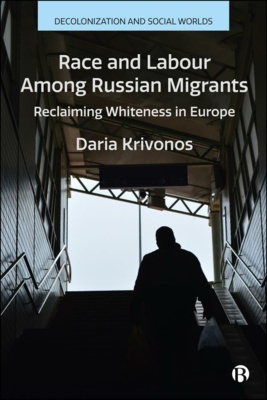
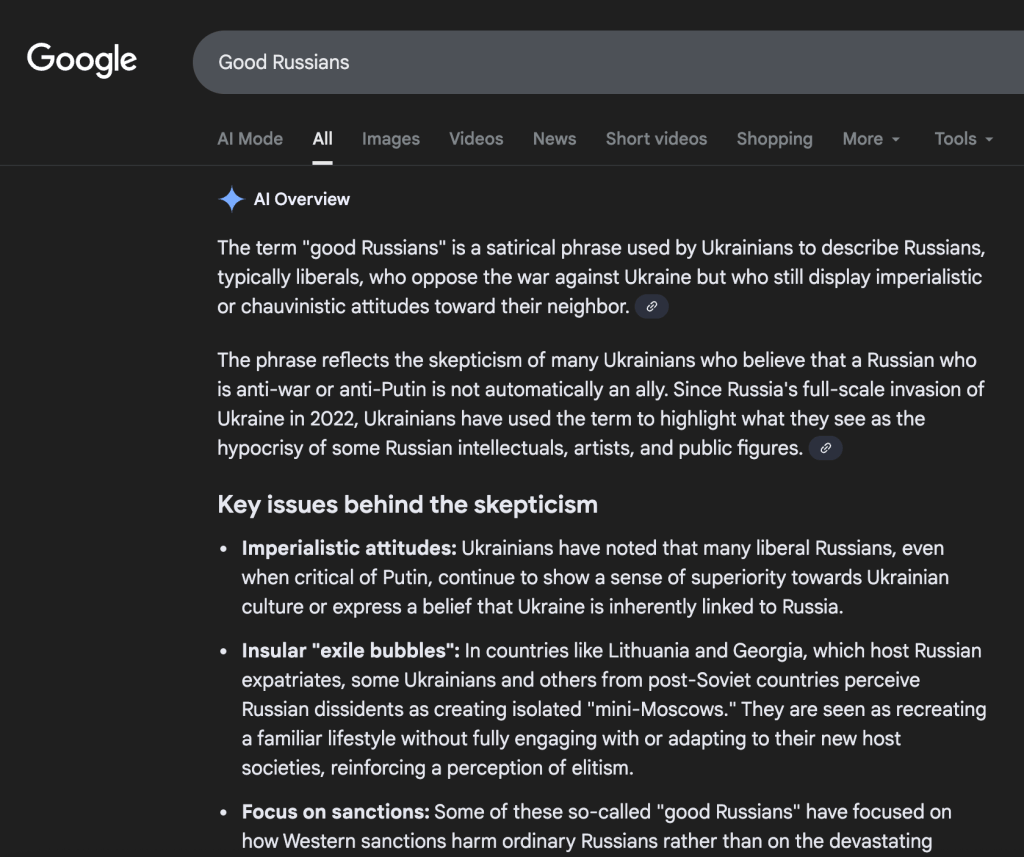
Reclaiming Whiteness: In Search of the “Good Russians”

As racial boundaries are constantly negotiated in Europe and across the globe, this book explores how Russian migrant workers navigate racial capitalism in the Nordic region.

Challenging the idea of a ‘race-neutral’ Eastern Europe, the book reveals how Russian migrants actively claim whiteness, often finding themselves on the margins of acceptability. Uniquely combining postsocialist and postcolonial perspectives, the author examines how these migrants, seeking recognition as European, reinforce economic and racial divides shaped by global capitalism.

This timely work offers fresh insights into race, migration and the boundaries of whiteness across Europe’s borders.

Source: Bristol University Press. Thanks to Sergey Abashin for the heads-up.


Before the age of budget airlines and Instagram wanderlust, Russians journeyed west not for leisure but for enlightenment. In March 1697 Peter the Great set off from Moscow to take in the sights of Amsterdam, London and Vienna, among others. Travelling under a pseudonym, but much recognised thanks to his towering height and posse of over 200 hangers-on, the tsar’s odyssey included the expected museum visits and posh balls. But the point of the trip was to experience something that could not be found in 17th-century Russia: modernity. The incognito emperor spent time working as a ship’s carpenter in Holland, took stock of the latest naval warfare tactics in Portsmouth, then studied democracy in action in Westminster. Alas, news of insurrection back home brought the escapade to a close after a mere 18 months. Having experienced modernity on his sojourn, Peter sought to impose it on his people. He promptly decreed facial hair to be “superfluous” and imposed a tax on beards. On the rest of Europe he soon imposed a grimmer fate: the Great Northern war, which embroiled bits of Scandinavia and the Baltics for two decades.

Three centuries after Peter’s odyssey, and three years after his wannabe successor Vladimir Putin launched his own protracted war in Ukraine, Russian tourism is still alive and well in Europe. What it lacks in ambition—the grand tour of yesteryear has been replaced by the more modest Mykonos beach jaunt, Milan shopping spree or week’s skiing in Courchevel—it makes up for in numbers. Over 500,000 Russians were granted visas to the European Union’s Schengen zone in 2024, nearly half of which allow for multiple entry over many years. The visitor numbers are down by 90% compared with 2019. But that is still far too many for those Europeans who wonder how citizens from a country whose army is raining missiles on Ukrainian cities can cavort in its beaches and boutiques. On November 7th the EU announced Russians would no longer be granted multiple-entry visas in a bid to get the number nearer to zero. What seems commonsensical to some is decried as deeply misguided by others—including Mr Putin’s foes.

The ostensible cause for the tightening is security. Beyond invading Ukraine, Russia is needling Europe with subtler forms of aggression. Drones circling airports, Baltic ships dredging cables, cyber-attacks and other forms of mischief have set nerves jangling in Europe. Even if security services there struggle to pin such “grey zone” attacks on Russian operators, to them it makes sense to view every visitor from there as a potential spy, saboteur or propagandist. Ending multiple-entry visas is a way to ensure vetting happens before each visit, a sensible precaution.

But the driving force for the visa ban is moral outrage. “Starting a war and expecting to move freely in Europe is hard to justify,” said Kaja Kallas, the hawkish Estonian who serves as the EU’s foreign-policy chief. Along with others hailing from the bloc’s eastern fringe, she has long lobbied for Europeans to equate all Russians with the regime they live under. Whether oligarchs or mere members of the upper-middle classes, those Muscovites who can afford a jolly in Ibiza are tacitly propping up Putinism. They are our enemy, too, unless proved otherwise. Exemptions to the visa ban will be made for relatives of EU citizens, as well as dissidents and others who can prove their “integrity”.

The security argument seems hard to quibble with, even if GRU goons have plenty of fake Western passports in their double-bottomed attaché cases (and are said to hire locals to do their dirty work, often via social-media platforms). But the all-Russians-are-Putinists argument is trickier. Your columnist has felt the discomfiting “ick” of sharing a Parisian café terrace or Alpine chairlift with Russian visitors, enjoying a carefree interlude before (probably) returning to well-paid jobs back home that will generate tax revenue for Mr Putin’s war. Is this wretched invasion not, at least in part, theirs as well? How dare they enjoy themselves?

But just as discomfiting is to apply the sins of a dictatorship to all 144m citizens who live in it—some of the first victims of Putinism. Not so long ago, Europe promoted the idea that everyday Russians should be separated from the regime that patently does not represent them. Oligarchs and those close to the regime were to be sanctioned, but ordinary Russians were potential allies againstMr Putin. Why not welcome them to Europe? Every rouble spaffed in Milan boutiques drains Russia of resources.

From Russia with visas

With the war in Ukraine dragging on, a more hawkish line has prevailed. In EU circles it is now expected that Russia’s middle class should somehow “do more” to unseat Mr Putin, and that failure to do so amounts to collaboration. Yet for ordinary Russians to be held collectively responsible for “their” leader’s actions is to assume they have the agency to turf him out. Tell that to the thousands languishing in gulags for even the merest of protests. Indeed, some with intimate experience of gulagdom have opposed the EU’s move. Yulia Navalnaya, whose husband Alexei Navalny died in an Arctic penal colony, has argued the visa ban would isolate Russia from Europe in precisely the way Mr Putin has in mind.

As with sanctions designed to target the regime and not the people, it may be that anti-Putinists end up as collateral damage of an otherwise sensible policy. How could it be otherwise? Europeans are being told to expect a frontal confrontation with Russia, perhaps soon. It is one thing to feel no animus towards ordinary Russians, another to host them for a mini-break just as defence spending in Europe is surging to take on a threat from their backyard. To curtail Russians visiting Europe may be to lump the oppressed with their oppressor. But with apologies to (some) Russians, any other outcome would make Europeans appear hopelessly naive. Let’s have you all over when the war ends. 

Source: “Charlemagne: Europe is cracking down on Russian tourists,” Economist, 13 November 2025


Join us for a discussion of Ambicoloniality and War: The Ukrainian–Russian Case with author Svitlana Biedarieva, in conversation with two prominent thinkers on issues of coloniality and Ukraine/Russia, Oksana Yakushko and Mykola Riabchuk.

Biedarieva’s book introduces the concept of “ambicoloniality” to describe the complex relationship between Ukraine and Russia, one in which Russia’s imperial desire to dominate Ukraine has paradoxically placed it under Ukraine’s symbolic influence. The work offers a fresh framework for understanding how colonial and decolonial dynamics have unfolded across shared borders rather than distant colonies, exploring the intertwined histories and cultural hybridities that continue to shape both nations.

Together, the author and discussants will examine how this new model redefines understandings of power, identity, and resistance in the post-Soviet space.

Source: GW Events Calendar


[…]

War-related news from Russia:

Russian man found guilty – posthumously – under LGBT law (Mediazona, 14 November) 

Twenty years on: Timur Kacharava’s murder remembered (The Russian Reader, 14 November)

First arrest under new Russian law over an Internet search for Ukraine’s Azov Regiment (Kharkiv Human Rights Protection Group, November 14th)

Russia feels the heat from oil sanctions (Meduza, 13 November)

Migrant women and the war: new discriminatory laws (Posle.Media, 12 November)

Russian anti-war prisoner: ‘I just did not want to murder Ukrainian people who have done me no ill’ (People & Nature, 12 November) 

The carousel: Russia’s system for re-arresting protesters (Meduza, 12 November)

To force deserters back to war, Russia’s military tortures their families (Meduza, 12 November)

“Thou shalt not idolize your motherland”: Russian Orthodox priests on the war in Ukraine and the degradation of their church (The Insider, November 10th)

Tracked down, coerced, threatened: How Russia hunts down deserters and forces them back to the front lines in Ukraine (The Insider, November 10th)

Source: News from Ukraine Bulletin 171 (17 November 2025)


The August sun was already warming Westlake Village when Anton Perevalov dressed in athletic shorts and decided to take an early morning stroll with his miniature pinscher, Ben, while his wife slept.

As he turned right onto Hillcrest Drive — a route he’d taken so many mornings before — an unmarked car stopped in front of him and a man he’d never met emerged and peppered him with questions: “Are you Anton Perevalov?” “Are you a citizen of Russia?”

When Perevalov, 43, answered in the affirmative, two other men exited the car and approached him. One took his phone and the other slapped handcuffs on him, ushering him and Ben into the car. As they drove toward his home, they instructed Perevalov to call his wife so she could come out and get the dog.

Perevalov pleaded with the men, saying that there had to be a mistake. He had documents proving he was legal to live and work in the United States. It didn’t matter, one of the men told him.

“You overstayed your visa,” he said. “You are under arrest and coming with us.”

Tatiana Zaiko sprinted out of the house in her pajamas and slippers, telling her 17-year-old son that his dad had been arrested and to lock the door. She’d be right back, she recalled telling him.

She wasn’t. Friends would later find the boy huddled under his parents’ bed, fearful that immigration agents may return for him too.

“I never imagined that something like this could happen in this country,” Zaiko, 43, said.

For years, Russian nationals and others seeking asylum in the United States were allowed to live and work here while their cases were being decided. That began to change in 2024 under the Biden administration and has been completely upended in the wake of President Trump’s efforts to boost deportation numbers, experts say.

Under Trump, those with a pending asylum claim aren’t exempt from being detained and deported. In fact, targeting asylum seekers in the United States makes it easier for immigration agents to carry out Trump’s stated plans of deporting at least 1 million people annually because they’re known to the government and easier to find, said Dara Lind, a senior fellow with the American Immigration Council.

“People who have done everything right are arguably easier for this administration to go after and more of a target than people who are actively trying to evade the law,” Lind said.

After Russia invaded Ukraine in 2022, the Kremlin introduced war censorship laws to make criticism of the war an offense punishable by significant jail time. Those who have been critical of the war and sought asylum in the United States are at risk of having property seized, being fined and spending significant time in prison if they were to return to Russia.

It was for this reason that Perevalov and Zaiko sought protection in the United States.

The couple applied for asylum in 2023 during what was initially a family vacation to New York City over Christmas. The trip was a longtime dream of their son’s, who grew up watching the movie “Home Alone 2: Lost in New York”, and wanted to spend the season taking in the sights of the Big Apple just like Kevin McCallister, the film’s lead character. Trump makes a brief cameo in the movie as himself.

But during the trip, the family received word from back home that the Russian police were looking to interrogate Perevalov about his opposition to the war in Ukraine. Perevalov hadn’t been shy about sharing his disapproval and had donated funds in support of Ukraine.

In schools, Perevalov said, they had introduced lessons of “military-patriotic education,” teaching children that Western countries wanted to take over Russia. At one point, their son’s teacher brought an AK-47 rifle to class and forced students to disassemble and reassemble it. The couple voiced their disapproval.

More than a week after arriving, the family decided returning to Russia would be too dangerous, so they contacted an attorney to help them apply for political asylum in the U.S. They filled out the application, Form I-589, and three weeks later received confirmation that their form had been accepted and they were scheduled for fingerprinting.

The document they received stated they were authorized to remain in the United States while their application was pending. They got work permits, settled in the San Fernando Valley and found jobs — Perevalov at a detailing studio and Zaiko as a house manager. They paid taxes and settled into the rhythm of life in America.

When immigration raids began ramping up across Southern California over the summer, the couple figured they had nothing to worry about since the Trump administration had emphasized it sought to deport dangerous criminals.

“We don’t understand,” Zaiko said. “We did everything right. We’re not criminals. We have documents. I thought it was a mistake, but it’s not a mistake.”

The Department of Homeland Security did not answer questions from The Times about the status of the couple’s immigration case.

“Perevalov and Zaiko will receive full due process and all their claims will be heard by an immigration judge,” Homeland Security Assistant Secretary Tricia McLaughlin said in an email. “For the record: a pending asylum claim does NOT protect illegal aliens from arrest or detention.”

The couple’s arrest — along with examples of others in similar circumstances being detained by federal officials — has spread fear through the Russian immigrant community in Southern California.

A Russian national living in Southern California who declined to provide his name for fear he could be targeted for deportation said he rarely goes out anymore. When he does leave his house, he scrutinizes every car that passes, wondering if it’s agents looking to detain him and his family.

His child has spent most of her life in the United States and doesn’t know what it was like in their home country. A return to Russia for him would probably mean death, he said.

“America was like a lighthouse of liberty for us,” the man said. “But it doesn’t feel that way right now.”

Despite the federal government’s assertion that it is targeting dangerous criminals, many of the Russian asylum seekers who have been placed in detention have no criminal records. Some have been victims of crimes, said Dmitry Valuev, president of the nonprofit group Russian America for Democracy in Russia.

Russian asylum applications to the United States rose sharply in the years since the country invaded Ukraine, as many Russians seek to leave for fear of political persecution or being conscripted into the military. This contributed to a growing backlog in immigration courts.

As of 2024 — the most recent data available — more than 14,600 asylum cases from Russia were pending in California, up from 1,771 in 2021, according to the Transactional Records Access Clearinghouse, which publishes immigration data.

In 2024, asylum applicants began landing in long-term detention while their cases were pending, a change that Valuev attributes to concerns about spies from post-Soviet countries infiltrating the United States and creating a national security risk.

After Trump’s inauguration, he declared a state of emergency at the southern border, where many asylum seekers including Russians showed up, allowing the federal government to deny them asylum and deport them back to their country of origin.

“Now they use any excuse, any reason to detain an individual whose immigration situation is pending,” Valuev said.

In June and August, two flights out of the United States involved the transfer of detained Russian nationals to Egyptian government custody. Those individuals were forcibly returned to Russia, including people who had been detained in the United States for more than a year after seeking asylum, according to Human Rights First, which tracks immigration flights out of the United States.

When they arrived at an Immigration and Customs Enforcement facility in downtown Los Angeles, Perevalov and Zaiko were again fingerprinted, had their belongings confiscated and were taken to roughly 1,000-square-foot holding cells separated by gender. On the men’s side, about 50 men were packed into the windowless cell. It felt like the air conditioning was always on and the concrete floor detainees slept on was freezing, the couple said.

They were given foil emergency blankets, which did little to warm them. Zaiko was given a thin mat to sleep on, a luxury not afforded to the men. The lights never went off. They dimmed only slightly at midnight, which was the only way to tell a new day had begun.

Meals were given at random times, sometimes at 1 a.m. or 2 a.m. When Perevalov asked for a toothbrush or other basic hygiene items, an officer told him it wasn’t “a hotel.” Zaiko, who takes medicine daily, had to have friends bring her pills from her home to the facility.

When the men flushed the toilet, the waste would back up into the women’s plumbing, creating a stench that Zaiko said was “unbearable.”

They were both questioned and given deportation documents, which they didn’t fully understand and refused to sign. They said their requests for translators were ignored.

After five days, they were shackled and transferred to separate detention centers — Zaiko to Adelanto and Perevalov to a center in San Diego — where they spent nearly a month before their attorney could get them released on bond.

Perevalov and Zaiko shared their story during a Los Angeles City Council meeting last month, a decision they made so that people could better understand the risks even asylum seekers face as immigration sweeps continue in Southern California, they said.

Standing at the lectern, Zaiko broke down in tears describing being handcuffed by immigration officers, then retreated into her husband’s arms.

Los Angeles City Councilmember Bob Blumenfield called the immigration raids a “crisis” for America during the meeting.

“There are many Russian couples who are here who would potentially be killed if they were sent back to Russia and they’re in this situation,” he said. “This administration is harming our communities and seem to be throwing our constitutional rights out of the window. This is America. This is not Russia.”

As of Friday, Perevalov and Zaiko were still waiting to hear what’s next for them in the immigration process.

In the meantime, they’re focusing on their son, who is still struggling with what happened even after his parents returned home. Zaiko will never forget the first thing he said to her when she arrived from detention — a simple plea that said so much.

“Please don’t leave me alone again.”

Source: Hannah Fry, “A Russian couple were living their L.A. dream. Then immigration grabbed them off the street,” Los Angeles Times, 14 November 2025


The European Union has added new restrictions on issuing multi-entry visas to Russians who live in Russia as a response to the continuing war in Ukraine. Most will now only be able to obtain a single-entry Schengen visa. The decision is not only reasonable, but also a very mild measure considering that there are many exceptions, including family members of EU citizens and Russians residing in the EU, transport workers, and “persons whose reliability and integrity is without doubt,” including dissidents, independent journalists, human rights defenders and representatives of civil society organisations. Nevertheless, prominent Russian opposition activists have responded by condemning the move, which only casts doubt on their claims to genuinely care about the crimes their country is committing.

“You can’t blame a whole country for the actions of its government,” exiled Russian activist Ilya Yashin told the UK’s Guardian newspaper. Meanwhile exiled Russian journalist Sergei Parkhomenko called the EU decision “extraordinary in its idiocy, ineffectiveness and demonstrative helplessness”. Former US ambassador to Russia Michael McFaul posted on X “Progress” in response to the news of the visa restrictions, to which exiled Russian journalist Leonid Ragozin responded, “The man who is trying to make even most pro-Western Russians hate the West because this half-witted policy results in thousands of personal tragedies, ruined families and relationships, people unable to see their elderly parents as well as additional risks and headaches for opposition activists. Not even because he means it, but because he is a vain, unreflective, incompetent ignoramus, a typical representative of the community that handled Russian affairs for the US government over the last 30 years.”

The noise the exiled Russians are making about visas for frequent trips to the EU contrasts starkly with their silence about Russia’s latest attacks on Ukrainian civilians. Last night Russia launched a massive attack on Kyiv, striking blocks of flats with missiles and drones, killing at least six people and injuring 35 others. The Azerbaijani embassy in the Ukrainian capital was also damaged by Iskander missile fragments, which may or may not have been coincidental considering the poor relations between Russia and Azerbaijan in recent months.

“This was the bedroom. If we had been sleeping here we would have been crushed. All of this would have fallen onto the bed,” a young woman in Kyiv told a reporter, pointing to a pile of rubble and broken windows in the bedroom of her flat. “Everything will be fine, because despair is a sin,” her mother said. “Everyone is alive. But we hate Russians.” Last Friday night Russia also struck a block of flat in Dnipro with a drone, killing two people and injuring 12 others.

“Ukraine is responding to these strikes with long-range strength, and the world must stop these attacks on life with sanctions,” Volodymyr Zelensky posted on X in response to the latest attacks. “Russia is still able to sell oil and build its schemes. All of this must end. A great deal of work is underway with partners to strengthen our air defense, but it is not enough. We need reinforcement with additional systems and interceptor missiles. Europe and the United States can help. We are counting on real decisions. Thank you to everyone who helps.”

It is very hard to see why the EU or any other democratic countries should welcome Russians for holidays when so many of them are participating in the war against Ukraine. In the case of Russia, the whole country really can be blamed. And the EU has gone out of its way to help the Russian complainers who are living in freedom while demanding greater leniency and sympathy for their compatriots. If anything, more countries should follow the EU’s example, and the measures taken should be even stricter.

Two sentenced for murder of Kherson Oblast man who criticised war

A court in occupied Kherson Oblast has sentenced two Ukrainians for the murder of a man who criticised the war and Russia. 58-year-old Petr Martynchuk was abducted and strangled in March 2023 because he openly supported Ukraine and spoke out against the occupation of his village. Oleksiy Yansevich and Mikola Antonenkov, described as Ukrainian collaborators, were arrested for the murder, along with Russian citizen Andrei Timchenko. After drinking alcohol the three got into an argument with Martynchuk about the war, took him to a field and strangled him with a wire. When the wire broke they finished the job with a shoelace. Yansevich was sentenced to 16 years in a maximum-security prison and Antonenkov to 12 years. Timchenko, who watched the murder, helped to hide the body and burned the victim’s Ukrainian passport, was given no sentence due to the “statute of limitations”.

Stoptime buskers jailed for third time

Singer from the group Stoptime Naoko (Diana Loginova) and her fiancé Alexander Orlov, the group’s guitarist, were arrested for a third time on Tuesday after serving their second consecutive jail sentences and given third sentences of 13 days for performing the banned music of “foreign agents” in front of a crowd on the streets of St. Petersburg. The group’s drummer, Vladislav Leontyev, was released after serving two consecutive jail sentences. Meanwhile in Perm musician Katya Romanova, who performed in solidarity with Stoptime, was given a seven-day sentence followed by a 15-day sentence. Courts have used the excuse that the musicians organised an unlawful gathering.

More people sentenced for anti-regime activities

A military court has sentenced 56-year-old IT specialist Sergei Pravdeyuk from Irkutsk Oblast to 6 ½ years in prison for justifying terrorism for Telegram posts that supported Ukraine and criticised the Russian government. The same military court sentenced Mark Orlan from Irkutsk Oblast to five years in prison for justifying terrorism for a WhatsApp status that the FSB considered supportive of the ISIS attack on Moscow’s Crocus City Hall in March last year in which 149 people were killed.

A court in Kostroma Oblast has upheld an appeal by prosecutors and changed a suspended sentence to a real five-year prison sentence for bookshop owner Yan Kulikov from Soligalich for “spreading fakes about the army”. Kulikov was not in court for the sentencing because he was taking care of his sick mother, but the court ordered his immediate arrest. He was given the five-year suspended sentence in September, having been sentenced to six months of correctional work in 2023 for two VKontakte posts about the Russian army shelling Ukrainian cities. Kulikov’s lawyer argued that the defendant was not aware that anything he had posted was false. A photograph of Kulikov showed him with handmade signs saying “Turn off the zombiebox” and “War is evil, we know,” highlighting the Z symbol for the invasion of Ukraine.

Source: Sarah Hurst, The Russia Report, 14 November 2025


“When I had decided to study Russia’s history and literature in college, my father warned me that our homeland was a country without a future,” Ioffe recalls. She returned to the United States in 2012 and is now convinced that he was right. She points out that Putin has deployed “traditional values” to consolidate control. Her conclusion is unsparingly bleak. “A new Russia had dawned, and it was a lot like the old one,” she writes. If there’s one change she notices, it’s this: Like the brief efflorescence of emancipation, all the people she loved there are gone.

Source: Jennifer Szalai, “The World’s Greatest Feminist Experiment Was Not Where You’d Think,” New York Times, 22 October 2025


In exile, Bakunina will be free to speak and write what she likes. It is a long and honourable tradition. But it seems unlikely to bother Putin. He calls it “a natural and necessary self-cleansing of society [that] will only strengthen our country.” He could scarcely be further from the truth. The ones who are leaving are the Good Russians.

Source: Quentin Peel, “Voices from the perestroika generation,” FT Weekend: Life & Arts, 15 November/16 November 2025, p. 8


Black Friday

“Black Friday”

Source: Ozon email advertising circular, 14 November 2025


An American World War II cemetery in the Netherlands removed displays focused on Black American soldiers, sparking outrage and compelling Dutch politicians to appeal to U.S. officials this week to restore the information.

The two displays were added to the Netherlands American Cemetery’s visitor center in September 2024 after some historians and relatives of service members criticized the site for not mentioning the unique experiences of Black troops. One plaque featured the story of George H. Pruitt, a Black soldier in the 43rd Signal Construction Battalion, who died trying to save a comrade. The other highlighted how Black American service members were “fighting on two fronts” — for freedom overseas and for their civil rights at home.

The displays’ removal, American and Dutch critics of the move say, signifies an erasure of Black Americans’ contributions in the war and their work to liberate the Netherlands from the Nazis. It also represents an overstep in the Trump administration’s campaign to curb what it deems diversity, equity and inclusion efforts, the critics said.

It’s unclear exactly when the plaques were removed.

The American Battle Monuments Commission, a U.S. government agency that oversees the cemetery, did not respond to requests for comment from The Washington Post. The commission told Dutch news outlets that one panel is “off display, though not out of rotation,” and a second panel was retired. The commission did not elaborate on either decision.

Janice Wiggins, the widow of Jefferson Wiggins, a Black WWII soldier who was quoted in one of the displays, said she had “a gut-wrenching feeling” when she learned the panels had been removed.

“Not only reading about, but actually experiencing, how history and those who shaped it can be so easily and casually erased,” she said. “It was very personal.”

“The removal of the displays is disrespectful to the Black American soldiers who served and to the legacies their families cherish,” Wiggins added.

More than 8,000 U.S. troops who fought in World War II are buried at the Netherlands American Cemetery, a solemn site in the village of Margraten in the southern part of the country. Just over 170 of these service members are Black Americans, a slice of the more than 1 million Black Americans who fought during World War II in segregated forces.

The cemetery is special to the local community, according to the American Battle Monument Commission’s website. Residents have adopted the grave sites, bringing flowers to the cemetery for decades.

The 6,450-square-foot visitor center, where the displays about Black service members were, tells the stories of the thousands of Americans commemorated at the cemetery.

One of the removed plaques described the “horrors of war” that Black service members faced while serving primarily in labor and support positions. In fall 1944, the U.S. Army’s 960th Quartermaster Service Company, a mostly Black unit, arrived in Margraten “to dig graves at the newly created cemetery,” the display read, according to a photo provided to The Post.

Jefferson Wiggins, a first lieutenant, recounted seeing service members under his command crying as they dug the graves.

“They were just completely traumatized,” the display said.

Now there is no textual information provided about Black troops at the cemetery, said Kees Ribbens, a senior researcher at the NIOD Institute for War, Holocaust and Genocide Studies in Amsterdam. Although it’s unclear why the displays were removed, Ribbens said it’s notable that it happened during the Trump administration’s crackdown on diversity efforts.

President Donald Trump signed executive orders on his first day in office banning government diversity, equity and inclusion efforts. The impact has been widespread: Arlington National Cemetery scrubbed information from its website about prominent Black, Hispanic and female service members and topics such as the Civil War. Exhibits related to slavery were removed at multiple national parks. The White House accused the Smithsonian of promoting “race-centered ideology.”

“Given the emphasis the current administration puts on DEI, it doesn’t make it that difficult to start wondering if the disappearance of Black history [at the cemetery] has to do with the current winds blowing in D.C.,” Ribbens said.

In the Netherlands, the public has been baffled that anyone would see a reason to remove the panels, Ribbens said.

Dutch politicians have demanded that the displays be reinstated, appealing to the American Battle Monuments Commission and the U.S. ambassador to the Netherlands.

Alain Krijnen, the mayor of Eijsden-Margraten, where the cemetery is, sent a letter Monday to the commission: “We greatly value the story of the Black Liberators in relation to the past, present and future. In that context, we would greatly appreciate it if the story of the Black Liberators — like the 172 Black Liberators buried in Margraten — could be given permanent attention in the visitor center, and therefore reconsider the removal of the displays.”

The office of the governor of Limburg, the Dutch province containing the cemetery, said it also has “serious concerns.”

“The displayed panels depicted a history we must never forget, and from which we can learn a great deal — especially now, as global divisions are being increasingly magnified,” Bas Alberson, a spokesman for the governor’s office, said in a statement to The Post.

The mayor’s office and the Limburg governor’s office said they had not heard from American officials as of Wednesday.

Janice Wiggins, the 77-year-old widow of Jefferson Wiggins, said she learned the displays had been removed after her friends visited the cemetery in October and noticed the absence. The removal chips away at some of her life’s work, she said.

“Along with [former] US Ambassador to the Netherlands Shefali Razdan Duggal and Dutch author Mieke Kirkels, I lobbied for the inclusion of Black American soldiers in the exhibits at the Netherlands American Cemetery Visitors Center. The original exhibits included only White soldiers,” Wiggins, who lives in New Fairfield, Connecticut, wrote in an email.

Those who have family buried at the cemetery also feel the loss.

Julius Morris is a Black WWII soldier who is buried there. His nephew, Raphael Morris, who lives in St. Louis, felt resigned when he heard the news.

“Business as usual by this administration,” said Morris, 73. “Color me concerned, disappointed, but not surprised.”

Source: Anamita Kaur, “U.S. WWII cemetery in the Netherlands removes displays about Black troops,” Washington Post, 13 November 2025


“Culture Black Friday, 14–24 November. Up to 60% discounts on tickets.”

Source: Bileter.ru email advertising circular, 14 November 2025

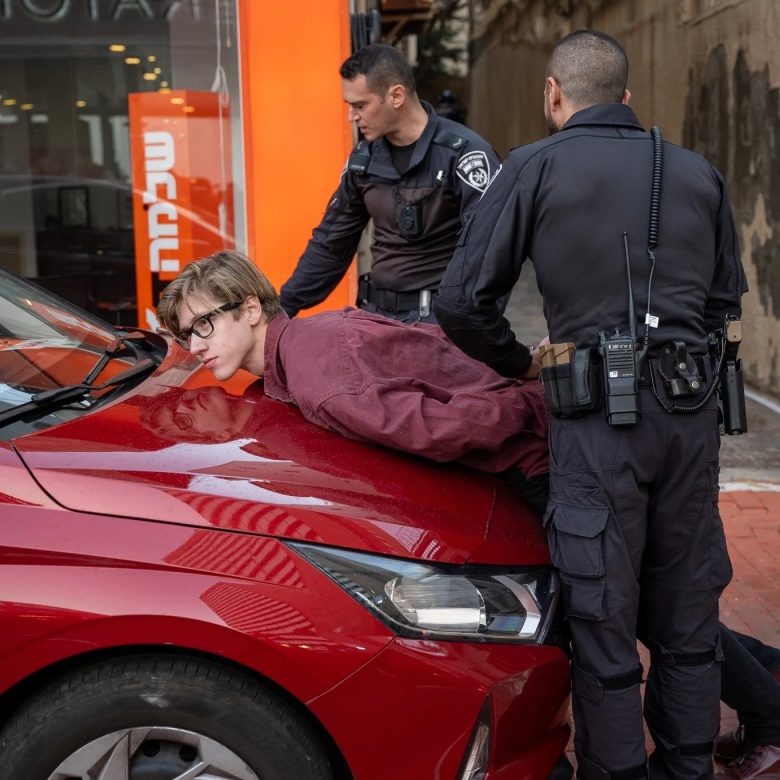
ICE Goes After Russian Asylum Seekers: The Cases of Alexander Bolokhoev and “Dimitry”

ICE agents in the U.S. have detained Alexander (“Sasha”) Bolokhoev, a cofounder of the movement Tusgaar Buryad-Mongolia, which advocates for Buryatia’s independence [from the Russian Federation].

Sasha left Russia in 2021—that is, before Russia’s full-scale invasion of Ukraine. In April 2022, he arrived in the U.S. and claimed political asylum. Unlike many of our compatriots, however, Sasha did not lie low and do nothing, pointing to the fact that he had been persecuted on ethnic grounds in Russia. He immediately joined the fight. He and Marina Khankhalaeva founded the Tusgaar movement, which has already been added to Russia’s official list of “extremists and terrorists.” He also spearheaded a congress of Buryat political organizations in New York.

Sasha’s detention by ICE was in no wise connected to his activism. He was detained in the state of Oklahoma during one of the anti-immigrant dragnets which have become a daily fact of life under Trump. Sasha was stopped on the highway and taken directly from his vehicle, which was left standing there.

Sasha is in the US completely legally. He has all the necessary papers, including a work permit. In the current reality, though, this may not matter much. Even green card holders and U.S. citizens have been detained and deported from the country.

Sasha is currently in custody in a deportation detention center in Oklahoma. He is held there along with a Chechen man who was also detained during a similar raid. The worst possible outcome for both of them would be deportation to Russia. I agree with Marina that torture and death would await Sasha in a Russian prison.

The Trump administration has instituted the systematic deportation of Russians on standalone flights to Moscow. As of October, at least three known charter flights have deported over a hundred people from the U.S. back to Russia. Upon landing in Moscow, all of these people are screened by the FSB (Federal Security Service) and they are often sent straight to a detention center.

Source: Julia Khazagaeva (Facebook), 21 October 2025. Translated by the Russian Reader. A special thanks to Ms. Khazagaeva for sending me the subtitled video interview with Sasha Bolokhoev, above.


The full interview with Buryat activist in exile Alexander Bolokhoev (in Russian and Buryat, with no subtitles)

Alexander Bolokhoev is a Buryat Mongol who immigrated to the United States and is a nationalist. He graduated from school with straight A’s, but soon left to work in Korea and then in the United States, where he currently is employed as a truck driver. In his featured spot “Saashyn Zam” (“Sasha’s Path”), Bolokhoev will talk about everyday life in the United States and his journey in life. You can join the discussion and ask questions every Wednesday at 8:30 p.m. (Ulaanbaatar time) on the channel @MiniiMongolGer.

Source: Buryadmongol (YouTube), 12 June 2024. You can watch a subtitled six-minute excerpt from this same interview in my translation of Ms. Khazagaeva’s Facebook post, above.


Buryat Emigrant Detained in US: Faces Deportation and Criminal Prosecution in Russia US

Immigration and Customs Enforcement (ICE) has detained Alexander Bolokhoev, an activist for the Buryat independence movement who has been living in the country since 2022 and seeking political asylum. The news was reported by Lyudi Baikala (People of Baikal).

According to the publication, Bolokhoev moved to the US in the spring of 2022, where he worked as a truck driver and participated in anti-war protests. He is an activist for the movement “Tusgaar Buryaad–Mongolia,” which is recognized as “terrorist and extremist” in Russia. In 2023, Bolokhoev participated in a congress of Buryat political organizations in New York, signed a declaration of Buryat independence, and joined the Buryat Independence Committee.

The movement’s leader, Marina Khankhalaeva, stated that if Bolokhoev is deported to Russia, he could face imprisonment or death due to his outspoken position and participation in the activities of the banned organization. The activist is currently being held in a detention center, and his status and a possible court decision on deportation are not yet known.

The movement “Tusgaar Buryaad–Mongolia” (“Independent Buryat-Mongolia”) was founded in the US by former opera singer and current homemaker Marina Khankhalaeva, and historian and professor Vladimir Khamutaev. The initiative advocates for “the self-determination of the Buryat people and the creation of an independent national state.”

Both founders have lived in the US for over ten years. Khankhalaeva was not previously involved in politics and stated she turned to activism after the start of the war in Ukraine. Khamutaev is known for his research on the annexation of Buryat lands to Russia and has been a proponent of Buryat autonomy since the 1980s.

The movement gained notoriety after Khankhalaeva spoke at the European Parliament during the Forum of Free Peoples of Russia, where decolonization issues were discussed. In 2023, the organization “Tusgaar Buryaad–Mongolia” was designated as terrorist and extremist in Russia.

According to Sota sources, the movement actively sought Buryat emigrants, suggesting they build their asylum cases through anti-war and “decolonization” speeches. However, after Trump came to power and mass migration acceptance was halted, such actions ceased to be beneficial for the emigrants but created a threat for them in Russia.

Source: Sota News (X), 21 October 2025


On a rainy evening in March, a Russian man named Dimitry stumbled through the dark, looking for a hole in a fence. In a former life, Dimitry worked as a fitness trainer for cops and bureaucrats in St. Petersburg, so he figured he could jump the barrier — “Honestly, with the shape I’m in, it wouldn’t be a problem.” But he was less confident about landing cleanly on the jungle terrain on the other side. Better, he thought, to look for a break in the chain-link.

The fence enclosed CATEM, a de facto immigrant detention center in Costa Rica where Dimitry, his wife, and their 6-year-old son were sent in February, along with 200 other asylum-seekers from Armenia, Afghanistan, Iran, Turkey, and Russia, among others. They were part of the first wave of migrants and asylum-seekers to be deported by the Trump administration to third countries — places other than their country of origin where, generally, the migrants had never been.

Dimitry’s plan, quickly formed a year earlier in an attempt to evade Russian authorities, had seemed straightforward. The family would fly to Tijuana, where they would download the U.S. Customs and Border Protection’s app, file a claim for political asylum, and wait to be given an appointment. But on January 20, 2025, after eight months of waiting, their appointment was canceled. They drove to the Tecate border crossing and restated their political-asylum claim. After being handcuffed and fingerprinted, the family was placed in a holding facility at the Otay Mesa border crossing. They spent a month there, separated, before they were put on a military plane to Arizona. In Arizona, they were led to a bus. One of the migrants asked the driver where they were being taken next.

“Costa Rica,” the driver replied.

Costa Rica, Dimitry thought. Is that a city or a country?

Continue reading “ICE Goes After Russian Asylum Seekers: The Cases of Alexander Bolokhoev and “Dimitry””

Toxicity

School of Rock performs System of a Down’s “Toxicity” (2022)

Actors Martin and Janet Sheen, John Cusack and Slovenian philosopher Slavoj Žižek have signed an open letter urging Russian prison officials to end the solitary confinement of jailed activist Mikhail Kriger, who has been on a dry hunger strike for more than a week.

They join Garbage frontwoman Shirley Manson, who earlier this week called on the local prison chief to end Kriger’s isolation.

Kriger, 65, first launched a hunger strike in late September. He started a dry hunger strike — meaning abstention from both food and water — last Friday after a planned visit with his daughter was canceled.

Kriger has accused prison authorities of deliberately trying to isolate him to prevent contact with other inmates. 

The latest signatories of the letter to the head of Correctional Colony No. 5 in Russia’s Oryol region claimed Kriger’s condition “has now become critical,” according to the letter published by the exiled news website Mediazona.

“[Kriger’s] speech has slowed, his gaze is unfocused and he is extremely weak. Dry hunger strikes cause organ failure and quickly lead to shock and death,” the Sheens, Cusack and Žižek wrote.

Kriger was in 2023 sentenced to seven years in prison for “justifying terrorism” and “inciting hatred” over anti-Kremlin social media posts. The activist said during trial that he was being persecuted for his anti-war views and open pro-Ukrainian position.

The Nobel Peace Prize-winning human rights group Memorial designated Kriger a political prisoner.

The anti-Kremlin activist group Pussy Riot raised alarm over Kriger’s hunger strike earlier this week, calling on followers to write letters to him and the prison administration. 

It was not immediately clear whether authorities in the Oryol region prison colony intended to respond to the international appeals.

It was also not clear when Kriger was expected to be moved out of solitary confinement and whether his medical condition was being properly monitored.

Kriger’s support group said the activist was taken to a regional hospital on Wednesday for tests, the results of which have not been shared.

Kriger’s lawyer said he was “cheerful, wrote poems and even offered to hop on one leg to show his strength,” the support group said in an update Thursday.

“Forced feeding will only begin if he loses consciousness or doctors deem his condition critical,” Kriger’s support group wrote on Telegram.

Source: “Hollywood Stars Back Jailed Russian Activist on Hunger Strike,” Moscow Times, 17 October 2025


Yegor Shramko holding a placard that reads “No to the war with Ukraine” in Petersburg’s Palace Square

Our correspondent reports that activist Yegor Shramko did an anti-war picket in Palace Square and was detained.

The Petersburg man held a blue-and-yellow placard bearing the slogan “No to the war in Ukraine” and stood this way for around an hour. Shramko told our correspondent that although passersby supported him, the police were summoned by animateurs dressed as Russian emperors and empresses who offer to take photos with them for money on the square.

“I cannot keep silent. A life in which you have to fear everything, keep quiet, and be afraid of every little noise has no value for me,” Shramko explained to Bumaga.

He told RusNews that he had been wanting to stage the protest for four months but only worked up the nerve today.

This past summer, Shramko was jailed for twenty-four hours on charges of “displaying extremist symbols.” The “extremist symbol” in this case was the portrait of Alexei Navalny which Shramko brought to the Solovetsky Stone on the murdered politician’s birthday. At the time, Shramko told Bumaga that Navalny’s own words—”I’m not afraid, and you shouldn’t be afraid either”—had encouraged him to take the plunge and risk arrest by carrying out the proteest.

Source: Bumaga (Facebook), 17 October 2025. Thanks to Hanna Perekhoda for the heads-up.


The activist held a solo picket for about an hour. St. Petersburg residents approached him—some offered words of support, while others began arguing with him. More than 50 minutes after the picket began, security forces in full uniform arrived and detained Yegor.

Source: “Security forces detained activist Yegor Shramko, who was holding a pacifist picket | St. Petersburg,” RusNews (YouTube), 18 October 2025


As you have probably heard, recently, on a Swiss train, a Russian man (with Latvian citizenship) attacked a family. The family was speaking Ukrainian among themselves. He started threatening to kill them and their baby.

It’s easy to dismiss this as just another “fait divers” (which, in a sense, it is), but I think it says something larger. To understand his actions, you have to understand where it comes from.

For centuries, the inhabitants of the Russian state lived in a situation where order depended on fear and extreme forms of violence. This was true in much of the world, but while many countries began to change over the last century (let’s put aside the reasons behind the change), in the Russian/Soviet empire the situation actually became worse. Much worse.

The rules were never something people agreed to follow together (after all, you need to feel a part of a society and thus to share common imaginary to do it, and it is impossible to do it if you live in the empire, however much some contemporary researchers might wish it). It is something they were imposed from above, by the state, or by whoever had power over you at the moment. People learned that laws only mattered when someone strong was watching. So when a person raised in that kind of world finds themselves in a place like Switzerland, where rules work because the majority respects them voluntarily, they see the absence of fear and coercion as a sign that anything goes.

The man in that train was in a setting where no one was looking as capable to physically stop him and he took that as permission to dominate others, those people that he hates for the mere fact of their existence.

This same pattern plays out on a global scale. The Russian state elites see Europe much like that man saw the train: as a place without explicit “real” (military) force. It looks fake, easy to break, like a house of cards, because it relies on trust, and thus, in their view, on NOTHING.

People and societies shaped by fear and domination can’t imagine relationships built on any agreements (that require trust). They assume that if no one is dominating explicitly, it’s an invitation to act.

The man on the train and Putin’s crew are two versions of the same story. Both come from a social setting that sees respect as submission, peace as weakness, agreements as empty shells and absence of explicit force as an invitation to unlimited violence.

Source: Hanna Perekhoda (Facebook), 18 October 2025


Donald Trump told Ukrainian President Volodymyr Zelensky on Friday to make a deal with Russia, pouring cold water on Kyiv’s push for Tomahawk missiles as the U.S. leader pursues a diplomatic solution to the war.

Trump said as recently as last month that he believed Ukraine could take back all its territory — but a day after agreeing to meet Russian President Vladimir Putin for a new summit the American had changed his tune.

After meeting with Zelensky at the White House, Trump said on social media that their talks were “very interesting, and cordial, but I told him, as I likewise strongly suggested to President Putin, that it is time to stop the killing, and make a DEAL!”

Trump also appeared to suggest both sides should accept their current front lines. “They should stop where they are. Let both claim Victory, let History decide!” he said.

Zelensky said after the meeting that Russia was “afraid” of the U.S.-made long-range Tomahawk cruise missiles, but that he was “realistic” about receiving the weapons from Washington.

He told reporters that while he and Trump talked about long-range weapons they “decided that we don’t speak about it because… the United States doesn’t want escalation.”

‘Get the war over’

Zelensky came to Washington after weeks of calls for Tomahawks, hoping to capitalize on Trump’s growing frustration with Putin after a summit in Alaska failed to produce a breakthrough.

But the Ukrainian left empty-handed as Trump eyes a fresh diplomatic breakthrough on the back of last week’s Gaza peace deal.

Trump has appeared far more upbeat about the prospects of a deal since his two-and-a-half hour call with Putin on Thursday, in which they agreed to meet in Budapest.

“Hopefully we’ll be able to get the war over with without thinking about Tomahawks,” Trump told journalists including an AFP reporter as he hosted Zelensky at the White House.

Trump added that he believed Putin “wants to end the war.”

Zelensky, who came to the White House to push for the long-range U.S.-made weapons, said however that he would be ready to swap “thousands” of Ukrainian drones in exchange for Tomahawks.

Zelensky congratulated Trump on his recent Middle East peace deal in Gaza and said he hoped he would do the same for Ukraine. “I hope that President Trump can manage it,” he said.

‘Many questions’

Diplomatic talks on ending Russia’s invasion have stalled since the Alaska summit.

The Kremlin said Friday that “many questions” needed resolving before Putin and Trump could meet, including who would be on each negotiating team.

But it brushed off suggestions Putin would have difficulty flying over European airspace.

Hungary said it would ensure Putin could enter and “hold successful talks” with the United States despite an International Criminal Court arrest warrant against him for alleged war crimes.

Since the start of his second term, Trump’s position on the Ukraine war has shifted dramatically back and forth.

Initially Trump and Putin reached out to each other as the U.S. leader derided Zelensky as a “dictator without elections.”

Tensions came to a head in February, when Trump accused his Ukrainian counterpart of “not having the cards” in a rancorous televised meeting at the Oval Office.

Relations between the two have since warmed as Trump has expressed growing frustration with Putin.

But Trump has kept a channel of dialogue open with Putin, saying that they “get along.”

The U.S. leader has repeatedly changed his position on sanctions and other steps against Moscow following calls with the Russian president.

Putin ordered a full-scale invasion of Ukraine in February 2022, describing it as a “special military operation” to demilitarize the country and prevent the expansion of NATO.

Russia now occupies around a fifth of Ukrainian territory — much of it ravaged by fighting.

On Friday the Russian Defense Ministry announced it had captured three villages in Ukraine’s Dnipropetrovsk and Kharkiv regions.

Source: Danny Kemp (AFP), “Trump Tells Zelensky to ‘Make a Deal’ as Tomahawk Plea Misfires,” Moscow Times, 18 October 2025


All last week, Republican leaders tried to portray the No Kings protests scheduled for Saturday, October 18, as “Hate America” rallies. G. Elliott Morris of Strength in Numbers partnered with Atlanta-based science newsroom The Xylom to estimate that as many as 8.2 million people turned out yesterday to oppose the Trump administration. The mood at the protests was joyful and peaceful, with protesters holding signs that championed American principles of democracy, free speech, equality, and the rule of law. As the Grand Junction, Colorado, Daily Sentinel put it in a front-page headline: “‘This is America’ ‘No Kings’ protests against Trump bring a street party vibe to cities nationwide.”

Then last night, after the protests, the president’s social media account posted an AI-generated video showing Trump in a fighter jet with “KING TRUMP” painted on the side. The president sits in the airplane in front of something round that could be seen as a halo. He is wearing a gold crown; weirdly, the oxygen mask is over his mouth and chin, rather than mouth and nose.

Once in the air, the plane drops excrement on American cities, including what seems to be New York City. The excrement drenches protesters, one of whom is 23-year-old liberal political commentator and influencer Harry Sisson. Journalist Aaron Rupar of Public Notice, who shares media clips that reflect politics, commented: “Trump posts AI video showing him literally dumping sh*t on America.” Historian Larry Glickman noted that media outlets make much of alleged Democratic disdain for ordinary Americans, but have had little to say about the disdain for Americans embodied by Trump’s video.

Several administration videos and images have responded to Americans saying “No Kings” by taking the position “Yes, We Want Kings,” an open embrace of the end of democracy. But they are more than simple trolling. Led by Trump, MAGA Republicans have abandoned the idea of politics, which is the process of engaging in debate and negotiation to attract support and win power. What is left when a system loses the give and take of politics is force.

The idea that leaders must attract voters with reasoned arguments to win power and must concede power when their opponents win has been the central premise of American government since 1800. In that year, after a charged election in which each side accused the other of trying to destroy the country, Federalist John Adams turned the reins of government over to the leader of the opposition, Thomas Jefferson. That peaceful transfer of power not only protected the people, it protected leaders who had lost the support of voters, giving them a way to leave office safely and either retire or regroup to make another run at power.

The peaceful transfer of power symbolized the nation’s political system and became the hallmark of the United States of America. It lasted until January 6, 2021, when sitting president Trump refused to accept the voters’ election of Democrat Joe Biden, the leader of the opposition.

Now back in power, Trump and his loyalists are continuing to undermine the idea of politics, policies, and debate, trying instead to delegitimize the Democratic opposition altogether. Yesterday, during the protests, President Donald Trump, Vice President J.D Vance, and the official White House social media account posted a video of Trump placing a royal crown on his head, draping a royal robe around his shoulders, and unsheathing and brandishing a sword (an image that raises questions about why Trump wanted one of General Dwight D. Eisenhower’s swords so badly that he had the museum director who refused to hand it over fired). In the video, Democratic leaders including former House speaker Nancy Pelosi (D-CA) and what appears to be Senate minority leader Chuck Schumer (D-NY) first kneel and then bow to Trump.

Administration imagery doesn’t simply insult opposition leaders; it undermines the idea of politics by suggesting that Democrats are un-American. Last night the White House continued its racist crusade against Democratic leaders by posted an AI-generated image of Trump and Vance wearing jewel-encrusted crowns positioned above an image of House minority leader Hakeem Jeffries (D-NY) and Senate minority leader Chuck Schumer (D-NY) wearing Mexican sombreros. The caption reads: “We’re built different.”

The administration’s hostility to loyal opposition is translating into direct assaults on our government. House speaker Mike Johnson is refusing to seat a member of the opposition. Voters chose representative-elect Adelita Grijalva (D-AZ) on September 23 to fill a vacant House seat, but Johnson has come up with one reason after another not to seat her. Until she is sworn in, she has no access to government resources and cannot represent her constituents. She also cannot be the 218th signature on a discharge petition that would force a vote on whether to demand the release of the Epstein files, the final signature needed.

Grijalva recorded a video reinforcing the political system, saying: “We need to get to work, get on the floor, and negotiate so we can reopen the government.”

But Republican congressional leaders are refusing even to talk with Democrats to reopen the government, let alone to negotiate with them. They are trying to force Democrats simply to do as they say, despite the fact that 78% of Americans, including 59% of Republicans, support the Democrats’ demand for an extension of the tax credit that lowers the cost of healthcare premiums on the Affordable Care Act markets. Lindsay Wise, Anna Wilde Mathews, and Katy Stech Ferek of the Wall Street Journal reported today that more than three quarters of those who are insured through the ACA markets live in states that voted for Trump.

A video of Trump in a bomber attacking American cities carries an implied threat that the disdain of throwing excrement doesn’t erase. This morning, Trump reinforced that threat when he reminded Fox News Channel host Maria Bartiromo: “Don’t forget I can use the Insurrection Act. Fifty percent of the presidents almost have used that. And that’s unquestioned power. I choose not to, I’d rather do this, but I’m met constantly by fake politicians, politicians that think that, that you know they it’s not like a part of the radical left movement to have safety. These cities have to be safe.”

That “safety” apparently involves detaining U.S. citizens without due process. On Thursday, Nicole Foy of ProPublica reported that more than 170 U.S. citizens have been detained by immigration agents. She reports they “have been dragged, tackled, beaten, tased and shot by immigration agents. They’ve had their necks kneeled on. They’ve been held outside in the rain while in their underwear. At least three citizens were pregnant when agents detained them. One of those women had already had the door of her home blown off while Department of Homeland Security Secretary Kristi Noem watched.”

On Friday, the Trump administration pushed its attempt to use the military in Democratic-led cities, asking the Supreme Court to let it deploy troops in Chicago immediately. Chris Geidner of Law Dork notes that four judges, two appointed by Democrats and two appointed by Republicans, have rejected the administration’s arguments for why they must send in troops. Now the Department of Justice has appealed to the Supreme Court, asking for a decision on the so-called shadow docket, which would provide a fast response, but one without any hearings or explanation.

The administration’s appeal to the Supreme Court warned that there was “pressing risk of violence” in Chicago—a premise the judges rejected—and said preventing Trump from going into the city “improperly impinges on the President’s authority.”

How much difference will the No Kings Day protests, even as big as they were, make in the face of the administration’s attempt to get rid of our democratic political system and replace it with authoritarianism? What good is an inflatable frog against federal agents?

Scholar of social movements Lisa Corrigan noted that large, fun marches full of art and music expand connections and make people more willing to take risks against growing state power. They build larger communities by creating new images that bring together recognizable images from the past in new ways, helping more people see themselves in such an opposition. The community and good feelings those gatherings develop help carry opposition through hard moments. Corrigan notes, too, that yesterday “every single rally (including in the small towns) was bigger than the surrounding police force available. That kind of image event is VERY IMPORTANT if you’re…demonstrating social coherence AGAINST a fascist government and its makeshift gestapo.”

Such rallies “bring together multigenerational groups and the playfulness can help create enthusiasm for big tent politics against the monoculture of fascism,” Corrigan writes. “The frogs (and unicorns and dinosaurs) will be defining ideographs of this period of struggle.”

Source: Heather Cox Richardson, Letters from an American, 19 October 2025


System of a Down, “Toxicity” (2001)

Suffer the Children

LOCAL INSPIRATION of the day. This quilt by Joleigh Kambic is part of a larger quilt titled “Babies in Gaza Who Never Made It To Their First Birthday.” The quilt is composed of smaller quilts created by nearly 40 quilters from across the Monterey Bay, commemorating the children who were killed in the Israel-Hamas war. It is on display through Oct. 3 at the Unitarian Universalist Church of the Monterey Peninsula, 490 Aguajito Road in Carmel.

Source: Monterey County NOW newsletter, 29 September 2025


Special detention center for waifs and “troubled” teens. Moscow, 1988. Photos: Igor Stomakhin

Source: Igor Stomakhin (Facebook), 1 September 2025. The first of September (aka Knowledge Day) is the first day of the school year in Russia and other former Soviet countries.

Continue reading “Suffer the Children”

Andrei Khrzhanovsky: Even Tel Aviv Hipsters Can Commit Genocide

Andrei Khrzhanovsky. Source: social media

Son of the renowned filmmaker Ilya Khrzhanovsky, anthropology graduate and activist Andrei Khrzhanovsky moved to Israel in 2022. He almost immediately adopted a pro-Palestinian stance in the Middle East conflict, dubbing Israel’s actions genocide, and Zionism an ethnically supremacist idea. He says he is fighting for the rights of Palestinians in the West Bank due to his sense of guilt over the war in Ukraine. He spoke with Marina Berdichevskaya about his radical stance and his conflicts with his family.


Andrei Khrzhanovsky, 26, has been living in Israel since 2022. When Russia launched its full-scale invasion of Ukraine, he found himself in Tel Aviv with his entire family, including his famous father, grandfather, and grandmother. When the time came to fly home, there was nowhere to go. On February 24, Ilya Khrzhanovsky had begun circulating a petition, condemning the invasion of Ukraine, among cultural figures. Andrei flew to Georgia and applied there for Israeli citizenship.

Since March 2022, Andrei X, as he likes to be called, has enthusiastically plunged into the weeds of Israeli life and quite quickly chosen a side: he has taken up activism and, so he claims, journalism, on behalf of “the most vulnerable group on Earth at the moment,” the inhabitants of the West Bank. At the same time, Andrei has been doing battle with “the genocide in Gaza” and on this score has found himself at odds with his father, who has repeatedly said that, in the wake of 7 October 2023, he has felt himself to be Israeli first and foremost.

We talked at length and quite emotionally about how the profoundly erudite Khrzhanovsky, who has a degree in anthropology from the University of London, has decided to atone for the collective guilt of generations for world colonialism. Andrei happily juggles concepts and historical facts and is sure that this is the only way to do things: to always stand up for the downtrodden and to never succumb to propaganda. Whether he himself is suspectible to propaganda is an open question. Ah, yes. The opinions expressed here do not necessarily reflect the views of Republic or its editors—nor should they.

“The closer you are to the empire’s center, the greater the blame”

— Let’s begin with where you live. Your Facebook page says you live in Jericho. Is this true?

— Nowadays, I don’t stay anywhere longer than a few days in a row. I rent a flat, but I won’t divulge its location, because I get several death threats a day. I come home once every month and a half for a couple of days and then I hit the road again. Yesterday, I came from Bethlehem.

—  How do people on the West Bank relate to you? Do they understand that you have an Israel passport?

— I’ve never had any problems with this because this is a political conflict, not an ethnic one. I speak with Palestinians deep in Area A (the West Bank is divided into three areas; Area A, which makes up seventeen percent of the West Bank, is wholly controlled by the Palestinian Authority — Republic) whose relatives have been killed, who have done time in prison. Israel fosters the illusion that all Palestinians want to kill all Jews. But this isn’t an ethnic conflict, and not even a religious one at the end of the day.

— In February of last year you said in an interview, “When the war in Ukraine began, I had an enormous sense of guilt that I hadn’t done more [to stop it]. That’s why I’ve thrown myself into all political activism here.” You explained your activism in terms of not wanting to “squander another country.” Where does such a young man come by a sense of personal guilt for what is happening in and with a country? After all, many Russian nationals, especially the remainers, reject the very principle of collective guilt.


Karèn Shainyan, interview with Andrei Khrzhanovsky and Artyom Nikitin (in Russian, with no subtitles)

Today’s episode of Who Am I After This? is very sensitive for me personally. The conversations with its two subjects, leftists and human rights activists, were the hardest and most emotional in the whole project because they both touch on a very painful personal conflict of loyalties for me. This is the only episode where there are two protagonists at once: journalist Andrei Khrzhanovsky and architect Artyom Nikitin. Quite handsome and young, both moved to Israel after the war in Ukraine began, and both travel to the West Bank to support the local Arab [sic] population, even and especially now, when there is a war in [sic] Israel.

Source: Karen Shainyan (YouTube), 2 February 2024


— Before February 2022 we all lived in a magical reality of sorts: there was a dictatorship in Russia, seemingly, but no one was getting killed, as it were; everything was sluggish, we had to tackle corruption and so on. But there was no sense of the disaster that any dictatorship represents. This illusion personally crumbled for me on 24 February 2022. The disaster started then, and then intensified after the genocide in Gaza began. Over the past few years, the feeling has only grown in me that we are all to blame for what is happening; some more, some less. The closer you are to the empire’s center, the greater the blame.

— And when did you personally start counting down that blame?

— If we speak of the entire timeline, there were three moments. The first was 24 February 2022. The second was an article by Yuval Abraham (an Israeli journalist and co-director of the Oscar-winning film No Other LandRepublic), based on conversations with soldiers fighting in Gaza who admitted that they had been tasked with firing on civilian targets. And the third was the morning when I woke up, opened Instagram, and saw the video of a man in Gaza burning alive after an IDF strike on a hospital.

Andrei Khrzhanovsky. Source: social media

— How did you get involved in political activism in Israel?

— I had an approximate, general notion of what was happening here when I turned up here. I grew up in the Russophone media space after all. But when I arrived I realized that I had to figure out what was happening. I started reading books and talking to people. The more I researched, the more horrified I was. Suddenly, I found out about the status of Palestinians in East Jerusalem: their land was annexed, but they weren’t granted [Israeli] citizenship. To get into the Shuafat refugee camp, which the Israelis annexed and surrounded with a wall, Palestinians have to go through a security checkpoint. The sheer number of different methods for constructing a state based on ethnic supremacy is insane.

Continue reading “Andrei Khrzhanovsky: Even Tel Aviv Hipsters Can Commit Genocide”

Something I Learned Today: The Pamirs Are Melting

a Map of the Kyzylsu catchment. The names of the main glaciers are indicated in black. The elevation information is taken from the AW3D Digital Elevation Model (DEM), while the hillshade was derived from high-resolution Pleiades DEMs acquired in 2022 and 2023. Glacier outlines and debris extents are from the RGI 6.0 inventory. Lakes were manually delineated from a Pléiades 2022 ortho-image. The inset maps show the location of the study site in Central Asia with a base map from Esri, along with glaciers shown as blue areas and sub-regions outlines from the RGI 6.0 inventory. b Picture taken by Jason Klimatsas in September 2023 of the on-glacier automatic weather station, located on the debris-covered portion of Kyzylsu Glacier. Maidakul Lake can be seen in the background,as indicated by an arrow. c Pluviometer station photographed by a time-lapse camera in March 2022, with the snow-covered terminus of Kyzylsu Glacier visible in the background. 

Source: Communications Earth & Environment


This week’s episode of the CAPS Unlock podcast opens with a discussion about a show of diplomatic unity in Central Asia. Following Israel’s strike on Qatar, all five governments of the region quickly issued statements of condemnation. Some went as far as calling the strike an act of aggression. We examine why these unusually swift and aligned reactions matter, how they highlight the region’s growing ties with Gulf states, and what they reveal about Central Asia’s selective application of principles such as territorial integrity.

Our interview segment features Achille Jouberton, visiting scientist at the Swiss Federal Institute for Forest, Snow and Landscape Research, and lead author of a major new study on the glaciers of Tajikistan’s Pamirs. Long thought relatively stable compared to the shrinking ice fields of the Himalayas and Tien Shan, the Pamirs are now losing mass at troubling rates. Jouberton explains how declining snowfall since 2018, measured through field stations, pressure sensors, and climate reanalysis, is reshaping water availability in the region. He discusses the role of large-scale climate systems, the combination of less snow and hotter summers, and the downstream implications for agriculture and hydropower.

We close by looking at President Kassym-Jomart Tokayev’s State of the Nation address in Kazakhstan. Among an eclectic mix of themes, including long passages on artificial intelligence, Tokayev floated the possibility of transforming Kazakhstan’s bicameral parliament into a single chamber. Though short on detail, the proposal hints at possible institutional re-engineering ahead of 2029, when Tokayev’s presidential mandate ends. We assess what this might mean for Kazakhstan’s political system and why even seemingly technical reforms can reshape the balance of power.

Links:

Snowfall decrease in recent years undermines glacier health and meltwater resources in the Northwestern Pamirs: https://www.nature.com/articles/s43247-025-02611-8

Tokayev’s state of the union speech: https://www.akorda.kz/ru/poslanie-glavy-gosudarstva-kasym-zhomarta-tokaeva-narodu-kazahstana-kazahstan-v-epohu-iskusstvennogo-intellekta-aktualnye-zadachi-i-ih-resheniya-cherez-cifrovuyu-transformaciyu-885145

Source: Peter Leonard, “The Pamirs melt, Tokayev retools, Central Asia rallies,” Havli, 16 September 2025


For years, the Pamir-Karakoram anomaly stood as a rare outlier in global climate trends: a region where glaciers remained relatively stable despite accelerating global warming. Now, new research from the Institute of Science and Technology Austria (ISTA) confirms that even these “last strongholds” have begun to lose mass at an alarming rate.

Snow Deficit and Rising Heat

Data collected from a climate monitoring station on the Kyzylsu glacier in the northwestern Pamirs, active from 1999 to 2023, reveals a sharp shift. According to an international research team led by Francesca Pelliccotti, the tipping point came in 2018, when a significant decline in snow cover and precipitation irreversibly altered the glaciers’ mass balance.

Once past this “point of no return,” glaciers began rapidly depleting their own reserves to compensate for the lack of new snowfall, a process accelerating their melt.

Since 2018, the region has experienced a persistent snow deficit. Snow depth has fallen by approximately 40 cm, and annual precipitation has declined by 328 mm, about one-third of the historical average. Seasonal snow melts earlier, is less stable in spring, and is no longer sufficient to replenish glacier mass.

July 2022 was the hottest month on record, and during this period, the Kyzylsu glacier recorded unprecedented mass loss, melting at a rate eight times faster than the 1999-2018 average. Scientists identify increasingly hot summers and a lack of precipitation as the primary causes.

Even the intensified ice melt has not made up for reduced snowfall: water inflow into rivers dropped by roughly 189 mm in water equivalent. The contribution of glacial runoff to total river flow rose from 19% to 31%, but this increase was still insufficient to offset the overall decline in water volume.

The situation is most severe at altitudes above 4,000 meters, where solid precipitation has declined sharply. Snow from avalanches, which previously helped sustain the glaciers, has dropped nearly threefold from 0.21 to 0.08 m per year.

Implications for Central Asia

Experts warn that this is not a localized issue. The Pamir and Karakoram glaciers feed the Amu Darya and Syr Darya rivers, lifelines for millions across Central Asia. Diminishing glacial mass threatens freshwater availability, agriculture, hydropower generation, and overall socio-economic stability.

“Due to the lack of accurate forecasts, we cannot yet say definitively whether the Pamir glaciers have passed the point of no return. However, since 2018, the processes have changed dramatically, and the reduction in precipitation has had a critical impact on their stability,” said ISTA researcher Achille Joubert.

Data Gaps and New Monitoring Efforts

Following the collapse of the Soviet Union, glacier monitoring in the region was largely suspended for nearly two decades. Systematic observations resumed only in 2021, when international researchers reinstalled instruments on the Kyzylsu glacier, one of the Vakhsh River’s primary sources.

These new measurements confirmed a drastic drop in precipitation and snow thickness starting in 2018, with consistently unfavorable conditions persisting since.

Compared to the late 1990s, spring and summer snow now melts much faster, and the “cold reserves” that once preserved glacier stability are disappearing rapidly.

The study’s findings were published in Communications Earth & Environment, reinforcing that even the most resilient glaciers in Central Asia are succumbing to climate change.

“The disappearance of glaciers means not only a shortage of water, but also a threat to climate stability,” the researchers warn.

The loss of these natural freshwater reserves could trigger cascading effects from reduced electricity generation to ecosystem degradation.

The end of the Pamir-Karakoram anomaly is not just a regional alarm bell. It signals the urgency of coordinated international climate action. Without it, scientists say, the process may already be beyond reversal.

For Central Asia, this carries profound geopolitical and economic implications. Water stress is already a driver of tension between upstream and downstream states, and shrinking glaciers will exacerbate disputes over allocation and dam construction. Governments are under pressure to accelerate adaptation strategies – modernizing irrigation, investing in alternative energy, and expanding regional cooperation on water-sharing agreements.

Researchers also stress the importance of filling data gaps with sustained monitoring. Long-term, high-resolution observations are critical for forecasting river flow and planning infrastructure. International support, they argue, could help countries like Tajikistan and Kyrgyzstan upgrade their hydrological networks, while linking local data into global climate models.

Ultimately, the fate of the Pamir and Karakoram glaciers will not be decided in the mountains alone. Their survival, or disappearance, depends on global emissions trajectories and the political will to implement serious mitigation measures. What happens here, at the heart of Asia’s water towers, will ripple far downstream into the lives of millions.

Source: Vagit Ismailov, “Pamir Loses Its ‘Ice Shield’: Scientists Confirm End of Glacier Stability Anomaly,” Times of Central Asia, 4 September 2025

Judging Them by How They Look

A Russian National Guard serviceman checks residency documents during a raid outside the Apraksin Dvor clothing market, in St. Petersburg, Russia, Friday, July 4, 2025. (AP Photo/File)

The immigrant worker from Uzbekistan entered the bank in Moscow, but when he reached the teller, she refused to serve him and she wouldn’t say why.

For him and others from impoverished countries across Central Asia who seek better lives in Russia, such hostility is woven into everyday life. Sometimes it bursts into outright violence.

“Mostly you notice it when you go to the hospital, a clinic, a government office: You stand in line and everyone shoots you dirty looks,” said the man, who spoke to the Associated Press on condition of anonymity because he feared repercussions.

Such xenophobia clashes with economic realities at a time when Russia has a labor shortage, primarily due to its war in Ukraine. In the first quarter of 2025, over 20% of Russian businesses said they were hindered by a lack of workers, according to the Central Bank. 

But rather than welcoming laborers, Russian officials are fomenting anti-migrant sentiment and increasing restrictions on immigrants, which the government says number 6.1 million, but is probably higher. The government is tracking their movement, clamping down on their employment and impeding their children’s rights to education.

A massacre and a backlash

The continued crackdown comes as a trial began this month for four Tajik nationals who are accused of the shooting and arson attack at a Moscow concert hall in March 2024 that killed 149 people. The four were arrested within hours of the attack and appeared in court with signs of being severely beaten. An Islamic State group claimed responsibility but Russia sought to blame Ukraine for the bloodshed.

Anti-migrant rhetoric had been growing in Russia since the early 2020s. But the massacre in particular launched a wave of “terrible violence” against immigrants, said lawyer Valentina Chupik, who has worked with the immigrant community for over 20 years. In the eight days after the killings, she received 700 reports of injuries to immigrants, including “faces smashed against the doors of police stations,” she said.

Parliament speaker Vyacheslav Volodin captured the public mood after the massacre, saying “migration control is extremely important” to ensure foreign nationals carrying out “illegal activity” could be deported without a court order.

The violence drew concern from human rights groups.

“Central Asian migrants seeking work in Russia due to dire economic conditions in their countries of origin today face ethnic profiling, arbitrary arrests, and other harassment by police in Russia,” Human Rights Watch said in a report on the anniversary of the attack.

“The heinous massacre cannot justify massive rights abuses against Central Asian migrants in Russia,” said its author, Syinat Sultanalieva.

Raids, roundups and restrictions

While some violence has subsided, it hasn’t disappeared. In April, police raided a Kyrgyz-run bathhouse in Moscow with video showing masked men forcing half-naked bathers to crawl across the floor and deliberately stepping on them before covering the lens of a security camera.

Police also reportedly rounded up immigrants in raids on warehouses, construction sites and mosques, then coerced them into joining the military to fight in Ukraine. Some are threatened with having their residency documents withheld, while others are recently naturalized citizens who failed to register for military service. In such cases, serving in the military is presented as the only alternative to prison or deportation. For others, a fast track to Russian citizenship is offered as an incentive for enlisting.

Speaking in St. Petersburg in May, Alexander Bastrykin, head of Russia’s Investigative Committee, said “20,000 ‘young’ citizens of Russia, who for some reason do not like living in Uzbekistan, Tajikistan (and) Kyrgyzstan” were serving in Ukraine.

Those immigrants who have avoided violence still are subject to new anti-migrant laws. Much of this is targeted specifically toward workers from Central Asia.

In 2024, 13 Russian regions banned immigrants from certain jobs, including in hospitality, catering and finance, and even as taxi drivers. A pilot program starting in September in the Moscow region requires migrants who enter Russia without a visa to be tracked via an app. Those failing to comply are added to a police watchlist, impeding access to services like banking, and subjecting them to a possible cutoff of cellphone and internet connectivity.

A nationwide law banned children of immigrants from attending school unless they could prove they could speak Russian. Less than six weeks after the law came into force, officials told local media that only 19% of children who applied for the language test were able to take it, and the most common reason for rejection was incomplete or inaccurate documents.

Another man from Uzbekistan who has worked in Russia for almost two decades and lives in St. Petersburg said he’s had to wait in line for over seven hours to get needed residency documents. The man, who also spoke to AP on condition of anonymity for fear of reprisals, hopes to stay in Russia but says the climate has worsened.

“It’s hard to get paperwork,” he said. “There just isn’t the time.”

The oppressive laws sometimes force immigrants to resort to paying bribes. Chupik, the lawyer, believes that Russia’s system results in “violations that cannot be avoided.”

“This is exactly what this mass regulation is striving for: not for all migrants to be here legally, but for everyone to be illegal,” she said. “That way, they can extract bribes from anyone at any moment and deport anyone who resists.”

Encouraging anti-migrant sentiment

Anti-migrant sentiment is unlikely to diminish anytime soon, mostly because it’s encouraged by authorities like the Investigative Committee’s Bastrykin, who said immigrants “physically occupy our territory, not just with their ideology but with specific buildings” — referring to sites such as mosques.

Ultra-nationalist lawmaker Leonid Slutsky said foreign workers “behave aggressively, causing conflicts and potentially dangerous situations.”

Migrants are an easy scapegoat for many social ills, and not just in Russia, said Caress Schenk, an associate professor of political science at Nazarbayev University in Kazakhstan.

“Closing borders, conducting migrant raids and tightening policies are all tools that are easy go-tos for politicians the world over,” she said. “It goes in cycles that are sensitive to geopolitical pressures, as we’re seeing now, but also things like election campaigns and domestic political rivalries.”

A surge of “anti-migrant propaganda” has dwarfed previous rhetoric of recent years, according to the Moscow-based Uzbek immigrant who was ignored by the bank teller.

“If every person paying attention to the TV, the radio, the internet is only told that migrants are ‘bad, bad, bad,’ if they only show bad places and bad people, of course, that’s what people are going to think,” he said.

Such anti-migrant rhetoric has become part of the nationalist narrative from President Vladimir Putin and others used to justify the 2022 invasion of Ukraine — that Russia is under constant threat.

“Russia has started lumping together all of ‘the external enemies’ that it’s created over the years for itself: the migrants, the Ukrainians, the West,” said Tajik journalist Sher Khashimov, who focuses on migration, identity and social issues. “It all becomes this part of this single narrative of Russia being this castle under siege, and Putin being the only person who is on the lookout for ordinary Russians.”

The Uzbek immigrant in Moscow said Russia has created conditions “supposedly to help people, to help migrants.”

“But the rules do not work,’ he added. ”Special barriers are created that migrants cannot pass through on their own.”

Source: Katie Marie Davies, “Immigrants from Central Asia find hostility and violence in Russia,” Associated Press, 22 August 2025


Source: SEIU California (Facebook), 8 September 2025


A prominent nonviolent activist from Moroccan-occupied Western Sahara has been detained by federal immigration officers. Jamal Fadel was seized by masked ICE agents at Manhattan’s notorious federal building at 26 Federal Plaza on August 25 after a routine immigration hearing — an arrest that was caught on video.

Fadel is from the occupied city of Boujdour in Western Sahara. He’s been protesting nonviolently against Morocco’s occupation since he was a high school student, and was threatened by Moroccan authorities so many times that he left to seek political asylum in the United States.

Fadel is currently being held by ICE at the Moshannon Valley Processing Center in Pennsylvania. His attorney expects ICE will move for an expedited removal hearing. If deported, Fadel faces lengthy imprisonment, torture — or worse.

Source: Democracy Now (Facebook), 9 September 2025


I spotted some of the Trump administration’s wanted men on Tuesday, the day after the U.S. Supreme Court granted immigration agents virtually unchecked permission to continue the “largest Mass Deportation Operation” in America’s history.

The wanted stood outside of a U-Haul truck rental outlet in the San Gabriel Valley. They polished other people’s BMWs and Range Rovers at a Pasadena car wash. I saw the wanted women too, walking to jobs as nannies and housekeepers.

They looked suspicious, all right, by the definition outlined Monday by Supreme Court Justice Brett M. Kavanaugh. They were natives of Mexico and Central America, seeking “certain kinds of jobs, such as day labor, landscaping, agriculture, and construction.”

They were suspect to many Californians too, but only of wanting to work, wanting to earn a little cash, wanting to pay their bills and feed their families. One hundred and seventy five years to the day after land that once belonged to Mexico became the 31st American state, California felt to many people Tuesday like it had reverted to a kind of frontier justice, where racial profiling had become the law of the land.

“I am just working hard and paying taxes,” said Mario, 50, between sips of coffee on the sidewalk outside the U-Haul station. Even before the Immigration and Customs Enforcement raids began three months ago, the Honduran immigrant said, life for street-corner workers was not easy.

“People are just looking for work. Some of them are even homeless,” said Mario, who declined to give his last name. “But some people are showing them hate, sometimes even hitting or kicking the homeless. We see it out on the street.”

At the Pasadena car wash where six workers were carted away in late August, those left behind continued their buffing and polishing Tuesday.

“It feels like we have come down low, really low,” said Cesar, between checking in customers. Though he was born just blocks away at Pasadena’s Huntington Hospital, he said he does not feel immune from the raids.

“If now they are just going to judge you by how you look, or maybe how you talk, I can get pulled over. Anyone can get pulled over,” said Cesar, who did not give his last name. “It’s gonna be harder for people to live a normal life. They’re gonna just have to deal with harassment. That’s not something I would want anyone to have to go through.”

Earlier raids by Trump immigration agents have spread far beyond snagging the criminals and drug traffickers the president and his allies claimed to be after. With 10 million Latinos living in the seven Southern California counties covered by the court’s order, a rights group said the high court’s action cleared the way for “an extraordinarily expansive dragnet, placing millions of law-abiding people at imminent risk of detention by federal agents.”

“We should not have to live in a country where the Government can seize anyone who looks Latino, speaks Spanish, and appears to work a low wage job,” Justice Sonia Sotomayor wrote. “Rather than stand idly by while our constitutional freedoms are lost, I dissent.”

The action offered portentous echoes of the mistreatment and greater violence unleashed on Chinese immigrants in the late 1800s. Today, it had U.S.-born citizens, such as The Times’ Gustavo Arellano, feeling they will have to carry their passports to prove their citizenship.

Outside the U-Haul, Mario said he holds a green card. So he will continue waiting on the sidewalk for his next job.

“I believe in God,” he said. “We might think different things, but we all have the same heart. There should be the same heart for everyone. Everyone.”

Source: James Rainey, “Essential California” newsletter (L.A. Times), 10 September 2025


The United States deported 39 Uzbek nationals on a charter flight to Tashkent, the U.S. Embassy confirmed in what it described as part of ongoing efforts to remove migrants without legal status. Earlier this year, more than 100 Central Asians, mostly Uzbeks, were repatriated in a similar U.S.-funded operation. The deportations attest to close cooperation between Washington and Tashkent on migration enforcement. That partnership has been accompanied by political overtures. Last week, Presidents Shavkat Mirziyoyev and Donald Trump held a phone call in which they pledged to broaden their strategic partnership ahead of an expanded dialogue session this autumn. U.S. officials have pointed to investment opportunities in Uzbekistan, particularly in critical minerals, while both sides also highlight cooperation on security and migration.

Source: Peter Leonard, “Central Asia’s week that was #70,” Havli, 10 September 2025

Eating Kimchi in Public

So the Korean Hyundai factory workers were racially profiled and yesterday SCOTUS said racial profiling is now constitutional. The workers were reported to ICE because someone saw a bunch of foreign workers. That is racial profiling.

Yesterday’s news made me think about when I was little and went on road trips with my family. My parents always insisted on preparing and eating Korean food at rest areas along the way. This was before Korean food became more well-known and I remember that if there were people nearby who could smell our food, they often made faces and comments about the smell. Eating kimchi in public was always an interesting experience back then. This was just embarrassing, but does the new Supreme Court ruling mean that in this scenario, it is now something much more ominous we should be worried about?

Now someone could call ICE on a foreign-looking family eating foreign-smelling food in a rest area. When ICE shows up we now would have to show papers to prove we are citizens based on a racially motivated tip, is that our reality? Also, remembering that my mother never became a citizen but had a green card and probably speeding tickets so she would have been deportable under the current regime? What if I can’t prove my citizenship because I don’t carry my passport or naturalization papers, I am detained until I can prove my citizenship and they have the legal authority to do all of this now?

Lawyers, please help me understand. Is this our reality now? Is eating kimchi in public while Korean enough to get ICE called on us?

And I want to add that racial profiling has always been used against Black Americans and to a lesser degree other less white adjacent communities forever in this country, whether it was deemed constitutional or not. This is not new for Black Americans and others and something I have to acknowledge.

Source: Son Mun (Facebook), 9 September 2025


Source: Clarence Patton (Facebook), 9 September 2025