2016 (Have a Heart)

About the Book

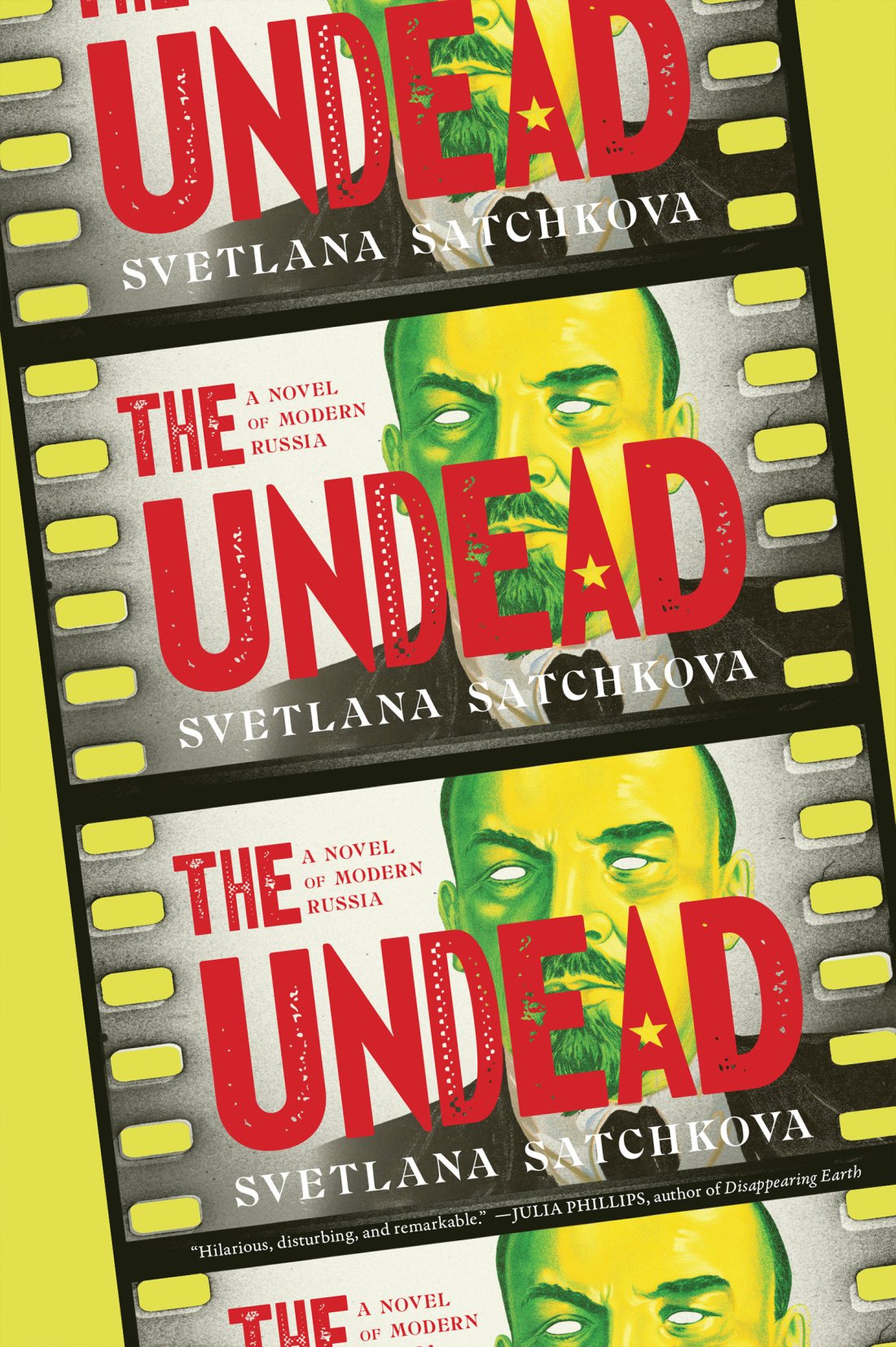
In this gripping tale of contemporary Russia, a young filmmaker and her friends run afoul of a government that ruthlessly oppresses artists who dare to satirize the regime

When Maya, a young Russian filmmaker, makes a low-budget horror movie with her friends, it seems like a promising start to a career in indie film. Little does she know that her jokey lo-fi film will soon attract the attention of the autocratic censors at the highest levels of the Russian police state.

What follows is a propulsive narrative of an artist being crushed by state power, and the choices that one makes within a system where free expression is literally illegal. Written with the undeniable voice of a emigre from Putin’s Russia, The Undead is a tense, piercing story that serves as a parable, and a warning, about political oppression.

Contributors

Svetlana Satchkova is a Russian-born journalist and writer who immigrated to the United States in 2016. She is an established arts journalist with bylines in the Rumpus, Newsweek, LARB, and others. She is currently a research fellow at the Jordan Center for the Advanced Study of Russia at New York University, has an MFA from Brooklyn College, and lives in Brooklyn. The Undead is her first novel in English.

Praise

“[An] exquisite balance between contentment and foreboding, tranquility and chaos” — Vogue

“Chillingly examines the Russian government’s stranglehold on the arts and media industries …. a convincing cautionary tale of the dangers of political apathy.” Publishers Weekly

“[A] brisk, vivid page turner” — The Milwaukee Shepherd Express

“There is nothing supernatural about the zombies in Svetlana Satchkova’s savvy, frightening novel. They are all of us, wherever we are, who keep looking away when authoritarian forces crush expression. Witty and unsettling, The Undead is a cautionary tale about, among other things, never quite admitting where the danger lies until it’s too late.” —Sam Lipsyte, author of The Ask

The Undead is a courageous and witty book about art and politics. With keen insight and wry humor, Svetlana Satchkova evokes a devastating artistic and moral reckoning. This fascinating, propulsive novel will stay with me.” —Helen Phillips, author of The Need

The Undead has the force of an undertow, pulling us relentlessly away from safety. Svetlana Satchkova has written a gripping, haunting portrait of a world coming undone.” —Madeleine Thien, author of Do Not Say We Have Nothing

In The Undead, the career and well-being of Maya, a young filmmaker in Moscow, unravel in the most bizarre, realistic way, showcasing the insidious, absurd nature of a totalitarian state. Deeply informative and engrossing, The Undead examines how bizarre and horrific human nature can evolve under the pressure of the desire to live unharmed rather than free. A moving examination of the meaning of home, the horror of a dictatorship, the hilarity and joy of movie-making, and one woman’s political coming of age in Putin’s Russia. Truly important reading for our times.” —Paula Bomer, author of The Stalker

Source: Melville House. The emphasis is mine. ||||| TRR


Glinstake, “Live at 16 Tons”

Glintshake‘s performance at the club 16 Tons on 2 April 2016.

Setlist:

  1. Halfman
  2. My New Style
  3. Squalor
  4. Shadows
  5. Fifteen Minutes to Five
  6. The Steppe is the Place
  7. Have a Heart 8
  8. Phoenix

ГШ (GLINTSHAKE): Facebook •. VKSoundcloudiTunes Instagram

CREDITS:

Camera: Alec Mirzametov, Anton Rodionov • Editing/Grading: Alec Mirzametov

Source: Alec Mir (YouTube), 30 May 2016. Annotation translated by the Russian Reader. The emphasis is mine. ||||| TRR


Glintshake, “Have a Heart” • Erarta Museum, St. Petersburg, 2 April 2017 • Source: Denis Morozov (YouTube)

[Verse 1]
Beyond the bright lights
Of sleepy buildings
Lines in the snow
Send signals
From distant stations
Docks are waiting
Waiting in the fog
For distant shores
In the haze of summer
In the arctic circle

[Chorus]
Have a heart

[Verse 2]
A gusty wind
Noise on the line
The compactor gently crushes the white Volga, waves splash
The markings are washed away
The airfield is not visible in the fog, the camera clicks
The speed drops
The waves crash
The earliest
The most distant flight
Faces and shadows
Of random passersby

[Bridge]
In dark apartments
In yellow deserts
In blue snows
In fiery rivers
In the foggy sea

[Chorus]
Have a heart

[Outro]
Salt on the dials
The needle flutters
The airfield is invisible in the fog, the camera clicks
Step on the gas!
In the endless field, in the pink jungle, in the summer haze
Have a heart

Source: Genius. Translated by the Russian Reader


Glintshake, “Halfman” (2016)

[Verse 1]
Headlights, I see a shadow
Someone’s been hanging around for days
Standing around the corner
Lying on the grass under the window
A bloodsucker
Or the corner
Loading
His black barrel
His black barrel
His black barrel
His black barrel

Who is he, a skinner
Or a TV reporter
A maniac, a Satanist
Or a Russian Orthodox Stalinist
I hear the wind
An ominous moan
The pungent scent
Of pouring cologne

[Chorus]
A halfman
Roams Moscow
A halfman
In a half-jacket

[Verse 2]
Strolls in places
Where everything is sold without a passport
Zhiguli cars are burning
We gotta move before they sweep us away
Gritting my teeth
I dance
In a techno club
Four days

When I grow up
I’ll stop thinking and understand everything
The light of faith will dispel the darkness
My same-sex marriage will fall apart
I’ll go out into the world
I’ll throw away my syringe
I’ll become the best
Of all the shop girls

[Chorus]
A halfman
Roams Moscow
A halfman
Not in his right mind

Source: Genius. Translated by the Russian Reader


In my days as a magazine editor in Russia, I used to write about movies Volodymyr Zelensky starred in. I thought of him as a decent actor and a nice enough person. Over the last few weeks, I’ve seen him turn into a towering historical figure. Watching his impassioned address to the UN Security Council, in which he spoke about war crimes committed by Russian troops in a town of Bucha, I caught myself thinking that I want Russia’s next leader to be just like him – courageous, principled, and boundlessly empathetic.

In the fall of 1993, I began my first semester at NYU. Just one year earlier, I’d been a regular Moscow teenager, whose wildest ambition was to own a nice pair of jeans. But my father had been offered a job at an American company, and our family relocated to New York. With the move, the world suddenly opened to me, possibilities beckoning. My father, ever the practical man, told me to study business. Ever the obedient Soviet child, I didn’t protest, despite the fact that nothing could interest me less — but fortunately for me, there was no such thing as a business major at NYU, and, when I got my BA in philosophy, I moved back to Russia, leaving my parents and younger brother behind. The fact that I did so was testament to how profoundly I’d changed in four years.

I was barely 20, but my reasons for returning were clear. I’d fallen in love with a man who lived in Moscow, and I longed for the glorious city which I still considered to be my home. In 1997, Moscow was an exciting place where everything was changing at an incredible pace. New lives were being built on top of the remnants of the USSR. I also felt drawn to Russian intellectual culture, having started writing my first novel in Russian, and I wanted my child, whom I was already carrying, to speak my native language as fluently as I did.

My marriage to the father of my son didn’t work out, as was perhaps expected of a union between people so young. But I was busy becoming who I wanted to be — a writer and a mother — and quickly bounced back. Meanwhile, Russia continued to change. In August 1999, I saw Vladimir Putin on television for the very first time, introduced as the new prime minister. I’ve never been particularly politically astute, but at that moment, I saw in his face, as in a crystal ball, what was going to happen in the years to come: the scheming, the corruption, the crackdown on independent media, the police state.

In September of that same year, a series of explosions destroyed several apartment blocks in the cities of Moscow, Buynaksk, and Volgodonsk; over 300 people died and 1700 were injured. I remember watching the news late at night, my two-year-old son asleep in the next room, and trembling in fear as I wondered if my building would be next. I imagined the most horrible thing – not that we’d both be dead, but dying, separated by fallen walls, him calling me, pleading for help. In a few days, rumors abounded that it was Putin who’d ordered the explosions with the aim of blaming them on Chechen militant Islamists. He became president in 2000, after starting the second war in Chechnya and famously having promised to “snuff ‘em in the outhouse,” to the delight of the majority of the population of Russia.

Had I believed my initial premonition, I would’ve left right away, but I liked to think of myself as a rational person. And so I tried to convince myself that I was being paranoid. It wasn’t easy.

Over the next ten years, Putin’s regime took away people’s freedoms in tiny steps that were probably meant to be unnoticeable, while he gathered enough power for himself that he could change the constitution and effectively be president indefinitely. Meanwhile, I built up my Moscow life. I was a writer, but I was also a single mother whose relatives lived across the ocean, and I worried about what would happen to my son if anything happened to me. So, though I wanted to report on the shrinking of democracy, I wrote instead about beauty and culture. In this way, I thought, I’d protect myself from the dangers of those who covered nationalist movements and wars. I wouldn’t end up dead, like Anna Politkovskaya and countless others.

But self-preservation under a regime like Putin’s can only take you so far. In 2014, when the people of Ukraine ousted their pro-Russia president Victor Yanukovych from his office, Putin swiftly moved into the neighboring country and annexed the Crimean Peninsula. Russian society split into two opposing camps, one cheering Putin’s maneuver and the other incensed by it. The question “Who does Crimea belong to?” became the most salient marker of “them” versus “us.” Marriages crumbled under the weight of this question; friendships were irreparably broken; people became estranged from their parents. Later that year, a provision to the criminal law obligated all dual nationals to report to the authorities. I made a copy of my American passport, filled out the requisite forms, and went to my local branch of the Federal Migration Service. The man who inspected my documents had the unmistakable air of someone who was embroiled in Russian state bureaucracy, at once condescending and menacing. He made it exceedingly clear what he thought of the likes of me, and when I came home that evening, I told my partner that, finally, I wanted to leave Russia for good.

It took us another two years to make the move, and we arrived in the United States in 2016. I began writing fiction in English and continued to work for Russian media outlets that didn’t support Putin’s regime. Still, I was careful not to write about politics, knowing that, if I went back to Moscow, I could face prosecution. Everything changed this February, however: Putin’s invasion into Ukraine — a country that I’d visited often and love, a country where many of my friends hail from — made it impossible for me to keep silent. I need to say publicly that this war is abhorrent and that Russians do not equal Putin –– even those of us who, like me, have been afraid to speak out in the past.

I do realize that I’m able to take this risk because I’m in New York, protected by my American passport. A law has been passed in Russia that prohibits its citizens from using the word “war” to refer to the “special operation” that’s taking place in Ukraine, and effectively prevents them from saying they’re against it under the threat of imprisonment. My heart goes out to all the people back home who feel the same way I do. I know that there are many of them and that they are experiencing crushing guilt for failing to somehow stop Putin, the president they didn’t elect. And while we’ll agonize for a long time over the question of what more each of us could have done, it’s beyond clear that peaceful protests don’t stand a chance against Putin’s weapons and his complete disregard for human life.

Source: Svetlana Satchkova, “I’m Russian and I stayed quiet about Putin for a long time. This is what I really think,” The Independent, 11 April 2022. The emphasis is mine.||||| TRR

Leavers vs. Remainers, Vol. 1

anatrrra, On the Arbat, December 2024

Kirill Medvedev,* a poet, publisher, and member of the band Arkady Kots, left Russia in 2023 and returned in late 2024. At Republic Weekly’s request, he explains his winding road, what Moscow looks like when one hasn’t seen it from the inside for a long time, and what remainers have to say about leavers.

After a year and a half of living in other countries for personal (but, of course, political) reasons, I have been living in Moscow for several months now. Despite certain risks, I really don’t want to leave, and I am terrified of everything having to do with living in exile. I’m willing to speak in allegories or even to keep silent altogether just to be able to live in my hometown. Although what could be more important than waking up in the morning and smacking the Putin regime in the face without pulling your punches?

Everything in Moscow is still familiar and homely. I am indifferent to Sobyanin’s renovations. Things have improved in some places, while in other places it’s the reverse. Half-abandoned spots have suddenly emerged even in the most expensive neighborhoods, as if the money had suddenly been hoovered out of them. I’m certain that’s literally what happened.

I don’t see any particular feasting amid a plague, but I guess I’m just not hitting the right spots. Moscow has become more desolate and wild on the whole. When the capital is finally moved to Siberia, the Moscow I know and love will look even better. But for now, it is still what it is: a crazy quilt fashioned from Eurasian chaos, absorbing a million shades of the glitz and poverty of the entire country and its neighbors, and tempting us with new revolutions somewhere in its squares and back alleys.

All of Russia can be found in Moscow, and yet, as everyone knows, Moscow is not Russia. Thanks to this fun fact, it is easier for Muscovites than for anyone else to love the entire country, albeit an imaginary and unfathomable country, shaped from different scraps. “I stand as before an eternal riddle, / Before a great and fabulous land,” sang one remarkable Muscovite. I repeat another poet’s line about another city, thinking that love for one’s capital city and one’s country is an enormous, complicated privilege: “May it not be my lot / To die far away from you.”

Online public communication habits have actually changed a lot because of the risks involved. It no longer feels like your event didn’t happen if it wasn’t written up online and if you didn’t post a photo of yourself with a crowd of happy spectators.

There are [now] more personal channels of communication within communities and more word of mouth. Reactions are more reserved in public and more emotional among friends. Pardon my sentimentality, but there is little to compare with physical hugs with friends and family in a city charged with your own and other people’s memories.

Of course, there are a lot of new problems, and I’d rather deal with some variety of internet addiction than the nightmare in which everyone has found themselves. And yet there is the perception that the war has ushered in the degradation of all ways of living in Russia. This is not true. Humans are ultra-creative and crafty creatures. Violent shocks do not neutralize life but propel it into new forms. A caveat: no new ways of living and creating can justify the mass murder of people who will never wake up to life again. But cultural, activist, educational, and other communities who persist and change, albeit semi-clandestinely, albeit at the cost of compromise or risk, increase our chances of transitioning to a different way of living in this country in the future. The more allies we have here at home now, the more likely they are to be in the right place at the right time—that is, if the first flights our friends who have been shoved out of the country plan to take are delayed a bit.

Irony or irritation towards the people who have left [Russia] for one reason or another is evident among almost all those who have stayed, except for those who are definitely planning to leave. One of the frequent complaints is “They left to live in safety, and they did the right thing—they just shouldn’t pass it off as a political act.”

That is true, though with many caveats. Bravo, of course, to the activists who have been helping people who have to leave to get out of the country and to adapt to life abroad. Bravo to the journalists who have moved to relatively safe places and continue to fulfill their professional obligation to their fellow citizens. Regular albeit serious news, reported with respect for themselves and the audience, without unnecessary harshness (“so that you can send it to your grandmother”) is needed desperately: almost everyone talks about it. But pessimism and aggression about life inside the country on the part of fellow citizens who have left the country is completely out of place. It is clearly old-fashioned exile self-therapy and should be practiced in private.

While the demand for alternative information is great (many people in the USSR who were not necessarily anti-Soviet also listened to Voice of America), one can see skepticism or simply a lack of interest in émigré politics. Why is this the case? There seem to be many examples in history when political émigrés came back home, were involved in great transformations, or even spearheaded them. Escaping from prison in Russia, making one’s way abroad, drinking to a successful adventure with comrades in Geneva, discussing future strategies in a relaxed atmosphere, and soon returning home to work underground was a typical trajectory for Russia’s radical democrats in the early twentieth century.

Things have changed since then, although today many also travel back and forth. You can talk at length to those who have stayed in Russia about the hardships of emigration, and they will agree and sympathize with you, especially if you were actually in danger here at home.

For the most part, though, people still see someone else’s moving abroad as their means of upgrading their private existence.

By renouncing your past life, it is as if you automatically renounce your past community. The propaganda, of course, does its best to inflate the resentment, but it’s not just propaganda at work. Emigration is indeed an experience of constant self-denial. Especially today, when Russian emigrants are so evidently prodded (gently and not so gently) to cancel themselves in terms of of their citizenship, background, language, identity, or even flag. Moreover, the reanimated ethical-religious discourse of the Cold War, with its confrontation between good and evil on a global scale, has played a considerable role in this.

The field where dialogue should have taken place between leavers and remainers, as well as between moderate oppositionists and hesitant loyalists, has been overrun by moralizers in proverbial white coats and rabid patriots. They are the dividers and conquerors.

The leavers more often argue in terms of negative freedom—freedom from censorship, political crackdowns, and military mobilization, from having to indirectly finance the war or live among its supporters. The remainers stay because they do not see how they can realize themselves abroad, at least not without the sort of superhuman effort and self-denial that many of them find more frightening than living under the threat of arrest or self-censorship. They often speak of duty—to elderly relatives, students, patients, voters, political prisoners, the graves of relatives, the homeland, etc. And they often hear in response that it is immoral to be involved in the normalized life in today’s Russia. The ethical conflict is evident.

I wander the Pokrovkas and the Ordynkas, thinking about where I can get money to pay the bills and pay off my debts. There are posters calling for men to sign up for the army. Somehow I don’t feel more upstanding than the guys who go off to kill for money. I would definitely not go to do that, but this certainty does not raise my moral self-esteem. I think of an old comrade who perished in the “special military operation.” His debts, low social status, and leftist anti-western ressentiment had blossomed into imperialist obfuscation.

I sit in a cafe, thinking about my plans. The people around me talk about different things, while people in a neighboring country are bombed in our name.

I’m good at displacing unpleasant things. We all are good at it.

Being here, dissolving into this life, it is difficult to feel like a member of an ethics committee. It’s easier to realize that all people are basically the same, that there are no insuperable differences between them. All our actions (whether ordinary, shameful, or magnificent), all the passivity of the masses, all the revolts of nations, are manifestations of the same human principle in different historical circumstances. The way humanness manifests itself in our present circumstances, the way my own humanness manifests itself in them, is the most interesting thing to observe. Okay, we’ve established that.

No, of course, there is a huge difference between opposition to evil, passive non-participation, and complicity in it. Putin’s propagandists have been blurring the distinction between the first, second and third to depoliticize and morally degrade society. We know this, and you can’t fool us. In both the secular and Christian systems, a person always has a choice and a responsibility for it. We should not see the individual as a unwilling victim of want and propaganda. But something else is also true: even if you believe that you have made your own super-correct moral choice once and for all, endlessly judging your neighbor, or believing they are made of some qualitatively different stuff than you, or finding them complicit in collective guilt without trial is also a quite devilish temptation, akin to the temptations proffered today in our country by various spiritual and political leaders.

Political evil is countered not by personal virtue, and even less by moralistic posturing. It is countered by political or civic ethics, but our country has a huge problem with that.

All the debates between the leavers and the remainers, all the debates over the slogans “peace now” vs. “war until the dictatorship’s defeat,” all the debates about whether Navalny should have returned to Russia, revolve around the missing answer to the ethical (aka political) question: for what are we willing to risk our private lives, for what collective ideals?

I certainly don’t have a clear answer. Russia is long past the heroic times of liberalism and socialism, when people believed that civic heroism was not weak-mindedness or recklessness, but a deliberate, mature step toward a better future. Popular willingness to take to the streets against war and dictatorship is impossible without the conviction that we are on the right side of history, that we are in a movement that both overlaps with and transcends our private interests.

The Bolsheviks believed in communism’s inevitable advent on a global scale, and were able to convince many people this would happen, which was why they won. In 1991, Russians believed that by defending the [Russian] White House and confronting the coup plotters’ tanks, they were leading Russia onto the road of progress which all democratic nations were already rolling down. Whether we like it or not, Russia is not ready to follow any well-trodden path. There is no single road anymore: the road is just going to have to be paved anew. (I’m reckoning on this.)

Today we see a faint glimmer of hope in republicanism, with its idea that community spirit is not a consolation prize for people who lack professional fulfillment and personal happiness. It is not reducible to a professional or personal virtue and is not a profession itself.

Anyone willing to stand with others to oppose tyranny and then work every day to prevent it from happening again is capable of demonstrating civic valor. And the brighter, bolder and more constructively a person commits to this work, the more they make use of their professional, creative and other kinds of potential, the greater their authority in the community will be and the more likely they will remain in the community’s memory. This sounds good as a motivation, but if the republican ethic is realizable, then it is realizable in the small and medium-size spaces of campaigns around residential buildings, courtyards, neighborhoods, and (at most) cities, where it is possible to find analogues of the ancient Greek square for people to hold meetings.

A national community is imaginary, no matter how you look at it, and it is based on a rather sketchy common historical plight and collective memory. If we do not want it to be the memory of how “everyone was afraid of us,” it should be the memory of how we survived together and resisted—secretly and explicitly, passively and actively—the extermination of others and self-extermination, of how we built ties, engaged in “culture,” taught children, supported political prisoners, and helped the bombing victims and the homeless.

This is the ground of community, a ground not nourished by moral superiority, by denying oneself and one’s roots, or by essentializing differences. It is nourished by responsibility for the people who stand or have stood next to you in the same squares and the same queues, for the people who walk the same streets, who went to the same schools, who share the same hopes for the future.

If we indeed stand on this ground, then it makes sense for us to challenge and set our hearts on something together.

* Medvedev has been placed on the Russian Justice Ministry’s registry of “foreign agents.”

Source: Kirill Medvedev, “I Returned to Moscow from Exile and I Don’t Want to Leave,” Republic, 5 January 2024. Translated by the Russian Reader


Yosif [sic] Brodsky, “Stanzas to the City,” trans. Nicholas Zissermann, Landfall 20, 2 (1966): 152. You can read the original poem in Russian here.