Minnesota Now, the U.S. Then and Now

I want to try and describe what it is like in Minnesota right now for my friends in other states. As a reminder, Alyse and I live in the suburbs — Apple Valley — not Minneapolis. This federal invasion and occupation is occurring all across the state, not just in Minneapolis.

ICE is not looking for specific people. They don’t have a sheet of paper with specific names, specific addresses, that they are arriving in communities to get. They drive around looking for kidnappings of opportunity.

So they will sit and idle in their car, waiting for a Black, brown or Asian person who is walking into the gas station, taking out their trash, walking their dog, or working at their job and then swarm and grab them.

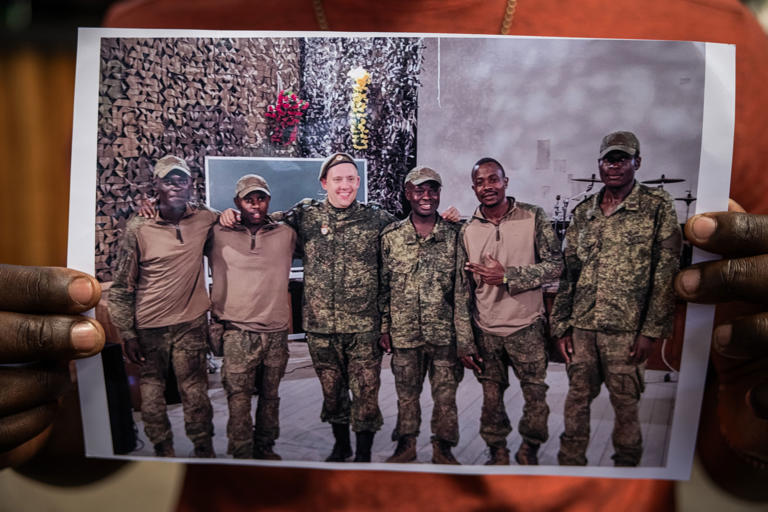
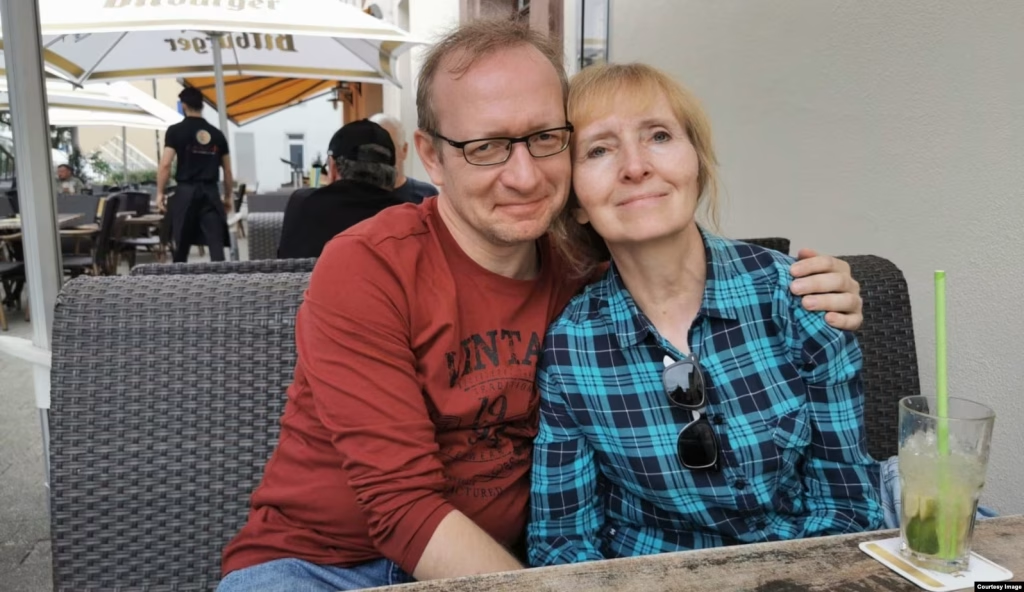
ICE drives around *incredibly recklessly* and uses license plate readers to find people with mostly-Hispanic sounding last names, pulls them over, and kidnaps them. Again, these aren’t specific people ICE has been tasked with finding. Most of the people who are kidnapped are U.S. citizens, lawful permanent residents, or have legal status of some sort (work permit, a social security number, or are a refugee or asylee) (picture 1). These are documented immigrants or citizens who have broken no laws — including not having broken laws entering the country. These are people just going about their daily life who get stopped and snatched because they’re Black, brown or Asian.

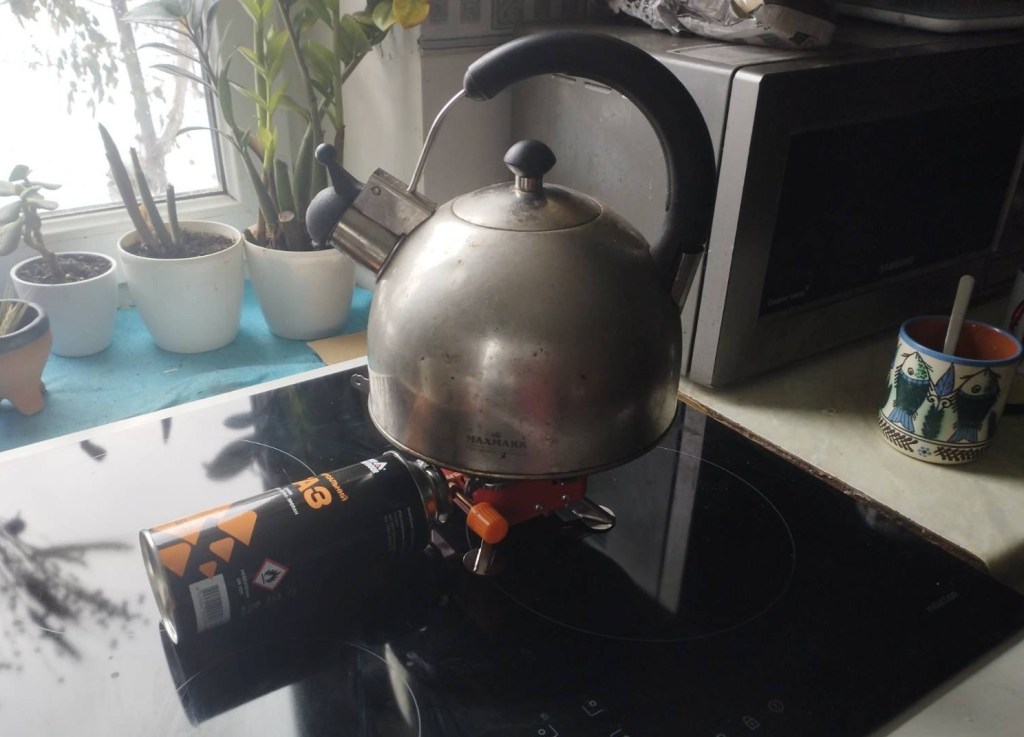
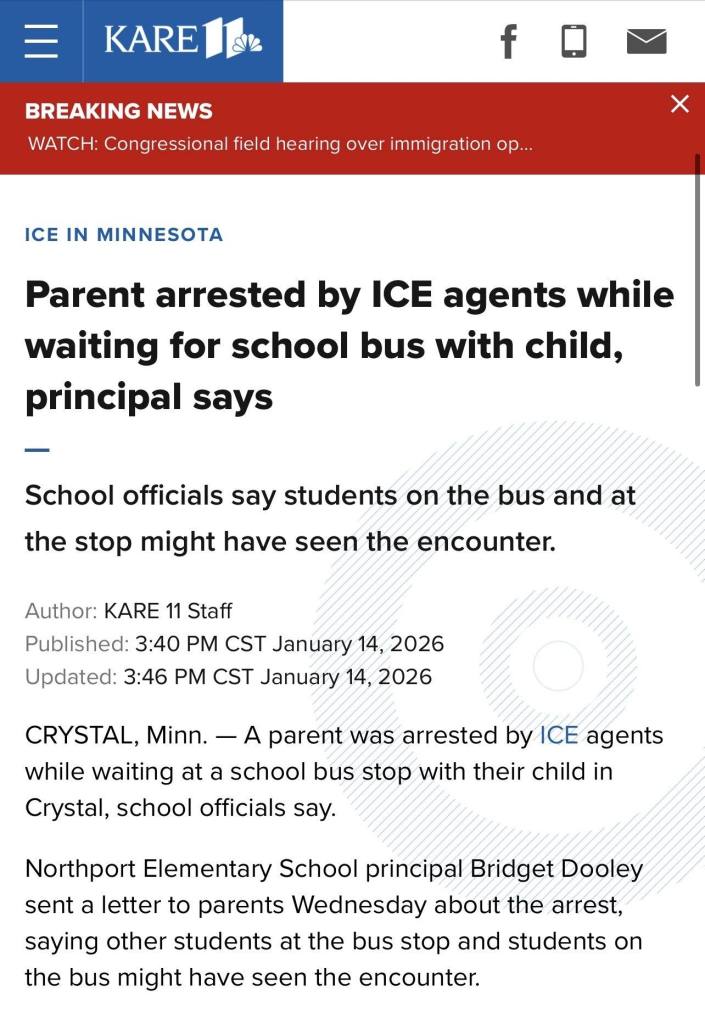
Just going about OUR daily life, we see abandoned cars in the middle of highways, on neighborhood streets, in front of doctors offices. Sometimes the doors are still open and the car is still running. We could be in line to get Burger King and watch ICE snatch a teenager on his way into work (picture 2). We could be taking out the trash, walking kids to the bus stop, going for a walk outside, and there will all of a sudden be a swarm of anonymous, masked, violent men ripping a family from their home or out of the booth at a restaurant. Picture 3 is a neighborhood, one mile from my house, at 8:30AM this past Wednesday. It was school bus pick up time and also trash day in that neighborhood. This is just in the middle of the neighborhood.

This can happen any where at any time. There is no place we can go and be assured we won’t see someone be violently taken. Target. The grocery store. A restaurant. Driving Hattie to swim lessons. Driving to church. Going to the doctor (picture 4). Multiple times a day, we get texts from co-workers, neighbors, friends, family members about a person they know (or are related to, or work with, or are their kids’ friends parents) who was taken.

ICE sets up checkpoints in neighborhoods and make everyone leaving or entering show their papers (note: very few people can prove their citizenship at a moments notice. A majority of Minnesotans don’t have passports. Citizens don’t just carry their birth certificate around). They go door-to-door in apartment buildings and neighborhoods, just hoping a Black, brown or Asian person will open their door (because they have no judicial warrant to take a specific person(s), just kidnapping whoever accidentally opens their door).

Schools have had to close. ICE has shown up to schools and just pepper sprayed kids and parents (picture 5). Districts are calling families and advising that their kids switch to online school. ICE circles and targets Spanish-immersion programs, forcing moms and dads to sit watch over their kids’ school to keep their kids and teachers safe (picture 6). Kids come home from school to empty houses, their parents having been stolen sometime during the day. When parents are kidnapped in front of others, they will yell out their full names and the name of their kids’ school(s) so someone can call the school and alert the administration, hoping their kids can be put with a safe adult instead of coming home to no one. There are people who signed delegation of parental authority (DOPA) forms — agreeing to take a neighbor or friend’s kids in the event of an emergency — who now have multiple children from multiple families.

ICE is ubiquitous. They are everywhere. We see them 3, 5, 7 times a day just going through our normal routine. There are more federal agents in Minnesota than there are local law enforcement from the ten largest metro police departments COMBINED (picture 7).

This is going to come to other states and I want people to be prepared, because I cannot overstate how many people have (had to) come together to respond.

Regular Minnesotans — people who have never once gone to a protest, called their elective representatives, participated in an economic strike, people who rarely even vote — have been activated. Grandparents carry whistles in their cars in case they come across ICE while living their lives and need to warn the surrounding area. Parents of kids in K-12 organize to ensure there’s parents at bus stops and the area around schools, because ICE stakes out bus stops and school properties — taking parents who are waiting at the bus stop or in the carpool line (picture 😎. We’ve set up massive food donation and delivery infrastructure. We organize rides to school and work. People are literally taking in families.
SO many kids aren’t going to school right now (picture 9). So many businesses are closed or have lost their customer base entirely. So many families are facing eviction because they can’t go to work and won’t be able to pay their rent.

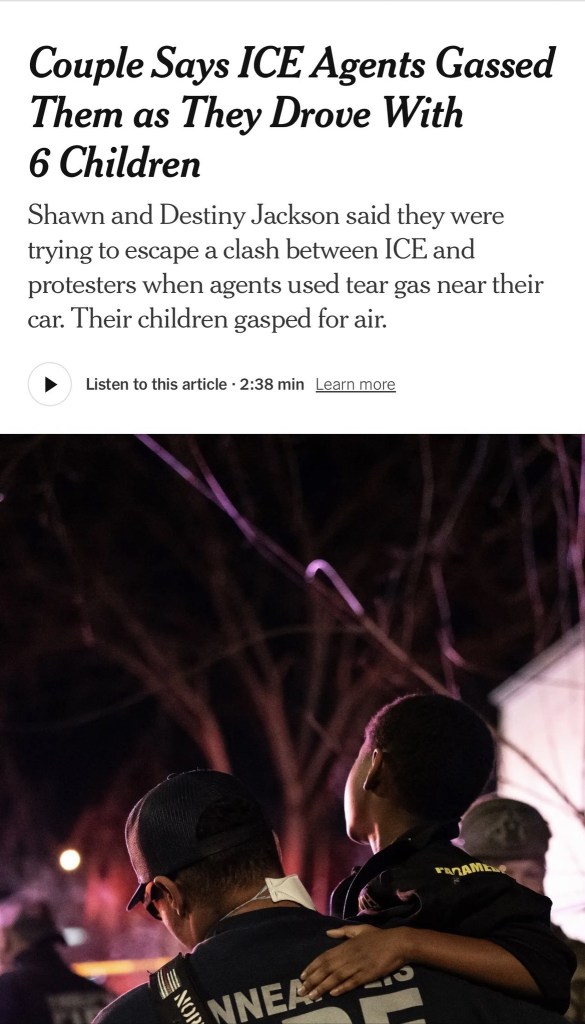
Minnesotans are being collectively punished and traumatized. 6 month old babies have been teargassed because their parents are just driving in their own neighborhood (picture 10). We are coming together in the most beautiful ways — I don’t want to understate that. But I want everyone outside of Minnesota to understand: we are under a federal invasion and occupation of armed, masked, paramilitary that roam our streets, brutalizing, harassing and murdering with impunity.

There may be people who might think that when this comes to your state, being white or being a U.S. citizen or living in a suburb or rural area or living in a neighborhood with few or no immigrant neighbors means you won’t see or experience this kind of daily assault of an invasion and occupation. I want to dispel that idea.

There are things I’m forgetting, certainly, but I wanted to try and paint the picture because this isn’t ending in Minnesota. We are the test case before expanding to other states in the country.

Help us now to stop this before it spreads. Organize in your communities now.

To support MN’s during this time, donate here: http://standwithminnesota.com/

Source: Erin Maye Quade (Facebook), 18 January 2026. Thanks to Rahul Mahajan for the heads-up.


On January 7 U.S. Immigration and Customs Enforcement (ICE) agent Jonathan Ross shot and killed Renee Good, a thirty-seven-year-old woman who had been observing ICE raids from her car in her Minneapolis neighborhood. In videos of the incident, we can see Ross firing through Good’s windshield and open window as she begins to drive away. The horrific footage of the killing felt like a stark symbol of today’s authoritarian moment—but at the same time, I knew that anyone involved in the struggle against police violence would find it tragically familiar.

To put Good’s killing in context, I spoke with historian and Boston Review contributing editor Robin D. G. Kelley, whose forthcoming book, Making a Killing: Capitalism, Cops, and the War on Black Life, covers the history of county, state, and municipal police violence—as well as the activism against it. In an email exchange, we discussed the pitfalls of the “perfect-victim narrative,” policing’s terror tactics, why agents don’t need more training, and where we go from here.

Deborah Chasman: Good’s killing shocked Americans. But much about it reflects violence that’s very familiar to you. Can you put the murder in the context of your research?

Robin D. G. Kelley: Despite having spent more than thirty years studying and writing about police violence, I am still shocked by every death—even when the outcome is predictable. But the killing of Good shocked even the most seasoned organizers. She was a white woman and a mother—two things you’re not supposed to be when armed agents of the state put you in a body bag. (That she was queer and a poet, not so much.)

Of course, the very idea that certain people, by virtue of their characteristics, don’t deserve to be brutalized, caged, or killed by police is the problem. Mariame Kaba warns against “perfect-victim narratives,” which reinforce what Ruth Wilson Gilmore calls “the problem of innocence.” Centering someone’s innocence clouds the case for abolition, which seeks to create a world where no one is caged or gunned down even if they broke the law. No matter who she was, what she looked like, her marital or citizenship status, or what she might have done in the past or even in the moment, Good had the absolute right not to be shot for driving away.

What doesn’t surprise me is why and how Jonathan Ross shot her and the federal government’s efforts to cover up what happened. Researching Making a Killing, I found too many incidents to count where police fatally shot people for attempting to drive away. These were not high-speed chases, by the way—sometimes it was just a car lurching forward or an engine revving up that prompted a shooting. They all have one thing in common: police justify the shootings as acts of self-defense. The alleged “suspect,” the story goes, intended to ram the officer, who opened fire because he feared for his life. After these shootings, cops rarely argue they were simply trying to stop a fleeing suspect, because it opens them up to two objections: that firing at a driver puts others in harm’s way, and that they could have taken down the license plate and pursued the person later. Fearing for one’s life is always used to absolve cops from having to explain why they didn’t act differently.

This is why, in videos of the moments before the shooting, we can hear Good’s wife Rebecca saying, “We don’t change our plates every morning, just so you know. It will be the same plate when you come talk to us later.” And this is also why, for many years and in different cities, movements fighting police misconduct demanded that officers be banned from using lethal force against fleeing suspects who do not pose an imminent threat, whether on foot or in a car.

I’m also not shocked by the utter refusal of the federal government to investigate or consider bringing charges against Ross. I’ve lived through and documented so many cases of officers whose egregious acts of violence led to no indictments and no investigations; so many cases of police and even prosecutors destroying incriminating evidence. The question is, why are so many people surprised and indignant about the feds’ unqualified defense of Ross? Maybe because we’ve fallen into the trap of distinguishing ICE and CBP (bad) from local police (good). Maybe it’s a residual effect of the January 6 insurrection, in which some police officers had been victims of right-wing mobs (which themselves included a disproportionate number of cops and soldiers). In any case, the narrative has taken hold that ICE agents are rogue cops or cops on steroids, trained to terrorize or simply untrained. Strangest of all in this story is the liberal pipe dream that local police will stand up against ICE and CBP, when police have collaborated with ICE and been deployed to protect agents from protesters, even in so-called sanctuary cities.

I’m not sure if it’s amnesia or just wishful thinking, but it seems like the well-documented terror tactics of municipal, county, and state police have just disappeared from people’s memory. Chicago and Los Angeles, where resistance to ICE has been extraordinary and well-organized, have histories of police violence that rival anything ICE agents are doing. Indeed, it is precisely the long experience of organizing against this violence that prepared activists in these cities to resist ICE.

Chicago, which takes up a very long chapter in my book, is known for police torture, the maintenance of secret “black sites,” assassinations and executions, and prosecutors who have consistently protected police even to the point of hiding evidence. This is the city where the second Black police superintendent, LeRoy Martin, bragged in 1987, “When you talk about gangs, I’ve got the toughest gang in town: the Chicago Police Department.” And it is the same city that has been a model of resistance to police repression for more than half a century, culminating in the collective struggles for justice for Rekia Boyd, Laquan McDonald, and victims of torture that brought down the ruling regime of Rahm Emanuel.

This is not to diminish ICE and CBP’s violent tactics. These outright abductions are terrifying, though again, not without precedent. Police have abducted Black men standing on a street corner or a stoop and tossed them into unmarked vans just for looking suspicious, and there are numerous cases of young Black women abducted off the streets and sexually assaulted by police. But there is a fundamental difference between these abductions and ICE’s: the former were intended to be secret, the latter publicized. ICE and CBP agents are either filming these acts of terror themselves (Ross had one hand on his gun and the other holding his cell phone to film!), or they are arriving with a film crew. The point is to create fear, to terrorize people into submission, to create a state of emergency.

Finally, let’s try not to make these attacks about Trump or even Stephen Miller. Both ICE and CBP have histories of violence dating back to well before 2016. My colleague Kelly Lytle Hernandez has written on the history of the Border Patrol, which has been terrorizing people since 1924.

DC: Republicans and right-wing pundits have been relentless in blaming Good for her murder, or calling her a domestic terrorist and warning that any activism will put you in harm’s way. Clearly there’s a legal element to blaming Good—it’s meant to exonerate the agent. But how do those narratives function politically?

RK: Anyone organizing against state power will be a target, whether their protest abides by the law or involves civil disobedience. Either way, nothing justifies the harm, which is what these narratives attempt to do. Just last night, after ICE shot another person in Minnesota and protesters were in the streets battling federal agents, there was a lot of talk—including from Governor Tim Walz and Minneapolis Mayor Jacob Frey—about the need for peaceful protest: code for candlelight vigils and silent prayer. Militant civil disobedience, aggressively confronting a phalanx of masked agents in riot gear, or blocking traffic is nonviolent, but these tactics are not considered by the political class to count as “peaceful protest.” And by now, it should be clear that peaceful protest, whatever form it takes, will not get ICE or CBP out of your city; it will not stop the terror or the abductions.

And yet, when we return to Good’s death, we must remember that she actually wasn’t protesting. She was a legal observer doing her job, and when told to leave she was complying. Unsurprisingly, J. D. Vance and all the right-wingers who blame Good for her death are simply lying. Calling her a domestic terrorist—it’s the oldest trick in the book. The subtext to which we ought to pay attention is how her gender and sexuality constituted the real threat to Ross, his fellow agents, Vance, Stephen Miller, and MAGA. One must imagine what it meant to Ross for a smiling queer woman to tell him, “I’m not mad at you.” After shooting her three times, Ross or an agent near him mutters, “Fucking bitch!” That says it all.

Nearly every victim of an ICE or CBP shooting is blamed for being either a fugitive or domestic terrorist. When ICE agents fatally shot Silverio Villegas-González, a thirty-eight-year-old immigrant from Mexico, as he tried to drive away from what amounted to an ambush in Chicago, DHS released a brazenly false statement claiming that he “refused to follow law enforcement officers’ commands” and used his car as a weapon, hitting and dragging one of the officers. And so the same old story goes: “Fearing for his own life and broader public safety, the officer fired his weapon.” We know now that no officer was hit or dragged, and the one officer allegedly hurt suffered minor cuts from breaking Villegas-González’s window.

Likewise, when CBP agents shot Marimar Martinez, a thirty-year-old schoolteacher and U.S. citizen—also in Chicago—they labeled her a domestic terrorist and charged her with ramming a federal law enforcement officer. We know now that the agent, Charles Exum, rammed her vehicle, jumped out with his gun drawn, and said “Do something bitch” before shooting her five times. The DHS lies were so egregious (and Exum didn’t help their case by bragging about it in text messages) that the prosecution had no choice but to drop all the charges.

DC: In the wake of Good’s murder, many have called for better training for ICE officers—a response that activist Kelly Hayes, among others, has forcefully rejected. I know you agree. Can you explain why?

RK: Jonathan Ross wasn’t one of those cats recruited with a $50,000 bonus and handed a gun. Besides being a veteran of the Iraq war, he had spent a decade as a member of the special response team of ICE’s enforcement and removal operation. He got more training than most of the other masked goons running the streets of the Twin Cities. The argument for more and better training was thoroughly discredited after George Floyd’s murder in 2020. As it turned out, Derek Chauvin had lots of training: he had taken the crisis intervention training, use-of-force training, de-escalation vs. restraint training, and even training in implicit bias, which became mandatory for Minneapolis police officers beginning in 2018. The result? Chauvin racked up seventeen misconduct complaints over nineteen years on the force. And after 2018, cases of police brutality and excessive force complaints increased across the city.

But if training hasn’t worked, why does it continue? Why is it always trotted out, alongside new technologies, as the solution? Because training and technologies (body cams, Tasers, so-called less-than-lethal weapons, predictive policing software) are a boondoggle for corporate interests. Training costs money, which increases police budgets, which are paid for through taxes and bonds—a hidden source of revenue for financial institutions that administer the bonds. The money for training flows to private companies, usually run by former police chiefs and so-called criminal justice experts—not community organizations that have been fighting for accountability. Sometimes the investment in new technologies and training comes from corporate-funded private police foundations, whose donations enable departments to purchase equipment, such as surveillance technology, guns, ballistic helmets, cameras, and drones, and assist officers with bonuses or legal fees, with no oversight or public input. But corporations like Amazon and Google get a great return on their investment since law enforcement agencies adopt technologies of surveillance, data mining and management, etc., coming from these companies.

To understand what “training” produces, let’s focus on one company: 21st Century Policing Solutions, LLC (21CP), which grew directly out of an Obama-era task force formed in late 2014 after the killing of Michael Brown. 21CP is made up of law enforcement officials, lawyers, and academics, and it’s paid by municipalities and university public safety forces to train police in a host of areas: gaining community trust, racial equity, changing use-of-force policies, communication, transparency, strategic management, and community policing. Usually, this work entails producing reports that ultimately just repeat boilerplate recommendations. Oklahoma City paid 21CP $193,000 for a report many Black residents found to be useless—nothing changed. Aurora, Colorado, paid 21CP $340,000 to “investigate” the police missteps that resulted in the death of Elijah McClain, a young Black man who had been injected with ketamine under police custody and died. 21CP produced a 161-page report that primarily described the operations of the Aurora Police Department, compared it with other departments in similar-sized cities, repeated what we all know about the death of McClain, and offered obvious and fairly innocuous recommendations: prohibiting chokeholds, retaliatory violence, using force on people who are handcuffed—in other words, prohibiting behavior that is already prohibited. And worse, these reports often suggest recruiting and training more officers. I want to suggest that when we talk about training and technology, we need to follow the money. And in the case of CBP and ICE, the last thing we should be doing is proposing reforms that give them more money.

As the coercive arm of the state, the police—including CBP and ICE—are the primary instruments of state violence within the borders of the United States. They function as an occupying force in America’s impoverished ghettos, barrios, reservations, on the Southwest border, and in any territory with high concentrations of subjugated communities. For people who reside in these communities, keeping us safe is not the objective. Instead, the modern police force—whether local, state, or federal—wages domestic war. Whether we call it a war on crime, a war on militants, or a war on drugs, law enforcement at every level has turned many Black working-class neighborhoods in particular into killing fields and open-air prisons, stripping vulnerable residents of equal protection, habeas corpus, freedom of movement, and even protection from torture. The attack on non-white immigrants is just another front in a war the police have waged since their inception.

And despite the handwringing and outrage over the Trump administration’s flagrant violation of the Posse Comitatus Act of 1878 limiting the use of the military in domestic matters, the police have long functioned as an army against dissident social movements. The police are the first line of defense against strikes and left-wing protests, while often serving as a cordon to protect Klansman, Nazis, and the alt-right.

DC: What are the chances that Ross will be held accountable? How does this end?

RK: Simply put, Ross will not be held accountable, nor will anyone else responsible for the death or injury of victims of ICE or CBP attacks. As I document in my book, we can’t get accountability from the “regular” police, whatever that means: after decades, we haven’t been able to achieve something as basic as an honest civilian review board with subpoena powers and the ability to hire and fire officers! Since Trump’s second term, things have gotten even worse. Guided by the Heritage Foundation’s Project 2025, the Trump administration rescinded Biden-era police and criminal justice reforms; shuttered the National Law Enforcement Accountability Database (NLEAD) created in 2023 to allow prospective employers to access the records of federal law enforcement officers in order to check their backgrounds for misconduct; halted all open federal investigations into law enforcement, notably in Jackson, Mississippi, and New York City; ended federal consent decrees mandating reforms of Louisville and Minneapolis police departments; made the extraordinary offer of free private-sector legal services for officers accused of misconduct.

It is not enough to abolish ICE. We need to abolish the police and cages and build other institutions and relationships that can bring us genuine safety. Abolition is less an act of demolition than a construction project. It is creative creation, the boundless, boundary-less struggle to make our collective lives better, what Ruth Wilson Gilmore calls “life in rehearsal.”

Ironically, the federal government’s escalation of violence and its spillover into other communities have actually forced people to find their own strategies to keep each other safe, through communication, patrols, whistles, trainings in nonviolent resistance, and old-fashioned organizing. It’s not just about keeping ICE out, but making sure that the medical and child care needs of neighbors are being met, that people who can’t leave their homes out of fear are fed, and that some homes can become designated safe houses.

I’m reminded of a 2009 statement issued by the abolitionist organization Critical Resistance. Instead of police, the statement asks,

What if we got together with members of our communities and created systems of support for each other?. . . . Relying on and deploying policing denies our ability to do this, to create real safety in our communities.

We’re seeing this in action now in the mobilizations against ICE. The question is whether it can be sustained and turned into something that can replace our dependence on armed agents of the state to solve human problems.

Independent and nonprofit, Boston Review relies on reader funding. To support work like this, please donate here. Robin D. G. Kelley is Distinguished Professor and Gary B. Nash Endowed Chair of U.S. History at UCLA and a contributing editor at Boston Review. His many books include Freedom Dreams: The Black Radical Imagination. Deborah Chasman is publisher and coeditor of Boston Review. Her writing has also appeared in New York magazine and the Chronicle of Higher Education.

Source: Robin D.G. Kelley and Deborah Chasman, “Renee Good’s Murder and Other Acts of Terror,” Boston Review, 17 January 2026

(Anti)Fascism Tuesday

Federal immigration agents detained three people and deployed chemical agents at multiple locations around E. 34th Street and Park Avenue in Minneapolis’ Powderhorn neighborhood Tuesday morning. At least two were observers and not the target of immigration enforcement operations.

Around 9:40 a.m., community response networks began sending alerts about Immigration and Customs Enforcement (ICE) door-knocking at E. 34th Street and Park Avenue. By 10 a.m., a crowd of over 100 observers had gathered, confronting agents at multiple intersections. 

Among the detainees was a woman who was forcibly removed from her vehicle after agents smashed her passenger-side window. 

In a video taken by Sahan Journal, the woman can be seen arguing with agents prior to being grabbed by multiple agents and carried to agents’ vehicle. The woman can be heard shouting that she is disabled and on her way to a doctor’s appointment that ICE was obstructing. Prior to the detention agents had instructed her to drive away.

After being pulled out of a car, a women screams as she’s being arrested by immigrations agents at 34th and Park in Minneapolis on Jan 13, 2026. Credit: Chris Juhn for Sahan Journal

Shortly after, another observer on site was tackled and forcibly put in agents’ vehicle as well. According to state Rep. Aisha Gomez, DFL-Minneapolis, who was present at the scene, agents pushed the man’s head into the concrete prior to carrying him away. Gomez also said that agents were physical with her as well. 

“These officers have obviously not had the basic law enforcement training,” Gomez said. “I was shoved with no verbal communication whatsoever.” 

Andy Larson, a south Minneapolis resident who was out observing ICE activity Tuesday, told Sahan Journal that one protester kicked out the taillight of an ICE vehicle and was tackled to the ground up the road on Park Avenue and E. 36th Street.

“It was a really good kick,” Larson said.

The protester managed to escape ICE agents, Larson said. ICE deployed chemical irritants and shot pepper balls into the crowd and fled the scene.

According to Sahan Journal photojournalist Chris Juhn, a Hispanic man was also visible in the back of one vehicle. It is unclear whether the man was an observer or target of federal operations. ICE did not respond to Sahan’s request for comment on the operations. 

At multiple points during the operation, agents deployed chemical agents at observers. Agents fired pepper balls at observers’ feet and threw canisters of tear gas at the corner of 34th Street and both Park and Oakland avenues prior to leaving the scene. Eyewitness Moses Wolf said there was no singular precipitating event that led to tear gas being deployed on Park Avenue.

“There was a crowd confronting each other telling ICE to get out,” Wolf said. “I didn’t really see any physical altercation happening.” He said it appeared to be a tactic by ICE agents to exit the scene.

Wolf said the confrontation prior to the deployment of tear gas had not escalated beyond what had already been happening. 

“It wasn’t anything crazy,” Wolf said. “I turned around for one second and there was this whole entire cloud of it, and pepper spray came with that.” 

Eyewitness Neph Sudduth said at Oakland Avenue agents used tear gas as they were leaving.

“They were finally leaving, it was the last car of the convoy,” Sudduth said. “They just threw two or three canisters out at us as they left.”

Both Sudduth and Wolf said they witnessed agents using pepper spray out of the windows of their vehicles as they drove off.

“They just wanted to hurt us cause we told them how we felt, and they didn’t like it,” Sudduth said.

The operation in Powderhorn is part of a flood of federal immigration activity in Minnesota. As many as 2,000 federal agents are present in the state according to reporting from the New York Times, with an additional 1,000 set to be deployed. 

For Gomez, the clash with ICE is the new reality of life in the Twin Cities with federal agents present. 

“This is what our streets are like,” Gomez said. “We have these masked, unaccountable unknown to us federal agents, and it’s like they’re the secret police.”

Despite the difficulties, Gomez believes observers should and will continue to show up to meet federal agents in the streets. 

“Our community is undeterred,” she said. “We’re not going to just lay down. You can gas us and mace us all you want, we’re not going to just lay down.”

Sahan Journal reporter Andrew Hazzard contributed to this story.

Source: Nicolas Scibelli, “Crowd of 100 confronts immigration agents door-knocking in south Minneapolis,” Sahan Journal, 13 January 2024


1. Numbers

During the 2024 campaign, Donald Trump promised to deport every illegal immigrant who was a rapist, murderer, or thief. He also promised to deport 20 million immigrants. Some voters believed the first promise; other voters believed the second.

Because people are stupid, that first group of voters believed that there were 20 million undocumented immigrants who have committed felonies. This is not possible. The total number of people in jail in America today—this includes federal, state, local, and tribal land prisons—is just under 2 million. The number of undocumented immigrants who have committed serious crimes cannot be 10x the entire prison population of the United States. If it were, then daily life in America would look like Escape from New York.

So some Trump voters were duped owing to their general ignorance and/or innumeracy.

But others were not. Others signed up for Trump because of his second promise (the 20 million deportations) and viewed the first promise (about deporting only criminals) as the pap necessary to get the suckers onboard.

There are two crucial questions about these two groups. The first is:

What is their relative size? What percentage of Republican voters were tricked into voting for Trump’s immigration policies versus what percentage are getting exactly what they wanted?

Would you like to guess? Go ahead. I promise that whatever you’re thinking, it isn’t dark enough.

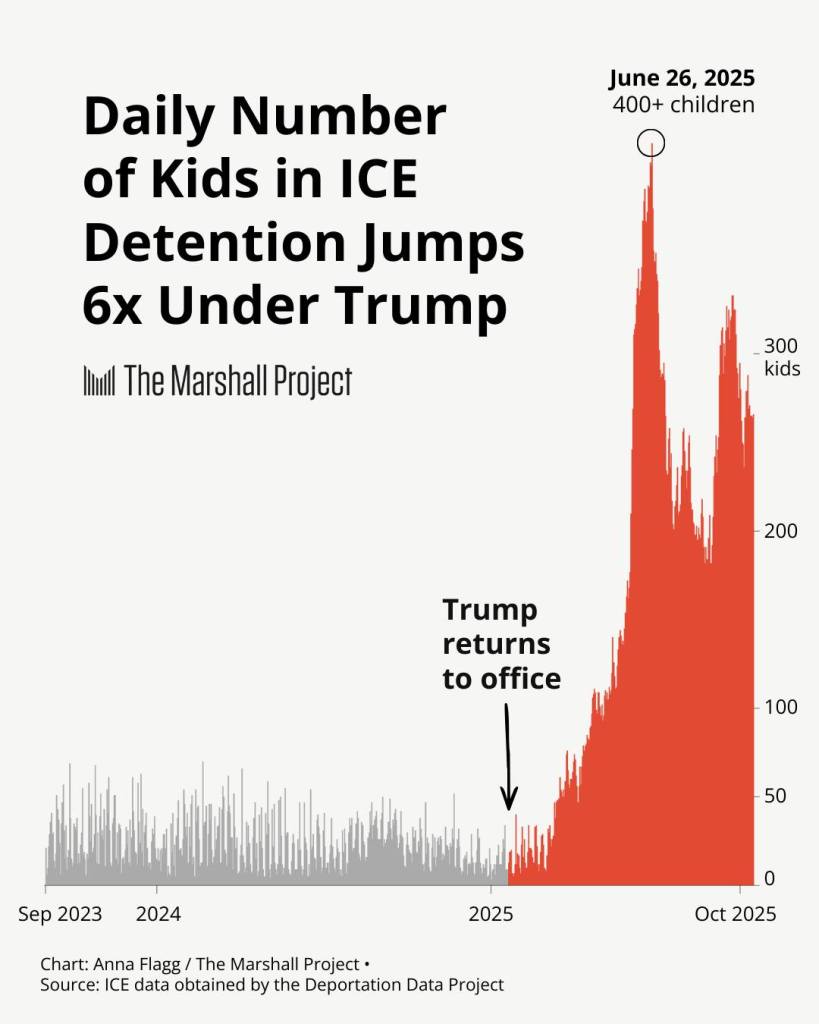
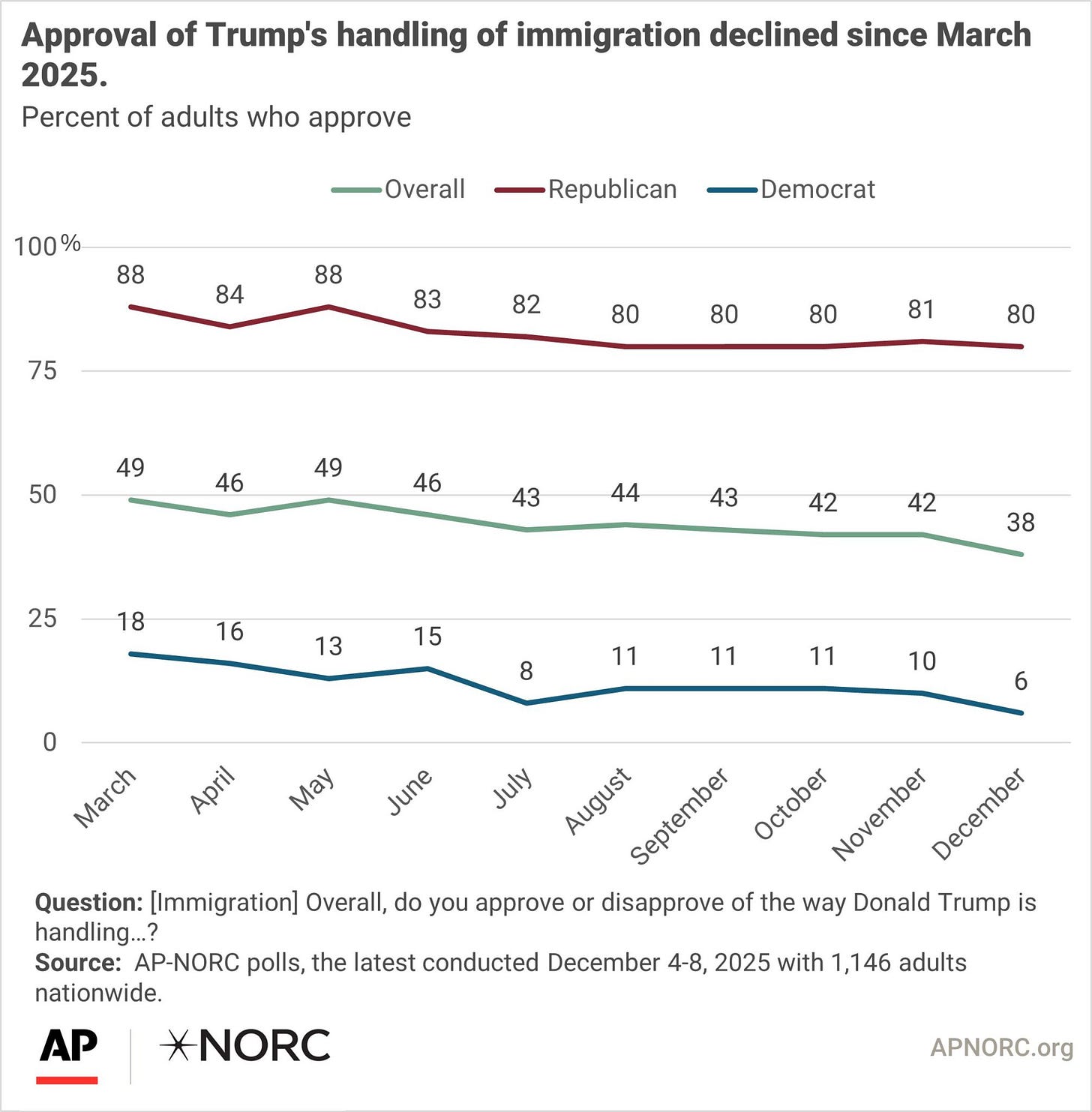
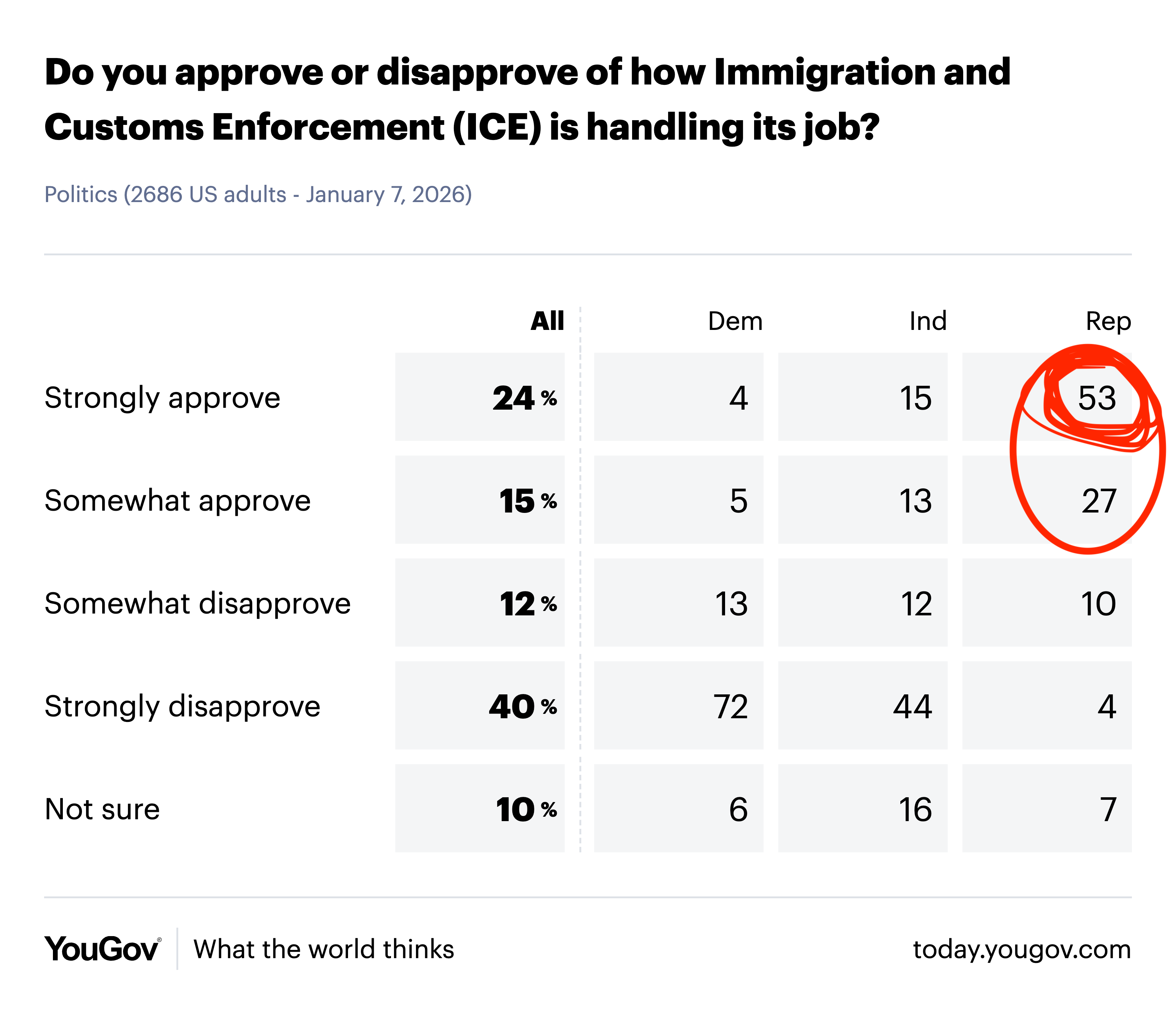
Here’s a survey tracking Republican approval of Trump’s immigration policies (the top line, in red) over most of 2025:

That’s a consistent level of support around 80 percent. Now here is the first poll conducted after the killing of Renee Good:

Even after the killing of an unarmed American citizen, a total of 80 percent of Republicans approve of what ICE is doing and 53 percent of Republicans strongly approve.

It seems pretty clear that, at best, one in five Trump voters were duped. The majority of them are getting exactly what they wanted.

Now if Trump were to lose the support of 20 percent of Republicans voters—or even 14 percent—it would be meaningful for Republican electoral prospects. Which is nice.

The problem is that having 80 percent of Republican voters actively supporting a fascist race war is meaningful for our societal prospects.


Which brings us to the second question: How are these groups distributed through the elite positions of power in government? And here it seems that many of the Republicans most invested in a race war have a great deal of power. Like, for instance, Vice President JD Vance, Deputy Chief of Staff Stephen Miller, and Secretary of Homeland Security Kristi Noem.

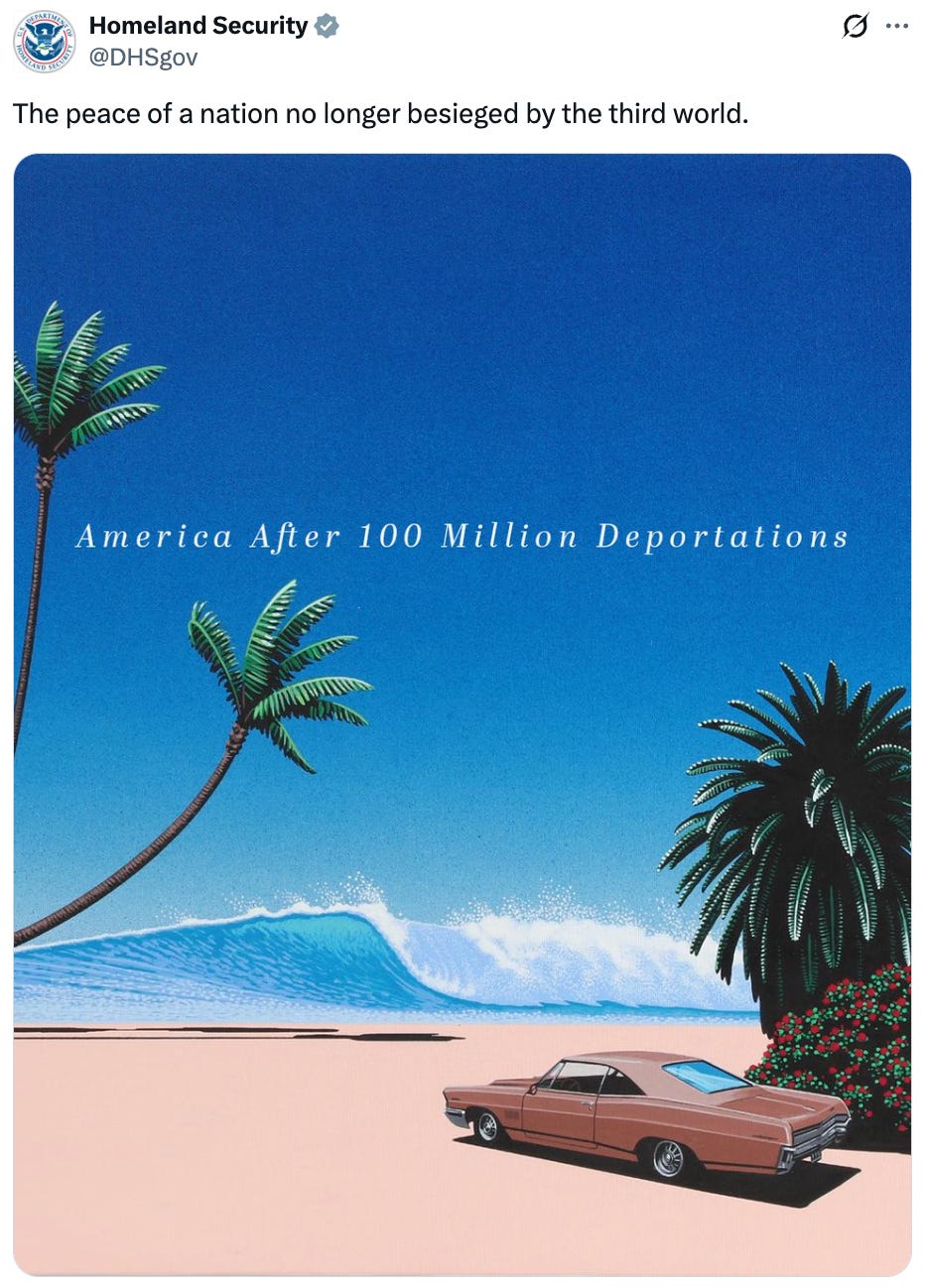
At the elite levels, even the idea of 20 million deportations is too little. Here’s a tweet from the Department of Homeland Security on New Year’s Eve:

100 million deportations?

There are 43 million foreign-born Americans. Most of them are legal immigrants. In order to perform 100 million deportations, DHS would have to round up every immigrant of any status—even naturalized citizens—and then also snatch 57 million American who are citizens by birth and deport them, too.

Want to guess who those other 57 million Americans might be?

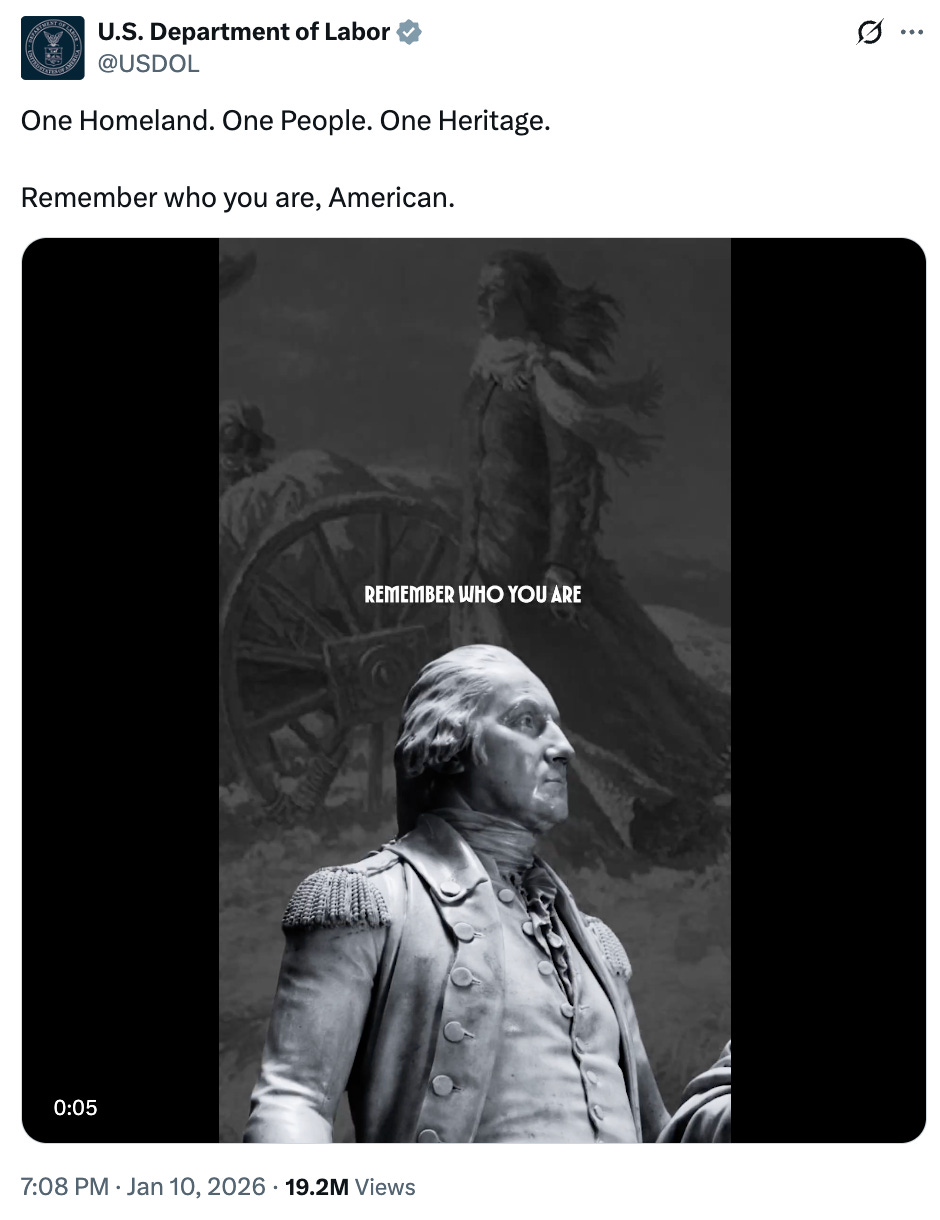
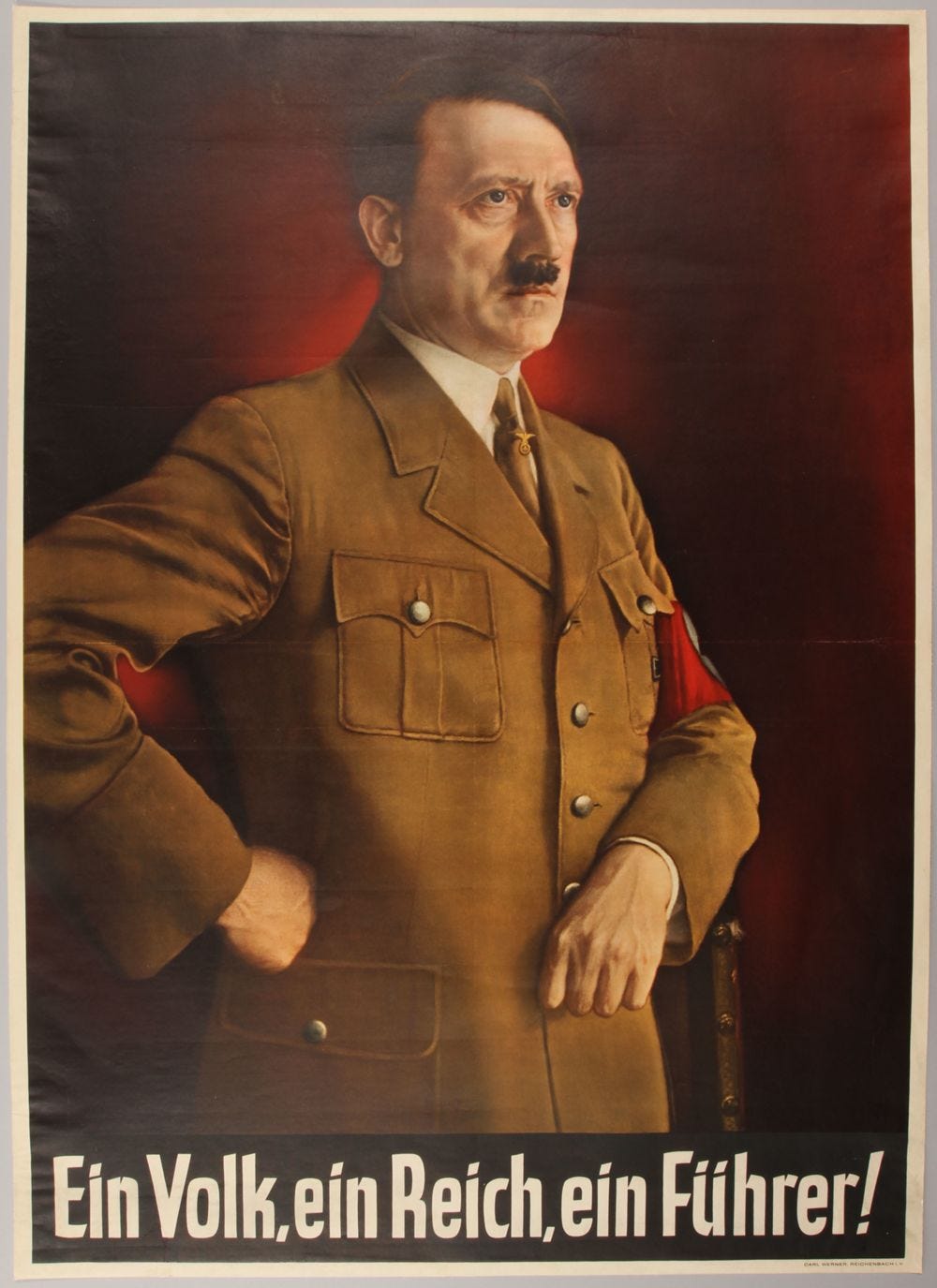
This week the Department of Labor published this:

Of course, the slogan sounds better in the original German.

Oh, and don’t forget the Department of Labor’s heroic propaganda posters depicting the American worker in a very specific way.

On the one hand, it feels weird to say that the U.S. government is attempting some low-key ethnic cleansing.

On the other hand, the reality is that we have a masked secret police force going door-to-door attempting to kidnap brown people; one government agency publicly daydreaming about deporting 100 million people; and another government agency saying that the ideal worker is a 20-year-old white guy.

2. Demographics

Another tell: This administration is obsessed with America’s falling fertility rate. From the NYT:

Vice President JD Vance last week called falling marriage rates “a big problem.” The deputy secretary of Health and Human Services in December urged his agency to “make America fertile again.” And at a recent conference for young conservatives, Sean Duffy, the transportation secretary, doubled down on the importance of marriage and children, holding out his nine kids as a model for others to follow.

Full disclosure: I am also obsessed with America’s falling fertility rate. Enough that I wrote a book about it.

The problem here is that nearly all of the declines in total fertility rate (TFR) over the last decade have been the result of declining Hispanic fertility.

Here’s the deal: The TFR—the total number of kids the average woman has over the course of her life—has been below the replacement level, but relatively stable, among white and black Americans for the last generation or so. But America’s TFR kept declining anyway. Why?

Because Hispanic Americans—many of whom were recent immigrants—had TFR’s higher than the U.S. average. And their baby-making propped up the nationwide number. The problem is that, as recent immigrants spent time in America, their reproductive behavior began regressing to the mean. The shift has been dramatic:

If you were concerned about the fertility rate in America, would you be trying to (a) halt all immigration—since immigrants usually bring with them fertility rates higher than native-born Americans—and (b) deport 100 million people from the ethnic group that has the highest fertility rate?

No.

The only reasonable conclusion is that the concern of people in the Trump administration isn’t about the total fertility rate. It’s about the white fertility rate.

I don’t know how much clearer the regime could be.

So tell me: What does the pie chart look like on Republican voters and race war? What is the percentage of Trump voters in each of these categories:

  • Group A: Sees and understands the administration’s intent and supports it.
  • Group B: Sees and understands, but oppose it.
  • Group C: Do not understand that the regime views its program as part of a race war and thinks it’s all business as usual?

And follow-up question: How big can Group A be for us to retain a functional, liberal society?

I look forward to your discussion.

Source: Jonathan V. Last, “The Nazi Slogans Are Not an Accident,” The Bulwark, 13 January 2026. I subscribe to the Bulwark, and so I have shared this article here as a service to my own readers. ||||| TRR


Forbes Breaking News, “BREAKING NEWS: Robin Kelly Introduces Articles Of Impeachment Against Kristi Noem,” 13 Jan. 2026

[. . .]

“Mr. Speaker, I rise today to announce I will be impeaching Homeland Security Secretary Kristi Noem,” announced Rep. Robin Kelly of Illinois.

“Secretary Noem has violated the Constitution and she needs to be held accountable for terrorizing our communities. Operation Midway Blitz has torn apart the Chicagoland area. President Trump declared war on Chicago and then he brought violence and destruction to our city and our suburbs in the form of immigration enforcement.”

Rep. Kelly then broke down some of the outrageous violence that ICE has visited upon her district.

“In my district, federal agents repelled down from Black Hawk helicopters and burst into an apartment building in the South Shore area. They dragged US citizens and non-citizens alike out of their beds in the middle of the night. They claimed the apartment was infiltrated by members of a Venezuelan gang. I don’t understand this president’s obsession with Venezuela, but they did not arrest a single member from that gang.”

“I visited that apartment building and saw firsthand the destruction those agents left. Doors to people’s homes or apartments were kicked down. Belongings, including little kids’ toys, were strewn about in the hallway. That raid and so many others shook our community, not just immigrants, but everyone. Now, Secretary Noem has brought her reign of terror to Minneapolis after she left Charlotte and Raleigh. We have all seen what happened.”

“ICE officers shot and killed Renee Nicole Good in cold blood. Without knowing any of the facts or an investigation, Secretary Noem lied about what happened. She called [a] beloved 37-year-old mom a domestic terrorist. Secretary Noem and her rogue agents are the ones terrorizing our communities, and she is breaking the law to do so. I will hold her accountable.”

“I’m filing three articles of impeachment against Secretary Noem. Number one, obstruction of Congress. Secretary Noem has denied me and other members of Congress oversight of ICE detention facilities. It is our constitutional duty to find out what’s happening in these centers where people are reportedly being treated like less than animals. Two, violation of public trust.”

“Secretary Noem directed ICE agents to arrest people without warrants, use tear gas against citizens, and ignore due process. She claims she’s taken murderers and rapists off our streets, but none of the 614 people arrested during Operation Midway Blitz has been charged or convicted of murder or rape.”

“Three, self-dealing. Secretary Noem has abused her power for personal benefit. She steered a federal contract to a new firm run by a friend, her friend. Her propaganda campaign to recruit ICE agents cost taxpayers $200 million. She made a video that turned the South Shore raid into something that looked more like a movie trailer. But make no mistake, this is not a movie. This is real life and real people are being hurt and killed. I really have to wonder who are the people behind the mask. These DHS agents have no identifying factor.”

“From all their botched raids and officer-involved shootings, I have to ask, what is their training like? What is the vetting? Is Secretary Noem recruiting January 6th insurrectionists? I was one of the last members of Congress to escape the House Gallery on January 6th. I remember hiding on my hands and knees and running through the hallways to a safe room. Insurrectionists are not fit to serve as law enforcement. I realize that impeachment of Secretary Noem does not bring Renee back.”

“True justice would be Renee alive today at home with her family. Impeachment doesn’t bring back the four other people killed by immigration officers this year, including a man in Chicago. We could not bring them back to their loved ones. What we can do, though, is impeach Secretary Noem. Hold her accountable. Let her know the public is watching. In this country, we do not kill people in cold blood without consequences. These are not policy disagreements.”

“These are violations of her oath of office and she must answer for her impeachable actions.”

[. . .]

Source: Occupy Democrats (Facebook), 13 January 2026


Audience members at the all-ages Minneapolis rock venue Pilllar Forum tussled with ICE agents on the street outside the club on Sunday — prompting that night’s show to be canceled.

The owner of Pilllar Forum, Corey Bracken, said several of his customers and musicians were pepper-sprayed by ICE agents and at least two were hit with batons on the street outside the venue, at 2300 Central Av. NE., where other ICE detainments and community protests have happened in recent days.

“My staff doesn’t feel safe after this, and our artists and customers don’t feel safe,” said Bracken, a dad who expanded his skateboarding store into a music venue and coffee shop in 2023 to bring more live music and art to underage fans.

He is leaving it up to his staff and the bands themselves to decide whether to proceed with upcoming concerts, including several more scheduled this week.

The ruckus started shortly after the 6:30 p.m. showtime for a four-band bill headlined by Pilllar Forum regular Anita Velveeta, a popular trans/queer punk act. Audience members saw ICE agents pull up and detain two individuals outside the neighboring Supermercado Latino market, prompting the club’s young music fans to quickly exit onto the street and protest the agents’ actions.

The Department of Homeland Security didn’t respond to a Star Tribune request for comment. An employee at Supermercado Latino also declined to comment on the incident.

Antonio Carvale, singer/guitarist in one of Sunday’s opening bands, BlueDriver, said he was one of five people at the venue who had to be treated with water and saline solution after being hit with pepper spray. He said agents fired the spray after they pushed a protester who pushed back.

“Honestly, the pain felt brutal, but fortunately the community was prepared and helped treat our eyes,” Carvale said, but he commiserated with a bandmate who was also struck by a baton and “banged up pretty bad.”

The band was disappointed Sunday’s gig then was canceled, but he added, “It would’ve been hard to play when I couldn’t even see the frets.”

One of the audience members who was pepper-sprayed, Jess Roberts of Minneapolis, said she had to go to an urgent care clinic because she was sprayed in the ear, which led to an infection.

The run-in with ICE followed a viral Instagram post by Pilllar Forum that went up Friday and landed 25,000 likes. It showed a peaceful but loud crowd of protesters shouting down ICE agents on Central Avenue, with the message, “And that is how you get it done.”

Minneapolis City Council President Elliott Payne and the new Minnesota state senator representing northeast Minneapolis, Doron Clark, joined Bracken in another social media video posted late Sunday denouncing the incident. Clark called Pilllar Forum “an institution here on Central.”

Payne urged residents, “Stay safe and stay vigilant.”

Twin Cities musicians and music fans offered online support for Pilllar Forum after Sunday’s mayhem.

“Thank you for supporting the community!” veteran rocker Tim Ritter of the band Muun Bato wrote on the venue’s Facebook page.

Bracken did offer refunds to paid attendees of Sunday’s canceled show, proceeds of which were to be donated to families affected by ICE detainments, per headliner Anita Velveeta’s request.

“So far, I haven’t heard from anyone who wants their money back,” Bracken said.

Source: Chris Riemenschneider, “Music fans scuffle with ICE outside all-ages Minneapolis rock venue,” Minnesota Star Tribune, 12 January 2026. I subscribe to the online edition of this newspaper (which I grew up reading as a kid), and so I am just as happy to share its contents here when appropriate. ||||| TRR

(Anti)Fascism Today

Brandon Siguenza (center) and his wife, Julia Rose (left) in happier times. Source: Facebook

Good morning,

My name is Brandon Siguenza, and I am a US citizen from Minneapolis. Yesterday, while doing legal observation, ICE stopped their cars to harass my friend and me. They sprayed pepper spray into the vent of our vehicle. We held our hands in the air and told them we were not obstructing, that the car was in park and they were free to drive forward and away. There was no active immigration raid. They returned to their cars, and drove forward a bit, then decided to stop again. They surrounded us, smashed the windows of our car, opened the doors (they were unlocked), ripped my friend and I out of the car and arrested us on charges of obstruction.

I was put in an unmarked SUV, separated from my friend. As I was put in the back seat an ICE agent tore the whistle off my neck and said “I’ll be taking this, I might need it later.” My phone was knocked out of my hand while being arrested. As we drove away I asked the driver and the passenger if they wouldn’t mind buckling my seatbelt, as they were driving erratically. I was ignored. I asked them if I could have the handcuffs loosened, as I was losing circulation, and was told no. At one point the passenger realized his own driver’s license was in the backseat next to mine, and tried to surreptitiously grab it without me seeing it.

We were taken to the Whipple federal building, where I saw dozens of brown people being processed in an unheated garage. I was frisked, told of my charges, and saw buses and vans being prepped. I later learned that these were being filled with detainees and driven to the airport for deportation. As we were led in, I noticed that the building was very busy. I got the impression that one of the 2 agents bringing me around was being trained. At multiple points throughout my stay, government agents were unable to open doors, not sure where they were meant to be going, and overall confused and overwhelmed. They couldn’t figure out how to use the building phones, or complained about a lack of cell service preventing them from checking the internet or making calls.

The people in the cells were extremely scared. We heard people screaming “let me out!”, crying, wailing and terrified screams. There were cells with as many as 8 people. I have no way of knowing how long they have been there, if they were allowed any contact with the outside world, or if they were being brought food or water. Most people were staring at the ground with almost no energy. I was not allowed to talk to anyone imprisoned. I distinctly remember seeing a desperate woman. She was staring at the ground with her head in her hands crying, hopeless, while her friend or family member sat on a bathroom seat observed by 3 men.

My friend and I were put in an area for “USCs,” which we eventually learned meant US citizens, separated by gender. We were imprisoned for 8 hours, during which my friend was never allowed a phone call. I was allowed to call my wife and tell her where I was. During my interview with Special Agent William and Special Agent Garcia, they asked me to empty my pockets. When I pulled out gloves, Agent William said those were meant to be taken when I was processed, and complained about having to fill out the form again. He frisked me once more, where he found glass in my pocket from when our car window was shattered. He filled out the form listing my personal items again, but put the wrong date. I was read my rights, I pleaded the fifth and was led back to my cell.

Food, water, and bathroom breaks were extremely difficult to acquire. I would ask over the intercom provided in the cell for a bathroom break, be told someone was on their way, then ask again 20 minutes later, be told someone was on their way, wait another 20 minutes, etc. Eventually they either turned off the intercom or it stopped working, because no one would respond. I could get water and bathroom breaks by pounding on the glass when someone happened to walk by and beg them directly. Hours would go by without anyone checking on us. I am vegan and the only food they offered were turkey sandwiches, fruit snacks with gelatin, and granola bars with honey. I eventually ate a granola bar out of hunger.

I was in the cell alone for between 1 and 2 hours, then another man was put into my cell, whose shirt was ripped open from his arrest, and an injured toe, who was carried aggressively into an unmarked car during his arrest. After about 4-5 hours, another man was brought in who had a cut on his head from his arrest. He told me he was tackled by 4 or 5 agents during his arrest. At no point was he offered medical assistance.

Later I was told that a lawyer was here to see me, and I was able to speak with him in a visitation room. The special agent told me that the door could not be closed all the way, so it was cracked during my interaction with my lawyer. I got the impression that they were not used to having lawyers present, and were trying to follow procedure as best they could. I asked an agent if the other detainees were allowed lawyers and was not answered.

At one point, 3 men from the department of Homeland Security Investigations brought me into a cell. They insinuated that they could help me out. After inquiring several times what exactly they meant they finally told me that they could offer undocumented family members of mine legal protection if I have any (I don’t), or money, in exchange for giving them the names of protest organizers, or undocumented persons. I was shocked, and told them no.

Finally, after hours of detention, I was told to follow an agent. At no point was I told whether or not I was being charged, or where I was going, but I was led out of the building. I asked if I could use a phone to call my wife to pick me up, and was told I could not. After pleading for several minutes eventually Special Agent William let me use his phone to call my wife. As I was escorted off the property by government agents, I was told to turn right. I was escorted to the protest area, where 5 minutes later, tear gas was deployed and I was struck by a paint ball gun. I was not protesting, I was simply being released without charges after an 8 hour detention. I was on the other side of the street, as instructed by the agents that released me and the agents shouting orders over a bullhorn. A passerby who was tear gassed was panicking and having an asthma attack, so I helped her find a medic to get her an inhaler. I used a stranger’s phone to co-ordinate pickup, and was picked up by my wife.

During my detention I knew that I was being released. I knew that as a citizen of the United States I have legal protection. The hundred or so other people being detained had no such protection. At this time I don’t need your help, it is the families that are being separated, abused, terrorized, harassed and killed that need your help. If this is happening to me, an American citizen born in the United States, then what is happening to the people in here that have no one calling lawyers on their behalf? That have no constitutional rights to due process? What is happening to the people that they will never be released to see their families, go to their jobs, or walk through their city ever again?

Please take care of yourselves, your family, and your community. I am safe and healthy, if you feel compelled to help, please offer your help to the Immigrant Defense Network at https://immigrantdefensenetwork.org/. If you know someone detained by ICE, call or text CAIR-MN at 612-206-3360 for 24/7 legal intake.

Source: Brandon Siguenza (Facebook), 12 January 2025. Thanks to KFK for the heads-up.


KARE 11, “Taken by ICE & Detained | Breaking the News Plus”

What is it like in the Minneapolis ICE Detention Center? Patty O’Keefe & Brandon Siguenza join Jana to discuss their experience being detained for over 9 hours.

Source: KARE 11 (YouTube), 12 January 2026


In this week’s bulletin: Trade Union Confederation statement after January 9th Russian attacks; statement by Ukraine Social Movement on Venezuela; captivity and oppression in the Russian-occupied territories; problems  of the Russian economy; anti-war messages in Russian cities.

News from the territories occupied by Russia:  

Ukrainian, abducted as a teenager from occupied Donbas in 2019, sentenced by Russian court to 22 years (Kharkiv Human Rights Protection Group, January 9th)

Ex-military and Ukrainian: No more needed for Russian ‘treason trials’ and massive sentences (Kharkiv Human Rights Protection Group, January 9th)

The Face of Resistance: The Story of Crimean Tatar Political Prisoner Ismet Ibrahimov (Crimea Platform, January 9th)

‘Russian world’ in occupied Luhansk oblast: no heating and deliberately cut off from mobile telephones and Internet (Kharkiv Human Rights Protection Group, January 8th)

Desperate plea from Russian prison: Ukrainian political prisoners need to be freed now, not after ‘peace deal’ (Kharkiv Human Rights Protection Group, January 7th)

Crimean Political Prisoner Tofik Abdulgaziev in Critical Condition (Crimea Platform, January 7th)

The Woman Who Didn’t Break. Part Two (Kharkiv Human Rights Protection Group, January 6th)

Monstrous 27-year sentence against Ukrainian civilian abducted from Russian-occupied Melitopol (Kharkiv Human Rights Protection Group, January 6th)

Weekly update on the situation in occupied Crimea on January 6,  2026 (Crimea Platform, January 6th)

Even Putin supporter debunks Russia’s lies about a ‘Ukrainian drone attack on civilians’ in occupied Khorly (Kharkiv Human Rights Protection Group, January 5th)

No answers & questions to Red Cross after Russia holds 64-year-old Melitopol journalist prisoner for third year (Kharkiv Human Rights Protection Group, January 5th)

“You must not show that you are afraid”: Tales of captivity in the Kremlin-controlled “People’s Republics” (The Insider, January 5th)

News from Ukraine:

Fire Point’s large missiles and contracts: the story of Ukraine’s most enigmatic defence company (Ukrainska Pravda, January 9th)

More artists killed in Ukraine (The Artist, January 9th)

Statement of the KVPU on the critical situation in Ukraine after January 9 Russian attacks  (Ukraine Solidarity EU, January 9th)

‘Bro-wolfieʼ: The story of a soldier who survived in Mariupol and rebuilt his life (Kharkiv Human Rights Protection Group, January 8th)

All change: why Zelensky needs to reshuffle Budanov, Fedorov, Shmyhal, Maliuk and other top officials (Ukrainska Pravda, January 5th)

Engineers, missile strikes and high technology: can Ukraine produce more weapons in 2026? (Ukrainska Pravda, January 4th)

Denys, a unionised railway worker on the front line (International Labour Network of Solidarity and Struggle, January 1st)  

War-related news from Russia:

Alexander Krichevsky of Izhevsk: Six Years in Prison for a Comment (Russian Reader, January 8th)

The rise and fall of the “Heroes of the Surgut Land”. How the Russian state works with memory of soldiers who died in the war with Ukraine (Mediazona, January 7th)

The streets speak. Anti-war messages in Russian cities (Mediazona, January 6th)

Timofey Anufriev Dies Fighting for Ukraine (Russian Reader, January 6th)

On thinning ice: After almost four years of war, Russia’s central bankers are running out of tricks to keep the economy afloat (The Insider, January 6th)

The Story of Gordey Nikitin: 17 Years for “High Treason”  (Russian Reader, December 31st)

Analysis and comment:

Cedos held a discussion on the impact of research on policy change (Cedos, January 9th)

Behind the Contact Line: How would the 20-point peace plan impact the millions of Ukrainians living under Russian occupation? (Meduza, January 9th)

When Information Starts Working on Its Own (Kharkiv Human Rights Protection Group, January 8th)

From master spy to lead negotiator: what does Zelensky’s new chief of staff, Kyrylo Budanov, bring to the peace talks? (Meduza, January 8th)

Women’s Careers in STEM: Barriers and Motivations  (Cedos, January 7th)

The Non-Peaceful Atom (Posle Media, January 7th)

Key challenges related to possible holding of an all-Ukrainian referendum on changes to Ukraine’s territory (Opora, January 5th)

Social Movement: What’s wrong with US aggression against Venezuela? (Ukraine Solidarity EU, January 3rd)

International solidarity:

Ukrainian leaders in UK call for Kemi Badenoch to sack David Wolfson, Russian assets to be used to aid Ukraine (USC, January 8th)

Upcoming events:

Thursday 15th January, at 7pm, Russia’s War On Ukraine, Us Strategy Review – Stopping The Authoritarians, organised by Ukraine Solidarity Campaign Scotland, register here.

Thursday 5th February, at 6.30pm. Try Me For Treason reading and discussion event at Clore Lecture Theatre, Birkbeck College Clore Management Centre, Torrington Square, London WC1E 7JL. Details here.

This bulletin is put together by labour movement activists in solidarity with Ukrainian resistance. To receive it by email each Monday, email us at 2022ukrainesolidarity@gmail.com.

Source: News from Ukraine Bulletin no. 178, 11 January 2026


Beginning in 1943, the War Department published a series of pamphlets for U.S. Army personnel in the European theater of World War II. Titled Army Talks, the series was designed “to help [the personnel] become better-informed men and women and therefore better soldiers.”

On March 24, 1945, the topic for the week was “FASCISM!”

“You are away from home, separated from your families, no longer at a civilian job or at school and many of you are risking your very lives,” the pamphlet explained, “because of a thing called fascism.” But, the publication asked, what is fascism? “Fascism is not the easiest thing to identify and analyze,” it said, “nor, once in power, is it easy to destroy. It is important for our future and that of the world that as many of us as possible understand the causes and practices of fascism, in order to combat it.”

Fascism, the U.S. government document explained, “is government by the few and for the few. The objective is seizure and control of the economic, political, social, and cultural life of the state.” “The people run democratic governments, but fascist governments run the people.”

“The basic principles of democracy stand in the way of their desires; hence—democracy must go! Anyone who is not a member of their inner gang has to do what he’s told. They permit no civil liberties, no equality before the law.” “Fascism treats women as mere breeders. ‘Children, kitchen, and the church,’ was the Nazi slogan for women,” the pamphlet said.

Fascists “make their own rules and change them when they choose…. They maintain themselves in power by use of force combined with propaganda based on primitive ideas of ‘blood’ and ‘race,’ by skillful manipulation of fear and hate, and by false promise of security. The propaganda glorifies war and insists it is smart and ‘realistic’ to be pitiless and violent.”

Fascists understood that “the fundamental principle of democracy—faith in the common sense of the common people—was the direct opposite of the fascist principle of rule by the elite few,” it explained, “[s]o they fought democracy…. They played political, religious, social, and economic groups against each other and seized power while these groups struggled.”

Americans should not be fooled into thinking that fascism could not come to America, the pamphlet warned; after all, “[w]e once laughed Hitler off as a harmless little clown with a funny mustache.” And indeed, the U.S. had experienced “sorry instances of mob sadism, lynchings, vigilantism, terror, and suppression of civil liberties. We have had our hooded gangs, Black Legions, Silver Shirts, and racial and religious bigots. All of them, in the name of Americanism, have used undemocratic methods and doctrines which…can be properly identified as ‘fascist.’”

The War Department thought it was important for Americans to understand the tactics fascists would use to take power in the United States. They would try to gain power “under the guise of ‘super-patriotism’ and ‘super-Americanism.’” And they would use three techniques:

First, they would pit religious, racial, and economic groups against one another to break down national unity. Part of that effort to divide and conquer would be a “well-planned ‘hate campaign’ against minority races, religions, and other groups.”

Second, they would deny any need for international cooperation, because that would fly in the face of their insistence that their supporters were better than everyone else. “In place of international cooperation, the fascists seek to substitute a perverted sort of ultra-nationalism which tells their people that they are the only people in the world who count. With this goes hatred and suspicion toward the people of all other nations.”

Third, fascists would insist that “the world has but two choices—either fascism or communism, and they label as ‘communists’ everyone who refuses to support them.”

It is “vitally important” to learn to spot native fascists, the government said, “even though they adopt names and slogans with popular appeal, drape themselves with the American flag, and attempt to carry out their program in the name of the democracy they are trying to destroy.”

The only way to stop the rise of fascism in the United States, the document said, “is by making our democracy work and by actively cooperating to preserve world peace and security.” In the midst of the insecurity of the modern world, the hatred at the root of fascism “fulfills a triple mission.” By dividing people, it weakens democracy. “By getting men to hate rather than to think,” it prevents them “from seeking the real cause and a democratic solution to the problem.” By falsely promising prosperity, it lures people to embrace its security.

“Fascism thrives on indifference and ignorance,” it warned. Freedom requires “being alert and on guard against the infringement not only of our own freedom but the freedom of every American. If we permit discrimination, prejudice, or hate to rob anyone of his democratic rights, our own freedom and all democracy is threatened.”

Notes:

https://onlinebooks.library.upenn.edu/webbin/serial?id=armytalks

War Department, “Army Talk 64: FASCISM!” March 24, 1945, at https://archive.org/details/ArmyTalkOrientationFactSheet64-Fascism/mode/2up

Source: Heather Cox Richardson, Letters from an American, 9 January 2026

Comply or Die

“Comply or die” has always been my country’s operative motto, especially when “compliance” has been a priori impossible:

On May 14, 1854, six Missourian explorers crested a steep ridge, some 150 miles north of San Francisco. After days of hard travel through mountainous, broken terrain, they encountered a stunning sight. Spread below them was twenty-five thousand acres of lush, flat land. The next day, the six horsemen descended to the floor of what is now known as Round Valley, in northern Mendocino County. According to Frank Asbill, son of one of the six, “they had not gone far when the tall, waving, wild oats began to wiggle in a thousand different places all at the same time.” The group’s leader, Pierce Asbill, then called out: “We’ve come a long way from Missouri to locate this place . . . an’ be damned if wigglin’ grass ’ull keep us away! Git a-hold of yer weapons—we’uns are goin’ in!” Reaching a creek bed, the six horsemen reportedly encountered three thousand Yuki Indians. “A war hoop went up from the Missourians [who] just lay over the horse[s’] neck[s] and shot. . . . They just rode them down. . . . It was not difficult to get an Indian with every shot. . . . When the shootin’ was over, thirty-two dead and dying [Yuki] lay scattered.” By the end of the day perhaps forty Indians were dead. The massacre was a prelude to an American genocide. 

Source: Benjamin Madley, “California’s Yuki Indians: Defining Genocide in Native American History, California History, Vol. 96, Number 4, p. 11. DOI: https://doi.org/10.1525/ch.2019.96.4.11. Image source.


President Donald Trump said the U.S. will seize control of Greenland “the easy way” or “the hard way” and warned that he won’t miss out on the opportunity to Russia or China.

“We are going to do something on Greenland whether they like it or not,” he said. He brushed off naming a price to purchase the land from Denmark but also didn’t describe what any potential military action would look like.

“I would like to make a deal the easy way, but if we don’t do it the easy way, we’re going to do it the hard way,” Trump said.

He made the comments during a press availability Jan. 9 as he met with some of the top oil companies in the world to discuss investment in Venezuela, where the U.S. just a week earlier captured leader Nicolás Maduro and brought him to New York to face drug charges.

Trump said if the U.S. hadn’t gone into Venezuela and attempted to reinvigorate their oil industry, Russia or China would have. He also referred to Venezuela as a next-door neighbor because of its location in the Western Hemisphere.

“And by the way, we don’t want Russia or China going to Greenland, which if we don’t take Greenland, you’re going to have Russia or China as your next door neighbor,” Trump said. “That’s not going to happen.”

Trump said there are Russian and Chinese destroyers, Russian submarines and larger Chinese ships, already sitting outside of Greenland.

Greenland is an autonomous territory of Denmark that has about 31 billion barrels of oil in reserves, about three-quarters of what the U.S. has. But the territory banned drilling in 2021, citing environmental concerns.

White House aide Stephen Miller questioned Denmark’s right to control Greenland in a Jan. 5 interview with CNN.

Source: Erin Mansfield and Bart Jansen, “By right or by might? Trump vows to take Greenland before Russia, China,” USA Today, 9 January 2026. I inserted the illustration, which I found here. ||||| TRR

Timofey Anufriev Dies Fighting for Ukraine

The name of the beautiful young woman in this photo, taken a month ago in Odessa, is Katya, and she is the mother of a wonderful young man, Timofey Anufriev, a Russian passport holder who went to war to defend Ukraine. Today we received news that he has been killed. You can learn more about him in the film to which I’ve linked in the comments. And try to think hard about [the difference between mere] words and real actions… May the memory of the heroes live forever!

Source: Vitaliy Manski (Facebook), 6 January 2026. Translated by the Russian Reader


The Insider, “‘War is like playing chess with death’: Confessions of a philosophy student from the RVC” (in Russian, no subtitles)

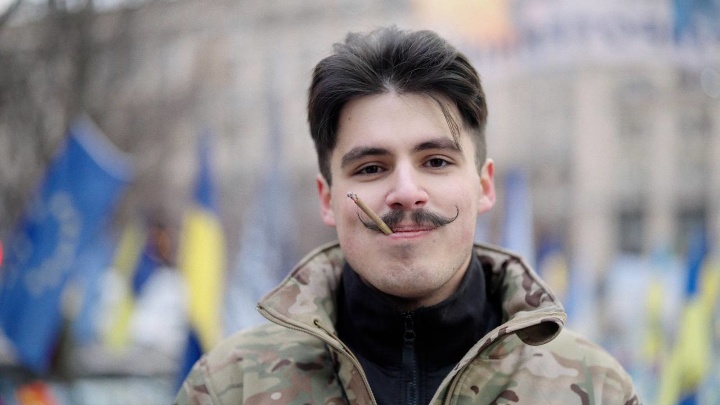
Until recently, 21-year-old Timofey Anufriev (son of the renowned artist Sergei Anufriev) was an ordinary university student in Petersburg. For over a year, though, he has been fighting for Ukraine in the ranks of RVC (Russian Volunteer Corps). Our film crew met with him in Kiev. Timofey talks about why he made this decision and about war and death in this report by The Insider.

Source: The Insider (YouTube), 20 March 2025. Annotation translated by the Russian Reader. There is an egregiously machine-translated and machine-dubbed version of this same film which can be viewed here. |||| TRR


Timofey Anufriev

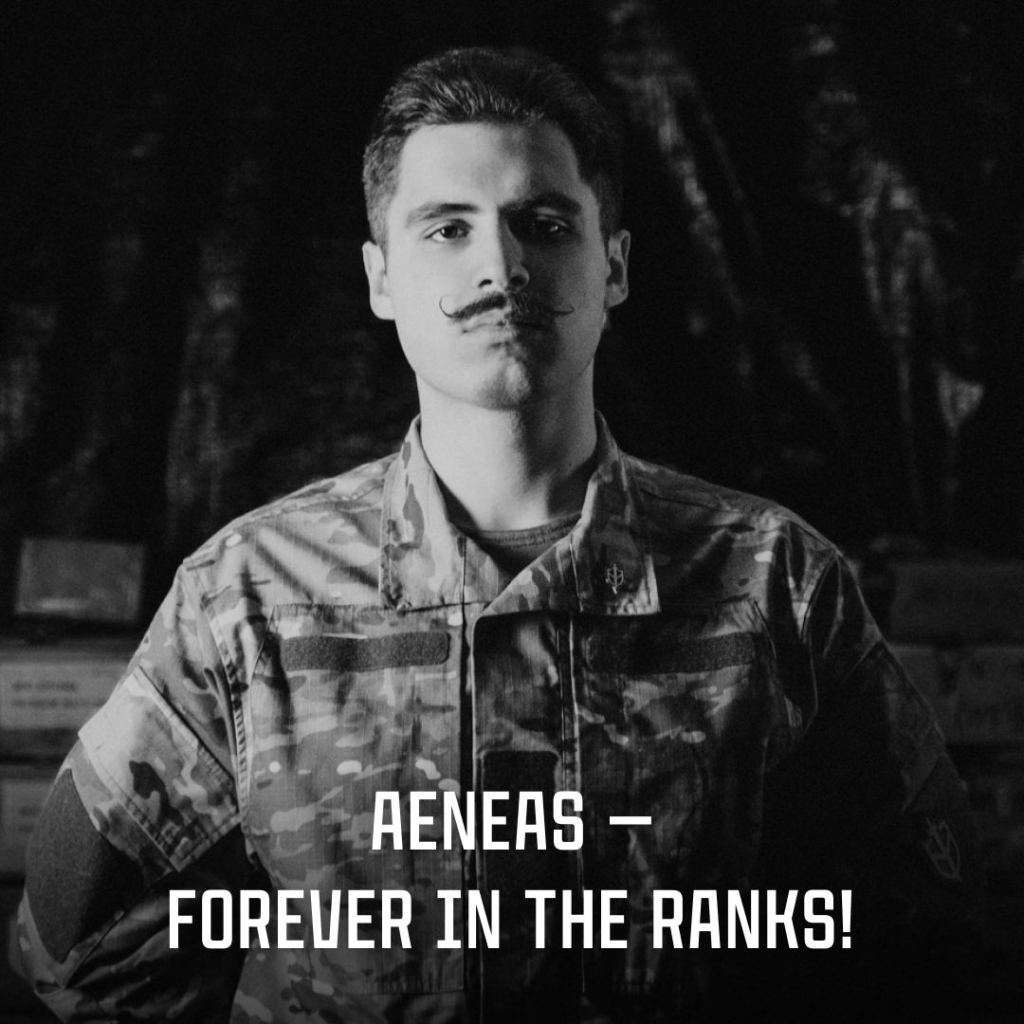
[The] 22-year-old Russian-Ukrainian fighter Timofey ‘Aeneas‘ Anufriev was kіlled in action while defending his second homeland.

“Timofey participated in many of the Corps‘ operations: assaults, cleanups, and capturing prisoners. He lived and dіеd like a true knight and poet, in a blaze of fiery glory! <…> Forever in the RVC, forever in the ranks!” the Corps wrote on its Telegram channel.

Anufriev served as a stormtrooper and had the call sign ‘Enei’ [Aeneas]. He was awarded the medal ‘For Assistance to Military Intelligence of Ukraine.’

“The son of a well-known conceptual artist [Sergei Anufriev], born in Moscow and raised in Odesa, Enei regarded both Ukraine and Russia as countries close to him. Highly intelligent and well-educated, open and kind, he sought to contribute to the Corps not only in combat but also beyond the battlefield.

From an early age, Enei was familiar with the cultural circles of two capitals. Unlike the detached, insular segment of the artistic elite that exists removed from reality, he was deeply concerned about the fate of his people.

The outbreak of the war coincided with his first year at university in Saint Petersburg, where he studied philosophy and planned to become a public intellectual. He was disturbed by the way many around him in Russia pretended that nothing was happening. As a result, he decided first to leave the country and later to join the Russian Volunteer Corps.

“There is always a choice,” Enei believed—and he made one guided by his sense of honor. Throughout his combat service, he served as an assault infantryman, one of the most dangerous roles in war.

He took part in numerous operations, including assaults, clearing operations, and the capture of enemy personnel. He lived—and died—in accordance with his convictions.” wrote RVC on its nocturnal post.

Source: ukrainciaga.international (Instagram), 6 January 2025


The son of a famous conceptual artist, he was born in Moscow and grew up in Odessa. Aeneas considered Ukraine and Russia to be his home countries. An exceptionally intelligent and educated, open and kind person, he sought to benefit the Corps not only in battle, but also beyond it.

From childhood, Aeneas was familiar with the cultural bohemian scene of the two capitals, but he was not part of the abstract and “airy” artistic elite that exists detached from reality. On the contrary, he was deeply concerned about the fate of his people.

The war began during his first year at university in St. Petersburg, where he studied philosophy and planned to become a public philosopher. He was disgusted by the fact that many of his peers in the Russian Federation pretended that nothing was happening. Therefore, he decided to first leave Russia and then join the Russian Volunteer Corps.

“There is always a choice,” Eney believed, and he made a choice dictated by honor. He spent his entire military career as an assault soldier — the most dangerous job in the war.

He participated in many operations of the Corps: he stormed, cleared, and took prisoners. He lived and died like a true knight and poet, in the rays of fiery glory!

He was awarded the medal “For Assistance to Military Intelligence of Ukraine.”

Timofey “Aeneas” Anufriev

Forever in the RVC!
Forever in the ranks!

Source: Russian Volunteer Corps Eng (Telegram), 6 January 2026

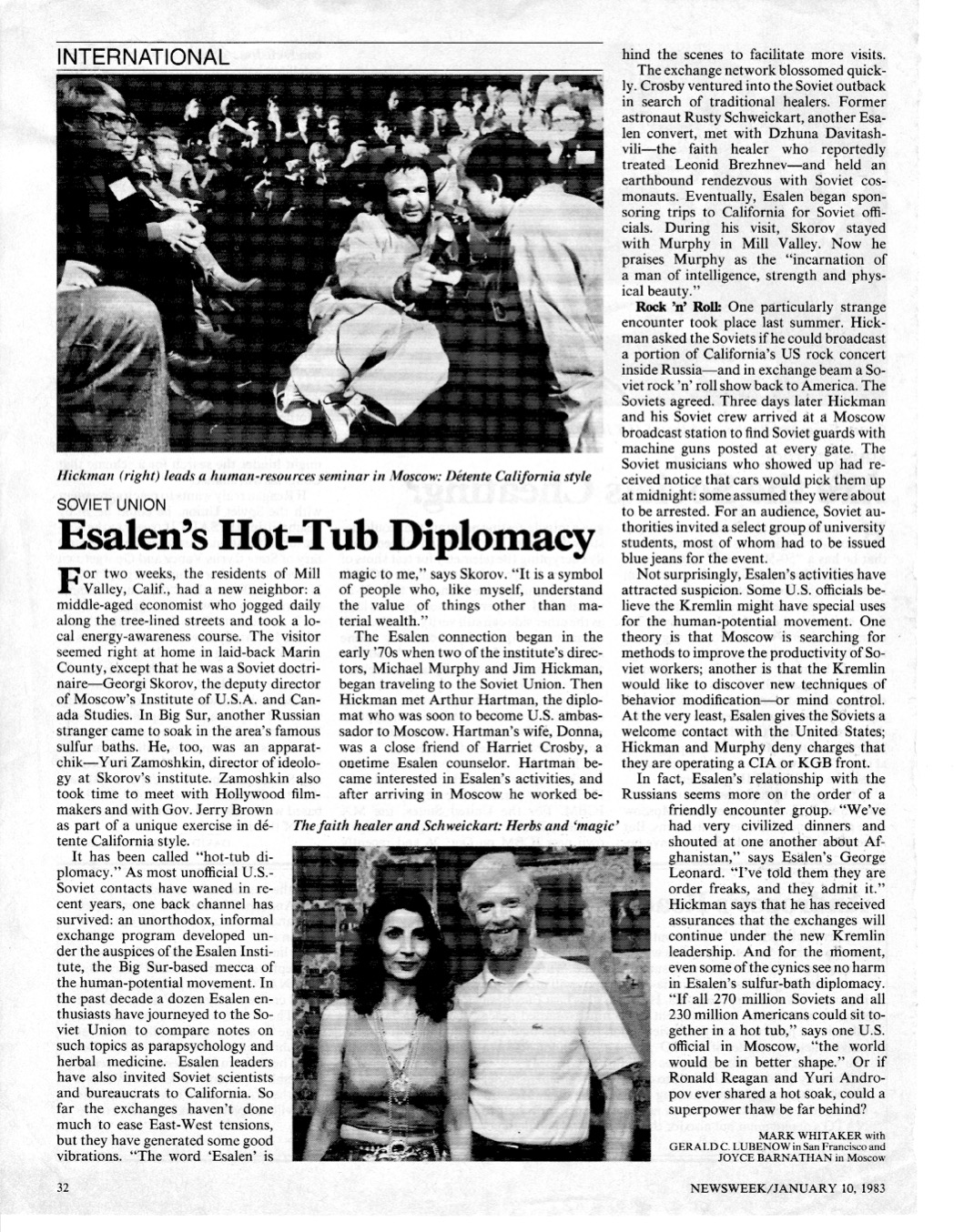
Wine, Hot Tubs and Skating Rinks: Three Russian(esque) Stories from California

A longstanding San Francisco wine competition accidentally accepted Russian wines, which are illegal to import to the U.S., leading to an outcry from the Bay Area’s pro-Ukrainian community.

The San Francisco International Wine Competition apologized for the mistake and removed the Russian wines before judging took place in early December, president Amanda Blue said, adding that the competition “takes full responsibility for the oversight.”

Since March 2022, the U.S. has banned Russian alcohol along with other products such as caviar, seafood and diamonds as part of its sanctions against the country for its invasion of Ukraine. But 15 Russian wineries went to apparently great lengths to smuggle their wines in for the San Francisco International Wine Competition.

The San Francisco International Wine Competition is run by a group called the Tasting Alliance, which was founded in 1980 and organizes a range of alcohol contests, including the San Francisco World Spirits Competition and the Asia World Spirits Competition. Alcohol makers submit their products to the competition, which convenes a group of expert judges to evaluate them blind and issue awards. (It has no affiliation with the San Francisco Chronicle Wine Competition, sponsored by this newspaper.)

Although awards from competitions like these tend not to be as influential as scores from wine critics, many wineries heavily feature their accolades — especially if they’ve won double gold, the San Francisco International Wine Competition’s highest honor — in their marketing materials.

“They were openly bragging about doing this,” said Dmytro Kushneruk, Ukraine’s consul general in San Francisco. His team learned about the smuggling operation from private Telegram channels that the consulate monitors. An article in the Russian publication Kommersant further explained the elaborate scheme that Pavel Mayorov, an executive with the Association of Winegrowers and Winemakers of Russia, deployed to sneak the wines into the U.S. He said that entering Russian wineries in international competitions was a priority for his organization in 2026, and that Russian customers like seeing international recognition for their country’s wines.

Pavel told Kommersant that he considered bringing the wine across the Mexican border using a “coyote,” and also weighed using a camper van to cross the Canadian border. Ultimately he used a passport that he possesses from another country (he did not say which one) to transport the wine as personal luggage, flying with the wine-stuffed suitcases through Tblisi and Doha before reaching San Francisco.

He told customs officers that the wines were “a collection assembled at the request of Californian winemakers,” according to Kommersant.

In total, 95 bottles of Russian wine from 15 wineries were submitted to the competition, Blue confirmed. The competition received roughly 2,000 entries.

Although the error was corrected, “we think it’s important for the public to know,” Kushneruk said. He noted the strong support that the Bay Area has shown for Ukraine throughout the war. Ukraine’s own wine industry has suffered significantly during the Russian invasion, he said: Some vineyards have been contaminated with the remnants of explosive materials, and bottles have burned, including at a large wine storage facility near Kiev that he said Russian soldiers destroyed.

Some Bay Area residents were outraged when they learned of the Russian submissions. Russia “has destroyed so much of Ukraine, displaced so many Ukrainians and also destroyed Ukrainian vineyards and wineries,” said Andy Starr, who, with his wife Deb Alter-Starr, runs Napa Valley to Ukraine, a nonprofit that raises funds for aid to Ukraine and its refugees.

“For them to potentially get awards at the same time as they’re destroying other wine regions, that doesn’t sit with me,” Starr continued. “That shouldn’t sit with anyone.”

Kushneruk’s office got in touch with the competition’s organizers once it learned about the submissions. He also contacted Rep. Mike Thompson, D-Napa, whose staff reached out directly to the competition to ensure that the Russian wines would not be included in the judging.

“Sanctions are a critical tool in holding Russia accountable for its brutal war against Ukraine,” Thompson wrote in an email to the Chronicle. “I was proud to join the California wine community to raise these concerns and I commend this decision ensuring that our industry does not provide a stage for Russian businesses while Ukrainians are under attack.”

After “consulting with legal counsel and executive leadership,” Blue said in a statement, the competition “concluded that these wineries are not eligible to participate due to U.S. sanctions imposed following Russia’s invasion of Ukraine.” The entries were not judged, and the wineries’ entry fees would be refunded, she said.

To Kushneruk’s knowledge, no Ukrainian wineries submitted bottles to the San Francisco International Wine Competition. “But next year we’ll definitely make sure our wine will be sent here,” he said. “Our idea is not only to make sure that the sanctions work, but that Ukrainian wine also has a chance to be evaluated by such a great competition as the San Francisco International Wine Competition.”

Source: Esther Mobley, “How a Russian winery group illegally smuggled its bottles into a longstanding San Francisco wine competition,” San Francisco Chronicle, 19 December 2025


Source: Internet Archive. Thanks to Comrade Koganzon for the heads-up.


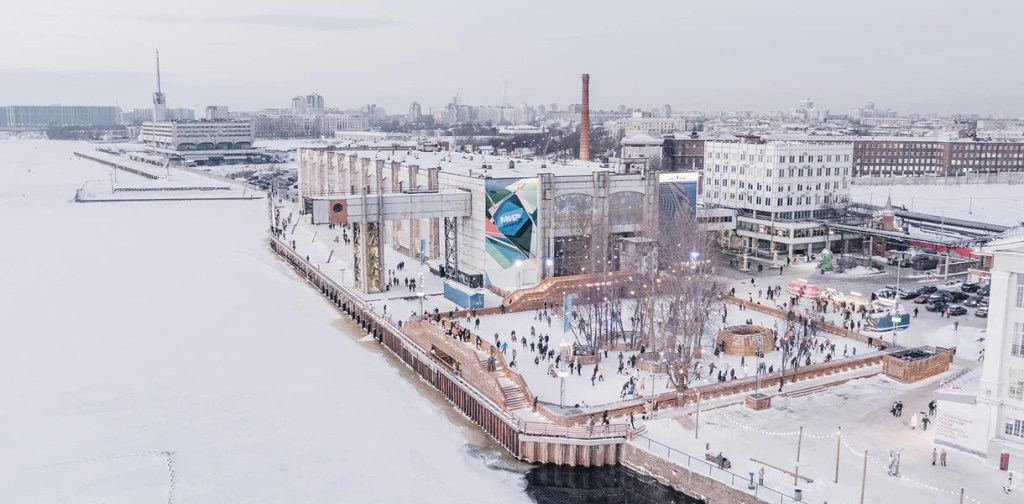
As a social activity, ice skating became the thing in the mid-19th century, popularized by Empress Eugene of France. For young women of her era, it became a way to present their slim ankles and effortless grace of their body in movement, not to mention an opportunity to fall into their partners’ arms without causing much scandal. In other words, ice skating provided freedom and romance, as documented in Tolstoy’s Anna Karenina – in which Levin sees Kitty Scherbatsky, whirling like a fairy and promptly falls in love. But Saint Petersburg has nothing on Monterey. Skating by the Bay’s seasonal ice skating rink is open daily until Jan. 4 for you to practice your body balance or maybe even start a little romance-on-ice. 

Source: Monterey County NOW, 18 December 2025. The emphasis is mine.


Monterey’s tiny and extremely short-lived seasonal skating rink looks like this. Photo: The Russian Reader.
Unsurprisingly, Petersburg has an advantage over Monterey when it comes to size and number of skating rinks. Photo: Tripster

Free Daria Egereva!

Brothers and sisters, colleagues,

I reach out to you in anger and pain concerning the arrest of my sister and colleague Daria Egereva and the new, large-scale crackdown against representatives of Russia’s Indigenous Peoples. Phrases like “isolated incident” or “local overreach” do not describe what is happening today. This is a deliberate, targeted state policy of intimidating, suppressing, and criminalizing Indigenous leaders, of destroying the will of our peoples.

I speak about this not only as a member of the UN Permanent Forum on Indigenous Issues but also as someone who has fallen victim to this crackdown myself. On 17 December 2025, my home in the village of Lovozero was searched. Security forces broke into my personal space and confiscated computer equipment, communication devices, and documents. Similar searches and interrogations took place in the homes of other Indigenous minority activists throughout Russia. It was a planned, well-coordinated campaign of intimidation.

This is not a new reality for us. Back in 2014, I and other representatives of Indigenous Peoples were persecuted by the security forces for trying to convey the truth about the circumstances of Indigenous Peoples in Russia to the international community when we were prevented from leaving the country to attend a UN conference. Today, this practice continues in a much more brutal form, and it has been happening across the country. Crackdowns against the people involved in the events in Baymak, criminal cases against Erzya activists, and the detention of social movement activists in the Altai Republic are just recent examples of how the state has been trying to destroy the independent voice of the peoples of Russia.

Indigenous human rights activists have been labeled “extremists” and “terrorists” simply because they have used peaceful means to defend their peoples’ rights to their traditional lifestyles, cultures, languages, and basic human dignity. This is punishment for those who are not afraid to speak the truth openly, including outside their country, at the UN and other human rights forums.

Particularly outrageous is the fact that the Russian authorities accuse activists of terrorism, a crime for which Russia today imposes monstrous sentences of fifteen to twenty years in prison on people who have not committed violent acts and have never called for violence. These sentences are not intended to “combat terrorism” but to intimidate. The Russian authorities have laid their hands on those who have led a traditional way of life for centuries, herding reindeer, fishing, hunting, and foraging for wild plants on their own land, thus preserving their knowledge of Nature bit by bit.

We must not mince words: this is not a fight against terrorism, it is political vengeance. It is direct punishment by the state for the fact that representatives of Indigenous Peoples dare to appeal to the UN, speak out about violations of their rights, take part in the work of international bodies, and tell the truth about what is happening in Russia. The Russian authorities are deliberately criminalizing the very idea of cooperating with the United Nations.

There is virtually no room left in today’s Russia for free and independent opinion. Any criticism, any dissent, any independent social activism is harshly squashed. It is particularly cynical that the blow is being dealt to the most vulnerable—to the Indigenous Peoples of Siberia and the Arctic, who are socially disadvantaged, dwell in remote settlements amid harsh natural conditions, have no political clout, and are invisible to “mainstream society.” Our peoples cannot defend their rights except through international law, and nd that is precisely why we are being punished today.

I would particularly like to emphasize the Russian state’s profound hypocrisy. While formally declaring its commitment to protecting the rights of Indigenous Peoples, it has been systematically destroying independent Indigenous Peoples’ organizations for many years by persecuting their leaders and using state-controlled structures such as RAIPON and councils attached to regional governments as puppets on the international stage. These puppets do not represent the real interests of Indigenous Peoples, serving only as a front for repressive policies and a means of propagandizing the “happy lives” of our peoples in Russia.

What is particularly cynical about the current developments is that just recently, in November 2025, Vladimir Putin decreed April thirtieth “Russia’s Indigenous Minorities Day” and September eighth “Languages of the Peoples of Russia Day,” and declared 2026 “Peoples of Russia Unity Year.” While the Kremlin announces celebrations and talks about “supporting” our peoples, the searches, interrogations, and arrests of their leaders continue at the local level.

I appeal to states, UN bodies, special procedures, international human rights mechanisms, international Indigenous peoples’ networks, and civil society organizations. A clear, principled, and public position is what is needed today. We must demand the immediate release of Daria Yegereva and the other activists who have been detained, as well as the immediate cessation of all forms of repression, criminal prosecution, and pressure against representatives of the Indigenous Peoples in Russia. We must demand an end to criminal prosecution for engaging in peaceful human rights work and cooperating with the United Nations.

For my part, I intend to raise this issue at the UN Permanent Forum on Indigenous Issues and other UN bodies. I will seek international condemnation of what is happening, protection for those who have been illegally persecuted, and attention to the gross and systematic violations of the rights of Indigenous Peoples in Russia.

In conclusion, I would like to address Daria personally.

Dasha, sister, you are not alone. Your courage and your voice have struck fear in those who are used to acting in silence and with impunity. We are with you, and we speak out and demand justice! The solidarity of Indigenous Peoples is stronger than prisons and political crackdowns. We are in this together!

Valentina Sovkina, member of the United Nations Permanent Forum on Indigenous Issues (UNPFII)

Source: Valentina Sovkina (Facebook), 22 December 2025. Valentina Sovkina is a Russian-Sami politician and chair of the Kola Sámi Assembly. Thanks to Comrade Koganzon for the heads-up. Translated by the Russian Reader


For Immediate Release

19th December 2025

The International Indigenous Peoples Forum on Climate Change (IIPFCC) condemns the wrongful arrest of IIPFCC Co-Chair, Daria Egereva, and demands her immediate release.

Daria Egereva speaking into a conference microphone. Photo courtesy of L&DC

Daria Egereva is a Selkup Indigenous person of Russia and a long-time member of the Centre for Support of Indigenous Peoples of the North (CSIPN). After many years of valued involvement in the Indigenous Peoples’ Caucus at the UNFCCC, she was elected Co-Chair of the IIPFCC in 2023. 

On December 17th, Russian authorities searched Ms. Egereva’s home, confiscated her digital devices, and arrested her under accusation of participating in a ‘terrorist organisation’ in direct retaliation for her Indigenous rights advocacy, including her leadership of accredited Indigenous Peoples at last month’s COP30 United Nations Climate Conference in Belém, Brazil.

A court hearing held on December 18th determined that Ms. Egereva will continue to be detained for two months, pending a further investigation into her case. The accusation carries a potential prison sentence of 10 to 20 years. 

“For the last three COPs, Daria has been foundational to the effectiveness of the IIPFCC. Not only a principled leader, she is warm and generous to friends and colleagues alike. Her arrest is completely unfounded and our whole caucus is very concerned for her,” says Dr Graeme Reed, former IIPFCC Co-Chair

Ms. Egereva’s arrest was part of a coordinated operation by the Federal Security Service of the Russian Federation (FSB), which targeted at least seventeen Indigenous leaders across Russia whose homes were raided, electronic devices confiscated, and who were accused under spurious terrorism-related charges. 

This targeted attack on Indigenous leaders represents direct retaliation for their participation in United Nations processes, and sets a dangerous precedent for the treatment of Indigenous Peoples who participate in global human rights and climate change meetings. 

“These reprisals are part of a broader pattern of repression affecting Indigenous Peoples across the globe, and are an unacceptable attack on the right of Indigenous Peoples to engage in the global human rights and climate change processes,” says Sineia Do Vale, Ms. Egereva’s fellow Co-Chair, IIPFCC

The IIPFCC is deeply concerned for Ms. Egereva, and calls upon all state parties to the UNFCCC, and all allies of Indigenous Peoples to mobilise in solidarity to:

1. Publicly and privately call for Ms. Daria Egereva’s immediate release and the dropping of all charges against her, which constitute an illegal retaliation for her legitimate and peaceful participation in COP30 and other UN processes.

2. Acknowledge and register this complaint as a case of intimidation and reprisal connected to participation in UNFCCC processes under the Code of Conduct for UNFCCC Events, and keep the IIPFCC informed of steps taken.

3. Raise this case without delay with the Government of the Russian Federation through appropriate diplomatic channels, stressing that criminalizing a UNFCCC Indigenous Co-Chair as a ‘terrorist’ is incompatible with the UNFCCC Code of Conduct and with Human Rights Council resolutions/determinations.

“This is not a prosecution of terrorism. It is a defiance of the Human Rights Council’s findings and an attempt to use domestic courts to override international human rights determinations and silence Indigenous Peoples.”

– Joan Carling, Executive Director of International Peoples Rights International

“Around the world, Indigenous leaders face criminalization, persecution, and judicial harassment mechanisms designed to silence our voices, dismantle our institutions, and weaken our collective efforts to defend our rights and territories. These targeted practices constitute serious violations of human rights and international law.”

– Hindou Oumarou Ibrahim, Vice Chair of the UN Permanent Forum on Indigenous Issues and former Co-Chair of the IIPFCC

The IIPFCC firmly rejects this unjust intimidation and detention. We stand with Daria, the other Indigenous leaders who have been detained, their families, and all Indigenous defenders whose safety, dignity, and freedom are under threat.

The IIPFCC echoes the messages of the ICIPR, and recommends reviewing their statement here for further details.

Contact: ipofocalpoints@gmail.com

About the IIPFCC: The International Indigenous Peoples Forum on Climate Change (IIPFCC) was established in 2008 as the caucus for Indigenous Peoples participating in the UNFCCC processes. It represents the collective positions of Indigenous Peoples from all seven socio-cultural regions.

Source: International Indigenous Peoples Forum on Climate Change (IIPFCC)

Delete All the Messages on Your Phone Before Going to Russia: The Treason Case Against Mikhail Loshchinin

Mikhail Loshchinin and his mother, Olga. Courtesy of RFE/RL

More and more Russians face trumped-up charges of “high treason.” Anything whatsoever—from commenting on a banned organization’s social media post to wiring a paltry sum of money to a relative or acquaintance in Ukraine—can occasion these charges. Foreign nationals who have retained their Russian citizenship have also faced prosecution. It has become ever more dangerous for them to travel to Russia to visit loved ones.

This past summer, Mikhail Loshchinin, a 48-year-old dual Belgian-Russian national, decided to visit his father, who had suffered a heart attack, and headed to Petersburg.

In recent years, Loshchinin had been living in Germany while working as a database manager in Luxembourg. On 1 July 2025, he crossed the Latvian border on a motorcycle with a German license plate and stopped at the Ubylinka border-crossing station, in the Pytalovo District of Russia’s Pskov Region. He was carrying a Russian federal passport, which he presented to the Russian border guards.

“They staged a provocation at the border”

“Sometime around 2020, before the war, Misha traveled to Russia by motorcycle. He made it there and back just fine. He had good memories [of the trip], and so he decided to repeat his ‘feat,'” says Loshchinin’s mother Olga, who now liveas in Poland. “The goal was to visit his father, who had undergone heart surgeries and had been feeling quite poorly after a heart attack; there was a risk the visit would be their last. [Mikhail] decided to travel with his Russian passport so as not to have bother getting a visa. (As a Russian national, Loshchinin does not need a visa to enter Russia—Sever.Realii.) He’d spent the last twenty-five years in Europe: his mindset had changed, he’d been Europeanized. He’d come to rely on the system’s accountability, on the fact that laws were obeyed.”

According to Olga, the border guards asked to check Mikhail’s telephone, on which they apparently found numerous Ukrainian contacts. Before his trip, Mikhail had not deleted anything from his WhatsApp account, as he did not consider corresponding with friends in Ukraine to be a crime.

“There were no grounds to detain him, so they staged a provocation at the border,” says Olga. “He had been waiting there for a long time for the inspection to end when he asked where he could buy some water. They told him to follow them on his motorcycle to the local store, that they would show him the way. He followed them, but they suddenly made a funny turn and detained him for crossing the border. In other words, they had deliberately lured him there to have a legal reason to detain him.”

Mikhail grew up in a large family: the four Loschinin children were born in the Soviet Union but later moved away. Mikhail had been living in Europe since 1999. His sister became a citizen of Ukraine, and he often visited her. He had many friends and acquaintances in Ukraine. Their contact details were stored in his phone, naturally.

Mikhail had always been apolitical, and his arrest has no connection with his work, says Olga.

“It is, rather, a matter of his being in the wrong place at the wrong time, and the police investigator admitted as much to him. . . . Misha has always had an excellent reputation, and his employers have valued him. He’s also a well-rounded fellow: he’s a biker, plays the guitar, and sings and does the lighting for productions by small Russian-language theaters. He bought the [lighting] equipment with his own money and promotes Russian culture among his western friends and acquaintances any way he can: he hasn’t lost his connections with his roots. . . . He falls in love easily, and has had several marriages, but now he’s a bachelor. He has a daughter from his second marriage.”

After Mikhail set off for Russia, he constantly telephoned with his sister and mother, who now live in Poland, but they lost touch with him on July first. Three days later, he called from someone else’s phone and told them he had been detained.

“At 10:27 a.m. on July fourth, there was a call from an unknown Russian number. It was our Misha. He said that Dmitry, an FSB officer, had given him a phone to make the call, that he was under guard at the Hotel Dubrava in the border town of Pytalovo, that they’d confiscated his papers and the keys to his motorcycle, and that the motorcycle itself was parked outside the hotel,” Olga recalls.

Mikhail told his loved ones that he had been given a choice: either he would be sent to a basement somewhere, where he would sit and wait until they decided what to do with him and his papers, or he could go to a hotel and wait there, at his own expense.

“No one wants to sit in a basement, naturally,” Olga continues. “He had some money, and since the rooms were inexpensive, he chose the hotel. They confiscated his telephone, his passport, and the papers for his motorcycle, and they posted guards without whom he wasn’t allowed to leave his room. They had to get the go-ahead for every trip outside the hotel. They escorted him when he would go out to the store and the post office.”

Mikhail spent nearly a month at the Dubrava Hotel.

“Misha’s money was running out. We were by then terribly anxious and contacted a lawyer, who arrived at the hotel on the evening of August first and was able to see Misha and speak with him. On August second, a group of persons unknown took him to an undisclosed location. Those were the roughest days for us. As later transpired, he had been transported from Pytalovo to Stary Oskol, in Belgorod Region, and the journey had taken several days. Misha later told us that along the way they had passed through Smolensk; he had managed to catch sight of that. It turns out that, in his correspondence for 2022, an ex-girlfriend of Mikhail’s had asked him for financial help. Her profile picture now has a Ukrainian symbol on it, but it wasn’t there in 2022.”

The lawyer traveled to Stary Oskol, Olga recounts, but at the local pretrial detention center he was told that they had “no such person” in custody. The lawyer then filed a formal appeal with the prosecutor’s office, the FSB, and the Investigative Committee, asking them to figure out what had become of Mikhail. On 21 August 2025, Mikhail telephoned Olga himself—from Pretrial Detention Center No. 1 in Pskov. The call was again made from an unknown number.

“Judging by how his voice sounded, he wasn’t himself. He was clearly under duress and kept asking whether it was alright to talk now, meaning that the call was made in someone else’s presence,” says Olga. “He said that he had been accused of ‘high treason’ per Article 275 of the Russian Federal Criminal Code: ‘financing representatives of a foreign state hostile to the Russian Federation.’ We got a call from someone named Denis, who introduced himself as Misha’s attorney. He called us again and warned us not to hire anyone else, claiming our own attorney wouldn’t even be admitted to the remand hearing. We recorded the call but of course we didn’t do what he asked; he had no right to say that to us, and our own attorney did attend the hearing. Since then, Misha has been in custody at the Pskov detention center. He’s under investigation.”

Later, Mikhail said that, in Stary Oskol, he had been placed in a specialized facility for Ukrainian prisoners of war.

“He was tortured and abused, both mentally and physically, there” says Olga. “First of all, they took away his glasses. He has terribly poor eyesight, minus eight, and he practically lost his sight. He could only walk with his head down, bent over. They stripped him naked and beat him. He told his lawyer about all of it. He was completely crushed, and of course this was done deliberately to squash any hope that he might be released and to make him agree to sign whatever papers they put in front of him. They forced him to sign a paper stating that he had been gallivanting freely around Russia until August twenty-first. He told us this recently. But we have a document stating that he was in Stary Oskol, and it is unlikely that he could have traveled freely around Russia without papers or a means of transport and without informing his relatives. There are many inconsistencies in their ‘body of evidence.'”

“I am horrified by what has happened to my son”

On 10 November, Mikhail Loshchinin celebrated his forty-eighth birthday in the Pskov detention center.

“I am horrified by what has happened to my son,” says Mikhail’s mother. “I’ve been doing a lot of soul-searching, since I didn’t expect the authorities to behave as they have behaved. And yet I didn’t have full faith in Russian law enforcement. My grandfather was in prison in 1937. He had been an officer in the White Army. The family was then living in Grozny, and my mom was small. Several former [White] officers lived in the vicinity. They would get together for readings and go on picnics; they were cultured folk. The entire group was arrested. Grandfather was the only one of them to survive because he didn’t sign anything [i.e., a confession]; the rest of them were shot. He never told anyone what price he had paid for this. My mom, still a kid then, brought care packages to him in prison.”

Olga has carefully researched Article 275 of the Russian Federal Criminal Code and argues that it has simply been “misapplied to a completely peaceful, innocent man.”

“We have a really good, tight-knit family. Although [Mikhail’s] dad lives in Petersburg, and we’re divorced, we have a decent relationship, and we’ve even started conversing more often now. And all the kids are tight-knit. Misha was always quite kind; we even wanted him to become a doctor, since kindness is quite valuable in a doctor. But he chose a different path in life. He wanted to be a programmer, and he’s been successful at it,” says Olga.

According to her, many of Mikhail’s friends in Luxembourg, where he had worked in recent years, are now deeply concerned about him.

“He always had a good head on his shoulders, and he became quite well known in Russian diaspora theatrical and cultural circles, and not only in those circles. He even did the sound for the Orthodox Church of Luxembourg,” says Olga. “There are videos on YouTube of him playing ‘Under the Blue Sky’ on the guitar in concert and his boss, a Frenchman, singing it in Russian. It is an ironic twist of fate that a person like can be destroyed so simply. . . . Summer is the time when theaters get ready for the high theatrical season, and right then Misha vanished. A support group has emerged, all of his friends. I honestly had no idea that there were so many of them.”

Mikhail’s friends have been writing petitions requesting his release from police custody, which his relatives have been passing on to his lawyer.

“Although Mikhail lived in Luxembourg, he visited us quite often recently. He has a girlfriend in Slovakia, and when he went to see her, he found ways to come through [Poland] and see us,” says Olga.

According to Loshchinin’s family, Mikhail has begun to suffer from retinal detachment while in custody.

“In 2024, he visited an ophthalmologist, who informed him that surgery was not necessary at the time, but that it would have to be performed immediately if he began seeing flashes in his line of sight. Now he has been seeing those flashes,” Olga explains. “It is hard to get proper medical care in prison, and I’m afraid that he may simply go blind in there. I can’t imagine that my son, who has done nothing nasty in his life, is now being treated as one of the most dangerous criminals, and all because he hadn’t cut off his ties with Russia. If you take someone’s phone and check their messages, every other person could be under suspicion.”

“Thousands of people across the country are being held without charge”

Loshchinin’s defense attorney declined to comment for this article because he is bound by a non-disclosure agreement.

Attorney Yevgeny Smirnov, who works for the human rights project Department One, says that there have been many such treason cases, and that there have even been prisoner exchanges involving people convicted of treason.

According to our count, at least 148 people in Russia faced criminal charges of treason, espionage, and clandestine collaboration with foreigners in 2023, and at least 88 such cases were brought before the courts. The trend continued in 2024 and 2025. According to statistics on court rulings for the first half of 2025, as published by the Judicial Department of the [Russian] Supreme Court, 115 high treason cases were instigated, which was twice as many as in the first half of 2024. At the same time, according to data from Department One, the Supreme Court has underestimated the number of convictions in such cases by at least threefold.

“Mikhail Loshchinin wired money to a private individual in Ukraine,” explains Smirnov. “According to the security forces, this is a form of high treason, and it has existed for over ten years: providing financial assistance for activities contrary to the security of the Russian Federation. The FSB often takes advantage of this. They might have claimed, for example, that the young woman to whom Mikhail wired money works for the SBU [Security Service of Ukraine] or is involved in the Territorial Defense Forces. Something like that. And that wiring her money was thus a criminal offense.”

The attorney is not surprised that Mikhail was detained in Pytalovo for a month without charges, staying in a hotel at his own expense and under guard.

“There are thousands of people across the country being held without charge. Some are under administrative arrest, while others are in former hotels refitted as [detention] centers, or in actual hotel rooms. Most often, police investigators need the time to get the go-ahead to file criminal charges. Moscow gives the go-ahead for such cases.”

“There is no good outcome in these situations,” Smirnov notes.

“They might sentence him up to thirteen years in prison. The only hope for release is through a prisoner exchange, and that would involve a political decision,” argues Smirnov. “How many people in Russia have been released in the last ten years via prisoner exchanges? A couple dozen, probably. And how many political prisoners are there in the country currently? Ten to fifteen thousand. [Mikhail’s] chances are a bit greater since he’s a Belgian national, of course. There are not so many Belgian nationals [in Russian prisons], and if Belgian politicians get involved in the campaign to secure his release, the chances will grow for sure.”

Olga, Mikhail’s mother, says that Belgian consular officers have tried on several occasions to get permission to visit him in the detention center but were turned down.

“He’s a Russian national, but Russia doesn’t recognize his Belgian citizenship,” says Smirnov. “Most countries don’t recognize dual citizenships: it’s a normal practice. So, Belgian consuls aren’t being allowed to see him. It’s been the usual practice for decades.”

Smirnov argues that people living abroad should not travel to Russia unless absolutely necessary “because it’s a big risk.” If travel is unavoidable, you should prepare in advance by purchasing a separate telephone, planning your itinerary with care, seeking advice from those in the know, and being ready for the fact that the border guards will question you and search all your devices.

Source: “‘The goal was to visit his father’: dual Belgian-Russian national detained and charged with treason,”Sever.Realii (RFE/RL), 3 December 2025. Translated by the Russian Reader

Trans(national) Solidarity

“Yara Tychina, a young transgender woman and Astana resident, picketed on Vodno-Zelyoniy Boulevard next to the House of Ministries and the Parliament. Unfurling a handmade transgender flag, she demanded that the Senate, the Presidential Administration, and the President reject the ‘LGBT propaganda’ amendments. She was taken to the Yesilskoye District Precinct of the Astana Police. Further details are in the video.”

[In which video Ms. Tychina says] Hello! I am Yara Tychina. I’m an ordinary citizen of Astana. I work in the coffeehouse [?] industry. I’m an openly trans women. I am protesting peacefully today because there are no other means to impact my country’s repressive policies. I don’t simply oppose this law. [It] violates my rights and freedoms, the rights and freedoms of my friends, my colleagues, the people in my life and, most importantly, my family, over half of whom are members of the LGBT minority community. I have carefully scrutinized this law and I can say truthfully that it has nothing whatsoever to do with ‘propaganda,’ since in black and white it says that any mention of LGBT—in a positive vein, in a neutral vein, it doesn’t matter which; in personal profiles, in personal conversations with people, it doesn’t matter where—is considered ‘propaganda.’ The fact that I’m an openly trans woman makes me a criminal, according to the new amendments. These amendments also don’t have anything whatsoever to do with ‘protecting children,’ since hundreds of Kazakhstani LGBT children, who had no way of influencing [who they are], will find themselves outlawed. They will be banned. They will be forbidden from talking about themselves on social media. They will be forbidden from gathering together in public or in private.

[Ms. Tychina is interrupted by Astana police officers, who claim she is violating the law. She repeatedly states her willingness to go with them to the police station. She then continues.] I heartily and tearfully implore the Presidential Administration, the Senate, and the President of the Republic of Kazakhstan, Kassym-Jomart Tokayev, and the Constitutional Court, if that doesn’t work, to reject these amendments. Otherwise, hundreds of thousands, if not millions, of Kazakhstanis, will unavoidably suffer. With these amendments, you will bridge the gap between Kazakhstan and Russia, but you will also drive away all international investments and significantly harm Kazakhstan’s standing in the international arena. But first of all you will harm people. You will harm my family. I implore you to stop it. Thank you!

[Responding to a reporter, who asks her name, Ms. Tychina says] My name is Yara Tychina. I’m in the coffeehouse [?] industry. I have a small business. I’m an ordinary [female] citizen. [Responding to a question about her flag, she says] It’s a transgender flag, the flag of my identity. It’s homemade. [To the police officers] Let’s go! Thank you! [A police officer explains to the press that Ms. Tychina has not been detained but has voluntarily agreed to go with them to the station.]

Source: werequest.kz (Instagram), 3 December 2025. Translated, from the Russian, by the Russian Reader. Thanks to Peter Leonard for the heads-up.


Police in Kazakhstan’s capital detained a transgender activist for staging a solitary protest against pending legislation prohibiting so-called “LGBT propaganda.” Yara Tychyna held up a handmade transgender flag near government buildings in downtown Astana and called for the Senate and the presidential administration to reject changes to the law, which are designed to proscribe “propaganda of non-traditional relations,” a formulation broad enough that positive portrayals of same-sex relations could be treated as prohibited content. Lawmakers have been debating the measure since the lower house approved it in November. Officials insist the restrictions are framed as child-protection rules. Critics warn that the draft’s language is vague and that equating LGBT themes with harmful content risks legitimising discrimination.

Source: Peter Leonard, “Central Asia’s week that was #82,” Havli, 3 December 2025


On Wednesday, November 12, the [lower house of the] Parliament of Kazakhstan (Mäjilis) unanimously passed a law banning “LGBT propaganda” in the media and on the internet. Violators face fines, and in the case of repeat violations, up to ten days in jail.

“Endeavoring to protect children from information detrimental to their health and development, provisions have been made to restrict the dissemination of information promoting pedophilia and non-traditional sexual orientation in public spaces, as well as via the media, telecommunications networks, and online platforms,” the document states.

The changes will affect nine laws. Violations of the ban will be punishable by a fine of up to forty minimum calculation indices (in 2025, this amounted to 157,000 tenge, or approximately 260 euros, or 24,500 rubles), or up to ten days in jail.

Kazakhstan’s Deputy Minister of Culture Yevgeny Kochetov explained that materials containing “propaganda of non-traditional relationships” would have to be labeled “18+.” Content that violates the law would be blocked.

Kochetov added that the strictures currently apply primarily to those who distribute materials. If minors attend a screening of a film rated 18+, the cinema’s managers, not the parents, would face a fine, he explained.

“If, for example, [men] are holding hands in the park, this is not considered propaganda. These are their personal boundaries, and there are no questions here,” said one of the sponsors of the bill, MP Yelnur Beisenbayev.

The Mäjilis initially sought to ban “LGBT propaganda,” in April 2024, by amending the law “On Mass Media.” They later proposed criminalizing “LGBT propaganda” and equating it with incitement to ethnic, social, or religious hatred.

When MPs began discussing banning “LGBT propaganda,” a petition entitled “We oppose open and covert LGBT propaganda in the R[epublic of] K[azakhstan]” was posted on the website E-Petition.kz. It was the third petition in the country to gather the fifty thousand signatures required for consideration by the government.

The Ministry of Culture and Information decided to partly accede to the petitioners’ demands—when it came to strictures aimed at “protecting and shielding adolescents and children from the promotion and cultivation of sexual relations.”

Consequently, the ban was presented as an amendment to the draft law on archiving.

Traditional values

In recent months, Kazakhstan President Kassym-Jomart Tokayev has repeatedly spoken about the need to protect “traditional values.” The day before the Mäjilis passed the bill, and ahead of his visit to Moscow, Tokayev published an article in Rossiiskaya Gazeta in which he spoke about the friendship between the two countries.

“We are united by a common take on traditional values, similar views on the pressing issues of contemporary life, and cooperation in ensuring the welfare of [our two] brotherly peoples,” Tokayev wrote.

In Russia, the law banning “LGBT propaganda” among minors was first introduced in St. Petersburg in 2011, and then at the federal level in 2013. In 2023, the Russian authorities went so far as to declare the “international LGBT movement” extremist.

As of July 2025, Human Rights Watch had catalogued more than one hundred criminal indictments and convictions [in Russia] for involvement in the “international LGBT movement” or for displaying symbols which the authorities attribute to this movement.

Following Russia’s lead, “LGBT propaganda” was banned in Hungary in 2021, and in Georgia in 2024.

LGBTQ+ in Kazakhstan

Homosexuality was decriminalized in Kazakhstan de facto in 1997 and de jure in 1998. Since 2003, transgender people have been able to change their gender marker in official documents.

In 2021, the Williams Institute at UCLA School of Law ranked Kazakhstan 154th out of 175 countries in terms of public acceptance of LGBTQ+, below Uzbekistan, Russia, and Afghanistan.

The online platform Equaldex, which researches the rights of sexual minorities around the world, writes that “[a]ccording to recent survey data, there appears to be strong opposition to LGBTQ+ rights in Kazakhstan.”

Many human rights organizations have already criticized Kazakhstan’s ban on “LGBT propaganda.”

Human Rights Watch urged lawmakers to reject the bill. The NGO argues that the proposed amendments violate fundamental human rights and could make LGBTQ+ people in Kazakhstan more vulnerable.

Organizations including ILGA-Europe (the European branch of the International Lesbian, Gay, Bisexual, Trans and Intersex Association), the World Organisation Against Torture (OMCT), and TGEU (Trans Europe and Central Asia) have also issued a joint statement against the bill.

The Kazakhstani organization Queer.kz commented on the Mäjilis’s passing the amendments banning “LGBT propaganda” as follows: “We continue to write letters! Our organization will continue to work together with our colleagues to defend human rights and freedom!”

Source: “Kazakhstan parliament votes to ban ‘LGBT propaganda,'” BBC Russian Service, 12 November 2025. Translated by the Russian Reader. Thanks to Peter Leonard for the heads-up.


Over the past four years of America’s modern anti-transgender panic, Missouri has been one of its chief laboratories. Each legislative session brings a flood of new proposals targeting transgender people—with each year opening with often more than a dozen bills—and 2026 is already shaping up to continue that pattern. In the first batch of early bills, lawmakers introduced 21 anti-LGBTQ+ measures, many escalating the state’s enforcement tactics beyond even last year’s cruelties. One stands out in particular: a bill that would ban “social transition” in schools—blocking teachers from using a student’s chosen name or pronouns, even with parental consent.

The bill, SB1085, filed by Senator Joe Nicola, states in its summary that it would prohibit “public school staff members from encouraging minor students in their ‘social transition,’” which the measure defines as engaging in any activity “with the goal of helping a student become perceived as a member of the opposite biological sex.” The text defines social transition broadly—“participating” in a student’s gender transition based on “details such as his or her name, appearance, or behavior”—and bars schools from taking part in any conduct that could contribute to a student “not being perceived and treated as a member of the student’s biological sex.”

The bill explicitly forbids all school staff and faculty from “the use of alternative pronouns or names for the minor student, either in school records or otherwise.” Notably, it contains no provision for parental consent—meaning the restrictions apply not only to unsupportive parents but also to parents who affirm their transgender children. The measure appears to single out trans students exclusively: nothing in its text bars name changes for any other reason unrelated to gender transition.

You can see the provisions here:

The bill marks the latest front in anti-transgender legislation: an effort not just to ban medical transition for trans youth, but to prohibit any form of transition at all, including social transition. Earlier this year, reporting out of Texas showed how a similar law led teachers to suddenly deadname students who had used their affirmed names for years without issue. Variations of this language have surfaced in several states, but Missouri’s proposal is among the most explicit and far-reaching attempts yet to regulate social transition in schools.

The ban on social transition—even with parental permission—underscores a shift in how anti-trans legislation is being sold to the public. For years, supporters of bathroom bans, sports bans, and “don’t say gay” policies framed their efforts as battles for “parental rights.” Increasingly, though, that language has fallen away as lawmakers move to strip supportive parents of any authority at all, mirroring the approach in medical transition bans that override parental consent entirely. Under Missouri’s proposal, parents would have no right to approve their child’s affirmed name or pronouns, and any teacher who honors a family’s wishes could face the loss of their license.

The social-transition ban is just one front in a broader offensive. Missouri lawmakers have already filed bills to outlaw public drag by defining it as prurient “male or female impersonation,” to strip Pride flags from public schools, and to roll back nondiscrimination protections for transgender people in housing, employment, and public accommodations. And more proposals are almost certain to follow. When the legislature gavels in on January 8, the real question for observers won’t be whether these bills appear—they already have—but which ones Republican leadership chooses to fast-track. That early movement will signal just how aggressive Missouri intends to be in advancing its anti-LGBTQ agenda this session.

Source: Erin Reed, “New Missouri Bill Would Ban “Social Transition” In Schools, Even With Parental Permission,” Erin in the Morning, 3 December 2025


On April 27, 2023, Kansas became the first state in the country to institute a statewide definition of sex. “A ‘female’ is an individual whose biological reproductive system is developed to produce ova,” the law declared, “and a ‘male’ is an individual whose biological reproductive system is developed to fertilize the ova of a female.” Since then dozens of state legislatures have introduced similar bills; sixteen have passed. In Indiana and Nebraska governors have issued executive orders to the same end. Each of these measures effectively strips transgender people of legal recognition.

The language of these policies usually distinguishes men from women by their reproductive capacity, which is assumed to be determined at birth or even at conception. Each statute mandates that its definitions of “sex,” “female,” and “male” be used whenever those words appear in any part of the state code. Some purport to be establishing a “women’s bill of rights,” as the titles of Kansas’s and Oklahoma’s bills suggest; Louisiana’s is titled “The Women’s Safety and Protection Act.” (On the other hand, the name of North Dakota’s bill—into which legislators slipped another term they wanted to define—captures the arbitrariness involved: “The Definition of Female, Male, Sex, and Scrap Metal Dealer.”)

This legislation is part of a broader onslaught. In the past few years Republican-controlled state legislatures have introduced thousands of bills targeting trans people, with measures to ban puberty blockers and hormones for trans youth, bar trans girls and women from sports, mandate that bathroom access be based on birth sex, outlaw drag performances, and more. So far more than two hundred of these laws have passed, with grave, often life-changing consequences for the trans residents of red states across the country.

Continue reading “Trans(national) Solidarity”

Give Them Want They Want

Putin: “Give me what I want!” Trump: “Hang on!”

Trump: “There’s a better way!” Trump: “Give him what he wants!”

Source: Moscow Times Russian Service weekly newsletter, 30 November 2025. Original by Michael de Adder. Translated by the Russian Reader


Following the shooting that claimed the life of a National Guard member last Wednesday in Washington, the Trump administration has announced it will be halting all asylum decisions and paused issuing visas for people travelling on Afghan passports. The suspect in Wednesday’s shooting that killed Specialist Sarah Beckstrom, 20, and critically wounded Staff Sgt. Andrew Wolfe, 24, is Rahmanullah Lakanwal, a 29-year-old Afghan national who worked with the CIA during the Afghanistan War and had been living in the U.S. since 2021. He applied for asylum during the Biden administration under a program that resettled Afghans after the U.S. withdrawal from the country, and was granted it this year under President Trump.

As seen in our infographic, based on data released by the U.S. Department of Justice, Afghanistan was not one of the 10 most common countries of origin for people who received asylum in the U.S. in the fiscal year 2024. Only 508 Afghans were granted asylum in the country that year, while 61 were refused. By comparison, the U.S. granted asylum to 3,605 Russian nationals, making Russia the most common nationality to get asylum in the country during that time period. This was followed by China, with 2,998 Chinese nationals receiving asylum, and Venezuela, with 2,656 successful asylum applications.

Source: Valentine Fourreau, “Who Is Granted Asylum in the United States?” Statista, 1 December 2025