Alexander Bakhtin: Justice Is Putin Behind Bars

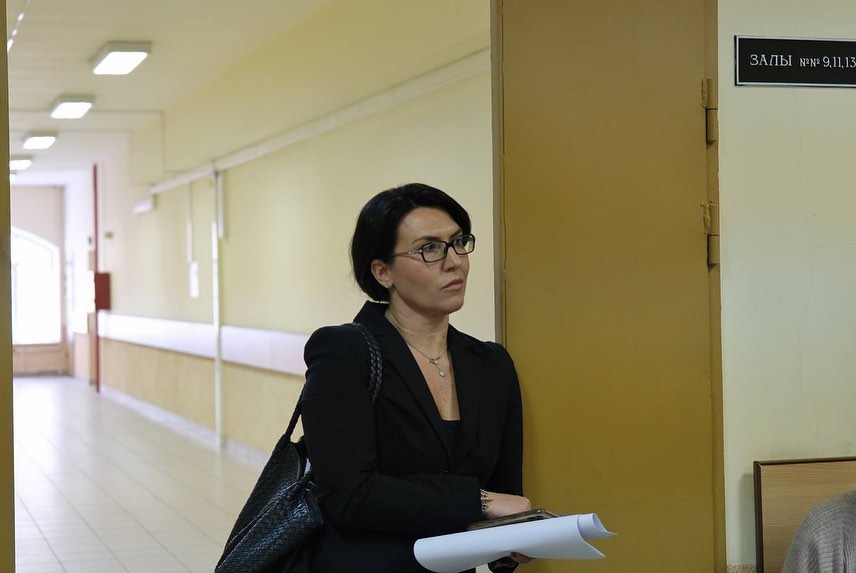
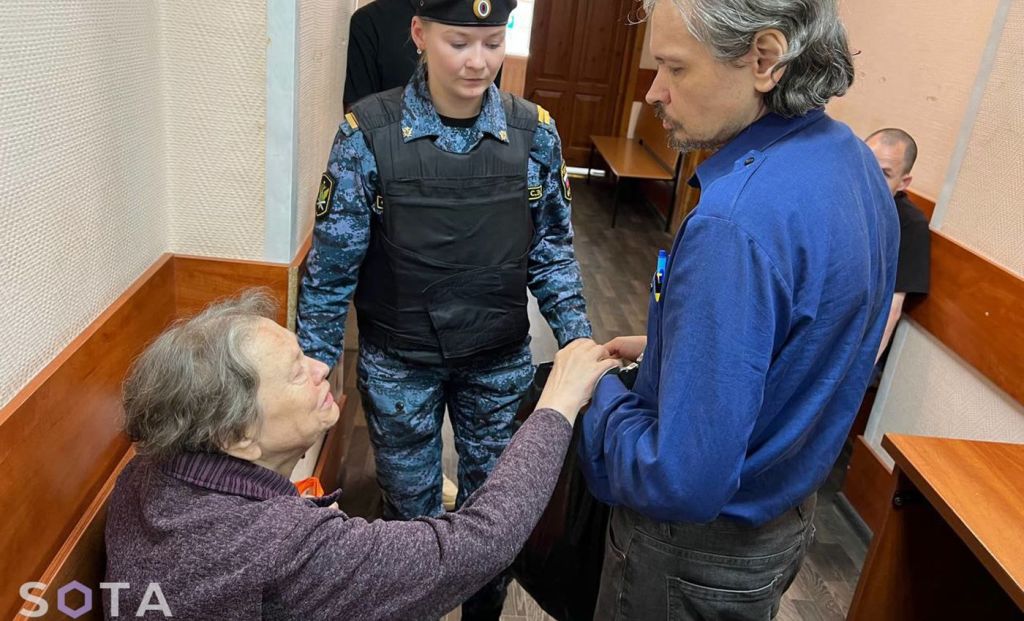
Alexander Bakhtin (right) says farewell to his mother after his trial. Photo: SOTA via Mediazona

Today, the Mytishchi City Court sentenced 51-year-old animal rights activist Alexander Bakhtin to six years in a penal colony. He was charged with disseminating “fake news” about the Russian army over three VKontakte (VK) posts written in the spring of 2022—about the possible blockade of Kyiv, about the murders of civilians in Bucha, and about Ukrainian volunteers who risked their lives saving homeless animals during the war. In addition to the time in the penal colony, the court ordered Bakhtin to undergo compulsory outpatient treatment supervised by a psychiatrist. The prosecution’s expert witness claimed that Bakhtin “could not have been fully cognizant of the actual nature and social danger of his actions and control them.” Mediazona publishes excerpts from Bakhtin’s rebuttal of the charges, which he asked to be entered into the case file before the verdict was announced. After reading these notes, readers will be able to assess for themselves the clarity and consistency of the convicted man’s thoughts.


  • In keeping with the principle of the presumption of innocence, it is not for me to prove that the materials I published are true, but for the prosecution to prove that these materials are “knowingly false.” But it was not proved who exactly committed the [war] crimes, which means it was not ascertained whether my actions constituted a crime.
  • Censorship is prohibited by the Constitution of the Russian Federation, and this Constitution is directly applicable [to my case]. Human rights can be restricted in the Russian Federation only when a nationwide state of emergency and martial law have been declared. But they have not been declared, which means that publishing materials that challenge the stance of the Defense Ministry is not a punishable offense.
  • I committed the actions that I am charged with in order to inform and familiarize my readers with an alternative point of view to the one that was then disseminated in the Russian media. At the same time, realizing that Ukraine’s official media are also an interested party in this conflict, I tried mainly to find information on the internet not in the official Ukrainian media, but as directly reported by local residents of Ukraine on their pages in social networks and online forums. My ultimate goal was to make what contribution I could to stopping this war, because, for example, the First Chechen War in 1996 was, as I believe, halted largely due to Russian society’s negative attitude towards it.
  • If we speak of “hatred and enmity” (as encountered in my posts in the form of harsh epithets directed at the Armed Forces of the Russian Federation), then these epithets do not apply to all [members of] the Armed Forces, but only to those [members] who employed various kinds of violence against civilians in Ukraine, or to those individuals who unleashed this war or called for unleashing it—that is, to war criminals. Perhaps, in terms of “generally accepted” definitions, those negative epithets of mine do apply to all their members, but I do not agree with this interpretation because, as follows from the findings of the forensic psychiatric commission, I am also generally partial to subjectivism, including when employing various definitions. So when I was asked by a psychologist to symbolically depict the concept of “justice,” I drew Putin behind bars. And when the psychologist asked me what that had to with justice, I replied that this was what justice looked liked to me right at that moment.
  • The severity [of a crime] should be defined by its effects. But can the prosecution prove that my publishing these posts produced any specific effects? For example, that they caused someone to lose their faith in the Armed Forces of the Russian Federation and commit an illegal action? At the time of my arrest, I had a little more than sixty friends on VK, and each criminal episode had about 100 views. There are no victims in the case. I myself stopped publishing these posts around the summer of 2022 precisely because they had no effect. By that time, the overwhelming majority of Russian citizens had already made up their minds about this war. Some of them sincerely supported the Russian authorities, while others supported them for opportunistic reasons (in order not to lose their jobs, etc.). Huge numbers of people were intimidated (including by disproportionate punishments meted out for anti-war stances) and kept quiet. Quite a large number of people emigrated from the Russian Federation altogether, while a huge number of Russians decided that this war did not concern them at all. Thus, not only my posts but also anti-war publications in general were unable to change anything, unfortunately. It was only on the battlefield that matters were decided.
  • If my posts are so socially dangerous, then why was my VK page not blocked for such a long time?

You can write a letter to Alexander Bakhtin through the Zonatelecom or FSIN-Pismo, or by regular mail to:

Bakhtin Alexander Sergeyevich (born 1971)
219 ul. Gorval, SIZO-2
Volokalamsk, Moscow Region 143600 Russian Federation

Mediazona thanks Nikita Spivak, a lawyer with OVD Info, for the opportunity to read his client’s manuscript.

Source: Nikita Sologub, “Justice is Putin behind bars: what Alexander Bakhtin, sentenced to six years for three posts about the war, said in court,” Mediazona, 11 August 2023. Translated by the Russian Reader. People living outside of Russia will find it difficult or impossible to send letters to Russian prisons via the FSIN-Pismo and Zonatelecom services or regular mail. In many cases, however, you can send letters (which must be written in Russian or translated into Russian) via the free, volunteer-run service RosUznik. Mr. Bakhtin has not yet appeared on their list of supported addressees, however. You can ask me (avvakum@pm.me) for assistance and advice in sending letters to him and other Russian political prisoners.
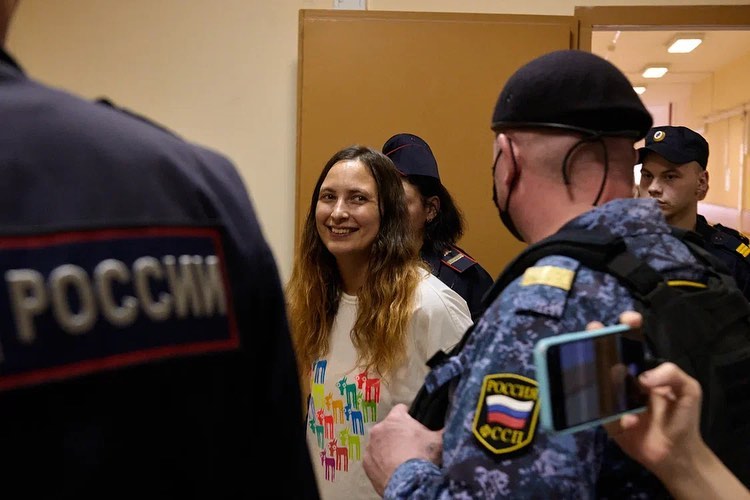
“Russia Isn’t a Fascist State, Because a Fascist State is Totalitarian, While Russia Is Democratic” (At the Sasha Skochilenko Trial)

Sasha Skochilenko, facing ten years in prison for anti-war price tags. Vasileoostrovsky District Court, St. Petersburg, 18 July 2023

Today’s hearing lasted almost nine hours!

It was finally possible to resume the cross-examination of Olga Safonova, on whose linguistic analysis of the price tags the prosecution’s case is largely based. At the last hearing it transpired that Safonova is actually a political science specialist who is brought in to provide linguistic (!) expertise on “political” issues. Moreover, she has already admitted that she cannot judge whether the information on price tags was “knowingly false,” although she wrote just the opposite in her expert analysis.

The cross-examination of Safonova took up most of the hearing, and it involved the lawyers, the independent expert Svetlana Drugoveyko-Dolzhanskaya, Sasha [Skochilenko] herself, and Prosecutor Gladyshev. (The defense requested that Gladyshev be recused for a number of reasons—including because he distorted the facts about Sasha’s income—but the motion was denied.) Safonova had a visibly hard time answering questions about the content of individual price tags and the linguistic terms she employs, and how she was able to identify motives of “political enmity” in the texts she analyzed. In fact, experts cannot assess an author’s motives, but Safonova refused to confirm this outright. “Just stay that this is not within your competence,” the lawyer Novolodsky asked her. “I won’t,” she replied.

Olga Safonova, expert witness for the prosecution. Vasileoostrovsky District Court, St. Petersburg, 18 July 2023

This was not the only occasion for laughter at today’s hearing. During a discussion of the texts on the price tags, Safonova also claimed that Russia is not a fascist state, since “a fascist state is totalitarian, while Russia is democratic.” She also asked that the defense not “examine every word [said or written] by expert witnesses with a magnifying glass, for crying out loud!” (She said this, I would like to remind you, at a criminal trial that could send Sasha to prison for ten years.)

As always, we want to say a huge thank-you to the journalists who have been covering Sasha’s case, and to everyone who came out to support Sasha! The next hearing will be held on September 14, after the judge’s vacation. Safonova will be summoned to court again. In addition, the court ordered the linguist Grishanina, the co-author of the expert analysis, forcibly delivered to the hearing.

P.S. We will have more to say about today’s hearing, so stay with us!

Photos courtesy of Andrei Bok and others

#freesashaskochilenko

Source: Sasha Skochilenko (Facebook), 18 July 2023. Translated by the Russian Reader

“Incompatible with the Prestige of a University Student”

Alexandra Zaitseva

The St. Petersburg State University Ethics Commission has ruled that a statement made by Alexandra Zaitseva, a first-year student and editor of the student media outlet Studen, was “incompatible with the prestige of a university student.” Another student media outlet, Lupa and Pupa, has publicized the incident.

The Details. Zaitseva was summoned to appear before the commission on July 7. Initially, the hearing was supposed to be held online, but the university subsequently changed the format to in-person and refused to change it back. According to Zaitseva, this was done so that she would be unable to record the hearing.

The Reasons. In June, an anonymous denunciation of Alexandra Zaitseva was posted in St. Petersburg State University’s virtual guestbook. The author of the denunciation did not like Zaitseva’s post on VKontakte about the expulsion of Mikhail Belousov’s students from the university’s history faculty.

“In this publication, she talks about the ‘vile and unjust expulsion,’ in her opinion, ‘of the students implicated in the sensational Belousov affair.’ In addition, she publicly insults other students (‘a bunch of bastards shouting goida on PUNK at night’) while obviously demeaning and voicing disdain for the patriotic citizens of our country,” the denunciation reads.

St. Petersburg State University replied that they had contacted “law enforcement agencies” and called a hearing of their ethics commission.

The Decision. “We consider A.N. Zaitseva’s behavior incompatible with the prestige of a St. Petersburg State University student,” the St. Petersburg State University Ethics Commission ruled.

Zaitseva told Bumaga that she believes she will be expelled. “I guess the outcome is pretty obvious. Although, I can’t say for sure—no order has been issued yet,” the student said.

The ethics commission members did not like the fact that Zaitseva had given a comment to TV Rain. According to them, in this way the young woman “once again displayed her openly negative attitude towards the university of which she is a student.”

Just prior to the hearing, St. Petersburg State University had banned university employees from giving comments and interviews to “foreign agent” media outlets.

The commission ruled that Zaitseva had violated the second and third paragraphs of the University Student’s Code, i.e., “To represent the university in extracurricular settings with dignity” and “To honor teachers, respect colleagues and students, maintain friendly relations both inside and outside the University, [and] contribute to the creation of an environment of mutual understanding and cooperation.”

“Apparently, the authors really don’t fancy the idea that someone might have principles: this is the only explanation why such a large piece of the text is devoted to them, and not to an analysis of my post,” Zaitseva said in reaction to the commission’s decision.

Source: “St. Petersburg State University student summoned by ethics commission over statement about expelled history faculty students,” Bumaga, 18 July 2023. Translated by the Russian Reader


The leadership of St. Petersburg State University (SPBGU) has fired Mikhail Belousov, a professor at the university’s History Institute, for committing an “immoral act” by speaking out against Russia’s invasion of Ukraine. The university posted its decision on its website. 

The university’s decision followed an investigation, during which university leadership confirmed that Belousov had circulated materials “discrediting” the Russian army, and “insulting the memory of those killed while fulfilling their military duty.”

“Belousov’s behavior violates the university’s moral traditions and generally accepted ethical norms, his actions are out of keeping with his and the university’s prestigious positions,” the document detailing the university’s decision says.

Petersburg publication Rotunda says the university began investigating Belousov and his students after Russian official and social media channels circulated screenshots of messages, allegedly written by the professor and his students, openly criticizing the war in Ukraine while the university was mourning one of its students, Fyodor Solomonov, who was killed in Ukraine.

Source: “St. Petersburg State University fires history professor for criticizing Russia’s invasion of Ukraine,” Meduza, 3 June 2023


Seven students of the previously dismissed associate professor Mikhail Belousov were expelled from the Faculty of History of St. Petersburg State University, Bumaga reports, citing sources at the university. They were among the ten people who were previously called to the ethics commission. The remaining three will have “some kind of meeting with the vice-rector for educational work.”

One of the expelled students told the publication that he would challenge the decision of the university.

At the end of May, Z-channels circulated screenshots with messages in which Belousov allegedly condemned the “internal” symbolism and said that “a direct and open approval of rashism is disgusting.” It was alleged that the associate professor wrote all this in the context of discussing the death of St. Petersburg University student Fyodor Solomonov in the war in Ukraine.

On June 3, Belousov was fired, and a group of his students were summoned to the ethics committee, which ruled that they “considered it appropriate to make fun of” Solomonov’s death instead of “showing normal human feelings.” It was also decided that the students’ actions were “incompatible with the status of a student at St. Petersburg State University.”

In October last year, associate professor Denis Skopin was fired from the same university for participating in a rally against mobilization, calling it an “immoral act.”

Source: “‘Paper’: St. Petersburg State University expelled seven students. Earlier, the university ethics commission condemned them for mocking a student who died in the war in Ukraine,” Russian Free Press, 16 June 2023

Terribly Far

This is the premiere of Terribly Far, a new program by Lyudmila Savitskaya.

We will talk about what is happening to people who are terribly far from Moscow and St. Petersburg. Who are terribly far from the congresses, conferences and conflicts of opposition leaders. Who are terribly far even from popular YouTube channels and shows. Who are also terribly far even from Telegram.

Why does this matter? It matters because otherwise we won’t understand how the country got to this point and why some Russians volunteer to fight in the war.

In this episode, you’ll learn what worries Russians more than Prigozhin’s rebellion, why the Baltic Sea in Kaliningrad is becoming bloody, in which city it is easiest to encounter wild bears on the streets, and the job you have to land to make a dream salary of 8,000 rubles [approx. 80 euros] a month.

00:10  Why this program is needed

02:05 “We support the president, but where is the water?!” On Prigozhin and the water in Kostroma

06:06 There is no money to pay mail carriers in Buryatia

09:26 People in Kaliningrad are trying to save the Baltic Sea from pig’s blood

12:44 People in Tomsk are fleeing from bears on the streets

15:20 Taxis in Penza risk sinking underwater even after a normal rain shower

16:18 Why all this matters even in wartime

Subscribe to our channel, where we talk about the problems of ordinary people. And if you live beyond the Moscow Ring Road and are facing trouble right now, write to us at:

strashnodaleki@gmail.com

We will definitely tell our viewers about it. Because we do care.

Source: “Terribly Far No. 1: Pigs vs. People | Prigozhin and Hot Water | Bears on the Streets,” Open Media (YouTube), 7 July 2023. In Russian, with Russian captions. Annotation translated by the Russian Reader

__________________

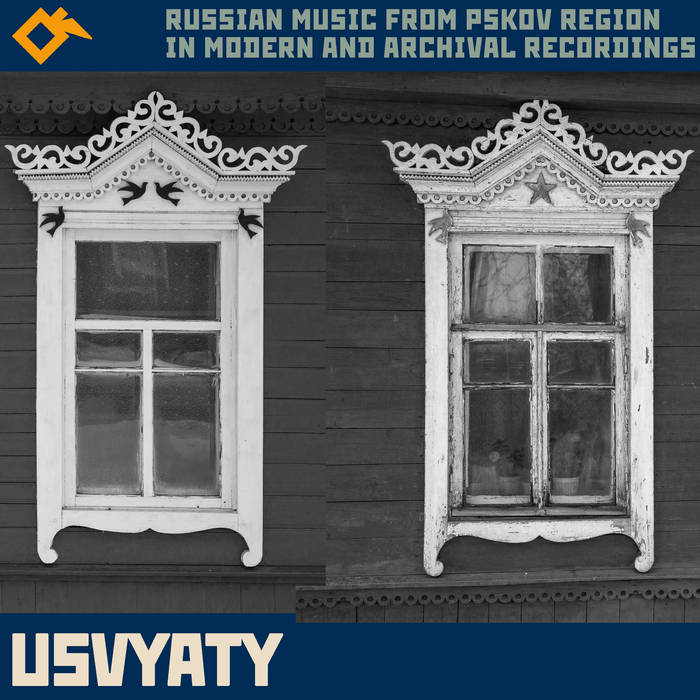
The Usvyaty District of the Pskov Region belongs to the ethnographic area known as Poozerye (Lakeland). There used to be many folk musicians there, the most famous of whom was the singer Olga Sergeeva (1922-2002).

Ekaterina Trusova (maiden name Kozintseva, tracks 1-7) is a garmon (Russian button accordeon) player living in Usvyaty. She was recorded at the Usvyaty House of Culture on December 12, 2021.

The other two musicians featured on this album belong to a previous generation and were recorded by Ekaterina herself in the 1990s on a home cassette tape recorder. The cassettes were digitized by Alexander Yuminov (KAMA Records) in 2022.

Sofya Rubisova (tracks 8-13) is a folk singer from the village of Sterevnevo, Usvyaty District.

Dmitry Kozintsev (tracks 14-17) is Ekaterina’s father, a garmon player from the village of Pysi. Unfortunately, the recordings of him are of poor quality, as the tape in the cassette turned upside down. But we still decided to include them in the album.

Another album from the area, from the village of Tserkovishchi, can be found here.

Source: Antonovka Records (Bandcamp), 8 July 2023. I’ve lightly edited the original annotation to make it more readable. ||| TRR

__________________

Branded “foreign agent,” Yaroslavl media outlet announces closure

YARNOVOSTI announced it was suspending its work on July 7. The publication had been running for over ten years. It covered the inhabitants of Yaroslavl, corruption, problems with public amenities, and politics.

In June, the Justice Ministry had declared YARNOVOSTI a “foreign agent.” None of its employees agreed to work under this label. The editors said that during its entire existence it had not received “a kopeck” of foreign funding.

“Of course, we expected to continue working, but, as Vladimir Putin said, nothing lasts forever. We are still getting to the bottom of what happened on June 2: we have made all possible and even impossible inquiries, and have drawn up the paperwork for the court,” the media outlet’s editorial team wrote.

Source: 7 x 7 (Telegram), 7 July 2023. Translated by the Russian Reader. As of this writing, YARNOVOSTI seems to have shut down its website, but its page on VKontakte is still functioning. In its latest post there, published on 7 July 2023, it informed readers of the decision to suspend its work.

Don’t Press the Button

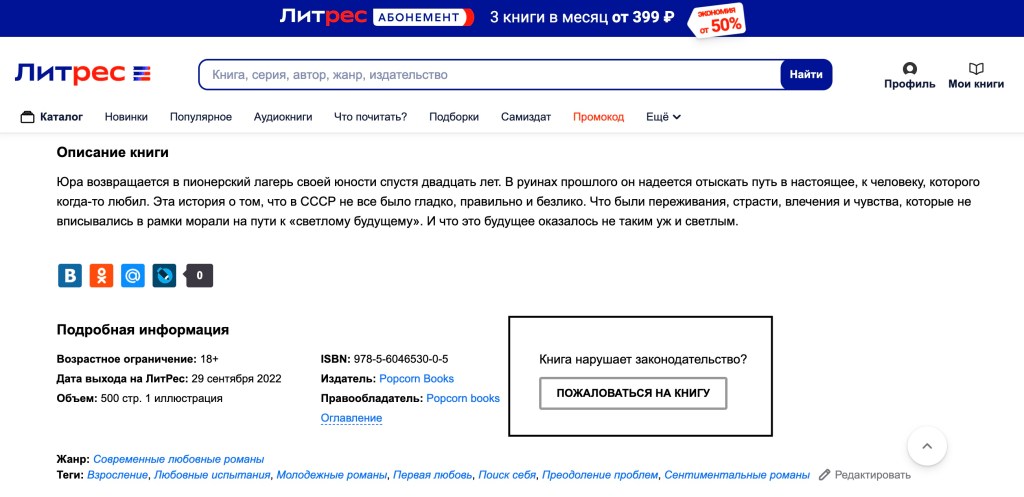
I read on social media yesterday that Russian ebook giant LitRes had added a button on its website for readers who want to file a complaint against any of the books it offers for violating Russian laws. To see whether this was true, I punched up the most popular recent Russian book among readers of this website, Katerina Silvanova and Elena Malisova’s runaway LGBTQ+ romance bestseller A Summer in a Young Pioneer’s Tie.

Indeed, there is such a button, located below the book’s description and right next to a summary of its front matter. In the screenshot I took, above, I’ve drawn a black box around the button, which reads, “Does the book violate the law? Complain about the book.”

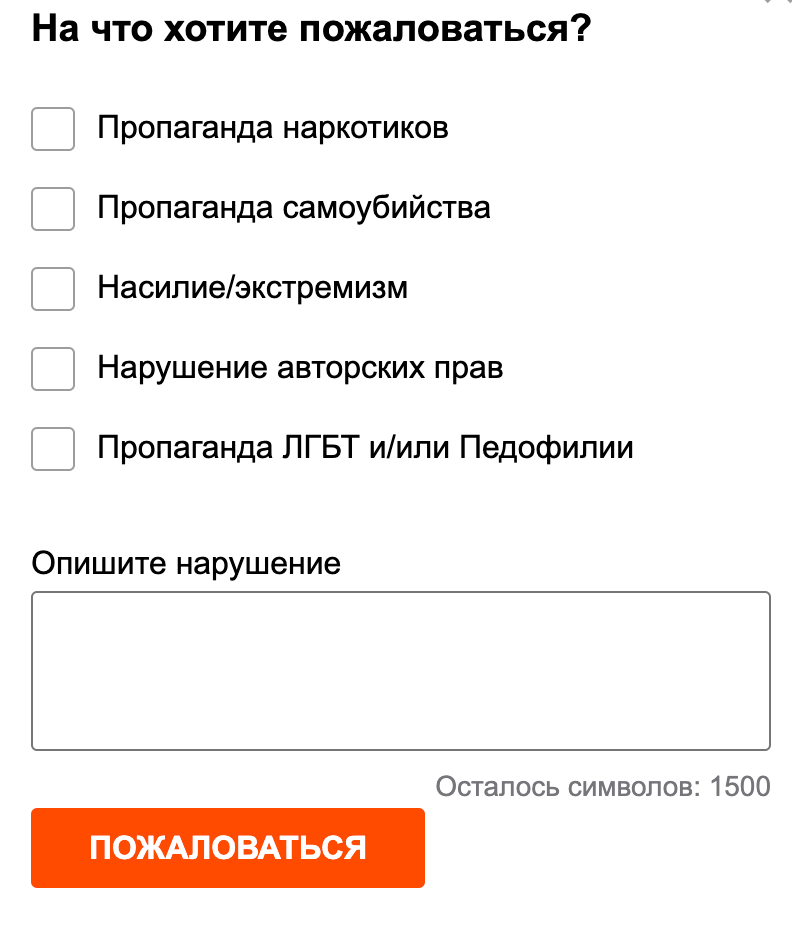
If you do the unthinkable and press the button, a window pops up:

“What do you want to complain about?” the prompt asks. The choices are “Promotion of narcotics,” “Promotion of suicide,” “Violence/extremism,” “Copyright violation,” and “Promotion of LGBT and/or Pedophilia.” You are then asked to “describe the violation” in 1,500 characters or less and dispatch your complaint to LitRes’s law-abiding overlords by hitting the big orange-red “Complain” button.

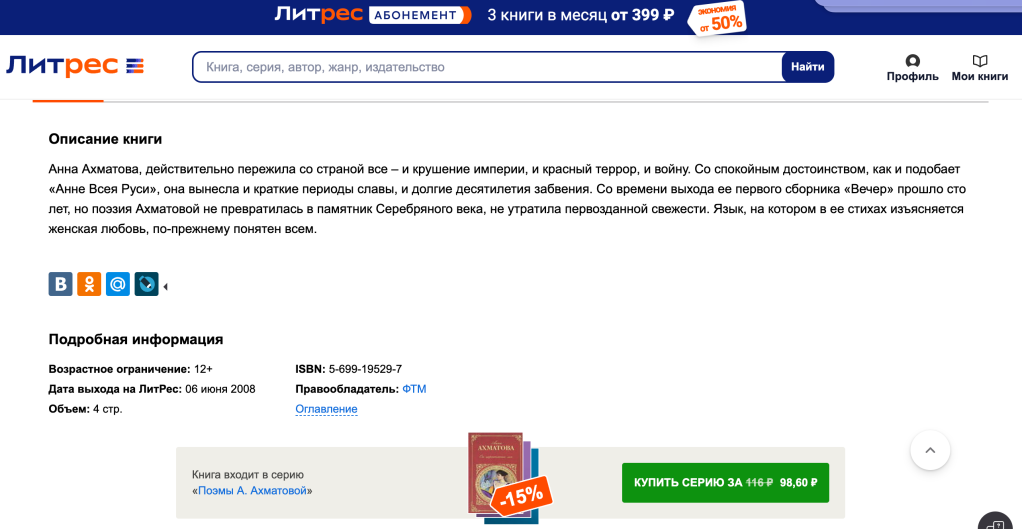
A quick scan of the 113 titles in my own “bookshelf” on LitRes and some of the book’s suggested to me by the service revealed, however, that readers cannot file a complaint against any book they wish. Anna Akhmatova’s Requiem, for example, is beyond suspicion, as you can see in the screenshot, below. ||| TRR

The Spectre

Royal Trux, “The Spectre” (1993)
My faith is in the spectre 
and there it shall remain
The spectre is a surgeon 
and an atomic guide
He haunts the lenses of my eyes
And the chemicals in my brain 

Once there was a rich man 
who drank from the spectre's cup
He always held his head so high 
but he never would look up
The spectre was above his head 
hanging like a sword
The lesson now it must be said
the spectre is its own reward

Lyrics courtesy of: David Gauthier (YouTube)


Three Denver police officers were injured early Friday morning while responding to a call for a welfare check. It began at 12:30 a.m. Friday when one officer arrived for a welfare check in the 600 block of North Pennsylvania Street. 

As the officer was speaking with the individual who made the call, the person in question came out of the building and attacked the officer, ripping off his police badge and then using it to cut the officer. 

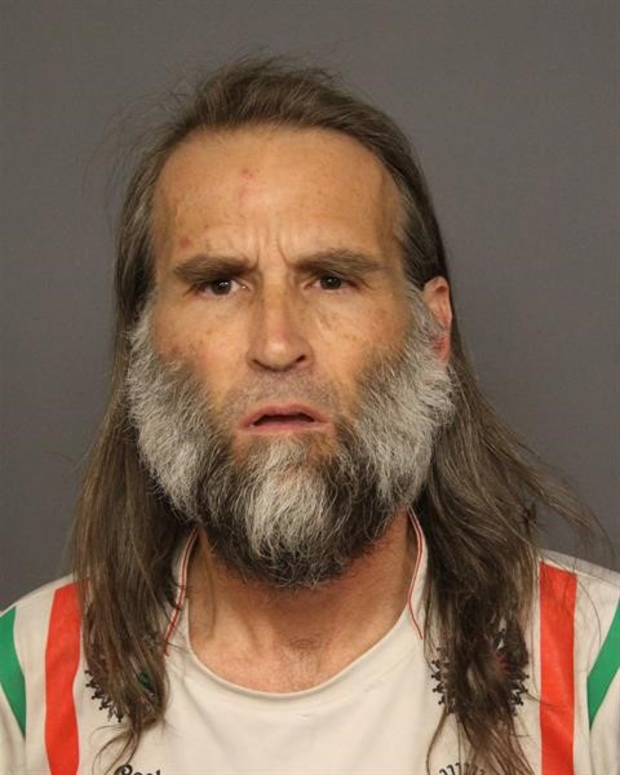
neil-hagerty-06-12-1965-copy.png
  Neil Hagerty/DENVER POLICE

As responding officers arrived, the man remained combative and injured two other officers. 

The suspect has been identified as Neil Hagerty, 57. He remains in custody for investigation of aggravated assault to a peace officer. 

The three officers involved suffered cuts and abrasions during the struggle. All three have been released from the hospital. 

Source: “3 Denver police officers injured, suspect Neil Hagerty arrested,” CBS News Colorado, 14 April 2023


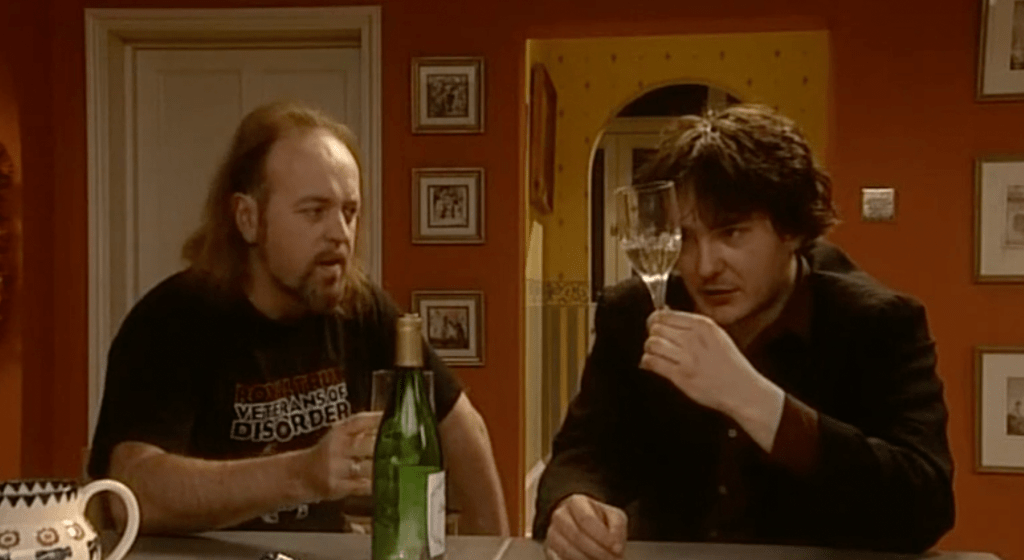
Manny (left), wearing a Royal Trux: Veterans of Disorder t-shirt during “Grapes of Wrath,” season 1, episode 3 of Black Books

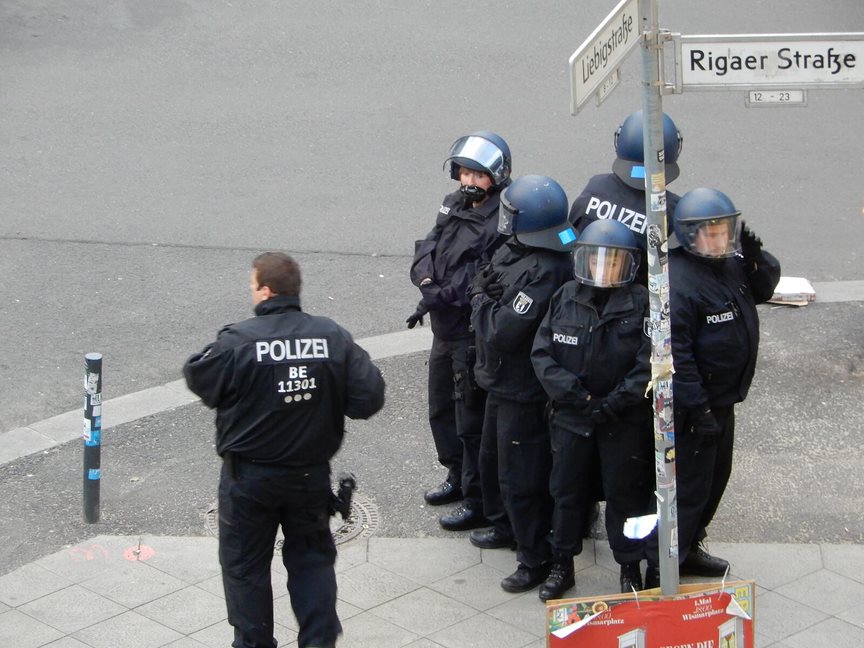
“All cops are bastardi.” Corner of Rigaer Strasse and Liebigstrasse, Berlin-Friedrichshain, 20 May 2019
The now-decimated anarcho-feminist punk squat Liebig 34, which I watched the deliriously awful Berlin police surveil, harass, and raid on a nearly daily basis during the winter and spring of 2019, is visible in the upper left of the photo. Photo by the Russian Reader
A closer view of the exact same street corner, only three days earlier, on 17 May 2019. Photo by the Russian Reader

Last week, we witnessed the deaths of 33 Palestinians in Gaza by an unprovoked Israeli murder campaign — or as they named it, “Operation Shield and Arrow.” The assault on Gaza not only coincided with the 75th anniversary of the Nakba, but also underscored the fact that the brutality with which Israel ethnically cleansed some three-quarters of a million Palestinians in 1948 continues to this day.

Palestinians around the world took to the streets not only to protest their governments’ complicity in the latest Israeli massacre, but also to have a space to express their grief and mourn 75 years of violent colonization, apartheid, and displacement. Given that Israel continues to prevent the return of millions of refugees and their descendants, remembering the Nakba is foundational to a Palestinian identity centered around our yearning to be back in our homeland.

Yet in countries like Germany, which is home to thousands of Palestinians, our right to freedom of expression and assembly is dangerously under attack. For the second year in a row, the Berlin police preemptively banned all Nakba commemorations and demonstrations, surpassing the upswing in violent policing tactics being reported elsewhere in Western Europe, including the U.K. The ban was implemented on the basis that the Nakba Day events posed an “immediate danger” of antisemitism and the glorification of violence.

Last year, Berlin police arrested and detained 170 people, including some who did not even participate in a demonstration; in a recent court hearing, a police officer admitted that they targeted people for wearing the keffiyeh, being dressed in the colors of the Palestinian flag, or simply looking like they intended to join a rally.

Following this year’s ban, the only event allowed to take place was a purely cultural one at Berlin’s Hermannplatz last Saturday. But even this was authorized with heavy conditions: police banned all speeches, took down signs at stands that included the words “BDS” or “Nakba,” confiscated political pamphlets, and at one point even told organizers that dabke, the traditional Palestinian dance, was “too political.” Surrounded by dozens of police officers who continuously videotaped the event, Berlin succeeded in making Palestinians feel the chilling effect of full-blown repression.

In the name of tackling “Israel-related antisemitism,” German authorities are doing Israel’s bidding in their own country. Now, however, it seems they are also keen on mimicking Israel’s repressive tactics against all expressions of Palestinian identity. Earlier this year, Israel’s far-right National Security Minister Itamar Ben Gvir ordered the Israeli police to enforce a ban on the Palestinian flag in public spaces, claiming that the flag is a rallying symbol for “terrorists.” And just last Saturday, the Berlin police banned a gathering that ironically was centered around the historical banning of the Palestinian flag, organized by Palestinian, Jewish, and German women.

With Israel’s encouragement, Germany’s adoption of the stifling IHRA definition of antisemitism and the Bundestag’s passing of the anti-BDS resolution has opened the floodgates to a new wave of repression against all aspects of Palestinian identity, bringing the ongoing Nakba to Europe.

I am the granddaughter of Palestinian refugees who were violently expelled from our ancestral village of Jimzu in the center of historic Palestine. Dispersed all over the world and becoming refugees within Palestine, my family still instilled in me a remembrance of our past and a yearning for our eventual return.

July 9, 1948, the date on which the Yiftach Brigade of the Zionist paramilitary group the Palmach invaded Jimzu, was the beginning of a lifetime of perseverance and resistance for my family and eventually me. Yet I am only one of thousands of Palestinians in Germany with identical stories, all living in a country that values the supreme power of a foreign state over its own citizens and residents.

“We want to die in our homes in Palestine,” my great grandfather, the mukhtar of the Aqabat Jaber refugee camp in Jericho, said in the documentary, “Aqabat Jaber — Peace with No Return?” “Who doesn’t want to live in peace?” he continued. “But there can be no peace without our right to return home. It will take years, it won’t happen now — it will take time, but we’re only here temporarily.”

Source: Hebh Jamal, “Where we can Palestinians mourn our catastrophe?” +972 Magazine, 18 May 2023

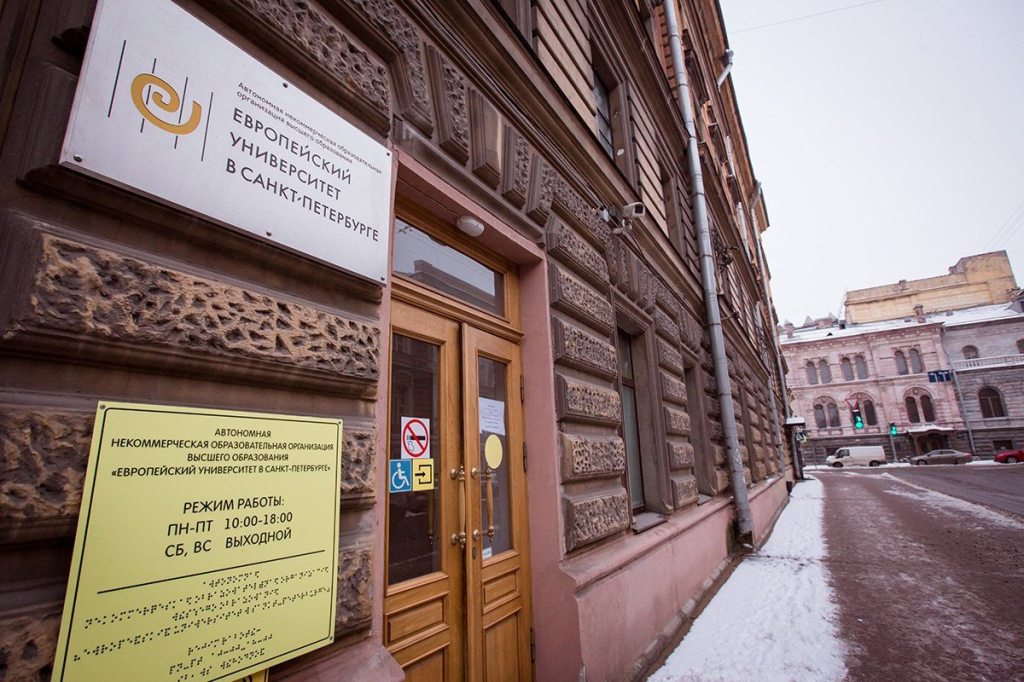
Is the European University at St. Petersburg “Extremist”?

The entrance to the European University at St. Petersburg, which I’ve walked through hundreds of times.
Photo courtesy of VG from an unidentified source

Rosobrnadzor [the Russian federal education watchdog] and the prosecutor’s office have begun an unscheduled inspection of the European University at St. Petersburg, sources at the university and close to the university have told the BBC. The inspectors are examining publications by the university’s lecturers and the topics of students’ dissertations, especially in political science, history, and sociology, and they are also observing classes. [In December 2016], a similar inspection led to the university’s license being revoked.

That the inspection was underway was confirmed to the BBC on condition of anonymity by eight sources, both within the university itself and among those associated with it. One of the academics told the BBC that the EUSP’s leadership was warned about the unscheduled inspection last Thursday. The inspectors arrived at the university on Monday [May 15].

The university’s rector, Vadim Volkov, responded to our request for comment by writing that he could not speak [about the matter], “especially with the BBC.” Alla Samoletova, chief of staff in the rector’s office and responsible for media contacts, did not respond to the BBC’s calls and messages.

Two of the BBC’s sources claimed that the prosecutor’s office is checking the university “for extremism.” According to one of them, the inspection is part of a campaign to counter extremism and terrorism. The supervisory authorities are interested in the content of academic papers and programs. In particular, the inspectors are looking for extremism in publications by the university’s lecturers, they said. Rosobrnadzor and prosecutor’s office inspectors have been stationed in a computer classroom two days in a row reading documents, as well as sitting in on classes at the university.

A source told the BBC that the inspectors requested a packet of documents for 2020–2023 that included dissertation topics and personal files of the university’s master’s degree and PhD students (the EUSP has no bachelor’s degree program), as well as their individual research plans, as authorized by their academic advisers. Such documents were retrieved from at least four faculties—anthropology, history, sociology, and political science—the source claimed.

The topics of dissertations and their content were always discussed at the university in terms of their compliance with academic standards, but they were not censored, one of the scholars noted. Another said that in recent years, when approving topics, advisers took in account how risky writing and publishing the work would be for the author, their informants, and the university, and whether the thesis could be successfully defended in the current circumstances.

After the outbreak of the war with Ukraine, the EUSP said farewell to foreign teaching staff and [Russian nationals teaching at the university] who fled Russia, sources said. The current audit affects several dozen of the university’s lecturers, as well as several hundred graduate students.

The technique for attacking a university, according to the BBC’s source, is standard: officials usually recruit experts who are willing to detect evidence of “extremist propaganda” and similar violations in research. These experts include people who have themselves been guilty of plagiarizing academic works, as the BBC has reported.

It is almost impossible to challenge such examinations, said a source close to the EUSP. According to them, the results of a similar inspection had led, in the past, to a shakeup of the teaching staff and changes in the curricula at the Faculty of Liberal Arts and Sciences (Smolny College) of St. Petersburg State University.

In 2021, similar audits took place at the Shaninka (Moscow School for the Social and Economic Sciences), and at RANEPA’s Institute of Social Sciences (ION). The prosecutor’s office, as during its audit of Smolny College, asked to see scholarly articles by university staff and a “steering document on disciplinary activity” said a BBC source familiar with the audit.

The European University is a private university founded in St. Petersburg in 1994. It was initially funded by grants from American and European NGOs, including the Soros Foundation, the MacArthur Foundation, and the Ford Foundation. These organizations are now deemed “undesirable” by the Russian authorities, but the EUSP has not received financing from them for a long time.

The EUSP Board of Trustees is headed by Mikhail Piotrovsky, director of the Hermitage Museum, while former Russian presidential chief of staff Alexander Voloshin and ex-chairman of the Federal Audit Chamber Alexei Kudrin are among the trustees. Kudrin is also a member of the board of trustees at the Shaninka, and he previously served as the dean of Smolny College.

The BBC Russian Service and other independent media have repeatedly reported that the intense focus of the oversight authorities on private universities in Russia (especially the EUSP and the Shaninka) is fueled by the FSB, which is unhappy with their independence and academic contacts with the West.

In 2016, the EUSP was subjected to a similar inspection by the same supervisory authorities. Inspectors then questioned students as well, but it has not come to that yet during the current inspection. Inspectors also then audited academic works for extremism, but could find no evidence of it. The only irregularities that Rosobrnadzor found find at the EUSP had to do with number of practical teachers [sic] in the Faculty of Political Science. The latter led to the revocation of the university’s license, which was reinstated only a year later. The BBC’s sources could not rule out that, this time around, the inspection would lead to the EUSP’s closure or the shuttering of individual programs at the university.

According to the consolidated register of inspections, the EUSP was audited thirteen times between 2016 and 2022, including three times by Rosobrnadzor. In October, the government banned planned inspections in 2023 of legal entities that do not belong to high-risk categories.

The BBC sent a written request for comment to the EUSP’s press service, as well as to the New League of Universities, which includes the EUSP, the Shaninka, the New Economic School (NES), and Skolkovo Institute of Science and Technology (Skoltech). The League advertises itself as an association of new Russian universities established in accord with international education standards. The BBC has also contacted Rosobrnadzor and the St. Petersburg Prosecutor’s Office for comment and is awaiting a response.

Source: Sergei Goryashko, Anastasia Golubeva & Elizaveta Podshivalova,”Prosecutor’s office checks European University in St. Petersburg for ‘extremism,'” BBC News Russian Service, 17 May 2023. Translated by the Russian Reader

Destructology

A court in Moscow has remanded the theater director Zhenya Berkovich to custody in a pretrial detention center and almost inevitably will render the same decision about the playwright Svetlana Petriichuk (whose pretrial restrictions hearing is still underway). This is the first criminal case in Russia against the authors of a work over its content. Both are accused of “condoning terrorism” in the play Finist the Brave Falcon, which recounts how Islamists recruited Russian women as wives. Last year, the production was awarded the state-sponsored Golden Mask theater prize in two nominations.

Before the court hearing, it transpired that the case was based on a forensic examination conducted by Roman Silantyev, head of Moscow State Linguistic University’s Destructology Laboratory, and his colleagues.

“Destructology” is a science invented by Silantyev himself. He claims that the new discipline “comprehensively examines extremist and terrorist organizations; psychotic cults and non-religious sects; totalitarian sects and the magical services sector; suicidal games and hobbies; deadly youth subcultures (Columbine, AUE, etc.) and medical dissidence.”

There are many experts in Russia whose findings are used by the security forces to imprison people for what they say and write. Often such experts are ignorant, their conclusions are unscientific, and their public statements are frankly obscurantist.

But Roman Silantyev stands out even in this crowd.

A former employee of the Moscow Patriarchate’s Department of External Ecclesiastical Relations (the church’s equivalent of the Ministry of Foreign Affairs), at the outset of his expert career, Silantyev presented himself as a specialist in Islam. In 2005, the publication of his book “The Modern History of the Russian Islamic Community” triggered a scandal: Russia’s Council of Muftis wrote that the author’s stance was at odds “with the most elementary norms of universal ethics and morality.”

To understand the outrage of the muftis, we should take a look at Silantyev’s statements. For example, he said that in order to fight the Wahhabis, “physical force—destruction and gouging—is maximally effective” and dreamed that “law enforcement agencies would finally realize that in this case it is better to cross the line than to come up short.”

Over time, Silantyev felt that he had outgrown his narrow remit as a scholar specializing in Islam and since then he has been commenting on everything. He has opposed Star Wars (calling Jediism an “anti-Christian multifunctional propaganda project”), claimed that Ukrainians profess the “religion of Ukrainianism,” and called for a legislative ban on Satanism in Russia, accusing Ukraine of spreading it.

In 2020, Silantyev traveled around Russia giving lectures on “extremism prevention.” He boasts that he has taught classes to officers and staffers at the Federal Security Service (FSB), the Federal Penitentiary Service (FSIN), and the Interior Ministry. And they seem to actually pay heed to him, or at least to successfully use him for their own purposes. It seems that Silantyev has already helped to send dozens (if not hundreds) of people to prison, including Muslims and Jehovah’s Witnesses.

And now he has helped send artists to jail. In their expert report, Silantyev and his fellow destructologists write that Berkovich and Petriichuk’s play contains “traces of the ISIS ideology, as well as the subculture of Russian Muslim neophytes.” In addition, the experts detected the “ideology of radical feminism” in the play.

“The ideology of radical feminism, based on the idea of women’s immanent humiliation, is far from harmless. Destructological science has recorded cases in which adoption of this ideology led to the deliberate planning and execution of a terrorist act,” the self-styled experts teach us. And the court, by sending artists to jail, seems to share this opinion.

Source: I Don’t Get It email newsletter (Mediazona), 5 May 2023. Photo and translation by the Russian Reader

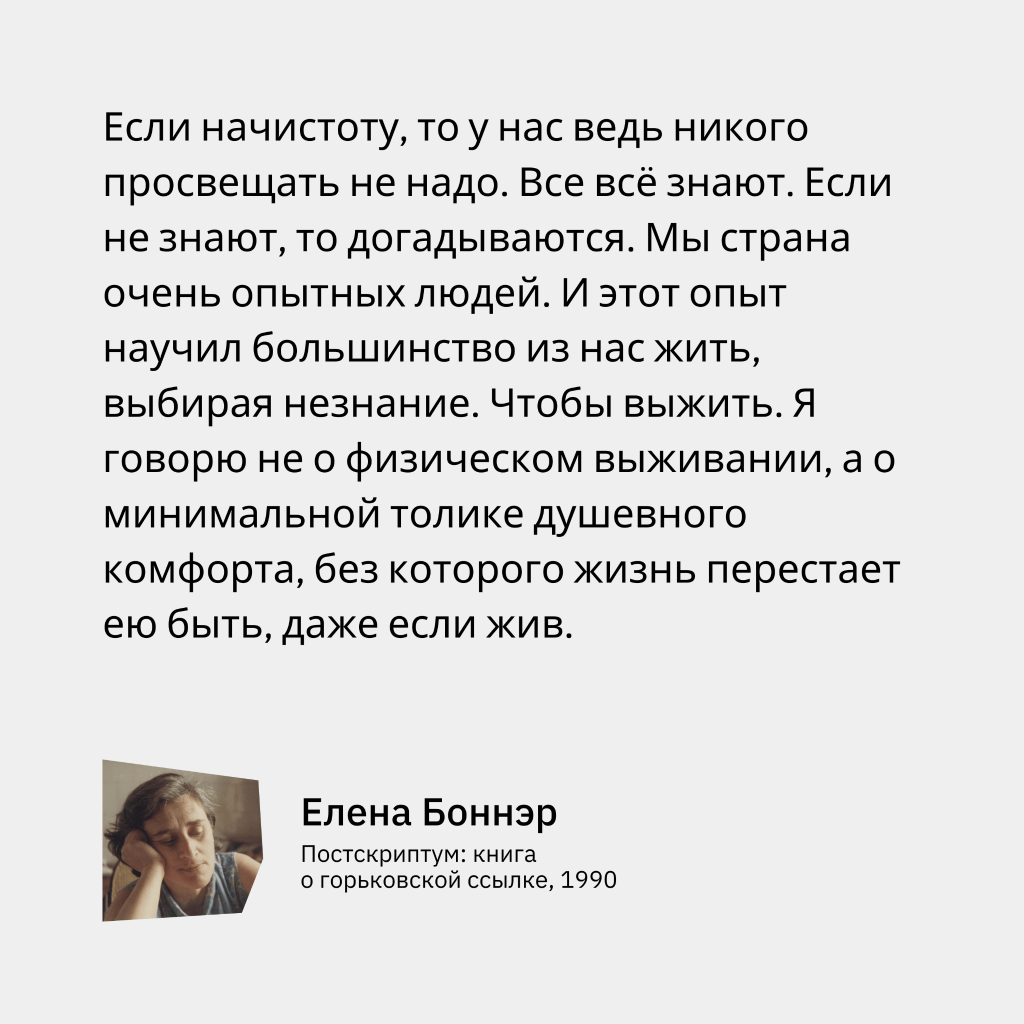
Everybody Knows Everything

“To be honest, we don’t need to educate anyone. Everyone knows everything. If they don’t know, they have a hunch. We are a country of very experienced people, and this experience has taught most of us to live by choosing ignorance — in order to survive. I’m not talking about physical survival, but about the minimum amount of mental comfort without which life ceases to be life, even if one is alive.” ||| Yelena Bonner, Postscript: A Book about the Exile in Gorky (Moscow: Interbruk, 1990), p. 247

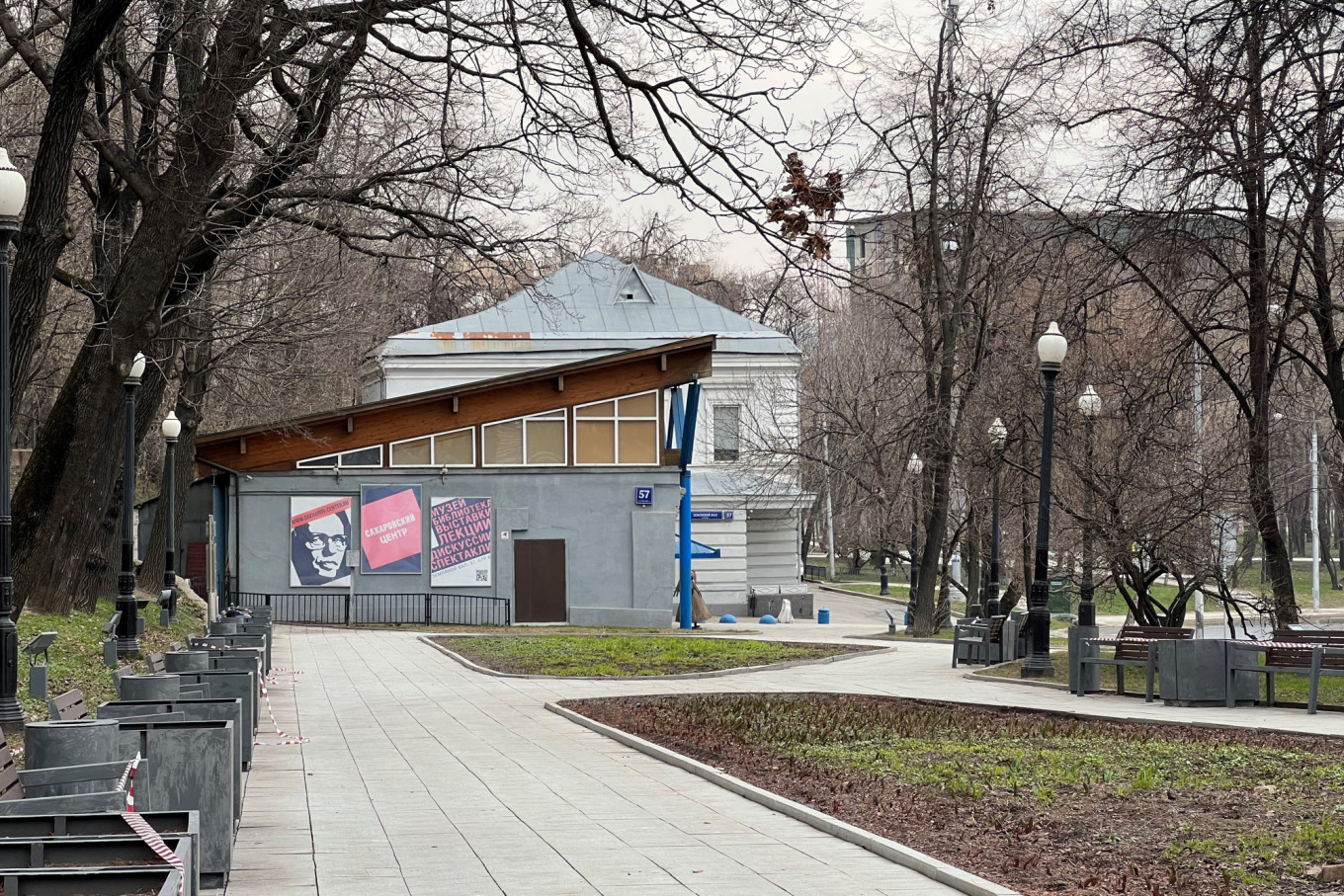
Very soon — this Sunday — our current exhibition will wrap up, and the Sakharov Center will close its doors.

THIS MATERIAL (INFORMATION) WAS PRODUCED AND/OR DISTRIBUTED BY A FOREIGN AGENT, THE SAKHAROV CENTER, OR CONCERNS THE ACTIVITIES OF A FOREIGN AGENT, THE SAKHAROV CENTER. 18+

Coincidentally, our final exhibition is dedicated to Yelena Georgiyevna Bonner, who founded the center. Eviction, of course, does not mean at all that we are ceasing operations. This year we expect to launch a website in honor of Yelena Georgiyevna, produce a podcast, and do a lot more. And yet, it is clear that an important period in the center’s history is coming to an end.

Source: Sakharov Center (Facebook), 14 April 2023. Translated by TRR


The headquarters of Russian human rights group the Sakharov Center, a rare island of free debate in the Russian capital, will close its doors to the public this weekend in response to an eviction order from local authorities as Russia’s wartime drive to suppress dissent shows no sign of ending. 

Opened in 1996 to honor the memory of Soviet dissident and Nobel Peace Prize winner Andrei Sakharov, the center has been an iconic location for talks, exhibitions, funerals and discussions about human rights. 

“Without these two buildings, we are no longer a public center,” said Vyacheslav Bakhmin, a veteran human rights activist and the chairman of the board of the Sakharov Center.

“It makes any activity extremely difficult.”  

The eviction comes as the few human rights groups still operating inside Russia face intensifying state pressure in the wake of the Kremlin’s decision to invade Ukraine. 

The country’s oldest human rights organization, the Moscow Helsinki Group, was closed down by a court order in January, while eight top members of shuttered rights group Memorial, which was jointly awarded the 2022 Nobel Prize last year, were targeted in police raids last month. 

The Sakharov’s Center’s final exhibition at its headquarters on the banks of the Yauza River in downtown Moscow was devoted to Yelena Bonner, the wife of Andrei Sakharov and a major Soviet dissident in her own right. 

“We did not plan this symbolism, it just happened this way — they started closing us down on the eve of Bonner’s centenary,” curator Natalia Samover told The Moscow Times. 

“This center is filled with her name,” she said, standing amid the exhibition that included some of Bonner’s photos and video interviews as well as her desk, notebooks and letters opposing Russia’s 1990s war in the North Caucasus republic of Chechnya. 

Bonner was involved in founding the Moscow Helsinki Group in the 1970s and worked tirelessly to raise Sakharov’s profile when he was exiled to Gorky (now Nizhny Novgorod) by the Soviet authorities. 


					The Sakharov Center.					 					MT
The Sakharov Center. Photo by The Moscow Times

Following Sakharov’s death in 1989, Bonner established the Sakharov Center — gifted rent-free by the Moscow authorities — and opened the Sakharov archives to the public. 

On a recent visit by a Moscow Times reporter to the Bonner exhibition, there were a handful of visitors. 

“The center is definitely a significant place — it’s important to have different points of view as well as places where these different points of view can be discussed,” said Artemy, an IT specialist, who decided to visit because he knew that the center was due to close.

“I think that everyone can be represented in the public field,” said another visitor, Stanislav, who admitted that he wasn’t aware of “the history of the center.”

The closure of the Bonner exhibition — titled “Life Was Typical, Tragic and Wonderful” — marks the end of the Sakharov Center’s long tradition of public engagement. 

Employees earlier this month dismantled the center’s permanent exhibition on the legacy of Sakharov and victims of Soviet-era repression and its final public event — dedicated to Bonner — will take place Sunday evening.  

According to the eviction notice, the center must be fully vacated by April 28. 

Formally, the authorities’ decision to deprive the Sakharov Center of its Moscow home was a result of the organization’s designation as a “foreign agent” in 2014 — Russian law forbids “foreign agent” organizations from receiving any state support.  

But the Sakharov Center has said it believes the order was really motivated by the Kremlin’s desire to destroy “independent organizations that defend the public interest.”

For the moment, the Sakharov Center does not have any new premises lined up and is planning to continue its activities online. 

In addition, it is undergoing an unscheduled inspection by the Justice Ministry this month, board chairman Bakhmin told The Moscow Times.  

“The results will make it clear whether and how we can continue,” Bakhmin said.

The eviction is just the latest example of official pressure on the Sakharov Center. 

Russia’s Prosecutor General’s Office declared the Andrei Sakharov Foundation — a group opened by Bonner in the U.S. — as an “undesirable” organization in January, a designation that means any association with the group could result in criminal charges in Russia. 

That means the Russia-based Sakharov Center now avoids any cooperation with its U.S. counterpart.

The current state of human rights in Russia is “unprecedented,” according to Tatiana Lokshina, a Europe and Central Asia expert at Human Rights Watch, which was forced to close its own Moscow office last year. 

“While Russia is fighting against Ukraine, it is also fighting against any critical actors within the country. This is a real war with dissenting opinions,” she told The Moscow Times. 

Over the years, the Sakharov Center, which describes itself as “a place uniting thousands of Russian citizens who are not indifferent to the fate of the country,” has hosted a number of landmark events — including the unofficial lying-in-state for Soviet dissident Valeria Novodvorskaya and murdered Kremlin critic Boris Nemtsov. 

Despite the loss of a physical presence in central Moscow, Bakhmin remains optimistic that the Sakharov Center will survive and the current crackdown will be reversed. 

“The situation [in Russia] will change again — the reality we live in right now has no future,” Bakhmin told The Moscow Times.

“There is always hope.” 

Source: “After 27 Years of Rights Activism, Moscow’s Sakharov Center Prepares to Close Its Doors,” Moscow Times, 14 April 2023

Never Speak of Him

The Second District Military Court in Moscow has fined Lilia Zhlobitskaya 300 thousand rubles [approx. 3,600 euros] for publishing poems about her nephew Mikhail Zhlobitsky, who blew himself up at the FSB’s Arkhangelsk regional offices. She herself reported this news to OVD Info.

A criminal case against Zhlobitskaya was launched in December. She was released on her own recognizance after being charged with “publicly condoning terrorism,” per Article 205.2.2 of the Criminal Code. The charge was triggered by posts she had made in November and December 2019 on VKontakte. Among them are reposts of poems from the website stihi.ru, as well as two reposts from the group page of the People’s Self-Defense with information about the bomb blast at the FSB.

According to the prosecution’s expert witnesses, Mikhail Zhlobitsky’s actions in the posts in question were deemed “correct, worthy of support and imitation,” and he himself was characterized as a “good guy.”

17-year-old student Mikhail Zhlobitsky detonated a homemade bomb in the lobby of the FSB’s Arkhangelsk directorate on [October 31,] 2018, killing himself and injuring three security forces officers. A few minutes before the blast, a warning about the attack from Zhlobitsky appeared in the chat of the Telegram channel “A Rebel’s Speech.” The message said that his act, in particular, was motivated by the fact that the FSB had been fabricating criminal cases.

Source: “Aunt of Mikhail Zhlobitsky, Who Blew Himself Up in Arkhangelsk FSB Offices, Fined for Publishing Poems About Her Nephew,” Mediazona, 27 March 2023. Lilia Zhlobitskya is the latest in a long list of Russians who have been investigated or prosecuted for, allegedly, “exonerating” or “condoning” the apparent suicide bombing by Mikhail Zhlobitsky on October 31, 2018. Other victims of this bizarre witch hunt include Yevgeny Gavrilov, Sergei Arbuzov, Alexander Merkulov, Alexei Shibanov, Svetlana Prokopyeva, Nadezhda Belova, Lyudmila Stech, Oleg Nemtsev, Ivan Lyubshin, Anton Ammosov, Pavel Zlomnov, Nadezhda Romasenko, Alexander Dovydenko, Galina Gorina, Alexander Sokolov, Yekaterina Muranova, 15-year-old Moscow schoolboy Kirill, and Vyacheslav Lukichev. Translated by the Russian Reader