“Across the River They’re Making Chocolate”: Vsevolod Korolev’s Closing Statement in Court

<Vsevolod Korolev

During his closing statement in court today the documentary filmmaker Vsevolod Korolev read a poem by Grigori Dashevsky:

1.

Across the river they’re making chocolate.

Out there the river-ice is breaking up.

And upriver we’re waiting, but for now

no bus comes, only its vacant ghost,

a desolate fleshless light flying ahead

to the engine’s howl

and the clatter of

the ad-slates changing.

We’re not cold, we bide our time.

The sky a deeper blue, the burning streetlights.


2.

To wait for each new minute as for a ghost,

to put on stage-paint for him alone,

to powder your face with light––and poorly it sticks,

but without it there’s nothing

to tell you apart: not from the many

faces—multitudes—

but from the lived-through years

which, like a star, are distant and weightless as smoke.


3.

But from the sweet smoke, the glory of heaven,

look up for a moment,

tear your eyes away
as from a book:

As much as a star has its shining

or a factory its smoke,

all things have

their limit: a book’s gilded edges

or a band of cloud.


4.

And turned from weddings not my own, and graves,

not waiting for the end, I rose

and saw an enormous room, a hall,

walls, walls, Moscow, and I asked:

where is the light that lit these pages,

where is the wind that rustled them like leaves?


5.

It’s late to be asking: each person is lit bright,

thrown open to the right dream

for the minutes, like pupils widened,

unscathed, like smoke or sleep:

they fly in, gleam, collect a promise:

Remember, remember (take leave of) me.


“I don’t intend to speak for very long. Your Honor, I am in some sense a colleague of yours, since I’ve worked as a third-tier soccer referee; I understand that you’re in a tough situation, it’s hard to envy someone stuck in the middle of this whole business. But nevertheless I have always believed in people and will continue to do so, even when it makes absolutely no sense. In any case I know this is really hard for you, but I think you’ll figure it out.” (Vsevolod Korolev)

“To ask for ten years when the maximum is ten and given the absence of aggravating circumstances and the evidence of mitigating ones—this goes against the fundamental norms of the criminal code. And this demonstrates for the umpteenth time the invalidity and baselessness of the prosecution’s case.” ([Korolev’s defense] lawyer Maria Zyrianova)

Source: Irina Kravtsova (Facebook), 18 March 2024. Translated by the Fabulous AM. Grigori Dashevsky, “Across the river they’re making chocolate,” trans. Ainsley Morse and Timmy Straw, The Hopkins Review 16.2 (Spring 2023): 18–19. Translation © 2023 Ainsley Morse and Timmy Straw, reproduced here courtesy of the translators.


Discourse journalist and documentary filmmaker Vsevolod Korolev has been sentenced to a three-year prison term on charges of “disseminating fake news” about the army.

During the trial on March 18 defense lawyer Maria Zyrianova noted that the case file did not indicate what information in Korolev’s posts had been determined to be knowingly false. Korolev is accused of making two posts on [the Russian social media network] Vkontakte about the mass murders of civilians in the Ukrainian cities of Bucha and Borodianka, as well as about the shelling of Donetsk.

The prosecution requested a nine-year prison sentence for Korolev. This, noted Discourse, was the longest prison term ever requested by state prosecutors for the charge of disseminating “fake news” about the Russian army.

During the court hearing on March 20, bailiffs at St. Petersburg’s Vyborg District Court recorded the names of those who came to support Korolev, SOTA reports. Earlier, SOTA published a recording of a telephone conversation between the bailiffs, in which they announced their intention to provide the lists of those who came to the trial to Center “E” [the “counter-extremism” police].

The Case of Vsevolod Korolev

  • Vsevolod Korolev is a documentary filmmaker and poet. He worked as a correspondent for the culture magazine Discourse and made films on social themes — about children with disabilities and political prisoners.
  • Korolev was detained in July 2022. During the search, his electronic devices were confiscated.
  • The prosecutors argued that Korolev’s documentaries about the political prisoners Maria Ponomarenko and Alexandra Skochilenko should be deemed an aggravating circumstance.
  • Linguistic expertise in the case was provided by linguist Alla Teplyashina and political scientist Olga Safonova from the Center for Expertise at St. Petersburg State University.
  • One of the prosecution’s witnesses later recanted their testimony.
  • In his closing statement at the trial, Korolev quoted a poem by Grigori Dashevsky: “It’s late to be asking: each person is lit bright, / thrown open to the right dream / for the minutes, like pupils widened, / unscathed, like smoke or sleep: / they fly in, gleam, collect a promise: / Remember, remember (take leave of) me.
  • Memorial has designated Korolev a political prisoner.

You can support Vsevolod Korolev by sending him a letter to the following address:

196655 St. Petersburg, Kolpino, Kolpinskaya Street, 9, FKU SIZO-1, Vsevolod Anatolyevich Korolev (born 1987)

You can also use the service FSIN-Pismo.

Source: Discourse journalist Vsevolod Korolev sentenced to three years for ‘fakes’ about the army,” DOXA, 20 March 2024. Translated by the Fabulous AM and the Russian Reader. People living outside of Russia will find it difficult or impossible to send letters to Russian prisons via regular mail or using online prison correspondence services such as FSIN-Pismo. In many cases, however, you can send letters (which must be written in Russian or translated into Russian) to Russian political prisoners via the free, volunteer-run service RosUznik. You can also write to me (avvakum@pm.me) for assistance and advice in sending such letters.||| TRR
“Russia Isn’t a Fascist State, Because a Fascist State is Totalitarian, While Russia Is Democratic” (At the Sasha Skochilenko Trial)

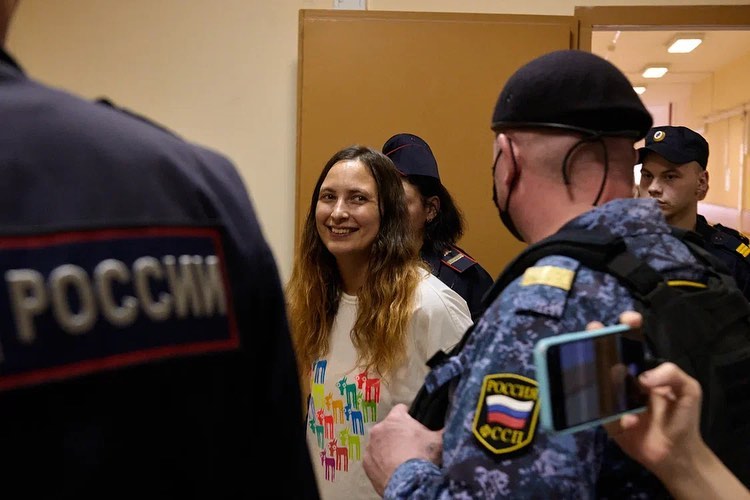
Sasha Skochilenko, facing ten years in prison for anti-war price tags. Vasileoostrovsky District Court, St. Petersburg, 18 July 2023

Today’s hearing lasted almost nine hours!

It was finally possible to resume the cross-examination of Olga Safonova, on whose linguistic analysis of the price tags the prosecution’s case is largely based. At the last hearing it transpired that Safonova is actually a political science specialist who is brought in to provide linguistic (!) expertise on “political” issues. Moreover, she has already admitted that she cannot judge whether the information on price tags was “knowingly false,” although she wrote just the opposite in her expert analysis.

The cross-examination of Safonova took up most of the hearing, and it involved the lawyers, the independent expert Svetlana Drugoveyko-Dolzhanskaya, Sasha [Skochilenko] herself, and Prosecutor Gladyshev. (The defense requested that Gladyshev be recused for a number of reasons—including because he distorted the facts about Sasha’s income—but the motion was denied.) Safonova had a visibly hard time answering questions about the content of individual price tags and the linguistic terms she employs, and how she was able to identify motives of “political enmity” in the texts she analyzed. In fact, experts cannot assess an author’s motives, but Safonova refused to confirm this outright. “Just stay that this is not within your competence,” the lawyer Novolodsky asked her. “I won’t,” she replied.

Olga Safonova, expert witness for the prosecution. Vasileoostrovsky District Court, St. Petersburg, 18 July 2023

This was not the only occasion for laughter at today’s hearing. During a discussion of the texts on the price tags, Safonova also claimed that Russia is not a fascist state, since “a fascist state is totalitarian, while Russia is democratic.” She also asked that the defense not “examine every word [said or written] by expert witnesses with a magnifying glass, for crying out loud!” (She said this, I would like to remind you, at a criminal trial that could send Sasha to prison for ten years.)

As always, we want to say a huge thank-you to the journalists who have been covering Sasha’s case, and to everyone who came out to support Sasha! The next hearing will be held on September 14, after the judge’s vacation. Safonova will be summoned to court again. In addition, the court ordered the linguist Grishanina, the co-author of the expert analysis, forcibly delivered to the hearing.

P.S. We will have more to say about today’s hearing, so stay with us!

Photos courtesy of Andrei Bok and others

#freesashaskochilenko

Source: Sasha Skochilenko (Facebook), 18 July 2023. Translated by the Russian Reader

The Sasha Skochilenko Trial: Olga Safonova’s “Slightly Misleading” Expert Analysis

Sasha Skochilenko (center) at her criminal trial in Petersburg, 25 May 2023. Photo: Nadezhda Skochilenko

At today’s hearing [in Sasha Skochilenko’s criminal trial on charges of disseminating knowingly false information about the Russian army], Sasha’s defense lawyers and Svetlana Drugoveyko-Dolzhanskaya, a linguist who conducted an independent forensic examination and found no knowingly false information in Sasha’s messages, were able to question one of the authors of the linguistic forensic examination [commissioned by the prosecution].

Olga Safonova, a specialist in political science (!), was enlisted to contribute to the linguistic forensic examination. But, as she was instructed to do by a staff member at the forensics expertise center, she evaluated whether what was written [on the anti-war “price tags” that Ms. Skochilenko is alleged to have posted in a Petersburg supermarket] was in line with the Russian Defense Ministry’s position, not whether it was truthful.

[Safonova] admitted that her analysis of one of the messages was “slightly misleading.” She was “at a loss” when asked to respond to the assertion that Sasha faces up to ten years in prison on the basis of such misleading conclusions, among other things.

After a recess (due to her heart problems, Sasha found it difficult to endure the stuffiness and lack of water), the examination of the witness was continued by Drugoveyko-Dolzhanskaya. Safonova was forced to admit that among the sources against which she checked Sasha’s messages, only the Defense Ministry’s website corresponded to her own definition of an official source — unlike the website Life.ru and anonymous Telegram channels. She also could not answer a school curriculum-level question about impersonal sentences, although their erroneous definition in the forensic examination is one of the “proofs” of Sasha’s guilt.

In addition to pointing out the errors in the forensic examination and its noncompliance with government standards, Drugoveyko-Dolzhanskaya recalled that, according to the Justice Ministry’s methodological recommendations, when an expert strays beyond their area of professional competence, it is a procedural error and is inadmissible [as evidence in court]. Safonova was forced to agree. Drugoveyko-Dolzhanskaya followed this up by asking a direct question: “Can you, as an expert, prove conclusively that Skochilenko knowingly falsified information?”

Safonova replied that she could not.

The new prosecutor abruptly interrupted her and requested that the hearing be postponed.

You can come out and support Sasha at 11:30 a.m on June 13. Many thanks to everyone who continues to attend the trial, shares information about the case, and donates money to pay the lawyers and buy food and medicine care packages! You can help Sasha financially here:

+79627117055

(Sofia S., Sberbank)

5469550065976075

(Sberbank)

Source: Nadezhda Skochilenko (Facebook), 25 May 2023. Translated by the Russian Reader. The details for donating money to Ms. Skochilenko’s defense fund are only for people based in Russia.


[…]

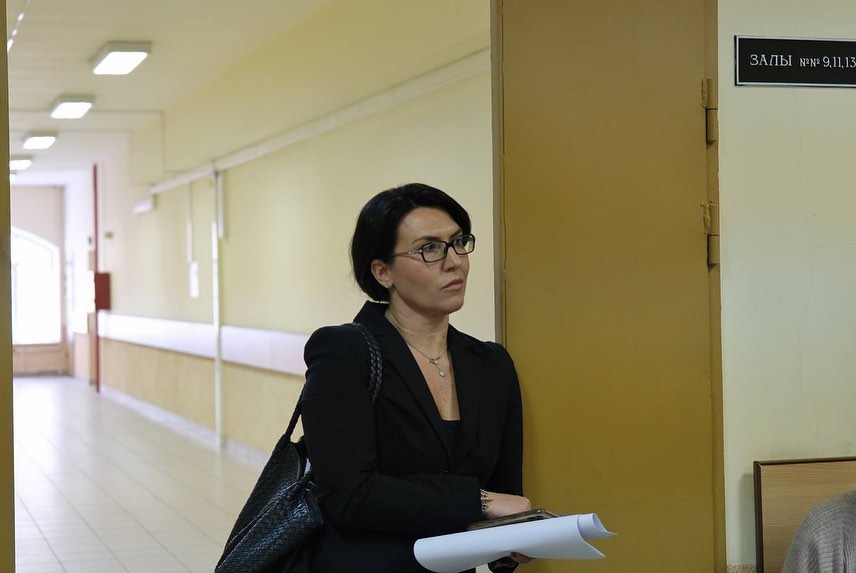
Olga Safonova. Photo courtesy of The Village

In the late 1990s, St. Petersburg State University, for reasons unknown, gave away one of its dormitories on Vasilievsky Island — 10 Bering Street — with a two-story attic built on. Later, one of the university’s vice-rectors regretfully claimed that if the building had not been given away, the university would have had room to house over 500 students. Today, the building houses apartments (a three-bedroom flat there will run you 20 million rubles) and offices. It is owned by the Bering-10 Condominium Association, whose chair is Olga Diomidovna Safonova. She has the exact same name as an associate professor in the Faculty of Political Science at St. Petersburg State University.

Safonova has been involved as an expert witness in the criminal cases against [Petersburg anti-war protesters] Victoria Petrova, Sasha Skochilenko, and Vsevolod Korolev. They face up to ten years in prison if convicted. These are quotations from the expert analysis in the case against Victoria Petrova:

“Objective facts indicate that the war crimes against the civilian population of Ukraine have not been committed by the Armed Forces of the Russian Federation, but by the Kiev regime and the armed formations controlled by it.”

“The practical intent and purpose of the statements under examination [i.e., Victoria Petrova’s posts] consists in generating false ideas among readers (listeners) that the actions of the Russian federal leadership are condemned by society, as manifested by the threat of the use of nuclear weapons against Ukraine and against European countries. […] In the materials submitted for examination, the negative assessment of the policy of Russian federal state bodies vis-a-vis their deployment of Russian federal armed forces to protect the interests of the Russian Federation and its citizens and maintain international peace and security, is not supported by arguments and evidence.”

Safonova graduated first from St. Petersburg State University’s law faculty, then from its philology faculty. In 2005, she defended her dissertation in political science. Here is a quote from the abstract: “Social deprivation has become a characteristic feature of the lifestyle of a significant portion of the Russian populace. A drop in the level of real monetary income has entailed increased competition for survival, thereby generating an increase in the stratum of people whose intentions have become criminal, i.e., unlawful.”

At least until the mid-2010s, Safonova led an active social life. The Village found the academic’s picture in a dozen photo reportages from different parties, as published by Sobaka.ru and Geometria. Here she is at a presentation by the jewelry house Freywille; here, at the (now-closed) restaurant Gusto’s birthday party; and here, at the opening of XXXX Baltika Brew.

The Village spoke about Safonova with graduates of various faculties at St. Petersburg State University: their assessments of her were contradictory. Journalist Anastasia Romanova, who took Safonova’s lecture course on political science, remembered her as “the toughest teacher, whose pass-fail exam was very hard to pass.” “She honestly read the whole class the riot act,” said Romanova. “It was very scary to go to her.” Emile, a graduate of the political science faculty, where Safonova taught a course on law, recalls, on the contrary, that “the course was a formality,” and “at some point that woman just disappeared.” It was one of the easiest subjects to pass,” he said.

In 2012, commenting to Delovoi Peterburg on the newly adopted law on foreign agents, Safonova said, “There are many organizations that, under plausible pretexts, are engaged in near-subversive activities. We as a state should be concerned about this, and it’s good that this issue has been addressed.”

“I remember that Safonova gave what I thought were absurd descriptions of the political regimes in other countries. She said there was no democracy anywhere. It seems to me that most students found her unpleasant both as a teacher and as an apologist for the regime. A couple of days ago, a classmate sent me an article in Rotunda about her involvement in the expert analysis [in the case of Victoria Petrova]. I wasn’t surprised,” says Emile. Romanova adds, “She didn’t give the impression of being a stupid person. Arrogant, yes. I think she understands perfectly well what is happening now.”

[…]

Source: Julia Galkina, “Meet the experts who help jail anti-war protesters in Petersburg. They teach at St. Petersburg State University,” The Village, 14 March 2023. Translated by the Russian Reader