We Wouldn’t Mind If You Died of AIDS and Hepatitis C

aids flagRussia has an HIV epidemic. According to the Federal Aids Prevention Center, approximately a million Russians are infected. A third of them also have hepatitis C. At best, only hundreds of these patients receive state-of-the-art treatment. Image by Yaroslava Chingayev, special to Vedomosti

Officials Want to Replace Current Hepatitis C Treatment with Outmoded Therapy
Industry and Trade Ministry Supplied Money for Manufacture of Drugs
Irina Sinitsyna and Olga Sukhoveiko
Vedomosti
December 13, 2018

The Russian Health Ministry plans to significantly reduce procurements of the most effective treatment for viral hepatitis C, combined interferon-free treatment, thus reducing the availability of the drugs for patients infected with HIV in combination with hepatitis B and hepatitis C. Instead, the ministry has proposed putting these patients on interferon therapy. Maria Onufriyeva, director of Community of People Living with HIV, an interregional grassroots organization, has written about the matter to Health Minister Veronika Svkortsova. Ms. Onufriyeva has also sent a letter to Valery Alexeyev, director of the Honest Procurements Project at the Russian People’s Front (ONF). Vedomosti has seen copies of the letters. Ms. Onufriyeva confirmed she sent them. A spokesperson for Mr. Alexeyev said he received the letter. The Health Ministry has not responded to her query.

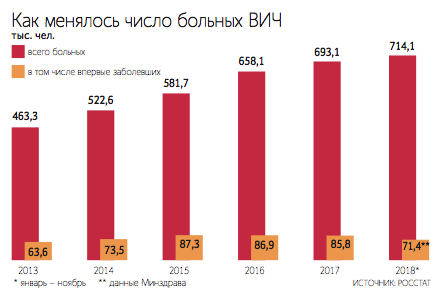
In November, Minister Skvortsova said that over 714,000 Russians were infected with HIV. According to the Federal Aids Prevention Center, whose figures Ms. Onufriyeva cites, there are 978,443 Russians infected with HIV. A third of them also have hepatitis C.

In late October, the Health Ministry published the final list and amounts of drugs it would be procuring in 2019 and providing to HIV patients, including HIV patients who also have hepatitis B and hepatitis C, writes Ms. Onufriyeva. (Vedomosti has seen a copy of this list.) In particular, the Health Ministry wants to reduce procument of dasabuvir by 750%, meaning one hundred patients would have access to the drug, while this year 748 people could count of getting it, according to the Community’s calculations.

In monetary terms, this would mean a drop in expenditures on the drug from 431.6 million rubles [approx. 5.7 million euros] to 57.9 million rubles [767, 754 euros].

The Health Ministry plans to switch to narlaprevir, intended for the treatment of hepatitis C in combination with other antiviral drugs. In 2018, as the Community has discovered, and as is borne out by information accessed on the federal procurements website, narlaprevir was not purchased by the Russian governmennt. In 2019, the Health Ministry could spend 139 million rubles [approx. 1.8 million euros] on procuring the drug in order to treat 430 people, the Community argues.

Dasabuvir is the most up-to-date antiviral drug. According to the Community, it can cure 98% of hepatitis C patients in twelve weeks.

This figure was confirmed by Vadim Pokrovsky, director of the Federal AIDS Prevention Center.

In Russia, HIV patients who also have hepatitis C have been treated with dasabuvir in combination with ombitasvir/paritaprevir/ritonavir, manufactured under the brand name Viekira Pak by the American company AbbVie. Dasabuvir was placed on the official Russian list of vital and essential drugs for this year. Two years ago, Alexey Repik’s R-Pharm and AbbVie agreed to partly localize manufacture of the drug at R-Pharm’s plant in Kostroma. As R-Pharm reported then, the deal covered repackaging of the drug and quality control. According to AbbVie, Viekira Pak is distributed in Russia by R-Pharm and Euroservice.

Ms. Onufriyeva writes that interferon therapy is much less effective in treating chronic hepatitis C patients with HIV. The treatment significantly reduces quality of life, since it requires weekly injections.

Mr. Pokrovsky explained the difference. Interferon treatment has almost no effect on the virus itself. It stimulates the body’s immune response, but it has numerous side effects, from impotence to mental disturbances. The treatment lasts a year.

Due to the length of the treatment, Ms. Onufriyeva said, it was between 52% and 133% more expensive than interferon-free treatment.

Tableted by R-Pharma, narlaprevir has to be taken together with ritonavir, pegylated (long-acting) interferon, and ribavirin, as indicated in the instructions.

In 2012, R-Pharma acquired a license for the production and sale of narlaprevir from Merck & Co. It tried to refine the drug with support from a federal targeted program administered by the Russian Industry and Trade Ministry. Trade publication Vademecum wrote that R-Pharm invested 700 million rubles in narlaprevir. The Industry and Trade Ministry would allocate 120 million rubles on clinical trials, Sergei Tsyb, head of the ministry’s Department for Chemical Engineering and Bioengineering, promised in 2012.

A R-Pharm spokesperson confirmed receipt of the funds.

R-Pharm registered narlaprevir in 2016. In the spring of 2017, during a meeting with the business community, President Putin promised R-Pharm’s director general Vasily Ignatiev that the government would allocate funds to procure the company’s drugs for hepatitis C patients.

“I will also keep this in mind when allocating resources for healthcare in 2018 and the following years, in 2019 and 2020. It will be necessary, of course, to use what you have developed,” Putin said.

Mr. Pokrovsky is certain the Health Ministry’s decision to reduce procurements of interferon-free drugs could have been influenced by Russian manufacturers wanting to compensate their costs at the state’s expense.

The R-Pharm spokesperson insisted that the company, like other manufactures, received a request from the Health Ministry to quote its prices for narlaprevir and dasabuvir.

“Our price offers for the drugs were the same as last year’s,” he said.

In total, according to the Community’s calculations, in 2019, the Health Ministry can spend 473.5 million rubles [approx. 6.3 million euros] on the procurement of drugs for treating chronic hepatitis C, as opposed to 1.1 billion rubles [approx. 14.6 million euros] last year.

In November, Vademecum wrote that, in 2019, the Health Ministry would also reduce its overall procurement of antiretroviral drugs under its program for providing drugs to people infected with HIV, including patients who were infected with HIV in combination with the hepatitis B and C viruses. However, although it would spend far less money, it planned to expand coverage to a mere sixty percent of those needing treatment.

Ms. Onufriyeva has asked the Health Ministry to consider increasing procurements and moving away from the chronic hepatitis C drugs scheduled for purchase in 2019 and towards drugs that have proven effective. The latter should be supplied to patients with HIV plus viral hepatitis C, including those suffering from advanced liver fibrosis and cirrhosis.

She has asked Mr. Alexeyev to assist her in protecting the interests of patients by sending inquiries to the Health Ministry, asking them to explain the reasons for the cuts in procurements and the selection of outmoded drugs. She also asked him to verify whether the Health Ministry’s actions were in compliance with antitrust laws.

She told Vedomosti she had not received replies to her letters.
vich

“How the Numbers of HIV-Infected Patients Have Changed, 2013–2018.” The red columns indicate total numbers of patients; the orange columns, first-time infections. Figures are given in thousands of people. Source: Rosstat. Courtesy of Vedomosti

Mr. Alexeyev explained the delay in replying. The letter contained a good deal of specialized and medical information, and it was under review by independent experts working for the Russian People Front’s Honest Procurements Project.

“The Russian People’s Front has drawn attention to problems with the list of essential and vital drugs, and their procurements, and this letter is the latest alarm,” he said.

According to Mr. Alexeyev, the Russian People’s Front has been reviewing the Health Ministry’s procedure for including medicines on the list and had already been in touch with the government.
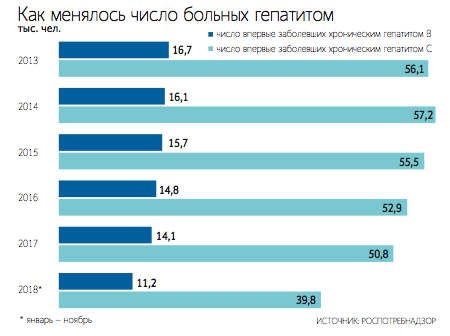
hep b and c

“How the Numbers of Hepatitis Patients Have Changed, 2013–2018.” The dark blue bars indicate first-time cases of chronic hepatitis B; the light blue bars, first-time cases of chronic hepatitis C. Figures are given in thousands of people. Source: Rospotrebnadzor. Courtesy of Vedomosti

If the grassroots organization Community of People Living with HIV believes the industry regulator acted in a way that violated specific regulations on procurements or antitrust statutes, it can file a complaint with the Federal Anti-Monopoly Service (FAS) in the manner prescribed by law, said Maxim Degtyarev, deputy head of the Department for Oversight of the Social Sector and Trade at FAS. For the time being, however, FAS had no grounds to perform an inspection.

The Industry and Trade Ministry did not respond to our request for information.

Elena Filimonova contributed to this article.

Translated by the Russian Reader

Squandering Its Way to Superpowerdom

“Squandering”: Did the US Secretary of State Grasp the Russian Approach to Budget Spending?
The Kremlin Accused the State Department of Tactlessness and Unprofessionalism, Yet Pompeo’s Remarks Were on the Mark
Yevgeny Karasyuk
Republic
December 13, 2018

padrino.jpgVenezuelan Defence Minister Vladimir Padrino gives his thumb up as he sits on the cockpit of a Russian Tupolev Tu-160 strategic long-range heavy supersonic bomber after it landed at Maiquetia International Airport, north of Caracas, on December 10, 2018. Courtesy of Federico Parra/AFP/Getty Images

Russian’s decision to send strategic bombers on a junket to an airport near Caracas elicited a curious reaction from US Secretary of State Mike Pompeo, who publicly expressed his pity for Russian taxpapers, whose money the Kremlin, habitually disregarding the costs, has been spending on its geopolitical moves.

“The Russian and Venezuelan people should see this for what it is: two corrupt governments squandering public funds, and squelching liberty and freedom while their people suffer,” Pompeo wrote.

The Russian Foreign Ministry responded by calling Pompeo’s statement “utterly unprofessional” and even “villainous.” Pompeo’s remarks, which the Kremlin, in turn, dubbed “inappropriate” and “undiplomatic,” were apparently really lacking in nuance: the hardships of Russians, fortunately, cannot yet be compared with the suffering of Venezuelans. But, hand on heart, was Pompeo so wrong when he talked about the losses to the Russian federal budget and lack of oversight?

Russian society has an extremely vague notion about how much the Kremlin’s expansionism has ultimately cost the country. According to calculations made by IHS Jane’s at the outset of Russia’s operations in Syria in autumn 2015, Russia could have been spending as much as $4 million a day. Later, the Yabloko Democratic Party, which is not seated in the Russian parliament, estimated the Kremlin had spent a total of 108–140 billion rubles [between $1.6 and $2.1 billion] on Syria. A more accurate assessment would be difficult to make. Experts doubt that anyone, including the Finance Ministry, keeps tabs on such expenditures. Thus, nobody knows the real cost of Russia’s involvement in the Syrian conflict, argues the Gaidar Institute’s Military Economics Laboratory.

The budget’s fading transparency has been a trend in recent years. In 2016, secret and top-secret allocations accounted for 22% of total federal budget expenditures, a record for the entire post-Soviet period, and much higher than secret allocations in comparable countries, according to RANEPA’s March 2015 report on the Russian economy.

Quite naturally, this state of affairs has not improved the quality of the state’s financial decisions. In terms of effective state spending, Russia ranked nineteenth in a new rating of twenty-five countries, compiled by the Higher School of Economics using data from the World Bank and OECD. Since they are not priorities for the current regime, problems with child mortality and life expectancy were among the reasons Russia ranked so low in the survey: the government spends more on the army than on healthcare—4.3% of GDP versus 3.8% of GDP, respectively. In these circumstances, the chances the Kremlin’s strategic projects in the Middle East and Africa (e.g., the Central African Republic, Burkina Faso, the Democratic Republic of the Congo, and Mozambique) will be decently funded are always much greater than the national healthcare project, which stipulated increased government spending on cancer treatment. The government nixed the plan over summer.

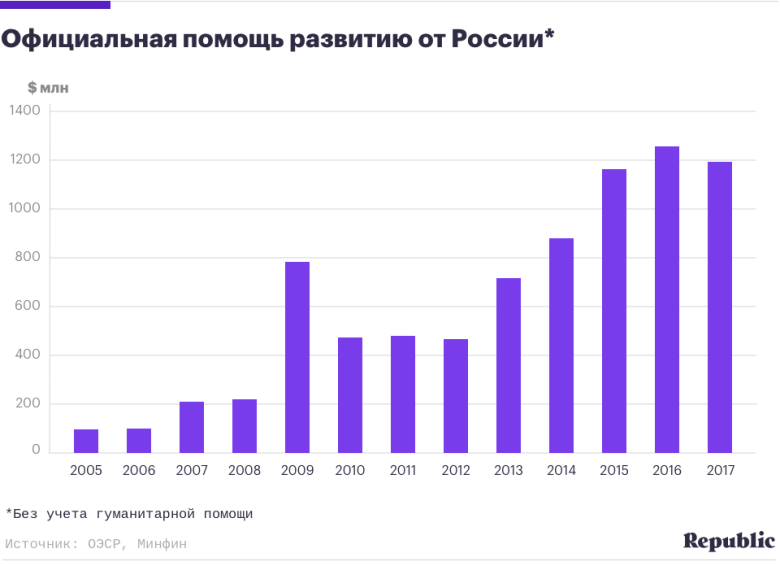
Since it remains largely Soviet in spirit, Russia’s foreign policy has been categorically blind to history’s lessons. The Soviet Union’s exorbitant geopolitical ambitions and support for fringe regimes around the world left the country with a legacy of mostly toxic multi-billion-dollar debts. The process of writing them off has been disguised as a form of international charity or, speaking diplomatically, official development assistance (ODA). According to RANEPA, writing off the debts of developing countries accounted for 35% of all such “international aid” last year or $425 million. It has been the Russian government’s usual way of doing business. Previously, the Russian government wrote off the debts of Nicaragua ($6.3 billion), Iraq ($21.5 billion), North Korea ($10.9 billion), Syria ($9.8 billion), Afghanistan ($11 billion), and Cuba ($29 billion), among other countries. Venezuela risks joining this sad list. Over the past twelve years, Russia has invested a total of $17 billion in the country.

Russia’s Expenditures on Official Development Assistance (Excluding Humanitarian Aid), 2005–2017, in Millions of Dollars. Sources: OECD, Russian Finance Ministry. Courtesy of Republic

Since it was paid for by the Russian federal budget, which has been running a deficit for the last seven years, Russian officials probably did not see the transatlantic flight of its strategic bombers as too expensive. On the contrary, they saw it as a flashy display of Russia’s military prowess and proof of its influence in the region. However, the government of Nicolás Maduro signed off on the stunt. Subject to growing pressure from creditors and an angry, desperate population, it lives day by day. In all likelihood, it will soon collapse, leaving behind a mountain of unpaid bills and unfulfilled obligations to its allies. If this is the case, can we evaluate the Russian government’s action better than the tactless Mike Pompeo did? Probably not.

Translated by the Russian Reader

Making Life Easier for Vegans in Petersburg

Анастасия Емельянова, основатель VegCode
Anastasia Yemelyanova, VegCode founder. Photo courtesy of Sergei Yermokhin and Delovoi Peterburg

A Barcode for Vegans: Petersburgers Develop App for Identifying Vegan Products Through Barcode
Inna Reikhard
Delovoi Peterburg
December 12, 2018

App Interests a Thousand Users in Single Woeek
Petersburgers Anastasia Yemelyanova, Alyona Kabardinova, and Nikolai Dubrovsky have developed the mobile VegCode app (Vegan IT LLC). Made available to users in early December, the app is designed for vegans. It lets shoppers use barcodes to figure out whether or not items in stores contain animal products and have been animal tested. The app currently has a database of 26,000 items marked “vegan” and “non-vegan.” Most of the items are edibles and cosmetics. Household cleaning products will soon be added to the list.

A Growing Segment
As the designers explained, there is a demand for the app, since the number of vegans in Russia has been growing at a rate of fifty percent annually. There are now approximately 150,000 vegans in Russia.

The team has been preparing to expand the app’s functionality by adding a map of vegan shops, cafes, and producers. The app, which operates in Russia and the CIS, will earn money by advertising the services of these businesses.

Attracting Investors
“Unlike Western Europe and the US, the problem of identifying vegan goods is much gnarlier in Russia, because there is not a well-defined system for labeling goods and far fewer speciality magazines,” Yemelyanova explains.

For example, you might find a retail item labeled “Lenten,” but it might not be appropriate for vegans. On the other hand, producers sometimes have no clue their product lines include ethical products.

The startuppers commenced work on the app in early 2018. They raised money on the crowdfunding website Planeta. They also made it to the finals of Philtech Accelerator, winning a 100,000-ruble prize from the Higher School of Economics. The team got another 300,000 rubles from venture investor Alexander Rumyantsev.

Yemelyanova says the hardest thing was compiling the database of retail items marked “vegan.”

“We get information about the content of products from open sources. Our users can also add items via the app. After they are moderated, the new items are listed in the database,” a spokesperson for the company said.

In a week’s time, the nearly thousand users who downloaded the app have suggested 4,000 more items for inclusion in the database.

Prospects
The market for vegan products in Petersburg has been growing rapidly. In 2015, sales were estimated at 80 million rubles [approx. 1 million euros]. In 2017, this figure climbed to 400 million rubles [approx. 5.3 million euros].

Petersburg has several dozen fast food outlets and shops catering to vegans, including Bunker and B12 Vegan Shop.

Petersburg is also home to a small number of vegan producers. Businessman Ivan Ivanov, for example, makes lactose-free dairy products, wheat steaks, and other edibles under the Primal Soymilk brand. Verde produces cheese and curd. Veganov makes soy and vegetable sausages, while Soymik produces soy-based products.

“Petersburg has the most thriving vegan movement in Russia. The city also has a growing number of vegan producers. Mainly, however, these are small businesses in which not a lot of money has been invested. Their products are usually not sold in retail chains, but I think the day when they’ll be sold there is not far off,” says Ivanov.

Ivanov says he had thought himself about making an app for identifying vegan products.

Translated by the Russian Reader

Give Me Your Datasets!

December 10, 2018

Hi,

I am trying to collect a richer database of all the large protests that have occurred in Russia since 1/1/17, and where they have occurred in space and time.

Our research is to determine the significance of cultural landmarks and locations for protests.

For example, we know 4 large protests occurred on the following day and locations (and we are trying to pin point the approximate time):

datasetBut we would love 100s more records.

By the looks of the attached white paper [there was no “white paper” attached], and the below links, CEPR has tracked over 2,500 protest locations.  I would love to work with the CEPR team doing this research, collaborating in any way we can.

http://cepr.su/category/monitoring-protests/

https://themoscowtimes.com/news/number-protests-russia-spikes-in-2018-researchers-say-63428

“With less than two months to go before the end of 2018, CEPR researchers said they have already recorded over 2,500 protests this year compared to under 1,500 nationwide last year, according to the report published Thursday.”

Thanks,

Mark

______________________

December 10, 2018

Mark,

You introduced yourself in no way, shape or form, and I’m not sure what it is that you’re asking me to do. I’m not an information clearinghouse.

I edit, translate, and write a blog called the Russian Reader, which is not affiliated in any way with the Center for Economic and Political Reform, although I have translated several articles by the center’s director, Nikolay Mironov, over the years.

If you would like to work with the CERP, you would have to send them a letter or call them. Their contact information is clearly indicated on their website.

http://cepr.su/about/

Контакты ЦЭПР:
E-mail: ceprsu@yandex.ruceprsu@gmail.com
Пресс-служба: +7 916 629 5609

If you don’t speak Russian, I would encourage you to learn it before doing research on Russia.
Yours,

The Russian Reader

______________________

December 11, 2018

Dear Russian Reader,

You sound angry. I think what I was asking for was pretty straightforward, and I don’t need to know Russian for what I am looking for.

I am looking for a dataset of protest locations in space and time, which is just simple math.

Have a nice 2019 and thanks for the tip on CERP.

Mark

______________________

And you are obtuse.

You just want a dataset. It’s simple math.

Where did I indicate on my site that I was in the business of handing out datasets I don’t have to people who don’t introduce themselves?

What you were asking for was not straightforward, and you were asking the wrong person.

People who don’t know Russia or Russian probably shouldn’t attempt to do research on it. Because you could have the most precise dataset on Russian protests possible, but it wouldn’t tell you anything about Russia or Russians.

Just as you failed to tell me anything about yourself or why you need this dataset.

______________________

From: Mark
7:18 AM (15 minutes ago)

Whatever.

Sent from Mobile Phone

Mercy

clean

I’m really surprised by people who think it’s an important development that Lev Ponomaryov, the veteran Russian human rights activist who was sentenced to 25 days in jail the other day for, essentially, no particular reason, had his sentence reduced to 16 days in jail.

This is not a meaningful distinction. He shouldn’t have been detained, hauled into a kangaroo court, and jailed in the first place.

Don’t let the Putinist vampires fool you with their little acts of “mercy.” They don’t mean well—ever. And if push comes to shove, God forbid, the judges amongst them will hand out death sentence after death sentence just like in the 1930s. And the FSB will carry out the executions as happily as their esteemed predecessors in the NKVD did in the 1930s.

It’s hard for any society to learn anything from its past and arrange things in the present so the past doesn’t repeat itself, so to speak, but Russian society has every chance of showing us, in the very near future, that it has learned nothing from its past.

The Putin regime has spent the last twenty years doing absolutely nothing but priming the populace for a wholesale bloodbath against the Motherland’s numerous enemies. Let’s keep hoping it has just been “kidding” all this time. {TRR}

________________

Squealing on Victims of the Great Terror: Who Wants to Tear Down Petersburg’s Last Address Plaques?

досто 25-табличкиThree Last Address plaques on the house at 27 Dostoevsky Street, in downtown Petersburg

Squealing on the Executed: Who Wants to Remove the Last Address Plaques?
Tatyana Voltskaya
Radio Svoboda
December 6, 2018

Alexander Mokhnatkin, a former aide to Russian MP Vitaly Milonov, filed a complaint with the Petersburg authorities, claiming the plaques mounted on houses throughout the city by Last Address had been erected illegally.

досто 25-улица и домThe plaques are barely visible from only ten meters away.
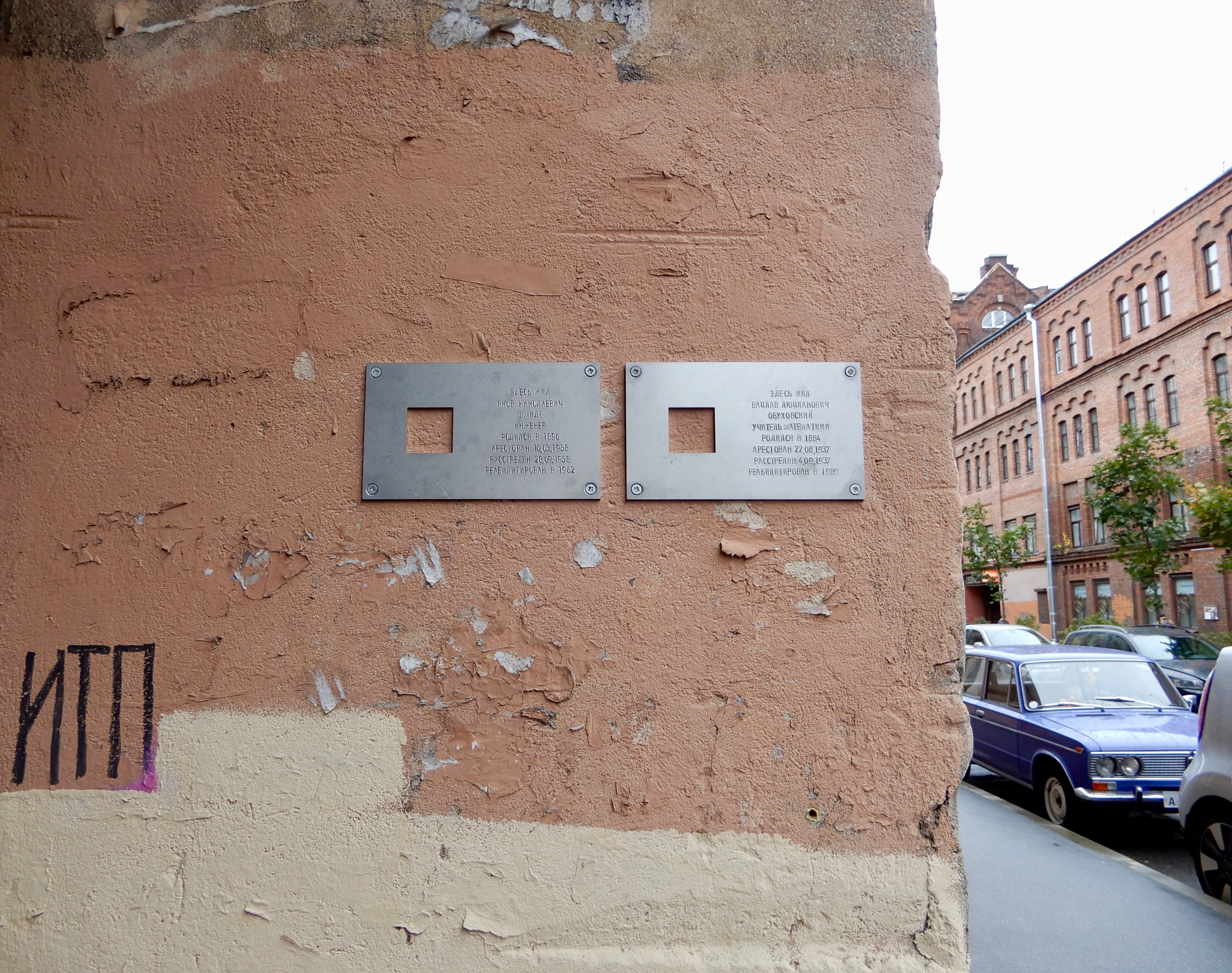
Andrei Pivovarov, co-chair of the Petersburg branch of Open Russia, wrote about the complaint on his Facebook page.

The city’s urban planning and architecture committee has already reacted to the complaint. It said the plaques, which bear the names of victims of Stalin’s Great Terror and have been placed on the walls of the houses where they lived just before their arrests and executions, were illegal.

досто 27-подворотняThere are two more plaques right next door, in the gateway of the house at 27 Dostoevsky Street.

“The informer decided the plaques were illegal advertisements? I wonder what for. The Stalinist Terror? He thinks they should be taken down. The Smolny responds to the snitch by indicating there were no legal grounds for putting the plaques up, and special city services would deal with them. It is difficult to guess when the wheel of the bureaucratic machine will turn, but, as Solzhenitsyn wrote, the country should know its snitches. I introduce you to Alexander Mokhnatkin, a man who has denounced people long ago victimized by the state and executed, and who has denounced the memory of those people,” Pivovarov wrote.

нев 111:полтав 3-3Unaware of the Last Address plaque on the wall next to her, a woman walks down Poltava Street, just off Old Nevsky, on a sunny day in October.

MP Milonov argues his former aide’s opinion is his personal opinion. Milonov, on the contrary, welcomes memorial plaques, but he does not like the fact that, currently, ordinary citizens have taken the lead in putting them up. He believes it would be better to let officials take the lead.

“I don’t think it would be good if there were lot of plaques on every house, as in a cemetery. The right thing to do, probably, would be to adopt a government program. The plaques would be hung according to the rules of the program, and protected by the law and the state,” argues Milonov.

нев 111:полтав 3-5When you step back ten or fifteen meters, the same plaque is nearly invisible to the naked eye.

He argues what matters most is “remembering the grandfathers of the people who now call themselves liberals squealed on our grandfathers and shot our grandfathers. Our grandfathers did not squeal on anyone. They died on the Solovki Islands. They were shot in the Gulag and various other places.”

Milonov admits different people wrote denunciations, but he believes the International Memorial Society has deliberately politicized the topic, using the memory of those shot during the Terror for their own ends. The MP argues that erecting memorial plaques should not be a “political mom-and-pop store.” Milonov fears chaos: that today one group of people will put up plaques, while tomorrow it will be another group of people. To avoid this, he proposes adopting official standards.

разъезжая 36-подъезд.jpgA Last Address plaque in the doorway of the house at 36 Razyezhaya Street, in Petersburg’s Central District.

​On the contrary, Evgeniya Kulakova, an employee of Memorial’s Research and Information Centre in Petersburg, stresses that Last Address is a grassroots undertaking. An important part of Last Address is the fact that the installation of each new plaque is done at the behest of private individuals, who order the plaques, pay for their manufacture, and take part in mounting them. Kulakova regards Milonov’s idea as completely unfeasible, since the municipal authorities have their own program in any case. The program has its own concept for commemorating victims of political terror, and the authorities have the means at their disposals to implement it. Last Address, however, is hugely popular among ordinary people who feel they can make their own contribution to the cause of preserving the memory of the people who perished during the Terror.

соц 6-улицаA Last Address plaque in the archway of the house at 6 Socialist Street, in central Petersburg.

Kulakov thinks it no coincidence Mokhnatkin has brought attention to the Last Address plaques, since previously he had taken an interest in the Solovetsky Stone in Trinity Square. Apparently, his actions are part of a campaign against remembering Soviet state terror and the campaign against Memorial.

Many Memorial branches in Russia have been having lots of trouble lately. In particular, Memorial’s large annual Returning the Names ceremony in Moscow was nearly canceled this autumn, while the Petersburg branch has been informed that the lease on its premises has been terminated. It has been threatened with eviction as of January 6, 2019.

черняховского 69-домThree Last Address plaques, barely visible from the middle of the street, on the house at 69 Chernyakhovsky Street, near the Moscow Station in Petersburg.

Historian Anatoly Razumov, head of the Returned Names Center, supports the concept of memorial plaques. He stressed they are installed only with the consent of building residents and apartment owners, and ordinary people welcome the undertaking. Moreover, people often put up the plaques not only to commemorate their own relatives but also to honor complete strangers whose lives have touched them. Razumov says people often find someone’s name in the Leningrad Martyrology. They then get written confirmation the person lived in a particular house. Only after collecting information about the person and obtaining the consent of the building’s residents do they erect a plaque.

“In Europe, such things are always under the protection of municipal authorities. I think we should also be going in the other direction: local district councils should do more to protect the plaques instead of saying they don’t meet the standards and they’re going to tear them down,” the historian argues.

Razumov argues that inquiries like the inquiry about the legality of the memorial plaques are served up under various attractive pretexts, but they are always based on the same thing: the fight against remembering the Terror. Some people want to preserve this memory forever, while others do everything they can to eradicate it by concocting hybrid or counter memories.

черняховского-все таблички.jpgThe plaques at 69 Chernyakhovsky Street commemorate Vasily Lagun, an electrician; Solomon Mayzel, a historian of the Arab world; and Irma Barsh. They were executed in 1937–1938 and exonerated of all charges in the late 1950s and early 1960s.
Boris Vishnevsky, a member of the St. Petersburg Legislative Assembly, argues that Last Address and Immortal Regiment are the most important popular undertakings of recent years. He is outraged by attempts of officials to encroach on them. He says he has written an appeal to the city’s urban planning and architecture committee.

Translation and photos by the Russian Reader

House of Cards

mir-sberbankA disembodied hand proudly holding a Sberbank-issued Mir card. Photo courtesy of PressTV

Central Bank Preparing for Cutoff of Some Banks from International Payment Systems
Regulator Asks Small Banks to Have Backup Intermediary Able to Service Their Cards
Anna Yeryomina
Vedomosti
December 6, 2018

The Russian Central Bank has asked small banks to find a backup partner that would be able to service their bank cards. This would be an asset if their current intermediary banks were cut off from international payment systems.

The Central Bank is concerned with the continuity of card transactions in banks that work with payment systems indirectly, that is, via an intermediary bank. The regulating authority has advised these indirect clients of payment systems to contract with another bank, besides their primary intermediary bank, that could supply them with access to card payment systems. Five bankers confirmed to us they had received the memorandum.

The memorandum also says the contract should provide for a test exchange of information when integrating with the new intermediary banks. It also states payment systems should draft an action plan and recommend it to their participating banks.

The major intermediary banks are Payment Center Credit Union, Uralsib, VTB Bank, Rosbank, and Promsvyazbank.

A Central Bank spokesperson stressed the memorandum was only advisory, but it was based on international recommendations for risk management in payment systems. The need for banks to contract with backup intermediary banks is not so obvious. According to several of its recipients, in early autumn the Central Bank had sent banks a letter urging them to draft plans to ensure the continuity of payments, but it had not recommended any specific measures.

Switching intermediary banks is a time-consuming, expensive process that takes between three to six months, notes Maya Glotova, director of Kartstandart, a processing center that partners with Payment Center Credit Union. The most high-profile case occurred in 2013 after Master Bank’s license was revoked. As Glotova recalls, Master Bank had functioned as an intermediary bank in payment systems and provided payment processing services. Small banks had to halt their operations for several weeks, and several of them had to leave the payments business. Glotova estimates it would cost a single bank more than $100,000 to switch intermediary banks in the three payment systems.

Intermediary banks had little to say about the memorandum. A spokesperson at Promsvyazbank promised to follow the Central Bank’s recommendations, while a spokesperson at VTB Bank said their own intermediary program had worked well.

Several bankers believe the Central Bank is hedging not only against the collapse of intermediary banks but also potential sanctions, which are fraught with the possibility that intermediary banks would be cut off from Visa and Mastercard, as occurred in 2014 and 2015. The United States has been drafting a new set of sanctions that could affect major banks. Payments within Russia would not be affected: these transactions are processed by the National Payment Card System (NSPK). Russian bank cards, however, would not function abroad. (A spokesperson for NSPK, which operates the Mir payment system, said they had not received the Central Bank’s memorandum.)

VTB Bank had drafted a plan to counter sanctions, its president, Andrei Kostin, told the TV channel Rossiya 24 in October.

“We have been mapping out with both the government and the Central Bank how to avoid the consequences, especially for individuals and companies. I think we can overcome them. I don’t think the sanctions will be wholesale and directed against the entire financial sector,” Kostin said.

Translated by the Russian Reader

We Wouldn’t Mind If You Died of AIDS

nutter

HIV Prevention Organization in Altai Territory Closes Due to Inability to Pay Court Fine
Takie Dela
December 4, 2018

Choice (Vybor), a non-profit HIV service organization, has been forced to close its office in Biysk, Altai Territory, due to its inability to pay a court-imposed fine, reports Kommersant. The NGO had been found guilty of refusing to acknowledge it was a “foreign agent.”

The Altai Territorial Court upheld the ruling of the Biysk City Court, which had fined Choice 150,000 rubles [approx. €2,000] for failing to recognize itself as a “foreign agent” and voluntarily place itself on the registry of “foreign agents.”

According to Maxim Olenichev, a lawyer from Attorneys for Equal Rights who represented Choice in court, on November 30, the organization was forced to close its office and cancel its HIV prevention programs in the region, including programs for intravenous drug users and other risk groups.

“HIV-service NGOS have access to ‘closed’ groups of people who are unwilling to turn to state institutions for help,” Olenichev said in an interview with reporters. “Attacking such NGOS reflects a policy of ‘traditional values,’ a policy focused on criminalizing the actions of people who do not comply with these values or ignore them. By using the law on ‘foreign agents’ to destroy NGOs, the state promotes the growth of HIV-infected people, although by joining forces with NGOs the state could halt the epidemic’s growth.”

The court ruled that several of Choice’s campaigns, during which the NGO handed out HIV express tests (41 people tested positive — TD), over 100,000 clean syringes, and 20,000 condoms for free, were “political” in nature. Choice employees noted they worked with the primary vulnerable groups as defined by the Russian state, using the same methods as specified in the official rules for HIV prevention. The court chose to ignore these arguments.

The court also agreed with the Russian Justice Ministry’s claim that Choice had received foreign funding in 2014 and 2016. Choice received 147,000 rubles from ESVERO, a non-profit partnership, and 272,000 rubles from the AIDS Healthcare Foundation.

Olenichev pointed out that ESVERO had been implementing a project of the Global Fund for Fighting AIDs, Tuberculosis and Malaria, which receives funding from the Russian government, in thirty-four Russian regions. The NGO was thus using grants to put the money back into the Russian economy. As for the AIDS Healthcare Foundation, which sponsored Choice with funding in rubles, Olenichev claimed there was no evidence in the case file that the organization was foreign. Nevertheless, the court refused to reverse the fine.

According to the latest data from the Russian Health Ministry, in 2017, 53.5% of new cases of HIV infection were caused by sexual intercourse, while 43.6% of new infections were caused by the use of intravenous drugs. According to official statistics, the number of HIV-infected people in Russia is 998,525. Eighty-one percent of them know they are infected.

The World Health Organization (WHO) has recognized Russia as leading Europe in new cases of HIV infections at 71.1 cases per every 100,000 people. The virus is primarily transmitted through heterosexual sex (59%) and intravenous drug use (30%). The Russian Health Ministry has called these figures “extremely inaccurate.”

In late October, the Saratov Regional Organization of Chronic Diabetes Sufferers announced its closure: a court had also fined it 300,000 rubles for violating the law on “foreign agents.” The expert employed by the prosecutor’s office to audit the organization concluded it had “shape[d] preconditions for discrediting the authorities” and “report[ed] about the region’s so-called sore points to [its] foreign partners.”

Thanks to Alexander Feldberg for the heads-up. Translated by the Russian Reader

If a Tree Falls in the Forest, Does It Make a Sound?

RUS-2016-Aerial-SPB-Field_of_Mars
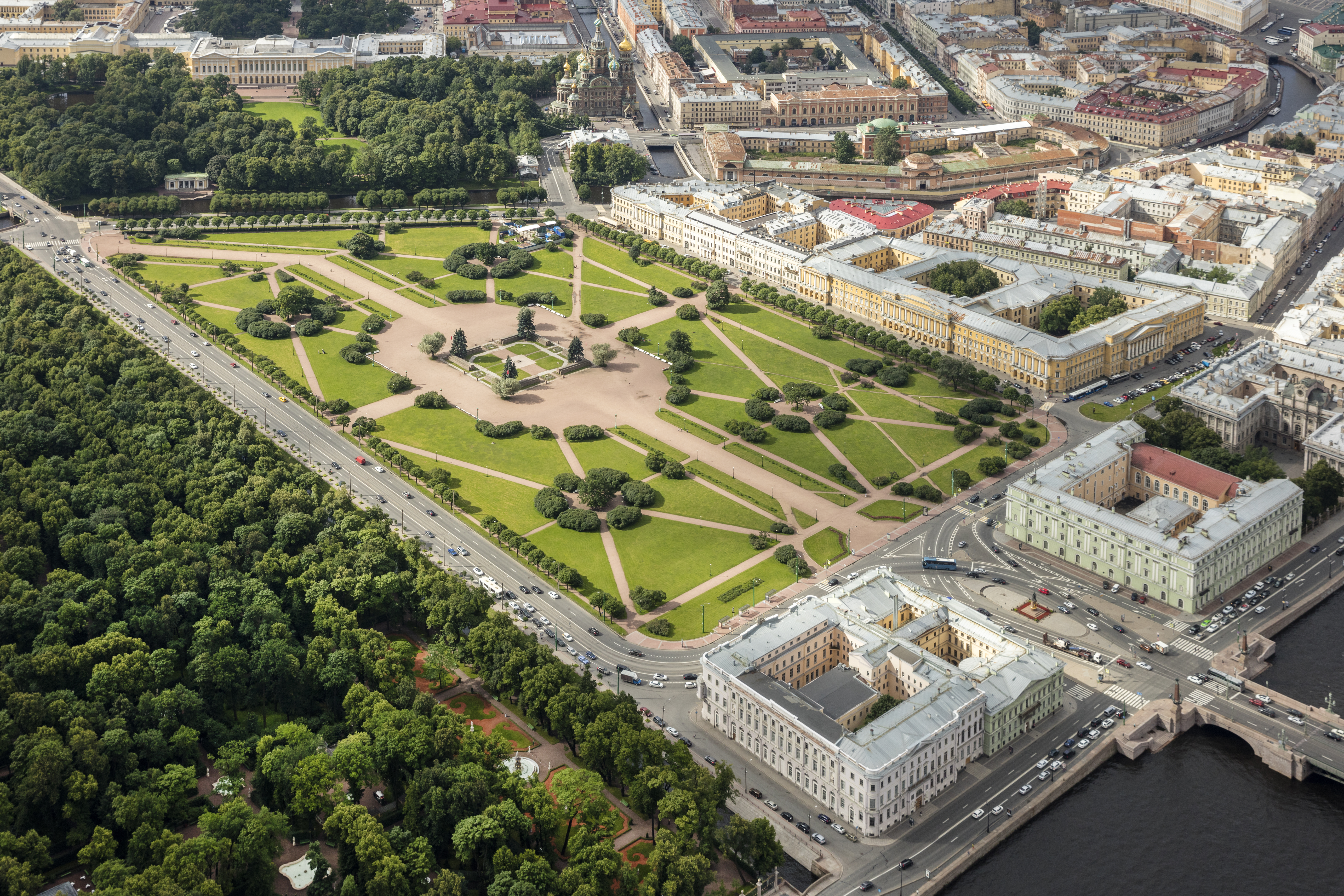
The Field of Mars is in the center of Petersburg, but it is conveniently isolated from well-populated residential neighborhoods and high streets. Unless they are extremely well attended, most political rallies held on the famous former parade grounds and revolutioanry mass burial site go unnoticed by the vast majority of Petersburgers. Photo courtesy of Andrew Shiva and Wikipedia

Up the River: The Smolny Will Expand List of Venues for Political Rallies
Mikhail Shevchuk
Delovoi Peterburg
December 4, 2018

As soon as he took up his duties as acting governor of St. Petersburg, Alexander Beglov announced plans to amend the law on political rallies.

“We need to make changes and introduce order, so there were will be no violations on either side,” he said at a meeting of the Presidential Council for Civil Society and Human Rights in October.

The Smolny has now drafted amendments to the law. The principle of “Hyde Parks,” that is, of specially designated places where Petersburgers can vent their indignation without prior notification of the authorites, remains in force. However, the Smolny has proposed establishing a minimum number of such places, eight in all.

The current law on political rallies does not specify the number of venues. City hall publishes the list of political rally sites in an ordinance. Originally, in 2012, the Field of Mars (or, rather, a small part of it) was designated the city’s “Hyde Park.” Two years later, four more venues were added: Udelny Park, Polyustrovsky Park, Yuzhno-Primorsky Park, and 30th Anniversary of October Gardens. The Field of Mars was struck from the list last year.

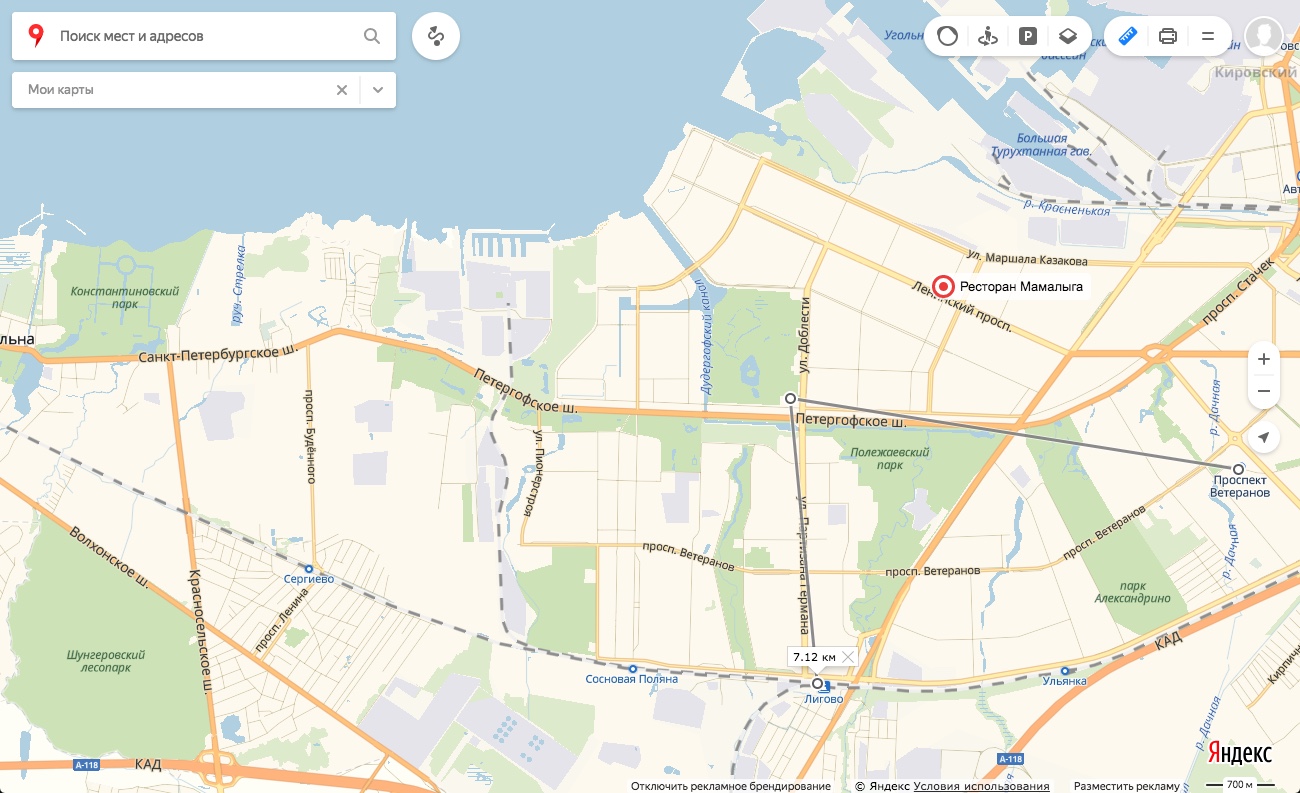
uppYuzhno-Primorsky Park is located in the far southwest of Petersburg. It is four kilometers from the nearest subway station, and three kilometers from the nearest suburban railroad station. Map courtesy of Yandex

Theoretically, it is possible to organize demonstrations in other places, but city hall usually refuses to sanction the rallies under various pretexts, suggesting to organizers they use one of the designated “Hyde Parks.” As a matter of principle, however, the opposition avoids the “Hyde Parks,” which are all situated in the city’s outskirts. Instead, they prefer to assemble at such traditional sites for political rallies as Lenin Square, Pioneer Square and, sometimes, even Palace Square, although they risk fines and forcible dispersal by police.

The maximum number of people who can attend a political rally held without prior notification of the authorities would range from 200 to 500 people under the amended law. As under the old law, State Duma MPs, members of the St. Petersburg Legislative Assembly, and members of the city’s municipal district councils would be able to hold meetings with constituents on the streets.

Officials would now calculate how many people can attend a political rally at a particular venue according to the norm of one person per square meter. Lenin Square and Pioneer Square would thus be able to accommodate rallies attended by as many as 10,000 people. Organizers would also be obliged to inform officials of canceled rallies under the threat of a fine of 5,000 rubles for individuals and 100,000 rubles for legal entities.

“It’s not the number of sites that matters,” said Andrei Pivovarov, leader of the local office of Open Russia. “And no one has ever been fined for going over the maximum number of attendees. One venue would be enough for us, but as long as it is in downtown Petersburg. If the venues are going to be in the outskirts, city hall could give us a dozen such places, but we would try to protest downtown anyway.”

However, Pivovarov said that if the new list included the Field of Mars, Lenin Square, and Pioneer Square, the opposition would be quite satisfied and make use of these venues.

St. Petersburg Legislative Assembly member Maxim Reznik also named the two squares. He said the number of people attending a rally and the convenience of Petersburgers were more important than a particular place. The opposition was always ready for dialogue, he said. However, if the regime made a point of tightening the screws, dissenters, Reznik said, would choose the paddy wagon, that is, they would choose to attend an unauthorized rally rather than cancel it.

Translated by the Russian Reader