Yana Sakhipova
Facebook
August 13, 2019
Hi, I’m married.
It’s an incredible feeling, really. For a year, you see each other only for several seconds in the hallway of the courthouse because they won’t let anyone in the courtroom. Then, for several months, in the courtroom through the bars of the cage. Then, two times, through the double-paned glass in remand prison, and you can even chat a bit.
But [at our wedding] we could hug and hold hands for a whole fifteen minutes, and I still can’t believe it. Yuli [Boyarshinov] was with me and everything was fine again, but then he was led away, of course.
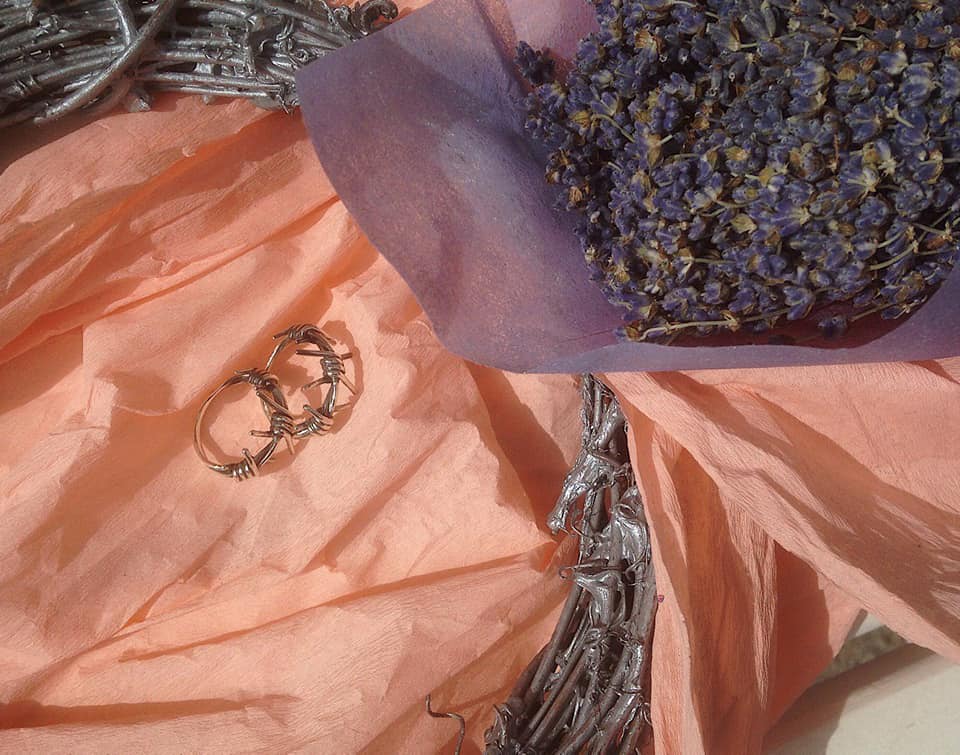
I had a paper veil: I wanted to do something ridiculous. And I had a barbed-wired ring. Yuli probably didn’t expect I wasn’t joking about the veil and the ring.
We were not allowed to bring a camera into the remand prison, of course.
Thank you all for your support: it’s cool and important. Someday this will all be over.

Victoria Andreyeva
Facebook
August 13, 2019
Today, I was going to the FSB archives and at the entrance I met Yuli Boyarshinov’s friends, who had come for a strange wedding. Boyarshinov has been imprisoned since January 2018 on ridiculous charges. He and other young men were tortured into giving testimony that would incriminate them as a “terrorist group.”
How could we let this happen? When you study the cases of 1936–1938 and see how investigators forced people to give ever more fantastic testimony, you imagine that such things could not happen in the twenty-first century. Stalin is dead, and the cases are part of the gloomy past. But when you read about what has happened to our contemporaries, how they testified under torture, you realize we are not so distant from that awful time when the violence of one group of people against another group of people was the norm. Read, for example, Tatyana Likhanova’s article about the case.
I hope that Yuli and the other [young men accused in the Network case] will soon be freed and the people who cooked up this whole business will be brought to justice.
Thanks to Victoria Andreyeva for the heads-up. Photos courtesy of Yana Sakhipova. Translated by the Russian Reader
__________________________________________
What can you do to support the Penza and Petersburg antifascists and anarchists who have been tortured and imprisoned by the Russian Federal Security Service (FSB)?
- Donate money to the Anarchist Black Cross via PayPal (abc-msk@riseup.net). Make sure to specify your donation is earmarked for “Rupression.”
- Spread the word about the Network Case aka the Penza-Petersburg “terrorism” case. You can find more information about the case and in-depth articles translated into English on this website (see below), rupression.com, and openDemocracyRussia.
- Organize solidarity events where you live to raise money and publicize the plight of the tortured Penza and Petersburg antifascists. Go to the website It’s Going Down to find printable posters and flyers you can download. You can also read more about the case there.
- If you have the time and means to design, produce, and sell solidarity merchandise, please write to rupression@protonmail.com.
- Write letters and postcards to the prisoners. Letters and postcards must be written in Russian or translated into Russian. You can find the addresses of the prisoners here.
- Design a solidarity postcard that can be printed and used by others to send messages of support to the prisoners. Send your ideas to rupression@protonmail.com.
- Write letters of support to the prisoners’ loved ones via rupression@protonmail.com.
- Translate the articles and information at rupression.com and this website into languages other than Russian and English, and publish your translations on social media and your own websites and blogs.
- If you know someone famous, ask them to record a solidarity video, write an op-ed piece for a mainstream newspaper or write letters to the prisoners.
- If you know someone who is a print, internet, TV or radio journalist, encourage them to write an article or broadcast a report about the case. Write to rupression@protonmail.com or the email listed on this website, and we will be happy to arrange interviews and provide additional information.
- It is extremely important this case break into the mainstream media both in Russia and abroad. Despite their apparent brashness, the FSB and their ilk do not like publicity. The more publicity the case receives, the safer our comrades will be in remand prison from violence at the hands of prison stooges and torture at the hands of the FSB, and the more likely the Russian authorities will be to drop the case altogether or release the defendants for time served if the case ever does go to trial.
- Why? Because the case is a complete frame-up, based on testimony obtained under torture and mental duress. When the complaints filed by the accused reach the European Court of Human Rights in Strasbourg and are examined by actual judges, the Russian government will again be forced to pay heavy fines for its cruel mockery of justice.
***************
If you have not been following the Penza-Petersburg “terrorism” case and other recent cases involving frame-ups, torture, and violent intimidation by the Russian Federal Security Service (FSB) and other branches of the Russian security state, read and share the articles the Russian Reader has posted on these subjects.
- “‘Hi, I’m Married,'” 14 August 2019
- “Ivan Davydov: The New Greatness Trial,” 12 July 2019
- “Guided Tour of a Torture Chamber,” 11 July 2019
- “They Are Who They Are,” 10 June 2019
- “Vocalese (The Network Trials),” 6 June 2019
- “Yana Teplitskaya: Can Torture Be Endured?” 3 June 2019
- “The Network Trials: Pinning the ‘Code’ on the Defendants,” 22 May 2019
- “My Generation,” 6 May 2019
- “Lie Still, Bitch!” 26 April 2019
- “Crossing Jordan: Day Three of the Network Trial,” 17 April 2019
- “Network Trial Begins in Petersburg,” 9 April 2019
- “FSB May Haved Used Neo-Nazi Provocateur to Frame Network Suspects,” 1 February 2019
- “Jenya Kulakova: A New Year of Sorts,” 18 January 2019
- “No Amnesty for ‘Terrorists,’” 15 January 2019
- “Relentless Repression in Russia: Why Londoners Are Demonstrating on January 19,” 14 January 2019
- “Solo,” 12 January 2019
- “Convoyed,” 31 October 2018
- “How the FSB Tortures Detainees: Stories of the Victims,” 28 October 2018
- “No Justice, No Peace: Petersburg’s Kangaroo Courts Revisited,” 21 October 2018
- “Shakursky and Pchelintsev Indicted for Organizing ‘Terrorist Community,’” 11 September 2018
- “Arman Sagynbayev: I Was Tortured by the FSB,” 8 September 2018
- “Yana Teplitskaya: Wonderland,” 6 September 2018
- “Network: Parents versus the FSB,” 2 August 2018
- “Is Maxim Shulgin an ‘Extremist’?” 26 July 2018
- “Moscow City Court Affirms Anna Pavlikova’s Remand in Custody,” 26 July 2018
- “Is Lydia Bainova an ‘Extremist’?” 24 July 2018
- “Anna Pavlikova: Enemy of the Putinist State?” 22 July 2018
- “A Funny Thing Happened in Pryamukhino,” 20 July 2018
- “Two More Suspects Detained in Network Case,” 6 July 2018
- “Petersburg Court Bailiffs Attack Reporter at Network Case Hearing,” 20 June 2018
- “Anna Tereshkina: At the Court Hearing,” 20 June 2018
- “Nikolai Boyarshinov: I Hope One Day We Can Say the FSB Has Been Banned,” 12 June 2018
- “Lemmy Kilmister vs. Vladimir Putin,” 19 May 2018
- “Brazil,” 18 May 2018
- “This Is What Antifascism Looks Like,” 13 May 2018
- “May Day in Petersburg: ‘Your Torture Won’t Kill Our Ideas,’” 2 May 2018
- “Riot Cops Raid Punk Rock in Barnaul: ‘Freaks, Not Patriots,” 29 April 2018
- “Hug Your Son and We’ll Open Fire,” 27 April 2018
- “Denis Lebedev’s Suicide Note,” 26 April 2018
- “‘Are You a Bitch Yet?’ FSB Makes New Threats to Framed and Tortured Antifascist Viktor Filinkov,” 26 April 2018
- “Suicide Invoice,” 25 April 2018
- “Zoya Svetova: Interview with Petersburg Public Monitoring Commission Members Yana Teplitskaya and Yekaterina Kosarevskaya,” 23 April 2018
- “TV Party Tonight!” 21 April 2018
- “Valery Pshenichny: Tortured, Then Murdered,” 19 April 2018
- “They Are Not Terrorists! The Terrorists at the FSB Torture People,” 16 April 2018
- “FSB and NTV Pressure Mother of Man Accused in ‘Terrorist’ Frame-Up,” 12 April 2018
- “A New Face in Hell: Yuli Boyarshinov,” 12 April 2018
- “Wife of Tortured Antifascist Seeks Asylum in Finland,” 11 April 2018
- “The FSB’s Tall Tales,” 10 April 2018
- “Families of Penza-Petersburg Terrorists Form Committee,” 9 April 2018
- “Extremism Inside Out,” 30 March 2018
- “Search and Intimidate,” 29 March 2018
- “Solidarity? (The Case of the Penza and Petersburg Antifascists),” 24 March 2018
- “Anna Tereshkina: At Viktor Filinkov’s Remand Extension Hearing,” 23 March 2018
- “Ping, Ping, Ping: The Remand Extension Hearing of the Penza ‘Terrorists,’” 20 March 2018
- “Tortured Petersburg Antifascist Viktor Filinkov Transferred to Remand Prison in Leningrad Region,” 17 March 2018
- “Svyatoslav Rechkalov: ‘They Proceeded to Pull Down My Trousers, Threatening to Shock Me in the Groin,’” 15 March 2018
- “They Jump on Anything That Moves, Part 3: The Case of the New Greatness Movement,” 15 March 2018
- “The Horrorshow Continues: Svyatoslav Rechkalov Tortured in Moscow,” 15 March 2018
- “The Rowdies Have to Be Apprehended Legally, So We Can Have a Celebration in the City on March 18, not Bedlam,” 15 March 2018
- “Ilya Kapustin: ‘When the Stamp Thudded in My Passport, It Was Like a Huge Weight Had Been Lifted from My Shoulders,’” 13 March 2018
- “Your Husband Safely Made the Flight to Minsk after We Abducted Him in Petersburg,” 2 March 2018
- “‘FSB Officers Always Get Their Way!’” 28 February 2018
- ‘The Case of the Anarchists: Disappearances, Torture, Frame-Up (11 AM, February 15, 2018, Moscow),” 14 February 2018
- “The Strange Investigation of a Strange Subway Attack,” 12 February 2018
- “Arrested Penza Antifascists Talk about Torture in Remand Prison,” 10 February 2018
- “Solidarity with Persecuted Russian Antifascists and Anarchists in NYC and Minneapolis,” 7 February 2018
- “Ilya Kapustin: ‘They Said They Could Break My Legs and Dump Me in the Woods,’” 31 January 2018
- “The Penza ‘Terrorism’ Case,” 30 January 2018
- “Breaking Bad with the FSB,” 29 January 2018
- “How ‘Stability’ Has Really Been Achieved in Russia,” 29 January 2018
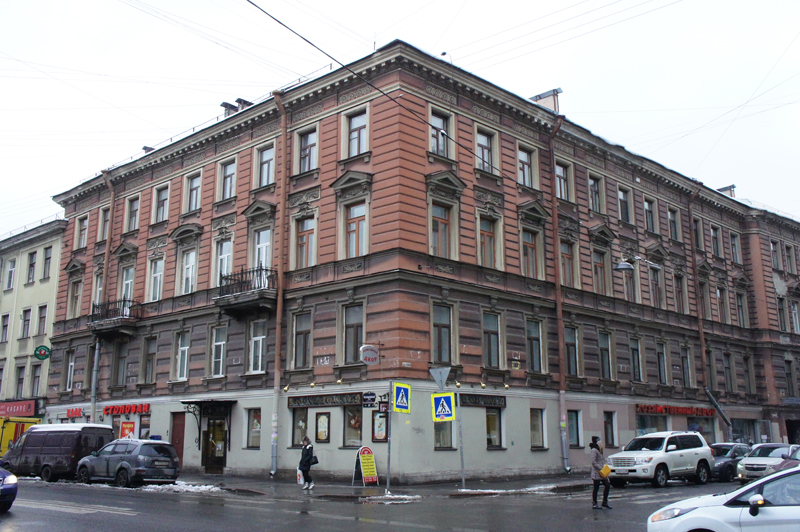
 70–72 Bolshoi Prospect, Petrograd Side, St. Petersburg (Uteman Tenement House, Dmitry Kryzhanovsky and Alexander Starobovsky, architects, 1912–1913). Photo courtesy of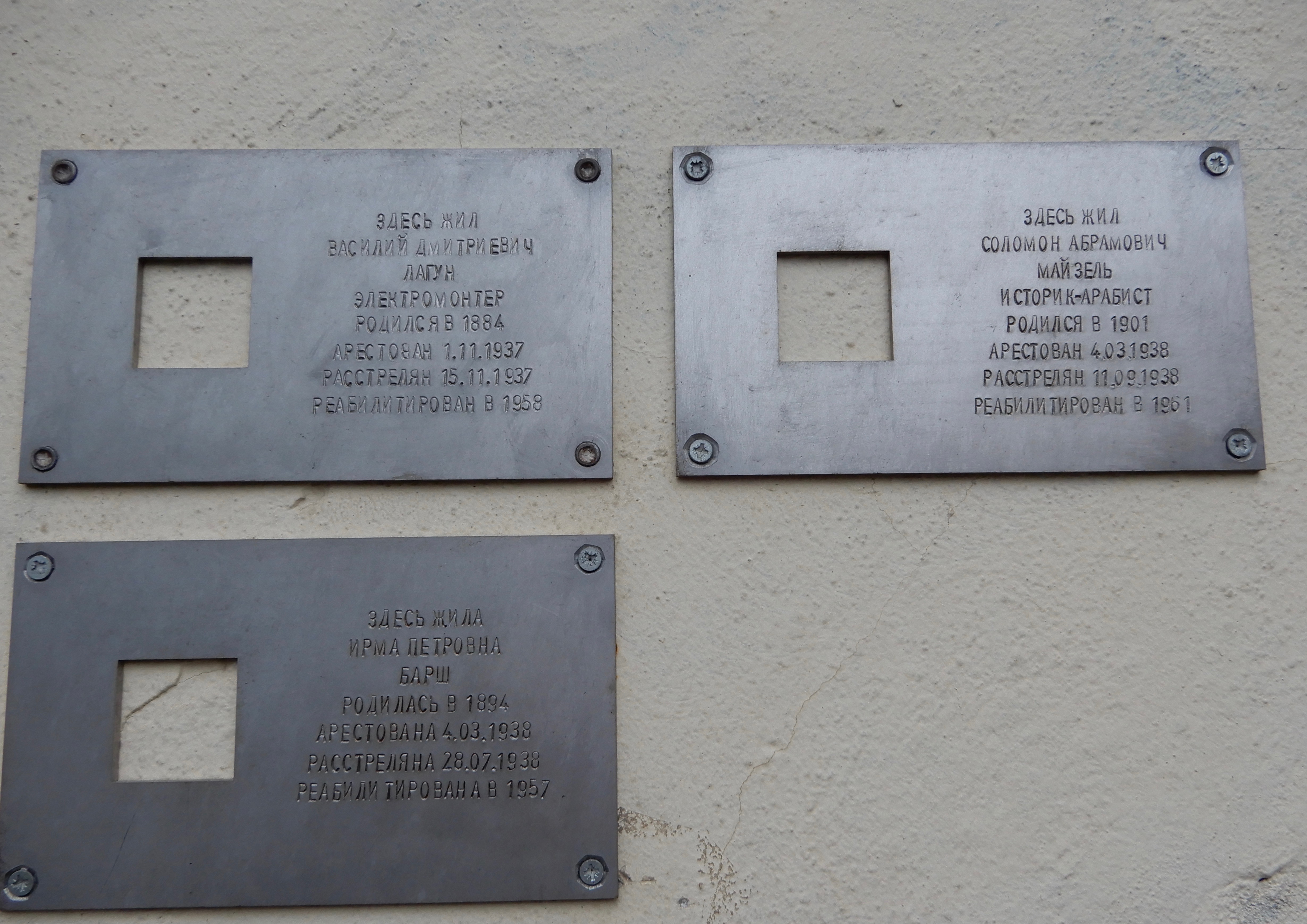
 Yevgeny Barthold, A Guide to Karelia and the Kola Peninsula (Moscow: OGIZ, 1935)
 The Mekhrenga River in Arkhangelsk Region. In 1939, Barthold was transferred to a camp station here.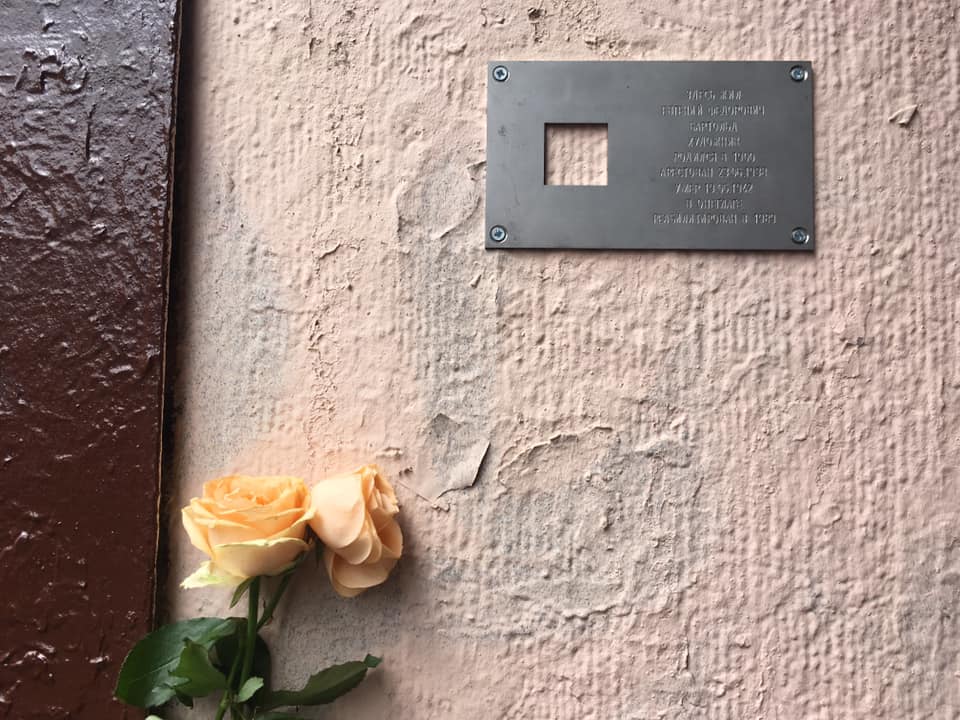
 This Sunday, June 30, we will install
 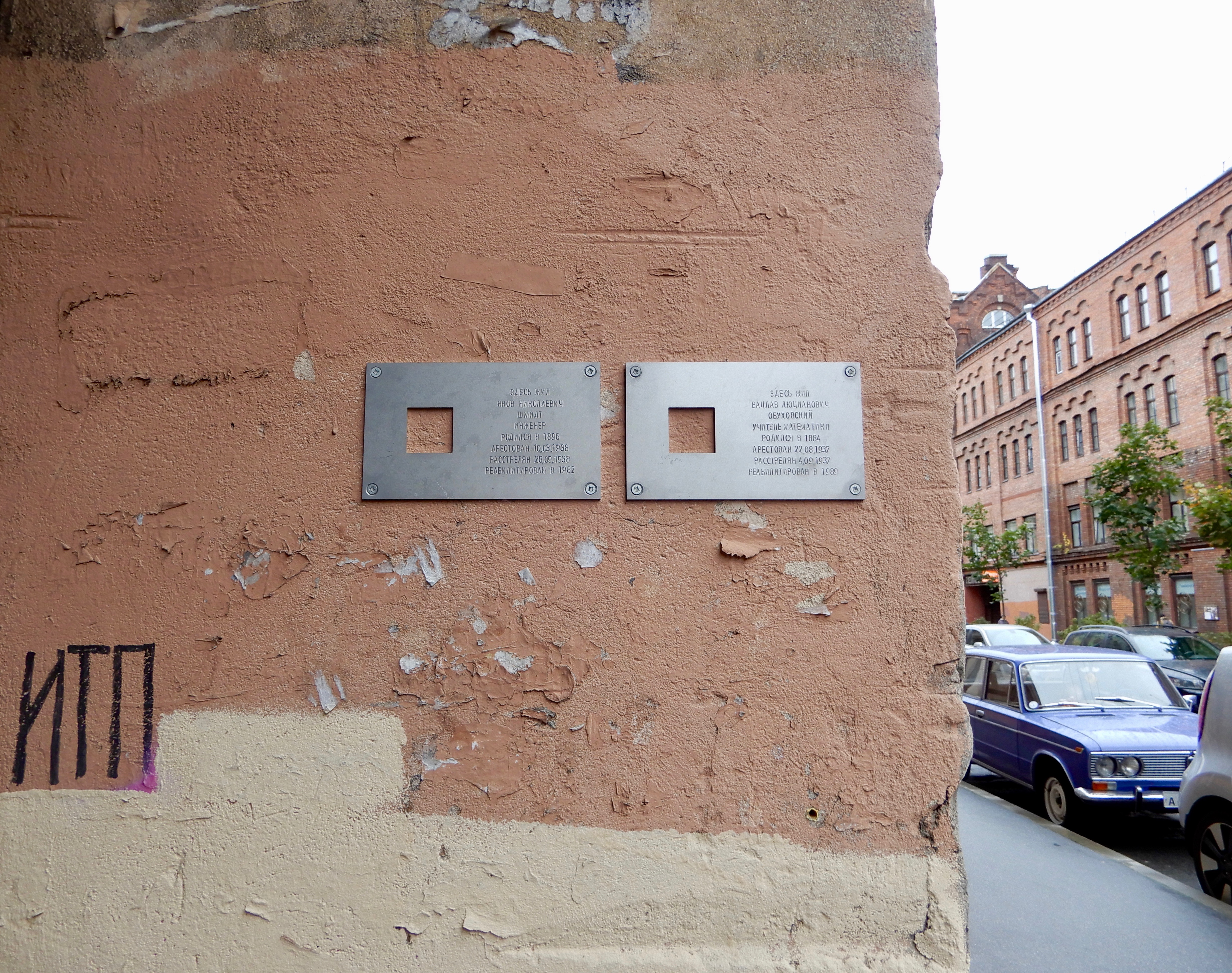 Two Last Address plaques at 27 Dostoevsky Street in downtown Petersburg, October 10, 2018. Photo by the Russian Reader
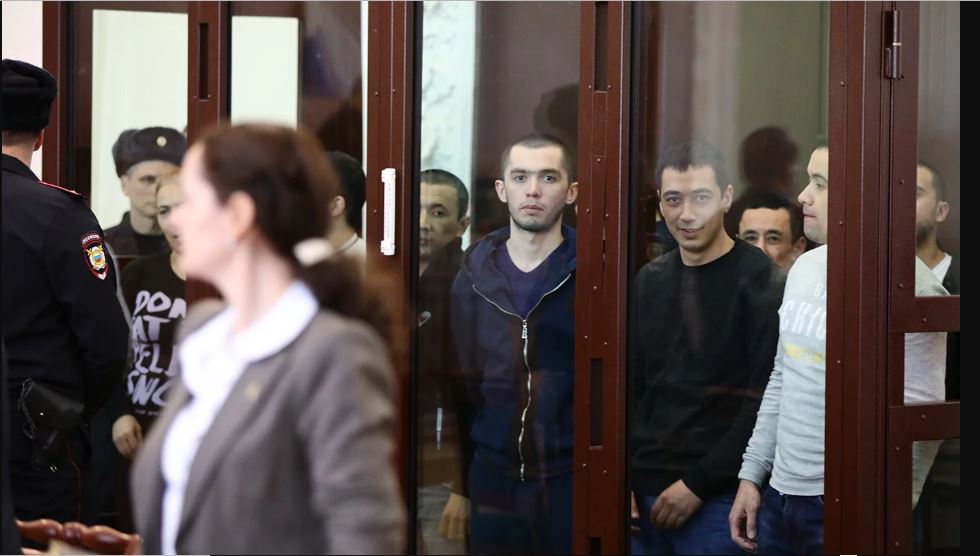 The defendants in the Petersburg subway bombing trial. Photo by David Frenkel
 Repeated endlessly by the Russophone liberal intelligentsia over the past three decades, claims that Russians are genetically programmed Stalinists and thus inevitably suspectible to Putin’s nonexistent charms and his neo-authoritarianism are false and pernicious cognitive dead ends that have done untold amounts of damage to the country’s grassroots democratic movements. Photo by the Russian Reader
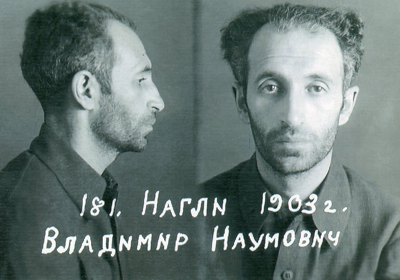
 “Here lived Vladimir Naumovich Nagly, theater director. Born 1903. Arrested 21 October 1938. Died 6 October 1940 in a prison camp in Kolyma. Exonerated in 1956.” Last Address memorial plaque at 38 Kolomenskaya Street in Petersburg’s Central District. Photo by the Russian Reader
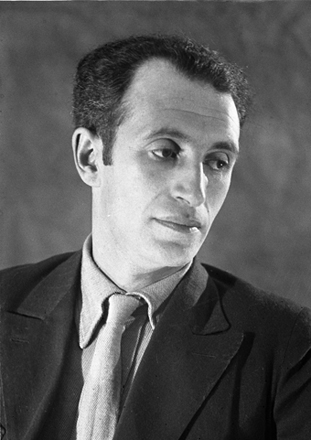 Vladimir Naumovich Nagly lived in the building in the 1930s.