Moscow Anarchist Azat Miftakhov: Arrested, Tortured and Missing

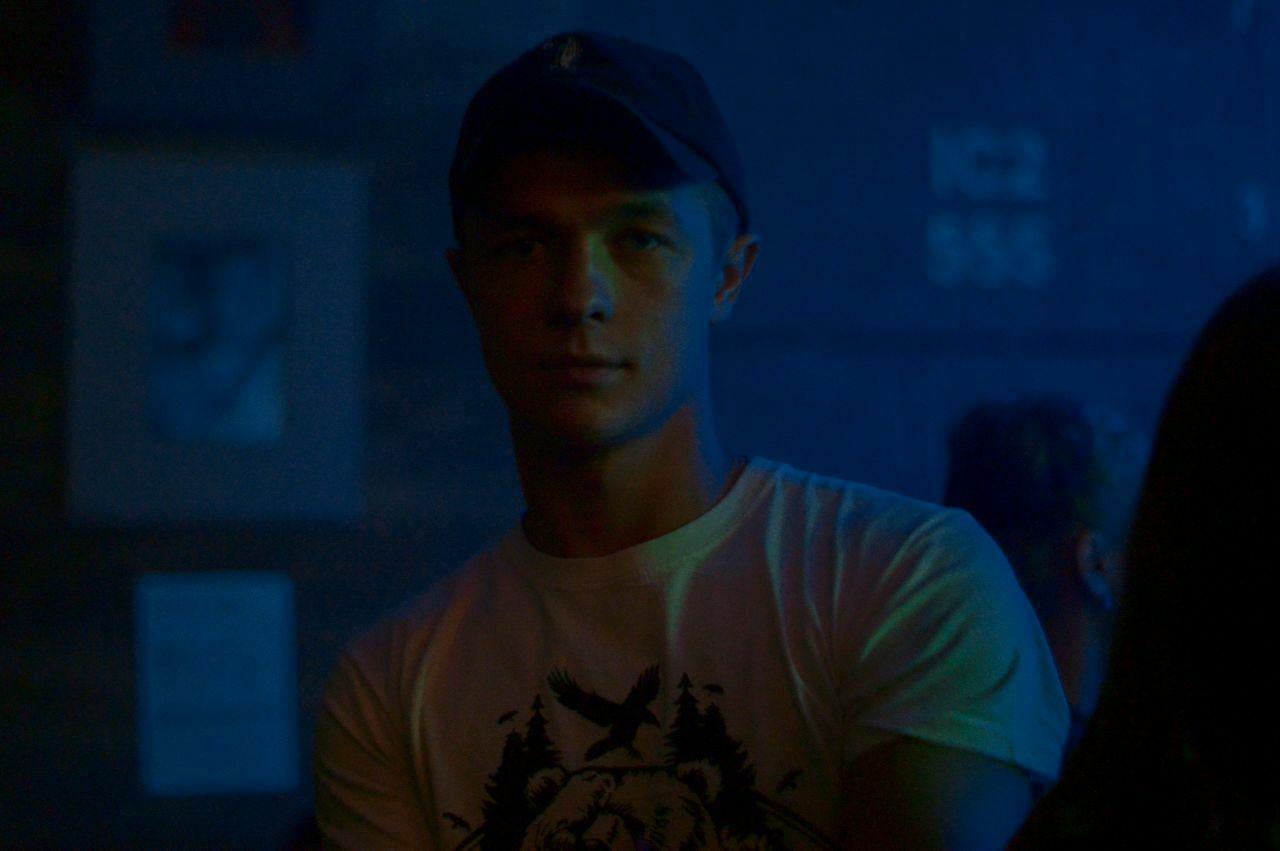
azatMoscow anarchist Azat Miftakhov at the center of a selfie taken, apparently, by the Center “E” officers who tortured him. Screenshot courtesy of Jenya Kulakova

Jenya Kulakova
Facebook
February 2, 2019

For a day and a half, lawyers have been unable to see Azat Miftakhov, an anarchist and Moscow State University graduate student who was detained yesterday. Yesterday evening, Miftakhov was taken from the Balashikha police station as a defense counselor looked on and taken to parts unknown. Miftakhov was bruised and surrounded by eight cop. It has been twenty-four hours since he was last seen. No one knows his whereabouts, his condition, and the charges against him.

On the other hand, Ren TV and Rossiya 24 have broadcast photos and videos from the Miftakhov’s search and interrogation. In one of them, an investigator mocks Miftakhov, who is handcuffed, when he claims he is afraid of being tortured. The Center “E” officers take a selfie with their prisoner. (I was unable to find any other photo, so that’s why it illustrates this post.)

The folks who were detained along with Miftakhov, but released yesterday, report they were beaten and tortured with electric shocks. The torture was so bad that yesterday Miftakhov “didn’t look like a human being.” He attempted to slash his wrists to keep from being tortured again. Today, lawyer Svetlana Sidorkina heard an investigator in court talking to someone about it.

The authorities did not produce Miftakhov in court today for his own custody hearing.

Like a year ago in Petersburg, torture is happening practically in broad daylight, but we don’t know what to do.  Yesterday, when I left a message on the Moscow police’s hotline, the operator almost laughed at me. Just as Putin claimed [at a recent meeting of the Council for Civil Society and Human Rights] that FSB officers don’t torture people in vehicles, she doubted what I was saying.

“He’s being tortured right in an Interior Ministry building? Right now? Give me a break,” she said to me.

A missing person report on Miftakhov has been filed, and lawyers have been trying since yesterday to get access to him. But what’s the point?

I hope this hell ends for him as soon as possible.

Here are a few links to articles [in Russian] about what has transpired about the searches and arrests in Moscow since yesterday.

Translated by the Russian Reader

Relentless Repression in Russia: Why Londoners Are Demonstrating on January 19

Relentless repression in Russia: why we will demonstrate on Saturday 19 January
People and Nature
14 January 2019

On Saturday, January 19, we will demonstrate in London in solidarity with Russian antifascists. Eleven of them, who have been arrested, tortured, and accused of fabricated “terrorism” charges, are awaiting trial. Many others have faced a relentless campaign of persecution by officers of the Federal Security Service (FSB) and the police, as summarized in the following article.

Please join us on Saturday to support the Russian antifascists and strengthen international solidarity against fascism, xenophobia, and state terror. Please repost and share this article.

Details of our London event here.

2018 summary

By Misha Shubin, 31 December 2018 (Original Russian text here)

I’ve also decided to sum up the year. Not my own year, but rather to remember what happened to anarchists and leftists in Russia in 2018. This post will be long, and many of you know  or heard something about the events I recount here.

But I think it is very important not to forget all this. [Note. Links from the original article to Russian-language sources are included. Links to English translations or relevant articles in English added where available. Translator.]

The Network Case

Eleven anarchists and antifascists have been arrested. They are accused of setting up a terrorist group and planning terrorist attacks. According to the Federal Security Service (FSB), they wanted to organise an armed uprising in Russia.

Almost all the evidence has been gathered on pain of torture. The detainees were beaten up. Some of them were tortured using shocks from a stationary electric dynamo, others with tasers. At least one of the accused, Dmitry Pchelintsev, was hung upside down.

The accused are Yegor Zorin, Ilya Shakursky, Vasily Kuksov, Dmitry Pchelintsev, Arman Sagynbayev, Andrei Chernov, Viktor Filinkov, Igor Shishkin, Yuli Boyarshinov, Mikhail Kulkov, and Maksim Ivankin.

What to read:

“How the FSB is manufacturing a terrorist case against antifascists in Russia”

What else you need to know about this case:

“A witness in the ‘network’ case, Ilya Kapustin, was tortured with a hand-held electric shocker.” Subsequently, he left for Finland, where he has applied for political asylum.

Viktoria Frolova, Ilya Shakursky’s girlfriend, was detained on Russia’s border with Ukraine. (Link in Russian.) Shakursky was threatened that “it would be bad” for his girlfriend if he did not make a confession.

The case of anarchist Yevgeny Karakashev

In early February 2018, anarchist Yevgeny Karakashev was arrested in Crimea [the peninsula annexed by Russia from Ukraine in 2014]. They brought him to the police station with a bag over his head. There were fresh bruises on his temples and his knees. On the basis of

two videos that he had uploaded to various chat forums, he was accused of making public calls for terrorist activity.

What to read:

“A rifle stock to the heart, a fist to the gut: how left-wing activists are persecuted in Crimea”

(And more in Russian.) [And a report of Karakashev’s subsequent court appearance is here.]

What else you need to know about this case:

The main prosecution witness is a former comrade of Karakashev’s.

In the autumn, 16 people from various Russian regions were summoned to the Russian Investigative Committee for interrogations. Many of them have expressed left-wing views. Some of them did not even know Karakashev.

Torture of anarchists in Chelyabinsk

Anarchists in Chelyabinsk staged an event on the night of 14–15 February in solidarity with the Network Case defendants. They displayed a banner outside the FSB headquarters and threw a flare over a fence. The banner read, “The FSB is the chief terrorist.”

Three days later, five people were arrested: Dmitry Semenov, Dmitry Tsibukovsky, Anastasia Safonova, Maksim Anfalov, and their friend Maksim. Tsibukovsky and Anfalov were beaten up and tortured with electric shockers.

Over the summer, the criminal case against theChelyabinsk anarchists was dropped.

What to read:

“The main thing at that moment, in that situation, was to come out alive”

What else you need to know about this case:

In November, a new criminal case was opened against anarchists Tsibukovsky, Safonova, Grigory Potanin, Mikhail Perkov, and Dmitry Dubovoi. This time, they were charged with vandalism during their protest of the government’s pension reform.

The broken window in United Russia’s office and torture of Svyatoslav Rechkalov

On 31 January, persons unknown broke a window at the office of United Russia [the largest party in the Russian parliament, which supports President Putin] and threw a smoke bomb. A criminal investigation into vandalism was launched. Sixteen days later, Yelena Gorban and Aleksei Kobaidze were arrested. After questioning, they were released on their own recognizance.

On 14 March, searches were conducted of the homes of anarchists from the People’s Self-

Defence organisation in connection with the case. Subsequently, Svyatoslav Rechkalov and Andrei were detained; the latter, most likely, was released.

Rechkalov was driven around the city for several hours, blindfolded. Then security services officers beat him and tortured him with electric shocks. They warned that, if he did not make the necessary confession, he would end up a defendant in the Network Case. After being tortured, Rechkalov was released. He emigrated to France.

What to read:

“The horror continues”, and “They put a bag on my head, cuffed my hands behind my back and tortured me with a taser”.

What else you need to know about this case:

In November, Rechkalov started getting threats from the FSB. (Link in Russian.)

Torture of Left Bloc activist Maksim Shulgin

In late April, Left Bloc activist Maksim Shulgin was detained in Tomsk. On the way to his interrogation, security service officers beat him up in their vehicle and held his face against a heater. To protect his face from burns, Shulgin put his arms against the heater

and received first- and second-degree burns. Shulgin was accused of inciting hatred towards the police after posting songs on VK [a Russian social network similar to Facebook].

Shulgin filed a complaint about his having been tortured. In late December, he was again detained. This time, law enforcers tried to choke him to force him to withdraw the accusations he had made against FSB officers.

What to read:

Arrest in April. “Is Maxim Shulgin An Extremist?” and “Tomsk resident tortured for posting songs about police on VK.”

Torture in December. (Link in Russian.)

What else you need to know about this case:

Another nine Left Bloc activists were detained with Shulgin. They were forced to make confessions under threat of torture. (Link in Russian.)

Explosion in Arkhangelsk, interrogation of anarchists and leftist activists, and torture of Vyacheslav Lukichev

On 31 October there was an explosion at the FSB headquarters in Arkhangelsk, set off by Mikhail Zhlobitsky [who died at the scene]. As a result, all over Russia the police detained and brought anarchists, left-wingers, and those who hold alternative political views in for so-called discussions. (Link in Russian.)

In early November, anarchist Vyacheslav Lukichev was arrested in Kaliningrad. He was accused of vindicating the explosion set off by Zhlobitsky. It was later established that after Lukichev’s arrest he was beaten by six people. He was questioned for 36 hours.

What to read:

“Vyacheslav Lukichev: interrogated for 36 hours and beaten”

What else you need to know about this case:

After the explosion, a 14-year old who, allegedly, had contact with Zhlobitsky was detained in Moscow on suspicion of planning bombings. (Link in Russian.)

What else happened this year?

■ In March, the police checked the documents of participants in a football tournament organised by antifascists. (Link in Russian.)

■ In July, police and FSB officers went to the Pryamukhino Readings [an event held annually to discuss the ideas and legacy of Mikhail Bakunin, at his birthplace in Tver Region]. The conference theme was “Revolution and Culture”. The security service officers checked participants’ passports, and then detained Artem Markin, an anarchist from Belarus. He was detained for three days for allegedly using psychotropic substances. See: “A Funny Thing Happened in Pryamukhino”.

■ In August, officers from Centre “E” [Center for Combating Extremism] turned up at the Icebreaker [Ledokol] punk festival. They arrested two people, tried to persuade them to turn informer, and asked about the People’s Self-Defence group. (Link in Russian.)

■ In October, anarchist Ilya Romanov was sentenced to five-and-a-half years on charges of incitement to terrorism. He allegedly published on Facebook a video recording of jihadists and an occult ritual featuring a puppet named Vladimir. All the indications are that the criminal case was a frame-up. See: “Meet Russian anarchist Ilya Romanov. He’s spent nearly twenty years in prison”.

■ In late December, the anarchist Aleksandr Kolchenko [from Crimea, who since 2015 has been serving a ten-year sentence in Russia on trumped-up charges] was transferred, on a formal pretext, to a punitive isolation cell, where he saw in the new year. (Link in Russian.)

Moloko plus siloviki

[Moloko is Russian for “milk”. Siloviki is a widely used term for the heads and officers of Russia’s numerous, overlapping security services, including the FSB, Centre “E”, the Russian National Guard, and the Russian Investigative Committee.]

In mid June, there was a gathering in Krasnodar of members of the collective that publishes the countercultural almanac moloko plus. Sofiko Arifdzhanova and Pavel Nikulin had planned to present the latest issue of the almanac, on the topic of revolution. On the day before the event, the police arrested Sofiko and a volunteer [who helped with printing], Anastasia Kkhukhurenko. The police would not release them and demanded a meeting with Pavel. They then forced Sofiko and Anastasia to sign an undertaking not to organise unauthorised mass gatherings and warned them about the punishments for extremist activity before releasing them

The next day, persons unknown attacked Sofiko and Pavel with pepper spray. A few hours later, at the presentation, the police arrived and confiscated almanac’s print run.

In September, there was another presentation, in Petersburg, and FSB officers turned up. In this case, everything turned out relatively peacefully. They just got up and left.

After another two weeks, there was a presentation here in Nizhny Novgorod. A few minutes after it began, officers from Centre “E” burst in, with armed back-up. Sofiko, Pavel, and I were arrested and taken to the police station. Ninety copies of the almanac were confiscated, along with some gas cylinders [sic]. Pavel was detained for two days on charges of insubordination to a police officer. The issue of moloko plus is now being checked for any indications of extremism. There is a big text about our adventures in Russian here.

I am sure I have forgotten something and so not included it. Generally speaking, that was the sort of year we had.

More on defending Russian political prisoners:

 The Rupression site

 “Convoyed”, on The Russian Reader

Thanks to People and Nature for their generous permission to republish this important article and solidarity appeal here. I have lightly edited the original text to make it hew more closely to this website’s imaginary style guide. {TRR}

Vyacheslav Lukichev: Interrogated for 36 Hours and Beaten

DSCN3140

Lawyer: Kaliningrad Anarchist Interrogated for 36 Hours and Beaten
OVD Info
November 8, 2018

Maria Bontsler, defense attorney of Kaliningrad anarchist Vyacheslav Lukichev, who has been charged with public “exoneration” of terrorism on the internet, said her client had been beaten, according to a post published by Valentina Dekhtyarenko, manager of the human rights advocacy program at Open Russia, on her Telegram channel.

Bontsler claimed Lukichev had been beaten by six riot police (OMON) officers. She noted the police officers beat Lukichev in such a way as to leave no traces on the anarchist’s body. According to Bontsler, the beating occured on November 4, immediately after Lukichev was detained, in a room in which Lukichev’s [original,] state-appointed defense attorney was present.

Bontsler also claimed Lukichev had been interrogated for thirty-six hours.

Lukichev, 24, is suspected of publicly exonerating terrorism (a felony under Article 205.2 Part 2 of the Russian Federal Criminal Code) after allegedly publishing a screenshot of the suicide note allegedly left by [17-year-old Mikhail Zhlobitsky].

[Zhlobitsky] has been alleged to have bombed the FSB’s regional office in Arkhangelsk [on October 31], killing himself and injuring three FSB officers.

Several minutes before the blast, a message about the attack was posted on Telegram in the open chat channel Rebel Talk [Rech’ buntovshchika].

The authorities have been investigating the incident as a terrorist attack.

Investigators claim Lukichev published a post on the Telegram channel Prometheus [Prometei] in which he called [Zhlobitsky] a hero.

At a court hearing, Bontsler said the phrase had been taken out of context.

Political activists in Perm, Krasnodar, Arkhangelsk, and Arkhangelsk Region have said police officers came to their homes or they received summons to police stations in the wake of the October 31 attack.

On November 3, the home of Danil Pinzhenin, second secretary of the Sochi municipal Komsomol [Communist Youth League] committee, was searched by police in connection with the incident.

Translated by the Russian Reader. The article has been edited to make it more readable and informative.

[sic]

sledkom-stampsA set of four 27-ruble stamps, celebrating the Russian Federal Investigative Committee, purchased at the Petersburg Central Post Office for 108 rubles on November 12, 2017.

After Dark, They Gonna Blow Up [sic]
Police Looking for Gang of Teenage Anarchists in Moscow
Yuri Syun
Kommersant
November 10, 2018

Kommersant has learned that FSB and police in Moscow are looking for a dozen young anarchists who could be involved in planning terrorist attacks and illegal trafficking of explosives. The chekists [sic] were made aware of the alleged underground organization as part of the investigation of the suicide bombing carried out by a second-year vocational school student [sic] at the FSB’s regional office in Arkhangelsk.

While checking the contacts of the vocational school student [sic], whose suicide bombing injured three FSB officers, investigators became aware of 14-year-old Kirill K., a student in the eighth form at School No. 1571 in Moscow. According to the chekists [sic], Kirill K. and the suicide bomber communicated by mobile phone over a long period and corresponded via Telegram, including the day the terrorist attack occurred in Arkhangelsk. Obviously [sic], it was his older comrade who had told Kirill one could manufacture explosives from ordinary household chemicals, including fertilizers, easily obtainable in hardware stores. During a search of the flat of the schoolboy’s parents, on Freedom Street, police discovered [sic] an improvised explosive device (IED) manufactured from ammonium nitrate, smokeless gunpowder, and bomb parts [sic]. According to investigators, the schoolboy could have assembled the IED for an attack during celebrations [sic] of National Unity and Harmony Day [sic].

The schoolboy was detained on November 2. Yesterday, the violent crimes and public safety case squad in the Russian Investigative Committee‘s Moscow office charged him with crimes under Articles 222.1 Part 3 and 223.1 Part of the Russian Federal Criminal Code (illegal purchase and possession of explosives or explosive devices, and illegal manufacture of explosives).

According to investigators, the suspect committed both crimes as part of an organized group. The group could have included the Arkhangelsk suicide bomber, as well as other, unidentifed persons. There could have been as many as ten people in this group, sources in law enforcement say. However, they have so far been unable to identify the vocational school student and schoolboy’s alleged accomplices. This may partly be due to the fact that Kirill, citing Article 51 of the Constitution, refused to testify and admit he manufactured explosives.

However, his lawyer, Sergei Ashanin, claims law enforcers did not find any explosive devices or parts of explosive devices at the flat of Kirill’s parents.

“Except for ten grams of saltpeter and gunpowder that fit in a glass yogurt jar, there was nothing else,” added the lawyer, refusing to comment on the case.

Ashanin plans to appeals the decision of the Presnya District Court, which remanded the schoolboy in custody. We should note the court’s decision was challenged not only by the suspect, his lawyer, and his legal guardian but also by the prosecutor. Consequently, the defense plans to insist in Moscow City Court that the schoolboy be placed under house arrest instead.

Translated by the Russian Reader

A Funny Thing Happened in Pryamukhino

Bakunin_PryamukhinoThe Pryamukhino Estate, birthplace of Mikhail Bakunin, circa 1860. Photograph courtesy of Wikimedia Commons

Mala Vida
Facebook
July 20, 2018

On the Police Raid in Pryamukhino

The Pryamukhino Readings, an annual open conference, took place on July 7–8, 2018. This year, the conference attracted the notice of Russian law enforcement. Since the conference has taken place in a village school for the last eighteen years, the Pryamukhino village council and the Kuvshinovo district council were informed in advance about the conference, but they made no attempt to prohibit the event.

However, as the conference’s organizing committee later learned, police officers had visited the village council on July 6, 2018, on the eve of the conference’s opening day.

Several men in plain clothes, who showede all the signs of being law enforcement officers, attended the first day of the conference, July 7. They chatted with conference goers about abstract historical and philosophical topics, but they also wondered aloud whether there were any “terrorists” in modern Russia.

On the second day, July 8, two police cars and a car without license plates arrived at the gathering point right when the annual sightseeing excursion of Pryamukhino Estate and Pryamukhino Park was to begin. Eight policemen, including members of the Torzhok Intermunicipal Police Precinct, members of the precinct’s immigration desk, and plainclothes officers who produced no IDs (they were probably officers of Center “E” or the FSB) checked and photographed the passports of the sightseers. According to the police officers, a public nuisance complaint from an unnamed local resident was the grounds for their visit.

As a consequence of the documents check, a conference goer, Artyom Markin, a Belarusian national, was detained. He was informed he was “banned” from entering Russia, a fact that had not been brought to his attention either when he crossed the Russian border or when police checked his papers.

Markin was taken to the Torzhok Intermunicipal Police Precinct. He refused to communicate with secret service officers, since no written charges had been filed against him. He was then taken for a medical examination, because the police, allegedly, suspected him of having used psychoactive substances. After Markin refused to take the medical exam (i.e., his alleged drug use was not certified by physicians), and despite the fact that he had not shown any signs of drug use (conference goers testifed Markin had not used psychoactive substances and did not look out of the ordinary), a magistrate declared him guilty of evading medical diagnosis (Russian Administrative Offenses Code Article 6.9 Part 1) and sentenced him to three days in jail.

At the same time, on the afternoon of July 8, two of the plainclothes officers returned to Pryamuhino, explaining they had come again because, allegedly, they were looking for Markin’s girlfriend. Their presence and the need to protect conference goers from the illegal actions of the authorities generated considerable difficulties when it came to proceeding with the conference. The plainclothes officers left for Torzhok only after four in the afternoon.

After spending three days in jail, Artyom Markin was forced to leave Russia. He was issued a notification from the immigration desk of the Torzhok Intermunicipal Police Precinct prohibiting him from entering Russia until 2022.

We believe that recent events in Belarus (e.g., police roughly detained local anarchists on June 30, 2018, during a gathering in the woods), a possible call from Belarusian law enforcement and security services to their Russian counterparts, and heightened security during the 2018 FIFA World Cup in Russia occasioned such furious actions on the part of the police. The ban on entering Russia, as issued to Artyom Markin, was justified, allegedly, in order to ensure “defense, national security or public order,” as stipulated by Article 27 of Russian Federal Law No. 114 (“On the Procedure for Departing and Entering Russia”), which outlines amendments to the law introduced during international sporting events.

Because the Pryamukhino Readings are an academic conference open to all comers, the organizers make an effort to get to know all of our attendees in order to ensure order and their own safety. However, we do not have the resources to prevent the use of force on the part of the police and curiosity on the part of the authorities.

The Pryamukhino Readings are an annual event run by volunteers. We do not cooperate with the authorities any more than is necessary for holding the conference. We have never supplied the authorities with personal information about our attendees or any additional information about them.

In the event of conflicts like the one described, above, our job is taking care of our out-of-town guests. However, we do not have the resources to provide qualified legal assistance on the spot.

We urge everyone to study the current Russian laws in order to better defend their rights when confronted by law enforcement officers, who often interpret the laws governing their own conduct too freely or falsely.

The Pryamukhino Readings Organizing Committee condemns crackdowns on social movements and independent public events, as well as the framing of social activists and the arbitrary use of administrative and other penalties in the absence of evidence and a demonstrable danger to the public.

The Pryamuhkino Readings Organizing Committee

Translated by the Russian Reader

_____________________________________

Anarchists Go on a Pilgrimage to Tver
Yulia Solovyova
Moscow Times
August 15, 2003

PRYAMUKHINO, Tver Region — Pavel Glazkov is fed up with people who hear the word anarchy and instantly conjure up thoughts of debauched sailors wreaking havoc and chaos.

Anarchism is a moral thing above all, Glazkov says, and it hinges on order, self-discipline and mutual assistance.

A graduate student from Tambov, Glazkov is in the process of writing a thesis on Mikhail Bakunin, the 19th-century philosopher whose ideas laid the foundation for modern anarchism. And he is active in spreading the gospel of anarchy. Glazkov posts leaflets at his university urging students to take action. At a children’s summer camp where he works as an educator, he tells children stories about anarchism before bedtime. The Tambov bar where he once worked as a bartender turned into a sort of a revolutionary circle full of conversation and debate, not unlike one of Bakunin’s many secret societies.

“I’m trying to educate people,” says Glazkov, 24, a gentle giant who wears black-rimmed glasses and two earrings in his left ear. “When I was a kid with an anarchy badge on my chest listening to the Sex Pistols no one told me what I was supposed to do as an anarchist.”

Late last month, Glazkov traveled 10 hours by train and bus to Pryamukhino, the Bakunin family estate in the Tver region, in search of like-minded people. What he found was an improbable mix: white-bearded intellectuals studying the Russian gentry culture alongside pierced and tattooed 20-somethings in black T-shirts and ragged jeans who were doing little more than frolicking in nature away from their parents’ control.

Glazkov spent a weekend in Pryamukhino. He took part in a scientific conference and civic duties like picking up trash in a park. At night he listened to romances—lyrical, sentimental songs—and drank vodka with the academics. Then it was time for a drunken rendition of the “Mother Anarchy” song by the kids, who described themselves as anarcho-communists, Marxists, Maoists, hippies and anti-fascist skinheads.

“It was great,” Glazkov enthused. “I met young people who are into ideas, and they don’t just stick to some stiff, outdated beliefs, but take them further.”

The Pryamukhino Free Co-Op was created in 1995, when a group of students from Moscow decided that Bakunin’s birthplace, which was formally protected by the state, actually needed protection from the state. Since then, a few dozen anarchists from central Russia and, occasionally, from abroad, have come here every summer to work in the park, scandalize the locals by skinny-dipping in the creek and debate anarchism around the campfire. They live in a cramped log house with a black anarchy flag flying from the roof and a sign over the door that reads, “Work is the best hangover treatment.”

The anarchist movement can encompass certain elements of other ideologies, such as Maoism and communism, while rejecting those components relating to authoritarian political control. The anarchist movement is not uniform, but this doesn’t appear to present a problem.

“What’s important is the rejection of the state, hierarchy, clericalism, dominance, all dogmas, everything that’s dead and rotten,” said Vasily Prytkov, who helped organize this summer’s co-op. “People who come here share these ideals.

Pryamukhino’s mixed appeal is the result of its rich heritage. In the 19th century, this traditional nobles’ nest was a nationwide cultural magnet. Bakunin’s parents and ten siblings were well-educated people known for their various talents, bon vivant habits and a taste for sophisticated company. Leading lights of the times, such as literary critic Vissarion Belinsky, novelists Ivan Turgenev and Leo Tolstoi, and thinker Nikolai Stankevich, walked among the exotic plants that grew in the estate’s sumptuous park.

All in all, the Pryamukhino harmony, as the contemporaries described life on the estate, shared little of the rebellious spirit of its most famous resident—the man who was all passion and bustle and pure will, the prototype of Richard Wagner’s Siegfried and the very model of a thunderbolt-hurling revolutionary.

Bakunin believed that the state and capitalism are evil and must be destroyed. He fought for a society based upon justice, equality and freedom. Being more of a doer than a writer, he threw himself into the insurrections that burst across Europe like thunderstorms in his day. Bakunin is often contrasted with Karl Marx, and credited with forecasting the inevitable connection between state communism and the Gulag.

Bakunin’s prophecies came true in the Soviet Union, and although streets across the country were named after him, his legacy was forgotten or distorted, and anarchy became almost a swearword. Similarly, his family’s country estate was plundered and destroyed. The great park, with fish ponds, artificial waterfalls and hills, became neglected and overgrown.

Today, Bakunin’s followers include the ragtag members of the international New Left movement, who share the values of anti-globalism, pacifism, environmentalism and human rights. In Russia, they are few and have little formal organization, with few exceptions, including the groups Avtonomnoye Deistviye, or Autonomous Action, and the Russian branch of the Rainbow Keepers, a radical eco-anarchist group.

“Collective social activity is much more important than setting up formal organizations,” said Mikhail, 31, one of the founders of the Pryamukhino Free Co-Op, who asked that his last name not to be used. “In Russia, people don’t have faith left in collective action and social change. But it’s necessary to keep trying.”

The anarchists occasionally participate in joint actions and social protests like the annual anti-capitalism rally in Moscow. Otherwise they are largely invisible on Russia’s political landscape.

On a recent Sunday morning, a group of anarchists, looking slightly woozy from the night before, trickled into a garden. While some camp goers are serious about anarchism, others are clearly there for the lifestyle that the relaxed environment provides, especially given the fact that the Bakunin Foundation covers all transportation and food costs.

The anarchists settled on the grass among flowers and buzzing bees, where they conducted a meeting concerning the areas of the camp that needed the most work. Soon, armed with a variety of garden tools, they began trimming plants in the park and cleaning up a pond under the supervision of Sergei Kornilov.

Kornilov is a director of the Bakunin Foundation, which was created to promote the legacy of the Bakunin family and restore the estate. A former theater director who says he was too brainwashed to care about anarchism in Soviet times, Kornilov, 65, has dedicated his life to the Pryamukhino estate since he moved there from Moscow in 1998.

A tanned and energetic man who looks like a 19th-century aristocrat, Kornilov mapped out Pryamukhino’s future as an artist would. Tourists were to stay in the recreated interiors of the Bakunin house, and church services, grand balls and theater plays would be staged in the vaulted basement of the remaining south wing of the estate.

“I looked up plays about Mikhail Bakunin, and there weren’t any,” Kornilov said. “So I decided to write one myself.” Kornilov has written a trilogy of plays about Bakunin.

Meanwhile, Glazkov, the Bakunin scholar from Tambov, wrestles with applying his ideas to contemporary realities.

“Go tell a Muscovite whose relative was killed in a terrorist act that Russia needs anarchism and they’ll tell you, ‘What are you, crazy?'” he said. “People are tired of terrorism, Marxism, and other isms. What they want is stability and strong leadership.”

May Day in Petersburg: “Your Torture Won’t Kill Our Ideas”

31715161_2002393253350140_6474713312398409728_n“Your torture won’t kill our ideas.” Anarchists and antifascists march down Nevsky Prospect in Petersburg on May Day 2018
St. Petersburg Anarchist Black Cross
Facebook
May 1, 2018

We, people who espouse anarchist and antifascist views, dedicated May Day this year to our comrades, arrested in The Network case, a frame-up by the Russian Federal Security Service (FSB). Despite the rain, we made common cause and march in the May Day demo. We carried placards inscribed with quotations from the diaries and testimony of the arrested men in which they talk of the torture to which FSB officers have subjected them.

31688009_2002392766683522_1947585257179971584_n

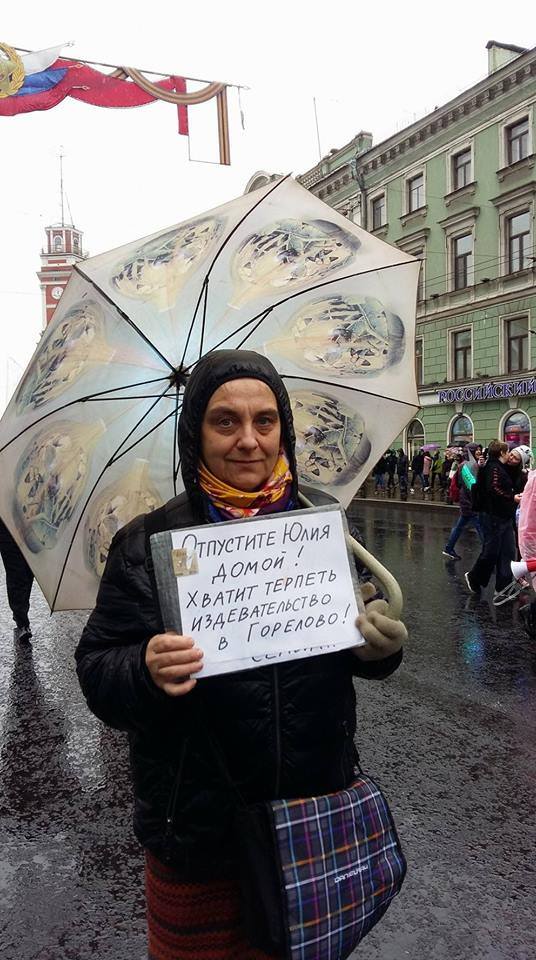
“Send Yuli home! Stop the bullying in Gorelovo!” Yuli Boyarshinov’s mother at 2018 May Day demo in Petersburg.

It was the most important message to convey during this year’s May Day demo.

Six young men were detained in Penza in autumn 2017. FSB officers had planted weapons and explosives in the cars and homes of some of the men. Then FSB officers tortured the antifascists in the local remand prison. They attached electrodes to various parts of their bodies and sent electrical currents surging through them. They hung them upside down and brutally assaulted them. During the torture sessions, the secret services tried to force the activists to memorize the testimony they wanted the men to give to investigators, a story about how they had established a nonexistent “terrorist community” of which they were, allegedly, members.

In late January 2019, two more antifascists were detained in Petersburg. They were also beaten, tasered, and forced to incriminate themselves.

In April 2018, a third young man in Petersburg was charged with involvement in the same fictitious “terrorist community.”

31682379_2002392876683511_519457091652419584_n“Viktor Filinkov, programmer.” || “I screamed, ‘Tell me what to say. I’ll say anything!'” Anarchist and antifascists at 2018 May Day demo in Petersburg
Establishing the truth is the essential goal and only value of law enforcement and the institutions of state power that enforce the law. The language of violence is not the language of truth. Confessions and testimony obtained under torture cannot constitute the truth. They are knowingly false. The worldview offered to us by the investigators in the case of the Penza and Petersburg antifascists is completely unconvincing.

Fascists fight for the past. Antifascists fight for the future.

Free Dmitry Pchelintsev, Ilya Shakursky, Armen Sagynbayev, Vasily Kuksov, Andrei Chernov, Viktor Filinkov, Yuli Boyarshinov, and Igor Shishkin!

The Party of the Dead, LEFT FEM, and the Column of Free Trade Unions also voiced their solidarity with the imprisoned antifascists during the 2018 May Day march in Petersburg.

Translated by the Russian Reader. If you have not been following the Penza-Petersburg “terrorism” case and other cases involving frame-ups, torture, and violent intimidation by the Russian Federal Security Service (FSB) and other branches of the Russian police state, please read and repost the recent articles I have published on these subjects.

The Horrorshow Continues: Svyatoslav Rechkalov Tortured in Moscow

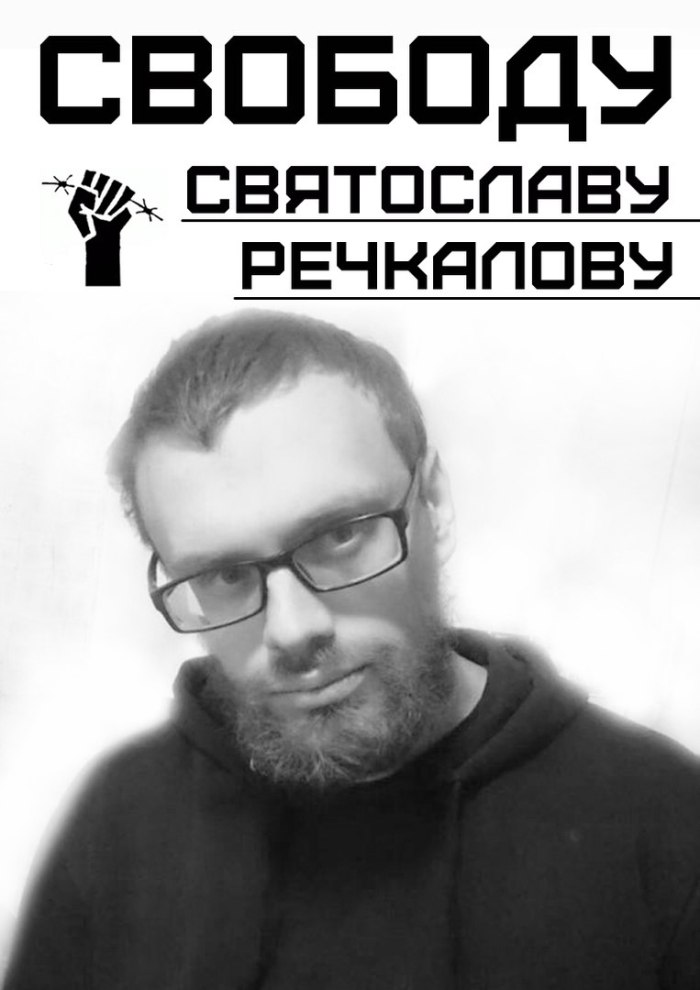
Tg4rFSHWUeY“Free Svyatoslav Rechkalov.” Photo courtesy of the VK page Popular Self-Defense
Anarchist Rechkalov Detained in Investigation of Attack on United Russia Campaign HQ, Tortured
Grani.ru
March 15, 2018

Anarchist Svyatoslav Rechkalov, detained yesterday as part of an investigation of the attack on the United Russia party campaign headquarters in the Moscow district of Khovrino, has been remanded in custody to the Temporary Detention Center, as reported in the early hours of Thursday by OVD Info, who cited Yevgenia, a friend of Rechkalov’s who was detained at Rechkalov’s flat along with him and another person whose name has not been ascertained. It cannot be ruled out the person in question was an anarchist named Andrei, who as of Wednesday evening had also not been released from police custody.

Rechkalov informed his comrades that,when he was in the Moscow police’s investigation department, police officers had tortured him, demanding he confess his involvement in the attack. They put a plastic bag over Rechkalov’s head and administered electrical shocks to his legs.

It has not been ascertained whether Rechkalov confessed or not. Yevgenia maintains he had nothing to do with the attack on the United Russia headquarters.

Yevgenia and the unidentifed third detainee were released last night, but on Thursday they were summoned to the investigative department for questioning as witnesses.

On Thursday morning, lawyer Mikhail Biryukov reported he was going to the investigative department to obtain permission to see Rechkalov.

Yesterday, we reported that Left Bloc activist Vladimir Zhuravlov and an anarchist named Artyom had been questioned as witnesses in the case. Both men said they had no information about the attack.

In addition, security services officers searched the Left Bloc’s headquarters, confiscating all the equipment they found there and cracking open a safe. The three activists present the headquarters—Vadim Timergalin, Grigory Sineglazov, and Denis Avdeyev—were detained and taken to a police precinct. They were later released without charge.

The Left Bloc’s VK page reports officers at the precinct had “conversations” with the activists during which they repeatedly threatened them, demanding they testify against their Left Bloc comrades.

It was also noted that, during the search, a lawyer [sic] received messages from unknown accounts, messages supposedly written by the activists. They informed him they did not need his help.

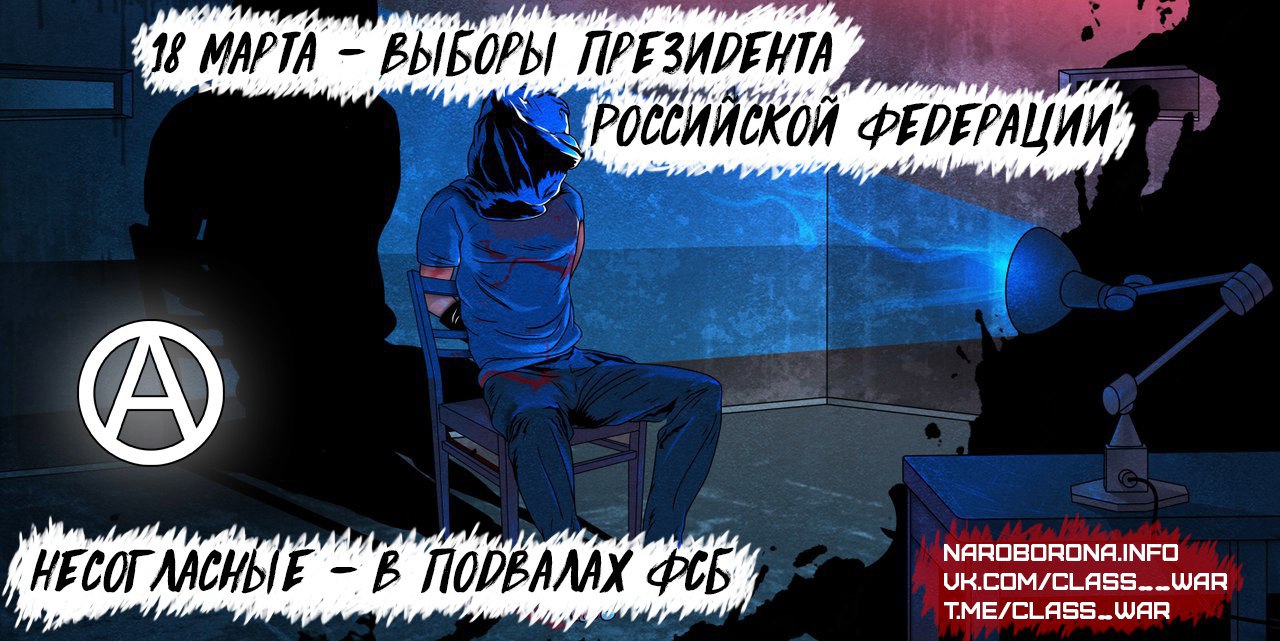
Left Bloc linked the search of their headquarters and the interrogation of Zhuravlov with the ongoing campaign to boycott the upcoming Russian predisdental election. In particular, they mentioned a protest opposite the Nikulin Circus on Tsvetnoy Boulevard during which a banner emblazoned with the slogan “March 18: Tricks and Clowns” had been unfurled.

We assume that, as the presidential election approaches, the police and FSB want to intimidate everyone who has been calling for a boycott. They are justifiably afraid a low voter turnout is a danger to the political farce wrongly called an “election.” All activists involved in the election boycott are now in danger. We concede the outrageous instances of coercion could continue. However, no crackdown can force us to abandon the fight. Boycott the election! We cannot be intimidated! We cannot be forbidden! 

—Excerpt from a pinned post on the Left Bloc’s VK page

“March 18: Russian presidential election. Dissenters in the cellars of the FSB.” Image from the VK page Popular Self-Defense

The attack on United Russia’s campaign headquarters in Khvorino occurred late on the evening of January 30. Three people, including a young woman, took part in the attack. The attackers broke a window in the office and tossed a lighted flare inside. One of attackers filmed the attack on video.

Antifascists Yelena Gorban and Alexei Kobaidze were detained in the case on February 13, charged with vandalism under Article 214 Part 1 of the Russian Federal Criminal Code. The crime entails a maximum punishment of three months in jail and, consequently, does not stipulate that people accused of the crime be remanded in police custody until a verdict has been reached, according to Article 108 Part 1 of the Russian Federal Criminal Procedural Code, which covers incarceration. Nevertheless, both Gorban and Kobaidze were sent to the Temporary Detention Center, as Rechkalov has been now.

However, forty-eight hours after they were apprehended, Gorban and Kobaidze were released on their own recognizance. Gorban had confessed her guilt, while it was reported Kobaidze had refused to testify, invoking his right not to incriminate himself under Article 51 of the Russian Constitution.

Thanks to Comrades AR and ZV for the heads-up. Translated by the Russian Reader

“FSB Officers Always Get Their Way!”

filinkova-torture

If you have been following the Penza-Petersburg “terrorism” case on this website, you should now make your way over to oDR (openDemocracy Russia), where coverage of the case continues with these frightening accounts by Viktor Filinkov and his wife Alexandra of Viktor’s abduction and torture by the Russian Federal Security Service (FSB), and Alexandra’s attempts to find out what happened to her husband, who had been scheduled to join her in Kyiv when he was disappeared by the FSB.

Meanwhile, as Mediazona correspondent Yegor Skovoroda writes, the FSB has, allegedly, tortured two anarchists in Chelyabinsk for the crime of protesting its barbaric actions in Penza and Petersburg.

Drawing by Alexandra Filinkova. Courtesy of oDR

Arrested Penza Antifascists Talk about Torture in Remand Prison

“He Would Check My Pulse by Touching My Neck and Monitor My Condition.” Arrested Penza Antifascists Talk about Electric Shock Torture in Remand Prison Basement
Anna Kozkina and Yegor Skovoroda
Mediazona
February 9, 2018


Dmitry Pchelintsev. Photo courtesy of his relatives and Mediazona

Ilya Shakursky and Dmitry Pchelintsev, arrested in Penza and charged with involvement in a “terrorist community,” have told their attorneys that Russian Federal Security Service (FSB) officers tortured them in the basement of the city’s remand prison. Mediazona has decided to publish the story told by Shakursky’s defense counsel and the transcript of what Pchelintsev relayed to his lawyer.

••••••••••

In October 2017, the FSB  detained four antifascists in Penza: Yegor Zorin, Ilya Shakursky, Vasily Kuksov, and Dmitry Pchelintsev. In early November, they detained Andrei Chernov in Penza, and Arman Sagynbayev, who was in Petersburg at the time. All six young men have been accused of involvement in a “terrorist community” (a criminal offense under Article 205.4 Part 2 of the Russian Federal Criminal Code). According to the FSB, the six had established an organization, known as The Network (Set’). They planned a series of bomb blasts during the presidential election, in March, and the World Cup, in June and July, that would “sway the popular masses in order to subsequently destabilize the political situation [in Russia]” and set off an armed insurrection.

The Network allegedly had cells functioning in Moscow, Petersburg, Penza, and Belarus [an independent country]. On January 23, 2018, antifascist Viktor Filinkov was detained in Petersburg, followed two days later by Igor Shishkin. Friends and family could not find either of them for over a day. A court had remanded both of them in custody as members of the alleged “terrorist community.”

In Penza, relatives of the detained activists told how law enforcement officers had planted weapons in the men’s cars and flats, and subjected them to torture by shocking them with electrical wires and hanging them upside down. According to friends and loved ones, all the detained men had been airsoft enthusiasts.

“All they ever did was learn how to render first aid in field conditions and survive in the woods. Is that illegal?” Angelina Pchelintseva, Dmitry Pchelintsev’s wife, asked OVD Info.

Initially, all the men in custody, except Kuksov, who invoked his right not to incriminate himself, as stipulated by Article 51 of the Russian Constitution, confessed to their alleged crimes.

After he was detained, Viktor Filinkov said that siloviki had tortured him with an electric shocker and forced him to memorize the wording of his testimony in order to repeat it later to investigators. Ilya Kapustin, interrogated as a witness in the case, also spoke of torture. FSB officers had shocked him with an electric shocker and threatened to break his legs and abandon him in the woods.

Igor Shishkin has not said anything about torture. The case file contains a letter written by Shishkin after he was detained. It is addressed to Alexander Rodionov, head of the FSB’s Petersburg Office. In the letter, Shishkin explains he received all his injuries while playing sports. Doctors confirmed Shishkin suffered a fracture to the lower wall of one eye socket, as well as numerous bruises and abrasions. Members of the Public Monitoring Commission on Conditions in Places of Imprisonment who visited Shishkin in a remand prison made note of numerous traces on his body of what looked like burns from electrical wires. Recently, Shishkin sent a petition to the authorities asking to cooperate with the investigation and requesting a pretrial agreement.

A Letter by Igor Shishkin from the Remand Prison
Greetings to friends, relatives, acquaintances, and sympathizers! In my stupidity, I got caught up in a very serious and unpleasant situation. I’ll skip the details. I just want to advise everyone to think a hundred times about what you are doing and how the consequences do not affect just you. I also want to send my sincerest apologies to the people whom my problem has affected. Sorry, guys! […] I really ask everyone not to generate a media buzz. We don’t need that right now.

“He Said, ‘I Couldn’t Take It. I Broke Down.'”
Attorney Anatoly Vahterov, Ilya Shakursky’s defense counsel, has written the following. Mr. Vahterov visited Mr. Shakursky in Penza Remand Prison No. 1 on February 7, 2018.

It follows from my client’s statement that he was one of six people simultaneously detained on suspicion of violating Article 205.4 of the Russian Federal Criminal Code. The article refers literally to “organization of a terrorist community.” During my conversation with my client, I did not have the slightest doubt he had not been involved in these actions.

I said to him, “I know that you signed a confession. How could that be?” 

He wrote a note to me, “I was beaten.”

Later, he gave me a more detailed account of how he had been tortured in the remand prison.

He said the plan was to implicate them in the Maltsev case. He said this. I was surprised. What was the connection? In my view, this case was fabricated on formal grounds. They grabbed one comrade by the name of Zorin. He was the weakest of them and testified against all his friends. Moreover, his testimony is absolutely far-fetched. It was grounds for detaining the other guys on suspicion of having committed the particular crime.

This is where it gets interesting. According to my client, all of them were tortured in the basement of the remand prison. The torture was sophisticated. Officers in masks and camouflage uniforms would enter their cells. They took them to a room in the basement, forced them to strip, attached electrodes to their fingertips, and cranked up a so-called dynamo. 

He just said, “I couldn’t take it. I broke down.”

9df5e576b811a2658cced24c766cda70Ilya Shakursky. Photo from personal archive and courtesy of Mediazona
Torture was also used against Pchelintsev, according to my client. They talk to each other in the remand prison. Sagynbayev has also been tortured. This is savagery, you realize? As if the year now were 1937.

There can be no question of any terrorist activity whatsoever. I would venture to say that during the preliminary investigation and trial we will try and prove it. The guys only played role-playing games. They were into airsoft and running round the woods. Yes, the guys gave each other nicknames. It was just easier for them to address each other that way. None of this is anything other than child’s play. Yes, there were nicknames, yes, there were assigned roles. Why not? We played war when we were kids. We also pretended to be medics, sappers, and snipers. Each had a role to play. There were role-playing games and nothing more.

The had their own group and their own music. They were involved in the antifascist movement and environmentalism. The authorities have been trying to accuse them of espousing anarchism, but the thing is that my client and the other comrades are antifascists. A person who opposes Nazism cannot preach Nazi ideas and chauvinism, engage in any kind of propaganda, and advocate overthrowing the social order.

Ilya Shakursky is a totally sensible, regular guy. I would say he is the salt of the Russian earth. He’s a normal, genuine, good Russian lad, raised in our society’s best traditions. He is not a criminal, that is for sure. But when he speaks, you can see the pain and resentment on his face. It happens. But he is hanging in there and hoping for a good defense. His mother was immediately fired from her job when the first articles about Pchelintsev and so on were published.

In order to be involved in a group, especially a terrorist group, a strict conspiracy, as my client has been accused of, there must be exclusively friendly relations, based on mutual respect, decency, and the knowledge that your comrade will not turn you over to the relevant authorities. But Shakursky and Pchelintsev had a falling-out over a young woman. They had fought with each other, and one even spit in the other’s eye.When there were conflicts like this, what kind of tightly knit team can we speak of?

In order to justify what I regard as groundless detentions, criminal charges, and remands in police custody, the men were accused of committing another crime, possession of weapons and explosives, Article 222 in the Criminal Code. Law enforcement planted two grenades and a pistol under the back seat of Shakursky’s car. If he and his friends were such conspirators, he would not have done something as amateurish as leaving two grenades in his car.  

Ilya Shakursky’s letter to his girlfriend 

Ilya Shakursky’s Letter to His Girlfriend
Today is exactly three months since I’ve been in the remand prison. If I were on the outside I would definitely go to the event commemorating two great heroes, Nastya Baburova and Stas Markelov.

We now find ourselves in circumstances in which we miss these people like never before. They fought injustice and helped people who were in very difficult situations in life. I sincerely hope that with the help of friends, loved ones, and concerned citizens we can get out of this pickle, which is one enormous misunderstanding and injustice.

Goodness will triumph!

January 19, 2018

All my acquaintances and friends should see this text.

“My Mouth Was Full of Blood, and One of the Torturers Stuck My Sock in It”
On February 6, 2018, attorney Oleg Zaitsev visited Dmitry Pchelintsev and interviewed him. Like most of the defense attorneys in the case, the investigator made Zaitsev sign a non-disclosure agreement concerning evidence in the preliminary investigation. Zaitsev notes that, under the circumstances, he has not violated investigatory privileges, but nevertheless he felt obliged to discuss all the violations of rights his client has suffered. What follows is a transcript of his interview with Pchelintsev.

I can say the following. On October 27, 2017, I left the house at around six o’clock in the morning to meet my grandmother. Near the end wall of the building, as I was nearing my car, four men in plain clothes suddenly approached me. I was so surprised I put my hands up in front of me. These men immediately beat me up and threw me on the ground. Their faces were not covered. I could identify them. Later, some of them escorted me from the remand prison to the FSB office. One of them looked to be thirty-five years old. He had light-brown hair, was wearing a gray jacket, and had a stout face and thickset build. They asked me my surname and struck various parts of my body. They reproached me for having putting up my dukes when I was being detained by the FSB. They confiscated the keys to my flat and used them to enter the place when my girlfriend was sleeping and search the place.

On October 28, 2017, after the court had remanded me in custody to the remand prison on Karakozov Street, I was in solidarity confinement cell 5-1. It was around four o’clock in the afternoon when a special forces policeman, the senior shift officer, and a major from the local office of the Russian Federal Penitentiary Service entered my cell. They told me to exit the cell and go to the nearby punishment cell, which I did. Six or seven men immediately entered the cell. Half of them were in MultiCam camouflage uniforms, while the other half were in plain clothes. But all of them wore balaclavas. Despite the headgear concealing their faces, I could identify some of these people by their voices, physique, and clothes. Subsequently, I recognized some of them when I was being transported and escorted.

They told me what to do, and I followed their orders. I stripped to my shorts, sat down on a bench, stretched my arms backwards, and put my head down. At first, I thought this was some examination everyone sent to the remand prison had to undergo, so I voluntarily submitted to it. Then they taped my hands behind me, tied one of my legs to the foot of the bench with more tape, and stuck a wad of gauze in my mouth.

One of the men was wearing white rubber medical gloves. He took out a dynamo and set it on a table. He stripped two wires with a boxcutter and told me to stick out my big toe. Another man checked my pulse by touching my neck. He would subsequently do this more than once: he was monitoring my condition. He was surprised my pulse was normal and I was not agitated. That was because I did not realize at first what was happening.

Then the man in gloves cranked the dynamo. The current flowed to my knees. My calf muscles contracted, and I was seized by paralytic pain. I screamed. My back and head convulsed against the wall. They put a jacket between my naked body and the stone wall. This went on for about ten seconds, but when it was happening, it felt like an eternity to me.

One of them spoke to me.

“I don’t know the word ‘no.’ I don’t remember it. You should forget it. You got me?” he said literally.

“Yes,” I replied.

“That’s the right answer. Attaboy, Dimochka,” he said.

The gauze was stuck in my mouth again, and I was shocked four times, three seconds each time. […] Then I was tossed onto the floor. Since one of my legs was tied to the foot of the bench, when I fell, I seriously banged up my knees, which bled profusely. My shorts were pulled off. I was lying on my stomach. They tried to attach the wires to my genitals. I screamed and asked them to stop brutalizing me.

“You’re the leader,” they repeated.

“Yes, I’m the leader,” I said to make them stop torturing me.

“You planned terrorist attacks.”

“Yes, we planned terrorist attacks,” I would reply.

One of the men who measured my pulse put his balaclava on me so I would not see them. At one point, I lost consciousness for awhile. […] After they left, a Federal Penitentiary Service officer entered the room and told me to get dressed. He took me back to my solitary confinement cell.

The next day, October 20, 2018, I broke the tank on the toilet and used the shards to slash my arms at the wrists and elbows, and my neck in order to stop the torture. There was a lot of blood from the cuts on my clothes and the floor, and I collapsed onto the floor. They probably saw what I did via the CCTV camera installed in the cell. Prison staffers entered my cell and gave me first aid. Then the prison’s psychologist, Vera Vladimirovna, paid me a visit.

As regards the video cameras installed in my cell, as well as in the punishment cell and the corridor, I can say that when FSB officers show up, the cameras either are turned off or the recording is later erased, or something is done with the sensors. The FSB officers completely control the local Federal Penitentiary Service officers.

On November 8, 2017, at around five o’clock in the afternoon, the senior shift officer was getting ready to leave.

“Will everything be alright with me?” I asked him.

“Don’t worry, I’ll be right back,” he replied.

I had connected his departure with the fact that the last time he left, the day before, Saginbayev’s scream was audible on the floor. I realized he was being tortured. Later, our paths crossed, and he apologized for testifying against me.

A lieutenant from the Federal Penitentiary Service then came to my door.

“Am I safe here?” I wrote on a piece of paper that I showed to him.

“Yes,” he replied in big letters.

After that I showed him the enormous bruise on my chest and stomach to let him know I had been tortured. After awhile he opened the cell door, and four men wearing prisoner’s uniforms dashed into the cell. Civilian clothes were visible under these uniforms, all of which were baggy. They were all wearing what looked like Buff masks, black tube scarves.

They beat and kicked me in the stomach, kidneys, and head. I had bruises from their blows, but they hit me like in a gym, so they would leave fewer visible traces. They informed me they were from the “underworld committee”: because of me they had been put on lockdown. They gave me a week to solve my problems with the “pigs.” If I didn’t solve them, they would punk me. One of them filmed the whole thing on a smartphone. The Federal Penitentiary Service officer was outside in the hallway the entire time. The four FSB guys from the “underworld committee” left. Later, I also recognized some of them when I was being escorted and transported.

Then the senior shift officer, a captain, returned.

“How can I believe you when FSB guys just came into my cell and beat me up?” I asked him.

He looked puzzled.

Afterwards, FSB agents have visited me many times in the remand prison. They wear no masks and chat with me in the visiting room. When they talk with me, they exert psychological pressure on me. They threaten, blackmail, and manipulate me. 

During an interrogation, the investigator told me it was he who gave the agents permission to visit me. They took their orders from him and they had their own work.

After I tried to commit suicide by slashing my veins open, I was put under special watch in the remand prison. The cuffs are not removed from my hands even when I am signing interrogation reports.

I want to add that, when I was tortured with electrical shocks, my mouth was full of “crushed teeth” due to the fact I gritted my teeth since the pain was strong, and I tore the frenulum of my tongue. My mouth was full of blood, and at some point one of my torturers stuck my sock in my mouth. 

I was beaten so badly I had open wounds on my head.

••••••••••

According to Republic, which has seen the case file, the FSB has named Pchelintsev the organizer of The Network terrorist group. He met his accomplices at concerts and allegedly founded the organization in 2014. According to the FSB, since 2015, every member of The Network has had his own role. Investigators believe Pchelintsev is The Network’s leader and ideologue. He has a deputy, nicknamed Redhead, who recruits new members.

The case files indicate that, in the summer of 2016, several cells joined The Network. The Penza cell was dubbed 5.11 (November Fifth) or Sunrise; the Moscow cell, MSK (Moscow Standard Time); and the two Petersburg cells, Field of Mars and Jordan. In addition, investigators believe The Network has a branch in Belarus, and that the cells were managed out of Penza. The FSB refers to all the detainees as anarchists.

Translated by the Russian Reader. Thanks to NV and PK for the heads-up

Solidarity with Persecuted Russian Antifascists and Anarchists in NYC and Minneapolis

27540850_322877634890103_3528138355329883641_n

Metropolitan Anarchist Coordinating Council – MACC
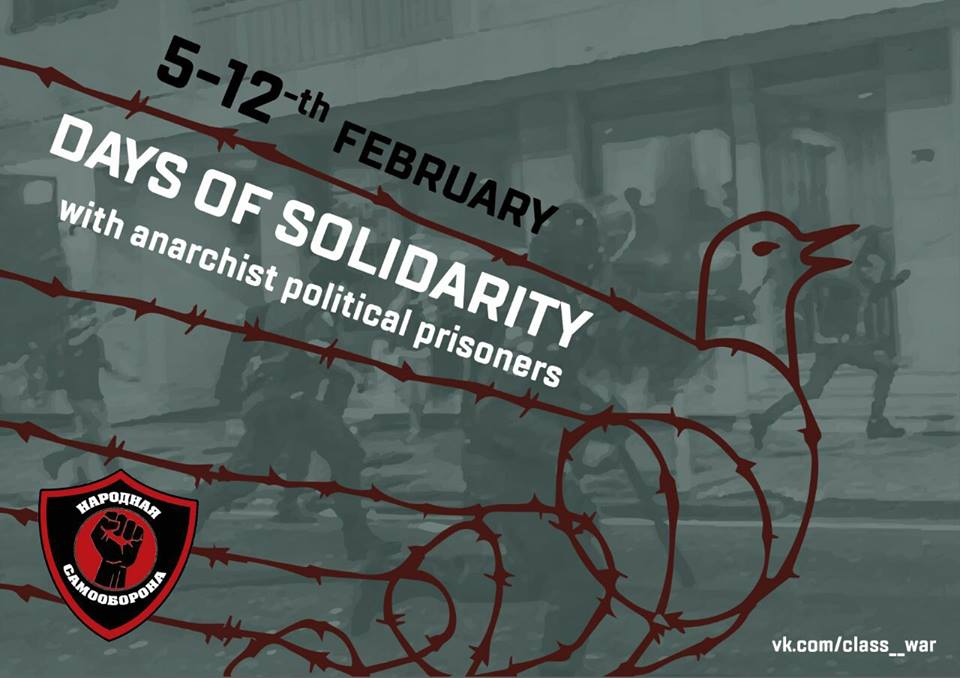
As part of the week of solidarity with Russian anarchist political prisoners there will be a demo at the Russian Consulate, 91st Street, today, February 7, 2:30 PM–4:00 PM.

#Antifa #Antifascism

More information on the recent arrest and torture of anarchist and antifascist political prisoners here:

https://freedomnews.org.uk/russia-arrests-and-torture-of-anarchists-and-antifascists/

•••••••••••

Solidarity with Russian Anarchists
The Base
1302 Myrtle Avenue, Brooklyn, New York 11221
7 PM–10 PM, February 8, 2018

Six anarchists have been arrested in Penza, Saint Petersburg, and Crimea, from October 2017 to February 2018, by officers of the Russian Federal Security Service (FSB) on charges of involvement in a terrorist group. During this period, there have been raids on the homes of anarchists and antifascist all over Russia. The arrested anarchists have been tortured into falsely confessing their involvement in the imaginary network. This is clearly a state-fabricated conspiracy being used to eradicate the anarchist movement.

As the support team says, “These repressions can only intimidate people and crush the anarchist movement. In this case it’s necessary to show that we are not afraid and we can’t be destroyed by their force. Otherwise, the repressions will be used every time when the anarchist movement attracts the notice of the FSB. We must show them that the stronger their crackdowns are, the more furious our resistance is.”

We are hosting a movie and information session about the broader anarchist and antifascist movement in Russia, and talking in more detail about this particular case.

About the movie
Antifascist Attitude is the first-ever documentary film on the emerging Russian antifascist movement made by activists themselves. The movie features moderate NGO activists and radical grassroots activists and anarchists from three cities: Moscow, St. Petersburg, and Irkutsk. It also features the antifascist lawyer Stanislav Markelov, murdered by neo-Nazis in Moscow on January 19, 2009.

Come and learn about what’s happening and ways to support our comrades in Russia!

•••••••••••

Solidarity Dinner with Russian Antifascists
Twin Cities IWW General Defense Committee Local 14
5:30–8:00 p.m., Saturday, February 17, 2018
2101 Hennepin Ave, Minneapolis, MN, United States

Join the General Defense Committee for a dinner, discussion, and letter writing to support antifascists targeted by the FSB crackdowns in Penza and St Petersburg.

The far right rises in the US, in Russia, and across the world, attacking oppressed peoples, immigrants, and working class revolutionaries. Antifascists are fighting against nationalist hate across borders, and facing attacks from the ruling class’s governments. In Russia, the FSB (Federal Security Service) are hard at work arresting, torturing, and framing antifascist activists in Penza, St. Petersburg, and elsewhere.

The Anarchist Black Cross in Moscow and St. Petersburg has asked for international solidarity with the Russian anarchists facing repression. We will be holding a dinner in the IWW offices at 2101 Hennepin Avenue South, Suite 101, Minneapolis, on Saturday, February 17, 2018, from 5:30 p.m. to 8:00 p.m.

We’ll discuss the situation in Russia as well as the repression faced by anarchists in Belarus, Ukraine, and other countries. We’ll collect donations, provide a space for letter writing to the defendants, and facilitate discussion on further international solidarity work with political prisoners, labor organizers, and anti-authoritarians.

https://libcom.org/news/support-anarchist-antifa-prisoners-stpetersburg-penza-31012018

https://itsgoingdown.org/call-international-days-solidarity-russian-anarchist-political-prisoners-feb-5th-12th-2018/

https://avtonom.org/en/news/how-stability-has-really-been-achieved-russia