Russia Is Not a Land of Opportunity for Central Asians

Tajikistan has condemned what it called an “ethnic hatred” attack in Russia after a 10-year-old boy from a Tajik family was stabbed to death at a school near Moscow, in a rare public rebuke aimed at a key partner for labor migration and security ties. The killing happened on December 16 in the village of Gorki-2 in the Odintsovo district of the Moscow region, according to Russia’s Investigative Committee, which said a minor attacked people at an educational institution, killing one child and injuring a school security guard.

A video of the attack circulated on Russian social media after the incident. According to reporting by Asia-Plus, footage published by the Telegram channel Mash shows the teenage assailant approaching a group of students while holding a knife and asking them about their nationality. The video then shows a school security guard attempting to intervene before the attacker sprays him with pepper spray and stabs him. The assailant subsequently turns the knife on the children, fatally wounding the 10-year-old boy.

statement released by Tajikistan’s interior ministry said it feared the case could “serve as a pretext for incitement and provocation by certain radical nationalist groups to commit similar crimes.” Tajikistan’s response also drew attention after the foreign ministry said the attack was “motivated by ethnic hatred.” Dushanbe subsequently summoned the Russian ambassador to protest the attack, handing him a missive “demanding that Russia conduct an immediate, objective, and impartial investigation into this tragic incident.”

The condemnation is particularly notable as Tajikistan rarely issues public criticism of Russia, which remains its main destination for migrant labor and a key security partner.

According to Russian media, the attacker, who has admitted their guilt, subscribed to neo-Nazi channels and had sent his classmates a racist manifesto entitled “My Rage,” in which he expressed hostility toward Jews, Muslims, anti-fascists, and liberals, a few days before the incident.

Tajik migrants form one of the largest foreign labor communities in Russia and across Central Asia. Millions of Tajik citizens work abroad each year, most of them in Russia, sending remittances that are a critical source of income for families at home. According to the World Bank, remittances account for roughly half of Tajikistan’s gross domestic product in some years, making labor migration a cornerstone of the country’s economy. Many Tajik migrants work in construction, services, and transport, often in precarious conditions and with limited legal protections. The killing comes as Central Asian migrants in Russia face growing pressure to enlist in the war in Ukraine, with coercion through detention, deportation threats, and promises of legal status having been reported.

The killing has also renewed scrutiny of rising xenophobia in Russia, particularly toward migrants from Central Asia. The Times of Central Asia has previously reported an increase in hate speech, harassment, and violent attacks targeting migrants, especially following major security incidents. Human Rights Watch has warned that Central Asian migrants in Russia face growing discrimination, arbitrary police checks, and racially motivated abuse, trends that have intensified in recent years amid heightened nationalist rhetoric.

Source: Stephen M. Bland, “Tajikistan Condemns Fatal Stabbing of Boy in Russia Citing Ethnic Hatred,” Times of Central Asia, 17 December 2025


It’s curious. I looked through some of the [social media] pages of Russia’s [most prominent] political émigrés—[Ilya] Yashin, [Vladimir] Kara-Murza, [Ekaterina] Schulmann, [Leonid] Volkov, [Elena] Lukyanova, [Dmitry] Bykov, [Marat] Gelman, [Boris] Zimin, [Boris] Akunin—but I couldn’t find a word about the violent death of a Tajik boy in a school near Moscow. They have expressed no sympathy, voiced no criticism of racism and xenophobia. It seemingly should be their direct obligation to speak out on this issue. But for some reason, mum’s the word. I also looked at the Telegram channels of the leading official anthropologists, and there is a mysterious muteness among them too. Surely it is their professional duty not to remain silent on such a matter. They even published a book called Tajiks and themselves speak everywhere of interethnic harmony. But in this case, it’s as if they’ve dummied up.

Source: S.A. (Facebook), 18 December 2025. Translated by the Russian Reader


As FB is reminding, there were times I believed I could protect my non-Slavic looking friends, lovers, relatives, foreign students and migrant workers from the nazis marching in the streets, from the nazis working as policemen, from the general xenophobia and unsensibility by magic tricks of art.

Source: Olga Jitlina (Facebook), 18 December 2025
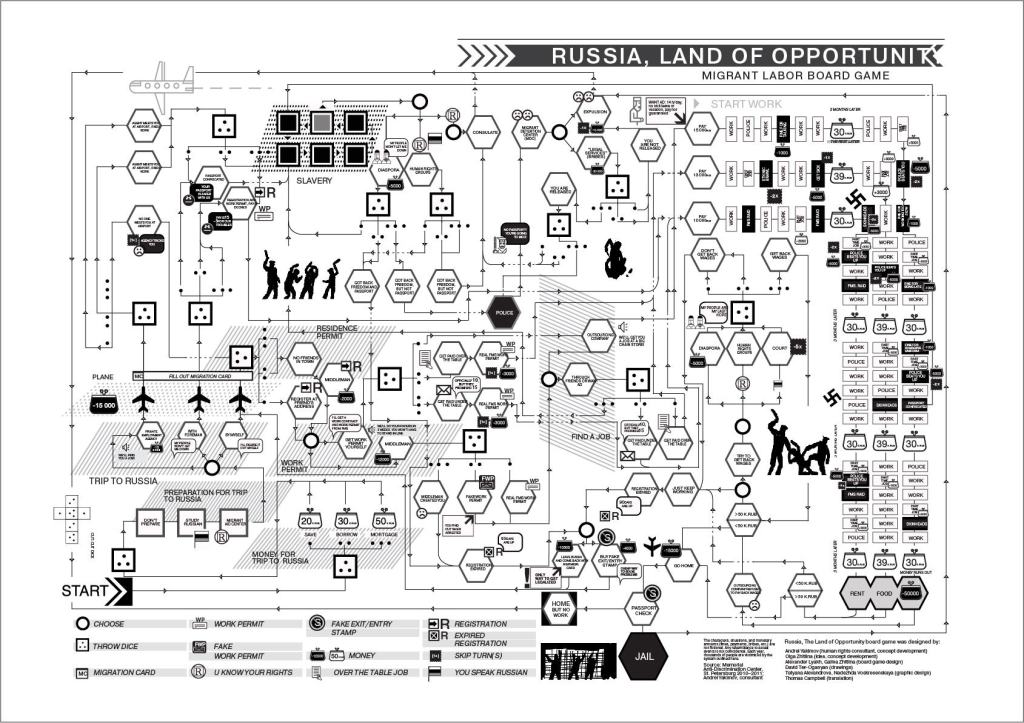

Thomas Campbell just translated our migrant labor board game Russia – The Land of Opportunity!!!

Russia – The Land of Opportunity board game is a means of talking about the possible ways that the destinies of the millions of immigrants who come annually to the Russian Federation from the former Soviet Central Asian republics to earn money play out.

Our goal is to give players the chance to live in the shoes of a foreign worker, to feel all the risks and opportunities, to understand the play between luck and personal responsibility, and thus answer the accusatory questions often addressed to immigrants – for example, “Why do they work illegally? Why do they agree to such conditions?”

On the other hand, only by describing the labyrinth of rules, deceptions, bureaucratic obstacles and traps that constitute immigration in today’s Russia can we get an overall picture of how one can operate within this scheme and what in it needs to be changed. We would like most of all for this game to become a historical document.

Source: Olga Jitlina (Facebook), 17 December 2011


Life for migrant workers is Russia is becoming increasingly difficult after stringent new controls introduced over the past year. These include a registry of “illegal” migrants, restrictions on enrolling migrant children in schools, new police powers to deport people without a court order, and a compulsory app for all new migrants in Moscow and the surrounding region to track their movements.

Working in Russia was already less appealing because of the war in Ukraine and the weakening rouble. Now, with these new restrictions, a growing number of young people from Central Asia are starting to look elsewhere — including to countries in Europe — in search of better opportunities.

Dreaming of Europe in Moscow

Like 89% of young Kyrgyzstanis, 25-year-old Bilal* had always dreamed of working abroad.

Young people in Kyrgyzstan grow up in an environment where leaving the country to find work is common, widespread, economically essential, and socially accepted — and where the domestic economy still cannot offer comparable opportunities.

The average monthly salary in the country is about 42,000 soms (around $480), while in Russia, for example, wages in manufacturing can reach 150,000 rubles (nearly $2,000). Unlike most of his peers, Bilal never planned to work in Russia. “Because many of our people face racism there,” he explains.

Europe was his dream, but without connections getting a job offer from an EU employer seemed nearly impossible. So Bilal turned to “intermediaries” — fellow Kyrgyzstanis who had established ties with European companies that were constantly seeking workers. They advised him to travel to St. Petersburg, where, they said, it would be easier to prepare the paperwork and apply for a visa.

But it was the height of the COVID-19 pandemic. Many Schengen countries had stopped issuing visas and temporarily shuttered their consulates. Bilal didn’t want to return home empty-handed, so he decided to stay in Russia — “not by choice,” as he puts it.

“At first I worked illegally at a ski resort. Mostly we chopped firewood and cleared snow around the cabins. They paid us in cash,” he says.

Two months later, Bilal moved to Moscow and obtained a patent — the work permit that allows citizens of visa-free countries to be legally employed in Russia. He found a job as a courier for Yandex.

Bilal speaks excellent Russian — something he says explains why, unlike many of his friends, he didn’t encounter xenophobia all that often. But conflicts still happened. “You’d run into people who’d say, ‘Migrants, coming here in droves…’ Especially when a customer had put down the wrong address and the delivery got messed up — somehow it was always the migrant’s fault.”

Bilal left Russia two months before the full-scale invasion of Ukraine. “Back then it wasn’t like it is now,” he recalls. “Yes, the police would stop you on the street, but they’d take some money and let you go. Now my friends talk about Amina (a Russian mobile app for monitoring migrants), about police rounding people up, and about being sent to the war.”

He decided to set his sights on Europe instead.

Watched and bullied

In Russia, the path to legal employment for migrant workers runs through a processing centre known as Sakharovo — located about 60 kilometres from Moscow and notorious for its massive queues, where people often wait for hours. The perimeter is guarded by armed security forces, and inside migrants undergo procedures such as blood and urine tests to screen for “socially significant diseases”. Those who manage to obtain their documents can work legally, but that doesn’t protect them from future problems.

Russians often refuse to rent apartments to migrants. Schools and kindergartens decline to accept migrant children, citing “lack of space,” while the adults themselves face workplace “raids” or frequent “document checks” on the street or on public transport. Even Russia’s war in Ukraine has become a tool for pressuring them: many migrants are pushed to join the military in exchange for various “bonuses,” such as fast-tracked citizenship.

After the attack on Crocus City Hall — which authorities say was carried out by four Tajik citizens —the security services launched large-scale raids. Tajikistan’s government, fearing a surge in xenophobic incidents, even advised its citizens not to leave their homes.

Lawmakers soon joined in. Over the past year, they have restricted the ability to obtain residency through marriage, granted the Interior Ministry the power to deport migrants without a court ruling, required migrant children to pass a Russian-language exam before being admitted to school, and created the Registry of Monitored Persons — a database of foreign nationals who supposedly lack legal grounds to stay in Russia. There are already known cases of people being added to the list by mistake, and effectively losing the right to move freely around the country after their bank accounts were frozen, and their driving permits revoked.

Officials have justified all these measures as necessary to fight illegal migration and prevent crime. In July, the Interior Ministry reported a rise in crimes committed by migrants, but migrants still make up only a small fraction of overall crime statistics. A study by the “To Be Exact” project found that adult Russian men are statistically more likely to commit crimes than migrant workers.

On September 1, a new pilot project went into effect: migrants from Uzbekistan, Tajikistan, Kyrgyzstan, Armenia, Kazakhstan, Georgia, Azerbaijan, Moldova, and Ukraine who are living in Moscow or the Moscow region must install a mobile app called “Amina.” Authorities openly acknowledge that the app’s main purpose is to continuously track users’ locations.

The app that doesn’t work

If a phone fails to transmit location data to Amina for more than three working days, the participant is automatically removed from the system. If the migrant cannot fix the issue quickly, they risk being added to the “monitored persons” registry — which can lead to frozen bank accounts, job loss, or even expulsion from university.

Imran, a 27-year-old Tajik citizen, is worried: “Location services on my phone are on, and Amina shows that everything is being transmitted, but several times a day I get notifications saying the app isn’t receiving my location. The app works terribly. And I have no idea what consequences this could have for me.”

Users report constant problems with Amina. Some can’t get past the first screen; others say the app won’t accept their photo; still others receive alerts that their data failed verification. But the most common issues are related to location tracking.

In comments on RuStore (Russia’s internal apps store), representatives of the developer respond that “specialists are constantly working to improve the app’s stability” and advise users to contact technical support. But migrants complain about waiting on the line for hours.

Anton Ignatov, the director of the Sakharovo centre, claims the programme will improve public safety and help “prevent violations by unscrupulous individuals”. He cites situations in which migrants buy a work patent — a permit to work — for a short period and then disappear “into the shadows,” “vanishing somewhere in the industrial zones of Moscow and the region”.

Such cases do happen, and the most obvious reason is money. Since January 1, the monthly payment for a work patent in Moscow and the Moscow region has been 8,900 roubles (about $115). For many migrants working in low-paid jobs — for example, in construction or warehouse work — this is a significant share of their income, pushing some into the informal economy.

Another factor is wage delays in the sectors where migrants from Central Asian countries most often work. Mukhammadjon from Uzbekistan, works on a construction site outside Moscow, hasn’t been paid in two and a half months. A month ago, he stopped paying for his patent — simply because he had no money left. He sees no tools to defend himself.

Employers, meanwhile, benefit from hiring such vulnerable workers: they can avoid paying social contributions, hand out wages in cash, and rely on employees who are willing to work overtime for low pay.

Getting a job is becoming harder

Kudaibergen, 32, from Kyrgyzstan, worked at a warehouse on the outskirts of Moscow — “to support my family”, he says. His employer provided hostel-style housing for migrant warehouse workers.

“OMON came to our building. They treated us like they were arresting dangerous terrorists. They showed up with batons and tasers, as if storming the place. They drove us all outside. We stood by the door with our hands behind our backs for about two hours while they checked everyone’s documents,” he recalls. “Some guys didn’t understand Russian well — it was very hard for them. If they didn’t understand something, they were beaten. […] Thank God, my documents were in order.”

Russian authorities typically insist that such inspections are carried out strictly within the law and that no unlawful actions are taken against migrants. As evidence, the Interior Ministry points out that migrants rarely file complaints with the police afterward.

As the new year approached — 2025 — the checks intensified, Kudaibergen says. Because of all the new rules and the overall treatment of migrants, he realized that working in Russia had become too difficult, so he returned home.

“But I still have to provide for my family,” he adds. “I’m thinking about Europe now. I ask friends and acquaintances how to leave. But I don’t know if it will work out. They say getting a visa is very hard.”

Gulnura, 35, a mother of three, had lived in Russia with her husband for more than ten years. In the spring of 2025, she flew with her children to her native Kyrgyzstan for a short break. Only after arriving did she learn about the new requirement obliging migrant children to pass a Russian-language exam in order to enroll in school. Her children speak Russian fluently, yet even before the rule change they hadn’t been admitted — schools said there were “no available places”.

“We originally planned to return to Moscow. But my friends who are still there complain that they can’t get their kids into school,” Gulnura says. “One friend has been collecting documents since April, but the school won’t accept them. Another managed to get her child to the test, but after the exam they sent a rejection: ‘Your child doesn’t know Russian well enough.’ Her daughter was born and raised in Moscow, speaks Russian fluently, went to kindergarten and prep classes, reads and writes.”

“Requiring language proficiency provides a pretext for an already widespread practice of arbitrarily refusing to admit migrant children to schools across Russia,” says Sainat Sultanaliyeva of Human Rights Watch. “By depriving migrant children of access to education, Russian authorities are effectively taking away the life opportunities schooling provides. Banning them from school undermines long-term social integration, increases the risk of harmful child labour, and heightens the danger of early marriage.”

Gulnura decided not to return to Russia with her children. “My husband is still in Moscow for now. He’ll come when everything is ready here, when he has work. But we — me and the kids — we’ve come back for good. It’s become impossible to live there.”

A chance to get into Europe

Despite numerous accounts of migrants becoming disillusioned with Russia, it’s impossible to say definitively whether labour migration has decreased in recent years: the available statistics are fragmented, and data from different government agencies often contradict one another.

The picture is further complicated by the Interior Ministry’s decision to stop publishing key data, as well as several changes to the methodology of migration accounting, which make year-to-year comparisons unreliable.

In 2024, researchers at the Higher School of Economics concluded that labour migration to Russia had fallen to its lowest level in a decade.

Since then, the number of entries into the country has grown, but the average annual presence of legal labour migrants has remained stable at around 3–3.5 million — noticeably lower than in previous years.

Rossiyskaya Gazeta writes that foreign workers are less willing to come to Russia for two reasons: tougher migration policies and declining incomes. With the rouble’s depreciation, earnings in dollar terms have fallen by roughly a third.

Yet Russia still remains the most popular destination for labour migrants from nearly all Central Asian countries.

In second place for migrants from Uzbekistan, Tajikistan, and Kyrgyzstan is Kazakhstan, where most work in construction, wholesale and retail trade, and various service industries.

Third is Turkey, where Central Asian migrants are employed in manufacturing — especially textiles and clothing — as well as construction, hospitality, and seasonal agriculture.

South Korea recruits migrant labor for factories, agriculture, construction, and the fishing and seafood-processing industries.

But for many — like Bilal, who left Russia behind — the dream is still to secure a job offer in Europe. In the end, he managed to do so through the same intermediaries he had relied on earlier, paying them $2,000, he says. They helped arrange an invitation from a logistics company.

“If you don’t have work experience in Europe, it’s hard at first to get a job with a good trucking company. There are bad employers who take advantage of newcomers not knowing their rights. They might underpay you or force you to work overtime. At the same time, the police keep a very close eye on work-and-rest rules and can fine you, so nobody wants to break the law. By law, if your driving time is up, you have to stop and rest,” Bilal says, recalling his first job at a Slovak company.

After gaining some experience, he moved to another company, where he now earns around €2,500 a month.

According to the International Road Transport Union (IRU), more than half of European transport companies cannot expand their business because of a shortage of qualified drivers. Across the EU, Norway, and the UK, more than 233,000 truck drivers are currently required. The crisis is deepened by the fact that the profession is aging rapidly, and young people are not drawn to it, despite decent pay.

Ukrainian citizens once made up a significant share of long-haul drivers in the EU, but because of the war many had to return home for military service. In addition, some European employers terminated contracts with Russian and Belarusian citizens (or their visas weren’t renewed), forcing them to return home as well.

In Slovakia, where Bilal is officially employed, the shortage reached 12,000 drivers last year. As a result, the country simplified visa procedures for several nations — including Kyrgyzstan, Tajikistan, Kazakhstan, Turkmenistan, and Ukraine — for applicants willing to work in freight transport.

Poland actively issues work permits to citizens of Uzbekistan and Kazakhstan; the Czech Republic attracts workers from Uzbekistan and Kyrgyzstan by fast-tracking work visas; Lithuania also issues visas to those seeking jobs as drivers.

In 2023, the number of first-time work permits issued in the EU to citizens of Kazakhstan, Uzbekistan, Kyrgyzstan, and Tajikistan rose by 30%, 39%, 50%, and 63% respectively compared to the previous year.

But Bilal believes that even with the current labour shortages, getting into Europe from Central Asia is still far from easy. “If you don’t have people here who can recommend you to a company, it’s a difficult process for ordinary working people,” he says.

All the more so because public frustration over migration has been growing across Europe in recent years, pushing some governments to tighten rules for third-country nationals — even in sectors suffering from labour shortages.

Bilal likes living in Europe. He’s satisfied with the good pay and the way people treat him — especially Italians and the French.

He describes his job as demanding. “We spend more time away from home than at home. Years go by, and people hardly see their families,” he says.

Bilal himself doesn’t yet have a wife or children. In a few years, he’ll be eligible to apply for permanent residency in Slovakia, but he hasn’t decided whether he’s ready to spend his whole life driving long-haul trucks across Europe.

*The protagonist’s name has been changed at his request. With contributions from Almira Abidinova and Aisymbat Tokoeva. Read this story in Russian here. English version edited by Jenny Norton.

Source: “Why Central Asian migrant workers are giving up on Russia,” BBC News Russian (Substack), 18 December 2025.

Darya Apahonchich: The Accusative Case

Hi, everyone! The Russian Federation put me on the wanted list today. Why? Because first I taught Russian to foreign students and because of that I became a “foreign agent,” and then, apparently, because I didn’t fulfill the requirements of the law on “foreign agents”: I drew anti-war comics on [“foreign agent”] report forms to the Justice Ministry.

Oh well.

Source: Darya Apahonchich (Facebook), 7 February 2025. Translated by the Russian Reader


(A chapter from a forthcoming book)

To Accuse

(A story in the guise of a Russian language lesson)

“The accusative case is the object case: it answers the questions whom and what. For example, whom do we love? What do we love? A friend, mom, a city. Whom do we hate? What do we hate? The weather, the rain, the snow.”

I point out the window. A disgusting Petersburg sleet is coming down outside, and the class laughs. We often joke about the the city’s atrocious weather. All my students hail from warm countries: Uzbekistan, Tajikistan, and Azerbaijan. Adults between the ages of twenty and fifty, they are people who are commonly called migrant workers. Tired, in black jackets, they apologize verbosely. They know Russian slang because they learn it on the street, at the market, and at work, but they don’t know what a noun is, because they have had little schooling even in their native languages and have been working since they were children.

“Remember we were talking about the dative case, the case of the addressee? To whom do we give something? To whom do we say something? To a sister, to a friend.’

(Here I want to make an aside about the verticality and horizontality of Russian grammatical cases, but I stop myself because I realize it’s superfluous, although I find the explanation felicitous: the dative case is horizontal, while the accusative case is hierarchical and vertical.)

I say this to my students, but my dean is sitting at the back of the classroom, listening attentively, and next to him sits an FSB officer whom my rector dragged into my class. The FSB officer is also listening attentively. It’s hard to say whether I hate anything in my life more than this situation and those two.

“Unlike the dative case — the case of the second subject in an exchange, where I talk to someone, for example, to a person or to a friend (the person is involved in the exchange: they hear and understand me) — the accusative case indicates the object of an action: I eat a pizza, I read a book.”

A few days earlier, my rector had telephoned me and asked me to ask one of my students to come in, ostensibly for a test. I asked him why this was necessary, if the woman had already taken the entrance exam. He said that an FSB officer would come to my lesson, because the student was person of interest to him, but that she should not know the FSB officer would be there.

I said that it was not part of my job description, that I never lie and would never lie to a student. I also told the rector that my class was a class, not an FSB office, and that I was opposed to anyone being spied on in my class, to which the rector replied that he had the right to come to my class with whomever he saw fit and that he would telephone the student himself.

‘What endings can we use in the accusative case? For masculine nouns, we use the zero ending if it is an object (a what?), for example, ‘I know this film’, ‘I read the text’, or -a/-ia if it is a person (a whom?), for example, ‘I know the [male] teacher’ [uchitelia], ‘I see the [male] student’ [studenta]. For feminine nouns, the ending is always -u, for example, ‘I see the book [knigu], ‘I see the [female] student [studentku].

I don’t see the student in class. I haven’t seen her all week since that phone call and I don’t know what to do. Should I call her and tell her that the dean wants to talk to her and that the FSB is interested in her? If I called her on my mobile phone, then the FSB would be interested in me. All week I have been trudging round the city: it’s autumn, November, the weather is disgusting, my feet are wet, I’m working ten hours a day, I don’t see my children, I don’t see the sun. How come I took it all on myself, this job, this workload? Why do I have to bear it alone? Who’s to blame? I guess it’s my fault. But I can’t afford not to work even on my birthday. And then there’s this student. God, what am I going to say to her? Flee the country? Maybe they’ll just ask her questions. It’s not like they’re going to bring a paddy wagon to the university to arrest her…

“What? Yes, there’s no difference between objects and persons: sister [sestru], girlfriend [podrugu], teacher [uchitel’nitsu], street [ulitsu], hand [ruku].

Why are the two of us — two women in a patriarchy — again getting screwed over for everything? Men have invented the patriarchy, that drug for their delicate egos which comes with wars, exploitation, violence, and control. It messes with your head and then blames you for everything being wrong.

“Yes, that’s right. Oyatullo, please come up with sentences using the verbs ‘read,’ ‘write,’ and ‘see’ with nouns in the accusative case.”

When I came to work today, the dean and the FSB guy were already in the classroom. While I was still thinking what to do, everything had already happened, so I started the lesson. Why aren’t future language teachers warned that their profession will involve this? There was pogrom at my last job, a year ago. They came from the FSB, from the migration service. They blocked the doors from the inside, tore my folders with the students’ documents inside, yelled at me and at the students, and those courses were shut down. Then a year passed, and I found a new job: the cultural capital of Russia, beautiful St. Petersburg, Liteiny Prospekt, the Yusupov mansion, stucco, gold, chandeliers, cold, dust, red carpets, students in their jackets and hats. It was sad but mentally manageable. It seemed like things would be decent now, but no, the cops have shown up here too. Now things are just as they should be, the whole nine yards.

“Okay, great! Now let’s do some exercises from the textbook.”

The thing I hate, the vertical in the back row, is slowly segueing into a diagonal. The FSB guy is sitting next to the radiator. You can tell by his flushed mousey face that he’s spent a lot of time outside today and now, in this warm room, he’s gone limp and snuggled up against the wall.

“Page 218, exercise 8, Munisa, please!”

I’ve been working here for a few months now. I have been telling the students about grammar, and they have been telling me about nationalism. They’ve told me about a lot of things — for instance, about the cop who confiscated one’s student’s sack of apples when he realized she didn’t have the money to pay him a bribe; about how they hid in cement bags; about how the neighborhood beat cop visits them once a month to collect 3,000 rubles from each their flats, just because he can; about how landlords refuse to let flats to them; about what people say to them on the street.

“Okay, now let’s turn the page.”

The FSB guy at the back desk is asleep, while the dean sits with his eyes half closed. I think that’s probably what the peak of your career looks like: when you have an FSB officer asleep in your class. Or, depending on how you look at it, maybe it’s the bottom of your career. I also think that it would be good if he kept sleeping like that. Sleeping Beauty slept for a hundred years, so there are historical precedents. That would suit me just fine. I try to keep my voice down.

“Let’s use these same verbs now in the future tense and at the same time we’ll practice the perfect and imperfect aspects of the verb.”

On the wall of my shabby office, just opposite the blackboard, the phrase “Dasha is a rube” was written in black, but then corrected to “Dasha is a nube” in green.

The student for whom the ambush at the back desk was arranged enters the classroom. She is older than me, thin, and wears a hijab, and she has come with her grown-up son. I quickly think that this is better, that it is good she is not alone. The dean briskly rushes up and tells me and my students to move to another classroom and finish our lesson there.

We leave with our books and notebooks. We walk along the red carpet, past a portrait of the patriarch in a golden frame, past a poster against corruption (I remember how once a student tried to bribe me right under this poster), past some oil landscape paintings, past stands with pictures of the father the rector, his son the assistant rector, and his mother the dean. Then we pass the security guard who calls my students “blacks.”

How shameful.

“Okay, let’s finish this page.”

I stopped by the classroom after class. The student and her son were already leaving, and they looked very upset. I never found out what had happened there or what the FSB had wanted with her, and I never saw her again.

This job of mine ended a few months later because of the [2018] FIFA World Cup. Private universities were prohibiting from offering “pre-university” courses. Formally, this was done to reduce the number of students from Central Asia, but in fact it was done so that there would be fewer migrant workers from Central Asia in Russia’s capital cities during the World Cup, because the superpower Russia hinges not only on power but also on provincialism. What would foreigners from the first world see when they came to Russia? Other foreigners, but from the third world?

My lousy work schedule ended a little later, when I was able to find a normal job, that is, several jobs. A little later still, my quasi-marriage ended, because I couldn’t fool myself anymore, and later still my life in St. Petersburg ended in political persecution and emigration.

And only a prolonged feeling of guilt remained with me in the wake of it all: about how I should have behaved, where that woman is now, and whether she is doing well.

Source: Darya Apahonchich (Facebook), 5 August 2024. Translated by the Russian Reader


Dear friends, thank you for the words of support. Yesterday, I realized that, although I had know that sooner or later I might be put on [Russia’s] wanted list, I wasn’t ready for it.

I probably used to joke about it, and I still do. For example, there are my children: their parents are wanted because one of them insulted the feelings of religious believers, while the other taught foreign students and submitted incorrect reports to the Justice Ministry.

An illustration of Nikolai Chernyshevsky’s mock execution on Mytninskaya Square in Petersburg, 31 May 1864. Source: Istoriia.RF

But this grotesque discrepancy between the gravity of the “crimes” and the sanctions masks what I see as a modern Russian form of mock execution. Remember how Chernyshevsky was put through this? He had a signboard bearing the words “state criminal” hung on his chest, and his sword was broken above his head.

In addition to that, he was sent into exile, banned from publishing books and living in the capital cities, placed under constant surveillance, and so on.

It’s a pity I don’t have a sword to break.

You know, when it happens to you, the feelings which arise are complicated. If it were only about my relations with the authorities, it would be easier. But it automatically implies that I cannot go back to Russia, and although I had not planned on doing this in the near future, yesterday I realized that it hurts me a lot.

I was on the bus when I got the call from Varya.

“I have to tell you so you don’t find out about this on the new,” she says to me.

“So, what happened?”

“You’ve been put on the wanted list. Are you okay?

(I’m not okay: I’m crying. I forgot I could cry like that.)

“Dasha, where are you now?”

“I’m on the bus, Varya. I missed my bus and the driver of another bus has let me ride for free.”

“He let you on because you could explain everything so well in German?”

“No, because he found out I was Russian. He said he was Serbian and loved Russia.”

(Varya laughs.)

“You tell him that his beloved Russia has put you on the wanted list.”

“Varechka, I still don’t have a ticket and I have to get to my destination, so I won’t tell him about this.”

As I rode in the bus, I thought that I should write down this conversation and that I too, like my Serbian driver, love Russia. I love Kamchatka, Siberia, and St. Petersburg — all three of my homelands, and I miss the people dear to me and the places dear to me, the people and places which nourished me and brought me up, teaching me to be freedom-loving and independent.

So I am sorry that thing are like this, that my country does not want to see me but puts me on the wanted list as if it wanted to see me. I would like our friendship to be mutual.

Source: Darya Apahonchich (Facebook), 8 February 2025. Translated by the Russian Reader

The Hegemony of the Mop

Almost a fifth of households in Moscow and St. Petersburg, even those with average incomes, regularly resort to the services of female domestic workers. Most often they need help around the house, as well as looking after the elderly and children. In most cases, Russians from the region where the employers reside are hired to do this work. A study by researchers at HSE and RANEPA shows that hired female household labor, which is considered a non-essential form of employment, is a vital part of urban economies.

Photo: Yevgeny Pavlenko/Kommersant

Almost one fifth of households in Moscow and St. Petersburg, having mainly an average income, employ female labor. This is the conclusion reached by Yulia Florinskaya, Nikita Mkrtchyan and Marina Kartseva (researchers at the Higher School of Economics and RANEPA) in the article “Women as hired workers in the households of Moscow and St. Petersburg,” published in the scholarly journal Woman in Russian Society (No. 2, 2022).

The first attempt in Russia to define the scale of wage labor in households in Russia’s megalopolises, the research study was based on a survey of residents of those cities who over the past three years have employed other people to do work usually performed by family members. Three thousand eight hundred people took part in the survey; their phone numbers were selected using systematic stratified random sampling. The results of the survey are unusual: although Russians generally believe that housekeepers, domestic help, and hired staff in a household involves a high family income and migrant labor and is a rare thing, it is, in reality, a fairly common practice among middle-income households in Moscow and St. Petersburg, and it is residents of the two capitals who are mainly hired to do such work.

First of all, hiring third parties to perform work in the household is a widespread practice in Russia’s two largest cities.

According to the survey results, female workers were employed by seventeen percent of households. Formally, men are employed by households much more. In fact, respondents were asking about paid employment in the household, including for such types of work as renovations and repairs, where men predominated. (Twenty-eight percent of the households surveyed had hired male hands.) Among “household chores,” “female” specializations were also discovered that would ordinarily not be thought of as “domestic help” — tutoring, primarily. In any case, seventeen percent of Moscow and Petersburg families employed female labor in households, a figure that dropped to around seven to eight percent when tutoring and repairs were factored out. Even with this proviso, however, the phenomenon goes beyond “elite consumption for the wealthy few.”

This also shows that, according to the survey data, most of the households (61%) who employed female workers estimated their incomes as average. When answering the standard question about their income (used, among others, by Rosstat in its questionnaires), they indicated that they had enough money for food, clothing, and household appliances. Twenty-three percent of respondents rated their incomes as high (in particular, as sufficient to buy a car or more) while sixteen percent rated them as low, since they were only enough to buy food. Thus, hired domestic workers are the preserve of the middle class rather than the income elite.

The prevalence of foreign nationals or, at least, migrant workers from other regions of Russia, among domestic workers has also been greatly exaggerated. According to the survey, almost two thirds (64%) of households that purchase women’s services [sic] in the household give jobs to women permanently residing in Moscow or St. Petersburg, where they themselves live.

Only in fourteen percent of households in the two cities was the employed woman a Russian national from another region, and in sixteen percent, a foreign national. (No breakdown by nationality is given.)

However, this fact is well known within the households and is clearly discussed by them. Only six percent of respondents who had dealings with female domestic workers were not aware whether she was a Muscovite [sic], a nonresident, or a foreign national.

Of course, households most often hired residents of their own region as tutors. Among domestic migrants this type of employment was two and a half times less common, while it was practically nonexistent among foreign women. At the same time, foreign women were twice as likely to be hired to do housework as Russian women, both local and migrant. However, domestic workers in the strict sense of the term — that is, those doing “housework” (cleaning, laundry, cooking, caring, and looking after children)— are still Muscovites and Petersburgers in most cases; residents of Krasnoyarsk and Samarkand [that is, domestic and foreign migrant workers, respectively] are in the minority. The authors of the study suggest that children are a “sensitive” area for households, and local women have in this instance an advantage over migrants: households are less likely to “trust” the latter. (The authors of the study avoid reaching an alternative conclusion: that this choice is a consequence of the phobias experienced by a significant part of the middle class towards migrants — phobias that are commonly denied in the middle-class milieu, as least in Moscow.)

Residents of other regions and countries are preferred only as caregivers, and the share of this type of employment among foreign women is three times higher than among women from the same region as their employers.

Florinskaya, Mkrtchyan and Kartseva describe a rather vital social phenomenon: migrant caregivers ask for their work, which is in demand among all strata of society, significantly less pay than do Russian nationals, and for most relatively poor households there is no alternative to hiring them, as they simply cannot afford a nurse from Moscow. But to carry out repair work, local women and migrants were hired with approximately the same frequency: the wallpaper pasted by a Ukrainian woman cannot be distinguished from the wallpaper pasted by a Petersburg woman, even by a specialist.

Finally, wage labor in households is extremely informal. Most often households hired female employees using recommendations from their acquaintances or relatives (63%), and more than two thirds of the households draw up written contracts when hiring female employees. The xenophobia of Muscovites has been exaggerated: female foreign workers lived in the household in a third of cases. (By contrast, 2.4% of households provided housing to residents of their own region, and 18.8% to migrants from within Russian Federation.)

The cautious attitude of Russians to hiring female employees to work in their households is, rather, a late Soviet legacy. After the tradition of employing “servants,” which was relatively common in large Soviet cities among the middle class, disappeared in the late 1940s and early 1950s, the term sounded somewhat insulting from the 1960s until today, and was replaced by euphemisms like “a woman who comes over.” The restoration of the practice is expected, and yet, as the study shows, this phenomenon (if only by virtue of its magnitude) is a vital albeit understated part of the modern urban economy of Russia’s megalopolises.

Source: Anastasia Manuilova and Dmitry Butrin, “Hegemony of the mop: domestic workers discovered in every fifth Moscow household,” Kommersant, 15 August 2022. Translated by the Russian Reader


Up to two-thirds of Russians do not have any savings. Two-thirds of Russians can only afford food and clothes while buying durable consumer goods for them is extremely difficult. Russia is a very poor country, and now, on top of that, we have sanctions that will destroy the lives of ordinary people even further.

Source: “Russian socialist Ilya Matveev: ‘Putin’s war on Ukraine is not about security, it is about imperialist interests,'” Links: International Journal of Socialist Renewal, 17 July 2022

There Are No Exceptions to the State of Exception

Sergey Abashin
Facebook
February 2, 2021

I have always said that many practices that are later transferred to Russian citizens are first tested out on “migrants.” Mechanisms for securing human rights and ordinary social rights and living conditions first stop functioning for migrants. They were the first to get what amounted to criminal punishments for administrative violations. They were the first to be stripped of their rights as workers. They were the first to be subjected to a universal system of total electronic surveillance. It is hard not to notice, for example, the link between the concept of “illegals” and the concept of “foreign agents.” It is symbolic that people illegally detained in Moscow for coming out to protest an anti-constitutional regime are now being transported to Sakharovo, a place where foreign nationals are imprisoned, often illegally. It’s very simple: there can be no human rights and rule of law if even one group is (initially with the public’s general consent) excluded from the protection of these laws and rights. Sooner or later, the exceptions will apply to everyone else.

Darya Apahonchich
Facebook
February 1, 2021

Re: the police search

THIS MESSAGE (MATERIAL) WAS CREATED AND (OR) DISTRIBUTED BY A FOREIGN MASS MEDIA OUTLET PERFORMING THE FUNCTIONS OF A FOREIGN AGENT, AND (OR) A RUSSIAN LEGAL ENTITY, PERFORMING THE FUNCTIONS OF A FOREIGN AGENT

While have never been a neat freak, I have never let things get like this. I had collected the posters for the Museum of Political History, and now I am sorting them out. Thank you for your words of support and anger: they help a lot. The children are still with relatives: I want to clean the place up before they come back. In the meantime, I have restored our SIM cards and bought new phones for myself and my daughter.

You ask how you can help? Stop by if you’re going to be near Vladimirskaya subway station today or tomorrow: we’ll drink coffee and rummage through my things. I’ve also been asked whether I need money to buy computers. [The police confiscated all the electronic devices in Apahonchich’s flat.] Of course, they’re obliged to return them, but in practice they often take their time doing it. They might turn them over in six months or give them back broken.

And I want to say a huge thank you to the advocates who were on duty in the help groups. Yesterday I watched how these wonderful, brave people work, and I was filled with admiration for them.

I am very worried about all the victims [of the mass arrests on Sunday, January 31].

I’m writing my [Sberbank] card number down here. If I get more money than I need for new computers, I will transfer the surplus to Mediazona and OVD Info.

4276 5500 7321 7849

Although I look rumpled (I didn’t sleep for almost two days), I’m in good spirits.

Svetlana Prokopyeva
Facebook
February 1, 2021

More than two years ago, I wrote a column about how the law enforcement system in our country had turned into a system of repression, and the state’s monopoly on violence had been turned against ordinary citizens who had grievances with the regime. As an example, I cited the arrest of Artyom Milushkin, the organizer of an authorized rally against corruption. On his way to the rally, he was thrown face-first into the mud by two men, who didn’t identify themselves. It later transpired that they were police officers.

It seems like such a minor thing today, doesn’t it?

And it is not surprising, given that the official response to my opinion piece was a criminal case against me, not an attempt to explain or discuss anything.

Of course, I was not the first to catch this trend, but it seems that I was the first to get such a clear and abrupt response. It was my text, the ideas I expressed, and my individual judgment that were declared the corpus delicti. My criminal case seems to have marked a watershed: we can no longer have our own opinions. People are tried for their opinions. Don’t ask questions.

What is happening on the streets today shows how cohesively the state repressive machine has crystallized. I don’t know what kind of orders those dashing fellows in helmets receive before going to disperse the guys and gals, but it is clear from the confident swings of their billy clubs that they see the enemy before them. The regime they serve has declared war on those who accuse it of theft and murder, although it seems that they already constitute a majority.

This is the death certificate for public politics in Russia, which was the point of my column “Crackdowns for the State.” For publishing it, I was found guilty of “condoning terrorism” (punishable under Article 205.2 of the Russian criminal code) and fined 500,000 rubles. I have an appeals hearing tomorrow at 10 a.m., but I don’t think we’ll be able to overturn the verdict, especially at a time like now.

I wrote that column in the belief that dialogue was possible, that it was not only necessary, but a real possibility, that it was still possible to prevent and stop what was happening, to force the authorities to think hard. Unfortunately, I no longer have that feeling.

(The photo, above, shows me halfway to the paddy wagon, but I never made it there because “Sorry, we didn’t figure out right away [that you were a journalist].”)

Translated by the Russian Reader

Welcome to St. Petersburg!

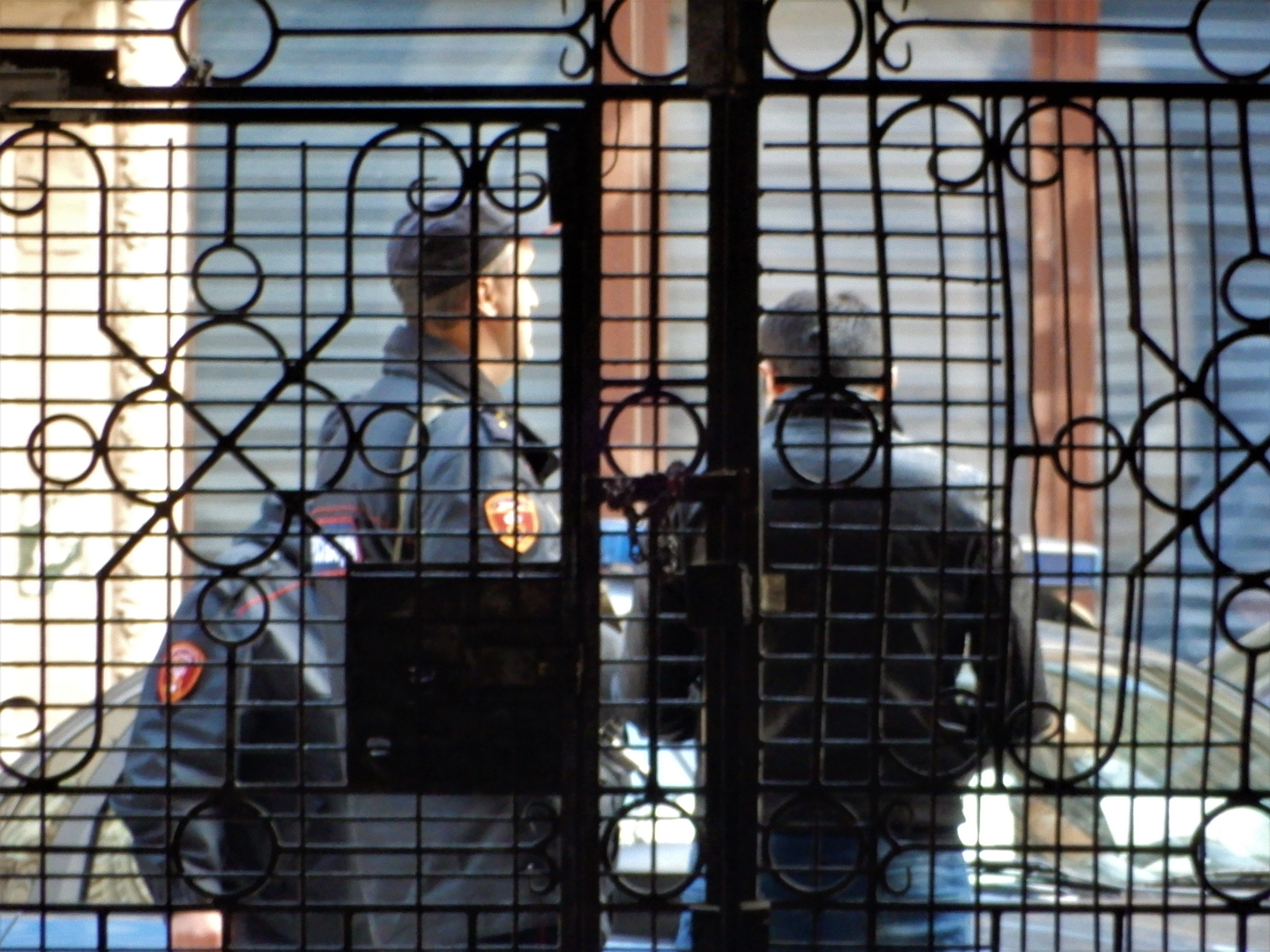
DSCN5677Two Russian National Guardsmen shake down a non-Russian and his friend (off camera) in the run-up to this summer’s FIFA World Cup. Photo by the Russian Reader
I remember when the G8 summit was held in Petersburg in July 2006. I will leave aside the counter-summit (aka the Russian Social Forum), held in then-already-doomed Kirov Stadium, that is, in a part of the city so far off the beaten path you had to want to be there very badly to get there, and the excellent job the Russian security services did making sure that social and political activists from other parts of the world’s largest country could not make it to Petersburg, much less to the forum.

I bring the summit up only because, the social forum aside, the city was pullulating with so many cops, riot cops (OMON), and Interior Ministry troops it was impossible not to notice them and realize how absurd and wasteful the security overkill was, especially since the summit per se was held in the newly refurbished Constantine Palace in the southern Petersburg suburb of Strelna, a site at least fifteen kilometers away from the central city and most of its inhabitants, and thus easily secured by a few hundred guards, policemen, and special forces troops.

Back in those halcyon days, I had a job that kept me moving round the city from morning to night, and so I would happen upon clusters of utterly idle cops, riot cops, and special forces troop in the oddest places on a regular basis while the summit was on. I remember how I once walked into an otherwise obscure, out-of-the-way courtyard late in the evening and found it chockablock with Russia police officers of some sort, possibly imported for the occasion from the other side of the country. They seemed almost ashamed to be hiding in that courtyard, protecting nobody at all from utterly nonexistent threats, and chainsmoking to kill the time.

Our beleaguered city’s next opportunity to shine in the international limelight will be during the 2018 FIFA World Cup, held in Petersburg and several other Russian cities from June 14 to July 15.

I was reminded by a tiny incident I witnessed earlier today of the Russian police state horrorshow literally everyone in the city with their heads screwed on straight expects during the month the World Cup is in town.

By the way, all locals with an ounce of sense in their brains are planning to be somewhere else, if only at their dachas in the countryside, during that month.

When I exited my building earlier today I immediately spotted two Russian National Guard officers hassling two young men of “non-Slavic appearance.” The officers were conducting their shakedown squarely in front of the gateway that accesses the yard of the building next to ours, the only courtyyard left on our street connecting it with the street running parallel to it.

Once upon a time not so long ago, central Petersburg was chockablock with interconnecting, walkthrough courtyards, and natives in the know could cover long distances in the inner city navigating this extensive network of courtyards without having to emerge onto the actual streets.

But when the new era of “capitalism” and “democracy” dawned, and Petersburgers privatized their flats and turned their courtyards into impromptu car parks, many of them gated, locked, and otherwise blocked off their courtyards, a move that in many cases was probably illegally, although no has ever gotten in trouble, so far as I know, for establishing their own little gated communities this way.

The guardsmen were reading the swarthy troublemakers the usual bored riot act about their having the wrong paperwork when I squeezed my way around them. One of them said they would have to take the swarthy men down to the precinct and write them up, which probably meant they would hold them there long enough to make their serious intentions plain before “fining” (bribing) them and letting them go.

The preparations for the 2018 World Cup have already been a debacle for Petersburg and many of the other host cities, as well as segments of the local populace that the authorities want to go away during the festivities, including university students, dogs and cats, antifascists tortured and framed as “terrorists,” and migrant workers.

I thus took the shakedown I witnessed as a sign of things to come: the full force of the utterly lawless, mendacious, and violent Russian law enforcement machine would be unleashed against migrant workers, people who look funny or out of place, and even completely ordinary, unprepossessing local residents while the World Cup was underway.

So, my message to you out there in the wide world is take a thought for us back here in the Motherland and keep your TV turned off during the World Cup. The “beautiful game” need not be played and enjoyed at such a high human cost to the World Cup’s Russian host cities, but since ultraviolence and the gleeful trampling of human rights are the only ways the current Russian regime knows how to handle mega events like the World Cup and the Winter Olympics, not to mention the country’s day-to-day governance, show a minimum of solidarity with us here in the line of fire and don’t watch any of the matches on TV. It won’t cost you a thing, but the world’s TV executives and advertisers will notice.

I won’t even bother appealing to the jetsetters who are planning to travel to Russia for the World Cup. You are beyond the pale in any case, since you choose to live your lives in such a thoughtless, wreckless way. My only hope for you is that, at some point during your expensive, wasteful trip, Russia’s real reality will burst through the carefully packaged and securitized experience the Russian authorities have planned for you, and you realize you paid Satan a lot of money to watch a few bloody football matches in person. // TRR

Sergey Abashin: Movements and Migrants in Central Asia

Movements and Migrants in Central Asia*
Sergey Abashin
STAB (School of Art and Theory Bishkek)

1. Movements

Movements in Central Asia have become large-scale and permanent, involving all social groups, rich and poor, women and men, young and old. They move around their own countries and among countries. Some go for several weeks or months and come back, while others live far from their place of birth for years, only occasionally visiting their homelands. Still others leave forever, breaking all ties. Some travel in search of a new homeland, so to speak. Others go to make money, study or receive medical treatment. Still others go for fun and excitement.

tumblr_mjqu91soeA1s05mw2o1_1280
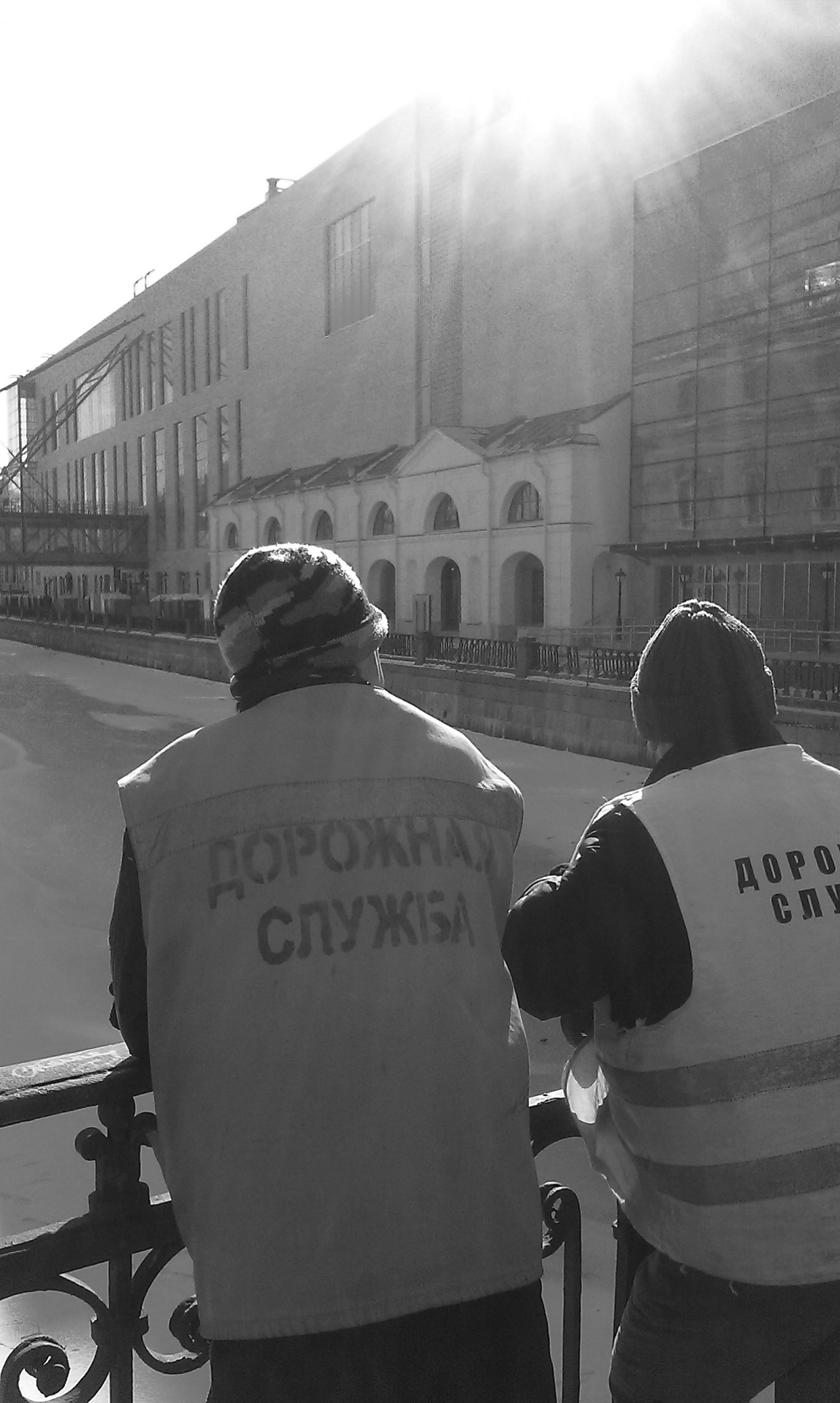
Immigrant road maintenance workers gaze at the newly completed second stage of the Mariinsky Theater. Kriukov Canal, Petrograd, March 15, 2013. Photo by the Russian Reader

All this movement has come as a surprise to experts and politicians. I still remember the debates in the Soviet Union in the 1980s as to why the people of Central Asia were reluctant to travel outside their region. Even then officials and academics in Moscow, observing the beginnings of the demographic decline in Russia itself, were planning to relocate people from borderlands with an excess labor force to the central regions of the then still-unified country. These plans failed, because few people wanted to leave their homes. Only organized and, in fact, involuntary labor recruitment and military labor brigades partly solved the increased need for labor power. The weak affinity that Uzbeks, Tajiks, and Kyrgyz felt for voluntary mobility was proclaimed, on their part, an inherent and incorrigible attachment to family, community, and the hot climate. However, all these explanations were put to shame only a decade after the collapse of the Soviet Union, when millions of people from the titular Central Asian nations felt an irresistible urge to hit the road, leaving and, sometimes, literally abandoning their homes.

Let us try and make sense of these circumstances, to understand why movement in the region has suddenly become a vital life strategy among a considerable number of people. The answer only seems to be lying on the surface. Yes, of course, the collapse of the Soviet system has led to the dismantling of all previous social and economic policies, which kept the population in place through social programs and investment in sometimes loss-making manufacturing enterprises. An abrupt, almost catastrophic decline in living standards, often accompanied by political turmoil and increased feelings of uncertain life prospects, could not fail to provoke an outflow of those wanting to find new prosperity and new stability outside their former worlds. Unemployment and negligibly small wages and pensions have pushed people into new labor markets in countries where even small incomes, by local standards, are much higher than the incomes Central Asians can expect to earn at home.

The future also looks ambivalent, depending on the forecaster’s optimism and pessimism. Some argue that economic, social, and political degradation in Central Asia will continue, becoming chronic, and the movements, therefore, will not stop but might even become even more intense, prolonged, and irreversible. Others, however, argue that sooner or later the situation will improve, investments and jobs will emerge at home, incomes and quality of life will increase and, consequently, outward migration will gradually dwindle.

This approach to movement as a consequence of degradation simplifies, in my view, the picture of events, distorting our perspective by ignoring and failing to analyze many important causes, factors, processes, and attitudes. If we look more broadly at the context in which human mobility in Central Asia has been growing, the first thing we see is an increase in the scope, range, and frequency of movement throughout the entire post-Soviet space and the world as a whole. Second, we see the unconditional link between mobility and the current stage of capitalism, which is sometimes called globalization, sometimes postindustrialism, and sometimes postmodernism. Viewed from this perspective, the picture of Central Asia appears in a somewhat different light than as a mere reflection of the disastrous state of affairs in the region’s newly independent countries. Spatial flows are not only a compulsory means of survival but also an impetus for distributing and assembling people, capital, information, and skills in new social configurations. The latter have a logic and meanings that do not depend directly on the characteristics of a particular country but are subject to wider trends and patterns.

What additional meanings can be attributed to the movements of people in Central Asia aside from as a reaction to post-Soviet degradation?

I think the situation can be described in terms of the momentum of the connections and mutual dependencies between Central Asia and Russia (and other lands) that developed and strengthened over at least a century and a half of coexistence within a single state. Usually, this kind of relationship is characterized as imperial or, if observers want to emphasize a distinctly unequal exchange, colonial. It is believed that empires inevitably fall, to be replaced by liberated nations. In this simple teleological scheme, which now dominates post-Soviet ideologies, much is not entirely clear, but one of the most controversial questions that many postcolonial critics ask is whether empire has actually disappeared or has adopted new shapes in which nations—i.e., constructs actually generated by empire—perform the old functions of borderlands, still pumping resources into the former metropoles in return for patronage and oversight. If we accept this argument, and there are many grounds for doing so, the massive movement of people from Central Asia to Moscow, Petersburg, and other Russian regions appears to be a post-imperial situation in which the circulation of labor power, money, practices, ideas, and information continues, acquiring new tempos and vectors. This movement establishes a new division of labor between the former “heartlands” and “borderlands,” and their hierarchy and mutual need for each other, even if the rhetoric has been dominated by harsh rejection of the newcomers.

Another implication of the movement of people in Central Asia is also quite obvious, although it is little remarked and little analyzed. The large-scale mobility—a significant (if not the lion’s) share of which consists of rural residents going to work abroad—is tantamount to a rather classic proletarization of a still largely agrarian Central Asian society. Soviet modernization attempted in its own way to organize this process by gradually transforming the locals into an agricultural working class while preserving the private agricultural sector and the corresponding rural practices, attitudes, and outlook in the region as a kind of compensation for semi-forced labor. The collapse of the Soviet Union also entailed the collapse of this transformative model. Consequently, the standard version of capitalist development, involving the ruin of the peasants, their impoverishment and exodus to the cities, where they are transformed into ruthlessly exploited proletarians, was inevitable. In other words, what is perceived as degradation is, in fact, a shift in the socio-economic order, not a return to old ways of life, as it sometimes has seemed, but accession to a completely new stage or form of community.

Proletarization has not been subject to discussion because, in particular, its course and effects have been concealed in a strictly ethnic view of the movement. In the countries of origin, the departed are considered traitors, victims or breadwinners. In the host countries, they are considered threatening outsiders or, again, victims. The emphasis, often cultural and racial, on their departure or arrival is more important than the social essence of movement. However, as soon as we remove our ethnic glasses we сan easily identify the class character of mobility. Its specificity consists only in the fact that the system in which class interaction takes place is not limited to particular countries and even regions but is non-national in scale. This system includes, first of all, the post-Soviet space as the nearest and most comprehensible space, a space that has, as I have already said, a history of a common existence and unequal relations of domination and subjugation between heartlands and borderlands. But mobility has already gone beyond the scope of the post-Soviet, spreading into new spaces of global capitalism and incorporating itself into a truly global order.

The other significance of the movement in Central Asia I would like to discuss is the mastery and appropriation of global space, infrastructures, and communication and transportation technologies. Let me explain this with a very simple example. Once upon a time, at the turn of the nineteenth and twentieth centuries, Russian imperial officials built a railroad that linked Central Asia with Russia’s central regions. The railway was built in no small measure to transport troops in the event of local uprisings and conflicts with other world powers, as well as for resettling Russian peasants, who were to colonize the new imperial lands. The railroad was also built to export the region’s cotton to the Ivanovo textile mills and import grain back to Turkestan, where the arable land was to be busy growing cotton. However, whatever objectives Petersburg officials pursued by allocating funds for the railroad’s construction, the end result was new transport infrastructure that made it possible to move large quantities of people and goods quickly, a means that had been available to different groups of people in different historical periods, and could be used for purposes that the said officials could not even imagine. Consequently, a hundred years later, the railway has become one of the main means of transporting millions of people of Central Asia to Russia and all over the world. This shift of functions and tasks might be dubbed mastery of new technologies and appropriation of completely new mechanisms for interacting with space, mechanisms which themselves define the impetuses and trajectories of movement. If we add highways and air travel to the railroads, we find ourselves with a huge network of possibilities that people transform into an element of their everyday practices and plans. The ease with which one can reach the other end of the world in a short time and gain access to new goods itself compels people to travel.

Here I would add the mastery of technologies for obtaining information about the world and communicating at great distances. They help create and maintain images and networks of acquaintances, which are also included in processes of movement and ensure its stability, direction, and reversibility. In a broader sense, I would also include here not only phones, internet, cars, and planes but also knowledge of languages, mastery of global systems of food and clothing, of finding and gaining employment, and so on. The penetration and expansion of such technologies and infrastructures in Central Asia and training oneself in the habits of using them shapes the demand for mobility as a distinct need and, sometimes, as a pleasure.

Finally, I want to use the notion of the migration of peoples for interpreting current movements. Despite the risks of drawing analogies between quite different historical periods, I think it vital to point out the temporal depth, continuity, and cyclical nature of movements, on the one hand, and, on the other, the gradual tectonic shifts in the spread of cultures, languages, and even genetic characteristics, shifts that may not always be visible from the perspective of several decades. I think we must keep sight of this prospect, too, because it is here that new mixtures and hybridizations happen, new cultural types and preferences are constructed, and new communities and identities are shaped. Marriages between locals and newcomers, children of newcomers who are born and grow up in the new land and speak the local language, shifts (back and forth) in musical and culinary tastes that are suggested by the newcomers and turn into new fashions, etc., are the individual and ephemeral symptoms of such transformations. They coalesce to form global trends that become visible after some time and only at a remove from the chaos of the present. The non-obvious nature of this tectonic shift and the uncertainty of its impact do not mean, however, that we do not sense, sometimes as vague and irrational fears and anxieties, the inevitability of this process by which completely new cultural forms emerge and acquire their own force and logic.

2. Migrants

I deliberately did not use the terms migration and migrants in the first part of my text, although in their original sense they are synonyms of movement and people in movement. However, the primarily recent negative usage of the word migrant in Russia, the destination of most Central Asians, has caused me to regard it as a discrete category, which indicates the particular circumstances in which people in movement find themselves. We can easily notice that the word is used selectively in the public debate and generally does not cover all types of movement, for which additional features and criteria are introduced. Why and how do certain people in movement end up in the exceptional circumstances of migrants?

The paradox of the present age is that the more massive and rapid the movement of people has become, the more societies and countries have established legal, political, social, and cultural obstacles and rules, including in the realm of ideology and ideas, for regulating and directing mobility. Having become an important feature of (post)modernity, movement has not changed the social order, which has remained hierarchical and antagonistic. But movement imparts to these hierarchies and antagonisms another, migratory dimension, which has become an important element in the allocation of status, wealth, and opportunity. More precisely, there are many such dimensions, and I will try to spell them out, based on the classification of the causes of increased mobility that I have proposed above. In particular, I mentioned post-imperialism, capitalization and proletarization, the appropriation of global space, and the migration of peoples.

The most obvious is the post-imperial or post-colonial conjuncture. The former distinctions between heartlands and borderlands, which in the past had a tangible and geographically measurable value, have been preserved, having forfeited, however, their sense of spatiality. The parts of the formerly united empire, fused over many decades and centuries, continue to need each other, even after the collapse of the unified state, in terms of resources, finances, labor power, military assistance, technologies, and ideas to maintain their existence and legitimacy. As before, mutual dependence has its own imbalances, which after the Soviet Union’s demise have not only not decreased but also in many ways have even increased. In the past, common imperial Russian and Soviet citizenship certainly served as tools of colonization and Russification, but aside from subordination, they contributed other modernizing and emancipatory consequences and effects. As the residents of the modernized and emancipated regions have flocked to the heartlands, depriving them of a common citizenship and, generally, of a stable legal status has been the new strategy for dominating the borderlands and its inhabitants. Earlier educational and Kulturträger aspirations have finally yielded to cold calculation: utopianism has become an unnecessary expense.

The status and label of the illegal (nelegal) has replaced the former terms aboriginal (tuzemets) and ethnic (natsmen) as the new tool of colonization. Illegality, which in its various shapes accompanies the majority of immigrants from Central Asia throughout their journey to Russia and other countries, is simultaneously a means of overexploitation and replacing distance (which in the past separated the residents of the heartlands from the populace of the borderlands, generating informal relations of “senior” and “junior”) with a new means of distancing. While reproaching the arriving hordes for illegality, Russia does everything possible to maintain this gray zone, which is a prerequisite of postcolonial welfare and subjugation and brings only material and symbolic benefits. Of course, the possibility of becoming a citizen and occupying a top position in the new circumstances remains for the illegal immigrant, just as once upon a time the aboriginal and ethnic could become a tsarist general or a member of the Central Committee, but this career requires stupendous effort, the overcoming of numerous obstacles, and repeated demonstrations of loyalty.

The proletarization of rural dwellers is accomplished not just as a movement from countryside to city but also as a movement from one country to another. This generates not only the possibility of doubly exploiting migrants as workers and, at the same time, as disenfranchised foreigners, but also impedes the formation of a pronounced class identity and class resistance among the new proletarians. Moreover, self-recognition as a working class occurs neither in the country of origin nor the host country.

In Russia, where migrants work and generate surplus value, they are considered guest workers and slaves who are not an electoral force, allegedly hinder the development of the local economy, skew the labor market by working for low wages, and increase crime rates. That is, they generate lots of so-called problems and threats. Even local leftist parties are not willing to recognize them as their own constituency, whose rights and class mobilization should be their concern. In Central Asia itself, where the migrants return with the money they have earned, they do not perceive themselves and are not perceived by others as a proletariat. Rather, they function as a kind of middle class who have successfully completed a business deal somewhere abroad. At home, the guest workers carefully maintain and reproduce all the attributes of prestige characteristic of the rural rich, community members, and supporters of a “traditional” lifestyle, albeit in contrived form. This method of joining the capitalist world prevents immigrants from Central Asia from recognizing their interests as proletarians and fighting for them, which only aggravates their oppressed position in their new circumstances.

Here I want to clarify an important point. Movement itself is not only proletarian in its import. The people involved in it also include businessmen, who attempt to preserve and capitalize their savings abroad; urban educated youth, hoping to enter the cohort of white collar workers; and cultural producers and academics, who are looking for freedom of inspiration and recognition in other countries, and so on. But these groups of Central Asians are often overlooked amidst the public phobias, are not identified as guest workers, and even occupy quite high-status positions in the new society. However, many of them are also under constant threat of ending up living their lives according to a proletarian logic. Subjugation, which cannot be reduced merely to proletarization but has a wider context, assigns people to different categories, leaving them very little choice in determining their own legal, professional, and social trajectories, eventually pushing them into the niche of disenfranchised workers, from which it is difficult to extract themselves.

Another factor associated with access to the infrastructures and technologies of mobility also generates its own limitations and hierarchies. The latter include abilities, skills, and psychological capacities, as well as, I intend to emphasize, the availability of the necessary financial means and connections for implementing this access. An important condition is the availability and number of intermediaries between the individual and the means of mobility.

The hierarchy begins to take shape the moment the decision is made who is personally capable of setting out on the long, distant journey. This decision predetermines who will be the breadwinner, and who, the dependent; who, by taking on heightened risks, will receive more of the symbolic and moral bonuses, and how roles and statuses will be allocated in the future within the family and the community. Depending on the availability of funds and skills, the emigrant chooses between strategies of searching for happiness individually or, more often, of joining a network. Within the network, each person is assigned a certain place, and strict limitations are imposed on all manifestations of independence. The network mediates between the individual and technologies. It gives him or her money for their first steps. It protects and insures them. It explains where they should go and what they should do. The societal network, which guides the individual down the beaten path, provides guarantees and confirms the usual order of relations, and reproduces its own forms of domination and subjugation among elders and youngsters, men and women, pioneers and followers, wise guys and foot soldiers. The technologies and infrastructures of globalization are for many people, paradoxically, a means of reproducing and even reinforcing so-called traditional collective practices and beliefs.

I want to note also that networks, by defining what each of its members should do and how they should do it, exacerbate the stigmatization of these people as illegal immigrants and guest workers. When he or she joins a network, the individual immediately ends up in a social niche already freighted with a given set of obligations and rights, symbols and identities. The Central Asian whom an older relative or acquaintance puts on a plane, then transports to a place of work and so on, is doomed to be a migrant, as no other roads remain open to him or her.

And, finally, the migration of peoples. I have spoken about the fact that this process leads to the invention and cultivation of new hybrid cultural forms and types. And yet the fabrication and materialization of these forms and types happens via alignment with a hierarchy, through assignment to specific superior or inferior positions in social classifications, through application of a whole set of rules and techniques for recognition and exclusion. In particular, in these processes, references to culture, religion, and race, alone or in various combinations, are turned into a necessary attribute for identifying migrants as a discrete category of people in movement.

Migrants are persons necessarily endowed with the signs of aliens. Their physical appearance, faith and religious practices, and cultural habits must be alien. Central Asians with Caucasoid and Mongoloid features are termed “blacks” (chornye). The Central Asian cultures, which experienced a large-scale modernization with the Russian Empire and Soviet Union for nearly a century and a half, are described as almost archaic and “traditionalist.” Central Asian Islam, which has just been recreated after an atheistic era and bears the stamp of eclecticism and internal inconsistency, already figures as a potential, homogenous “threat” both to Christians and atheists. The discursive racialization, and cultural and religious stigmatization to which a significant number of people traveling between countries are exposed is a condition for entering the new situation of constant movement. New generalizing identities and derogatory nicknames legitimize, albeit negatively, the redistribution of space currently underway. At the same time, endowment of legal, professional or class status is made dependent on cultural and biological characteristics. Despite the apparent relativization of culture in movement, the essentialization of these characteristics has only been amplified and has moved from the level of individual countries and regions to the global level.

I want to conclude my short essay on movement and migrants in Central Asia not with a series of conclusions but with something like an inquiry. The new era has opened up many new opportunities for people, but at the same time it has generated new types of dependence and subjugation. How will these opportunities be used? Have we recognized all the risks? I think that when answering these questions we must choose a particular point of view that opens onto a wider temporal and spatial context, that does not focus on details, whatever feelings of pride or resentment they might cause, and that would not be attached to a particular ethnic loyalty and affiliation. Depending on how this works out or whether it works out at all, we can hope for the emergence of a new dialogue about the new era, a dialogue that for the time being we sorely lack.

* My research was conducted with support from a grant by the Russian Humanities Academic Fund (“Problems of Intercultural Interaction between Migrants from Central Asia and Russian Society,” No. 11-01-00045а).

________

Sergey Abashin is British Petroleum Professor of Migration Studies at the European University in Saint Petersburg. His most recent book is Sovetskii kishlak: Mezhdu kolonializmom i modernizatsiei [The Soviet Central Asian village: between colonialism and modernization], Moscow: Novoe literaturnoe obozrenie, 2015.

This essay was originally printed, in Russian, in STAB Almanac No. 1: Regain the Future, edited by Georgy Mamedov and Oksana Shatalova. Published by the School of Theory and Activism Bishkek (STAB) in 2014, the almanac can be accessed in full (in Russian) here. This is the first in a series of new posts dealing with Central Asia, Central Asians, and immigration. Translated by the Russian Reader