The Russian Opposition in Exile

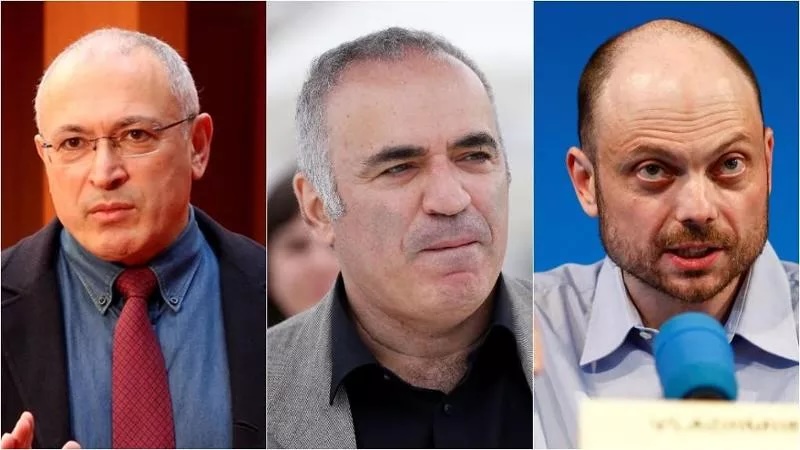
This isn’t a show of unity but a photo montage from La Stampa: (left to right) Mikhail Khodorkovsky, Garry Kasparov, and Vladimir Kara-Murza all lay claim to leadership of the Russian opposition in exile and the Russian antiwar movement.

Vladimir Kara-Murza has resigned from the [Russian] Antiwar Committee after Garry Kasparov’s offensive outburst in Paris.

I was there when it happened.

What happened, exactly?

At a dinner before a morning meeting with the leadership of the Parliamentary Assembly of the Council of Europe (PACE), Kasparov adopted a mobsterish tone with Kara-Murza, demanding to know why he would not sign the Berlin Declaration. Kara-Murza tried to respond constructively, explaining that he had been in prison when the Berlin Declaration was drafted.

“Aren’t you ashamed to say that you only served two years in prison, when there is a man here who served ten years?” Kasparov said, (referring to [Mikhail] Khodorkovsky. — A.G.).

To which the retort was: “Are you speaking as someone who fled Russia in 2013? As far as we know, you have served five days in jail in your entire life.”

At that point, Garry Kimovich lost it and started yelling that all true militants against Putin’s regime had left [Russia] and were fighting for Ukraine, rather than serving time in prisons.

“Why aren’t you fighting for Ukraine yourself, instead of serving time in a restaurant in Paris?” I asked.

“Why aren’t you fighting?” the chess player blurted out.

“But you’re a man, aren’t you?”

“I’m sixty-two years old!”

***

“You scoundrel!” Kasparov shouted at Kara-Murza. “Who got you out of prison?! I got you out! You’re not signing the Berlin Declaration because you can’t say that Crimea belongs to Ukraine!”

FYI: In 2014, after Kasparov had already emigrated, Kara-Murza declared that Crimea was part of Ukraine during an [anti-war] march in Moscow.

***

But here is the most “brilliant” thing the future member of PACE’s Russian platform said:

“Kara-Murza has a British passport, he swore allegiance to the Queen! But I haven’t sworn allegiance to anyone. I have a Croatian passport… just for traveling.”

He’s a traveler all right.😌

Croatian, my ass.

This was how PACE’s Russian platform was assembled.

Source: Alexandra Garmazhapova (Facebook), 12 December 2025. Translated by the Russian Reader


PACE has decided to create a Platform for Dialogue between the Assembly and Russian democratic forces in exile.

Participants in the platform – whose composition has yet to be decided, based on a set of criteria – would be able to hold two-way exchanges with the Assembly on issues of common concern. They would also be able to attend meetings of selected committees during part-sessions.

Unanimously approving a resolution based on a report by Eerik-Niiles Kross (Estonia, ALDE), the Assembly said participants in the platform would be “persons of the highest moral standing” who, among other conditions, all share Council of Europe values, unconditionally recognise Ukraine’s sovereignty, independence and territorial integrity, and are working towards “regime change” in Russia.

The parliamentarians said the new platform – among other things – would help to strengthen the capacity of Russian democratic forces to “bring about sustainable democratic change in Russia and help achieve a lasting and just peace in Ukraine, alongside ensuring the responsibility of Russian actors for the international crimes committed”.

The Assembly said it honours the commitment of “those Russian human rights defenders, democratic forces, free media, and independent civil society who oppose the totalitarian and neo-imperialistic Russian regime, fight for democracy, human rights and the rule of law, and support Ukraine, sometimes at the risk of their lives and freedom”.

However, unlike Belarusian democratic forces, “Russian democratic forces do not have a single, unified political structure”, the Assembly pointed out. It encouraged Russian groups and initiatives in exile to join forces to advocate for democratic change in Russia, expose the crimes of the Russian regime and support Ukrainians.

Source: “PACE creates a ‘platform for dialogue’ with exiled Russian democratic forces,” Parliamentary Assembly of the Council of Europe, 2 October 2025


On 1 October 2025, the Parliamentary Assembly of the Council of Europe (PACE) adopted a resolution to establish a Platform for Dialogue with Russian Democratic Forces (RDF). The initiative is intended to provide a framework for exchanges on issues of shared interest. The decision has sparked some controversy, which appears likely to grow.  

A “Legitimate Alternative” Without Legitimacy 

According to the report presented by the PACE General Rapporteur on RDF, Eerik-Niiles Kross, the Platform is designed to facilitate the participation of Russian opposition representatives in the Assembly’s activities. Approved candidates will form a delegation, gain access to committee meetings, and be able to address them. Yet the nomination procedure remains vague: Russian opposition groups are expected to reach a “common decision” on who will attend PACE sessions and then submit a candidate list to the President of the Assembly. This process is supposed to be completed by early next year. 

The report describes Russian democratic forces as “a legitimate alternative to Putin’s regime.” However, the basis for such legitimacy remains unclear. Unlike the Belarusian opposition, which can point to Sviatlana Tsikhanouskaya’s electoral mandate from the 2020 presidential race, Russian opposition figures lack any comparable representative legitimacy. Strictly speaking, they represent no one but themselves. 

PACE further specifies which actors it considers part of these “democratic forces”: structures associated with Mikhail Khodorkovsky, Garry Kasparov’s Free Russia Forum, Vladimir Kara-Murza’s Free Russia Foundation, as well as unspecified “representatives of the peoples of Russia.” The Anti-Corruption Foundation (FBK), founded by Alexei Navalny, is also mentioned, but the report explicitly excludes it from the category of democratic forces. The reason given is that the FBK refused to sign the Berlin Declaration, defined by the rapporteur as a conditio sine qua non for cooperation with PACE. In response, FBK representatives reiterated their lack of interest in working with what they called a “talk shop for expressing concerns” and branded the report “rude and vile.” 

Defining Democratic Credentials 

However, it is not only about the FBK. Some influencers and activists who denounce Russia’s crimes in Ukraine refuse to sign the Berlin Declaration, viewing it not as a universal document, but rather as an act of swearing personal allegiance to Mikhail Khodorkovsky and his Anti-War Committee, which drafted it. Even human rights defenders who did sign the Declaration question why it, in particular, has come to serve as the benchmark of democratic credentials. They regard its inclusion among the criteria for assessing the democratic legitimacy of a potential member as “odd,” since the Berlin Declaration represents “a private statement by one particular segment of the Russian opposition.”  

Indeed, it is worth recalling that eight months before the Berlin Declaration, Alexei Navalny’s “15 Points”—a set of principles to which a significant number of Russian political activists still profess commitment—were published. These points outline similar foundations: ending hostilities and withdrawing Russian troops from the occupied territories, compensating Ukraine for the damage caused by the war, condemning imperial policies, committing to a European path of development, as well as dismantling the Putin regime and transforming Russia into a political system that would make the usurpation of power impossible. At the same time, both documents contain elements that appear puzzling. Notably, neither the Berlin Declaration nor Navalny’s 15 Points frames the war in Ukraine as Russia’s war, and both remain silent on the future of captive nations in Russia. 

But even if one sets aside the questions raised by Navalnists as to why the “15 Points” are not adopted as the criterion of democratic legitimacy, how will PACE respond if other Russian opposition groups come up with similar declarations of their own? 

Ukraine: Scepticism and Restrained Acceptance 

Unsurprisingly, initiatives to create platforms involving Russian opposition figures within international organisations are viewed with deep scepticism in Ukraine. Most prominent Russian émigré politicians do not take part in armed resistance against the Putin regime, prefer to shift all responsibility for the invasion onto Putin personally, reject the idea of dismantling the Russian empire, and instead lobby for easing sanctions against “regular Russians.” Increasingly, they blame the west—rather than themselves—for the failure of democratisation in Russia. Nearly four years into the war, the exiled Russian opposition has proven largely irrelevant to Ukraine’s struggle against the invasion. 

These arguments were strongly echoed by members of the Ukrainian delegation during the debate. Seven deputies took the floor. None opposed the resolution outright, but all signalled their distrust of the Russian political figures present in the chamber, stressing that they do not view them as a genuine opposition to Putin. Dialogue, they insisted, should be held only with Russians fighting in the Ukrainian armed forces and with representatives of captive nations. 

Another concern raised was the lack of clarity in the procedure for determining Russian participants. The Ukrainian delegation succeeded in nearly doubling the criteria for candidate selection, but the Assembly rejected amendments that would have formalised Ukraine’s role in approving the list. This gave the impression that there is no genuine consensus within PACE on the establishment of the Platform for Dialogue with the RDF. As a result, some Assembly members began to doubt the wisdom of the initiative, suggesting that consultations with Russian opposition figures remain at the informal level. 

Still, indirect signs suggest that communication between the PACE’s leadership and the Ukrainian delegation had taken place before the resolution was put to a vote. Notably, Ukrainian deputies refrained from openly torpedoing the resolution and instead largely abstained from the vote. Such restraint likely reflected a compromise, which may include the following items. First, the right of Ukraine to nominate representatives of Russian volunteer battalions serving in the Ukrainian armed forces, such as the Russian Volunteer Corps, which has already expressed willingness to join the Platform. Second, a commitment by PACE to establish a separate forum for indigenous peoples and national minorities of Russia, with one-third of seats on the current Platform reserved for them until that forum is created. Third, indirect Ukrainian involvement in controlling the Platform’s activities, possibly through performance indicators such as “feedback from Ukrainian civil society.” 

Risks of Division Within the Platform 

The creation of the Platform seems to carry potential risks for PACE while offering few tangible benefits. One of the key objectives declared by the resolution’s initiators is to foster greater unity among the highly fragmented Russian anti-Putin forces. In practice, however, it may have the opposite effect—further deepening and cementing the existing divisions among Russian diaspora political groups.  

Besides, the inclusion of a diverse array of groups engaged in mutually irreconcilable conflicts raises the question of whether PACE can manage the level of potential tensions within the Platform itself. Frictions are likely to emerge between Russians fighting in the Ukrainian armed forces and well-known dissidents espousing pacifist convictions. Similarly, some Russian émigré politicians—despite condemning imperial policies—still advocate the armed suppression of any hypothetical secession by the North Caucasus. Such a position is unlikely to resonate with representatives of oppressed peoples, who view supporters of continued Russian control over their territories as foes. 

It is also unclear whether PACE has a contingency plan should Ukrainian criticism intensify amid internal conflicts within the Platform. Such a scenario could place the Assembly in a difficult position, straining relations with Ukraine, a country whose citizens are dying daily for their independence and the values that the Council of Europe stands for. Were that to happen, the Platform would be remembered alongside PACE’s scandalous decision to restore the credentials of the Russian delegation in 2019 and the leadership’s attempts to shield its disgraced president, Pedro Agramunt—further damaging the Assembly’s image in Ukraine. 

Defending his resolution proposal during the debate, Eerik-Niiles Kross drew a parallel with the Soviet occupation, noting that the Estonian diaspora played a vital role by representing the idea of an independent Estonia. By analogy, he argued, Russian democratic forces could play a similar role today, potentially producing their own Willy Brandt or Konrad Adenauer. The comparison, however, is not entirely accurate. Estonian émigrés did not enjoy a formal platform within PACE, but they still managed to convey their message effectively and ultimately saw it realised. Besides, the case of Germany clearly shows that it is not the establishment of a dialogue platform in Strasbourg that increases the chances of Russian Brandts and Adenauers emerging, but Ukraine’s victory on the battlefield. So far, there is scant evidence that prominent Russian emigrants have contributed anything of tangible significance to this cause.

Source: Igor Gretskiy, “Why PACE’s New Russian Platform May Backfire,” International Centre for Defence and Security (ICDS), 9 October 2025


Declaration of Russian Democratic Forces

In this darkest hour, we declare our strategic goals – to stop the aggression against Ukraine and create a free, rule of law based, federal Russia. To do this, we consider it necessary to strengthen the coordination of our actions.

We declare our commitment to the following fundamental positions:

  1. The war against Ukraine is criminal. Russian troops must be withdrawn from all occupied territories. The internationally recognized borders of Russia must be restored; war criminals must be brought to justice and the victims of aggression must be compensated.
  2. Putin’s regime is illegitimate and criminal. Therefore, it must be liquidated. We see Russia as a country in which the individual freedoms and rights are guaranteed, in which the usurpation of state power is eliminated.
  3. The implementation of imperial policy within Russia and abroad is unacceptable.
  4. Political prisoners in Russia and prisoners of war must be released, forcibly displaced persons must be allowed to return home, and abducted Ukrainian children must be returned to Ukraine.
  5. We express our solidarity with those Russians who, despite the brutal repressions, have the courage to speak up from anti-Putin and anti-war positions, and with those tens of millions who refuse to participate in the crimes of the Putin’s regime.

The signatories of the Declaration share the values of a democratic society, respectful communication, recognize human rights and freedoms, the principles of diversity and equal rights, rejection of discrimination.

The signatories refrain from public conflicts in the democratic and anti-war movements.

We call on the citizens of Russia to join this Declaration.

We commit to uphold this Declaration until our common strategic goals are achieved.

Berlin, April 30, 2023

Source: “Declaration of Russian Democratic Forces,” Russian Antiwar Committee, 30 April 2023


According to eyewitnesses who spoke to SOTA, the reason for Vladimir Kara-Murza’s departure from the “Anti-War Committee” today was an argument that took place in a restaurant where potential PACE delegation members were seated. The quarrel began with Garry Kasparov accusing Vladimir Kara-Murza of a lack of teamwork.

According to Kasparov, Kara-Murza deliberately brought Yulia Navalnaya and Ilya Yashin to meet the PACE President, bypassing the general meeting—despite neither of them having signed the Berlin Declaration, which implies support for Ukraine. It should be noted that the opposition will receive only 12 seats in PACE, 4 of which are allocated to “decolonizers.”

Alexandra Garmazhapova, who is close to “Free Russia” and heads the “Free Buryatia” foundation created under its protection, omitted the beginning of the conflict with “Free Russia” Vice-President Kara-Murza in her Facebook post.

According to the former journalist, “Kasparov started questioning Kara-Murza in a thuggish tone about why he had not signed the Berlin Declaration. Kara-Murza tried to respond constructively that he was in prison when work on the Berlin Declaration was underway.”

Meanwhile, Kara-Murza himself stated on X (formerly Twitter) today that he and his colleagues from “Free Russia” were allegedly ready to sign the declaration but did not explain why they have not done so yet.

Back in October, Kara-Murza had virtually refused to sign the declaration: “When the criterion for participation in the Russian democratic platform at PACE is signing a document that a significant number of people associate only with one specific political group—that, in my opinion, is a completely clear element of political manipulation, and it is strange, to say the least. Many colleagues feel the same way, including those who were here in Strasbourg last week at the PACE plenary session.”

The “political group” he referred to is the “Anti-War Committee,” which Kara-Murza only left today under the pretense of a conflict with Kasparov, who is only one of its participants.

Garmazhapova further reported that Kasparov accused Kara-Murza of having “only served two years” in prison, unlike Mikhail Khodorkovsky. Garmazhapova then intervened in the conflict on the side of her “Free Russia” colleague, asking why 62-year-old Kasparov is not on the front line but demands it of others.

It should be noted that Natalia Arno—head of “Free Russia”—and Ilya Yashin, who conducts his world tours with funds from this foundation, also joined the public conflict.

Arno stated that “G. Kasparov allowed monstrous insults directed at my colleague Vladimir Kara-Murza,” called it “dirty methods,” called Kara-Murza a hero, and Kasparov someone who fled Russia in 2013. Arno herself emigrated in 2012.

Ilya Yashin, on X, urged Kara-Murza to believe that “he is there for him.”

Thus, the conflict for leadership in PACE between Khodorkovsky and Kara-Murza, as Arno’s protégé, which SOTA previously wrote about, became public today: Kara-Murza’s self-removal from the “Anti-War Committee,” despite the formal conflict with Kasparov—who is only one of its members—only highlighted the brewing contradictions and “intrigues” that Kasparov had mentioned.
Source: “‘Free Russia’ vs. ‘Anti-War Committee’: What Happened Between Kasparov and Kara-Murza,” Sota News (X), 12 December 2025

Julia Khazagaeva: I Am Just a Mom with Three Kids

The statements about the war made by Muscovite political exiles cause public indignation because what they say is at odds with the horror of the situation. Instead of taking to European podiums and demanding decisive action to defend Ukraine, they ask [European officials] to lift sanctions against Russians and mumble helplessly about “one nation.”

It is obvious that, for the fourth year running, Russia has been waging not just a war against Ukraine on the front lines, but a bloody, boundless campaign of terror. Nearly every day Russian missiles kill [Ukrainian] civilians, including children. Ukrainian soldiers who surrender unarmed are executed on the spot by the Russians, or are even ritually beheaded. But you continue to talk about Russia’s “democratic future,” ignoring the fact that the entire country, including schoolchildren, has been slaving away at destroying the Ukrainians.

I am not a politician, just a microblogger who cares about current events. But even I remember InformNapalm’s OSINT investigation which showed that the Russian fighter planes bombing Ukraine are still equipped with French avionics. Without this unique equipment, Russia’s Su-30SM fighter planes are blind and cannot fly. Russia obtains this equipment through Kazakhstan, thus bypassing sanctions. The report came out a year ago. I don’t know what the situation is like now, but warplanes are still taking off from Russian airfields.

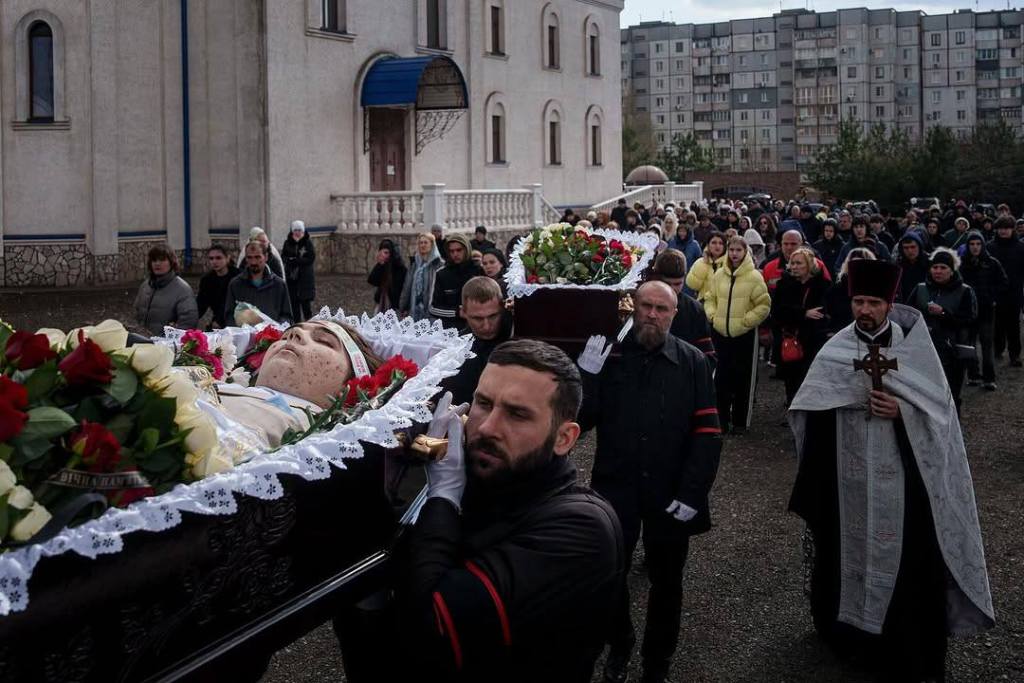
Why couldn’t you have talked about that in the French Senate? Especially since, a week earlier, a Russian missile fired from a fighter plane and packed with shrapnel killed twenty people, including nine children, in Krivyi Rih. The photo of a young [boy] in a coffin, whose face had been riddled by the tiny metal shards, is impossible to forget.

The coffins of 15-year-old Nikita Perekrest and his cousin, 16-year-old Kostiantyn Novik. Nikita’s father serves in the Ukrainian Armed Forces, and his mother took Kostiantyn in after his parents were killed. The two boys were outside in the yard when the Russian army struck Kryvyi Rih. Photo: Evgeniy Maloletka/AP/Scanpix/LETA, via Meduza

I realize that none of Moscow’s so-called opposition activists have the courage of political prisoner [Vladimir] Bukovsky and demand that Ukraine be given missiles to target Lubyanka. But you could launch investigations into the schemes by which Russia circumvents sanctions and obtains not only components for its fighter planes but also foreign chips for its missiles. You could demand that the Bosphorus be closed to Russia’s shadow fleet, which brings Putin the revenue to produce new missiles. Finally, you could show solidarity with Ukraine at least in word [if not in deed] and stop embarrassing yourself by repeating the impersonal and irrelevant slogan “No War.” You could do a lot of things in your safe havens. But instead you just wait for Putin to die and are not even ashamed to say so. Meanwhile, it is not so much the Ukrainians or the decolonizers who are waiting for you to act as it is your own fellow Russian citizens, who have not yet lost their minds and are basically living under occupation in Russia.

///

As for the ridiculous claim that it is easier for non-Russians to go to war and that is why they make up the majority [of soldiers] in the [Russian] army, according to the analytical resource buryatmemorial.org, a total of 2,425 people from Buryatia have been killed in the “special military operation” as of March 2025. And you’ll pardon me, but hardly half of them are ethnic Buryats (as you can see from the photos). This is due to the fact that ethnic Buryats constitute no more than 31% of the republic’s entire population. According to Ukrainian figures, Russian losses have already lost 933,000 men in the war. Even if we multiplied the figures for Buryatia by ten, its war dead would still roughly amount to two and a half percent of the total. I emphasize that the Buryats are an ethnic minority in their own land.

A screenshot of the website buryatmemorial.org, showing the names and faces of Buryatia’s war dead

According to Caucasian Knot, as of March 2025, 233 men from Chechnya, 121 from Ingushetia, 104 from Karachay-Cherkessia, and 112 from Kalmykia have been killed in the special military operation. Again, we can multiply this figure by ten for the sake of statistical rigor, but we still get hundredths of a percent of the total losses.

To put an end to the topic of Vladimir Kara-Murza’s ridiculous misinformation drop, yes, I saw yesterday’s post by the activist Anastasia Shevchenko, from which it follows that she was the mysterious “colleague” who shared with Kara-Murza the “observation” that it may be easier for non-Russians to go to war, while Russians find it psychologically difficult to kill Ukrainians due to their cultural affinity. Anastasia writes that the source of this hypothesis was not even her, but a third party who voiced this conjecture in a private conversation. Do you realize what has happened? This was not a scientific observation; no studies or surveys of Russian POWs were done that would indicate such a trend. This “information” came from the bush telegraph and was repeated by a [Russian] opposition politician in the French Senate, where decisions are made on the basis of the words people utter. And even after the ruckus that this delusional phrase caused among the public, no apology or explanation has been forthcoming from the politician.

Again, I am just a mom with three kids who left Russia to avoid supporting the war. In exile, I wash floors and clean other people’s houses so that I can send at least thirty dollars [a month] to the Ukrainians so they can buy drones. At night I write social media posts and read decolonial literature. I try to do anything I can to stop my former country from murdering innocent people. In my opinion, I have the right to demand that those who call themselves politicians, who have the bully pulpits and the opportunities, do something meaningful to ensure that Russia can no longer wage war.

There is nothing more important right now.

Source: Julia Khazagaeva (Facebook), 14 April 2025. Translated by the Russian Reader

The Buryats Made Them Do It

This is Vladimir Kara-Murza, speaking at the French Senate:

There is another reason why the Russian Defense Ministry recruits so many members of ethnic minorities [to fight in the war against Ukraine]: as it turns out, because it is psychologically really difficult for [ethnic] Russians to kill Ukrainians. Because we are one people. We are very close peoples, as everybody knows. We have nearly the same language, the same religion, and centuries of history in common. But if it’s someone from another culture, allegedly it’s easier [for them to kill Ukrainians]. I hadn’t really thought about it before. I thought the reasons were primarily economic. But after what [a colleague who spoke about the Buryats] said, I started thinking about it too.

A screenshot of the video Ms. Khazagaeva cites in her Facebook post

You did get that, friends? It’s so difficult, so unbearable for ethnic Russians to kill you Ukrainians that Buryats and Chechens have been doing all the work for them — because [Buryats and Chechens] are beasts and savages. That makes sense, doesn’t it?

By the way, [Kara-Murza] refers to Buryats and Chechens as “those ethnic minorities.”

In other words, all eleven years [of Russia’s war against Ukraine], the Buryats, who number under four hundred and fifty thousand people, including children and the elderly, have been attempting to kill the forty million Ukrainians. It transpires, however, that the hundred million ethnic Russians have had it “psychologically difficult” all those eleven years. They are mere victims of this war, which is something “those [other] ethnic groups” want. Don’t get them wrong: ethnic Russians love you Ukrainians like brothers!

You have explained everything so clearly, Mr. Kara-Murza. I have literally just a couple of follow-up questions. Excuse me, has it also been the Buryats who have been launching missiles at Ukrainian cities? And the creatures who on Russian television rejoice at the deaths of Ukrainian children in Kryvyi Rih, are they also members of these same ethnic minorities?

I’m sorry, but I have another question. The whole world knows what the Pskov paratroopers did in Bucha. Do you have any ideas how to repaint them as Buryats? Although it would probably be a bit difficult, since “your lads” have already been testifying.

One more question. The other day, 7 April, was the thirtieth anniversary of the Samashki massacre. Eighty people, mostly children, women and old people, were burned alive in Samashki, and hundreds of people were killed in total. This is not to mention the forty thousand Chechen children killed in the two [Chechen] wars. Excuse me, did the Chechens shell themselves? Ethnic Russians are totally incapable of that, aren’t they? To hell with what Tolstoy wrote in Hadji Murat. Tolstoy was a renegade.

Oh, I’ve gotten a little carried away. Two million people were killed in the Soviet invasion of Afghanistan. They say that’s where the notorious practice of “mopping up” villages, leaving mass graves in their wake, originated. I’m sorry, who did the killing in Afghanistan? Was that the Buryats too?

Good Lord, where do you get so many of them?

The only thing I don’t understand is how the idea of the “Russian world” could have emerged, since you ethnic Russians live in love and friendship with all countries. It must have been the Chukchi who overdid it on that front.

I also don’t understand why it is the ethnic Russians who do ballet, but it is the non-Russians who make war.

P.S. Thanks to the lovely Olga Arles for her [translation] of Kara-Murza’s full speech.

///

Updated, 13 April. I have replaced the picture originally below the post with a video featuring the entire quotation by Kara-Murza. Thanks to the good people who provided the AI translation. It shows that Kara-Murza’s words, whether presented in expanded or abridged form, bear the same message: ethnic Russians don’t want to kill Ukrainians, and it’s easier for non-Russians to do it. Because we ethnic Russians and the Ukrainians are one and the same, but we’re not the same as those non-Russians. It matters not a whit that Kara-Murza referenced someone else’s observation. What matters is that he voiced this idea personally and voluntarily, and that he confirmed his commitment to it by saying that it has given him pause for thought too. Think about it. A Russian politician (as Kara-Murza fancies himself), while visiting the parliament of a major European country, says that it is mainly Buryats who want the war. He says this on the record in a place where every word uttered potentially has legal force. He said it not in a bar, not on a beach, but in the French Senate, where decisions on sanctions are made.

I have not emended the text of my original post, dated 12 April.

Source: Julia Khazagaeva (Facebook), 11 April 2025. Translated by the Russian Reader.


On 10 April 2025, the Senate Foreign Affairs Committee heard the testimony of Vladimir Kara-Murza, vice-president of the Free Russia Foundation and a former Russian political prisoner. A Russian politician and opponent of Vladimir Putin, Kara-Murza survived two poisoning attempts, in 2015 and 2017. In April 2023, he was sentenced to 25 years in a penal colony by the Russian justice system after criticizing Russia’s invasion of Ukraine. He was released on 1 August 2024 in a prisoner exchange. In his testimony to the senators, he stressed the autocratic and violent nature of Putin’s regime. He called on the European Union to maintain its sanctions against Russia, and to bring its weight to bear on peace negotiations in Ukraine. He maintains the hope that the country will soon become democratic.

Source: Public Sénat (YouTube), 10 April 2025. Annotation translated, from the French, by the Russian Reader

Alexander Podrabinek: Opposition Politicians Must Live in Russia to Do Their Jobs

Alexander Podrabinek in 1980

The recent prisoner swap has suddenly and quite vividly clarified the emotions and motives of the militant segment of the Russian emigration. Those who did photography in the old days will remember how you would dip a blank sheet of photographic paper into developer and gradually an image would appear on it. At first, the image would be vague, just outlines, but then it would become clearer and clearer, until finally you would pull it out from under the red lamp and hold it up to the white light: wow, you could see everything clearly!

I will avoid beeing politically correct and say everything I think. Emigrants from the so-called liberal crowd went abroad because they were afraid of going to prison in Russia. It’s an understandable fear—a valid reason, one might even say. The issue of personal security, their personal well-being and that of their families, was more important to them than Russian freedom and democracy, about which they spoke with such pathos and fervor at protest rallies, in the independent press, and on the internet. They did not have the guts, and such things happen. There is nothing laudable about it, but nothing catastrophic either. No one obliges them to sacrifice themselves, and they themselves were willing to be heroes on the podiums, but not in a real showdown with the repressive regime. All right, so they left: it’s no great loss. In any case, it is better to leave in time than to spill your guts later during an investigation.

I think most of those who have left Russia feel fine, but a certain segment of the emigration, the most militant and vocal, experiences emotional discomfort. They sense their own political inferiority, especially amidst what has happened in Russia to those who stayed, to those who have been resisting and are now in prison. To prove to themselves and others their insightfulness and to confirm the correctness of their choice to emigrate, they portray those who have remained in Russia as naive fools who don’t understand life. The very existence of political prisoners irritates them. They believe that people have been imprisoned by mistake or because they overestimated themselves. But they themselves didn’t overestimate!

Alexei Navalny’s decision to stay in Russia cut them to the quick. A month before his death, Navalny wrote in a letter from prison camp: “I have my country and my beliefs. I don’t want to give up either my country or my beliefs. I can betray neither the first nor the second. If your beliefs are worth something, you must be ready to stand up for them. And if necessary, to make sacrifices.”

The bombastic Ekaterina Schulmann just doesn’t get it. “The context of events is such that the first thought that comes to mind upon hearing the news is how he could have failed to leave [Russia] after the first [guilty] verdict, and almost the only emotion is amazement at this fact.” She is amazed: isn’t personal well-being the most important thing?

Dmitry Gudkov, a politician who is quite nimble in all respects, was even more definite at the time. “Almost all public figures, including well-known opposition figures, have been allowed to leave. But in case they didn’t get the signal, they go to jail. So if you don’t want to go to jail, you don’t have to wait for mercy from the Investigative Committee—there are flights to Tbilisi and other beautiful cities. At the slightest hint of danger, save yourself. The decision to take care of your life is always the right one.”

Gudkov and Schulmann are simple people, and they write about the benefits of cowardice in a straightforward, uncomplicated manner. But some others feel uncomfortable in such situations. They don’t like to feel as if they are fugitives saving they own skin—they need decent arguments. They want to remain on top, preferably at the heights they commanded in Russia, where everyone listened to them.

And what arguments are these? The most murderous one is that Russia is a lost country and the whole nation supports the fascist regime. As if there were not hundreds of political prisoners in camps and prisons who have chosen resistance rather than escape. As if there had not been rallies and marches throughout Russia, attended by many thousands of people, when such events could still be organized. As if the authorities didn’t have to falsify election results to avoid revealing Putin’s paltry electoral support.

Anna Rose writes about her Russian acquaintances, but it reads as if she is writing about Russians in general: “My Russian acquaintances didn’t show any sympathy for the real victims of aggression. The fact that in Ukraine, due to Russia’s fault and with their own tacit consent, people were being killed every day, that not only only cities were destroyed but also the basis for civic life in a sovereign country, seemed to them a backdrop, not the essence of what was going on.” What to do with such a worthless people? Clearly, run away from them and denounce them in the crudest possible language. And God forbid anyone should think that you are one of them yourself.

Journalist Victoria Ivleva took it a step further by attacking Vladimir Kara-Murza, Ilya Yashin, and Andrei Pivovarov on her Facebook page for talking too little and saying the wrong things about Ukraine at their press conference. “I would very much like to hear a single word of repentance from you, not stories about how Putin is to blame while the nation is wonderful and fresh. Who elected Putin time after time, was it not the nation? The war started by our Motherland has left us all with only one right—to get down on our knees.”

A well-off emigrant, Ivleva expects words of repentance from recent political prisoners who were imprisoned for their anti-war stance! Ivleva herself has nothing to do with it, she has nothing to repent for. It is they, the Russians, who should all fall on their knees as one, while those who left in time are not to blame for anything. But if we are talking about sincere repentance, shouldn’t Ivleva repent for the Soviet Union’s war against Afghanistan? That war was no less bloody than the current one, and Ivleva was then a civic-minded Soviet student and a successful journalist who was published in the Communist Youth Union’s newspaper. She didn’t protest. She didn’t get down on her knees. If we call everyone to repent for the sins of the regime, shouldn’t we turn to ourselves?

No, of course, only the people are to blame, the people who, according to Ivleva, have elected Putin time and time again. That is, the presidential elections, in her opinion, have been fair and transparent time and again: the president was elected by the people, the president is legitimate, and, therefore, the evidence of the people’s worthlessness is clear. And let’s forget about how the ballot rigging has been exposed and pretend that it didn’t happen.

The great thing about collective responsibility is that personal responsibility dissolves into universal responsibility. If everyone is to blame, then no one is to blame. It is a very convenient position. In a debate on Facebook, Konstantin Borovoy denounces the freed political prisoners: “Asking the West to lift sanctions when the regime has gone berserk and the citizens are supporting it is stupid and mean.” To say nothing of playing fast and loose with the facts (they were not talking about lifting sanctions, but about targeting them correctly), claiming that the citizenry supports the brutal regime is a sin against the truth. Some people support it and some don’t. No one knows the exact percentage, but it is certain that millions of people in Russia do not support this regime. Why should we talk about the unity of the party and the people and thus echo Putin’s propaganda? And if we are to blame everyone, shouldn’t we start with ourselves? Borovoy was a member of parliament during the crucial years and had much more sway in politics than the average man on the street. If something has gone wrong in our country, maybe we should think about our place in these processes? Or is everyone else to blame?

The premise of national guilt is not enough for successful self-affirmation. The liberated political prisoners are hysterically pointed to the plight of Ukraine and its prisoners of war in Russia, as if anyone would argue with this. But this generates the illusion that only the political emigrants are concerned about it, while no one in Russia understands any of it and no one in Russia sympathizes with Ukraine. The opinion that there are also Russian problems that require a political solution is jealously disputed: no, today there is only one problem—the war in Ukraine.

Yes, it is true that the war is the most important issue for Ukraine. But for Russia it is not the most important issue. It may be the most painful, but it is not the main one. For Russia, the primary problem is the authoritarian regime, a dictatorship which at a single person’s whim can start a war, murder dissidents, take away all freedoms, and threaten the entire world. The war in Ukraine is a consequence of Russia’s primary problem and this is what the liberated political prisoners were talking about. The fundamental solution to the issues of war and peace depends on the nature of the regime, not on military successes or defeats. Russia’s policy towards other states depends on the kind of regime it has. This is obvious.

Kara-Murza’s and Yashin’s desire to engage primarily in Russian politics and address the interests of Russia’s democratic future is understandable and rational. A democratic Russia will have no need of enemies on its borders or anywhere in Africa. It will return all annexed territories, pay reparations, and atone for and eventually redeem its guilt before Ukraine and the other countries it has attacked.

Opposition politicians must be in Russia to make this all happen. It won’t work otherwise. It’s understandable that this elicits a rabid reaction from political emigrants who label cowardice prudence and prefer glamorously clamoring in emigration to risking resistance in Russia. In my opinion, Kara-Murza explained it all quite clearly to them in an interview which he gave in March of this year while still in prison.

“A politician cannot work remotely. It is not a matter of practical efficacy; for a public figure, it is a question of ethics and responsibility to their fellow citizens. If you are calling on people to oppose an authoritarian regime, you cannot do this from a safe distance—you must share the risks with your community.”

Source: Alexander Podrabinek (Facebook), 6 August 2024. Translated by the Russian Reader. Mr. Podrabinek is a well-known dissident, journalist, human rights activist, and former political prisoner.

Say My Name

Putin’s critics have long noted his obstinate refusal to publicly utter the name of imprisoned opposition politician Alexei Navalny. But on Sunday, when asked by loyalist journalist Andrei Kolesnikov about Moscow theater director Zhenya Berkovich and Moscow leftist Boris Kagarlitsky, both of whom have been arrested on flagrantly trumped-up charges of “condoning terrorism,” Putin claimed never to have heard of them.

Maybe he hadn’t heard of them. But a good deal of progressive humanity has heard of them, not only because of the outrageous charges against them, but also because both of them are minor celebrities. This means that their cases matter enough to the Moscow-centered Russian “liberal” intelligentsia (broadly defined) and to leftist and liberal circles in the west that you will have already heard about them, too, and you will undoubtedly hear much more about them in the weeks and months to come.

What about the other, uncelebrated Russians persecuted for their dissenting views and direct protest actions during wartime? According to OVD Info, 665 criminal cases have been opened against “anti-war dissidents” since February 24, 2022. It would be understandable if the international press had trouble reporting in depth on each of these cases, despite the best efforts of international human rights organizations and projects like this website. But it turns out that the Russian opposition also finds it too troublesome to remember all their names, let alone name them publicly.

“Every day there are more and more [political] prisoners in Russia. Moreover, we do not have time to remember their names, because they are activists from Khabarovsk and Vologda, Murmansk and Perm. We don’t have time to remember these names,” Olga Romanova, the founder and head of Russia Behind Bars told Radio Svoboda at a rally in Berlin yesterday “in support of Vladimir Kara-Murza, Alexei Navalny and other political prisoners in Russia.”

I shouldn’t have been surprised, then, as I prepared a post yesterday about the trial of Petersburg anti-war activist Olga Smirnova, that a Google search for the keywords “Olga Smirnova trial Petersburg” generated the following dismal picture, in which it transpires that this remarkable, incredibly brave grassroots battler has been roundly ignored by the Anglophone world except for the dependable folks at RFE/RL and silly old me.

Several years ago, a Petersburg “artivist” with whom I worked closely for a time became fascinated with the so-called attention economy. I soon realized that the lesson they had learned from their “research” of the topic was that they had to compete even harder for attention to their own projects and causes. Later, I became convinced that nearly the entire Moscow-centric Russian opposition and their target audiences at home and abroad were also practicing “attention economics” to the extent that the political persecution of non-celebrities, regional activists, and social outsiders (Jehovah’s Witnesses, for example) almost never merited their focused and sustained attention.

They thus missed what I thought was the bigger picture, which was that the Putin regime and its repressive apparatus were themselves rehearsing for something “grander,” something that came to fruition on February 24, 2022.

And yet the right-thinking “attention economists” who dominate the Russian opposition and, consequently, the non-Russian Russia watchers whose narratives they help to shape, continue to engage in celebrity worship amid a fascist assault on Ukrainian independence, Ukrainian lives, and Russian grassroots dissent, thus betraying their own deep-seated anti-democratic biases. When people who should know better and should do better feel impelled not to say the names and share the stories of “lesser” political prisoners like Olga Smirnova, they are doing the Russian police state’s work for it. ||| TRR

__________

During a press conference after the Russia-Africa summit on Saturday evening, Kommersant reporter Andrei Kolesnikov asked the President of Russia a question about a number of the arrests that have occurred recently in the country.

Kolesnikov cited to Putin the names of the arrested sociologist Boris Kagarlitsky, against whom “condoning terrorism” charges have been filed for a post about the explosion on the Kerch Bridge, and theater director Yevgenia Berkovich. She has been charged with “condoning terrorism” over a theater production about Russian women recruited by the terrorist group Islamic State. The play is based on real events.

Human rights activists call the cases against Kagarlitsky and Berkovich politically motivated.

“People are arrested for written or spoken words. Is this normal? Well, thank God, it’s not 1937 here! But some people, you know, think that maybe it is 1937,” Kolesnikov asked.

“It’s 2023 here, and the Russian Federation is in a state of armed conflict with its neighbor. I think that there should be a certain attitude towards those people inside the country who harm us,” Putin replied, adding that “in order to achieve success, including in the combat zone, we must all follow certain rules.”

The President stated several times that he did not know about the cases against those whom Kolesnikov cited as an example. “I don’t know who you are talking about. I am hearing these names for the first time and don’t really understand what they did and what was done to them,” Putin said, but immediately added, “In Ukraine, people are shot for this.” As an example of an “execution,” he referred (without naming him by name) to Denis Kireyev, a member of the Ukrainian delegation to peace negotiations with Russia, who was killed in early March last year. “I don’t know what they [Berkovich and Kagarlitsky] did, you will tell me later. Maybe they don’t deserve what has been done to them. I don’t even know how,” Putin concluded his answer.

Putin did not explain how the case of Kireyev, who was [a Russian] agent, according to the Security Service of Ukraine (SBU), and whose death had nothing to do with any of his public statements, was connected with the Berkovich and Kagarlitsky cases. In addition, the case against Berkovich, although she did speak publicly against the war, is not connected with her anti-war statements, according to investigators.

[…]

Source: “Putin responds to question about prosecution of Kagarlitsky and Berkovich,” Radio Svoboda, 30 July 2023. Translated by the Russian Reader

__________

Today, a rally in support of Vladimir Kara-Murza, Alexei Navalny, and other political prisoners in Russia took place in downtown Berlin in front of the Brandenburg Gate. It was held by the organization Russia Behind Bars with the support of other Russophone NGOs in Berlin.

More than two hundred people turned to the rally on a cold July evening. Among them were human rights activists, journalists, and members of the creative intelligentsia, both those who have lived in Berlin for a long time and those who have recently arrived here.

“Every day there are more and more [political] prisoners in Russia. Moreover, we do not have time to remember their names, because they are activists from Khabarovsk and Vologda, Murmansk and Perm. We don’t have time to remember these names,” Olga Romanova, the founder and head of Russia Behind Bars told Radio Svoboda, “but Putin reminded us of something when he said that it was not 1937 in Russia now. He doesn’t know the names of either Boris Kagarlitsky or Zhenya Berkovich, but he firmly knows that they are guilty, and he firmly knows that people like them are ‘shot in Ukraine.’ It is very scary that Russia is ruled by a person with such ‘facts’ in his head and such a set of beliefs. It seems to me that we are here not only to let political prisoners know that we remember them, but also to try to show the rest of the world that not all of Russia is Putin and that perhaps Russia still has a future. There are people in Russia who oppose Putin. They are people who think the same way we do.”

A statement by Vladimir Kara-Murza was read out at the rally. In particular, he argues that Russian citizens who have publicly opposed the brutal, aggressive and unjust war that the Putin regime unleashed against Ukraine occupy a place on this list [sic].

“We are very different people, people of different professions, generations, and outlooks. Among us there are politicians and journalists, priests and soldiers, artists and lawyers, students and pensioners, leftists and rightists. We are united by our rejection of Putin’s criminal war, which the Kremlin is waging on Russia’s behalf . There are millions of people in our country who think like us. Thank you for listening to us and for not believing the Kremlin propaganda tall tales about the alleged universal support for these crimes. I know that the day will come when this darkness will dissipate and another Russia will return to the family of civilized nations, and we will finally be able to create a real united peaceful Europe.”

The words of the Russian politician sentenced to twenty-five years in prison in Russia were heard at the end of the evening rally in Berlin. On the same day, an appeals court in Moscow upheld the sentence against Kara-Murza, whom human rights activists consider a political prisoner.

One of the people attending the rally told Radio Svoboda that he considers it his duty to voice his disagreement with Russia’s criminal full-scale war in Ukraine in any format anywhere in the world. “Individual conscience is what matters. It doesn’t allow us to regard calmly the crimes that Russia is committing on behalf of its citizens,” the rally participant said.

Source: Anna Rose, “Rally in support of Russian political prisoners takes place in Berlin,” Radio Svoboda, 31 July 2023. Translated by the Russian Reader

__________

Say my name
Play my game

I tried to tell you
That you’re up to no good
So I lied to fell you
Just like you knew I would

I made you love me
I was a part of your life
You’d stand above me
Behind the blade of a knife

Return to sender
That’s what it says in the mail
I’ll never end up
Inside the county jail

The look of crystal
Still makes me blue
I’ll load my pistol
And keep my eye on you

Not much for living
But I’m pledging my time
This gift of giving
It perpetrated my crime

Don’t have to like it
So just stay out of my way
Don’t try to fight it
You know the words to say

From Country Hymn, released September 17, 2016
Words by Sumanth Gopinath, music by The Gated Community
Copyright 2016

Sumanth Gopinath: lead vocals, acoustic guitar
Rosie Harris: lead vocals, banjo
Beth Hartman: backing vocals, egg shaker
Teresa Gowan: fiddles
Johnny Becker: mandolin
Cody Johnson: electric bass
Paul Hatlelid: drums

Vladimir Kara-Murza: Closing Statement in Court

After two decades spent in Russian politics, after all that I have seen and experienced, I was sure that nothing can surprise me any more. I must admit that I was wrong.

I’ve been surprised by how far my trial, in its secrecy and contempt for legal norms, has surpassed even the “trials” of Soviet dissidents in the 1960s and 1970s. And that’s not even to mention the harsh sentence requested by the prosecution or the talk of “enemies of the state”. In this respect, we’ve gone beyond the 1970s – all the way back to the 1930s.

As a historian, for me this is an occasion for reflection.

At one point during my testimony, the presiding judge reminded me that one of the extenuating circumstances [in my case] was “remorse for what [the accused] has done”. And although there is little that’s funny about my current situation, I couldn’t help but smile: A criminal, of course, must repent of his deeds. I’m in jail for my political views. For speaking out against the war in Ukraine. For many years of struggle against Vladimir Putin’s dictatorship. For facilitating the adoption of personal international sanctions under the Magnitsky Act against human rights violators.

Not only do I not repent of any of this, I am proud of it. I am proud that [assassinated opposition politician] Boris Nemtsov brought me into politics. And I hope that he is not ashamed of me. I support every word that I have spoken and every word of which I have been accused by this court. I blame myself for only one thing: that over the years of my political activity I have not managed to convince enough of my compatriots and enough politicians in the democratic countries of the danger that the current regime in the Kremlin poses for Russia and for the world. Today this is obvious to everyone, but at a terrible price – the price of war.

In their last statements to the court, defendants usually ask for an acquittal. For a person who has not committed any crimes, acquittal would be the only fair verdict. But I do not ask this court for anything. I know the verdict. I knew it a year ago when I saw people in black uniforms and black masks running after my car in the rear view mirror. Such is the price for speaking up in Russia today.

But I also know that the day will come when the darkness over our country will evaporate. When black will be called black and white will be called white; when it will be officially recognised that two times two is still four; when a war will be called a war, and a usurper a usurper; and when those who fostered and unleashed this war will be recognised as criminals, rather than those who tried to stop it.

This day will come as spring comes after even the coldest winter. And then our society will open its eyes and be horrified by what terrible crimes were committed on its behalf. Through this realisation, through this reflection, the long, difficult but vital path toward Russia’s recovery and restoration begins, its return to the community of civilised countries.

Even today, even in the darkness surrounding us, even sitting in this cage, I love my country and believe in our people. I believe that we can walk this path.

Source: Thomas Rowley, “Poignant final defence speech of jailed Russian opposition politician: Vladimir Kara-Murza gave this speech to a Russian court before receiving his 25-year sentence for ‘treason’ and other charges,” openDemocracy, 17 April 2023


A Russian court sentenced opposition politician Vladimir Kara-Murza to 25 years in prison on charges of treason and “fake news” Monday, capping a high-profile trial of one of the country’s most defiant anti-war voices.

Moscow City Court found Kara-Murza, 41, guilty of treason, “false information about the Russian army,” and affiliation with an “undesirable organization,” Interfax reported.

“Russia will be free, tell everyone,” Kara-Murza said after the verdict, according to the independent news site Avtozak.info.

Russia has witnessed a widespread wartime crackdown on dissent, but the severity of Kara-Murza’s sentence marks a new record as the Kremlin seeks to muzzle any criticism of its ongoing invasion of Ukraine.

The Western-educated politician was detained in April 2022 on charges of “spreading false information about the Russian army” in an address to U.S. state legislators a month earlier.

Kara-Murza was later accused of being affiliated with an “undesirable organization” for participating in a conference in support of political prisoners. His treason charges came in October over anti-war comments made at three public events abroad.

Prosecutors had requested a prison sentence of 25 years — the maximum possible jail term — for Kara-Murza.

“My self-esteem even went up [on the prosecutors’ request]. I realized I was doing everything right,” Kara-Murza’s lawyer Maria Eismont recounted her client as saying.

“Twenty-five years is the highest score I could get for what I did, what I believe in as a citizen, as a patriot, as a politician,” Eismont quoted him as saying, adding that he greeted the verdict “with a smile.”

His trial was held behind closed doors.

Monday’s hearing was attended by several Kara-Murza supporters and foreign diplomats including a U.S. embassy official named David Bernstein, according to the Mediazona news site.

The Kremlin declined to comment on Kara-Murza’s prison sentence, which his supporters and Western governments slammed as politically motivated.

U.S. Ambassador Lynne Tracy called Russia’s criminal prosecution of Kremlin critics “a symbol of weakness, not strength,” while Canadian Ambassador Alison LeClaire said Kara-Murza’s sentence marked a “dark turn” in Russia’s post-Soviet history.

The British Ambassador in Moscow Deborah Bronnert denounced the court ruling and called for the “immediate” release of Kara-Murza, a dual British-Russian citizen.

“The British government expresses solidarity with Vladimir Kara-Murza and his family,” Bronnert told journalists from the steps of the courthouse.

A Russian citizen by birth, Kara-Murza received British citizenship after moving to the United Kingdom with his mother when he was 15.

Russia’s Ambassador in London Andrei Kelin was summoned by the U.K. Foreign Office, which condemned Kara-Murza’s sentence as a violation of his right to a fair trial under international law.

The European Union denounced Kara-Murza’s sentence as “outrageously harsh” and called on Russia to provide access to health care for the ailing Kremlin critic.

The opposition activist suffers from a nerve condition called polyneuropathy which his lawyers say was due to poisoning attempts in 2015 and 2017. 

The condition has worsened in prison, and he was too unwell to attend some of his hearings, his lawyers said.

Kara-Murza says he was poisoned twice because of his political activities, but he continued to spend long periods of time in Russia.

Kara-Murza has said he stands by all of his political statements, including those opposing the Ukraine offensive.

“I subscribe to every word that I have said, that I am incriminated for today,” Kara-Murza said in his final address to court last week, highlighting his fight against the Ukraine offensive and President Vladimir Putin. 

“Not only do I not repent for any of it — I am proud of it,” he said.

Germany condemned the “shocking level repression” in Russia on Monday, and Latvia announced it had banned 10 Russian nationals from traveling to the Baltic country in retaliation to the court ruling.

Source: “Kremlin critic Kara-Murza sentenced to 25 years in prison,” Moscow Times, 17 April 2023