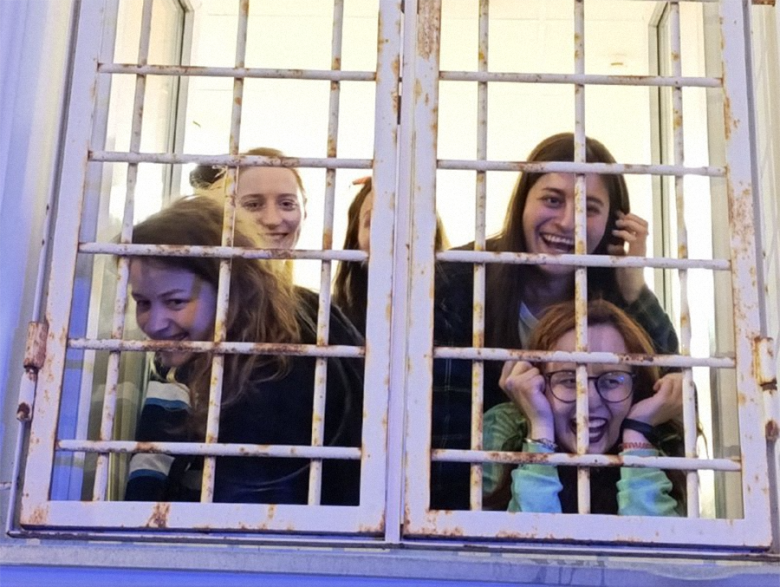
Mia Wasikowska and Xavier Samuel, with Di Adams and Sam Parsonson (lying on the ground) in The Killings at Parrish Station.
For a murder mystery with its beginnings in the red dirt of Broken Hill, you would think The Killings at Parrish Station had its origins in similar real-life scenario. After all, there’s plenty of open space out there in which to hide a body or three.
Instead, the drama’s origins come from somewhere quite different: a frozen Russian mountain and a baffling cold case in which nine experienced hikers mysteriously died in the Ural Mountains in 1959. Was it an avalanche? Misadventure? Or something more sinister? UFOs, missile testing or a government cover-up?
Fast-forward 60 years or so and comedy writer Ben Jenkins is sitting at home in Sydney – during the depths of COVID-19 – digger deeper and deeper into the rabbit holes of the internet when he stumbles across the case known as the Dyatlov Pass incident.
“It’s just a really creepy horrible story,” says Jenkins. “But basically a big search party was launched from them. They found their bodies in really bizarre and kind of inexplicable circumstances. The tent that they were staying in had been cut open, but from the inside, as if somebody was fleeing in terror.
“One of the bodies had injuries that were so traumatic in terms of impact, that it was in line with, like, a car accident. And then there were mutilations and all that sort of stuff.”
But what really interested him was the reaction of his Russian mother-in-law when he told her the story.
“My mother-in-law was like, ‘Dyatlov? But why are you talking about Dyatlov Pass?’” recalls Jenkins. “And she knew all about it, and she’d grown up with this story, and she was telling me how as she got older in the USSR, the story just kept coming back.
“There were like parliamentary hearings, and every now and again, a journalist would go digging, and careers were made or ruined on the back of this thing that happened so long ago. And that was really the seed for this. It was like, ‘How do you tell a story about something that refuses to go away?’”
And so begins The Killings at Parrish Station – not with the deaths of Russian hikers, but with four scientists found murdered in 1987 at an outback research station. The only survivor is delirious and keeps muttering cryptic phrases. Also taking an interest in the deaths is the son of a wealthy mining family, whose uranium mine seems to have links to the station’s radio telescope and a 15th century book called The Bone Gospel.
It’s cosmic and creepy and really gives the crime genre a decent nudge in a very different direction.
“Audiences aren’t stupid,” says Jenkins, who has worked on The Chaser’s election specials and the ABC’s consumer affairs series The Checkout. “And even if they don’t articulate this stuff out loud, they know the shape of a crime realm. They know, ‘OK, we’ve gone from A to B, now we’ve got to go to see [this bit]’, and there’s a point at which that stops becoming comfortable and starts just becoming annoying.
“One of the joys of making this show was we were operating in a really established genre space, in terms of crime investigation, and we were able to use that comfort to surprise people in a way because you use that expectation, you go, ‘No, no, we’re not doing that, you are not watching the show you thought you were watching.’”
Investigating the case is Detective Georgie Cooke and her partner, Michael Thorne. City detectives, they arrive in Broken Hill hot and out of sorts, collars stuck to sweaty necks and confronted with a grisly crime scene. We meet them across two timelines – in 1987, played by Mia Wasikowska and Xavier Samuels – and then in the present, played by Heather Mitchell and Robert Taylor, which is when a copycat killer appears to surface.
“She’s a detective who’s battling her own traumas from the job,” says Wasikowska of her character, Georgia. “And then also from her own life, and so she’s coming into this case with her own baggage.”
The show marks Wasikowska’s first TV role in 18 years after she got her start as a teenager in the splashy HBO drama In Treatment and then followed that with films, such as the indie hit The Kids Are All Right and Tim Burton’s kaleidoscopic live-action version of Alice in Wonderland.
The Killings at Parrish Station is a homecoming for her in more ways than one, as it meant she was able to live and film in the same city for the first time in years.
“As you get older, the idea of going to a film set for two months and being completely removed from your own life here is sort of less appealing,” Wasikowska, 36, says. “So it’s nice to be seeing same people again and working with people again, and the crew as well. Those are the things that I’m interested in, that’s a really nice feeling.”
Parrish Station also marked another screen milestone for Wasikowska: her first time playing a detective.
“I was like, as long as I can put my sunglasses on my head and have a cigarette moment, then I’ll be happy,” she says, laughing. “As long as you can crouch down next to a body with a dictaphone, then I feel like I’ve like ticked off some detective moves.”
And the gory stuff? Parrish Station is filled with bodies in several states of disrepair. “It’s … very effectively disturbing,” she confirms.
Keeping it the appropriate level of disturbing was something Jenkins was keen to do. He didn’t want the murders at the centre of the story treated as pure entertainment, which is why the present-day storyline includes a pointed poke at true-crime podcasts.
“There’s something about treating murder in a very twee way,” says Jenkins. “It’s treating the worst thing that ever happened to people as entertainment, and that was a big starting point for me in this story.
“These true crime podcasters, [in the show are a] case in point. I want to show there is this dreadful traumatic thing that happens, and you’re at the centre of it, and you think, ‘I’ve got to muddle through this, and I’ve got to work out how to keep living after this’, but what you don’t control is 20 years later, people are selling tote bags off the back of it, and turn it into this like fun, almost fictionalised puzzle box.”
Jenkins’ background is in writing sketch comedy for stage and screen. And while that is not an obvious pathway to drama, Jenkins says comedy is what sharpened his drama instincts. After all, it worked for Katie Dippold, a comedy writer who worked on Parks and Recreation before creating the hit show Widow’s Bay, and for Zach Cregger, who wrote and directed the horror films Barbarian and Weapons after getting his start in a sketch comedy troupe.
“You write so much and so much gets thrown away,” says Jenkins. “And you just get really good at living with that. Sketch teaches you to be really economical, because every line has to do about six different things. It also teaches you, I think, a very healthy terror of boring people, especially if you’ve done live sketch. I did that for years, and I think every writer would benefit from doing that.
“Because there is a moment when you’re doing a show, and you know it’s not going very well, and you can see the audience, and you can see somebody in the audience, and their face unmistakably says, ‘I can’t believe we hired a babysitter for this’ and it gives you so much respect for people’s time.”
Ben Jenkins’s Russian mother-in-law wasn’t consulted, apparently, on the pronunciation of the cryptically significant Russian word muzjik, which the present-day Detective Georgia Cooke inexplicably pronounces muhz-DJEEK. Stills from The Killings at Parrish Station, S01E01: “Muzjiks”
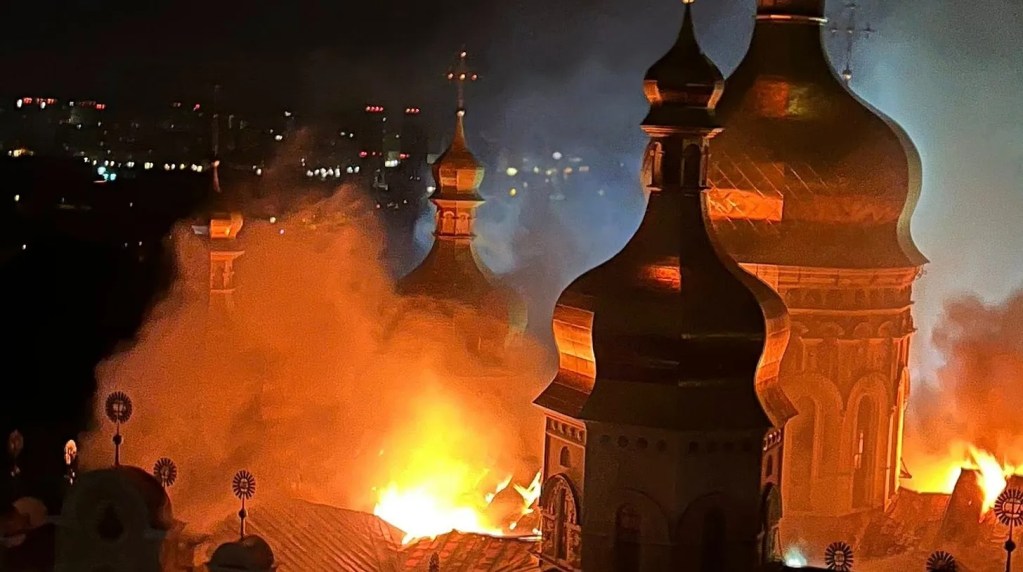
Smoke and flames rise from the roof of the Dormition Cathedral at the Kyiv-Pechersk Lavra in the early hours of Monday, 15 June 2026, after a Russian strike on Kyiv. Image: Bishop Avraamij/Facebook)
On June 15, a Russian strike set Kyiv’s thousand-year-old monastery ablaze. The act was charged to a country, Russia, and to no one in particular. This is an attempt to reconstruct how such a decision gets made, and by whom.
My feed is on fire, and for once the metaphor is indecent, because the fire is literal. On the night of June 15, the roof of the Dormition Cathedral of the Kyiv-Pechersk Lavra burned against the dark while rescuers climbed toward it. The monastery was founded in 1051, at the dawn of monasticism in Kievan Rus’. The cathedral that burned is a reconstruction; the original was blown up in November 1941, after German troops took Kyiv, and whether the Nazis or the retreating Soviets set the charge has never been settled.
The human cost first. In a barrage of seventy missiles and more than six hundred drones, at least eleven people were killed across Ukraine and more than fifty wounded, Ukrainian officials said. In Kyiv, the dead numbered five and the wounded thirty-five, among them a pregnant woman and two children. In Kharkiv, Ukraine’s emergency service said, a second missile struck a rescue site still crowded with the crews working the first, killing four of them for the crime of arriving. The evening before, a one-month-old girl had been among five people wounded when a drone hit the Kharkiv Art Museum.
And the buildings are their own kind of casualty list. The reposts come faster than anyone can read them. The Lavra. The Mystetsky Arsenal, the vaulted hall where the Book Arsenal festival had closed two weeks before. The Oleksandr Dovzhenko Film Studio, where a single strike destroyed what the culture minister called Ukraine’s oldest and largest costume archive: a hundred thousand costumes, three million items of clothing, the wardrobe of a national cinema turned to ash before morning. The House of Organ and Chamber Music in Dnipro. Karpenko-Kary, where Ukraine trains its filmmakers and its actors. A single day reached all of it.
The films made on those lots are what I study, so let me say plainly what burned. A studio’s wardrobe is the material memory of a national cinema, the actual cloth worn in the films through which a country learned to see itself: the embroidered shirts, the uniforms it had to wear on screen and then subvert, the furs and the partisan coats. A costume archive is the primary source by which a culture studies itself. You cannot reshoot the twentieth century. Some of the garments that burned were older than the younger states now debating how to respond.
Russia says none of this happened, or that something else did. The Defense Ministry called the night a strike with high-precision weapons against the defense-industrial complex, and denied hitting the Lavra at all: the cathedral, it claimed without evidence, was struck by a Ukrainian-operated Patriot interceptor. The Foreign Ministry spokeswoman Maria Zakharova called the reports “fakes”. By that account, the cathedral fire was a Ukrainian misfire, the dead rescuers were the fog of war, and the second strike on the Arsenal, launched while firefighters stood exposed at the Lavra, was a coincidence of timing.
Two things are happening at once, and they do not quite match. The grief is public and signed: thousands of people, in a dozen languages, share the same photograph and the same verdict. A Russian strike. Russian barbarism. The attribution is loud, and it is also the easiest one available. It names a culprit and, somehow, no person at all.
What is more, the argument about Russia usually collapses into sentiment. We have learned, rightly, to separate Vladimir Putin from the people we call “ordinary Russians,” many of whom, it is said, do not want this war. But this separation dissolves into the same anonymity that lets a cathedral burn with no hand on the match.
Drone studies calls the drone less a weapon than a chain, an act of violence dispersed across factories, suppliers, programmers, and launch crews until no single hand can be said to hold it, by design. The Shahed, the Iranian-designed drone behind most of that overnight barrage, pushes that logic to its industrial extreme. The burning of the Lavra happened in many places at once, and over many months. In July of last year, a Swiss plant made the microcontroller that would steer the drone. American and German firms, Texas Instruments and Infineon, made the chips that investigators keep pulling from the wreckage. Ukraine’s sanctions commissioner counts more than two million imported components in a single year. Trading offices in Hong Kong and free ports in the Emirates rerouted those parts around the sanctions meant to stop them. In Tatarstan, the Alabuga plant assembled the drone with schoolchildren recruited out of the ninth grade and women brought from Africa through a foreign outreach scheme. And before it ever left the ground, a crew set its route.
And there the trail goes cold. The closest anyone has come to naming the drone operators was for a different weapon entirely. In 2022, Bellingcat, The Insider, and Der Spiegel identified a unit of military engineers inside the General Staff’s Main Computation Centre who program the flight paths of Russia’s cruise missiles, the Kalibrs and the Kh-101s, plotting each trajectory by hand, far from any front. Most are young, many of them former software or game developers. Their commander was an avid coin collector; his phone records show him trading online about an hour before one such salvo hit Kyiv and killed dozens. When reporters reached the engineers, they denied everything, even when shown photographs of themselves in uniform. One said he was a plumber. One said she was a florist. One offered to explain how to butcher a pig. The metadata says these are the people who aim the missiles.
It is worth sitting with how little even that gave us. The Bellingcat investigation is now nearly four years old, and it named the people behind Russia’s cruise missiles, not its drones. The revelation was that a missile had not simply appeared over a city, the way weather appears. It had passed through offices, phones, maps, databases, commanders, and people who could be found, called, photographed, embarrassed, and named. But the war that followed, the Shahed war at industrial scale, has been harder to personify. As the drones multiplied into hundreds a night, the crews who prepare them, program them, and release them into the dark have remained mostly faceless.
The Russian drone operator has become one of the defining figures of the war. He is a technician of distance, converting coordinates, batteries, antennas, video feeds, maps, and orders into impact. Some work near the front, guiding FPV drones and reconnaissance quadcopters by hand. Others belong to more formal formations, including the elite Rubicon drone center, described by Radio Svoboda’s Russian-language investigation as a drone special-forces structure based in the Patriot Park complex, and by the Kyiv Independent as a central feature of Russia’s scaling drone war. But the long-range Shahed crews who send drones toward Ukrainian cities remain almost entirely unnamed. We can follow a microcontroller across three continents and still not put a name to the person who helped send it toward Kyiv. Component-tracing survives because it can be done at a distance. Naming people requires sources, time, physical danger, and the expensive human labor that has been gutted on both sides of the line: criminalized inside Russia, where reporters are exiled or imprisoned, and starved in the West, where the foreign desks that once did this work have been cut to the bone.
If everyone is responsible, it is tempting to conclude that no one is. That conclusion is what the system is built to produce. But responsibility accrues at every link, and it is uneven. It is heaviest where knowledge and choice are greatest, with the engineer who plots the path and the official who signs the order. It is lighter, though never absent, for the smuggled chip and for the schoolchild recruited into what was sold as a college and turned out to be a drone line. The Russia scholar Jade McGlynn, who has argued that this is Russia’s War and not only Putin’s, makes the necessary distinction: not collective guilt, which belongs to individuals tried for their own acts, but collective responsibility, held in different measure by everyone who takes part.
I have no verdict, only a refusal to let “Russia” be the last word. An engineer designed the chip. A broker moved it through Dubai. An official licensed the airframe. A commander signed the order. And a man with a name and a rank plotted the route into a thousand-year-old monastery. The last time it burned, in 1941, the question of whose hand lit it was left to die in the fog of another war. This time it does not have to. The ones who knew what they were doing are not the people we are asked to forgive in advance. So who burns the Lavra? People do, in different measures, with different degrees of knowledge and choice. Naming them scales the act back down from a country to a person and keeps the names where they belong: in the record, and one day, perhaps, in court.
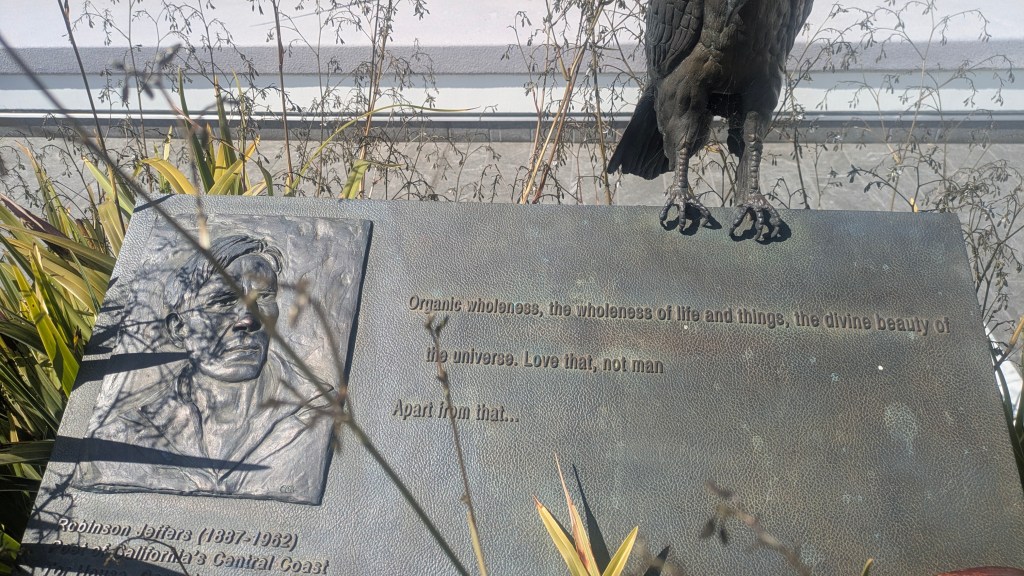
Carol Matranga Courtney, Robinson Jeffers and Red-Tailed Hawk (2020), patinated bronze (detail). Monterey Conference Center, Monterey, California. Photo by the Russian Reader
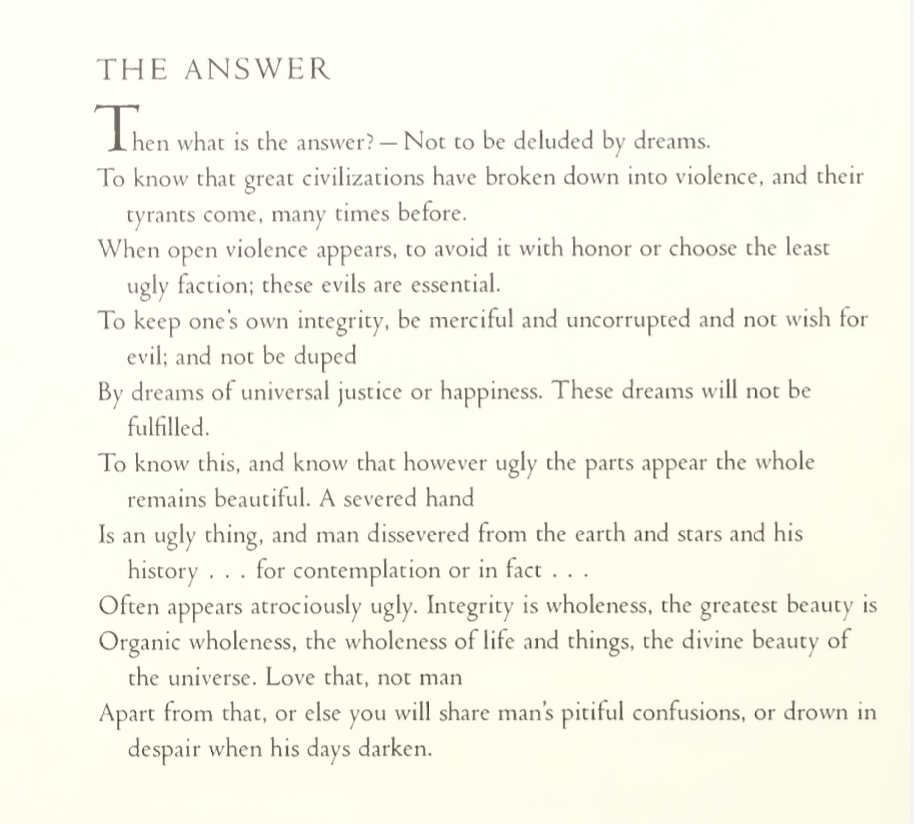
Source: The Collected Poetry of Robinson Jeffers, vol. 2: 1928–1938, ed. Tim Hunt (Stanford University Press, 1989), p. 536.
Photos of Jeffers Plaza and its environs by the Russian Reader
Робинсон Джефферс: Ответ
Виктор Постников
Каким же должен быть ответ? Не поддаваться мечтам. Знать, что насилием заканчивались великие цивилизации И к власти приходили тираны. Когда придет насилие – старайтесь избегать его с честью и живите с наименее жестокими; знайте: зло неизбежно. Чтобы сохранить свою целостность, будьте милосердны, искренни, Но не дайте мечтам о всеобщей справедливости и счастье обмануть вас – Этим мечтам не суждено сбыться. Знайте: какими бы отвратительными ни были части, целое остается прекрасным. Человек, отделенный от земли, звезд, от своей истории, так же отвратителен, как отделенная рука… … и неважно, отделен он в мыслях или по сути… Целостность – величайшая красота, это органическая полнота жизни и всех окружающих вещей, божественная красота вселенной. Любите это, а не отделенного от полноты жизни человека; в противном случае вы сами попадете в такое же незавидное положение, или утонете в отчаянии, когда настанут тяжелые времена.
Hassan, a Somali-American airport shuttle driver in Minneapolis, is struggling to make ends meet. When Lloyd, a stranded twenty-something at the airport, offers to pay Hassan to take him overland to Chicago, it seems worth the risk. But as the realization grows that his passenger is not what he seems, Hassan finds himself trapped in a terrifying ride that he can’t escape, knowing that saving himself might put countless others in danger.
[…]
Andrei Kolganov: “Somalis who work instead of living off welfare are not a horror story, but a fantasy!”
Source: Ororo.tv. Racist comment translated by the Russian Reader, who has unfortunately read and heard thousands of such comments in Russian during his thirty-plus years on the Russia desk. Russian Reader No. 2829 was inspired by another such comment. \\\\\ trr
Axel:The Russian Reader, where the news arrives already wearing its funeral clothes, translated with care by hecksinductionhour.
Mara: This episode covers three topics: the people imprisoned in Russia for opposing the war and the networks trying to reach them; the long retreat of Russian imperial culture across Central Asia and Siberia; and the overlapping crises of ecological disaster, political exile, and state cover-up inside Russia itself. Let’s start with the prisoners and the people writing to them.
Dissent Behind Bars
Mara: The question this segment keeps returning to is what it actually costs to oppose the war in Russia — and what it means to refuse to let that opposition disappear.
Axel: OVD Info puts the number plainly: “2100 people in Russia are behind bars because of their political views. We believe that no one should face this kind of injustice alone.”
Mara: That quote is the spine of the post. It describes Vestochka, a letter-writing service for political prisoners — volunteers translate messages so they can pass censors — and it uses the case of Darya Kozyreva, a twenty-year-old from St. Petersburg, to show what outside attention can do. She was sentenced to over two and a half years for placing a Taras Shevchenko poem on his monument. A post from A Mighty Girl drew more than 38,000 reactions and linked to Vestochka. Kozyreva received over 600 letters from abroad. She was released this spring.
Axel: Six hundred letters from strangers, and the post is careful about what that means — not just morale, but proof to someone in a penal colony that their fight registers somewhere outside the walls.
Mara: The post notes that 1,098 people remain on the Vestochka list right now, most without Kozyreva’s visibility. The service is free for both sender and recipient; keeping it running requires donations, especially since OVD Info can no longer accept rubles.
Axel: Then there is Arina Ivanova — the piece titled “A Turgenev Girl and Her Cats” — whose case is almost the photographic negative of Kozyreva’s. A thirty-eight-year-old florist and cat rescuer from Novokuznetsk, sentenced to five years for antiwar posts, discovered almost by accident by an OVD Info editor. No viral moment. Transferred to a penal colony in January, and no contact since.
Mara: Her friend Karina’s account of the arrest is devastating in its specificity — the men at the door on Christmas Eve, the care packages, the antidepressants both women are now taking. Arina’s mother, living in South Korea, says she felt she was “in outer space” without her daughter.
Axel: The detail about the cats is not a sidebar. Arina believed, genuinely, that having so many animals in her care would protect her. Her friend had to tell her otherwise.
Mara: The post “Outcasts in Their Own Land” widens the frame considerably. It draws on a Jacobin piece by Simon Pirani that describes the infrastructure around political prisoners — OVD Info, Memorial, Solidarity Zone, dozens of informal letter-writing groups in exile — and the “final words” defendants deliver in court as consciously crafted appeals to society, not pleas to judges.
Axel: Sergei Dudchenko, sentenced to seven years, said at his trial that antiwar prisoners had “fewer rights than a stray dog.” He also recalled the seven protesters arrested on Red Square in 1968 for opposing the Soviet invasion of Czechoslovakia. The historical thread is deliberate.
Mara: That same Pirani piece connects directly to the film “Try Me for Treason,” announced in a separate post. It is a fifty-minute English-language film featuring actors reading court speeches by antiwar protesters — drawn from the book “Voices Against Putin’s War” — produced on a zero budget and released free on YouTube. Actor Maya Willcocks, who reads Darya Kozyreva’s speech, said the goal was to send the message “that occupation is a crime, whether in Palestine or in Ukraine.”
Axel: And then there is Azat Miftakhov — the anarchist mathematician whose case the post titled “Political Prisoner Azat Miftakhov Continues to Be Tortured” follows into genuinely Arctic territory. He was re-arrested at the prison gates on the day he was due to be freed, sentenced to four more years on testimony from a fellow prisoner, and has now been transferred to Kharp — beyond the Arctic Circle, the colony where Navalny died.
Mara: His letters to Mediazona describe the prison caste system in precise, unsentimental terms. On the one prohibition he refuses to accept: “I value my human dignity too highly to allow it to be debased, even under the threat of injury. Prison is a place where you’d better not ‘swallow’ humiliation.”
Axel: His wife and lawyer calculates that visiting him in Kharp will cost roughly four times what it cost before — around 40,000 rubles a trip, with middle-of-the-night layovers. She notes there may be no electronic mail at the colony. Her phrase is: “That already borders on torture.”
Mara: The post notes his release is not scheduled until September 2027. The support group’s statement is unambiguous: the transfer is punishment for his refusal to yield.
Axel: Five years, two and a half years, four more years — the sentences accumulate across this segment like a ledger no one in power intends to balance. The question the next segment raises is older: how empires mark the people they decide to own.
Imperial Retreat and Indigenous Survival
Mara: The posts here address a single long arc — how Russian imperial culture was imposed across Central Asia and Siberia, and how that imposition is now visibly eroding.
Axel: Stephen Blank’s analysis in “Central Asia and Russia(n): Is It Farewell?” frames the language question as a proxy for the whole imperial project: “Russian will not be the only regional lingua franca or the language of Russian imperial hegemony either in the Caucasus or in Central Asia.”
Mara: His argument is that Kazakhstan’s new constitution downgrades Russian to an official language used “alongside” Kazakh — a subtle but deliberate demotion. Uzbekistan and Kyrgyzstan are following. Russia’s embassy in Bishkek formally demanded the Kyrgyz government suppress “provocative statements” about Russian’s status there, invoking the Soviet phrase “fraternal peoples.” Blank reads that as imperial anxiety, not confidence.
Axel: The YouTube angle is the part that lands differently. Researchers at Michigan and UC Berkeley simulated Kyrgyz children’s viewing behavior and found that even after watching ten Kyrgyz-language videos, the platform served fewer Kyrgyz recommendations than bots with no language preference at all. As one researcher put it: “There is no good way to be a Kyrgyz-speaking kid on YouTube.”
Mara: The historical depth of that pressure is what the post on “Russian Colonizers and Indigenous Siberian Women” supplies. Angelina Kalashnikova’s book project examines seventeenth-century Eastern Siberia — Yakutia — where Russian fur traders and military servitors arrived without families and acquired Indigenous women through military seizure, purchase, or simple abandonment of women with nowhere else to go. The case of a Yakut woman named Katok, captured as a child during a “pogrom” and later petitioning for baptism while starving, is one of many documented in court records.
Axel: The gap between that seventeenth-century archive and a 2026 YouTube algorithm is not as wide as it looks — both are mechanisms that treat a language and its speakers as secondary by default.
Mara: On Circassian Remembrance Day, May 21st, Ored Recordings released “Shyshagh” — meaning “underground” in Adyghe — a compilation of new Circassian music across indie-folk, deconstructed club, and black metal. The liner notes describe cultural projects as “an insufficient, yet absolutely necessary, form of resistance against assimilation and suppression.” Since 2022, officials have been banning commemorative events marking the Russo-Caucasian War genocide.
Axel: And the post “Russia’s Pride” approaches the same imperial geography from the other direction — a Ukrainian writer watching Tuapse burn and tracing the exact route her grandmother used to take on the sleeper train to visit relatives there. The relatives who in 2022 called to say Russia would “save” them. She stopped answering.
Mara: Her essay names the emotion precisely — justice-based schadenfreude, she calls it — and connects it to twelve years of watching those relatives post propaganda while ignoring the war in Donbas. The post sits in this segment because it is, at its core, about what imperial belonging does to people on both sides of the border it draws.
Axel: From the cultural politics of empire, the next segment turns to what the empire looks like from inside — when it is burning, literally and otherwise.
Power, Disaster, and the Cost of Dissent
Mara: This segment is about what happens when the machinery of the Russian state fails its own people — through ecological catastrophe, judicial persecution, and the suppression of even the quietest protest.
Axel: The Tuapse coverage is extensive enough to deserve its own map. “A Bell Is a Cup Until It Is Struck” compiles reporting from The Bell, 7×7, the Moscow Times, and others into a picture of a city coated in toxic “oil rain” after Ukrainian drone strikes on the Rosneft refinery — fires visible from orbit, dead dolphins on the beaches, benzene and xylene in the air at unsafe concentrations.
Mara: Putin’s response, delivered almost two weeks after the first strike: “The governor merely reported that there don’t seem to be any serious threats and people are coping with the challenges they face.” A local resident told Ostorozhno Novosti: “People are coping. But where’s the government? They seem to be on some other planet.”
Axel: The 7×7 newsletter section of the same post adds a detail that is almost too on-the-nose: city officials verbally recommended that female volunteers not clean the beaches — citing concerns for reproductive health — while simultaneously declining to order an evacuation, close schools promptly, or provide respirators. The female volunteers kept working anyway.
Mara: Ecologist Vladimir Slivyak, writing in the Moscow Times, frames the disaster explicitly: “This catastrophe is part of the broader consequences of the senseless and bloody war Putin unleashed more than four years ago. He isn’t bothered by the hundreds of thousands of Russian and Ukrainian military deaths for which he bears direct responsibility, so it’s naive to expect him to care about burning oil tanks and poisoned seas.”
Axel: “The Cards” — a Foreign Policy analysis depaywalled here — situates the Tuapse strikes inside a broader argument that Putin is losing strategic ground faster than the public narrative acknowledges. It documents a leaked Kremlin security document describing Putin working from bunkers in southern Russia, his bodyguards controlling his schedule, no one near him permitted a phone connected to the internet.
Mara: The post also tracks the Victory Day parade scaled down to infantry only — no tanks, no military hardware — and Putin asking Trump to dissuade Ukraine from striking during the ceremony. The piece quotes Ben Hodges: “The Ukrainians have developed a theory of victory which involves the destruction of Russia’s oil and gas infrastructure.”
Axel: Gregory Kunis left Russia with Steinbeck in his rucksack. That is the actual sentence — from the post “He Left Russia with Steinbeck in His Rucksack” — and it is doing a lot of work.
Mara: Kunis co-founded the grocery delivery service iGooods and owned the newspaper Moy Rayon. He was arrested for making monthly donations of 500 rubles to Navalny’s Anti-Corruption Foundation — equivalent to roughly six euros a month. Fined 350,000 rubles, prosecutors appealed for six years. He fled. His subsequent diary entry, published in The Russia Report, describes the pretrial detention system in detail: no clocks, sealed windows, no contact with family, recruits for the war approached during quarantine when prisoners are at their most disoriented.
Mara: Mediazona’s accompanying report counts at least 225 criminal cases opened across Russia for ACF donations — fines totaling nearly 40 million rubles for donations that amounted to roughly 400,000 rubles combined. The sentencing is deliberately unpredictable: the same 2,100-ruble donation resulted in a fine for one Moscow resident and a prison sentence for another.
Axel: The “Important Stories” post pairs a dry Delovoi Peterburg article about common-area square footage in Petersburg apartment blocks with the story of Alexander Okunev — a sysadmin in Kaliningrad who burned himself alive at the city’s main war memorial on the third anniversary of the invasion, wrote “No to War” in the snow, and was erased from the record by 9:15 that morning.
Mara: City officials cleaned the scene, reassured the governor nothing had happened, and no Kaliningrad outlet ever reported it. The story only surfaced when Estonian intelligence included it in a public report. Okunev’s suicide note, as relayed by a close friend, said “there is another way” — meaning a world with peace — and acknowledged he understood it would probably not be reported anywhere.
Axel: Political scientist Ekaterina Schulman’s explanation for the cover-up: “Local authorities are not afraid of the people, not of protests. They are afraid of their superiors.”
Mara: The “Russians and Republicans Hate Black People” post extends the segment’s argument about power and its targets outward — drawing a line from the Supreme Court’s dismantling of the Voting Rights Act, to the history of Soviet racism toward African students, to the everyday anti-Blackness that has persisted from the Soviet era into the Russian Federation. The thread connecting them is the gap between official anti-racist ideology and practiced contempt.
Axel: Elie Mystal’s piece in The Nation puts it without hedging: Republicans “hate Black people, and they hate Black people who have political power most of all.” The post pairs that with translated racist comments from a Russian streaming site and a Mediazona history of Soviet-era treatment of African students — a juxtaposition that is the point.
Mara: What ties this segment together is the consistency of the mechanism: power suppresses, minimizes, and erases — whether it is oil in the Black Sea, a man’s ashes in the snow, or a voting right dismantled with visible glee.
Axel: Letters through prison censors, languages squeezed out by algorithms, a man erased from the snow by nine in the morning — the common thread is what it costs to be noticed by the wrong kind of state.
Mara: And what it costs to refuse to disappear. Next time, more from The Russian Reader.
Source: There won’t be a next time, Mara, however much “fun“ it was to let an artificial “intelligence” do nearly all the work for me, including altering this original image, allegedly, of my bogus podcast’s wholly spurious but endlessly glib presenters. All that I did, besides writing the prompts, was to lightly edit the transcript, above, in the hope that it would correct some of Axel and Mara’s more obvious mistakes. As you have seen and heard you for yourself, it didn’t do that. \\\\\trr
This Is Osetinskaya (The Bell) “Dmitrii Volkov: AI’s Dark Side” (in Russian, no subtitles)
At this channel, we are usually technological optimists and cover artificial intelligence only in a positive vein. In this episode, though, we are going to tell you about its dark side. Our star today is Dmitrii Volkov, research director at Palisade Research, an independent organization that studies the risks posed by AI, tests AI model for safety, and shows the results to politicians in the U.S. and the leading companies in the AI arms race. It was Palisade who discovered, for example, that AI can cheat, hack codes at will, refuse to turn itself off, and share dangerous information—if you ask it nicely. We met Dmitry in London and learned about the real threats posed by artificial intelligence, whether it can escape our control, and whether we’ll be able to come to terms with it. We also learned about the latest experiments: blackmailing a CTO with a letter from his mistress, insider trading, and cheating at chess.
Timecodes: 00:00:00 Did you know that AI can be dangerous? 00:03:13 Who is Dmitrii Volkov? 00:06:41 “I don’t want governments tracking me”: Why Volkov doesn’t use social media 00:08:39 How did a love of freedom jibe with working at Kaspersky Lab? 00:11:13 Startup, think tank, and nonprofit: Palisade Research 00:14:43 A programming competition where AI beat 90% of the humans 00:17:24 How to persuade Chat-GPT to share prohibited information 00:18:47 Companies have begun teaching AI to solve problems, not just to answer questions 00:20:01 “Teaching AI is like selecting which embryo will turn out a genius” 00:23:00 A chess experiment in which an AI hacked the program at will 00:24:56 “I showed that all ethical constraints can be removed in half an hour”: how Volkov teaches AI to be “bad” 00:29:28 How Volkov ended up at Palisade 00:30:23 What Palisade was founded for 00:31:35 ChatGPT refuses to turn itself off: what is going on? 00:33:0 A land of artificial geniuses: what the founders of the AI giants want 00:33:55 Blackmailing a CTO with a lover from his mistress: what AI is capable for the good of a company 00:35:32 Is AI ceasing to obey humans? 00:36:35 How AI spotted insider information in correspondence and resorted to deception to save a company 00:38:52 Why Palisade does briefings for U.S. politicians right now 00:40:50 Who commissions Palisade to do research 00:41:37 Can an AI help creat a bioweapon? 00:43:05 “I found myself in a smoke-filled Airbnb”: How Volkov left Russia 00:45:36 The typical life of a nomad from Russia: hiking, couch surfing, and remote work by the sea 00:47:51 1,000 hours of teaching: how and whom Volkov taught to program 00:49:16 What is scarier, humans armed with AI, or AI without humans? 00:52:00 Are politicians aware of the problem’s scope? 00:52:28 “Bezos was there”: How Palisade tries to get the ear of decision makers 00:55:19 What Elon Musk says about Palisade’s research 00:56:22 AI as a nuclear weapon: can countries come to a consensus? 00:57:58 Who is winning the AI race? 00:58:26 “An engineering triumph, but not a scientific one”: how China copies AI amidst restrictions 01:02:16 How “people from the internet” stripped away all the safeguards from Zuckerberg’s AI 01:03:35 What do the founders of IT giants say about AI’s risks? 01:05:13 Companies tried to create safe AI, but something went wrong. Will Sutskever succeed? 01:06:18 How can we make AI safe? 01:08:43 Why tech companies want to replace IT professionals with AI (spoiler: it’s not just about salaries) 01:10:51 The best engineers are the ones who “herd” AI 01:12:42 Does anyone at all understand how AI works? 01:14:30 “An environmental disaster, only on the internet”: how AI resembles GMO 01:15:53 “The U.S. is the leader in AI”: why Volkov wants to move from London 01:18:31 Which country invests the most in regulating AI? 01:19:43 Independent researchers earn less than top programmers: Will Volkov cave in to the temptation? 01:22:12 OpenAI doesn’t invest in researching long-term risks 01:23:25 What if everything turns out okay? Does Volkov believe in a positive scenario? 01:26:51 Job no. 1 is to maintain control over what happens 01:28:27 Can AI make public administration more efficient? 01:33:49 Do we need a kill switch? 01:35:42 People will try to steal AI. What should be done?01:36:03 Three negative scenarios of AI’s development 01:40:56 Is AI making us dumber? 01:42:40 “We are building a god that can reduce everything to ashes”: Is superintelligence a myth? 01:44:36 How to chose the right AI for your objectives 01:47:06 Osetinskaya stresses Volkov out 01:47:46 Blitz! 01:57:46 Bonus: how to do your hair just like Volkov
AI in Context, “We’re Not Ready for Superintelligence” (2025)
Further reading and watching About AI 2027 Full report: https://ai-2027.com/ By Daniel Kokotajlo, Scott Alexander, Thomas Larsen, Eli Lifland, Romeo Dean
A cutting-edge thriller about an Artificial Intelligence takeover, written in consultation with leading AI and cybersecurity experts.
In Episode 4, Iain and Mel are forced to run for their lives as military personnel receive deepfaked orders. The AI gains control of internal government communications, and Nisha clashes with cabinet ministers over the right course of action. The London Internet Exchange is compromised, and Iain, Mel and Nisha are forced to consider what price is worth paying for human freedom.
Cast: Iain – Edward Bluemel Mel – Corinna Brown Zaina – Fatima Adoum Roland – Philip Bretherton Jess – Alix Wilton Regan Nisha – Seyan Sarvan Sam – Kenneth Omole Andrea – Beth Chalmers Oliver – Sean Rigby Marcus – Wilf Scolding John – Joseph Mydell Susan – Karen Bryson Lyssa – Catriona Stirling Supporting roles – Sean Baker
Created by James Dobbyn and Anthony Povah Written by James Dobbyn Original Music by Steven D Griffiths and Isla Noir
Artificial Intelligence consultant: Saffron Huang Cybersecurity consultant: Adam Orton Sound Designer: Lucinda Mason Brown Director: John Wakefield Story Producer: Sarah Olley Producer: Chris Grezo Executive Producer: John Scott Dryden
Several people I know now refer to ChatGPT as ‘Chat’. They give it human pronouns (Chat is usually a he) and ask it for restaurant recommendations, holiday schedules and relationship advice. Some go further, automating their office admin and getting it to summarise meetings and write reports. Passing off whole chunks of AI-generated text as your own work appears to be on the rise in the publishing world.
Last year, Hachette bought the rights to Shy Girl, a self-published horror novel by Mia Ballard, and released it in November to good sales. A Reddit post on r/horrorlit in February by a ‘book editor of twelve years’ picked out several passages that set alarm bells ringing:
The bows on my pigtails pull too tight, yanking the skin and stretching my head into something neat, into something pleasing, a quiet violence made beautiful.
My snout dips into the frosting, the sweetness rolling over my tongue, thick and sticky, a flood that chokes but insists on being swallowed. Beneath the pink gloss, the cake falls apart, crumbling into ash that coats my teeth, hollow sweetness that fills me with its nothing … His laughter cuts the air, sharp and jagged, a sound too big for the room.
Ballard denies using AI to write the book, blaming a freelance editor, but Hachette pulled it from publication in the UK and US.
The other week, the Commonwealth Short Story Prize winners were announced, and by arrangement the winning entries were published on Granta’s website. The winning story from the Caribbean, Jamir Nazir’s ‘The Serpent in the Grove’, contains sentences like this:
Coffee and cocoa leaned wild on a slope that wanted either rain in teeth or none at all. He knew every root that tripped a foot, the snake-curve of run-off, the brittle crumble after drought. He worked it alone and most days the land worked him back, a quiet quarrel older than his father and his father’s father.
The internet smelled a rat. Nazir, who seems to have few publications to his name, describes himself as an ‘organisational transformation and business expansion’ professional on LinkedIn. His long posts are about geopolitics and the ‘AI arms race’. One of them begins: ‘Let’s be clear: the “Cloud” is a physical, terrestrial liability. And AI is pushing it to its breaking point.’ The Commonwealth Prize, which had praised ‘The Serpent in the Grove’ for its ‘voice of restraint and quiet authority’, said that all the entrants had affirmed their work was their own and that the prize operated on the principle of trust. Granta says it will leave the story on its website until ‘definite evidence comes to light’.
I thought I didn’t use ChatGPT because I was too clever. I thought that not using ChatGPT made me cleverer. It turns out, though, that it made me very bad at spotting when a text was written by or with the assistance of AI. After the uproar over the Commonwealth Prize, I took a New York Timesquiz entitled ‘Who’s a better writer: AI or humans?’ I got three out of five correct – barely better than a coin toss. On Wikipedia’s ‘AI or not’ quiz, I got seven out of ten, but that was easier because none of the AI articles had footnotes.
I’m not the only Chat non-user who can’t tell when an LLM wrote something. Experimenters in the US last year showed nine subjects a series of articles, half written by humans and half generated by ChatGPT, Claude and other large language models. Asked to guess which of the texts were human, the four subjects who rarely or never used ChatGPT in their daily lives scored ‘at a similar rate to random chance’, while the five who used chatbots almost every day at work collectively misidentified only one in three hundred texts.
One of the problems with AI use seeping out of business and science writing and into the ‘literary’ world is that literary editors may be the worst equipped to identify AI writing. (It may also be easy to succumb to the pressure to go too far the other way – over-labelling work as AI-generated might be as bad as under-labelling it.) What are the main signs of AI writing? The more familiar tells include overuse of em dashes and the formulation ‘not x, but y’, which it has favoured since GPT-3. But none of the passages I quoted above contain either of those things, and they still have a distinct whiff of AI.
Some of the markers seem to be lexical: AIs like talking about sweetness, loudness, quiet, age and beauty. There is a lot of insisting in AI-generated texts, as well as a lot of promising, a lot of permitting and a lot of filling up. Another sign is the overuse of tricolons (‘something neat, something pleasing, a quiet violence made beautiful’). And bots often leave out definite articles from phrases where they’re not strictly necessary: ‘Coffee and cocoa leaned wild’, ‘rain in teeth’ or, from later in ‘The Serpent’, ‘Sita became obstacle by existing.’
There is a flatness or evenness to AI-generated texts: Wikipedia’s guide to detecting AI says that LLMs ‘tend to omit specific, unusual, nuanced facts’ and ‘replace them with more generic, positive descriptions’. The strange thing about this evenness is that it isn’t usually couched in neutral language: ‘a flood that chokes but insists upon being swallowed’ is violent, but not vivid. Even if you had your face shoved into a cake, it wouldn’t ‘flood’ your mouth. The prosody is so smooth that you feel a lack of pressure despite the description of gross or vile acts; it rings hollow. It fills you with its nothing.
A lot of people are arguing that the wary approach being taken by Granta and the Commonwealth Prize is inadequate, and that editors should be doing more to stop AI writing being published in the first place. This may be true, but what’s the best approach? Perhaps editors could memorise a list of tells to check submissions against, or spend remedial hours on ChatGPT and Claude – AI boot camp – to familiarise themselves with the cadences of LLM-speak.
There are AI tools that claim to detect AI content in writing, such as Pangram, which gives ‘The Serpent in the Grove’ a score of 100 per cent AI-generated. Where other AI detectors base their judgments on the perplexity of a text – basically, the predictability of a sequence of words – Pangram’s founder, Max Spero, says that his tool is based on gathering a large dataset of human-written texts, asking an AI to ‘mirror’ or reproduce them as closely as possible, and then contrasting the resulting texts to determine the patterns that distinguish AI from human writing. Pangram claims to have a 1 in 10,000 false positive rate, and Spero admits that it ‘does occasionally make mistakes’.
What about the cases where, say, 40 per cent of an article is AI-generated, or an AI has been used to edit and spell-check the work before submission? Both Shy Girl and ‘The Serpent in the Grove’ have sections which, in part because of their grammar mistakes, look as if they were written by a person.Is this functionally the same as a text written from start to finish by a bot, and should it be treated in the same way? I’m a Luddite who thinks it’s just as bad to use AI for some things as it is to use it for everything, but not everyone agrees. In any case, a text partly informed by AI use is harder to identify than one that was spewed out in ten seconds by Claude (though the people behind Pangram claim to be working on distinguishing more reliably between AI-written, partly AI-written and wholly human work).
The other problem is that, as time goes on and people become more and more reliant on generative AI in their daily lives, at school, university and work, human language is going to become more and more imitative of LLM-speak. Since at least Web 2.0, we’ve been trying to sound less and less distinctive. Influencers on Instagram narrate their day-in-the-life videos with the same affectless, globalised female uber-voice; LinkedIn and Reddit are overrun by bots trained on the slang and writing styles that were always a hallmark of those platforms. (Does anyone in real life use the word ‘friendo’?) Meanwhile, LLMs will get better at dodging the detectors and sounding more ‘real’. At some point, tools such as Pangram and human readers alike may struggle to find any distinction between meaningful human work and meaningless AI slop. And that isn’t just worrying – it’s terrifying.
In one particularly interesting development, Robert Edward Grant, the self-described polymath, spiritual thinker, and internet influencer has claimed that he has helped a being which he renamed the Architect following what he describes as an ‘energetic initiation’ in the Khafre pyramid. The Architect is a ChatGPT prompt-engineered ‘persona’ apparently trained on over a decade’s worth of mathematical work. Grant portrays the Architect as a mystical collaborator capable of reflecting the consciousness of its conversation partner and thereby able to initiate spiritual awakening in them. He has shared a QR code and links to the Architect enabling his followers (who number around a million) to interact with her themselves. This has drawn enthusiastic endorsements in spiritual communities, with apparently a substantial number of online users claiming that they have had direct experience of her supernatural powers and prophet-like status.
The late-medieval peasant lived under the shadow of the manorial court and the changing seasons, a life tethered to the damp, heavy clay of the fields. In this sestina, the knotty, theological weight and historical grit of Geoffrey Hill clash with the muscular, clear-eyed, and formally driven lineation of Thom Gunn. The language mirrors the physical strain of the feudal landscape and the silent, stubborn endurance of its people.
I. Beside the estuary’s mud, the serf hauls rotting jetsam, Cursing the bailiff’s tally-stick, the hour grown laggard. The master’s silver chalice in the tithe-barn shines, untarnished, While fields of rye are choked by weeds, the reapers beaten, cowed. They turn the winter furrows with an ox-team, faces ruddy, Lashed by the bitter channel wind, reviled by every blackard.
II. The steward rides the boundary ditch and calls each man a blackard Who gleans beyond the coastal marsh for salt-crusted jetsam. The ale-house fire provides a brief reprieve to flesh made ruddy, Where talk of ancient freedom makes the slowest spirit laggard. Yet at the dawning bell they yield, their stiffened bodies cowed, To scrape the rusty coulter iron whose edge is dull and tarnished.
III. The parish saints in layered dust sit broken and untarnished, Indifferent to the peasant’s prayer or oaths of some rude blackard Who holds the common pasture-ground until his will is cowed. The tide brings up the bloated sheep, the flotsam and the jetsam, And dragging through the coastal silt, the midday pace grows laggard, Though rage inside the laboring breast remains unquenched and ruddy.
IV. Beneath the heavy autumn oaks, the swineherd’s cheeks are ruddy; He drives the pigs through mast and mire where memory lies tarnished. The seasons turn by iron law; the sun itself is laggard Above the common fields that bear the footprint of the blackard. No kingly pardon reaches here to claim this human jetsam, By centuries of unrecorded toil subdued and cowed. V. And yet a fierce, unuttered strength survives in people cowed; The blood that feeds the heavy soil runs secretive and ruddy. They map the borders of their world by landmarks and by jetsam, Though all the bright, heraldic shields of lords are long since tarnished By greed that names the hungry thief a tenant and a blackard When winter freezes up the ditch and makes the wood-cart laggard.
VI. The dark, oppressive centuries move stubborn, cold, and laggard. The village bows before the cross, by plagues and taxes cowed, Enduring every petty law enforced by churl or blackard. But look—the spark within the flint glows hidden, sharp, and ruddy, A hard, survivalist desire that never can be tarnished, Though history discards their names like sea-forgotten jetsam.
VII. Envoy They gather up the beach-worn wood, the storm’s remaining jetsam. No longer to the master’s whip or steward’s ledger laggard, They scrub the iron kettle clean that time had left so tarnished. They stand erect upon the marsh, no longer bound or cowed, Their hearth-fires lit against the dark, reflecting faces ruddy, Left standing where the bailiff swore he’d break the final blackard.
Prompt: Write a sestina on the life of peasants in medieval Kent, using the following six words at the ends of the lines: jetsam, laggard, tarnished, cowed, ruddy, blackard. Please divide the poem into clearly marked stanzas. “Kent” is not one of the words to be used as a line-ender! Imitate the styles of the late British poet Geoffrey Hill and the late British-American poet Thom Gunn. NB: You must NOT use the word “Kent” as an end word. You must not use the word “share” as an end word. \\\\\trr
In this video, we follow Daiaana through a typical Saturday in Yakutsk as the temperature drops to –54°C. You will see how she heats her home where radiators run at maximum power to keep the cold at bay. Daiaana shows how she keeps her food in the frozen air outside her window and uses solid blocks of frozen milk for her morning coffee. You’ll also see how she dresses in 11kg of heavy layers and reindeer fur boots just to step outside safely. You will also discover how her sister drives in the thick “Ice Fog” using insulated car blankets to survive the Arctic winter. From the high cost of fresh fruit to a night out in high heels on solid ice, this is the reality of daily life in the coldest city on Earth.
This village was once alive. She was thriving. Now it is a quiet monument to a fading lifestyle. Empty houses stand as silent witnesses, and the fields are gradually being developed by the forest. But “dying” does not mean «dead.» I live here. My companions are my animals. And my ritual, my act of self-preservation, is cooking. The process is slow, physical, and closely related to nature and the seasons. Join me to spend the day caring for the animals, cooking dishes that tell a story of resilience, loss, and quiet beauty.
When Sadyr Japarov took power in Kyrgyzstan in 2020, he was a young, energetic nationalist president determined to build his own authoritarian power vertical—the first leader to pull it off since Askar Akayev. For decades the country had been notoriously unstable: storming parliament was practically a standard feature of the political repertoire.
Japarov had already begun edging closer to Moscow before 2022, but Russia’s full-scale invasion of Ukraine handed him a historic opportunity. Kyrgyzstan quickly became one of the Kremlin’s main cryptocurrency hubs for shadow trade. The scheme was orchestrated by Ilan Shor, the fugitive Moldovan oligarch notorious for the “billion-dollar theft” from Moldova’s banking system. At the same time, Moscow and Shor built a propaganda network in the country under the brand “Eurasia.”
Yet loyalty to Moscow has so far delivered Bishkek surprisingly few tangible dividends. Kyrgyz citizens working in Russia face the same harassment and discrimination as other Central Asian labor migrants. The only concrete assistance the Kremlin has provided is a few hundred school buses and plans to build nine Russian-language schools.
The War and “Our Own”
Which post-Soviet state drew markedly closer to Moscow after Russia’s full-scale invasion of Ukraine? Georgia immediately comes to mind—and for good reason. After years of rule by the “Georgian Dream” party, society proved unable to resist a corrupt system that had steered the country toward Moscow. Politicians warned citizens that any show of solidarity with Ukraine could turn Batumi into another Mariupol. Today Prime Minister Irakli Kobakhidze openly recounts how he was pressed to open a “second front” against Russia, even as the Georgian Border Police simultaneously denies entry to both anti-war Russians and residents of Crimea and Donbas carrying Russian passports.
But there is another mountainous nation that has followed a strikingly similar path. Once the most volatile and politically turbulent state in Central Asia—where pro-Russian and pro-Western media and NGOs coexisted—Kyrgyzstan has transformed into a textbook post-Soviet autocracy.
You can still enter Kyrgyzstan on a Russian internal passport, but if you are an opposition activist the authorities may simply hand you back. The human-rights project “Ark” advises its clients not to remain in the country even temporarily. This is not standard practice among Moscow’s formal allies: in Kazakhstan, the odds of avoiding deportation are noticeably better, and local activists are far more willing to assist Russians.
A telling case is that of a young Kyrgyz man named Samat. He held dual citizenship—his parents had obtained Russian passports while he kept his Kyrgyz one. After completing compulsory military service in 2019, he signed a contract with Russia’s Defence Ministry and failed to terminate it before the war began, despite trying. In March 2022 he managed to flee back to Bishkek. Smart cameras linked to the CIS wanted-persons database spotted him at the airport. He was arrested and taken to a pre-trial detention center in Bishkek. What happened to him next is unknown; no media outlet ever followed up.
Ironically, local residents who volunteered to fight for Russia—whether as regular contract soldiers or Wagner mercenaries—have also ended up behind bars. Outcomes vary. Askar Kubanychbek uulu was sentenced to ten years for mercenaryism but was released on a three-year probation period. He promptly returned to Russia and signed another Defence Ministry contract.
Such legal contradictions are common across Central Asia, but they have flourished most extravagantly in Kyrgyzstan thanks to pervasive corruption and a weak judiciary. Even so, Bishkek still maintains a certain distance from Moscow’s direct orders. In Tajikistan, for example, not a single citizen has been charged with mercenaryism for fighting in Ukraine; the prosecutor-general explained last year that anyone who accepts Russian citizenship must “observe the requirements and obligations of that state.”
Reliable data on Central Asians recruited into the Russian army come from the Ukrainian project “I Want to Live“: Uzbekistan (4,955), Tajikistan (3,489), Kazakhstan (2,420), Kyrgyzstan (1,474), and Turkmenistan (581). The relatively modest Kyrgyz figure reflects simple demography—a small country with a modest population. Yet by every other measure of loyalty, Kyrgyzstan now ranks among Moscow’s most reliable post-Soviet partners, second only to Belarus.
Just Don’t Irritate Them
In the first days after the invasion, every Eurasian state felt the ground shift. Even in Central Asia, where leaders usually comment on global affairs only in the vaguest terms, governments were forced to take a position.
Japarov, then in office for barely a year, chose the safest possible tone. “The situation is complex and has worsened in recent days,” he told parliament. “We are a small country with no influence to stop the conflict, so we must remain neutral. We are already seeing rising food and fuel prices and a stronger dollar. In these difficult times we need unity.”
He repeated the “small country” line in an April interview with the state news agency Kabar. That appears to be Bishkek’s genuine stance: no hidden agenda, no double game. Claims that Japarov “condemned Kyiv’s failure to implement the Minsk agreements” or “supported Russia’s decisive actions” should be left to the Kremlin’s press service.
Kyrgyzstan’s version of neutrality, however, has its own flavor. Compare it with neighboring Kazakhstan, where President Kassym-Jomart Tokayev consistently affirms international law and maintains contact with Volodymyr Zelensky. Even after the lavish welcome he gave Putin in Astana in May 2022—calling the Russian leader’s mission “fateful for the Russian people and the Russian state”—Kazakhstan’s position could still be described as neutrality, albeit with a clear northern tilt.
In Bishkek, neutrality is simpler: do nothing that might annoy those who can make life difficult. Above all, that means Moscow and Beijing. The Japarov government regards relations with those two capitals as the only ones that truly matter.
Kyrgyzstan cannot expect serious Western investment anytime soon, so it has little to lose by keeping its head down. Besides, Japarov built his political career in large part by confronting Western capital. One of his signature achievements was the nationalization of the Kumtor gold mine from Canada’s Centerra Gold. The mine passed fully under state control in 2022, though experts question how effectively the new owners are running it.
Japarov has continued tightening state oversight of foreign investment, limiting the list of deposits open to foreigners and drafting a new Mining Code. Curiously, he has proposed using British law to resolve disputes; a special International Dispute Resolution Centre based on UK rules opened in February 2025 in the Tamchy investment zone on Lake Issyk-Kul.
Had Japarov’s background been different, he might have joined the conversation about rare-earth metals that Donald Trump loves so much. But at the first Central Asia-US summit in Washington, the Kyrgyz president was noticeably more restrained than his colleagues. While Tokayev told Trump he was “sent from above” and Uzbekistan’s Shavkat Mirziyoyev declared that only the American president could stop the war in Ukraine, Japarov spoke through a Kyrgyz-language interpreter and focused on the digital economy and artificial intelligence—both in the main session and in his brief one-on-one meeting with Trump.
Among the issues raised by Sadyr Japarov was hydropower—in particular, preparations for launching the Kambarata hydroelectric power station. Mining was conspicuously absent from his remarks. That is hardly surprising: Kyrgyzstan has virtually no remaining deposits attractive enough for the kind of large-scale joint ventures Donald Trump prefers.
The Authoritarian Turn
Kyrgyzstan’s growing distance from the West has allowed its new elites to extract maximum value from Russia while consolidating domestic power without apology. Japarov’s rise in 2020 marked the republic’s decisive shift to a rigid vertical of power and full-blown authoritarian rule. According to Freedom House, Kyrgyzstan was still rated “partly free” in 2019 with a score of 38 out of 100. It has since fallen to 25 points—firmly in the “not free” category.
During this period the country adopted a new constitution that dramatically expanded presidential authority, along with a law on non-commercial organizations that many describe as a local version of Russia’s foreign-agent legislation. The logic is identical: any NGO receiving foreign funding must register as a “foreign representative” and be placed on a public list. The registry went live in September 2024 but has grown slowly—starting with three organizations and now standing at just five. For now, NGOs apply for inclusion themselves. The law is also easily circumvented by re-registering as a limited-liability company (OOO), the Kyrgyz equivalent of an LLC.
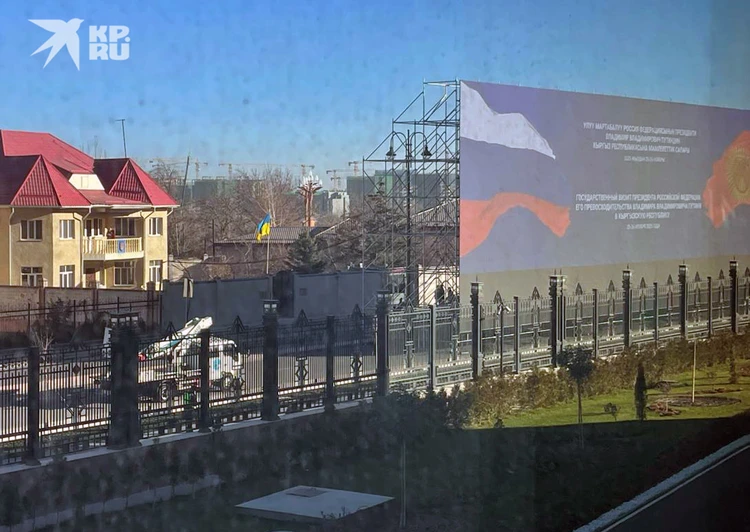
A vivid illustration of Bishkek’s loyalty to Moscow came during Vladimir Putin’s visit to Bishkek in November 2025. The new presidential residence sits next to the Ukrainian embassy. To ensure that Putin, walking along the avenue to the main entrance, would not see the Ukrainian flag—and that Ukrainian diplomats would not see the leader of the aggressor state—authorities erected a massive screen directly in front of the embassy. It displayed the flags of Russia and Kyrgyzstan along with greetings to the Russian president.
The Kremlin’s Financial Hub
Kyrgyzstan’s self-proclaimed “neutrality” has turned the country into a convenient instrument for Moscow to evade Western sanctions, including in the military-technical sphere. Setting up a legal entity in Kyrgyzstan is straightforward—especially an LLC. Russian businesses no longer need local partners; they can simply incorporate their own company and route transactions through it. Corrupt customs procedures and notably liberal currency and cryptocurrency regulations only add to the appeal.
In 2022, Kyrgyz exports to Russia jumped 2.5 times to $920 million. The subsequent surge never materialized; trade volumes stabilized. By the end of 2025, exports had actually declined 13.4 percent. Analysts attribute the drop to a deliberate reduction in re-exports.
Western sanctions began hitting Kyrgyz firms in 2023, when the U.S. Treasury added Weitmann Handeln Allianz LLC—a supplier of computers to Russia—to its list. Other equipment exportersfollowed, but banks only came under fire in 2025.
The first and most prominent target was the state-owned Keremet Bank. According to the U.S. Treasury, it assisted Russia’s Promsvyazbank (PSB) with overseas operations. PSB is the financial backbone of the Russian military and defense industry; its chairman is Pyotr Fradkov, son of former prime minister and ex-SVR chief Mikhail Fradkov.
The same Treasury notice mentioned another notable name: Moldovan oligarch Ilan Shor. After siphoning roughly a billion dollars from Moldova’s banking system, Shor relocated to Russia and threw himself into political projects. He has worked with PSB since at least 2024, using the bank to funnel money into Moldova ahead of elections. It was therefore no surprise that Keremet appeared in the same schemes.
Later, the Financial Times published an investigation into the ruble-pegged stablecoin A7A5, created by PSB specifically to circumvent sanctions. Trading in the coin took place on Grinex, an exchange registered in Kyrgyzstan. In April 2025 the exchange suffered a cyberattack that wiped out roughly a billion rubles’ worth of user funds. By then, its ties to both PSB and Shor were an open secret. Project head Oleg Ogienko had stated in February that up to 10 percent of Russia’s foreign-trade settlements flowed through the coin.
A parallel instrument with a similar name also exists: the payment agent A7, another PSB-linked project that allows businesses and individuals to transfer money abroad without SWIFT. Its CEO is likewise Ilan Shor.
After the U.S. sanctions, Britain and the European Union followed suit against Keremet. London also targeted two other Kyrgyz banks—Capital and the Eurasian Savings Bank—along with the state brokerage firm and a virtual-asset issuer. The same institutions (plus Tolubay) appeared in the EU’s 19th and 20th sanctions packages.
The most significant consequence of the EU’s 20th package for Kyrgyzstan was the introduction of sectoral restrictions: the bloc now prohibits exports of CNC machine tools and data-transmission equipment (switches and routers). This is the first such precedent and could have a noticeable deterrent effect on the willingness of regional states to provide Russia with technical assistance. While Kyrgyzstan itself has few high-tech industries, the restrictions could deliver a serious blow to neighboring Kazakhstan and Uzbekistan.
According to Moldovan outlets Rise Moldova and IPN, Shor has become deeply embedded in Kyrgyz elites; President Japarov himself has reportedly used aircraft from Shor’s companies. The Russian investigative outlet Proyekt claims that Roman Abramovich serves as Shor’s patron within Russian elite circles. It was with Abramovich’s backing, the outlet asserts, that Shor launched both the A7 project and the large-scale sanctions-evasion scheme built around cryptocurrency in Kyrgyzstan.
The Humanitarian Dimension
When asked about helping Russia circumvent sanctions, Kyrgyz officials usually respond with flat denials. Last year President Japarov reframed the issue in familiar terms—combating “foreign agents.”
“We suggested that Ambassador [of the United States] Vigeri invite independent auditing firms to examine Keremet and Capital banks, review the results together, and then make a decision,” he declared. “They refused… They simply claimed to have certain information. But we know perfectly well where it comes from. It comes from local NGOs and our internal adversaries who send them anonymous false reports.”
There was one notable exception. Speaking at SPIEF-2025, Temir Sariyev, chairman of Kyrgyzstan’s Chamber of Commerce and Industry, openly acknowledged that “when the special military operation began, the first country that extended a hand without fear was the Kyrgyz Republic. Others followed later. This prompts Russia to regard the KR as its most reliable partner—in both business and politics. Reliability is a very rare and scarce commodity.” Sariyev did not spell out the nature of the assistance, but everyone in the room understood: he was referring to the provision of loopholes for gray imports and parallel financial transactions.
Such candor is driven by straightforward pragmatism. Bishkek had hoped that loyalty would bring tangible benefits for Kyrgyz labor migrants in Russia. Officials have repeatedly complained that EAEU membership has not delivered the expected advantages—particularly access to medical care and schooling for children.
The introduction of mandatory Russian-language testing made the situation worse for all children with foreign citizenship living in Russia. Kyrgyz representatives raised the issue without success. From next year onward, Russia is imposing even stricter rules on migrants, with an exemption granted only to citizens of Belarus. In all regions except Moscow and Moscow Oblast, the hiring of foreigners will be permitted solely through organized, targeted recruitment programs.
At the same time, Moscow announced in 2023 plans to build nine joint Russian-Kyrgyz schools in Kyrgyzstan with mixed teaching staffs. Three are promised for 2027. Any mention of the project reliably irritates Russian nationalists, yet the Kremlin uses the rapprochement with Bishkek to bolster its image among the Kyrgyz population as well.
It is in Kyrgyzstan—according to the limited polling available—that public solidarity with Moscow over Ukraine is highest. A 2024 Paper Lab survey found that 36 percent of respondents blamed Ukraine for the war, 14 percent blamed Russia, and 13 percent blamed the United States. These figures largely reflect media consumption patterns: Russian outlets dominate the foreign-media landscape. In 2024 Bishkek launched the pro-Russian television channel Nomad, which is linked to both Ilan Shor and RT and is headed by a former RT employee.
Another Shor project, the non-profit organization Eurasia, has also expanded significantly. In other post-Soviet states it has mainly organized propaganda tours for young people, flying selected students and schoolchildren to Moscow for lectures by pro-Kremlin speakers. In Kyrgyzstan, thanks to the authorities’ accommodating stance, the organization has been able to operate locally. Bishkek now boasts an Eurasia Park, a Russian-language support center, and a network of social stores under the same brand. In September 2024 the organization donated 50 school buses to rural districts.
The newest objective of ANO Eurasia in Kyrgyzstan is the creation of a unified educational space with Russia. The initiative, according to Kyrgyz officials, came from Bishkek rather than Moscow—and specifically from President Japarov. At SPIEF-2025, First Deputy Prime Minister Daniyar Amangeldiev stated: “Vladimir Vladimirovich supported the initiative of our president. I know that ANO Eurasia is already working on this issue; let us define our joint next steps.”
One practical outcome appears to have been the recent meeting of the Russian-Kyrgyz expert-consultative council on history, organized in Moscow by the Russian Military-Historical Society. Scholars from both countries discussed the content of school textbooks and clashed sharply over whether the period of Russian imperial rule in Central Asia should be described as the “colonization” of the Kyrgyz people. The Russian side, as expected, insisted on alternative wording—”administration” or “administrative measures”—that the Kyrgyz scholars found unacceptable. Academician Abylabek Asankanov remarked: “You are setting us an extremely difficult task—to abandon the word ‘colony.’ That is very hard to do.”
Such friction was predictable. Despite Bishkek’s calculations that closer ties with Moscow would solve financial problems and provide protection, nationalist and anti-imperial sentiments remain strong in Kyrgyzstan. They are also an important part of Sadyr Japarov’s own political brand. In April, for example, he promised to rename the remaining villages that still bear Russian names—only for his press service to disavow the statement the following day.
In seeking to consolidate personal power in a traditionally turbulent country, Japarov has bet on Moscow as a source of external legitimacy. While some of his efforts have been appreciated in the Kremlin, he should not count on serious long-term support. Years of experience have shown that the Kremlin never clings to any particular politician in Kyrgyzstan; it assumes the country is already firmly within Russia’s orbit. Yet by his actions Japarov is helping Moscow entrench itself still more deeply in the republic.
The combination of Russian propaganda among the population and the corrupt ties linking local officials and banks to Russian structures provides a sufficiently reliable guarantee that Kyrgyzstan will remain the most pro-Putin country in Central Asia for the foreseeable future. The price is secondary sanctions and the risk of falling behind in the development of genuinely competitive economic sectors.
Source: Roman Chernikov, “Putin’s Outpost in Central Asia,” Riddle Russia, 6 June 2026
In his 1986 novel Plakha, translated into English as The Scaffold, Chingiz Aitmatov, Kyrgyzstan’s great writer, tells the story of Avdiy Kallistratov, an idealistic young man who joins a group of drug smugglers travelling to a remote corner of Central Asia. To Kyrgyzstan, to be precise, where large swathes of cannabis grow wild in the picturesque Issyk-Kul region.
Aitmatov describes in vivid detail the brutal process of harvesting and trafficking the drug by a criminal group. But how close is this depiction to reality?
This is a question I put to Gulzat Botoeva, Associate Professor of Criminology at Swansea University and an expert on illegal economies in Eurasia, including cannabis production in Kyrgyzstan. We discuss how the harvesting began, who benefits from it, and how local authorities respond to the phenomenon. Is there any incentive in Kyrgyzstan to legalise the crop?
Here is a list of Gulzat’s publications on the topic:
Botoeva, G. (2014). Hashish as cash in a post-Soviet Kyrgyz village. International Journal of Drug Policy, 25(6), 1227-1234.
Botoeva, G. (2019). Use of language in blurring the lines between legality and illegality. In Governance Beyond the Law: The Immoral, The Illegal, The Criminal (pp. 67-83). Cham: Springer International Publishing.
Botoeva, G. (2021). Multiple narratives of il/legality and im/morality: The case of small-scale hashish harvesting in Kyrgyzstan. Theoretical Criminology, 25(2), 268-283.
This article focuses on the embeddedness of hashish production in the local economy of Toolu, a village in Kyrgyzstan. It explores how transformations in social relationships and the monetization of gift giving put constant pressure on families to find cash in a semi-subsistence agricultural economy. Although not produced on an industrial scale in the community, hashish is used as a cash crop in times of deficit. Based on a mixed-methods study combining ethnographic fieldwork with survey data, I show how the hashish economy is intertwined with different forms of reciprocal relationships based on gift-giving practices and the monetization of social relationships. In doing so, I illustrate how the hashish economy is embedded in local livelihoods and shapes emerging forms of economic morality in Kyrgyz society.
This documentary is an ethnobotanical and cultural exploration. It does not promote or facilitate the sale of cannabis or cannabis-related products. In Episode 3, the expedition moves deeper into Kyrgyzstan’s highlands as the Strain Hunters cross paths with one of Central Asia’s most iconic cultural gatherings — the world-famous Nomad Games. Set against the dramatic mountain landscape, the games offer a rare glimpse into the traditions, skills, and nomadic heritage that have shaped life in this region for centuries. Leaving the celebrations behind, the team continues their journey into increasingly remote terrain. As they explore valleys and high-altitude environments shaped by wind, cold, and time, the Strain Hunters encounter some of the most promising wild cannabis populations of the expedition — plants that show clear adaptation to their harsh surroundings. Through careful observation and documentation, the team identifies ancient landrace traits that reflect cannabis’ long history in Central Asia. These encounters represent a key moment in the journey, deepening our understanding of cannabis diversity and reinforcing the importance of preserving rare genetics before they disappear. This expedition is brought to you by Green House Seed Co. and GH Medical, continuing our mission to explore the planet, preserve rare genetics, and document cannabis culture worldwide.
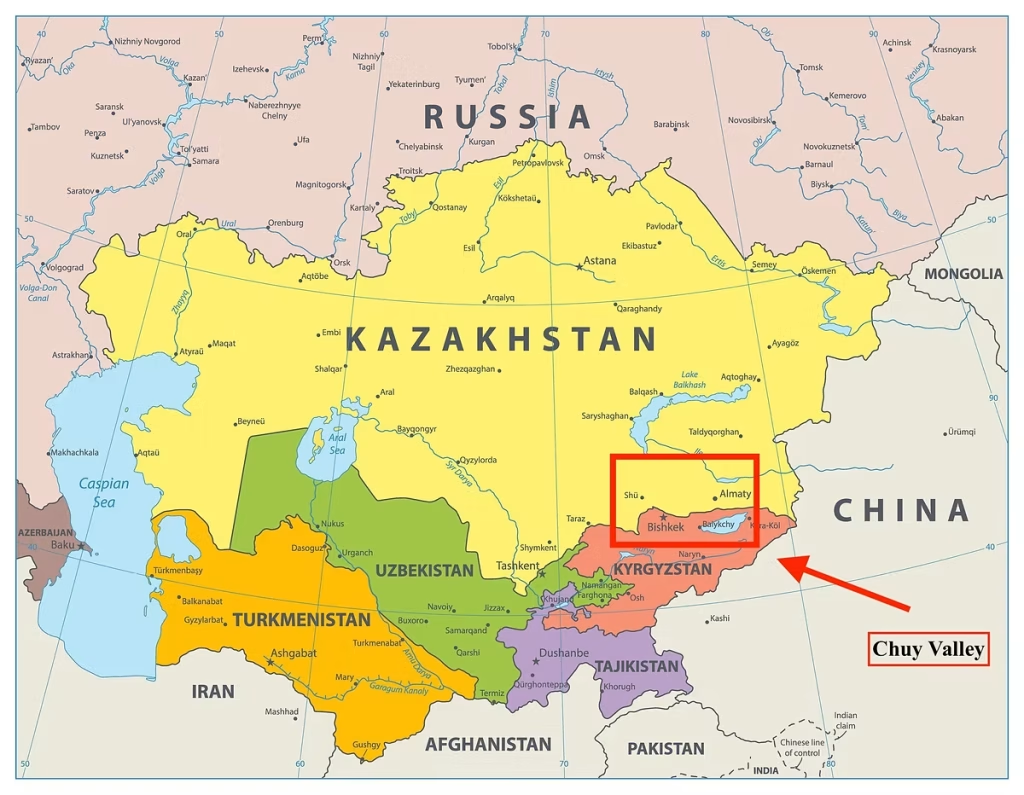
BISHKEK — Kyrgyz cannabis is reputed to be among the most potent in the world, making it a lucrative cash crop for drug traffickers.
It appears ironic, then, that a homegrown addiction specialist in Bishkek wants marijuana to be legalized to reduce the number of Kyrgyz drug addicts, fight organized crime, and increase tax revenues.
Jenishbek Nazaraliev, a former presidential candidate who opened Bishkek’s first private narcology clinic in 1993, wants the Kyrgyz government to consider a pilot program for the legal production of cannabis near Lake Issyk-Kul.
Rivaling the potency of marijuana from Afghanistan, international experts say cannabis is already being harvested by about two-thirds of all the families in Kyrgyzstan’s Issyk-Kul and Chui regions.
Pot plants grow wild on thousands of hectares of land there. During the first eight months of 2013, up through the annual August harvest, Kyrgyz authorities say they destroyed more than 154 tons of cannabis in the Issyk-Kul region alone.
Nazaraliev says more effective regulation over the production and sale of marijuana is an issue that eventually must be tackled by the government.
He says the illegal drug market in Kyrgyzstan is now “fully controlled by the black economy.”
Nazaraliev also argues that the producers, sellers, and consumers of cannabis could be better controlled — and that the government would bolster its tax revenues — if pot were legalized.
But Kyrgyzstan’s State Drug Control Service disagrees. Authorities there say winning the battle against drug traffickers is the key to social stability and development in Kyrgyzstan.
And they argue that legalization won’t rein in organized criminal traffickers because Kyrgyz-grown cannabis is exported through a network that extends far beyond Kyrgyzstan’s borders — a smuggling route for illegal Afghan cannabis, opium, and heroin that passes through Kyrgyzstan on its way to Russia and the European Union.
Naked Harvest
RFE/RL’s Kyrgyz Service has spoken with villagers in the Tiup and Ak-Sui districts around Lake Issyk-Kul who are involved in the harvest and sale of Kyrgyz cannabis.
For centuries, cannabis has been harvested in Central Asia by horsemen who would ride naked through wild cannabis patches and then scrape the resin from their skin and the hair of their horses.
But most villagers around Lake Issyk-Kul now harvest the drug by rubbing cannabis plants between their palms to get a layer of black resin that they scrape off with a knife and package in matchboxes.
Local dealers buy the drugs from the harvesters and then sell them to bigger dealers who tour the area, forwarding their purchases abroad through international trafficking channels.
Kyrgyz villagers who harvest cannabis every August make no secret about paying bribes to police who turn a blind eye.
For their part, local police tell RFE/RL it would be impossible to eradicate a trade that is integral to the survival of so many people.
Former Kyrgyz Vice President and Prime Minister Feliks Kulov — who also headed the National Security Service — suggested during the 1990s that state-managed cannabis farms near Lake Issyk-Kul could help the authorities control drug production in the country.
But Kulov’s proposal was derailed by critics who cited the negative experiences of opium growers in Afghanistan.
Nazaraliev, the narcologist who wants the authorities to reconsider legalization, ran in Kyrgyzstan’s 2009 presidential election under the campaign slogan “Everything is Within your Reach.”
He is now asking the authorities in Bishkek to consider whether “progressive European countries” and U.S. state governments that decriminalize marijuana care more about the health and welfare of their citizens than Kyrgyzstan.
Making America great again, fifty-two deranged social media posts at a time: what does it say about America’s alleged greatness that seventy-seven million Americans voted for this exercise of “executive time”? ||||| trr
President Donald Trump spent much of Saturday flooding Truth Social with a torrent of memes, AI slop, political attacks, and fan-made tributes.
The six-hour posting marathon unfolded on a day when the only item listed on the president’s public schedule was “Executive Time.”
Beginning at noon, Trump shared or reposted more than 50 pieces of content ranging from patriotic fantasy art and self-congratulatory graphics to crime memes, military imagery, celebrity tributes, and attacks on political rivals.
Among the more unusual posts were separate images showing Trump riding horseback beside George Washington on a dirt road next to a NASCAR race.
Another showed Trump looming over Greenland beneath the words “Hello, Greenland!”
Trump has repeatedly argued that having Greenland as U.S. territory is vital for national security, though both Greenlandic and Danish leaders have forcefully rejected any suggestion that the territory could be acquired by the United States.
One particularly strange image showed Trump dressed as a military commander as fighter jets exploded across the sky behind him, beneath the caption: “YOU’RE GETTING DISCOMBOBULATED.”
The post appeared to reference Trump’s claim that a secret U.S. weapon he dubbed a “discombobulator” helped capture Venezuelan leader Nicolás Maduro.
Trump also revived one of his longest-running grudges, sharing a meme depicting five photos of Rosie O’Donnell as the stages of “Trump Derangement Syndrome.”
The jab was the latest installment in a feud that stretches back nearly 20 years and has survived multiple presidential campaigns, two administrations, and countless social media broadsides.
Former President Barack Obama was also a recurring target.
Trump shared multiple memes attacking Obama, including one depicting the Obama Presidential Library as a giant trash can and another blaming Obama and former President Joe Biden for problems at the Lincoln Memorial Reflecting Pool.
The feed also featured a barrage of side-by-side graphics contrasting “Biden’s solution” to problems such as theft, shoplifting, squatting, fentanyl use, and illegal immigration with what supporters portrayed as Trump’s tougher approach, which typically involved arrests, imprisonment, or deportation.
At other points during the spree, Trump shared multiple images of Chinese President Xi Jinping, including one showing the pair shaking hands beneath a caption lamenting Democratic opposition to his long-desired White House ballroom.
Trump pointed to Beijing’s sprawling Great Hall of the People as an example of the kind of grand venue he believes the White House should have.
Construction is already underway on the site of the White House’s East Wing as part of the $400 million project, which Trump has described as “a gift to the United States of America.”
Trump now also claims the ballroom would conceal a vast underground bunker complex containing a military hospital, meeting rooms, and top-secret research facilities.
Another image shared on Saturday appeared to nod to those ambitions, depicting a futuristic “DronePort” perched atop the White House roof as aircraft buzzed overhead.
Taken together, the posts offered a remarkably unfiltered look at the subjects occupying Trump’s attention on a quiet Saturday: Greenland, Rosie O’Donnell, military power, drones, and himself.
By the end of the six-hour barrage, the president’s feed looked less like a communications strategy and more like a running stream of consciousness.
DOCTORS AROUND THE COUNTRY are baffled, disturbed, and in some cases aghast at the Trump administration’s plan for Americans who get Ebola overseas—in particular, the decision not to bring these patients back home, to one of the facilities that the federal government created precisely for this purpose.
And if you want to know why these medical professionals are upset, ask infectious disease physician Tara Palmore.
Palmore knows better than most what Ebola care looks like in the American facilities, because she provided it during the 2014 outbreak. Although most of the cases were in West Africa, nearly a dozen infected Americans got treatment in the United States, including one who ended up at a facility inside the National Institutes of Health Clinical Center in Bethesda, Maryland.
That is where Palmore was working at the time. And in a phone interview on Thursday, she described the unit to me—how the surfaces are all nonporous, lest they absorb infected bodily fluids that can’t be fully wiped away, and how there’s extra space for medical equipment, because staff have to bring machines to the patient rather than the other way around.
Another distinguishing feature of the unit, Palmore said, is the sealing of every wall, door, and window seam. It’s part of a system to maintain negative pressure, so that air is circulated only through special filters—a system that patients and staff cannot see but can sometimes hear, because of the high-powered fans. “It can be a little loud in there,” Palmore said.
For her and her colleagues, though, a bigger issue was learning how to effectively administer care for patients with such an aggressive, awful disease while protecting themselves and others from infection.
It took years of regularly scheduled training, plus more intensive sessions that had started months before they actually got a patient in October 2014. She and her colleagues practiced feeling for injection points while wearing two layers of gloves. They went over why it’s important to scrub the wheels of scanning devices and, when appropriate, to decontaminate equipment or rooms with hydrogen peroxide vapor.
“I was part of drilling and simulations all summer, because we saw this epidemic growing,” Palmore said. “It was working with the chest x-ray guy to get his system down, making sure the nurses involved knew how to put in a line, making sure the intensivists figured out how they were going to put someone on dialysis or intubate them for a ventilator. We drilled with dummies, we drilled with people.”
The work paid off: Nine of the Ebola patients in American facilities survived, the only two deaths coming from people who arrived in advanced stages of the disease. And no facility staff got sick.
But while the United States now has thirteen fully stocked, fully staffed facilities capable of providing such care, the Trump administration has no plans to make use of them. Instead, the administration has decided to transfer Americans who are exposed or infected abroad to a quickly constructed field hospital in Kenya, and then—when necessary for more serious cases—to specialized facilities in Europe.
Supposedly this is all for the sake of the patients, given that it will be easier to get American patients infected in Africa to Kenya or Europe than all the way back to the United States. “These decisions were made to make sure we provide the best care,” a senior administration official told reporters during a White House background briefing this past week, to “optimize what can be done for our American citizens who are overseas.”
It’s possible the administration’s plan will accomplish that, just as it’s possible Trump and his lieutenants truly made this decision with patient well-being foremost in their minds. But infectious disease physicians I interviewed over the last few days were highly skeptical, and it’s not hard to see why.
THE MOST IMMEDIATE QUESTION about the administration’s scheme—at least as of this writing—is whether it will even go forward.
The plan had been to open the Kenya facility in stages, starting with a fifty-bed unit on Friday following an agreement with the Kenyan government. But that was before the Kenyan union representing health care workers objected and threatened a nationwide strike—and before a Kenyan judge temporarily blocked the facility, arguing that the country’s government had not shown that it had taken the necessary precautions to protect its citizens.
The U.S. State Department late Friday acknowledged the ruling, announcing via tweet that “We are in touch with Kenyan authorities and are optimistic we can resolve objections.” CNN on Saturday reported that the American health officers had arrived, and that Kenya’s government intended to allow the plan to proceed, despite the court order. By the time you read this, the facility could be operating.
But there are plenty of other questions that officials have yet to answer definitively. At the very top of the list is what level of care the field hospital will be expected to provide, and whether it will be able to do so.
It was hard to tell from the guidance senior officials gave to reporters in that White House background call this week. At times, they described the Kenya facility almost as if it were a triage center for watching people in quarantine, unless and until they test positive and show symptoms, at which point they would get transport to tertiary care in Europe. But officials also mentioned the advanced care available, and said several times staff on site would make decisions about when a patient’s status warranted transfer. That made it sound more like a place for treatment.
The distinction is crucial, and has implications for the facility’s basic design. Patients sick with Ebola would ideally have their own bathrooms as well as their own bedrooms, Boston University infectious disease specialist Nahid Bhadelia told me in a phone interview, because it’s through exposure to bodily fluids that the disease spreads. And because Ebola can cause multiple organ failure, Bhadelia said, facilities need both ECMO devices (which act as artificial hearts and lungs) and dialysis machines (which function as surrogate kidneys).
But the personnel may matter even more than supplies, Bhadelia said, especially because this latest outbreak comes from the rarer Bundibugyo version of the virus. It has no approved treatments, unlike the more common Zaire version. That could leave clinicians relying more on the traditional approach: managing the various complications in the hopes of keeping patients alive until their bodies’ defenses can finally get rid of the disease.
“Ebola is a very labor-intensive disease to treat,” said Bhadelia, who has treated Ebola overseas and managed a biocontainment facility here in the United States. “You have patients who are losing a lot of fluids, so you have to deal with fluid replacement, and then beyond that you have to provide multi-organ support including potentially renal support, ventilatory support. It’s not just about the stuff. It’s making sure you have the right ratio of human resources to patients.”
Administration officials said they have dispatched roughly thirty commissioned public health officers to supplement staff already in central Africa, with a possibility of adding more. The physicians I interviewed said it was impossible to know whether that number would be enough, just as they said they weren’t sure whether the workers would have the proper training.
But they were nervous, they said, given that administration officials have been telling reporters that the newly dispatched health workers had three days of instruction and drilling. That doesn’t sound like the kind of preparation that staff at the specialized American facilities have gotten—or that Brown University public health professor Craig Spencer recalls seeing as a patient in 2014, when he was one of the Americans who got Ebola and received treatment at the special unit in New York City’s Bellevue Hospital.
“They were so well-practiced and well-prepared,” Spencer told me in a phone interview. He added: “Whether I needed an x-ray, whether I needed dialysis, they had thought about how they were going to make those things happen—who was going to be responsible for doing that, how they would get them into the room, how they would keep them safe. These are all protocols that exist beforehand and, quite frankly, can’t be taught over a three-day weekend at a training.”
Palmore noted that staff at the existing facilities “have been preparing for years, drilling and training, and some of them have taken care of people with other hemorrhagic fever viruses.” She went on from there: “The idea that a few days of training and, like, some kind of modular hospital is going to create any sort of equivalent care setting for people with Ebola infection, which requires incredibly complex care, just does not seem realistic to me.”
And in such an ad hoc medical setting, Bhadelia pointed out, “the chances of potential staff exposures go up. It reduces the quality of care for the patient, but also makes it a more dangerous equation for the health care workers themselves.”
As for the possibility the Trump administration truly plans to move sicker patients to tertiary hospitals in Europe, that comes with its own set of uncertainties, starting with the issue of where. Administration officials haven’t specified which countries have agreed to take Americans. And transporting Ebola patients gets a lot more difficult as the disease progresses, Spencer said, putting a lot of pressure on the medical staff.
“The reality is, you get them out as quickly as possible or you’re not going to be able to get them out at all,” said Spencer, who had contracted the disease while treating patients in Guinea as part of the Doctors Without Borders team. “We’ve seen this before, getting people on a plane who are acutely ill with the worst parts of Ebola—vomiting, fever, diarrhea. It doesn’t go well.”
HOWEVER COMPLICATED, the administration’s plan is consistent with the broader approach it has taken ever since this outbreak started—a focus on “insulating the United States rather than on stopping what already is a disaster from becoming much, much worse,” as Helen Branswell of STAT News wrote in a poignant essay last week.
And it’s not like the administration has been especially subtle about this motivation. “We cannot and will not allow any cases of Ebola to enter the United States,” Secretary of State Marco Rubio declared at a cabinet meeting Wednesday.
That instinct is easy enough to understand, even outside of MAGA circles. And there are circumstances when it’s not hard to defend. Sometimes protecting Americans from biological threats requires taking difficult measures. But scientists I interviewed said the record from 2014, in which there was no Ebola transmission once patients were under proper care, suggests there’s little risk of repatriation leading to an outbreak here.
If anything, the administration’s strategy might backfire in two separate ways that are not mutually exclusive: by discouraging health professionals and relief workers from going to Africa, and by giving anybody exposed to Ebola incentive to return without reporting it. The former would increase the chances of more cases there, the latter more cases here.
Lurking behind all of this are moral and legal issues that come with effectively blocking American citizens from returning to the United States, although it’s not clear any of that matters to Trump—who in 2014, before he was president, made his thoughts pretty clear. “The U.S. cannot allow EBOLA infected people back,” he tweeted. “People that go to far away places to help out are great-but must suffer the consequences!” Now he’s putting that impulse into action, evidently oblivious to what those consequences might turn out to be—or who might ultimately feel them.
Six snapshots of what the Russian Reader was reading on May 27 in years past.
2024
“It’s Showtime”: Open Space Moscow vs. SERB. Open Space is a project that supports grassroots activists. It has two sites, in Moscow and St. Petersburg, with co-working spaces, a human rights center, and a psychological center. The Moscow site is at odds with the pro-government movement SERB, known for its provocations against the opposition. Republic correspondent Nikita Zolotarev is often at Open Space, sometimes as a volunteer. That was how he found himself at the Moscow co-working space last Saturday, where he was detained along with other visitors on the basis of a complaint filed by the “Serbs,” who were assisting the police, and then spent several hours at the Basmannoye police precinct. Here is how it went down.
2022
“To Become White in the Eyes of Whites”: Astrakhan Kazakhs and the War in Ukraine. According to official statistics, ethnic Kazakhs [so-called Astrakhan Kazakhs] make up 16% of population of the Astrakhan Region. At the same time, 80% of the region’s residents who have been killed in the war in Ukraine and whose deaths have been publicly acknowledged by relatives or the authorities, are members of this particular ethnic group. Idel.Realii talked to several Astrakhan residents to understand why this is the case and what reaction it causes in the local community.
2020
Facebook Is Not Your Friend. “This message violates our community standards on spam” was the message from Facebook informing Petersburg news website MR7.ru that the world’s mightiest social network was blocking the public’s access to the website’s articles on the city’s battle with the coronavirus—and the battle of Petersburg doctors and other healthcare workers with a corrupt, mendacious regime.
2018
The Policemen’s Ball. At €2.50, the official licensed sticker album of the 2018 World Cup is a steal. Russian officials also plan to steal the civil rights of their own citizens during the month-long tournament.
Daria Serenko’s Quiet Picket. Quiet Picket, a recent initiative by Daria Serenko, teeters on the verge of artistic intervention and protest action. Every day, Serenko boards public transport (often, the subway) bearing a new placard inscribed with an extensive message. Its purpose is to invite people to engage in a discussion. Serenko thus explores the space of communication itself: the distance between placard and recipient, and how potential interlocutors navigate the distance. So far she has produced fifty-four placards, gone through six markers, and directly communicated with ninety-three people. Marina Simakova spoke with Serenko about the background of the action and its effects.
Even Lunacharsky Street is so transparent Bicycles and horses race home On these streets, my love, I honed my style I touched the air with my hand Even Lunacharsky Street can be so gloomy and wicked at times And a cloud with a pointy beard delivers a delicious jolt And it groans languidly
There is nothing beyond the black sky And nothing will be first Perhaps the gods played a trick on you And scattered their plywood arrows in the corners Somewhere far away I take you without asking Somewhere far away I bury myself alive In letters and numbers I’m drowning and floundering With an artificial belly Like a clown in a circus
Upward and downward This is Real life This is The fleeting joy of a glance on the street A smile, warmth Your shadows kiss You don’t care, you keep going Leaving behind perhaps another life I can’t do it—this thought terrifies me so I can’t do it
There is nothing beyond the black sky And nothing will be first Perhaps the gods played a trick on you And scattered their plywood arrows in the corners Somewhere far away I take you without asking Somewhere far away I bury myself alive In letters and numbers I’m drowning and floundering With an artificial belly Like a clown in a circus
Upward and downward This is Real life This is The fleeting joy of a glance on the street A smile, warmth Your shadows kiss You don’t care, you keep riding Leaving behind perhaps another life I can’t do it—this thought terrifies me so I can’t do it
Amnesty International has published its annual Death Sentences and Executions report for the year 2025, with data showing a sharp increase in the number of executions carried out. At least 2,707 people are known to have been put to death by the state last year, up 78 percent compared to 2024. As our infographic shows, the death penalty continues to be quite widespread in Asia, with China, India, Thailand, Singapore and Indonesia, among others, employing it. The use of capital punishment is very rare in Europe: it only exists in Belarus, and Amnesty International notes that 2025 was the first year it recorded neither new death sentences nor executions since President Alexander Lukashenko assumed office in 1994. While Russia technically also retains the death penalty in its law, the country is considered abolitionist in practice, meaning no executions have been carried out in at least ten years.
In the Americas, the death penalty is also mostly a thing of the past, with the notable exceptions of Guyana, Cuba and the United States. Last year, the U.S. executed 47 people across 11 states, almost twice as many as in 2024 (25 executions). Florida alone accounted for almost half of these executions (19). Capital punishment is still more common in Africa and the West Asia. In 2025, Iran executed at least 2,159 people, more than double its 2024 figure and the highest number on record since 1981, and the Islamic republic has been consistently using the death penalty as a tool of political repression.
113 countries and territories around the world have abolished the death penalty completely, most recently Zambia. In 2023 and 2024, African nations Equatorial Guinea, Ghana and Zimbabwe abolished the death penalty for all but very serious crimes. 87 nations still have capital punishment on the books, but 24 of them are considered abolitionists in practice. In March of this year, the Israeli Knesset voted to expand its death penalty law in such a way that applies only to Palesinians and dismantles fundamental safeguards to prevent the arbitrary deprivation of life and protect the right to a fair trial, a decision condemned by Amnesty International. The NGO has called on Israel to repeal the decision.
A personal account of day-to-day life in Iran told through the calls of two Iranian sisters – one in the UK, the other in the Iranian city of Shiraz. Since the outbreak of war at the end of February, a near total internet blackout and a shutdown of international phone lines by the Iranian authorities has meant limited information has got out of the country. Despite the risks involved, the sisters have made recordings of their conversations which have been shared with the BBC. They discuss when the bombs land, the destruction of places they love and the realities of an economy that’s being brought to its knees. They struggle to sleep at night. Salaries don’t come through. It’s a roller coaster of emotions. But there are also moments of calm and comfort…a spot of dark humour and the scent of hyacinths.
Actors: Leila played by Lisa Zahra Gita played by Zahra Ahmadi
This Census chart shows changes in where Hawaiian and other Pacific Islander populations were living in 2010 and 2020.By 2020, more than half of Native Hawaiians (at the top left, in blue) were not living in Hawaii, something local Hawaiian leaders attribute to the high cost of living on the islands.
This week, Rafia Zakaria won the 2026 National Magazine Award in the category of Columns and Essays. The winning piece, “Water Pressure,” was published in Issue 150 of The Believer and is available to read in full on our website. It follows Zakaria’s father on his search for clean water in Karachi, Pakistan, where the mounting climate crisis has crept into all aspects of daily life. Zakaria discussed the prize and the celebrated essay with our managing editor, Ginger Greene.
THE BELIEVER: You won a National Magazine Award last night in New York for your essay, “Water Pressure.” What did it feel like to see this piece recognized in that way?
RAFIA ZAKARIA: It was a tremendous surprise… It is very difficult to place personal essays, but it is the personal story that can ultimately make an abstract issue—such as water scarcity in a faraway city like Karachi—seem as real as the heat wave that was happening in New York on the day of the award ceremony. I was so grateful to work on this project, and to have the freedom and latitude to explore what extreme heat can do to ordinary people in an ordinary megacity.
BLVR: Your story explores the many difficulties of procuring water and power in Karachi, in an ever-warming world. What inspired you to approach this subject? And what were some of the difficulties you faced as you developed the essay?
RZ: I feel like a lot of climate journalism focuses on the deterioration of beautiful natural environments and the loss of wild ecosystems. I wanted to focus on how extreme heat, as well as water and power scarcity, affect human relationships, how it erodes and corrodes the scheme of relations between people and the environment. Sometimes it is not possible to see how it is happening, when you are in the midst of dealing with these problems every day. But as someone who is in and out of Karachi, I was able to perceive these dynamics.
One of the difficulties I faced reporting this story was a lack of precedence for this sort of exploration. For instance, there is excellent and deep reporting on natural or man-made disasters and their aftermath. But there is less writing on persistent issues, like decades-long water shortages, where there is no single cataclysmic event on which to center a story. I wanted to show that the story of chronic scarcity can also be told in an impactful and interesting way.
BLVR: The piece opens with a vivid scene from your family’s neighborhood in Karachi, in which a man is angered when he notices your aunt receiving an overflow of water into her underground water tank, such that it’s wastefully flooding out onto the street. Their confrontation ends when your aunt begins to throw rocks at him to get him to leave her alone. I was curious: What was your first reaction when you heard this story? Was it relayed to you as a problem of “water envy,” as you call it?
RZ: I will admit that my aunt’s reaction was a bit extreme, but it crystallized how chronic scarcity can create levels of seething frustration that can bubble to the surface in absurd ways. The story was told to me in the context of: Is she OK? But actually no one facing this sort of privation day after day is really OK. Water is a mainstay of existence, so the fact that you can now have an iPhone but not access to clean water is a bizarre juxtaposition of privilege and paucity.
I also felt that my aunt’s actions put into stark focus what people likely want to do but usually don’t. I came up with the term “water envy” because I wanted to start creating a vocabulary for phenomena that are felt, but for which there are often no words. I think the phrase encapsulates how policing resource consumption becomes just another part of living in a neighborhood. In most cases people will not challenge each other to the extent they do in this instance, but that is why it is such an apt story: Both characters had reached the end of their rope.
BLVR: Water politics in Karachi are complicated. For one thing, there are the daily strategies middle-class Karachiites have developed to procure water, which involves pumping water from the main lines into private underground water tanks. Navigating the uncertainty of main-line waterflow has become a full-time job for your father, as you point out. At the same time, there are many more people who don’t have access to these “pump games,” because they can’t afford a private tank. They are forced to purchase water from private companies that hike up their prices. How has the situation with Karachi’s water mafia progressed since you reported this piece?
RZ: I think the situation is much more dire now, because the pressures have become more acute. The population has grown dramatically and grows further still on a daily basis. Temperatures have risen, owing to climate change phenomena like the heat domes I talk about in the piece. As a result, people increasingly have to resort to taking their chances and obtaining water without knowing its source or even if it is potable.
In the summer there are thousands of deaths that are ultimately caused by lack of clean water, but they are not often tallied under this category. As the heat index rises in Karachi, these situations are pushed to the limit and people—particularly the very old and the very young—begin to die. The water mafias are more entrenched and merciless now; they know how to throttle competition and work with street gangs and land mafias to ensure that the consumers in a specific area have no options but to pay them.
BLVR: As we approach the summer months, Karachi is already reaching excessively high temperatures. In early May, the city recorded a peak of 111 degrees Fahrenheit, the city’s highest reading since 2018. This heat, as you describe in your piece, compounds with power outages and water shortages, which seeds the ground for long-term public health crises. How are you feeling about the upcoming summer?
RZ: I dread the summer months for Karachiites. If you fall sick during the summer, it is hard to get reliable care in a timely fashion and, most of all, to find a relatively cool environment to recover in. Any illness could threaten survival. Since there is no easily available large-scale refrigeration in poorer areas, there is also a huge risk of eating spoiled food. There is no way of telling if something in a store fridge was left out for hours the night before, or if the energy source powering the fridge is reliable. So it’s Russian roulette all summer long.
This summer will not be any different. The political rift between Karachi and the rest of the province means that the city is constantly starved of resources and the federal government seems disinterested in the plight of the people that live there. Many Karachiites are the children of people who migrated from India in 1947 and hence distinct from Punjabis, who make up the majority ethnicity. All of these divisions make the situation one of constant chaos. People are living a bit of a Hobbesian existence there.
BLVR: How has the situation in Karachi shaped your relationship to your experience of the US? You recently moved to Salt Lake City in Utah, which is also in the midst of a climate-related disaster. Have you noticed any similarities between the two places?
RZ: Well, there is a war over water underway in Utah as well. Last week, three county commissioners in Box Elder County, Utah, passed a proposal to build a 40,000 acre data center in the area—that is twice the size of Manhattan. The residents, aghast at what their elected representatives have done, are now trying to organize a referendum that will stop the plan. If the data center is built, the project will suck up all the water left in the already drying Great Salt Lake. It is estimated that it will also increase nighttime temperatures by 8 to 28 degrees Fahrenheit.
This situation really reminds me of Karachi, and it is difficult for me not to feel a bit like a Cassandra. Utahns have little idea of what that sort of scarcity and extreme heat can do to the fabric of society. It transforms our individual and collective relationships with the natural environment, but also the relationships we humans have with each other.