Every Tree in the Forest Would Understand You

Every Tree in the Forest Would Understand You
Anastasia Lotareva
Takie Dela
August 11, 2017

In Russia, there are six people left who can tell tales, sing songs, and simply converse in one of the world’s most ancient languages.

The dialects of the Selkup language are unique. For example, they have retained semantic stress (that is, stress that changes the meanings of words). It was inherited from Proto-Samoyedic, the language spoken in Siberia before our era. Researchers from around the world study the Selkup dialects, and Russian linguists recently were awarded an unprecedented grant to research them. If the language of the southern Selkups disappears before scholars are able to record it, what the language has preserved for thousands of years will disappear forever. 

“God got paradise, the Devil got Narym Territory,” laughs an elderly mustached man as he tosses another heavy bag on board the speedboat or kaeski. The boat is moored directly to the shore, since there is no dock. It is loaded with food, parcels, and medicines, as well as children.

“He’s going to his grandma’s. You see that he doesn’t forget to get off at Shpalozavod.”

There are no strangers here at all. The first mate, who sells tickets printed back in Soviet times, regards us with suspicion.

“May I ask where you’re going? To Narym? Whatever for?”

“We’re writing an article about the Selkups.”

“Ah . . . More researchers going to see our Ostyaks.”

He closes the door to the deck. It is strictly forbidden to go on deck when the boat is under speed: the weather is poor, and the boat is badly buffeted. In short order, the small craft jumps right into the middle of the Ob River. On the right is the taiga, on the left is the taiga. For several hours and many kilometers there is nothing but the taiga.

Like Sverdlov and Stalin
There are now less than fifty indigenous minorities in Russia. The list of these peoples was approved at the beginning of the twenty-first century, and it has been constantly revised downward. The Selkups are relatively numerous. There are a few thousand of them in Tyumen Region, fifty in Krasnoyarsk Territory, and nearly two thousand in northern Tomsk Region, where Narym is located. The term Selkup emerged and gradually came into usage in the 1930s. Previously, the names Ostyak and Ostyak-Samoyed were used. They are still used in ordinary, non-scholarly language, and sometimes they seep into official documents. The Selkups tend to call themselves Ostyaks.

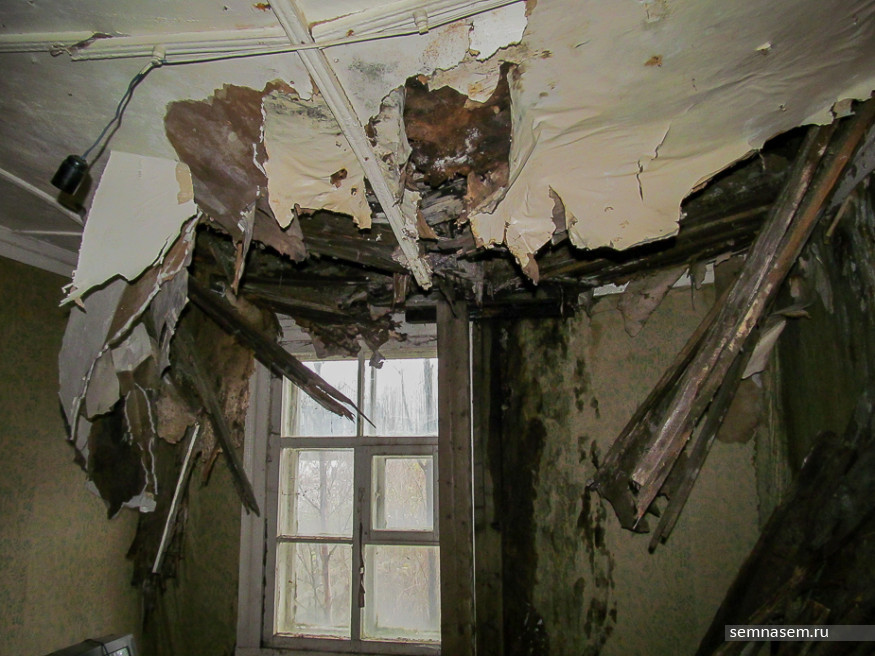
Narym. This building was the police station before the revolution. Photo courtesy of Anton Unitysn/Takie Dela

The Selkups have been divided the last three hundred years or so. There are the northern Selkups, who live along the Taz and Turukhan Rivers, and there are the southern Selkups, the Narym Selkups, who live in the middle basin of the Ob River. They have different folkways, now nearly erased by time and assimilation, and different dialects. If Selkups speak their native tongues, southerners would not understand northerners. Only they do not speak it. The Selkups started to disappear and assimilate as early as the nineteenth century, and the language retreated when the Selkups settled in Russian villages. Their secretive, forest way of life came to an end.

“An airplane flew to Narym once a week, and ships would arrive daily, not just one, like nowadays, but many. But now we’re like Stalin and Sverdlov, like Sverdlov and Stalin. Hey, young folks, do you know who Stalin is?” a female fellow passenger asks us.

Narym was a free land. In the sixteenth century, it was ruled by the Skewbald Horde, a group of four hundred Selkups, according to the written sources, or five million, as a beautiful brochure published by the local authorities claims. The horde was led by Prince Vonya, an ally of Kuchum Khan, ruler of the Khanate of Sibir. Battered by Cossack detachments and tsarist military governors, the khanate fell. The Skewbald Horde surrendered only after construction of Narym Fortress in the late sixteenth century.
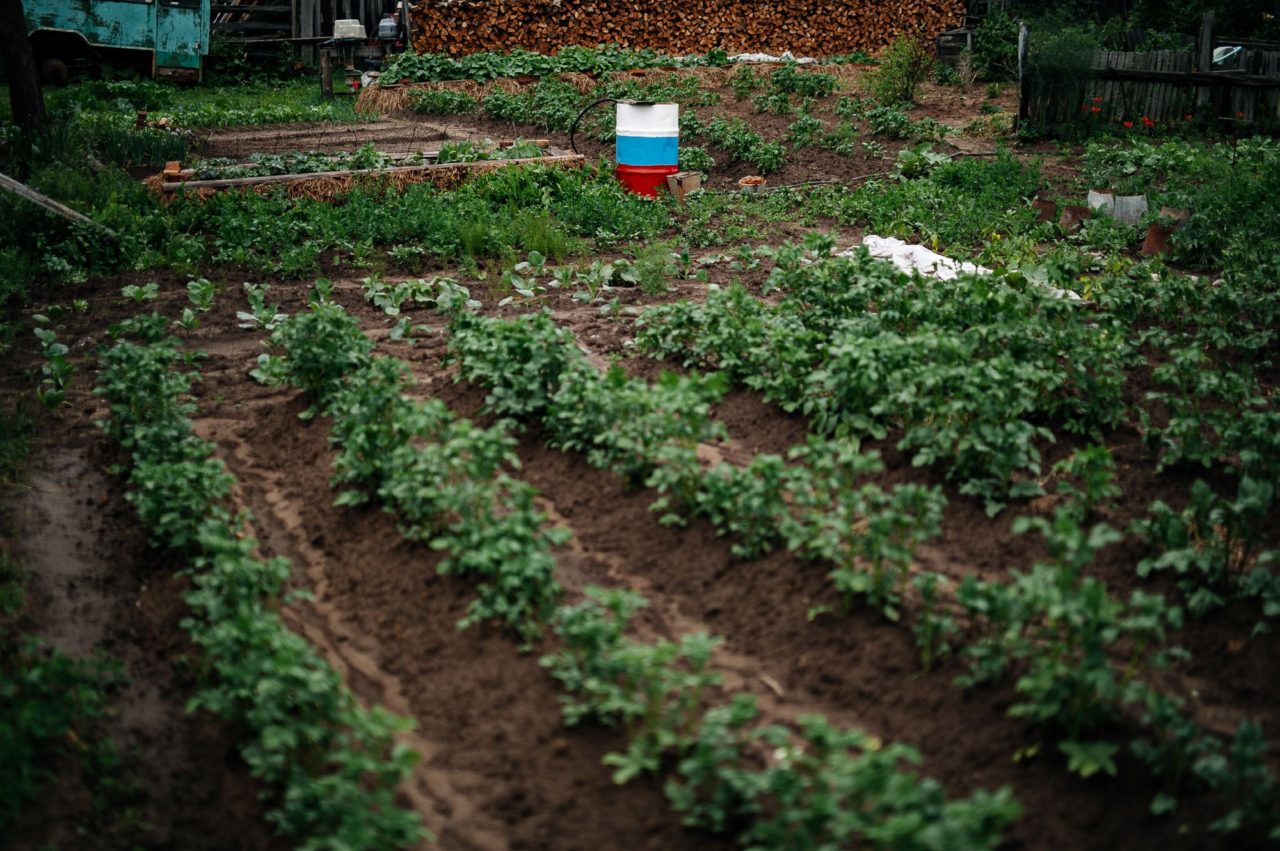
A street in Narym. Photo courtesy of Anton Unitysn/Takie Dela

Narym was no longer a free land. Common criminals and enemies of the regime were exiled there, including the Decembrist Nikolai Mozgalevsky, the Latvian communist Jānis Pieče, the Bolsheviks Yakovlev, Shishkov, and Tomsky, and Stalin and Sverdlov, the latter along with his youngest brother. The political prisoners were not guarded very closely, and many of them managed to escape. Stalin, for example, spent only forty-one days of a five-year exile in Narym before grabbing a steamer to Tomsk and traveling from there to Switzerland, where he resumed his revolutionary career.

Little People
“You Russians distort everything. Ostyakh is not what Selkups called themselves, but what the Khanty called them. It means ‘here I am.’ Or take nyar’m, ‘marsh’ in Selkup. But no, you turn it into Narym.”

We are told this by Ludmila Shadrina, a Narym Selkup and former elementary school teacher.
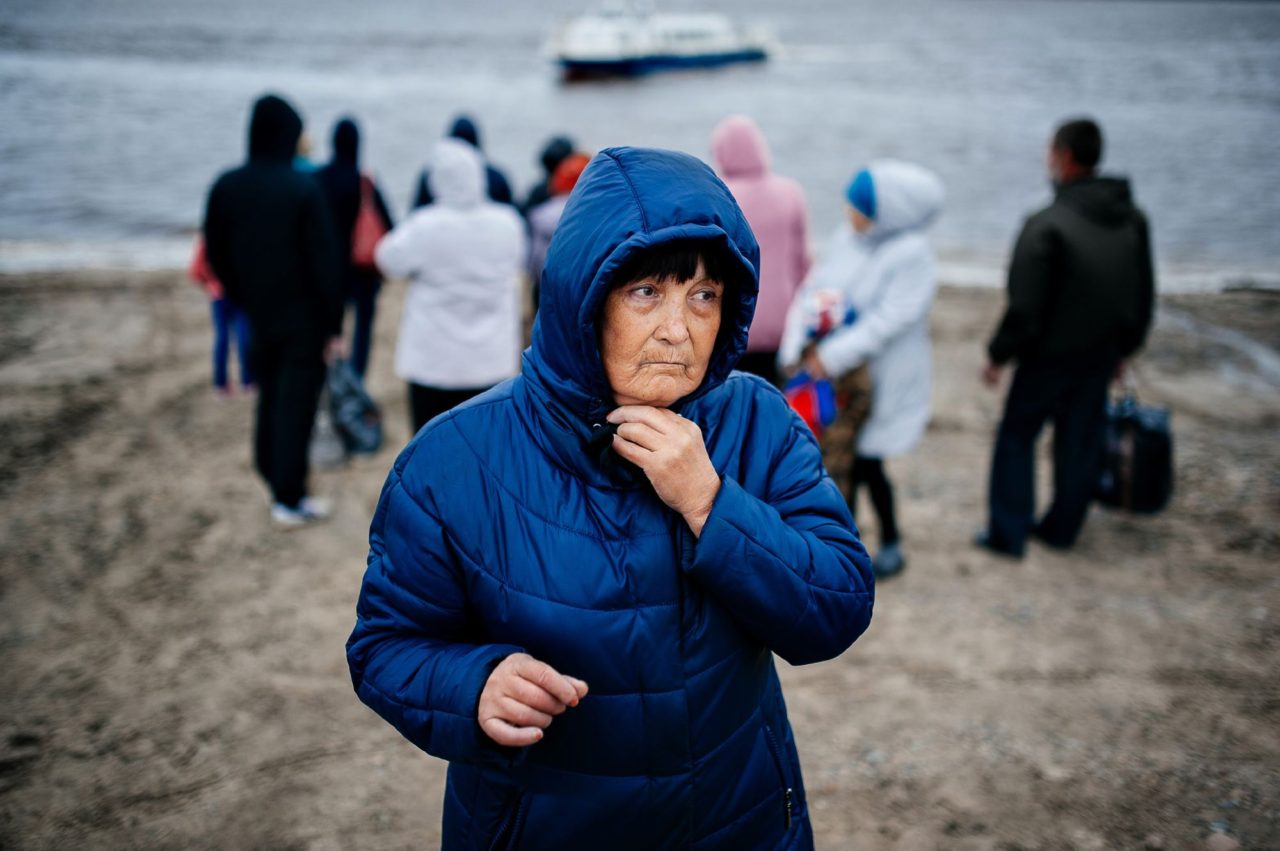
Ludmila Shadrina. Photo courtesy of Anton Unitysn/Takie Dela

Ludmila walks quickly, almost at a run, over the boardwalks that do the work of sidewalks in Narym. It is late and quite cold. The museum, which contains three rooms on political exiles and one room on the Selkups, closed much earlier in the day, but Ludmila has agreed with the people who run it to open it for us.

“Not all Selkups like it when people come and interrogate them.”

“But you like it?”

“My cow has been waiting for over an hour to be milked, and yet I’m running around here. But I realize we have to tell people about ourselves.”

I ask Ludmila why this is necessary.

“Because we exist,” Ludmila says.

In front of the little house of the peasant Alexeyev, where Stalin was quartered, is a karamo, a Selkup dugout. The house is authentic, but the karamo is a reconstruction: the Selkups ceased living in them in the early twentieth century. However, Ludmila says her nephew builds the very same dugouts when he hunts sables. Selkups still also build lean-tos, sheds mounted on piles to keep rodents from pilfering victuals.
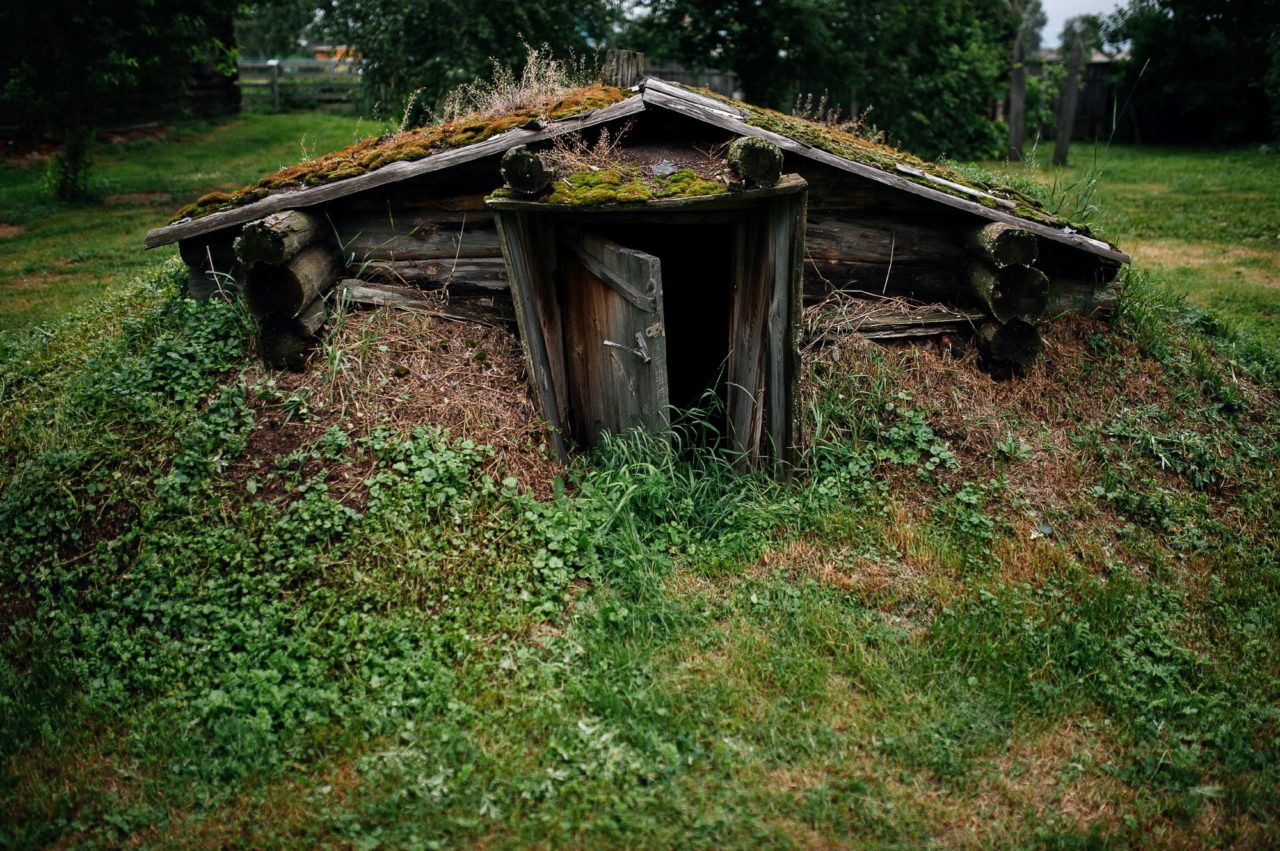
Dugout at Narym Museum. Photo courtesy of Anton Unitysn/Takie Dela

Exhibits at Narym Museum. Photo courtesy of Anton Unitysn/Takie Dela

Ludmila, whose Selkup father died young, grew up in a small Selkup village with her Russian mother. All traces of the traditional way of life had vanished. The village was dying.

“Dad took me fishing with him,” says Ludmila. “What can you say? He was an Ostyak and fished well. We were still eating dried fish several years after his death. He was ill and that’s why he took me along. He thought if he kicked the bucket, then at least I, a living soul, would go find people and tell them where his body was. When Dad felt weak, he would lie on the sand, half asleep, half breathing. I would lie next to him, gazing at the forest, at all the bugs. The trees would sway, but what was beyond the trees? Bears? People? I was frightened.”

Ludmila takes us to her sister Raisa’s house, telling us on the way that bears have become more frequent in Narym in the past year. Тhey snatch cows, stroll down the street, and rip dogs to shreds. If people guard one side of the village, they will infiltrate it from the other side. Ludmila feared them as a little girl and still fears them as an adult. Bears are inventive, cagey animals. The surrounding area is chockablock with them.

When she greets us at the door, Raisa suggests “freezing” us, that is, getting out cold fish, so-called chush, cut into large rings.

“Do you go far to fish?”

“We fish right here on the creek.”

The “creek” is Raisa’s name for the Ob, Russia’s longest river.

Narym. Photo courtesy of Anton Unitysn/Takie Dela

Neither Raisa nor Ludmila speaks Selkup. They know only certain words.

“It wasn’t the done thing. Yeah, the old people spoke Selkup. We understood them, but replied in Russian, especially after going to boarding school.”

All the children from the tiny Selkup villages were not sent to a regular school in nearby towns, but to special Selkup schools many kilometers away. They were part of the special welfare system for the indigenous minorities of the Russian North, a system crowned by the Institute of the Peoples of the North, which still functions in St. Petersburg. During the impoverished postwar period, the boarding schools provided their young charges with everything from food to clothing. Being sent to such a boarding school was considered good fortune and a privilege. But this same privilege almost completely destroyed the Selkup language and eroded ethnic self-identity. The children would come back home speaking Russian, but more seriously, they no longer wanted to living in the small, impoverished Selkup villages.
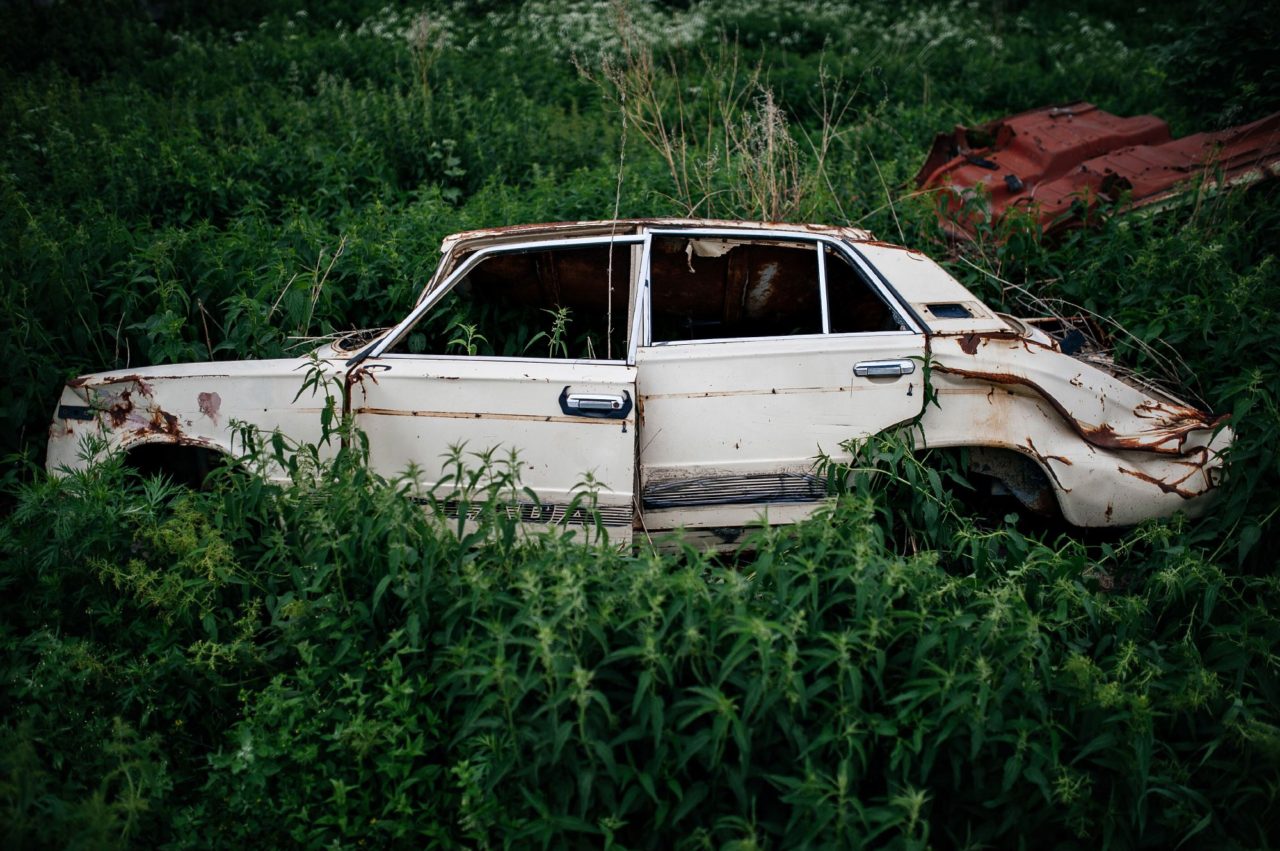
Narym. Photo courtesy of Anton Unitysn/Takie Dela
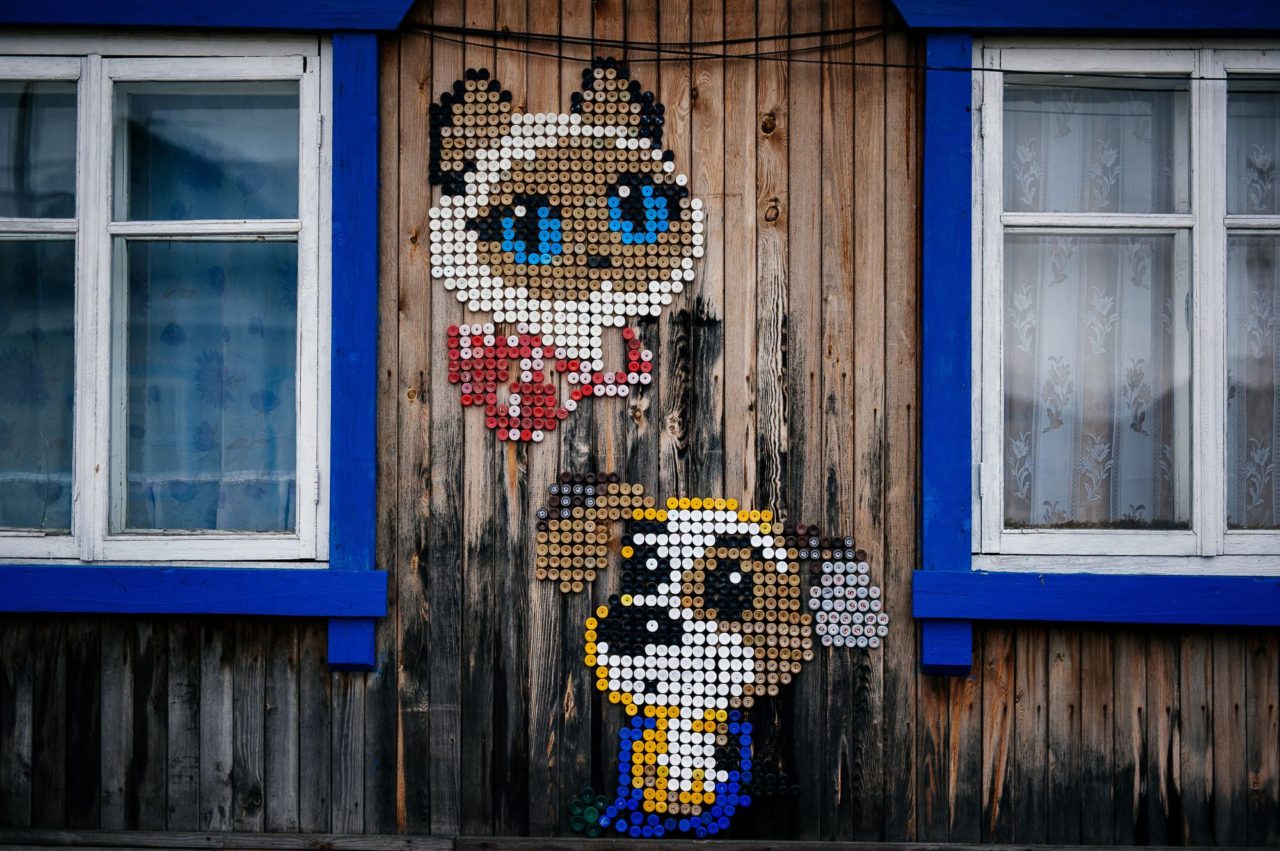
Narym. Photo courtesy of Anton Unitysn/Takie Dela

I ask Ludmila and Raisa whether they liked boarding school. They answered yes without hesitating. Nourishing food, good clothes, and friends, with many of whom they are still in touch.

A minute later, however, Raisa adds something.

“The boarding school influenced us. We got used to getting ourselves out of scrapes. We worked and we studied, and our parents helped us. But our own children are not independent. They are softer. They cannot do the things we did. I always told myself when I had a child I would not give it away to anyone. This is probably because of the boarding school.”

Boarding school students were teased, but Raisa remembers this without malice.

“Well yeah, we were teased, of course, and people said we drank a lot, that we were poor and narrow-minded. Only certain people would get stuck on this, and I would put my arms on my hips and say, ‘Yeah, I’m an Ostyak. What of it?!’ They didn’t know what to say.”

According to Ludmila, many of her fellow villagers are embarrassed of their ethnicity and identify themselves as Russians.

“Then the neighbors say to them, ‘You have passed yourselves off as Russians, but what you going to do with your Ostyak mug? We’re forest people, little people. Everything gives us away, including our faces and figures.”

The Last Native Speaker
Parabel, the district center, is a large, rich village, founded in the seventeenth century on the site of several old Russian settlements. Nowadays, major oil and natural gas pipelines run through it. Gazprom runs a compressor platform and oil pumping station in the village, and so its freshly paved streets are filled with foreign-made cars, and the rooms in certain hotels are never vacant, because there are many business travelers. There is a cinema, a cultural center, and a large museum, which has grown over the nearly thirty years since the Soviet Union’s collapse from a small in-school museum to a large-scale history and ethnography museum.

“When the Selkups organized themselves, culture got involved. What did you expect?” Irina Fokina, head of the local culture department explains. “They said it to me just like that: ‘Irina Petrovna, the time has come to deal with the small peoples.'”

“Did you know anything about the Selkups before this?”

“When I was at school, we didn’t know any Selkups. The Ostyaks, on the other hand, lived with us, and they were sometimes spoken of poorly,” Fokina falters, choosing her words carefully.

Irina Korobeinikova is the last native speaker of a rare Selkup dialect. Photo courtesy of Anton Unitysn/Takie Dela

“They called us ‘second class,'” laconically notes Irina Korobeinikova, the last native speaker of the Narym dialect of Selkup and the person who launched the southern Selkup renaissance.

The notion of a “native speaker” is a quite broad concept, a concept with numerous gradations, ranging from people who remember a few words of their native language from childhood to those who converse with household members in their native language as adults. There are no such people left among the Selkups. Irina speaks Selkup fluently and publishes fairy tales and legends in her native tongue, but as reverse translations. First, she recalls a story or reads a Russian transcription of it, as recorded by ethnographers, and only then does she translate it into Selkup. Her children do not know the language. Even her brother, who grew up with her and has heard his fill of Selkup, converses with his sister in Russian.

“But why doesn’t he want to speak his native language?”

“He says he doesn’t want to and that’s that. Who can say?”

Irina spoke only Selkup until the age of seven, mainly with her grandmother, who raised her six grandchildren. Grandmother hunted and fished. Irina’s mother was also a good hunter. She and her sister would bring in two thousand squirrels per season and turn them over to the Soviet state in return for fabric to make a dress or a cashmere scarf. Did the Russian women hunt? Irina says she cannot recall such a thing. It was a purely Selkup practice.

“Did you call yourself Selkups?”

“We called ourselves chomilkups, forest people. Mom and Dad were identified as Ostyaks in their internal Soviet passports, while I was identified as a Selkup. By the way, when I went to the first Congress of Indigenous Minorities, in Kolpashevo, I raised this question when the head of the passport office spoke. I was indignant. Am I not related to Mom and Dad? I was told the academic world had settled on it. This was how our people were now called.”

Irina’s grassroots activism kicked off during perestroika.

“The authorities really supported us then.”

Korobeinikova recalls with pleasure the Congress of Indigenous Minorities of the North, this time held in Moscow, and meeting Mikhail Gorbachev.

Parabel. Photo courtesy of Anton Unitysn/Takie Dela

The place in Parabel where the speedboats to Narym dock. Photo courtesy of Anton Unitysn/Takie Dela

“The Yakuts and I went up to him. He had only recently been elected. We congratulated him. He shook our hands, and what soft hands he had. He had only ever held pens and papers in them, not shovels, as we had.”

The Soviet Union’s collapse opened borders, and foreign linguists came to see the Selkups. Irina shows me the first Selkup-Russian dictionary, published in Hungary. She tells me about a trip to Hamburg, where she was invited to translate texts in Selkup, written down by German scholars way back in the late nineteenth century. When I see a photograph of a jolly Japanese woman, dressed in a reconstructed Selkup costume, I cannot stand it anymore.

Hungarians, Germans, and Japanese. Why do the Selkups matter so much to them?

Irina smiles subtly and says, “That is because we’re so interesting.”

Happy People
“One of them just left. She was writing down everything. Either researchers are showing up or Irina comes. They sit down with their laptops and off they go. How did you do this? How did you do that?”

Illarion Ivanovich Izhenbin, a Belomorkanal cigarette dangling from his mouth, pumps the tire on his granddaughter’s bike. He lives in a two-storey stone house. There is a nest in the entryway: five swallow chicks protrude from it. Illarion says it’s a good omen, but the chicks are too loud. Sometimes you can hear them in his flat.
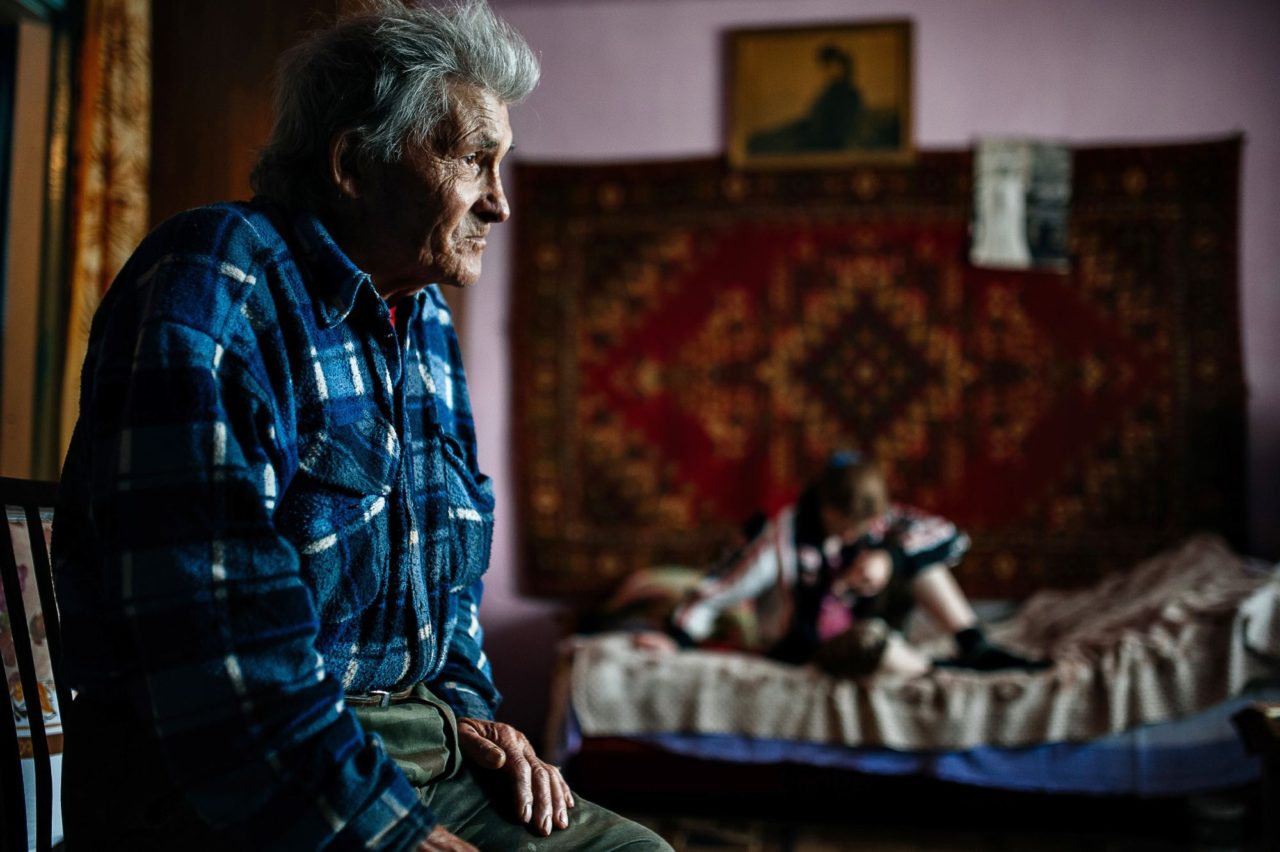
Illarion Izhenbin. Photo courtesy of Anton Unitysn/Takie Dela

“Are you tired of talking with researchers?”

“Would that I could remember something. I have lived among Selkups my whole life. When I go fishing, and it’s quiet and there is no one else round, I look at things and translate them silently. What are the Selkup words for stars, moon, and water? I spoke only Selkup until 1957. Do you know Selkup’s distinguishing trait? It has no foul language.”

“How did people curse?”

“Homo tat! is the most you can say. It means ‘I’m sick of you,’ ‘Go to hell,’ ‘Don’t hang around here.'”

Illarion was also raised by his grandmother. His father was burned to death in a tank near the Reichstag four days before the Second World War ended, while his mother constantly worked in the fishing fleet of small Selkup village. As a boy, he fashioned arrowheads from tin cans, hunted with a bow, set traps, and fished.

“Granny taught me so well that if you left me in the wild with a knife and matches, I could survive,” he says. “She also always told me to look backwards, between my ears, to make sure there were no animals or bad men behind me. The taiga is not evil, but you can’t say the same thing about men.”

Illarion still goes out hunting, but he brings almost nothing back.

“When I catch sight of a squirrel or chipmunk and take aim, I feel sorry for them. After all, I converse with them. If I kill them, with whom will I converse? We are always asked what constitutes our identity, and it is bound up with hunting and fishing. So now my identity has left me, because I almost never kill animals.”

Illarion’s internal passport lists him as Russian, while his military service card identifies him as Ostyak.

“They came up with these Selkups of yours only when Khrushchev ascended the throne,” he says.

“How were Ostyaks treated?”

“Ostyaks were respected everywhere. I have been through the mill, but I was and always will be an Ostyak. When I meet old acquaintances at the police station, they say, ‘Illarion, for the things you were sent down for, you wouldn’t get three days in jail in our day and age.’ I went to prison camp six times.”

“Did the people in prison know you were an Ostyak?”

“Until I was fifty that was my nickname: Ostyak. Afterwards, they started calling me Grandpa. It means my life is over.”
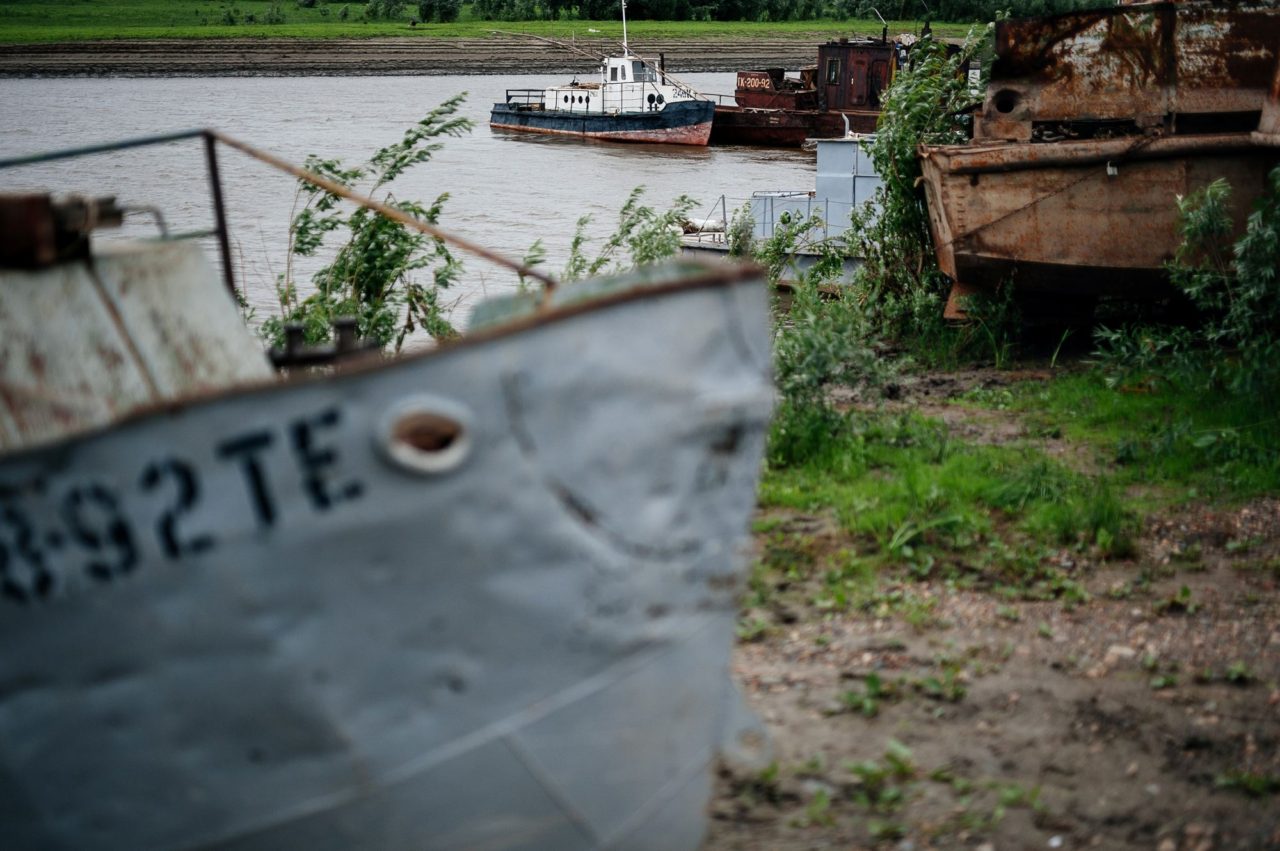
The docks in Parabel. Photo courtesy of Anton Unitysn/Takie Dela

Izhenbin recalls visits by researchers from the University of Vienna and the University of Budapest. There have been lots of Germans.

“I got such a kick from one professor. He and I went fishing. He got himself muddy from head to toe, pulled out some crap half a palm long from the river, and said, ‘Wonderful!’ Do you know what that means in English? The little fish is excellent. Then I took him out to pick pine nuts, and after that we made fish soup and drank vodka. He told me that for him to spend a day like that at home, he would have to work for a whole year, but we live this way all the time. We are happy people.”

Every Tree in the Forest, Every Fish in the River
“There’s a lot of terra incognita in researching Selkups in general and Selkup culture in particular, but you reporters always ask the same questions,” says Grigory Korotkikh, displeased. “For example, why did I, a Russian, take up the study of the Selkup language, and what is written on my t-shirt?”

The slogan on his t-shirt reads, “Every tree in the forest, every fish in the river would understand you if you spoke Selkup.”

Grigory, who is 17, grew up in Seversk, a closed city not far from Tomsk, but we meet in Moscow, where he is attending a linguistics camp.

“I had tried learning different languages of the indigenous minorities of the North. It’s just that I was able to making a living connection with the southern Selkups,” says Korotkikh.

Grigory stresses he is primarily interested in the academic, linguistic aspect, but he almost immediately interrupts himself to say nothing has been done for the Selkup people. There are no books in Selkup, and the language has not been studied in a centralized way.

“We publish academic articles, but only for each other, for other researchers. It means nothing to the Selkups themselves,” he says excitedly. “The Selkups may, in fact, be happy to study their own language, but they have no means to do so.”

Grigory is the Seversk representative of the grassroots organization Kolta-Kup, which promotes the interests of the indigenous peoples of the North. His colleagues predict a big future for him in grassroots activism. There is a lot of work to be done. Local officials say the right things to indigenous peoples, but in practice they are treated as colorful ethnographic attractions, entertainment for tourists, and a means of reporting to higher-ups that the officials have been solving the problems of the local populace. Activists have not even been able to get a full-time position of Selkup language teacher established in the schools. Ludmila Shadrina in Narym and Irina Korobeinikova in Parabel ran their Selkup language and culture clubs at their own behest.

Non-Russian Languages
Tomsk is a university town. When you drive down the city’s main boulevard, still called Lenin Avenue, you pass Tomsk Polytechnic University, Tomsk University of Control Systems and Radio Electronics, and Tomsk State University. Nadezhda Fedotova, a linguist at TSU, tells me how Tomsk and Moscow scholars managed to get the first academic mega grant in the field of linguistics, thus becoming part of an unprecedented program for financing university-level research in Russia.

The linguists’ overarching goal, which they stated in the application for the mega grant, is to describe the languages of Southern Siberia as fully as possible. Andrei Dulzon, a Soviet linguist, ethnologist, and archaeologist, began tackling the problem in the mid twentieth century. Exiled to Tomsk in 1941 as an ethnic German, Dulzon had lost everything from the ability to work in his profession to his unique card catalogue of dialects. In 1943, he was enlisted to work in the mines, but a year later the authorities relented and allowed the researcher to work at the Tomsk Pedagogical Institute. Dulzon had specialized in German dialects in Moscow, but in Tomsk he took up a new area of research, the indigenous peoples of Siberia, and carried out a revolution in the field. He encouraged archaeologists to excavate Siberian burial mounds, and he organized regular ethnographic and linguistic expeditions that collected so much raw data it is still being processed.
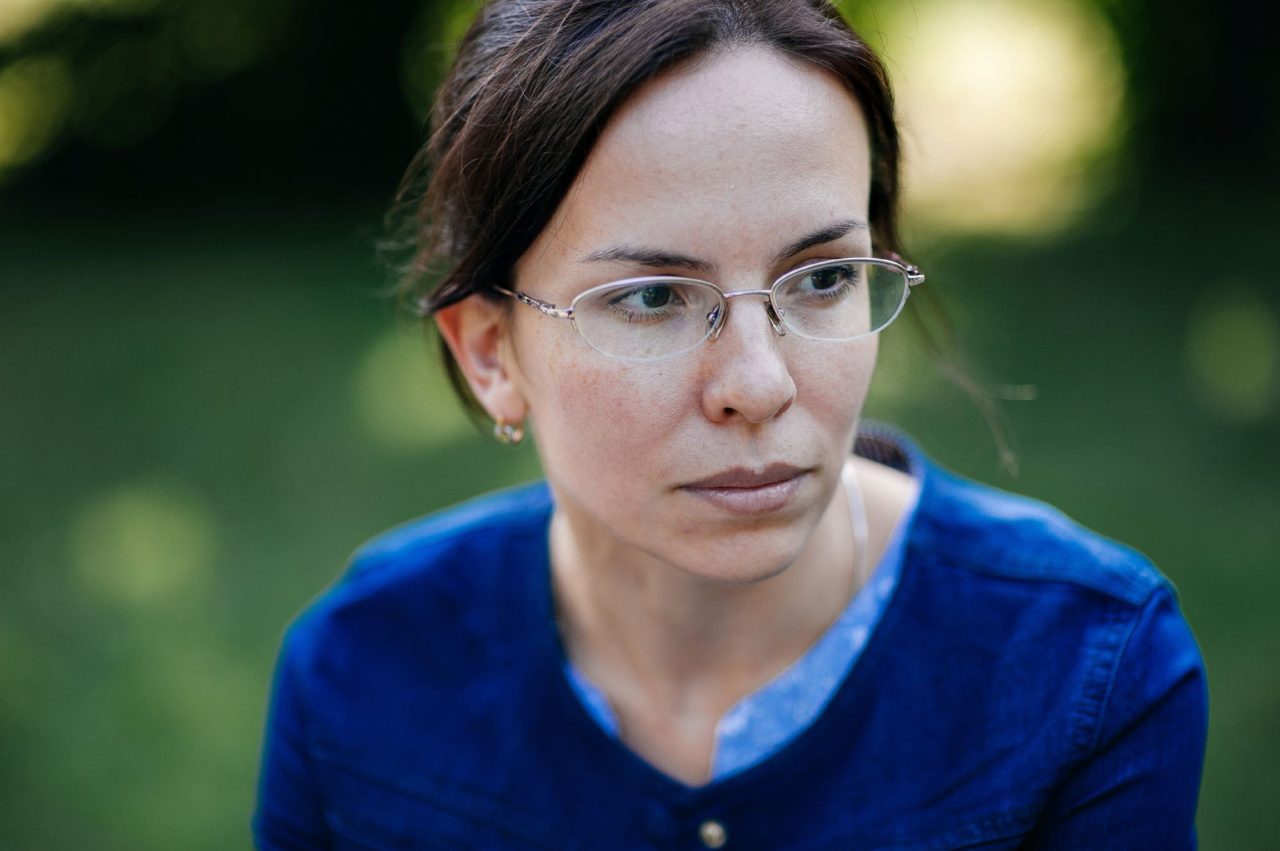
Nadezhda Fedotova, researcher at Tomsk State University’s Linguistic Anthropology Lab.  Photo courtesy of Anton Unitysn/Takie Dela

“Our ethnologist colleagues in Tomsk had already won a mega grant, and the tradition of researching minority languages has been a good one,” says Fedotova, “so it was decided to set up a linguistic anthropology lab here under the direction of Anna Dybo. And there she is!”

A corresponding member of the Russian Academy of Sciences, the linguist and Turkologist Anna Dybo rides her bike toward the university library, which houses the lab. It is eight in the evening, but no one is planning to go home, despite the fact the linguists had to attend continuing education lectures all day.

According to Dybo, the lab currently employs seventy people: its funding is incomparable to any research group in the west. The most expensive line item in its budget are the expeditions to meet with native speakers of minority languages, but a lot of money is also spent on processing the data they collect and publishing it in the shape of huge dictionaries and text corpora. A text corpus is a gigantic structured set of texts, selected and processed according to certain rules, which is used to study a language, test statistical hypotheses, and validate linguistic rules. For all this to work, programmers and linguists must engage in a nonstop collaboration. At first, they worked for the sheer joy of it, but nowadays Russian technical designs are a product willingly purchased in the west. In addition to processing material that has already been collected, computer technology is used in field work, for example, a system that catches the way a person perceives a spoken word by tracking certain eye movements.

“Did you know the Selkups have a word meaning all colors at once?” asks Yulia Normanskaya, doctor of philology and head of the university’s Uralic languages department. “Green, blue, yellow, gray . . . Simply put, in their language, grass, the sky, and dandelions are the same color. When you ask them to translate it into Russian, they imagine it as one color.”

Yulia Normanskaya, senior researcher at Tomsk State University’s Linguistic Anthropology Lab. Photo courtesy of Anton Unitysn/Takie Dela

Normanskaya got interested in minority languages in her youth after she learned her ancestors had translated the Gospels into the Chuvash language. Consequently, nearly all of them were shot during the Revolution.

“In the late nineteenth century, the Russian Orthodox Church set up a Translation Commission to publish books in non-Russian languages,” she explains. “The primary aim was to spread the Word of God among minorities, but they published not only liturgical literature but also dictionaries and children’s tales.”

There were also medical brochures, e.g. “On Cholera,” “On Trachoma,” and there were moral tracts. Many of these publications have been lost irretrievably, although some have been preserved at the Russian National Library in St. Petersburg. Another set was unexpectedly discovered in Finland. Normanskaya was looking through the card catalogue at the Helsinki Library [sic] and found information there about the publications of the Translation Commission. The booklets were simply lying in boxes, unsorted. No one had been making use of them or done any research on them. The find included three large books in Selkup, among them a complete translation of the Old and New Testaments, although the received opinion was that alphabets had been devised for the vast majority of indigenous peoples, including the Selkups, in the 1930s under Stalin. In Soviet times, the books of the Translation Commission were discussed pejoratively and accused of being primitive. However, by working with modern native speakers of minority languages, researchers have shown that, in fact, the books were a quite accurate record of the living languages.

“When you compare a map of native speakers of minority languages in the early twentieth century with the current map, the impression is, of course, completely catastrophic,” says Normanskaya. “Even when Dulzon was active, there were dozens of villages where people spoke only Selkup. Currently, there are six people who can tell tales, sing songs, and generally speak the central and southern dialects.”

Statuettes in the park at Tomsk State University. Photo courtesy of Anton Unitysn/Takie Dela

The Selkup dialects are unique. For example, they have retained semantic stress (that is, stress that changes the meanings of words). It was inherited from Proto-Samoyedic, the language spoken in Siberia before our era.

“On the one hand, we see an impoverished daily life in which people barely speak their native tongue, and many are ashamed to admit they are Selkups. On the other hand, we find a unique language that has retained ancient features over the millennia, a language that converts into Enets, Nganasan, and other geographically remote languages with mathematical accuracy,” says Normanskaya.

If the language of the southern Selkups disappears, and researchers do not record it in time, what has been passed down through the centuries and preserved in the language for thousands of years will remain unknown forever.

“But if we described these dialects,” adds Normanskaya, “it would be one more proof that languages change in an amazingly systematic way. By converting words from one language into another according to mathematically exact rules, we can restore the pronunciation of the Siberian languages that existed before our era.”

I ask Normanskaya whether we should preserve a language if people do not want to speak it. Norman smiles and, instead of answering my question, recounts how the Soviet linguist Valentin Rassadin invented the Tofa alphabet in 1988. At the time, the Tofas themselved did not converse in their native tongue at all. In the 1990s, actvists in the Tofalar ethnic movement got the Tofa language, as written in Rassadin’s alphabet, on the curriculum of schools and kindergartens, and currently there are whole villages that speak Tofa. The Tofalars consider the linguist Rassadin a national hero.

Translated by the Russian Reader

Kefir the Plough

punisher-it's a lonely row to hoe

I cannot discern grace.

A child of God may have the kingdom of grace in his heart, and yet not know it. The cup was in Benjamin’s sack, though he did not know it was there; so thou mayest have faith in thy heart, the cup may be in thy sack, though thou knowest it not. Old Jacob wept for his son Joseph when Joseph was alive; so thou mayest weep for want of grace, when grace may be alive in thy heart. The seed may be in the ground, when we do not see it spring up; so the seed of God may be sown in thy heart, though thou dost not perceive it springing up. Think not grace is lost because it is hid.

Before the kingdom of grace come into the heart, there must be some preparation for it; the fallow ground must be broken up: I fear the plough of the law has not gone deep enough: I have not been humbled enough: therefore I have no grace.

__________________________________________

Today on The Archers:

At Bridge Farm Susan is keen to start promoting the kefir again now that Christmas is over. However, Helen is far too busy, and insists she’ll have to wait for Tom to return from his conference. Susan devises a market research project of her own, and starts pouncing on customers at the Ambridge Tearoom. Fallon and Emma worry that she’s scaring away customers, and do their best to moderate her zeal. Eventually Emma puts her foot down: the Tea Room is not the place for Susan’s market research.

__________________________________________

What Emma says to Susan when she puts her foot down over the latter’s sinister kefirization of the Ambridge Tea Room:

Take Life or Nonlife in the Anthropocene and the Meteorocene. Geology and meteorology are devouring their companion discipline, biology. For if we look at where and how life began, and how and why it might end, then how can we separate Life from Nonlife? Life is not the miracle—the dynamic opposed to the inert of rocky substance. Nonlife is what holds, or should hold for us, the more radical potential. For Nonlife created what it is radically not, Life, and will in time fold this extension of itself back into itself as it has already done so often and long. It will fold its own extension back into the geological strata and rocky being, whereas Life can only fall into what already is. Life is merely a moment in the greater dynamic unfolding of Nonlife. And thus Life is devoured from a geological perspective under the pressure of the Anthropocene and Meteorocene. Life is merely another internal organ of a planet that will still be here when it is not, when we are not, undergoing its unfolding, creating who knows what. Will Life be a relevant concept there? If not, perhaps Nonlife will finally be freed from Life’s anxiety, freed from being Nonlife, or as Luce Irigaray might have said, from being the other of the same, freed to finally be the other of the other.

Until then perhaps we shouldn’t be surprised that the emergence of geontopower is mobilizing very similar techniques and tactics that we saw when we were looking at late liberalism. We hear all around us the coming Event, the catastrophic imaginary orienting and demanding action—the last wave, the sixth extinction. And yet pulsing through various terrains is a very different temporality—the river becomes a polluted dump; the fog becomes smog; rock formations become computer components. Is this why the poetics of the quasi-event stitch together the environmental studies of Rob Nixon, the affective optimisms of Lauren Berlant, and the crumbling worlds of settler liberalism? It is most certainly why we see the constant seduction of older late liberal politics of recognition: the sudden realization, the welcoming of an otherwise into what already exists, the extension of qualities we already most value and create most of our value from to the other.

Get out the musical instruments. Put on the robes. Say a mass of remembrance for the repose of the souls of the dead. Cling to life if even in the form of its mass extinction.

__________________________________________

I can imagine listeners will have a lot to say about the further radicalization of The Archers on this week’s edition of Feedback.

Andrey Kalikh: It’s Good to Live in the Country

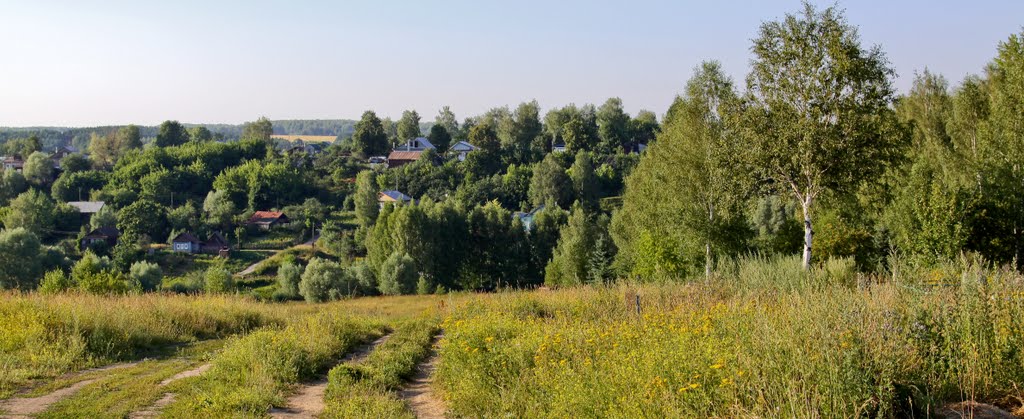
48763870One view of the Russian countryside

Andrey Kalikh
Facebook
December 31, 2017

Four and half years ago, we got the hell out of the city and settled in the country. Three circumstances happily combined to facilitate this: the issue of an apartment, which had been suffocating us; metal fatigue, so to speak; and the lack of the need to go to the office.

By this time I was grazing on the abundant meadows of freelancing, earning money as I had never earned by translating from German, writing articles for the German media, and working as a fixer for German reporters. After the tedium of an office human rights job, I had the sense I had finally yielded to sin, and my fall was as predictable as it was sweet.

Since then, the four of us have become five, the kids play in a two-story house, and I have my own study, where I pen valuable eternities, like Solzhenitsyn in Vermont. And then I go outside and deal with eternal values, like the roof, the sewer, firewood, sawdust, and so on.

I’ve long been able to earn a living without leaving the house, and increasingly I have no idea why I should go to the city. More and more often, my trips to the city are limited to the airport.

Time and distance have a salutary effect on mind and nerves. I have a nervous mind, and the big city and its hysterical intensity were claiming both my mind and my nerves. Life in the country is wonderful for its emptiness. It is your personal responsibility to fill the emptiness.

So, despite outward deprivations, my year has been peaceful and successful thanks to new ideas and the new wonderful people who have appeared in our midst recently, most of them in virtual space. In 2018, I would like to devirtualize my relationships with most of you. As for old friends, I would just like to see you.

With the beautiful Natasha Panova, without whom none of this would have happened.

Translated by the Russian Reader. Photo courtesy of panoramio.com

______________________________

Olga Romanova: Yevgeny Makarov’s Life Is in Danger

25348294_1778733372160895_7929908659001172524_n

Olga Romanova
Facebook
December 15, 2017

I have to write this so you’ll read it, so as many people as possible will read it, because a man’s life depends on it. So repost this, please, and maybe we’ll save his life.

His name is Yevgeny Makarov. Ivan Nepomnyashchikh has written a lot about him, because they were in prison together. There were three of them: Ivan, Ruslan Vakhapov, and Yevgeny Makarov. Of the fifteen hundred inmates in Penal Colony No. 1 in Yaroslavl, the three of them stubbornly stood up to the sadism, bullying, and humiliation meted out by wardens and guards. For their pains, they were beaten, held in solitary confinement, and issued leaky dishes, and they went on hunger strike.

They were not allowed to see their lawyers, but the prison’s special forces team would be dispatched to deal with them.

When Ivan was released, he immediately left the country. He has now enrolled at a university in the US. Ruslan and Yevgeny still have to serve out their sentences.

It was Yevgeny who has borne the brunt of the wardens’ anger. On December 5, he was transferred to Penal Colony No. 8.  The prison guards stripped Makarov naked, sat him in a chair, and beat him with a wet rag knotted on the end. They then poured water over him and shocked him with a cattle prod. Afterwards, guards attempted to plunge Makarov’s head in a toilet. (This is one method of “punking” an inmate.) Makarov resisted, and his head was slammed against the toilet bowl. His torturers stopped at this point and put Makarov in solitary confinement for fifteen days. He has also been sentenced to eight months in a single-cell room (abbreviated EPKT in Russian), a prison within a prison.

Our friends the lawyers at the Public Verdict Foundation have filed a complaint with the European Court of Human Rights in Strasbourg.

The ECHR has ordered the Russian Federation government to ensure that Makarov has been given a medical exam within 48 hours by physicians independent of the Russian Federal Penitentiary Service and provide the court with a report on the results of the exam. The Russian goverment must also ensure Makarov’s safety and that he has unhindered access to legal counsel representing his interests. The EHCR drew the Russian government’s attention to the fact that it has taken urgent measures on behalf of Yevgeny Makarov. The complaint has been given priority status.

But the wardens in Russian prisons could not care less about the ECHR. They don’t understand. And human life there is worthless.

Thanks to Dmitry Kalugin for the heads-up. Translated by the Russian Reader

Cotton in Volgograd: An Immigrant’s Story

The White Gold Immigrant
Alexandra Dontsova
Takie Dela
December 5, 2017

Oybek Kimsanbayev’s life is like a Hollywood film: a brilliant scientific career, crushing failure, departure from his native country, work on a construction site, and his first experiments with cotton in Russia.

A heated discussion was underway at Volgograd State Agricultural University. Local and university officials were telling a visiting deputy agriculture minister about the local curiosity: cotton. Imagine, they told the deputy minister, it grows here, and the quality is even excellent. They dreamed aloud how it would be grown on an industrial scale. All that was needed was state support and processing complexes.

While the officials were singing cotton’s praises to the deputy minister from Moscow, a man with a haggard face stood in the doorway of the conference hall. He nervously bit his lips, alternating his gaze between the floor and the audience. Oybek Kimsanbayev heads a group of scientists who have developed varieties of cotton capable of growing in the Volgograd Region’s climate. The region is recognized as the northernmost point in the world where it is possible to grow cotton. Although he was the most important person in the room, Kimsanbayev was not on the list of speakers.

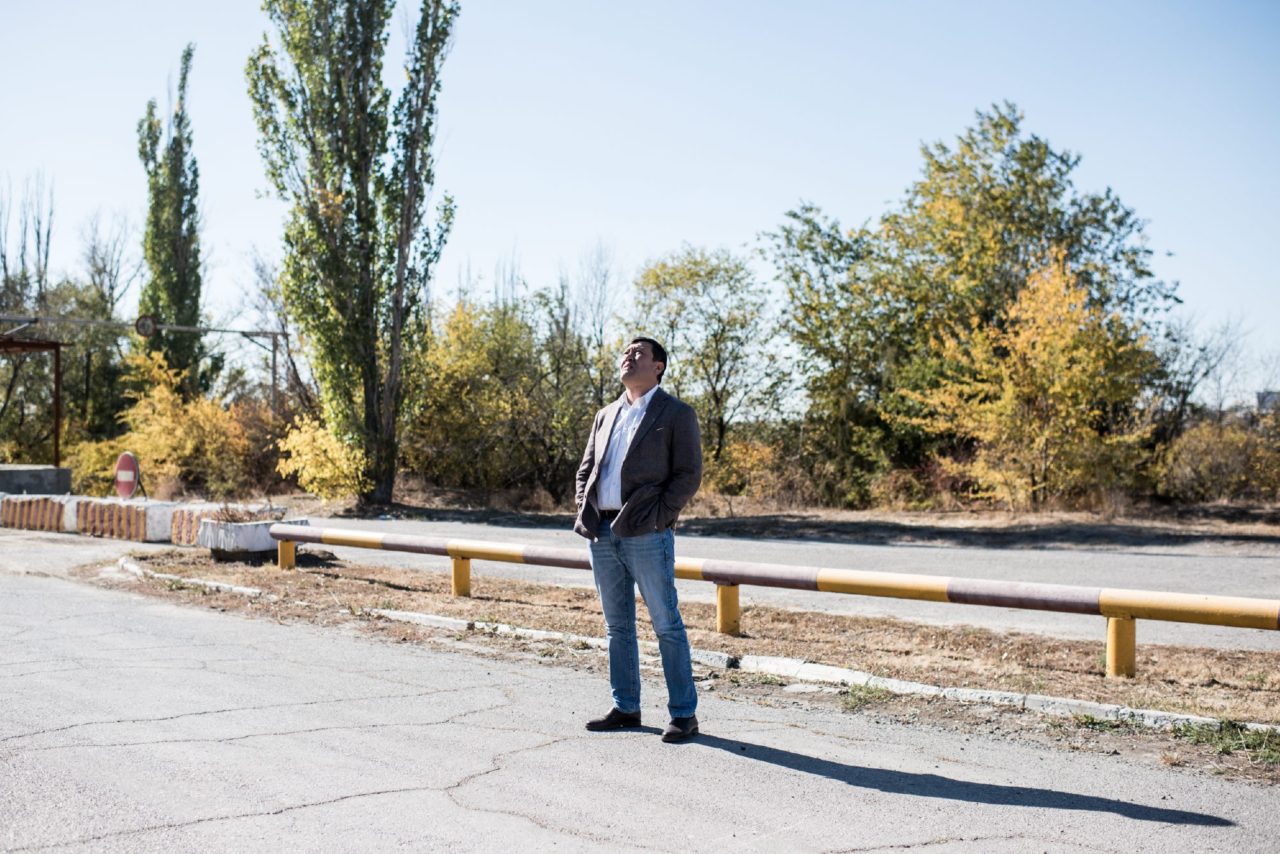
Oybek Kimsanbayev waiting to be interviewed. Photo by Alina Desyatnichenko for Takie Dela
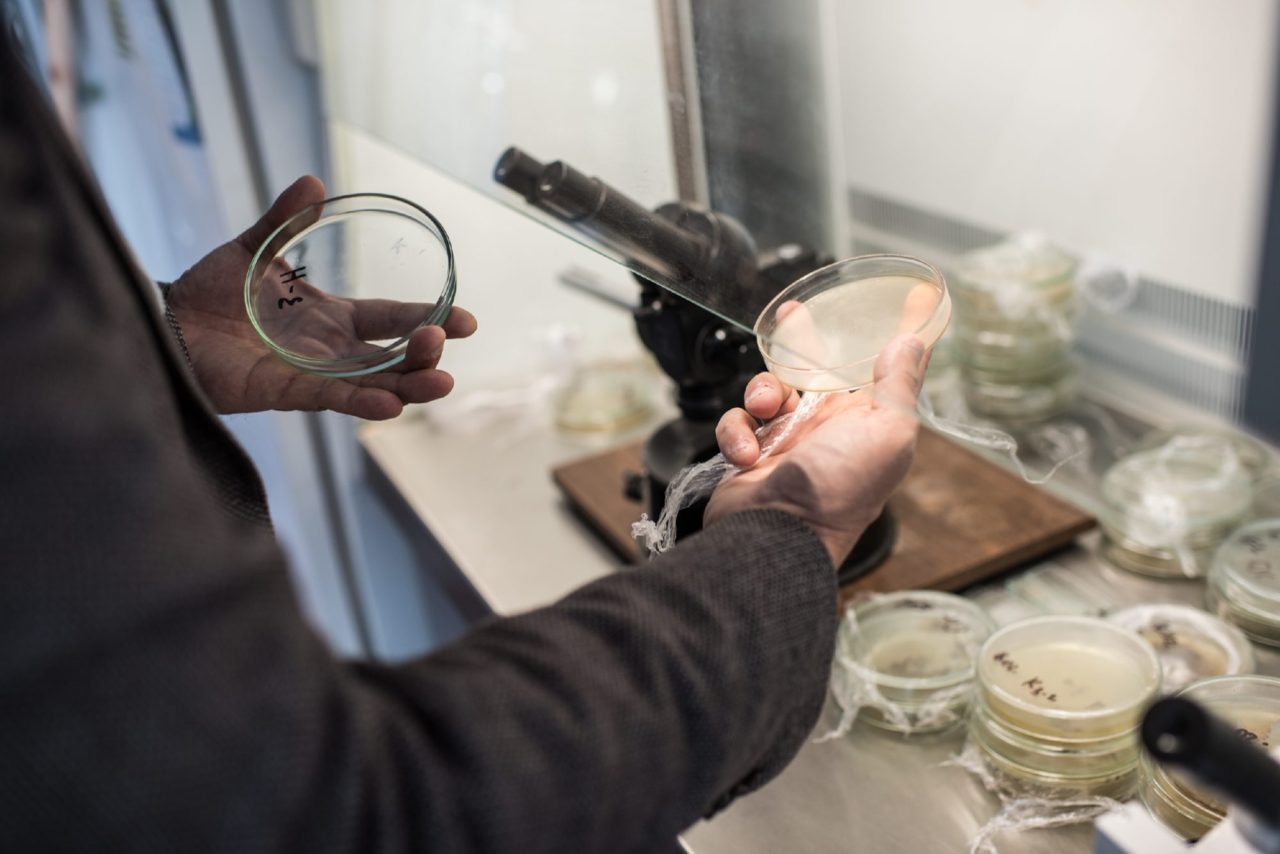
Everyone except the man who had made the conversation possible talked about cotton and the prospects of its cultivation in Russia. (Given a skillful approach, Russian cotton might challenge the US and China’s hold on the market.) However, at some point, the university’s rector realized the discussion lacked something and gestured for Kimsanbayev to come and sit down at the round table at a place that had happily been  vacated.

Construction and Cotton

Kimsanbayev tells journalists nearly the same story when asked why he started researching cotton in Russia, adding that he is very grateful. Were it not for reporters, few people would know of his work, and he scarcely would have been able to get the ear of the authorities.

“In 2006, a cooperation agreement was concluded between Taskhent State Agricultural University and Volgograd State Agricultural University. Researchers launched projects on alternative crop production, meaning cultivatings crops that have not usually been grown in a particular area. One lab worked on reviving cotton growing in Russia. The outcome was a project for generating ultra-early ripening, high-quality varieties with a high fiber yield,” Kimsanbayev says at one go.

“And the non-official story? Why did you start researching cotton in Volgograd?”

We are sitting in small cafe in the Hotel Volgograd. It is pouring rain outside. Opposite our table is a group of foreigners. Judging the by patches on their blazers, they are FIFA officials, who have arrived in the city to monitor construction of the city’sstadium for the 2018 World Cup.

Kimsanbayev is forty-three years old. Aside from Tashkent Agricultural University, he has a degree from the University of Seoul, taught at Columbia University, ran a lab, worked for the president of Uzbekistan in the early noughties, and at the age of thirty-five became the youngest doctor of agricultural sciences in his country. He has published hundreds of scientific papers, and he has developed and co-developed some two dozen varieties of cotton. Until 2012, he led an international project for creating ultra-early ripening cotton varieties.

Kimsanbayev shows the work his lab does. Photo by Alina Desyatnichenko for Takie Dela
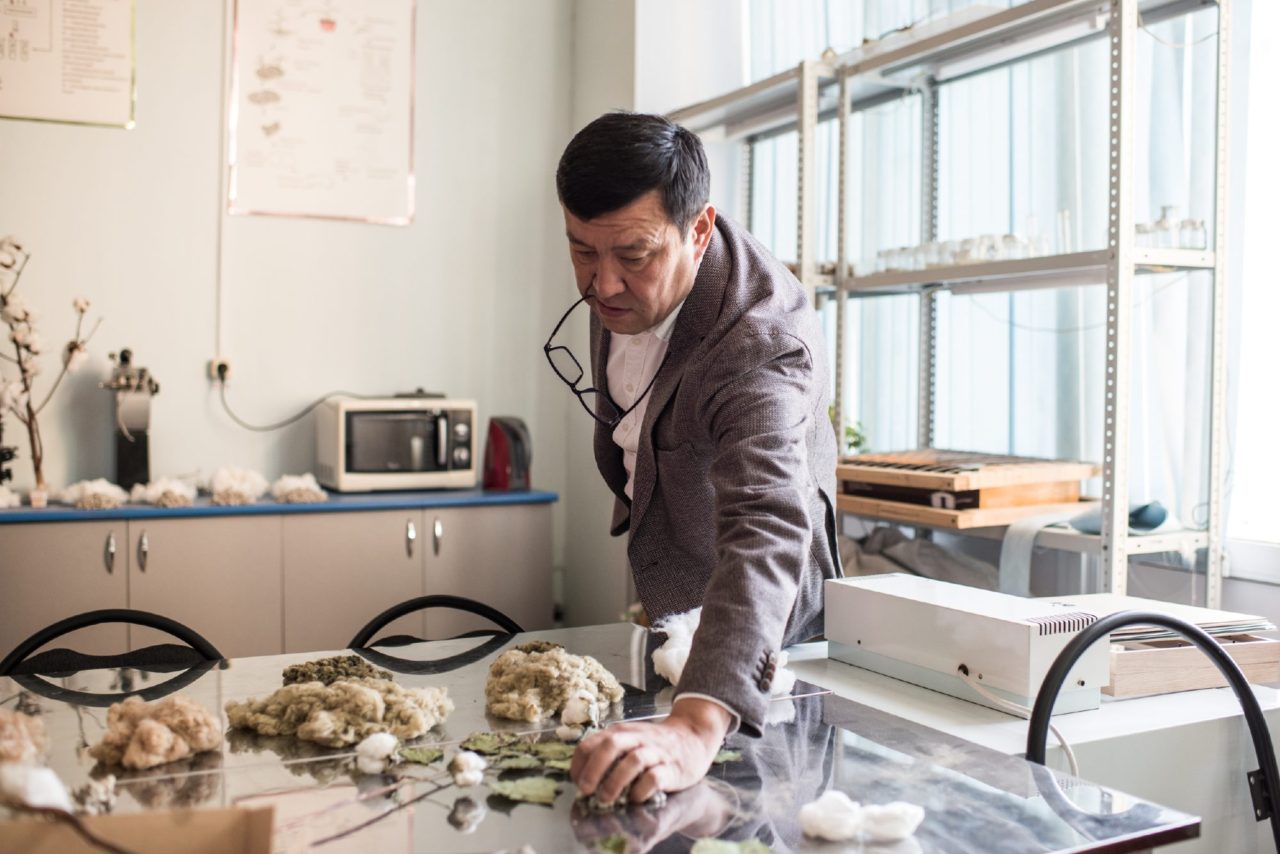
It was at this high point that Kimsanbayev’s life, chockablock with prospects and ambitious plans, fell apart overnight. Due to a mistake he discusses reluctantly, he was forced to leave Uzbekistan.

“Yeah, I have a big mouth. I was working with a Russian university. We had established a distance-learning platform for Uzbek children. But not everyone liked what we were doing. So it happened I lost my job and could not find another one.”

Professor Kimsanbayev was forced to go to Russia to work as an ordinary migrant worker. An acquaintance in Volgograd hired him to work for his company, to “make some moves,” as Kimsanbayev puts it.

“The helter-skelter was not my thing, and I went and got a job at a construction site. I was an ordinary unskilled laborer, along with other men from my country. I don’t see anything shameful about working with my hands. If I have to, I’ll wash floors. Or work on building the stadium.”

Chance brought Kimsanbayev together with good people who took him to Volgograd State Agricultural University. After a long interview with the rector and after he supplied the university with his academic credentials, Kimsanbayev was appointed a lecturer in the agricultural technology department. Realizing the worth of their new faculty member, the university rented a flat for him. He was given the chance to do what he does best: experiment with cotton.

Not Just Cotton Wool

The first year, Kimsanbayev planted only 25 acres. The professor did everything himself in a field the size of four typical dacha plots. He sowed it, plowed it, watered it, and did battle with weeds and pests. Many people doubted the seeds would sprout.

“I brought an international collection of cotton seeds to Volgograd: 97 varieties from all the cotton-producing countries, from Latin America, the US, China, India, and so on. I selected 25 varieties, which sprouted in the local climate. I narrowed these down to three varieties. That is how we arrived at an ultra-early ripening cotton in Volgograd, a variety that matures between April and September.”

The following year, the experimental cotton field had grown to eight hectares. To help him with the work, Kimsanbayev hired Uzbek agronomists and encouraged the university’s students to join them. The outcome: not only did the cotton seeds sprout, but the field turned into a white carpet in due time.

“As they say, I woke up famous one day. Reporters and local officials came to see me in the field. Now everyone believed Volgograd cotton was a reality. However, we are faced with other problems. We have to convince farmers it is worth growing cotton, that the crop is economically profitable: the price of one kilo of raw cotton is equal to the price of thirty kilos of wheat. In addition, we need specialist agronomists. So, basically, I promote cotton and, of course, train students. I don’t work alone. Several scientists, including Igor Podkovyrov and Taisiya Konotopskaya, have been working on cultivating new varieties with me and training specialists.”

Kimsanbayev now heads the university’s Center for Applied Genetics, Selective Breeding, and Cotton Seed Production. In total, 109 hectares were planted with cotton this year.

Oybek Kimsanbayev in the lab. Photo by Alina Desyatnichenko for Takie Dela
Kimsanbayev says that Allah loves him. Otherwise, he would not have sent him so many trials and so many people, willing to help him just like that, without asking anything in return.

“There have been deplorable circumstances when my life was not worth a penny. Yet people helped him. But there are things I really regret. I once behaved disgracefully and therefore moved away from my family. So the burden of guilt would not drag me down, I simply shoved off to Russia, frankly. That is why I have worked so hard, so that, down the line, my family—my dad, my brother, my wife and our three children—would be proud of me. That is my own real goal in the work I do.”

“What did you do that was disgraceful?”

“I don’t want to talk about it.”

“When was the last time you were in Tashkent?”

“I constantly have meetings and business trips. My schedule is crazy. I just got back from Astrakhan, where the region’s governor and I discussed a plan for sowing 200 hectares of cotton in the spring. I haven’t been home for four months.”

Kimsanbayev suddenly falls silent. The expression on his face changes noticeably when the conversation turns to family and children. His eldest daughter and son are seventeen and sixteen, respectively, while his youngest son is five.

“I miss them, of course. I’m really afraid of losing my family due to my work.”

“Why don’t you move them to Volgograd?”

“Where would I put them? In a rented flat on a monthly salary of 27,000 rubles [approx. 390 euros]? Listen, your questions are making me depressed, and it’s raining outside as it  is.”

Later, Kimsanbayev confesses he bought tickets for home right after our interview.

Potatoes on Mars

The cotton harvest is nearing completion in the university’s experimental field. The agronomist Bahadir or, as he introduces himself, Boris, specially recruited from Tashkent for the experiment outside Volgograd, shows me how to pick cotton. It is fairly straightforward. You pull the fiber from the boll. If it gives, you keep pulling until you have all the white cotton in your hand.

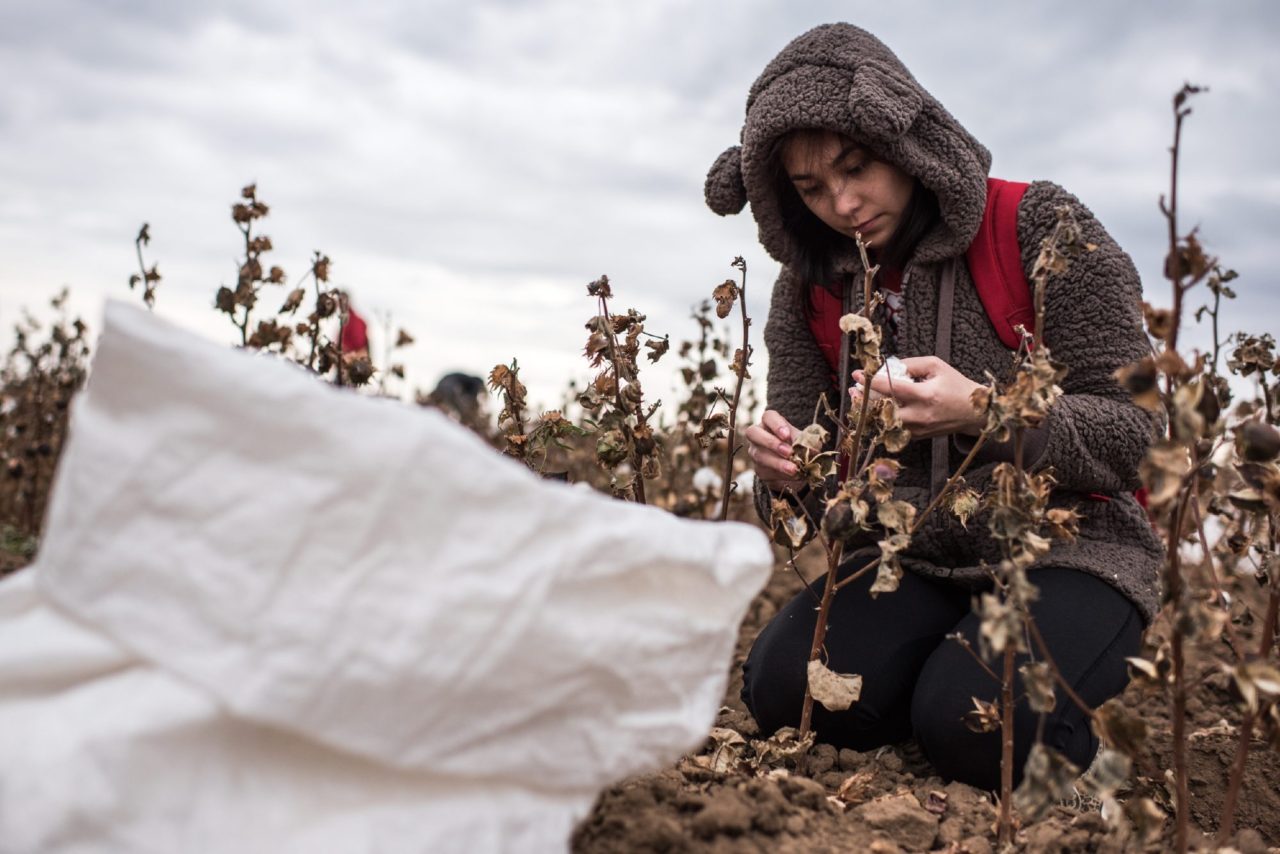
University students help pick the cotton. The white caps from the cotton plants are quickly deposited into sacks. Soft as a cat’s paw, the fiber is pleasant to the touch. The softness is a small reward for one’s efforts. Pulling the cotton from the boll without being pricked is nearly impossible.

A student from Volgograd State Agricultural University picks cotton. Photo by Alina Desyatnichenko for Takie Dela

There are several unusual rows on the edge of the large field. The cotton there is not white, but dirty yellow and brownish green. It transpires that this year the Volgograd researchers bred a special variety of colored cotton. Someone joked the military ordered green cotton for sewing its uniforms.

Since Oybek Kimsanbayev joined its faculty, Volgograd State Agricultural University became the only university in Russia where cotton scientists are trained.

“Do you know how I enticed students into studying cotton? I said they would be rare specialists, and they would especially in demand abroad. But I hope, nonetheless, that Russian farmers realize the crop is quite profitable economically. This year, for example, there was overproduction of wheat in southern Russia. Farmers cannot sell the grain at a good price, while there is simply nowhere to store such yields. Consequently, they are making a loss. And this isn’t the first year we’ve seen this scenario. So, farmers need to switch to other crops, including non-traditional crops. Cotton could be one of those crops.”

“Where else in Russia could cotton be grown?”

“Currently, Volgograd Region is the northernmost area in the world where cotton is planted. The crop could be planted farther south, in Astrakhan, Kalmykia, Stavropol, and Krasnodar. Just imagine, in Volgograd Region, in one of the districts along the Volga River there are one and a half million hectares of cropland lying fallow. If you sow all that land with cotton, and the yield from one hectare is around one ton, Russia could reshape the world cotton market. It would simply crash it. Russia would not be dependent on imported cotton, which is especially vital given ongoing western sanctions and Uzbekistan’s refusal to export raw cotton to Russia. The really funny thing is that cotton was once grown in these parts. However, the technology was lost over the last decades. So now we folks at the university are once again developing techniques for cultivating cotton and breeding new varieties.”

The harvested cotton is loaded into a trailer for the journey to the warehouse. Photo by Alina Desyatnichenko for Takie Dela
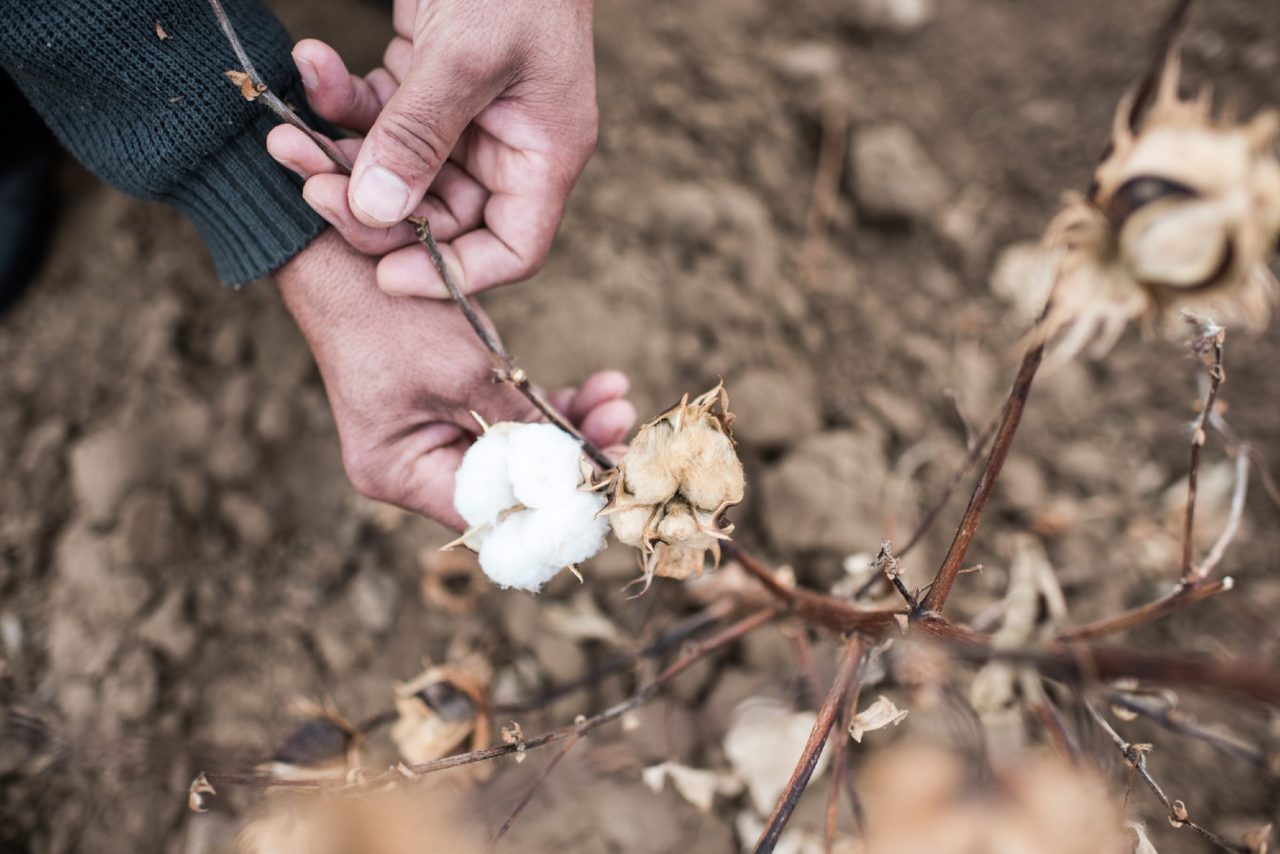
The cotton from the experimental field is of very high quality. Its quality has impressed the local textile mill and a Moldovan company, almost the only full-cycle plant in the CIS where raw cotton is processed and fabric produced. It is they who are hurrying the researchers in Volgograd to breed varieties that would yield 3,000 kilos a hectare.

“Next year, six times more cropland will be sown with cotton seed in Volgograd Region alone: 630 hectares. Plus there will be 200 hectares in Astrakhan Region. We are negotiating with Kalmykia. We provide scientific support to all the farmers. Recently, at an ag expo in Moscow, I spoked with your agriculture minister, Alexander Tkachov. He told me a program for supporting cotton growing in Russia was in the works. I think the availability of state support would ultimately convince farmers to take up cotton.”

“Do industrialists try and recruit you? The salaries are definitely higher in industry than at a regional university.”

“I’ve had offers. But I turned them down. I would have to work as an agronomist or seed cultivator whose job would be to increase gross crop yields. I don’t find that interesting. I’m a scientist. I’ve created a variety, I’ve let it go to work, and I’ve set myself a new goal.”

“Do you have a new goal?”

“I do. Roughly speaking, our project aims to study alternative crop production. Meaning that we cultivate crops in places where they usually don’t grow. Have you seen the movie The Martian, in which an astronaut grows potatoes? They took the idea from reality. Thirty years ago, the Soviet cosmonaut Vladimir Dzhanibekov was the first person to grow cotton in outer space. My objective is to cultivate varieties of different crops that would adapt to all natural conditions, so that no amount of frost could damage them. I have proven this is possible. However grandiloquent it might sound, the job of farmers is to feed the world. If plants can yield crops under any conditions, imagine how that would change a country’s economy.”

The agronomist Bahadir shows off Volgograd’s know-how: colored cotton. Photo by Alina Desyatnichenko for Takie Dela
Cotton is the only crop that has several sets of genetic chromosomes. That is why it is perfect for different experiments.

“How do they relate to your work and success in Uzbekistan? Are they kicking themselves for letting such a valuable employee go?”

“I don’t know whether they’re kicking themselves. But I have been offered a prestigious job and a high post. I’m not ready to go back yet.”

Translated by the Russian Reader

Latifundism in Russia

Land Prices in Russia Reach Five-Year High
Farmland may become cheaper next year
Irina Sinitsyna
Vedomosti
December 6, 2017

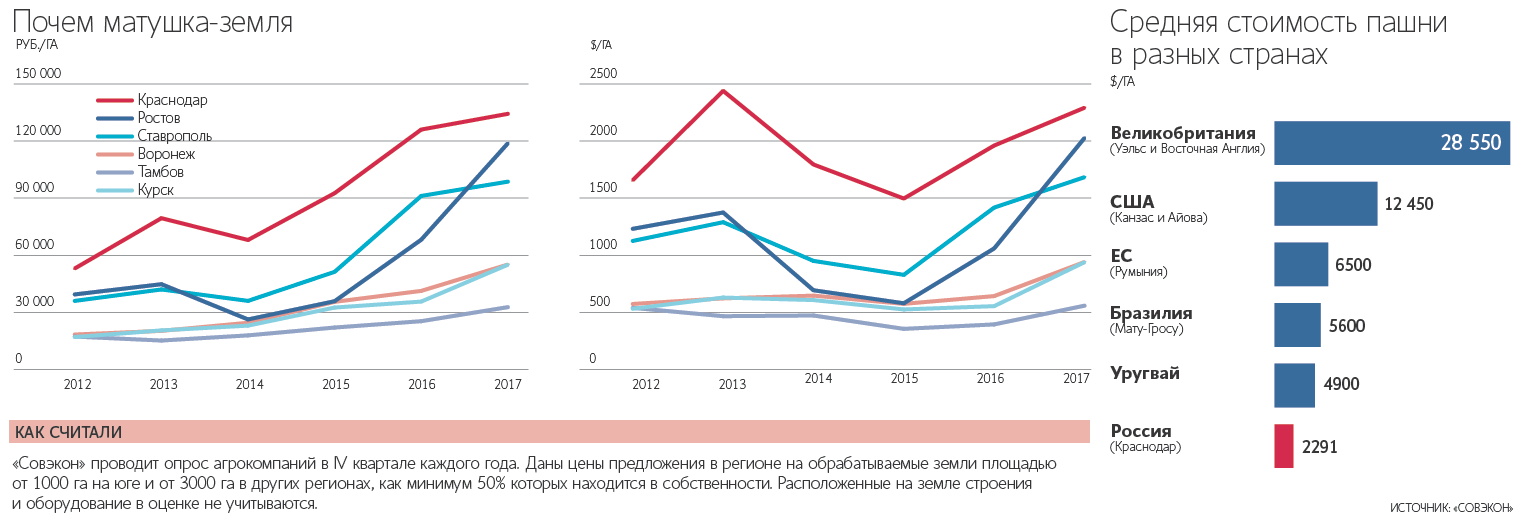
The cost of farmland in Russia’s primary grain-producing regions reached its five-year peak in 2017, as valued both in rubles and dollars. This conclusion was reached by analysts at Sovecon, an agro industry research center, based on the results of an annual survey.

Amongst the fundamental reasons were the record profits made by agricultural producers in the 2016–2017 season, sparked by good harvests and relatively high ruble prices for most commodities, says Andrei Sizov, Sovecon’s director.

In addition, there has been consistently strong demand for land on the part of predominantly Russian capital in the guise of industry-specific investors, Sizov adds. Amongst the most active public buyers, Sizov identified the agricultural division of Sistema, the N.I. Tkachov Agrocomplex, owned by the family of Alexander Tkachov, Russia’s agricultural minister, and Volgo-Donselkhozinvest, owned by the family of Sergei Kukura, adviser to Lukoil president Vagit Alekperov. New players, such as the companies owned by Roman Avdeyev, have also continued to expand into the agro business. On the year, from the fourth quarter of 2016 to the third quarter of 2017, Sistema’s subsidiaries increased their land holdings by one and a half times, from 247,000 hectares to 380,000 hectares. In the spring, Volgo-Donselkhozinvest closed a deal to buy the Russsian assets of the Swedish company Black Earth Farming: a total of 244,000 hectares. In late 2016, Avdeyev’s investment vehicle Rossium purchased 99% of the Lipetsk agro holding Agronova-L, which grows grain and oilseeds on more than 70,000 hectares in Lipetsk and Tambov regions.

At the same time, Russian farmlands are still undervalued compared to agricultural land in other countries, for example in Eastern Europe, adds Sizov. In several regions such as Kursk Region, however, land prices are unjustifiably inflated, argues Alexander Krasnov, head of the legal department at the agro holding Miratorg.

Land has gone up in price in recent years, but this year growth slowed or even halted, notes Vladislav Novoselov, managing director of agro industy consulting company BEFL. According to Novoselov, the main cause of the previous price rise was an increase in agriculture’s profitability, due largely to devaluation.

In the coming year, the growth of the value of land in southern Russia could slow down significantly, and in regions located farther from export ports, land prices could stagnate altogether or even decrease, argues Sizov.

Domestic prices for all major agricultural products, especially grain, fell precipitously this year amidst a bumper grain harvest, explains Sizov. According to Sovecon, in November, the main export commodity, fourth-class wheat, was 10% cheaper in southern Russia than a year ago, 20% cheaper in central Russia, and cheaper by a third in the Volga River basin. In 2017, prices for all major commodities declined significantly, Novoselov agrees, and problems with storage and transportation considerably reduced the incomes of market players. Many of yesterday’s land buyers have taken a break in anticipation of lower prices, says Novoselov.

Especially in Russia’s central regions, land prices have already fallen, Krasnov points out.

“You can now buy land for 10% to 15% less than at the beginning of the year,” he says.

At the same time, he adds, the quality of the land on offer has improved. There is a selection of large land plots of 5,000 hectares to 6,000 hectares, and there is more cultivated land on offer. Earlier, they would have been sold for a premium, he recalls, but not anymore.

In addition, the number of speculators has decreased significantly, continues Krasnov. Holding land in anticipation of price rises is no longer profitable due to high taxes and fines for those who do not cultivate their land.

fullscreen-4ltPrices of farmland in Krasnodar (red), Rostov (dark blue), Stavropol (light green), Voronezh (beige), Tambov (violet), and Kursk (light green) from 2012 to 2017, as valued in rubles/hectare and dollars/hectare, and compared with the prices of farmland in Great Britain (Wales and East Anglia), the US (Kansas and Iowa), the EU (Romania), Brazil (Mato Grosso), Uruguay, and Russia (Krasnodar), as valued in dollars/hectare. Source: Sovecon. Courtesy of Vedomosti

___________________

Agrocomplex Owned by Ag Minister’s Family Fourth Largest Farmland Holding in Russia
It lacks 4,000 hectares to claim third place
Yekaterina Burlakova
Vedomosti
April 25, 2017

The three leaders, as determined by the consulting company BEFL, have not changed over the past year. In first place is Igor Khudokormov’s Prodimex group (including Agrokultura’s assets), which controls 790,000 hectares of farmland. Rusagro surpassed Miratorg: they now own 670,000 hectares and 644,000 hectares, respectively (cf. the infographic, below). Rusagro’s director general Maxim Basov confirms the figures. A spokesperson for Miratorg refused to comment on the list. Nikolai Shevchenko, head of Prodimex’s agro division, cites figures that do not take into account Agrokultura, since it is Khudokormov’s personal project, leaving a total of a little over 600,000 hectares.

The N.I. Tkachov Agrocomplex in Krasnodar Territory has risen from sixth place to fourth place, having increased its holdings by 40% to 640,000 hectares. The agrocomplex lacked a mere 4,000 hectares to join the top three. The N.I. Tkachov Agrocomplex was found in 1993 by the father of the current Russian agriculture minister, Nikolai Tkachov. The company grows grain, is one of the major producers of raw milk in Russia, and the second largest rice producer. The agrocomplex also produces produces pork and beef, and has been developing a chain of stores. It currently runs over 600 stores in Krasnodar Territory, Stavropol Territory, and Rostov Region.

In recent years, Tkachov Agrocomplex has vigorously increased its land holdings: in last year’s BEFL rating, it entered the top ten for the first time. In 2015, it purchased the assets of the major agro holding Valinor, which owned land in southern Russia. A former top manager at Valinor informed Vedomosti the Tkachov family acquired 170,000 hectares in the deal. The agrocomplex continued its acquisitions in 2016. In the summer, it was reported the company had purchased over 30,000 hectares of rice fields, previously owned by the Razgulyay Group. Several months later, the Tkachovs bought Parus Agro Group, a major Krasnodar agro holding, from Andrei Muravyov, ex-president of Siberian Cement and ex-Qiwi shareholder. Parus Agro had controlled nearly 100,000 hectares of arable land in Krasnodar Territory, Stavropol Territory, and Adygea. Over the past three years, Tkachov Agrocomplex has increased its land holdings by 440,000 hectares, more than tripling them, according to BEFL.

Tkhachov Agrocomplex director general Yevgeny Khvorostin declined to comment for this article.

Vladimir Yevtushenkov‘s Sistema increased its land holdings most significantly. Its subsidiary, the agro holding Steppe, added 200,000 hectares over the past year, according to BEFL. Taking into account RZ Agro, which Sistema co-owns with the Louis Dreyfus Company, the corporation’s land holdings have risen to 350,000 hectares. Steppe has continued to increase its land holdings by acquiring assets, as stipulated by its overall strategy, says a spokesperson for Steppe. The goal is to increase its holdings to 500,000 hectares, company management has announced.

The past year was quite productive for major agro holdings, according to BEFL’s survey. The companies included in the 2017 list own a total of more than 12 million hectares of land, which is approximately 14% more than a year earlier. BEFL managing director Vladislav Novoselov says the last three years have witnessed a vigorous consolidation of the market. The fact is that, due to devaluation of the ruble, the return on investment in crop production has increased. Sistema’s spokesperson also agrees with this assessment.

In 2016, for the first time in three years, not only ruble, but dollar prices began to grow, Sovecon reported earlier. In Russia’s southern regions, agricultural commodity prices grew from 31% to 83%; in the central regions, from 6% to 17%; and in the Volga River basin, from 1% to 36%.

Late last year, however, it was obvious that in the future the profitability of crop production would not be so high. Domestric prices for agricultural produce have not been growing, and they have even declined for some commodities, partly because of the ruble’s resurgence, says Novoselov. Rusagro’s Basov confirms this is the case. Nevertheless, his agro holding has continued to acquire land. Taking into account the decreasing margin, land prices must drop for deals to go through, he concludes.

mobile_high-2p72017’s top ten corporate owners of farmland in Russia, in thousands of hectares. The second set numbers (in gray, in the far right column) indicates their places in the 2016 rating. 1. Prodimex + Agrokultura (790,000 ha); 2. Rusagro (670,000 ha); 3. Miratorg (644,000 ha); 4. N.I. Tkachov Agrocomplex (640,000 ha); 5. Ak Bars Agro (505,000 ha); 6. Ivolga Holding (489,000 ha); 7. Rosargo (400,000 ha); 8. Avangard-Agro (390,000 ha); Steppe + RZ Agro (350,000 hectares); Dominant Group (320,000 ha). Source: BEFL. Courtesy of Vedomosti

If you are interested in how this runaway latifundism has affected family farming in Russia, read my series of posts on the Krasnodar farmers’ protest movement and their allies in the Russian independent truckers’ movement.

Translated by the Russian Reader

Käppäselgä: A Godforsaken Corner of a Would-Be Superpower

Resident of Karelian Village Käppäselgä: My House Might Not Survive the Winter 
Maria Dmitriyeva
7X7
November 28, 2017

Galina Ryaziyeva

Galina Ryaziyeva, a pensioner living in the Karelian village of Käppäselgä, is afraid the roof of her home might collapse. The adjacent flats are dilapidated and are pulling the only remaining habitable section of the wooden barracks down with them. A lawsuit filed against the district council, which owns most of the house, has dragged on. Our correspondent tried to get to the bottom of the story.

The Back of Beyond
Käppäselgä is located the backwoods of the Kondopoga District. It is not just that you can encounter real bears in the village but also that it is one of the district’s northernmost corners. It is closer to the town of Medvezhyegorsk [Bear Hill] than the district’s seat, Kondopoga. Despite the seeming proximity of the Kola Highway, it is no easy trick getting to Käppäselgä, due to twenty kilometers of dirt road, reduced to rubble by lumber trucks. It took us three hours to drive to Käppäselgä from Petrozavodsk, capital of the Republic of Karelia. The last hour of the trip was spent traveling over those twenty kilometers of dirt road.

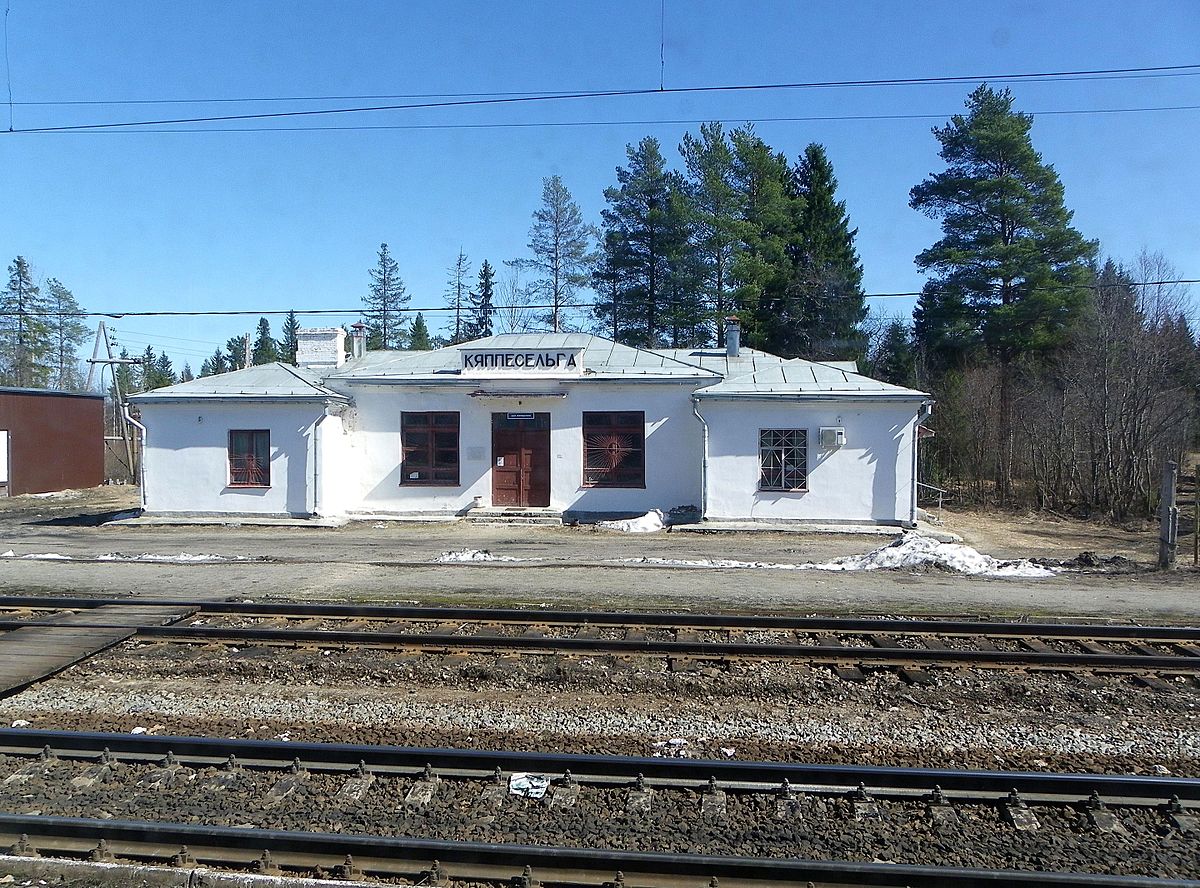
Кяппесельга.jpgKäppäselgä’s train station. Photo courtesy of Wikipedia
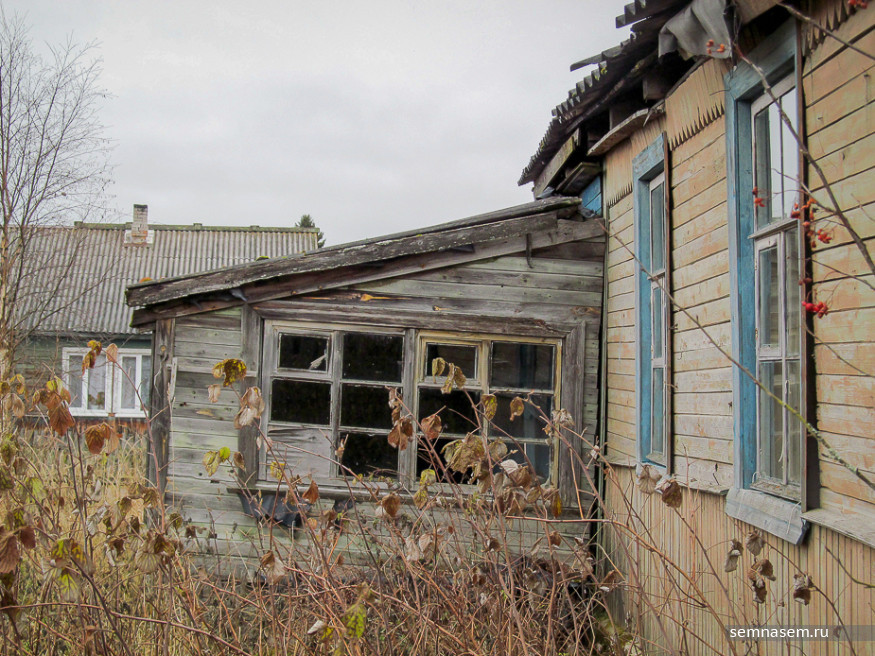
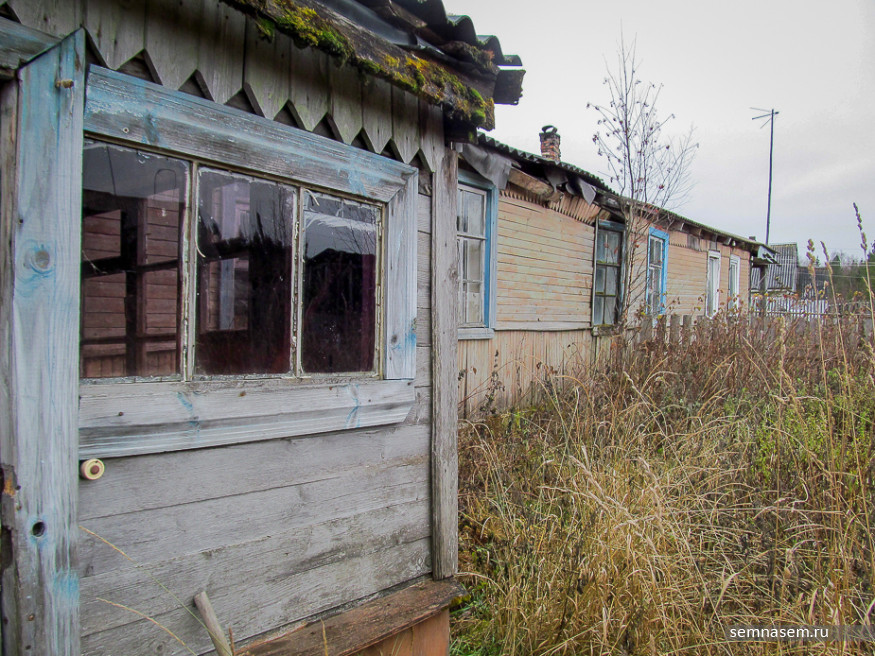
Socially, the circumstances in Käppäselgä are typical of Karelian villages. Nearly all the young people have left for the city long ago. There are ever fewer jobs available, and children can study at the local school only until the ninth form. The housing stock consists entirely of wooden houses. The amenities are outside, and fresh water is truck into the villaged. When a house is uninhabited, it rapidly deteriorates, and the roof eventually caves in. Currently, there are many such dilapidated barracks-style houses in Käppäselgä. There are also problems with transportation. A commuter train used to run twice a day (Käppäselgä has its own train station), but several years ago the schedule was reduced to once a day. So, if they want to go to Kondopoga or Petrozavodsky, villagers have to be at the station at four in the morning. The bus runs only once a week.

4Ramshackle roofs, broken windows, and empty houses are a common sight in Käppäselgä. 

Given these conditions, living in Käppäselgä is an accomplishment in itself. But the villagers face another obstacle: the unwillingness of the district council, which owns a considerable portion of the housing stock, to fulfill its responsibilities.

“It Could End in Disaster”
“I’m still afraid to sleep at night, because when the roof collapsed, it made such a racket. I jumped out of bed. I couldn’t understand what the cracklonging noise was. I went up to the attic. I could see my part of the roof was still intact, but the rest of the roof had collapsed into the flat next door,” said Ryaziyeva.

Ryaziyeva is sixty-two years old. She has had a stroke, suffers from diabetes and hypertension, and lives in a wooden house whose roof, she argues, could collapse at any moment due to inaction by the district council.

All the locals know Ryaziyeva: she worked at the local hospital for several decades. In the early 1980s, she and her husband moved into a four-flat wooden barracks, built in 1953, on Central Street. In 1984, the house was refurbished. The common corridor shared by the flats was removed, but the roof was not repanelled and reshingled. Consequently, for many years the roof would leak after heavy rains, dousing “either the ceiling lamp or the sofa.” In the 2000s, Ryaziyeva managed to get the council to repair the roof by threatening to take them to court, but according to her, the roofers the council hired for the job repaired only her portion of the roof, and slipped the old roof slats back under the new shingles.

There has not been a thorough renovation since then, and repairs that were carried out from time to time, such as replacing the window frames, were done by the residents themselves. Several years ago, when there was a hullabaloo about the nationwide housing privatization program’s coming to an end, Ryaziyeva privatized her flat. The other three flats in the house remained the council’s property.

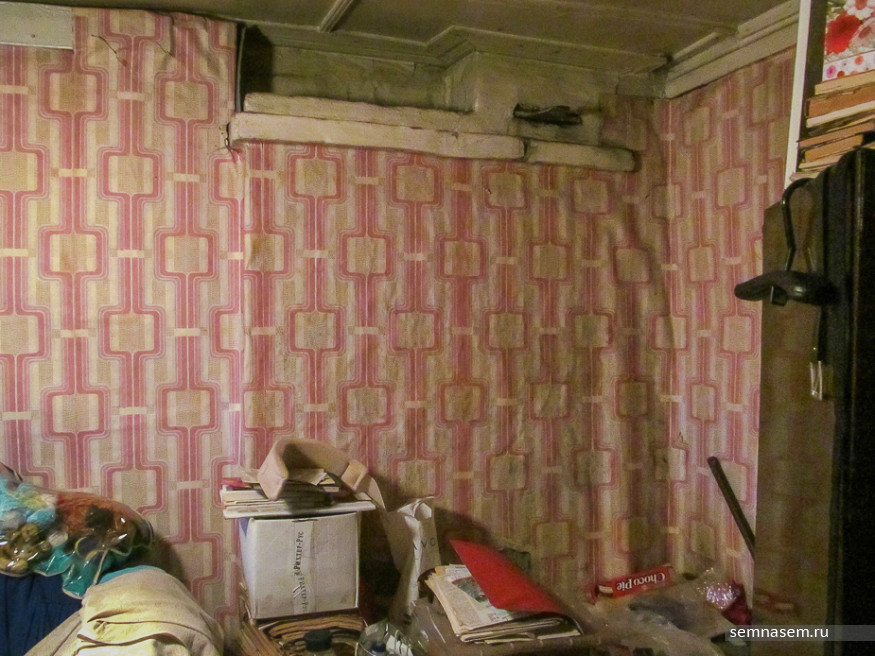
Ryaziyeva now lives alone in the deserted barracks. Her children, grown up, have moved to the city, and her neighbors have either moved away, died or gone to prison. So, the other flats in the house are uninhabited and unheated, and so they are falling apart. The damage is so extensive that the roof in one flat has collapsed: this was the incident described by Ryaziyeva, above, when a terrible racket woke her up in the middle of the night. There is still serious danger that the rotten section of the roof above the empty flats will collapse, taking the roof over Ryaziyeva’s flat down with them. She has had to close two rooms in her own flat. The furnaces in those rooms, adjacent to the flats next door, could no longer be heated. The cold and damp swelled the wallpaper on the walls, and the window frames sagged and succumbed to rot.

2An uninhabited room in Galina Ryaziyeva’s flat

There is another problem. Uninvited guests have taken to visiting the uninhabited part of the house.

“The housing inspectorate ordered the council to make the house inaccessible to strangers. But this was not done. My son-in-law and I had to drive them out. Two men got blotto in there and fell asleep. Then I boarded up the doors myself. It could end in disaster.”

The Council Was to Blame
Ryaziyeva first sounded the alarm in 2014, but her patience ran out in 2016, when part of the roof collapsed. She made several appeals to the Kondopoga District Council, which has recently been tasked with managing all the housing stock in the district. She also contacted the prosecutor’s office, the housing inspectorate, Alexander Hudilainen, former head of the Karelian Republic, and even federal MP Vladimir Zhirinovsky. Her son Alexei has twice written to President Putin’s public liaison office and recently sent a letter to Artur Parfyonchikov, the republic’s new head. Their appeals and letters were not dismissed. Recognizing the problem and receiving instructions from the relevant authorities, local officials promised to deal with the situation and carry out repairs, initially, after the snow melted, and later, in the spring or summer. So, in the voluminous archive of official correspondence and documents Ryaziyeva has amassed in recent years, there is a letter, signed by acting district head Dmitry Kirpu, in which the latter writes, “By Decree No. 535, dated 9 September 2016, of the Kondopoga Municipal District, flats no. 2, 3, 4 in the multi-flat house on Central Street in the village of Käppäselgä will be demolished in 2017. (The work is tentatively scheduled for the spring or summer of 2017). You will receive more information about the dates and deadlines of the work.”

The letter even mentioned a specific estimate of the repair’s cost: 300,000 rubles [approx. 4,300 euros]. According to Yelena Paltseva, who represented the Ryaziyev family in court, this figure was also mentioned later in the process. However, an independent inspection, which the family later commissioned, showed that more money would be required to rebuild the house.

Spring and summer came and went, but no work was done. Ryaziyeva appealed to Parfyonchikov’s community liaison office on several occasions, and Anna Lopatkina and Andrei Pogodin insisted she file a lawsuit, which she finally did.

The independent inspection determined the list of repairs necessary to save the Ryaziyev family flat. While reconstructing the house, it would be necessary to separate their portion of the house from the other, uninhabited parts of house, which would involve dismantling the chimneys and removing the roof, and then partly restoring the roof, the walls, and the foundation. Currently, assessors have evaluated the physical state of their flat as unsatisfactory: “It can be inhabited provided capital repairs and reconstruction are carried out.” The work should cost approximately 400,000 rubles.


An excerpt from the court’s ruling on the inspection: “An inspection has established that part of the residential building (flats no. 2, 3, 4) are dilapidated. Major leaks in the roof, deformation of the walls, subsidence of the foundation, and buckling of the window frames and door frames have been detected. The walls are subject to massive worsening cracks, severe rotting, and penetration by draughts and frost. Flats no. 2, 3, 4 are not heated. Their furnaces and chimneys have been destroyed. The wiring is in disrepair, and the load-bearing structures are dilapidated and partly destroyed. The dilapidation of the load-bearing structures in flats no. 2, 3, 4 has caused the deformation and destruction of the adjacent walls and ceiling beams in flat no. 1, and consequently the dilapidated flats should be dismantled. It is technically possible to eliminate their negative impact[.]” 

The district council has questioned the outcome of the assessment.

“Actually, the house is not currently dilapidated,” claims Dmitry Kipru, now deputy head of the Kondopoga Municipal District. “I agree that things look bad. But currently there is no danger to the Ryaziyev flat. There are all sorts of independent assessors. We could commission a second assessment and get a different finding and a different estimate.”

In court, however, the defense refrained from challenging the assessment’s objectivity.

10The adjacent flats are in this condition.
The trial spanned several hearings. The plaintiff was present for all of them except the final hearing. Ryaziyeva would often have to get up at night, in the dark, to go to the train station to catch the train that would bring her to Kondopoga at five in the morning—sometimes only to hear that the defendant was not ready for the hearing and had asked it be postponed.

“Those trips have really worn me out over the past two years,” Ryaziyeva confesses.

In turn, Paltseva claims the defense sometimes came to hearings unprepared.

“For example, we wanted to hear the testimony of the engineer who had declared the house dilapidated. But we were constantly offered supposedly valid reasons why he could not make it to the trial. Since their lawyer was not an engineer, he could not comment on certain matters, and he would ask that the hearings be postponed. I think they were dragging things out,” says Paltseva.

Judge Olga Sysoyeva personally traveled to Käppäselgä and saw the picture with her own eyes, a picture that had earlier consisted only of testimony, documents, and photographs.

7The condition of the roof worries Ryaziyeva most of all. 

The Ryaziyevs won the lawsuit. According to the court, it was the district council’s inaction, which has the three empty flats on its books, that reduced the house to its current condition.

“The court has sufficient grounds to conclude there is a causal link between the condition of the residential building and inaction on the part of the proprietor of the council flats and the common property in the house, who has failed to carry out capital repairs,” reads the court’s ruling.

Taking into account the nature and scope of the reconstruction work and the time needed to complete it, the court set a deadline: three months from the day the ruling entered into legal force.

But this is not the end of the story. The Kondopoga District Council has appealed the ruling in the Karelian Supreme Court. In particular, according to the appeal, the defense was not satisfied the lower court had “removed the plaintiffs from equity involvement, having assigned the duty to reconstruct the multi-flat residential building singlehandedly to one of the proprietors […] the Kondopoga Muncipal District.”

During the trial, the defense attorney requested the Ryaziyevs should, in keeping with their share of the house’s overall floor space, pay 33% of the repairs. The court declined the request.

Commenting on the situation, deputy district head Kirpu repeated the demand that the Ryaziyevs co-finance the repairs, as indicated in the appellate complaint. When we asked him why no such demand had been made when he issued the decree, which was never carried out, to demolish the dilapidated flats during the spring or summer of 2017, he found it difficult to respond.

“Our lawyers vet every decree. Maybe someone overlooked something,” Kirpu speculated.

Moreover, at the end of our conversation, Kirpu informed me that money for reconstruction of the house (around 500,000 rubles) had been found among the district’s nonappropriated funds, but they had not been allocated, because the Ryaziyevs had filed suit against the council.

17Galina Ryaziyeva has to take care of her half of the house and the adjoining half of the house.

“In Karelia’s districts, people are held hostage by the inaction of the local authorities. They file lawsuits not for the fun of it, but to force councils to look for funds and fulfill their direct responsibilities in maintaining the housing stock,” argues Paltseva. “Besides, by law, a propietor can demand satisfaction if their rights have been violated, although the violations were not connected with dispossessing them of their property. A lawsuit petitioning the court to compel a defendant to act must be upheld even in cases in which the proprietor shows there is a real threat of violation of their rights due to inaction by the authorities. The assessment commissioned by the Ryaziyevs proved there was a direct causal link between the destruction of their flat and the council’s behavior. A date for the appeal hearing has not yet been set, but Karelia is already snowbound.”

This means that 25 Central Street will have to survive yet another winter. Who knows whether the roof will hold out or the lintel will collapse. According to the Ryaziyevs, the the local council has deliberately delayed the process so that there will be nothing left to save and restore.

All photos by Maria Dmitriyeva and courtesy of 7X7. Translated by the Russian Reader. Thanks to the always reliable Comrade Koganzon for the heads-up

As Protests Increase, National Guard Ready to Crack Down

dimon balet
“Dimon, what’s with the ballet?” Anti-corruption protesters on the Field of Mars in Petersburg. Photo courtesy of Sergei Nikolayev/DP

Experts Speak of Sharp Increase in Number of Protests in Russia
Delovoi Peterburg
November 7, 2017

According to a report by the Center for Economic and Political Reform (CEPF), the number of social and political protests in Russia has risen sharply compared to the beginning of the year.

The number of protests has been continuously growing in Russia throughout the year. In the first quarter, 284 protests were recorded; in the second quarter, 378; and in the third quarter, 445. Thus, as noted in the report, the overall number of protests has increased by almost 60% since the beginning of the year.

The analysts at the CEPF divide protests into political protests, socio-economic protests, and labor protests. They note that around 70% of protests had to do with socio-economic issues, including protests by Russian truckers against the Plato road tolls system, and protests by Russian farmers against the seizure of land by agroholdings, as well as protests by hoodwinked investors in unbuilt cooperative apartment buildings.

Political protests came in second place, including protests by supporters of opposition leader Alexei Navalny. A total of 106 political protests were recorded in the third quarter of 2017. There were 27 labor protests in the third quarter.

The number of conflicts related to labor relations has also steadily climbed throughout the year. The number of protests caused by cases of late payment and non-payment of wages, for example, has grown as follows: 142 in the first quarter, 196 in the second quarter, and 447 in the third quarter. Thus, by the third quarter, the number of such incidents had more than tripled.

The authors of the CEPR report cites figures provided by Rosstat, according to which the amount of unpaid back wages in Russia totaled 3.38 billion rubles [approx. 49 million euros] as of October 1, 2017. The number of incidents of late payment and non-payment of wages in the third quarter of 2017 (447 companies) was more than triple the number of such incidents in the first quarter (147 companies), and more than double the number in the second quarter (196 companies).

The analysts point out that Russia has not yet put in place a system for preventing and constructively solving social conflicts, and thus protests are still nearly the only effective means for employees to defend their rights.

“We should generally expect the high number of protests nationwide to continue, especially in the socio-economic realm. This is due to the fact the problems people (hoodwinked investors, truckers, farmers, opponents of construction projects, environmental activists et al.) have been currently protesting have not been solved. At the same time, evolution of the protest movement has been greatly hampered by the lack of capable political parties, grassroots organizations, and trade unions,” write CEPR’s analysts.

Translated by the Russian Reader

_________________

Ahead Of Election, Putin Seeks Wider Mandate For Russian National Guard
Radio Free Europe/Radio Liberty
November 6, 2017

0327929D-DFC1-4E65-BD89-EC9685C0B625_cx0_cy8_cw0_w1023_r1_sRussian President Vladimir Putin (second right) and National Guard chief Viktor Zolotov (third left) take part in a ceremony marking National Guard Day in Moscow on March 27. Photo courtesy of Mikhail Klimentyev/TASS

Russian President Vladimir Putin has proposed legislation to widen the responsibility of the National Guard, an entity created last year and headed by Putin’s former chief bodyguard, to include protecting regional governors.

The bill was published on the website of the State Duma, the lower house of parliament, on November 6.

The Duma is dominated by the Kremlin-controlled United Russia party and supports almost all Kremlin initiatives.

The proposed change could enhance Putin’s ability to crack down on dissent or seek to impose order if there is unrest in Russia’s far-flung regions.

The National Guard reports directly to the president. Its director, Viktor Zolotov, was chief of the presidential security service from 2000 to 2013.

The initiative comes months before a March 18 election in which Putin is expected to seek and secure a new six-year term.

Putin will be barred from seeking reelection in 2024 if he does win a fourth presidential term in the March vote, raising questions about how Russian politics will play out in the coming years and how he will maintain his grip.

Putin established the National Guard (Rosgvardia) in 2016 on the basis of the Interior Ministry troops and other security forces.

Its stated tasks initially included preserving “social order,” fighting against terrorism and extremism, and guarding state facilities.

The National Guard announced that it will be also responsible for a fingerprints database, issuing weapons-possession licenses, averting “threats to state order,” and protecting information security.

Being a Farmer in Karelia Is Not Easy

intro_235922527_17240
Karelian Farmer Mikhail Zenzin. His placard reads, “For the government’s rotten work a rotten harvest from a grateful farmer.” Photo courtesy of Gleb Yarovoi/7X7

Farmer Brings Rotten Berries to Picket Outside Karelia’s Government House
Gleb Yarovoi
7X7
September 6, 2017

On September 6, Mikhail Zenzin, a farmer from Karelia’s Onega District, held a solo picket outside the Karelian government house in Petrozavodsk, the republic’s capital. The man arrived at the building carrying a box of rotten berries and a placard that read, “For the government’s rotten work a rotten harvest from a grateful farmer,” our correspondent reported from the site of the picket.

Several minutes later, a young woman emerged from government house to talk to Zenzin. She invited him to the reception room of the region’s head, where he was able to make an appointment to meet with the head in October 2017. Officials did not accept Zenzin’s gift of berries, and the farmer was forced to discard them.

According to Zenzin, being a farmer in Karelia is no easy task. He says he sees only interference from the state, but would like to receive help. Since spring 2017, he has tried on several occasions to obtain a permit to sell his produce in Petrozavodsk, but so far he has been unsuccessful.

“Karelia needs a farmer’s market. The one held in October is trivial. People grow a lot of produce, but we cannot sell it outside, since the issue of street trading has not been settled yet. There was a decree in April of this year that allocated three plots in Petrozavodsk for the sale of produce, but they had to be purchased through an auction. All over the world, farmers transport their produce to town and sell it freely. In May, I wrote to Arthur Parfenchikov, acting head of Karelia, and asked him how farmers were supposed to sell their produce, but I got no reply from him. Instead, I got the run-around from the Agriculture Ministry, who wrote to me that I should contact the retail chains and ask to sell my produce on their premises. I tried to meet with Parfenchikov during office hours. I called his reception office, where I was told the head received the general public once a quarter, and so I was turned down. If I had known he would refuse to debate the issue, I would have brought my berries to Petrozavodsk long ago and dumped them on the steps of government house,” said Zenzin.

This was not Zenzin’s first protest. For several years, he held similar pickets outside Karelian government house and the Karelian Nature Ministry. In the spring of 2013, he held a picket outside the Karelian Natural Resources and Environment Ministry because Ladva Forest Holding, Ltd., had begun clear-cutting a thirteen-acre land plot that had been transferred to the farmer in perpetuity.

In 2014, Zenzin held a solo picket outside government house and went on a hunger strike. As the farmer told the Forest Website, for several years he had been unable  to farm and develop nature tourism in the vicinity of the village of Ladva-Vetka, because the tenant of the area’s forest reserves, Ladva Forest Holding, Ltd., had damaged the road by which Zenzin reached his own plot.

Zenzin doused himself with water in sub-zero temperatures outside the Karelian Natural Resources and Environment Ministry, thus symbolizing how the republic had put small business on ice. A month later, Zenzin, who lives in Ladva-Vetka, was once again outside government house, but this time he had a noose around his neck and a placard that read, “With a man like this running the republic, Karelian small business can only put its head in a noose.” In 2015, Zenzin stood in the way of logging equipment and prevented loggers from cutting down the forest.

According to Zenzin, the issue was resolved in 2016 after Oleg Telnov, ex-deputy head of Karelia, personally intervened.

Translated by the Russian Reader. Thanks to Comrade Koganzon for the heads-up

“Extremism” Case against Adygean Environmentalist Valery Brinikh Dropped

Defense lawyer Andrei Sabinin (left) and environmentalist Valery Brinikh. Photo courtesy of Agora

Adygean Court Drops “Extremism” Case against Environmentalist Valery Brinikh 
Agora
August 7, 2017

Maykop City Court today dropped the “extremism” criminal case against well-known local environmentalist Valery Brinikh, director of the Institute for Regional Biological Research. Brinikh was on trial for, allegedly, having insulted the dignity of the Adgyean people by writing and publishing an article entitled “The Silence of the Lambs.” The court dropped the case for want of criminal culpability.

He was explained his right to exoneration. This news from courtroom was reported by Alexander Popkov, an attorney with the Agora International Human Rights Group, who represented Brinikh along with attorney Andrei Sabinin.

“Today in court, the state prosecutor filed a motion to drop the charges of incitement of hatred against Brinikkh and drop the criminal case for want of criminal culpability in his actions,” said Popkov. “The judge retired to chambers before he announced the decision to terminate the criminal case. The ultimate argument in favor of this decision was a forensic examination carried out by the FSB Criminalistics Institute, which found no traces of “extremism” in the environmentalist’s article. A total of four expert opinions and three forensic examinations had been ordered in the case, and only one of them supported the charges. The case lasted almost three years.

According to police investigators, in the fall of 2014, Valery Brinikh, director of the Institute for Regional Biological Research, and ex-director of the Caucasus Nature Reserve (1999-2001) и the Daur Nature Reserve (1993-1999), had produced “extremist” matter, an original article entitled “The Silence of the Lambs.” The article dealt with the environmental mental problems caused by one company’s hog-breeding facility in Adygea’s Teuchezhsk District. The company was founded by Vyacheslav Derev, representative of Karachay-Cherkessia in the Federation Council.

Vyacheslav Derev. Photo courtesy of the Federation Council of the Russian Federal Assembly

The investigators claimed that Brinikh subsequently conveyed this matter to unidentified persons for dissemination on the internet. The environmentalist’s article was published on a local website. The defense did not agree with the prosecution’s argument, saying it was absurd, a violation of freedom of speech and freedom of expression.

On December 14, 2014, Maykop City Court ruled the article “The Silence of the Lambs” “extremist” matter. In March 2015, the Adygea Supreme Court upheld the lower court’s decision.

ADV-TV, published on YouTube on August 7, 2017. On August 7, 2017, Maykop City Court dropped the “extremism” criminal case against well-known local environmentalist Valery Brinikh, director of the Institute for Regional Biological Research. Brinikh was on trial for, allegedly, having insulted the dignity of the Adgyean people by writing and publishing an article entitled “The Silence of the Lambs.“ The court dropped the case for want of criminal culpability. Brinikh was defended in court by attorney Andrei Sabinin and attorney Alexander Popkov, with the Agora International Human Rights Group.

*  * * * * *

Valery Brinikh poses for a photograph outside the Maykop City Court. Courtesy of Valery Brinikh

Court Refuses to Rule Biologist “Extremist”for Criticizing Hog Breeders
Although Article Containing the Criticisms Remains on List of “Extremist” Matter
Anastasia Kornya
Vedomosti
August 8, 2017

On Monday, Maykop City Court terminated the “extremist” criminal case (Russian Criminal Code Article 282) against Valery Brinikh, director of the Institute for Regional Biological Research. He was on trial for the article “The Silence of the Lambs,” about the environmental damaged caused by the Kievo-Zhuraki Agro-Industrial Complex. The news was reported Alexander Popkov, an attorney with the Agora International Human Rights Group, one of Brinikh’s defense attorneys.

The charges had been filed in December 2014. According to police investigators, the article contained a negative assessment of ethnic Adyghes. Ultimately, however, the prosecutor’s officer dropped the charges. The decisive argument was a forensic examination, conducted by the FSB Criminalistics Institute, which found no evidence of “extremism.” The article contains criticism of the republic’s authorities, “but criticism of persons engaged in political activity is the norm in a civic, democratic society,” the report concludes.

Investigators cited the conclusions of Sergei Fedyayev, an analyst at the Interior Ministry’s Criminalistics Center for Krasnodar Territory. Fedyayev argued that the negative connotations of the word “sheep” extended to the word “lamb,” as used in the article. On the basis of the report written by this same analyst and at the request of the republic’s prosecutor’s office, in December 2014, the Maykop City Court ruled that Brinikh’s article was “extremist” matter. Thus, Brinikh has been cleared of “extremist” charges, but his articles is still listed in the database of extremist matter.

Popkov argues that the ruling is a precedent. He cannot remember similar cases. Theoretically, one of the parties could petition the court to exclude the article from the list of extremist matter, but his client has not yet decided whether he will pursue this. The Adygea Prosecutor’s Office did not respond promptly to our request for a reaction to the ruling.

From a legal point of view, the case is not absurd, argues a source in law enforcement. The author of a text considered “extremist” may not be an “extremist” himself. In this case, the decisive role is played by the intent in his actions to incite hatred. It might well transpire that the individual had no sinister intent whatsoever, but after the text he authored has been published, it lives its own life.

Alexander Verkhovsky, director of the SOVA Center, knows of cases when matter has been excluded from the official list of “extremist” matter, but not due to the acquittal of suspected “extremists.” That happens all to rarely. However, the case in Maykop is a good illustration of the poor quality of such judicial rulings, he notes. In approximately half of cases, matter is ruled extremist using a simplified procedure. Authors are usually not involved in the case, and so no dispute as such arises. Recently, the Prosecutor General’s Office tightened the procedure for applying to the courts with such requests. Now they can be made only by regional prosecutors and only after they have vetted the request with the Prosecutor General’s Office. Verkhovsky acknowledges that such measures have indeed worked, but they have not solved the problem of rubber-stamp court decisions on “extremist” matter, he argues.

Translated by the Russian Reader. Thanks to Comrade AK and Comrade Uvarova for the heads-up. See all my previous postings on the Brinikh case.